
Managed PaaS Operations Services Market Size and Share
Market Overview
| Study Period | 2021 - 2032 |
|---|---|
| Market Size (2027) | USD 17.27 Billion |
| Market Size (2032) | USD 31.61 Billion |
| Growth Rate (2027 - 2032) | 12.85 % |
| Fastest Growing Market | Asia-Pacific |
| Largest Market | North America |
| Market Concentration | Medium |
Major Players *Disclaimer: Major Players sorted in no particular order Image © Mordor Intelligence. Reuse requires attribution under CC BY 4.0. | |
Managed PaaS Operations Services Market Analysis by Mordor Intelligence
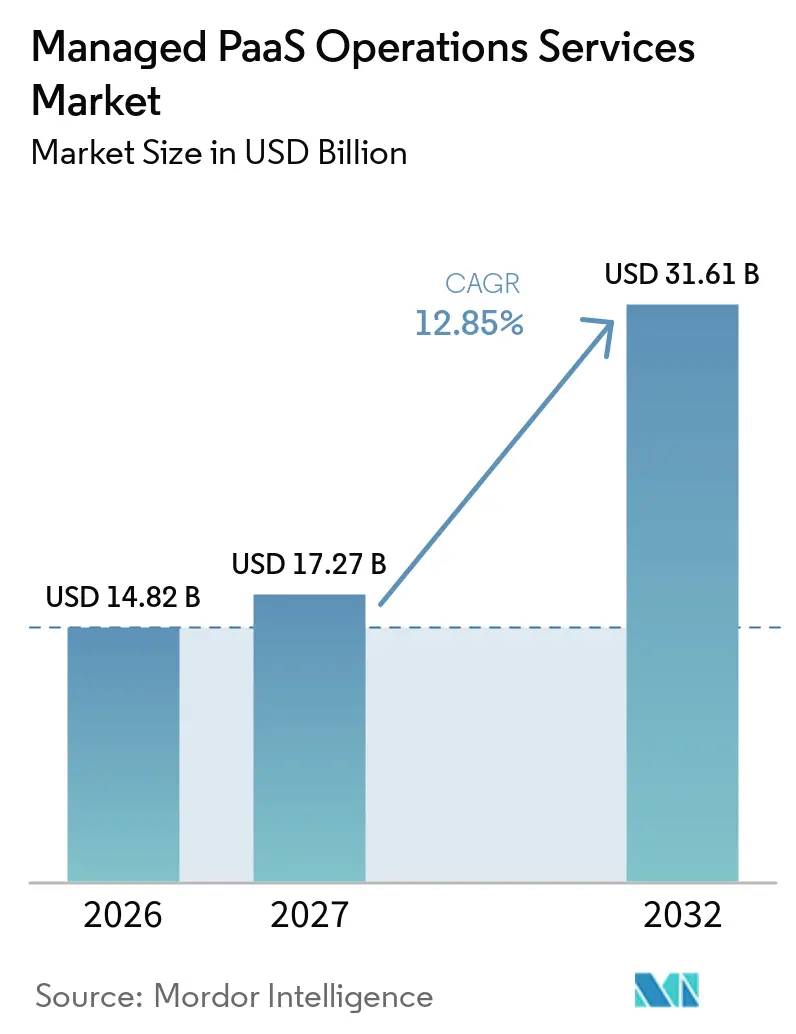
The Managed PaaS Operations Services Market size is projected to expand from USD 14.82 billion in 2026 and USD 17.27 billion in 2027 to USD 31.61 billion by 2032, registering a CAGR of 12.85% between 2027 and 2032. Enterprises are moving from isolated cloud programs to estates that combine public, private, and edge environments, which increases the need for managed operational support. The Managed PaaS Operations Services Market is benefiting as buyers seek consistent governance, observability, and remediation across several platform environments. Faster application delivery is also raising the value of platform engineering and day-2 operations for internal developer platforms. Compliance, data residency, and resilience requirements are making provider certifications and audit support more important in procurement decisions. AI-supported remediation can reduce manual operational effort, while cloud talent shortages make external service delivery more attractive for both large enterprises and smaller firms.
Key Report Takeaways
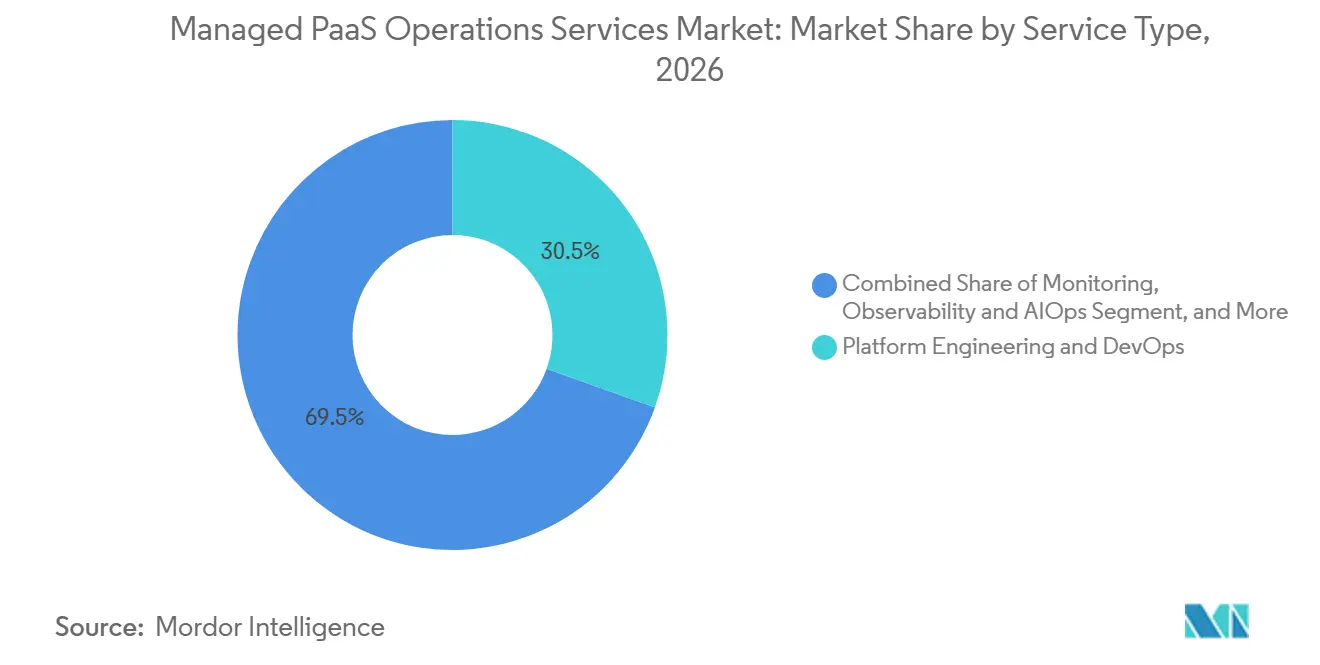
- By service type, Platform Engineering and DevOps Operations held 30.47% of the Managed PaaS Operations Services Market share in 2026 and is projected to expand at a 14.57% CAGR through 2032.
- By platform layer, Container and Orchestration Platforms accounted for 33.57% of the Managed PaaS Operations Services Market in 2026, while Data, Analytics, and AI/ML Platforms are projected to expand at a 15.42% CAGR through 2032.
- By deployment model, Public Cloud-based PaaS held 61.53% of the Managed PaaS Operations Services Market in 2026, while Private and Hybrid Cloud PaaS are projected to expand at a 15.25% CAGR through 2032.
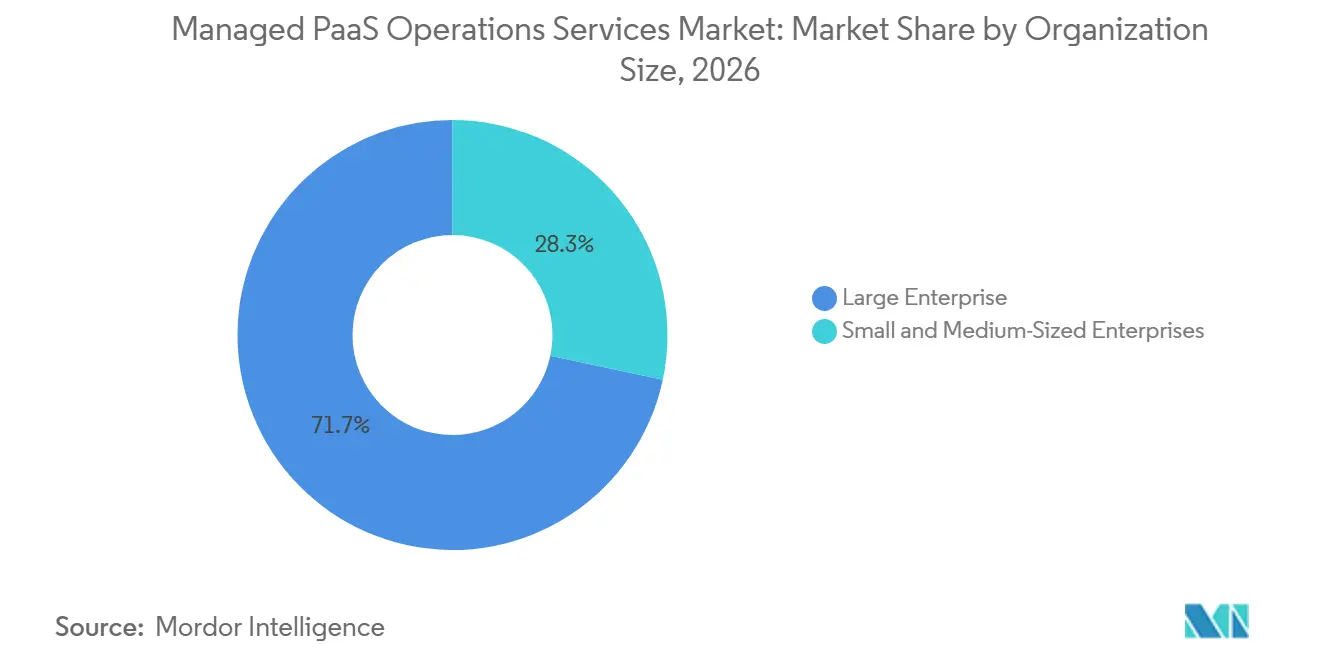
- By organization size, Large Enterprises accounted for 72.67% of the Managed PaaS Operations Services Market in 2026, while SMEs are projected to expand at a 16.13% CAGR through 2032.
- By end-user industry, BFSI held 26.87% of the market in 2026, while IT and Telecommunications is projected to expand at a 15.35% CAGR through 2032.
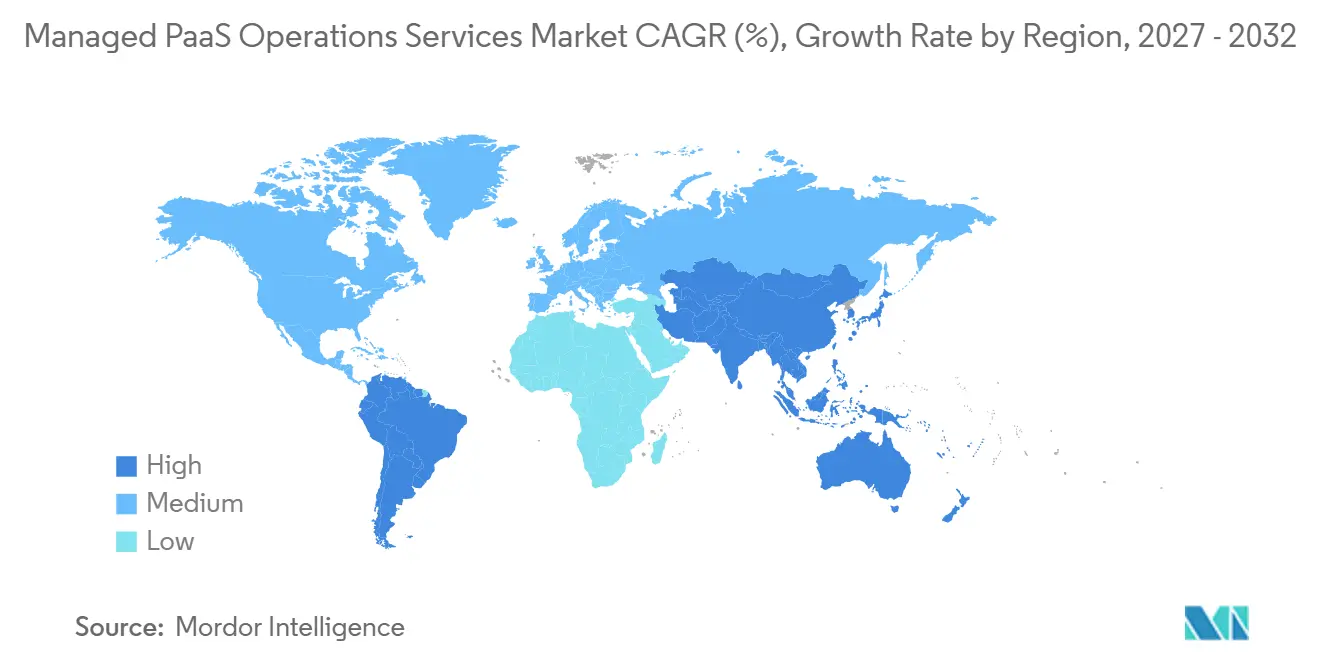
- By geography, North America held 36.41% of the market in 2026, while Asia-Pacific is projected to expand at a 15.89% CAGR through 2032.
Note: Market numbers in this report are based on Mordor Intelligence's proprietary estimation framework, which combines nine months of actuals with Q4 projections for base year 2026.
Global Managed PaaS Operations Services Market Trends and Insights
Drivers Impact Analysis*
| Driver | (~) % Impact on CAGR Forecast | Geographic Relevance | Impact Timeline |
|---|---|---|---|
| Rising Hybrid and Multi-Cloud Operating Complexity | +2.8% | Global, with concentrated intensity in North America and Europe | Short term (≤ 2 years) |
| Growing Cybersecurity, Compliance, and Resilience Requirements | +2.2% | Europe, North America, and Asia-Pacific | Medium term (2-4 years) |
| Enterprise Demand for Faster Application Release Cycles | +1.9% | Global, with highest velocity in North America and Asia-Pacific | Short term (≤ 2 years) |
| AI-Assisted Remediation Increasing Managed Operations Productivity | +1.8% | Global, with North America leading adoption, followed by Europe and Asia-Pacific | Medium term (2-4 years) |
| Persistent Cloud Talent and Site Reliability Engineering Shortages | +1.6% | Global, with acute demand in Japan and emerging Asia-Pacific markets | Medium term (2-4 years) |
| PaaS Estate Sprawl Creating Demand for Cross-Platform Governance | +1.2% | North America and Europe, with spillover into Asia-Pacific | Long term (≥ 4 years) |
| Source: Mordor Intelligence | |||
Rising Hybrid and Multi-Cloud Operating Complexity
Enterprises operating across several cloud environments face governance and operational demands that internal teams often cannot absorb. HashiCorp reported that 97% of organizations use multiple tools to manage cloud environments, with an average of 5 tools per enterprise. This tool sprawl can increase costs, create fragmented visibility, and make security controls harder to apply consistently. The Managed PaaS Operations Services Market benefits when providers unify observability, governance, and remediation in one operating model. Multi-cloud environments also require expertise across different services, identity models, and deployment processes. This creates a stronger case for contracted operations rather than adding more internal tools and staff.
Growing Cybersecurity, Compliance, and Resilience Requirements
Compliance requirements are changing cloud procurement, especially in financial services and public-sector workloads. DORA became applicable on January 17, 2025, and its framework requires financial entities to manage information and communication technology risk, including third-party risk. ESMA finalized revised cloud outsourcing guidelines in 2025, reinforcing the need for governance over cloud service providers. The Managed PaaS Operations Services Market gains from demand for providers that can support audit trails, secure configurations, and incident response procedures. Certifications such as ISO/IEC 27001, SOC 2, and FedRAMP can influence supplier selection because they provide documented controls. Requirements are also extending beyond BFSI into healthcare, government, and data-intensive industries.
Enterprise Demand for Faster Application Release Cycles
Internal developer platforms are becoming more central to how enterprises release and maintain applications. Google Cloud found that 55% of surveyed organizations had adopted platform engineering, while 85% of adopters said developers rely on the platform to succeed. The same research stated that 90% of adopters planned to expand their platform’s reach. Managed providers can operate these platforms after implementation, covering availability, deployment pipelines, updates, and incident management. This service model helps enterprise teams focus more directly on product development. The Managed PaaS Operations Services Market, therefore, has opportunities where providers can demonstrate better release reliability along with service availability.
AI-Assisted Remediation Increasing Managed Operations Productivity
AI-assisted operations tools are changing incident detection, diagnosis, and remediation in cloud environments. A 2025 journal study reported a 72% reduction in median resolution time for incidents handled with LLM-powered AIOps, with a 58% reduction at the 95th percentile. STRATUS, presented at NeurIPS 2025, reported higher failure-mitigation success than prior SRE agents across benchmark suites. Kyndryl launched Agentic Service Management in April 2026 with structured assessments and implementation blueprints for autonomous service operations.[1] Higher automation can support outcome-based contracts and reduce the manual work attached to recurring incidents. The Managed PaaS Operations Services Market can become more accessible to smaller customers that cannot fund large internal SRE teams.
Restraints Impact Analysis*
| Restraint | (~) % Impact on CAGR Forecast | Geographic Relevance | Impact Timeline |
|---|---|---|---|
| Data Security, Sovereignty, and Loss-of-Control Concerns | -1.4% | Europe, Asia-Pacific national cloud markets, and the North American federal sector | Medium term (2-4 years) |
| Vendor Lock-In and Portability Constraints | -1.2% | Global, with strongest impact in enterprises using proprietary hyperscaler PaaS services | Long term (≥ 4 years) |
| PaaS-Specific Operational Knowledge Concentrated in Hyperscaler Ecosystems | -0.9% | Global, with highest exposure in emerging markets with lower certification density | Medium term (2-4 years) |
| Hidden Consumption Variability Weakening Contract Margin Predictability | -0.7% | Global, with acute exposure in serverless and event-driven PaaS architectures | Short term (≤ 2 years) |
| Source: Mordor Intelligence | |||
Data Security, Sovereignty, and Loss-of-Control Concerns
Third-party operational control can conflict with national data residency and sovereignty requirements. DORA places clear emphasis on ICT third-party risk, which makes customer oversight of cloud arrangements more important. ESMA’s revised guidance also strengthens expectations around cloud outsourcing governance. Buyers in defense, government, and financial services may seek guarantees on data location, encryption-key custody, and exit rights. Those requirements can lengthen sales cycles and increase the cost of delivering regulated contracts. The Managed PaaS Operations Services Market faces limits in sensitive workloads until providers can satisfy these controls in each required jurisdiction.
Vendor Lock-In and Portability Constraints
Proprietary APIs, managed runtimes, and native data services can make platform migration difficult. The Cloud Security Alliance’s portability guidance notes that interoperability and portability remain core cloud governance concerns.[2] Enterprises can be cautious about operations contracts that deepen reliance on one hyperscaler environment. This caution is greater when a provider has expertise in only one platform ecosystem. Procurement teams may require stronger exit provisions, portable architectures, and documentation before they award a contract. These conditions can delay decisions in the Managed PaaS Operations Services Market and limit the speed of new contract formation.
*Our forecasts treat driver/restraint impacts as directional, not additive. The impact forecasts reflect baseline growth, mix effects, and variable interactions.
Segment Analysis
By Service Type: Platform Engineering Leads, AIOps Supports Broader Operations
Platform Engineering and DevOps Operations held 30.47% market share in 2026 and is projected to expand at a 14.57% CAGR through 2032. The result reflects the importance of internal developer platforms and continuous-delivery processes in enterprise cloud operations. Google Cloud reported that developers rely on their internal platforms at 85% of adopting organizations. Managed providers are therefore being asked to cover platform reliability after the initial implementation phase. This broad operating role makes the Managed PaaS Operations Services Market central to many enterprise outsourcing programs.
Monitoring, Observability, and AIOps is an adjacent category that benefits from wider use of automated root-cause analysis and remediation. The 2025 LLM-powered AIOps study documented lower incident resolution times in the tested environment. Security, Compliance, and Governance Operations is gaining relevance in regulated accounts that need evidence of control performance. FinOps and Modernization Operations also matter where customers need better visibility into cloud consumption and legacy modernization. The Managed PaaS Operations Services Market is also supported by Incident and Event Management that uses automated triage to reduce manual escalation.

By Platform Layer: Containers Hold Scale, AI/ML Broadens Demand
Container and Orchestration Platforms accounted for 33.57% of the market in 2026. Kubernetes-based operating models have become important across cloud-native, hybrid, and regulated environments. Managing multi-cluster environments requires skills in security, networking, scaling, policy, and workload recovery. Providers with operational experience in container platforms can support day-2 tasks that customer DevOps teams may not want to manage internally. This keeps the Managed PaaS Operations Services Market tied to a major source of container-service demand.
Data, Analytics, and AI/ML Platforms are projected to expand at a 15.42% CAGR through 2032. AI workloads require managed support for model training, inference endpoints, data pipelines, access controls, and governance. The Managed PaaS Operations Services Market is also supported by enterprise demand for reliable data environments that work across teams and applications. Integration, API, and Event Messaging Platforms need consistent governance as enterprises connect systems across hybrid environments. Other PaaS Platforms, including low-code and industry-specific systems, provide smaller opportunities in healthcare and manufacturing.
By Deployment Model: Public Cloud Holds Scale, Hybrid Models Advance
Public Cloud-based PaaS accounted for 61.53% of the market in 2026. Hyperscalers continue to set the price-performance baseline for enterprise platform services. Managed providers support these environments through monitoring, configuration, incident response, security operations, and cost oversight. Public cloud remains the usual starting point for new cloud-native workloads. This gives service providers a broad installed base for operational contracts.
Private and Hybrid Cloud PaaS is projected to expand at a 15.25% CAGR through 2032. Regulatory, latency, and sovereignty needs are leading firms to retain some workloads within enterprise-controlled environments. Rackspace launched Rackspace Cloud in August 2026 as a fully managed multitenant platform built on VMware Cloud Foundation 9.1.[3] VMware stated that 93% of organizations expect to maintain a mix of public and private cloud during the next 3 years. Edge and Distributed Cloud PaaS are smaller but relevant in manufacturing, telecommunications, and logistics, where latency-sensitive applications need local processing.
By Organization Size: Large Enterprises Anchor Revenue, SMEs Add Momentum
Large Enterprises held 72.67% of the market in 2026. These organizations usually operate complex, multi-cloud PaaS estates that create the strongest demand for managed operations. Their environments often require a combination of platform engineering, security, observability, compliance, and FinOps services. Their contracts can cover more than 1 platform layer or deployment model. This keeps the Managed PaaS Operations Services Market important to provider revenue and long-term account strategies.
SMEs are projected to expand at a 16.13% CAGR through 2032. Consumption-based service pricing can reduce the minimum commitments that historically limited access to managed operations. The Managed PaaS Operations Services Market can reach smaller organizations when providers package monitoring, security, and remediation into accessible service offerings. Limited availability of cloud infrastructure and SRE skills makes outsourced operations a practical alternative to internal hiring. SME demand also supports the use of AI/ML and serverless platforms, where external expertise can reduce the burden of specialized hiring.
By End-User Industry: BFSI Leads, IT and Telecommunications Expands Quickly
BFSI held 26.87% of the market in 2026. Financial institutions manage platform environments under close scrutiny for operational resilience, cybersecurity, data control, and third-party risk. DORA’s ICT risk requirements create a direct need for documented governance of cloud service arrangements. These requirements can favor providers that support audit evidence, secure configuration management, and defined incident procedures. This makes BFSI a high-value segment for bundled managed PaaS operations.
IT and Telecommunications is projected to expand at a 15.35% CAGR through 2032. Telecommunications providers are modernizing service delivery platforms and require continuous operations across hybrid and multi-vendor environments. Infosys announced a joint venture with Telstra in 2025 to provide AI-enabled cloud and digital solutions for Australian enterprises. Government and Public Sector workloads create opportunities in sovereign cloud environments with heightened compliance needs. The Managed PaaS Operations Services Market supports retail, consumer goods, manufacturing, and automotive clients using inventory, personalization, industrial IoT, and edge-cloud workloads.
Geography Analysis
North America held 36.41% of the market in 2026. The region combines mature enterprise cloud adoption with a dense concentration of hyperscaler infrastructure and ecosystem partners. Federal requirements such as FedRAMP and HIPAA create a structured demand for secure operations. The United States has many large enterprises with complex PaaS estates that require ongoing management. The Managed PaaS Operations Services Market also draws regional demand from Canada’s financial sector and Mexico’s nearshoring-driven manufacturing and logistics activity.
Europe remains a distinct operating environment because sovereignty and resilience requirements often guide purchasing decisions. DORA applies to financial entities across the European Union and drives closer attention to third-party ICT risk. ESMA’s revised cloud outsourcing guidelines reinforce the need for supplier oversight and documented governance. Germany, the United Kingdom, and France remain major enterprise spending centers. The Managed PaaS Operations Services Market in Europe is supported by audit-ready services and local operational capabilities in regulated sectors.
Asia-Pacific is projected to expand at a 15.89% CAGR through 2032. India’s global capability centers, China’s domestic cloud platforms, and Southeast Asian financial services and telecommunications adoption support regional demand. Japan’s talent shortage increases the need to outsource platform operations, with the Linux Foundation reporting that 70% or more of surveyed organizations were understaffed in DevOps, CI/CD, and site reliability engineering roles.[4] Saudi Arabia, the UAE, South Africa, Egypt, Nigeria, and Brazil provide further emerging opportunities for managed cloud operations.
Competitive Landscape
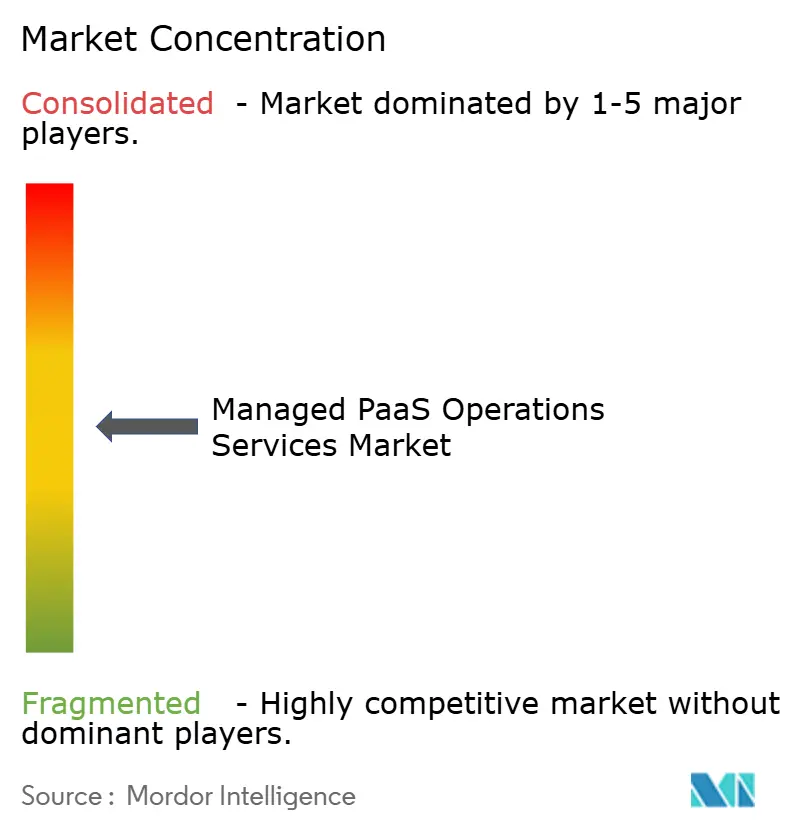
The Managed PaaS Operations Services Market is moderately fragmented among large systems integrators, while specialist providers compete through focused engineering capabilities. IBM Corporation, Accenture plc, Capgemini SE, Kyndryl Inc., and NTT DATA Corporation compete with broad hyperscaler alliances and proprietary operations tools. Mirantis Inc., Caylent Inc., Nordcloud Oy, and Bespin Global Inc. compete through depth in selected cloud-native platforms. Providers commonly differentiate through platform engineering, observability, security, automation, cross-platform governance, and vertical capabilities. Hyperscaler co-sell programs remain important because they connect managed service providers with cloud customers that need operational support.
AI-enabled operations are becoming a key competitive area. Kyndryl launched Agentic Service Management in April 2026 to help enterprises move from traditional IT operations to more autonomous workflows. The company stated that Kyndryl Bridge executes nearly 200 million automations each month through more than 8,000 certified playbooks. Accenture expanded its Google Cloud relationship in April 2025 with capabilities in agentic AI, networking, and mainframe modernization. Rackspace introduced a Cloud Management Platform in August 2025 with full-stack observability and a consumption-based model.
Opportunities remain in cross-cloud FinOps, sovereign cloud operations, and consumption-based offerings for SMEs. The FinOps Foundation reported that 19% of respondents had reached an advanced FinOps maturity level in 2025. Kyndryl agreed to acquire Solvinity in November 2025, expanding its secure managed cloud capabilities for regulated European workloads. The resulting structure supports moderate concentration among large providers while leaving room for specialists with clear platform or regional strengths.
Managed PaaS Operations Services Industry Leaders
-
IBM Corporation
-
Accenture plc
-
Capgemini SE
-
Rackspace Technology, Inc.
-
Kyndryl Inc.
- *Disclaimer: Major Players sorted in no particular order
Recent Industry Developments
- August 2026: Rackspace Technology launched Rackspace Cloud, a fully managed, multitenant cloud platform built on VMware Cloud Foundation 9.1, initially available in Dallas with planned expansion to North Virginia and Chicago. The platform offers enterprises Kubernetes and containerized application capabilities within a VMware-controlled environment, representing one of the first commercially available multitenant platforms on VCF 9.1 and positioning Rackspace as a Broadcom Advantage Partner for VCF-based managed cloud services.
- April 2026: Kyndryl Inc. launched Agentic Service Management, combining a maturity model, structured assessments, and implementation blueprints to help enterprises transition from traditional IT service operations to autonomous, intelligent workflows. The service is aligned with ISO 42001 governance frameworks for AI-native environments and builds on Kyndryl Bridge, which executes nearly 200 million automations per month through more than 8,000 certified playbooks.
- November 2025: Kyndryl agreed to acquire Solvinity, a Dutch provider of secure managed cloud platforms and services. The deal expanded Kyndryl's sovereign and hybrid cloud capabilities by combining its advisory and managed services with Solvinity's security-focused offerings, specifically targeting compliance-driven, sensitive workloads in the European market.
- October 2025: Cognizant Technology Solutions Corporation deepened its strategic partnership with Google Cloud to accelerate enterprise adoption of agentic AI. Cognizant committed to enterprise-wide deployment of Gemini Enterprise, invested in skilling 20,000 associates across Google Cloud Centers of Excellence, and aligned the initiative with its Neuro AI and Agent Foundry platforms to deliver AI-led operations, risk, and compliance solutions.
Global Managed PaaS Operations Services Market Report Scope
Managed PaaS operations services refer to the end-to-end outsourcing of platform engineering, security compliance, monitoring, and financial operations across various deployment models like public, private, and edge clouds. These services enable enterprises to optimize, secure, and scale their serverless, containerized data and integration platform layers without the burden of day-to-day administrative management.
The Managed PaaS Operations Services Market Report is Segmented by Offering Service Type (Platform Engineering and DevOps Operations, Monitoring, Observability and AIOps, Security, Compliance, and Governance Operations, FinOps and Modernization Operations, Incident and Event Management, and Managed Database and Data Services), Platform Layer (Application and Serverless PaaS Platforms, Container and Orchestration Platforms, Data, Analytics and AI/ML Platforms, Integration, API and Event Messaging Platforms, and Other PaaS Platforms), Deployment Model (Public Cloud-based PaaS, Private and Hybrid Cloud PaaS, and Edge and Distributed Cloud PaaS), Organization Size (Large Enterprises and Small and Medium-Sized Enterprises), End-User Industry (Banking, Financial Services, and Insurance [BFSI], IT and Telecommunications, Healthcare and Life Sciences, Government and Public Sector, Retail and Consumer Goods, Manufacturing and Automotive, and Other End User Industries), and Geography (North America, South America, Europe, Asia-Pacific, Middle East, and Africa). The Market Forecasts are Provided in Terms of Value (USD).
| Platform Engineering and DevOps Operations |
| Monitoring, Observability and AIOps |
| Security, Compliance, and Governance Operations |
| FinOps and Modernization Operations |
| Incident and Event Management |
| Managed Database and Data Services |
| Application and Serverless PaaS Platforms |
| Container and Orchestration Platforms |
| Data, Analytics and AI/ML Platforms |
| Integration, API and Event Messaging Platforms |
| Other PaaS Platforms |
| Public Cloud-based PaaS |
| Private and Hybrid Cloud PaaS |
| Edge and Distributed Cloud PaaS |
| Large Enterprises |
| Small and Medium-Sized Enterprises |
| Banking, Financial Services, and Insurance (BFSI) |
| IT and Telecommunications |
| Healthcare and Life Sciences |
| Government and Public Sector |
| Retail and Consumer Goods |
| Manufacturing and Automotive |
| Other End-User Industries |
| North America | United States |
| Canada | |
| Mexico | |
| South America | Brazil |
| Argentina | |
| Rest of South America | |
| Europe | Germany |
| United Kingdom | |
| France | |
| Italy | |
| Spain | |
| Rest of Europe | |
| Asia-Pacific | China |
| India | |
| Japan | |
| South Korea | |
| Australia | |
| Rest of Asia-Pacific | |
| Middle East | Saudi Arabia |
| United Arab Emirates | |
| Turkey | |
| Rest of Middle East | |
| Africa | South Africa |
| Egypt | |
| Nigeria | |
| Rest of Africa |
| By Service Type | Platform Engineering and DevOps Operations | |
| Monitoring, Observability and AIOps | ||
| Security, Compliance, and Governance Operations | ||
| FinOps and Modernization Operations | ||
| Incident and Event Management | ||
| Managed Database and Data Services | ||
| By Platform Layer | Application and Serverless PaaS Platforms | |
| Container and Orchestration Platforms | ||
| Data, Analytics and AI/ML Platforms | ||
| Integration, API and Event Messaging Platforms | ||
| Other PaaS Platforms | ||
| By Deployment Model | Public Cloud-based PaaS | |
| Private and Hybrid Cloud PaaS | ||
| Edge and Distributed Cloud PaaS | ||
| By Organization Size | Large Enterprises | |
| Small and Medium-Sized Enterprises | ||
| By End-User Industry | Banking, Financial Services, and Insurance (BFSI) | |
| IT and Telecommunications | ||
| Healthcare and Life Sciences | ||
| Government and Public Sector | ||
| Retail and Consumer Goods | ||
| Manufacturing and Automotive | ||
| Other End-User Industries | ||
| By Geography | North America | United States |
| Canada | ||
| Mexico | ||
| South America | Brazil | |
| Argentina | ||
| Rest of South America | ||
| Europe | Germany | |
| United Kingdom | ||
| France | ||
| Italy | ||
| Spain | ||
| Rest of Europe | ||
| Asia-Pacific | China | |
| India | ||
| Japan | ||
| South Korea | ||
| Australia | ||
| Rest of Asia-Pacific | ||
| Middle East | Saudi Arabia | |
| United Arab Emirates | ||
| Turkey | ||
| Rest of Middle East | ||
| Africa | South Africa | |
| Egypt | ||
| Nigeria | ||
| Rest of Africa | ||
Key Questions Answered in the Report
What is the managed PaaS operations services market size?
The Managed PaaS Operations Services Market is projected to expand from USD 14.82 billion in 2026 and USD 17.27 billion in 2027 to USD 31.61 billion by 2032, at a 12.85% CAGR.
What services are included in managed PaaS operations?
Key services include platform engineering and DevOps, observability and AIOps, security and compliance operations, FinOps, modernization, incident management, and managed database services. Providers operate these functions across public, private, hybrid, and distributed environments. This coverage gives customers a defined operating model for complex cloud workloads.
Which deployment model has the largest managed PaaS operations base?
Public Cloud-based PaaS held 61.053% of the market in 2026, while Private and Hybrid Cloud PaaS is the fastest-growing deployment model at a 15.25% CAGR through 2032. This blend reflects the need for scale, control, and platform continuity.
Which organizations are driving adoption of managed PaaS operations?
Large Enterprises held 72.67% of the market in 2026, but SMEs are projected to expand at a 16.13% CAGR as consumption-based pricing improves access to managed services. The model can reduce the need to build specialized cloud operations teams.
Why are financial institutions using managed PaaS operations?
BFSI held 26.87% of the market in 2026 because cloud operations must meet high requirements for resilience, compliance, security, and third-party risk management. These requirements matter when platforms support sensitive data and customer services.
Which region is expanding fastest for managed PaaS operations?
Asia-Pacific is projected to expand at a 15.89% CAGR through 2032, supported by cloud adoption, digital programs, and demand for specialist operations talent. This demand is reinforced by enterprise cloud adoption and shortages of specialized operations staff.