
Managed Endpoint Threat Hunting Services Market Size and Share
Market Overview
| Study Period | 2021 - 2032 |
|---|---|
| Market Size (2027) | USD 1.51 Billion |
| Market Size (2032) | USD 3.9 Billion |
| Growth Rate (2027 - 2032) | 20.89 % |
| Fastest Growing Market | Asia-Pacific |
| Largest Market | North America |
| Market Concentration | Medium |
Major Players *Disclaimer: Major Players sorted in no particular order Image © Mordor Intelligence. Reuse requires attribution under CC BY 4.0. | |
Managed Endpoint Threat Hunting Services Market Analysis by Mordor Intelligence
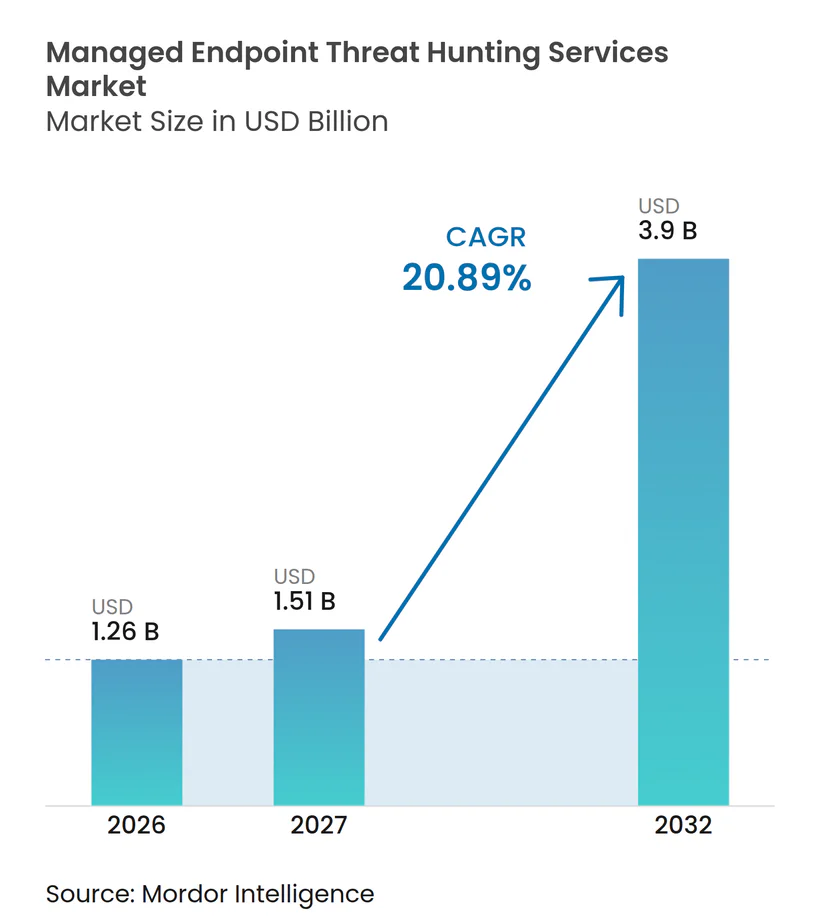
The managed endpoint threat hunting services market size is projected to be USD 1.26 billion in 2026, USD 1.51 billion in 2027, and reach USD 3.90 billion by 2032, growing at a CAGR of 20.89% from 2027 to 2032. Demand is rising as attackers use malware-free techniques that conventional signature-based controls often miss. CrowdStrike reported that 82% of detections in 2025 were malware-free, while adversary breakout time fell to as little as 27 seconds, increasing the value of continuous hunting. Organizations are shifting security spending toward expert-led services that seek hidden activity before automated alerts are generated. Platform consolidation is reshaping provider options, while data residency rules, multi-vendor integration, and changing attacker tactics remain important operating constraints. The managed endpoint threat hunting services market therefore favors providers that can combine broad telemetry coverage, strong threat intelligence, and measurable detection outcomes.
Key Report Takeaways
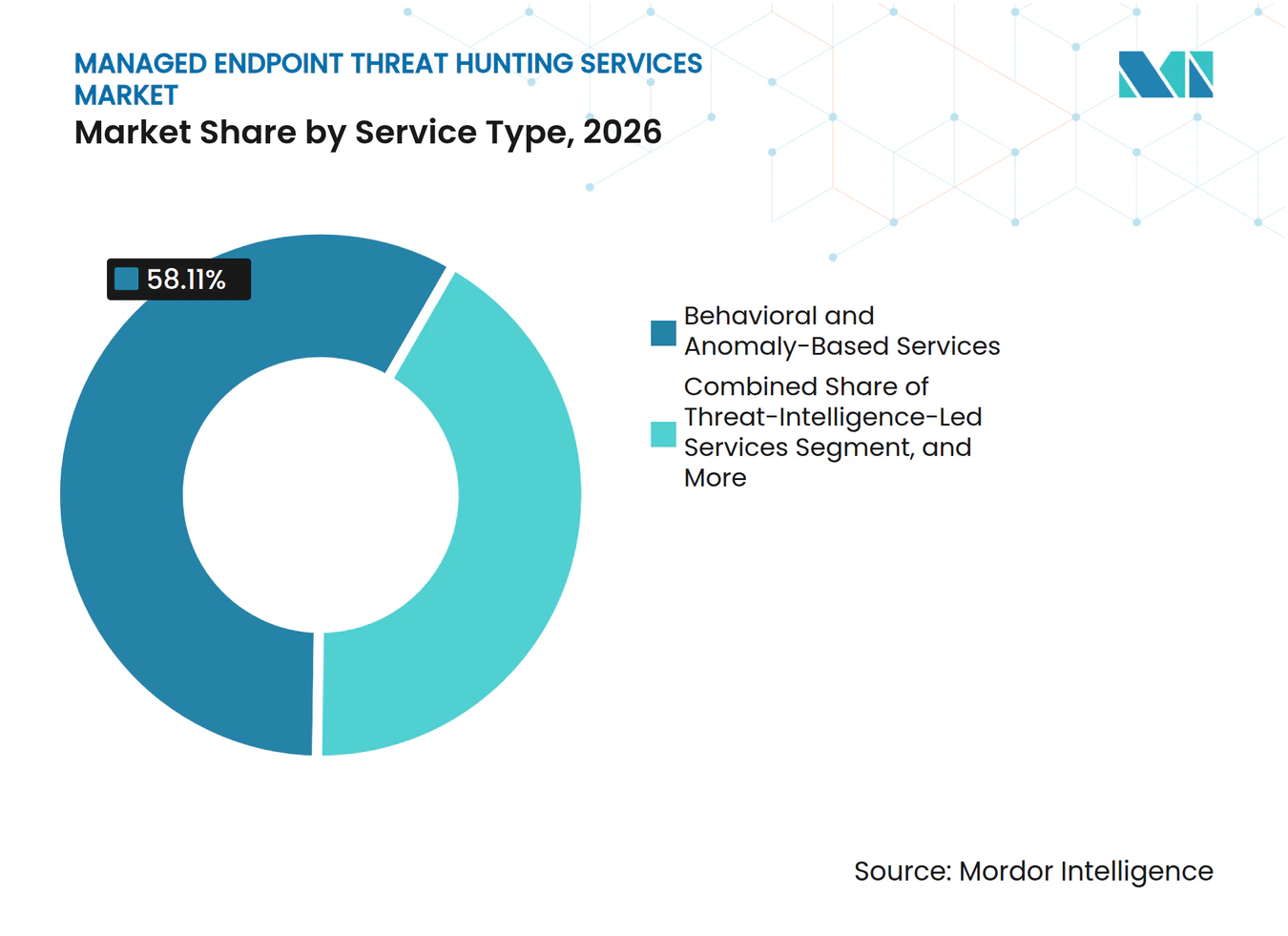
- By service type, Behavioral and Anomaly-Based Services held 58.11% of the managed endpoint threat hunting services market share in 2026, while Threat-Intelligence-Led Services are projected to expand at a 22.05% CAGR through 2032.
- By deployment mode, Cloud-Based deployment accounted for 66.41% of revenue in 2026, while Hybrid deployment is projected to grow at a 22.36% CAGR through 2032.
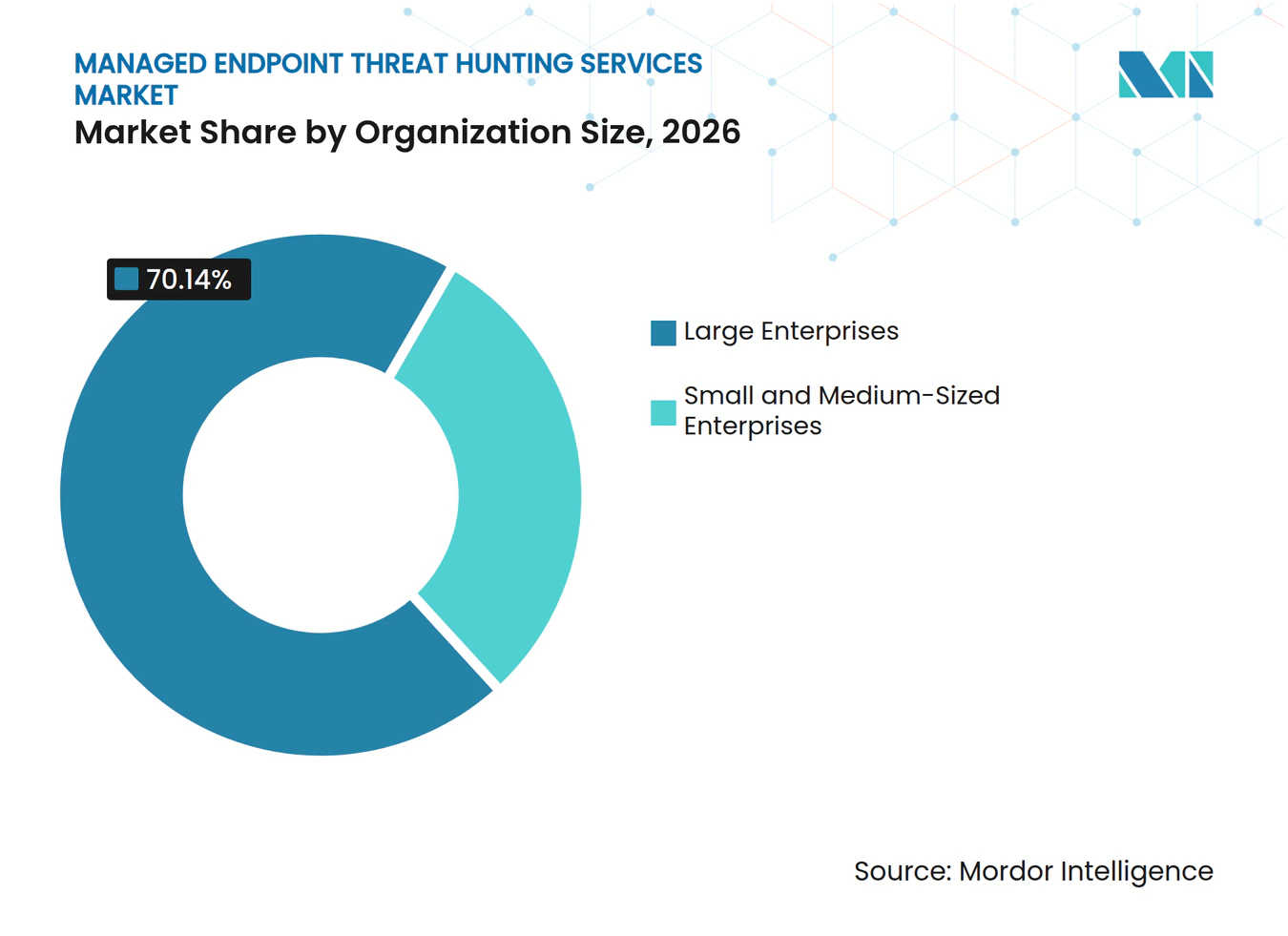
- By organization size, Large Enterprises held 70.14% of revenue in 2026, while Small and Medium-Sized Enterprises are projected to grow at a 22.79% CAGR through 2032.
- By end-user industry, BFSI held 27.19% of revenue in 2026, while Government and Public Administration is projected to expand at a 21.44% CAGR through 2032.
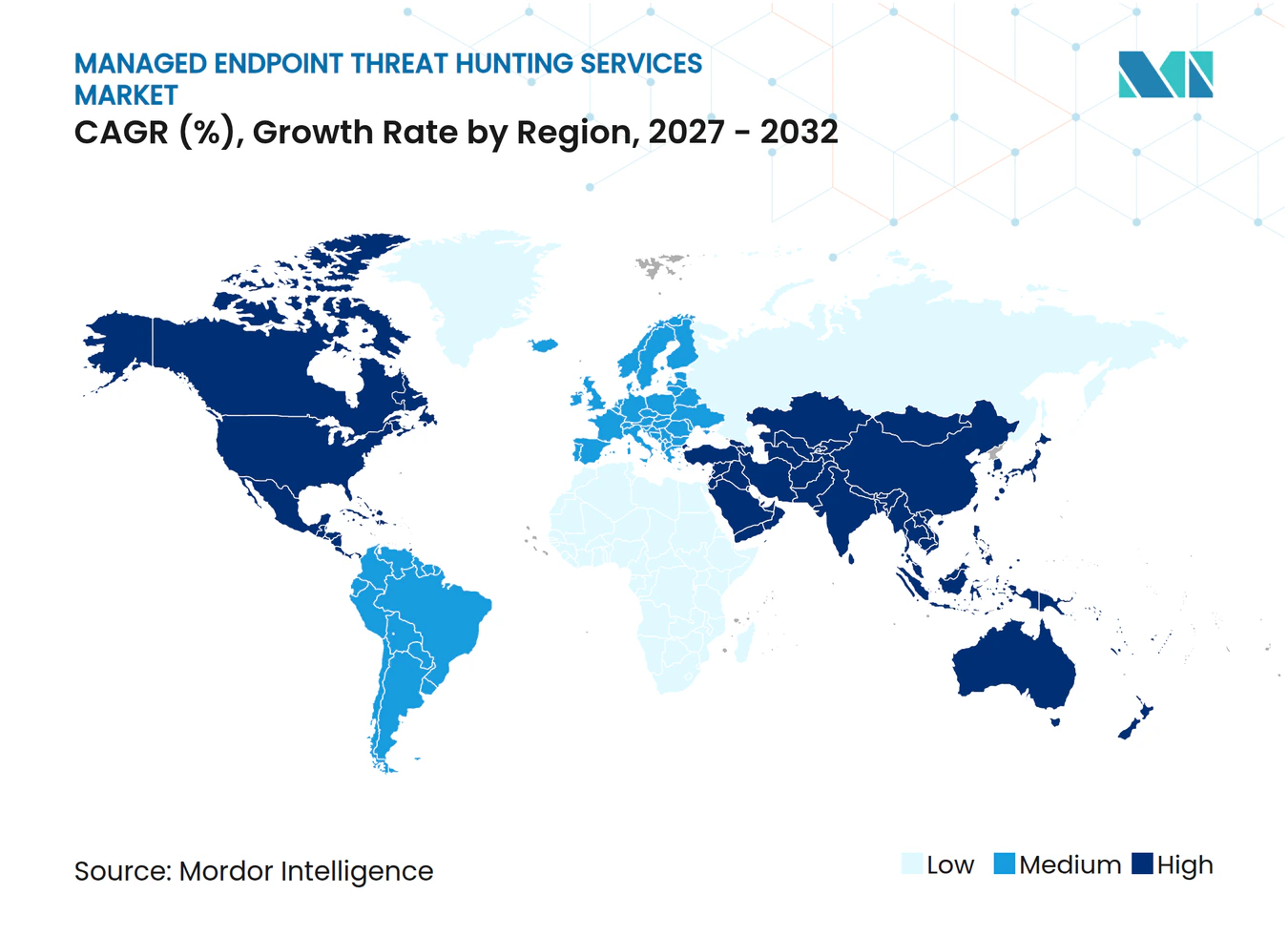
- By geography, North America held 37.16% of revenue in 2026, while Asia-Pacific is projected to grow at a 21.78% CAGR through 2032.
Note: Market numbers in this report are based on Mordor Intelligence's proprietary estimation framework, which combines nine months of actuals with Q4 projections for base year 2026.
Market Trends and Insights
Drivers Impact Analysis of Managed Endpoint Threat Hunting Services Market*
| Driver | (~) % Impact on CAGR Forecast | Geographic Relevance | Impact Timeline |
|---|---|---|---|
| Rising Ransomware, Business Email Compromise, and Living-off-the-Land Attacks | +3.0% | Global, with acute concentration in North America and Europe | Short term (≤ 2 years) |
| Shortage of Specialized Security Operations Talent | +2.5% | Global, most acute in North America, Europe, and Asia-Pacific | Medium term (2-4 years) |
| Escalating Regulatory and Cyber-Insurance Requirements | +2.0% | North America and EU, growing in Asia-Pacific and Middle East | Medium term (2-4 years) |
| Expansion of Cloud, Remote Work, and Distributed Endpoints | +1.5% | Global, fastest-growing in Asia-Pacific and South America | Short term (≤ 2 years) |
| AI-Assisted Detection Engineering and Response Automation | +1.0% | North America and Europe lead, Asia-Pacific accelerating | Long term (≥ 4 years) |
| Endpoint Telemetry Expansion Across Ephemeral Assets and Operational Technology | +0.5% | Global, with operational technology focus in industrial Europe, North America, and Asia-Pacific | Long term (≥ 4 years) |
| Source: Mordor Intelligence | |||
Rising Ransomware, Business Email Compromise, and Living-off-the-Land Attacks
The attack environment has strengthened demand in the managed endpoint threat hunting services market. Coalition found that business email compromise and funds transfer fraud accounted for 58% of observed cyber incidents in 2025. The FBI recorded USD 2.9 billion in business email compromise-related losses, compared with USD 1.0 billion attributed to ransomware, which shows the scale of email-enabled intrusions. ThreatDown reported that 86% of ransomware activity in 2025 involved remote encryption launched from unmanaged or shadow information technology systems. Verizon found ransomware in 48% of breaches, up from 44% in the prior period. These patterns make behavioral analysis and intelligence-led hunting more important because traditional malware indicators may not be present.
Shortage of Specialized Security Operations Talent
The shortage of skilled security personnel continues to increase reliance on outside hunting teams in the managed endpoint threat hunting services market. ISACA reported that 58% of organizations considered their cybersecurity teams understaffed, while 61% had open roles.[1] SANS found that the skills gap was the leading workforce challenge for 60% of respondents in 2026.[2] Fortinet reported that 71% of security leaders saw the shortage as an organizational risk and 56% faced recruitment difficulty. Red Canary found that 75% of organizations had a skills shortage in intrusion detection, while the attack surface widened by 41% over 12 months. The managed endpoint threat hunting services market benefits because organizations can obtain continuous expertise without building a full internal security operations center.
Escalating Regulatory and Cyber-Insurance Requirements
Regulatory requirements are making continuous detection a more direct operating need in the managed endpoint threat hunting services market. The California Privacy Protection Agency adopted rules that include cybersecurity audit requirements for certain businesses handling high-risk personal information. The U.S. Department of Justice Bulk Data Transfer Rule took effect on April 8, 2025, creating controls for access to sensitive U.S. data by countries of concern. Reporting requirements can tighten the time available to identify and contain a reportable incident. Such reporting windows increase the value of earlier threat identification. Insurers also seek evidence of endpoint detection and ongoing monitoring, which supports adoption of managed endpoint threat hunting services in regulated environments.
Expansion of Cloud, Remote Work, and Distributed Endpoints
Cloud workloads, remote devices, containers, and internet-connected equipment have enlarged the endpoint estate served by the managed endpoint threat hunting services market. CrowdStrike reported that its sensors detected more than 1,800 artificial intelligence applications running on enterprise devices, representing nearly 160 million unique application instances. This variety makes a static, on-premises monitoring model less effective. Containers, serverless functions, and short-lived virtual machines also reduce the time available to retain evidence and reconstruct an intrusion. Providers in the managed endpoint threat hunting services market need telemetry normalization and real-time correlation across cloud and endpoint environments. Cloud-native platforms have an advantage where they can process this data at scale without requiring organizations to maintain equivalent infrastructure.
Restraints Impact Analysis of Managed Endpoint Threat Hunting Services Market*
| Restraint | (~) % Impact on CAGR Forecast | Geographic Relevance | Impact Timeline |
|---|---|---|---|
| Data Residency and Cross-Border Transfer Constraints | -1.5% | China, EU, India, Middle East | Medium term (2-4 years) |
| Integration Complexity Across Multi-Vendor Security Stacks | -1.0% | Global | Short term (≤ 2 years) |
| Provider Dependence on High-Quality Endpoint Telemetry | -0.7% | Global, most acute in SME segment and emerging markets | Medium term (2-4 years) |
| Adversary Adaptation to Automated and AI-Assisted Hunting | -0.5% | Global | Long term (≥ 4 years) |
| Source: Mordor Intelligence | |||
Data Residency and Cross-Border Transfer Constraints
Data localization requirements can limit the ability to aggregate endpoint records across jurisdictions in the managed endpoint threat hunting services market. China released cross-border data transfer guidance on January 30, 2026, affecting which telemetry from China-based endpoints can be sent to overseas security operations centers. The U.S. Bulk Data Transfer Rule also requires providers to consider data routing controls for covered transactions. These obligations can require separate data environments in the United States, Europe, China, and India. Separate environments raise infrastructure costs and can limit the global correlation of threat intelligence. The managed endpoint threat hunting services market therefore places greater value on multi-region service delivery and data-sovereign deployment options.
Integration Complexity Across Multi-Vendor Security Stacks
Most organizations served by the managed endpoint threat hunting services market use several endpoint, identity, cloud, orchestration, and security information and event management products. This environment can slow implementation of managed hunting because providers must map data fields, remove gaps, and avoid duplicate alerting. Expel found that endpoint attacks represented 29% of the incidents it investigated in 2026.[3] The Bank of Mauritius specified interoperability with SIEM, SOAR, endpoint detection, firewall, and external intelligence tools in a 2025 threat intelligence platform procurement. Red Canary and CrowdStrike expanded their partnership in August 2025 to connect the Zscaler Zero Trust Exchange, CrowdStrike Falcon, and Red Canary's managed detection platform. These examples show why prebuilt integrations and clear onboarding processes matter, particularly for managed service providers serving smaller customers.
*Our forecasts treat driver/restraint impacts as directional, not additive. The impact forecasts reflect baseline growth, mix effects, and variable interactions.
Managed Endpoint Threat Hunting Services Market Segment Analysis
By Service Type:
Behavioral Services Lead While Intelligence-Led Hunting ExpandsBehavioral and Anomaly-Based Services held 58.11% of the managed endpoint threat hunting services market share in 2026. The segment fits an environment where attackers use valid credentials, native administration tools, and other techniques that do not leave a conventional malware file. CrowdStrike reported that 82% of threat detections in 2025 were malware-free. Behavioral baselining identifies unusual access patterns, process behavior, and data movement that signature tools can miss. Endpoint Compromise Assessment Services provide periodic forensic reviews, while Ransomware and Advanced Services combine hunting, containment, recovery, and rollback for organizations that cannot tolerate disruption.
Threat-Intelligence-Led Services are projected to grow at a 22.05% CAGR through 2032, the fastest rate among service types. The managed endpoint threat hunting services market size for this service type is supported by the wider availability of intelligence feeds and artificial intelligence tools that sort adversary tactics, techniques, and procedures. Expel introduced Expel Intel in October 2025, a formal threat intelligence program developed with researcher Marcus Hutchins. ENISA issued a 2026 tender for monitoring, analysis, threat hunting, and incident response over a 48-month framework. These initiatives show that intelligence-led hunting is becoming more formalized in commercial and public procurement.



By Deployment Mode:
Cloud Delivery Leads While Hybrid Models Gain GroundCloud-Based deployment held 66.41% of revenue in 2026, the largest share of the managed endpoint threat hunting services market. Technology, retail, and professional services organizations often use cloud-native endpoints and can adopt centrally delivered services quickly. The cloud model offers elastic telemetry processing and continuous updates without requiring clients to operate large data platforms. CrowdStrike stated that its hunting operations can analyze up to 6.2 trillion events each day. Shared intelligence also allows providers to connect behavior observed across customer environments.
Hybrid deployment is projected to grow at a 22.36% CAGR through 2032. Regulated organizations use hybrid architectures to process suitable data in cloud environments while retaining sensitive logs on premises or in sovereign clouds. This approach separates broad telemetry processing from local data retention and addresses cross-border transfer concerns. On-premises deployment remains relevant for defense, intelligence, and critical infrastructure sites with air-gapped or classified systems. TXOne Networks released Stellar Version 3.2 in March 2025 for operational technology endpoint protection and threat hunting, while CISA and the FBI stressed that owners need a current endpoint inventory for proactive hunting.
By Organization Size:
Large Enterprises Provide the Core While SMEs Scale Through PartnersLarge Enterprises held 70.14% of revenue in 2026. Their broad endpoint estates, multiple cloud environments, and larger security budgets support ongoing expert-led operations. Large organizations often use a continuous managed service alongside periodic red-team exercises and may run more than 1 endpoint security platform. Arctic Wolf was selected by Chubb as a preferred managed detection and response provider in February 2026. Deepwatch positioned its precision MDR platform around high-fidelity alerts for enterprise security teams.
Small and Medium-Sized Enterprises are projected to grow at a 22.79% CAGR through 2032. Managed service provider channels make specialist monitoring more accessible to organizations that cannot maintain a full security operations center. Huntress reported more than USD 250 million in annual recurring revenue and over 270,000 protected businesses, with its model focused largely on smaller organizations. SentinelOne partnered with Pax8, and ConnectWise, Microsoft, and Pax8 introduced an integrated cybersecurity and endpoint management solution for managed service providers. The managed endpoint threat hunting services market is expanding in this group because channel delivery reduces the cost and operational complexity of expert-led hunting.

By End-User Industry:
BFSI Leads While Public Sector Demand AcceleratesBFSI held 27.19% of managed endpoint threat hunting services market revenue in 2026. Financial organizations face persistent fraud, ransomware, identity abuse, and compliance risks, which support continuous threat monitoring. CrowdStrike tracked sophisticated financially motivated adversaries targeting financial services in its 2026 report. Punjab National Bank allocated INR 4 billion, USD 47.6 million at 2026 average exchange rates, to its annual cybersecurity budget, including a next-generation security operations center, endpoint monitoring, and API-based fraud detection. Healthcare, life sciences, IT and telecommunications, manufacturing, energy, utilities, retail, and e-commerce each require hunting approaches suited to their endpoint environments.
Government and Public Administration is projected to grow at a 21.44% CAGR through 2032. The U.S. General Services Administration awarded Nightwing all 5 Highly Adaptive Cybersecurity Services Special Item Numbers in March 2025, including Cyber Hunt. CISA advanced a USD 100 million multi-award vehicle for continuous government threat hunting, while ENISA's 48-month framework tender shows similar demand in European institutions. Public contracts can support long-running provider relationships. Government customers require strong data handling, compliance, and deployment controls, creating a barrier for providers without proven delivery capabilities.
Geography Analysis
North America Managed Endpoint Threat Hunting Services Market
North America held 37.16% of the managed endpoint threat hunting services market share in 2026. The region has a mature base of cloud-native enterprises, a large managed security provider population, and established cyber insurance practices. The U.S. Department of Justice operates a Cyber Threat Hunting program using endpoint and SIEM log integrations. CISA's USD 100 million threat hunting vehicle also supports public-sector demand. The U.S. Bulk Data Transfer Rule can favor domestic security operations infrastructure, while Canada and Mexico benefit from cross-border supply-chain links.
APAC Managed Endpoint Threat Hunting Services Market
Asia-Pacific is projected to grow at a 21.78% CAGR through 2032, the fastest regional rate in the managed endpoint threat hunting services market. Digital transformation, broader cloud use, and public investment in cybersecurity are enlarging endpoint estates across China, India, Japan, South Korea, and Southeast Asia. China's data transfer requirements create demand for local security operations centers and multi-region service designs. Japan continues to outsource detection and response work where internal security talent is limited. Australia remains the largest individual Asia-Pacific market, accounting for nearly 1-third of regional revenue, although its growth is expected to be slower than the regional rate as managed security spending matures.
EMEA and South America Managed Endpoint Threat Hunting Services Market
Europe, South America, the Middle East, and Africa have different maturity levels within the managed endpoint threat hunting services market. The EU Digital Operational Resilience Act has applied to financial services firms since January 2025 and requires continuous information and communication technology risk monitoring and incident detection. Germany, the United Kingdom, and France have established provider ecosystems, while Brazil and Argentina respond to ransomware risks in banking and critical infrastructure. Saudi Arabia, the UAE, South Africa, and Nigeria are broadening demand through cybersecurity investment, banking digitization, and mobile-first enterprise systems.
Competitive Landscape
Market Concentration
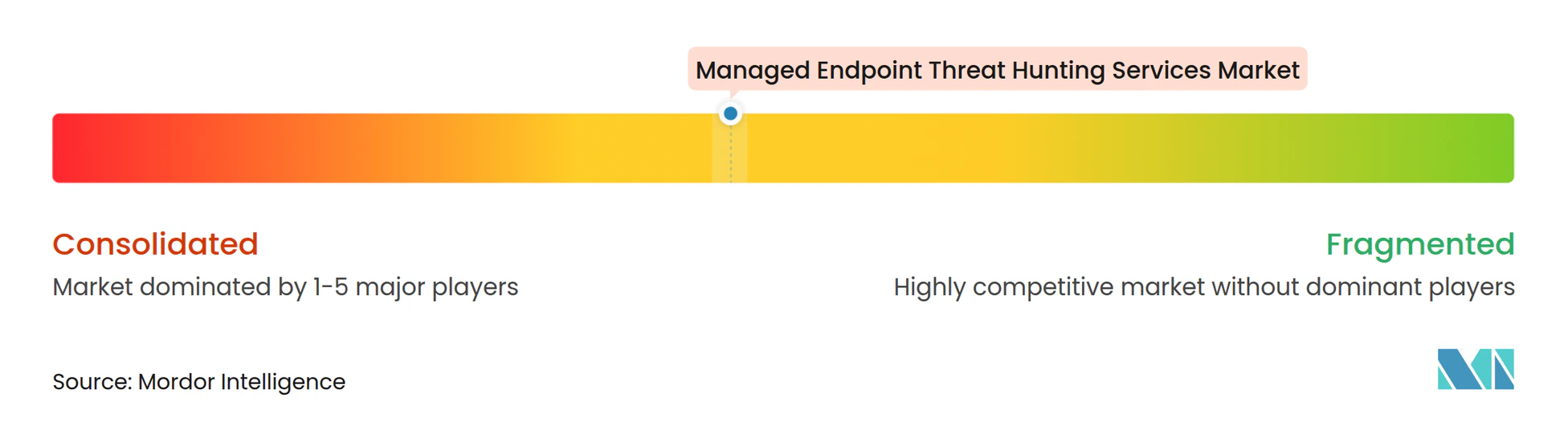
The managed endpoint threat hunting services market is moderately concentrated. CrowdStrike, Sophos, SentinelOne, and Arctic Wolf operate at scale, while Expel, Huntress, eSentire, and Deepwatch compete as specialized managed detection and response providers. Sophos completed its acquisition of Secureworks in February 2025 in an all-cash transaction valued at USD 859 million. The combined business serves more than 28,000 organizations through the Taegis platform and Sophos X-Ops intelligence capabilities. This transaction increased the importance of platform breadth, multi-vendor integration, and research capacity.
The managed endpoint threat hunting services market is being shaped by artificial intelligence, automation, third-party coverage, and response quality. CrowdStrike introduced 7 mission-ready AI agents in its Fall 2025 release, including a Hunt Agent that scans live intelligence from more than 280 tracked nation-state, eCrime, and hacktivist groups. In May 2026, CrowdStrike launched Falcon OverWatch for Defender, and stated that the service can reduce threat-hunting staffing costs by up to 95%. Expel introduced managed detection and response coverage for the full AI attack surface in August 2026. These actions show providers seeking differentiation in fast-changing endpoint environments.
Specialists are responding through co-managed services, human analyst depth, service-level commitments, and managed service provider relationships. Deepwatch opened a Global Capability Center in Bangalore in December 2025, while Arctic Wolf launched Aurora Managed Endpoint Defense for managed service providers and SentinelOne expanded access through Pax8. Operational technology hunting, AI attack-surface coverage, and SME channel delivery remain meaningful areas for expansion. MITRE ATT&CK for ICS alignment and SOC 2 Type II certification serve as recognized signs of program maturity in enterprise buying processes.
Managed Endpoint Threat Hunting Services Industry Leaders
-
CrowdStrike Holdings, Inc.
-
Arctic Wolf Networks, Inc.
-
Sophos Limited
-
Rapid7, Inc.
-
eSentire, Inc.
- *Disclaimer: Major Players sorted in no particular order
Managed Endpoint Threat Hunting Services Market Companies Covered in this Report
- CrowdStrike Holdings, Inc.
- Arctic Wolf Networks, Inc.
- Sophos Limited
- Rapid7, Inc.
- eSentire, Inc.
- Red Canary, Inc.
- Expel, Inc.
- Deepwatch, Inc.
- Binary Defense Systems, Inc.
- Critical Start, Inc.
- Huntress Labs Incorporated
- Secureworks Corp.
- SentinelOne, Inc.
- Cybereason Inc.
- WithSecure Corporation
- Bitdefender SRL
- Kaspersky Lab AO
- Redscan Cyber Security Limited
- LMNTRIX Inc.
- GoSecure Inc.
Recent Industry Developments in Managed Endpoint Threat Hunting Services Market
- August 2026: Expel launched managed detection and response coverage for the full AI attack surface, extending its SOC capabilities to threats generated with AI, employee AI misuse, and adversarial exposure inside AI systems, a market-first positioning that opens a high-margin service category ahead of broader competitor entry.
- May 2026: CrowdStrike launched Falcon OverWatch for Defender, extending expert-led managed threat hunting to Microsoft Defender for Endpoint customers. The service analyzes up to 6.2 trillion events per day and delivers up to a 95% reduction in threat-hunting staffing costs and 98% true-positive detection rates, building on CrowdStrike's earlier Falcon Next-Gen SIEM for Defender launch.
- February 2026: Arctic Wolf launched Aurora Managed Endpoint Defense for MSPs and was selected by Chubb as a preferred Managed Detection and Response provider, significantly expanding its channel reach and signaling growing insurer interest in outcome-guaranteed threat hunting partnerships.
- November 2025: SentinelOne launched the Wayfinder Threat Detection and Response suite in partnership with Google Threat Intelligence at OneCon 2025, introducing 4 managed service tiers, including an elite Wayfinder Threat Hunting service combining human hunters with agentic AI and Google-curated adversary intelligence, with general availability in November 2025.
Global Managed Endpoint Threat Hunting Services Market Report Scope
The Managed Endpoint Threat Hunting Services Market comprises outsourced cybersecurity services that proactively identify, investigate, and mitigate advanced threats, suspicious activities, and indicators of compromise across endpoint environments. These services leverage endpoint telemetry, behavioral analytics, threat intelligence, compromise assessments, and advanced threat-hunting methodologies to detect threats that may evade traditional security controls and to support continuous endpoint security operations.
The Managed Endpoint Threat Hunting Services Market Report is Segmented by Service Type (Behavioral and Anomaly-Based Services, Threat-Intelligence-Led Services, Endpoint Compromise Assessment Services, Ransomware and Advanced Services, and Other Service Types), Deployment Mode (Cloud, On-Premises, and Hybrid), Size (Large Enterprises, and Small and Medium-Sized Enterprises), End-User Industry (Banking, Financial Services, and Insurance (BFSI), Government and Public Administration, Healthcare and Life Sciences, IT and Telecommunication, Industrial Manufacturing, Retail and E-commerce, Energy and Utilities, and Other End-User Industries), and Geography (North America, South America, Europe, Asia-Pacific, Middle East, and Africa). The Market Forecasts are Provided in Terms of Value (USD).
Segmentation Overview
| Behavioral and Anomaly-Based Services |
| Threat-Intelligence-Led Services |
| Endpoint Compromise Assessment Services |
| Ransomware and Advanced Services |
| Other Service Types |
| Cloud-Based |
| On-Premises |
| Hybrid |
| Large Enterprises |
| Small and Medium-Sized Enterprises |
| Banking, Financial Services, and Insurance (BFSI) |
| Government and Public Administration |
| Healthcare and Life Sciences |
| IT and Telecommunication |
| Industrial Manufacturing |
| Retail and E-commerce |
| Energy and Utilities |
| Other End-User Industries |
| North America | United States |
| Canada | |
| Mexico | |
| South America | Brazil |
| Argentina | |
| Rest of South America | |
| Europe | Germany |
| United Kingdom | |
| France | |
| Italy | |
| Russia | |
| Rest of Europe | |
| Asia-Pacific | China |
| Japan | |
| India | |
| South Korea | |
| Rest of Asia-Pacific | |
| Middle East | Saudi Arabia |
| United Arab Emirates | |
| Rest of Middle East | |
| Africa | South Africa |
| Nigeria | |
| Rest of Africa |
| By Service Type | Behavioral and Anomaly-Based Services | |
| Threat-Intelligence-Led Services | ||
| Endpoint Compromise Assessment Services | ||
| Ransomware and Advanced Services | ||
| Other Service Types | ||
| By Deployment Mode | Cloud-Based | |
| On-Premises | ||
| Hybrid | ||
| By Organization Size | Large Enterprises | |
| Small and Medium-Sized Enterprises | ||
| By End-User Industry | Banking, Financial Services, and Insurance (BFSI) | |
| Government and Public Administration | ||
| Healthcare and Life Sciences | ||
| IT and Telecommunication | ||
| Industrial Manufacturing | ||
| Retail and E-commerce | ||
| Energy and Utilities | ||
| Other End-User Industries | ||
| By Geography | North America | United States |
| Canada | ||
| Mexico | ||
| South America | Brazil | |
| Argentina | ||
| Rest of South America | ||
| Europe | Germany | |
| United Kingdom | ||
| France | ||
| Italy | ||
| Russia | ||
| Rest of Europe | ||
| Asia-Pacific | China | |
| Japan | ||
| India | ||
| South Korea | ||
| Rest of Asia-Pacific | ||
| Middle East | Saudi Arabia | |
| United Arab Emirates | ||
| Rest of Middle East | ||
| Africa | South Africa | |
| Nigeria | ||
| Rest of Africa | ||
Key Questions Answered in the Report
What is the managed endpoint threat hunting services market size?
The managed endpoint threat hunting services market is projected to increase from USD 1.51 billion in 2027 to USD 3.90 billion by 2032 at a 20.89% CAGR.
What is driving demand for managed endpoint threat hunting services?
Malware-free intrusions, ransomware, business email compromise, and a shortage of skilled security staff are increasing demand for continuous expert-led detection.
Which service type leads managed endpoint threat hunting?
Behavioral and Anomaly-Based Services held 58.11% of revenue in 2026 because they can identify suspicious behavior that signature-based tools may miss.
Why are hybrid threat hunting deployments growing?
Hybrid deployment is projected to grow at a 22.36% CAGR through 2032 because regulated organizations need cloud-scale analysis while retaining sensitive data in controlled environments.
Which customer group is adopting these services fastest?
Small and Medium-Sized Enterprises are projected to grow at a 22.79% CAGR through 2032 as managed service provider channels reduce the need for an internal security operations center.
Which region is growing fastest for endpoint threat hunting services?
Asia-Pacific is projected to expand at a 21.78% CAGR through 2032 as cloud adoption, cybersecurity investment, and endpoint estates grow across the region.