
Managed Endpoint Malware Analysis Services Market Size and Share
Market Overview
| Study Period | 2021 - 2032 |
|---|---|
| Market Size (2027) | USD 3.21 Billion |
| Market Size (2032) | USD 6.58 Billion |
| Growth Rate (2027 - 2032) | 15.44 % |
| Fastest Growing Market | Asia-Pacific |
| Largest Market | North America |
| Market Concentration | Medium |
Major Players *Disclaimer: Major Players sorted in no particular order Image © Mordor Intelligence. Reuse requires attribution under CC BY 4.0. | |
Managed Endpoint Malware Analysis Services Market Analysis by Mordor Intelligence
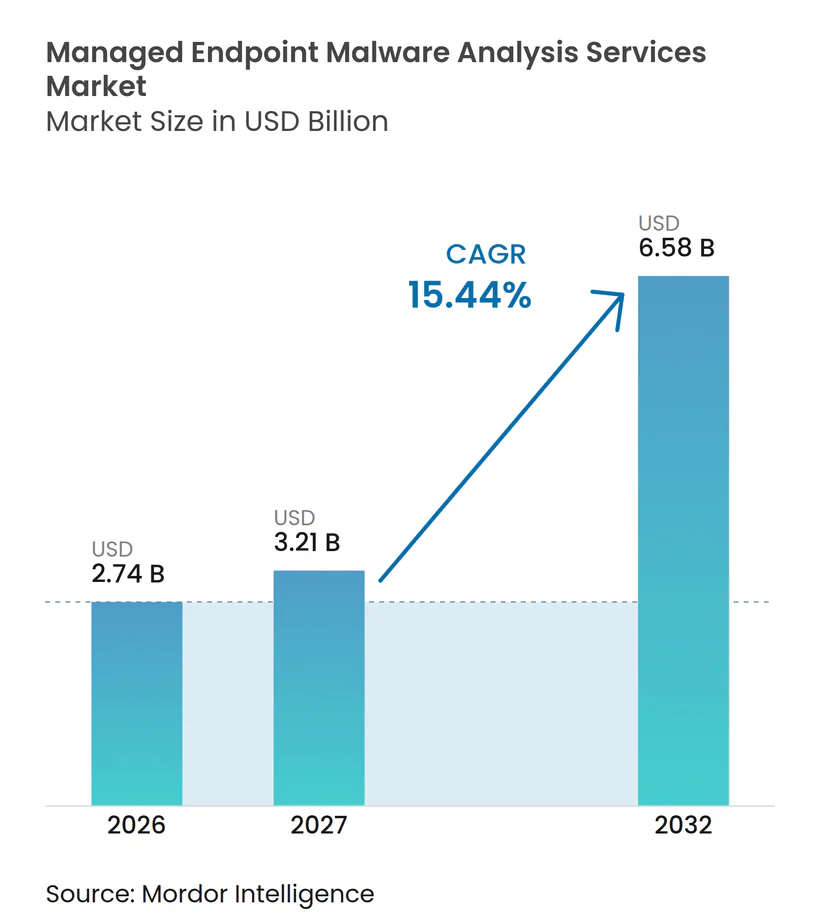
The Managed Endpoint Malware Analysis Services Market size is projected to expand from USD 2.74 billion in 2026 and USD 3.21 billion in 2027 to USD 6.58 billion by 2032, registering a CAGR of 15.44% between 2027 to 2032. The market is moving away from signature-dependent protection toward continuous analysis that combines behavioral monitoring, investigation, and response. AI-generated malware, a limited supply of experienced security professionals, and disclosure requirements are increasing the need for managed analysis. Providers are responding by combining endpoint, identity, cloud, and network data in their operations platforms. Compliance-ready reporting is becoming an important part of service design because the same endpoint records can support incident investigations and regulatory filings. The Managed Endpoint Malware Analysis Services Market is therefore becoming more closely linked to routine risk and compliance operations.
Key Report Takeaways
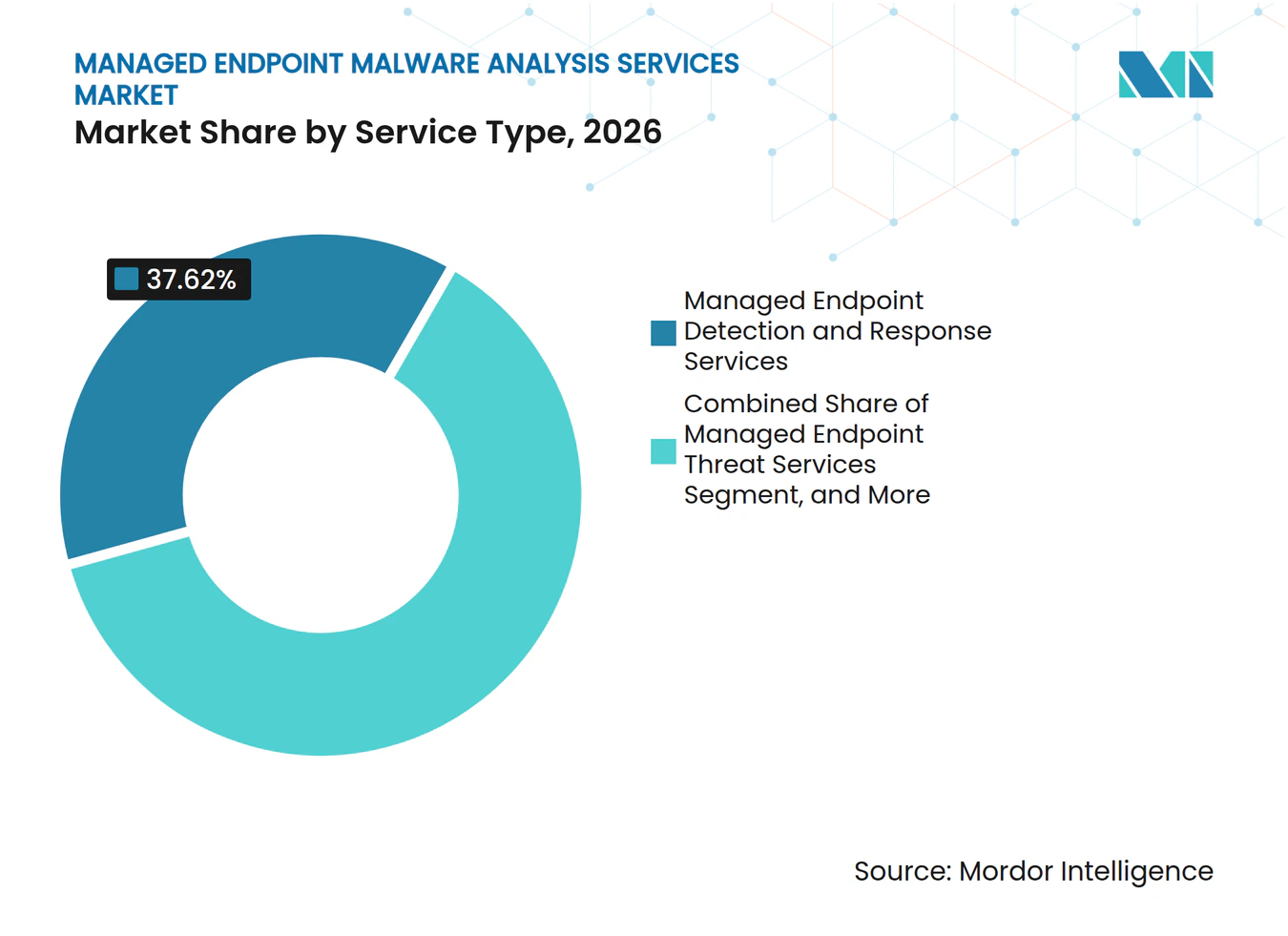
- By service type, Managed Endpoint Detection and Response Services held 37.62% of the Managed Endpoint Malware Analysis Services Market share in 2026, while Managed Endpoint Detection Engineering Services is projected to expand at a 16.48% CAGR through 2032.
- By analysis type, Hybrid and Machine Learning-Assisted Analysis held 29.43% share in 2026, while Threat Intelligence and Indicator Enrichment is projected to grow at a 16.42% CAGR through 2032.
- By deployment model, Cloud-Based deployment accounted for 59.17% share in 2026, while Hybrid deployment is projected to advance at a 16.34% CAGR through 2032.
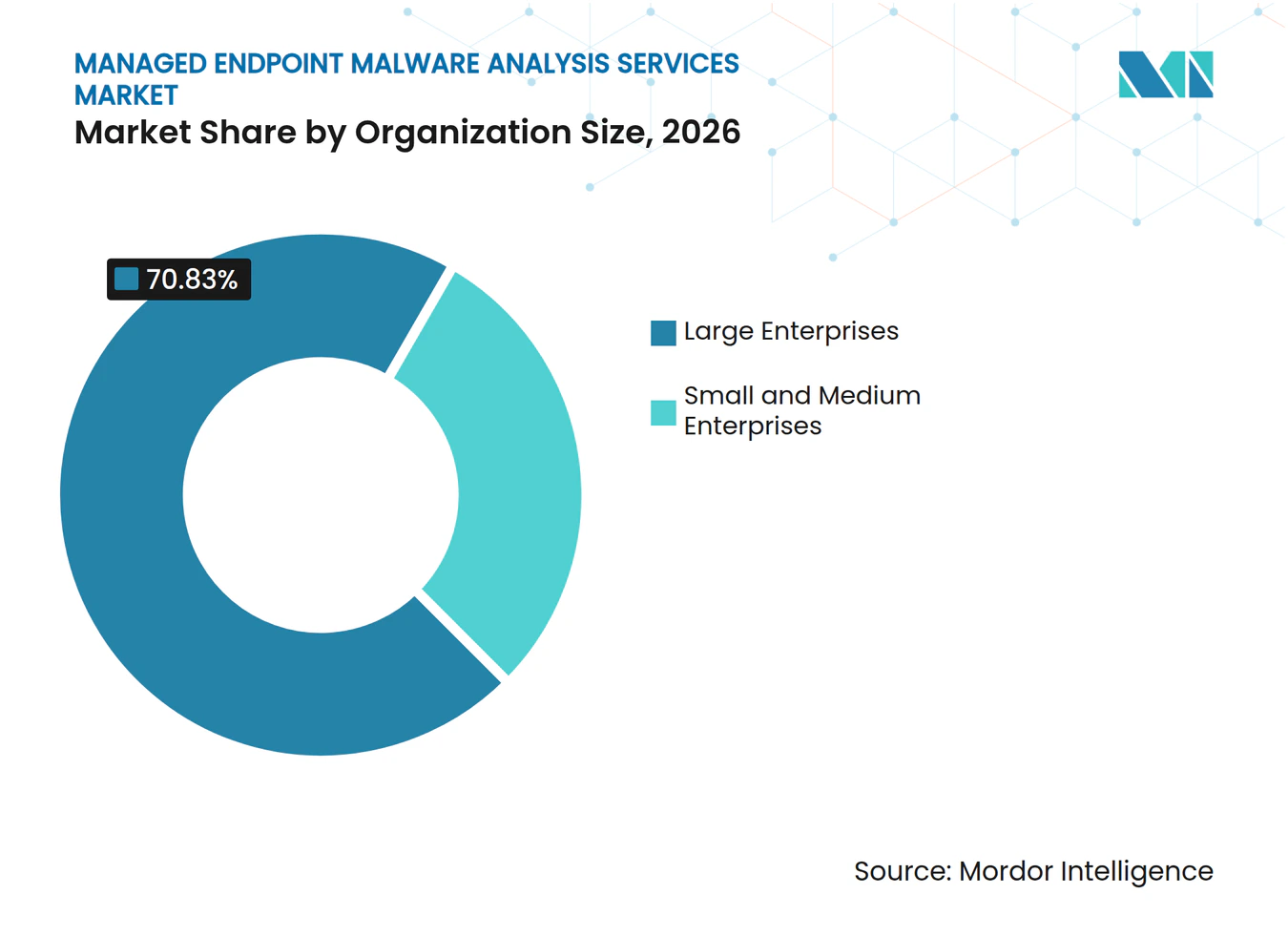
- By organization size, Large Enterprises represented 70.83% share in 2026, while SMEs are projected to expand at a 16.92% CAGR through 2032.
- By end-user industry, BFSI held 24.87% share in 2026, while Healthcare is projected to grow at a 16.63% CAGR through 2032.
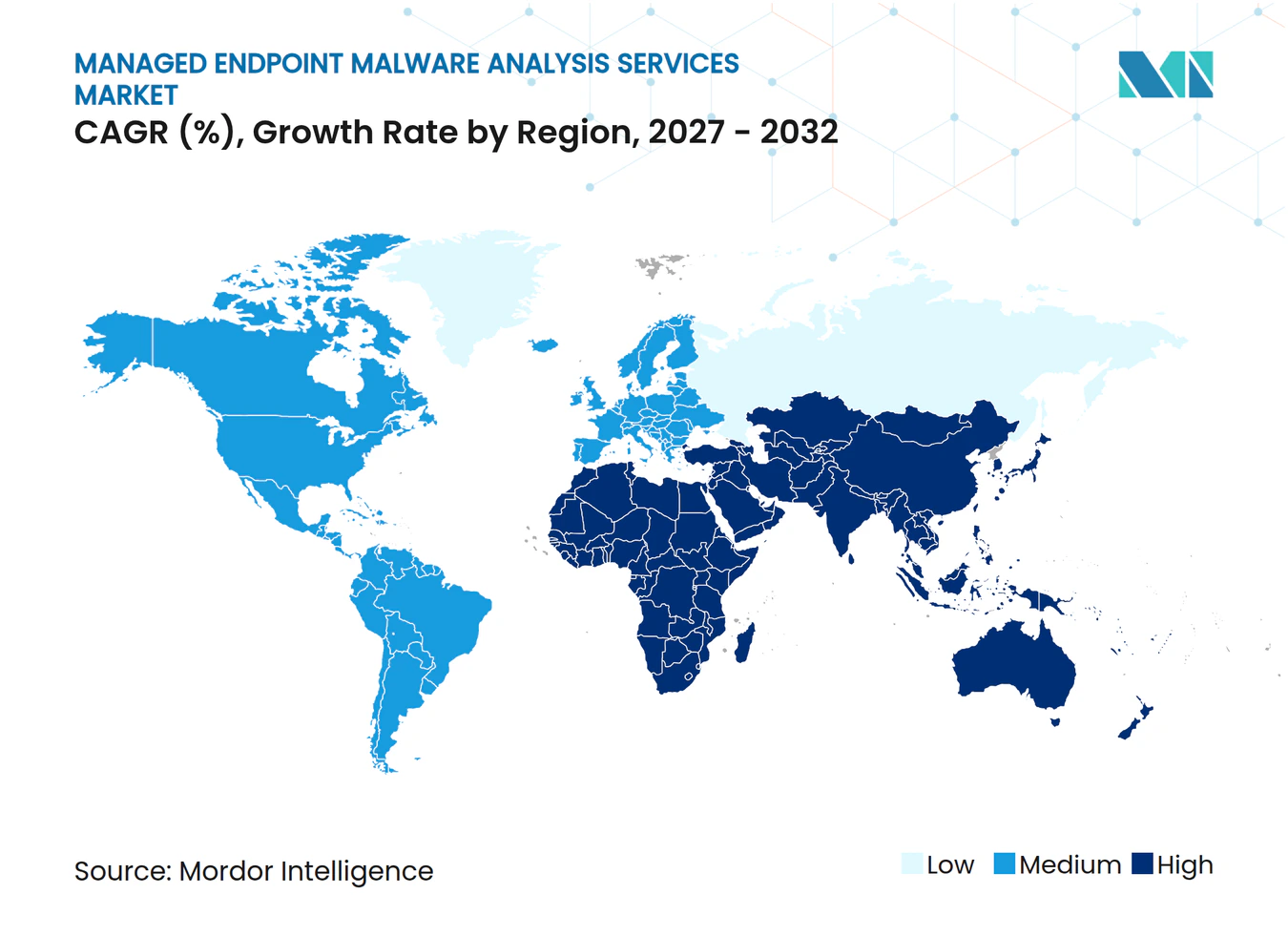
- By geography, North America accounted for 40.38% of the Managed Endpoint Malware Analysis Services Market share in 2026, while Asia-Pacific is projected to expand at a 16.27% CAGR through 2032.
Note: Market numbers in this report are based on Mordor Intelligence's proprietary estimation framework, which combines nine months of actuals with Q4 projections for base year 2026.
Global Managed Endpoint Malware Analysis Services Market Trends and Insights
Drivers Impact Analysis*
| Driver | (~) % Impact on CAGR Forecast | Geographic Relevance | Impact Timeline |
|---|---|---|---|
| Escalation of Polymorphic and AI-Generated Malware | +3.4% | Global | Short term (≤ 2 years) |
| Cybersecurity Skills Shortages and Alert Overload | +2.9% | Global, pronounced in North America and Europe | Short term (≤ 2 years) |
| Expansion of Hybrid-Work and Bring Your Own Device Endpoints | +2.4% | Global, Asia-Pacific core, spill-over to Middle East and Africa | Medium term (2-4 years) |
| Mandatory Breach-Reporting and Cyber-Insurance Requirements | +1.9% | North America and EU, growing reach across Asia-Pacific | Medium term (2-4 years) |
| Ephemeral Cloud Workloads Requiring Continuous Malware Inspection | +1.5% | Global, North America and Asia-Pacific leading | Long term (≥ 4 years) |
| Endpoint Telemetry Reuse Across Detection, Investigation, and Compliance Workflows | +1.1% | Global | Long term (≥ 4 years) |
| Source: Mordor Intelligence | |||
Escalation of Polymorphic and AI-Generated Malware
Check Point Research documented VoidLink in January 2026 as an advanced malware framework that it assessed as being authored almost entirely with AI. The research reported that one actor developed the framework in under 1 week, reducing the effort needed to create complex malware. ESET documented PromptLock as an AI-driven ransomware capable of generating malicious scripts on demand, indicating that this threat had moved beyond a theoretical concern.[1] ESET WatchGuard reported that new and unique malware rose 1,548% between Q3 and Q4 2025, while 23% of detected samples bypassed signature-based controls. The findings favor providers that can inspect behavior, memory activity, and related indicators rather than relying only on file signatures. The Managed Endpoint Malware Analysis Services Market benefits when buyers seek continuous model updates and analyst reviews for rapidly evolving threats.
Cybersecurity Skills Shortages and Alert Overload
SANS reported in 2026 that 60% of surveyed organizations identified a skills gap as their leading workforce challenge, compared with 40% identifying insufficient staffing. ISC2 found that 95% of practitioners reported at least 1 skills gap in its 2025 workforce study, and 59% described those gaps as critical or significant. ISC2 Fortinet reported that 60% of security leaders could not recruit people with AI security experience, and 71% viewed skills shortages as an ongoing risk. Managed Services gives organizations access to analysts and investigative processes without waiting to build an in-house specialist team. This shortage supports demand for providers that can filter alerts and deliver clear investigation outcomes.
Expansion of Hybrid-Work and Bring Your Own Device Endpoints
Hybrid work has kept more endpoints outside traditional office networks, which increases the importance of continuous visibility. Japan's IPA ranked attacks on remote-work environments sixth in its 2026 list of major information security threats. The continued ranking shows that remote access remains a practical exposure for organizations, rather than a short-lived response to past workplace disruption. Devices used across homes, branches, and shared locations can create blind spots when security controls differ by user or device type. Bring Your Own Device arrangements make those gaps harder to manage because personal devices may not carry the same monitoring tools as managed corporate assets. Providers are responding with lighter deployment models and service designs that reduce friction while preserving enough telemetry for analysis. This creates an opportunity in the Managed Endpoint Malware Analysis Services Market for services that work across varied endpoint environments.
Mandatory Breach-Reporting and Cyber-Insurance Requirements
The SEC requires companies to disclose material cybersecurity incidents on Form 8-K Item 1.05 within 4 business days after determining that an incident is material. ENISA published NIS2 technical implementation guidance in June 2025, reinforcing the need for documented cybersecurity controls and incident handling. CIRCIA is expected to require covered entities to report significant cyber incidents within 72 hours and ransomware payments within 24 hours after its rules take effect. These obligations increase the value of endpoint records that can support an investigation and a formal report. Cyber-insurance requirements add another reason to maintain verifiable detection and response controls.
Restraints Impact Analysis*
| Restraint | (~) % Impact on CAGR Forecast | Geographic Relevance | Impact Timeline |
|---|---|---|---|
| Data-Sovereignty Restrictions on Malware-Sample Sharing | -1.8% | EU, China, Japan, India | Medium term (2-4 years) |
| False Positives from Automated Dynamic Analysis | -1.5% | Global | Short term (≤ 2 years) |
| High Integration Complexity Across Endpoint, SIEM, SOAR, and XDR Platforms | -1.1% | Global, pronounced in large enterprises | Long term (≥ 4 years) |
| Limited Availability of Reverse-Engineering and Threat-Hunting Specialists | -0.8% | Global | Long term (≥ 4 years) |
| Source: Mordor Intelligence | |||
Data-Sovereignty Restrictions on Malware-Sample Sharing
Cloud-delivered analysis depends on sharing suspicious files and related artifacts across sensor networks. Data residency rules can limit that exchange when malware samples or endpoint records are subject to local handling requirements. Germany's BSI supported Operation Endgame 2.0 in May 2025, illustrating the scale of coordinated action against malware infrastructure. BSI: At the same time, organizations operating in the EU must consider governance rules when data is transferred to overseas analysis environments. China, Japan, and India present similar operational considerations for providers serving regulated customers. Providers may need regional analysis capacity and local processes, which can raise operating costs and complicate the global sharing model. The Managed Endpoint Malware Analysis Services Market can therefore develop unevenly, where data governance limits the use of centralized cloud infrastructure.
False Positives From Automated Dynamic Analysis
Automated sandboxes can generate high alert volumes, creating more work for security teams when legitimate software is classified as suspicious. Custom business applications can be particularly difficult because unusual runtime behavior does not always indicate malicious activity. Cisco states that its security operations research is informed by visibility across more than 880 billion security events each day. That level of visibility demonstrates the intelligence and engineering effort needed to improve detection quality over time. Palo Alto Networks stated that Cortex XDR One reduced false positives by 95% through cross-domain telemetry correlation, but the company presented this as a product-specific outcome. Smaller organizations remain sensitive to false positives because they may lack the staff to quickly validate automated findings.
*Our forecasts treat driver/restraint impacts as directional, not additive. The impact forecasts reflect baseline growth, mix effects, and variable interactions.
Segment Analysis
By Service Type: Detection Engineering Expands Provider Roles
Managed Endpoint Detection and Response Services held 37.62% of the Managed Endpoint Malware Analysis Services Market share in 2026. The segment benefits from customers replacing traditional antivirus products with continuous monitoring and automated containment. It gives organizations a managed way to receive alerts, investigations, and response support across large endpoint estates. Managed Endpoint Malware Sandbox Services and Managed Endpoint Threat Hunting Services serve organizations that need targeted analysis without a full detection-and-response operating model. Managed Endpoint Incident Investigation and Response Services are also relevant when customers need specialist support after a breach.
Managed Endpoint Detection Engineering Services is projected to record the fastest service-type CAGR at 16.48% through 2032. The service lets providers help customers create and maintain detection rules that reflect their own environments. This can include tuning detections for business applications, user behavior, and specific attack paths. The relationship goes beyond handling standard alerts because the provider becomes part of the customer's detection design process. Organizations may find it harder to replace a provider once its teams understand the internal rule library and investigation practices.



By Analysis Type: Hybrid Methods Combine Speed and Context
Hybrid and Machine Learning-Assisted Analysis led this category with 29.43% of the Managed Endpoint Malware Analysis Services Market share in 2026. The approach combines automated classification with behavioral analysis, giving security teams faster initial decisions and additional context for unusual activity. Static Analysis remains useful for rapid file inspection, while Dynamic Behavioral Analysis identifies how a sample acts when executed. Memory and Kernel Analysis is valuable for fileless threats and attempts to interfere with endpoint security tools. Cisco Talos described a Qilin ransomware chain that used a DLL to disable more than 300 EDR driver variants in April 2026.
Threat Intelligence and Indicator Enrichment is projected to grow at a 16.42% CAGR through 2032. This work links detected artifacts to known campaigns, infrastructure, techniques, and potential threat actors. It helps security teams decide whether an isolated event is part of a broader incident. Providers that combine this context with static, dynamic, memory, and machine-learning methods can offer a more complete investigative process. The segment's growth indicates that organizations need information to prioritize responses, not just a verdict on a single file. It also supports faster communication with internal risk teams and external stakeholders during an incident.
By Deployment Model: Hybrid Design Addresses Control Requirements
Cloud-Based deployment accounted for 59.17% of the Managed Endpoint Malware Analysis Services Market size in 2026. Cloud services support central administration, shared intelligence, and elastic processing capacity for malware analysis. They can also reduce the upfront infrastructure burden for organizations that do not operate their own sandboxes or large security teams. Global providers use cloud architectures to update detection content and coordinate investigations across distributed customer environments. The model is well-suited to organizations that need consistent security operations across many locations. However, deployment decisions still depend on the sensitivity of endpoint records and applicable data governance requirements.
Hybrid deployment is projected to be the fastest-growing model at a 16.34% CAGR through 2032. It gives customers the option to retain selected telemetry, samples, or controls on-premises while using cloud processing, where permitted. Banking, healthcare, government, and industrial organizations often need that balance because they operate under strict rules governing sensitive data. On-Premises deployment remains relevant for classified systems and air-gapped environments where cloud connectivity is not appropriate. Its share may decline as cloud use expands, but it remains important for specialized operational settings. The Managed Endpoint Malware Analysis Services Market is likely to favor providers that can support more than 1 deployment approach without reducing investigation quality.
By Organization Size: SMEs Broaden the Customer Base
Large Enterprises represented 70.83% of demand in 2026. These organizations often have large, complex endpoint environments that include multiple operating systems, locations, and existing security products. Their budgets and previous investment in endpoint detection and response also make managed analysis a logical extension of established security operations. Large enterprises need providers that can integrate with internal teams, incident processes, and a broad set of enterprise tools. They also face detailed compliance obligations and may be required to provide formal reporting after a material incident.
SMEs are projected to grow at the highest organization-size CAGR of 16.92% through 2032. Ransomware activity, insurance requirements, and limited in-house expertise are making managed services more relevant to smaller organizations. ISC2 found in September 2026 that 97% of respondents in its India workforce research reported needing at least 1 cybersecurity skill, and 74% called the need critical or significant. ISC2 Subscription pricing can give SMEs access to security capabilities that would be difficult to build internally. Providers are adapting with simpler onboarding, co-managed services, and fixed-fee offerings. This customer group can reward vendors that make analyst-led malware analysis easier to buy and operate.

By End-User Industry: Regulated Sectors Prioritize Evidence
BFSI held 24.87% of the Managed Endpoint Malware Analysis Services Market share in 2026. The sector is a frequent target because it holds sensitive customer and transaction data, and it operates under extensive regulatory requirements. These conditions support spending on services that provide rapid investigation, containment, and well-documented evidence. Financial institutions also need tools that work across legacy systems, employee endpoints, and increasingly digital customer services.
Healthcare is projected to be the fastest-growing end-user industry at a 16.63% CAGR through 2032. Health-ISAC recorded 317 ransomware events in the health sector in Q3 2026, equal to 9.72% of global attacks during that period. The sector needs to protect clinical operations and sensitive patient information while responding quickly to threats. The American Hospital Association identified cyber threats as a major risk for healthcare organizations in 2026.[2] IT and Telecommunications, Government and Defense, Manufacturing, Retail and E-Commerce, Energy and Utilities, Transportation and Logistics, Education, and Hospitality and Travel also present broad demand as digital operations increase the number of exposed endpoints. Across these sectors, services that can turn telemetry into a clear investigation record have a practical advantage.
Geography Analysis
North America held 40.38% of the Managed Endpoint Malware Analysis Services Market share in 2026. The region combines mature security budgets, a large base of managed service providers, and extensive incident reporting obligations. CrowdStrike found that hands-on keyboard intrusions against financial institutions in North America increased 48% over 2 years. The United States supports demand through SEC disclosure requirements and the expected CIRCIA reporting regime. Canada also has a developed enterprise security environment that supports the adoption of managed services. South America, led by Brazil, is an important emerging entry point as data protection rules and increased digitization heighten the need for defensible security operations.
Europe relies on layered requirements, including NIS2, DORA for financial entities, and national frameworks such as Germany's BSI guidance. These rules make continuous endpoint monitoring and documented incident handling more relevant to buyers. WatchGuard data showed that Germany ranked third globally for detections of obfuscated Office exploits in 2025, accounting for 21.12% of the worldwide volume. France, Italy, and Spain are influenced by NIS2 implementation and financial-sector modernization. The Middle East and Africa are earlier-stage markets, where investment programs and developing frameworks can support demand for managed analysis.
Asia-Pacific is projected to grow at the fastest regional CAGR of 16.27% through 2032. Japan's IPA placed AI-related cyber risks third in its 2026 major threats list, the first time AI-specific risks appeared in that list. IPA This places added attention on AI-capable analysis services in the region. China requires providers to consider onshore infrastructure and domestic regulatory conditions, which supports locally operated service models. India has a large base of growing BFSI and digital organizations that need specialist security capacity. Australia is an important regional market outside Japan and China, while Indonesia, Vietnam, and Thailand are expanding as digitization grows faster than security infrastructure maturity.
Competitive Landscape
Market Concentration
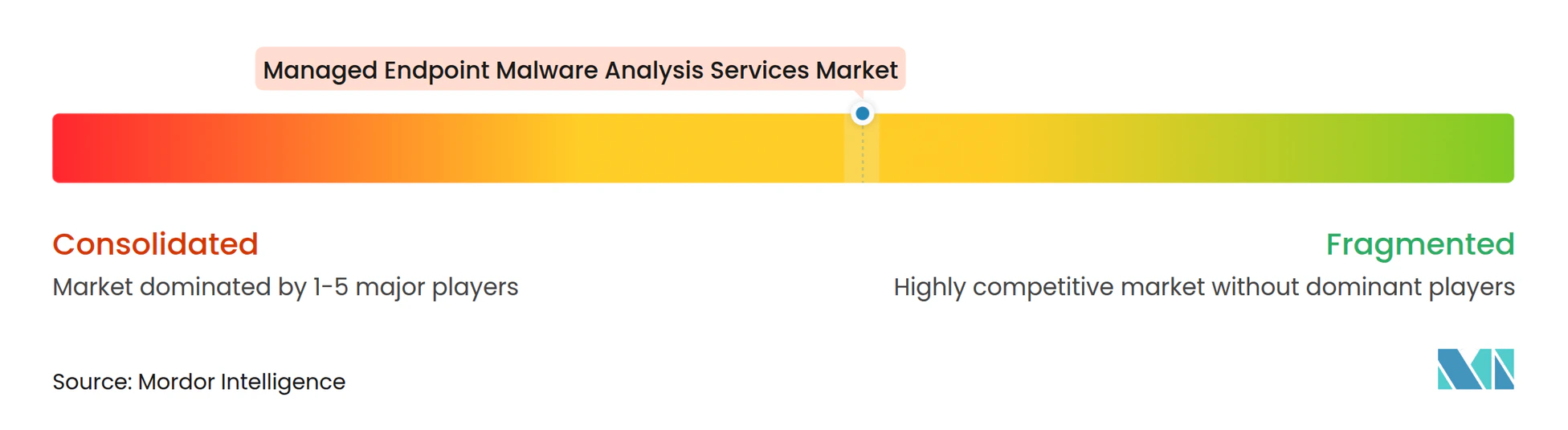
The Managed Endpoint Malware Analysis Services Market includes global platform vendors and specialist managed detection and response providers. Major vendors include CrowdStrike Holdings, Palo Alto Networks, Microsoft, Broadcom, Cisco Systems, SentinelOne, Fortinet, Sophos, Arctic Wolf Networks, Trellix, eSentire, Rapid7, Bitdefender, and ESET. Their competitive focus includes automated detection, broad telemetry coverage, analyst expertise, and the ability to produce compliance-ready reporting. Larger platform vendors can invest in threat intelligence and regularly retrain detection models across large installed bases. Specialist providers compete through dedicated analyst coverage, flexible co-management, and service models that can be easier for customers to adopt. This combination keeps the field moderately concentrated while leaving room for specialists in defined customer groups.
Trellix introduced SecondSight in February 2026, combining AI analytics with human hunters across endpoint, network, and email telemetry. Palo Alto Networks launched Cortex XDR One in October 2026 with endpoint-based small language models designed to classify evasive and fileless threats offline. Fortinet advanced its Security Operations Platform in September 2026 with unified SOC functions and endpoint enhancements.[3] These moves show that product strategies increasingly link endpoint analysis to a wider security operations platform. Providers are adding automation while retaining analyst-led investigation for complex cases.
Regional providers can compete where customers require local hosting, local support, or a specific approach to data governance. Adjacent XDR providers are also bringing malware analysis into broader platforms rather than selling it as a separate service. Open telemetry approaches can reduce integration barriers for public-sector and other procurement-sensitive buyers. At the same time, the need for high-quality analyst review remains important when automated systems generate uncertain findings. SMEs remain an attractive opportunity because complex pricing and difficult onboarding can limit adoption of established platforms. The competitive landscape will favor vendors that combine clear service delivery, integration flexibility, and credible evidence for customers facing an incident.
Managed Endpoint Malware Analysis Services Industry Leaders
-
CrowdStrike Holdings, Inc.
-
Palo Alto Networks, Inc.
-
Microsoft Corporation
-
Broadcom Inc.
-
Sophos Limited
- *Disclaimer: Major Players sorted in no particular order
Recent Industry Developments
- October 2026: Palo Alto Networks launched Cortex XDR One, deploying optimized small language models on the endpoint sensor to classify evasive, fileless threats offline and claiming a 95% reduction in false positives through cross-domain telemetry correlation.
- September 2026: Fortinet advanced its Security Operations Platform with a unified SOC architecture, agentic AI for autonomous alert triage and root cause tracing, and FortiEndpoint enhancements that consolidate ZTNA, SASE, EPP, EDR, and data loss prevention into a single agent.
- August 2025: Red Canary and CrowdStrike expanded their strategic partnership, designating Falcon as the preferred EDR for Red Canary's agentic AI-driven MDR service. The integration combines Zscaler Zero Trust Exchange, CrowdStrike Falcon, and Red Canary's SOC platform to deliver unified endpoint, identity, and network threat detection and response.
- June 2025: Red Canary deployed AI agents that reduced investigation times by 90%, from over 20 minutes to under 3 minutes, maintaining a 99.6% true positive rate across more than 2.5 million endpoint, identity, cloud, and SIEM investigations.
Global Managed Endpoint Malware Analysis Services Market Report Scope
The Managed Endpoint Malware Analysis Services Market covers services that monitor, detect, analyze, and respond to malware threats affecting endpoint devices, including desktops, laptops, servers, mobile devices, and other connected assets. Managed service providers deliver these services through continuous threat monitoring, malware investigation, incident response, threat intelligence, and remediation support. The market scope includes cloud-based and on-premises service delivery models across organizations of varying sizes and industries.
The Managed Endpoint Malware Analysis Services Market Report is Segmented by Service Type (Managed Endpoint Detection and Response Services, Managed Endpoint Malware Sandbox Services, Managed Endpoint Threat Hunting Services, Managed Endpoint Incident Investigation and Response Services, Managed Endpoint Detection Engineering Services, and Managed Endpoint Forensics and Compliance Reporting Services), Analysis Type (Static Analysis, Dynamic Behavioral Analysis, Hybrid and Machine Learning-Assisted Analysis, Memory and Kernel Analysis, and Threat Intelligence and Indicator Enrichment), Deployment Model (On-Premises, Cloud-Based, and Hybrid), Organization Size (Small and Medium Enterprises and Large Enterprises), End-User Industry (Information Technology and Telecommunications, BFSI, Healthcare, Retail and E-Commerce, Manufacturing, Government and Defense, and Other End-User Industries), and Geography (North America, South America, Europe, Asia-Pacific, Middle East, and Africa). The Market Forecasts are Provided in Terms of Value (USD).
| Managed Endpoint Detection and Response Services |
| Managed Endpoint Malware Sandbox Services |
| Managed Endpoint Threat Hunting Services |
| Managed Endpoint Incident Investigation and Response Services |
| Managed Endpoint Detection Engineering Services |
| Managed Endpoint Forensics and Compliance Reporting Services |
| Static Analysis |
| Dynamic Behavioral Analysis |
| Hybrid and Machine Learning-Assisted Analysis |
| Memory and Kernel Analysis |
| Threat Intelligence and Indicator Enrichment |
| On-Premises |
| Cloud-Based |
| Hybrid |
| Small and Medium Enterprises |
| Large Enterprises |
| Information Technology and Telecommunications |
| BFSI |
| Healthcare |
| Retail and E-Commerce |
| Manufacturing |
| Government and Defense |
| Other End-User Industries |
| North America | United States |
| Canada | |
| Mexico | |
| South America | Brazil |
| Argentina | |
| Rest of South America | |
| Europe | Germany |
| United Kingdom | |
| France | |
| Italy | |
| Spain | |
| Russia | |
| Rest of Europe | |
| Asia-Pacific | China |
| India | |
| Japan | |
| South Korea | |
| Australia | |
| Rest of Asia-Pacific | |
| Middle East | Saudi Arabia |
| United Arab Emirates | |
| Turkey | |
| Rest of Middle East | |
| Africa | South Africa |
| Egypt | |
| Nigeria | |
| Rest of Africa |
| By Service Type | Managed Endpoint Detection and Response Services | |
| Managed Endpoint Malware Sandbox Services | ||
| Managed Endpoint Threat Hunting Services | ||
| Managed Endpoint Incident Investigation and Response Services | ||
| Managed Endpoint Detection Engineering Services | ||
| Managed Endpoint Forensics and Compliance Reporting Services | ||
| By Analysis Type | Static Analysis | |
| Dynamic Behavioral Analysis | ||
| Hybrid and Machine Learning-Assisted Analysis | ||
| Memory and Kernel Analysis | ||
| Threat Intelligence and Indicator Enrichment | ||
| By Deployment Model | On-Premises | |
| Cloud-Based | ||
| Hybrid | ||
| By Organization Size | Small and Medium Enterprises | |
| Large Enterprises | ||
| By End-User Industry | Information Technology and Telecommunications | |
| BFSI | ||
| Healthcare | ||
| Retail and E-Commerce | ||
| Manufacturing | ||
| Government and Defense | ||
| Other End-User Industries | ||
| By Geography | North America | United States |
| Canada | ||
| Mexico | ||
| South America | Brazil | |
| Argentina | ||
| Rest of South America | ||
| Europe | Germany | |
| United Kingdom | ||
| France | ||
| Italy | ||
| Spain | ||
| Russia | ||
| Rest of Europe | ||
| Asia-Pacific | China | |
| India | ||
| Japan | ||
| South Korea | ||
| Australia | ||
| Rest of Asia-Pacific | ||
| Middle East | Saudi Arabia | |
| United Arab Emirates | ||
| Turkey | ||
| Rest of Middle East | ||
| Africa | South Africa | |
| Egypt | ||
| Nigeria | ||
| Rest of Africa | ||
Key Questions Answered in the Report
What is the Managed Endpoint Malware Analysis Services Market size?
The Managed Endpoint Malware Analysis Services Market is projected to grow from USD 2.74 billion in 2026 and USD 3.21 billion in 2027 to USD 6.58 billion by 2032, at a 15.44% CAGR.
What is driving demand for managed endpoint malware analysis services?
AI-generated malware, security skills shortages, remote endpoints, and stricter incident-reporting requirements are increasing demand for continuous analysis and investigation support.
Which service type leads managed endpoint malware analysis services?
Managed Endpoint Detection and Response Services leads with a 37.62% share in 2026. Managed Endpoint Detection Engineering Services is projected to grow fastest at a 16.48% CAGR.
Which deployment model is most widely used for managed endpoint malware analysis?
Cloud-Based deployment holds 59.17% share in 2026 because it supports centralized management, shared intelligence, and scalable processing capacity. | | Which end-user sector has the largest demand for these services?
Which region is growing fastest for managed endpoint malware analysis services?
Asia-Pacific is projected to grow at a 16.27% CAGR through 2032, supported by rising digitalization and growing attention to AI-related cyber risks.