
Endpoint Privilege Management (EPM) Market Size and Share
Market Overview
| Study Period | 2021 - 2032 |
|---|---|
| Market Size (2027) | USD 1.04 Billion |
| Market Size (2032) | USD 1.92 Billion |
| Growth Rate (2027 - 2032) | 13.05 % |
| Fastest Growing Market | Africa |
| Largest Market | North America |
| Market Concentration | Medium |
Major Players *Disclaimer: Major Players sorted in no particular order Image © Mordor Intelligence. Reuse requires attribution under CC BY 4.0. | |
Endpoint Privilege Management (EPM) Market Analysis by Mordor Intelligence
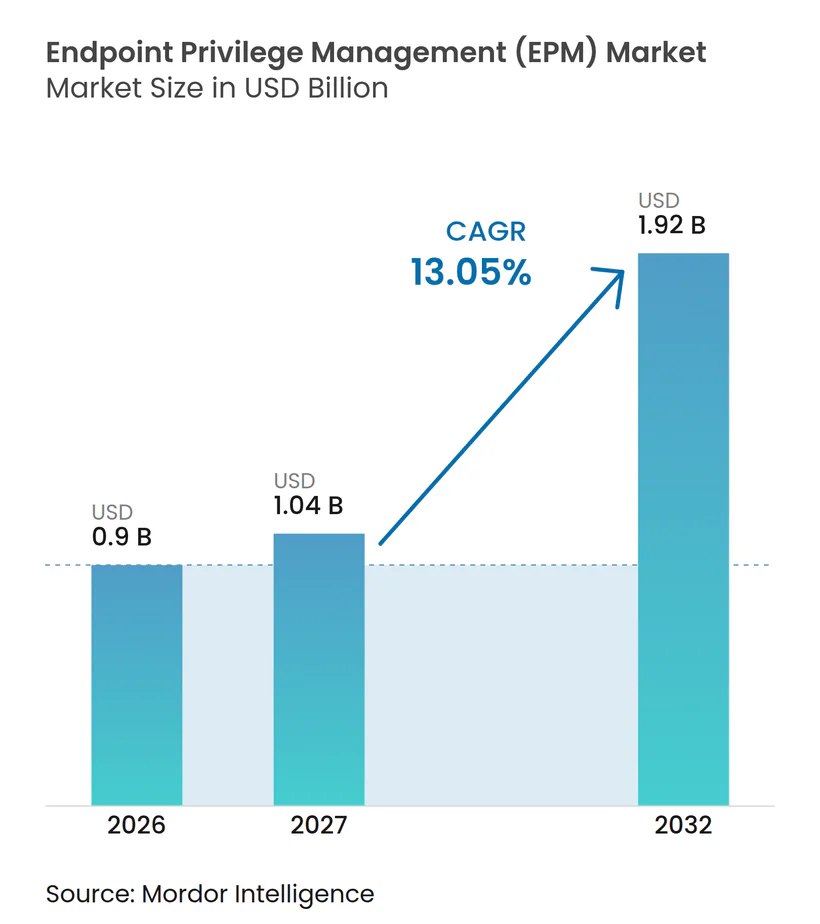
The Endpoint privilege management market size is projected to expand from USD 0.90 billion in 2026 and USD 1.04 billion in 2027 to USD 1.92 billion by 2032, registering a CAGR of 13.05% between 2027 and 2032. Demand is shifting from responding to privilege-related incidents toward removing unnecessary privileges before they can be misused. This shift places endpoint controls at the center of least-privilege programs because enterprises must govern access across expanding device, application, and identity estates. The Endpoint privilege management market is also being shaped by cloud adoption, distributed work, and the increasing use of machine and AI-agent identities. Competition is separating broad security platforms from specialists that can manage cross-platform endpoints and more complex privileged workflows. Basic Windows elevation capabilities face pricing pressure, while controls for AI agents and non-Windows estates leave room for differentiated offerings.
Key Report Takeaways
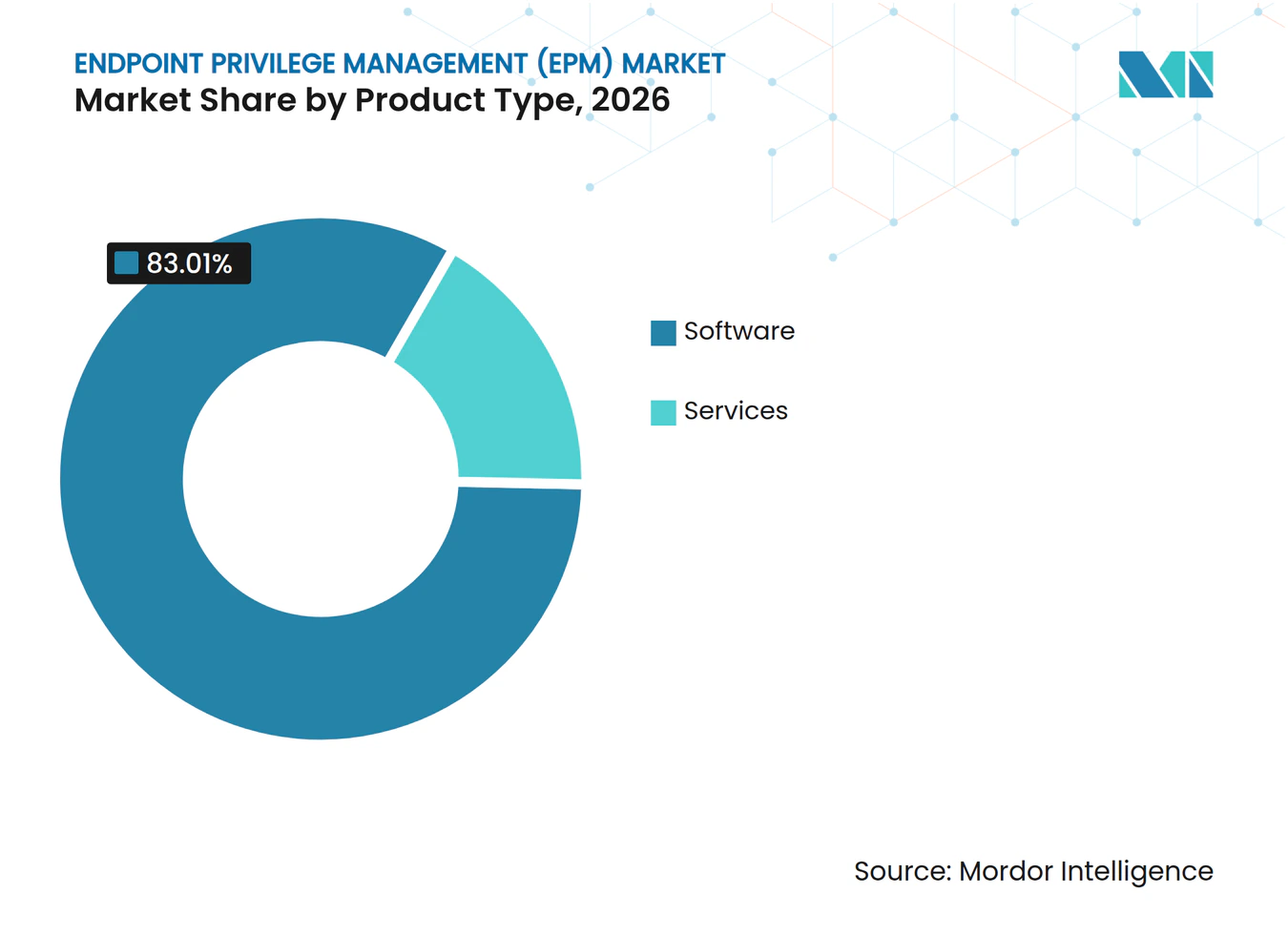
- By product type, software held 83.01% of the Endpoint privilege management market share in 2026, while managed services is projected to expand at a 14.26% CAGR through 2032.
- By deployment mode, cloud accounted for 41.01% of revenue in 2026 and is projected to expand at a 13.82% CAGR through 2032.
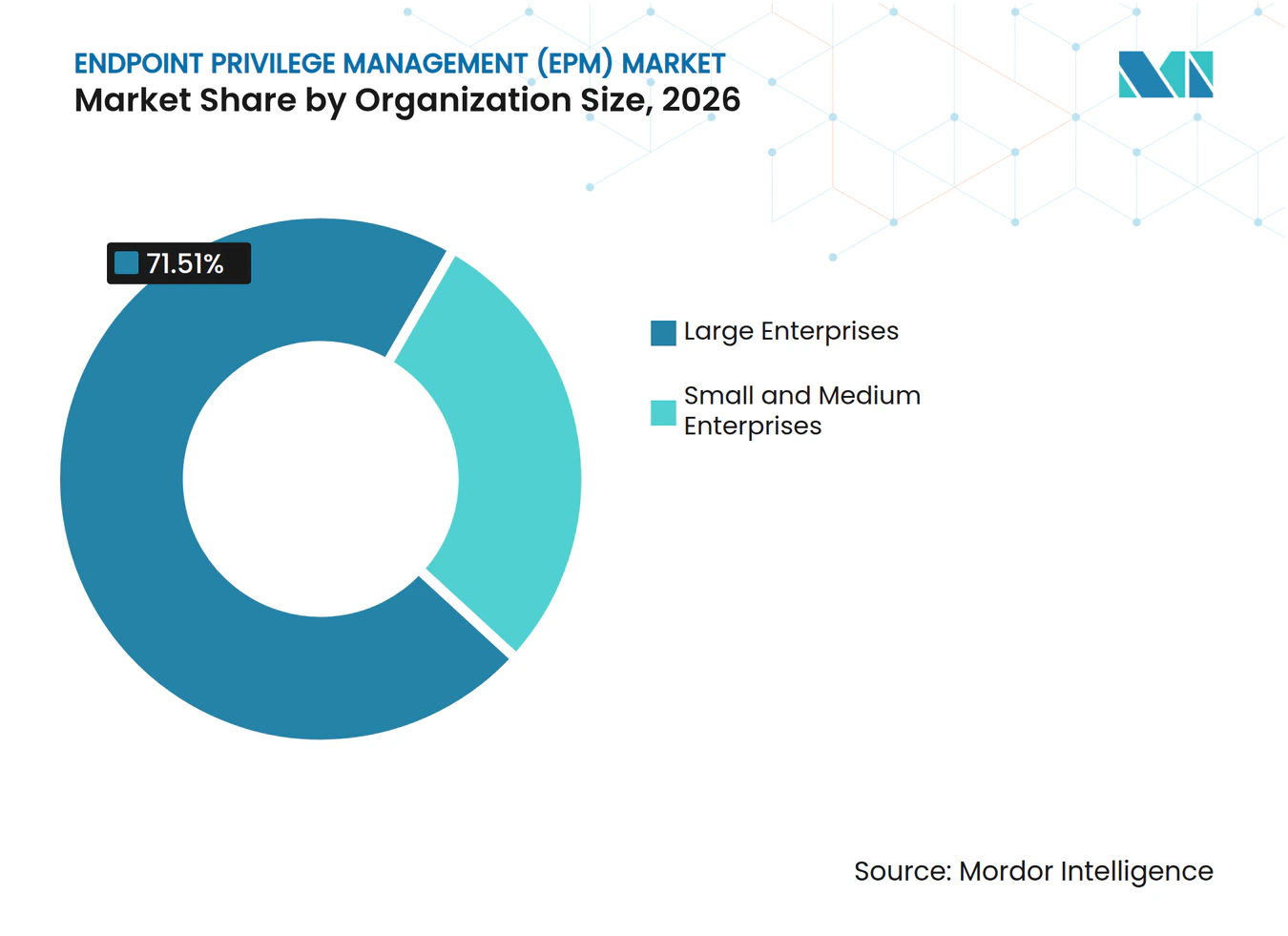
- By organization size, large enterprises held 71.51% of revenue in 2026, while SMEs are projected to expand at a 14.48% CAGR through 2032.
- By platform, Windows accounted for 71.21% of revenue in 2026, while mobile platforms are projected to expand at a 14.52% CAGR through 2032.
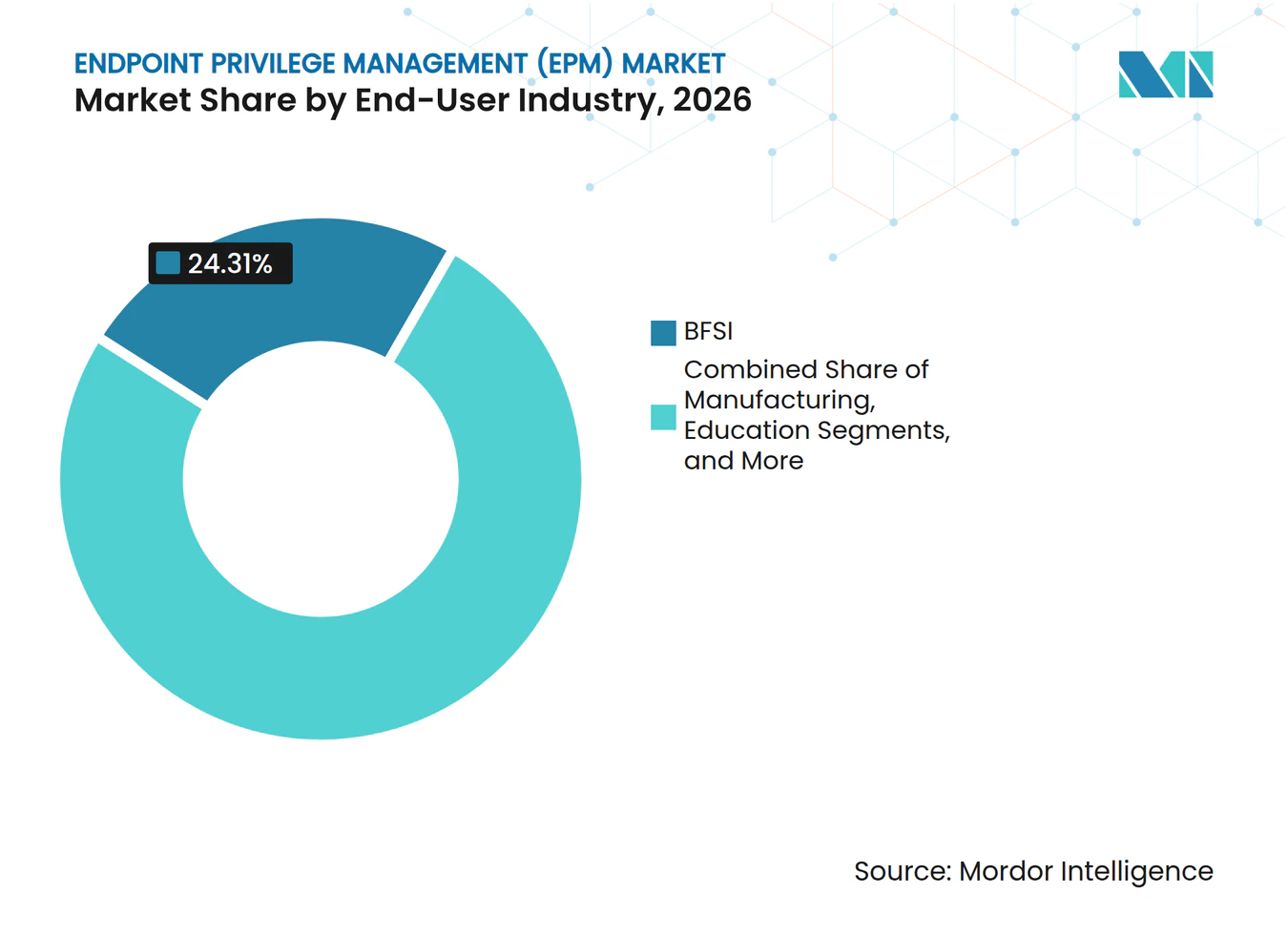
- By end-user industry, BFSI held 24.31% of revenue in 2026, while energy and utilities is projected to expand at a 14.87% CAGR through 2032.
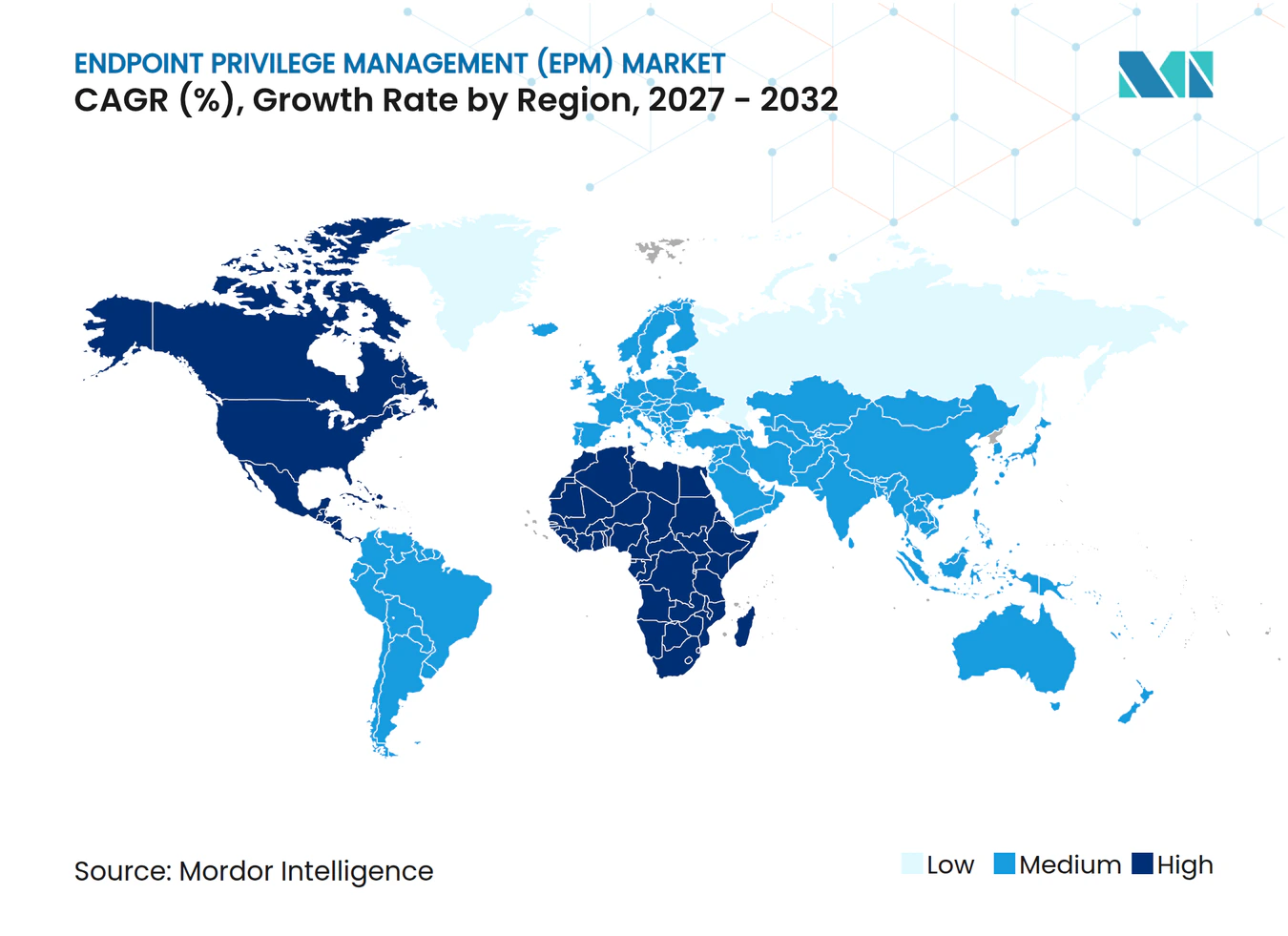
- By geography, North America held 42.46% of revenue in 2026, while Africa is projected to expand at a 14.26% CAGR through 2032.
Note: Market numbers in this report are based on Mordor Intelligence's proprietary estimation framework, which combines nine months of actuals with Q4 projections for base year 2026.
Market Trends and Insights
Drivers Impact Analysis of Endpoint Privilege Management (EPM) Market*
| Driver | (~) % Impact on CAGR Forecast | Geographic Relevance | Impact Timeline |
|---|---|---|---|
| Escalating Privileged-Account Abuse and Endpoint Breaches | +3.5% | Global, highest in North America and Europe | Short term (≤ 2 years) |
| Zero-Trust Adoption and Least-Privilege Enforcement | +2.8% | Global, strongest in North America, Europe, and Asia-Pacific | Medium term (2-4 years) |
| Remote and Hybrid Workforce Expansion | +1.9% | Global, pronounced in North America, Europe, and emerging Asia-Pacific | Short term (≤ 2 years) |
| Cloud, SaaS, and Hybrid Infrastructure Expansion | +1.7% | Global, early gains in North America and Western Europe | Medium term (2-4 years) |
| Machine and AI-Agent Identity Proliferation | +1.4% | Global, initial concentration in North America and Asia-Pacific technology hubs | Long term (≥ 4 years) |
| Just-in-Time Privilege Elevation for Developer and Administrator Workflows | +0.9% | North America and Europe, with spillover to Asia-Pacific DevOps centers | Medium term (2-4 years) |
| Source: Mordor Intelligence | |||
Escalating Privileged-Account Abuse and Endpoint Breaches
Privileged-account compromise is creating immediate demand for endpoint privilege controls because it can expose sensitive systems through a single administrator account. In July 2025, CISA and the U.S. Coast Guard identified shared local administrator credentials, passwords stored in deployment scripts, and unrestricted remote access at a U.S. critical infrastructure organization.[1] The advisory called for unique local administrator passwords, phishing-resistant MFA, role separation, and the removal of shared credentials. Those actions make endpoint privilege management relevant to operational technology as well as conventional IT environments. The CIS Controls v8.1 Account and Credential Management Policy Template, published in September 2025, also presents least privilege as a core organizational practice.[2] This regulatory and operational focus keeps privilege reduction visible in security budgets across industries. The Endpoint privilege management market benefits when buyers treat credential exposure as a control issue that requires action at the device level.
Zero-Trust Adoption and Least-Privilege Enforcement
Zero-trust programs are moving the access-control boundary from the network perimeter to each identity, device, and endpoint session. NIST issued Special Publication 800-63 Revision 4 in August 2025, covering digital identity requirements for non-human accounts and hybrid cloud contexts.[3] This scope makes standing administrator rights harder to justify where organizations seek stronger identity assurance. NIST guidance on implementing a zero-trust architecture also provides a framework for applying identity and access controls across enterprise resources. CISA's Cross-Sector Cybersecurity Performance Goals Version 2.0 identifies least-privilege access as a cross-sector baseline. The Endpoint privilege management market benefits when organizations require temporary elevation and detailed audit records rather than permanent local administration.
Remote and Hybrid Workforce Expansion
Distributed work has extended privileged activity to residential networks, unmanaged devices, and locations outside corporate network visibility. Developers, administrators, and finance personnel can initiate sensitive sessions from locations that are not consistently included in security monitoring. This makes lateral movement harder to identify than activity inside a managed office environment. Endpoint controls can apply the same elevation policy to users regardless of where they connect from. They can also create records of elevation requests, approvals, and session activity for review by security teams. The Endpoint privilege management market therefore remains relevant as organizations maintain hybrid work arrangements and seek consistent controls across dispersed endpoints.
Cloud, SaaS, and Hybrid Infrastructure Expansion
Cloud environments create many administrative surfaces, each with its own identity model, console, and policy requirements. DevOps teams need elevated access to cloud consoles, CI/CD pipelines, Kubernetes clusters, and databases, which can make manual privilege governance difficult to maintain. BeyondTrust integrated its endpoint privilege management offering with IBM QRadar in April 2025 to forward elevation events for real-time security information and event management correlation. Delinea completed its acquisition of StrongDM in March 2026, combining vault-based privileged access management with a just-in-time authorization approach for cloud-native infrastructure. These moves show how vendors are extending privilege governance from endpoints into cloud and developer workflows. The Endpoint privilege management market is consequently linked to the broader convergence of endpoint, cloud, and identity controls.
Restraints Impact Analysis of Endpoint Privilege Management (EPM) Market*
| Restraint | (~) % Impact on CAGR Forecast | Geographic Relevance | Impact Timeline |
|---|---|---|---|
| Integration Complexity Across Legacy and Heterogeneous Endpoints | -1.8% | Global, most acute in manufacturing, government, and energy sectors | Medium term (2-4 years) |
| High Total Cost of Ownership for Small and Medium-Sized Organizations | -1.3% | Global, most severe in South America, Africa, and Southeast Asia | Short term (≤ 2 years) |
| Privilege-Policy Friction in Autonomous Software and AI-Agent Workflows | -0.9% | Global, concentrated in North America and Asia-Pacific | Long term (≥ 4 years) |
| Shortage of Endpoint Privilege Governance Expertise | -0.7% | Global, most severe in Africa, South America, and smaller Asia-Pacific markets | Medium term (2-4 years) |
| Source: Mordor Intelligence | |||
Integration Complexity Across Legacy and Heterogeneous Endpoints
Legacy operating systems, proprietary industrial platforms, and mixed endpoint estates can slow endpoint privilege management deployments. Utilities, manufacturers, and government agencies may operate older Windows versions, several Linux distributions, and operational technology controllers that need separate policy approaches. Teams must evaluate agent compatibility, define application exceptions, and assess the operational effect of removing administrator rights from production systems. These requirements can extend evaluation and rollout periods even after security leaders commit to privilege reduction. Regulatory obligations for energy operators increase the need for stronger controls, but they do not remove the technical work required across heterogeneous estates. The Endpoint privilege management market must accommodate different device ages, operating systems, and production requirements before a common policy can be applied. A staged rollout can reduce disruption, but it also lengthens the time between product evaluation and full deployment.
High Total Cost of Ownership for Small and Medium-Sized Organizations
Enterprise endpoint privilege platforms can combine license fees with implementation, maintenance, policy design, exception management, and user change support costs. SMEs often have limited internal expertise to tune policies without interrupting work when administrator rights are removed. That risk can lead to partial rollbacks and uneven security coverage. Managed delivery offers an alternative, but it can retain a service premium that is difficult for organizations in cost-sensitive regions to absorb. Microsoft 365 E3 does not include Endpoint Privilege Management, which leaves a coverage gap for cost-sensitive organizations that do not use the E5 tier. The Endpoint privilege management market must therefore balance advanced control functions with delivery models that smaller organizations can implement and sustain.
*Our forecasts treat driver/restraint impacts as directional, not additive. The impact forecasts reflect baseline growth, mix effects, and variable interactions.
Endpoint Privilege Management (EPM) Market Segment Analysis
By Product Type:
Software Holds Most Revenue While Managed Services Expand FasterSoftware commanded 83.01% of Endpoint privilege management market share in 2026 because agent-based tools support real-time privilege decisions at scale. Large enterprises use these products to apply policy across extensive endpoint fleets and reduce dependence on manual approval processes. The software model is established in organizations that need persistent policy enforcement, detailed audit records, and integration with existing security tools. Professional services support these deployments through policy design, onboarding, exception handling, and change management.
Managed services is projected to expand at a 14.26% CAGR through 2032 as resource-constrained organizations seek external support for policy definition and agent maintenance. CyberArk launched its cloud-based MSP Hub in June 2025 to support multi-tenant delivery of PAM, identity governance and administration, and identity and access management capabilities. The model allows partners to deliver controls across customer environments rather than relying on each customer to operate a separate platform. It also creates a clearer route for organizations that need outside assistance with monitoring, policy maintenance, and routine administrative tasks. This supports mid-market adoption where internal teams may not have the capacity to manage privilege policies independently. The Endpoint privilege management market can reach more organizations when technical delivery and policy oversight are available through one provider relationship. Customers can use managed support to set initial rules, address exceptions, and maintain endpoint agents as their estate changes. This service model preserves the basic objective of least privilege while shifting much of the operating work to a specialist partner.


By Deployment Mode:
Cloud Leads in Share and Forecast ExpansionCloud held 41.01% of Endpoint privilege management market size in 2026 and is projected to expand at a 13.82% CAGR through 2032. This position reflects continuing migration to SaaS-delivered privilege controls rather than a mature deployment cycle. Organizations use cloud delivery to manage policy across geographically distributed endpoints, update agents without on-premises overhead, and connect with cloud identity providers. These operational benefits are particularly relevant for businesses with remote users and distributed IT operations. Cloud delivery can also give policy teams one view of changes across endpoint groups, which reduces the need to maintain several separate administrative tools. That advantage matters when organizations are trying to apply the same approval and audit process across offices, home-based staff, and branch locations. It can also simplify the delivery of policy changes when new endpoint groups are brought under a common operating model. For security teams, centralized management supports more consistent records of elevation activity and policy compliance.
On-premises deployments remain relevant in regulated banking, government, and defense settings where data residency requirements restrict SaaS adoption. Hybrid models support organizations that continue to operate on-premises policy vaults while moving selected devices and identity functions to cloud services. This approach lets organizations phase migration while retaining controls for systems that cannot immediately move to SaaS. Data sovereignty requirements in Germany, India, and Gulf Cooperation Council markets are expected to sustain demand for hybrid deployments during the forecast period. Hybrid configurations also allow security teams to keep sensitive systems on established infrastructure while extending cloud-based policy management to newer endpoint groups. This practical transition approach limits disruption for organizations that cannot change every system at the same pace. It also recognizes that legacy applications and specialized workloads may need to remain within established controls for longer periods. Hybrid adoption is therefore a practical response to operational constraints, not simply a temporary technical preference.
By Organization Size:
Large Enterprises Lead While SMEs AccelerateLarge enterprises held 71.51% of revenue in 2026 because they operate broad endpoint fleets and can support multi-policy privilege governance. Their purchasing decisions often favor platforms that integrate with Active Directory, SIEM systems, and endpoint detection and response tools. This makes ecosystem depth an important consideration for large deployments. These organizations also have greater capacity to manage policy design, application exceptions, and ongoing administration. Their larger security teams can test policy changes in controlled groups before applying them more widely. This helps them use endpoint privilege tools as part of a broader program that covers identity, detection, and response functions.
SMEs are projected to expand at a 14.48% CAGR through 2032 as cyber insurance requirements, NIS2 obligations, and subscription delivery models broaden adoption. WALLIX Group's European positioning aligns with compliance-driven demand among mid-sized organizations in France and Germany. The segment also benefits when managed providers deliver policy expertise as a service. Subscription-based products can make it easier for these customers to start with a limited set of users and expand when policies are established. Smaller organizations can focus on the highest-risk administrator accounts before extending controls to more employees and endpoints. This staged approach can reduce the disruption that follows a sudden withdrawal of broad local rights. The Endpoint privilege management market is therefore moving from initial enterprise adoption toward a wider mid-market customer base, with smaller average deal sizes but a broader volume of users.

By Platform:
Windows Remains the Primary Base While Mobile ExpandsWindows accounted for 71.21% of revenue in 2026, reflecting its broad presence in corporate environments and the longstanding issue of excessive local administrator rights. Windows estates often have documented exposure to lateral movement when privileged accounts are over-provisioned. This installed base continues to make Windows a central platform for endpoint policy enforcement. Organizations also need controls that can remove standing rights without disrupting routine business applications. That requirement keeps application control and well-maintained exception processes important for Windows deployments. The focus is not only on blocking elevation, but also on allowing authorized work to continue with a documented and time-limited approval path. This reflects the need to balance security policy with the day-to-day requirements of employees and technical teams. It also makes user experience and clear policy communication important in large Windows environments.
Mobile platforms are projected to expand at a 14.52% CAGR through 2032 as BYOD policies make mobile devices part of privileged access workflows. macOS adoption is also increasing in design and software engineering organizations, while Linux privilege management requires more granular policy structures. NIST Special Publication 800-63 Revision 4 addresses mobile authentication contexts and supports a broader identity framework for regulated organizations. Vendors that support Windows, macOS, Linux, and mobile environments can address customers with mixed endpoint fleets and more varied administrative activity. This reduces the burden of applying separate products and separate policy standards to each operating system. Cross-platform scope is therefore relevant where endpoint strategies include personal devices, engineering workstations, and server environments. Different operating systems create different administration patterns, so the policy model must be flexible without becoming difficult to operate. Providers that can support these patterns through one management approach have a clearer position with mixed-fleet customers.
By End-User Industry:
BFSI Leads While Energy and Utilities Advances FastestBFSI held 24.31% of revenue in 2026 because financial institutions must meet strict access-control requirements. DORA has applied to EU financial entities since January 17, 2025, while PCI DSS 4.0 and the SWIFT Customer Security Programme also reinforce privileged-access governance. Healthcare and life sciences represent another major user group because connected devices and sensitive data increase the importance of controlled administrative access. IT and telecommunications customers use endpoint privilege tools with DevOps systems to govern cloud service administrator accounts and CI/CD credentials.
Energy and utilities is projected to expand at a 14.87% CAGR through 2032 as security requirements increase across electricity, gas, oil, and heat operations. Information security requirements for energy utilities are becoming more formal, which moves certain security investments from discretionary initiatives toward compliance-driven programs. Operators need policies that can work across corporate systems and specialized operational environments. Government and defense buyers also follow NIST SP 800-53 and related national frameworks, which can make procurement less sensitive to routine budget cycles. These sectors commonly require auditability, clear role separation, and documented administrative activity. Those needs make consistent endpoint policy enforcement a practical part of a broader compliance program. The same requirements also support demand for tools that record how and when administrative rights were used. This is relevant when organizations need to demonstrate that elevated access was controlled and reviewable.

Geography Analysis
North America Endpoint Privilege Management (EPM) Market
North America held 42.46% of Endpoint privilege management market share in 2026 and remains the most mature regional adoption base. U.S. federal zero-trust initiatives support least-privilege adoption among federal agencies, state and local bodies, and critical infrastructure operators. CISA's Cross-Sector Cybersecurity Performance Goals Version 2.0 identifies least-privilege access as a baseline security goal. The 2025 CISA and U.S. Coast Guard advisory also highlighted weaknesses in local administrator credentials at a critical infrastructure organization. Canada applies similar attention to endpoint hardening, while Mexico develops through multinational organizations that extend parent-company controls to local operations. The region also has a large installed base of enterprises with established security operations teams and formal identity programs. This supports deployments that connect endpoint elevation data with other security monitoring processes.
Europe and APAC Endpoint Privilege Management (EPM) Market
Europe is the second-largest geography and has a dense set of regulatory influences across finance, critical infrastructure, transport, health, and digital services. DORA has been enforceable since January 2025, while NIS2 is introducing access-governance requirements for essential and important entities. European energy operators face a stronger focus on systematic risk management and timely incident reporting. In Asia-Pacific, Japan, Australia, and South Korea each apply their own cybersecurity frameworks. The Endpoint privilege management market is shaped by these country-specific requirements as well as by enterprise technology choices. NTT TechnoCross reported that iDoperation held a 33.3% share of Japan's privileged ID management tool sector in fiscal 2024, which shows the role of domestic vendors alongside global platforms. This local competition means global vendors need to align their products with regional procurement practices and established customer relationships. It also shows that the region includes both multinational deployments and country-specific security platforms.
MEA and South America Endpoint Privilege Management (EPM) Market
Africa is projected to expand at a 14.26% CAGR through 2032, the fastest regional rate in the Endpoint privilege management market. South America, the Middle East, and Africa are at different stages of adoption, but each presents new deployment opportunities. Brazil is supported by LGPD obligations and financial-sector access-governance requirements. Saudi Arabia and the United Arab Emirates are advancing adoption through digitization programs and cybersecurity expectations for government and critical infrastructure. Nigeria, South Africa, and Kenya are expanding financial and telecommunications infrastructure, creating new endpoint estates that require privilege controls. South Africa and Egypt lead African deployments, while Nigeria is extending policy requirements toward mobile banking and application access workflows. The region's higher forecast rate reflects the expansion of digital services from a lower deployment base. Organizations that add new financial and telecommunications infrastructure can introduce privilege controls as endpoint estates are built and extended.
Competitive Landscape
Market Concentration
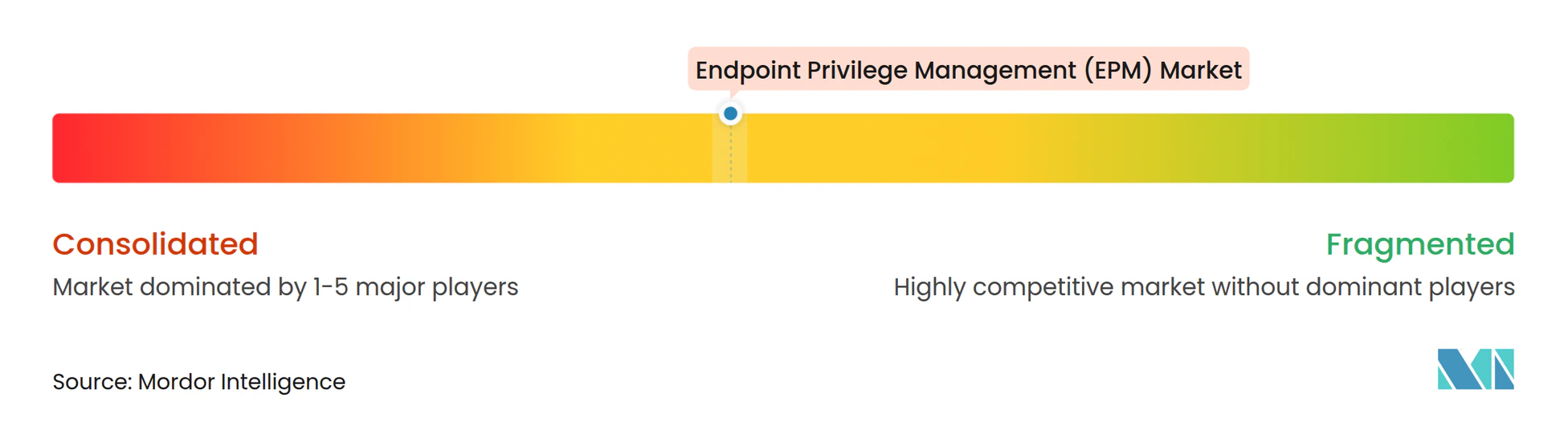
The Endpoint privilege management market has moderate concentration among CyberArk, BeyondTrust, and Delinea in large-enterprise accounts, while regional and specialist vendors compete for mid-market and vertical opportunities. The leading vendors are broadening their platforms through acquisitions, cloud delivery, and identity governance capabilities. CyberArk acquired Zilla Security for USD 175 million in April 2025, adding AI-assisted access review capabilities to its identity security platform. Delinea completed the StrongDM acquisition in March 2026 to combine vault-based privileged access management with continuous authorization for cloud infrastructure and AI-agent use cases. BeyondTrust has strengthened its operational context through an integration that forwards endpoint elevation events to IBM QRadar. These actions reflect a competitive focus on connecting privilege data with broader identity and security operations. Buyers can therefore assess providers by the breadth of controls around the endpoint rather than elevation features alone.
Competitive space remains open in AI-agent identity governance, cross-platform mobile support, and managed delivery for smaller organizations. The Endpoint privilege management market continues to develop as vendors extend their controls beyond standard workstation administration. CyberArk introduced its Secure AI Agents Solution in November 2025 with just-in-time access, zero-standing privileges, and session monitoring for AI agents. This area is important because AI agents may require privileged access across SaaS, cloud, and developer environments. The Endpoint privilege management market also favors providers that can connect developer workflow controls with policy enforcement for human and non-human identities. Vendors serving cross-platform endpoints can address customers whose Windows, macOS, Linux, and mobile environments fall outside a single operating system approach. This is particularly relevant for organizations that need one policy structure for employee devices, engineering systems, and servers. The Endpoint privilege management market continues to reward providers that can reduce separate management processes across these environments.
Managed delivery is another competitive route because many SMEs need security outcomes without building large in-house policy teams. The Endpoint privilege management market can serve this group when providers make policy administration easier to access and maintain. CyberArk's MSP Hub supports multi-tenant administration and partner-led delivery, which can lower the operational burden for customers. Keeper Security launched Endpoint Privilege Manager in May 2025 with just-in-time elevation, optional MFA, approval workflows, and support for Windows, macOS, and Linux. This makes cross-platform functionality a practical point of differentiation for vendors seeking mid-market accounts. Products that pair simple deployment with clear approval paths can be better suited to teams that cannot maintain complex exception libraries. Competitive success therefore depends on both coverage and the ability to make least-privilege policies workable for daily users.
Endpoint Privilege Management (EPM) Industry Leaders
-
Palo Alto Networks
-
BeyondTrust Corporation
-
Delinea Inc.
-
One Identity LLC
-
Zoho Corporation Pvt. Ltd.
- *Disclaimer: Major Players sorted in no particular order
Endpoint Privilege Management (EPM) Market Companies Covered in this Report
- Palo Alto Networks
- BeyondTrust Corporation
- Delinea Inc.
- One Identity LLC
- Zoho Corporation Pvt. Ltd.
- WALLIX Group SA
- ARCON TechSolutions Pvt. Ltd.
- Hitachi ID Systems, Inc.
- IBM Corporation
- Microsoft Corporation
- Broadcom Inc.
- Quest Software Inc.
- Osirium Technologies plc
- Senhasegura
- Fudo Security
- Saviynt, Inc.
- Keeper Security, Inc.
- FastTrack Software ApS
Recent Industry Developments in Endpoint Privilege Management (EPM) Market
- July 2026: SailPoint introduced instance-level PAM discovery connectors for BeyondTrust Password Safe Cloud and Delinea Secret Server within its Identity Security Cloud on July 9, 2026, using OAuth 2.0 authentication. The update extends SailPoint's privileged access management governance coverage to Idira, BeyondTrust, and Delinea, enabling inventory of managed systems for identity governance alignment.
- May 2026: Palo Alto Networks introduced Idira on May 12, 2026, integrating PAM, identity governance and administration, machine identity security, and agentic identity security into a single platform with over 300 integrations. Existing CyberArk customers continue on the same platform under the Idira brand, with access to cross-platform capabilities across the Palo Alto Networks portfolio.
- March 2026: Delinea closed its acquisition of StrongDM on March 5, 2026, merging vault-based PAM with StrongDM's just-in-time proxy-based access model for cloud-native infrastructure, databases, Kubernetes clusters, and CI/CD pipelines. The combined platform, powered by Delinea Iris AI, provides real-time policy evaluation for human and non-human identities and supports a zero-standing-privilege model without replacing existing PAM infrastructure.
- January 2026: Delinea and StrongDM announced a definitive acquisition agreement on January 15, 2026. StrongDM carried an estimated USD 16 million ARR, and the deal received ACCC clearance on February, 2026 before closing in March 2026.
Global Endpoint Privilege Management (EPM) Market Report Scope
The Endpoint Privilege Management Market is Segmented by Product Type (Software, Services(Professional Services, Managed Services)), Deployment Mode (Cloud, On-Premises, Hybrid), Organization Size (Large Enterprises, Small and Medium Enterprises), Platform (Windows, macOS, Linux, Mobile Platforms), End-User Industry (BFSI, Healthcare and Life Sciences, Information Technology and Telecommunications, Government and Defense, Manufacturing, Retail and E-Commerce, Energy and Utilities, Education, Other End-User Industries), and Geography (North America, South America, Europe, Asia-Pacific, Middle East, Africa). The Market Forecasts are Provided in Terms of Value (USD).
Segmentation Overview
| Software | |
| Services | Professional Services |
| Managed Services |
| Cloud |
| On-Premises |
| Hybrid |
| Large Enterprises |
| Small and Medium Enterprises |
| Windows |
| macOS |
| Linux |
| Mobile Platforms |
| BFSI |
| Healthcare and Life Sciences |
| Information Technology and Telecommunications |
| Government and Defense |
| Manufacturing |
| Retail and E-Commerce |
| Energy and Utilities |
| Education |
| Other End-User Industries |
| North America | United States |
| Canada | |
| Mexico | |
| South America | Brazil |
| Argentina | |
| Rest of South America | |
| Europe | Germany |
| United Kingdom | |
| France | |
| Italy | |
| Spain | |
| Russia | |
| Rest of Europe | |
| Asia-Pacific | China |
| India | |
| Japan | |
| South Korea | |
| Australia | |
| Rest of Asia-Pacific | |
| Middle East | Saudi Arabia |
| United Arab Emirates | |
| Turkey | |
| Rest of Middle East | |
| Africa | South Africa |
| Egypt | |
| Nigeria | |
| Rest of Africa |
| By Product Type | Software | |
| Services | Professional Services | |
| Managed Services | ||
| By Deployment Mode | Cloud | |
| On-Premises | ||
| Hybrid | ||
| By Organization Size | Large Enterprises | |
| Small and Medium Enterprises | ||
| By Platform | Windows | |
| macOS | ||
| Linux | ||
| Mobile Platforms | ||
| By End-User Industry | BFSI | |
| Healthcare and Life Sciences | ||
| Information Technology and Telecommunications | ||
| Government and Defense | ||
| Manufacturing | ||
| Retail and E-Commerce | ||
| Energy and Utilities | ||
| Education | ||
| Other End-User Industries | ||
| By Geography | North America | United States |
| Canada | ||
| Mexico | ||
| South America | Brazil | |
| Argentina | ||
| Rest of South America | ||
| Europe | Germany | |
| United Kingdom | ||
| France | ||
| Italy | ||
| Spain | ||
| Russia | ||
| Rest of Europe | ||
| Asia-Pacific | China | |
| India | ||
| Japan | ||
| South Korea | ||
| Australia | ||
| Rest of Asia-Pacific | ||
| Middle East | Saudi Arabia | |
| United Arab Emirates | ||
| Turkey | ||
| Rest of Middle East | ||
| Africa | South Africa | |
| Egypt | ||
| Nigeria | ||
| Rest of Africa | ||
Key Questions Answered in the Report
What is the Endpoint privilege management market size?
The Endpoint privilege management market is projected to be USD 1.04 billion in 2027 and USD 1.92 billion by 2032, at a 13.05% CAGR.
What is driving adoption of endpoint privilege management?
Privileged-account abuse, zero-trust programs, distributed work, and cloud administration needs are increasing demand for just-in-time elevation and least-privilege controls.
Which product type leads endpoint privilege management adoption?
Software led with 83.01% of 2026 revenue because enterprises use agent-based tools for real-time policy enforcement across large endpoint fleets.
Which deployment model is expanding fastest?
Cloud delivery led with 41.01% of 2026 revenue and is projected to expand at a 13.82% CAGR through 2032.
Which end-user sector has the fastest projected expansion?
Energy and utilities is projected to expand at a 14.87% CAGR through 2032 as security requirements increase for critical infrastructure operators.
Which region has the fastest projected expansion?
Africa is projected to expand at a 14.26% CAGR through 2032, supported by financial digitization and new telecommunications infrastructure.