
Managed Endpoint Compliance Services Market Size and Share
Market Overview
| Study Period | 2021 - 2032 |
|---|---|
| Market Size (2027) | USD 6.07 Billion |
| Market Size (2032) | USD 11.43 Billion |
| Growth Rate (2027 - 2032) | 13.49 % |
| Fastest Growing Market | Asia-Pacific |
| Largest Market | North America |
| Market Concentration | Medium |
Major Players *Disclaimer: Major Players sorted in no particular order Image © Mordor Intelligence. Reuse requires attribution under CC BY 4.0. | |
Managed Endpoint Compliance Services Market Analysis by Mordor Intelligence
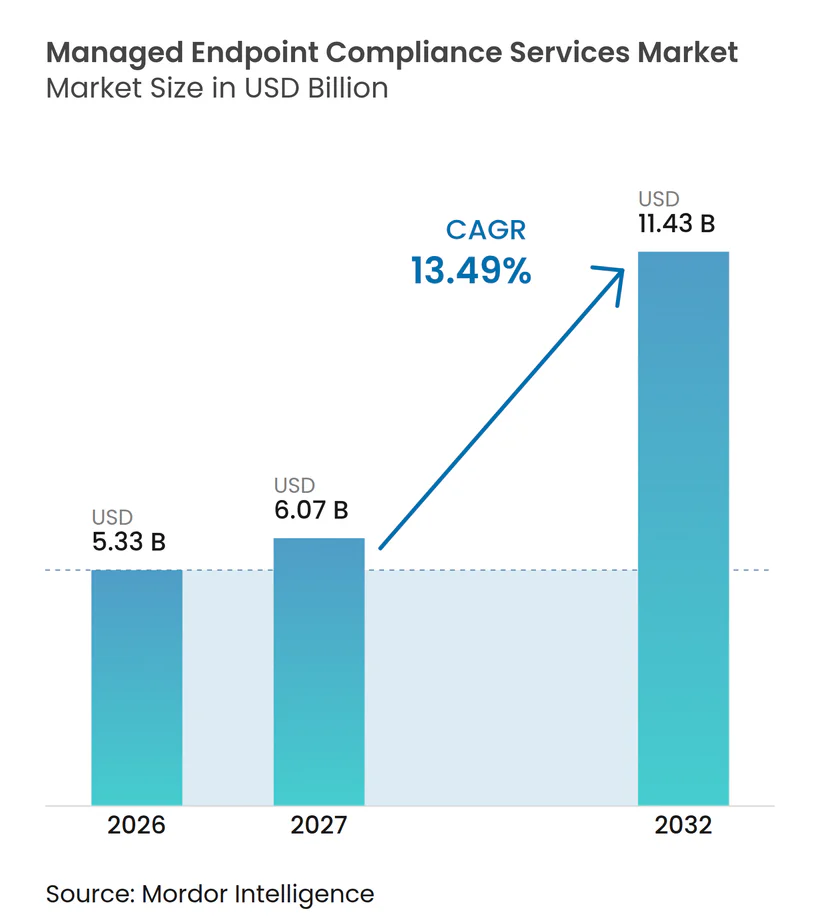
The Managed Endpoint Compliance Services Market size is projected to expand from USD 5.33 billion in 2026 and USD 6.05 billion in 2027 to USD 11.43 billion by 2032, registering a CAGR of 13.49% between 2027 and 2032. Hybrid work has widened the range of networks, devices, and operating settings that enterprise IT teams must oversee. This is moving endpoint compliance from a narrow security task to a continuous governance function that affects resilience, regulatory compliance, and employee productivity. Buyers increasingly expect providers to prevent issues and show results, rather than only close support tickets after an incident. Automation, cloud platforms, and digital employee experience tools are therefore becoming more important in service design and contract delivery. Providers that can combine automation with an auditable compliance process are better placed as customers move toward outcome-based arrangements.
Key Report Takeaways
- By service type, Service Desk and Technical Support held 32.24% of the Managed Endpoint Compliance Services Market in 2026, while Self-Heal and Automation a projected to expand at a 13.94% CAGR through 2032.
- By deployment mode, Cloud accounted for 72.28% of revenue in 2026 and is projected to expand at a 13.88% CAGR through 2032.
- By organization size, Large Enterprises held 78.54% of revenue in 2026, while Small and Medium Enterprises are projected to expand at a 13.79% CAGR through 2032.
- By enterprise type, the Private Sector accounted for 77.63% of revenue in 2026 and is projected to grow at a 13.93% CAGR through 2032.
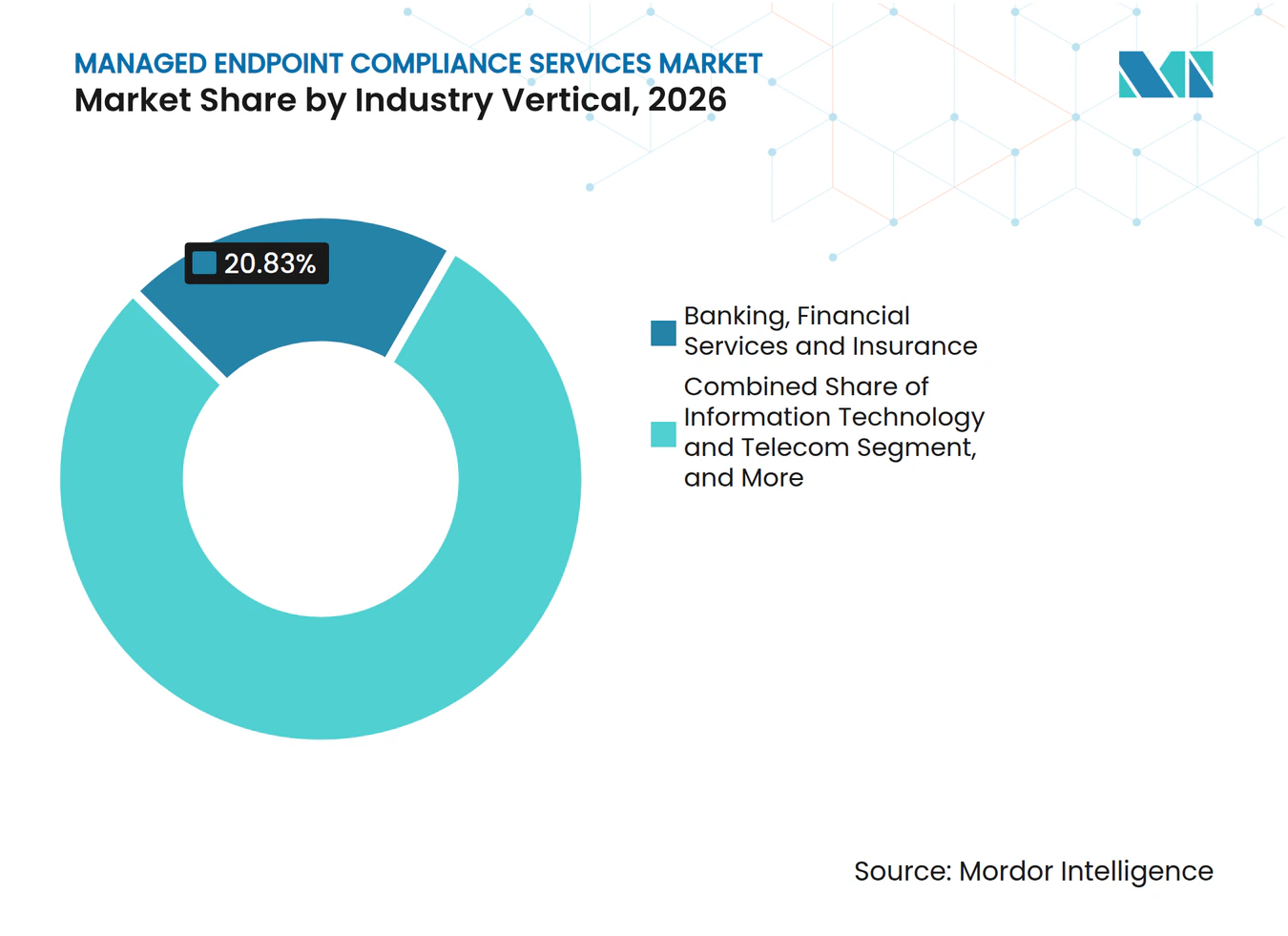
- By industry vertical, BFSI accounted for 20.83% of revenue in 2026, while Healthcare is projected to expand at a 14.12% CAGR through 2032.
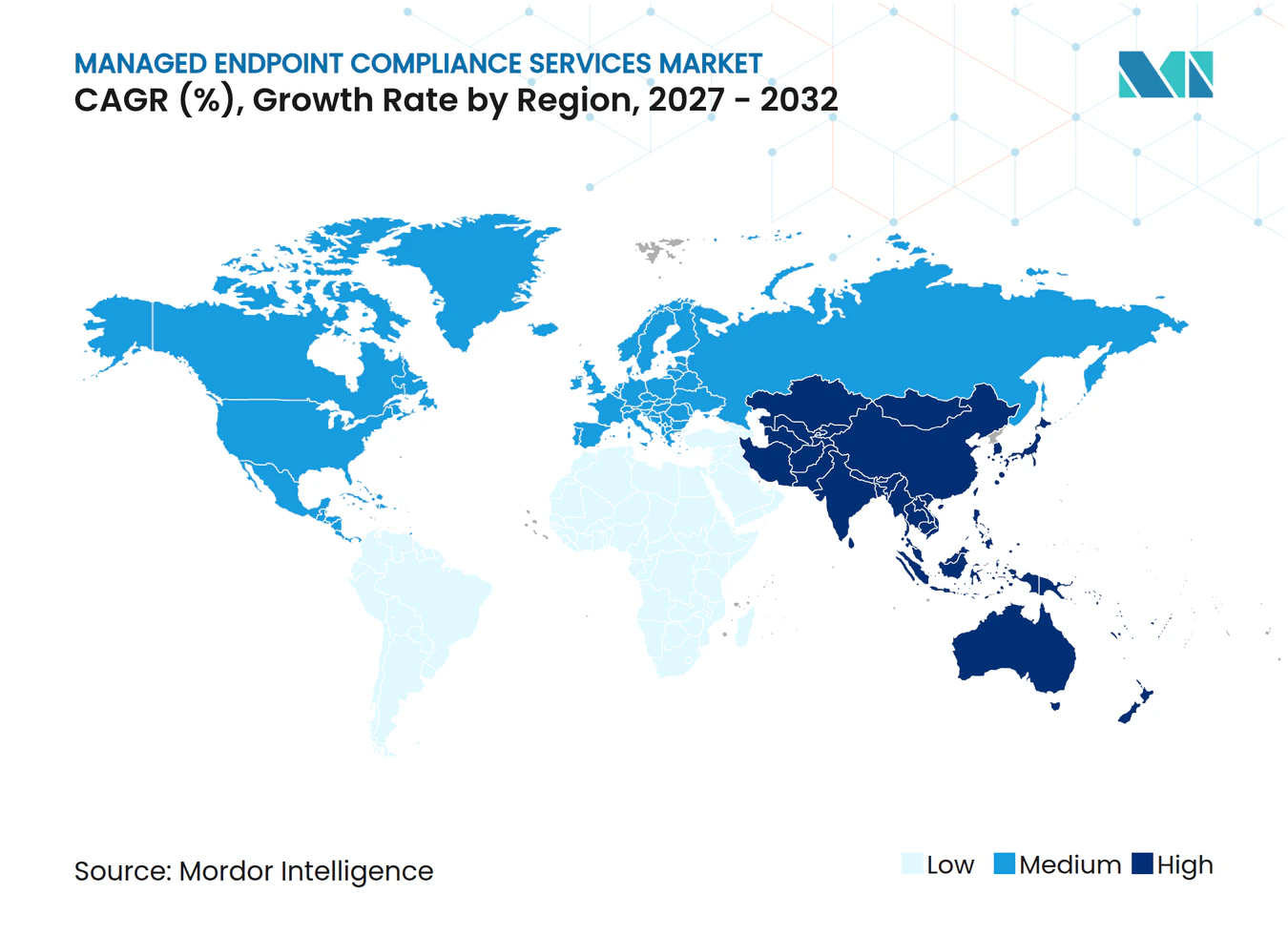
- By geography, North America held 42.18% of revenue in 2026, while Asia-Pacific is projected to expand at a 14.24% CAGR through 2032.
Note: Market numbers in this report are based on Mordor Intelligence's proprietary estimation framework, which combines nine months of actuals with Q4 projections for base year 2026.
Market Trends and Insights
Drivers Impact Analysis of Managed Endpoint Compliance Services Market*
| Driver | (~) % Impact on CAGR Forecast | Geographic Relevance | Impact Timeline |
|---|---|---|---|
| Hybrid Work Support Complexity | +3.2% | Global | Short term (≤ 2 years) |
| Cloud Workplace Platform Adoption | +2.8% | North America, Europe, Asia-Pacific | Medium term (2-4 years) |
| AI-Enabled Service Desk Modernization | +2.5% | Global | Medium term (2-4 years) |
| Experience-Level Agreements and Outcome-Based Contracting | +1.9% | North America, Europe | Medium term (2-4 years) |
| Agentic Workplace Orchestration and Self-Healing Operations | +1.6% | North America, Asia-Pacific | Long term (≥ 4 years) |
| Mobile and Frontline Workforce Observability | +1.2% | Asia-Pacific, Middle East and Africa, South America | Medium term (2-4 years) |
| Source: Mordor Intelligence | |||
Hybrid Work Support Complexity
Hybrid work creates a higher support burden that single-location IT models cannot consistently address across a dispersed workforce. Enterprises now manage endpoint estates across offices, home networks, public Wi-Fi connections, customer locations, and branch settings. Each setting can produce different device-health patterns, application performance issues, access conditions, and security risks. Ivanti found that 77% of IT professionals said their organizations measure and manage digital employee experience, although only 50% treated it as a high priority.[1] The gap is especially clear in large organizations that still use separate monitoring tools and cannot identify problems across work settings early enough to prevent them. The Managed Endpoint Compliance Services Market benefits when providers can bring this telemetry together, apply a common service process, and deliver consistent remediation wherever employees work.
Cloud Workplace Platform Adoption
Cloud-delivered management platforms allow providers to apply policy updates, security patches, and endpoint configuration changes across a managed estate without maintaining local management infrastructure. This capability can reduce the time needed to apply a shared compliance baseline across dispersed devices, operating systems, and workforce locations. It also makes centralized audit records, configuration tracking, and retained evidence more practical for organizations with large device estates. Cloud-native policy engines can identify configuration drift in real time and preserve an audit trail that legacy local tools may not provide. As workplace platforms expand their endpoint governance capabilities, managed service providers need deeper integrations and stronger operational processes rather than additional infrastructure capacity. This supports the Managed Endpoint Compliance Services Market because providers can organize delivery around policy enforcement, visibility, documented compliance outcomes, and timely response.
AI-Enabled Service Desk Modernization
Service desks are shifting from a tiered escalation model toward AI-supported triage, guided decision-making, and automated resolution of defined issues. Endpoint health, recent configuration changes, application behavior, and user identity information can be assembled before a technician begins work. This context can shorten resolution times, reduce repeated diagnostic steps, and lower the effort required from support staff handling routine cases. Research in Electronics described how agentic AIOps systems can execute resolution workflows across varied infrastructure and support self-healing IT environments.[2] Providers that apply these tools can manage more incidents without matching increases in staff numbers, while reserving specialist skills for complex exceptions. The Managed Endpoint Compliance Services Market benefits from this shift, as automation can reduce demand for routine support while increasing the value of managed remediation, operational oversight, and compliance management.
Experience-Level Agreements and Outcome-Based Contracting
Experience-level agreements evaluate services through employee outcomes such as satisfaction, perceived productivity loss, ease of support, and effort required to complete work. This differs from traditional service-level agreements that focus on uptime, incident volumes, and ticket closure. Managed providers must therefore show that endpoint services improve the employee experience as well as meet technical operating targets. Automation can make delivery results more consistent, which is important when service outcomes are tied to contract measures and provider accountability. Computacenter reported that more than 30% of surveyed organizations viewed experience-level agreements as a way to better understand employee satisfaction. The Managed Endpoint Compliance Services Market is affected as buyers compare providers based on auditable workforce outcomes, service consistency, and visible remediation results rather than staffing capacity alone.
Restraints Impact Analysis of Managed Endpoint Compliance Services Market*
| Restraint | (~) % Impact on CAGR Forecast | Geographic Relevance | Impact Timeline |
|---|---|---|---|
| Employee Telemetry Privacy and Consent Requirements | -1.8% | Europe, North America | Short term (≤ 2 years) |
| Cyber Risk From Privileged Outsourced Support Access | -1.4% | Global | Medium term (2-4 years) |
| Tool Overlap Across DEX, UEM, ITSM and Observability Platforms | -1.1% | North America, Europe | Medium term (2-4 years) |
| DEX Outcome Attribution and Mid-Market Budget Scrutiny | -0.9% | North America, Europe | Short term (≤ 2 years) |
| Source: Mordor Intelligence | |||
Employee Telemetry Privacy and Consent Requirements
Endpoint telemetry can capture device activity, application use, network behavior, user interaction signals, and the condition of workplace equipment. This creates friction with privacy laws, labor expectations, and internal employee-consent requirements. The UK Information Commissioner’s Office states that worker monitoring must meet data-minimization principles, establish a lawful basis for processing, and protect workers’ rights over personal data.[3] Providers must adjust telemetry settings by country, employment contract type, and the legitimate purpose of each monitoring activity. Organizations that use monitoring tools without data protection impact assessments can face regulatory risk, additional contractual reviews, and slower outsourcing decisions. The Managed Endpoint Compliance Services Market can therefore face longer sales cycles as data residency, consent tracking, and AI processing requirements become more varied.
Cyber Risk From Privileged Outsourced Support Access
Managed endpoint support requires privileged access to devices, identity systems, configuration databases, and sometimes security or compliance controls. A compromised privileged account can create opportunities to alter policy settings, interrupt business operations, or remove data across a large endpoint estate. US data breach costs reached USD 10.22 million per incident in 2025, up 9% from the prior year. Regulated customers are responding with just-in-time access, zero-trust connectivity, session controls, and continuous monitoring of provider activity. These controls can make delivery more costly, lengthen security reviews, and slow contract approval. The effect is strongest in banking and healthcare, where endpoint access is subject to formal examination under PCI-DSS v4.0 and HIPAA requirements.
*Our forecasts treat driver/restraint impacts as directional, not additive. The impact forecasts reflect baseline growth, mix effects, and variable interactions.
Managed Endpoint Compliance Services Market Segment Analysis
By Service Type:
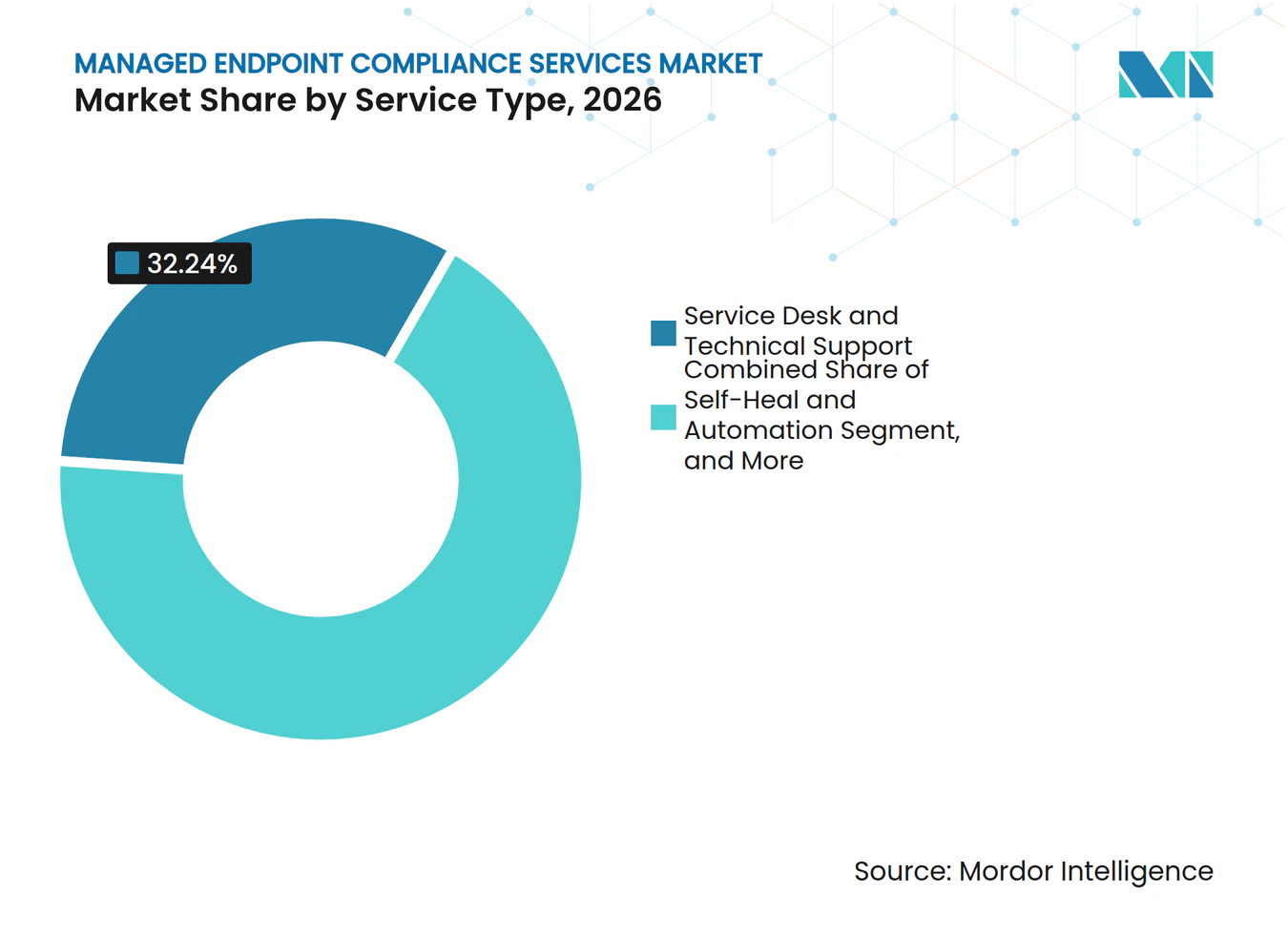
Automation Changes the Established Support Desk ModelService Desk and Technical Support held 32.24% of the Managed Endpoint Compliance Services Market share in 2026, making it the largest service type. Its position reflects continuing demand for human-led resolution of authentication failures, VPN issues, and device configuration problems. Hybrid work has increased the number and variety of incidents that require first-line support. DEX Monitoring and Analytics supports visibility into device and application performance. Persona and Sentiment Management helps providers understand the employee experience across user groups. Device, Application, and Network Experience Management brings operational signals together across the endpoint environment. These offerings serve different observability and continuity needs within the broader managed compliance service stack. They also help providers find recurring issues before they become widespread support incidents.
Self-Heal and Automation are projected to expand at a 13.94% CAGR from 2027 to 2032. Autonomous remediation allows endpoint agents to detect, diagnose, and address defined issues without human intervention. This can reduce ticket volumes and shorten the time needed to restore service. Its adoption does not remove the need for service desks because exception-driven cases still require skilled staff. Instead, it changes the role of service-desk teams toward complex cases, oversight, and improvement of automation rules. The Managed Endpoint Compliance Services Market size for automation-led services benefits as providers package playbooks, outcome dashboards, and documented remediation processes into higher-value contracts. This shift can pressure traditional per-incident work while supporting higher-margin management of automated services. Providers that document their workflows and maintain clear controls are better placed to support compliance reviews.



By Deployment Mode:
Cloud Leadership Reflects Operating RequirementsCloud accounted for 72.28% of revenue in 2026 and held the leading position in this deployment mode. Cloud is also projected to expand at a 13.88% CAGR from 2027 to 2032. Centralized policy enforcement is a major reason for this position. Providers can update controls and configurations across large endpoint estates without relying on local infrastructure in every site. Cloud platforms also support shared reporting, audit records, and continuous monitoring for distributed users. These functions are valuable when security rules and compliance baselines must be applied consistently. The Managed Endpoint Compliance Services Market has a strong cloud foundation because buyers want current controls without the burden of maintaining on-premises management systems.
Cloud-native platforms are also well-suited to AI-supported remediation and centralized configuration analysis. Providers can build services around policy-drift detection, real-time logs, and regulatory configuration benchmarks. This gives customers a clearer record of actions taken across managed devices. On-premise deployment remains relevant in air-gapped environments and organizations with strict sovereignty rules. Government agencies and regulated industries may retain local systems when data processing or connectivity needs are tightly controlled. Hybrid configurations remain important during transitions from legacy endpoint estates to cloud management. In Europe, NIS2-related compliance duties reinforce the need for structured endpoint reporting across operating locations. The Managed Endpoint Compliance Services Market industry continues to include several deployment options because regulatory settings and legacy environments differ across customers.
By Organization Size:
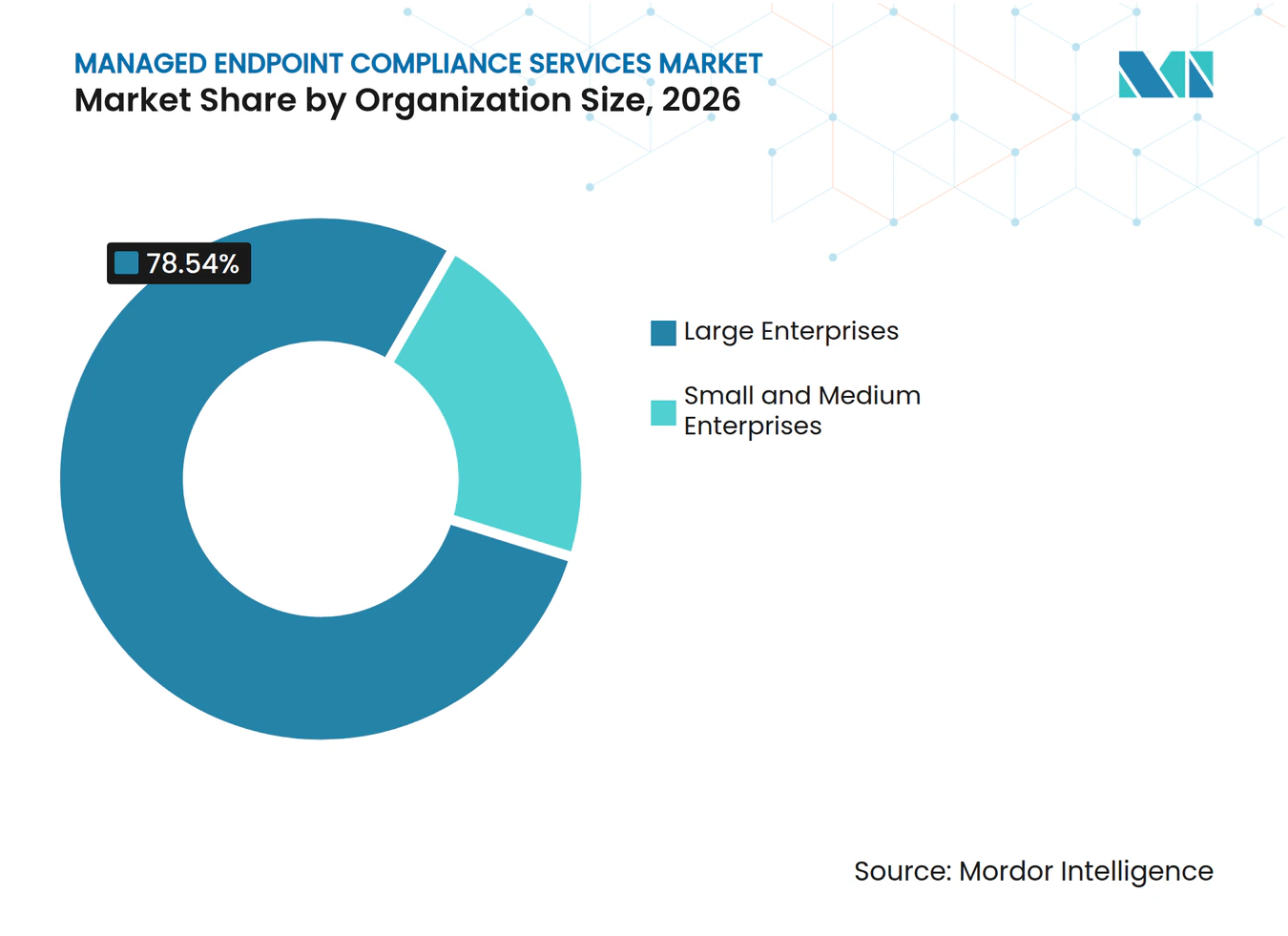
Large Enterprises Lead While SMEs Increase AdoptionLarge Enterprises held 78.54% of revenue in 2026, giving this group the largest position by organization size. Their endpoint estates are often complex and include several device vendors, operating environments, and internal user groups. Publicly listed organizations and regulated enterprises also face ongoing governance requirements. For these customers, continuous endpoint compliance can become an operating requirement instead of a discretionary IT purchase. Managed services can provide specialized coverage across a broad estate without building all capabilities internally. Large enterprises are therefore more likely to use formal managed IT service arrangements. Their size also supports longer contracts and more detailed reporting requirements. The Managed Endpoint Compliance Services Market share held by this group reflects these operational and regulatory demands.
Small and Medium Enterprises are projected to expand at a 13.79% CAGR from 2027 to 2032. Cloud delivery reduces the deployment effort and cost barriers that once limited outsourced endpoint compliance among smaller IT teams. A provider can support many smaller customers on shared policy and monitoring platforms. This model improves delivery economics without requiring each customer to operate its own infrastructure. Smaller organizations often prioritize easy deployment, bundled pricing, and straightforward procurement. They may place less emphasis on highly customized service features than large enterprises. This has created a distinct competitive layer below the global integrator-led enterprise segment. The Managed Endpoint Compliance Services Market industry can broaden as providers tailor simplified services to these buyers.

By Enterprise Type:
Private-Sector Demand Anchors Current AdoptionThe Private Sector held 77.63% of revenue in 2026 and represented the largest enterprise type. Private organizations adopted outcome-based IT governance and managed-access models earlier than many public institutions. Their operating models often link endpoint oversight to broader audit, operational, and environmental, social, and governance programs. This can make endpoint compliance a regular part of corporate risk management. The Private Sector is also projected to expand at a 13.93% CAGR from 2027 to 2032. Enterprises are increasingly outsourcing both endpoint management and compliance reporting functions. The Managed Endpoint Compliance Services Market benefits when customers seek a single provider for monitoring, remediation, and documentation.
The Public Sector has a smaller current presence but continues to build momentum. Governments are digitizing service delivery and setting device security baselines for civil servants and contractors. Many agencies are also using structured procurement frameworks for managed digital workplace services. Kyndryl’s listing for Modern Endpoint and Lifecycle services on the UK Digital Marketplace shows how managed providers are accessing public-sector procurement channels. Public-sector requirements can be more prescriptive than private-sector requirements. Formal accreditation and security certification can create barriers for providers without established government credentials. Longer procurement cycles can slow entry, but they can also support durable positions for qualified providers. This pattern gives the Managed Endpoint Compliance Services Market a growing public-sector opportunity.
By Industry Vertical:
BFSI Leads While Healthcare Expands FasterBFSI accounted for 20.83% of revenue in 2026, making it the largest industry vertical. Banking, insurance, and financial services organizations often have high device counts per employee. Trading, customer service, branch operations, and back-office functions require reliable and controlled endpoint environments. These organizations also operate under dense regulatory oversight. PCI-DSS v4.0 and the European Union’s Digital Operational Resilience Act make endpoint governance part of wider operational resilience activity. The Act entered into effect in January 2025 and increased the formal importance of technology risk management for covered financial entities. The Managed Endpoint Compliance Services Market has a durable BFSI base because evidence of compliance and controlled privileged access are essential to this vertical.
Healthcare is projected to expand at a 14.12% CAGR from 2027 to 2032, making it the fastest-growing vertical. Connected medical devices and expanding clinical technology estates add to endpoint visibility and security needs. HIPAA requirements also make control and documentation important in North American healthcare organizations. NinjaOne reported nearly 70% year-over-year growth in healthcare-related annual recurring revenue and close to 1,000 new healthcare customers in 2025. The European Commission’s hospital cybersecurity action plan identified centralized asset visibility and continuous endpoint monitoring as baseline security measures. Manufacturing is also seeing interest as information technology and operational technology settings become more connected. Retail and e-commerce organizations are adopting these services to support point-of-sale compliance and seasonal workforce device provisioning. The Managed Endpoint Compliance Services Market is therefore supported by different compliance needs across major verticals.
Geography Analysis
North America Managed Endpoint Compliance Services Market
North America accounted for 42.18% of revenue in 2026 and remained the largest regional segment. Mature outsourcing practices, dense enterprise device estates, and formal regulatory accountability support demand across the region. The United States is the primary country-level market because organizations in healthcare, financial services, and critical infrastructure face detailed endpoint governance requirements. HIPAA and the Securities and Exchange Commission's cybersecurity disclosure rules make monitoring and documentation important for many organizations. Canada and Mexico are smaller but expanding markets where enterprise digitization and nearshore managed-service delivery support demand. Computacenter reported that North America accounted for nearly 40% of its adjusted operating profit in 2025, up from nearly 20% in 2024, after nearly doubling its operating profit in the region. This performance underscores the commercial importance of enterprise demand in North America for the Managed Endpoint Compliance Services Market.
Europe and South America Managed Endpoint Compliance Services Market
Europe is the second-largest geographic position, supported by NIS2 enforcement and GDPR-compliant endpoint monitoring requirements. Germany, the United Kingdom, and France are important country markets. Germany’s public-sector recovery in the second half of 2025 supported additional managed-services contract activity. Buyers in regulated sectors often require data processing within the European Union and clear jurisdictional control. These sovereign cloud preferences can narrow the pool of providers capable of meeting procurement requirements. This can create stronger positions for providers with compliant regional infrastructure and established credentials. South America, led by Brazil and Argentina, offers an emerging opportunity as governance maturity improves from a lower managed-service base. The Managed Endpoint Compliance Services Market size in these locations can benefit from cloud-native delivery models that are accessible to cost-sensitive organizations.
APAC and MEA Managed Endpoint Compliance Services Market
Asia-Pacific is projected to expand at a 14.24% CAGR from 2027 to 2032, making it the fastest-growing region. India is an important growth engine because it can support large workplace deployments at speed. Microsoft reported that Infosys, Tata Consultancy Services, and Wipro scaled Microsoft 365 Copilot to more than 300,000 employees in under 6 months. China has the largest country-level position within the region, supported by the scale of enterprise IT estates in banking, telecommunications, and energy. Japan and South Korea prioritize controlled deployment models and compliance certification. The Middle East and Africa are developing through government-backed secure digital workplace programs in Saudi Arabia and the United Arab Emirates. Sovereign digital transformation programs in these countries are creating structured procurement pipelines that can offer multi-year visibility for providers.
Competitive Landscape
Market Concentration
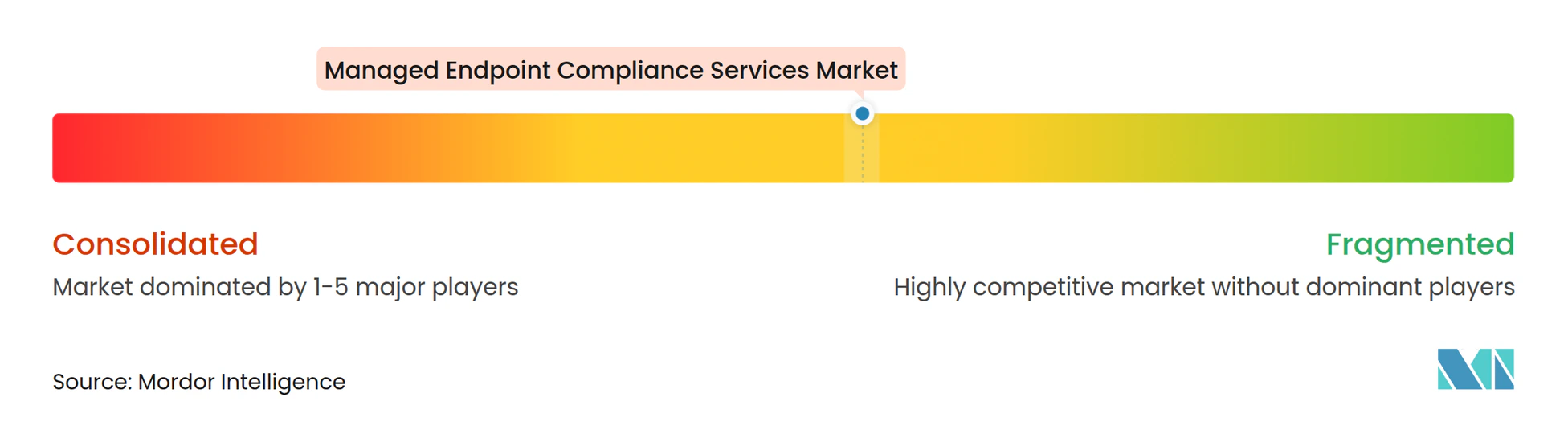
The Managed Endpoint Compliance Services Market has a moderately concentrated structure. Accenture, Kyndryl, HCL Technologies, Wipro, and Infosys have strong positions in large-enterprise accounts. Their scale is supported by automation tools, cloud-platform relationships, and experience-level agreement structures. Smaller regional operators can find it difficult to match these capabilities across global accounts. Competition is moving away from delivery headcount as the main point of distinction. Providers are investing in AI service platforms, self-healing libraries, and real-time compliance dashboards. The Managed Endpoint Compliance Services Market now rewards providers that can translate automation into measurable service and compliance outcomes.
HCL Technologies announced a USD 1.14 billion strategic partnership with a Europe-headquartered Fortune Global 50 company in July 2026. The agreement covered AI-driven digital workplace services and enterprise network management through December 2031. It included an operating model for the customer’s global workplace, as well as IT procurement, hardware, and software management. Wipro renewed its Digital Workplace Services contract with ABB in September 2026. The engagement uses SmartOps AIOps for autonomous remediation, generative AI-supported self-service, and AI-assisted dispatch. These moves show how leading providers use platform capability and large contract execution to protect their positions. Accenture and ServiceNow also launched AI-powered managed security services in June 2026 for risk modernization and regulatory compliance automation.
The mid-market remains an opening for providers that can offer cloud-based compliance monitoring at accessible price points. Frontline workforce observability is another opening because mobile and ruggedized device management is not the core strength of every global integrator. Capgemini completed the acquisition of Cloud4C in November 2025 to extend automation-driven managed cloud services. Computacenter completed its acquisition of AgreeYa Solutions for USD 120 million in January 2026, expanding professional services capacity in North America and India. NTT DATA announced the acquisition of Netgain in August 2026, strengthening ServiceNow-focused delivery in Sweden. These actions indicate that capability building through acquisitions remains part of the competitive response. The Managed Endpoint Compliance Services Market includes both global providers and specialist firms, but platform depth and compliance credentials remain important competitive barriers.
Managed Endpoint Compliance Services Industry Leaders
-
Microsoft Corporation
-
IBM Corporation
-
Broadcom Inc.
-
Ivanti, Inc.
-
CrowdStrike Holdings, Inc.
- *Disclaimer: Major Players sorted in no particular order
Managed Endpoint Compliance Services Market Companies Covered in this Report
- Accenture plc
- Kyndryl Holdings, Inc.
- DXC Technology Company
- Atos SE
- Wipro Limited
- HCL Technologies Limited
- Unisys Corporation
- NTT DATA Corporation
- Tata Consultancy Services Limited
- Cognizant Technology Solutions Corporation
- Capgemini SE
- Infosys Limited
- Fujitsu Limited
- International Business Machines Corporation
- Computacenter plc
- Logicalis Group Limited
- Getronics N.V.
- Microland Limited
- TeamViewer SE
- ServiceNow, Inc.
Recent Industry Developments in Managed Endpoint Compliance Services Market
- October 2026: NinjaOne launched Katana AI, an agentic AI assistant built natively into the NinjaOne platform that summarizes device health, surfaces critical alerts, and provides guided remediation recommendations. The launch includes governance-first controls, role-based access, per-AI controls, and a global kill switch, addressing enterprise concerns about autonomous endpoint management without human oversight. Katana AI also introduces NinjaOne MCP, a model context protocol connecting external AI systems to NinjaOne's data and tools, marking a step toward interoperable agentic operations for managed service providers.
- September 2026: Wipro renewed its Digital Workplace Services contract with ABB, extending a multi-year relationship covering AI-enabled workplace services, device lifecycle management, and endpoint security across ABB's global operations. The renewed engagement deploys Wipro's SmartOps AIOps capability for autonomous remediation, GenAI-powered self-service, and AI-assisted dispatch, using telemetry and usage data to manage device lifecycle and endpoint security aligned with ABB's digital transformation and sustainability goals.
- August 2026: NTT DATA announced the acquisition of Netgain, a ServiceNow specialist in Sweden, which combined with its December 2025 acquisition of The Cloud People creates Sweden's largest pure-play ServiceNow company. This move strengthens NTT DATA's managed ITSM and endpoint compliance delivery capability across the Nordic region, a high-compliance-maturity enterprise market.
- July 2026: HCL Technologies announced a USD 1.14 billion strategic partnership with a Europe-headquartered Fortune Global 50 company, covering AI-driven digital workplace services and enterprise network management from July 2026 to December 2031. The deal includes building an AI-driven operating model to transform and manage the client's global digital workplace, alongside IT procurement, hardware, and software management for employees.
Global Managed Endpoint Compliance Services Market Report Scope
The Managed Endpoint Compliance Services Market Report is Segmented by Service Type (DEX Monitoring and Analytics, Self-Heal and Automation, Service Desk and Technical Support, Persona and Sentiment Management, and Device, Application and Network Experience Management), Deployment Mode (Cloud, On-Premise, and Hybrid), Organization Size (Large Enterprises and Small and Medium Enterprises), Enterprise Type (Private Sector and Public Sector), Industry Vertical (Banking, Financial Services and Insurance, Information Technology and Telecom, Healthcare, Manufacturing, Retail and E-Commerce, Government, and Other Industry Vertical), and Geography (North America, South America, Europe, Asia-Pacific, and Middle East and Africa). The Market Forecasts Are Provided in Terms of Value (USD).
Segmentation Overview
| DEX Monitoring and Analytics |
| Self-Heal and Automation |
| Service Desk and Technical Support |
| Persona and Sentiment Management |
| Device, Application and Network Experience Management |
| Cloud |
| On-Premise |
| Hybrid |
| Large Enterprises |
| Small and Medium Enterprises |
| Private Sector |
| Public Sector |
| Banking, Financial Services and Insurance |
| Information Technology and Telecom |
| Healthcare |
| Manufacturing |
| Retail and E-Commerce |
| Government |
| Other Industry Vertical |
| North America | United States |
| Canada | |
| Mexico | |
| South America | Brazil |
| Argentina | |
| Rest of South America | |
| Europe | Germany |
| United Kingdom | |
| France | |
| Italy | |
| Spain | |
| Rest of Europe | |
| Asia-Pacific | China |
| Japan | |
| India | |
| South Korea | |
| Rest of Asia-Pacific | |
| Middle East and Africa | Saudi Arabia |
| United Arab Emirates | |
| South Africa | |
| Egypt | |
| Rest of Middle East and Africa |
| By Service Type | DEX Monitoring and Analytics | |
| Self-Heal and Automation | ||
| Service Desk and Technical Support | ||
| Persona and Sentiment Management | ||
| Device, Application and Network Experience Management | ||
| By Deployment Mode | Cloud | |
| On-Premise | ||
| Hybrid | ||
| By Organization Size | Large Enterprises | |
| Small and Medium Enterprises | ||
| By Enterprise Type | Private Sector | |
| Public Sector | ||
| By Industry Vertical | Banking, Financial Services and Insurance | |
| Information Technology and Telecom | ||
| Healthcare | ||
| Manufacturing | ||
| Retail and E-Commerce | ||
| Government | ||
| Other Industry Vertical | ||
| By Geography | North America | United States |
| Canada | ||
| Mexico | ||
| South America | Brazil | |
| Argentina | ||
| Rest of South America | ||
| Europe | Germany | |
| United Kingdom | ||
| France | ||
| Italy | ||
| Spain | ||
| Rest of Europe | ||
| Asia-Pacific | China | |
| Japan | ||
| India | ||
| South Korea | ||
| Rest of Asia-Pacific | ||
| Middle East and Africa | Saudi Arabia | |
| United Arab Emirates | ||
| South Africa | ||
| Egypt | ||
| Rest of Middle East and Africa | ||
Key Questions Answered in the Report
What is the size of the Managed Endpoint Compliance Services Market?
The Managed Endpoint Compliance Services Market is projected to expand from USD 5.33 billion in 2026 and USD 6.05 billion in 2027 to USD 11.43 billion by 2032, at a 13.49% CAGR. This outlook reflects demand for continuous endpoint visibility, remediation, and documented governance across distributed work environments.
What is driving demand for managed endpoint compliance services?
Hybrid work, larger device estates, cloud platform adoption, AI-supported service desks, and outcome-based service contracts are supporting demand. Organizations also need consistent policy enforcement and audit records across users, locations, and device types.
Which service type has the largest position?
Service Desk and Technical Support held 32.24% of revenue in 2026, while Self-Heal and Automation is the fastest-expanding service type at a 13.94% CAGR. Human-led support remains important for exception cases that cannot be resolved through defined automation workflows.
Why is cloud deployment important for endpoint compliance?
Cloud held 72.28% of revenue in 2026 because it supports centralized policy enforcement, shared reporting, audit records, and scalable endpoint monitoring. It also allows providers to apply changes across distributed device estates without maintaining local management infrastructure at every location.
Which end-user vertical is expanding fastest?
Healthcare is projected to expand at a 14.12% CAGR through 2032, supported by connected medical devices, clinical technology estates, and compliance requirements. Healthcare organizations need reliable endpoint visibility and documented security controls across clinical and administrative environments.
Which region is expanding fastest?
Asia-Pacific is projected to expand at a 14.24% CAGR through 2032, led by enterprise digitization and large-scale workplace technology deployments. India, China, Japan, and South Korea each support regional demand through distinct enterprise-scale or compliance-led requirements.