
Managed Endpoint Privilege Management Services Market Size and Share
Market Overview
| Study Period | 2021 - 2032 |
|---|---|
| Market Size (2027) | USD 1.45 Billion |
| Market Size (2032) | USD 3.73 Billion |
| Growth Rate (2027 - 2032) | 20.79 % |
| Fastest Growing Market | Asia-Pacific |
| Largest Market | North America |
| Market Concentration | Medium |
Major Players *Disclaimer: Major Players sorted in no particular order Image © Mordor Intelligence. Reuse requires attribution under CC BY 4.0. | |
Managed Endpoint Privilege Management Services Market Analysis by Mordor Intelligence
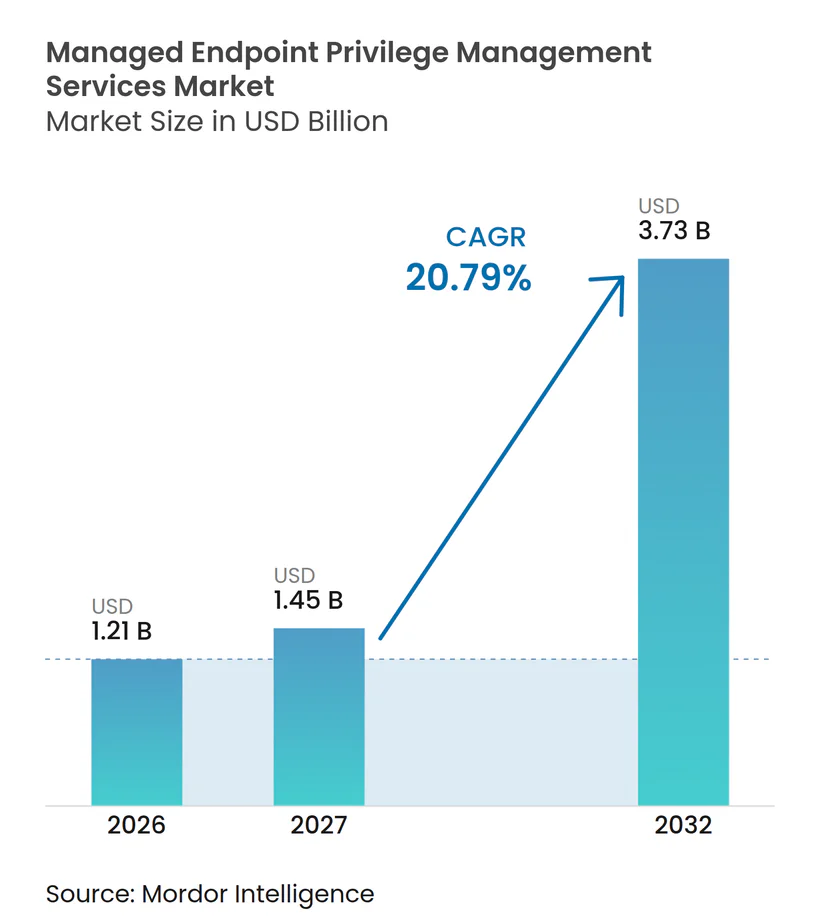
The Managed Endpoint Privilege Management Services Market size was valued at USD 1.21 billion in 2026 and estimated to grow from USD 1.45 billion in 2027 to reach USD 3.73 billion by 2032, at a CAGR of 20.79% during the forecast period (2027-2032). The managed endpoint privilege management services market is expanding as organizations treat compromised identities and endpoint administrator rights as connected risks. Managed service providers are addressing the operational burden of applying, monitoring, and reviewing least-privilege policies across hybrid device estates. The managed endpoint privilege management services market also benefits when buyers need continuous coverage that internal teams cannot maintain around the clock. SaaS adoption has widened the number of administrative accounts, cloud tenants, and applications requiring control. Built-in endpoint tools are likely to increase basic adoption, while providers with specialized managed capabilities compete for complex and highly regulated deployments.
Key Report Takeaways
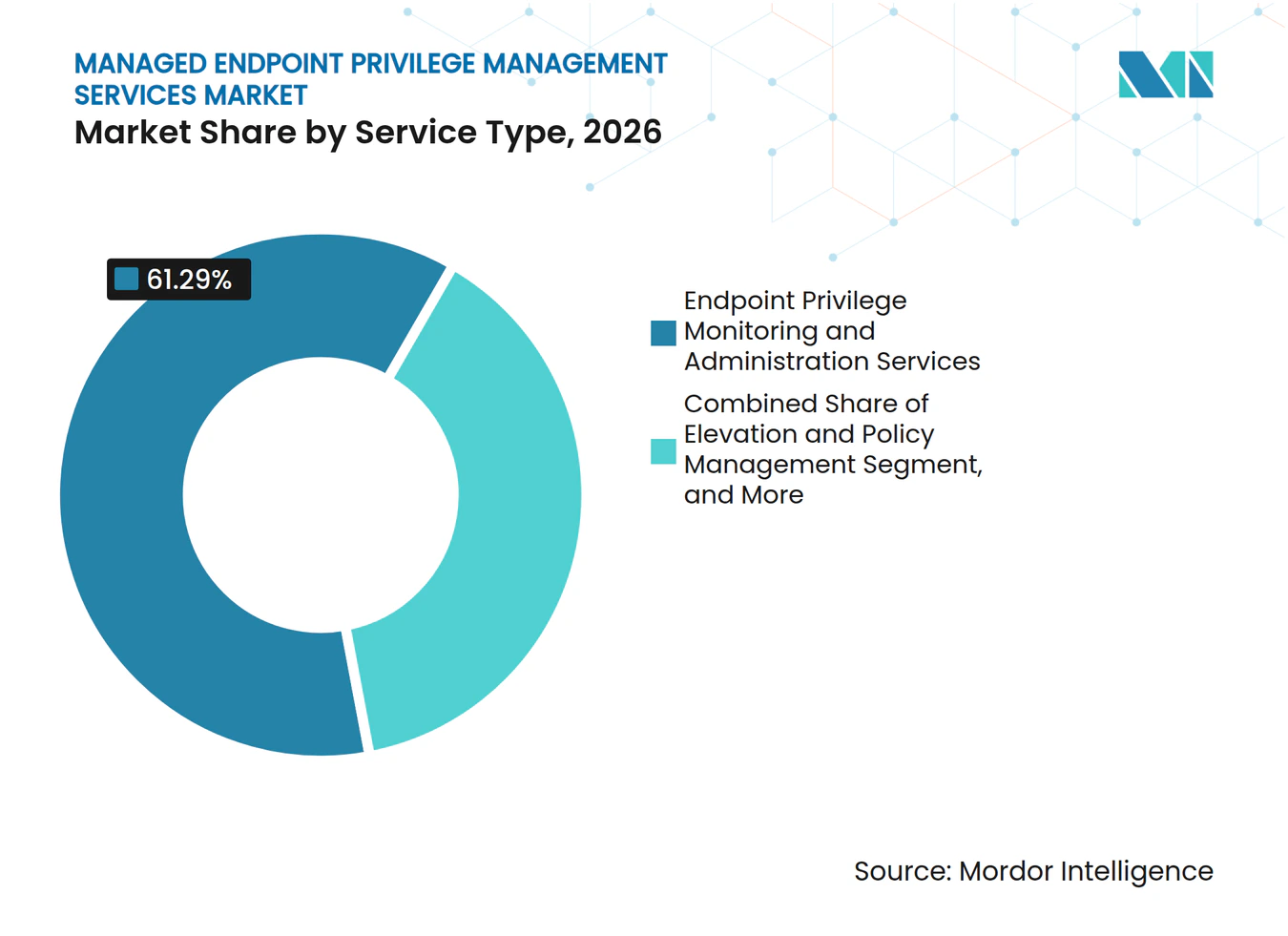
- By service type, Endpoint Privilege Monitoring and Administration Services held 61.29% of the managed endpoint privilege management services market share in 2026, while Endpoint Privilege Elevation and Policy Management Services are projected to grow at a 21.78% CAGR through 2032.
- By deployment model, cloud-based deployment accounted for 67.33% of the managed endpoint privilege management services market share in 2026, while hybrid deployment is projected to expand at a 22.06% CAGR through 2032.
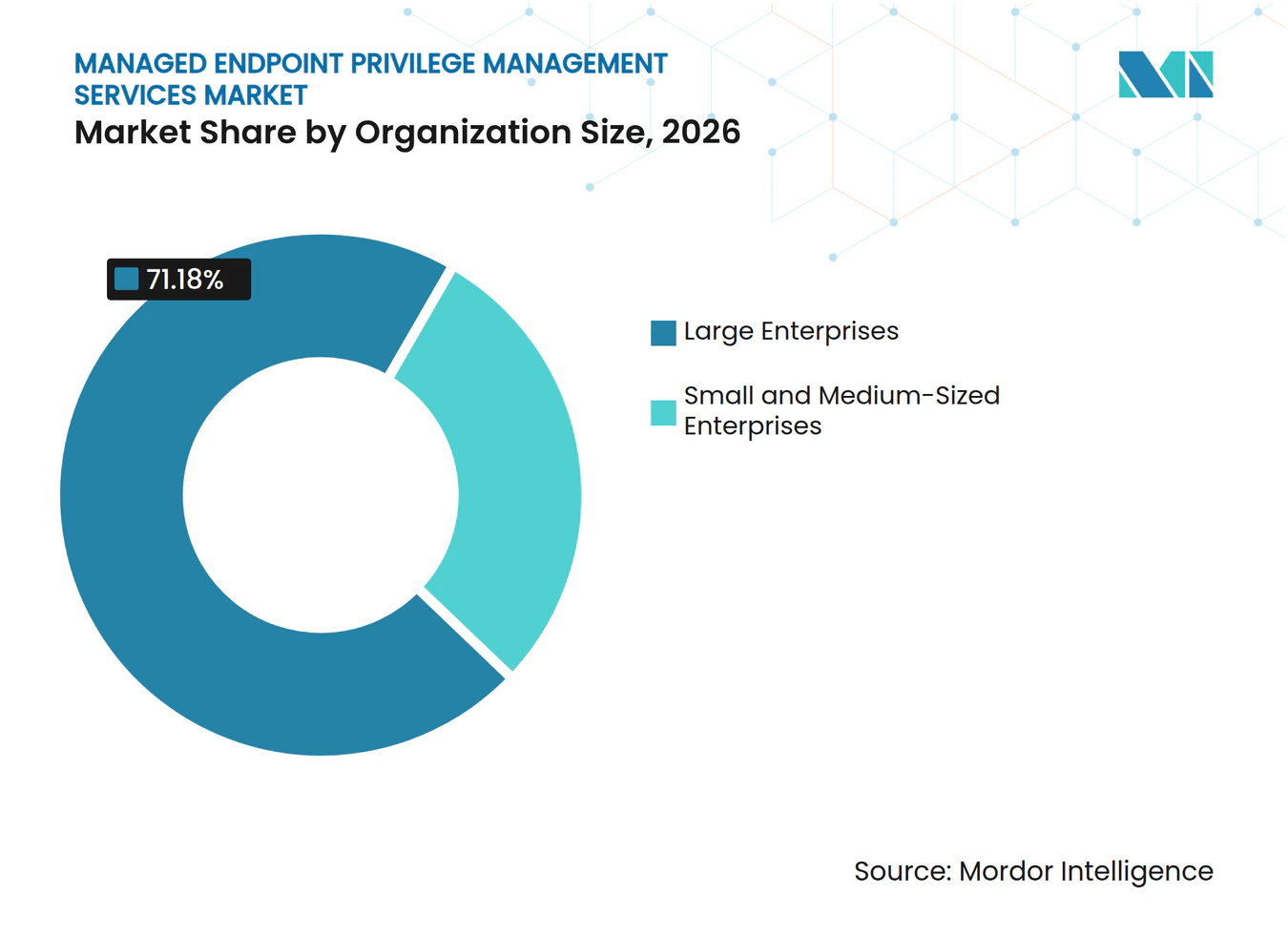
- By organization size, Large Enterprises held 71.18% of revenue in 2026, while Small and Medium-Sized Enterprises are projected to record a 22.36% CAGR through 2032.
- By end-user industry, Banking, Financial Services, and Insurance accounted for 29.13% of revenue in 2026, while Government and Public Administration is projected to grow at a 21.12% CAGR through 2032.
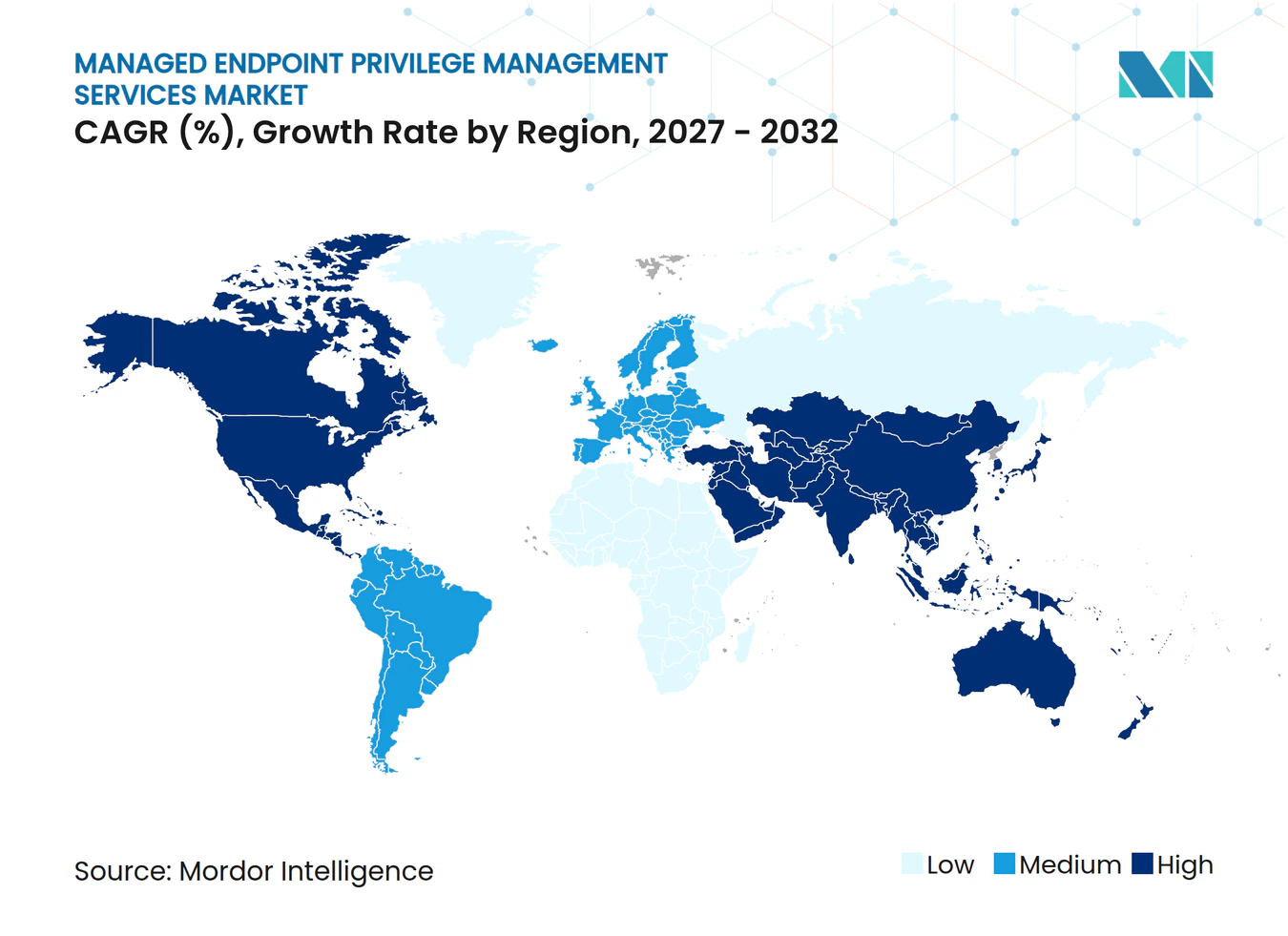
- By geography, North America held 35.41% of revenue in 2026, while Asia-Pacific is projected to expand at a 21.40% CAGR through 2032.
Note: Market numbers in this report are based on Mordor Intelligence's proprietary estimation framework, which combines nine months of actuals with Q4 projections for base year 2026.
Market Trends and Insights
Drivers Impact Analysis of Managed Endpoint Privilege Management Services Market*
| Driver | (~) % Impact on CAGR Forecast | Geographic Relevance | Impact Timeline |
|---|---|---|---|
| Rising Ransomware and Identity-Based Attacks | +5.2% | Global | Short term (≤ 2 years) |
| Expansion of Hybrid and Distributed Workforces | +4.0% | Global | Medium term (2-4 years) |
| Stronger Least-Privilege and Zero Trust Compliance Requirements | +3.5% | North America and Europe, spill-over to Asia-Pacific | Short term (≤ 2 years) |
| Cloud Migration and SaaS Administrative Access Sprawl | +2.8% | Global, with early concentration in North America and Asia-Pacific | Medium term (2-4 years) |
| Managed Security Staffing Shortages and Outsourcing Demand | +2.2% | Global | Medium term (2-4 years) |
| Endpoint Telemetry and Policy Automation Improving Deployment Economics | +1.8% | North America and Europe | Long term (≥ 4 years) |
| Source: Mordor Intelligence | |||
Rising Ransomware and Identity-Based Attacks
Identity-based attacks are increasing the importance of removing standing administrative privileges from endpoints. Sophos reported that 67% of the incidents it investigated involved identity-related attacks in 2026.[1] The same research found attackers reached Active Directory servers within 3.4 hours after an initial breach. Multifactor authentication existed in 97% of cases involving compromised credentials, which points to coverage and privilege gaps rather than simple absence of authentication. The managed endpoint privilege management services market therefore supports controls that limit lateral movement after an identity is compromised. Semperis found that 87% of ransomware attacks targeted identity systems, including Active Directory, Microsoft Entra ID, and Okta.[2]
Expansion of Hybrid and Distributed Workforces
Hybrid work has separated many devices from the network perimeters used by older privilege management systems. Sophos found that 34% of smaller organizations stopped ransomware before encryption or extortion, compared with 46% of larger organizations. The difference reflects uneven security resources across distributed endpoint estates. Managed endpoint privilege management services can apply policy through cloud-managed agents without requiring a constant VPN connection. Organizations also need consistent controls across corporate devices and unmanaged devices used in hybrid settings. Sophos reported that 88% of ransomware payloads were deployed outside normal business hours, which supports demand for continuous managed monitoring.
Stronger Least-Privilege and Zero Trust Compliance Requirements
Compliance requirements are turning endpoint least-privilege controls into more immediate procurement needs. New York's amended 23 NYCRR Part 500 took effect in May 2025 and requires Class A financial entities to implement privileged access management solutions. The rule also requires elevated account use to be limited to situations where it is operationally necessary. NIST published SP 1800-35 in June 2025 with 19 zero trust reference implementations that place endpoint controls within the device pillar. CISA released its zero trust microsegmentation guidance in July 2025 and identified endpoint least-privilege enforcement as a prerequisite for effective isolation. These requirements favor the managed endpoint privilege management services market where financial institutions and government agencies need documented control operation as well as tools.
Cloud Migration and SaaS Administrative Access Sprawl
Cloud migration has increased the number of privileged accounts spread across applications, tenants, and identity systems. CloudEagle.ai reported in June 2025 that 60% of enterprise SaaS and AI applications operated outside direct IT visibility. Its survey also found that only 5% of organizations actively enforced least-privilege policies across their application estates. Separate research from the company found that 48% of former employees retained application access months after leaving. Managed providers can overlay policy across existing identity infrastructure, rather than require customers to replace every tool. This position is relevant for the managed endpoint privilege management services market when cloud and on-premises systems must operate together.
Restraints Impact Analysis of Managed Endpoint Privilege Management Services Market*
| Restraint | (~) % Impact on CAGR Forecast | Geographic Relevance | Impact Timeline |
|---|---|---|---|
| Endpoint Agent Compatibility and User-Experience Friction | -2.5% | Global | Short term (≤ 2 years) |
| Complex Policy Tuning Across Legacy and OT Endpoints | -2.0% | Europe and Asia-Pacific, industrial sectors globally | Medium term (2-4 years) |
| Budget Competition with Broader Endpoint Security Platforms | -1.5% | Global | Medium term (2-4 years) |
| Data Sovereignty and Cross-Border Administrative Session Constraints | -1.0% | Europe, Middle East, and Asia-Pacific | Long term (≥ 4 years) |
| Source: Mordor Intelligence | |||
Endpoint Agent Compatibility and User-Experience Friction
Endpoint agents must operate alongside endpoint detection, device management, and vulnerability management software without creating conflicts. This requirement increases the effort needed to onboard large organizations with varied technology stacks. Privileged access controls can delay projects when users encounter poorly tuned approval processes. Employees may bypass controls when they perceive those processes as disruptive. Such behavior can produce audit gaps and weaken the value that providers promise. Just-in-time elevation can reduce frequent prompts, but it requires detailed policy tuning before deployment.
Complex Policy Tuning Across Legacy and OT Endpoints
Legacy systems and operational technology environments do not always support current endpoint agent architectures. Air-gapped networks, proprietary industrial protocols, and long patch cycles make standard least-privilege policies difficult to apply. Windows 10 reached end of support in October 2025, adding devices to compatibility backlogs while customers plan operating system migration.[3] Providers serving industrial customers may need cloud-managed controls for modern devices and alternative session controls for older equipment. This dual delivery model can extend deployment time and place pressure on managed service margins. The issue is particularly relevant in European and Asia-Pacific manufacturing environments where endpoint controls must protect operational continuity.
*Our forecasts treat driver/restraint impacts as directional, not additive. The impact forecasts reflect baseline growth, mix effects, and variable interactions.
Managed Endpoint Privilege Management Services Market Segment Analysis
By Service Type:
Monitoring and Administration Remain the Revenue Base, While Elevation Services Gain MomentumEndpoint Privilege Monitoring and Administration Services held 61.29% of the managed endpoint privilege management services market share in 2026. The position reflects the need for continuous session recording, account discovery, and audit evidence. Many organizations first seek visibility into administrative activity before introducing more automated controls. This sequence keeps monitoring and administration at the center of current managed service contracts. The managed endpoint privilege management services market size for this service category is supported by buyers with complex endpoint estates. These buyers need an operating record that can support internal reviews and external audits. Continuous oversight also gives providers a basis for identifying unusual privilege use. It can reveal unneeded administrative accounts before those accounts become a security exposure. The segment consequently remains an entry point for enterprises beginning a structured least-privilege program. Its scale also indicates that many buyers are still progressing from basic oversight toward broader policy automation.
Endpoint Privilege Elevation and Policy Management Services are projected to grow at a 21.78% CAGR through 2032. The service category addresses demand for just-in-time elevation and application-level policy enforcement. Organizations with always-on administrative rights have substantial scope to adopt context-based access controls. Assessment, optimization, implementation, and migration services support customers preparing their environment for managed delivery. BeyondTrust introduced an AI decision-support layer in Pathfinder during August 2025 to analyze privilege patterns, entitlement drift, and access behavior. Automation may reduce manual policy tuning over time. That change could shift contract design from labor-intensive work toward recurring outcome-based services. The managed endpoint privilege management services industry is therefore moving toward more dynamic privilege control while retaining monitoring as a foundational service.



By Deployment Model:
Cloud Leads Current Demand, While Hybrid Architectures ExpandCloud-based deployment accounted for 67.33% of the managed endpoint privilege management services market share in 2026. Its agent-based approach does not require customers to maintain on-premises hardware for every policy function. Centralized telemetry can provide a view across distributed devices and sites. This structure supports behavioral analysis and identification of unusual endpoint activity. Cloud deployment is also suited to organizations with employees, contractors, and devices across multiple locations. Providers can update policies without requiring physical access to each endpoint. The model reduces infrastructure effort for buyers with limited security operations capacity. It also provides a practical route for mid-sized organizations seeking managed protection. The managed endpoint privilege management services market continues to benefit when cloud delivery shortens deployment and simplifies ongoing administration. Cloud leadership does not remove the need for local controls in sensitive environments.
Hybrid deployment is projected to grow at a 22.06% CAGR from 2027 to 2032. Healthcare, financial services, and government organizations often need cloud policy management alongside local storage or session recording. This approach can meet data residency and workload sensitivity requirements without losing centralized management. On-premises deployment remains important in air-gapped and classified environments where internet connectivity is restricted. Microsoft included Endpoint Privilege Management within Microsoft 365 E5 licenses in July 2026 as a cloud-native capability. Organizations already committed to Microsoft 365 may adopt basic cloud controls more quickly. Complex multi-cloud and operational technology environments can still require third-party managed support. These environments may not align with cloud-only tools or standard deployment patterns. Hybrid providers can serve customers that need distinct controls for different workloads. The managed endpoint privilege management services market size for hybrid delivery is supported by that practical need for flexible architecture.
By Organization Size:
Large Enterprises Lead Revenue, While SMEs Broaden AdoptionLarge Enterprises accounted for 71.18% of the managed endpoint privilege management services market share in 2026. Their device estates often include thousands of endpoints and varied application portfolios. These organizations also face more formal audit obligations and multi-year service procurement processes. Listed companies must address requirements related to financial reporting and access control. Sector-specific rules add further pressure in financial services, healthcare, and government contracting. Large enterprises are therefore better positioned to fund broad managed privilege programs. Their scale supports recurring contracts that combine monitoring, policy management, and implementation services. The managed endpoint privilege management services market is shaped by these buyers because their requirements extend across regions and business units. Their environments also create demand for integrations with identity, endpoint, and security operations tools. Large enterprise demand remains tied to the need for consistent evidence that privileged access is being controlled.
Small and Medium-Sized Enterprises are projected to grow at a 22.36% CAGR through 2032. The segment is gaining access to managed offerings designed for organizations with fewer than 500 seats. Six Degrees found in February 2025 that two-thirds of UK SMEs planned to increase their reliance on managed security services over the next 12 months. The reported reason was lack of specialist internal skills rather than cost alone. WALLIX launched One PAM Core in September 2025 for SMEs and mid-sized organizations facing NIS2 compliance requirements. The offering was designed for SaaS or on-premises use without changes to existing infrastructure. Easier deployment can make managed controls more accessible to smaller security teams. The segment also creates an opportunity for providers that package onboarding, policy design, and monitoring into a clear service model. The managed endpoint privilege management services industry can broaden further when these organizations replace informal administrator practices with controlled elevation.

By End-User Industry:
BFSI Supports Current Demand, While Government AcceleratesBanking, Financial Services, and Insurance accounted for 29.13% of the managed endpoint privilege management services market size in 2026. Financial institutions must maintain audit trails and access visibility across sensitive systems. New York's cybersecurity regulation requires privileged access management for Class A financial entities. The regulation also requires limits on privileged account use. PCI DSS, SOX, and GDPR further reinforce requirements for access control and auditable operations. These obligations can be difficult for internal teams to maintain across broad endpoint environments. Managed services provide monitoring and evidence collection that can support compliance work. The segment remains important across North America and South Asia, where banking organizations face formal governance expectations. BFSI demand gives providers a stable base for specialized controls, documented processes, and long-term contracts.
Government and Public Administration is projected to grow at a 21.12% CAGR through 2032. Zero trust mandates are moving from high-level policy to active procurement and implementation programs. NIST's 2025 guidance provides reference designs that help agencies translate zero trust principles into operational controls. NIST.GOV CISA's 2025 microsegmentation guidance further links least-privilege practices to network isolation. BeyondTrust received FedRAMP authorization for Identity Security Insights for Government in October 2025. Healthcare, telecommunications, manufacturing, retail, energy, and utilities also offer demand shaped by their own compliance needs. Industrial and energy users often require more preparation because of operational technology compatibility constraints. The managed endpoint privilege management services market has opportunities where agencies and regulated operators need support across both modern and older devices. Government growth favors providers able to meet formal procurement, authorization, and reporting requirements.
Geography Analysis
North America Managed Endpoint Privilege Management Services Market
North America held 35.41% of the managed endpoint privilege management services market share in 2026. The region combines regulatory pressure, substantial enterprise technology spending, and a developed managed security channel. ISC2 reported in its 2025 workforce study that 20% of organizations outsourced work and 19% engaged third-party providers to address skill shortages. Barracuda Networks reported in July 2025 that 73% of organizations with up to 2,000 employees relied on managed service providers for security support. The United States is the primary demand center because financial services, government, and large enterprises face extensive control requirements. Canada and Mexico add demand through digital modernization and manufacturing and logistics activity. BeyondTrust's 2025 FedRAMP authorization strengthened its ability to serve federal, state, and municipal government users. The managed endpoint privilege management services market size in North America is also supported by customers seeking external capacity to manage extensive endpoint estates.
APAC Managed Endpoint Privilege Management Services Market
Asia-Pacific is projected to grow at a 21.40% CAGR from 2027 to 2032. India, China, Japan, and South Korea are key demand centers for endpoint security and managed access controls. India’s CERT-In framework and South Korean data protection rules support more formal approaches to privileged access oversight. China’s cybersecurity law creates comparable expectations for critical infrastructure operators. The rest of Asia-Pacific is gaining importance as multinational companies extend headquarters security standards to regional offices. BeyondTrust expanded Pathfinder to India, Singapore, South Africa, and the UAE in 2026. The company cited growth in machine identities and agentic AI risks as demand factors. The managed endpoint privilege management services market share for Asia-Pacific is likely to rise as providers localize delivery to meet data residency requirements.
EMEA and South America Managed Endpoint Privilege Management Services Market
Europe holds a meaningful position because GDPR and NIS2 reinforce the need for controlled privileged access at essential service operators. WALLIX achieved BSI and ANSSI certifications for its PAM platform in Germany and France during October 2025. Such certifications can influence public sector procurement where sovereign compliance is important. France also showed deep cybersecurity outsourcing adoption among SMEs and mid-sized firms during 2026. The managed endpoint privilege management services market in South America, the Middle East, and Africa remains at an earlier stage. Demand is concentrated in financial services and energy organizations with cross-border compliance responsibilities. National cybersecurity programs in Saudi Arabia and the UAE, together with South Africa's data protection requirements, are raising expectations for privileged access governance.
Competitive Landscape
Market Concentration
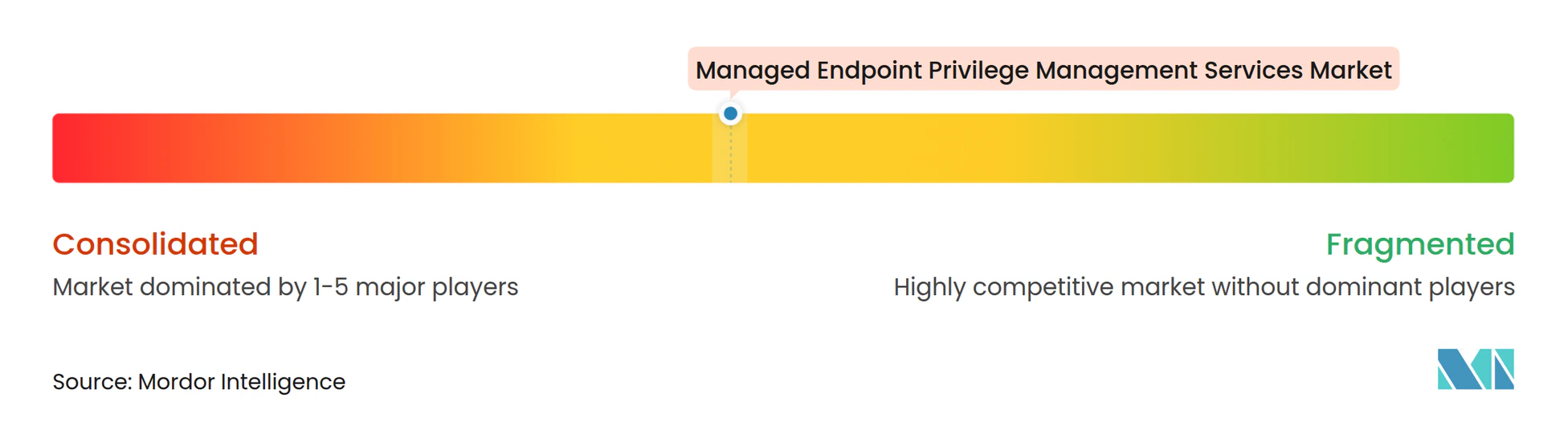
The managed endpoint privilege management services market is moderately fragmented. BeyondTrust, Palo Alto Networks, and Delinea compete with focused providers and adjacent endpoint and identity security vendors. Larger platforms are extending their offerings through privilege analytics, non-human identity controls, and just-in-time access automation. BeyondTrust showcased native Pathfinder capabilities at Black Hat USA 2026, including AI Agent Security, Non-Human Identity Governance, and Workload Credentials. This move expanded its scope from traditional privileged accounts to AI agents and cloud workloads. CyberArk also demonstrated large-scale deployment capability through its Northern Trust customer deployment. The company reported onboarding 50,000 endpoints in 16 days with zero incidents. It also reported a 137% improvement in password rotation compliance and a 250% increase in privileged account coverage.
Smaller providers compete through specialization, deployment speed, and targeted compliance support. ThreatLocker secured USD 190 million in Series F funding in July 2026 to support product development and global expansion. Its application allowlisting and zero trust approach offers a different model from standard privilege elevation. Heimdal published a Cyber Essentials control mapping for Privilege Elevation and Delegation Management in February 2026. This helped UK organizations and managed service providers document least-privilege control against a government-backed certification scheme. WALLIX has targeted smaller organizations with a PAM offering built for quicker deployment. These approaches are relevant where buyers prioritize short implementation periods, lower operational burden, or specific national compliance requirements.
The managed endpoint privilege management services market has open opportunities among SMEs and industrial and energy organizations. Buyers in these groups may need managed coverage but cannot always use a standard enterprise platform or cloud-only tool. Microsoft’s decision to include Endpoint Privilege Management in Microsoft 365 E5 may increase awareness of endpoint privilege control among existing customers. It may also place pricing pressure on standalone providers serving basic requirements. Providers can differentiate through managed operation, hybrid delivery, policy design, and support for older or operational technology devices. SailPoint expanded its PAM application discovery connectors for CyberArk, BeyondTrust, and Delinea during July 2026. This move shows how PAM telemetry is becoming part of broader identity governance workflows.
Managed Endpoint Privilege Management Services Industry Leaders
-
Palo Alto Networks
-
BeyondTrust Corporation
-
Delinea, Inc.
-
Netwrix Corporation
-
WALLIX Group SA
- *Disclaimer: Major Players sorted in no particular order
Managed Endpoint Privilege Management Services Market Companies Covered in this Report
- BeyondTrust Corporation
- Palo Alto Networks
- Delinea, Inc.
- WALLIX Group SA
- Netwrix Corporation
- One Identity LLC
- Quest Software Inc.
- ManageEngine (Zoho Corporation Private Limited)
- Ivanti, Inc.
- ARCON TechSolutions Private Limited
- Osirium Technologies plc
- Hysolate Ltd.
- FastTrack Software A/S
- Heimdal Security ApS
- ThreatLocker, Inc.
- SSH Communications Security Corporation
- Fudo Security, Inc.
- Segura, Inc.
- Syteca Inc.
- Devolutions Inc.
Recent Industry Developments in Managed Endpoint Privilege Management Services Market
- August 2026: BeyondTrust showcased the first wave of native Pathfinder capabilities at Black Hat USA 2026, including PathfinderAI and MCP Server, AI Agent Security, Non-Human Identity Governance, and Workload Credentials. These capabilities extend privilege management scope from human and machine identities to AI agents and cloud workloads, advancing the company's zero standing privilege vision across heterogeneous enterprise environments.
- July 2026: ThreatLocker secured USD 190 million in Series F funding to drive product innovation and global expansion, reinforcing investor confidence in the company's zero trust application allowlisting architecture as a scalable alternative to agent-based privilege elevation for enterprise endpoint security.
- July 2026: SailPoint expanded Privileged Access Management application discovery in Identity Security Cloud, adding new connectors for BeyondTrust and Delinea and enhancing the CyberArk connector to surface application instance-level inventory. This integration enables identity governance workflows to ingest granular PAM data, tightening the link between endpoint privilege controls and broader enterprise access certification.
- March 2026: ThreatLocker launched Zero Trust network and cloud access capabilities specifically designed to stop credential-based cyberattacks, extending its zero trust enforcement model from the endpoint layer to network and cloud access control.
Global Managed Endpoint Privilege Management Services Market Report Scope
The Managed Endpoint Privilege Management Services Market comprises outsourced services that manage, control, monitor, and optimize privileged access rights on endpoint devices across enterprise environments. These services enable organizations to implement least-privilege principles, control administrator access, manage privilege elevation, enforce security policies, and reduce endpoint attack surfaces through ongoing monitoring, policy administration, assessment, implementation, and optimization of endpoint privilege controls.
The Managed Endpoint Privilege Management Services Market Report is Segmented by Service Type (Endpoint Privilege Monitoring and Administration Services, Endpoint Privilege Elevation and Policy Management Services, Endpoint Privilege Assessment and Optimization Services, Endpoint Privilege Implementation and Migration Services, Others Service Types), Deployment Model (Cloud-Based, On-Premises, and Hybrid), Organization Size (Large Enterprises, and Small and Medium-Sized Enterprises), End-User Industry (Banking, Financial Services, and Insurance (BFSI), Government and Public Administration, Healthcare and Life Sciences, IT and Telecommunication, Industrial Manufacturing, Retail and E-commerce, Energy and Utilities, Other End-User Industries), and Geography (North America, South America, Europe, Asia-Pacific, Middle East, and Africa). The Market Forecasts are Provided in Terms of Value (USD).
Segmentation Overview
| Endpoint Privilege Monitoring and Administration Services |
| Endpoint Privilege Elevation and Policy Management Services |
| Endpoint Privilege Assessment and Optimization Services |
| Endpoint Privilege Implementation and Migration Services |
| Others Service Types |
| Cloud-Based |
| On-Premises |
| Hybrid |
| Large Enterprises |
| Small and Medium-Sized Enterprises |
| Banking, Financial Services, and Insurance (BFSI) |
| Government and Public Administration |
| Healthcare and Life Sciences |
| IT and Telecommunication |
| Industrial Manufacturing |
| Retail and E-commerce |
| Energy and Utilities |
| Other End-User Industries |
| North America | United States |
| Canada | |
| Mexico | |
| South America | Brazil |
| Argentina | |
| Rest of South America | |
| Europe | Germany |
| United Kingdom | |
| France | |
| Italy | |
| Russia | |
| Rest of Europe | |
| Asia-Pacific | China |
| Japan | |
| India | |
| South Korea | |
| Rest of Asia-Pacific | |
| Middle East | Saudi Arabia |
| United Arab Emirates | |
| Rest of Middle East | |
| Africa | South Africa |
| Nigeria | |
| Rest of Africa |
| By Service Type | Endpoint Privilege Monitoring and Administration Services | |
| Endpoint Privilege Elevation and Policy Management Services | ||
| Endpoint Privilege Assessment and Optimization Services | ||
| Endpoint Privilege Implementation and Migration Services | ||
| Others Service Types | ||
| By Deployment Model | Cloud-Based | |
| On-Premises | ||
| Hybrid | ||
| By Organization Size | Large Enterprises | |
| Small and Medium-Sized Enterprises | ||
| By End-User Industry | Banking, Financial Services, and Insurance (BFSI) | |
| Government and Public Administration | ||
| Healthcare and Life Sciences | ||
| IT and Telecommunication | ||
| Industrial Manufacturing | ||
| Retail and E-commerce | ||
| Energy and Utilities | ||
| Other End-User Industries | ||
| By Geography | North America | United States |
| Canada | ||
| Mexico | ||
| South America | Brazil | |
| Argentina | ||
| Rest of South America | ||
| Europe | Germany | |
| United Kingdom | ||
| France | ||
| Italy | ||
| Russia | ||
| Rest of Europe | ||
| Asia-Pacific | China | |
| Japan | ||
| India | ||
| South Korea | ||
| Rest of Asia-Pacific | ||
| Middle East | Saudi Arabia | |
| United Arab Emirates | ||
| Rest of Middle East | ||
| Africa | South Africa | |
| Nigeria | ||
| Rest of Africa | ||
Key Questions Answered in the Report
What is the managed endpoint privilege management services market size?
The managed endpoint privilege management services market size is USD 1.21 billion in 2026 and is forecast to reach USD 3.73 billion by 2032 at a 20.79% CAGR.
What is driving demand for managed endpoint privilege management services?
Identity-based attacks, hybrid work, zero trust requirements, and SaaS administrative access sprawl are increasing demand for managed endpoint privilege controls.
Which service type leads managed endpoint privilege management services?
Endpoint Privilege Monitoring and Administration Services lead with 61.29% share in 2026, while elevation and policy management is the fastest-growing service type.
Which deployment model is growing fastest for endpoint privilege management?
Hybrid deployment is projected to grow at a 22.06% CAGR through 2032 because regulated users need both cloud and local controls.
Which end-user sector is the largest buyer of these services?
Banking, Financial Services, and Insurance leads with 29.13% revenue share in 2026 due to audit and privileged-access compliance needs.
Which region is growing fastest for endpoint privilege management services?
Asia-Pacific is projected to grow at a 21.40% CAGR through 2032 as regulations and digital transformation expand managed security demand.