
Managed Endpoint Compliance Monitoring Services Market Size and Share
Market Overview
| Study Period | 2021 - 2032 |
|---|---|
| Market Size (2027) | USD 1.72 Billion |
| Market Size (2032) | USD 4.09 Billion |
| Growth Rate (2027 - 2032) | 18.94 % |
| Fastest Growing Market | Asia-Pacific |
| Largest Market | North America |
| Market Concentration | Medium |
Major Players *Disclaimer: Major Players sorted in no particular order Image © Mordor Intelligence. Reuse requires attribution under CC BY 4.0. | |
Managed Endpoint Compliance Monitoring Services Market Analysis by Mordor Intelligence
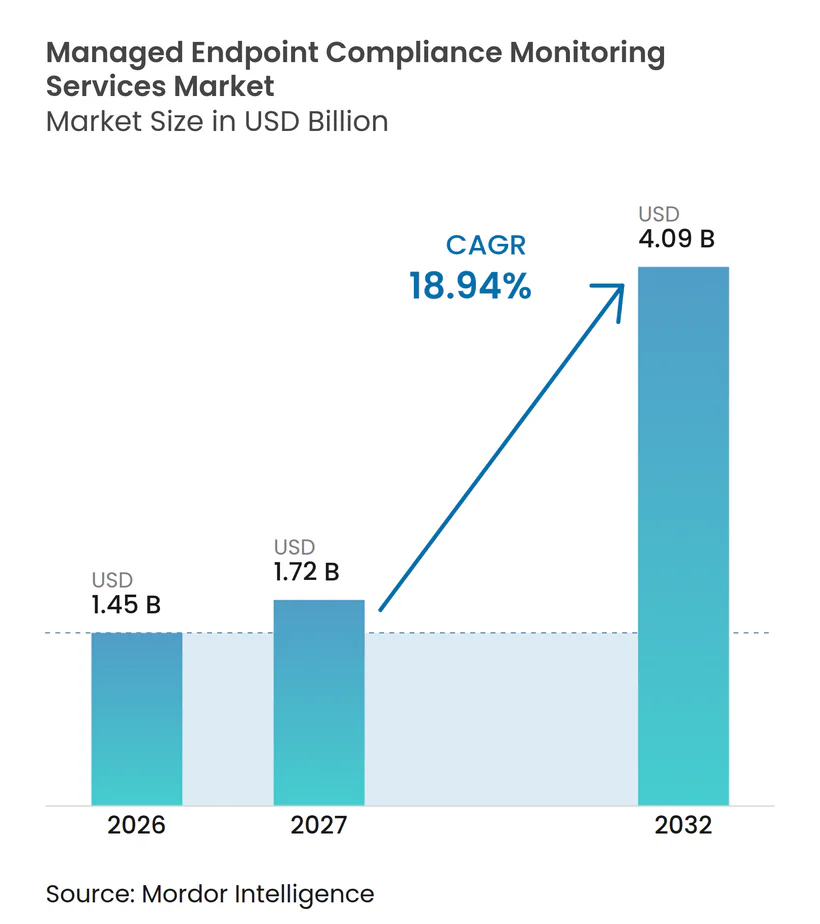
The Managed Endpoint Compliance Monitoring Services Market size is projected to expand from USD 1.45 billion in 2026 to USD 4.09 billion by 2032, registering a CAGR of 18.94% between 2027 to 2032. Growth reflects a wider endpoint perimeter, tighter evidence requirements, and limited internal capacity to operate continuous compliance programs across distributed devices, especially where security teams must coordinate policy status, patch records, access conditions, and audit requests across offices, home locations, cloud applications, and mobile work patterns. Hybrid work, personal-device access, and cloud applications have moved compliance checks beyond the traditional corporate network, making continuous device visibility more important for regulated organizations that need a reliable record of what was checked, when controls were applied, and how exceptions were resolved. Regulations in Europe, the United States, and Asia-Pacific are also shortening procurement cycles because buyers need auditable controls rather than periodic confirmation that policies exist, and because compliance teams need information that can be shared clearly with risk leaders, internal audit groups, regulators, and external assessors. The managed endpoint compliance monitoring services market therefore favors providers that combine monitoring, remediation, reporting, and regulatory mapping without adding another disconnected tool to the customer environment.
Key Report Takeaways
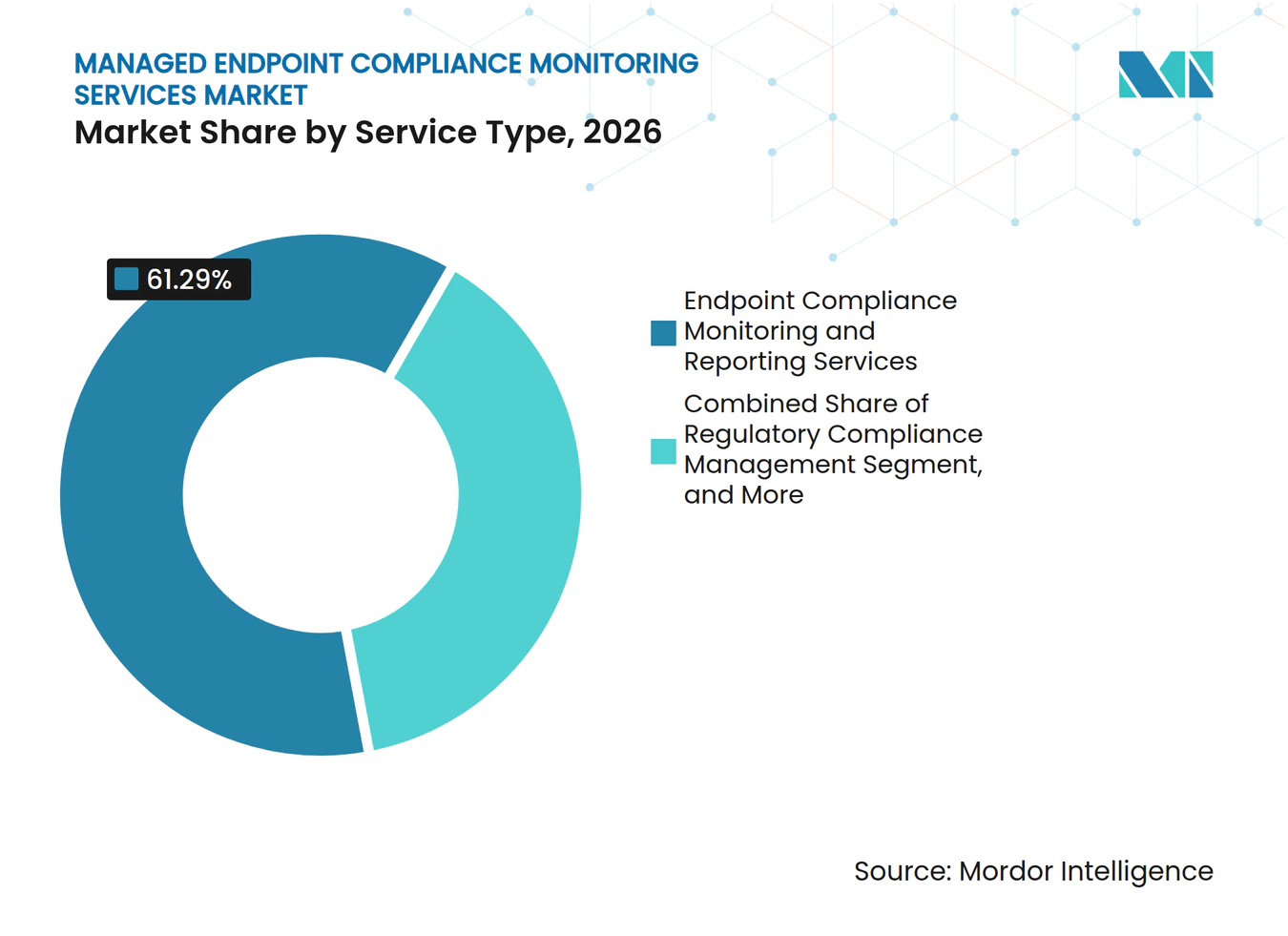
- By service type, Endpoint Compliance Monitoring and Reporting Services held 61.29% of the Managed Endpoint Compliance Monitoring Services Market revenue share in 2026, while Regulatory Compliance Management Services is projected to expand at a 19.89% CAGR through 2032.
- By deployment mode, cloud-based delivery accounted for 68.41% of the Managed Endpoint Compliance Monitoring Services Market revenue share in 2026, while hybrid deployment is projected to expand at a 20.12% CAGR through 2032.
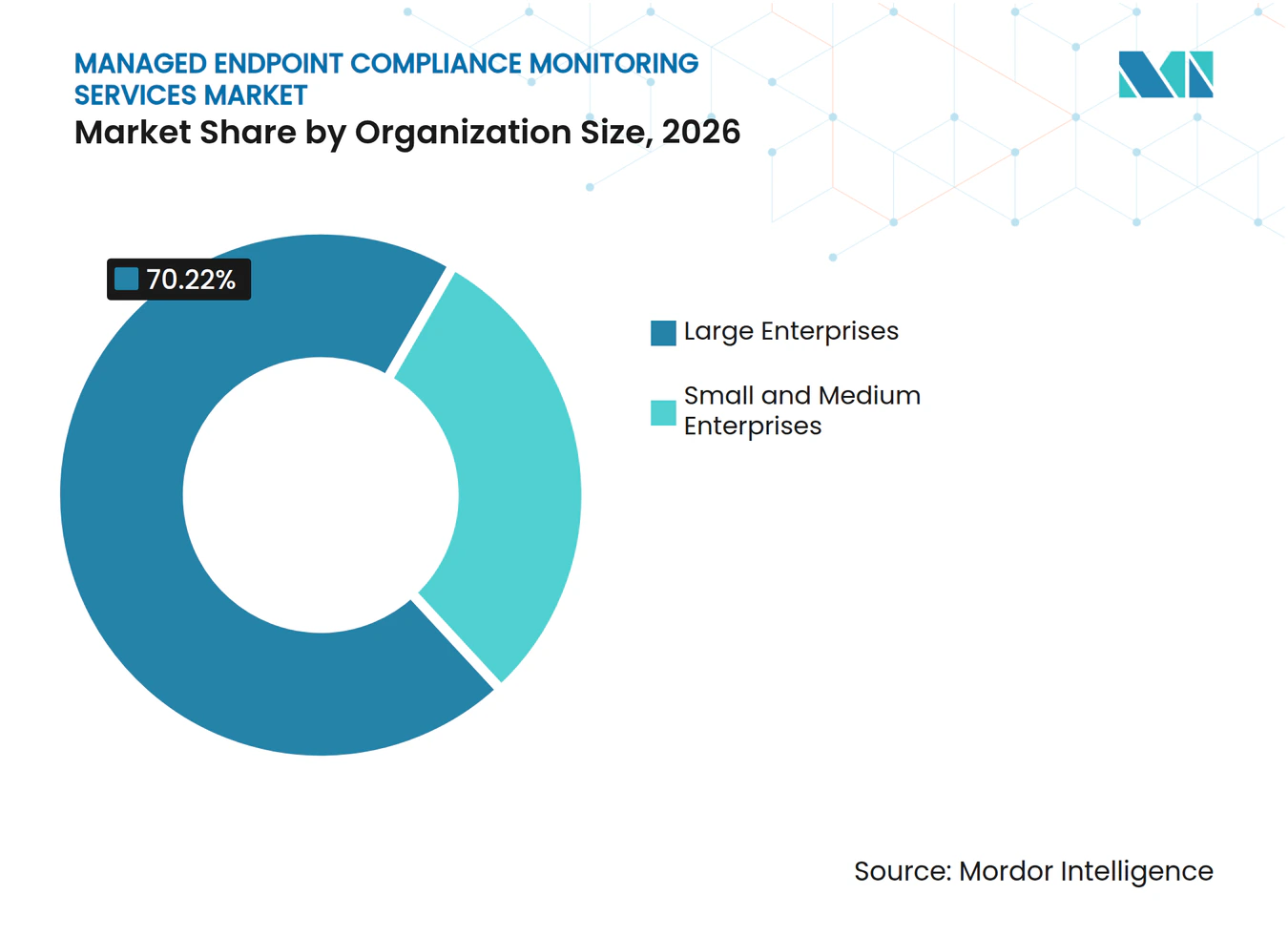
- By organization size, large enterprises held 70.22% of the Managed Endpoint Compliance Monitoring Services Market revenue share in 2026, while small and medium enterprises are projected to expand at a 20.41% CAGR through 2032.
- By end-user industry, BFSI accounted for 28.11% of the Managed Endpoint Compliance Monitoring Services Market revenue share in 2026, while Government and Public Administration is projected to expand at a 19.29% CAGR through 2032.
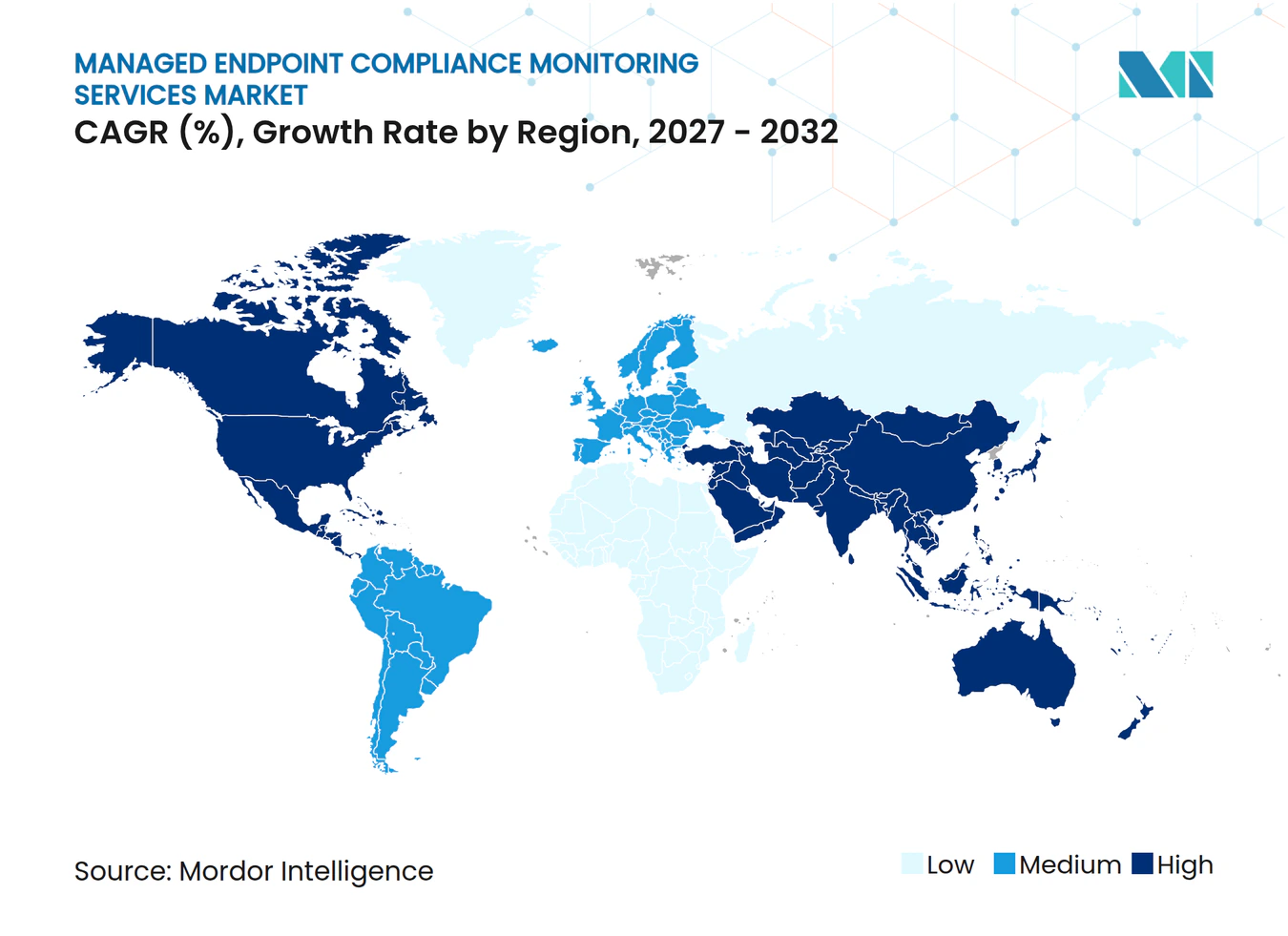
- By geography, North America held 36.14% of the Managed Endpoint Compliance Monitoring Services Market revenue share in 2026, while Asia-Pacific is projected to expand at a 19.58% CAGR through 2032.
Note: Market numbers in this report are based on Mordor Intelligence's proprietary estimation framework, which combines nine months of actuals with Q4 projections for base year 2026.
Market Trends and Insights
Drivers Impact Analysis of Managed Endpoint Compliance Monitoring Services Market*
| Driver | (~) % Impact on CAGR Forecast | Geographic Relevance | Impact Timeline |
|---|---|---|---|
| NIS2, DORA, CMMC, and Sector Regulation Readiness Spending | +4.2% | Global, with the European Union and North America primary, followed by Asia-Pacific and Middle East and Africa | Medium term (2-4 years) |
| Hybrid Work and BYOD Governance Expansion | +3.8% | Global | Short term (≤ 2 years) |
| Zero-Trust and Endpoint Security Convergence | +3.5% | Global, with North America and the European Union leading and Asia-Pacific accelerating | Medium term (2-4 years) |
| Cloud-First UEM Adoption Across Distributed Fleets | +2.9% | Global, with Asia-Pacific showing the fastest adoption pace | Medium term (2-4 years) |
| Continuous Evidence Requirements for Audit-Ready Compliance | +2.3% | Global, with the strongest demand in North America and the European Union | Short term (≤ 2 years) |
| Compliance Telemetry as a Managed Service for Lean IT Teams | +1.8% | Global, with the strongest uptake in North America and Asia-Pacific | Short term (≤ 2 years) |
| Source: Mordor Intelligence | |||
NIS2, DORA, CMMC, and Sector Regulation Readiness Spending
NIS2, DORA, CMMC, and sector-specific rules are creating direct demand for managed endpoint compliance monitoring services because they require organizations to demonstrate operating controls, not simply document internal policies. ENISA reported that 70% of surveyed European organizations identified compliance with NIS2, the Cyber Resilience Act, and DORA as their primary cybersecurity investment driver.[1] The same study found that 43% of ICT service management entities had not completed cybersecurity testing during the prior year and 45% took more than 3 months to apply critical patches. DORA supervision for European financial entities, CMMC requirements for the United States defense supply chain, and financial-sector rules in India and Malaysia each increase the importance of endpoint controls and structured evidence. The managed endpoint compliance monitoring services market benefits when a provider can map one device data set to several regulatory obligations, reducing duplicated evidence collection for the client and making control evidence easier to review.
Hybrid Work and BYOD Governance Expansion
Hybrid work has increased the number of locations, networks, and device types that must meet the same corporate baseline. Company devices now connect through home networks, hotel Wi-Fi, and mobile hotspots, while personal devices may access enterprise software soon after an employee is onboarded. Automox stated that 50% of organizations needed 5 or more days to patch critical vulnerabilities, exposing a gap between a documented policy and timely control execution. In Asia-Pacific, Josys and CAC Corporation introduced managed endpoint offerings that use recurring per-device pricing, making continuous monitoring more accessible to midsize organizations.[2] The managed endpoint compliance monitoring services market gains from this shift because clients need evidence that policy controls apply consistently to enrolled and remotely used devices, including those used beyond the corporate network. Mature BYOD rules also become important because device enrollment alone does not confirm that each device can support audit-ready evidence.
Zero-Trust and Endpoint Security Convergence
Zero-trust programs bring device condition closer to access decisions because access policies can check endpoint health before granting a user entry to an application. This approach creates a recurring device record that can support both security operations and compliance reporting. Tanium's October 2026 platform relaunch added endpoint behavioral monitoring, a federated security operations model, and plain-language threat-hunting functions based on real-time endpoint state. That combination shows why buyers increasingly prefer platforms that can connect detection, remediation, and compliance evidence through a common operating view. Organizations with incomplete conditional-access policies still produce exceptions and evidence gaps, which can increase the value of a managed service that validates controls and explains gaps to compliance teams. The managed endpoint compliance monitoring services market is therefore supported by zero-trust projects that need practical operating support after the initial security architecture has been selected and deployed across diverse devices.
Cloud-First UEM Adoption Across Distributed Fleets
Cloud-based unified endpoint management supports policy delivery and reporting without requiring each customer to maintain the management platform in its own data center. This model is well suited to distributed fleets because a centrally managed service can reach devices operating outside the corporate network. Microsoft Intune, Microsoft Defender for Endpoint, and Microsoft Purview were combined by CAC Corporation in a packaged endpoint security enhancement service launched for Japanese enterprises in December 2025. The offer illustrates how cloud platforms can be combined with managed operations to give clients a repeatable service rather than a one-time implementation. China remains a limiting case because MLPS obligations and data-localization requirements can require telemetry to remain within domestic infrastructure. The managed endpoint compliance monitoring services market will continue to reward providers that can offer cloud-scale management while routing data according to local hosting and residency requirements, without weakening the evidence available to local compliance teams.
Restraints Impact Analysis of Managed Endpoint Compliance Monitoring Services Market*
| Restraint | (~) % Impact on CAGR Forecast | Geographic Relevance | Impact Timeline |
|---|---|---|---|
| Legacy Toolchain Migration and Integration Complexity | -2.8% | Global, most acute in European Union and North American large-enterprise environments | Medium term (2-4 years) |
| Data Sovereignty and Regional Hosting Constraints | -2.2% | Asia-Pacific, including China and India, the European Union, and Middle East and Africa | Long term (≥ 4 years) |
| Endpoint Agent Fatigue and Performance Trade-Offs | -1.5% | Global | Medium term (2-4 years) |
| Evidence Ownership and Cross-Tenant Audit-Chain Ambiguity | -1.0% | Global, concentrated in regulated industries | Medium term (2-4 years) |
| Source: Mordor Intelligence | |||
Legacy Toolchain Migration and Integration Complexity
Replacing an incumbent endpoint toolchain can delay adoption because large organizations often have several systems supporting endpoint management, identity, security monitoring, and compliance reporting. Those systems must be mapped carefully before a new managed service can produce a reliable continuous posture record. The resulting work can compete with broader modernization programs for the same security and IT staff. Automox launched Canopy in August 2026 to connect with existing Jamf Pro and Microsoft Intune deployments instead of requiring an immediate MDM replacement.[3] The product supports Apple Silicon macOS patching, Linux, servers, and more than 600 third-party applications through a coexistence model. Providers that integrate with a client's existing management tools can reduce implementation friction and preserve historical evidence while the client plans a longer-term platform decision.
Data Sovereignty and Regional Hosting Constraints
Managed services centralize telemetry from distributed device fleets, but local data rules can limit where that telemetry is stored, processed, and accessed. The General Data Protection Regulation, DORA, China's MLPS framework, and national financial-sector rules impose different obligations on cross-border data handling. The Association of Banks in Singapore stated that cross-border data flows require institution-level risk assessments for each jurisdiction pair, increasing the operating burden for banks and their service providers. India's data protection framework, Indonesia's financial-sector systems rules, and African data protection laws add further country-level requirements for providers serving regulated clients. Providers with jurisdiction-specific routing and regional processing options can address these constraints more effectively than services that depend on a single global telemetry location. The restraint remains material because localized delivery raises operating complexity and can slow entry into new regulated markets.
*Our forecasts treat driver/restraint impacts as directional, not additive. The impact forecasts reflect baseline growth, mix effects, and variable interactions.
Managed Endpoint Compliance Monitoring Services Market Segment Analysis
By Service Type:
Monitoring and Reporting Services Anchor the Revenue BaseEndpoint Compliance Monitoring and Reporting Services accounted for 61.29% of revenue in 2026, making it the largest service type in the managed endpoint compliance monitoring services market. The segment provides the posture visibility that clients need before they can automate remediation or produce assessor-ready material, bringing device health, software status, configuration checks, and identified exceptions into a record that can be used by both operational and compliance teams. Monitoring is often the initial service because it shows where configuration, patch, and policy exceptions exist across the fleet. This foundation can support later purchases of remediation, audit support, and regulatory-management services from the same provider, since clients can extend the use of an established device data set instead of rebuilding collection processes when a new control requirement appears. Endpoint Remediation and Policy Enforcement Services is the next major service area because clients need actions such as device quarantine, configuration rollback, and patch deployment once an exception is identified. Compliance Assessment and Audit Support Services then organize technical records into material that can be reviewed by internal audit teams and external assessors.
Regulatory Compliance Management Services is projected to grow at a 19.89% CAGR through 2032 within the managed endpoint compliance monitoring services market size. The segment responds to the need to manage NIS2, DORA, CMMC, HIPAA, PCI DSS, and similar requirements across the same device fleet. Its value comes from aligning common endpoint information to different control expectations without asking the customer to rebuild the evidence collection process for each framework. Other service types include emerging offerings related to AI governance and endpoint benchmarking. Addigy introduced an AI Compliance Benchmark in September 2026 that monitors 30 controls related to AI tool use at the application and network levels. Providers that combine monitoring, remediation, audit support, and regulatory coordination in one engagement are better positioned to retain clients as their compliance programs become more complex. The managed endpoint compliance monitoring services market also gives these providers a clearer opportunity to extend work from core device reporting into broader compliance operations.



By Deployment Mode:
Cloud Leads While Hybrid Supports Regulated WorkloadsCloud-based delivery held 68.41% of revenue in 2026, making it the leading deployment model in the managed endpoint compliance monitoring services market. Cloud agents can reach remote devices through standard network connections and can support frequent policy updates without a client-managed upgrade cycle for the control plane. This arrangement is useful where employees use several operating systems and move between locations. A central service console also makes it easier to compare device status across a distributed workforce. On-premises deployment remains relevant in air-gapped environments and high-security settings where data-handling rules do not allow cloud-routed telemetry. Government, defense, and certain critical-infrastructure operators continue to need these local models.
Hybrid deployment is projected to expand at a 20.12% CAGR through 2032. The model allows sensitive endpoint information to be processed locally while policy administration and reporting are managed through cloud services, giving clients a practical way to separate local data-handling obligations from the need for centralized operating oversight across teams and business units. This configuration can meet data residency obligations while preserving centralized visibility for the enterprise. The managed endpoint compliance monitoring services market is strengthened when that design avoids a separate process for each regulated location. It is particularly relevant to financial institutions subject to European privacy and operational-resilience requirements. The managed endpoint compliance monitoring services industry is likely to favor providers with one console for cloud, on-premises, and hybrid devices because clients do not want to reconcile separate evidence sets. Per-tenant routing controls also allow providers to adapt their services to different client jurisdictions without changing the daily management experience. The managed endpoint compliance monitoring services market benefits where this flexibility is available because regulated clients can retain a consistent operational process across locations.
By Organization Size:
Large Enterprises Lead as SMEs Gain AccessLarge enterprises held 70.22% of revenue in 2026 because they have broader regulatory exposure, larger endpoint estates, and more resources for managed service contracts. Their programs often cover thousands of devices across business units and jurisdictions, making continuous monitoring more useful than periodic manual review because the service can present a shared view of device exceptions before issues become separate audit, security, and operational problems. Multi-year service contracts can also be difficult to replace because a change requires careful migration of policies, device records, and compliance evidence. ENISA reported median annual cybersecurity spending of EUR 1.5 million among surveyed organizations, reinforcing the capacity of larger regulated organizations to fund sustained security and compliance programs. These buyers remain central to current revenue because they need repeatable controls across a broad device population.
Small and medium enterprises are projected to grow at a 20.41% CAGR through 2032, the highest pace among the reported segmentation types. Subscription pricing reduces the upfront infrastructure and staffing requirements that once limited continuous endpoint compliance programs to larger organizations. NinjaOne reported more than USD 500 million in annual recurring revenue and more than 35,000 customers across 140 countries in January 2026. Its scale shows the potential of cloud-native endpoint platforms to serve smaller customers without the same professional-services model used for large enterprise deployments. Managed service providers and value-added resellers are also important routes to smaller BFSI and healthcare clients that face compliance obligations despite limited internal security headcount. The managed endpoint compliance monitoring services industry can gain from this customer group when packages remain clear, affordable, and usable with existing device-management tools. In the managed endpoint compliance monitoring services market, that requirement puts pressure on providers to keep onboarding, service scope, and billing straightforward for smaller buyers.

By End-User Industry:
BFSI Anchors Demand While Government Grows FastestBFSI accounted for 28.11% of revenue in 2026 and remained the largest end-user group in the managed endpoint compliance monitoring services market. Financial institutions must address DORA, PCI DSS, GLBA, NYDFS 23 NYCRR 500, and central-bank technology risk requirements across their device estates. These overlapping obligations increase the value of a service that turns endpoint configuration and patch information into traceable evidence, while helping risk and technology teams connect routine endpoint work to the control language used in audits and supervisory reviews. The Office of the Comptroller of the Currency identified asset inventory, vulnerability management, and incident notification as important elements of financial-system resilience. Healthcare and life sciences also generate demand because devices that handle patient data must support demonstrable safeguards under HIPAA and related privacy requirements. Both verticals benefit from continuous posture validation because an audit cannot rely solely on a historical configuration snapshot.
Government and Public Administration is projected to grow at a 19.29% CAGR through 2032. CMMC Phase 1, critical-infrastructure requirements, and digital government programs expand the number of managed endpoints without increasing cybersecurity staffing at the same rate. Government buyers also value providers with authorization pathways that support public-sector procurement. NinjaOne reported FedRAMP, GovRAMP, and Texas-RAMP authorizations in January 2026, illustrating the role of credentials in public-sector access. IT and telecommunication, industrial manufacturing, retail and e-commerce, energy and utilities, and other end-user industries add demand through their own control requirements. AI governance creates an additional need in IT and retail where organizations are beginning to monitor unauthorized AI tool use from endpoints. The managed endpoint compliance monitoring services market can address this need where providers make those controls part of regular endpoint reporting rather than a separate manual process.
Geography Analysis
North America Managed Endpoint Compliance Monitoring Services Market
North America held 36.14% of revenue in 2026 and led the managed endpoint compliance monitoring services market. The United States contributes most regional revenue because of its dense cybersecurity vendor base, large regulated sectors, and CMMC-related defense procurement. CMMC Phase 1 became relevant to covered defense supply-chain suppliers from November 2025, increasing attention to endpoint-level controls aligned with NIST SP 800-171. Financial services buyers must address FFIEC expectations, SEC cyber risk rules, NYDFS requirements, and Federal Trade Commission safeguards requirements. This layered environment supports recurring demand for providers that turn technical endpoint status into evidence suitable for examination. The managed endpoint compliance monitoring services market is supported when that evidence can be organized without delaying routine technology operations. Canada and Mexico add regional breadth through privacy modernization and enterprise technology programs.
Europe Managed Endpoint Compliance Monitoring Services Market
Europe remains the second-largest demand base because NIS2, DORA, and the EU AI Act create related but distinct evidence needs. ENISA found that compliance was the primary cybersecurity investment driver for 70% of surveyed organizations, while many respondents reported long patching cycles and limited testing activity. Germany, the United Kingdom, and France lead demand through their large enterprise populations and more mature compliance programs. Italy, Russia, and other European markets offer expansion potential as regulatory enforcement and compliance deadlines become more immediate. Ivanti and e92plus announced a distribution partnership for the United Kingdom and Ireland in October 2026, showing continued investment in regional channel coverage.
APAC, South America and MEA Managed Endpoint Compliance Monitoring Services Market
Asia-Pacific is projected to expand at a 19.58% CAGR through 2032, the fastest regional pace in the managed endpoint compliance monitoring services market. Regulatory developments, digital workplace programs, and regional service providers are expanding the addressable customer base. CAC Corporation launched its Endpoint Security Enhancement Service in Japan during December 2025, combining Microsoft Intune, Defender for Endpoint, and Purview in a managed package. Mitsubishi Electric Digital Innovation deployed managed EDR services at Hirotani Corporation from April 2025 and reported a 98% reduction in compliance-monitoring operational effort through 24/7 SOC coverage. China’s data-localization and MLPS obligations raise demand for domestic or locally hosted platforms. South America, the Middle East, and Africa remain earlier-stage regions, but national digitization and public-sector cybersecurity programs are widening demand for managed compliance services. The managed endpoint compliance monitoring services market has room to develop in these regions as local providers, channel partners, and public organizations build the required operating capacity.
Competitive Landscape
Market Concentration
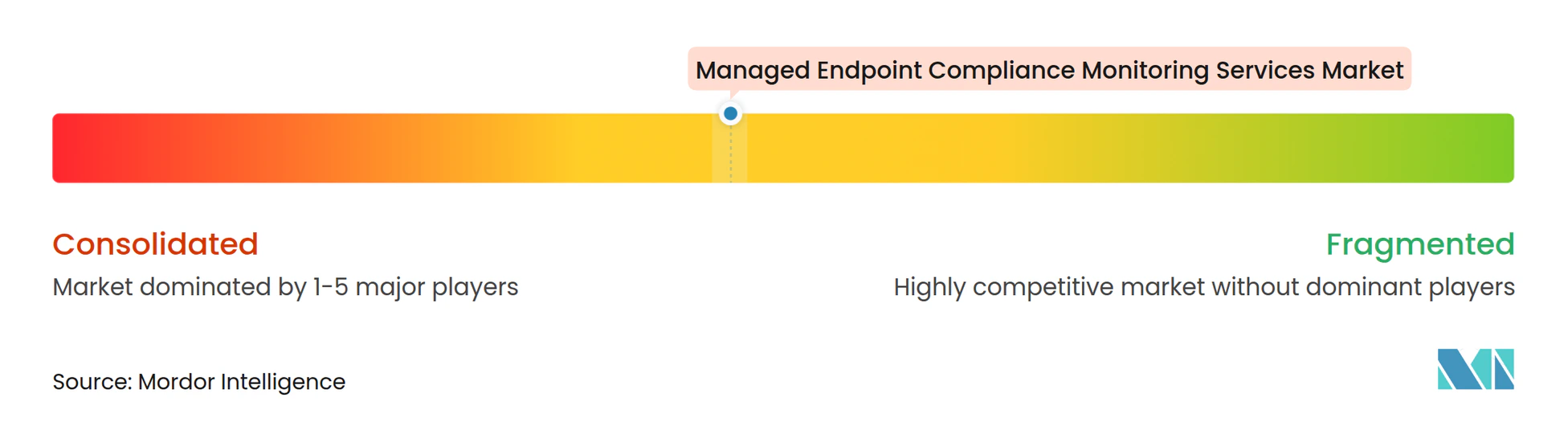
The managed endpoint compliance monitoring services market is moderately fragmented because no provider has a dominant position across cloud-native SME delivery, large-enterprise UEM, government credentialing, and Apple-focused endpoint management. Buyers select providers based on their existing endpoint stack, regulatory environment, deployment preference, and ability to operate across several device types. The market concentration score is 4 out of 10 because the available material describes moderate fragmentation and does not identify a top-player group with a combined share that would support a higher concentration score. Platform consolidation was a major strategic pattern during 2025 and 2026 as vendors combined device management, identity functions, behavioral telemetry, and data protection. The strategic purpose is to reduce the number of endpoint agents and management consoles that enterprise clients must operate. The managed endpoint compliance monitoring services market is affected by this choice because clients increasingly assess service providers against their ability to work with, rather than complicate, the existing endpoint environment.
Tanium relaunched its Security Operations platform in October 2026 with Endpoint Drift, an Insights Engine, a Federated SOC model, and Tanium Atlas for plain-language threat hunting. The move connects real-time endpoint state, detection, response, and threat hunting in a single operational environment. F5 and Omnissa announced a September 2026 partnership integrating F5 BIG-IP Zero Trust Access with Omnissa Horizon and Workspace ONE Access. The partnership addresses virtual desktop access and continuous policy enforcement, areas where device posture can inform application access. Jamf completed its USD 216.1 million acquisition of Identity Automation in April 2025, bringing identity lifecycle capabilities closer to Apple device management and security.
Providers compete more effectively when they can create evidence for several frameworks from the same endpoint data set. This is particularly important in regulated sectors where one device population must satisfy NIS2, DORA, CMMC, HIPAA, and other requirements. There is also opportunity in operational technology endpoints, multi-cloud evidence coordination, and services that support jurisdiction-specific telemetry handling. Addigy expanded its Apple device management capabilities with an Intelligence Suite and AI-related compliance functions in September 2026. Ivanti pursued FedRAMP High and DoD IL5 authorization through Project Hosts in 2025, reflecting the importance of public-sector authorization pathways. Smaller vendors can remain competitive by integrating with established platforms and automating the link between vulnerability discovery, remediation, and documentation. The managed endpoint compliance monitoring services market remains open to specialists that lower migration effort and provide usable evidence outputs.
Managed Endpoint Compliance Monitoring Services Industry Leaders
-
Ivanti Software, Inc.
-
Jamf Holding Corp.
-
SOTI Inc.
-
Tanium Inc.
-
Omnissa, LLC
- *Disclaimer: Major Players sorted in no particular order
Managed Endpoint Compliance Monitoring Services Market Companies Covered in this Report
- Jamf Holding Corp.
- Ivanti Software, Inc.
- SOTI Inc.
- Mitsogo Inc.
- 42Gears Mobility Systems Pvt. Ltd.
- Matrix42 GmbH
- Omnissa, LLC
- NinjaOne, LLC
- Tanium Inc.
- Automox, Inc.
- JumpCloud Inc.
- Kandji, Inc.
- Addigy, Inc.
- Mosyle Corporation
- ProMobi Technologies Pvt. Ltd.
- Syxsense Inc.
- Action1 Corporation
- Atera Networks Ltd.
- baramundi software GmbH
- Aagon GmbH
Recent Industry Developments in Managed Endpoint Compliance Monitoring Services Market
- October 2026: Tanium relaunched its Security Operations platform with Endpoint Drift, the Insights Engine, the Federated SOC model, and Tanium Atlas. The relaunch positioned continuous endpoint behavioral monitoring as a direct input to security operations and connected compliance posture with threat response in a single platform.
- October 2026: Ivanti and e92plus announced a strategic distribution partnership covering the United Kingdom and Ireland. The partnership expanded channel access for Ivanti’s managed endpoint and compliance monitoring services across mid-market European organizations.
- September 2026: F5 and Omnissa announced a strategic partnership integrating F5 BIG-IP Zero Trust Access with Omnissa Horizon and Workspace ONE Access. The joint solution consolidated legacy virtual desktop gateway proxies into a unified management platform with continuous policy enforcement and single sign-on.
- September 2026: Addigy launched its Intelligence Suite, an AI layer within its real-time Apple device management platform. The release included plain-language device search, compliance reporting, an AI Compliance Benchmark, Script Assist, and the Addigy MCP AI gateway with approval gates for administrator actions.
Global Managed Endpoint Compliance Monitoring Services Market Report Scope
The Managed Endpoint Compliance Monitoring Services Market comprises outsourced services that continuously monitor, assess, enforce, and report endpoint compliance across enterprise device environments, including desktops, laptops, mobile devices, and other managed endpoints. These services help organizations maintain adherence to internal security policies, industry standards, and regulatory requirements by providing compliance monitoring, remediation, policy enforcement, audit support, and regulatory compliance management through centralized endpoint management and security platforms.
The Managed Endpoint Compliance Monitoring Services Market Report is Segmented by Service Type (Endpoint Compliance Monitoring and Reporting Services, Endpoint Remediation and Policy Enforcement Services, Compliance Assessment and Audit Support Services, Regulatory Compliance Management Services, Other Service Types), Deployment Mode (Cloud-Based, On-Premises, Hybrid), Organization Size (Large Enterprises, Small and Medium Enterprises), End-User Industry (Banking, Financial Services, and Insurance (BFSI), Government and Public Administration, Healthcare and Life Sciences, IT and Telecommunication, Industrial Manufacturing, Retail and E-commerce, Energy and Utilities, Other End-User Industries), and Geography (North America, South America, Europe, Asia-Pacific, Middle East, Africa). The Market Forecasts are Provided in Value (USD).
Segmentation Overview
| Endpoint Compliance Monitoring and Reporting Services |
| Endpoint Remediation and Policy Enforcement Services |
| Compliance Assessment and Audit Support Services |
| Regulatory Compliance Management Services |
| Other Service Types |
| Cloud-Based |
| On-Premises |
| Hybrid |
| Large Enterprises |
| Small and Medium Enterprises |
| Banking, Financial Services, and Insurance (BFSI) |
| Government and Public Administration |
| Healthcare and Life Sciences |
| IT and Telecommunication |
| Industrial Manufacturing |
| Retail and E-commerce |
| Energy and Utilities |
| Other End-User Industries |
| North America | United States |
| Canada | |
| Mexico | |
| South America | Brazil |
| Argentina | |
| Rest of South America | |
| Europe | Germany |
| United Kingdom | |
| France | |
| Italy | |
| Russia | |
| Rest of Europe | |
| Asia-Pacific | China |
| Japan | |
| India | |
| South Korea | |
| Rest of Asia-Pacific | |
| Middle East | Saudi Arabia |
| United Arab Emirates | |
| Rest of Middle East | |
| Africa | South Africa |
| Nigeria | |
| Rest of Africa |
| By Service Type | Endpoint Compliance Monitoring and Reporting Services | |
| Endpoint Remediation and Policy Enforcement Services | ||
| Compliance Assessment and Audit Support Services | ||
| Regulatory Compliance Management Services | ||
| Other Service Types | ||
| By Deployment Mode | Cloud-Based | |
| On-Premises | ||
| Hybrid | ||
| By Organization Size | Large Enterprises | |
| Small and Medium Enterprises | ||
| By End-User Industry | Banking, Financial Services, and Insurance (BFSI) | |
| Government and Public Administration | ||
| Healthcare and Life Sciences | ||
| IT and Telecommunication | ||
| Industrial Manufacturing | ||
| Retail and E-commerce | ||
| Energy and Utilities | ||
| Other End-User Industries | ||
| By Geography | North America | United States |
| Canada | ||
| Mexico | ||
| South America | Brazil | |
| Argentina | ||
| Rest of South America | ||
| Europe | Germany | |
| United Kingdom | ||
| France | ||
| Italy | ||
| Russia | ||
| Rest of Europe | ||
| Asia-Pacific | China | |
| Japan | ||
| India | ||
| South Korea | ||
| Rest of Asia-Pacific | ||
| Middle East | Saudi Arabia | |
| United Arab Emirates | ||
| Rest of Middle East | ||
| Africa | South Africa | |
| Nigeria | ||
| Rest of Africa | ||
Key Questions Answered in the Report
What is the managed endpoint compliance monitoring services market size?
The managed endpoint compliance monitoring services market is valued at USD 1.45 billion in 2026 and is projected to reach USD 4.09 billion by 2032, at an 18.94% CAGR from 2027 to 2032.
What is driving demand for managed endpoint compliance monitoring services?
Hybrid work, BYOD governance, cloud endpoint management, and compliance requirements under frameworks such as NIS2, DORA, and CMMC are increasing demand for continuous device evidence.
Which service type leads endpoint compliance monitoring demand?
Endpoint Compliance Monitoring and Reporting Services leads with 61.29% revenue share in 2026 because it provides the basic visibility needed for remediation and audit support.
Which deployment model is growing fastest for endpoint compliance services?
Hybrid deployment is projected to grow at a 20.12% CAGR through 2032 as regulated organizations retain sensitive data locally while using cloud-based policy and reporting functions.
Which organizations are adopting managed endpoint compliance services fastest?
Small and medium enterprises are projected to grow at a 20.41% CAGR through 2032 as subscription pricing reduces the infrastructure and staffing barriers to continuous monitoring.
Which region is expanding fastest for endpoint compliance monitoring?
Asia-Pacific is projected to grow at a 19.58% CAGR through 2032, supported by digital workplace investment, regional service providers, and stronger cybersecurity requirements.