
Managed EDR Tuning and Detection Engineering Services Market Size and Share
Market Overview
| Study Period | 2021 - 2032 |
|---|---|
| Market Size (2027) | USD 1.23 Billion |
| Market Size (2032) | USD 3.35 Billion |
| Growth Rate (2027 - 2032) | 22.20 % |
| Fastest Growing Market | Asia-Pacific |
| Largest Market | North America |
| Market Concentration | Medium |
Major Players *Disclaimer: Major Players sorted in no particular order Image © Mordor Intelligence. Reuse requires attribution under CC BY 4.0. | |
Managed EDR Tuning and Detection Engineering Services Market Analysis by Mordor Intelligence
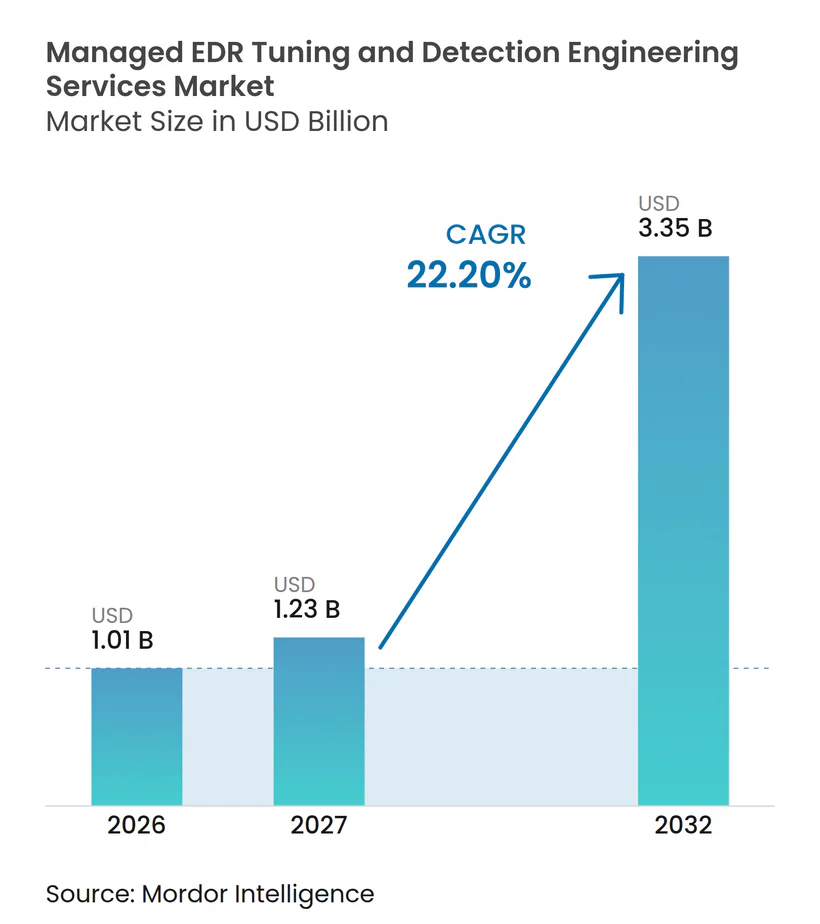
The Managed EDR Tuning and Detection Engineering Services market size is projected to expand from USD 1.01 billion in 2026 to USD 1.23 billion in 2027, and to USD 3.35 billion by 2032, registering a CAGR of 22.20% between 2027 and 2032. The Managed EDR Tuning and Detection Engineering Services market serves organizations that have deployed endpoint detection and response tools but lack the in-house capability to maintain behavioral baselines, refine exclusion lists, and update detection content. Buyer evaluation is moving beyond platform deployment toward measurable outcomes, including detection speed, false-positive control, and containment accuracy. Ransomware and identity-led attacks are increasing the need for detection logic that can recognize misuse of credentials, OAuth workflows, and session tokens. Managed delivery is also becoming more important as cloud, hybrid, and distributed endpoint environments make internal operations harder to sustain. Consolidation is raising the standard for content breadth and automation, while data sovereignty requirements create opportunities for providers with local infrastructure and auditable access controls.
Key Report Takeaways
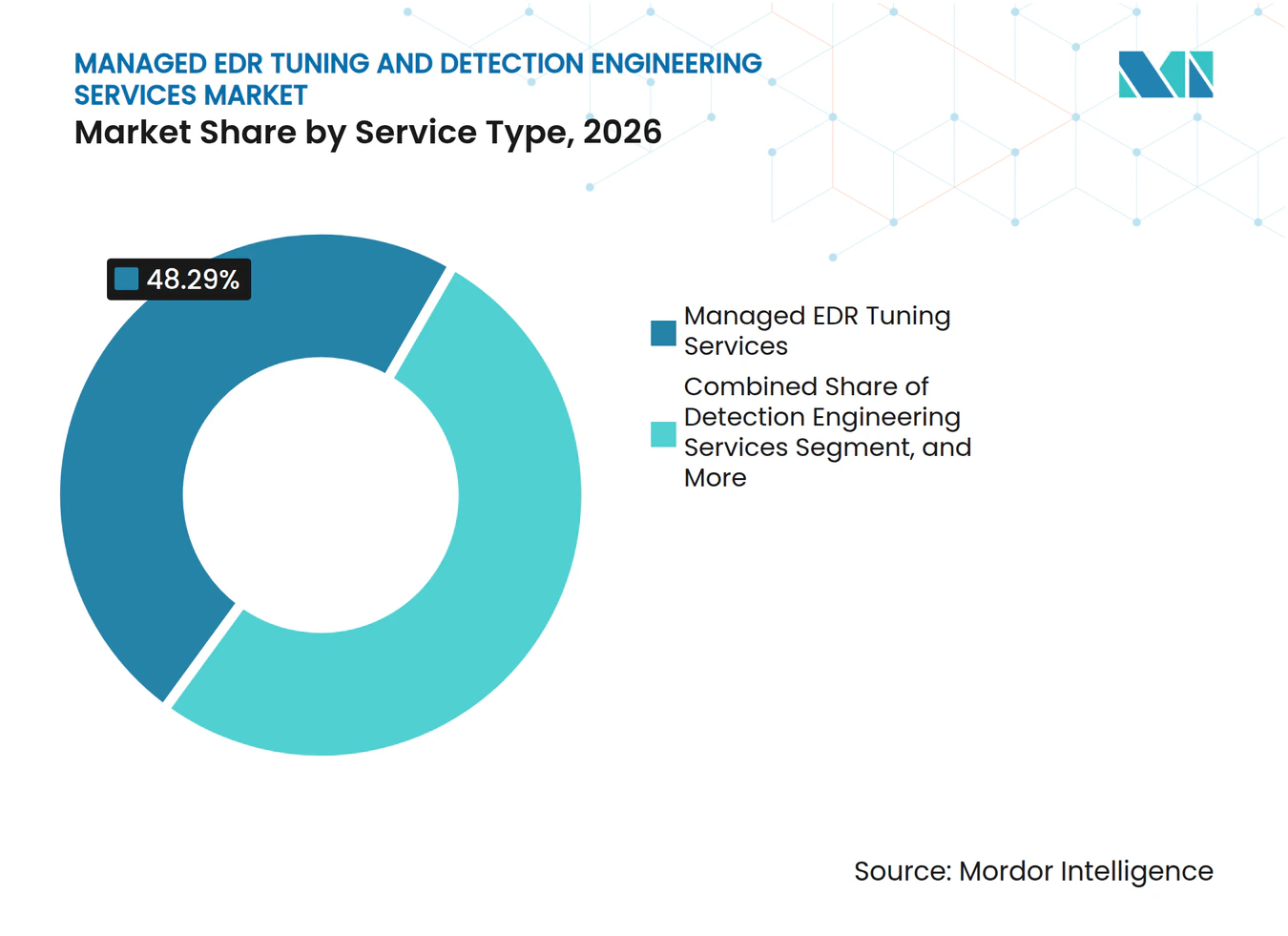
- By service type, Managed EDR Tuning Services held 48.29% of the Managed EDR Tuning and Detection Engineering Services market share in 2026, while Detection Engineering Services are projected to expand at a 23.45% CAGR through 2032.
- By delivery model, Fully Managed Services held 67.14% of the Managed EDR Tuning and Detection Engineering Services market revenue share in 2026, while Co-Managed Services are projected to expand at a 23.77% CAGR through 2032.
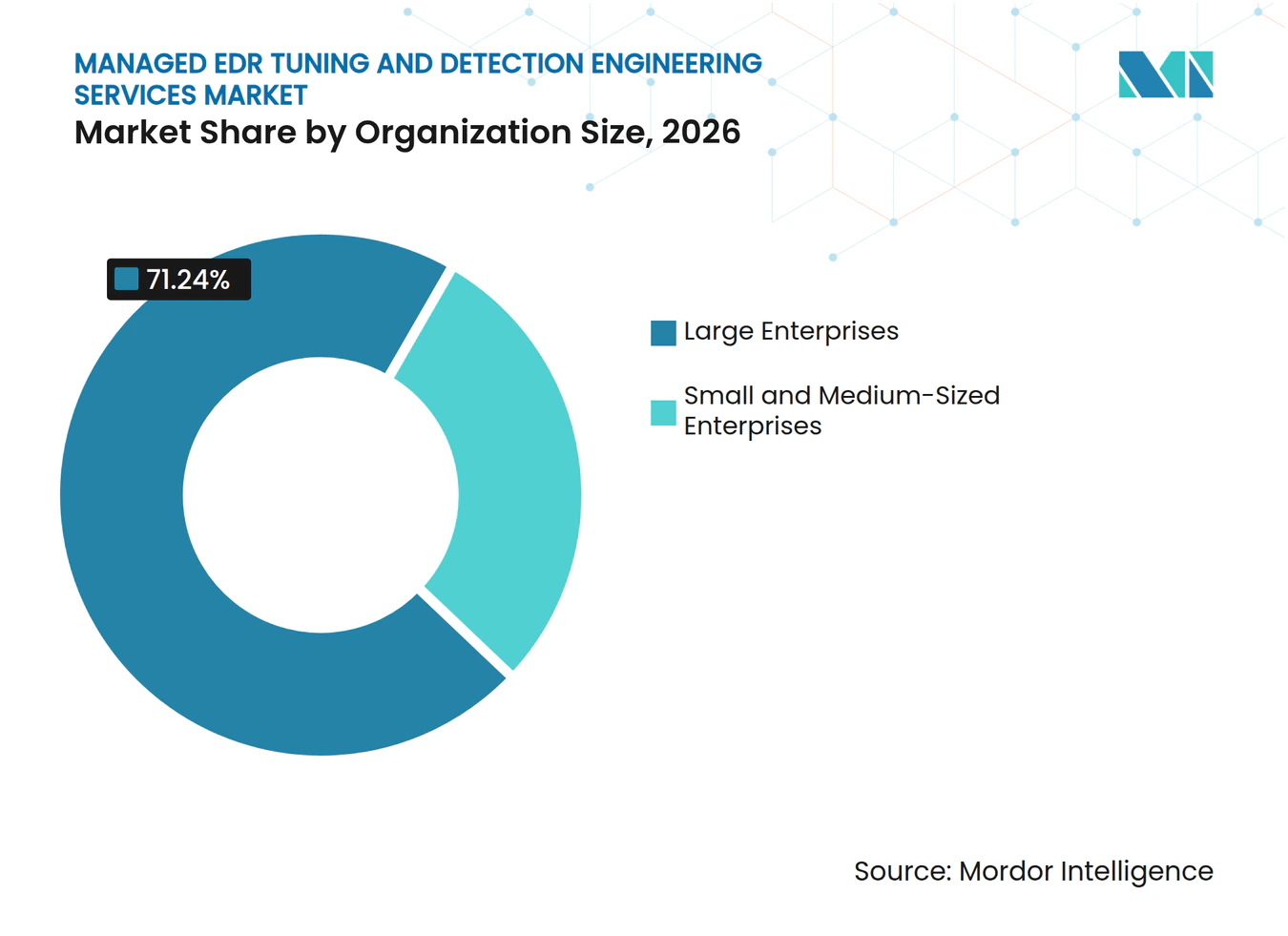
- By organization size, Large Enterprises held 71.24% of the Managed EDR Tuning and Detection Engineering Services market revenue share in 2026, while SMEs are projected to expand at a 24.02% CAGR through 2032.
- By end-user industry, BFSI held 27.12% of the Managed EDR Tuning and Detection Engineering Services market revenue share in 2026, while Government and Public Administration are projected to expand at a 22.76% CAGR through 2032.
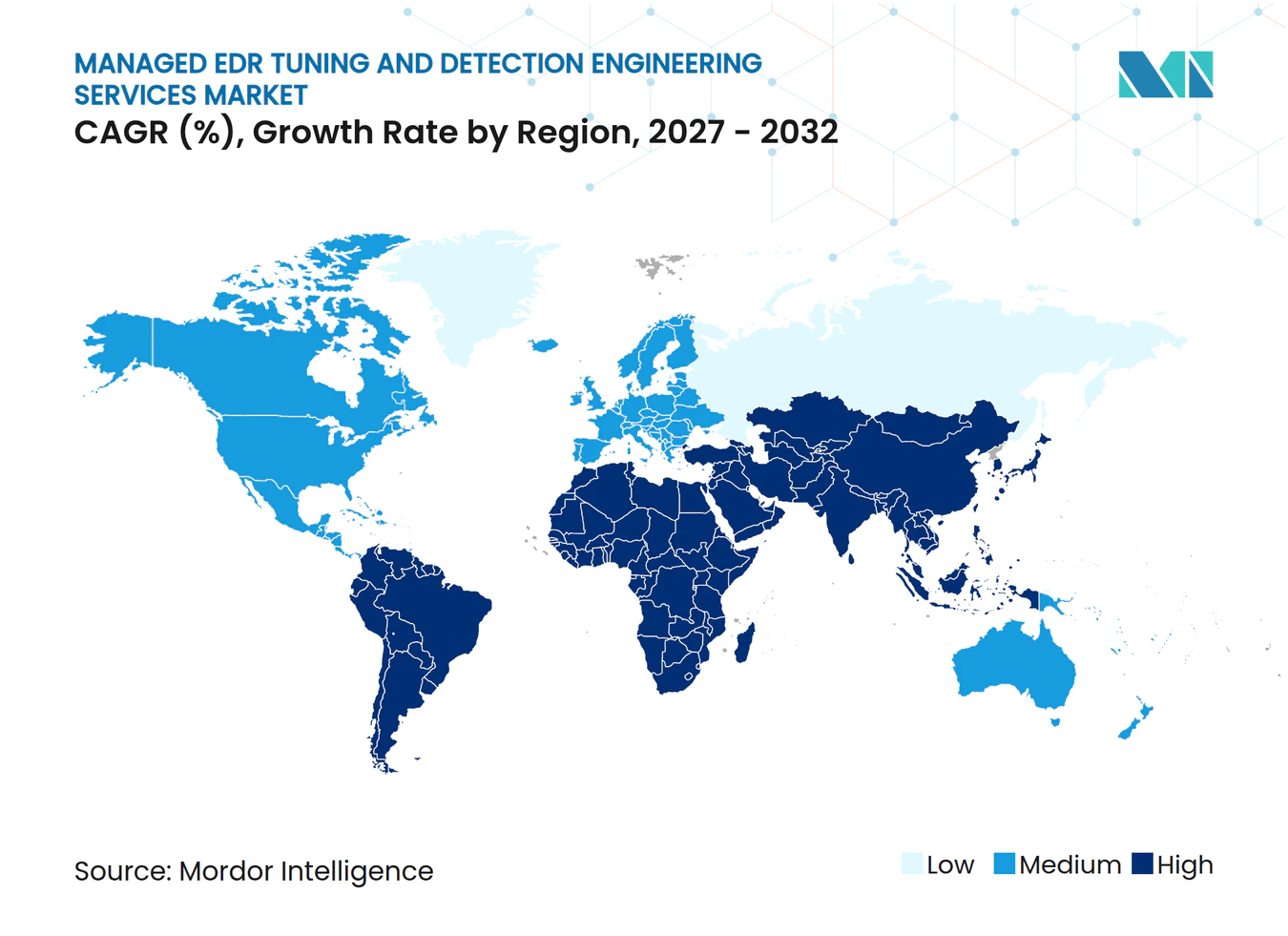
- By geography, North America held 36.44% of the Managed EDR Tuning and Detection Engineering Services market revenue share in 2026, while Asia-Pacific is projected to expand at a 23.10% CAGR through 2032.
Note: Market numbers in this report are based on Mordor Intelligence's proprietary estimation framework, which combines nine months of actuals with Q4 projections for base year 2026.
Market Trends and Insights
Drivers Impact Analysis of Managed EDR Tuning and Detection Engineering Services Market*
| Driver | (~) % Impact on CAGR Forecast | Geographic Relevance | Impact Timeline |
|---|---|---|---|
| Rising Ransomware and Identity-Based Attack Complexity | +4.2% | Global, with the highest concentration in North America, Western Europe, and core Asia-Pacific markets | Short term (≤ 2 years) |
| Cybersecurity Talent Shortages and SOC Capacity Constraints | +3.8% | Global, particularly North America, Western Europe, and emerging Asia-Pacific markets | Medium term (2-4 years) |
| Expansion of Cloud, Hybrid, and Distributed Endpoint Environments | +3.2% | Global, with the fastest endpoint expansion in Asia-Pacific and South America | Medium term (2-4 years) |
| Detection Engineering Automation Through AI-Assisted Analytics | +2.8% | Primarily North America and Europe, with accelerating adoption in Asia-Pacific | Long term (≥ 4 years) |
| Regulatory Pressure for Continuous Monitoring and Incident Readiness | +2.2% | North America and the European Union, with spillover to Asia-Pacific financial hubs | Medium term (2-4 years) |
| SMB-Led Managed-Service and MSP Channel Pull | +1.8% | Primarily North America and the United Kingdom, with growth through local MSSPs in Asia-Pacific | Long term (≥ 4 years) |
| Source: Mordor Intelligence | |||
Rising Ransomware and Identity-Based Attack Complexity
Ransomware campaigns increasingly use stolen identities and multiple attack stages, which expands the scope of managed EDR tuning work. Sophos found that 71% of organizations experienced at least 1 identity-related breach during the previous 12 months, and the reported average recovery cost was USD 1.64 million. The report also found that 47.7% of identity incidents resulted in successful account access via stolen credentials. This makes file-based alerts insufficient when abuse occurs through single sign-on, OAuth activity, or session tokens. The Managed EDR Tuning and Detection Engineering Services market benefits when providers keep detection libraries current against these techniques. Providers that connect threat intelligence to engineering workflows can reduce the time between an emerging technique and a validated production detection.
Cybersecurity Talent Shortages and SOC Capacity Constraints
Cybersecurity staffing challenges are increasingly defined by gaps in specialist skills rather than by headcount alone. SANS found that 60% of organizations saw skills gaps as the larger challenge, while 27% reported a breach linked to workforce capability gaps. Fortinet reported that 71% of organizations considered the shortage a source of additional cyber risk, and 60% could not find candidates with AI-specific security expertise. Detection engineering requires simultaneous knowledge of threat intelligence, query languages, behavioral analytics, and attacker tactics and techniques. These skills are difficult to recruit and retain within a single internal security team. The Managed EDR Tuning and Detection Engineering Services market, therefore, offers a practical route for organizations that need experienced analysts without having to build every capability internally.
Expansion of Cloud, Hybrid, and Distributed Endpoint Environments
Cloud workloads and remote endpoints have widened the operating environment that managed EDR providers must cover. Expel found that endpoint attacks accounted for 29% of reported incidents in its 2026 annual threat report, with delivery methods including ClickFix activity and backdoored productivity applications. Detection teams must account for endpoints, containerized applications, cloud infrastructure, and devices operating across multiple jurisdictions. Telemetry structures can differ between cloud-native agents and traditional on-premises deployments. A rule that performs well in one setting can lead to missed detections or noisy results in another. The Managed EDR Tuning and Detection Engineering Services market gains from providers that can calibrate coverage across several platforms and operating environments.
Detection Engineering Automation Through AI-Assisted Analytics
AI-assisted authoring is shortening the time needed to create and test detection logic. Microsoft introduced CTI-REALM in March 2026 as an open-source benchmark for AI agents that perform end-to-end detection engineering tasks across Linux, AKS, and Azure environments. The Canadian Center for Cyber Security described an automated process that produced 8 production-ready detection rules per test case after human review. Automation shifts specialist work toward validation, threat simulation, and rule quality review. It can widen coverage when governance is effective. It can also generate alert volume when models are poorly configured, so provider value remains dependent on experienced human oversight.
Restraints Impact Analysis of Managed EDR Tuning and Detection Engineering Services Market*
| Restraint | (~) % Impact on CAGR Forecast | Geographic Relevance | Impact Timeline |
|---|---|---|---|
| Data Privacy, Sovereignty, and Third-Party Access Concerns | -2.2% | European Union, India, Southeast Asia, and jurisdictions with strict data-localization mandates | Medium term (2-4 years) |
| Integration Complexity Across Heterogeneous Security Stacks | -1.8% | Global, with the greatest effect on large enterprises with diverse legacy stacks | Medium term (2-4 years) |
| Misconfigured AI Models and Alert-Flood Risk | -1.5% | Global, particularly organizations with immature AI governance | Short term (≤ 2 years) |
| Open-Source Agent Forks and Price Compression | -1.0% | Primarily North America and Europe, with growing relevance in Asia-Pacific | Long term (≥ 4 years) |
| Source: Mordor Intelligence | |||
Data Privacy, Sovereignty, and Third-Party Access Concerns
Rules governing security telemetry are becoming more demanding for managed service delivery. The European Union’s Digital Operational Resilience Act has been in force since January 2025 and requires covered financial entities to manage their relationships with third-party ICT service providers in a controlled manner. India’s Reserve Bank issued its 2026 cybersecurity, technology, risk, resilience, and assurance directions for commercial banks in October 2026, including requirements that affect continuous monitoring and third-party arrangements.[1] Endpoint data can reveal process activity, credential use, and file access patterns. Customers may therefore limit which telemetry can leave their jurisdiction or enter a provider environment. The Managed EDR Tuning and Detection Engineering Services market favors providers that can offer local processing, clear access logging, and audit-ready controls.
Integration Complexity Across Heterogeneous Security Stacks
Managed EDR engagements often require data to move among endpoint tools, SIEM platforms, SOAR systems, identity tools, and cloud monitoring services. Red Canary reported that the attack surface had widened by 41% in the preceding 12 months, while 73% of leaders said detection-to-resolution time had increased. Each security product may use different data structures, rate limits, and normalization requirements. Detection logic written for 1 endpoint agent often needs to be reengineered for another agent. Mergers, acquisitions, and cloud migrations can add to this complexity. Longer onboarding and rule conversion cycles can slow service adoption in the Managed EDR Tuning and Detection Engineering Services market.
*Our forecasts treat driver/restraint impacts as directional, not additive. The impact forecasts reflect baseline growth, mix effects, and variable interactions.
Managed EDR Tuning and Detection Engineering Services Market Segment Analysis
By Service Type - Managed EDR Tuning Services Lead While Detection Engineering Services Grow Fastest
Managed EDR Tuning Services held 48.29% market share in the Managed EDR Tuning and Detection Engineering Services market in 2026. The position reflects the gap between purchasing an EDR platform and effectively operating it. Many organizations deploy endpoint tools for compliance or insurance needs. They still need support with exclusion-list maintenance, behavioral baselines, and platform-specific tuning. Regular review is important because ordinary business activity can change, which makes alerts useful. The service also helps teams document why exclusions are made and when those decisions should be revisited. Detection Engineering Services are projected to grow at a 23.45% CAGR through 2032. This service meets demand for providers that build, validate, and continuously improve detection content. AI-assisted tools can shorten initial authoring cycles, but production rules still need to be tested in the customer environment. This preserves the importance of specialist engineers who can judge rule quality and operational impact.
Managed Investigation and Response Services complement tuning by handling alert triage and containment for confirmed incidents. Threat Hunting Services are relevant in regulated sectors where organizations need to search for suspicious activity beyond automated alerts. Energy and utility operators face particular pressure to identify activity around operational technology and connected endpoint systems. Other service types include detection library audits and EDR deployment assessments. These offers can introduce buyers to a recurring managed relationship. A focused assessment can identify coverage gaps before an organization commits to ongoing service. The Managed EDR Tuning and Detection Engineering Services market is supported when providers link these early engagements to defined improvement plans. Customers also gain a clearer view of which telemetry sources are missing or inconsistent. The service portfolio, therefore, ranges from operational tuning to more specialized engineering and assurance work.



By Delivery Model - Fully Managed Services Hold the Largest Share While Co-Managed Services Expand Fastest
Fully Managed Services accounted for 67.14% of the Managed EDR Tuning and Detection Engineering Services market size in 2026. The model remains important for mid-sized organizations with limited internal security headcount. These buyers may not have enough staff to share day-to-day detection and response responsibilities. Co-Managed Services are projected to expand at a 23.77% CAGR through 2032. This model suits enterprises that want a provider to extend their security operations center rather than replace it. It is also useful when internal teams need a documented review of changes to detection logic. The model can combine external engineering depth with customer knowledge of business processes. It allows internal analysts to understand how new detections are selected and deployed. It creates a closer operating relationship between the provider and the internal security team.
Project-Based Services address time-limited work, such as post-breach remediation, EDR migrations, and initial development of detection libraries. These projects can be valuable when an organization needs a defined result before entering a longer contract. A migration may require a complete review of legacy rules and a rebuild for a new endpoint platform. A post-breach engagement can also reveal gaps in data collection, tuning, and response procedures. International incident response guidance can encourage organizations to procure an assessment before establishing continuous services. The assessment can establish a baseline for later reviews of coverage and tuning outcomes. The Managed EDR Tuning and Detection Engineering Services market benefits when project engagements demonstrate measurable improvements in coverage. Customers who see those improvements can become candidates for fully managed or co-managed delivery. The project model, therefore, acts as both a specialist service and a path to recurring revenue.
By Organization Size - Large Enterprises Supply Revenue While SMEs Expand Faster
Large Enterprises held 71.24% of the Managed EDR Tuning and Detection Engineering Services market share in 2026. Their endpoint estates can span thousands of devices, several operating systems, cloud workloads, and multiple EDR platforms inherited through acquisitions. This complexity creates a significant and ongoing need for specialist tuning. Senior security roles can also take a long time to fill. SANS reported that 55% of senior-level cybersecurity hires took at least 6 months to complete. Managed delivery can therefore cost less than maintaining internal expertise across several platform query languages. It can also provide continuity when internal security teams change or expand. Larger buyers also tend to require audit evidence and structured change processes. These requirements support service models that combine operational scale with documentation.
SMEs are projected to record the highest growth at a 24.02% CAGR through 2032. Managed EDR delivered through MSP channels can make specialized detection support available at per-endpoint pricing. Smaller organizations often implement EDR to meet insurance requirements or to respond to supply chain risks. They may have little internal capacity to assess whether detections are complete or correctly tuned. This makes fully managed delivery especially relevant to this group. It also creates a risk that inherited configuration gaps will persist unless the provider performs regular review. Clear reporting can make it easier for smaller teams to understand which issues require their attention. The Managed EDR Tuning and Detection Engineering Services market can reach these buyers through local MSSPs that already manage core IT environments. Clear service packages and practical reporting can help providers show value without asking SMEs to develop deep internal security expertise.

By End-User Industry - BFSI Holds the Largest Position While Government Advances Fastest
BFSI accounted for 27.12% of the Managed EDR Tuning and Detection Engineering Services market size in 2026. Financial institutions face requirements for continuous monitoring, incident detection, and formal oversight of technology risk. DORA requires covered European financial entities to maintain ICT risk management controls, including arrangements relevant to incident detection. The Office of the Comptroller of the Currency described a 36-hour notification standard for certain cyber incidents affecting US banking organizations.[2] These duties increase the value of fast detection, strong evidence collection, and documented response processes. They also make consistent tuning important when platforms and data sources change. BFSI buyers also need to manage sensitive identity and transaction data. Providers serving this sector must align detection content with both technical risks and governance requirements.
Government and Public Administration are projected to expand at a 22.76% CAGR through 2032. Public organizations face modernization requirements alongside persistent exposure to sophisticated threats. Procurement programs often require managed security providers to document controls, access practices, and service performance. Healthcare and life sciences also require effective detection because systems handle sensitive records and operationally important services. IT and telecommunications providers manage extensive distributed infrastructures that need broad endpoint visibility. Manufacturing, retail, energy, and utilities also require tailored coverage for complex endpoint estates and connected operational environments. The Managed EDR Tuning and Detection Engineering Services market can address these requirements through vertical detection libraries and operational processes. A provider’s ability to adapt content for regulated and specialized environments can be more important than a generic alert feed.
Geography Analysis
North America Managed EDR Tuning and Detection Engineering Services Market
North America held 36.44% of the Managed EDR Tuning and Detection Engineering Services market share in 2026. The region has a deep concentration of managed security providers and mature enterprise security procurement practices. US banking organizations face reporting expectations that increase the importance of fast detection and documented incident handling. The Office of the Comptroller of the Currency’s 2026 resilience report linked cybersecurity preparedness to financial system stability.
Europe and APAC Managed EDR Tuning and Detection Engineering Services Market
Europe is shaped by obligations that affect both financial entities and providers of important services. DORA has been in effect since January 2025 and places substantial emphasis on ICT risk governance and third-party provider management.[3] Data localization and privacy expectations can limit centralized telemetry processing. Providers with European delivery capacity and detailed access controls can respond to this requirement. Asia-Pacific is projected to expand at a 23.10% CAGR through 2032 and includes fast-growing endpoint environments, varied regulatory requirements, and a need for managed delivery that can serve organizations with limited internal specialists.
MEA and South America Managed EDR Tuning and Detection Engineering Services Market
South America, the Middle East, and Africa remain earlier-stage demand environments for the Managed EDR Tuning and Detection Engineering Services market. Brazil is an important regional security buyer, especially among financial institutions and professional services firms. Saudi Arabia and the United Arab Emirates are directing investment in digital transformation toward government and critical infrastructure technologies. South Africa and Nigeria are adding endpoint exposure as financial services become more digital. Cloud-delivered managed services can be a practical entry point where on-premises security models are costly to maintain.
Competitive Landscape
Market Concentration
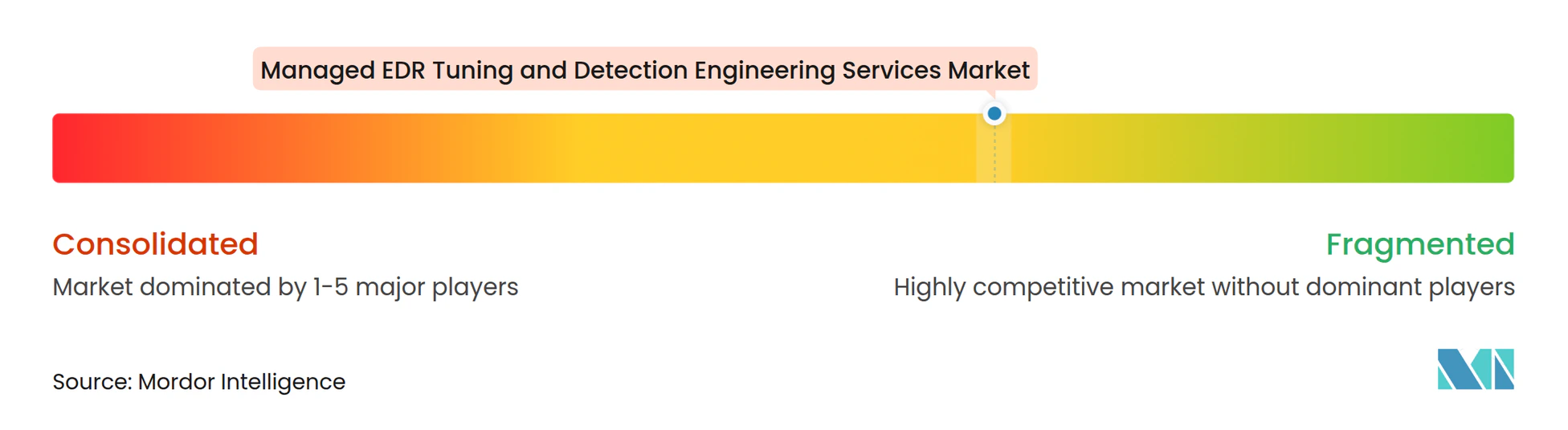
The Managed EDR Tuning and Detection Engineering Services market is moderately fragmented, with scaled security platforms competing against specialist providers that focus on detection content and vertical knowledge. ReliaQuest raised more than USD 500 million in March 2025 at a USD 3.4 billion valuation, supporting investment in security operations automation and international growth. Competitive strength depends on the quality of behavioral detections, not only on the number of alerts a platform generates. Providers need content that works across endpoint, cloud, identity, and software-as-a-service environments, and they need to show customers how rules are tested, governed, and improved. These requirements create room for both large platforms and focused engineering firms.
Consolidation is increasing the competitive baseline for coverage and service scale. Larger providers can combine broader service portfolios with engineering capacity and established customer relationships. This puts pressure on mid-sized providers to establish a clear specialization. Sovereign-compliant delivery and co-managed services are 2 routes, as they support regulated customers and enable internal analysts to work alongside external engineering teams.
AI is becoming an important competitive area, although it does not remove the need for analyst oversight. BlueVoyant launched BlueVoyant AI in June 2026 for both fully managed and enterprise self-service security operations. Deepwatch launched its NEXA collaborative agentic AI ecosystem in November 2025.[4] Providers are using AI to support rule creation, coverage analysis, and detection simulation, but buyers will still require evidence that generated rules are validated before deployment. The Managed EDR Tuning and Detection Engineering Services market rewards providers that combine automation with explainable review, strong content governance, and reliable service operations.
Managed EDR Tuning and Detection Engineering Services Industry Leaders
-
Arctic Wolf Networks, Inc.
-
Expel, Inc.
-
Binary Defense Systems, Inc.
-
Deepwatch, Inc.
-
Proficio, Inc.
- *Disclaimer: Major Players sorted in no particular order
Managed EDR Tuning and Detection Engineering Services Market Companies Covered in this Report
- Arctic Wolf Networks, Inc.
- eSentire, Inc.
- Expel, Inc.
- Red Canary, Inc.
- Huntress Labs Incorporated
- Binary Defense Systems, Inc.
- Deepwatch, Inc.
- Critical Start, Inc.
- Proficio, Inc.
- LMNTRIX, Inc.
- Alert Logic, Inc.
- Cysiv, Inc.
- GoSecure, Inc.
- Redscan Limited
- ActZero, Inc.
- BlueVoyant, Inc.
- CyberProof, Inc.
- Secureworks Corp.
- ReliaQuest Holdings, LLC
- Kudelski Security, Inc.
Recent Industry Developments in Managed EDR Tuning and Detection Engineering Services Market
- October 2026: Huntress expanded its EMEA distribution reach through a partnership with ALSO, extending its Agentic Security Platform across 31 European countries through ALSO's pan-European network. The move accelerates Huntress's channel strategy in a region where NIS2 compliance deadlines are driving adoption of MSP-delivered managed security services among SMEs.
- June 2026: BlueVoyant launched BlueVoyant AI, an agentic SecOps platform that supports both fully managed and enterprise self-service SOC deployments, with real-time deterministic decision-making and deep integration with the Microsoft Security ecosystem.
- March 2026: Huntress launched Managed Endpoint Security Posture Management (ESPM) and Managed Identity Security Posture Management (ISPM) products, adding continuous misconfiguration detection and automatic rollback of unauthorized Entra ID changes to the Agentic Security Platform within four months of acquiring Inside Agent.
- November 2025: Deepwatch launched NEXA, described as the MDR industry's first collaborative Agentic AI ecosystem, combining natural-language interaction with agentic AI to deliver real-time visibility and actionable security insights across the full threat lifecycle.
Global Managed EDR Tuning and Detection Engineering Services Market Report Scope
The Managed EDR Tuning and Detection Engineering Services Market comprises outsourced cybersecurity services that optimize, customize, tune, validate, and continuously improve Endpoint Detection and Response (EDR) platforms, detection rules, threat analytics, alerting mechanisms, and response workflows. The market includes managed EDR tuning, detection engineering, threat hunting, investigation and response services, detection content development, rule optimization, alert reduction, and ongoing management services designed to improve threat detection accuracy and the effectiveness of security operations.
The Managed EDR Tuning and Detection Engineering Services Market Report is Segmented by Service Type (Managed EDR Tuning Services, Detection Engineering Services, Managed Investigation and Response Services, Threat Hunting Services, and Other Service Types), Delivery Model (Fully Managed Services, Co-Managed Services, and Project-Based Services), Organization Size (Small and Medium-Sized Enterprises, and Large Enterprises), End-User Industry (Banking, Financial Services, and Insurance [BFSI], Government and Public Administration, Healthcare and Life Sciences, IT and Telecommunication, Industrial Manufacturing, Retail and E-commerce, Energy and Utilities, and Other End-User Industries), and Geography (North America, South America, Europe, Asia-Pacific, Middle East, and Africa). The Market Forecasts are Provided in Terms of Value (USD).
Segmentation Overview
| Managed EDR Tuning Services |
| Detection Engineering Services |
| Managed Investigation and Response Services |
| Threat Hunting Services |
| Other Service Types |
| Fully Managed Services |
| Co-Managed Services |
| Project-Based Services |
| Small and Medium-Sized Enterprises |
| Large Enterprises |
| Banking, Financial Services, and Insurance (BFSI) |
| Government and Public Administration |
| Healthcare and Life Sciences |
| IT and Telecommunication |
| Industrial Manufacturing |
| Retail and E-commerce |
| Energy and Utilities |
| Other End-User Industries |
| North America | United States |
| Canada | |
| Mexico | |
| South America | Brazil |
| Argentina | |
| Rest of South America | |
| Europe | Germany |
| United Kingdom | |
| France | |
| Italy | |
| Russia | |
| Rest of Europe | |
| Asia-Pacific | China |
| Japan | |
| India | |
| South Korea | |
| Rest of Asia-Pacific | |
| Middle East | Saudi Arabia |
| United Arab Emirates | |
| Rest of Middle East | |
| Africa | South Africa |
| Nigeria | |
| Rest of Africa |
| By Service Type | Managed EDR Tuning Services | |
| Detection Engineering Services | ||
| Managed Investigation and Response Services | ||
| Threat Hunting Services | ||
| Other Service Types | ||
| By Delivery Model | Fully Managed Services | |
| Co-Managed Services | ||
| Project-Based Services | ||
| By Organization Size | Small and Medium-Sized Enterprises | |
| Large Enterprises | ||
| By End-User Industry | Banking, Financial Services, and Insurance (BFSI) | |
| Government and Public Administration | ||
| Healthcare and Life Sciences | ||
| IT and Telecommunication | ||
| Industrial Manufacturing | ||
| Retail and E-commerce | ||
| Energy and Utilities | ||
| Other End-User Industries | ||
| By Geography | North America | United States |
| Canada | ||
| Mexico | ||
| South America | Brazil | |
| Argentina | ||
| Rest of South America | ||
| Europe | Germany | |
| United Kingdom | ||
| France | ||
| Italy | ||
| Russia | ||
| Rest of Europe | ||
| Asia-Pacific | China | |
| Japan | ||
| India | ||
| South Korea | ||
| Rest of Asia-Pacific | ||
| Middle East | Saudi Arabia | |
| United Arab Emirates | ||
| Rest of Middle East | ||
| Africa | South Africa | |
| Nigeria | ||
| Rest of Africa | ||
Key Questions Answered in the Report
What is the size of the Managed EDR Tuning and Detection Engineering Services market?
The market is projected to rise from USD 1.01 billion in 2026 to USD 3.35 billion by 2032, at a 22.20% CAGR from 2027 to 2032.
What is driving demand for managed EDR tuning services?
Identity-related breaches, ransomware, cloud expansion, and security skills gaps are increasing demand for ongoing tuning and detection content management.
Which service type has the largest revenue share?
Managed EDR Tuning Services held 48.29% of 2026 revenue, reflecting the need to make deployed endpoint tools work effectively.
Which delivery model is growing fastest?
Co-Managed Services are projected to grow at a 23.77% CAGR through 2032 as enterprises combine internal security teams with outside specialists.
Which organizations are the fastest-growing buyers?
SMEs are projected to expand at a 24.02% CAGR through 2032, supported by MSP-delivered service models.
Which region is expected to grow fastest?
Asia-Pacific is projected to grow at a 23.10% CAGR through 2032 as endpoint environments expand and managed delivery gains relevance.