
Managed Detection Engineering Services Market Size and Share
Market Overview
| Study Period | 2021 - 2032 |
|---|---|
| Market Size (2027) | USD 6.11 Billion |
| Market Size (2032) | USD 17.03 Billion |
| Growth Rate (2027 - 2032) | 22.75 % |
| Fastest Growing Market | Asia-Pacific |
| Largest Market | North America |
| Market Concentration | Medium |
Major Players *Disclaimer: Major Players sorted in no particular order Image © Mordor Intelligence. Reuse requires attribution under CC BY 4.0. | |
Managed Detection Engineering Services Market Analysis by Mordor Intelligence
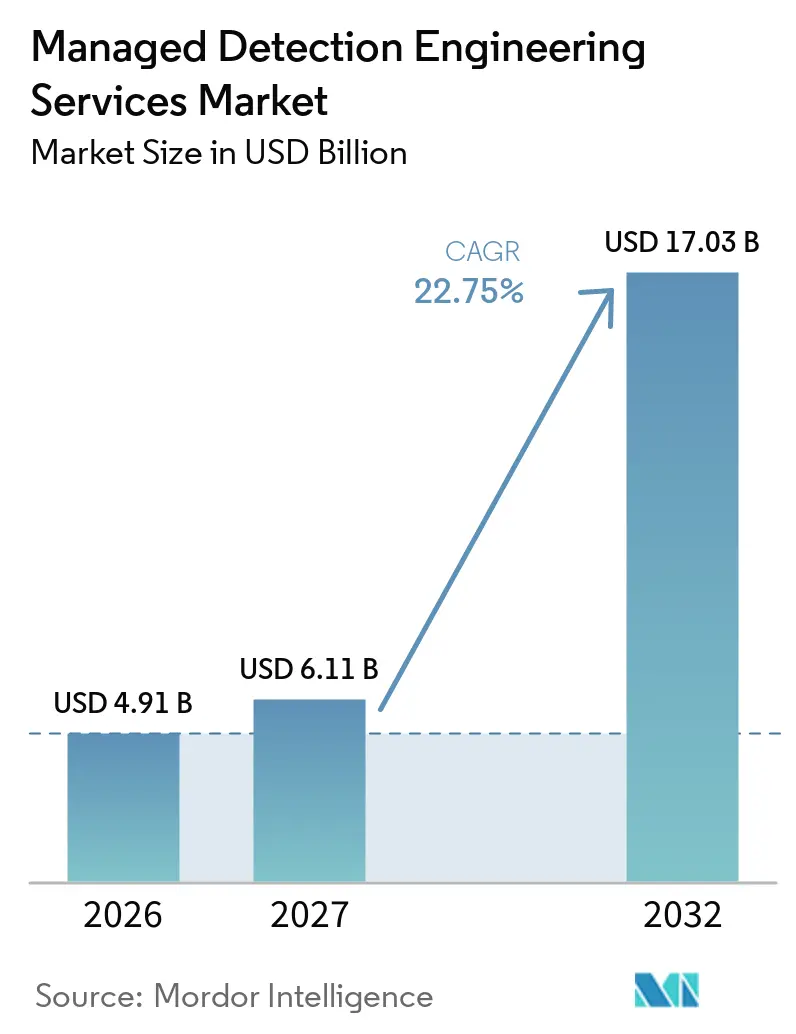
The managed detection engineering services market size is expected to grow from USD 4.91 billion in 2026 to USD 6.11 billion in 2027 and is forecast to reach USD 17.03 billion by 2032 at 22.75% CAGR over 2027-2032. Demand is moving beyond basic alert handling because enterprises need detection rules that can be written, tested, and updated across changing cloud, identity, and endpoint environments. Identity-led attacks, shorter incident-reporting windows, and the wider use of hybrid infrastructure are increasing the value of continuous monitoring. Providers are responding by linking SIEM content, SOAR playbooks, identity analytics, and extended detection tools within a managed service. The Managed Detection Engineering Services Market also benefits when organizations lack the specialized staff needed to maintain detection logic around the clock. This favors providers that combine automation with analysts who can investigate and contain threats.
Key Report Takeaways
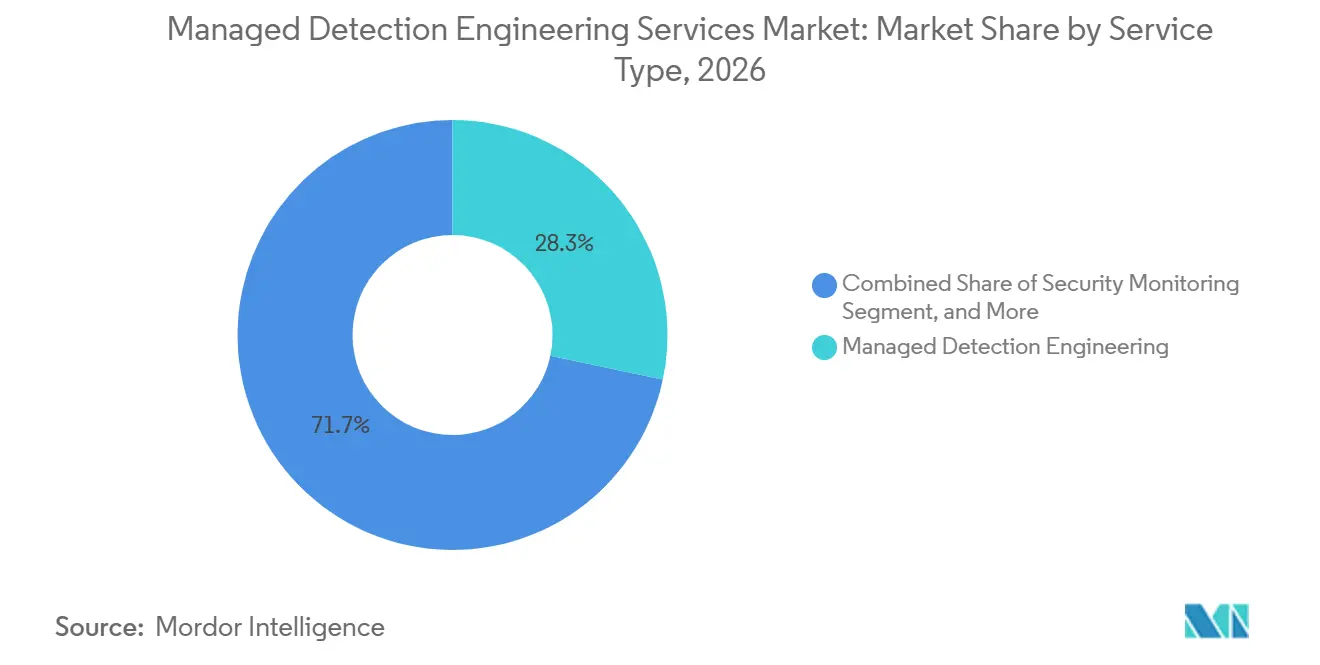
- By service type, Managed Detection Engineering held 28.31% revenue share in the managed detection engineering services market in 2026, while Managed Security Automation and Orchestration is projected to expand at a 23.97% CAGR through 2032.
- By detection content, SIEM Detection Rules held 26.41% revenue share in 2026, while SOAR Playbooks and Automated Response Logic are projected to expand at a 24.61% CAGR through 2032.
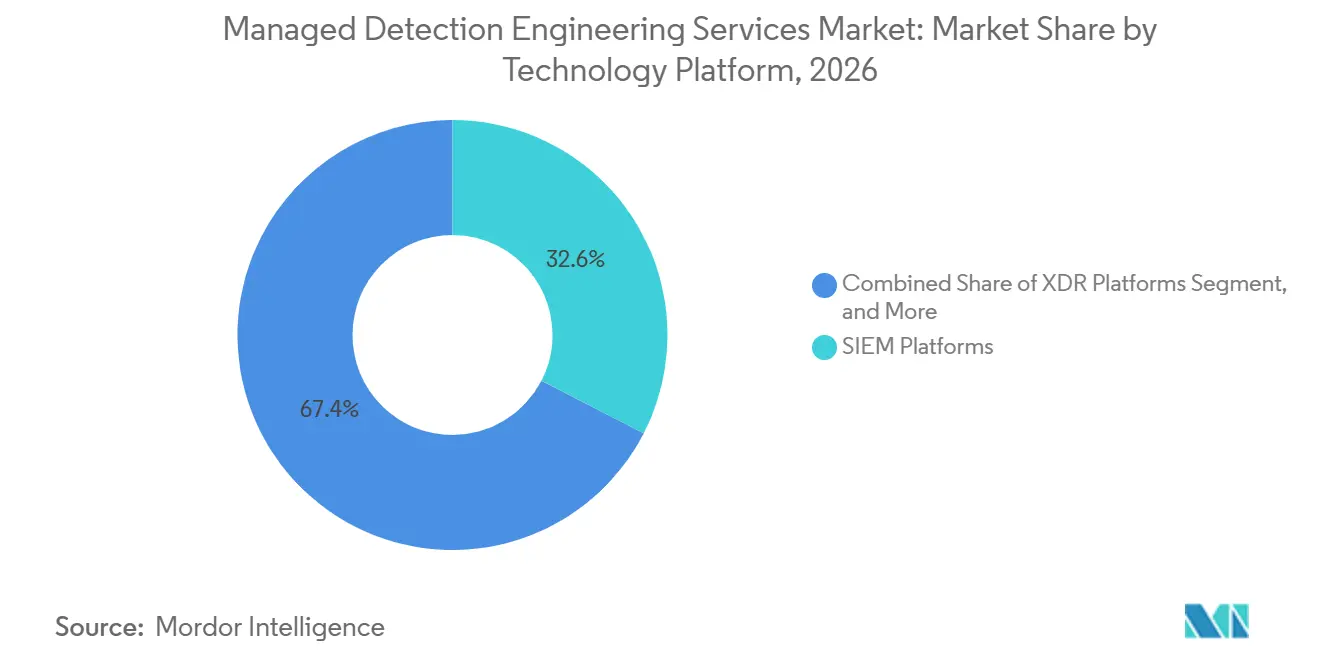
- By technology platform, SIEM Platforms held 32.56% revenue share in 2026, while Identity Threat Detection and Response Platforms are projected to expand at a 24.62% CAGR through 2032.
- By deployment model, cloud-based deployment accounted for 68.58% of revenue in the managed detection engineering services market in 2026 and is projected to expand at a 25.82% CAGR through 2032.
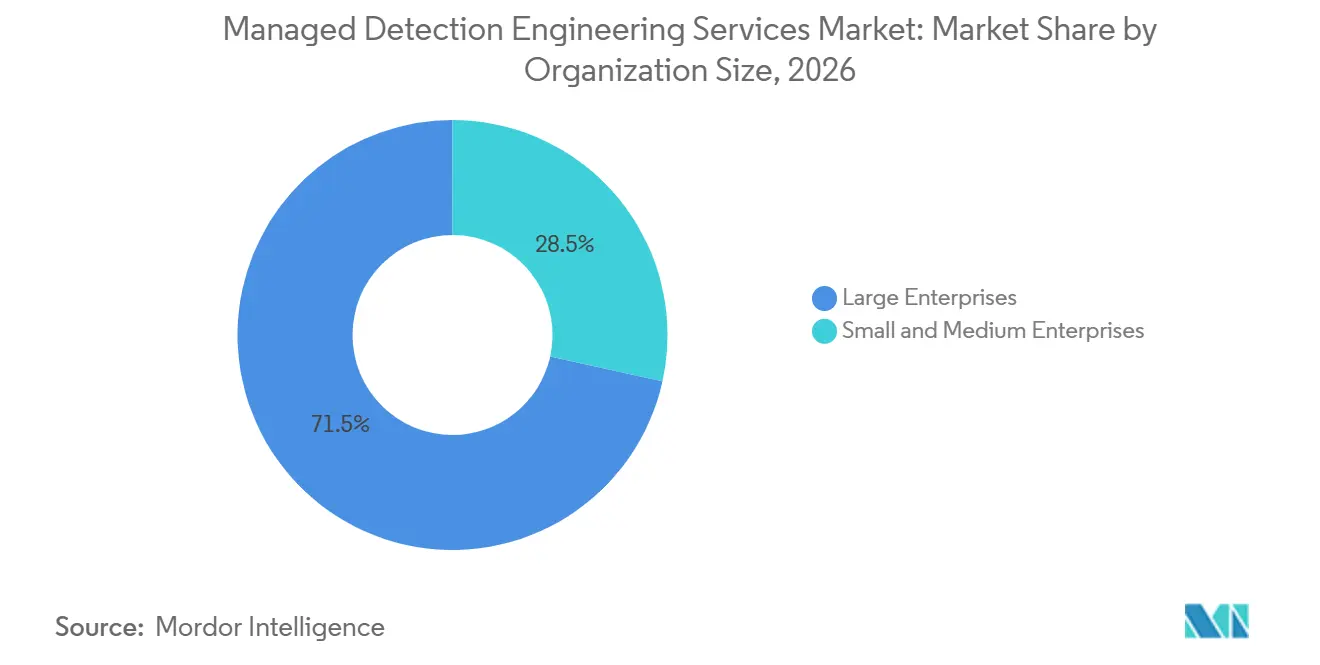
- By organization size, large enterprises held 71.54% revenue share in 2026, while SMEs are projected to expand at a 24.73% CAGR through 2032.
- By end-user industry, BFSI held 26.69% revenue share in 2026, while IT and Telecommunications are projected to expand at a 24.88% CAGR through 2032.
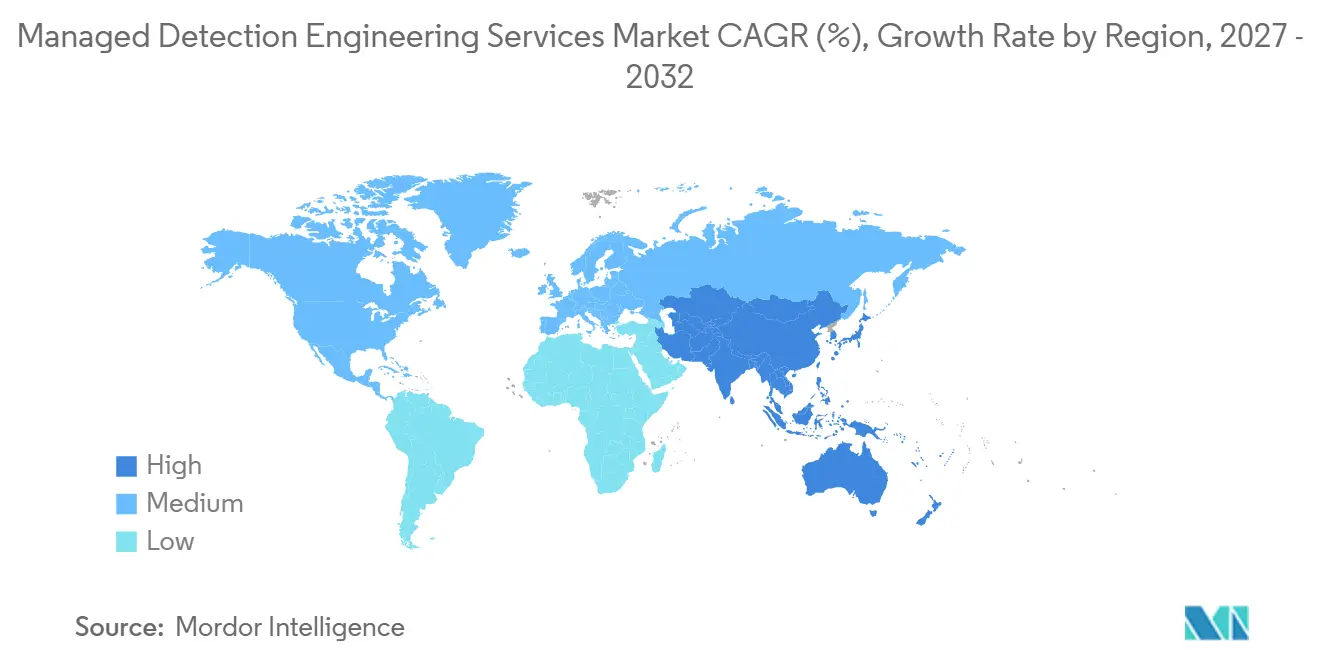
- By geography, North America held 41.64% revenue share in the managed detection engineering services market in 2026, while Asia-Pacific is projected to expand at a 23.91% CAGR through 2032.
Note: Market numbers in this report are based on Mordor Intelligence's proprietary estimation framework, which combines nine months of actuals with Q4 projections for base year 2026.
Market Trends and Insights
Drivers Impact Analysis of Managed Detection Engineering Services Market*
| DRIVER | (~) % IMPACT ON CAGR FORECAST | GEOGRAPHIC RELEVANCE | IMPACT TIMELINE |
|---|---|---|---|
| Escalating Ransomware and Identity-Based Attacks | +5.2% | Global | Short term (≤ 2 years) |
| Expansion of Cloud, Hybrid and Multi-Cloud Attack Surfaces | +4.6% | Global | Short term (≤ 2 years) |
| Cybersecurity Skills Shortages and 24/7 Coverage Requirements | +4.1% | Global, concentrated in North America and Europe | Medium term (2-4 years) |
| Regulatory Pressure for Continuous Monitoring and Incident Reporting | +3.3% | EU, North America | Medium term (2-4 years) |
| Detection Content Portability Across Heterogeneous Security Stacks | +2.1% | North America and Europe, expanding to Asia-Pacific | Long term (≥ 4 years) |
| Telemetry Cost Optimization Through Detection Engineering | +1.6% | Global, concentrated in large-enterprise markets | Long term (≥ 4 years) |
| Source: Mordor Intelligence | |||
Escalating Ransomware and Identity-Based Attacks
Identity-based intrusion methods have shifted attention from perimeter alerts toward behavior around accounts, permissions, and authentication. Sophos found that multifactor authentication was absent in 59% of incidents involving compromised credentials, while 88% of ransomware payloads were deployed outside standard business hours.[1] Semperis reported that 87% of ransomware attacks targeted identity systems, including Active Directory, Entra ID, and Okta. Verizon reported ransomware in 44% of breaches, and vulnerability exploitation increased 34%. The Managed Detection Engineering Services Market is therefore supported by services that build identity-specific rules, correlate suspicious activity across systems, distinguish normal account behavior from privilege misuse, and preserve evidence for the investigation team. Continuous coverage matters because credential abuse can move from initial access to critical infrastructure before a daytime-only team can respond.
Expansion of Cloud, Hybrid and Multi-Cloud Attack Surfaces
Hybrid and multi-cloud environments create security data that differs by provider, identity model, and log format. Tenable found that 82% of organizations operated hybrid environments, while 63% used more than 1 cloud provider and managed an average of 2.7 cloud environments.[2] Detection rules written for 1 platform often require further work before they can monitor another environment effectively. The International Telecommunication Union issued Recommendation ITU-T X.1649 in December 2025, covering multi-cloud security practices that include log correlation and real-time monitoring. This makes engineering capacity important to customers who need common security coverage across cloud workloads. The Managed Detection Engineering Services Market gains from this need because providers can normalize telemetry, align fields that differ between cloud providers, maintain rules across more than 1 infrastructure environment, and review changes before they produce unreliable alerts.
Cybersecurity Skills Shortages and 24/7 Coverage Requirements
The shortage of cybersecurity specialists is increasingly a problem of practical engineering skills, not only staffing levels. ISC2 found that 59% of professionals reported critical or significant skills needs in 2025, up from 44% in 2024, with cloud security and security engineering among the key gaps. ISACA reported that 55% of teams were understaffed and 65% had unfilled positions. Red Canary found that 75% of surveyed organizations faced intrusion-detection skill shortages, while 72% faced incident-response shortages. Managed providers can supply specialized detection work, rule maintenance, investigation support, and after-hours monitoring without requiring each customer to recruit a full internal team. This is important when ransomware activity is more likely to occur outside normal operating hours.
Regulatory Pressure for Continuous Monitoring and Incident Reporting
Regulatory requirements are making rapid detection and documented response more important for financial institutions and critical infrastructure operators. DORA has been applied since January 17, 2025, and requires financial entities to make an initial notification for major ICT incidents within 4 hours of classification and within 24 hours of awareness. NIS2 also raises expectations for monitoring, incident records, and notification of significant incidents. A 2026 legal analysis noted that a listed financial entity may face separate reporting timelines under MAR, DORA, and SEC rules. These parallel obligations increase the need for disciplined case classification and evidence collection. The Managed Detection Engineering Services Market is supported when providers automate repeatable incident workflows, retain clear audit records, and help customers maintain continuous security operations across the reporting and response cycle.
Restraints Impact Analysis of Managed Detection Engineering Services Market*
| RESTRAINT | (~) % IMPACT ON CAGR FORECAST | GEOGRAPHIC RELEVANCE | IMPACT TIMELINE |
|---|---|---|---|
| Data Sovereignty and Cross-Border Investigation Constraints | -2.6% | Europe, Asia-Pacific, Middle East | Medium term (2-4 years) |
| Tool Sprawl and Integration Complexity | -2.2% | Global | Short term (≤ 2 years) |
| Detection-Rule Ownership and Provider Lock-In Risk | -1.5% | North America and Europe | Medium term (2-4 years) |
| Limited Availability of OT and Industry-Specific Detection Expertise | -1.1% | Global, with intensity in industrial and healthcare verticals | Long term (≥ 4 years) |
| Source: Mordor Intelligence | |||
Data Sovereignty and Cross-Border Investigation Constraints
Data localization requirements can complicate investigations delivered through shared detection infrastructure. A 2025 study found that cross-border electronic evidence collection can be delayed by mutual legal-assistance procedures, while some systems retain logs for only 24 hours. GDPR and China’s Personal Information Protection Law impose conditions on where personal data can be held and transferred. A Cambridge legal analysis described growing conflicts between extraterritorial investigative claims and data-sovereignty obligations in the jurisdictions where cloud data is hosted. Providers may need regional infrastructure and separate operational processes to meet these obligations. That can slow rule updates, require separate storage and access processes, and limit the ability to use common behavioral baselines across international customers.
Tool Sprawl and Integration Complexity
Large security stacks can fragment data and divert time from rule development to integration work. An IBM and Palo Alto Networks study found that the average enterprise managed 83 security solutions from 29 vendors. Kaspersky reported that 43% of security professionals viewed their stacks as overly complex, and 41% could not automate effectively because tools lacked suitable integration. Each additional log source requires normalization, field mapping, and validation before it can support dependable behavioral detection. Consolidation can reduce this burden, but the migration period can still limit customer readiness, interrupt established workflows, and reduce provider efficiency while integrations are being rebuilt.
*Our forecasts treat driver/restraint impacts as directional, not additive. The impact forecasts reflect baseline growth, mix effects, and variable interactions.
Managed Detection Engineering Services Market Segment Analysis
By Service Type:
Managed Detection Engineering Anchors Revenue, Automation Advances FastestManaged Detection Engineering accounted for 28.31% revenue share in 2026. Within the Managed Detection Engineering Services Market, it reflects an enterprise preference for an ongoing detection-as-code partnership, where content is built, tested, tuned, and maintained instead of being delivered as a one-time monitoring installation. Providers write, test, and refine logic against active customer environments. This work includes rule development and optimization, threat hunting, security monitoring, and incident response. It gives customers broader SOC coverage without requiring every capability to be built internally.
Managed Security Automation and Orchestration is projected to expand at a 23.97% CAGR through 2032. It supports account disablement, endpoint isolation, and OAuth token revocation after a credible signal. Cisco introduced agentic AI capabilities in September 2025, including natural-language playbook authoring.[3] The Managed Detection Engineering Services Market can benefit when providers automate routine workflows, document the sequence of response actions, and retain analysts for validation and complex investigations involving business-critical accounts.

By Detection Content:
SIEM Rules Lead, SOAR Playbooks Accelerate With AutomationSIEM Detection Rules accounted for 26.41% of revenue in 2026. Within the Managed Detection Engineering Services Market, their position reflects the installed SIEM base that customers seek to improve rather than replace, especially where reporting processes, alert investigations, and historical security records already depend on the platform. SIEM rules convert logs and events into alerts for investigation. Sigma provides a detection language that can be translated into several SIEM formats. A 2025 Zenodo guide documented translations across Splunk SPL, Elastic ES|QL, Microsoft KQL, and IBM QRadar AQL.
SOAR Playbooks and Automated Response Logic are projected to expand at a 24.61% CAGR through 2032. The segment uses defined workflows for alert enrichment, investigation, containment, and documentation, allowing the provider to gather context from several tools, assign actions to the appropriate people, and preserve an understandable record of the decisions taken. The Managed Detection Engineering Services Market can use these workflows to make service delivery more consistent across customers, while allowing playbooks to be adapted to each customer’s approval rules and risk tolerance.
By Technology Platform:
SIEM Platforms Retain Scale, Identity Platforms Lead GrowthSIEM Platforms accounted for 32.56% revenue share in 2026. Within the Managed Detection Engineering Services Market, they remain central to security reporting and monitoring across BFSI, government, and healthcare because they bring diverse event data into a common environment for retention, searching, alerting, and investigation. XDR Platforms collect data across endpoints, networks, and cloud workloads. EDR Platforms provide detailed device and process visibility. Cloud Security Platforms focus on configuration, workload behavior, and runtime risk.
Identity Threat Detection and Response Platforms are projected to expand at a 24.62% CAGR through 2032. Expel reported that identity events made up 68.6% of its managed incidents in 2025, while 47.7% resulted in successful account access through stolen credentials.[4] Separate identity systems across cloud environments increase the need to correlate authentication activity across multiple sources, including successful and failed sign-ins, privilege changes, access-token use, endpoint behavior, and cloud-control actions that may otherwise appear unrelated. This favors dedicated platforms that connect identity, endpoint, and cloud context, then present the related access, device, and workload activity in a form that investigators can review.
By Deployment Model:
Cloud-Based Delivery Leads Share and Forecast ExpansionCloud-based deployment held 68.58% revenue share in 2026 and is projected to expand at a 25.82% CAGR through 2032. Within the Managed Detection Engineering Services Market, its high share reflects the operating model used by providers to deliver monitoring and detection content at scale, where centrally managed rule libraries can be maintained without separate deployment windows at every customer site. A cloud service can update shared rule libraries without a separate customer rollout for each change. It can also combine threat intelligence with data processing, subject to data-handling obligations. Cloud delivery also gives providers a practical way to apply a shared operating model while preserving the customer-specific configuration and access controls required for each environment.
Hybrid deployment remains relevant for customers with data-residency duties or operational technology assets. On-premises deployment also serves air-gapped networks and classified government settings. These models require customized integration and operations, which can support premium service pricing. The Managed Detection Engineering Services Market needs all 3 models to serve customers with varied infrastructure and compliance requirements.
By Organization Size:
Large Enterprises Lead, SMEs Present the Faster OpportunityLarge enterprises held 71.54% revenue share in 2026. Within the Managed Detection Engineering Services Market, their scale reflects complex technology stacks, larger security budgets, demanding compliance requirements, and a need to coordinate detection across different business units, geographies, identities, applications, and infrastructure estates. Many have internal SOC teams but use external specialists for selected platforms or content engineering. This supports co-managed service models rather than complete outsourcing. The customer can retain day-to-day control while the provider handles specialized rule creation, tuning, and monitoring coverage.
SMEs are projected to expand at a 24.73% CAGR through 2032. This group often has limited staff and fewer resources to build continuous monitoring internally, so a managed service can supply structured alert triage, detection-rule updates, escalation procedures, and access to experienced analysts without the fixed cost of a large internal team. CrowdStrike found that 67% of SMBs prioritized affordability, only 11% had adopted AI-powered defenses, and ransomware affected 29% of the smallest businesses that experienced an incident. The Managed Detection Engineering Services Market can expand when standardized automation makes advanced detection accessible to smaller customers, particularly when providers package monitoring, rule tuning, reporting, and incident support into a service that is easier to adopt.
By End-User Industry:
BFSI Supports Demand, IT and Telecommunications Leads Forecast ExpansionBFSI held 26.69% revenue share in 2026. Within the Managed Detection Engineering Services Market, the sector combines valuable data and transaction systems with extensive regulatory oversight, requiring providers to distinguish between expected financial activity, unusual customer behavior, and signs of account compromise or unauthorized access. DORA, PCI DSS, the NYDFS Cybersecurity Regulation, and SEC disclosure requirements make monitoring and response a continuing requirement. Detection rules often need context because unusual financial activity is not necessarily malicious. This creates demand for environment-specific tuning rather than generic alert libraries.
The IT and Telecommunications industry is projected to expand at a 24.88% CAGR through 2032. The segment manages infrastructure that supports communications and digital services, creating broad cyber exposure across networks, customer systems, cloud environments, devices, and the connected services that businesses and households rely on each day. Healthcare and Life Sciences, Government and Public Sector, Industrial Manufacturing, and Retail and E-Commerce also drive demand due to ransomware, formal compliance requirements, IT and OT convergence, and payment security. Accenture Federal Services introduced a FedRAMP High-authorized MxDR solution with Google Public Sector in April 2025 for U.S. federal agencies. The Managed Detection Engineering Services Market therefore serves end users with different technical and regulatory needs, where the required detection content is shaped by payment activity, critical services, patient data, production systems, or customer-facing digital operations.
Geography Analysis
North America Managed Detection Engineering Services Market
North America held 41.64% of the Managed Detection Engineering Services Market share in 2026. Within the Managed Detection Engineering Services Market, the region benefits from mature cybersecurity programs, demanding disclosure requirements, a large concentration of providers, and many enterprises that already operate advanced endpoint, cloud, email, and identity security tools. U.S. SEC disclosure rules, continuous diagnostics programs, and FedRAMP requirements support demand for managed monitoring. Rapid7 expanded its Microsoft partnership in November 2025 to deliver 24/7 detection and response across endpoint, cloud, identity, and email environments. Canada and Mexico add demand from financial services and manufacturing, where customers often need detection coverage that can work across established enterprise systems, cloud workloads, and distributed operational locations.
Europe Managed Detection Engineering Services Market
Europe’s demand profile is shaped by regulatory requirements and the threat environment. DORA and NIS2 influence procurement among financial entities, essential service operators, and critical IT suppliers. Separate European and U.S. reporting expectations can be difficult for internal teams to coordinate. Germany, the United Kingdom, France, Italy, and the rest of Europe offer opportunity as national guidance and NIS2 implementation progress in manufacturing and critical infrastructure.
APAC, South America and MEA Managed Detection Engineering Services Market
Asia-Pacific is projected to expand at a 23.91% CAGR through 2032. Within the Managed Detection Engineering Services Market, the region is supported by digital infrastructure expansion, public cybersecurity investment, lower penetration of managed services, and an expanding base of organizations that need recurring monitoring as their cloud and connected-service use increases. SK Shieldus was recognized as a major player for managed detection and response in Asia-Pacific in 2025 and has expanded localized SaaS MDR portals into several regions. India, South Korea, and other economies offer rising demand for locally adapted services. South America, the Middle East, and Africa remain earlier-stage markets where BFSI and government needs are supported by national cybersecurity strategies, increasing attention to continuous monitoring, incident preparedness, and service models that can be delivered with local requirements in mind.
Competitive Landscape
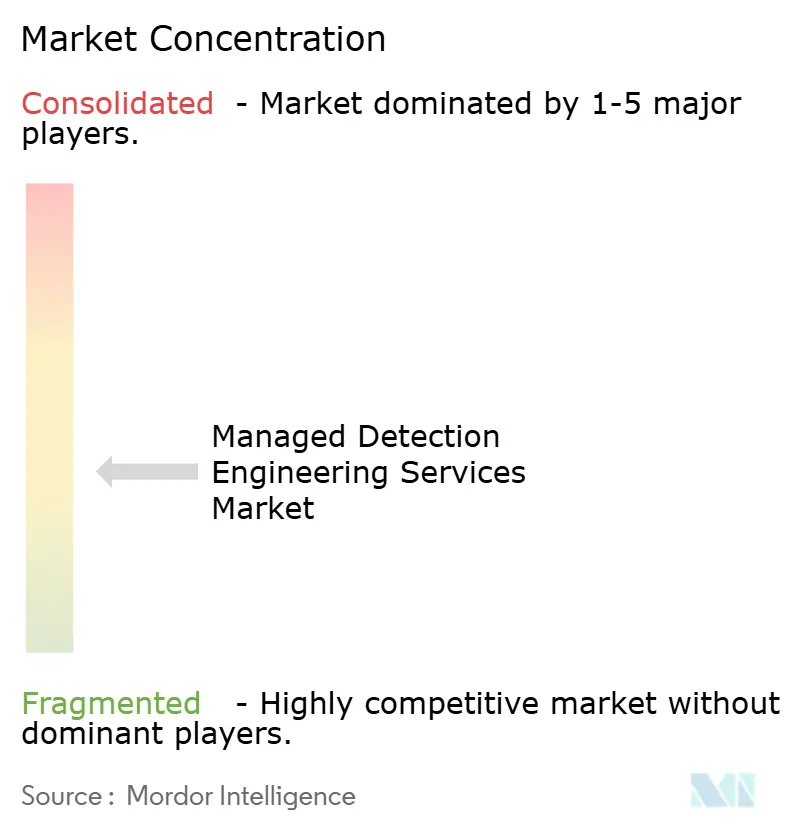
The managed detection engineering services market is moderately fragmented globally, although the providers capable of operating detection-as-code programs at enterprise scale form a smaller group. CrowdStrike, Palo Alto Networks, Microsoft, and SentinelOne benefit from native telemetry and broader platform portfolios. Within the Managed Detection Engineering Services Market, specialist providers such as Red Canary and Expel compete by emphasizing transparent operations, clear investigation records, and customer control of rule libraries, rather than relying only on the breadth of a proprietary platform. Expel launched Managed SIEM in March 2026 as a co-managed service for Microsoft Sentinel and Splunk Enterprise Security, with customer ownership of the rules created for the environment. This approach addresses concerns about provider dependence and loss of operational visibility, because customers can see how rules are tuned and can retain the content if they change service arrangements.
AI-related capability acquisition has become an important competitive response. SentinelOne announced the acquisition of Observo AI for USD 225 million in September 2025 to add AI-native telemetry pipeline management to its AI SIEM offering. These moves show a focus on better visibility over data pipelines and activity involving AI agents, which can help providers identify whether new application behavior, user access, or telemetry processing has introduced a security concern.
Within the Managed Detection Engineering Services Market, partnership-led delivery also matters because systems integrators can extend platform capabilities into customer operations, provide local implementation support, and connect a global vendor’s technical tools with the processes used by the customer’s security team. Wipro expanded its Palo Alto Networks partnership in June 2026 to offer AI-driven MDR services combining Cortex XSIAM with Wipro CyberShield. Wipro also launched CyberShield MDR with CrowdStrike in September 2025 through its Cyber Defense Centers. The Managed Detection Engineering Services Market retains openings in operational technology detection, healthcare analytics, and multi-jurisdiction compliance reporting. These areas require operating knowledge that broad rule libraries may not fully provide, including familiarity with industrial processes, clinical workflows, reporting duties, and the practical consequences of taking a system offline during an investigation.
Managed Detection Engineering Services Industry Leaders
-
Accenture PLC
-
Cisco Systems, Inc.
-
International Business Machines Corporation
-
CrowdStrike Holdings, Inc.
-
Microsoft Corporation
- *Disclaimer: Major Players sorted in no particular order
Managed Detection Engineering Services Market Companies Covered in this Report
- Accenture PLC
- Cisco Systems, Inc.
- International Business Machines Corporation
- CrowdStrike Holdings, Inc.
- Microsoft Corporation
- AT&T Inc.
- eSentire, Inc.
- Expel, Inc.
- Atos SE
- Kyndryl, Inc.
- Arctic Wolf Networks
- NTT DATA Corporation
- Palo Alto Networks, Inc.
- Rapid7, Inc.
- Red Canary, Inc.
- Secureworks Corp.
- SentinelOne, Inc.
- Sophos Limited
- Trustwave Holdings, Inc.
- Verizon Communications Inc.
- Wipro Limited
Recent Industry Developments in Managed Detection Engineering Services Market
- September 2026: Wipro and CrowdStrike jointly launched the CISO Command Center, integrating Wipro's CyberTransform and CyberShield managed security services with the CrowdStrike Falcon platform across Wipro's 8 global Cyber Defense Centers, enabling enterprises to shift from tool-driven to risk-led security operating models with unified endpoint security, cloud security, and exposure management.
- June 2026: Wipro expanded its partnership with Palo Alto Networks to deliver AI-driven MDR services combining Palo Alto Networks' Cortex XSIAM with Wipro CyberShield, using machine learning and automation to predict threats and filter noise across complex enterprise environments via Wipro's proprietary SOC GURU framework.
- April 2026: CrowdStrike Falcon Next-Gen SIEM began ingesting Microsoft Defender for Endpoint telemetry as the first third-party EDR solution integrated into the Falcon detection pipeline, while simultaneously becoming available in the Microsoft Azure Marketplace, opening access to enterprises with existing Microsoft Azure Consumption Commitment agreements.
- March 2026: Expel launched Expel Managed SIEM as a generally available co-managed service for Microsoft Sentinel and Splunk Enterprise Security, placing Expel detection engineers directly inside customer SIEM environments to author, tune, and optimize detection rules while ensuring full customer rule ownership and real-time visibility into every tuning decision.
Global Managed Detection Engineering Services Market Report Scope
Managed detection engineering services market involves third-party specialists who design, build, test, tune, and maintain detection rules, analytics, use cases, and threat-hunting logic across security telemetry sources. The objective is to improve an organization’s ability to identify real threats accurately while reducing alert noise and detection gaps.
The Managed Detection Engineering Services Market Report is Segmented by Service Type (Managed Detection Engineering, Detection Rule Development and Optimization, Threat Hunting, Security Monitoring, Incident Response, and Managed Security Automation and Orchestration), Detection Content (Sigma Rules, YARA Rules, SIEM Detection Rules, KQL and Microsoft Security Rules, Correlation Rules and Behavioral Analytics, and SOAR Playbooks and Automated Response Logic), Technology Platform (SIEM Platforms, XDR Platforms, EDR Platforms, Cloud Security Platforms, Identity Threat Detection and Response Platforms, and Other Technology Platforms), Deployment Model (Cloud-Based, On-Premises, and Hybrid), Organization Size (Large Enterprises, and Small and Medium Enterprises), End-User Industry (Banking, Financial Services and Insurance (BFSI), IT and Telecommunications, Healthcare and Life Sciences, Government and Public Sector, Industrial Manufacturing, Retail and E-Commerce, and Other End-User Industries), and Geography (North America, South America, Europe, Asia-Pacific, Middle East, and Africa). The Market Forecasts are Provided in Terms of Value (USD).
Segmentation Overview
| Managed Detection Engineering |
| Detection Rule Development and Optimization |
| Threat Hunting |
| Security Monitoring |
| Incident Response |
| Managed Security Automation and Orchestration |
| Sigma Rules |
| YARA Rules |
| SIEM Detection Rules |
| KQL and Microsoft Security Rules |
| Correlation Rules and Behavioral Analytics |
| SOAR Playbooks and Automated Response Logic |
| SIEM Platforms |
| XDR Platforms |
| EDR Platforms |
| Cloud Security Platforms |
| Identity Threat Detection and Response Platforms |
| Other Technology Platforms |
| Cloud-Based |
| On-Premises |
| Hybrid |
| Large Enterprises |
| Small and Medium Enterprises |
| Banking, Financial Services and Insurance (BFSI) |
| IT and Telecommunications |
| Healthcare and Life Sciences |
| Government and Public Sector |
| Industrial Manufacturing |
| Retail and E-Commerce |
| Other End-User Industries |
| North America | United States |
| Canada | |
| Mexico | |
| South America | Brazil |
| Argentina | |
| Rest of South America | |
| Europe | Germany |
| United Kingdom | |
| France | |
| Italy | |
| Rest of Europe | |
| Asia-Pacific | China |
| Japan | |
| India | |
| South Korea | |
| Rest of Asia-Pacific | |
| Middle East | Saudi Arabia |
| United Arab Emirates | |
| Rest of Middle East | |
| Africa | South Africa |
| Nigeria | |
| Rest of Africa |
| By Service Type | Managed Detection Engineering | |
| Detection Rule Development and Optimization | ||
| Threat Hunting | ||
| Security Monitoring | ||
| Incident Response | ||
| Managed Security Automation and Orchestration | ||
| By Detection Content | Sigma Rules | |
| YARA Rules | ||
| SIEM Detection Rules | ||
| KQL and Microsoft Security Rules | ||
| Correlation Rules and Behavioral Analytics | ||
| SOAR Playbooks and Automated Response Logic | ||
| By Technology Platform | SIEM Platforms | |
| XDR Platforms | ||
| EDR Platforms | ||
| Cloud Security Platforms | ||
| Identity Threat Detection and Response Platforms | ||
| Other Technology Platforms | ||
| By Deployment Model | Cloud-Based | |
| On-Premises | ||
| Hybrid | ||
| By Organization Size | Large Enterprises | |
| Small and Medium Enterprises | ||
| By End-User Industry | Banking, Financial Services and Insurance (BFSI) | |
| IT and Telecommunications | ||
| Healthcare and Life Sciences | ||
| Government and Public Sector | ||
| Industrial Manufacturing | ||
| Retail and E-Commerce | ||
| Other End-User Industries | ||
| By Geography | North America | United States |
| Canada | ||
| Mexico | ||
| South America | Brazil | |
| Argentina | ||
| Rest of South America | ||
| Europe | Germany | |
| United Kingdom | ||
| France | ||
| Italy | ||
| Rest of Europe | ||
| Asia-Pacific | China | |
| Japan | ||
| India | ||
| South Korea | ||
| Rest of Asia-Pacific | ||
| Middle East | Saudi Arabia | |
| United Arab Emirates | ||
| Rest of Middle East | ||
| Africa | South Africa | |
| Nigeria | ||
| Rest of Africa | ||
Key Questions Answered in the Report
What is the size of the managed detection engineering services market?
The managed detection engineering services market size is expected to grow from USD 4.91 billion in 2026 to USD 6.11 billion in 2027 and is forecast to reach USD 17.03 billion by 2032 at 22.75% CAGR over 2027-2032.
What is managed detection engineering?
It is a managed security service that develops, tests, tunes, and maintains detection rules and response logic across customer security environments.
Why are organizations adopting managed detection engineering services?
Identity-based attacks, multi-cloud environments, regulatory deadlines, and shortages of detection specialists are increasing the need for continuous monitoring and response.
Which deployment model has the strongest outlook?
Cloud-based deployment held 68.58% revenue share in 2026 and is projected to expand at a 25.82% CAGR through 2032.
Which end-user sector leads demand for these services?
BFSI held 26.69% revenue share in 2026 because it faces high-value threats and extensive requirements for security monitoring and incident reporting.
Which region is expected to expand fastest?
Asia-Pacific is projected to expand at a 23.91% CAGR through 2032, supported by digital infrastructure investment and wider cybersecurity adoption.