
Co-Managed EDR Services Market Size and Share
Market Overview
| Study Period | 2021 - 2032 |
|---|---|
| Market Size (2027) | USD 1.29 Billion |
| Market Size (2032) | USD 2.72 Billion |
| Growth Rate (2027 - 2032) | 16.03 % |
| Fastest Growing Market | Asia-Pacific |
| Largest Market | North America |
| Market Concentration | Medium |
Major Players *Disclaimer: Major Players sorted in no particular order Image © Mordor Intelligence. Reuse requires attribution under CC BY 4.0. | |
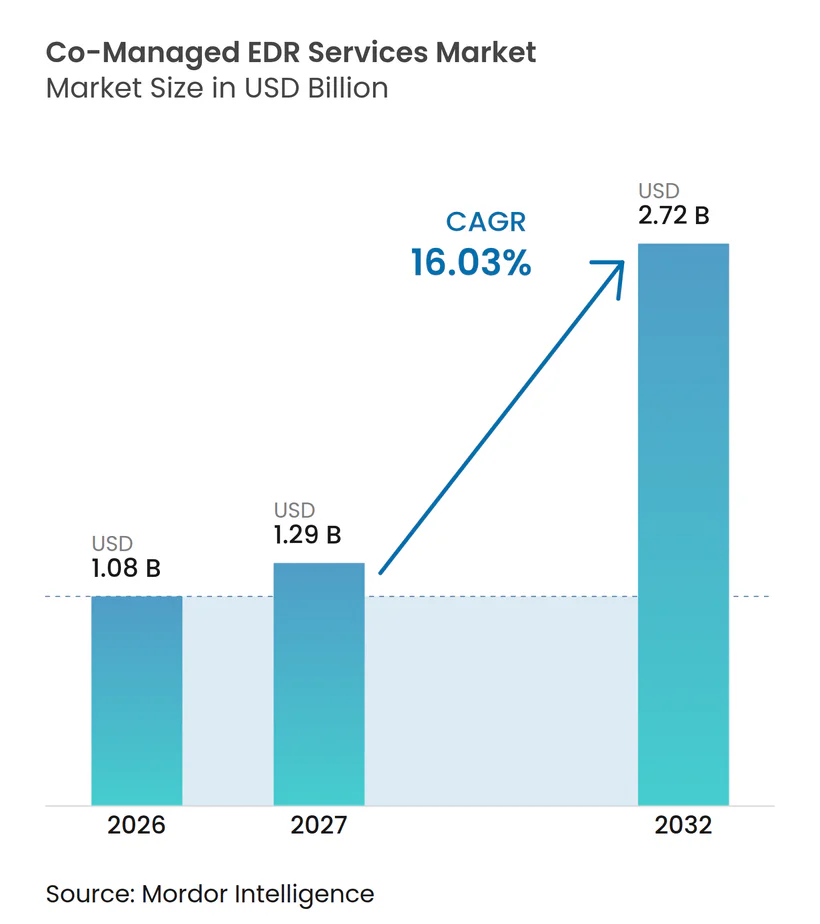
Co-Managed EDR Services Market Analysis by Mordor Intelligence
The Co-managed EDR services market size is projected to be USD 1.08 billion in 2026, USD 1.29 billion in 2027, and reach USD 2.72 billion by 2032, growing at a CAGR of 16.03% from 2027 to 2032. The co-managed EDR services market reflects a change in security buying, as organizations move away from a choice between fully outsourced operations and a wholly internal security operations center. Shared operating models allow customer and provider analysts to work through a common toolset while setting clear responsibility boundaries. Ransomware campaigns increasingly combine data theft, lateral movement, and disruption, which makes continuous specialist coverage more relevant to organizations with limited internal capacity. Customers are also seeking stronger control over response decisions after endpoint security failures demonstrated the operational risk of relying on one provider or one control point. These conditions create room for providers that can pair rapid investigation with clear customer authority, dependable service delivery, practical onboarding, and deployment options that match the customer’s operating, compliance, and data-location requirements.
Key Report Takeaways
- By service offering, managed EDR monitoring and alert triage held 36.41% of the Co-managed EDR services market share in 2026, while co-managed containment and remediation is projected to expand at a 17.03% CAGR through 2032.
- By deployment model, cloud-delivered architecture accounted for 68.66% of the Co-managed EDR services market share in 2026, while sovereign or regional cloud is projected to expand at a 16.82% CAGR through 2032.
- By organization size, large enterprises held 57.14% of the market in 2026, while small and medium-sized enterprises are projected to expand at a 16.41% CAGR through 2032.
- By end-user vertical, BFSI accounted for 18.89% of the market in 2026, while healthcare and life sciences is projected to expand at a 17.61% CAGR through 2032.
- By geography, North America held 43.32% of the market in 2026, while Asia-Pacific is projected to expand at a 16.98% CAGR through 2032.
Note: Market numbers in this report are based on Mordor Intelligence's proprietary estimation framework, which combines nine months of actuals with Q4 projections for base year 2026.
Market Trends and Insights
Drivers Impact Analysis of Co-Managed EDR Services Market*
| Driver | (~) % Impact on CAGR Forecast | Geographic Relevance | Impact Timeline |
|---|---|---|---|
| Escalating Endpoint Attack Complexity and Ransomware Operations | +3.2% | Global, peak intensity in North America and Europe | Short term (≤ 2 years) |
| Cybersecurity Talent Shortages and SOC Capacity Constraints | +3.0% | Global, most acute in North America, Europe, and Japan | Medium term (2-4 years) |
| Rising Compliance Requirements for Continuous Monitoring | +2.5% | Europe, North America, and Asia-Pacific | Medium term (2-4 years) |
| Expansion of Cloud, Remote Work, and Distributed Endpoint Estates | +2.3% | Global, fastest expansion in Asia-Pacific and South America | Short term (≤ 2 years) |
| Shared Investigation Workbenches and RACI-Based Co-Management | +1.8% | Primarily North America and Europe | Medium term (2-4 years) |
| Agentic AI Reducing Alert Triage and Response Latency | +1.5% | Global, early adoption in North America and Asia-Pacific | Long term (≥ 4 years) |
| Source: Mordor Intelligence | |||
Escalating Endpoint Attack Complexity and Ransomware Operations
Ransomware groups have moved beyond campaigns focused only on file encryption and increasingly use staged extortion that begins with data theft. Google reported that data theft occurred in 77% of ransomware intrusions examined in 2025, up from 57% in 2024. Broadcom reported 6,182 encryptionless extortion events in 2025, up 23% from 2024.[1]Attackers also use vulnerable drivers to disable endpoint controls before running their payloads. RDP appeared in 85% of the investigated intrusions, while virtualization infrastructure was targeted in 43% of cases, compared with 29% in 2024.[2] The co-managed EDR services market benefits when provider analysts can investigate and contain activity before it reaches multiple systems.
Cybersecurity Talent Shortages and SOC Capacity Constraints
Security operations teams continue to face both staffing gaps and gaps in specialized skills. ISACA found that 55% of teams were understaffed in 2025 and 65% had open positions. Fortinet found that 71% of organizations regarded the skills shortage as an active organizational risk in 2026, compared with 67% in 2024. SANS reported that 60% of organizations viewed skills gaps as more serious than headcount shortages, and 27% linked breaches to workforce capability gaps. These pressures extend the challenge beyond hiring because organizations also need analysts who can investigate complex activity and respond under established procedures. The co-managed EDR services market gives customers access to analyst capacity without the long recruitment cycle needed to create a comparable in-house team.
Rising Compliance Requirements for Continuous Monitoring
DORA has applied since January 17, 2025, and requires financial entities to monitor ICT systems continuously and define alert thresholds for response processes. NIS2 requires continuous threat monitoring and initial incident reporting within 24 hours for covered entities. These obligations make business-hours-only coverage difficult for financial services and critical infrastructure operators. CMMC Level 2 requirements also raise the need for endpoint logging and incident response among United States defense contractors. SANS reported that the share of organizations where regulation affected security hiring rose from 40% to 95% between 2025 and 2026. The co-managed EDR services market is supported by providers that can document monitoring, escalation, and response responsibilities for regulated customers.
Expansion of Cloud, Remote Work, and Distributed Endpoint Estates
Hybrid work has extended endpoint populations across managed laptops, personal devices, cloud workloads, and operational technology assets. These systems can run different sensor agents and produce different forms of telemetry. The provider role becomes more important when internal teams must maintain consistent monitoring across locations and endpoint types. IT and operational technology convergence adds demand from manufacturers that extend coverage from enterprise systems to plant-floor equipment. Zscaler and Red Canary found that 75% of organizations reported a skills shortage in intrusion detection and 72% reported one in incident response. The Co-managed EDR services market is therefore supported by customers that need shared investigation capacity across dispersed estates.
Restraints Impact Analysis of Co-Managed EDR Services Market*
| Restraint | (~) % Impact on CAGR Forecast | Geographic Relevance | Impact Timeline |
|---|---|---|---|
| Data Sovereignty and Customer-Control Concerns | -1.8% | Europe, Middle East, and Asia-Pacific | Medium term (2-4 years) |
| Integration Complexity Across Fragmented Endpoint and Security Stacks | -1.5% | Global | Short term (≤ 2 years) |
| EDR Sensor Outages and Operational Concentration Risk | -1.0% | Global, most impactful in North America and Europe | Short term (≤ 2 years) |
| Ambiguous Liability for Provider-Authorized Containment Actions | -0.7% | Global, most acute in regulated sectors | Long term (≥ 4 years) |
| Source: Mordor Intelligence | |||
Data Sovereignty and Customer-Control Concerns
Shared cloud-based processing can move endpoint telemetry across borders and create conflicts with local privacy, security, and residency rules. The European Commission published its Cloud Sovereignty Framework in October 2025, setting 8 sovereignty objectives for EU institutional cloud procurement.[3] The framework increasingly informs security service tenders in regulated sectors. France and Germany have also advanced sovereign cloud approaches that may require separate infrastructure for local delivery. Providers relying only on a centralized cloud model face a narrower addressable customer base in Europe and the Middle East. The co-managed EDR services market must balance regional deployment needs against the cost advantages of shared service operations.
Integration Complexity Across Fragmented Endpoint and Security Stacks
Co-managed EDR onboarding can be difficult when customers retain legacy antivirus products alongside newer sensors. Mixed Windows, Linux, and macOS environments also generate different telemetry, while operational technology assets can need specialized deployment methods. Customers with more than 5,000 endpoints can face onboarding periods longer than 90 days. These delays can postpone provider revenue recognition and affect customer confidence early in the relationship. Zscaler and Red Canary reported skills gaps in intrusion detection and incident response that also complicate the transition to shared operations. Open application programming interfaces and standardized telemetry ingestion can shorten implementation cycles and distinguish providers in the co-managed EDR services market.
*Our forecasts treat driver/restraint impacts as directional, not additive. The impact forecasts reflect baseline growth, mix effects, and variable interactions.
Co-Managed EDR Services Market Segment Analysis
By Service Offering:
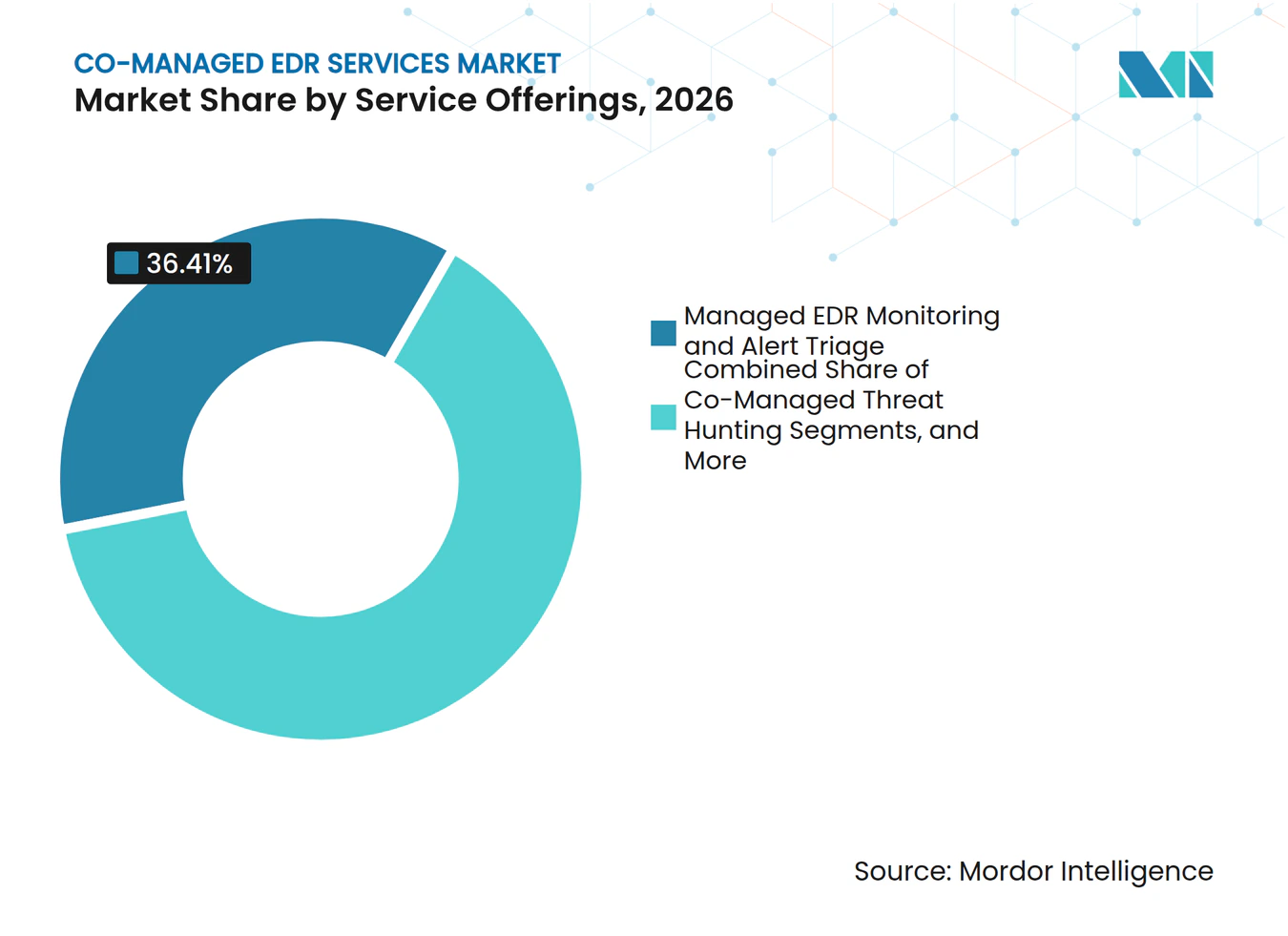
Monitoring Anchors Revenue While Remediation Leads GrowthManaged EDR monitoring and alert triage held 36.41% of the Co-managed EDR services market share in 2026. It is the usual entry point for customers seeking continuous monitoring, alert prioritization, and provider support without transferring control of high-impact decisions. Internal teams can test the shared model before they grant broader authority, while providers supply consistent analyst coverage. Co-managed threat hunting supports mid-sized buyers that can investigate focused issues but lack the intelligence depth for proactive campaigns. Investigation and forensics services can also prepare healthcare and financial services customers for wider co-management by establishing evidence-handling and documented investigation workflows.
The Co-managed EDR services market size for containment and remediation is projected to expand at a 17.03% CAGR from 2027 to 2032. Higher buyer confidence reflects clearer response rules, tested customer-provider contracts, and shared investigation workbenches where both sides can assess activity in the same environment. CrowdStrike introduced Falcon Complete Hub in its Fall 2025 release as a collaboration interface for provider and customer analysts within one console. The interface supports a move from sequential escalations toward real-time joint decisions. Clear escalation paths remain essential where containment actions can affect a customer’s business operations.



By Deployment Model:
Cloud Delivery Dominates as Sovereign Variants Reshape ProcurementCloud-delivered architecture held 68.66% of the Co-managed EDR services market share in 2026. Enterprises favor it for centralized telemetry processing, elastic compute, rapid sensor updates, and support for many endpoint locations without new on-site infrastructure. Hybrid designs serve financial institutions and industrial operators that correlate cloud and local telemetry before passing cases to shared analysts. On-premises and air-gapped systems remain necessary for defense, government, and critical infrastructure organizations that cannot move data outside their facilities. The varied deployment choices show that architecture is a procurement decision shaped by operating needs, regulatory duties, and data location.
Sovereign or regional cloud is projected to expand at a 16.82% CAGR from 2027 to 2032 within the co-managed EDR services market. DORA enforcement and the European Commission framework make local processing more important in regulated tenders. Providers need regional options that preserve operating consistency while meeting customer control requirements. SentinelOne announced Prompt Security On-Premise at RSAC 2026 for air-gapped and sovereign environments. The move illustrates how platform-native providers are addressing customers that need local control as well as effective detection.
By Organization Size:
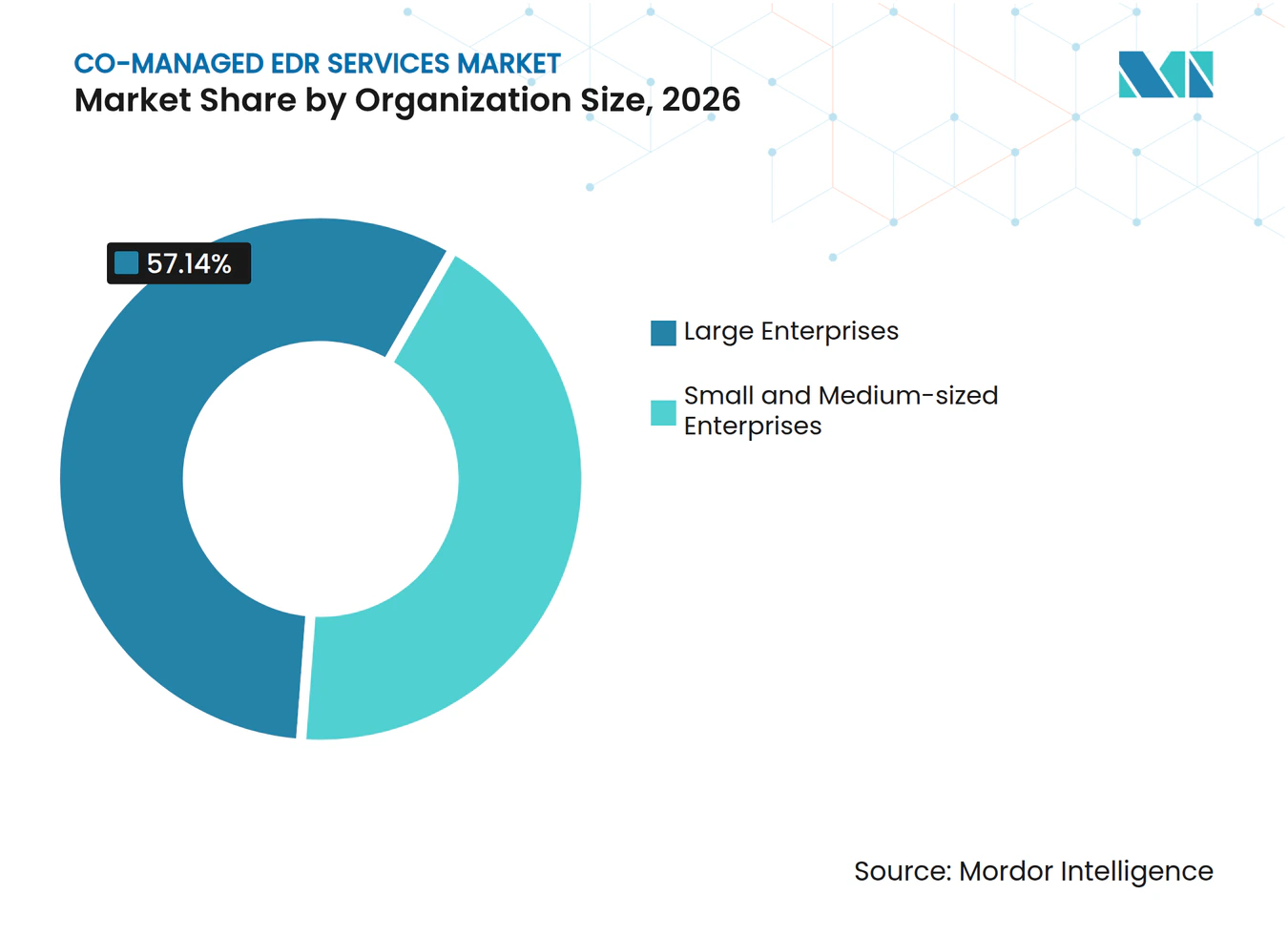
Enterprises Anchor Revenue as SMEs Narrow the GapLarge enterprises held 57.14% of the Co-managed EDR services market share in 2026. Large endpoint estates, existing EDR investment, and complex compliance duties make co-management an overlay to internal operations rather than a full replacement. These customers use providers to extend coverage across subsidiaries, remote offices, and global locations, while retaining strategic oversight over security risks. They also seek threat-hunting capability that can be difficult to recruit and retain internally. This creates larger and more complex engagements for providers that can operate alongside established security teams.
Small and medium-sized enterprises are projected to expand at a 16.41% CAGR from 2027 to 2032 in the Co-managed EDR services market. Per-endpoint pricing and managed service provider channels reduce the cost of 24/7 coverage for organizations without dedicated security operations budgets. Huntress reported more than USD 250 million in annual recurring revenue and protection for more than 270,000 businesses in 2026. Its reported 65% year-over-year expansion points to demand for offers built around smaller customer budgets and simpler administration. Supply-chain attack concerns also make continuous endpoint coverage more relevant for smaller organizations that depend on external systems and providers.

By End-User Vertical:
BFSI Maintains Lead as Healthcare Generates Fastest MomentumBFSI held 18.89% of the Co-managed EDR services market share in 2026. The sector combines long-standing compliance-led security investment with DORA requirements for continuous monitoring at covered EU financial institutions. Co-managed services provide constant coverage while allowing financial institutions to retain key risk decisions. Their documented escalation and evidence-handling processes align with the sector’s oversight needs. Customer data, payment systems, and operational continuity make rapid endpoint investigation especially valuable to these buyers.
Healthcare and life sciences is projected to expand at a 17.61% CAGR from 2027 to 2032 in the Co-managed EDR services market. Connected medical devices and clinical systems have increased the attack surface, while security maturity has not always kept pace. Patient information and care continuity can raise the impact of a ransomware event, encouraging more structured monitoring arrangements. In October 2026, Palo Alto Networks and IBM announced an NHS England partnership covering more than 2 million devices and 55,000 organizations handling health data. Government and defense, IT and telecommunications, manufacturing, retail, energy, and utilities are also becoming relevant as sector-specific risks and requirements increase.
Geography Analysis
North America Co-Managed EDR Services Market
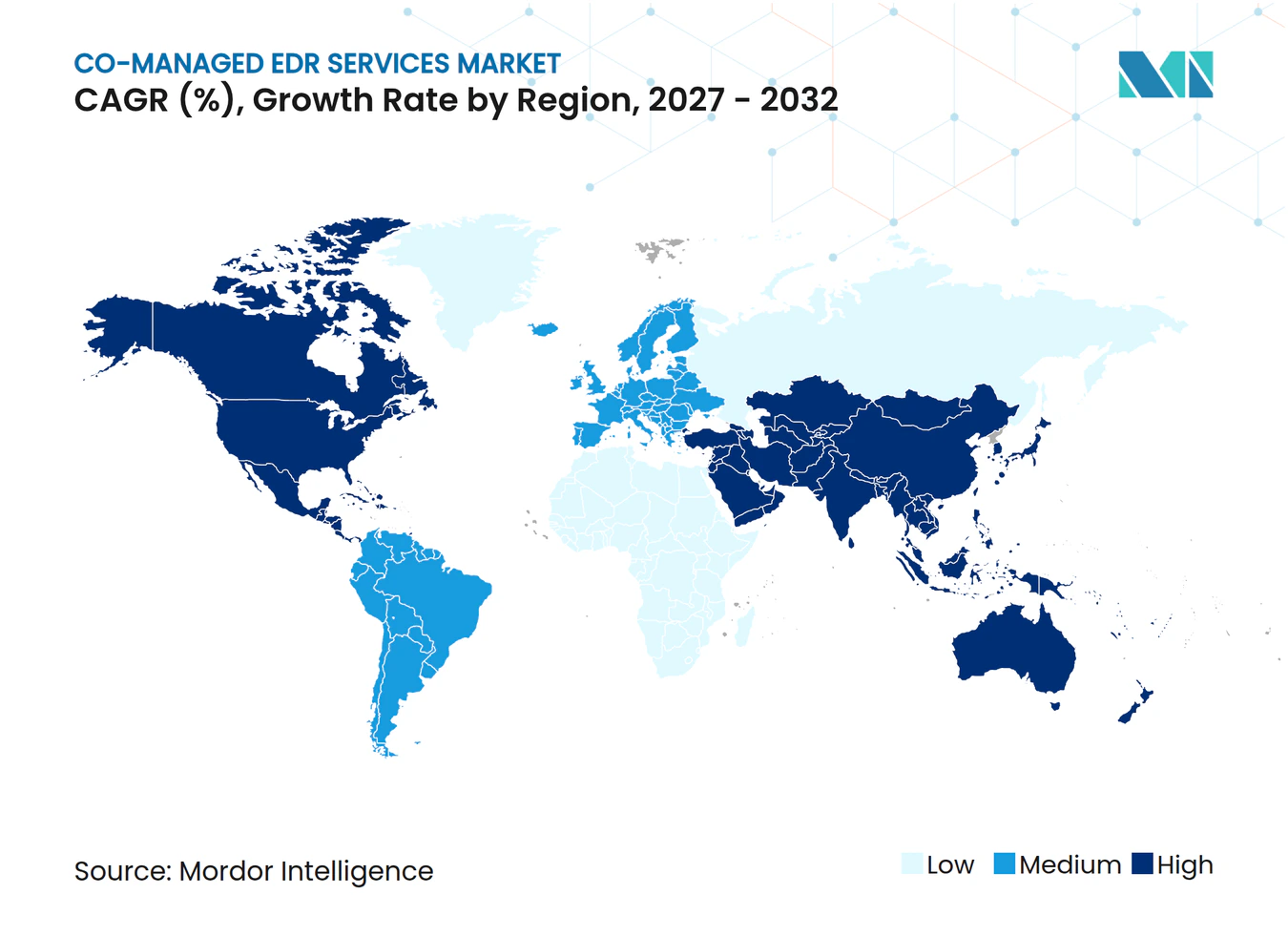
North America held 43.32% of the Co-managed EDR services market share in 2026. The region combines a high concentration of EDR-licensed enterprises with a mature managed security service provider channel, and the United States provides most revenue through large organizations and a broad mid-market. This buyer base gives providers access to customers that already understand endpoint technology but need continuous operating support under CMMC requirements and SEC cybersecurity disclosure rules. Competition is dense because platform providers and specialist services target the same enterprise and mid-market accounts. This pressure can make monitoring-only offerings harder to differentiate and can increase the need for broader service capabilities, clearer operating models, and response options that align with customer risk tolerance.
Europe Co-Managed EDR Services Market
Europe remains important because rules are changing the terms of procurement as well as the volume of demand. DORA and NIS2 favor providers that can support local or regional cloud boundaries and meet incident reporting timelines. Germany and the United Kingdom are the largest European markets in the supplied scope, while France’s Cloud de Confiance certification requirement makes data location, response authority, and incident procedures visible criteria in customer evaluations. Bitdefender and OVHcloud partnered to host GravityZone on SecNumCloud infrastructure for delivery aligned with GDPR, NIS2, and DORA requirements. The co-managed EDR services market in Europe rewards providers that make compliance and data location visible parts of their offer.
APAC, MEA and South America Co-Managed EDR Services Market
Asia-Pacific is projected to expand at a 16.98% CAGR from 2027 to 2032 in the Co-managed EDR services market. Digital transformation, higher attack frequency, and historically limited investment in security operations are supporting demand and a need for delivery models that help customers improve operations without extensive internal staffing. India, Singapore, South Korea, and Australia are increasing procurement as cybersecurity frameworks and financial sector rules develop. The Middle East, led by Saudi Arabia and the UAE, is increasing managed security investment to support Vision 2030 digital infrastructure programs, while South America is led by Brazil’s LGPD compliance requirements and Africa remains at an earlier stage with demand centered on financial services in South Africa and Nigeria.
Competitive Landscape
Market Concentration
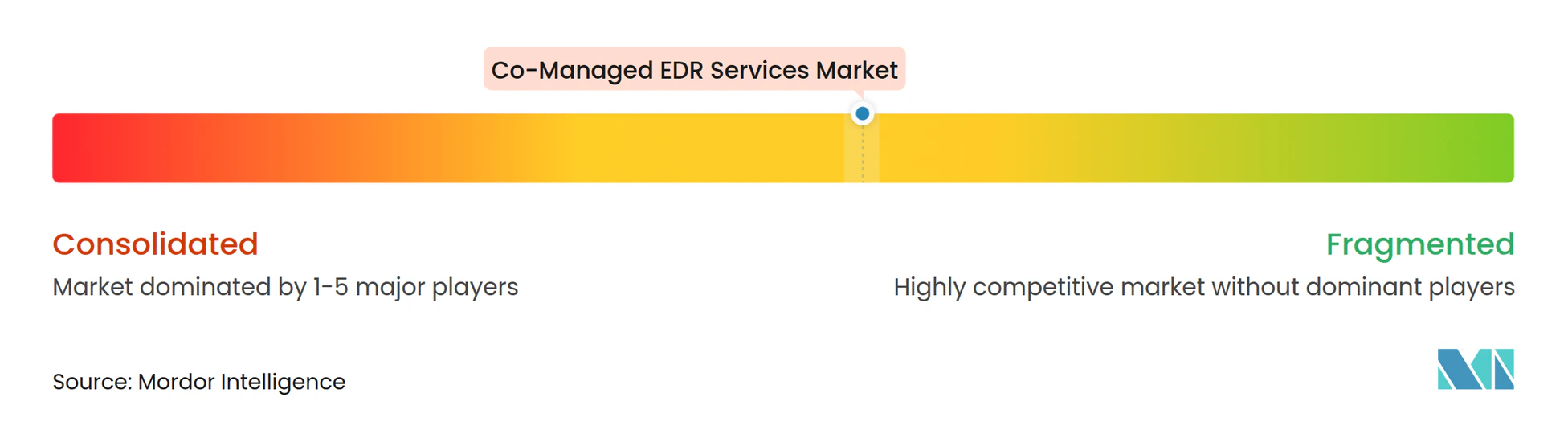
The co-managed EDR services market is moderately fragmented, with competition divided between platform-native vendors and vendor-agnostic managed security providers. Platform-native vendors compete through detection effectiveness, sensor integration, and faster triage, which can simplify the handoff between product data and analyst action. CrowdStrike introduced Charlotte AI Detection Triage in its Fall 2025 release to evaluate detections and recommend actions before a human analyst review. This approach places automated analysis at the first stage of a shared workflow and can reduce the volume of routine decisions analysts must review. Sophos completed its Secureworks acquisition in February 2025 and integrated Sophos Endpoint into all Taegis MDR and XDR subscriptions by September 2025, bringing endpoint technology and a multi-vendor managed service layer together.
Vendor-agnostic providers compete through flexibility and models that are easier for mid-market buyers to adopt. Arctic Wolf acquired Cylance for USD 160 million in February 2025, adding a proprietary endpoint agent to its Aurora platform and reducing its previous dependence on third-party endpoint tools. Zscaler completed its USD 675 million Red Canary acquisition on August 1, 2025, linking managed detection capability with zero-trust telemetry and exposure management. LevelBlue completed its Cybereason acquisition on November 25, 2025, adding XDR, digital forensics, incident response, and threat intelligence capabilities that broaden its security operations offer.
Partnerships are also an important competitive route in the co-managed EDR services market. Cyderes and Palo Alto Networks announced a partnership on October 1, 2026, positioning Cyderes as a delivery partner for Cortex XDR and Cortex XSIAM in North America and EMEA. The model separates platform development from analyst operations while retaining a linked customer offering and defined service responsibilities. Sovereign-compliant delivery for regulated mid-market customers outside North America and Western Europe remains an open opportunity, alongside monitoring that correlates industrial endpoint data with enterprise telemetry. ISO/IEC 27001 certification and SOC 2 Type II attestation have become baseline requirements in regulated verticals, and providers without them can be excluded during the request-for-proposal stage.
Co-Managed EDR Services Industry Leaders
-
CrowdStrike Holdings, Inc.
-
Sophos Limited
-
Arctic Wolf Networks, Inc.
-
SentinelOne, Inc.
-
Rapid7, Inc.
- *Disclaimer: Major Players sorted in no particular order
Co-Managed EDR Services Market Companies Covered in this Report
- CrowdStrike Holdings, Inc.
- SentinelOne, Inc.
- Sophos Limited
- Arctic Wolf Networks, Inc.
- Rapid7, Inc.
- Palo Alto Networks, Inc.
- Trend Micro Incorporated
- Fortinet, Inc.
- Check Point Software Technologies Ltd.
- Bitdefender SRL
- WithSecure Corporation
- ESET, spol. s r.o.
- Red Canary, Inc.
- eSentire, Inc.
- Expel, Inc.
- Deepwatch, Inc.
- Critical Start, Inc.
- Binary Defense Systems, Inc.
- Huntress Labs Incorporated
- Ontinue, Inc.
- LevelBlue, Inc.
- Cybereason Inc.
- Malwarebytes Inc.
- Trellix, a division of Musarubra US LLC
Recent Industry Developments in Co-Managed EDR Services Market
- October 2026: Palo Alto Networks and IBM announced a partnership for the next phase of NHS England's Secure Boundary programme, delivering co-managed cloud-based security across more than 2 million devices, 200 NHS trusts, and 55,000 organizations handling health data under a "Defend as One" model.
- October 2026: Cyderes and Palo Alto Networks announced a partnership positioning Cyderes as a premier delivery partner for Cortex XDR and Cortex XSIAM across the United States, Canada, and EMEA, supporting both fully managed and co-managed security programs.
- October 2026: Huntress announced a distribution partnership with ALSO, expanding the Huntress Agentic Security Platform across 31 European countries and strengthening its EMEA channel ecosystem for SME-focused co-managed EDR services.
- March 2026: Huntress launched Managed Endpoint Security Posture Management and Managed Identity Security Posture Management products, expanding its Agentic Security Platform to proactive attack-surface reduction alongside co-managed EDR for SME customers.
Global Co-Managed EDR Services Market Report Scope
The Co-Managed EDR Services Market Report is Segmented by Service Offering(Managed EDR Monitoring and Alert Triage, Co-Managed Threat Hunting, Co-Managed Investigation and Forensics, Co-Managed Containment and Remediation, and Other Service Offerings), Deployment Model (Cloud-Delivered,Hybrid Cloud and On-Premises, On-Premises and Air-Gapped, Sovereign or Regional Cloud), Organization Size (Small and Medium-Sized Enterprises, Large Enterprises), End-User Vertical (BFSI, Healthcare and Life Sciences, IT and Telecommunications, Government and Defense, Manufacturing and Industrial, Retail and E-Commerce, Energy and Utilities, and Other End-User Verticals), and Geography (North America, South America, Europe, Asia-Pacific, Middle East, Africa). The Market Forecasts are Provided in Terms of Value (USD).
Segmentation Overview
| Managed EDR Monitoring and Alert Triage |
| Co-Managed Threat Hunting |
| Co-Managed Investigation and Forensics |
| Co-Managed Containment and Remediation |
| Other Service Offerings |
| Cloud-Delivered |
| Hybrid Cloud and On-Premises |
| On-Premises and Air-Gapped |
| Sovereign or Regional Cloud |
| Small and Medium-Sized Enterprises |
| Large Enterprises |
| BFSI |
| Healthcare and Life Sciences |
| IT and Telecommunications |
| Government and Defense |
| Manufacturing and Industrial |
| Retail and E-Commerce |
| Energy and Utilities |
| Other End-User Verticals |
| North America | United States |
| Canada | |
| Mexico | |
| South America | Brazil |
| Argentina | |
| Chile | |
| Rest of South America | |
| Europe | Germany |
| United Kingdom | |
| France | |
| Italy | |
| Spain | |
| Russia | |
| Rest of Europe | |
| Asia-Pacific | China |
| Japan | |
| India | |
| South Korea | |
| Australia | |
| Singapore | |
| Rest of Asia-Pacific | |
| Middle East | Saudi Arabia |
| United Arab Emirates | |
| Israel | |
| Turkey | |
| Rest of Middle East | |
| Africa | South Africa |
| Nigeria | |
| Egypt |
| By Service Offering | Managed EDR Monitoring and Alert Triage | |
| Co-Managed Threat Hunting | ||
| Co-Managed Investigation and Forensics | ||
| Co-Managed Containment and Remediation | ||
| Other Service Offerings | ||
| By Deployment Model | Cloud-Delivered | |
| Hybrid Cloud and On-Premises | ||
| On-Premises and Air-Gapped | ||
| Sovereign or Regional Cloud | ||
| By Organization Size | Small and Medium-Sized Enterprises | |
| Large Enterprises | ||
| By End-User Vertical | BFSI | |
| Healthcare and Life Sciences | ||
| IT and Telecommunications | ||
| Government and Defense | ||
| Manufacturing and Industrial | ||
| Retail and E-Commerce | ||
| Energy and Utilities | ||
| Other End-User Verticals | ||
| By Geography | North America | United States |
| Canada | ||
| Mexico | ||
| South America | Brazil | |
| Argentina | ||
| Chile | ||
| Rest of South America | ||
| Europe | Germany | |
| United Kingdom | ||
| France | ||
| Italy | ||
| Spain | ||
| Russia | ||
| Rest of Europe | ||
| Asia-Pacific | China | |
| Japan | ||
| India | ||
| South Korea | ||
| Australia | ||
| Singapore | ||
| Rest of Asia-Pacific | ||
| Middle East | Saudi Arabia | |
| United Arab Emirates | ||
| Israel | ||
| Turkey | ||
| Rest of Middle East | ||
| Africa | South Africa | |
| Nigeria | ||
| Egypt | ||
Key Questions Answered in the Report
What is the co-managed EDR services market size?
The co-managed EDR services market size is projected to be USD 1.08 billion in 2026, USD 1.29 billion in 2027, and USD 2.72 billion by 2032, based on a forecast period running from 2027 to 2032.
What is the forecast CAGR for co-managed EDR services?
The sector is projected to expand at a 16.03% CAGR from 2027 to 2032 as customers seek continuous monitoring, coordinated investigation, and clear responsibility between internal and provider teams.
Which service offering has the largest share?
Managed EDR monitoring and alert triage held 36.41% of revenue in 2026 because it provides a practical entry point for organizations that want outside analyst support while keeping higher-impact response decisions internal.
Which deployment model is gaining momentum?
Sovereign or regional cloud is projected to expand at a 16.82% CAGR through 2032 as data residency requirements increasingly affect regulated customer procurement and the design of shared security service delivery.
Which end-user vertical is expanding fastest?
Healthcare and life sciences is projected to expand at a 17.61% CAGR from 2027 to 2032 because connected medical devices, clinical systems, patient information, and care continuity create important security operations requirements.
Which region is projected to expand fastest?
Asia-Pacific is projected to expand at a 16.98% CAGR through 2032, supported by digital transformation, higher attack frequency, cybersecurity frameworks, and greater need for security operations support across its high-growth economies.