
Detection Engineering Platform Market Size and Share
Market Overview
| Study Period | 2021 - 2032 |
|---|---|
| Market Size (2027) | USD 4.26 Billion |
| Market Size (2032) | USD 10.84 Billion |
| Growth Rate (2027 - 2032) | 20.54 % |
| Fastest Growing Market | Asia-Pacific |
| Largest Market | North America |
| Market Concentration | Medium |
Major Players *Disclaimer: Major Players sorted in no particular order Image © Mordor Intelligence. Reuse requires attribution under CC BY 4.0. | |
Detection Engineering Platform Market Analysis by Mordor Intelligence
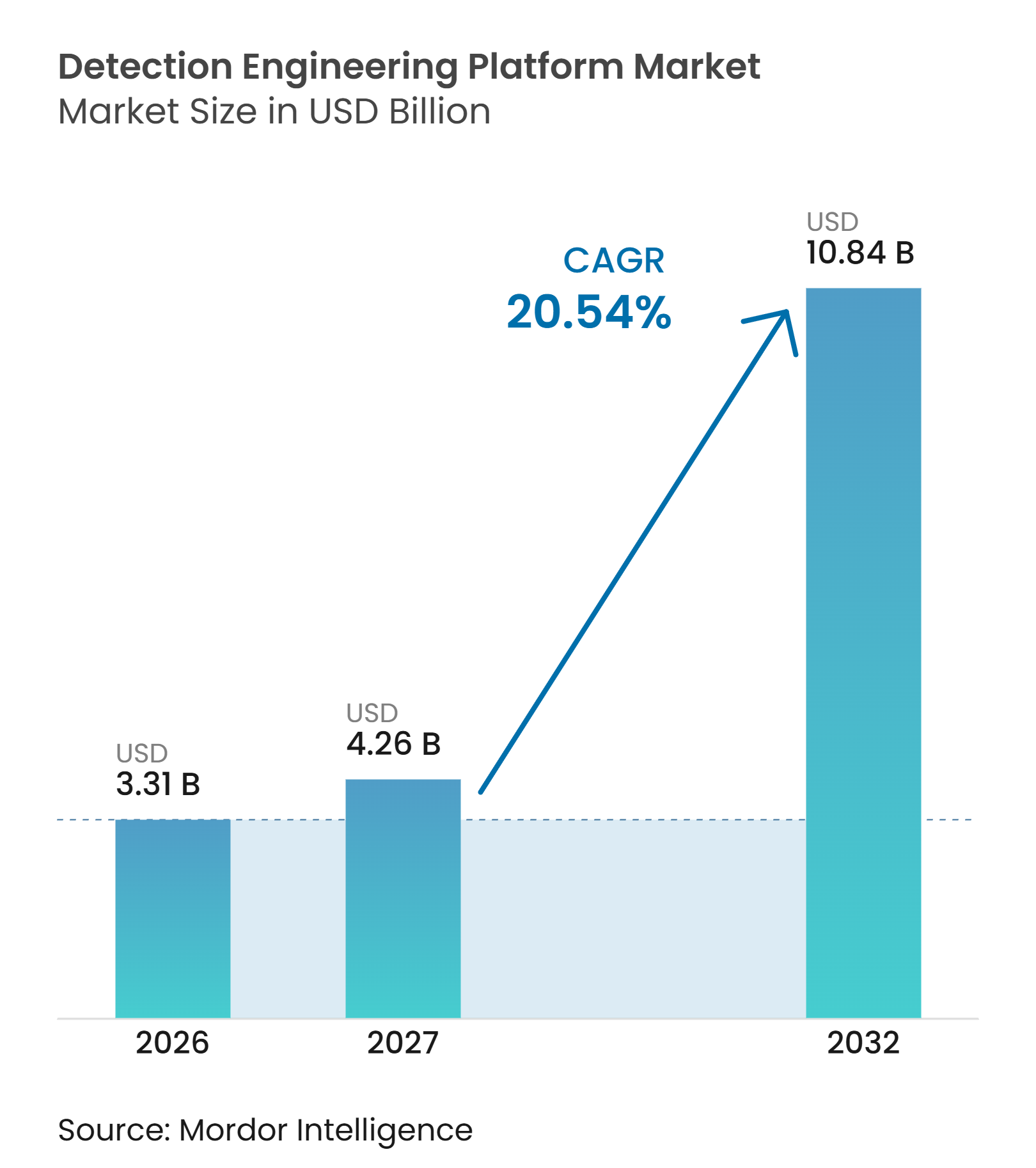
The detection engineering platform market size is projected to be USD 3.31 billion in 2026, USD 4.26 billion in 2027, and reach USD 10.84 billion by 2032, growing at a CAGR of 20.54% from 2027 to 2032. The detection engineering platform market is moving from a specialized security activity toward a core function within security operations as attackers use valid credentials, sanctioned tools, and several linked access paths. Organizations are placing greater emphasis on behavior, identity, activity, and the relationships among events because isolated signature alerts do not reveal the full attack path. Platform vendors are using their established SIEM, XDR, and security data platforms to bring detection content, rule management, automation, and operational oversight into one environment. This favors buyers who need shared processes across endpoint, cloud, identity, network, and SaaS records. The detection engineering platform market also benefits from regulatory expectations for documented, testable, and time-stamped detection activity, particularly in regulated sectors.
Key Report Takeaways
- By component, platforms held 72.36% of the detection engineering platform market in 2026, while services are projected to expand at a 22.61% CAGR through 2032.
- By deployment mode, cloud-based deployment held 64.89% share in 2026 and is projected to expand at a 24.72% CAGR through 2032.
- By organization size, large enterprises held 69.81% share of the detection engineering platform market in 2026, while small and medium-sized enterprises are projected to expand at a 23.44% CAGR through 2032.
- By detection content type, behavioral and anomaly-based detections held 27.54% share in 2026, while identity and entity behavior detections are projected to expand at a 24.51% CAGR through 2032.
- By end user, BFSI held 29.31% share in 2026, while healthcare and life sciences are projected to expand at a 22.64% CAGR through 2032.
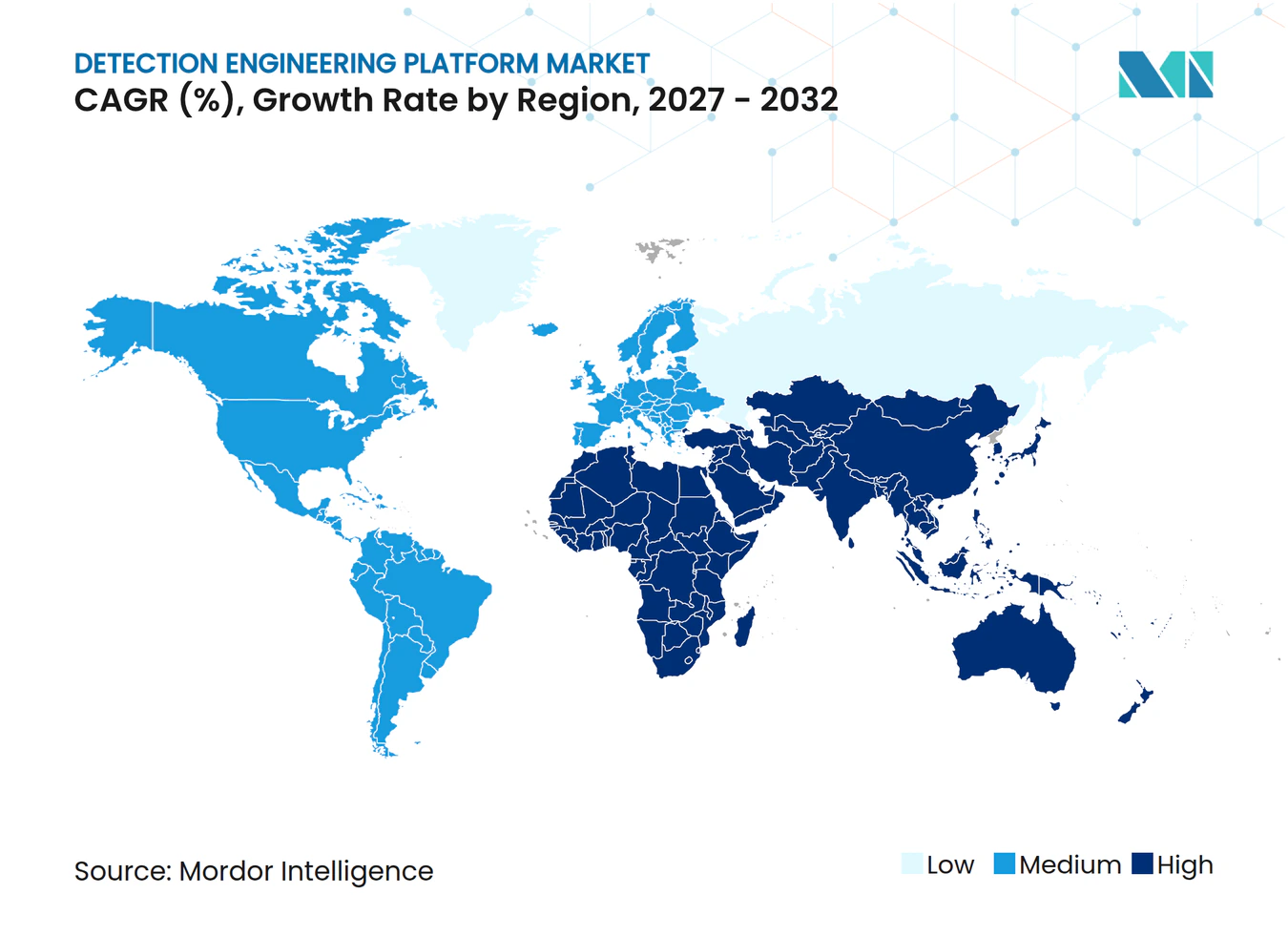
- By geography, North America held 41.64% share of the detection engineering platform market in 2026, while Asia-Pacific is projected to expand at a 24.81% CAGR through 2032.
Note: Market numbers in this report are based on Mordor Intelligence's proprietary estimation framework, which combines nine months of actuals with Q4 projections for base year 2026.
Market Trends and Insights
Drivers Impact Analysis of Detection Engineering Platform Market*
| Driver | (~) % Impact on CAGR Forecast | Geographic Relevance | Impact Timeline |
|---|---|---|---|
| Escalating Adversary Complexity and Multi-Stage Attack Paths | +4.5% | Global | Short term (≤ 2 years) |
| Cloud, Identity, Endpoint, and SaaS Telemetry Expansion | +4.0% | Global | Medium term (2-4 years) |
| Detection-as-Code and CI/CD Adoption in Security Operations | +3.5% | North America and Europe | Medium term (2-4 years) |
| Regulatory Demand for Testable Detection Evidence | +3.2% | Europe, North America, and India | Short term (≤ 2 years) |
| AI-Assisted Rule Generation and Continuous Coverage Optimization | +2.8% | Global | Medium term (2-4 years) |
| Data Drift and Schema Change Driving Self-Healing Detections | +2.0% | Asia-Pacific core, with spillover to North America | Long term (≥ 4 years) |
| Source: Mordor Intelligence | |||
Escalating Adversary Complexity and Multi-Stage Attack Paths
The detection engineering platform market is supported by attacks that move through several credential stores, cloud tenants, and SaaS environments. Threat actors can gain access through identity theft and then use familiar administrative tools, which makes a malware-only response inadequate. The SANS 2025 survey reported that living-off-the-land techniques appeared in 76% of nation-state attacks.[1] Security teams, therefore, need to connect activity across identity, endpoint, network, and cloud records rather than assess each signal alone. Detection programs that cover identity pivots, lateral movement, and data staging provide a more complete view of these linked attack paths. This need supports continued investment in detection content that can be tested and maintained as attacker behavior changes.
Cloud, Identity, Endpoint, and SaaS Telemetry Expansion
Cloud-native workloads, SaaS applications, identity providers, and managed endpoints have expanded the volume of information that security teams must process. The 2026 SANS survey found that 43% of respondents saw cloud-native environments as their largest detection coverage gap. This gap reflects how quickly cloud activity has exceeded the coverage of existing rules and established data models in the detection engineering platform market. Organizations are responding by normalizing records before detection logic is applied in the SIEM. Microsoft expanded Sentinel UEBA in April 2026 to cover AWS, Google Cloud Platform, and Okta sources within a common behavioral analysis approach.[2] The detection engineering platform market gains from architectures that treat data collection, normalization, and rule execution as connected parts of the detection process.
Detection-as-Code and CI/CD Adoption in Security Operations
Detection-as-code applies version control, peer review, automated testing, and deployment pipelines to detection rules. The 2026 SANS survey stated that 93% of respondents use or plan to use automation in their detection engineering workflow. This method helps teams in the detection engineering platform market record changes, review false-positive tuning, and restore earlier rule versions when necessary. It also gives security leaders a clearer record of coverage against the MITRE ATT&CK framework. Rapid7 made its Terraform provider for detection-as-code available across InsightIDR tiers, allowing programmatic deployment and validation of detection logic. Common Sigma rule formats can further support portability between security platforms, reducing the burden of maintaining separate rule sets.
Regulatory Demand for Testable Detection Evidence
Regulatory obligations are making detection activity more visible to boards, auditors, and supervisory bodies. The EU Digital Operational Resilience Act has been in force since January 17, 2025, and requires financial entities to report major ICT incidents within defined time limits. A short reporting window makes the original detection event, its validation, and its recordkeeping operationally important. The European Commission proposed NIS2 amendments in January 2026 that would extend structured obligations to 28,700 additional organizations, including 6,200 micro and small enterprises. The detection engineering platform market is therefore supported by demand for versioned rules, traceable testing, and evidence that links alerts to risk decisions. These needs are especially important in financial services and critical infrastructure.
Restraints Impact Analysis of Detection Engineering Platform Market*
| Restraint | (~) % Impact on CAGR Forecast | Geographic Relevance | Impact Timeline |
|---|---|---|---|
| High Integration Complexity Across Heterogeneous Telemetry | -2.8% | Global | Short term (≤ 2 years) |
| Shortage of Detection Engineering and Threat-Hunting Talent | -2.4% | Global | Medium term (2-4 years) |
| Privacy, Data Sovereignty, and Employee-Monitoring Constraints | -1.8% | Europe and Asia-Pacific | Medium term (2-4 years) |
| Incomplete, Low-Fidelity, or Unstable Telemetry From Legacy and Unsanctioned Environments | -1.5% | Global, with emphasis on emerging economies with legacy infrastructure | Long term (≥ 4 years) |
| Source: Mordor Intelligence | |||
High Integration Complexity Across Heterogeneous Telemetry
The detection engineering platform market faces a practical constraint when data arrives through different connectors and incompatible schemas. Hybrid, multi-cloud, and on-premises estates require teams to normalize information before common detection logic can be used. This work absorbs resources that could otherwise be used to develop new coverage. CrowdStrike stated that Falcon Onum can process up to 5 times more events per second than legacy architectures and route detection-ready data across its platform and third-party destinations.[3] Enterprises with large legacy SIEM investments can face lengthy migration programs. Data validation expectations under DORA and ISO/IEC 27001:2022 add urgency, because integration choices must also support reliable evidence.
Shortage of Detection Engineering and Threat-Hunting Talent
Detection engineering requires knowledge of adversary activity, query languages, MITRE ATT&CK mapping, and software practices. The SANS 2025 survey found that 61% of organizations identified shortages of skilled staff as their main barrier to effective threat hunting. This shortage can concentrate coverage around the tools and techniques that existing staff know best. As a result, unusual attack paths may receive less attention. The 2026 SANS survey reported that 45% of organizations use AI for anomaly detection, rule generation, and alert triage, while 88% expect AI to have a significant effect on their programs within 3 years. Platform automation and managed services can reduce the pressure, but they do not remove the need for skilled review and governance.
*Our forecasts treat driver/restraint impacts as directional, not additive. The impact forecasts reflect baseline growth, mix effects, and variable interactions.
Detection Engineering Platform Market Segment Analysis
By Component:
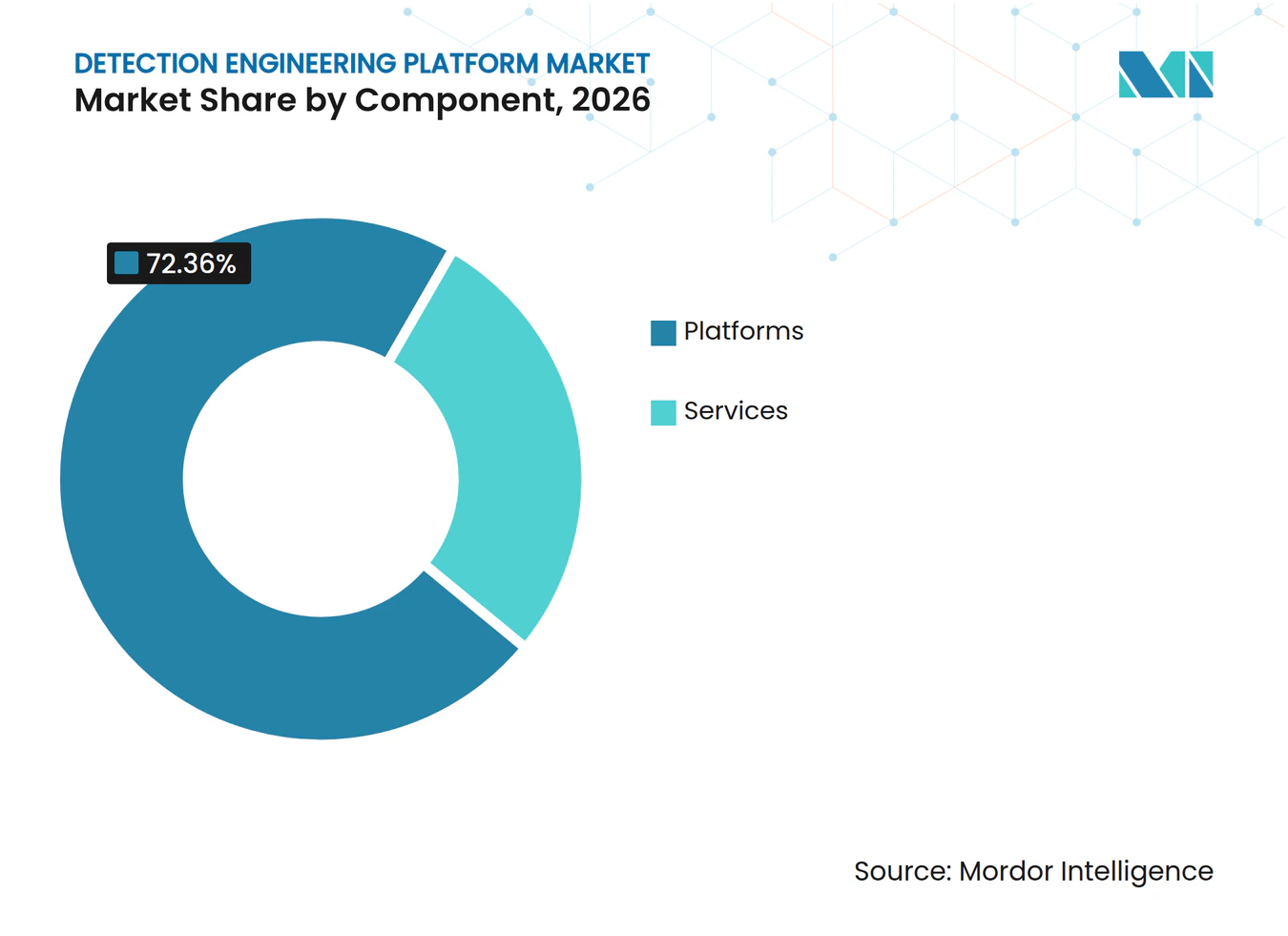
Platforms Anchor Revenue While Services Reshape DeliveryPlatforms accounted for 72.36% of the detection engineering platform market share in 2026. Enterprises use next-generation SIEM and XDR products for rule creation, alert review, and response coordination. These tools bring together threat intelligence, event storage, workflow controls, and content management. Vendor-specific query languages and rule governance can make platform changes difficult after programs are established. The Detection engineering platform market size for platforms reflects a preference for integrated operating environments rather than separate point tools.
Services are projected to expand at a 22.61% CAGR through 2032. Professional services support program design, data onboarding, rule testing, and operating-model change. Managed detection engineering services focus on creating, testing, and maintaining content rather than only incident response. This model helps organizations that lack internal detection specialists and need assurance of external coverage. The Detection engineering platform market creates room for providers that combine content work with repeatable governance and reporting.


By Deployment Mode:
Cloud Consolidates as Hybrid Addresses Sovereignty DemandsCloud-based deployment accounted for 64.89% share in 2026 and is projected to expand to a 24.72% CAGR through 2032. Elastic computing supports the ingestion and review of large volumes of telemetry data. Cloud environments can provide continuing updates to threat intelligence and analytical tools. The Detection engineering platform market size associated with cloud delivery is driven by the wider adoption of cloud-native security data lakes. Cloud deployment also makes centralized rule management more practical across distributed operations.
On-premises deployment remains relevant when data residency, internal control, or operational isolation is required. Hybrid environments combine local data handling with cloud-based analysis where policy permits. This combination provides a gradual path away from older SIEM estates. SOC Prime introduced DetectFlow Enterprise in March 2026 for cloud-connected and air-gapped architectures, with a stated mean time to detect of 0.005 to 0.01 seconds.[4] The Detection engineering platform market must support different deployment choices rather than assume a complete public cloud transition.
By Organization Size:
Enterprises Lead While SMEs Emerge as the Growth EngineLarge enterprises held 69.81% share in 2026. Their security operations manage substantial volumes of telemetry and often use more than 1 SIEM or XDR platform. They have broader regulatory exposure and formal procedures for detecting and approving content. Dedicated detection engineering teams are more common in these organizations. The Detection engineering platform market is anchored by enterprise demand for broad visibility and audit-ready processes.
Small and medium-sized enterprises are projected to expand at a 23.44% CAGR through 2032. Subscription-based cloud services have lowered the barrier to entry for advanced detection capabilities. Supply chain security expectations may also require suppliers to maintain basic detection and response controls. Managed services offer access to skills that smaller organizations may not employ internally. The Detection Engineering industry is extending beyond large security teams as vendors package automation, monitoring, and content into accessible services.
By Detection Content Type:
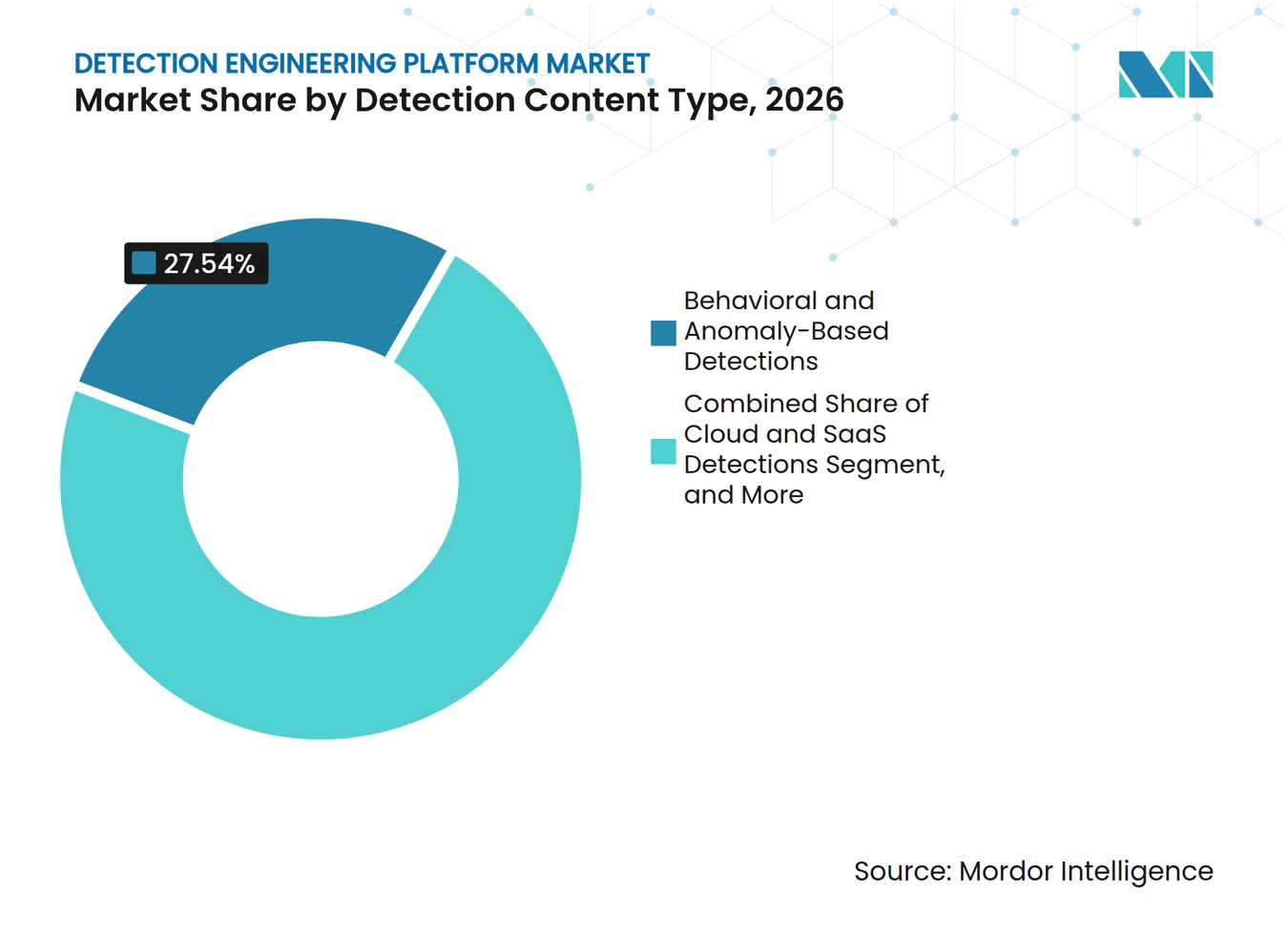
Behavioral Analytics Leads as Identity-Centric Threats Drive New DemandBehavioral and anomaly-based detections held 27.54% share in 2026. These detections identify departures from established patterns rather than relying only on known malicious files or indicators. They can reveal credential misuse and unusual insider activity. A 2026 study using the CERT Insider Threat Dataset reported 97.9% detection accuracy and a 0.99 AUC for a hybrid transformer-and-graph-neural-network UEBA framework.[5] Behavioral content reflects the need to identify activity that is operationally unusual but technically permitted.
Identity and entity behavior detections are projected to expand at a 24.51% CAGR through 2032. Federated identity providers, cloud role assignments, and non-human AI agent identities increase the number of identities requiring monitoring. These systems create relationships between users, devices, applications, and privileges that isolated alerts cannot assess well. Signature and indicator-based content remains an important hygiene layer, while correlation and cloud and SaaS content also expand. The Detection Engineering industry supports these content types as teams seek coverage across several data sources.


By End User:
BFSI Retains Leadership as Healthcare Growth AcceleratesBFSI held 29.31% share in 2026. Banks, insurers, and other financial organizations operate under overlapping requirements for incident detection, reporting, governance, and evidence. DORA, NIS2, SEC disclosure rules, and the Reserve Bank of India framework increase the need for structured detection operations. These requirements make timeliness and traceability central to detection programs. The Detection engineering platform market in BFSI is driven by sensitive data, operational risk, and regulatory scrutiny.
The healthcare and life sciences industry is projected to expand at a 22.64% CAGR through 2032. Electronic health records contain sensitive data and are managed across many systems, broadening the monitoring requirement. Ransomware pressure and limited security resources can increase the need for better detection coverage. Government, IT and telecommunications, energy and utilities, and manufacturing also contribute, each with distinct risk profiles. The Detection engineering platform market serves these sectors with content that must reflect different technologies, critical services, and obligations.
Geography Analysis
North America Detection Engineering Platform Market
North America accounted for 41.64% of the Detection engineering platform market in 2026. The region has a large concentration of enterprise security programs and a dense vendor base. It also has active requirements for incident disclosure and cyber reporting. The SEC requires disclosure of a material cybersecurity incident within 4 business days after a company determines that the incident is material.[6] CrowdStrike, Splunk, Palo Alto Networks, Rapid7, and SentinelOne invest in content libraries and platform automation.
Europe Detection Engineering Platform Market
Europe is the second-largest regional block in the Detection engineering platform market. DORA and NIS2 shape purchasing across the detection engineering platform market in financial services and critical infrastructure. The Commission's January 2026 proposal would simplify NIS2 compliance while extending the framework to 28,700 organizations, including 6,200 micro and small enterprises. France's ANSSI published its 2025 cyber threat panorama alongside the national cybersecurity strategy for 2026-2030, while Germany, the United Kingdom, and the Netherlands have a meaningful concentration of cybersecurity vendors.
APAC and MEA Detection Engineering Platform Market
Asia-Pacific is projected to expand at a 24.81% CAGR through 2032. China, India, Japan, and South Korea are advancing digital programs and cybersecurity frameworks. India's CERT-In directions require 180-day log retention and 6-hour reporting for specified incidents. These requirements raise expectations for data retention and timely detection in regulated environments. The Middle East and Africa remain earlier-stage regions, while the UAE and Saudi Arabia support investment through national cybersecurity programs and sovereign cloud development.
Competitive Landscape
Market Concentration
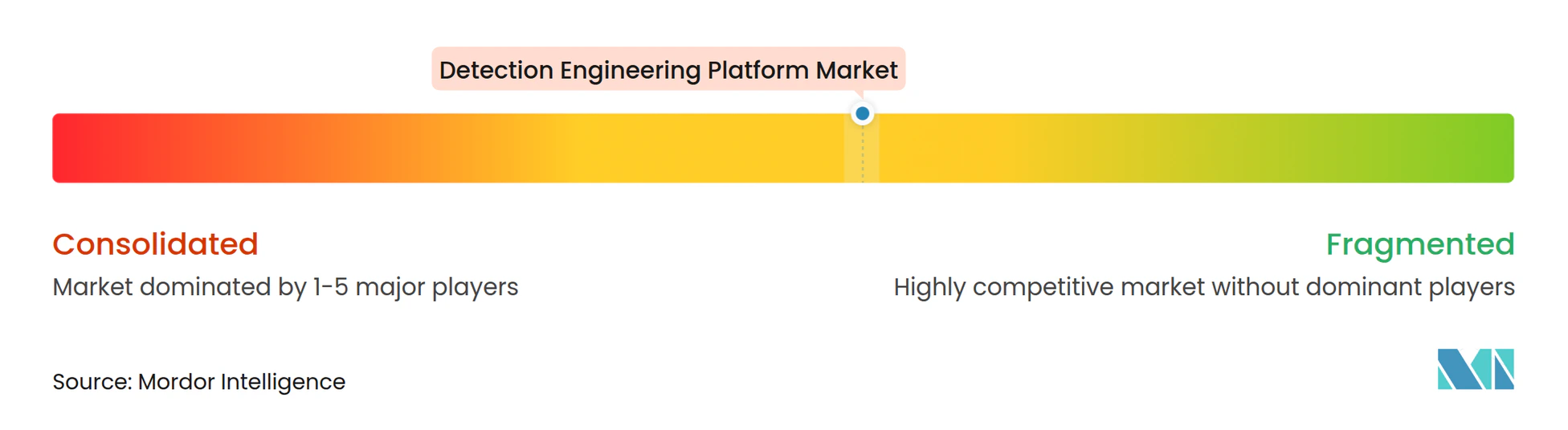
The Detection engineering platform market is moderately concentrated, with Microsoft, CrowdStrike, Splunk, Palo Alto Networks, and Google holding strong revenue positions through SIEM, XDR, and security data platforms. These companies compete through telemetry breadth, native integrations, AI-based automation, and detection content depth. Their installed customer bases allow them to include detection engineering capabilities in platforms enterprises already use. This creates a procurement advantage because buyers can manage multiple functions within a single operating environment.
CrowdStrike has invested in expanding its platform around the Falcon environment. It's the SafeMind project, announced at Fal.Con 2026, used adversarial reinforcement learning and was post-trained on 3.1 million working hours of detection engineering expertise. In August 2026, the company expanded Project QuiltWorks to bring real-time data from 12 ecosystem partners into Falcon Next-Gen SIEM. SOC Prime supports 56 SIEM, EDR, data lake, and pipeline platforms through its Detection Intelligence dataset. Its managed detection engineering model reported savings of 4,000 hours per year in threat research and content coding for MDR partners.
Consolidation is also shaping competition in the Detection engineering platform market. Cribl acquired CardinalOps in July 2026 to combine telemetry pipeline management with detection posture management. Securonix achieved ISO/IEC 42001:2023 certification for AI governance across its portfolio in October 2026, without major audit findings. Devo Technology, Exabeam, and Query.AI differentiate through open data architectures and federated search for multi-SIEM environments. Opportunities remain in managed services for small and medium-sized enterprises, as well as in OT and ICS content for Modbus, DNP3, and other industrial protocols.
Detection Engineering Platform Industry Leaders
-
Splunk Inc.
-
Microsoft Corporation
-
Palo Alto Networks, Inc.
-
CrowdStrike Holdings, Inc.
-
Elastic N.V.
- *Disclaimer: Major Players sorted in no particular order
Detection Engineering Platform Market Companies Covered in this Report
- Splunk Inc.
- Microsoft Corporation
- Palo Alto Networks, Inc.
- CrowdStrike Holdings, Inc.
- Elastic N.V.
- IBM Corporation
- Cisco Systems, Inc.
- SentinelOne, Inc.
- Securonix, Inc.
- Exabeam, Inc.
- Rapid7, Inc.
- Sumo Logic, Inc.
- Devo Technology, Inc.
- Google LLC
- Trellix
- Fortinet, Inc.
- AttackIQ, Inc.
- Cymulate Ltd.
- CardinalOps, Inc.
- Fig Security, Inc.
- Query.AI, Inc.
- SOC Prime, Inc.
Recent Industry Developments in Detection Engineering Platform Market
- October 2026: Securonix launched Advanced Behavioral Analytics (ABA), combining Agent and Entity Behavior Analytics (AEBA) with UEBA to detect technically permitted but operationally abnormal activity across users, AI agents, cloud environments, and applications. The launch extends behavioral baselining to non-human AI agent identities, a category that has grown rapidly with enterprise agentic AI deployments.
- October 2026: Securonix achieved ISO/IEC 42001:2023 certification covering AI governance across its full product portfolio including ThreatQ, with no major audit findings, providing independent validation of AI risk management and human oversight practices.
- September 2026: Splunk released Enterprise Security 8.7, advancing its Agentic SOC vision with an improved Detection Builder Agent for creating and refining detections, enhanced SPL guidance, and governed autonomous response workflows that maintain human accountability. The release marks a deliberate transition from AI-assisted investigation to AI-governed response within the SOC.
- August 2026: CrowdStrike expanded Project QuiltWorks at Fal.Con 2026, integrating real-time data from 12 ecosystem partners into Falcon Next-Gen SIEM. Falcon Onum's intelligent filtering reduces storage costs by up to 50%, while in-pipeline detection logic surfaces attack paths before data reaches downstream systems.
Global Detection Engineering Platform Market Report Scope
The detection engineering platform market comprises revenue generated from software platforms and directly attached services that enable security teams to develop, translate, test, deploy, monitor, optimize, and maintain detection logic across security telemetry sources. These platforms support Detection-as-Code practices, including rule authoring, version control, automated validation, coverage measurement, false-positive reduction, threat-intelligence integration, and CI/CD-based deployment across SIEM, EDR, XDR, cloud, identity, and network environments.
The Detection Engineering Platform Market Report is Segmented by Component (Platforms, and Services), Deployment Mode (Cloud-Based, On-Premises, and Hybrid), Organization Size (Large Enterprises, and Small and Medium-Sized Enterprises), Detection Content Type (Signature and Indicator-Based Detections, Behavioral and Anomaly-Based Detections, Correlation and Multi-Event Detections, Identity and Entity Behavior Detections, Cloud and SaaS Detections, and Other Detection Content Types), End User (Banking, Financial Services, and Insurance (BFSI), Government and Public Administration, IT and Telecommunications, Healthcare and Life Sciences, Energy and Utilities, Manufacturing and Industrial, and Other End Users), and Geography (North America, South America, Europe, Asia-Pacific, Middle East, and Africa), The Market Forecasts are Provided in Terms of Value (USD).
Segmentation Overview
| Platforms | |
| Services | Professional Services |
| Managed Detection Engineering Services |
| Cloud |
| On-Premises |
| Hybrid |
| Large Enterprises |
| Small and Medium-Sized Enterprises |
| Signature and Indicator-Based Detections |
| Behavioral and Anomaly-Based Detections |
| Correlation and Multi-Event Detections |
| Identity and Entity Behavior Detections |
| Cloud and SaaS Detections |
| Other Detection Content Types |
| Banking, Financial Services, and Insurance (BFSI) |
| Government and Public Administration |
| IT and Telecommunications |
| Healthcare and Life Sciences |
| Energy and Utilities |
| Manufacturing and Industrial |
| Other End Users |
| North America | United States |
| Canada | |
| South America | Brazil |
| Mexico | |
| Rest of South America | |
| Europe | United Kingdom |
| Germany | |
| France | |
| Italy | |
| Rest of Europe | |
| Asia-Pacific | China |
| Japan | |
| India | |
| South Korea | |
| Rest of Asia-Pacific | |
| Middle East | United Arab Emirates |
| Saudi Arabia | |
| Rest of Middle East | |
| Africa | South Africa |
| Nigeria | |
| Rest of Africa |
| By Component | Platforms | |
| Services | Professional Services | |
| Managed Detection Engineering Services | ||
| By Deployment Mode | Cloud | |
| On-Premises | ||
| Hybrid | ||
| By Organization Size | Large Enterprises | |
| Small and Medium-Sized Enterprises | ||
| By Detection Content Type | Signature and Indicator-Based Detections | |
| Behavioral and Anomaly-Based Detections | ||
| Correlation and Multi-Event Detections | ||
| Identity and Entity Behavior Detections | ||
| Cloud and SaaS Detections | ||
| Other Detection Content Types | ||
| By End User | Banking, Financial Services, and Insurance (BFSI) | |
| Government and Public Administration | ||
| IT and Telecommunications | ||
| Healthcare and Life Sciences | ||
| Energy and Utilities | ||
| Manufacturing and Industrial | ||
| Other End Users | ||
| By Geography | North America | United States |
| Canada | ||
| South America | Brazil | |
| Mexico | ||
| Rest of South America | ||
| Europe | United Kingdom | |
| Germany | ||
| France | ||
| Italy | ||
| Rest of Europe | ||
| Asia-Pacific | China | |
| Japan | ||
| India | ||
| South Korea | ||
| Rest of Asia-Pacific | ||
| Middle East | United Arab Emirates | |
| Saudi Arabia | ||
| Rest of Middle East | ||
| Africa | South Africa | |
| Nigeria | ||
| Rest of Africa | ||
Key Questions Answered in the Report
What is the detection engineering platform market size?
The detection engineering platform market size is projected to be USD 3.31 billion in 2026, USD 4.26 billion in 2027, and reach USD 10.84 billion by 2032, growing at a CAGR of 20.54% from 2027 to 2032.
Which component has the largest share in detection engineering?
Platforms held 72.36% share in 2026 because enterprises use SIEM and XDR platforms to manage detection content, alerts, and related workflows.
Why is cloud deployment gaining adoption for detection engineering?
Cloud-based deployment held 64.89% share in 2026 and is projected to expand at a 24.72% CAGR through 2032, supported by scalable telemetry processing and cloud-native data architectures.
Which organizations are adopting detection engineering most quickly?
Small and medium-sized enterprises are projected to expand at a 23.44% CAGR through 2032 as subscription services and managed delivery lower implementation barriers.
What is driving demand from financial services organizations?
BFSI held 29.31% share in 2026, supported by incident-reporting, audit trail, and detection evidence requirements under frameworks such as DORA and the RBI directions.
Which region is expanding fastest?
Asia-Pacific is projected to expand at a 24.81% CAGR through 2032, supported by digital transformation and strengthened cybersecurity requirements in major economies.