
Managed API Operations Services Market Size and Share
Market Overview
| Study Period | 2021 - 2032 |
|---|---|
| Market Size (2027) | USD 4.17 Billion |
| Market Size (2032) | USD 8.36 Billion |
| Growth Rate (2027 - 2032) | 14.92 % |
| Fastest Growing Market | Asia-Pacific |
| Largest Market | North America |
| Market Concentration | Medium |
Major Players *Disclaimer: Major Players sorted in no particular order Image © Mordor Intelligence. Reuse requires attribution under CC BY 4.0. | |
Managed API Operations Services Market Analysis by Mordor Intelligence
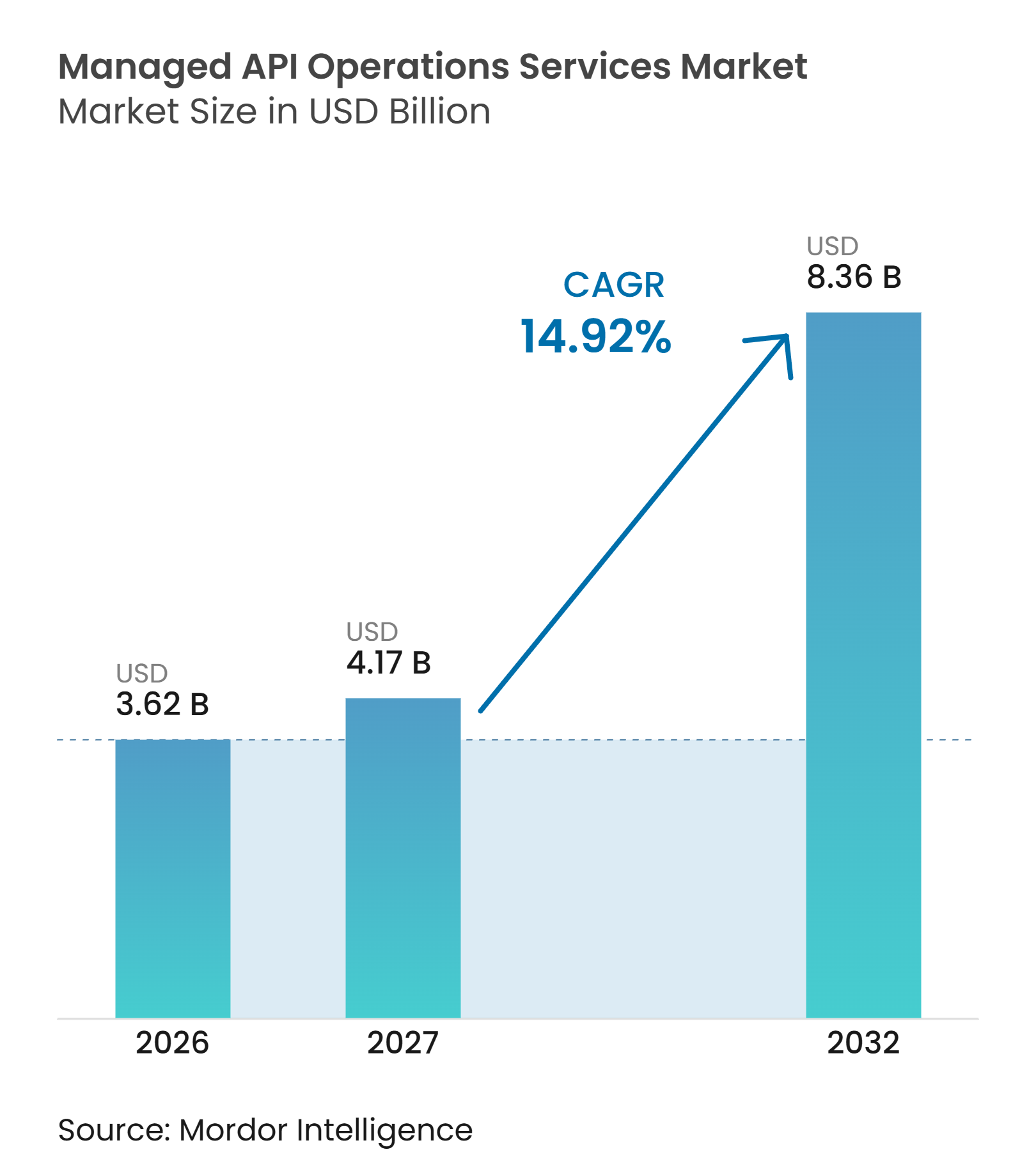
The managed API operations services market size is projected to expand from USD 3.62 billion in 2026 and USD 4.16 billion in 2027 to USD 8.36 billion by 2032, registering a CAGR of 14.92% between 2027 to 2032. APIs have become revenue-bearing systems, and their availability, security, and performance now affect commercial operations rather than only software delivery. AI agents, partner connections, and hybrid cloud environments are increasing the number of API interactions that need oversight. This makes service providers that can run gateways, enforce policies, and respond to incidents more relevant to enterprises with complex technology estates. Demand also favors providers that can manage regional data rules without forcing customers to operate separate control systems. The managed API operations services market is therefore moving toward long-term service contracts centered on accountability, resilience, and operational control.
Key Report Takeaways
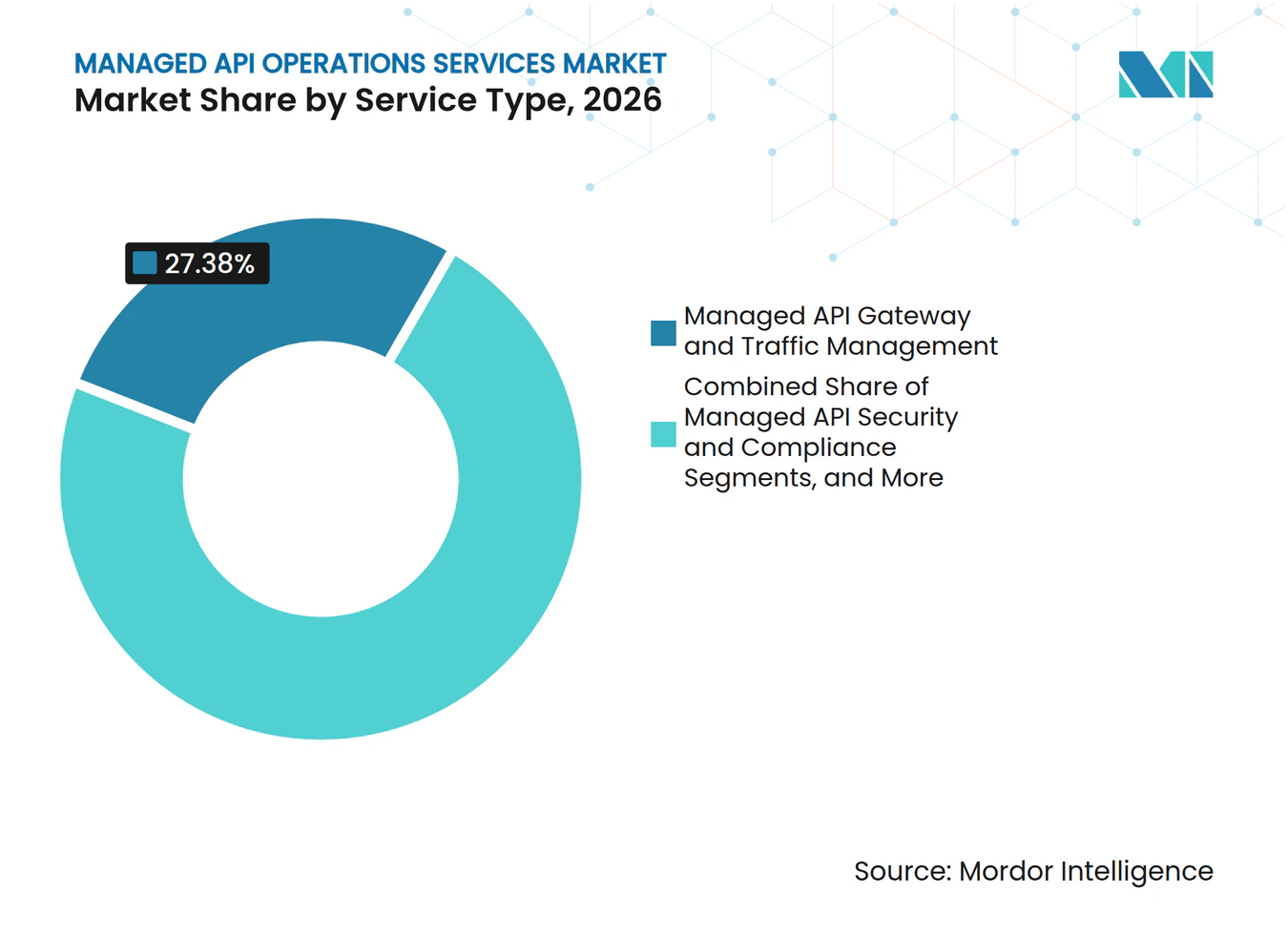
- By service type, managed API gateway and traffic management held 27.38% of the managed API operations services market in 2026, while managed API security and compliance is projected to expand at a 15.27% CAGR through 2032.
- By deployment model, cloud-based deployment accounted for 58.43% of revenue in 2026, while hybrid deployment is projected to expand at a 15.39% CAGR through 2032.
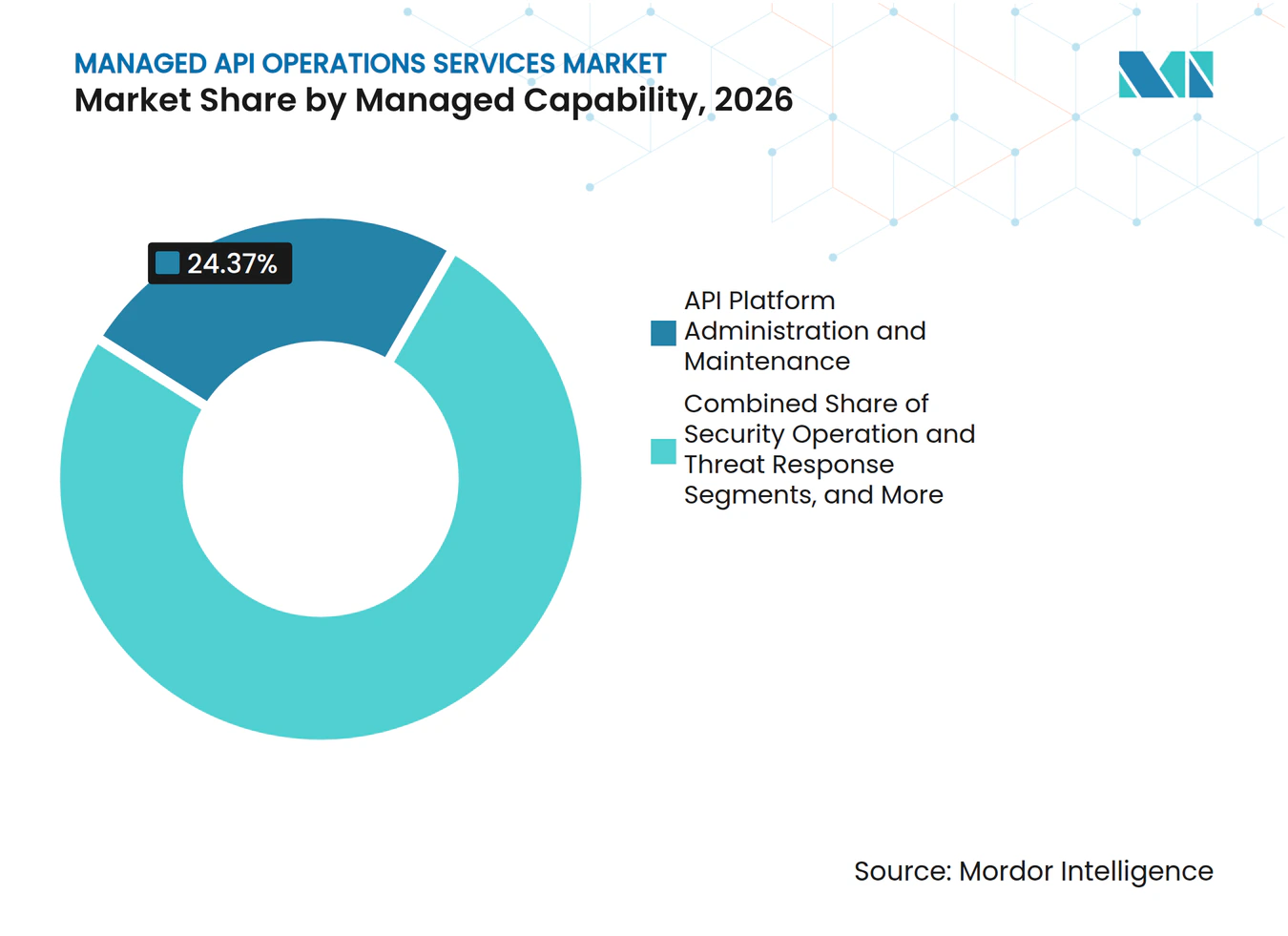
- By managed capability, API platform administration and maintenance held 24.37% of revenue in 2026, while security operations and threat response is projected to expand at a 15.63% CAGR through 2032.
- By organization size, large enterprises accounted for 71.84% of revenue in 2026, while small and medium enterprises are projected to expand at a 15.42% CAGR through 2032.
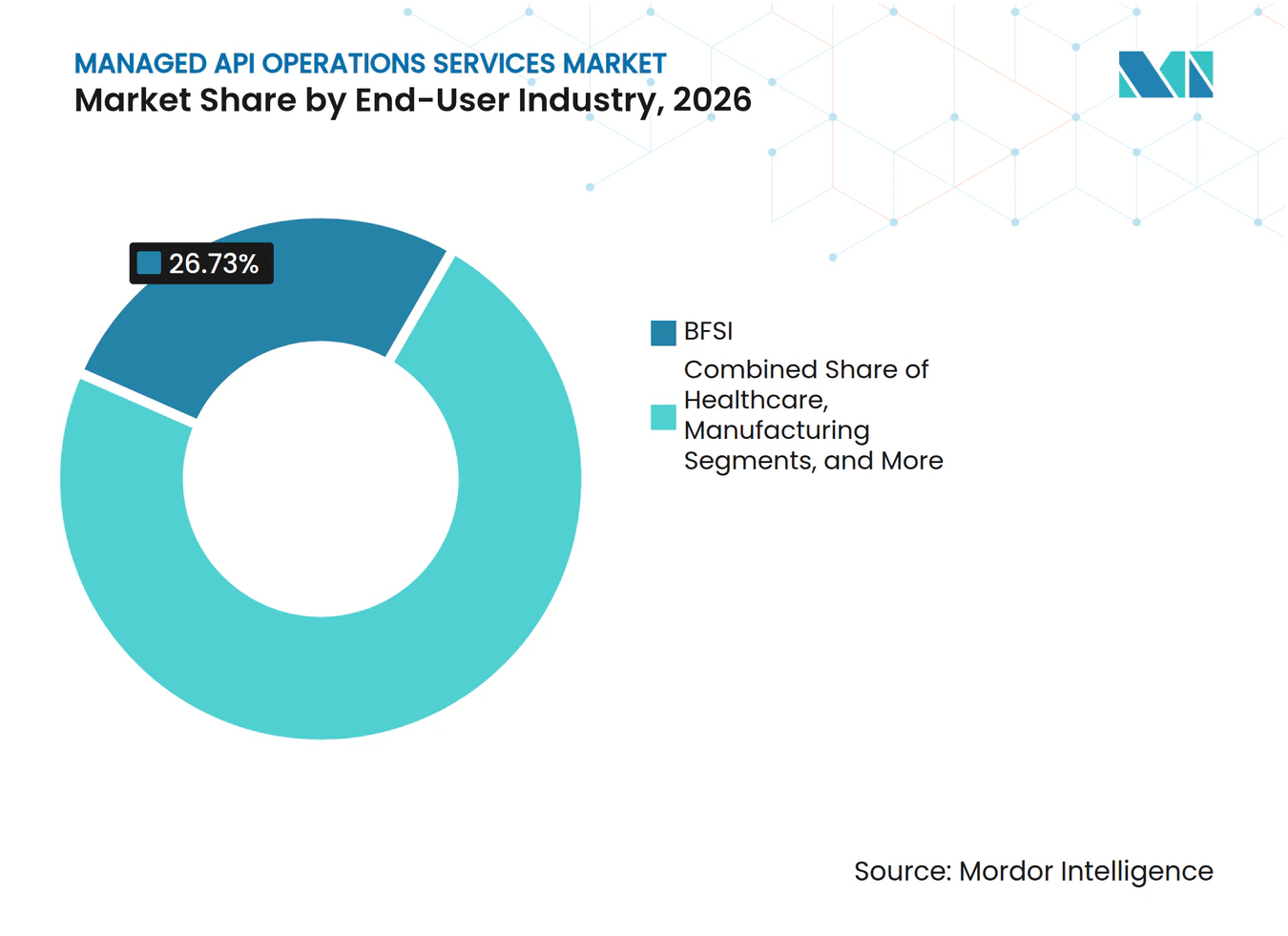
- By end-user industry, BFSI held 26.73% of revenue in 2026, while healthcare is projected to expand at a 15.68% CAGR through 2032.
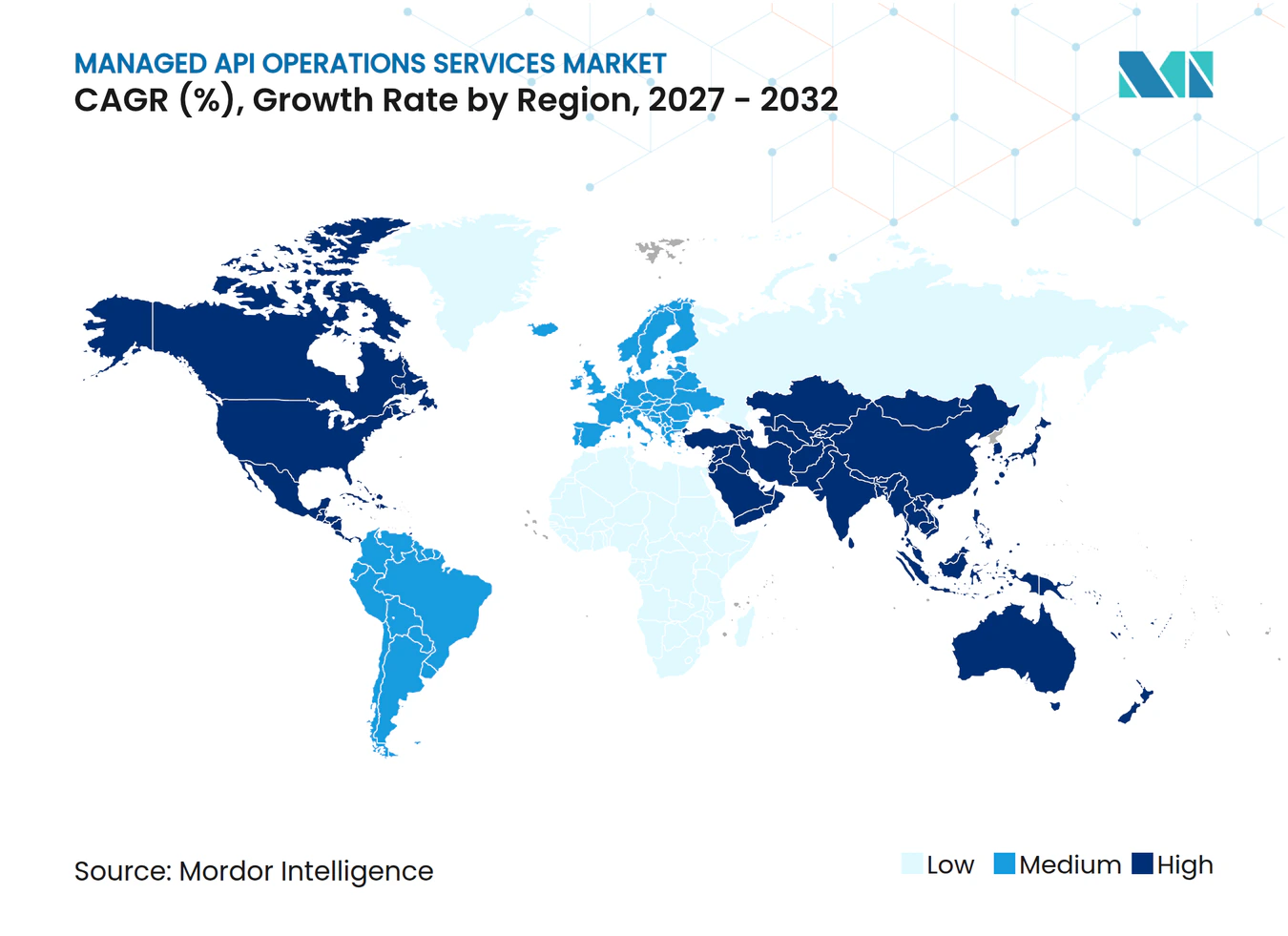
- By geography, North America held 39.47% of revenue in 2026, while Asia-Pacific is projected to expand at a 16.08% CAGR through 2032.
Note: Market numbers in this report are based on Mordor Intelligence's proprietary estimation framework, which combines nine months of actuals with Q4 projections for base year 2026.
Market Trends and Insights
Drivers Impact Analysis of Managed API Operations Services Market*
| Driver | (~) % Impact on CAGR Forecast | Geographic Relevance | Impact Timeline |
|---|---|---|---|
| Rising API Criticality in Digital Products and Revenue Workflows | +3.5% | Global | Short term (≤ 2 years) |
| Expansion of Microservices, Event-Driven, and Hybrid Architectures | +2.8% | Global, with Asia-Pacific core and spillover to South America and Middle East and Africa | Medium term (2-4 years) |
| Escalating API Security and Compliance Accountability | +2.5% | North America and Europe, with growing relevance across Asia-Pacific | Short term (≤ 2 years) |
| Demand for 24/7 Reliability and Faster Incident Resolution | +1.9% | Global | Short term (≤ 2 years) |
| AI Agent and Model Context Protocol API Exposure | +1.6% | North America and Asia-Pacific core | Medium term (2-4 years) |
| Enterprise Shortage of API Operations and Platform Engineering Talent | +1.2% | Global, most acute in South Asia and South America | Medium term (2-4 years) |
| Source: Mordor Intelligence | |||
Rising API Criticality in Digital Products and Revenue Workflows
API monetization has shifted from a specialized financial technology practice to a wider enterprise revenue approach. Postman reported that 64.5% of organizations generate revenue through APIs, while 83.2% use an API-first approach in some form. API downtime, configuration failures, and slower response times can now interrupt customer transactions or partner services.[1] That changes the role of the managed API operations services market because operations teams are being asked to protect commercial workflows. A gateway policy error can interrupt a revenue stream without a change to application code. Providers with contractual service commitments can therefore appeal to organizations that want clear responsibility for operational performance.
Expansion of Microservices, Event-Driven, and Hybrid Architectures
Microservices, event-driven systems, and hybrid architectures create more endpoints that need lifecycle control and security policies. A 2025 peer-reviewed study found that combining microservices, event-driven architecture, and API gateways can improve scalability and distributed governance, while also expanding operational requirements. Google Cloud introduced Eventarc Advanced in 2025 with centralized observability and per-message access control for multi-source environments.[2] Kong also introduced an Event Gateway that extends familiar API controls to event streams. These developments bring API and event operations closer together. The managed API operations services market benefits when enterprises need consistent governance across private infrastructure and public cloud services.
Escalating API Security and Compliance Accountability
Security requirements are raising the standard for API operations in financial services, healthcare, and public services. PCI DSS v4.0.1 took effect in January 2025 and requires controls such as encryption, access management, and network segmentation for payment-processing APIs. The National Security Agency identified access control gaps, insecure context serialization, token lifecycle issues, and incomplete audit logs as risks in Model Context Protocol deployments.[3] These risks make continuous policy enforcement and evidence collection more important for managed providers. The managed API operations services market is supported by buyers that need audit-ready records rather than informal operational assurance. Providers must also manage security requirements across different regions and industry rules.
Demand for 24/7 Reliability and Faster Incident Resolution
Payment settlement, health data exchange, and logistics coordination depend on APIs that remain available throughout the day. Internal teams often lack the staffing depth for full-time incident monitoring and response. Akamai introduced its Managed Service for API Performance in September 2025 with 24/7 synthetic testing, expert incident validation, and automated conformance checks. The service is designed for resilience and regulatory benchmarks that include DORA, NIS2, MAS TRM, and SEC SCI. The managed API operations services market gains from enterprises that view endpoint disruption as a business continuity problem. Providers that can demonstrate dependable response processes are better positioned in regulated accounts.
Restraints Impact Analysis of Managed API Operations Services Market*
| Restraint | (~) % Impact on CAGR Forecast | Geographic Relevance | Impact Timeline |
|---|---|---|---|
| Fragmented Multi-Gateway and Legacy API Estates | -2.0% | Global, most acute in BFSI and government sectors | Medium term (2-4 years) |
| Observability Data Inflation and Unpredictable Usage Costs | -1.7% | Global | Short term (≤ 2 years) |
| Customer Concerns About Data Sovereignty and Third-Party Operational Control | -1.4% | Europe, Asia-Pacific, and Middle East | Long term (≥ 4 years) |
| API Ownership, Documentation, and Governance Gaps | -0.9% | Global | Medium term (2-4 years) |
| Source: Mordor Intelligence | |||
Fragmented Multi-Gateway and Legacy API Estates
Many enterprises operate more than 1 gateway because of cloud migrations, acquisitions, decentralized buying, and multi-cloud programs. Each gateway can use a different identity model, policy language, and observability format. This makes uniform service-level commitments harder for the managed API operations services market to deliver. WSO2 states that legacy integration platforms can consume up to 70% of an IT budget through maintenance. However, business-critical dependencies make customers cautious about replacing existing systems. The issue is especially important for BFSI and government organizations, where a migration can require regulatory approval and coordination with many dependent systems.
Observability Data Inflation and Unpredictable Usage Costs
Distributed systems generate large telemetry volumes, often faster than enterprises can plan for the associated monitoring costs. Grafana Labs found that 37% of organizations considered observability costs too high, while 29% said those costs were hard to budget. Cost pressure can slow adoption because clients expect observability to be included in a service contract. At the same time, volume-based data ingestion can weaken provider margins when API traffic rises unexpectedly. The managed API operations services market needs providers to filter low-value signals and retain information that supports security and service quality. Better sampling and pipeline management can make fixed-fee services more viable.
*Our forecasts treat driver/restraint impacts as directional, not additive. The impact forecasts reflect baseline growth, mix effects, and variable interactions.
Managed API Operations Services Market Segment Analysis
By Service Type:
Gateway Management Anchors Revenue as Security Services AccelerateManaged API gateway and traffic management held 27.38% of the managed API operations services market share in 2026. This service is a practical starting point because traffic must be routed and policies must be applied before other operational work can be completed. It covers gateway availability, configuration, and policy enforcement across API environments. Managed API monitoring, observability, and analytics is also widely purchased because enterprises need help managing large data volumes and identifying meaningful operational signals. Managed API lifecycle, developer portal, and documentation services address the challenge of helping developers find and reuse existing APIs. Managed API operations services providers also support consulting, migration, and optimization when customers seek to consolidate multi-gateway estates. Reliability engineering and incident response are becoming distinct contractual offerings rather than an extension of occasional DevOps support.
Managed API security and compliance is projected to expand at a 15.27% CAGR through 2032. AI agent deployments add new entry points and make continuous policy enforcement more important. The NSA guidance on Model Context Protocol risks supports the need for controls over agent access, context handling, token use, and audit records. Kong announced support for MCP in Konnect during October 2025, including an enterprise gateway and an MCP-enabled developer portal. This direction places security operations closer to the core of API service delivery. Buyers increasingly expect monitoring for unauthorized tool calls, unusual agent behavior, and token misuse. The managed API operations services industry is therefore placing greater value on providers that can combine security monitoring with day-to-day gateway operations.



By Deployment Model:
Cloud Dominance Meets Hybrid MomentumCloud-based deployment accounted for 58.43% of revenue in 2026. Enterprises use cloud delivery because it can simplify provisioning and integrate closely with cloud identity, billing, and application environments. Cloud-native providers in the managed API operations services market can also place API services near the workloads they support. Kong stated that its Dedicated Cloud Gateways support AWS, Microsoft Azure, and Google Cloud Platform, with a 99.95% SLA across more than 25 regions. Marketplace availability can make procurement easier when enterprises want to apply existing cloud commitments to managed connectivity. On-premises deployment remains relevant where public cloud connectivity is restricted. This includes air-gapped government, defense, and financial clearinghouse environments.
Hybrid deployment is projected to expand at a 15.39% CAGR from 2027 to 2032. Organizations need this model when APIs span private data centers and several public cloud tenants. Data residency requirements and established infrastructure make a complete move to a single environment impractical for many buyers. Gravitee introduced multi-provider gateway deployment capabilities in 2025 that support geographic sharding for data residency needs. WSO2 also supports federated management across its own gateways and third-party gateways under 1 control plane. These products show why hybrid management is becoming a standard requirement in regulated sectors. The managed API operations services market favors providers that can apply common governance without forcing customers to abandon existing platforms.
By Managed Capability:
Platform Administration Leads as Security Operations Gains GroundAPI platform administration and maintenance held 24.37% of revenue in 2026. The capability includes gateway provisioning, policy development, patching, and version governance. It is widely used because every operating environment requires routine administration before advanced services can be effective. Performance, availability, and capacity operations follow closely because API-dependent revenue flows increase the cost of downtime. Governance, compliance, and audit evidence are also becoming more important for organizations that must show how API controls were applied. Release, versioning, and deprecation work is commonly bundled with developer experience and API product operations. Managed testing, conformance, and quality engineering is also emerging as enterprises seek continuous validation against evolving API specifications.
Security operations and threat response is projected to expand at a 15.63% CAGR through 2032. AI agents that use APIs through MCP create risks that traditional perimeter controls do not fully address. The National Security Agency has stated that insecure context serialization and weak audit practices can expose MCP deployments. Boomi added MCP support, Apigee federation, and OpenTelemetry integration to its API platform in September 2025. This product direction increases the functional standard for providers offering managed security operations. Customers are looking for continuous detection of unauthorized access, exposed endpoints, and abnormal application behavior. Security operations can therefore be a differentiator for the managed API operations services industry.

By Organization Size:
Large Enterprises Drive Volume, SMEs AccelerateLarge enterprises accounted for 71.84% of revenue in 2026. Their API environments often cover several business units, partner channels, and cloud platforms. This scale creates operating requirements that keep the managed API operations services market relevant to large enterprise buyers. Large contracts also commonly include demanding security, audit, and uptime requirements. The pressure is especially visible in BFSI and healthcare, where providers must work across multiple jurisdictions. Standardized platform practices can reduce the work required from internal engineers. These characteristics keep large enterprises central to the managed API operations services market.
Small and medium enterprises are projected to expand at a 15.42% CAGR from 2027 to 2032. Cloud-native delivery and consumption-based pricing lower the initial commitment for smaller buyers. These organizations often need predictable onboarding, clear service levels, and simple operational reporting. They may not need the same regulatory depth as a major bank, but they still need secure and dependable API connections. Standardized runbooks and packaged service tiers can help providers serve this group efficiently. The managed API operations services market can broaden as SaaS delivery reduces the need for specialist in-house staffing. This also shifts competition toward transparency, speed, and clear pricing.
By End-User Industry:
BFSI Anchors Revenue as Healthcare AcceleratesBFSI held 26.73% of revenue in 2026. Banks and insurers use APIs for open banking, payment processing, core system modernization, and settlement between institutions. They must manage controls under frameworks that include PCI DSS v4.0.1, PSD2 strong customer authentication, and DORA. These needs require secure configuration, real-time monitoring, and defensible records. Managed services can provide recurring support where an organization lacks a dedicated API security team. Banks also use APIs as products for fintech partners and enterprise customers. This use case sustains demand in the managed API operations services market.
Healthcare is projected to expand at a 15.68% CAGR through 2032. FHIR interoperability requirements create work for hospital networks, payers, and digital health platforms that need compliant APIs. Rhapsody launched Guardian in October 2025 to govern FHIR APIs, HL7 interfaces, MCP, and custom APIs through 1 platform. The French digital health authority published its 2025 doctrine that reinforced the Pro Santé Connectée API trust framework. Healthcare organizations need authentication, rate limiting, audit trails, and visibility across a diverse set of clinical systems. This gives specialized providers an opportunity to offer services designed around sector requirements. The managed API operations services market is strengthened where interoperability programs make API governance a routine operational need.
Geography Analysis
North America held 39.47% of managed API operations services market share in 2026. The region has high enterprise spending on APIs and a concentrated group of platform providers. U.S. federal zero-trust architecture requirements have increased deployment of API gateways in public-sector environments. Canada’s financial services API standardization work also supports open banking management needs. Akamai introduced a managed API performance service in the region during September 2025. Kong announced MCP support in October 2025, which reflects the region’s active development of AI-related API controls.
Asia-Pacific is projected to expand at a 16.08% CAGR from 2027 to 2032. Telecom operators participating in the GSMA Open Gateway initiative are exposing network capabilities through APIs that need professional management. Public digital infrastructure programs in India, Indonesia, and Vietnam are also increasing the need for standardized API operations. Cloud capacity growth and fintech expansion support a wider base of API-intensive organizations. China, South Korea, and Japan are using API management in semiconductor supply chains, automotive platforms, and smart-city systems. Australia is advancing cloud-native operations through its federal digital identity work. These factors create opportunities in the managed API operations services market for providers that can support local data rules and cross-border platform requirements.
Europe remains a mature demand center, led by Germany, the United Kingdom, and France. DORA requirements are supporting managed services procurement across European financial institutions. France’s 2025 digital health doctrine also reinforced a trust framework for connected health APIs. South America is emerging through Brazil’s fintech ecosystem and Pix payment API infrastructure. The Middle East, led by Saudi Arabia and the UAE, is investing in API management as part of economic diversification programs. Sovereign cloud and data residency requirements support hybrid service models in this region. Africa, led by Nigeria, South Africa, and Egypt, remains a longer-term opportunity for the managed API operations services market as mobile fintech and telecom API commercialization expand.
Competitive Landscape
Market Concentration
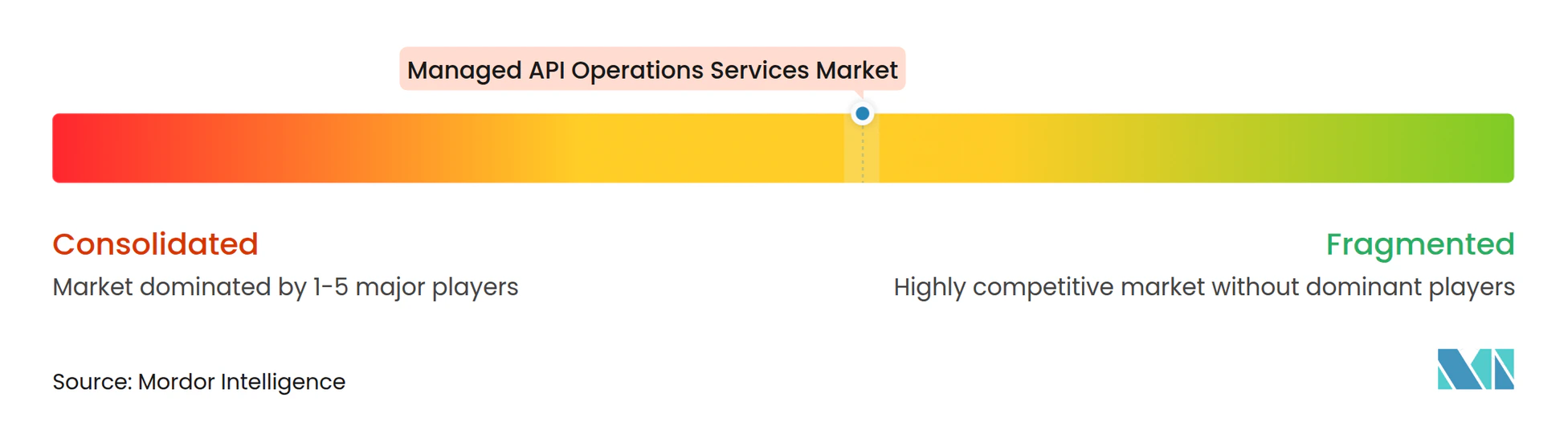
The managed API operations services market is moderately fragmented, with no single provider leading across every service type, deployment model, and geography. Google, Microsoft, and Amazon Web Services compete through cloud-native gateways linked to their billing and identity environments. Kong, WSO2, and Tyk Technologies differentiate through flexibility across environments and open-source approaches. IBM operates IBM API Connect and webMethods after completing the webMethods acquisition in 2024. Tata Consultancy Services competes through lifecycle coverage, regulatory knowledge, and delivery capacity. Torry Harris Business Solutions and Sensedia focus on regulated sectors where industry-specific compliance knowledge can support premium contracts. Buyers are increasingly interested in tools that discover and govern APIs across more than 1 gateway.
Competition is moving toward AI agent governance, observability cost management, and multi-cloud federation. Persistent Systems and Kong announced a strategic partnership in May 2026 to develop enterprise architecture for governing APIs, data, and AI systems across hybrid and multi-cloud environments. Boomi added Apigee X federation and OpenTelemetry support in its September 2025 release. Kong’s MCP functionality and Boomi’s control-plane features show how suppliers are extending API management into AI operations. This responds to the security and governance challenges identified by the National Security Agency. Providers that connect traditional API lifecycle management with AI agent controls can address a wider set of enterprise requirements.
Compliance credentials and resilient delivery are also important competitive tools. Kong reported SOC 2 Type II compliance for Dedicated Cloud Gateways on Google Cloud Platform in June 2025. The company subsequently made its portfolio available across AWS, Microsoft Azure, and Google Cloud marketplaces in June 2026. Akamai’s managed API performance offering combines testing, expert validation, and conformance monitoring. These moves show that leading providers are competing on procurement simplicity, security assurance, and managed reliability. The managed API operations services market remains open to specialists that can provide credible support in regulated verticals. Scale matters, but customers also need providers that can work across complex existing environments.
Managed API Operations Services Industry Leaders
-
Google LLC
-
Microsoft Corporation
-
Amazon Web Services, Inc.
-
IBM Corporation
-
Salesforce, Inc.
- *Disclaimer: Major Players sorted in no particular order
Managed API Operations Services Market Companies Covered in this Report
- Google LLC
- Microsoft Corporation
- Amazon Web Services, Inc.
- Salesforce, Inc.
- IBM Corporation
- Axway Inc.
- Broadcom Inc.
- Boomi, Inc.
- Kong Inc.
- WSO2, Inc.
- Akamai Technologies, Inc.
- SAP SE
- Oracle Corporation
- TIBCO Software Inc.
- Torry Harris Business Solutions
- Sensedia Inc.
- Postman, Inc.
- Tyk Technologies Limited
- Gravitee Limited
- Prolifics, Inc.
- Tata Consultancy Services Limited
Recent Industry Developments in Managed API Operations Services Market
- June 2026: Kong made its full product portfolio, including Kong Konnect, available across AWS Marketplace, Microsoft Azure Marketplace, and Google Cloud Marketplace simultaneously, simplifying enterprise procurement and enabling customers to apply existing cloud spend commitments, AWS EDP, Microsoft MACC, and Google Cloud CUD, to managed API connectivity infrastructure.
- June 2026: The National Security Agency published “Model Context Protocol (MCP): Security Design Considerations for AI-Driven Automation” Version 1.0, May 2026, formally identifying access control gaps, insecure context serialization, token lifecycle vulnerabilities, and missing audit logs as exploitable risks in enterprise MCP deployments, establishing a government-level security baseline for AI-driven API governance.
- May 2026: Persistent Systems and Kong announced a strategic partnership to define a new enterprise architecture for governing APIs, data, and AI systems across hybrid and multi-cloud environments. The agreement positions Persistent as Kong's global systems integration partner for MCP-based architecture deployments and legacy API estate modernization.
- November 2025: Microsoft Azure API Management introduced a native Service Bus integration policy enabling REST-to-event bridge architectures with managed identity authentication, enterprise-grade rate limiting, quotas, and authorization controls, extending Azure APIM's managed operations scope to event-driven workloads without requiring separate messaging infrastructure.
Global Managed API Operations Services Market Report Scope
The managed API operations services market includes services that help organizations deploy, monitor, secure, maintain, and optimize application programming interfaces (APIs). Managed API operations services involve outsourcing API lifecycle management activities to specialized service providers, enabling organizations to improve API performance, reliability, security, and scalability.
The Managed API Operations Services Market Report is Segmented by Service Type (Managed API Gateway and Traffic Management, Managed API Security and Compliance, Managed API Monitoring, Observability, and Analytics, Managed API Lifecycle, Developer Portal, and Documentation, Managed API Reliability Engineering and Incident Response, and API Operations Consulting, Migration, and Optimization), Deployment Model (On-Premises, Cloud-Based, and Hybrid), Managed Capability (API Platform Administration and Maintenance, Security Operations and Threat Response, Performance, Availability, and Capacity Operations, Governance, Compliance, and Audit Evidence, Release, Versioning, and Deprecation Operations, Developer Experience and API Product Operations, and Managed Testing, Conformance, and Quality Engineering), Organization Size (Small and Medium Enterprises, and Large Enterprises), End-User Industry (Information Technology and Telecommunications, BFSI, Healthcare, Retail and E-Commerce, Manufacturing, Government and Defense, and Other End-User Industries), and Geography (North America, South America, Europe, Asia-Pacific, Middle East, and Africa). The Market Forecasts are Provided in Terms of Value (USD).
Segmentation Overview
| Managed API Gateway and Traffic Management |
| Managed API Security and Compliance |
| Managed API Monitoring, Observability, and Analytics |
| Managed API Lifecycle, Developer Portal, and Documentation |
| Managed API Reliability Engineering and Incident Response |
| API Operations Consulting, Migration, and Optimization |
| On-Premises |
| Cloud-Based |
| Hybrid |
| API Platform Administration and Maintenance |
| Security Operations and Threat Response |
| Performance, Availability, and Capacity Operations |
| Governance, Compliance, and Audit Evidence |
| Release, Versioning, and Deprecation Operations |
| Developer Experience and API Product Operations |
| Managed Testing, Conformance, and Quality Engineering |
| Small and Medium Enterprises |
| Large Enterprises |
| Information Technology and Telecommunications |
| BFSI |
| Healthcare |
| Retail and E-Commerce |
| Manufacturing |
| Government and Defense |
| Other End-User Industries |
| North America | United States |
| Canada | |
| Mexico | |
| South America | Brazil |
| Argentina | |
| Rest of South America | |
| Europe | Germany |
| United Kingdom | |
| France | |
| Italy | |
| Spain | |
| Russia | |
| Rest of Europe | |
| Asia-Pacific | China |
| India | |
| Japan | |
| South Korea | |
| Australia | |
| Rest of Asia-Pacific | |
| Middle East | Saudi Arabia |
| United Arab Emirates | |
| Turkey | |
| Rest of Middle East | |
| Africa | South Africa |
| Egypt | |
| Nigeria | |
| Rest of Africa |
| By Service Type | Managed API Gateway and Traffic Management | |
| Managed API Security and Compliance | ||
| Managed API Monitoring, Observability, and Analytics | ||
| Managed API Lifecycle, Developer Portal, and Documentation | ||
| Managed API Reliability Engineering and Incident Response | ||
| API Operations Consulting, Migration, and Optimization | ||
| By Deployment Model | On-Premises | |
| Cloud-Based | ||
| Hybrid | ||
| By Managed Capability | API Platform Administration and Maintenance | |
| Security Operations and Threat Response | ||
| Performance, Availability, and Capacity Operations | ||
| Governance, Compliance, and Audit Evidence | ||
| Release, Versioning, and Deprecation Operations | ||
| Developer Experience and API Product Operations | ||
| Managed Testing, Conformance, and Quality Engineering | ||
| By Organization Size | Small and Medium Enterprises | |
| Large Enterprises | ||
| By End-User Industry | Information Technology and Telecommunications | |
| BFSI | ||
| Healthcare | ||
| Retail and E-Commerce | ||
| Manufacturing | ||
| Government and Defense | ||
| Other End-User Industries | ||
| By Geography | North America | United States |
| Canada | ||
| Mexico | ||
| South America | Brazil | |
| Argentina | ||
| Rest of South America | ||
| Europe | Germany | |
| United Kingdom | ||
| France | ||
| Italy | ||
| Spain | ||
| Russia | ||
| Rest of Europe | ||
| Asia-Pacific | China | |
| India | ||
| Japan | ||
| South Korea | ||
| Australia | ||
| Rest of Asia-Pacific | ||
| Middle East | Saudi Arabia | |
| United Arab Emirates | ||
| Turkey | ||
| Rest of Middle East | ||
| Africa | South Africa | |
| Egypt | ||
| Nigeria | ||
| Rest of Africa | ||
Key Questions Answered in the Report
What is the managed API operations services market size?
The managed API operations services market size is projected to rise from USD 3.62 billion in 2026 and USD 4.16 billion in 2027 to USD 8.36 billion by 2032, at a 14.92% CAGR.
What is driving demand for managed API operations services?
API-driven revenue workflows, tighter security requirements, hybrid architectures, and the need for 24/7 incident response are increasing demand.
Which service type leads managed API operations services?
Managed API gateway and traffic management led with 27.38% of 2026 revenue because gateway operations underpin routing and policy enforcement.
Which deployment model is growing fastest?
Hybrid deployment is projected to grow at a 15.39% CAGR through 2032 as organizations govern APIs across private infrastructure and public cloud environments.
Which end-user sector is growing fastest?
Healthcare is projected to grow at a 15.68% CAGR through 2032 as interoperability and FHIR requirements increase the need for compliant API management.
Which region is expanding fastest?
Asia-Pacific is projected to grow at a 16.08% CAGR through 2032, supported by digital public infrastructure, fintech growth, and telecom API activity.