
Mobile DevOps Platform Market Size and Share
Market Overview
| Study Period | 2020 - 2031 |
|---|---|
| Market Size (2026) | USD 2.68 Billion |
| Market Size (2031) | USD 4.99 Billion |
| Growth Rate (2026 - 2031) | 13.24 % |
| Fastest Growing Market | Asia-Pacific |
| Largest Market | North America |
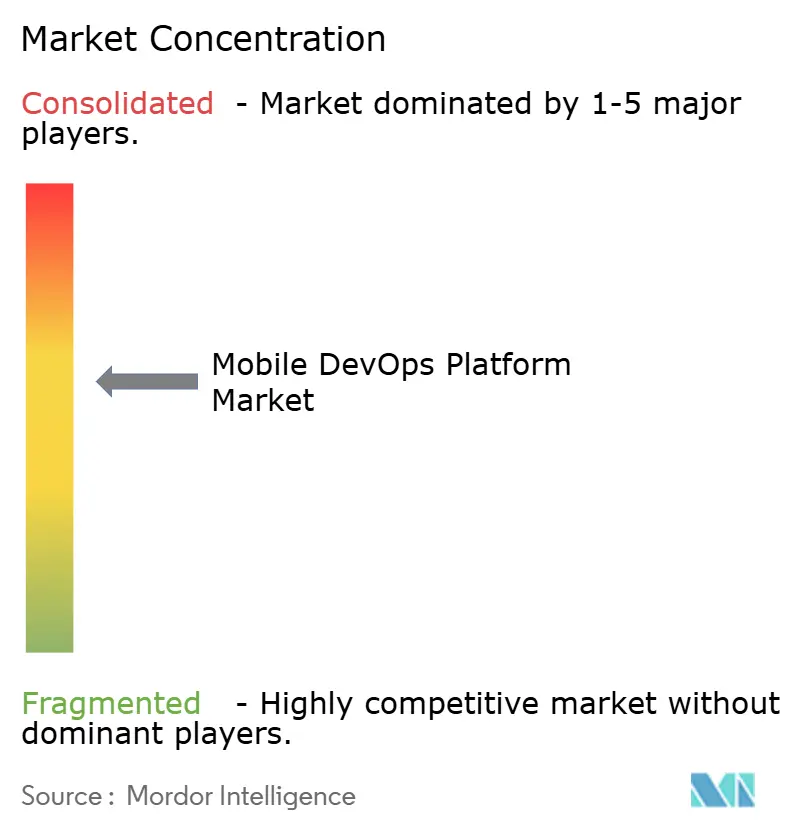
| Market Concentration | Medium |
Major Players *Disclaimer: Major Players sorted in no particular order Image © Mordor Intelligence. Reuse requires attribution under CC BY 4.0. | |
Mobile DevOps Platform Market Analysis by Mordor Intelligence
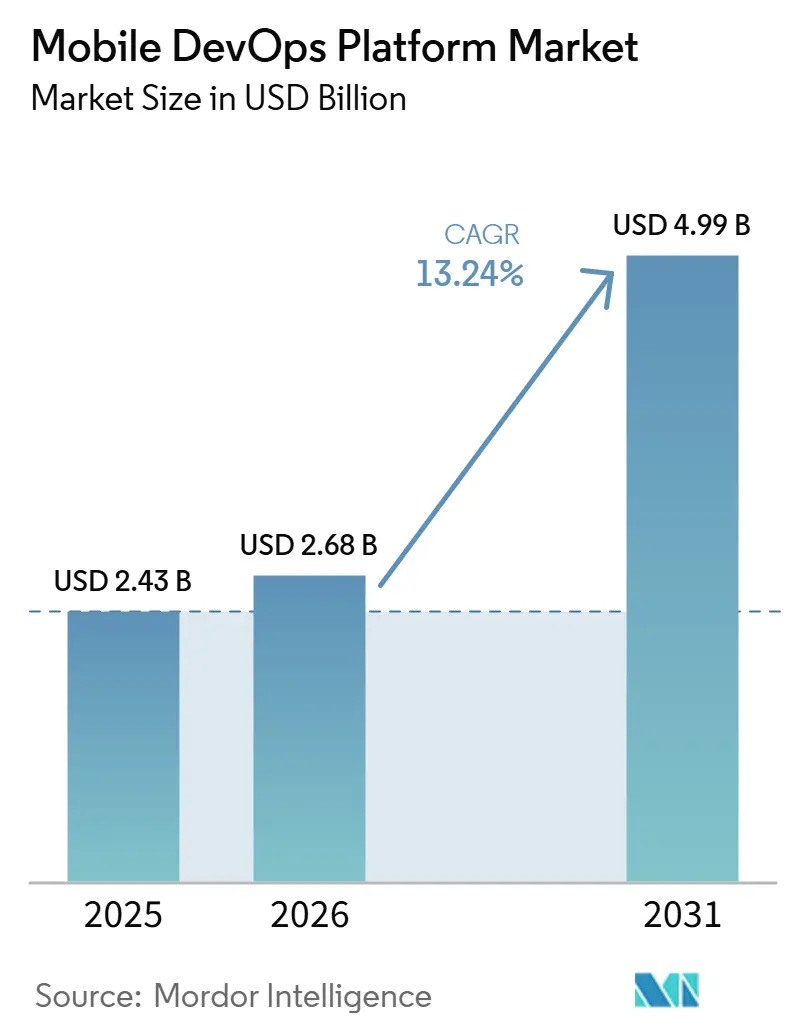
The Mobile DevOps Platform Market size was valued at USD 2.43 billion in 2025 and is estimated to grow from USD 2.68 billion in 2026 to reach USD 4.99 billion by 2031, at a CAGR of 13.24% during the forecast period (2026-2031). The Mobile DevOps Platform Market is supported by enterprise efforts to shorten mobile release cycles, automate quality checks, and introduce security earlier in delivery work. Organizations are moving from separate automation tools toward integrated platforms that manage code commits, testing, approvals, and production releases. AI-assisted build and testing agents are changing platform selection because buyers need governance and audit records for code generated with AI support. Data residency rules in Europe are also raising demand for delivery infrastructure that can keep code and operational data in approved regions. These conditions create opportunities for vendors that can connect with existing tools while providing stronger controls for regulated users.
Key Report Takeaways
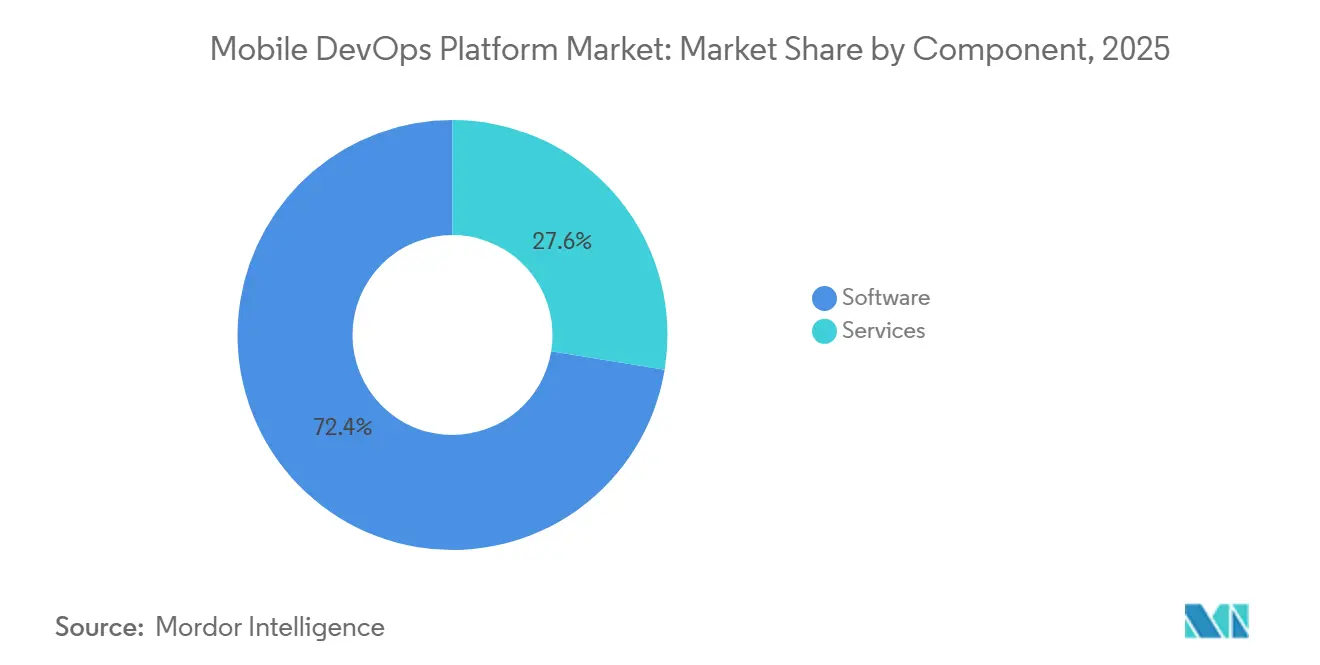
- By component, software held 72.41% of the Mobile DevOps Platform Market share in 2025, while services are projected to expand at a 16.82% CAGR through 2031.
- By deployment model, cloud deployment accounted for 68.19% of revenue in the Mobile DevOps Platform Market 2025, while hybrid deployment is projected to expand at a 15.43% CAGR through 2031.
- By enterprise size, large enterprises held 64.83% of revenue in 2025, while small and medium-sized enterprises are projected to expand at a 17.24% CAGR through 2031.
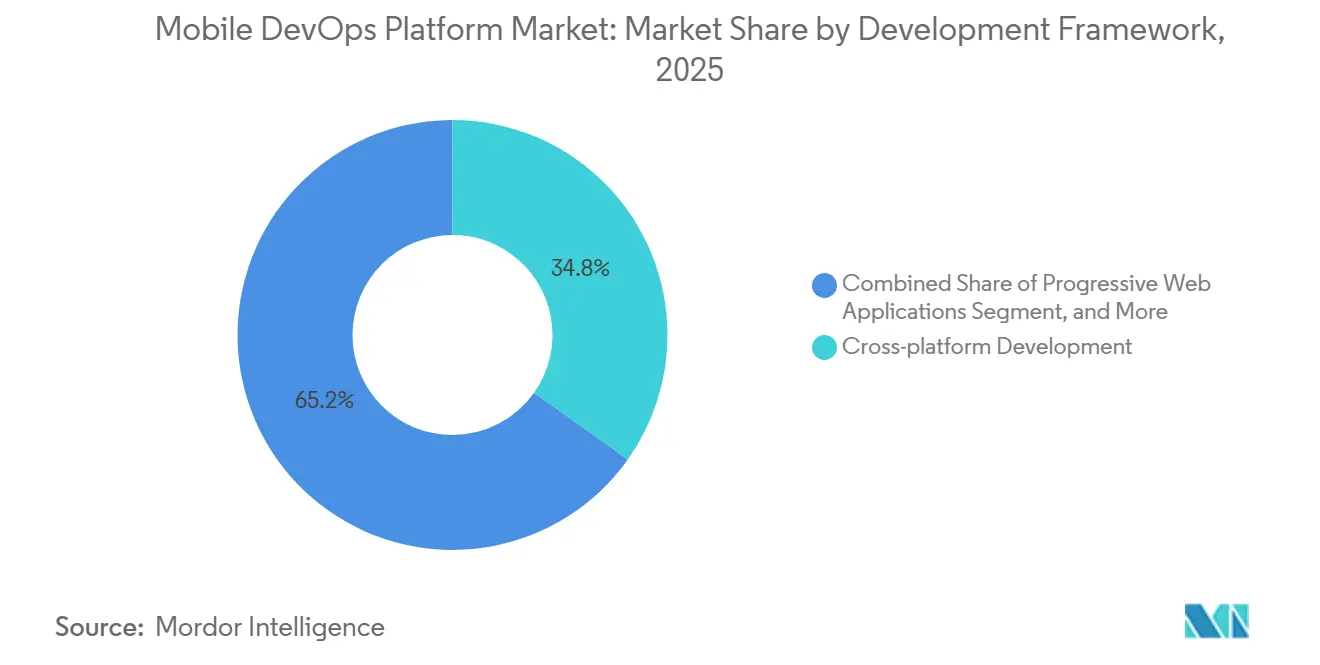
- By development framework, cross-platform development accounted for 34.82% of revenue in the Mobile DevOps Platform Market 2025, while progressive web applications are projected to expand at an 18.91% CAGR through 2031.
- By end user, IT and telecommunication held 24.36% of revenue in 2025, while healthcare and life sciences are projected to expand at a 16.47% CAGR through 2031.
Note: Market size and forecast figures in this report are generated using Mordor Intelligence’s proprietary estimation framework, updated with the latest available data and insights as of January 2026.
Market Trends and Insights
Drivers Impact Analysis of Mobile DevOps Platform Market*
| Driver | (~) % Impact on CAGR Forecast | Geographic Relevance | Impact Timeline |
|---|---|---|---|
| Continuous Delivery and Automated Mobile Release Pipelines | +3.8% | Global, with highest intensity in North America and Europe | Short term (≤ 2 years) |
| AI and ML Integration for Autonomous Pipeline Management | +3.2% | North America and Europe initially, expanding to Asia-Pacific | Medium term (2-4 years) |
| Cloud-Native Adoption and Hybrid Deployment in Regulated Sectors | +2.5% | Global, particularly North America, Europe, and Asia-Pacific | Short term (≤ 2 years) |
| Mobile-First Digital Transformation Across Key Verticals | +1.9% | Global, with early momentum in North America and Asia-Pacific | Medium term (2-4 years) |
| Shift-Left Security and DevSecOps Compliance Integration | +1.1% | North America and Europe, expanding to Asia-Pacific core markets | Medium term (2-4 years) |
| Cross-Platform and PWA Framework Growth | +0.8% | Global, with faster adoption in Asia-Pacific and Europe | Long term (≥ 4 years) |
| Source: Mordor Intelligence | |||
Accelerating Demand for Continuous Delivery and Automated Mobile Release Pipelines
The Mobile DevOps Platform Market benefits as consumer-facing enterprises seek to release mobile updates in hours instead of weeks. A 2025 JetBrains survey of 805 software professionals found that 41% of organizations deployed via GitHub Actions, while Jenkins remained widely used in large enterprises due to its plugin ecosystem.[1]JetBrains TeamCity, “The State of CI/CD in 2025: Key Insights From the Latest JetBrains Survey,” JetBrains TeamCity Blog, blog.jetbrains.com Many enterprises still operate legacy build servers beside cloud-based CI/CD tools, which increases maintenance work and complicates release management. This creates demand for platforms that connect with current orchestrators rather than requiring a full migration. Mobile DevOps Platform providers that support the full delivery process through a single control layer can address this need. Expectations for quick app updates are placing additional pressure on procurement and engineering teams to modernize release workflows.
AI and ML Integration Enabling Autonomous Pipeline Management
AI-supported workflows are moving from code suggestions to automated testing, failure review, remediation, and deployment management. Harness introduced Autonomous Worker Agents in June 2026, with governance features that include Open Policy Agent controls and audit trails for pipeline actions.[2]Harness, “Introducing Autonomous Worker Agents,” Harness Blog, harness.io Bitrise reported that AI-assisted builds increased 164 times over 1 year, while the rate at which teams shipped to users fell by 20%. The gap shows that code generation can increase pressure on test and release processes if delivery systems do not scale with it. Platforms that work with AI coding tools and preserve review records are likely to have a stronger position with enterprise buyers. The Mobile DevOps Platform Market is therefore placing greater value on governance features rather than managed build capacity alone.
Rising Cloud-Native Adoption and Hybrid Deployment Architectures
Cloud deployment held 68.19% of revenue in 2025, but hybrid deployment is projected to grow at a 15.43% CAGR through 2031. Regulated organizations are using hybrid designs to combine cloud capacity with on-premises control over sensitive data and source code. GitLab introduced GitLab Orbit in June 2026 as a context graph that connects code, pipelines, deployments, and production signals for AI agents and engineers.[3]GitLab Inc., “GitLab Announces New Capabilities to Give Enterprises Speed and Control at Agentic Scale,” GitLab Press Release, about.gitlab.com The capability reflects the operational need for a consistent view across hybrid environments. Bitrise invested USD 3 million in 2024 to establish an EU-operated mobile DevOps data center in the Netherlands to address European data sovereignty requirements. The Mobile DevOps Platform Market has room for vendors that offer comparable functions across cloud and on-premises environments.[4]Bitrise, “Bitrise Remote Dev Environments Beta Launch,” Bitrise Blog, bitrise.io
Mobile-First Digital Transformation Across Healthcare, BFSI, and Telecom Verticals
Healthcare and life sciences are projected to expand at an exponential rate through 2031 as providers digitize clinical workflows and require stronger release controls. Healthcare teams must document controls for each build artifact, not only for software after release. This creates a role for specialized delivery processes that support HIPAA review requirements. Banks and insurers are also moving from annual native application releases to 2-4 week delivery cycles. These organizations need multiple release tracks while maintaining PCI DSS 4.0 controls.
Restraints Impact Analysis of Mobile DevOps Platform Market*
| Restraint | (~) % Impact on CAGR Forecast | Geographic Relevance | Impact Timeline |
|---|---|---|---|
| Legacy IT Infrastructure Integration and Migration Overhead | -1.8% | Global, most acute in Europe and North America’s incumbent-heavy industries | Medium term (2-4 years) |
| Shortage of Qualified Mobile DevOps Engineering Talent | -1.2% | Global, with highest pressure in North America, Europe, and Asia-Pacific core markets | Short term (≤ 2 years) |
| Security and Data Governance Concerns Around Shared CI/CD Infrastructure | -0.7% | North America and Europe, expanding to Asia-Pacific core markets | Short term (≤ 2 years) |
| High Enterprise Platform Costs for SMEs | -0.5% | Global, particularly Southeast Asia, South America, and Middle East and Africa | Medium term (2-4 years) |
| Source: Mordor Intelligence | |||
Legacy IT Infrastructure Integration Complexity and High Migration Overhead
Migration costs remain a major obstacle for enterprises that use Jenkins pipelines with large numbers of custom plugins. The 2025 JetBrains survey found that 32% of organizations used 2 CI/CD tools and 9% used 3 or more. These mixed environments can delay full platform consolidation for long periods. Mobile signing systems, including provisioning profiles, keystores, and App Store Connect credentials, are closely tied to current pipeline settings. Rebuilding those processes can require more work than moving the build steps themselves. ISO/IEC 27001 requirements can add further complexity, as organizations must maintain audit records throughout the transition. The Mobile DevOps Platform Market must therefore address both migration planning and product functionality.
Acute Shortage of Qualified Mobile DevOps Engineering Talent
Mobile DevOps requires knowledge of iOS and Android build systems, cloud infrastructure, security automation, and CI/CD orchestration. This combination remains difficult to hire even in regions with large developer workforces. The talent constraint encourages organizations to choose guided configuration tools and managed services rather than build every pipeline internally. Platforms that simplify code signing, simulator management, and App Store submission can reduce dependence on highly specialized engineers. This is particularly relevant for small and medium-sized enterprises that cannot afford to retain separate experts for each mobile delivery task. The Mobile DevOps Platform Market can benefit from vendors that make complex pipeline workflows accessible through structured interfaces.
*Our forecasts treat driver/restraint impacts as directional, not additive. The impact forecasts reflect baseline growth, mix effects, and variable interactions.
Mobile DevOps Platform Market Segment Analysis
By Component:
Services Growth Reflects More Complex Enterprise AdoptionSoftware held 72.41% of the Mobile DevOps Platform Market share in 2025, reflecting enterprise use of subscription-based CI/CD platforms. Organizations moved from self-managed build servers to software platforms during the 2019-2025 period. The software category gives teams modular access to build, test, release, security review, and workflow approval functions from a common operating environment. It also supports license-based purchasing, which lets organizations align platform access with user counts, project needs, and recurring software budgets rather than project-specific service engagements. This structure remains attractive for enterprises that want common controls across several mobile teams.
Services are projected to grow at a 16.82% CAGR from 2026 to 2031, faster than software. Implementation consulting, pipeline migration, managed operations, and workflow design are becoming increasingly important after a platform is purchased, as production use requires practical changes to team processes. Many organizations need help adapting a platform to existing build, security, release, approval, and reporting processes without interrupting active application delivery. Vendors that combine services with platform licenses can develop more durable customer relationships. These services can also reduce the risk of disruption during a move from existing toolchains.


By Deployment Model:
Hybrid Architectures Balance Control and FlexibilityCloud deployment accounted for 68.19% of the Mobile DevOps Platform Market size in 2025. Enterprises have used managed cloud runners to reduce the maintenance costs associated with legacy build infrastructure, including hardware administration, software updates, capacity planning, and runner availability. Cloud platforms also provide capacity when application release activity increases, which is useful when teams need parallel builds, automated tests, and distribution workflows across several applications. This model suits organizations that need to support several teams without maintaining their own build hardware. It has become the largest deployment option because it can simplify standard mobile delivery tasks.
Hybrid deployment is projected to grow at a 15.43% CAGR through 2031. Regulated sectors use this approach to keep selected controls, source repositories, credentials, and audit records on-premises while using cloud computing capacity when needed. Bitrise’s USD 3 million investment in an EU-operated data center addressed the need to keep customer data within European jurisdictions. Defense, government, and highly regulated financial services users may continue to require isolated environments. ISO/IEC 27001 certifications and GDPR data processing requirements are becoming important factors in deployment decisions.
By Enterprise Size:
SME Adoption Gains Support From Flexible PricingLarge enterprises held 64.83% of the Mobile DevOps Platform Market revenue in 2025. Their position reflected larger software budgets, centralized DevOps teams, high volumes of applications under continuous delivery, and the need to coordinate releases across business units. These organizations often need release coordination across many products, operating regions, teams, device types, and customer-facing digital services. They also have more resources to implement detailed governance and security controls. This makes large enterprises a significant source of platform spending.
Small and medium-sized enterprises are projected to grow at a 17.24% CAGR from 2026 to 2031. Consumption-based and freemium pricing can reduce entry barriers that once limited adoption to larger customers, allowing smaller teams to start with limited workloads and expand gradually. Smaller teams often prioritize rapid onboarding, transparent pricing, prebuilt workflows, and easier configuration over extensive governance features that require dedicated administrators. Bitrise, Codemagic, and Appcircle offer mobile-focused entry options that address these needs. The Mobile DevOps Platform Market can widen its customer base when providers make advanced delivery functions easier to adopt without large initial commitments.
By Development Framework:
PWA Growth Broadens Mobile Delivery RequirementsCross-platform development held 34.82% of revenue in 2025. Flutter and React Native enable teams to maintain a single codebase for iOS and Android. This approach can reduce the need to maintain separate teams for each operating system, while allowing shared release planning and more consistent application behavior. It also shapes demand for delivery tools that manage shared dependencies, device testing, signing, build caching, distribution, and store submission processes. Cross-platform work, therefore, remains a major use case for specialized mobile pipelines.
Progressive web applications are projected to grow at an 18.91% CAGR through 2031. Their growth reflects improvements in browser capabilities, installation support, and the lower development burden of web-based experiences that can be maintained using common web technologies. Bitrise launched Build Cache for React Native in July 2026, reporting build-time reductions of up to 46% by caching Gradle, Xcode, and shared C++ layers. Apple Safari and the Web Hypertext Application Technology Working Group have extended progressive web application capabilities since 2024, including support for installation on iOS Safari. Native iOS and Android development remains important for gaming, augmented reality, health sensors, and other uses that require direct hardware access.

By End User:
Healthcare and BFSI Need More Controlled Release ProcessesIT and telecommunication held 24.36% of the Mobile DevOps Platform Market share in 2025. The sector adopted DevOps practices early because software delivery directly affects its products, network-related services, customer applications, and ability to respond to user needs. Mobile releases are central to customer experience for communication and digital service providers, where application reliability and update timing can affect daily engagement. The sector also has the internal technical skills to use advanced automation tools. Its established DevOps practices continue to support platform demand.
Healthcare and life sciences are projected to grow at a 16.47% CAGR through 2031. Remote patient monitoring, clinical workflow digitization, HIPAA requirements, and the handling of sensitive patient data are increasing the need for auditable release processes. Appdome provides build-artifact security and compliance capabilities for mobile health applications, including support for HIPAA and GDPR requirements. Banks and insurers need multiple concurrent release tracks while maintaining PCI DSS 4.0 controls, internal approval processes, and regional supervisory requirements. Automotive, retail, manufacturing, education, government, energy, and utilities also add demand through their separate security and compliance obligations.
Geography Analysis
North America Mobile DevOps Platform Market
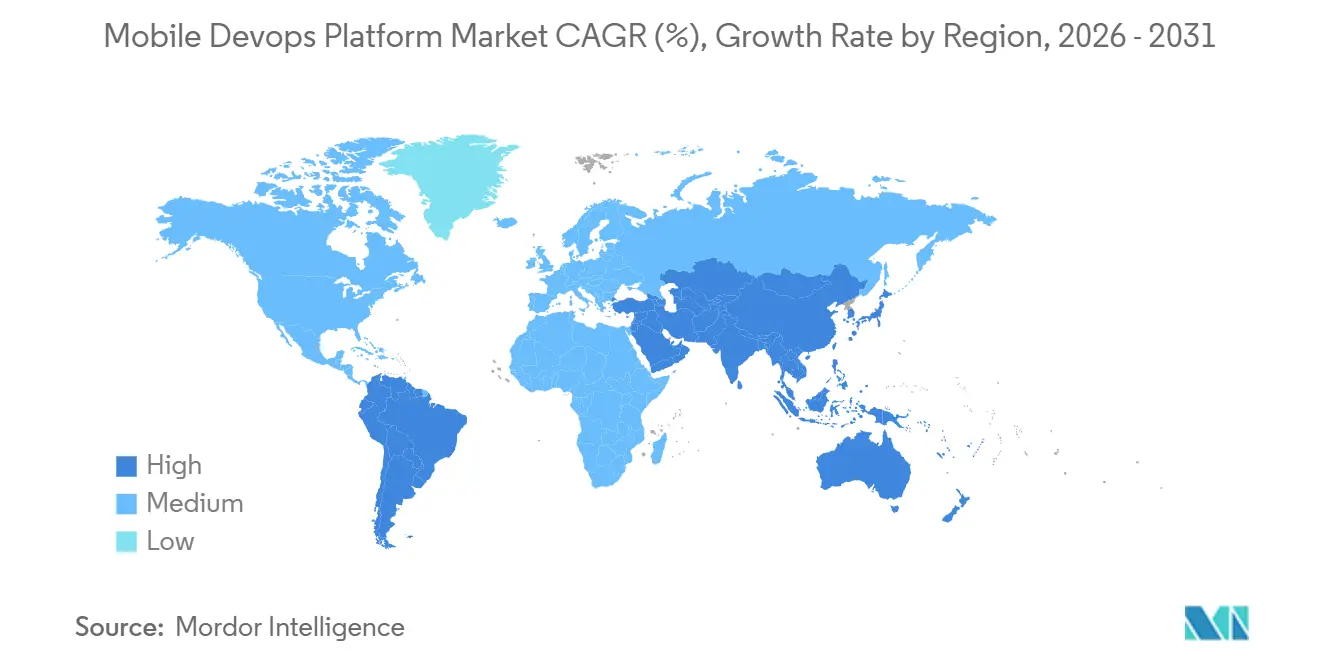
North America held 36.71% of the Mobile DevOps Platform Market share in 2025. The region benefits from a high concentration of software-focused companies, mature cloud infrastructure, and strong spending on developer tools. Many enterprises are extending basic CI/CD practices to include release management, observability, and AI-assisted pipeline functions. Canadian financial institutions and government agencies also support hybrid demand through technology risk management expectations. Large buyers can retain pricing power because spending is concentrated among a smaller group of major platform companies.
APAC Mobile DevOps Platform Market
Asia-Pacific is projected to grow at a 17.83% CAGR from 2026 to 2031, making it the fastest-growing regional area. India’s growing developer base, China’s large application platforms, and Japan’s manufacturing digitization support demand for structured engineering and release tooling. South Korea’s 5G-enabled application ecosystem contributes to demand from automotive technology and gaming users. Indonesia, Thailand, and Vietnam are developing as a regional demand cluster as digital financial services companies scale consumer applications.
EMEA and South America Mobile DevOps Platform Market
Europe is the 3rd-largest regional area, led by Germany, the United Kingdom, and France. GDPR, DORA, and the Cyber Resilience Act are making compliance a more direct part of DevOps procurement in the region. GitLab released version 19.0 in May 2026 with on-premises support for the Duo Agent Platform in air-gapped regulated environments. South America has early adoption among fintech and e-commerce companies building new mobile platforms. The Middle East and Africa have demand from digital government and fintech investment in Saudi Arabia and the United Arab Emirates, while South Africa and Nigeria represent growing mobile-first markets.

Competitive Landscape
The Mobile DevOps Platform Market is moderately consolidated among mobile-focused specialists and larger DevSecOps providers. Bitrise, Codemagic, and Appcircle serve mobile-specific needs, while Microsoft, GitLab, and Harness extend broader developer toolchains into mobile delivery. Bitrise has focused on mobile-specific build infrastructure that can operate with established developer workflows. This approach allows specialist providers to work with existing orchestration tools rather than requiring customers to replace them.
GitLab released version 19.2 in July 2026 with governed agentic automation, Security Review Flow, Dependency Scanning Auto-Remediation, and the GitLab Duo CLI. The release shows how larger platforms are incorporating AI governance into CI/CD workflows. Appcircle has also addressed the private cloud requirements of banking and fintech users with controls designed to meet GDPR and PCI DSS requirements. Halkbank replaced Azure DevOps with Appcircle and reported a 15% increase in productivity for its mobile development team. These moves show that enterprise buyers are weighing mobile specialization, security controls, and compatibility with existing development systems.
The main competitive gap remains the combination of mobile-specific pipeline functions, regulated-sector compliance controls, and AI-supported testing for device fragmentation. Sovereign cloud infrastructure and AI governance are likely to remain important selection factors for regulated enterprises. These needs favor providers that can sustain product development and infrastructure investment. The Mobile DevOps Platform Market remains open to both focused vendors and larger platforms that can meet those requirements.
Mobile DevOps Platform Industry Leaders
BrowserStack Limited
Bitrise AB
Sauce Labs Inc.
Kobiton, Inc.
Appcircle Inc.
- *Disclaimer: Major Players sorted in no particular order
Mobile DevOps Platform Market Companies Covered in this Report
- Bitrise AB
- Appcircle Inc.
- Nevercode Ltd.
- Kobiton, Inc.
- BrowserStack Limited
- Sauce Labs Inc.
- LambdaTest, Inc.
- HeadSpin, Inc.
- Perfecto Mobile, Inc.
- Applause App Quality, Inc.
- Kobiton Testing, Inc.
- Rainforest QA, Inc.
- Testlio, Inc.
- Global App Testing Limited
- Applause GmbH
- Buildkite Pty Ltd.
- Circle Internet Services, Inc.
- Harness, Inc.
- GitLab Inc.
- Atlassian Corporation Plc
- JFrog Ltd.
- CloudBees, Inc.
- Gradle Inc.
- JetBrains s.r.o.
- Embrace Mobile, Inc.
- Instabug, Inc.
- Zimperium, Inc.
- Appium

Recent Industry Developments in Mobile DevOps Platform Market
- July 2026: Bitrise launched Build Cache for React Native on July 8, 2026, cutting build times by up to 46% by caching Gradle, Xcode, and shared C++ layers in React Native workflows. The release addressed a performance bottleneck in cross-platform mobile CI/CD and reflected Bitrise’s focus on the React Native ecosystem as Flutter and React Native gained more new enterprise project starts. It cached Gradle, Xcode, and shared C++ layers, which are commonly rebuilt across related workflows. The change was intended to reduce repeated work when teams maintain several application branches, test environments, or distribution targets. This type of improvement matters in the Mobile DevOps Platform Market because build delays can limit the practical value of automated release processes. It also gives teams more time for review and testing within a release window.
- July 2026: GitLab released version 19.2 on July 16, 2026, introducing governed agentic automation, including Dependency Scanning Auto-Remediation and Security Review Flow in public beta. GitLab Duo CLI reached general availability across GitLab.com, Self-Managed, and Dedicated deployments. GitLab described the release as a response to the growing review and security work created by AI-assisted coding. The new security functions were placed inside the delivery workflow so teams could identify dependencies and review changes before production release. The update also gave organizations a path to use agent-based functions with policy controls and established approval processes. This approach reflects the need for the Mobile DevOps Platform Market to support faster code production without removing accountable review steps. It preserved a defined place for security and dependency checks in release preparation.
- June 2026: Harness launched Autonomous Worker Agents for software delivery. The agents executed testing, security, deployment, and remediation tasks with Open Policy Agent enforcement, approval gates, and audit trails. The release coincided with 62 features shipped in June 2026, including AI-generated Open Policy Agent policies, a redesigned Cloud and AI Cost Management dashboard, and thin SDKs for mobile applications and edge JavaScript environments. The thin SDKs were relevant for teams that need delivery and governance functions across applications running beyond traditional server environments. Harness also positioned the worker agents to carry out remediation under specified controls instead of operating without review. The development showed how vendors are combining automation with recordkeeping for regulated software delivery. It also connected policy generation with delivery and cost management functions.
- June 2026: Bitrise opened Remote Dev Environments in public beta on June 30, 2026. The service gave mobile engineering teams cloud-hosted macOS environments using the same Apple Silicon infrastructure as Bitrise CI builds. It allowed developers and AI agents to work in an environment aligned with production CI and reduced differences between development and build systems. The beta was designed to give developers access to cloud-hosted macOS capacity without requiring every team to manage comparable local machines. It also supported iterative work using infrastructure that matched the operating environment used for CI builds. The launch added a development-stage capability to Bitrise’s existing build and release tooling. The service linked developer activity more closely to the later CI environment.


Global Mobile DevOps Platform Market Report Scope
The mobile DevOps platform market refers to the ecosystem of software solutions and associated services designed to automate, integrate, and streamline the entire mobile application development lifecycle from initial coding and building to testing, deployment, and ongoing performance monitoring. These platforms provide essential capabilities such as continuous integration and continuous delivery (CI/CD), automated testing across real devices and simulators, release orchestration, and real-time application performance management (APM). They support a variety of development frameworks, including native iOS and Android environments, cross-platform tools, and progressive web applications (PWAs). Deployed via cloud, hybrid, or on-premises models, mobile DevOps platforms cater to organizations of all sizes across diverse industries, including IT, BFSI, healthcare, and retail. By breaking down silos between development, quality assurance, and operations teams, these platforms enable businesses to accelerate time-to-market, ensure consistent app quality and security across fragmented mobile ecosystems, reduce manual overhead, and rapidly iterate based on user feedback.
The Mobile DevOps Platform Market Report is Segmented by Component (Software, and Services), Deployment Model (Cloud, Hybrid, and On-Premises), Enterprise Size (Large Enterprises, and Small and Medium-Sized Enterprises), Development Framework (Native iOS Development, Native Android Development, Cross-platform Development, and Progressive Web Applications), End User (IT and Telecommunication, BFSI, Automotive and Transportation, Healthcare and Life Sciences, Retail and E-Commerce, Industrial Manufacturing, Education and Research Institutions, Government and Administration, Energy and Utilities, and Other End-Users), and Geography (North America, South America, Europe, Asia-Pacific, and Middle East and Africa). The Market Forecasts are Provided in Terms of Value (USD).
| Software |
| Services |
| Cloud |
| Hybrid |
| On-Premises |
| Large Enterprises |
| Small and Medium-Sized Enterprises |
| Native iOS Development |
| Native Android Development |
| Cross-platform Development |
| Progressive Web Applications |
| IT and Telecommunication |
| BFSI |
| Automotive and Transportation |
| Healthcare and Life Sciences |
| Retail and E-Commerce |
| Industrial Manufacturing |
| Education and Research Institutions |
| Government and Administration |
| Energy and Utilities |
| Other End Users |
| North America | United States | |
| Canada | ||
| Mexico | ||
| South America | Brazil | |
| Argentina | ||
| Rest of South America | ||
| Europe | Germany | |
| United Kingdom | ||
| France | ||
| Russia | ||
| Spain | ||
| Rest of Europe | ||
| Asia-Pacific | China | |
| Japan | ||
| India | ||
| South Korea | ||
| Southeast Asia | ||
| Rest of Asia-Pacific | ||
| Middle East and Africa | Middle East | Saudi Arabia |
| United Arab Emirates | ||
| Rest of Middle East | ||
| Africa | South Africa | |
| Nigeria | ||
| Rest of Africa | ||
| By Component | Software | ||
| Services | |||
| By Deployment Model | Cloud | ||
| Hybrid | |||
| On-Premises | |||
| By Enterprise Size | Large Enterprises | ||
| Small and Medium-Sized Enterprises | |||
| By Development Framework | Native iOS Development | ||
| Native Android Development | |||
| Cross-platform Development | |||
| Progressive Web Applications | |||
| By End User | IT and Telecommunication | ||
| BFSI | |||
| Automotive and Transportation | |||
| Healthcare and Life Sciences | |||
| Retail and E-Commerce | |||
| Industrial Manufacturing | |||
| Education and Research Institutions | |||
| Government and Administration | |||
| Energy and Utilities | |||
| Other End Users | |||
| By Geography | North America | United States | |
| Canada | |||
| Mexico | |||
| South America | Brazil | ||
| Argentina | |||
| Rest of South America | |||
| Europe | Germany | ||
| United Kingdom | |||
| France | |||
| Russia | |||
| Spain | |||
| Rest of Europe | |||
| Asia-Pacific | China | ||
| Japan | |||
| India | |||
| South Korea | |||
| Southeast Asia | |||
| Rest of Asia-Pacific | |||
| Middle East and Africa | Middle East | Saudi Arabia | |
| United Arab Emirates | |||
| Rest of Middle East | |||
| Africa | South Africa | ||
| Nigeria | |||
| Rest of Africa | |||


Key Questions Answered in the Report
What is the size of the Mobile DevOps Platform Market?
The Mobile DevOps Platform Market was valued at USD 2.43 billion in 2025, is estimated at USD 2.68 billion in 2026, and is forecast to reach USD 4.99 billion by 2031 at a 13.24% CAGR.
Which component leads mobile DevOps platform revenue?
Software led with a 72.41% share in 2025, while services are projected to grow faster at a 16.82% CAGR through 2031.
Which deployment model is growing fastest for mobile delivery platforms?
Hybrid deployment is projected to grow at a 15.43% CAGR through 2031 as regulated organizations combine cloud capacity with on-premises controls.
Which organizations are adopting these platforms fastest?
Small and medium-sized enterprises are projected to expand at a 17.24% CAGR through 2031 as flexible pricing and guided configuration reduce adoption barriers.
Which development framework has the highest projected growth?
Progressive web applications are projected to grow at an 18.91% CAGR through 2031, supported by improving browser capabilities and lower development demands.
Which end-user sector has the fastest projected growth?
Healthcare and life sciences are projected to grow at a 16.47% CAGR through 2031 because mobile releases require stronger documentation and compliance controls.
Page last updated on:


 Your data is secure and never sold or shared.


