
Managed DDoS and Threat Prevention Services Market Size and Share
Market Overview
| Study Period | 2021 - 2032 |
|---|---|
| Market Size (2027) | USD 3.53 Billion |
| Market Size (2032) | USD 7.63 Billion |
| Growth Rate (2027 - 2032) | 16.71 % |
| Fastest Growing Market | Asia-Pacific |
| Largest Market | North America |
| Market Concentration | Medium |
Major Players *Disclaimer: Major Players sorted in no particular order Image © Mordor Intelligence. Reuse requires attribution under CC BY 4.0. | |
Managed DDoS and Threat Prevention Services Market Analysis by Mordor Intelligence
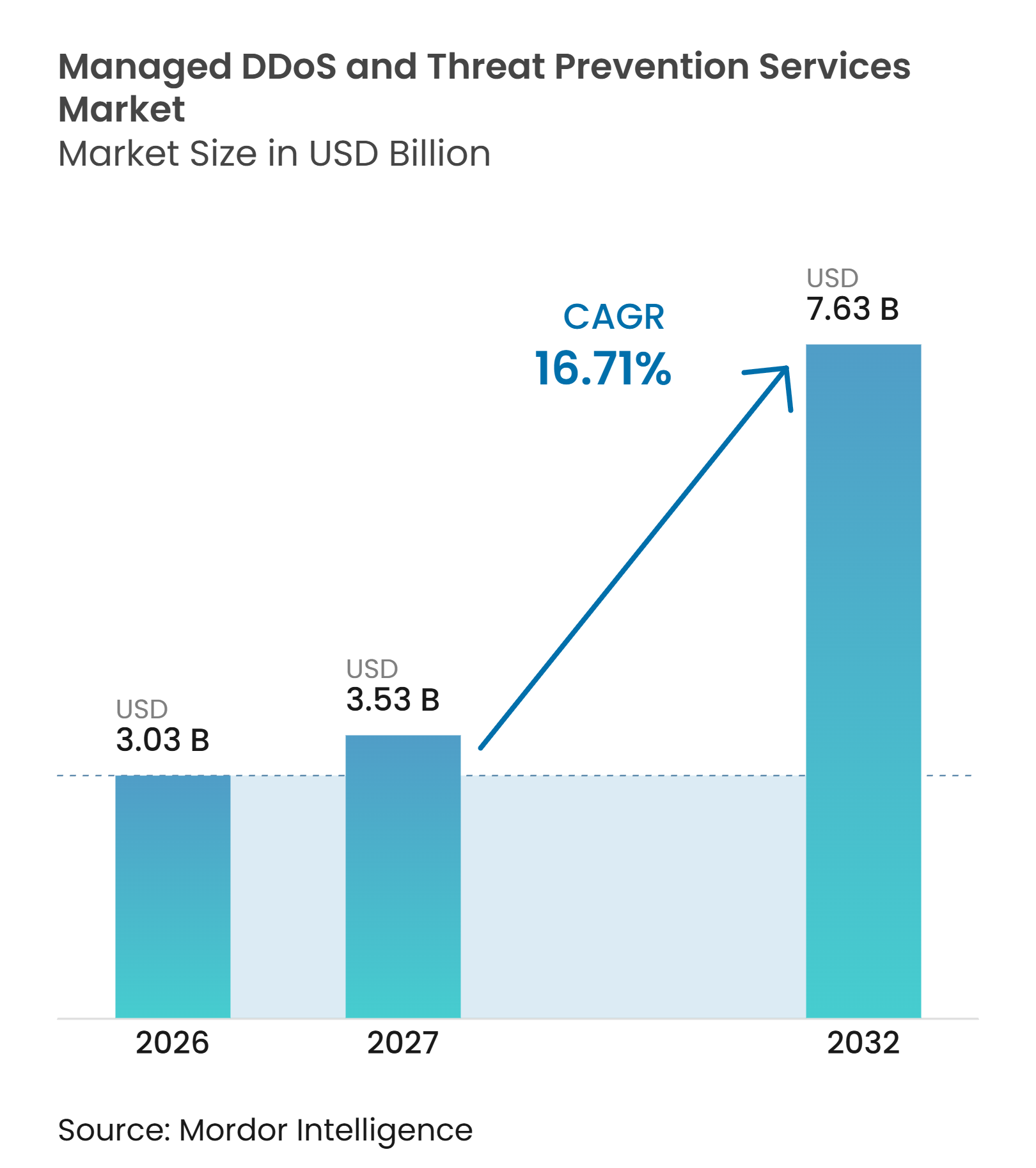
The managed DDoS and threat prevention services market size is projected to expand from USD 3.03 billion in 2026 to USD 3.53 billion in 2027, and to USD 7.63 billion by 2032, registering a CAGR of 16.71% between 2027 and 2032. The managed DDoS and threat prevention services market is growing as enterprises shift their security spending toward continuous external protection that can respond at a network scale. Higher attack volumes are making periodic equipment upgrades less effective for organizations that operate public applications, APIs, and critical services. Cloud adoption is also expanding the number of entry points that security teams must protect across distributed environments. Skills shortages and stricter availability requirements are encouraging buyers to use providers that combine capacity, monitoring, and response support. Providers are responding by combining DDoS protection with application, API, and bot defenses, while carriers and managed service providers create additional routes to market.
Key Report Takeaways
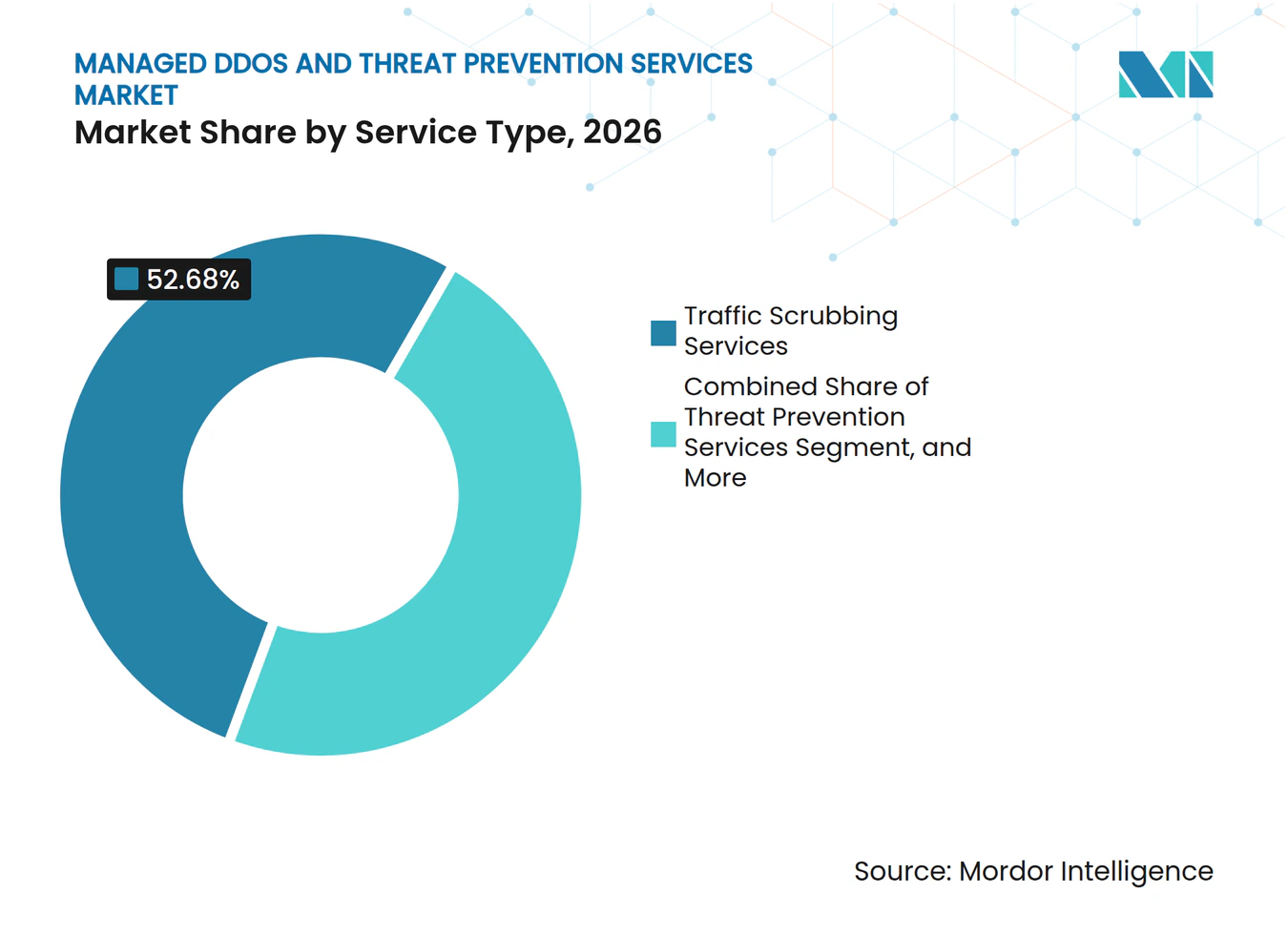
- By service type, Traffic Scrubbing Services held 52.68% of the managed DDoS and threat prevention services market share in 2026, while Threat Prevention Services is projected to expand at a 17.78% CAGR through 2032.
- By deployment mode, On-Premises accounted for 66.81% of the managed DDoS and threat prevention services market revenue in 2026, while Cloud is projected to grow at an 18.07% CAGR through 2032.
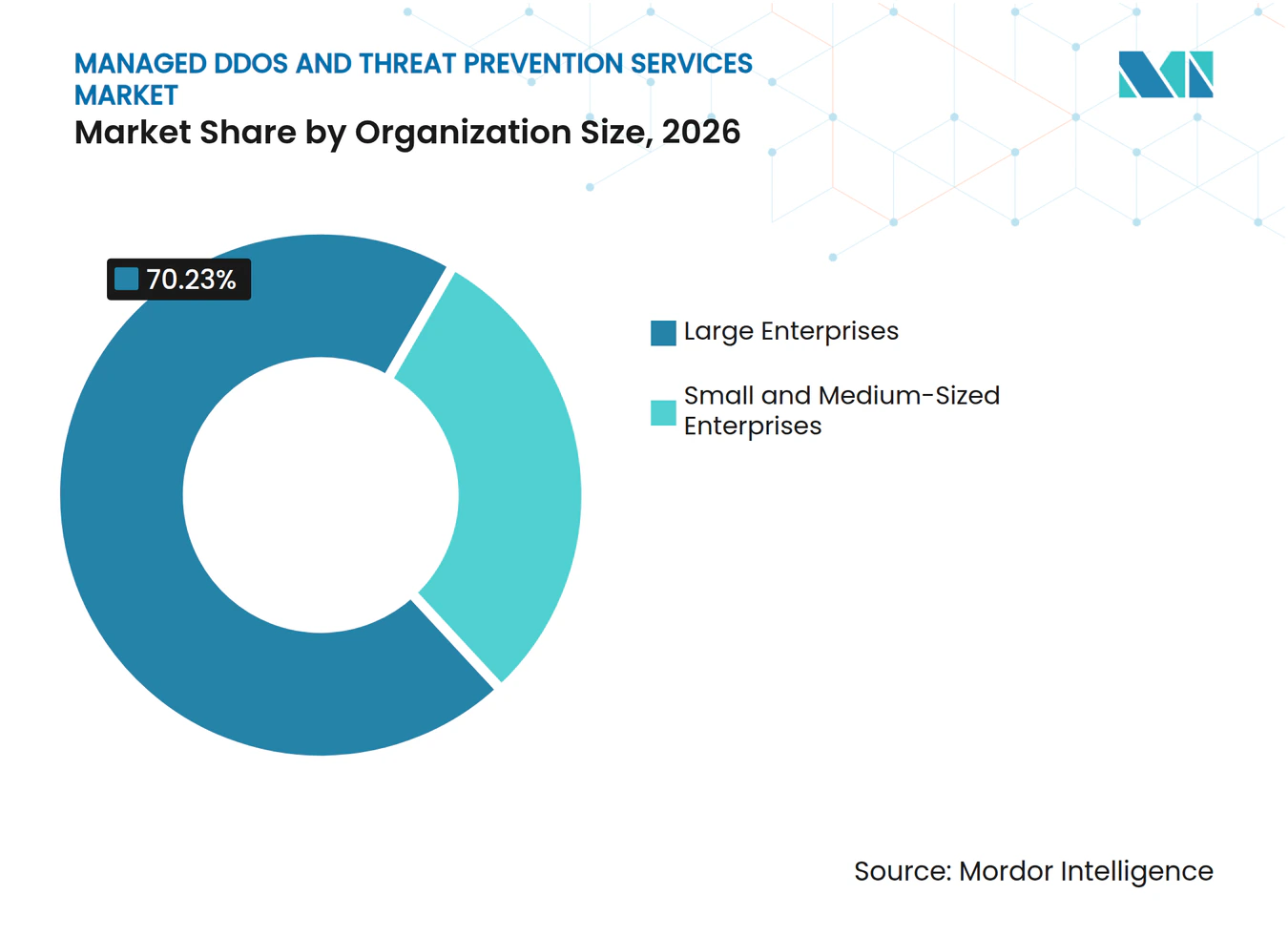
- By organization size, Large Enterprises accounted for 70.23% of the managed DDoS and threat prevention services market revenue in 2026, while Small and Medium-Sized Enterprises are expected to advance at an 18.39% CAGR through 2032.
- By end-user industry, BFSI accounted for 29.16% of managed DDoS and threat prevention services market revenue, while Government and Public Administration is projected to grow at a 17.05% CAGR through 2032.
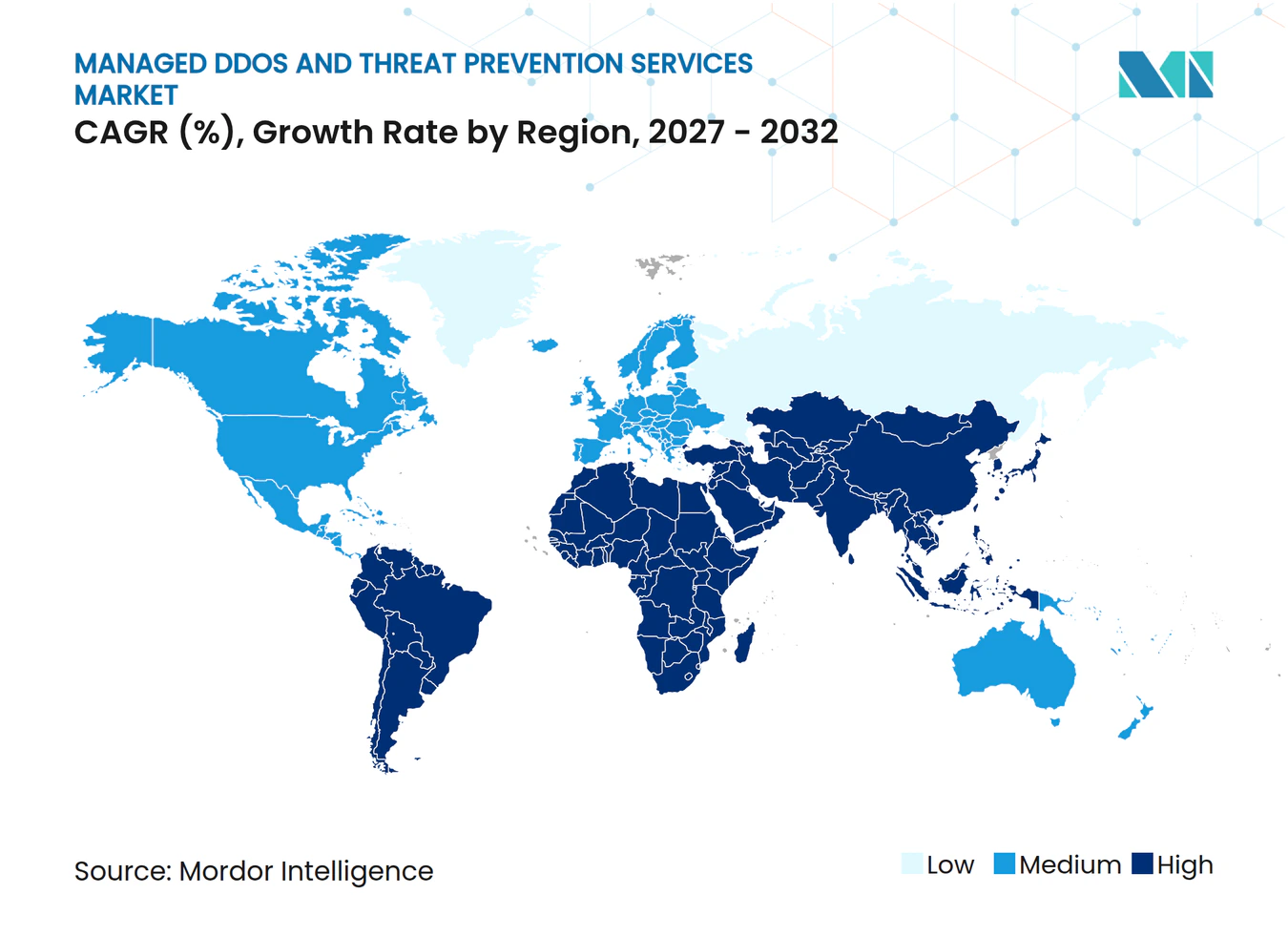
- By geography, North America held 36.44% of the managed DDoS and threat prevention services market revenue, while Asia-Pacific is forecast to expand at a 17.34% CAGR through 2032.
Note: Market numbers in this report are based on Mordor Intelligence's proprietary estimation framework, which combines nine months of actuals with Q4 projections for base year 2026.
Market Trends and Insights
Drivers Impact Analysis of Managed DDoS and Threat Prevention Services Market*
| Driver | (~) % Impact on CAGR Forecast | Geographic Relevance | Impact Timeline |
|---|---|---|---|
| Increasing Frequency and Sophistication of Multi-Vector Attacks | +3.8% | Global, most intense in EMEA and APAC | Short term (≤ 2 years) |
| Cloud Migration and Expansion of Internet-Facing Attack Surfaces | +3.2% | Global, led by North America and Western Europe | Medium term (2-4 years) |
| Shortage of In-House Cybersecurity Skills | +2.5% | Global, acutest in APAC and South America | Medium term (2-4 years) |
| Regulatory and Critical-Infrastructure Availability Requirements | +2.1% | North America, EU, and core APAC markets | Medium term (2-4 years) |
| Subscription-Based Access to Terabit-Scale Mitigation Capacity | +1.8% | Global, with SME adoption led by North America and Western Europe | Long term (≥ 4 years) |
| Carrier and Hosting Provider Monetization of Managed DDoS Services | +1.4% | Asia-Pacific and North America, with early spillover to the Middle East and Africa | Long term (≥ 4 years) |
| Source: Mordor Intelligence | |||
Increasing Frequency and Sophistication of Multi-Vector Attacks
The managed DDoS and threat prevention services market is supported by a threat environment that is becoming more frequent and more difficult to contain with internal resources alone. NETSCOUT documented 9.1 million DDoS attacks across 209 countries in the first half of 2026. Attacks exceeding 1 Tbps or 1 Gpps increased by 1,286% year over year, placing pressure on organizations that rely on fixed capacity and scheduled appliance upgrades. NETSCOUT also reported that DDoS-for-hire operators used large language models as operational tools to coordinate campaigns across the DNS, application, and network layers.[1] Cloudflare reported that the Aisuru-Kimwolf botnet generated a 31.4 Tbps attack in the fourth quarter of 2025, demonstrating the scale that always-on edge capacity may need to absorb. Direct-path and carpet-bombing methods accounted for nearly two-thirds of observed attacks in the first half of 2026, underscoring the need for continuous monitoring and prevention alongside traffic scrubbing.
Cloud Migration and Expansion of Internet-Facing Attack Surfaces
The managed DDoS and threat prevention services market is also benefiting from the growing number of public-facing components in cloud and hybrid environments. Distributed workloads expose APIs, cloud interconnects, and containerized applications that cannot be protected by one on-premises device at every network edge. Financial services data from Akamai showed that Layer 3 and Layer 4 DDoS attack duration increased 738% from 2024 to 2025, creating longer exposure periods for organizations with distributed architectures. Cloudflare identified generative AI service providers as one of the most targeted infrastructure categories in the fourth quarter of 2025, connecting the growth of AI workloads with a changing attack surface. The managed DDoS and threat prevention services industry benefits when a provider can manage traffic protection across cloud and on-premises environments under a single operating model. Cloud providers are also becoming distribution partners by incorporating DDoS coverage into network services, thereby extending access beyond enterprise direct sales channels.
Shortage of In-House Cybersecurity Skills
The managed DDoS and threat prevention services market has additional demand due to the shortage of specialists who can analyze and tune network-layer defenses in real time. ISC2 found that 95% of surveyed organizations had at least 1 cybersecurity skills gap in 2025. The same study reported that 59% of respondents considered their gaps critical or significant, compared with 44% in 2024. ISACA reported that 65% of organizations had unfilled cybersecurity positions and that training non-security personnel for security roles fell to 29% from 41% in the prior year. This gap is most relevant to the capabilities offered by managed providers, including network analysis, mitigation tuning, and application-layer anomaly detection. ISC2 also found that 19% of organizations used third-party service providers as their primary response to competency gaps, linking workforce limitations to the purchase of managed services.
Regulatory and Critical-Infrastructure Availability Requirements
The managed DDoS and threat prevention services market is gaining support from requirements that treat availability failures as regulatory events rather than only technology incidents. The Federal Reserve stated in July 2025 that banking organizations must notify their primary regulator within 36 hours of determining that a significant computer security incident has occurred. This requirement places additional value on monitored response processes and incident documentation. The Financial Stability Board published the Format for Incident Reporting Exchange in April 2025, providing a common incident-reporting format for financial authorities and firms. Singapore's requirements for IP interconnection identify DDoS mitigation as a baseline network security expectation for licensed operators. India also requires reporting of specified cyber incidents, including DDoS attacks, within 6 hours, which supports the demand for always-on monitoring to maintain usable incident records.
Restraints Impact Analysis of Managed DDoS and Threat Prevention Services Market*
| Restraint | (~) % Impact on CAGR Forecast | Geographic Relevance | Impact Timeline |
|---|---|---|---|
| High Cost of Global Scrubbing Capacity and Premium Service-Level Agreements | -2.8% | Global, most acute in cost-sensitive SME segments in APAC and South America | Short term (≤ 2 years) |
| Complexity of Coordinating Protection Across Multi-Cloud and Hybrid Architectures | -2.1% | Global, most intense in North America and Europe where multi-cloud adoption is highest | Medium term (2-4 years) |
| False Positives and Latency Risk in Application-Layer Mitigation | -1.6% | Global, concentrated in latency-sensitive sectors including financial services and gaming | Medium term (2-4 years) |
| Customer Reluctance to Share Traffic Telemetry and Route Traffic Through Third Parties | -1.3% | Global, intensified in regulated industries and data-sovereignty markets | Long term (≥ 4 years) |
| Source: Mordor Intelligence | |||
High Cost of Global Scrubbing Capacity and Premium Service-Level Agreements
The cost of global scrubbing infrastructure and 24/7 security operations limits how quickly the managed DDoS and threat prevention services market can reach price-sensitive buyers. Premium service-level agreements require reserved capacity that providers cannot always share when several customers experience attacks at the same time. NETSCOUT recorded 8.09 million attacks during the second half of 2025, illustrating the scale of demand that providers may need to support during active periods. Providers can offer shared and dedicated capacity tiers, but the difference between entry-level coverage and enterprise commitments remains material for many smaller customers. This constraint is especially relevant in South America, Southeast Asia, and Africa, where budgets can be less able to absorb premium contracts. The managed DDoS and threat prevention services market must balance broad access with the investment needed to sustain high-capacity protection.
Complexity of Coordinating Protection Across Multi-Cloud and Hybrid Architectures
The managed DDoS and threat prevention services market also faces longer deployment and procurement cycles when organizations run a mix of data centers and cloud platforms. Cloud providers use different approaches for traffic steering, IP anycast, and scrubbing interfaces, which requires service providers to maintain multiple connectors. Radware described a top-10 global SaaS provider that replaced separate on-premises and cloud DDoS vendors with a single hybrid design after the earlier arrangement failed to provide coherent protection across its distributed environment. The Federal Reserve also listed cloud resilience as a dedicated cybersecurity priority for 2025, recognizing that cloud configurations require controls that go beyond traditional internal standards. These integration requirements increase the technical work before a contract becomes active. They also favor providers that can support hybrid traffic management without creating extra latency or operational complexity.
*Our forecasts treat driver/restraint impacts as directional, not additive. The impact forecasts reflect baseline growth, mix effects, and variable interactions.
Managed DDoS and Threat Prevention Services Market Segment Analysis
By Service Type:
Traffic Scrubbing Anchors Revenue as Threat Prevention AcceleratesTraffic Scrubbing Services commanded 52.68% of the managed DDoS and threat prevention services market share in 2026, reflecting the central role of redirecting malicious traffic before it reaches customer systems. The service relies on capacity, carrier relationships, and traffic-routing capabilities that established providers have developed over many years. It remains the foundation of many defense arrangements because volumetric attacks can require fast diversion of large traffic flows. DDoS Monitoring Services add visibility by identifying anomalies, documenting activity, and helping security teams assess whether a response is needed. Incident Response Services provide a structured process for activating mitigation, coordinating technical teams, and preserving records for compliance reviews. Other services include red-team exercises, configuration assessments, and service-level agreement validation for organizations that want to test the effectiveness of existing protection.
Threat Prevention Services is projected to record a 17.78% CAGR from 2027 to 2032, the highest rate within this service grouping. The managed DDoS and threat prevention services market size for prevention-led services is driven by demand for behavioral analysis to identify attacks before volumes reach disruptive levels. NETSCOUT reported that direct-path attacks accounted for nearly two-thirds of observed events in the first half of 2026, making upstream intelligence more important when link saturation is not the primary mechanism of disruption. Akamai added a machine-learning behavioral DDoS engine to App and API Protector in April 2025, reflecting the shift toward prevention capabilities inside broader security services. The distinction between prevention and monitoring is becoming less clear as correlation tools bring both functions under one managed agreement. This approach gives buyers a path to combine detection, analysis, and response without managing several separate providers.



By Deployment Mode:
On-Premises Leads as Cloud Reshapes Buying PatternsOn-Premises deployment accounted for 66.81% of 2026 revenue, driven by the requirements of service providers, financial institutions, and government agencies that need in-network traffic control. The managed DDoS and threat prevention services market share for this mode reflects buyer preference for data sovereignty and consistent response times. Routing traffic to a distant scrubbing center can introduce latency that is unacceptable for carrier operations and tightly controlled services. In-path equipment can therefore remain necessary where service-level commitments require local mitigation. Corero reported a 96% renewal rate for its multi-year, subscription-based DDoS Protection as-a-Service products through the first half of 2026. These renewals show that on-premises managed contracts can remain durable after they become part of a customer’s network design.
Cloud deployment is projected to grow at an 18.07% CAGR from 2027 to 2032, driven by lower upfront infrastructure requirements and elastic capacity during high-volume events. This option aligns with organizations that run cloud-first applications and prefer recurring operating expenses to capital purchases. It also provides a simpler way for smaller organizations to access capacity that would be difficult to build internally. Corero enabled SmartWall ONE orchestration to operate on Akamai Compute in July 2025, allowing the control plane to run in the cloud while inline mitigation remains on-premises.[2] This design reflects how hybrid deployments can retain local precision while using cloud-based management. As subscription models and cloud billing integrations develop, some revenue that is now counted as on-premises may shift toward cloud classifications.
By Organization Size:
Large Enterprises Dominate as SMEs Close the GapLarge Enterprises accounted for 70.23% of 2026 revenue because they operate broad public application portfolios and complex technology environments. Their exposure includes large customer bases, regulatory obligations, and the potential cost of a prolonged service outage. These buyers can also fund multi-year protection programs and require continuous coverage across locations. Radware reported an eight-digit contract with a North American government IT services agency that replaced an incumbent on-premises DDoS provider in 2025. Such contracts show how large organizations assess service quality, integration, and replacement risk over long operating periods. The managed DDoS and threat prevention services market continues to depend on these buyers for high-value, complex deployments.
Small and Medium-Sized Enterprises are projected to record an 18.39% CAGR from 2027 to 2032, the fastest rate by organization size. Subscription tiers reduce the need for these organizations to purchase and maintain dedicated mitigation equipment. In 2025, ISC2 found that 70% of respondents at small organizations had experienced at least 1 AI-related security incident during the preceding 12 months. These organizations often lack the internal specialists needed to monitor unusual network behavior or to tune mitigation controls. Radware signed agreements with 4 U.S.-based managed service providers in July 2025 to offer Cloud Application Protection Services and Cloud DDoS Protection to customers in healthcare, finance, government, and technology. Channel-led delivery can lower customer acquisition costs and make managed protection easier for smaller customers to buy.

By End-User Industry:
BFSI Leads Spending as Government Demand SurgesBFSI held 29.16% of 2026 revenue, making it the largest end-user category in the managed DDoS and threat prevention services market. Banks and insurers handle high volumes of customer-facing activity, payment processing, and API traffic, which raises the operational cost of disruption. Akamai reported that banking accounted for 83% of API endpoint attacks in 2025 and that the maximum volumetric DDoS scale affecting financial institutions rose by 236% from 2024 to 2025. Sweden's central bank stated that even brief DDoS-related outages at payment systems can carry implications beyond the institution directly targeted. IT and telecommunications, healthcare and life sciences, energy and utilities, retail, and e-commerce also purchase protection based on their individual service availability and regulatory needs.
Government and Public Administration is projected to expand at a 17.05% CAGR from 2027 to 2032. Public agencies have become recurring targets of hacktivist campaigns seeking to disrupt public services or create political pressure. NETSCOUT identified government agencies as a high-concentration target category in its second-half 2025 assessment and cited persistent activity by groups including NoName057(16). The Philippine Department of Energy issued a procurement material for a DDoS protection solution, including maintenance and support services, in 2026. Industrial manufacturing remains less served because operational technology environments may not provide the telemetry needed to establish behavioral baselines. This leaves an opening as connected manufacturing systems increase their public and partner-facing interfaces.
Geography Analysis
North America Managed DDoS and Threat Prevention Services Market
North America held 36.44% of 2026 revenue, making it the largest regional contributor to the managed DDoS and threat prevention services market. The region combines regulated financial institutions, federal agencies, and large technology companies with demanding service-level commitments. The Federal Reserve's 36-hour notification requirement for material incidents increases the value of providers that can combine mitigation with reporting records. Cloudflare reported USD 2,167.9 million in 2025 revenue, up 30% year over year, while Radware reported USD 301.9 million in 2025 revenue. These results reflect the commercial maturity of security platforms serving enterprise and public-sector buyers.
North America and EMEA Managed DDoS and Threat Prevention Services Market
Canada adds to regional demand as critical infrastructure requirements encourage utilities and financial institutions to maintain reliable service availability. The managed DDoS and threat prevention services market in North America includes global platform operators, specialist providers, and managed service providers focused on smaller healthcare and government customers. Europe has a divided profile, with mature Western economies responding to wider security obligations and Eastern markets experiencing persistent hacktivist activity. Corero secured a 5-year managed services contract with a U.K. Tier-1 telecommunications provider in September 2026, citing the customer's preparation for the Cyber Security and Resilience Bill. NETSCOUT recorded 3.33 million DDoS attacks in EMEA during the second half of 2025, the highest concentration of any region during that period.
APAC, MEA and South America Managed DDoS and Threat Prevention Services Market
Asia-Pacific is projected to grow at a 17.34% CAGR from 2027 to 2032, the fastest regional rate. NETSCOUT recorded 1.9 million attacks in Asia-Pacific during the second half of 2025. Cloudflare ranked Hong Kong as the second-most-targeted location globally in the fourth quarter of 2025, and India ninth.[3] Singapore’s network security requirements and the active expansion of digital infrastructure across the region support demand for managed mitigation. South America, the Middle East, and Africa remain earlier-stage areas, with Brazil, Saudi Arabia, the United Arab Emirates, Nigeria, and South Africa showing government or enterprise activity that can support future adoption.
Competitive Landscape
Market Concentration
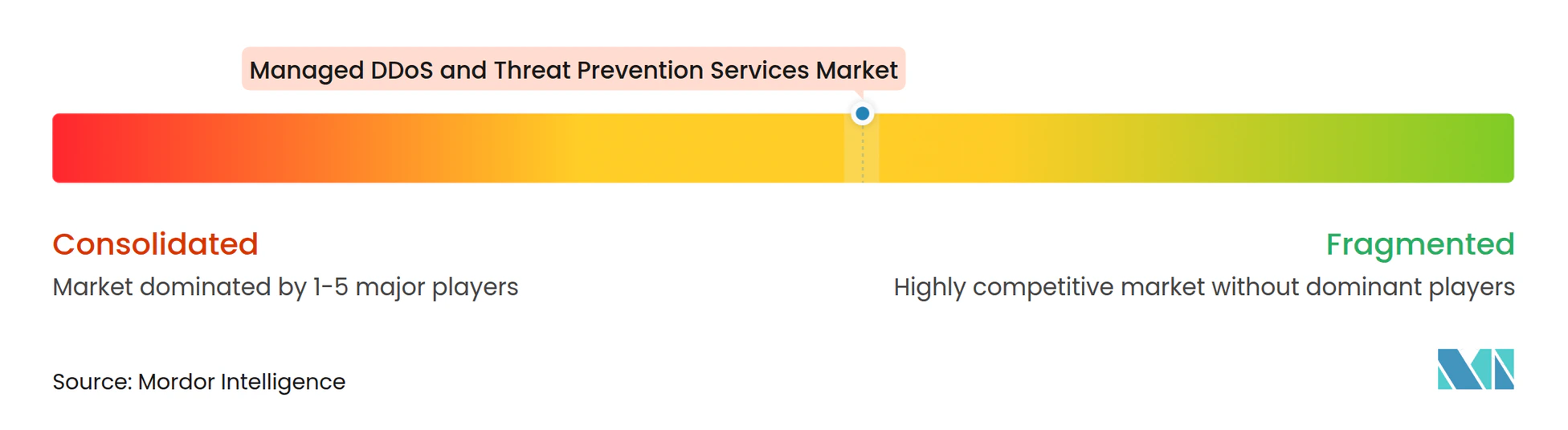
The managed DDoS and threat prevention services market is moderately consolidated among platform providers and fragmented among regional and specialist firms. Akamai, Cloudflare, and NETSCOUT compete with broad networks and portfolios that include application, API, and bot security capabilities. Cloudflare reported USD 2,167.9 million in revenue for 2025, while NETSCOUT set fiscal 2026 revenue guidance of USD 830 million to USD 870 million. Radware reported a record 2025 revenue of USD 301.9 million and 23% annual recurring revenue growth in the cloud. The leading firms seek to build multi-product customer relationships that increase switching costs and reduce reliance on stand-alone DDoS contracts.
Akamai launched App and API Protector Hybrid in April 2025, extending unified policy management across multicloud and on-premises environments.[4] Radware acquired Pynt in January 2026 to add API security testing capabilities to identify vulnerabilities before they are exploited in application-layer attacks. These moves reflect a competitive focus on combining mitigation with wider application security functions. Regulatory requirements also make documentation, audit trails, and incident-reporting templates important elements in provider selection. The managed DDoS and threat prevention services market favors vendors that can demonstrate both mitigation capacity and clear response procedures. This can be particularly important in finance, telecommunications, and public administration.
Corero, Nexusguard, Link11, Haltdos, and Indusface compete through latency performance, local data handling, and cloud-native deployment options. Corero reported a 96% renewal rate through the first half of 2026 and cited its alliance with Akamai as a way to pair specialized protection with a broader platform. Cloudflare expanded its channel program in 2025, including a partnership with Rakuten Mobile in Japan, while Radware has leveraged relationships with managed service providers and carriers to extend its reach. Carrier partnerships can provide established billing, routing, and customer relationships without the same level of direct-sales expense. Industrial and operational technology environments remain underserved because providers must work around limited telemetry and specialized network designs.
Managed DDoS and Threat Prevention Services Industry Leaders
-
Akamai Technologies, Inc.
-
Cloudflare, Inc.
-
NETSCOUT Systems, Inc.
-
Corero Network Security plc
-
Nexusguard Limited
- *Disclaimer: Major Players sorted in no particular order
Managed DDoS and Threat Prevention Services Market Companies Covered in this Report
- Akamai Technologies, Inc.
- Cloudflare, Inc.
- NETSCOUT Systems, Inc.
- Radware Ltd.
- Corero Network Security plc
- Nexusguard Limited
- Link11 GmbH
- NSFOCUS Technologies Group Co., Ltd.
- StormWall s. r. o.
- IQWeb FZ-LLC (DDoS-Guard)
- Qrator Labs
- Haltdos Private Limited
- MazeBolt Technologies Ltd.
- Indusface Private Limited
- Mlytics Inc.
- RioRey, Incorporated
- Redge Technologies sp. z o.o.
- FastNetMon LTD
- ThreatX (A10 Networks, Inc.)
- DOSarrest Internet Security Limited
Recent Industry Developments in Managed DDoS and Threat Prevention Services Market
- October 2026: NETSCOUT released its 1H 2026 DDoS Threat Intelligence Report documenting 9.1 million attacks globally in January-June 2026, with high-capacity events exceeding 1 Tbps or 1 Gpps surging 1,286% year over year. The report identified direct-path and carpet-bombing methods as the dominant vectors, shifting the defensive architecture required to maintain availability without link saturation.
- October 2026: Corero Network Security secured a 5-year managed services contract worth USD 3.4 million with a U.K. Tier-1 fixed and mobile telecommunications provider, deploying SmartWall ONE and CORE Platform with Layer 7 TLS capabilities. The customer cited preparation for the U.K.'s Cyber Security and Resilience Bill as a procurement rationale.
- July 2026: Radware introduced a cloud-augmented architecture for DefensePro X that combines local traffic inspection with AI-powered cloud algorithms, and an associated Web DDoS Defense capability that decrypts traffic locally while sending only non-sensitive metadata to the cloud, addressing customer concerns about TLS key exposure under cloud-based mitigation models.
- January 2026: Radware acquired Pynt Inc., an API security testing company, strengthening its platform's ability to identify and remediate API vulnerabilities before they can be exploited in application-layer DDoS campaigns, reflecting the convergence of the threat surfaces of API abuse and volumetric DDoS.
Global Managed DDoS and Threat Prevention Services Market Report Scope
The Managed DDoS and Threat Prevention Services Market comprises outsourced security services that continuously monitor, detect, analyze, mitigate, and prevent distributed denial-of-service attacks and related network, application-layer, and infrastructure threats across enterprise environments. These services include traffic scrubbing, DDoS monitoring, threat prevention, incident response, and related mitigation services delivered through cloud-based or on-premises security operations. The market includes managed services, consulting, deployment, integration, support, maintenance, and continuous threat mitigation operations.
The Managed DDoS and Threat Prevention Services Market Report is Segmented by Service Type (Traffic Scrubbing Services, DDoS Monitoring Services, Threat Prevention Services, Incident Response Services, and Other Service Types), Deployment Mode (On-Premises, and Cloud), Organization Size (Large Enterprises, and Small and Medium-Sized Enterprises), End-User Industry (Banking, Financial Services, and Insurance [BFSI], Government and Public Administration, Healthcare and Life Sciences, IT and Telecommunication, Industrial Manufacturing, Retail and E-commerce, Energy and Utilities, and Other End-User Industries), and Geography (North America, South America, Europe, Asia-Pacific, Middle East, and Africa). The Market Forecasts are Provided in Terms of Value (USD).
Segmentation Overview
| Traffic Scrubbing Services |
| DDoS Monitoring Services |
| Threat Prevention Services |
| Incident Response Services |
| Other Service Types |
| On-Premises |
| Cloud |
| Large Enterprises |
| Small and Medium-Sized Enterprises |
| Banking, Financial Services, and Insurance (BFSI) |
| Government and Public Administration |
| Healthcare and Life Sciences |
| IT and Telecommunication |
| Industrial Manufacturing |
| Retail and E-commerce |
| Energy and Utilities |
| Other End-User Industries |
| North America | United States |
| Canada | |
| Mexico | |
| South America | Brazil |
| Argentina | |
| Rest of South America | |
| Europe | Germany |
| United Kingdom | |
| France | |
| Italy | |
| Russia | |
| Rest of Europe | |
| Asia-Pacific | China |
| Japan | |
| India | |
| South Korea | |
| Rest of Asia-Pacific | |
| Middle East | Saudi Arabia |
| United Arab Emirates | |
| Rest of Middle East | |
| Africa | South Africa |
| Nigeria | |
| Rest of Africa |
| By Service Type | Traffic Scrubbing Services | |
| DDoS Monitoring Services | ||
| Threat Prevention Services | ||
| Incident Response Services | ||
| Other Service Types | ||
| By Deployment Mode | On-Premises | |
| Cloud | ||
| By Organization Size | Large Enterprises | |
| Small and Medium-Sized Enterprises | ||
| By End-User Industry | Banking, Financial Services, and Insurance (BFSI) | |
| Government and Public Administration | ||
| Healthcare and Life Sciences | ||
| IT and Telecommunication | ||
| Industrial Manufacturing | ||
| Retail and E-commerce | ||
| Energy and Utilities | ||
| Other End-User Industries | ||
| By Geography | North America | United States |
| Canada | ||
| Mexico | ||
| South America | Brazil | |
| Argentina | ||
| Rest of South America | ||
| Europe | Germany | |
| United Kingdom | ||
| France | ||
| Italy | ||
| Russia | ||
| Rest of Europe | ||
| Asia-Pacific | China | |
| Japan | ||
| India | ||
| South Korea | ||
| Rest of Asia-Pacific | ||
| Middle East | Saudi Arabia | |
| United Arab Emirates | ||
| Rest of Middle East | ||
| Africa | South Africa | |
| Nigeria | ||
| Rest of Africa | ||
Key Questions Answered in the Report
What is the size of the managed DDoS and threat prevention services market?
The market is projected to increase from USD 3.03 billion in 2026 and USD 3.53 billion in 2027 to USD 7.63 billion by 2032, at a 16.71% CAGR.
Which service type leads managed DDoS spending?
Traffic Scrubbing Services led with 52.68% of 2026 revenue because traffic diversion remains fundamental to containing high-volume attacks.
Which deployment model is growing fastest?
Cloud deployment is projected to grow at an 18.07% CAGR through 2032 as buyers seek elastic capacity and lower upfront infrastructure requirements.
Why are organizations using managed DDoS services?
Rising attack volumes, cloud exposure, workforce gaps, and availability requirements increase the need for continuous monitoring and response support.
Which end-user category has the largest share of spending?
BFSI held 29.16% of 2026 revenue due to the sector's high exposure to payment, customer-service, and API disruption risks.
Which region is growing fastest for managed DDoS protection?
Asia-Pacific is projected to expand at a 17.34% CAGR through 2032, supported by growing attacks, digital infrastructure investment, and security requirements.