
Managed Web Application and API Protection (WAAP) Services Market Size and Share
Market Overview
| Study Period | 2021 - 2032 |
|---|---|
| Market Size (2027) | USD 5.32 Billion |
| Market Size (2032) | USD 9.56 Billion |
| Growth Rate (2026 - 2032) | 15.65 % |
| Fastest Growing Market | Asia-Pacific |
| Largest Market | North America |
| Market Concentration | Medium |
Major Players *Disclaimer: Major Players sorted in no particular order Image © Mordor Intelligence. Reuse requires attribution under CC BY 4.0. | |
Managed Web Application and API Protection (WAAP) Services Market Analysis by Mordor Intelligence
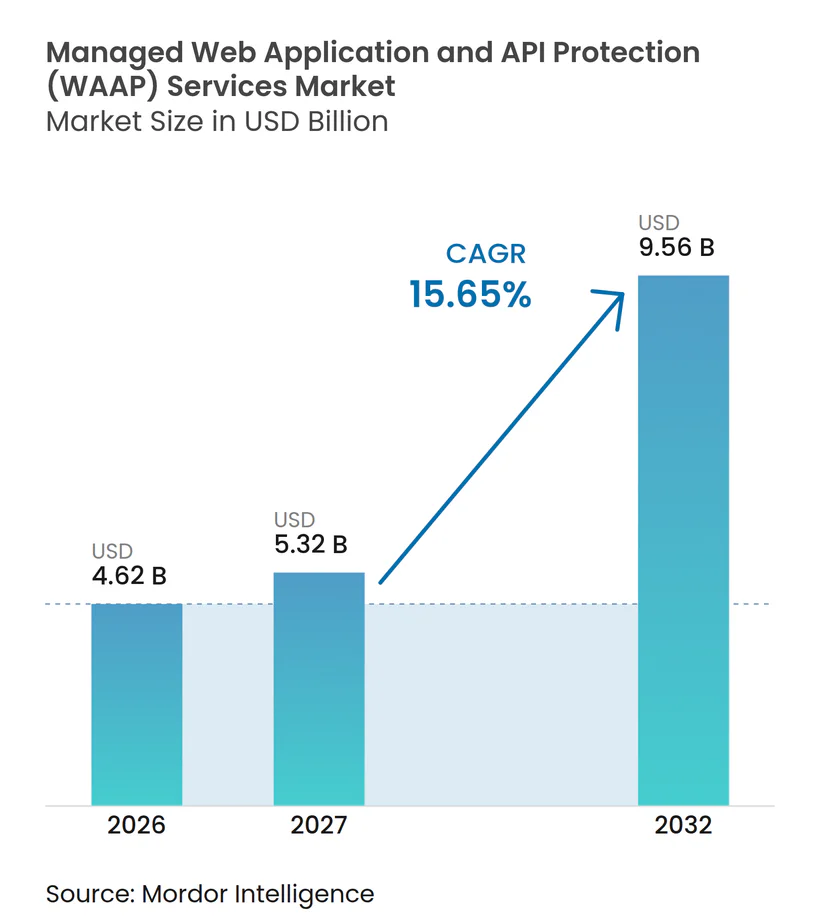
The managed Web Application and API protection (WAAP) services market size is projected to expand from USD 4.62 billion in 2026 and USD 5.32 billion in 2027 to USD 9.56 billion by 2032, registering a CAGR of 15.65% between 2027 to 2032. The managed web application and API protection (WAAP) services market is expanding as organizations place application programming interfaces, or APIs, at the center of customer services, payments, and internal digital operations. This change has shifted security spending from conventional web application firewalls to services that can identify, monitor, and protect application and API traffic. Demand also reflects the need for continuous operations coverage, because many organizations cannot maintain specialists and response teams around the clock. Providers are responding by combining web application firewall, distributed denial-of-service protection, bot management, and API security in integrated offerings. The managed web application and API protection (WAAP) services market also benefits when enterprises seek fewer security suppliers and closer integration with cloud platforms.
Key Report Takeaways
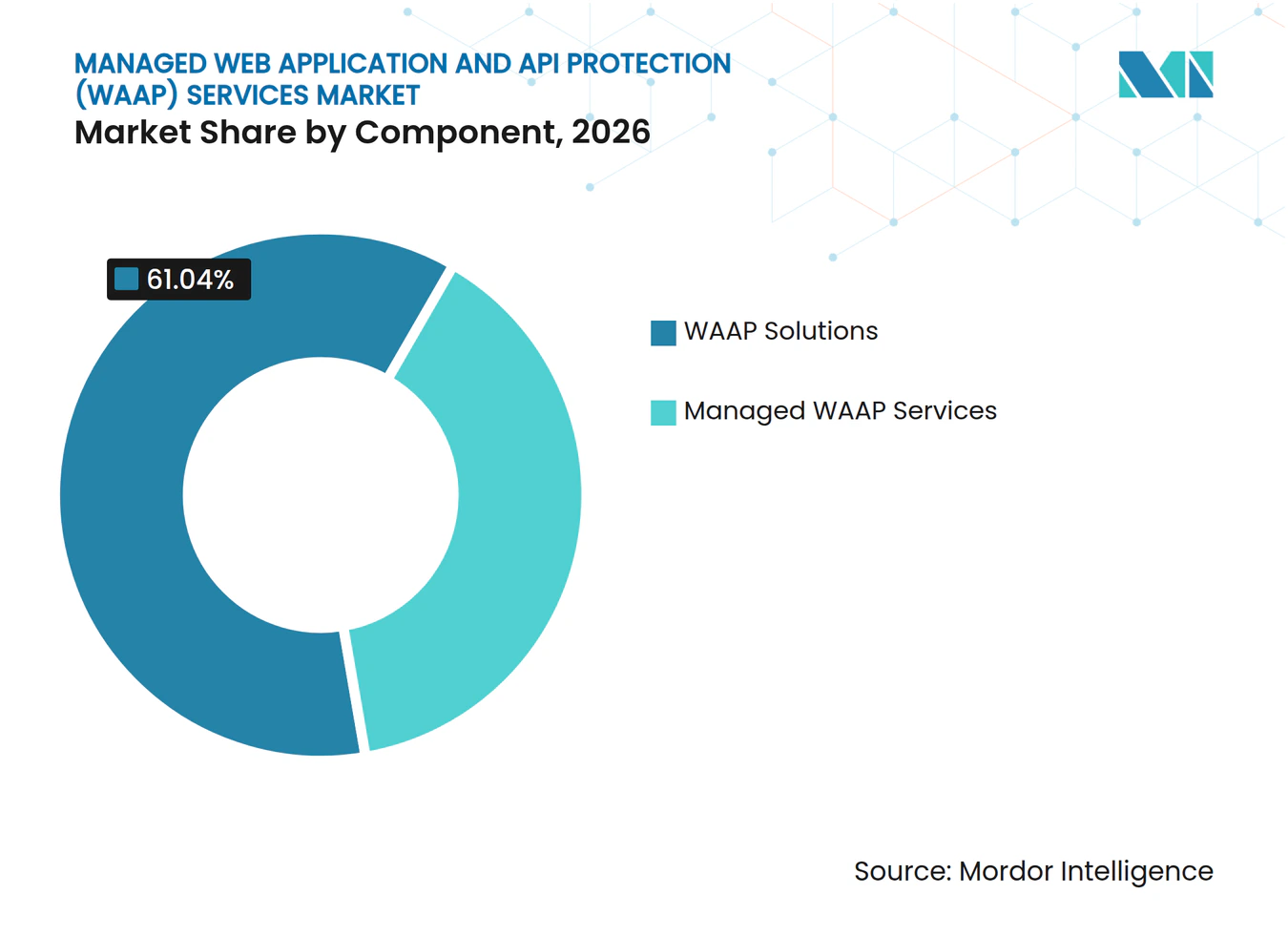
- By component, WAAP Solutions held 61.04% of the managed web application and API protection (WAAP) services market share in 2026 and are projected to expand at a 16.21% CAGR through 2032.
- By end-user industry, BFSI held 23.45% of the managed web application and API protection (WAAP) services market share in 2026, while retail and e-commerce is projected to expand at a 16.84% CAGR through 2032.
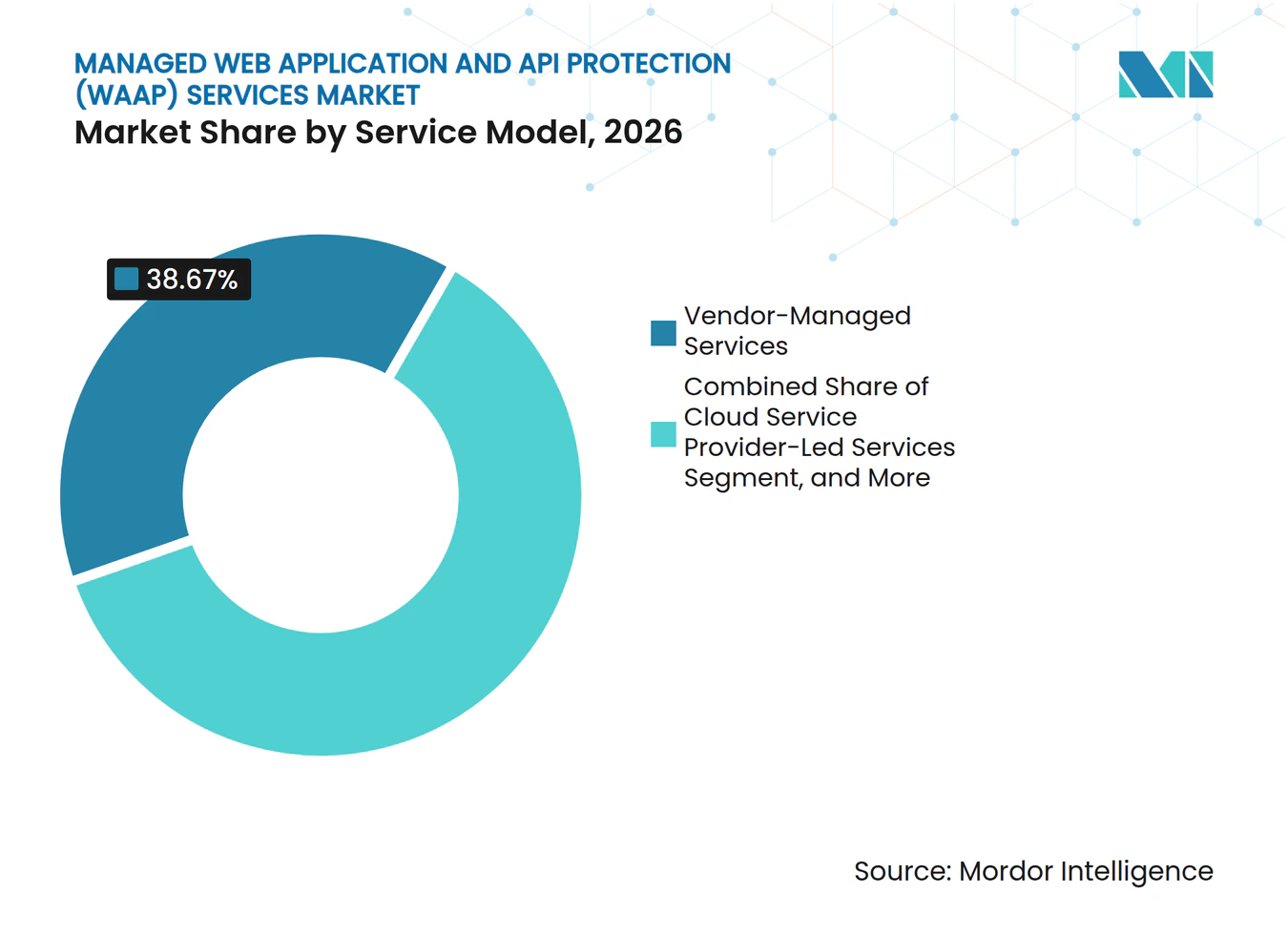
- By service model, vendor-managed services held 38.67% share in 2026, while cloud service provider-led services are projected to expand at a 16.52% CAGR through 2032.
- By geography, North America held 38.47% share in 2026, while Asia-Pacific is projected to expand at a 16.76% CAGR through 2032.
Note: Market numbers in this report are based on Mordor Intelligence's proprietary estimation framework, which combines nine months of actuals with Q4 projections for base year 2026.
Market Trends and Insights
Drivers Impact Analysis of Managed Web Application and API Protection (WAAP) Services Market*
| Driver | (~) % Impact on CAGR Forecast | Geographic Relevance | Impact Timeline |
|---|---|---|---|
| Rising API Exposure and API-Specific Attack Frequency | +3.5% | Global, most acute in North America and Asia-Pacific | Short term (≤ 2 years) |
| Expansion of Cloud-Native Applications and Microservices | +3.0% | Global, with Asia-Pacific and North America as primary growth centers | Medium term (2-4 years) |
| Stricter Data Protection and Application Security Compliance | +2.5% | North America and Europe, with spillover to Asia-Pacific and the Middle East | Medium term (2-4 years) |
| Increasing Demand for 24/7 Security Operations Coverage | +2.0% | Global, concentrated in BFSI, government, and healthcare | Short term (≤ 2 years) |
| AI Agent and Large Language Model Workflows Increasing API Dependence | +1.5% | North America, Europe, and advanced Asia-Pacific economies | Long term (≥ 4 years) |
| Shadow, Zombie, and Unmanaged APIs Creating Discovery-Led Security Demand | +1.2% | Global, with early traction in North America | Medium term (2-4 years) |
| Source: Mordor Intelligence | |||
Rising API Exposure and API-Specific Attack Frequency
APIs now carry transactions and data exchanges that were once handled through traditional web pages. Thales reported more than 40,000 API incidents across more than 4,000 monitored environments in the first half of 2025. Salt Security reported that 95% of API attacks in 2025 originated from authenticated sources, which limits the value of perimeter controls alone. Akamai recorded more than 311 billion web application and API attacks in 2024, with API attacks increasing 113% from the previous year. The managed WAAP services market addresses this exposure through endpoint discovery, behavioral analysis, and policy enforcement that can continue after a user has authenticated. Financial services remain especially exposed because applications support payments, account access, and open banking interfaces.
Expansion of Cloud-Native Applications and Microservices
Cloud-native applications spread security responsibilities across APIs, containers, gateways, and development teams. F5 found that 86% of organizations deploy API gateways, while only 34% have implemented API security measures. The same survey reported a 275% increase in service-to-service attacks compared with prior years. Different departments often use different API management approaches, which can create inconsistent policies and incomplete visibility. Managed providers can apply common controls across environments and connect security checks to continuous integration and continuous delivery processes. Red Hat reported that more than 60% of organizations plan to invest in DevSecOps automation in 2026.[1] This shift supports the managed web application and API protection (WAAP) services market because protection is increasingly expected to work within development workflows rather than only at the network edge.
Stricter Data Protection and Application Security Compliance
Security requirements increasingly make application, and API controls are a formal purchasing requirement. The PCI Security Standards Council states that PCI DSS v4.0.1 applies to the protection of payment account data and is supported by requirements for secure systems and applications. NIS2 requires essential and important entities to apply risk-management measures, including incident handling and supply-chain security. DORA also requires financial entities in the European Union to manage information and communication technology risk. These rules bring API inventories, access logging, validation, and incident response into routine governance discussions. The managed web application and API protection (WAAP) services market, therefore, has a wider buyer base across regulated sectors. Providers that can document controls and support audits have an advantage where compliance teams influence security procurement.
Increasing Demand for 24/7 Security Operations Coverage
Continuous monitoring has become more important as attacks can occur outside local business hours. SCSK Security launched a 24/7 WAAP monitoring service in Japan in July 2025 using F5 Distributed Cloud WAAP. LevelBlue and Akamai introduced managed web application and API protection services in August 2025 with 24/7 operations as a core part of the offer. Organizations without a dedicated security operations center can use these services for monitoring, policy tuning, and incident response. This can lower the operational burden of maintaining protection across many APIs and applications. The managed web application and API protection (WAAP) services market gains from this need because maintaining round-the-clock internal coverage is costly for many enterprises. It also creates demand for local service delivery where data residency and response requirements matter.
Restraints Impact Analysis of Managed Web Application and API Protection (WAAP) Services Market*
| Restraint | (~) % Impact on CAGR Forecast | Geographic Relevance | Impact Timeline |
|---|---|---|---|
| False Positives and Business Disruption | -1.5% | Global, most pronounced in North America and Europe | Short term (≤ 2 years) |
| Shortage of Specialized WAAP and API Security Talent | -1.2% | Global, with acute pressure in North America, Europe, and Asia-Pacific | Medium term (2-4 years) |
| Integration Complexity Across Hybrid and Multicloud Estates | -0.8% | North America, Europe, and advanced Asia-Pacific economies | Medium term (2-4 years) |
| QUIC, HTTP/3, and Encrypted Traffic Inspection Costs | -0.5% | Global, with disproportionate impact on smaller operators | Long term (≥ 4 years) |
| Source: Mordor Intelligence | |||
False Positives and Business Disruption
False positives can block legitimate users, disrupt transactions, and reduce confidence in protection controls. This issue is difficult when policies are applied to changing API payloads and complex JSON traffic. Akamai notes that alert fatigue and inaccurate detections can lead organizations to reconsider how they operate web application firewall controls. Poorly tuned rules can make security teams reluctant to enforce controls aggressively during high-volume events. The result can be either disrupted legitimate traffic or weaker protection against actual attacks. Managed providers can reduce this risk through continuous tuning, but customers still need confidence in the provider's operating model. The managed web application and API protection (WAAP) services market may see slower adoption in businesses with low tolerance for checkout, payment, or customer service disruption.
Shortage of Specialized WAAP and API Security Talent
The shortage of security specialists complicates both technology evaluation and service onboarding. Fortinet reported a global cybersecurity workforce gap of more than 4.7 million professionals in 2025.[2] ISACA found that 55% of cybersecurity teams were understaffed and 65% had unfilled positions. Buyers may lack the staff needed to assess product claims, integrate controls, and define acceptable policies. At the same time, the same shortage supports outsourcing because providers offer access to specialist analysts. The managed web application and API protection (WAAP) services market must therefore address a mixed effect, as limited expertise can delay decisions while strengthening the case for managed operations.
*Our forecasts treat driver/restraint impacts as directional, not additive. The impact forecasts reflect baseline growth, mix effects, and variable interactions.
Managed Web Application and API Protection (WAAP) Services Market Segment Analysis
By Component:
WAAP Solutions Support Platform ConsolidationWAAP Solutions held 61.04% of the managed WAAP services market share in 2026 and are projected to expand at a 16.21% CAGR through 2032. Organizations prefer platforms that combine web application firewall, bot mitigation, distributed denial-of-service protection, and API security under one management plane. This approach can reduce the burden of managing separate tools and policies. The managed web application and API protection services industry is moving toward integrated platforms as buyers seek shared visibility across application traffic. Imperva stated that its Application Security platform integrates API Detection and Response with its existing application security controls.
Managed the WAAP Services account for the remaining component share and translated platform functions into daily operational support. These services commonly include monitoring, policy adjustments, incident response, and compliance reporting. Akamai introduced a managed API security service in June 2025 that combined monitoring, expert response, and compliance dashboards. The boundary between solution and service revenue may become less distinct as vendors bundle platform access with expert operations. The managed web application and API protection (WAAP) services market is also affected by API-focused suppliers that add web application firewall and distributed denial-of-service functions, as shown by Cequence's July 2025 WAAP launch.


By End-User Industry:
BFSI Compliance Requirements Support SpendingBFSI held 23.45% of the managed WAAP services market share in 2026. Financial institutions use APIs for payments, balance checks, authentication, and open banking data flows. Akamai observed an 11% increase in web attacks on financial services sites from 2024 through 2025, while distributed denial-of-service attacks on financial services APIs increased 58%. FS-ISAC has identified API control hardening as a concern for financial organizations. PCI DSS, DORA, and other sector rules make security controls more central to procurement and can support more resilient demand.
Retail and e-commerce are projected to expand at a 16.84% CAGR through 2032. Automated product scraping, credential abuse, account takeover, and checkout attacks create a need for controls that can assess both API behavior and web traffic. Cequence reported that retailers faced 66.5% of malicious traffic in its 2025 research, including 822 million product-scraping attempts and more than 300 million account takeover attempts during the measured year. Healthcare and life sciences need protection as health information exchanges connect more organizations through APIs. The managed web application and API protection (WAAP) services market can also serve government, manufacturing, telecommunications, and travel organizations that need specialist support.
By Service Model:
Cloud Service Provider-Led Services Gain MomentumVendor-managed services held 38.67% of the managed web application and API protection (WAAP) services market share in 2026. Under this model, a dedicated security provider delivers detection, policy management, and incident response as a bundled service. Large enterprises often value clear accountability and service-level agreements when they already use a vendor's platform. This model can also support compliance reviews through established reporting and escalation processes. The managed web application and API protection (WAAP) services market continues to use vendor-managed services where security architecture requires tailored policies.
Cloud service provider-led services are projected to expand at a 16.52% CAGR through 2032. Enterprises increasingly prefer to obtain security controls through cloud relationships that already support their compute and network environments. Cloudflare announced an integration with Oracle Cloud Infrastructure in October 2026, enabling customers to access Cloudflare's application and API protection capabilities in the Oracle environment.[3] The managed WAAP services market benefits when protection is available through cloud procurement channels. Co-managed services remain a hybrid option for customers that retain internal policy control while outsourcing specialist monitoring and response.


Geography Analysis
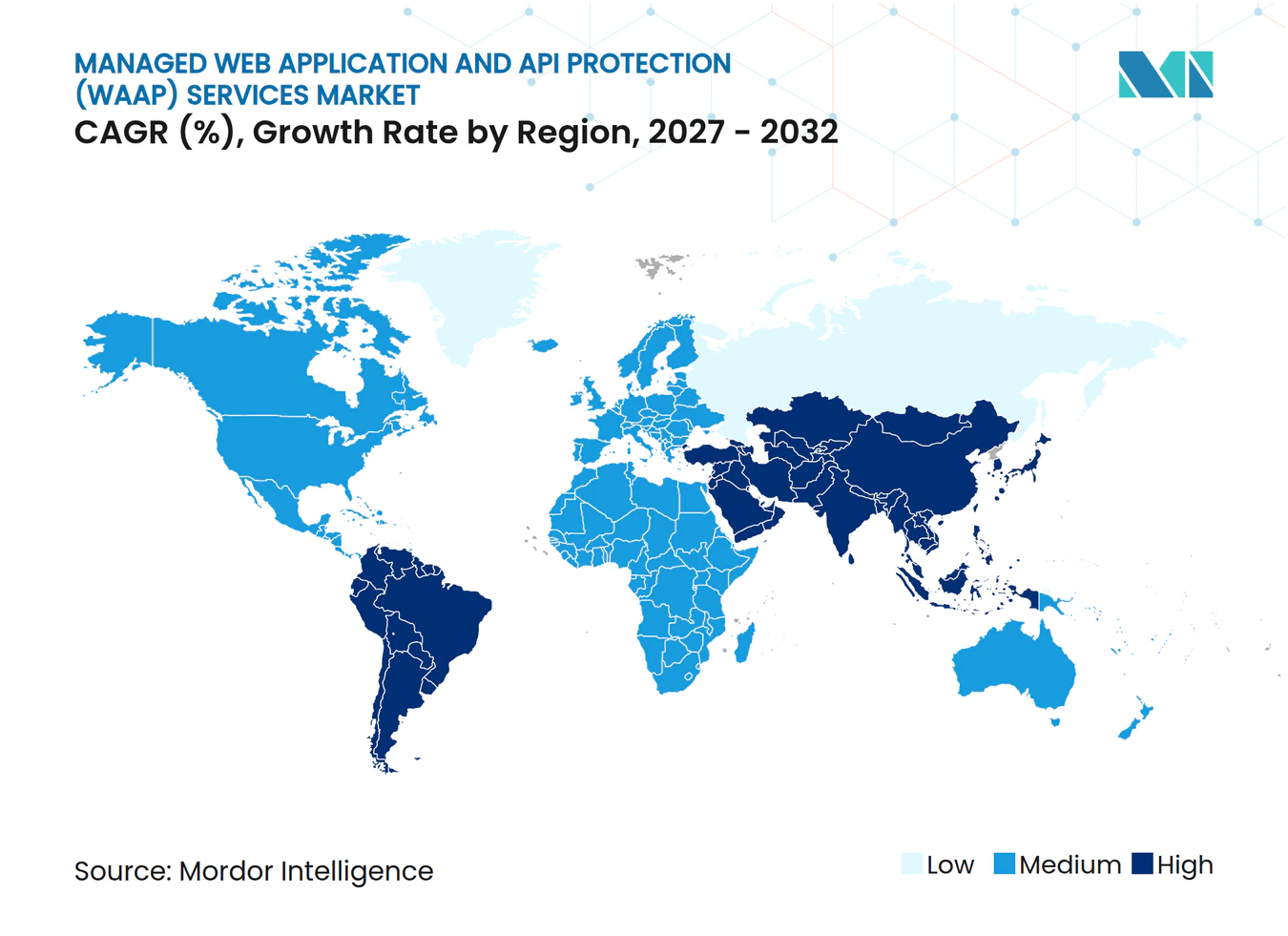
North America held 38.47% of the managed web application and API protection (WAAP) services market share in 2026. The region benefits from a high concentration of large enterprises, cloud infrastructure, and security suppliers. Salt Security reported in its 2025 study that 80% of organizations lacked continuous, real-time API monitoring. The gap leaves room for managed service adoption among midmarket buyers that have not yet implemented comprehensive monitoring. Canada and Mexico add demand through digital services, financial technology, and retail activity.
Europe has a distinct demand pattern because security requirements are closely tied to regulation. NIS2 requires national implementation measures and covers incident handling, supply-chain security, and effectiveness assessment. DORA has applied to European Union financial entities since January 2025 and has reinforced information and communication technology risk-management requirements. Germany, the United Kingdom, and France anchor regional demand, particularly in financial centers that use API-based open banking services. The managed web application and API protection (WAAP) services market could face an additional selection criterion as ENISA develops a managed-security-services certification scheme.
Asia-Pacific is projected to expand at a 16.76% CAGR through 2032. Akamai found that 85% of surveyed Asia-Pacific organizations had experienced at least 1 API security incident during the previous 12 months, with an average financial impact above USD 580,000 per incident. India has a large digital payments ecosystem and a gap between reported executive confidence and application-security teams' API inventory visibility. Japan is seeing demand for expert-managed coverage, as shown by SCSK Security's 2025 service launch. The managed WAAP services market also has opportunities in the Middle East and South America, where data residency, data protection, and financial technology expansion support adoption.
Competitive Landscape
Market Concentration
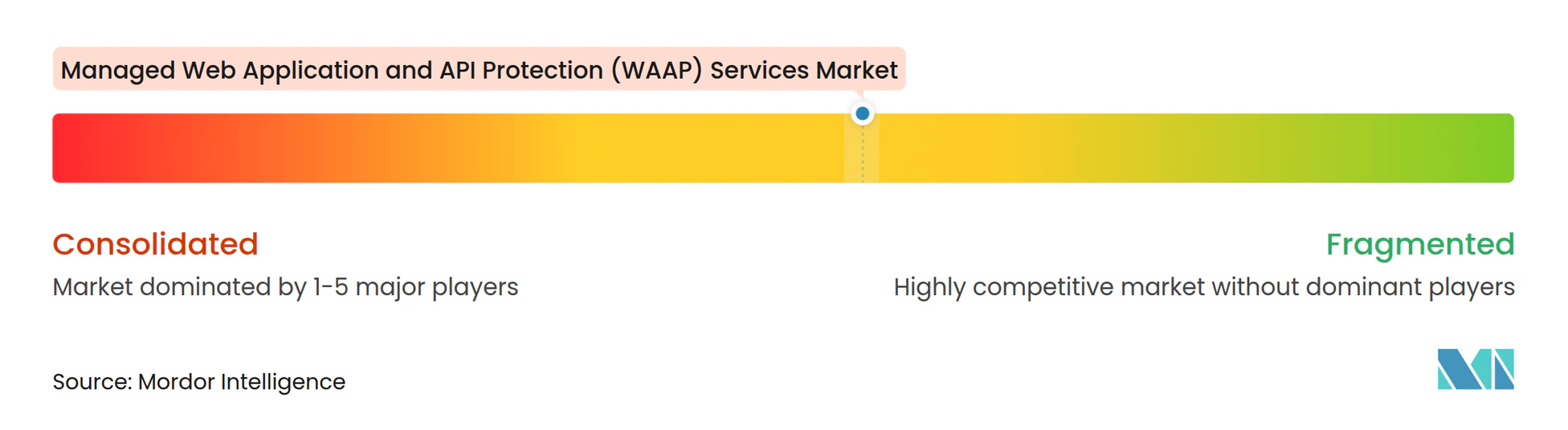
The managed web application and API protection (WAAP) services market is moderately concentrated among broad platform providers and more fragmented among API-focused specialists. Akamai, Cloudflare, Imperva, F5, and Fortinet compete through platform breadth, delivery capability, and integration across cloud and application environments. Buyers often seek a provider that can protect web applications, APIs, bots, and distributed denial-of-service traffic through a single operating model. Independent testing and vendor evaluations can influence procurement where internal teams cannot run extensive assessments. The managed web application and API protection (WAAP) services market rewards providers that can demonstrate dependable detection and operational support.
Incumbents are expanding their platforms to address API-specific risk. Imperva integrated API Detection and Response into its Application Security platform in June 2025 to detect and mitigate risks, including broken object-level authorization and unauthenticated APIs. [4] Akamai launched Firewall for AI in April 2025 to protect AI applications, large language models, and AI-driven APIs. It also introduced App and API Protector Hybrid for multicloud, on-premises, and content-delivery-network-agnostic environments. These moves extend protection beyond conventional perimeter deployment and support one policy approach across distributed infrastructure.
Specialist providers are broadening their product lines to compete for consolidated security budgets. Traceable introduced Traceable Cloud WAAP in April 2025 after its merger with Harness. Cequence added web application firewall and distributed denial-of-service capabilities to its API security and bot management platform in July 2025. This leaves space for co-managed security services and AI API protection as organizations move more AI functions into production.
Managed Web Application and API Protection (WAAP) Services Industry Leaders
-
Akamai Technologies, Inc.
-
Cloudflare, Inc.
-
Imperva, Inc.
-
F5, Inc.
-
Radware Ltd.
- *Disclaimer: Major Players sorted in no particular order
Managed Web Application and API Protection (WAAP) Services Market Companies Covered in this Report
- Akamai Technologies, Inc.
- Cloudflare, Inc.
- Imperva, Inc.
- F5, Inc.
- Radware Ltd.
- Fastly, Inc.
- Barracuda Networks, Inc.
- Fortinet, Inc.
- Palo Alto Networks, Inc.
- Check Point Software Technologies Ltd.
- Qualys, Inc.
- A10 Networks, Inc.
- Wallarm, Inc.
- Cequence Security, Inc.
- Salt Security, Inc.
- Traceable, Inc.
- Data Theorem, Inc.
- 42Crunch Limited
- Indusface Private Limited
- UBIKA Security SAS
- Prophaze Technologies Private Limited
- Reblaze Technologies Ltd.
Recent Industry Developments in Managed Web Application and API Protection (WAAP) Services Market
- October 2026: Cloudflare integrated its connectivity cloud platform natively with Oracle Cloud Infrastructure (OCI), enabling joint customers to access Cloudflare's WAF, DDoS protection, and API security directly from OCI across hybrid, multicloud, and edge environments. The integration simplifies security procurement for OCI-anchored enterprises and signals the acceleration of Cloud Service Provider-Led WAAP delivery as a commercial model.
- August 2026: SecureIQLab published its Cloud WAAP v5.0 CyberRisk Validation Report, testing 12 WAAP vendors on more than 1,360 attack types. Imperva was the only vendor to achieve a 100% Complete Security Score, while F5, Fortinet, and Akamai also placed in the Leader category. The report is used as a direct procurement benchmark by enterprise buyers evaluating managed WAAP platforms.
- June 2026: F5 announced AI-powered WAAP enhancements, including WAF capabilities, air-gapped API discovery and security, and virtual patching. The focus is on identifying exposed APIs and mitigating vulnerabilities before exploitation, supporting demand for managed services that combine application-layer defense with faster vulnerability response.
- March 2026: Cloudflare launched a beta Web and API Vulnerability Scanner initially targeting Broken Object Level Authorization (BOLA), a prominent API security risk. The development extends protection beyond blocking malicious requests in real time toward identifying application and API weaknesses before they are exploited, broadening the scope of managed API security.
Global Managed Web Application and API Protection (WAAP) Services Market Report Scope
The Managed Web Application and API Protection (WAAP) Services Market comprises security services that enable organizations to protect web applications, application programming interfaces (APIs), and cloud-hosted application workloads against application-layer attacks, automated threats, malicious API requests, and unauthorized access. These services include the deployment, configuration, monitoring, and management of web application firewalls, API security controls, bot mitigation, distributed denial-of-service (DDoS) protection, API discovery, vulnerability detection, threat analysis, and application-layer attack prevention. Managed WAAP providers deliver continuous security monitoring, policy tuning, threat detection and response, and application protection across cloud-native, hybrid, and multicloud environments, while supporting organizations in managing API exposure, application vulnerabilities, and evolving security requirements.
The Managed Web Application and API Protection (WAAP) Services Market Report is Segmented by Component (WAAP Solutions, and Managed WAAP Services), End-User Industry (Banking, Financial Services and Insurance, Retail and E-Commerce, Information Technology and Telecommunications, Healthcare and Life Sciences, Government and Defense, Manufacturing, Travel and Hospitality, and Other End-User Industries), Service Model (Vendor-Managed Services, Managed Security Service Provider-Led Services, Cloud Service Provider-Led Services, Systems Integrator-Led Services, and Co-Managed Enterprise Security Services), and Geography (North America, South America, Europe, Asia-Pacific, Middle East, and Africa). The Market Forecasts are Provided in Terms of Value (USD).
Segmentation Overview
| WAAP Solutions |
| Managed WAAP Services |
| Banking, Financial Services and Insurance |
| Retail and E-Commerce |
| Information Technology and Telecommunications |
| Healthcare and Life Sciences |
| Government and Defense |
| Manufacturing |
| Travel and Hospitality |
| Other End-User Industries |
| Vendor-Managed Services |
| Managed Security Service Provider-Led Services |
| Cloud Service Provider-Led Services |
| Systems Integrator-Led Services |
| Co-Managed Enterprise Security Services |
| North America | United States |
| Canada | |
| Mexico | |
| South America | Brazil |
| Argentina | |
| Rest of South America | |
| Europe | United Kingdom |
| Germany | |
| France | |
| Italy | |
| Russia | |
| Rest of Europe | |
| Asia-Pacific | China |
| Japan | |
| India | |
| South Korea | |
| Australia | |
| Rest of Asia-Pacific | |
| Middle East | Saudi Arabia |
| United Arab Emirates | |
| Turkey | |
| Rest of Middle East | |
| Africa | South Africa |
| Egypt | |
| Rest of Africa |
| By Component | WAAP Solutions | |
| Managed WAAP Services | ||
| By End-User Industry | Banking, Financial Services and Insurance | |
| Retail and E-Commerce | ||
| Information Technology and Telecommunications | ||
| Healthcare and Life Sciences | ||
| Government and Defense | ||
| Manufacturing | ||
| Travel and Hospitality | ||
| Other End-User Industries | ||
| By Service Model | Vendor-Managed Services | |
| Managed Security Service Provider-Led Services | ||
| Cloud Service Provider-Led Services | ||
| Systems Integrator-Led Services | ||
| Co-Managed Enterprise Security Services | ||
| By Geography | North America | United States |
| Canada | ||
| Mexico | ||
| South America | Brazil | |
| Argentina | ||
| Rest of South America | ||
| Europe | United Kingdom | |
| Germany | ||
| France | ||
| Italy | ||
| Russia | ||
| Rest of Europe | ||
| Asia-Pacific | China | |
| Japan | ||
| India | ||
| South Korea | ||
| Australia | ||
| Rest of Asia-Pacific | ||
| Middle East | Saudi Arabia | |
| United Arab Emirates | ||
| Turkey | ||
| Rest of Middle East | ||
| Africa | South Africa | |
| Egypt | ||
| Rest of Africa | ||
Key Questions Answered in the Report
What is the size of the managed web application and API protection services market?
The sector is projected to reach USD 5.32 billion in 2027 and USD 9.56 billion by 2032, at a 15.65% CAGR from 2027 to 2032.
Why are managed WAAP services becoming more important?
Enterprises need combined protection for web applications, APIs, bots, and distributed denial-of-service attacks, along with 24/7 operational support.
Which end-user sector has the largest share?
BFSI held 23.45% of 2026 revenue because payments, authentication, open banking, and compliance requirements raise protection needs.
Which end-user segment is expected to expand fastest?
Retail and e-commerce is projected to expand at a 16.84% CAGR through 2032 as automated scraping, account takeover, and checkout abuse increase.
Which service model is expanding fastest?
Cloud service provider-led services are projected to expand at a 16.52% CAGR through 2032 as customers consolidate security procurement with cloud platforms.
Which region is projected to expand fastest?
Asia-Pacific is projected to expand at a 16.76% CAGR through 2032, supported by digitalization, payment activity, and cybersecurity requirements.