
Managed Application Layer DDoS Protection Services Market Size and Share
Market Overview
| Study Period | 2021 - 2032 |
|---|---|
| Market Size (2027) | USD 2.23 Billion |
| Market Size (2032) | USD 3.93 Billion |
| Growth Rate (2027 - 2032) | 14.87 % |
| Fastest Growing Market | Asia-Pacific |
| Largest Market | North America |
| Market Concentration | Medium |
Major Players *Disclaimer: Major Players sorted in no particular order Image © Mordor Intelligence. Reuse requires attribution under CC BY 4.0. | |
Managed Application Layer DDoS Protection Services Market Analysis by Mordor Intelligence
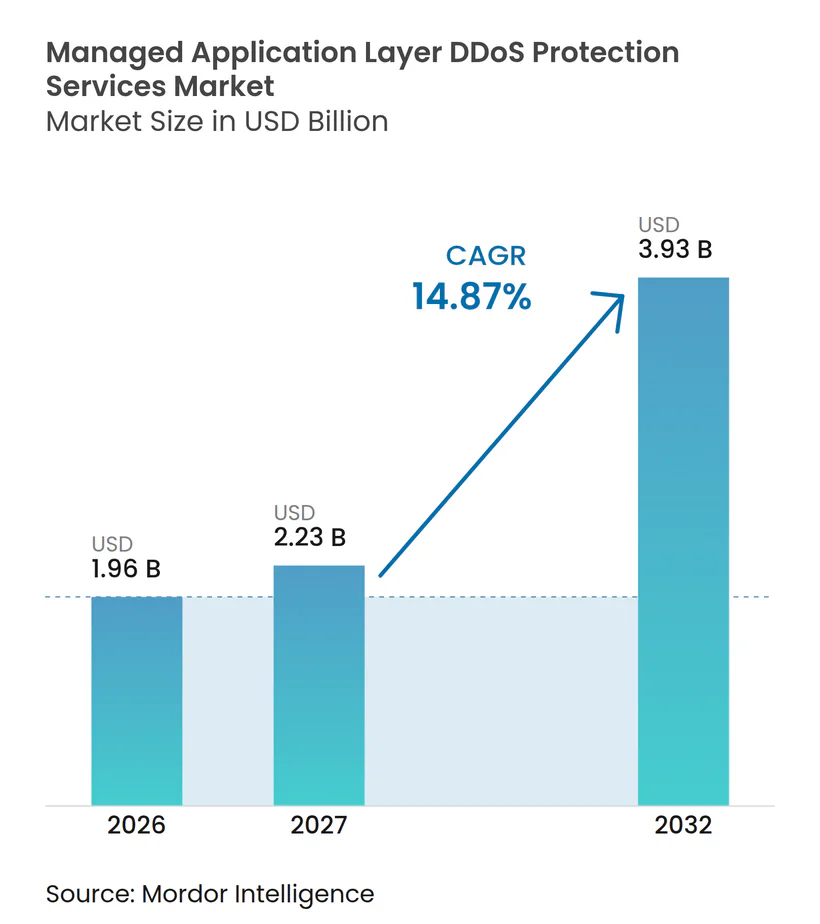
The managed application layer DDoS protection services market size is projected to expand from USD 1.96 billion in 2026 and USD 2.23 billion in 2027 to USD 3.93 billion by 2032, registering a CAGR of 14.87% between 2027 to 2032. The managed application layer DDoS protection services market is being shaped by the rising volume of application-layer attacks and the cost of service disruption. Buyers are moving from reactive arrangements toward always-on services because short attacks can still interrupt customer transactions and digital operations. Cloud delivery has widened access to elastic mitigation capacity, while it has also increased the number of public-facing applications that require protection. Providers are competing on scrubbing capacity, automated behavioral detection, and managed security service provider channels. Multi-cloud integration, sovereign-data requirements, and the cost of premium capacity remain important limits on adoption.
Key Report Takeaways
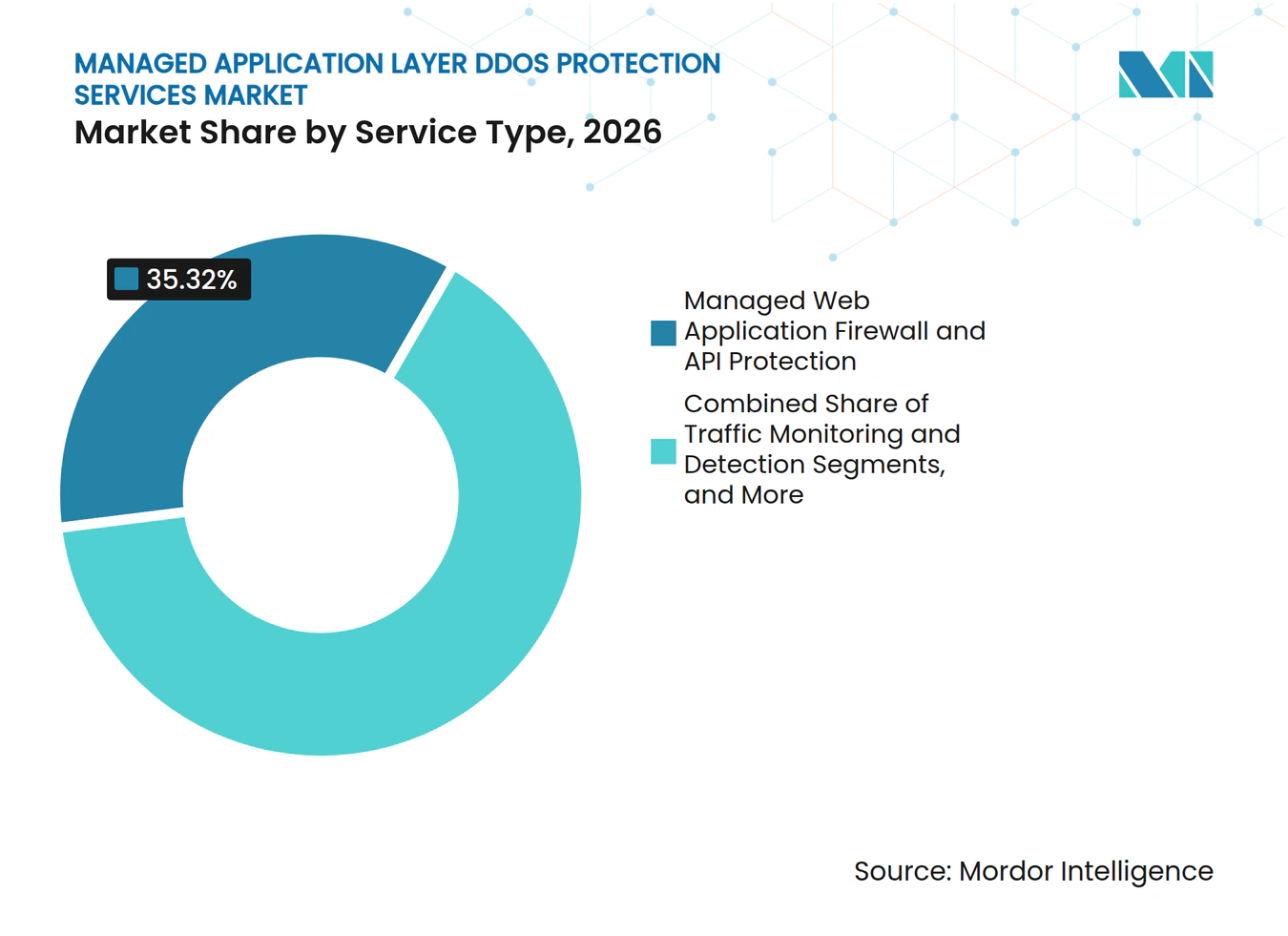
- By service type, Managed WAF and API Protection held 35.32% of the managed application layer DDoS protection services market share in 2026, while Incident Response and Emergency Protection is projected to expand at a CAGR of 15.86% through 2032.
- By deployment model, cloud-based deployments accounted for 68.12% of revenue in 2026 and are projected to expand at a CAGR of 15.47% through 2032.
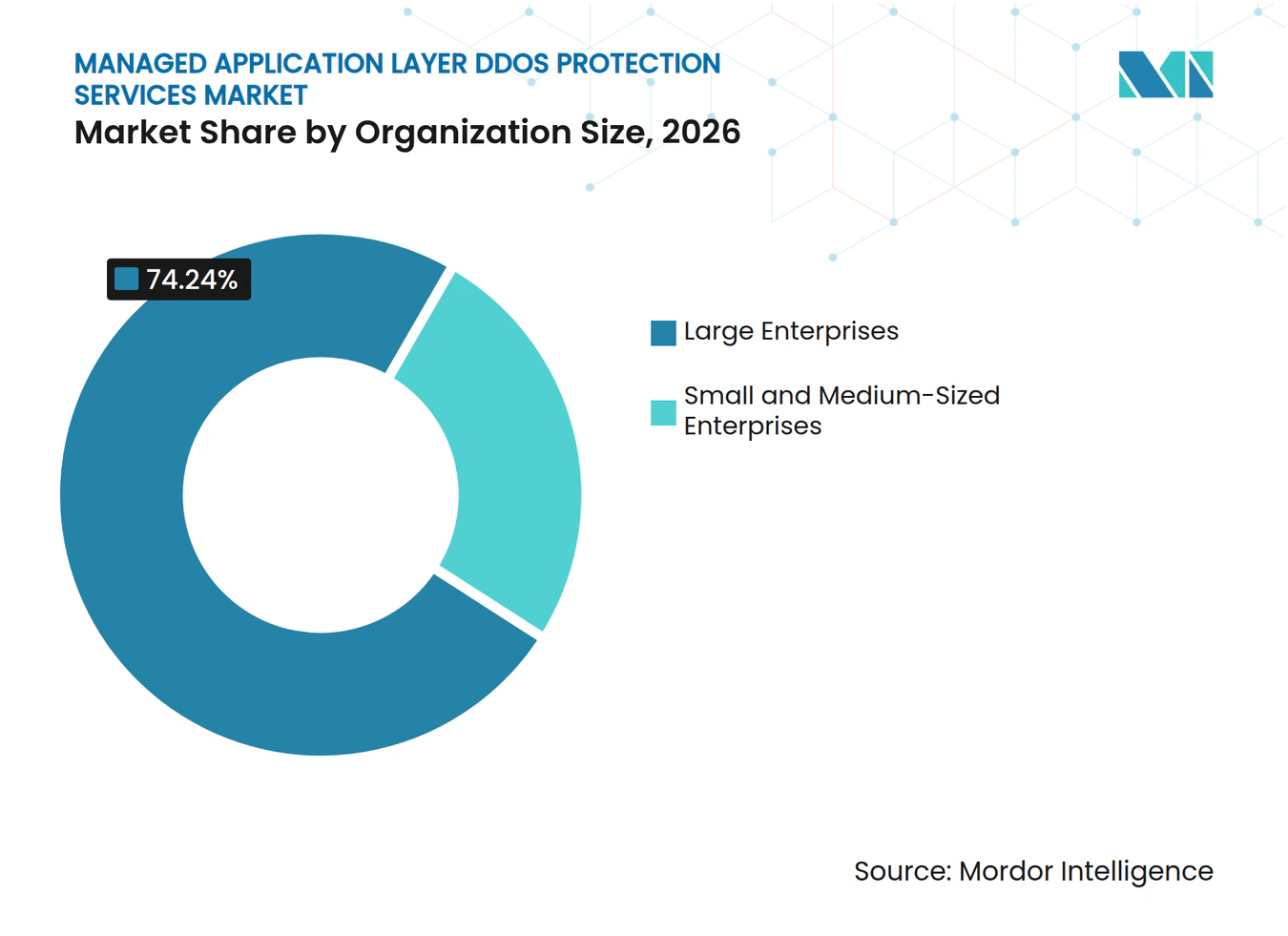
- By organization size, large enterprises held 74.24% of revenue in 2026, while SMEs are projected to expand at a CAGR of 15.29% through 2032.
- By application type, Websites and Web Applications held 29.93% of revenue in 2026, while APIs and Microservices are projected to expand at a CAGR of 15.84% through 2032.
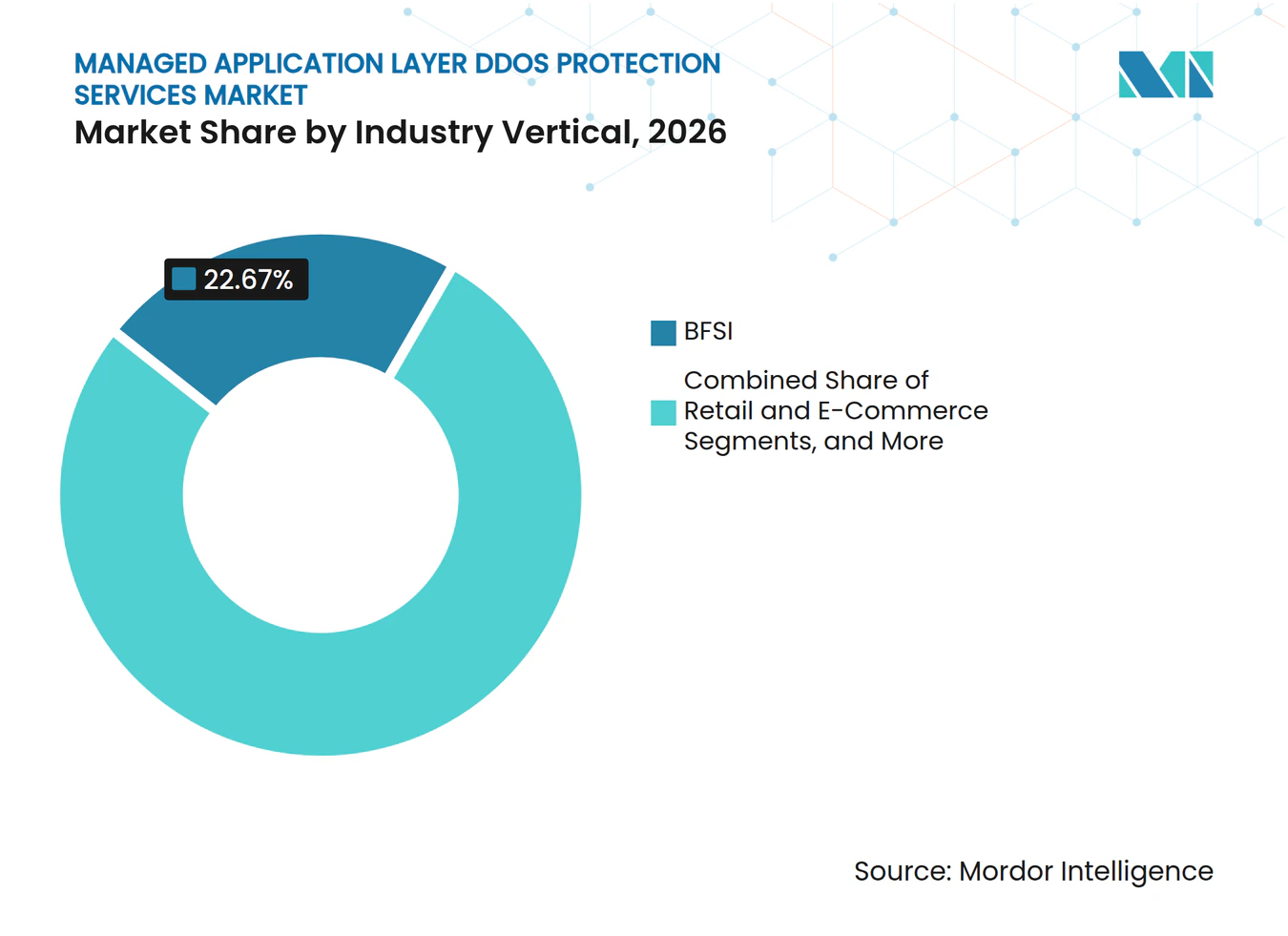
- By industry vertical, BFSI held 22.67% of revenue in 2026, while Media, Gaming and Entertainment is projected to expand at a CAGR of 16.22% through 2032.
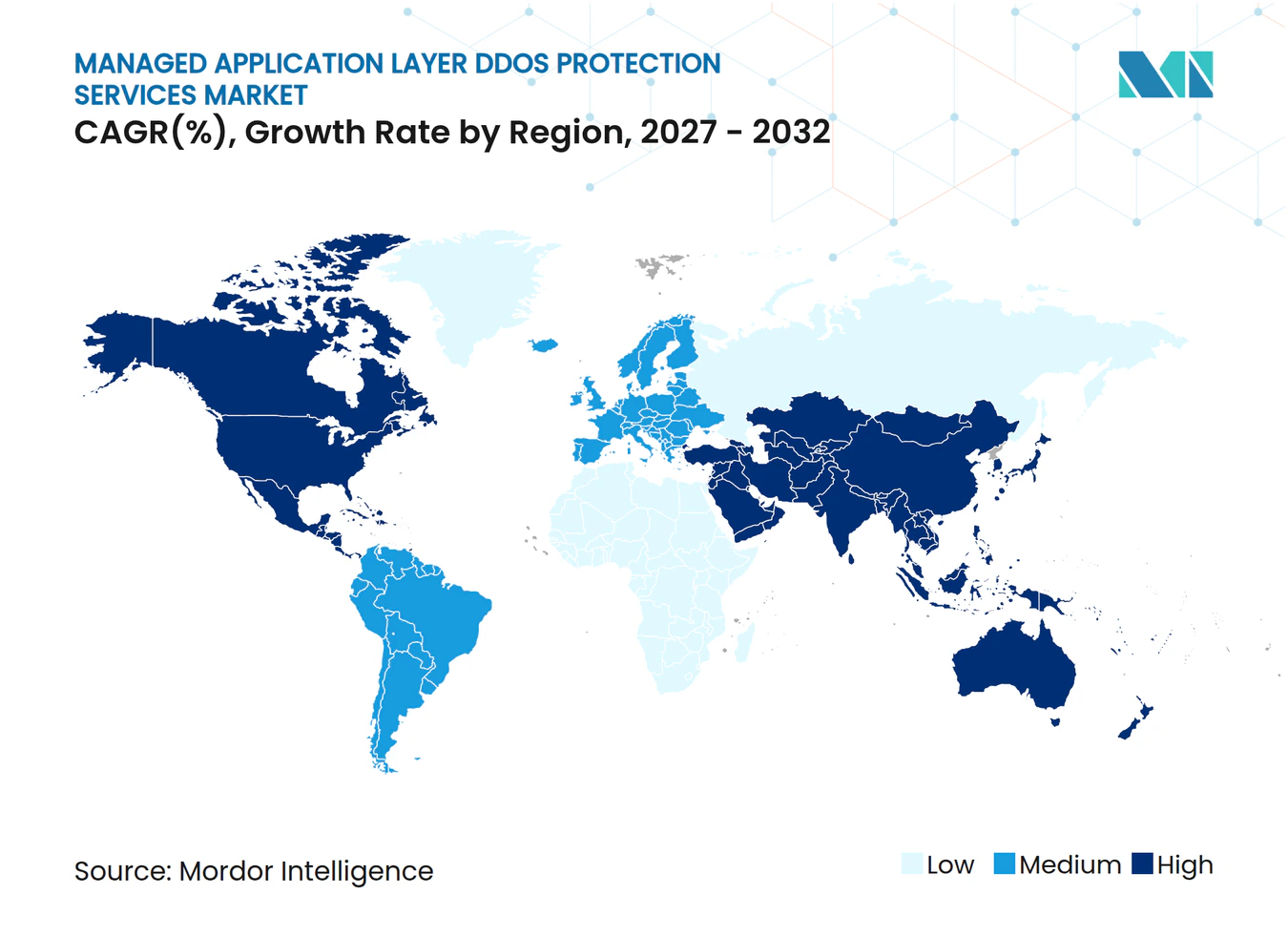
- By geography, North America held 28.52% of the managed application layer DDoS protection services market share in 2026, while Asia-Pacific is projected to expand at a CAGR of 15.81% through 2032.
Note: Market numbers in this report are based on Mordor Intelligence's proprietary estimation framework, which combines nine months of actuals with Q4 projections for base year 2026.
Market Trends and Insights
Drivers Impact Analysis of Managed Application Layer DDoS Protection Services Market*
| Driver | (~) % Impact on CAGR Forecast | Geographic Relevance | Impact Timeline |
|---|---|---|---|
| Rising Frequency and Complexity of Layer 7 Attacks | +3.8% | Global, highest intensity in North America and EMEA | Short term (≤ 2 years) |
| AI-Driven Behavioral Detection and Automated Mitigation | +2.5% | Global, early concentration in North America and Asia-Pacific core | Medium term (2-4 years) |
| Cloud Migration and Expansion of Internet-Facing Applications | +2.4% | Global, with spillover to Asia-Pacific and South America | Medium term (2-4 years) |
| Growth of API, Microservices, and Digital-Transaction Exposure | +2.2% | Global, strongest acceleration in Asia-Pacific and North America | Medium term (2-4 years) |
| Outsourcing Demand from Cybersecurity Skills Shortages | +1.6% | Global, highest demand intensity in EMEA and Asia-Pacific | Long term (≥ 4 years) |
| Regulatory and Operational-Resilience Requirements | +1.4% | EU, North America, and Asia-Pacific national frameworks | Medium term (2-4 years) |
| Source: Mordor Intelligence | |||
Rising Frequency and Complexity of Layer 7 Attacks
The managed application layer DDoS protection services market is responding to attacks that increasingly target web and API layers. Radware reported that web DDoS attacks rose 187.1% year over year in the first quarter of 2026.[1] It also found that 93% of web DDoS events stayed below 100,000 requests per second, a pattern that can avoid simple threshold controls while still degrading availability. Akamai reported that application-layer DDoS activity increased 104% across its reported 2-year period, while its research also described industrialized attack campaigns against applications and APIs.[2] Cloudflare mitigated 29.64 trillion HTTP DDoS requests during the first half of 2026, reinforcing the limited usefulness of manual intervention for large attack volumes. These conditions support contracts that provide continuous monitoring and rapid mitigation rather than a service activated after disruption begins.
AI-Driven Behavioral Detection and Automated Mitigation
Automated detection is becoming a core service requirement in the managed application layer DDoS protection services market. NETSCOUT stated in July 2026 that it had expanded Arbor Cloud capacity to 33 Tbps and introduced AI-supported capabilities designed to automate mitigation for up to 80% of DDoS attacks without analyst action. This approach matters when application attacks develop faster than an operations team can assess a traffic spike and change a policy. Behavioral models can identify changes in request patterns that fixed rules may miss, particularly in shared cloud environments. Automation also reduces the number of urgent actions required from security teams during an incident. Providers that cannot demonstrate reliable detection and mitigation performance are likely to face stricter enterprise procurement reviews.
Cloud Migration and Expansion of Internet-Facing Applications
The move to cloud and hybrid architectures is expanding the addressable need for managed protection. Public applications, customer portals, APIs, and cloud workloads create more entry points that must remain available. AWS introduced managed application-layer DDoS protections for AWS WAF and AWS Shield Advanced customers in 2025, reducing the need to configure individual access-control rules for HTTP flood mitigation. Elastic cloud capacity also allows providers to direct traffic to scrubbing networks during peak attack periods. This operating model supports the managed application layer DDoS protection services market because customers can access large-scale protection without owning comparable infrastructure. It also makes consistent policy management across public clouds, private environments, and remote locations a practical purchasing concern.
Growth of API, Microservices, and Digital-Transaction Exposure
API use is creating a distinct protection requirement within the managed application layer DDoS protection services market. Akamai reported that the average number of daily API attacks rose 113% year over year in its 2026 research. The CERT Coordination Center disclosed CVE-2025-8671, known as MadeYouReset, as an HTTP/2 denial-of-service vulnerability affecting implementations from several vendors. Research published in Future Internet found that dependencies within microservice workflows can exhaust resources despite rate limiting and load balancing. Managed providers can apply behavioral analysis across API calls and service interactions where browser-focused rules offer incomplete coverage. The increased exposure of transaction flows and distributed services supports demand for continuous API-layer monitoring.
Restraints Impact Analysis of Managed Application Layer DDoS Protection Services Market*
| Restraint | (~) % Impact on CAGR Forecast | Geographic Relevance | Impact Timeline |
|---|---|---|---|
| Integration Complexity Across Multi-Cloud and Multi-Vendor Environments | -1.8% | Global, most pronounced in North America and EMEA multi-cloud deployments | Medium term (2-4 years) |
| High Cost of Global Scrubbing Capacity and Premium Managed Services | -1.4% | Global, constraining SME and mid-market adoption in Asia-Pacific and South America | Long term (≥ 4 years) |
| False Positives and User-Friction Risk in Challenge-Based Mitigation | -0.9% | Global, highest friction in retail, e-commerce, and media verticals | Short term (≤ 2 years) |
| Data-Sovereignty, Encryption, and Traffic-Inspection Constraints | -0.7% | EU and national data-residency regimes in Asia-Pacific | Medium term (2-4 years) |
| Source: Mordor Intelligence | |||
Integration Complexity Across Multi-Cloud and Multi-Vendor Environments
The managed application layer DDoS protection services market remains harder to adopt when buyers operate across multiple cloud platforms. Each cloud provider uses different routing, policy, logging, and security-control models. A managed layer therefore needs to fit into several existing environments without creating visibility gaps or forcing a provider change. The European Commission's NIS2 implementing regulation sets technical and methodological requirements for managed service providers, cloud computing service providers, and content delivery network providers.[3] These requirements make consistent controls and documented responsibilities more important for regulated buyers. Integration work can delay deployment, especially for organizations without a unified security operations function.
High Cost of Global Scrubbing Capacity and Premium Managed Services
Large global networks require sustained investment, which can limit service affordability for smaller customers. Cloudflare reported mitigating 935 attacks greater than 1 Tbps in the first half of 2026. Radware stated that its global scrubbing network reached 30 Tbps across 65 centers during 2025, while NETSCOUT reported 33 Tbps of Arbor Cloud capacity in July 2026. These capabilities are valuable during extreme attacks, but their operating costs may be reflected in premium managed-service prices. LevelBlue introduced Essential and Advanced managed WAAP tiers in 2025, showing how providers are developing options for organizations with different budget levels. Tiered offers may improve access, although price remains a material issue for SMEs.
*Our forecasts treat driver/restraint impacts as directional, not additive. The impact forecasts reflect baseline growth, mix effects, and variable interactions.
Managed Application Layer DDoS Protection Services Market Segment Analysis
By Service Type:
Managed WAF and API Protection Holds the Largest Revenue PositionManaged WAF and API Protection held 35.32% of the managed application layer DDoS protection services revenue in 2026. The service brings web application firewall management, DDoS mitigation, bot controls, and API monitoring into a managed operating model. This combination suits enterprises that want fewer separate security policies and providers. The managed application layer DDoS protection services market size for this service is supported by the need to protect public websites and business APIs through the same operational process. Akamai reported that API attacks were becoming the primary attack surface for many organizations, which supports integrated web and API controls.
Incident Response and Emergency Protection is projected to expand at a CAGR of 15.86% through 2032. This service addresses buyers that need guaranteed access to response expertise and mitigation capacity when an incident occurs in the managed application layer DDoS protection services market. Cloudflare reported that 90.6% of mitigated network-layer attacks lasted under 10 minutes in the first half of 2026. Short attack durations make delayed escalation and conventional service-level processes less useful. Emergency services can also provide an entry point for organizations that have not yet implemented an always-on program.



By Deployment Model:
Cloud-Based Delivery Combines Scale and Operational FlexibilityCloud-based deployments accounted for 68.12% of revenue in 2026 and are projected to expand at a CAGR of 15.47% through 2032. The deployment model gives customers access to shared scrubbing infrastructure without requiring them to build and operate comparable capacity. Radware described a 30 Tbps global network, and NETSCOUT reported 33 Tbps of Arbor Cloud capacity in July 2026. These network benchmarks show why cloud delivery is important in the managed application layer DDoS protection services market. The model allows providers to absorb high traffic volumes and update mitigation logic centrally.
Hybrid deployments remain relevant for regulated organizations and large enterprises with latency-sensitive traffic. These buyers may keep inline detection close to key systems while using cloud capacity when attack traffic exceeds local limits in the managed application layer DDoS protection services market. The Digital Operational Resilience Act has applied to EU financial entities since January 2025 and requires ICT risk management, incident reporting, and management of third-party ICT risk. This framework reinforces the need to document resilience arrangements across both local and cloud controls. On-premises deployments continue in air-gapped government, defense, and critical-infrastructure settings. Their relative role is constrained where traffic cannot be sent through external scrubbing networks.
By Organization Size:
Large Enterprises Lead While SMEs Adopt Managed ServicesLarge enterprises accounted for 74.24% of revenue in 2026. Financial institutions, large e-commerce companies, telecommunications carriers, and cloud-intensive firms often have high volumes of public traffic and greater exposure to operational disruption. They also have established procurement processes for managed security and service-level commitments. Radware reported that 71% of surveyed organizations experienced application-layer or API-focused DDoS attacks daily, weekly, or monthly. This broad exposure makes availability protection relevant beyond the largest buyers, while large enterprises retain the budget for dedicated coverage.
SMEs are projected to expand at a CAGR of 15.29% through 2032. Cloud delivery reduces the need for upfront hardware investment and supports subscription-based protection. Managed service providers and telecommunications carriers can package security operations, mitigation capacity, and support for smaller organizations in the managed application layer DDoS protection services market. Spectrum Business used Radware's SecureLink platform to expand managed DDoS services for enterprise and mid-market clients. Smaller companies can use external expertise when they do not operate a 24-hour security operations center.

By Application Type:
Websites Lead While API and Microservice Exposure AcceleratesWebsites and Web Applications held 29.93% of revenue in 2026. These assets are widely exposed to customer traffic, credential abuse, bots, and application-layer floods. Radware reported that malicious web application and API transactions blocked in the first quarter of 2026 equaled 60% of the total blocked during all of 2025. The data indicates a sharp increase in traffic that must be assessed at the application layer. Gaming and interactive platforms also face recurring campaigns, while DNS and internet-facing infrastructure have availability dependencies for downstream services.
APIs and Microservices are projected to expand at a CAGR of 15.84% through 2032. APIs connect customer interfaces, internal systems, partner integrations, and payment flows, making them important targets for attacks that may not resemble browser traffic. The MadeYouReset vulnerability showed that HTTP/2 implementations can create broad denial-of-service exposure across commonly used technology. Academic research also showed that service dependencies can create resource exhaustion even where conventional controls are present. Managed services in the managed application layer DDoS protection services market can analyze call patterns, request volumes, and abnormal behavior across distributed applications.
By Industry Vertical:
BFSI Leads Compliance-Led Demand and Media and Gaming AccelerateBFSI held 22.67% of revenue in 2026. Banks, insurers, payment firms, and other financial entities depend on continuously available customer-facing services and transaction systems. DORA has applied since January 2025 and requires financial entities to maintain ICT risk management and report major ICT-related incidents under defined requirements. The regulation also increases scrutiny of third-party ICT services, which supports documented managed protection arrangements. The managed application layer DDoS protection services industry is therefore closely linked to formal resilience requirements in financial services.
Media, Gaming and Entertainment is projected to expand at a CAGR of 16.22% through 2032. Cloudflare identified media, production, and publishing as the most attacked sector in the first half of 2026, representing 14.2% of mitigated HTTP DDoS requests. The sector can attract attacks during geopolitical events when news distribution and public access become targets. Gaming platforms also require continuous availability and low latency for users, adding demand within the managed application layer DDoS protection services market. These businesses can face highly visible service disruptions even when an attack is brief.
Geography Analysis
North America Managed Application Layer DDoS Protection Services Market
North America held 28.52% of the managed application layer DDoS protection services revenue in 2026. The region has substantial demand from financial services, cloud providers, federal digital systems, e-commerce companies, and telecommunications networks. Cloudflare reported that the US government sector moved from rank 29 to rank 9 by share of mitigated HTTP DDoS requests in the first half of 2026. Mature managed-security procurement and channel relationships support continued regional leadership in the managed application layer DDoS protection services market.
Europe Managed Application Layer DDoS Protection Services Market
Europe is an established part of the managed application layer DDoS protection services market, supported by compliance requirements. DORA has applied across EU member states since January 2025 and requires formal ICT risk management and oversight of critical third-party providers. NIS2 implementing rules also set requirements relevant to managed service providers, cloud computing providers, and content delivery networks. These rules encourage documented security responsibilities rather than informal, on-demand arrangements. Data sovereignty and encrypted traffic inspection may complicate cross-border deployment in the managed application layer DDoS protection services market, making local service capacity and clear handling practices important.
APAC Managed Application Layer DDoS Protection Services Market
Asia-Pacific is projected to expand at a CAGR of 15.81% through 2032. The managed application layer DDoS protection services market size in the region is supported by cloud adoption, digital payment systems, and expanding internet-facing services across China, India, Southeast Asia, Japan, South Korea, and Australia. Corero entered Singapore through a partnership with ONESECURE Asia in September 2025, extending its managed security reach across Southeast Asia. Radware and Chief Telecom launched the Godshield Pro subscription service in Taiwan in May 2026, combining local network delivery with Radware protection capabilities.
Competitive Landscape
Market Concentration
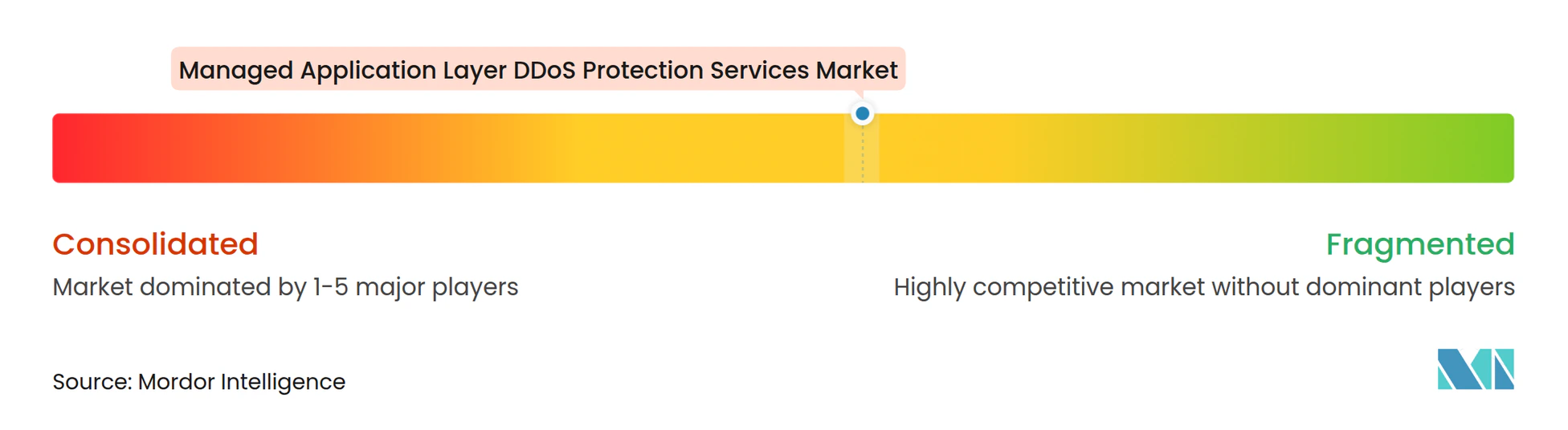
The managed application layer DDoS protection services market has a moderately consolidated upper tier that includes Akamai Technologies, Cloudflare, Radware, and NETSCOUT. These providers compete through global scrubbing capacity, traffic intelligence, managed detection, and the ability to support large enterprise customers. Regional and specialized competitors include Corero Network Security, Imperva, Vercara, Gcore, and Qrator Labs.
NETSCOUT closed its acquisition of DigiCert's DDoS protection business assets in May 2026. The company stated that the acquired assets were expected to contribute USD 20 million in annualized revenue to fiscal year 2027, while supporting the expansion of Arbor Cloud. In July 2026, NETSCOUT reported the doubling of Arbor Cloud capacity to 33 Tbps and AI-supported automation for up to 80% of DDoS attacks. Radware introduced web DDoS protection designed to detect and mitigate encrypted web attacks without TLS termination. These moves address the need for capacity, automation, and traffic inspection that respects customer privacy and compliance requirements.
Channel strategy is also central to the managed application layer DDoS protection services market. Carrier-embedded services can provide mitigation near network traffic and extend protection to mid-market buyers through existing business relationships. Spectrum Business expanded managed DDoS protection based on Radware's SecureLink and Cloud Always-On platforms. Chief Telecom introduced Godshield Pro in Taiwan with Radware in May 2026. Providers are also developing services for API behavior because conventional WAF controls may not fully address distributed application traffic. Opportunities remain in simpler managed packages for SMEs and in localized services that meet national data and compliance requirements.
Managed Application Layer DDoS Protection Services Industry Leaders
-
Akamai Technologies, Inc.
-
Cloudflare, Inc.
-
Radware Ltd.
-
Imperva, Inc.
-
NETSCOUT SYSTEMS, INC.
- *Disclaimer: Major Players sorted in no particular order
Managed Application Layer DDoS Protection Services Market Companies Covered in this Report
- Radware Ltd.
- Imperva, Inc.
- NETSCOUT SYSTEMS, INC.
- Corero Network Security plc
- Link11 GmbH
- Myra Security GmbH
- Nexusguard Limited
- StormWall Ltd.
- Haltdos Pte. Ltd.
- Gcore S.A.
- Qrator Labs LLC
- Servicepipe LLC
- DDoS-Guard Corp.
- Vercara, Inc.
- Path Network, Inc.
- Akamai Technologies, Inc.
- Cloudflare, Inc.
- Fastly, Inc.
- F5, Inc.
- A10 Networks, Inc.
Recent Industry Developments in Managed Application Layer DDoS Protection Services Market
- July 2026: NETSCOUT doubled Arbor Cloud DDoS mitigation capacity to 33 Tbps following its May 2026 acquisition of DigiCert's DDoS protection business assets. The DigiCert assets are expected to contribute USD 20 million in annualized revenue to fiscal year 2027 results, and the capacity expansion was paired with AI-driven infrastructure upgrades tightening alignment between threat intelligence and automated mitigation.
- July 2026: Radware named Spectrum Business its US Managed Security Services Partner of the Year, recognizing its expansion of managed DDoS protection services built on Radware's SecureLink and Cloud Always-On DDoS Protection platforms, serving enterprise and mid-market clients across 41 US states.
- May 2026: NETSCOUT closed its acquisition of DigiCert, Inc.'s DDoS protection business assets, an immediately accretive transaction strengthening Arbor Cloud with additional enterprise client relationships and providing infrastructure for accelerated cloud mitigation capacity investment.
- May 2026: Radware and Chief Telecom launched Godshield Pro, a subscription-based DDoS protection service for enterprises in Taiwan, combining Radware's AI-driven protection with Chief Telecom's local network backbone for in-network mitigation with elastic scaling to 30 Tbps global scrubbing capacity.
Global Managed Application Layer DDoS Protection Services Market Report Scope
The Managed Application Layer DDoS Protection Services Market refers to the market for specialized security services that detect, analyze, mitigate, and prevent distributed denial-of-service (DDoS) attacks targeting the application layer (Layer 7) of the network stack. These services protect websites, web applications, application programming interfaces (APIs), microservices, mobile applications, digital transaction platforms, gaming environments, and other internet-facing infrastructure from malicious traffic designed to exhaust application resources, disrupt service availability, or compromise digital operations.
The Managed Application Layer DDoS Protection Services Market Report is Segmented by Service Type (Traffic Monitoring and Detection, Traffic Scrubbing and Mitigation, Incident Response and Emergency Protection, Threat Intelligence and Reporting, Managed Web Application Firewall and API Protection), Deployment Model (Cloud-Based, Hybrid, On-Premises), Organization Size (Large Enterprises, and Small and Medium-Sized Enterprises), Application Type (Websites and Web Applications, APIs and Microservices, Mobile and Digital-Transaction Applications, Gaming and Interactive Platforms, DNS and Internet-Facing Infrastructure), Industry Vertical (BFSI, Information Technology and Telecommunications, Retail and E-Commerce, Healthcare and Life Sciences, Government and Defense, Media, Gaming and Entertainment, Other Industry Verticals ), and Geography (North America, South America, Europe, Asia-Pacific, Middle East, Africa). The Market Forecasts are Provided in Terms of Value (USD).
Segmentation Overview
| Traffic Monitoring and Detection |
| Traffic Scrubbing and Mitigation |
| Incident Response and Emergency Protection |
| Threat Intelligence and Reporting |
| Managed Web Application Firewall and API Protection |
| Cloud-Based |
| Hybrid |
| On-PremiseS |
| Large Enterprises |
| Small and Medium-Sized Enterprises |
| Websites and Web Applications |
| APIs and Microservices |
| Mobile and Digital-Transaction Applications |
| Gaming and Interactive Platforms |
| DNS and Internet-Facing Infrastructure |
| BFSI |
| Information Technology and Telecommunications |
| Retail and E-Commerce |
| Healthcare and Life Sciences |
| Government and Defense |
| Media, Gaming and Entertainment |
| Other Industry Verticals |
| North America | United States |
| Canada | |
| Mexico | |
| South America | Brazil |
| Argentina | |
| Rest of South America | |
| Europe | Germany |
| United Kingdom | |
| France | |
| Italy | |
| Spain | |
| Russia | |
| Rest of Europe | |
| Asia-Pacific | China |
| Japan | |
| India | |
| South Korea | |
| Southeast Asia | |
| Australia | |
| Rest of Asia-Pacific | |
| Middle East | Saudi Arabia |
| United Arab Emirates | |
| Israel | |
| Turkey | |
| Rest of Middle East | |
| Africa | South Africa |
| Nigeria | |
| Egypt | |
| Rest of Africa |
| By Service Type | Traffic Monitoring and Detection | |
| Traffic Scrubbing and Mitigation | ||
| Incident Response and Emergency Protection | ||
| Threat Intelligence and Reporting | ||
| Managed Web Application Firewall and API Protection | ||
| By Deployment Model | Cloud-Based | |
| Hybrid | ||
| On-PremiseS | ||
| By Organization Size | Large Enterprises | |
| Small and Medium-Sized Enterprises | ||
| By Application Type | Websites and Web Applications | |
| APIs and Microservices | ||
| Mobile and Digital-Transaction Applications | ||
| Gaming and Interactive Platforms | ||
| DNS and Internet-Facing Infrastructure | ||
| By Industry Vertical | BFSI | |
| Information Technology and Telecommunications | ||
| Retail and E-Commerce | ||
| Healthcare and Life Sciences | ||
| Government and Defense | ||
| Media, Gaming and Entertainment | ||
| Other Industry Verticals | ||
| By Geography | North America | United States |
| Canada | ||
| Mexico | ||
| South America | Brazil | |
| Argentina | ||
| Rest of South America | ||
| Europe | Germany | |
| United Kingdom | ||
| France | ||
| Italy | ||
| Spain | ||
| Russia | ||
| Rest of Europe | ||
| Asia-Pacific | China | |
| Japan | ||
| India | ||
| South Korea | ||
| Southeast Asia | ||
| Australia | ||
| Rest of Asia-Pacific | ||
| Middle East | Saudi Arabia | |
| United Arab Emirates | ||
| Israel | ||
| Turkey | ||
| Rest of Middle East | ||
| Africa | South Africa | |
| Nigeria | ||
| Egypt | ||
| Rest of Africa | ||
Key Questions Answered in the Report
What is the managed application layer DDoS protection services market size?
The managed application layer DDoS protection services market is projected at USD 1.96 billion in 2026, USD 2.23 billion in 2027, and USD 3.93 billion by 2032, at a CAGR of 14.87%.
What is driving demand for managed application-layer DDoS protection?
Rising web and API attacks, cloud adoption, and the need for automated mitigation are increasing demand for continuous managed services.
Which service type leads managed application-layer DDoS protection revenue?
Managed WAF and API Protection leads with a 35.32% share in 2026, combining web, bot, DDoS, and API controls.
Which deployment model is most widely used for application-layer DDoS protection?
Cloud-based delivery leads with 68.12% of revenue in 2026 and is projected to expand at a CAGR of 15.47% through 2032.
Which customer group is adopting these services fastest?
SMEs are projected to expand at a CAGR of 15.29% through 2032 as cloud subscriptions and managed service packages reduce operational barriers.
Which region is projected to expand fastest through 2032?
Asia-Pacific is projected to expand at a CAGR of 15.81% through 2032, supported by cloud adoption, digital payments, and public-facing services.