
Managed Data Classification and Discovery Services Market Size and Share
Market Overview
| Study Period | 2021 - 2032 |
|---|---|
| Market Size (2027) | USD 1.17 Billion |
| Market Size (2032) | USD 2.85 Billion |
| Growth Rate (2027 - 2032) | 19.37 % |
| Fastest Growing Market | Asia-Pacific |
| Largest Market | North America |
| Market Concentration | Medium |
Major Players *Disclaimer: Major Players sorted in no particular order Image © Mordor Intelligence. Reuse requires attribution under CC BY 4.0. | |
Managed Data Classification and Discovery Services Market Analysis by Mordor Intelligence
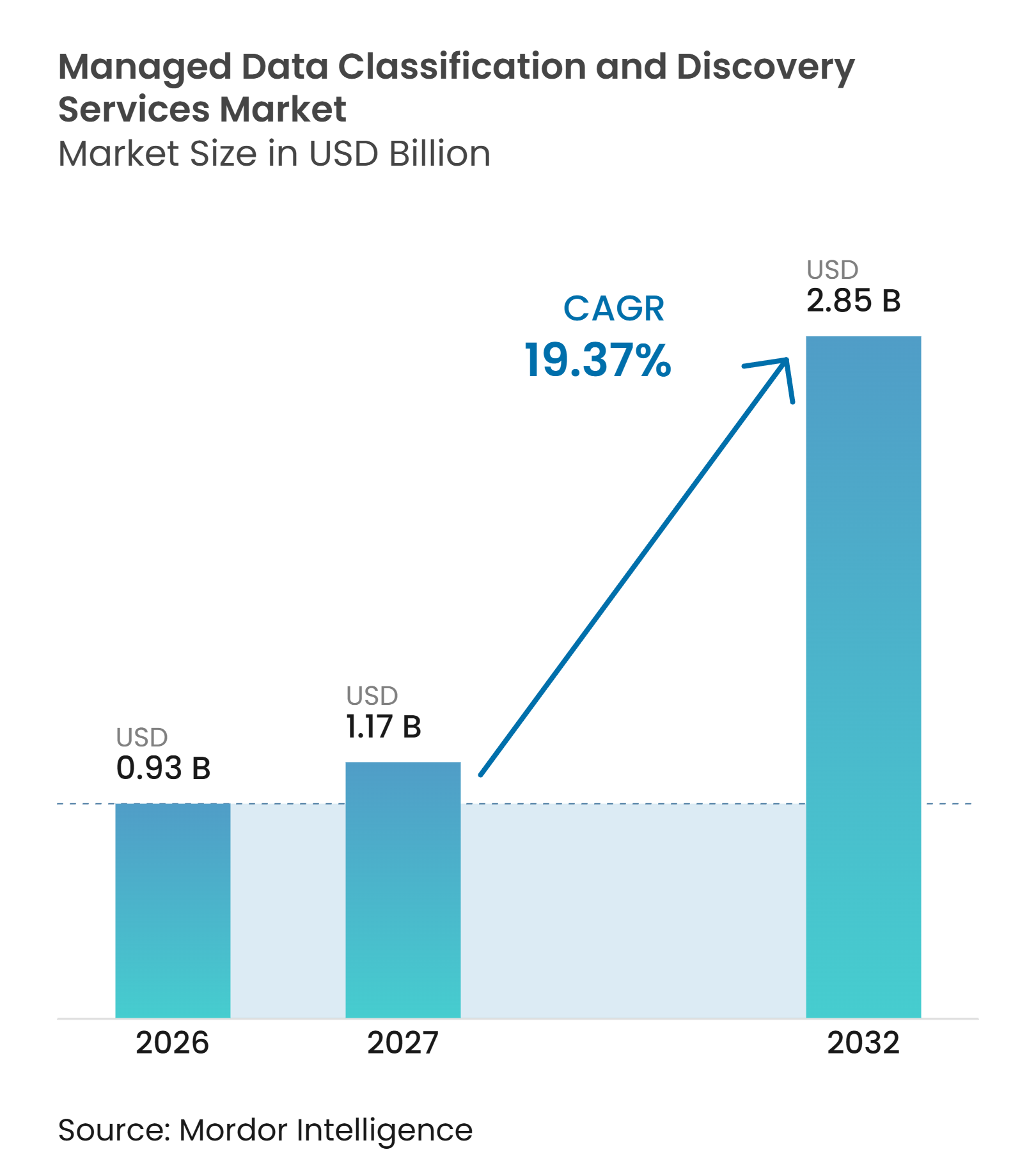
The Managed data classification and discovery services market size is projected to expand from USD 0.93 billion in 2026 and USD 1.17 billion in 2027 to USD 2.85 billion by 2032, registering a CAGR of 19.37% between 2027 to 2032. The Managed data classification and discovery services market is moving from periodic compliance work toward an ongoing service that supports data governance and AI use. Providers can take on recurring work such as retraining models, updating rules, and resolving classification issues, which helps clients use operating budgets rather than one-time internal projects. Data residency rules, cloud adoption, and the wider use of AI are increasing the need for continuous discovery and classification across business data. The Managed data classification and discovery services market also benefits when clients combine classification, security controls, access governance, and reporting under one contract. Accuracy, legacy-system integration, and shortages of governance specialists remain practical limits on deployment and provider capacity.
Key Report Takeaways
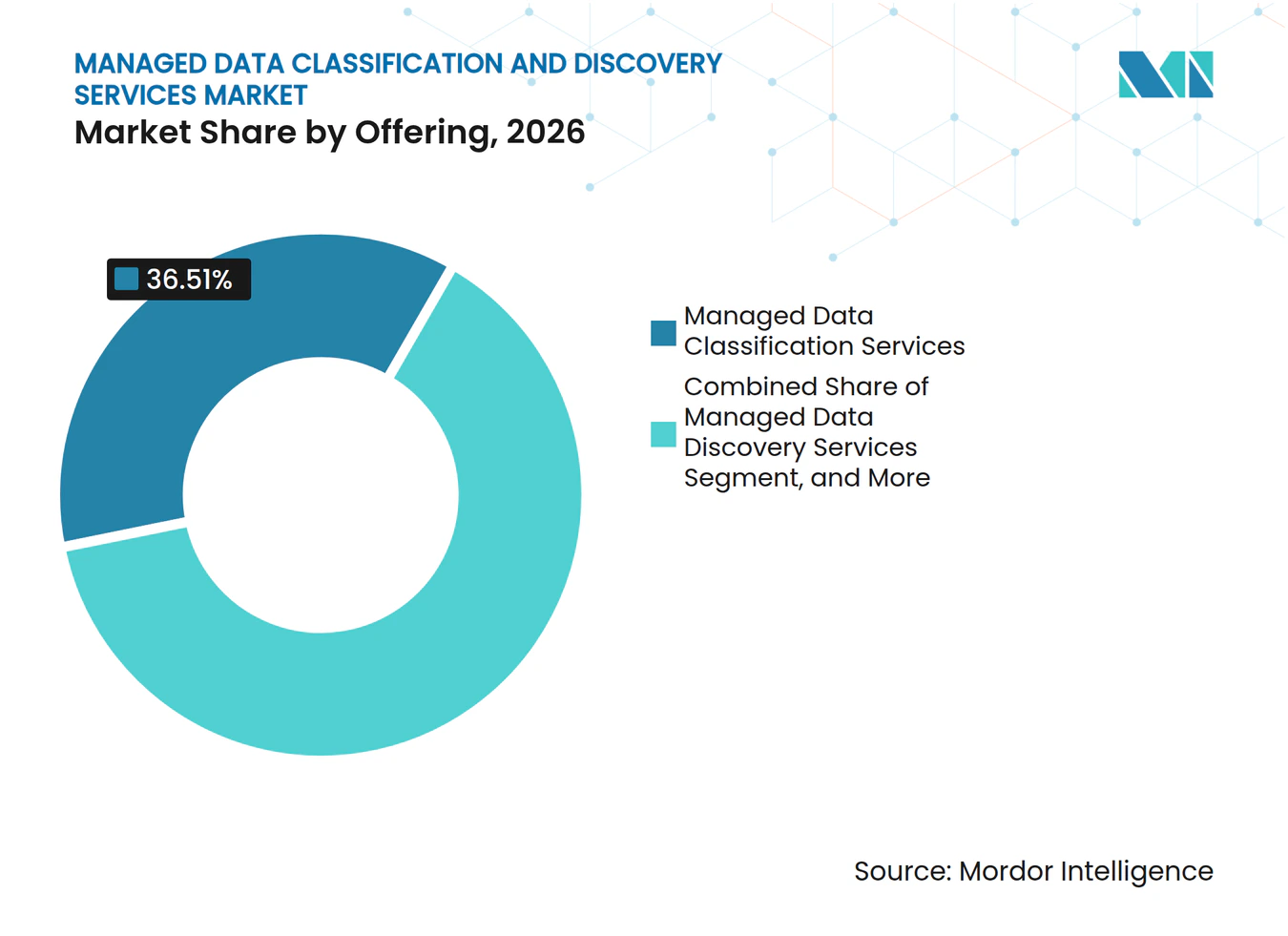
- By offering Managed Data Classification Services, which held 36.51% of revenue in 2026, while Integrated Managed Data Security Services is projected to expand at a 21.92% CAGR through 2032.
- By deployment model, cloud held 44.59% of revenue in 2026 and is projected to expand at a 22.54% CAGR through 2032 in the Managed data classification and discovery services market.
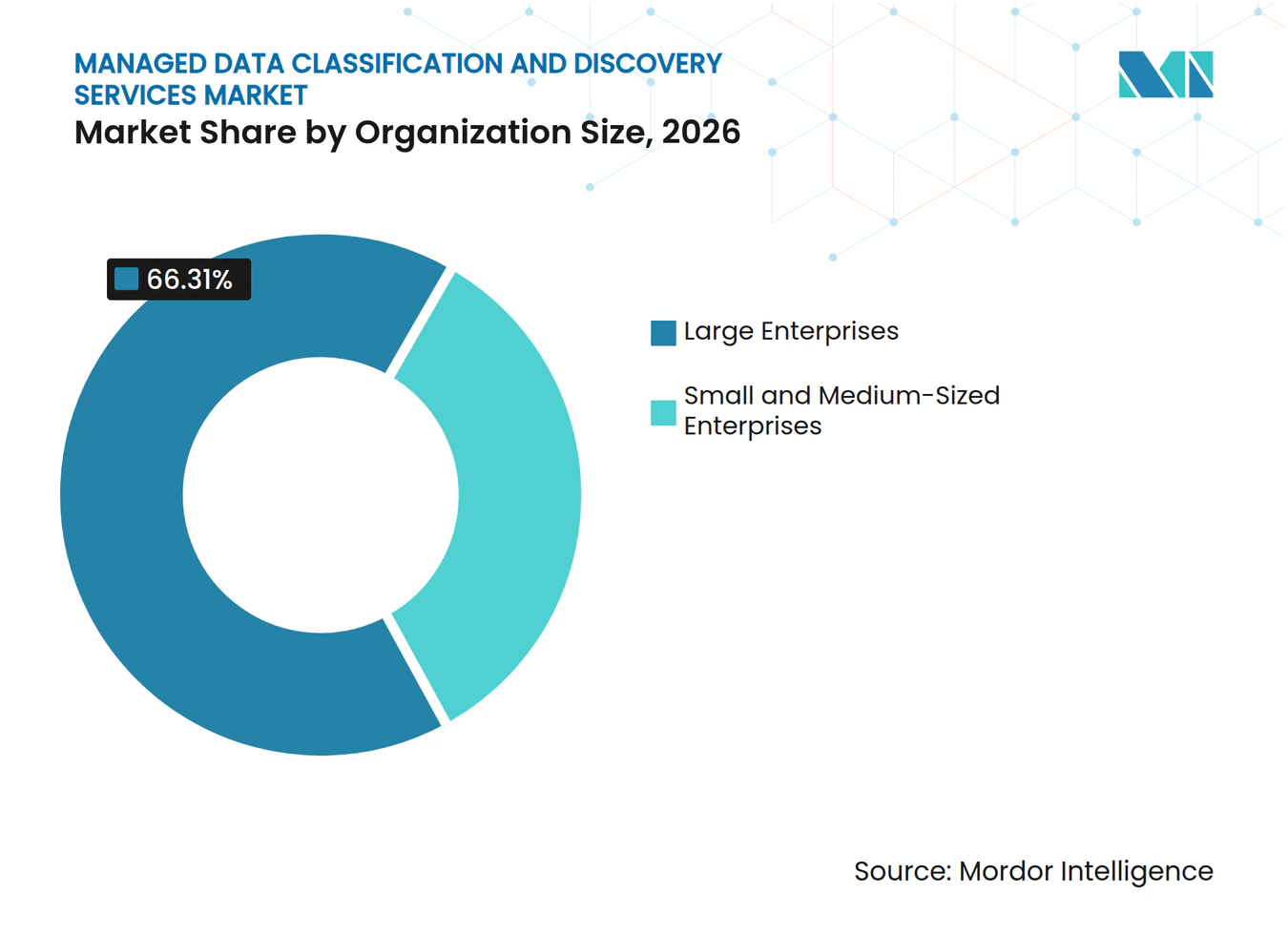
- By organization size, large enterprises accounted for 66.31% of revenue in 2026, while SMEs are projected to grow at a 22.38% CAGR through 2032.
- By industry vertical, BFSI held 25.58% of revenue in 2026, while Healthcare and Life Sciences are projected to expand at a 20.61% CAGR through 2032.
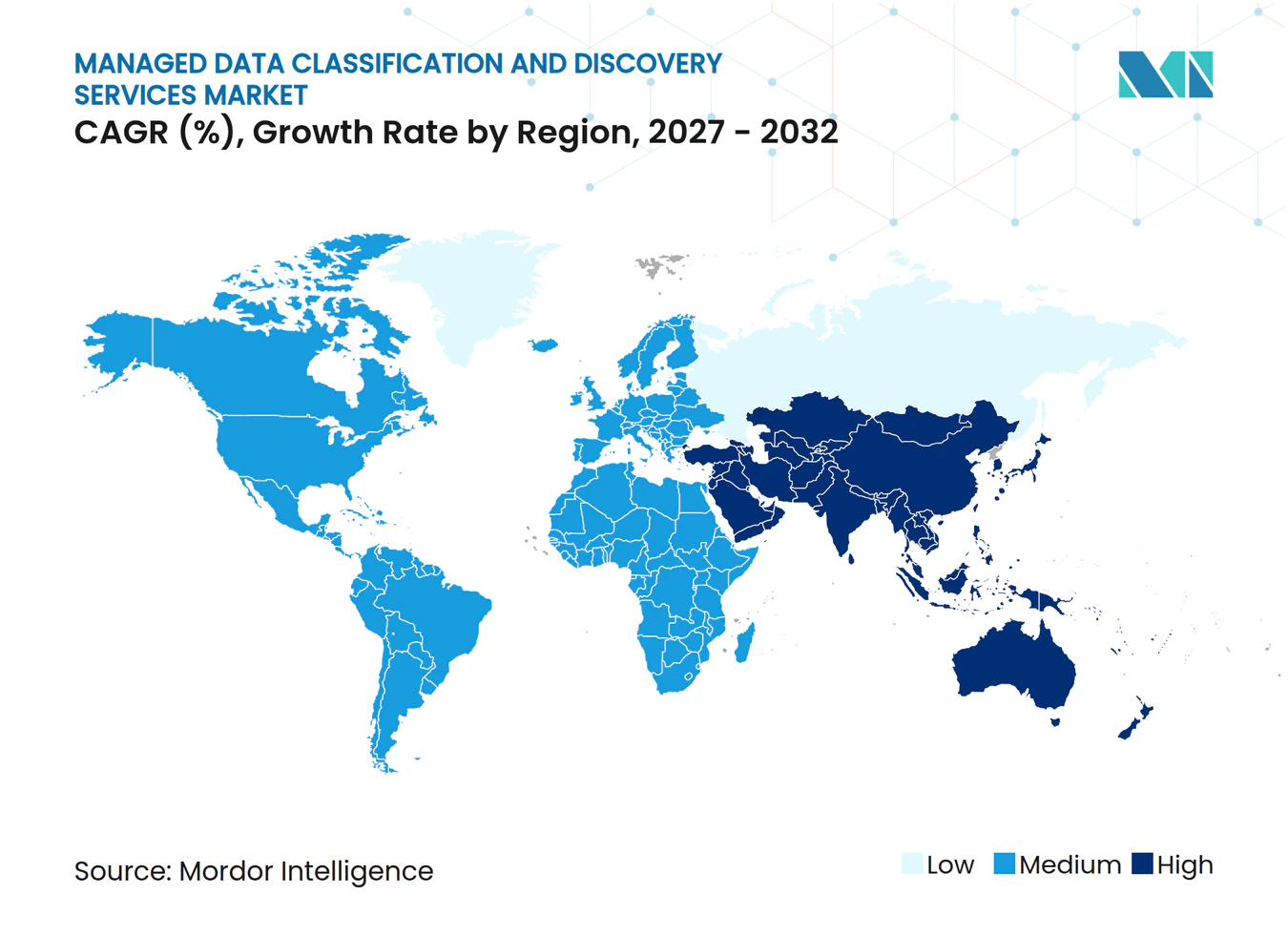
- By geography, North America held 38.42% of revenue in 2026, while Asia-Pacific is projected to expand at a 22.77% CAGR through 2032.
Note: Market numbers in this report are based on Mordor Intelligence's proprietary estimation framework, which combines nine months of actuals with Q4 projections for base year 2026.
Market Trends and Insights
Drivers Impact Analysis of Managed Data Classification and Discovery Services Market*
| Driver | (~) % Impact on CAGR Forecast | Geographic Relevance | Impact Timeline |
|---|---|---|---|
| Expansion of Privacy and Data-Residency Obligations | +4.8% | Global, with intensity in EU, Asia-Pacific, and India | Medium term (2-4 years) |
| Rising Volumes of Structured and Unstructured Enterprise Data | +4.2% | Global | Long term (≥ 4 years) |
| Growth of Cloud, SaaS, and Multicloud Data Sprawl | +3.8% | North America and EU, spillover to Asia-Pacific | Medium term (2-4 years) |
| Increasing Adoption of Zero-Trust Security and Automated Compliance | +3.2% | North America, EU, and Australia | Medium term (2-4 years) |
| AI-Agent Data Access Requiring Continuous Classification | +2.5% | Global | Short term (≤ 2 years) |
| Localized Classification for Legacy and Low-Connectivity Repositories | +1.5% | South America, Middle East and Africa, and Southeast Asia | Long term (≥ 4 years) |
| Source: Mordor Intelligence | |||
Expansion of Privacy and Data-Residency Obligations
Data residency obligations are creating a sustained need for managed classification, as enterprises must identify which data they hold and where it can be processed. These requirements vary by data category, transfer condition, and audit expectation, making a periodic inventory inadequate for large organizations. The Managed data classification and discovery services market, therefore, gains from continuous work rather than being limited to a single compliance review. The resulting review, documentation, and remediation work favor providers that can update classifications as data sets and obligations change. This can make managed delivery more relevant for organizations with operations across several jurisdictions.
Rising Volumes of Structured and Unstructured Enterprise Data
Rising volumes of structured and unstructured information are widening the gap between what enterprises store and what internal teams can review. Proofpoint reported that more than 29% of organizations experienced at least 30% data growth in the preceding year, and more than 25% managed over 1 petabyte. Documents, collaboration content, and AI-generated material are harder to classify consistently with simple rules. The Managed data classification and discovery services market can address this issue through recurring discovery cycles and model maintenance. Managed providers can also absorb the effort required when clients introduce new data formats or revise internal taxonomies. The result is a service relationship that focuses on maintaining usable classification rather than producing a static inventory.
Growth of Cloud, SaaS, and Multicloud Data Sprawl
Cloud, SaaS, and multicloud deployments distribute sensitive data across environments with different controls and metadata practices. Proofpoint found that nearly 2 in 3 organizations used 6 or more data-security vendors, which can weaken visibility across repositories. This fragmentation makes it harder for internal teams to sustain unified discovery and classification. The Managed data classification and discovery services market presents an opportunity for clients seeking a consolidated view across cloud repositories, file systems, and collaboration platforms. In February 2026, ASEAN endorsed a regional framework for cross-border cloud computing, including Trusted Data Corridors for regulated sectors. This framework can reduce hesitation toward cloud-based classification services in Southeast Asia while keeping governance requirements in view.
Increasing Adoption of Zero-Trust Security and Automated Compliance
Zero-trust security places greater value on data classification because access decisions can account for the sensitivity of the requested information. Classification metadata can help align access controls with users, data, and operating contexts. The US Department of Defense zero-trust roadmap identifies automated data discovery and classification as part of advanced data capabilities.[1] Requirements of this kind can influence the expectations of contractors and organizations that align their controls with public-sector standards. The Managed data classification and discovery services market can benefit as engagements shift from periodic scans to ongoing access governance work. A broader contract scope can strengthen customer retention when classification results are integrated into daily security and compliance workflows.
Restraints Impact Analysis of Managed Data Classification and Discovery Services Market*
| Restraint | (~) % Impact on CAGR Forecast | Geographic Relevance | Impact Timeline |
|---|---|---|---|
| High False-Positive Rates and Classification Trust Erosion | -1.6% | Global | Short term (≤ 2 years) |
| Complex Integration Across Legacy and Bespoke Data Sources | -1.2% | North America, Europe, and South America | Medium term (2-4 years) |
| Shortage of Data Governance and Remediation Specialists | -0.9% | Global, acute in EU and North America | Long term (≥ 4 years) |
| High Cost of Full-Environment Scanning and Continuous Reclassification | -0.7% | Emerging markets and SMEs globally | Medium term (2-4 years) |
| Source: Mordor Intelligence | |||
High False-Positive Rates and Classification Trust Erosion
False positives can reduce confidence in classification programs when routine business content is repeatedly identified as sensitive. A 2025 study found that 65% of security analysts preferred hybrid human-AI oversight to full automation.[2] This preference shows why clients may retain human review even when automated engines are available. If error rates remain high, teams can add exclusion lists that reduce coverage and create gaps that appear during an audit. The Managed data classification and discovery services market must therefore compete on validation quality as well as breadth of coverage. Providers that combine automation with targeted human review can better address trust issues without sacrificing continuous operation.
Complex Integration Across Legacy and Bespoke Data Sources
Legacy systems and bespoke repositories can slow managed classification because they may lack consistent schemas or a usable classification interface. The issue is material in environments that use older enterprise resource planning systems, operational technology, proprietary databases, or custom data structures. A study on data classification methods notes that implementation must account for the varied characteristics of data and operating environments. Industrial and energy settings can be difficult because operational protocols may not provide metadata that classification engines can interpret directly. Providers may need custom connectors and more extensive onboarding before continuous scanning becomes practical. These demands can extend implementation timelines and make costs harder to define early in a client engagement.
*Our forecasts treat driver/restraint impacts as directional, not additive. The impact forecasts reflect baseline growth, mix effects, and variable interactions.
Managed Data Classification and Discovery Services Market Segment Analysis
By Offering:
Classification Services Anchor Revenue as Integrated Security Bundles ScaleManaged Data Classification Services held 36.51% market share in the Managed data classification and discovery services market in 2026, making it the leading offering. Classification is usually the initial service layer because an organization must first identify the type and sensitivity of its data. This service can establish the data inventory that later supports discovery, access governance, and compliance reporting. It also gives providers an entry point into client processes that require continuing data review. Managed Data Discovery Services ranked second-largest because enterprises need ongoing visibility across evolving cloud repositories and collaboration platforms.
Integrated Managed Data Security Services is projected to expand at a 21.92% CAGR through 2032. Buyers are increasingly seeking contracts that connect classification, discovery, security posture management, access governance, and compliance reporting. This preference can reduce the burden of managing several separate tools and service relationships. The Managed data classification and discovery services industry is responding by bringing these functions into broader platform and managed-service offerings. The resulting bundle can support higher contract values when the provider is responsible for both identifying data and helping manage its protection.



By Deployment Model:
Cloud Dominates and Accelerates as Hybrid Anchors Regulated SectorsCloud accounted for 44.59% of revenue in 2026 and is the leading deployment model. Scalable SaaS delivery supports classification across distributed workloads without requiring every client to operate the same level of internal infrastructure. Cloud delivery also suits organizations that need coverage across multiple environments. The model is especially relevant when data moves between repositories faster than a conventional annual review can keep pace with. It also supports subscription-based services that can be adjusted as data estates change.
Cloud is projected to expand at a 22.54% CAGR through 2032, making it the fastest-growing deployment model. The ASEAN regional cloud framework, endorsed in 2026, can foster greater comfort with cloud-based governance services for regulated Southeast Asian use cases. On-premises and hybrid models still matter when defense, critical infrastructure, or sovereign cloud requirements limit where data can be examined. Concentric AI introduced Private Scan Manager for AWS GovCloud in January 2026 to support classification and compliance work in air-gapped environments. The Managed data classification and discovery services market will therefore continue to require deployment choices that reflect security and residency needs.
By Organization Size:
Large Enterprises Lead While SMEs Emerge as Growth CatalystLarge enterprises held 66.31% of revenue in 2026, reflecting the scale of their regulatory exposure and multinational data estates. In the Managed data classification and discovery services market, these organizations often manage large volumes of customer, operational, and employee information across many systems. Their accumulated classification work can include scanning programs that run for years and uncover large remediation backlogs. This scale favors managed providers that can coordinate discovery, policy updates, and remediation workflows. Large accounts can also support deeper integrations across cloud and internal repositories.
SMEs are projected to expand at a 22.38% CAGR through 2032. Their demand is supported by a broader compliance perimeter and by cloud-native services that reduce the need for extensive internal teams. Subscription services can offer lower onboarding friction than programs designed for the largest enterprises. The Managed data classification and discovery services industry can reach this cohort by making enterprise governance practices more accessible as a managed service. Providers that make outcomes clear and implementation manageable are better positioned to serve smaller organizations.

By Industry Vertical:
BFSI Leads on Regulatory Density While Healthcare Accelerates on PHI ComplexityBFSI accounted for 25.58% of revenue in 2026, making it the largest vertical. Financial institutions operate under overlapping requirements for customer information, data quality, payment security, and supervisory review. They also handle large data estates, making continuous discovery and classification more practical than manual review. The Managed data classification and discovery services market meets this need through the ongoing identification of sensitive records and the monitoring of unauthorized access. The scale and sensitivity of financial data can make managed services a useful option when internal governance teams need additional capacity.
Healthcare and Life Sciences are projected to expand at a 20.61% CAGR through 2032. Protected health information now extends across telehealth, imaging archives, research data sets, connected devices, cloud repositories, and third-party processors. Censinet described dynamic classification as relevant to identifying protected health information across cloud repositories and supporting HIPAA compliance. This operating environment increases the value of classification that is current rather than limited to a historical record. Government and Public Administration, IT and Telecommunications, Retail and E-Commerce, Industrial Manufacturing, and Energy and Utilities provide a diversified base of remaining demand.
Geography Analysis
North America Managed Data Classification and Discovery Services Market
North America held 38.42% of the Managed data classification and discovery services market share in 2026, making it the largest regional contributor. The region benefits from advanced cybersecurity spending, broad cloud use, and formal privacy requirements. The US Department of Defense zero-trust roadmap identifies automated discovery and classification as part of advanced data capabilities. Such requirements can influence procurement standards for federal contractors and related organizations. The United States provides most of the regional revenue, while Canada and Mexico underscore the need for coordinated treatment of cross-border data flows.
Europe Managed Data Classification and Discovery Services Market
Europe is the second-largest regional cluster in the Managed data classification and discovery services market. Enterprises in Germany, the United Kingdom, and France have significant requirements in financial services and industrial manufacturing. These organizations often operate complex data estates and face stringent supervisory expectations, while Italy, Spain, and other European markets are developing classification programs at a steadier pace. The regional opportunity depends on service models that support different national requirements while retaining a consolidated view of enterprise data.
APAC, MEA and South America Managed Data Classification and Discovery Services Market
Asia-Pacific is projected to expand at a 22.77% CAGR through 2032, making it the fastest-growing region. Sovereign cloud policies, data residency requirements, and enterprise AI adoption are increasing the need to establish reliable data categories. The ASEAN cloud framework endorsed in February 2026 included Trusted Data Corridors for regulated sectors. India, Singapore, Japan, South Korea, and Australia are important locations for this work because cloud architecture and governance requirements are evolving together. The Middle East and Africa are developing steadily through digital government programs and broader data protection activity, while South America is an earlier-stage opportunity centered on financial services and retail.
Competitive Landscape
Market Concentration
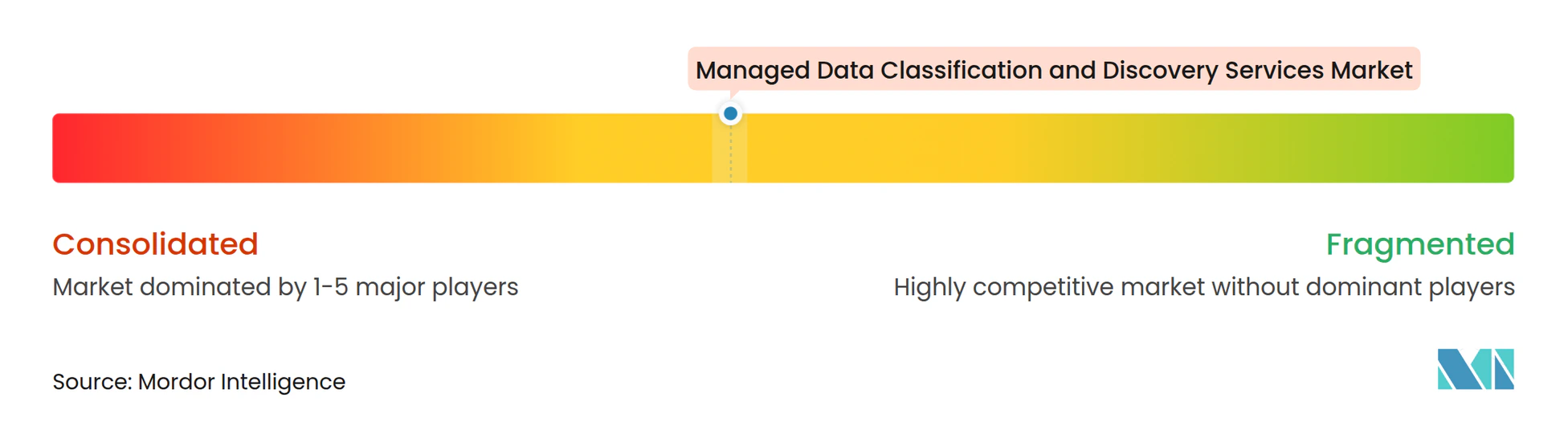
The Managed data classification and discovery services market is moderately concentrated among vendors, while its delivery models remain fragmented. Hyperscaler-adjacent platforms, specialist providers, and managed security service providers compete for enterprise contracts. Large platforms are seeking to combine data classification with access governance, AI security posture management, and compliance automation. This approach can make a broader vendor relationship more attractive to buyers who want fewer separate control systems.
Platform consolidation is a defining feature of the 2026 competitive environment. In October 2026, Proofpoint announced a USD 6.3 billion all-cash acquisition of Varonis Systems, combining Varonis' data and AI security capabilities with Proofpoint's cybersecurity capabilities. In December 2025, Veeam completed its acquisition of Securiti AI and incorporated the DataAI Command Center into its data protection platform.[3] Cyera made its data security posture management platform available through AWS Security Hub in February 2026, thereby integrating classification outputs into established cloud security workflows. These moves show that classification is becoming part of wider security and governance portfolios rather than a separate point capability.
Specialists such as Spirion, PKWARE, Nightfall AI, Sentra, Ground Labs, and Dathena focus on particular data types and vertical use cases. This specialization can be important for protected health information, payment data, intellectual property, and other content where general-purpose engines may not achieve the required accuracy. A notable gap remains in operational technology and industrial data, including sensor logs, SCADA records, and engineering drawings, which may require custom connectors. Concentric AI expanded sensitive-data discovery for documents with consistent visual signatures in August 2026. The Managed data classification and discovery services market offers providers room to differentiate through AI-driven content coverage, industry-specific connectors, and managed remediation support.
Managed Data Classification and Discovery Services Industry Leaders
-
Varonis Systems, Inc.
-
BigID, Inc.
-
Cyera, Inc.
-
Securiti, Inc.
-
archTIS Limited
- *Disclaimer: Major Players sorted in no particular order
Managed Data Classification and Discovery Services Market Companies Covered in this Report
- Varonis Systems, Inc.
- BigID, Inc.
- Cyera, Inc.
- Securiti, Inc.
- Spirion, LLC
- Ground Labs Pte. Ltd.
- PKWARE, Inc.
- Netwrix Corporation
- Nightfall AI, Inc.
- Sentra, Inc.
- DataSunrise, Inc.
- Dathena Science Pte. Ltd.
- 1touch.io, Inc.
- Concentric AI, Inc.
- MinerEye Ltd.
- ActiveNav, Inc.
- Dataguise, Inc.
- Safetica Technologies s.r.o.
- MENTIS, Inc.
- GTB Technologies, Inc.
- Seclore Technology Private Limited
Recent Industry Developments in Managed Data Classification and Discovery Services Market
- October 2026: Proofpoint announced a USD 6.3 billion all-cash acquisition of Varonis Systems, Inc., combining Varonis's data and AI security platform with Proofpoint's human and agent cybersecurity capabilities. Unanimously approved by the Varonis board and expected to close in the first half of 2027, the deal is financed by Thoma Bravo committed equity and co-investment from Ontario Teachers' Pension Plan. Varonis will be delisted from Nasdaq upon closing.
- September 2026: Concentric AI strengthened its executive leadership team to support growing global demand for AI and data security governance, signaling organizational scale-up ahead of geographic and vertical expansion.
- March 2026: Netwrix expanded its 1Secure platform to deliver visibility and governance over how AI agents and assistants, including Microsoft Copilot, access sensitive data, adding expanded discovery and classification capabilities across collaboration platforms, file systems, and cloud environments, and introducing AI data loss prevention blocking sensitive data from being shared via AI prompts in browsers.
- February 2026: Cyera made its data security posture management platform available through AWS Security Hub on an extended plan, integrating classification outputs directly into existing cloud-security workflows for AWS-native enterprise buyers.
Global Managed Data Classification and Discovery Services Market Report Scope
The Managed Data Classification and Discovery Services Market refers to the market for outsourced and professionally managed services that enable organizations to identify, discover, classify, organize, and protect structured and unstructured data across their IT environments. These services help organizations locate sensitive, confidential, regulated, and business-critical information across cloud, on-premises, and hybrid infrastructures, enabling improved data visibility, governance, privacy management, regulatory compliance, and information security.
The Managed Data Classification and Discovery Services Market is Segmented by Offering (Managed Data Classification Services, Managed Data Discovery Services, Integrated Managed Data Security Services, and Other Managed Data Services), Deployment Model (Cloud, On-Premises, and Hybrid), Organization Size (Large Enterprises and Small and Medium-Sized Enterprises), Industry Vertical (BFSI, Healthcare and Life Sciences, Government and Public Administration, IT and Telecommunications, Retail and E-Commerce, Industrial Manufacturing, Energy and Utilities, and Other Industry Verticals), and Geography (North America, South America, Europe, Asia-Pacific, and Middle East and Africa). The Market Forecasts are Provided in Terms of Value (USD).
Segmentation Overview
| Managed Data Classification Services |
| Managed Data Discovery Services |
| Integrated Managed Data Security Services |
| Other Managed Data Services |
| Cloud |
| On-Premises |
| Hybrid |
| Large Enterprises |
| Small and Medium-Sized Enterprises |
| BFSI |
| Healthcare and Life Sciences |
| Government and Public Administration |
| Information Technology and Telecommunications |
| Retail and E-Commerce |
| Industrial Manufacturing |
| Energy and Utilities |
| Other Industry Verticals |
| North America | United States |
| Canada | |
| Mexico | |
| South America | Brazil |
| Argentina | |
| Chile | |
| Rest of South America | |
| Europe | Germany |
| United Kingdom | |
| France | |
| Italy | |
| Russia | |
| Spain | |
| Rest of Europe | |
| Asia-Pacific | China |
| Japan | |
| India | |
| South Korea | |
| Australia | |
| Singapore | |
| Rest of Asia-Pacific | |
| Middle East | United Arab Emirates |
| Saudi Arabia | |
| Turkey | |
| Rest of Middle East | |
| Africa | South Africa |
| Nigeria | |
| Kenya | |
| Rest of Africa |
| By Offering | Managed Data Classification Services | |
| Managed Data Discovery Services | ||
| Integrated Managed Data Security Services | ||
| Other Managed Data Services | ||
| By Deployment Model | Cloud | |
| On-Premises | ||
| Hybrid | ||
| By Organization Size | Large Enterprises | |
| Small and Medium-Sized Enterprises | ||
| By Industry Vertical | BFSI | |
| Healthcare and Life Sciences | ||
| Government and Public Administration | ||
| Information Technology and Telecommunications | ||
| Retail and E-Commerce | ||
| Industrial Manufacturing | ||
| Energy and Utilities | ||
| Other Industry Verticals | ||
| By Geography | North America | United States |
| Canada | ||
| Mexico | ||
| South America | Brazil | |
| Argentina | ||
| Chile | ||
| Rest of South America | ||
| Europe | Germany | |
| United Kingdom | ||
| France | ||
| Italy | ||
| Russia | ||
| Spain | ||
| Rest of Europe | ||
| Asia-Pacific | China | |
| Japan | ||
| India | ||
| South Korea | ||
| Australia | ||
| Singapore | ||
| Rest of Asia-Pacific | ||
| Middle East | United Arab Emirates | |
| Saudi Arabia | ||
| Turkey | ||
| Rest of Middle East | ||
| Africa | South Africa | |
| Nigeria | ||
| Kenya | ||
| Rest of Africa | ||
Key Questions Answered in the Report
What is the managed data classification and discovery services market size?
The Managed data classification and discovery services market is projected to expand from USD 0.93 billion in 2026 and USD 1.17 billion in 2027 to USD 2.85 billion by 2032, at a 19.37% CAGR. The Managed data classification and discovery services market reflects a shift toward continuous classification, discovery, governance, and remediation support instead of a one-time data inventory.
What is driving demand for managed data classification services?
The Managed data classification and discovery services market is supported by data-residency obligations, higher volumes of structured and unstructured data, cloud sprawl, and zero-trust security requirements. These factors increase the need to identify data consistently as it moves between repositories, users, and applications, while requiring providers to maintain rules and validate classifications over time.
Which offering leads managed data classification and discovery services?
Managed Data Classification Services led with 36.51% of revenue in 2026, while Integrated Managed Data Security Services is projected to have the fastest expansion at a 21.92% CAGR. The Managed data classification and discovery services market is moving toward bundled service relationships that link classification with discovery, security controls, access governance, and compliance reporting under a single provider relationship.
Why is cloud important for managed data classification?
Cloud held 44.59% of revenue in 2026 and is projected to expand at a 22.54% CAGR, supported by distributed workloads and SaaS delivery. The Managed data classification and discovery services market needs cloud coverage because clients store sensitive information across providers, collaboration tools, file systems, and business applications that can change more frequently than a standard annual review.
Which customer group is expanding fastest?
SMEs are projected to expand at a 22.38% CAGR through 2032 as subscription-based services reduce onboarding barriers. The Managed data classification and discovery services market can serve these organizations through cloud-native options that limit the need for large internal teams, complex customized programs, and substantial upfront technical work.
Which region is expected to expand fastest?
Asia-Pacific is projected to expand at a 22.77% CAGR through 2032, supported by data-residency policies, cloud governance needs, and AI adoption. The Managed data classification and discovery services market is relevant in this region because policy and cloud-architecture decisions increasingly require organizations to understand the sensitivity, location, and permitted use of their data.