
Managed Data Security Posture Management (DSPM) Services Market Size and Share
Market Overview
| Study Period | 2021 - 2032 |
|---|---|
| Market Size (2027) | USD 1.48 Billion |
| Market Size (2032) | USD 3.89 Billion |
| Growth Rate (2027 - 2032) | 21.32 % |
| Fastest Growing Market | Asia-Pacific |
| Largest Market | North America |
| Market Concentration | Medium |
Major Players *Disclaimer: Major Players sorted in no particular order Image © Mordor Intelligence. Reuse requires attribution under CC BY 4.0. | |
Managed Data Security Posture Management (DSPM) Services Market Analysis by Mordor Intelligence
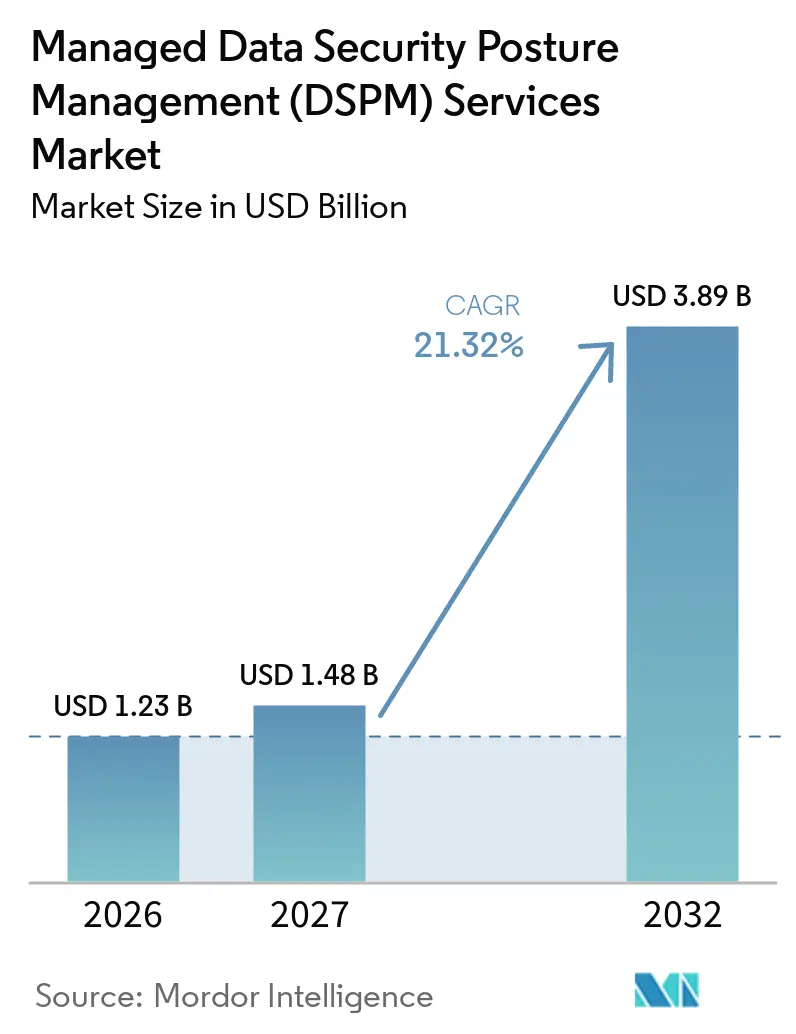
The managed data security posture management (DSPM) services market size was valued at USD 1.23 billion in 2026 and is estimated to expand from USD 1.48 billion in 2027 to reach USD 3.89 billion by 2032, at a CAGR of 21.32% during the forecast period (2027-2032). The managed data security posture management (DSPM) services market is supported by the expansion of multicloud data estates and the need for continuous visibility across cloud, SaaS, and legacy data environments. Regulatory requirements are making data sovereignty, encryption key control, and supplier oversight more central to service contracts. Providers are combining managed operations with advisory, implementation, and AI data governance capabilities to meet these requirements. The managed DSPM services market also faces deployment delays where older databases and fragmented security tools lack standardized integrations. Consolidation is reshaping competition as broader security platforms add data discovery, classification, and remediation capabilities.
Key Report Takeaways
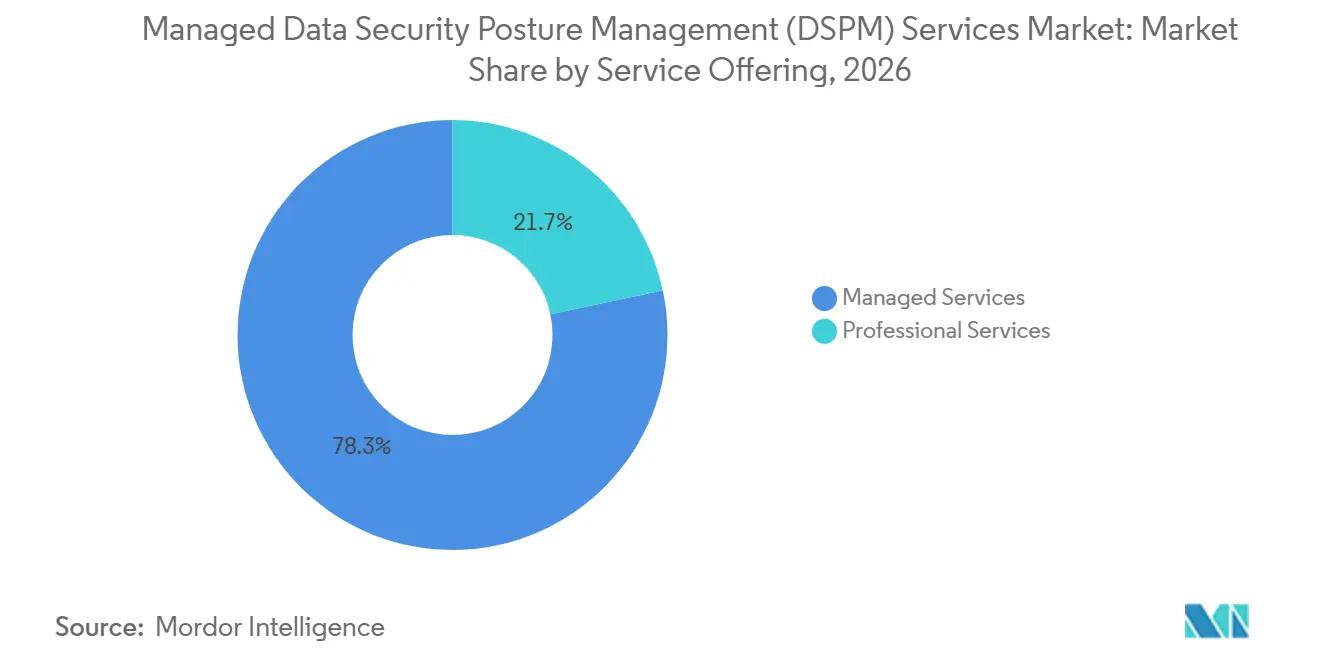
- By service offering, managed services held 78.32% of revenue in the managed data security posture management (DSPM) services market in 2026, while professional services are projected to expand at a 22.73% CAGR through 2032.
- By delivery model, fully managed data security posture management (DSPM) services accounted for 26.41% of revenue in 2026 and are projected to expand at a 23.61% CAGR through 2032.
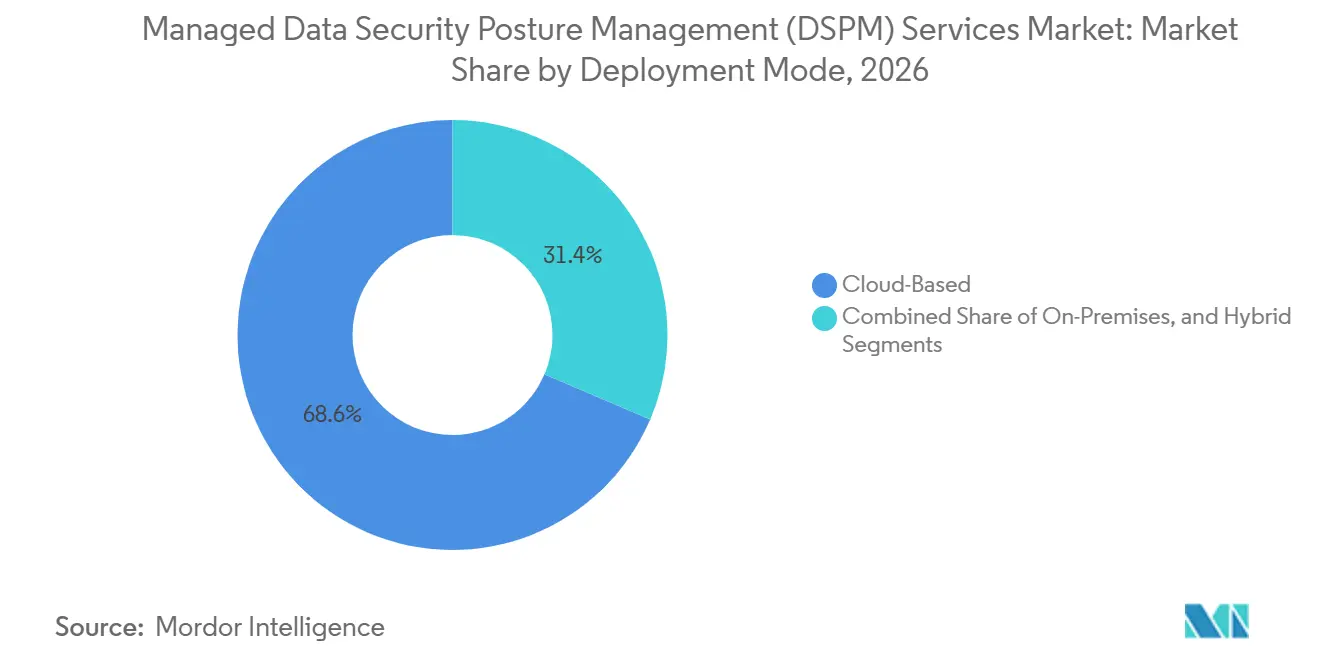
- By deployment environment, cloud-based deployment accounted for 68.58% of revenue in 2026 and is projected to grow at a 23.92% CAGR through 2032.
- By service function, data discovery and classification accounted for 26.91% of revenue in the managed data security posture management (DSPM) services market in 2026, while data access governance is projected to expand at a 24.82% CAGR through 2032.
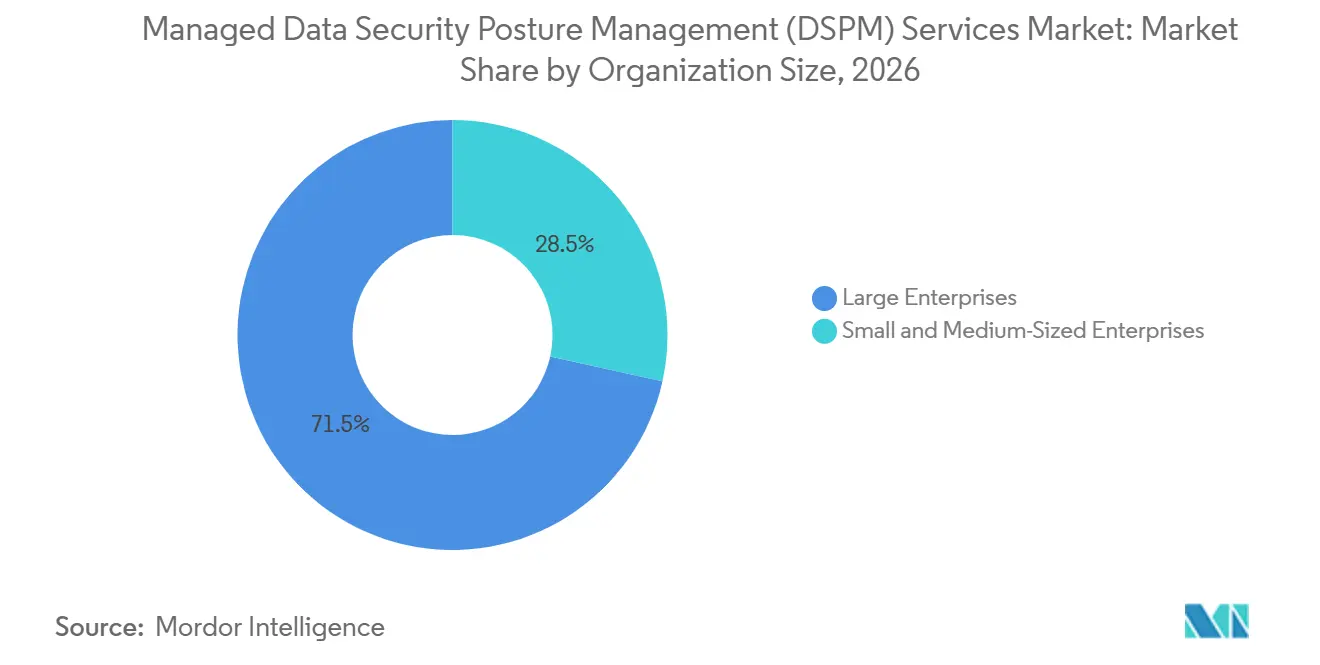
- By organization size, large enterprises held 71.54% of revenue in 2026, while small and medium-sized enterprises are projected to expand at a 23.82% CAGR through 2032.
- By industry vertical, BFSI accounted for 27.69% of revenue in 2026, while IT and telecommunications are projected to expand at an 18.54% CAGR through 2032.
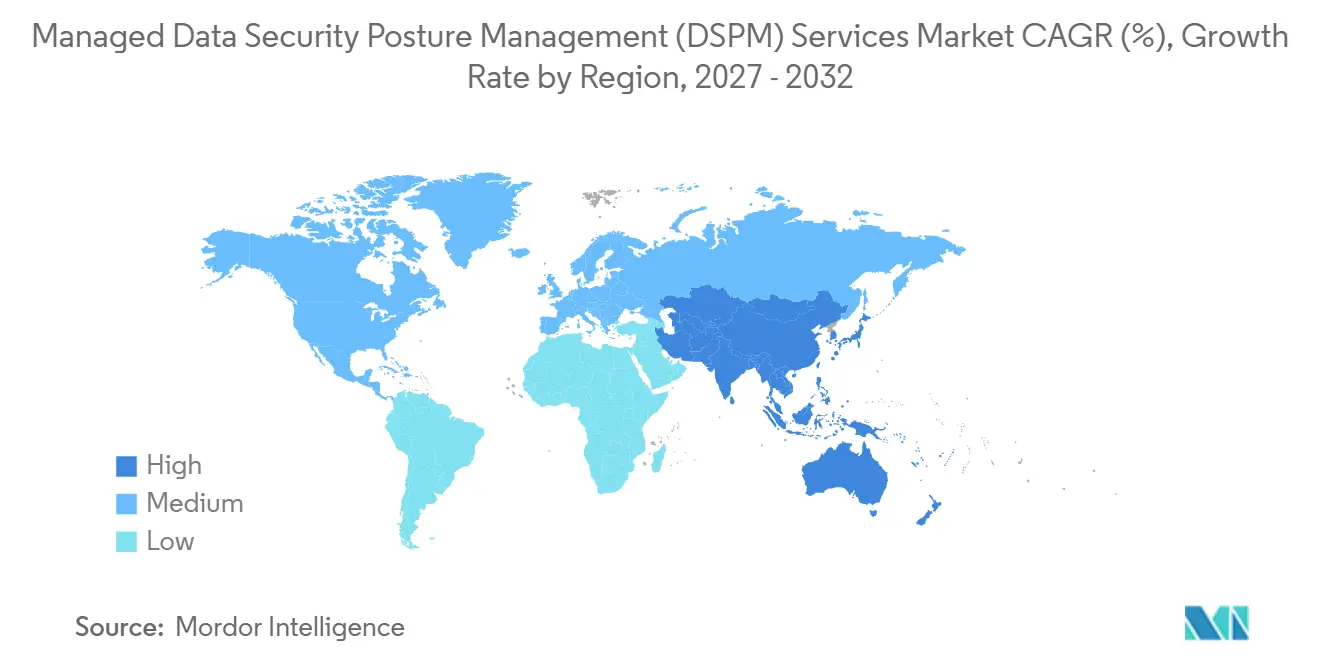
- By geography, North America held 38.64% of the managed DSPM services market in 2026, while Asia-Pacific is projected to expand at a 22.86% CAGR through 2032.
Note: Market numbers in this report are based on Mordor Intelligence's proprietary estimation framework, which combines nine months of actuals with Q4 projections for base year 2026.
Market Trends and Insights
Drivers Impact Analysis of Managed Data Security Posture Management (DSPM) Services Market*
| DRIVER | (~) % IMPACT ON CAGR FORECAST | GEOGRAPHIC RELEVANCE | IMPACT TIMELINE |
|---|---|---|---|
| Expansion of Multicloud and Hybrid Data Estates | +4.5% | Global, most acute in North America and Asia-Pacific | Short term (≤ 2 years) |
| Escalating Regulatory and Data Sovereignty Obligations | +3.5% | EU core, spill-over to Asia-Pacific and Middle East | Medium term (2-4 years) |
| Rising Breach, Ransomware, and Sensitive-Data Exposure Risk | +3.0% | Global, with North America and Europe as high-frequency breach regions | Short term (≤ 2 years) |
| Zero-Trust and AI Data Governance Adoption | +2.5% | North America and Europe, with early adoption in Asia-Pacific | Medium term (2-4 years) |
| Shortage of Specialized DSPM Operations Talent | +2.0% | Global, most severe in Asia-Pacific and South America | Short term (≤ 2 years) |
| Shift Toward Outcome-Based Continuous Data Security Operations | +1.5% | North America and Europe | Long term (≥ 4 years) |
| Source: Mordor Intelligence | |||
Expansion of Multicloud and Hybrid Data Estates
The managed data security posture management (DSPM) services market depends on the ability to maintain visibility across cloud environments that use different security models, logs, and access controls. NIST identified 23 consolidated challenges in multicloud architectures, including differences in cloud-native services, staffing complexity, and centralized security implementation.[1] Sensitive information can be copied into data pipelines, regional backups, warehouse snapshots, SaaS applications, and AI workspaces without a single authoritative inventory. This makes periodic review insufficient for organizations that handle regulated or business-critical data. Managed services can provide agentless discovery and policy monitoring across providers, which reduces the need to operate separate tools for each environment. The managed DSPM services market therefore benefits as hybrid estates become more complex rather than more standardized.
Escalating Regulatory and Data Sovereignty Obligations
DORA has applied to European Union financial entities since January 2025 and requires contractual arrangements with ICT providers to address areas including data security and exit strategies. NIS2 extends cybersecurity responsibilities across essential entities and places greater emphasis on supply chain risk management. These requirements make data location, encryption key authority, access control, and documented oversight relevant to the procurement of managed services. The European Commission’s Digital Omnibus initiative also seeks to simplify several reporting obligations while retaining the underlying obligations for organizations and providers. The managed data security posture management (DSPM) services market is gaining from this shift because buyers increasingly need evidence that data controls operate continuously. Senior management accountability under NIS2 also brings data risk decisions closer to executive oversight.
Rising Breach, Ransomware, and Sensitive-Data Exposure Risk
The managed data security posture management (DSPM) services market is supported by attacks that focus on accessible and valuable data, rather than only on network disruption. The Identity Theft Resource Center recorded 739 data compromises in financial services and 534 in healthcare during 2025.[2] Zscaler reported 896.2 terabytes of ransomware-related data theft and an average ransom payment of USD 431,995 in its 2026 report. These incidents place more attention on finding sensitive data, identifying excessive access, and prioritizing exposed records before an attacker reaches them. Continuous classification and access review help service teams focus on the data assets most likely to create legal, operational, or customer harm. This supports managed delivery because many organizations cannot sustain those reviews with internal resources alone.
Zero-Trust and AI Data Governance Adoption
Zero-trust practices now increasingly cover data access by applications, service accounts, and AI agents. Microsoft’s March 2026 guidance applies verification, least-privilege access, and breach-assumption principles to AI workloads and agent behavior. AI systems may retrieve training data, query enterprise repositories, and produce output that carries sensitive content. This creates data flows that conventional data loss prevention tools were not designed to fully track. Managed providers can map data touched by AI workloads, classify those interactions, and prepare compliance evidence for frameworks such as GDPR, HIPAA, and the EU AI Act. The managed data security posture management (DSPM) services market presents an opportunity for organizations that require operational controls rather than a one-time AI governance review.
Restraints Impact Analysis of Managed Data Security Posture Management (DSPM) Services Market*
| RESTRAINT | (~) % IMPACT ON CAGR FORECAST | GEOGRAPHIC RELEVANCE | IMPACT TIMELINE |
|---|---|---|---|
| Legacy-System Integration and Security-Tool Sprawl | -2.5% | Global, most acute in manufacturing-heavy and government markets | Medium term (2-4 years) |
| Alert Fatigue and Sensitive-Data Misclassification | -1.5% | Global, with highest severity in large enterprises with unstructured data sprawl | Short term (≤ 2 years) |
| Data Sovereignty and Trust Concerns Over Outsourced Telemetry | -1.0% | Europe and Middle East, with growing visibility in Asia-Pacific | Medium term (2-4 years) |
| Unclear Accountability for Automated Remediation Decisions | -0.5% | North America and Europe | Long term (≥ 4 years) |
| Source: Mordor Intelligence | |||
Legacy-System Integration and Security-Tool Sprawl
The managed data security posture management (DSPM) services market may see slower adoption in enterprises that rely on mainframes, legacy relational databases, file servers, and older enterprise resource planning systems. These environments may not offer the application programming interfaces needed for agentless discovery. A large enterprise can also operate dozens of security products whose findings must be normalized alongside DSPM outputs. This creates added work across SIEM, cloud security posture management, data loss prevention, and identity governance systems. Government and manufacturing organizations are especially exposed because sensitive operational data can remain in systems that are not easily connected. Providers with tested connectors and clear integration plans can reduce this constraint and shorten the time required to make services operational.
Alert Fatigue and Sensitive-Data Misclassification
Data risk findings can overwhelm security teams when they lack useful context or identify too many false positives. The Identity Theft Resource Center found that 70% of 2025 breach notices did not disclose attack information, compared with 45% in 2023. This limits the ability to rebuild attack timelines and judge which data assets were actually exposed. Classification errors are more likely in large unstructured data collections where context changes across documents, messages, and repositories. Providers need risk scoring that considers data sensitivity, access patterns, regulatory scope, and links to known attack paths. The managed data security posture management (DSPM) services market will be more credible when service teams can turn a broad inventory of findings into a concise remediation queue.
*Our forecasts treat driver/restraint impacts as directional, not additive. The impact forecasts reflect baseline growth, mix effects, and variable interactions.
Managed Data Security Posture Management (DSPM) Services Market Segment Analysis
By Service Offering:
Managed Operations Retain the Largest Revenue BaseManaged services accounted for 78.32% of revenue in 2026, reflecting clients' preference for continuous security operations that they cannot staff internally at a comparable cost. The service revenue base is linked to ongoing discovery, risk prioritization, classification tuning, and remediation support that must continue after initial deployment. Many buyers lack teams that combine cloud data architecture knowledge, classification policy skills, and regulatory expertise. Managed delivery transfers the recurring operational workload to providers, who use specialized processes and tools. This approach gives clients access to established runbooks, escalation paths, and reporting processes without having to build those capabilities from the ground up. It is especially relevant to regulated customers where evidence of continuing control is important. It also supports longer service relationships because data estates and regulatory obligations change over time.
Professional services are projected to expand at a 22.73% CAGR through 2032 as organizations seek implementation guidance, policy design, and integration support. These engagements commonly help clients prepare cloud environments, define data-handling rules, and connect DSPM platforms to existing security operations. Specialists can also translate broad regulatory requirements into practical data ownership, retention, and access-control rules. They are not replacing managed services. Instead, professional work often establishes the architecture and operating model that supports a later managed contract. The managed data security posture management (DSPM) services industry therefore uses advisory delivery as an entry point into continuous operations. Compliance assessments related to DORA, NIS2, and GDPR can further create demand for professional support before service operations begin.
By Delivery Model:
Fully Managed Delivery Combines Scale and ExpansionFully managed DSPM services held 26.41% of revenue in 2026 and are projected to expand at a 23.61% CAGR through 2032. The model transfers discovery, classification management, access governance policy, and incident response support to a specialist provider. Clients use it when they seek complete operational coverage rather than only additional capacity for an internal team. Providers can maintain regular reviews as data locations, permissions, and business applications change. The fact that this category leads in both share and forecast expansion suggests continued demand for outsourced operations. It also indicates that existing provider capacity has not removed the need for dedicated services. The managed data security posture management (DSPM) services market benefits from recurring service fees tied to data estates that need continuous review.
Co-managed services remain relevant for organizations with mature security teams that want to retain control of strategy and policy. Those teams can use a provider for monitoring, classification refinement, and operational reporting while maintaining internal approval authority. This balance lets internal teams preserve institutional knowledge while using external capacity for routine analysis and reporting. Cyera launched DataWatcher in September 2025 as a fully managed service covering discovery, classification, policy tuning, access control governance, and breach response.[3] This example shows how DSPM vendors are building recurring service delivery alongside software licensing. AI-related data governance can add another workload as providers oversee how agents access sensitive repositories. The managed data security posture management (DSPM) services industry can use both models to address buyers with different levels of internal security maturity.
By Deployment Mode:
Cloud-Based Environments Set the PaceCloud-based deployment held 68.58% of revenue in 2026 and is projected to expand at a 23.92% CAGR through 2032. This segment accounts for the largest share of the managed data security posture management (DSPM) services market and records the highest forecast growth rate among deployment environments. Organizations are moving sensitive workloads into cloud data stores, object storage, and SaaS collaboration applications. Agentless integrations can provide providers with visibility without requiring them to install and maintain separate software for each workload. Centralized service operations can compare policy status across cloud accounts and identify data that is copied between environments. Cloud services also enable consistent policy treatment across multiple providers. This makes cloud deployment the principal revenue base for managed providers.
On-premises environments retain demand where data residency rules, classified workloads, or internal policies limit the processing of telemetry in the cloud. Hybrid environments join these older repositories with newer cloud workloads and require a consistent policy layer across both. A provider must account for different authentication methods, data formats, and reporting paths when it supports this mix. The operational burden can be higher because providers must normalize reporting and classifications across different architectures. This supports service fees that reflect connector work, orchestration, and continuing tuning. Organizations in mid-migration may keep hybrid delivery for several years rather than moving all sensitive data at once. The managed data security posture management (DSPM) services market therefore has a durable role in cloud, on-premises, and combined environments.

By Service Function:
Data Access Governance Has the Highest Forecast RateData discovery and classification held 26.91% of revenue in 2026 because other security actions depend on knowing where sensitive data resides. A complete inventory helps providers identify data types, map owners, and apply the policies relevant to each repository. It also gives security teams a common reference point when they review exposure, retention, and access decisions. Rapid inventory development can be valuable where a client operates multiple cloud accounts and data platforms. Classification also supports more reliable compliance reporting and exposure assessment. These activities provide the base for access governance and data loss prevention work. The managed data security posture management (DSPM) services market uses this foundational function to establish the scope of later service delivery.
Data access governance is projected to expand at a 24.82% CAGR through 2032. The rate reflects rising attention to nonhuman identities, including AI agents, service accounts, and automated data pipelines that may retain extensive privileges. Providers can help clients identify rights that are no longer needed and establish review processes for newly created identities. GDPR, HIPAA, and DORA all reinforce the need for documented control over sensitive-data access. Risk assessment and compliance support can serve as practical starting points for clients before they adopt broader governance. Data loss prevention refinement also follows discovery because policies need accurate classifications to avoid unnecessary alerts. The managed data security posture management (DSPM) services market gains when clients move from identifying data to actively managing who and what may access it.
By Organization Size:
Large Enterprises Fund the Largest WorkloadLarge enterprises accounted for 71.54% of revenue in 2026 because they typically manage more sensitive data, operate complex cloud estates, and face stringent compliance obligations. Their contracts may also cover integration with security operations centers, governance platforms, and regulatory reporting workflows. BFSI, healthcare, and government customers can require customized policy design and deeper evidence collection. Revenue is therefore concentrated in organizations with substantial data volume and technical complexity. Their distributed structures can also require coordination among data owners, security teams, legal functions, and application managers. These buyers can support higher contract values where a provider must coordinate across multiple business units and data platforms. Their requirements also drive demand for specialized implementation services before steady-state operations begin.
Small and medium-sized enterprises are projected to expand at a 23.82% CAGR through 2032. Co-managed and fully managed models reduce the need to employ dedicated data security specialists. These organizations may also fall within the scope of new legal obligations as they handle increasing amounts of cloud data. A service provider can give them a defined operating process that would be difficult to create with a small internal team. Providers are responding with tiered packages that match smaller data estates and lower security headcount. Smaller clients are less likely to build large internal DSPM teams after adoption, which can support contract renewals. The managed data security posture management (DSPM) services market can broaden its customer base if providers maintain clear pricing, usable reporting, and appropriate service boundaries.
By Industry Vertical:
BFSI Leads While IT and Telecommunications AdvancesBFSI held 27.69% of revenue in 2026 because financial institutions handle high-value data and face strict requirements for operational resilience, access control, and third-party oversight. DORA has been applied since January 2025 and increases the importance of managing ICT-related risks in European financial entities.[4] Payment data rules and internal governance practices add to the need for careful data classification and monitoring. Managed providers can support continuous evidence gathering and review across complex financial data environments. They can also help maintain an organized view of data use across customer-facing and back-office systems. The managed data security posture management (DSPM) services market is further supported by the sector’s exposure to targeted attacks and detailed regulatory examinations. This makes BFSI a central customer group for advanced service offerings.
The IT and telecommunications industry is projected to expand at an 18.54% CAGR through 2032. Providers in this vertical use data security services internally and can also deliver related services to enterprise clients. This dual role encourages investment in data handling practices that can later be adapted for customer service delivery. Healthcare demand is shaped by health data protection and expanding digital clinical information. Government adoption is linked to zero-trust requirements, while manufacturing adoption reflects the convergence of operational technology and enterprise data. Retailers require stronger controls for payment and customer data. The managed DSPM services industry can address these settings through industry-specific policies, certifications, and integration methods.
Geography Analysis
The Americas Managed Data Security Posture Management (DSPM) Services Market
North America held 38.64% of revenue in 2026, supported by established managed security provider ecosystems and a high concentration of data security posture management (DSPM) vendors. The United States remains central because federal agencies have adopted zero-trust requirements and government cloud environments have detailed compliance expectations. Buyers often need to show that sensitive records remain classified and monitored as workloads move across more than one cloud environment. Wiz integrated DSPM into its FedRAMP-authorized Wiz for Government offering in May 2025, supporting automated classification and continuous monitoring in multicloud government environments. This type of integration supports service delivery where government customers need controls that align with existing authorization processes. Canada contributes through privacy requirements and federal security management practices. Mexico is developing demand as financial services and manufacturing organizations expand digital operations. South America remains smaller, although cloud adoption and evolving privacy requirements establish a base for longer-term service demand.
Europe Managed Data Security Posture Management (DSPM) Services Market
Europe is a major demand center because GDPR, NIS2, DORA, and the EU AI Act create overlapping requirements for data protection and cybersecurity governance. The managed data security posture management (DSPM) services market share in the region is sustained by purchasers that need verified control over cloud providers and outsourced security operations. Service buyers must often consider where data is processed, how access is authorized, and whether they can retrieve data and exit a provider relationship safely. Germany has active demand from regulated and critical infrastructure organizations that must handle sensitive data with clear oversight. The United Kingdom, France, Italy, and Spain contribute across financial services, energy, and the public sector. ENISA has highlighted the strategic role of managed security services and work on certification approaches under the EU Cybersecurity Act. Sovereignty requirements can favor providers that offer European data processing and customer-controlled encryption keys.
APAC and MEA Managed Data Security Posture Management (DSPM) Services Market
Asia-Pacific is projected to expand at a 22.86% CAGR through 2032, the highest rate among geographic regions. China, Japan, India, and South Korea are expanding cloud use while strengthening privacy and cybersecurity obligations. The region includes companies that operate across several legal systems and may need consistent data controls even when local requirements differ. Japan’s APPI, India’s Digital Personal Data Protection Act, and South Korea’s Personal Information Protection Act increase the need for clear data governance practices. Japan and South Korea have more mature demand across regulated organizations and critical infrastructure. India offers a developing opportunity as technology companies and BFSI institutions expand cloud estates. The Middle East is shaped by sovereign cloud investment and data residency requirements in the UAE and Saudi Arabia, while Africa remains earlier in adoption as cloud infrastructure and regulatory enforcement develop.
Competitive Landscape
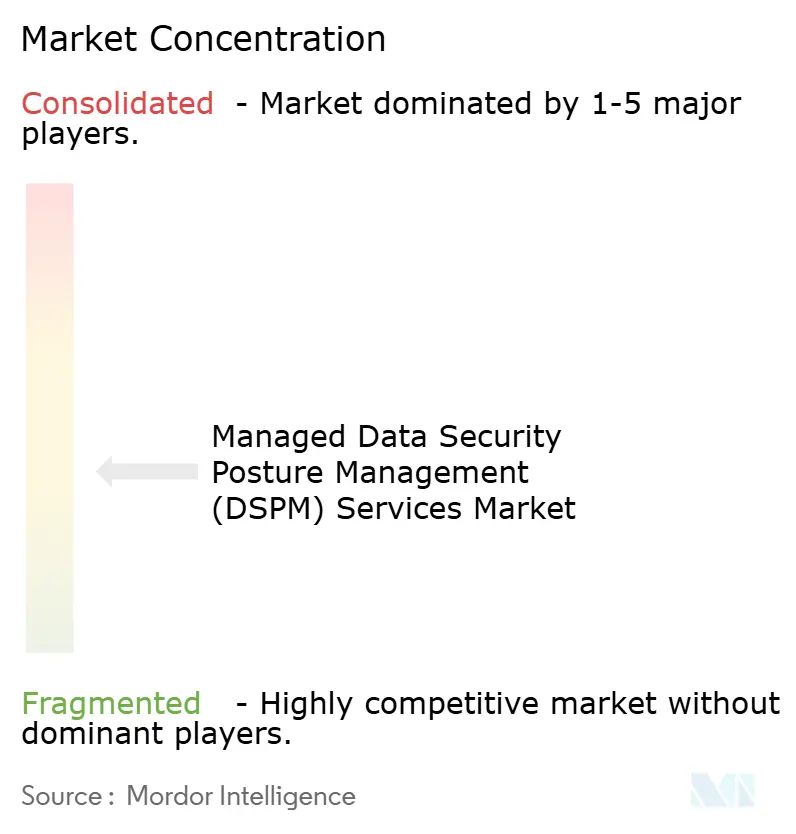
The managed data security posture management (DSPM) services market is moderately fragmented because no single provider has commanding revenue control across the full service scope. Competition is forming between platform vendors that embed DSPM into wider security suites and specialists that focus on classification, data access, and managed operations. Buyers also evaluate consulting-led providers that begin with advisory work and add operations after deployment. Providers must make their responsibilities clear when an automated control recommends or completes a remediation action. Consolidation has become important as broader providers seek to combine data resilience, privacy, governance, and AI controls. This can place price pressure on smaller service firms while widening the set of capabilities offered to customers. It can also change the purchasing decision from a point technology choice to a broader platform and service evaluation.
Veeam signed a definitive agreement in October 2025 to acquire Securiti AI for USD 1.725 billion, combining data resilience with DSPM, privacy, governance, access, and AI trust capabilities. Forcepoint announced its agreement to acquire Getvisibility in March 2025 to expand AI-driven data security and risk visibility across SaaS, cloud, on-premises environments, AI platforms, and endpoints. These moves show that data posture tools are being incorporated into larger data security portfolios. Vendors also compete through connectors, managed response capabilities, and the ability to support a client from initial assessment through ongoing operations. A broader portfolio can make it easier for buyers to align data posture work with resilience, privacy, and detection programs that are already funded. The managed DSPM services market is likely to favor providers that can provide clear operating accountability in addition to software features.
Technology remains an important point of differentiation, particularly for classification accuracy, encrypted-data coverage, and remediation workflows. AI can assist providers with ranking data risks and reducing the delay between finding an issue and taking an approved action. It does not remove the need for defined human approval, reliable data context, and records that explain why a control was applied. Deutsche Telekom and Palo Alto Networks launched Sovereign Cortex with T Security in June 2026, a European data-sovereign cyber defense service where Deutsche Telekom retains encryption key authority. This offering illustrates the competitive value of sovereign architecture for regulated European customers. Specialists such as Sentra and Symmetry Systems can differentiate in data-access governance and data-identity use cases. The managed DSPM services market also has an opening for standardized, audit-ready services governing AI agent and copilot access to sensitive enterprise data.
Managed Data Security Posture Management (DSPM) Services Industry Leaders
-
Accenture plc
-
Amazon Web Services, Inc.
-
AvePoint, Inc.
-
BigID, Inc.
-
Concentric AI, Inc.
- *Disclaimer: Major Players sorted in no particular order
Managed Data Security Posture Management (DSPM) Services Market Companies Covered in this Report
- Accenture plc
- Amazon Web Services, Inc.
- AvePoint, Inc.
- BigID, Inc.
- Concentric AI, Inc.
- CrowdStrike Holdings, Inc.
- Cyera Ltd.
- Deloitte Touche Tohmatsu Limited
- Forcepoint LLC
- Google LLC
- International Business Machines Corporation
- KPMG International Cooperative
- Kyndryl, Inc.
- Microsoft Corporation
- Netskope, Inc.
- OneTrust LLC
- Palo Alto Networks, Inc.
- Proofpoint, Inc.
- Rubrik, Inc.
- Securiti AI, Inc.
- Sentra Inc.
- Symmetry Systems, Inc.
- Thales S.A.
- Varonis Systems, Inc.
- Wipro Limited
- Zscaler, Inc.
Recent Industry Developments in Managed Data Security Posture Management (DSPM) Services Market
- August 2026: eclore and Glean announced an integration between ARMOR DSPM and Glean's enterprise AI platform, enabling context-aware sensitivity classification and unified remediation controls for regulated organizations in financial services, healthcare, legal services, and government. The integration writes sensitivity labels directly onto source files, providing persistent AI-ready data classification across the full data estate.
- July 2026: Deutsche Telekom and Palo Alto Networks launched Sovereign Cortex with T Security, a data-sovereign cyber defense managed service. All customer and system data, including telemetry and threat intelligence, is stored, processed, and retrieved exclusively within Europe, with encryption controlled by Deutsche Telekom through the External Key Manager.
- October 2025: Veeam Software signed a definitive agreement to acquire Securiti AI for USD 1.725 billion, combining Veeam's data resilience capabilities with Securiti AI's DSPM, privacy, governance, access, and AI trust capabilities across hybrid, multicloud, and SaaS platforms.
- September 2025: Cyera launched DataWatcher, a fully managed service for its DSPM and Omni DLP platform. The service covers continuous discovery, classification, policy tuning, access control governance, and rapid breach response.
Global Managed Data Security Posture Management (DSPM) Services Market Report Scope
Managed data security posture management (DSPM) services refer to an outsourced offering in which a provider deploys, operates, tunes, and continuously monitors DSPM capabilities to discover, classify, assess, and remediate risks associated with sensitive data across cloud, SaaS, and hybrid environments. These services help organizations improve data visibility, control excessive access, prevent exposure, and support compliance requirements.
The Managed Data Security Posture Management (DSPM) Services Market Report is Segmented by Service Offering (Professional Services, and Managed Services), Delivery Model (Fully Managed DSPM Services, and Co-Managed DSPM Services), Deployment Mode (Cloud-Based, On-Premises, and Hybrid), Service Function (Data Discovery and Classification, Data Risk Assessment and Exposure Management, Data Access Governance, Compliance and Regulatory Management, and Data Loss Prevention Enhancement), Organization Size (Large Enterprises, and Small and Medium Enterprises), End-User Industry (Banking, Financial Services and Insurance (BFSI), IT and Telecommunications, Healthcare and Life Sciences, Government and Public Sector, Industrial Manufacturing, Retail and E-Commerce, and Other End-User Industries), and Geography (North America, South America, Europe, Asia-Pacific, Middle East, and Africa). The Market Forecasts are Provided in Terms of Value (USD).
Segmentation Overview
| Professional Services |
| Managed Services |
| Fully Managed DSPM Services |
| Co-Managed DSPM Services |
| Cloud-Based |
| On-Premises |
| Hybrid |
| Data Discovery and Classification |
| Data Risk Assessment and Exposure Management |
| Data Access Governance |
| Compliance and Regulatory Management |
| Data Loss Prevention Enhancement |
| Large Enterprises |
| Small and Medium-Sized Enterprises |
| Banking, Financial Services and Insurance (BFSI) |
| IT and Telecommunications |
| Healthcare and Life Sciences |
| Government and Public Sector |
| Industrial Manufacturing |
| Retail and E-Commerce |
| Other End-User Industries |
| North America | United States |
| Canada | |
| Mexico | |
| South America | Brazil |
| Argentina | |
| Rest of South America | |
| Europe | United Kingdom |
| Germany | |
| France | |
| Italy | |
| Spain | |
| Rest of Europe | |
| Asia-Pacific | China |
| Japan | |
| India | |
| South Korea | |
| Rest of Asia-Pacific | |
| Middle East | United Arab Emirates |
| Saudi Arabia | |
| Qatar | |
| Rest of Middle East | |
| Africa | South Africa |
| Nigeria | |
| Rest of Africa |
| By Service Offering | Professional Services | |
| Managed Services | ||
| By Delivery Model | Fully Managed DSPM Services | |
| Co-Managed DSPM Services | ||
| By Deployment Mode | Cloud-Based | |
| On-Premises | ||
| Hybrid | ||
| By Service Function | Data Discovery and Classification | |
| Data Risk Assessment and Exposure Management | ||
| Data Access Governance | ||
| Compliance and Regulatory Management | ||
| Data Loss Prevention Enhancement | ||
| By Organization Size | Large Enterprises | |
| Small and Medium-Sized Enterprises | ||
| By End-User Industry | Banking, Financial Services and Insurance (BFSI) | |
| IT and Telecommunications | ||
| Healthcare and Life Sciences | ||
| Government and Public Sector | ||
| Industrial Manufacturing | ||
| Retail and E-Commerce | ||
| Other End-User Industries | ||
| By Geography | North America | United States |
| Canada | ||
| Mexico | ||
| South America | Brazil | |
| Argentina | ||
| Rest of South America | ||
| Europe | United Kingdom | |
| Germany | ||
| France | ||
| Italy | ||
| Spain | ||
| Rest of Europe | ||
| Asia-Pacific | China | |
| Japan | ||
| India | ||
| South Korea | ||
| Rest of Asia-Pacific | ||
| Middle East | United Arab Emirates | |
| Saudi Arabia | ||
| Qatar | ||
| Rest of Middle East | ||
| Africa | South Africa | |
| Nigeria | ||
| Rest of Africa | ||
Key Questions Answered in the Report
What is the managed data security posture management DSPM services market size?
The managed data security posture management DSPM services market size is expected to grow from USD 1.23 billion in 2026 to USD 1.48 billion in 2027 and is forecast to reach USD 3.89 billion by 2032 at 21.32% CAGR over 2027-2032.
Which service offering has the largest share?
Managed services held 78.32% of revenue in 2026 because organizations often need ongoing discovery, classification tuning, risk prioritization, and operational reporting. Many clients use external teams when they do not have the staffing or specialized skills to run these activities internally. This model also keeps the service aligned as data locations and access privileges change.
Why are managed DSPM services being adopted?
Multicloud data estates, regulatory obligations, data exposure risk, and AI-related data access are supporting adoption. Managed delivery helps organizations maintain policies and reporting as data locations, permissions, and business applications change over time. It also provides an operating model for clients that need more than a periodic security assessment.
Which deployment environment is expanding fastest?
Cloud-based deployment is projected to expand at a 23.92% CAGR through 2032 and held 68.58% of revenue in 2026. Cloud systems enable agentless integration and common policy oversight across data stores, SaaS applications, and more than one cloud provider. Hybrid environments remain relevant when cloud workloads operate alongside legacy repositories.
Which region is projected to expand fastest?
Asia-Pacific is projected to expand at a 22.86% CAGR through 2032, supported by cloud adoption and stronger privacy obligations. Demand is shaped by the use of cloud services across China, Japan, India, and South Korea and by their changing data governance requirements. Japan and South Korea are relatively mature demand centers within the region.
Which customer group is the largest?
Large enterprises held 71.54% of revenue in 2026 because their data estates, regulatory requirements, and security operations are more complex. Their service needs can include integration with security operations centers, governance platforms, and regulatory reporting workflows. Smaller organizations are forecast to expand faster because managed models lower the need for internal specialist staffing.