
Sensitive Data Discovery Market Size and Share
Market Overview
| Study Period | 2020 - 2031 |
|---|---|
| Market Size (2026) | USD 9.94 Billion |
| Market Size (2031) | USD 20.76 Billion |
| Growth Rate (2026 - 2031) | 15.87 % |
| Fastest Growing Market | Asia-Pacific |
| Largest Market | North America |
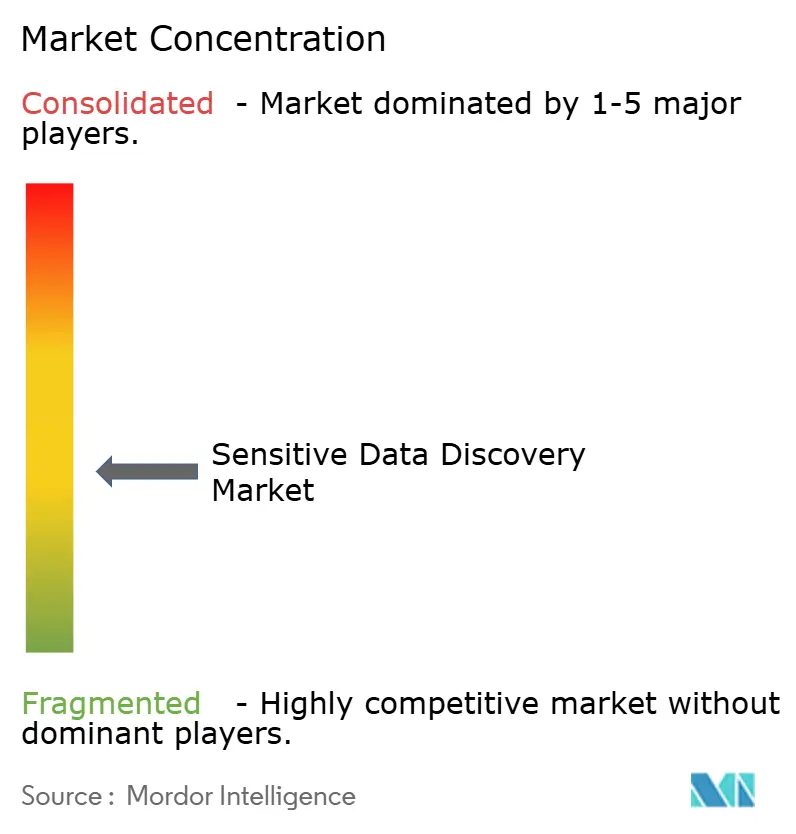
| Market Concentration | Medium |
Major Players *Disclaimer: Major Players sorted in no particular order Image © Mordor Intelligence. Reuse requires attribution under CC BY 4.0. | |
Sensitive Data Discovery Market Analysis by Mordor Intelligence
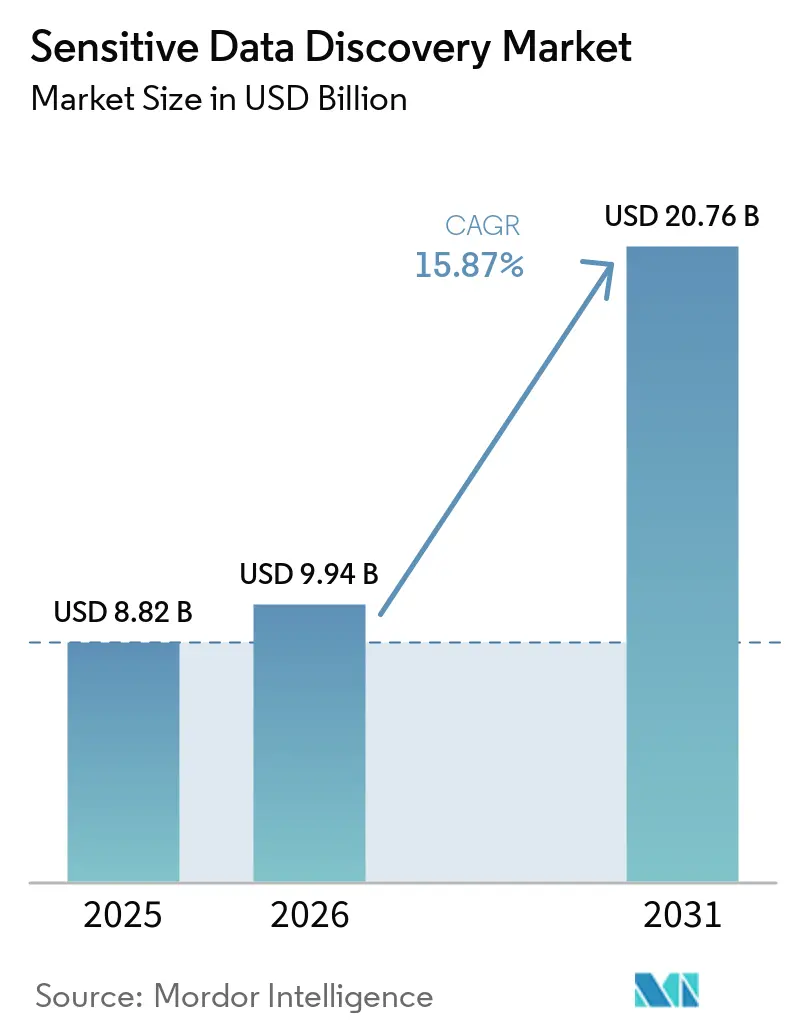
The sensitive data discovery market size was USD 8.82 billion in 2025 and is projected to reach USD 20.76 billion by 2031, at a CAGR of 15.87% during 2026-2031. The sensitive data discovery market is expanding as organizations deploy generative AI and autonomous agents across data estates that were not fully cataloged, including cloud platforms, SaaS applications, older internal systems, and collaboration environments, which changes the scope of data governance because automated tools can create, retrieve, summarize, and transfer information without a conventional review step. Privacy rules and more active enforcement are also making data visibility a senior management concern, as organizations must locate personal or regulated information before responding to legal, security, or operational requirements. Privacy, security, data, and business teams often need the same record of where sensitive information resides. Buyers are looking for tools that identify sensitive information, apply consistent classifications, and support security and compliance operations across an increasing number of repositories, while also providing a practical path from classification to access controls, retention decisions, and remediation activities. Competition is increasing as specialist providers and larger platform vendors add related data security, governance, resilience, and AI controls, changing buying decisions, as some organizations prefer an integrated platform while others need specialist capabilities for difficult repositories, precise classification, or complex integrations. This combination of automated AI activity, changing data environments, and regulatory obligations is making discovery a continuing operational process rather than a limited technology deployment.
Key Report Takeaways
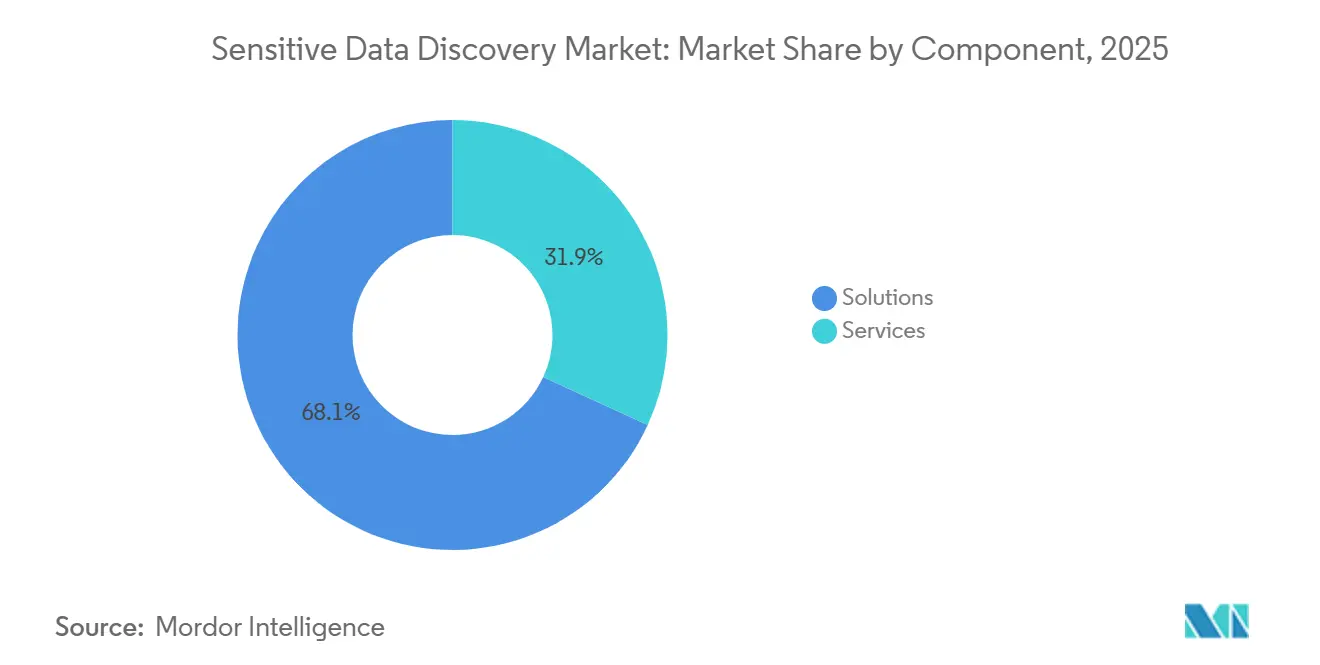
- By component, solutions held 68.12% of the sensitive data discovery market revenue share in 2025, while services are projected to expand at an 18.02% CAGR through 2031.
- By data type, unstructured data held 60.29% of the sensitive data discovery market revenue share in 2025, while semi-structured data is projected to expand at a 17.05% CAGR through 2031.
- By deployment mode, cloud deployment held 62.44% of the sensitive data discovery market revenue share in 2025, while hybrid deployment is projected to expand at a 17.45% CAGR through 2031.
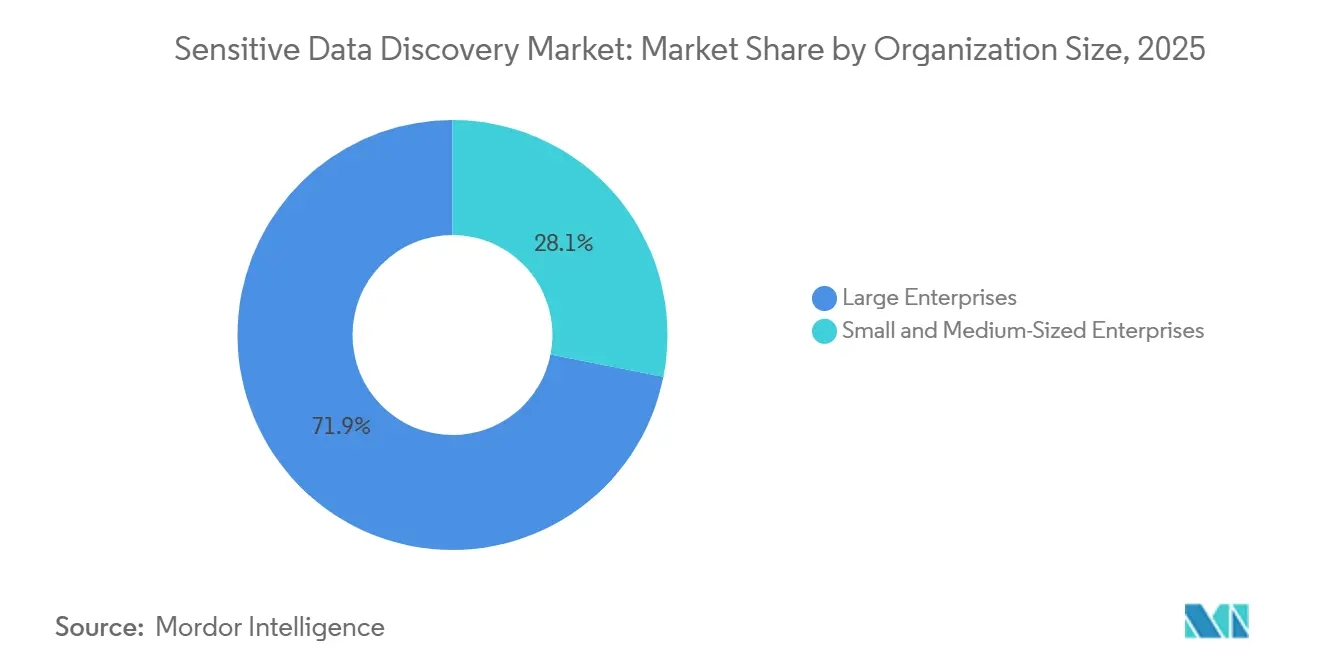
- By organization size, large enterprises held 71.89% of the sensitive data discovery market revenue share in 2025, while SMEs are projected to expand at a 17.71% CAGR through 2031.
- By industry vertical, BFSI held 24.51% of the sensitive data discovery market revenue share in 2025, while healthcare and life sciences are projected to expand at a 16.49% CAGR through 2031.
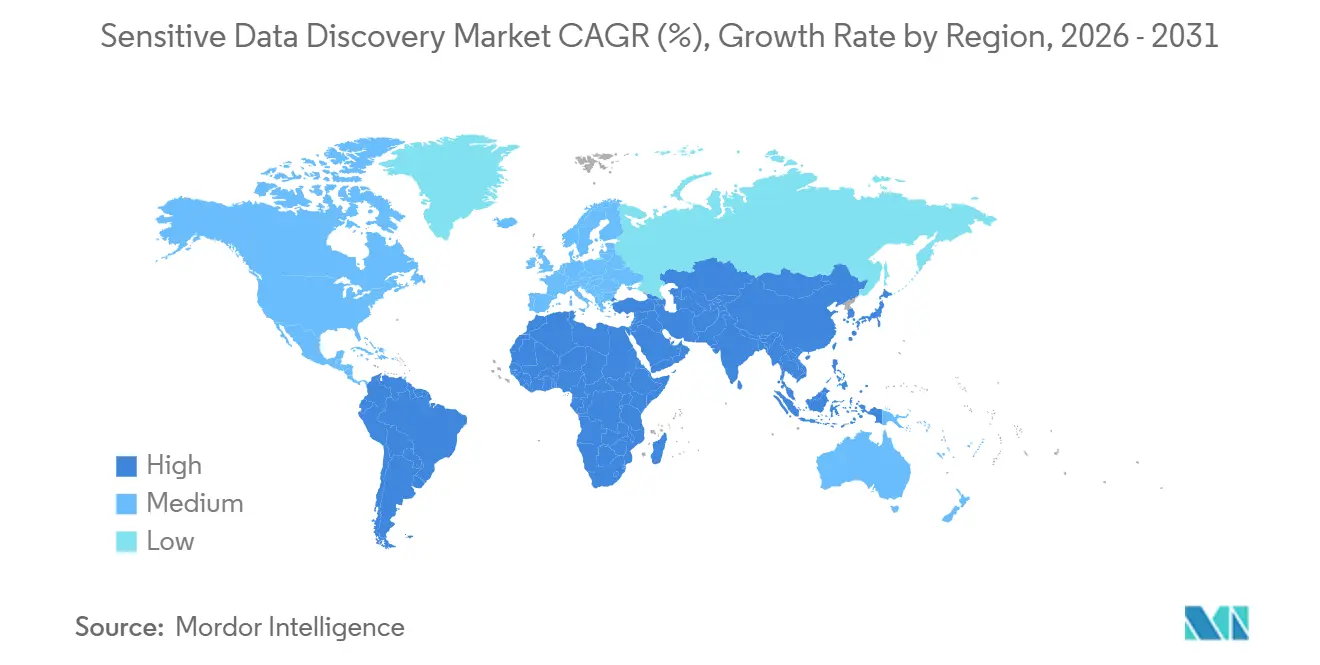
- By geography, North America held 35.74% of the sensitive data discovery market revenue share in 2025, while Asia-Pacific is projected to expand at a 16.78% CAGR through 2031.
Note: Market size and forecast figures in this report are generated using Mordor Intelligence’s proprietary estimation framework, updated with the latest available data and insights as of January 2026.
Global Sensitive Data Discovery Market Trends and Insights
Drivers Impact Analysis*
| Driver | (~) % Impact on CAGR Forecast | Geographic Relevance | Impact Timeline |
|---|---|---|---|
| Enterprise AI Deployment Across Uncataloged Data | +3.5% | Global, concentrated in North America and Western Europe | Short term (≤ 2 years) |
| Statutory Requirements for Sensitive Data Visibility | +3.0% | Global, strongest in Europe, North America, and Asia-Pacific regulatory jurisdictions | Medium term (2-4 years) |
| Zero-Trust Security and Automated Compliance Adoption | +2.5% | North America and Europe, with spillover to Asia-Pacific and Middle East and Africa enterprise segments | Medium term (2-4 years) |
| Cloud, SaaS, and Multicloud Data Sprawl | +2.0% | Global, highest in cloud-mature markets | Short term (≤ 2 years) |
| AI-Ready Data Governance and Data Lineage Requirements | +1.5% | Global, concentrated in regulated sectors | Medium term (2-4 years) |
| Data Discovery Expansion Into Broader Security Platforms | +1.2% | North America and Europe, with emerging adoption in Asia-Pacific and Middle East and Africa | Long term (≥ 4 years) |
| Source: Mordor Intelligence | |||
Enterprise AI Deployment Across Uncataloged Data
Enterprise use of generative AI and autonomous agents is making data discovery a continuous governance requirement because systems can ingest file shares, email archives, and retrieval-augmented generation pipelines at machine speed. Cyera reported in June 2026 that 68% of organizations could not distinguish human activity from AI-agent activity in their data systems, raising concerns about data stores lacking dependable classification. NIST’s February 2026 draft Special Publication 1800-39 identified automated classification as a requirement for zero-trust and AI model-training governance, placing classification before policy decisions that rely on data sensitivity. The guidance also links the task to wider security planning, including quantum-safe cryptography and supporting recurring scanning rather than a one-time inventory. BigID introduced Agentic Access Control and Intent-Based Activity Monitoring in August 2026 to compare AI-agent behavior against declared purposes. The sensitive data discovery market is gaining relevance, where organizations need to understand what automated systems can access and infer from existing information.[1]The growing adoption of AI, analytics, and data-governance initiatives is expected to further increase demand for sensitive data discovery solutions.
Statutory Requirements for Sensitive Data Visibility
Privacy enforcement is making data-mapping gaps more consequential because organizations cannot consistently apply deletion, access, retention, or transfer rules if they do not know where relevant information is stored. California’s Attorney General announced a USD 2.75 million CCPA settlement with Disney in February 2026 and described it as the largest CCPA settlement in California history. The settlement showed that data governance failures can carry direct financial consequences and require an auditable view of personal information across systems. Privacy frameworks in the Asia-Pacific are also increasing the need for organizations to understand where personal information is stored and who owns each repository. This requires data inventories that can support documentation, security, and handling decisions across business units and technology environments. The sensitive data discovery market can benefit when businesses prepare repeatable discovery processes before compliance obligations take effect.
Zero-Trust Security and Automated Compliance Adoption
Zero-trust security requires that access decisions reflect data sensitivity, requester identity, and purpose, so it depends on a current sensitive-data inventory of sensitive data. The sensitive data discovery market addresses the gap between identity-based access controls and full data awareness by supplying information that policy engines and security teams can use. The HPE Zero Trust Security Report 2026 surveyed 851 IT and security professionals, finding that 56% used AI or machine learning for threat detection and 42% for real-time policy automation. These findings show that security automation is moving into daily operations and that automated policy decisions require dependable data labels. NIST’s draft guidance treats classification as a foundation for privacy compliance, zero-trust access, AI governance, and cryptographic planning, widening the groups that may support an investment. Buyers are likely to assess whether a platform can keep classifications up to date as repositories and policies change.
Cloud, SaaS, and Multicloud Data Sprawl
Cloud services, SaaS applications, and multicloud deployments have expanded the number of locations where sensitive data can be stored, including temporary stores, analytics staging areas, and AI vector databases. Netskope reported in 2026 that 87% of organizations managed data across 5 or more tools or platforms, while 58% used 11 or more separate data security tools. These conditions can create blind spots at the handoff between applications, cloud accounts, and security products. Production data copies may have permissions that differ from source systems and may not appear in older data inventories. Organizations need to identify those copies before applying retention, access, or deletion requirements across distributed technology estates. The sensitive data discovery market responds to the need for a broader and more consistent view of cloud, SaaS, and connected operational data.
Restraints Impact Analysis*
| Restraint | (~) % Impact on CAGR Forecast | Geographic Relevance | Impact Timeline |
|---|---|---|---|
| False Positives in Pattern-Based Classification | -1.5% | Global, most acute in large-estate enterprises in regulated industries | Short term (≤ 2 years) |
| Fragmented Connectors Across Legacy and Bespoke Systems | -1.0% | Global, most severe in Asia-Pacific and Middle East and Africa where legacy infrastructure concentrations are higher | Medium term (2-4 years) |
| Shortage of Remediation Skills and Business Owner Authority | -0.8% | Global, most acute among SMEs and organizations without dedicated governance functions | Medium term (2-4 years) |
| Compute, Energy, and Full-Estate Scanning Costs | -0.6% | Global, with the highest impact in organizations with petabyte-scale unstructured data estates | Long term (≥ 4 years) |
| Source: Mordor Intelligence | |||
False Positives in Pattern-Based Classification
Pattern-matching tools remain common in sensitive-data classification and can create false positives when a pattern resembles sensitive information but lacks the required context. When alerts are repeatedly inaccurate, analysts may trust them less, reduce follow-up activity, and weaken enforcement even when the tool remains deployed. Research presented at the 2026 ACM Symposium on Document Engineering showed that multistage architectures needed careful tuning to keep false-positive rates below 1% across heterogeneous document types at enterprise scale. High-quality classification is important when downstream controls rely on results without human review, because incorrect labels can prompt unnecessary investigation or impede a legitimate process. Organizations need to test models across documents, repositories, and languages that reflect their own environments, which makes implementation work important even with advanced machine learning features. The sensitive data discovery market favors providers that demonstrate precision and provide a clear process for improving classifications.
Fragmented Connectors Across Legacy and Bespoke Systems
A platform can only scan the systems that its connectors can reach, while many enterprises still use mainframe-era systems, bespoke applications, and custom databases without standard interfaces. These systems may contain older customer records, intellectual property archives, and regulatory filings that have been retained for many years. Organizations can address gaps through vendor-developed custom connectors or middleware layers, but both add cost, implementation time, and maintenance work. This can delay a broad discovery program even when a buyer has approved the technology, particularly in industrial manufacturing, oil and gas, and government administration. The issue can persist, with infrastructure modernization continuing into the 2030s, including parts of Asia-Pacific, South America, the Middle East, and Africa. The sensitive data discovery market is constrained, where organizations cannot achieve coverage across the data sources that matter most, making connector breadth an important selection criterion.
*Our forecasts treat driver/restraint impacts as directional, not additive. The impact forecasts reflect baseline growth, mix effects, and variable interactions.
Segment Analysis
By Component: Services Grow Faster as Implementation Complexity Rises
Solutions held 68.12% of revenue in 2025. They provide the software for locating, classifying, and monitoring sensitive information across enterprise repositories. Their leading position reflects the central role of platform capabilities in a discovery program. Organizations need tools that scan data sources and present classification results. The market share of sensitive data discovery solutions reflects demand for data visibility across cloud, SaaS, and on-premises environments.
Services are projected to expand at an 18.02% CAGR during 2026-2031. They include consulting and assessment, implementation and integration, managed discovery, training, support, and maintenance. Implementation work grows as organizations extend coverage from cloud environments to on-premises repositories and legacy SaaS applications. Managed discovery is gaining importance among mid-market buyers without internal data engineering resources. The sensitive data discovery industry is moving toward a services-supported delivery model, with configuration and remediation continuing after deployment.
By Data Type: Unstructured Data Leads While Semi-Structured Data Accelerates
Unstructured data held 60.29% of revenue in 2025. Documents, emails, presentations, and collaboration content are difficult to govern with database-focused controls because sensitive information is embedded in free text and mixed formats. These sources are spread across shared folders and business applications. The leading position reflects the need to find personal, financial, and other sensitive information outside predefined database fields. Context-aware classification helps distinguish sensitive content from ordinary text.
Semi-structured data is projected to expand at a 17.05% CAGR during 2026-2031. The category includes JSON logs, XML feeds, API payloads, and event streams from AI pipelines. Cloud-native applications generate these records as they exchange information and capture system activity. Sensitive identifiers can appear within operational data even when the record exists for technical monitoring. The sensitive data discovery market is responding to an environment characterized by increased application telemetry and AI-related records.[2]As organizations expand AI adoption and machine-generated data collection, demand is expected to grow for solutions that can continuously identify, classify, and govern sensitive information embedded within increasingly complex data ecosystems.
By Deployment Mode: Hybrid Deployments Gain as Residency Requirements Expand
Cloud deployment held 62.44% of revenue in 2025. SaaS applications and cloud-native data stores are important locations for business information. Agentless scanning can enable discovery without requiring infrastructure changes on each target system. This can simplify early coverage for organizations with distributed cloud environments. Cloud deployment also supports scaling as new repositories are added.
Hybrid deployment is projected to expand at a 17.45% CAGR through 2031. Data residency and sovereignty requirements can limit a move to a pure-cloud design. Many organizations cannot retire on-premises infrastructure during the forecast period. On-premises deployment remains relevant for air-gapped defense, classified government, and regulated financial services environments. Providers with unified policy management across cloud, on-premises, and SaaS environments can address the size of the sensitive data discovery market associated with these mixed estates.
By Organization Size: SMEs Accelerate Adoption as Platform Economics Change
Large enterprises held 71.89% of revenue in 2025. They manage larger data estates, operate across more jurisdictions, and can fund platforms, integrations, and dedicated governance teams. These conditions made large organizations early buyers of broad discovery capabilities. Their environments often include cloud services, legacy systems, and many business units. The share of the sensitive data discovery market held by large enterprises reflects this combination of data complexity and compliance costs.
SMEs are projected to expand at a 17.71% CAGR during 2026-2031. Consumption-based SaaS pricing can reduce the upfront investment that limited access to discovery capabilities. Smaller organizations also face statutory penalties and supply-chain compliance demands. IBM reported a global average data breach cost of USD 4.99 million in 2026, based on 602 organizations breached between March 2025 and February 2026. Cloud-native providers such as Nightfall AI and Sentra offer classification coverage without the professional-services burden common in large deployments.
By Industry Vertical: BFSI Leads While Healthcare and Life Sciences Accelerate
BFSI held 24.51% of revenue in 2025. Financial institutions manage payment data, customer records, transaction information, and other high-value data classes. They face concurrent requirements, including PCI DSS 4.0.1, DORA, NYDFS Part 500, and the GLBA Safeguards Rule. PCI DSS 4.0.1 became fully effective in March 2025, and the supplied material identifies NYDFS Part 500 as fully enforced in 2026. IBM ranked financial services as the second-costliest sector for data breaches, with USD 6.29 million per incident in its 2026 report.
Healthcare and life sciences are projected to expand at a 16.49% CAGR during 2026-2031. The sector holds protected health information, clinical records, and research-related data across many systems. HHS OCR settled 4 HIPAA Security Rule ransomware investigations for USD 1.165 million in April 2026 and cited each entity for failures to conduct required risk analyses. Government and public administration, IT and telecommunication, and retail and e-commerce form the next demand tier, with retail supported by payment and behavioral records from omnichannel collection. Healthcare’s faster growth reflects a discovery maturity gap relative to financial institutions.
Geography Analysis
North America held 35.74% of revenue in 2025. The region combines a high concentration of cloud-native enterprises with overlapping federal and state requirements. It also has a mature vendor ecosystem, with BigID, Varonis, Cyera, Nightfall AI, and Sentra headquartered in the United States. California’s Attorney General announced a USD 2.75 million CCPA settlement with Disney in February 2026. The office described it as the largest CCPA settlement in California history.[3]The growing intensity of regulatory enforcement and rising financial penalties for data governance failures are expected to accelerate investment in sensitive data discovery solutions.
Asia-Pacific is projected to expand at a 16.78% CAGR during 2026-2031. The sensitive data discovery market size in the region is supported by new and strengthening privacy frameworks. Privacy requirements increase the need for discovery, classification, and documentation processes across cloud, SaaS, and on-premises environments. Digital transformation and regulatory activation support the region’s faster growth profile. These conditions strengthen the need for consistent data-handling practices.
Europe held the second-largest revenue share in 2025. Germany’s preference for European sovereign and on-premises deployments supports hybrid architectures. France issued Decree No. 2026-272 in April 2026, requiring SecNumCloud qualification for cloud services handling sensitive state data. South America is an early-stage opportunity supported by Brazil’s LGPD enforcement, while the Middle East and Africa are developing through national data governance frameworks.
Competitive Landscape
The sensitive data discovery market is moderately fragmented. Specialist suppliers include BigID, Cyera, Sentra, Netwrix, Spirion, Ground Labs, and Nightfall AI, while larger platform vendors include Microsoft via Purview, Palo Alto Networks via Cortex Cloud, IBM via Guardium, and Informatica. These providers compete on discovery coverage, classification quality, integration, and the connection between discovery and broader controls. Buyers can choose between specialist depth and a wider platform relationship. The sensitive data discovery market includes both point products and integrated governance and security platforms.
Cyera raised USD 600 million at a USD 12 billion valuation in June 2026 and stated that total capital raised exceeded USD 2.3 billion. It also stated that annual recurring revenue had tripled for 3 consecutive years and that it completed 5 acquisitions in the prior 18 months, including Ryft and Genie for agentic AI governance. Veeam completed its USD 1.725 billion acquisition of Securiti AI in December 2025, combining data resilience with data security posture management, privacy, governance, and AI trust. Microsoft’s Purview documentation confirms integrations with Varonis, Cyera, and BigID. These moves show both consolidation and partnership opportunities for specialist providers.[4]The market is expected to witness further growth opportunities as enterprises seek integrated platforms that combine data discovery, governance, privacy, AI trust, and cyber resilience capabilities within a unified data-security framework.
BigID announced Agentic Access Control and Intent-Based Activity Monitoring in August 2026, while Netwrix announced AI governance capabilities for hybrid Microsoft environments in June 2026. Proofpoint made enhanced European data security posture management capabilities available in August 2026, including AI-assisted discovery and classification in major European business languages from a Frankfurt data center. Opportunities remain in sector-specific profiles for genomic and clinical trial data, AI training-data governance, and discovery-as-a-service for SMEs. The sensitive data discovery market may reward providers that combine local requirements with reliable integration and classification results.
Sensitive Data Discovery Industry Leaders
-
OpenText Corporation
-
IBM Corporation
-
Microsoft Corporation
-
Palo Alto Networks, Inc.
-
Varonis Systems, Inc.
- *Disclaimer: Major Players sorted in no particular order
Recent Industry Developments
- August 2026: BigID announced Agentic Access Control and Intent-Based Activity Monitoring at Black Hat, extending its platform to govern AI-agent data access based on declared purpose and observed behavior. The capability addressed governance gaps created when static permissions could not adapt to machine-speed, chained agent activity across regulated data stores.
- August 2026: Proofpoint made available enhanced European DSPM capabilities, including AI-assisted discovery and classification across major European business languages, hosted from its Frankfurt, Germany data center. The release, announced in February 2026, directly targeted enterprises with data-residency and EU AI Act compliance requirements.
- June 2026: Cyera raised USD 600 million in a Series D round at a USD 12 billion valuation, led by Evolution Equity Partners, with participation from Cyberstarts and Temasek, bringing total funding to over USD 2.3 billion. Cyera disclosed that ARR tripled over 3 consecutive years and that 5 acquisitions were completed over the prior 18 months, including Ryft and Genie for agentic AI governance.
- June 2026: Netwrix unveiled new AI governance capabilities for hybrid Microsoft environments through its 1Secure SaaS platform, adding visibility and control over sensitive data access by AI agents and Microsoft Copilot across on-premises and cloud configurations.
Global Sensitive Data Discovery Market Report Scope
The Sensitive Data Discovery Market comprises solutions and services that enable organizations to identify, classify, inventory, monitor, and manage sensitive data across structured, semi-structured, and unstructured data repositories. These solutions help organizations discover personally identifiable information (PII), protected health information (PHI), payment card data, intellectual property, confidential business information, and other regulated or sensitive data assets across on-premises, cloud, and hybrid environments. Sensitive data discovery platforms support data protection, privacy compliance, cybersecurity, governance, risk management, data minimization, and regulatory reporting initiatives by providing visibility into the location, movement, and exposure of sensitive information.
The Sensitive Data Discovery Market Report is Segmented by Component (Solutions, and Services [Consulting and Assessment Services, Implementation and Integration Services, Managed Sensitive Data Discovery Services, and Training, Support, and Maintenance Services]), Data Type (Structured Data, Unstructured Data, and Semi-Structured Data), Deployment Mode (Cloud, On-Premises, and Hybrid), Organization Size (Large Enterprises, and Small and Medium-Sized Enterprises), Industry Vertical (Government and Public Administration, Industrial Manufacturing, IT and Telecommunication, Healthcare and Life Sciences, Banking, Financial Services, and Insurance [BFSI], and Other Industry Verticals), and Geography (North America, South America, Europe, Asia-Pacific, and Middle East and Africa). The Market Forecasts are Provided in Terms of Value (USD).
| Solutions | |
| Services | Consulting and Assessment Services |
| Implementation and Integration Services | |
| Managed Sensitive Data Discovery Services | |
| Training, Support, and Maintenance Services |
| Structured Data |
| Unstructured Data |
| Semi-Structured Data |
| Cloud |
| On-Premises |
| Hybrid |
| Large Enterprises |
| Small and Medium-Sized Enterprises |
| Government and Public Administration |
| Industrial Manufacturing |
| IT and Telecommunication |
| Healthcare and Life Sciences |
| Banking, Financial Services, and Insurance (BFSI) |
| Other Industry Verticals |
| North America | United States | |
| Canada | ||
| South America | Brazil | |
| Mexico | ||
| Rest of South America | ||
| Europe | Germany | |
| United Kingdom | ||
| France | ||
| Italy | ||
| Rest of Europe | ||
| Asia-Pacific | China | |
| Japan | ||
| India | ||
| South Korea | ||
| Rest of Asia-Pacific | ||
| Middle East and Africa | Middle East | United Arab Emirates |
| Saudi Arabia | ||
| Rest of Middle East | ||
| Africa | South Africa | |
| Rest of Africa | ||
| By Component | Solutions | ||
| Services | Consulting and Assessment Services | ||
| Implementation and Integration Services | |||
| Managed Sensitive Data Discovery Services | |||
| Training, Support, and Maintenance Services | |||
| By Data Type | Structured Data | ||
| Unstructured Data | |||
| Semi-Structured Data | |||
| By Deployment Mode | Cloud | ||
| On-Premises | |||
| Hybrid | |||
| By Organization Size | Large Enterprises | ||
| Small and Medium-Sized Enterprises | |||
| By Industry Vertical | Government and Public Administration | ||
| Industrial Manufacturing | |||
| IT and Telecommunication | |||
| Healthcare and Life Sciences | |||
| Banking, Financial Services, and Insurance (BFSI) | |||
| Other Industry Verticals | |||
| By Geography | North America | United States | |
| Canada | |||
| South America | Brazil | ||
| Mexico | |||
| Rest of South America | |||
| Europe | Germany | ||
| United Kingdom | |||
| France | |||
| Italy | |||
| Rest of Europe | |||
| Asia-Pacific | China | ||
| Japan | |||
| India | |||
| South Korea | |||
| Rest of Asia-Pacific | |||
| Middle East and Africa | Middle East | United Arab Emirates | |
| Saudi Arabia | |||
| Rest of Middle East | |||
| Africa | South Africa | ||
| Rest of Africa | |||
Key Questions Answered in the Report
What is the sensitive data discovery market size?
The sensitive data discovery market was USD 8.82 billion in 2025 and is projected to reach USD 20.76 billion by 2031, at a CAGR of 15.87% during 2026-2031.
What is driving demand for sensitive data discovery platforms?
Generative AI adoption, privacy enforcement, zero-trust programs, and data sprawl across cloud and SaaS environments are increasing demand, especially when enterprises need continuous visibility across legacy and new repositories, classify information consistently, and connect results to access, retention, and remediation actions.
Which component is expected to grow fastest through 2031?
Services are projected to expand at an 18.02% CAGR as buyers need implementation, integration, managed discovery, training, support, and assistance with ongoing configuration and remediation.
Which deployment model is growing fastest?
Hybrid deployment is projected to expand at a 17.45% CAGR through 2031 because many organizations need to support cloud and on-premises data while meeting data-residency requirements.
Which region is expected to grow fastest?
Asia-Pacific is projected to expand at a 16.78% CAGR during 2026-2031 as privacy frameworks and digital transformation increase compliance investment.
Which vertical offers the fastest growth opportunity?
Healthcare and life sciences is projected to expand at a 16.49% CAGR through 2031, supported by the need to improve visibility over protected health information across complex clinical systems.