
Managed Compliance Operations Market Size and Share
Market Overview
| Study Period | 2021 - 2032 |
|---|---|
| Market Size (2027) | USD 11.27 Billion |
| Market Size (2032) | USD 21.93 Billion |
| Growth Rate (2027 - 2032) | 14.24 % |
| Fastest Growing Market | Asia-Pacific |
| Largest Market | North America |
| Market Concentration | Medium |
Major Players *Disclaimer: Major Players sorted in no particular order Image © Mordor Intelligence. Reuse requires attribution under CC BY 4.0. | |
Managed Compliance Operations Market Analysis by Mordor Intelligence
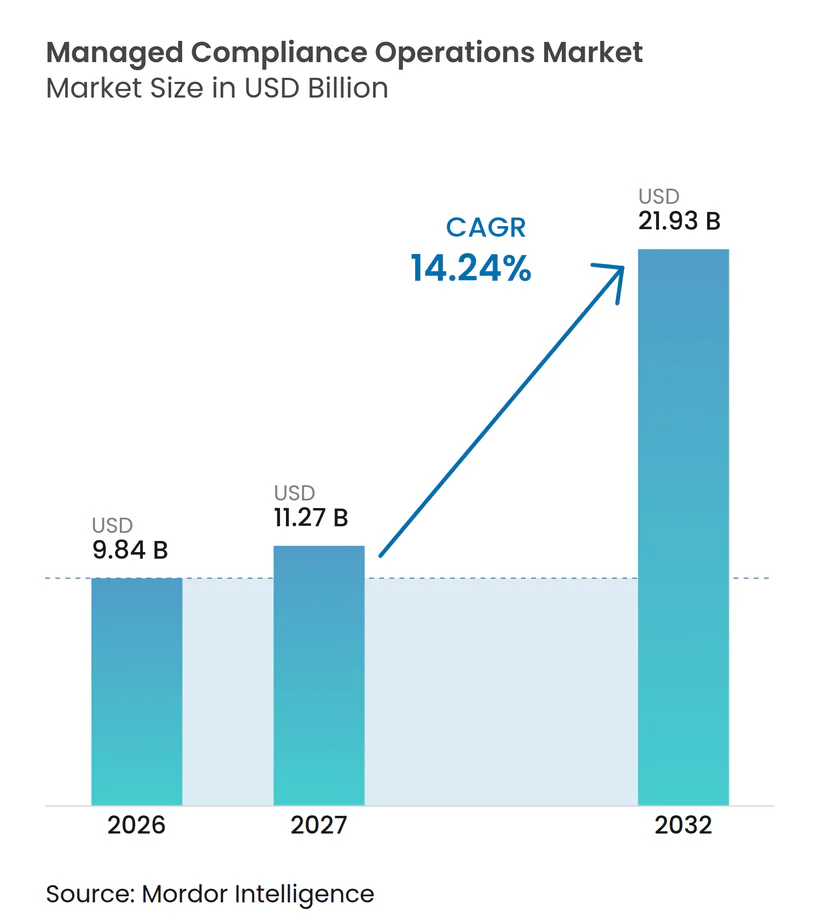
The managed compliance operations market size is projected to expand from USD 9.84 billion in 2026 and USD 11.24 billion in 2027 to USD 21.93 billion by 2032, registering a CAGR of 14.24% between 2027 to 2032. Growth reflects the widening gap between regulatory requirements and the capacity of internal compliance teams to manage them. Providers support continuous monitoring, evidence collection, audit preparation, policy management, and risk assessment. Demand is becoming more operational because organizations need documented proof of compliance throughout the year, not only during audits. AI governance rules are adding work for teams that must monitor automated decisions and maintain clear records. The Managed compliance operations market also faces limits because legal accountability remains with the organization that outsources the work.
Key Report Takeaways
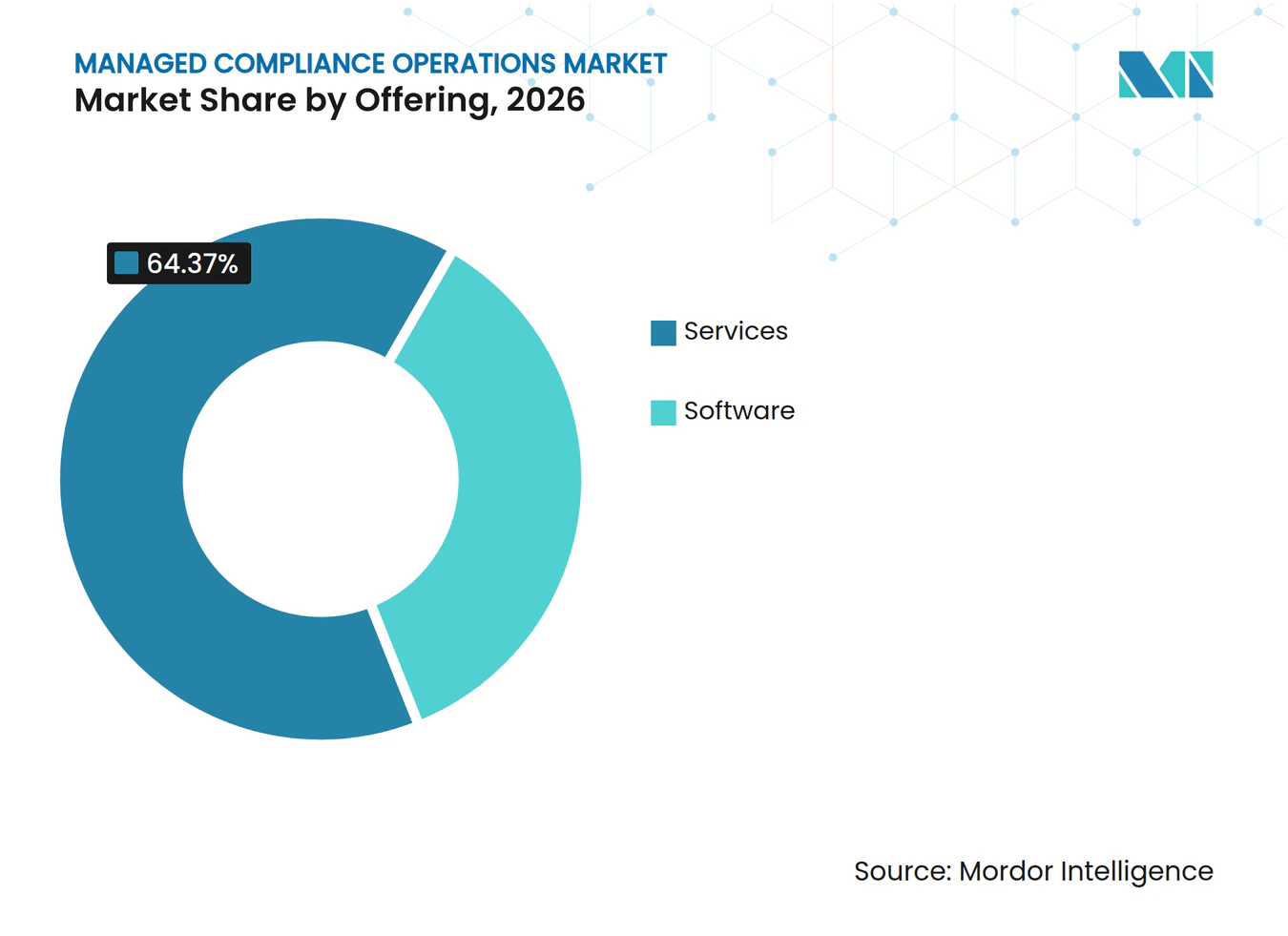
- By offering, services held 64.37% of the Managed compliance operations market share in 2026, while software is projected to expand at a 15.87% CAGR through 2032.
- By service model, the fully managed model held 29.43% share in 2026, while the technology-led self-service model is projected to expand at a 15.43% CAGR through 2032.
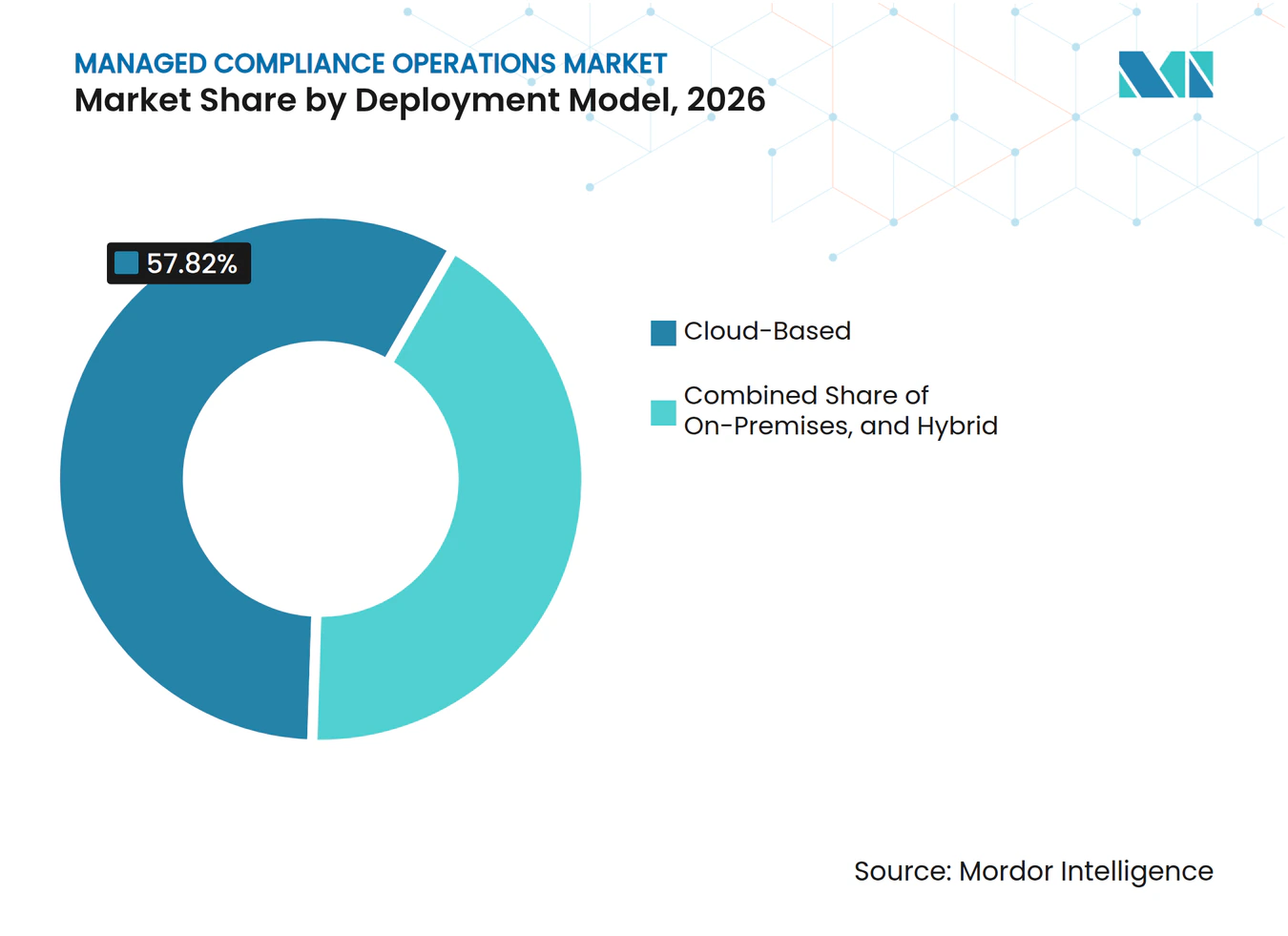
- By deployment model, cloud-based deployment held 57.82% share in 2026, while hybrid deployment is projected to expand at a 15.68% CAGR through 2032.
- By organization size, large enterprises held 69.17% share in 2026, while SMEs are projected to expand at a 15.93% CAGR through 2032.
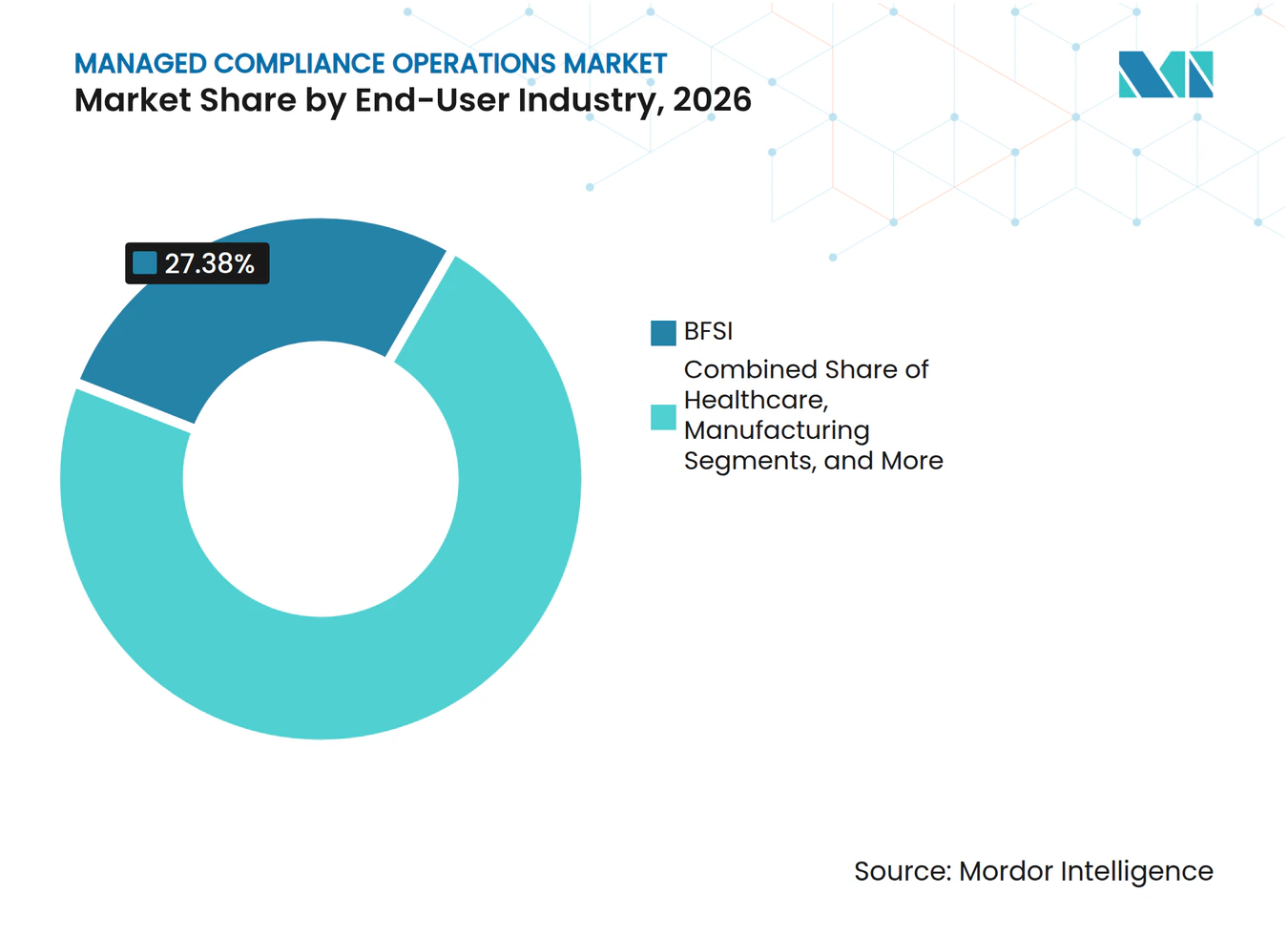
- By end-user industry, BFSI held 27.38% share in 2026, while healthcare is projected to expand at a 15.28% CAGR through 2032.
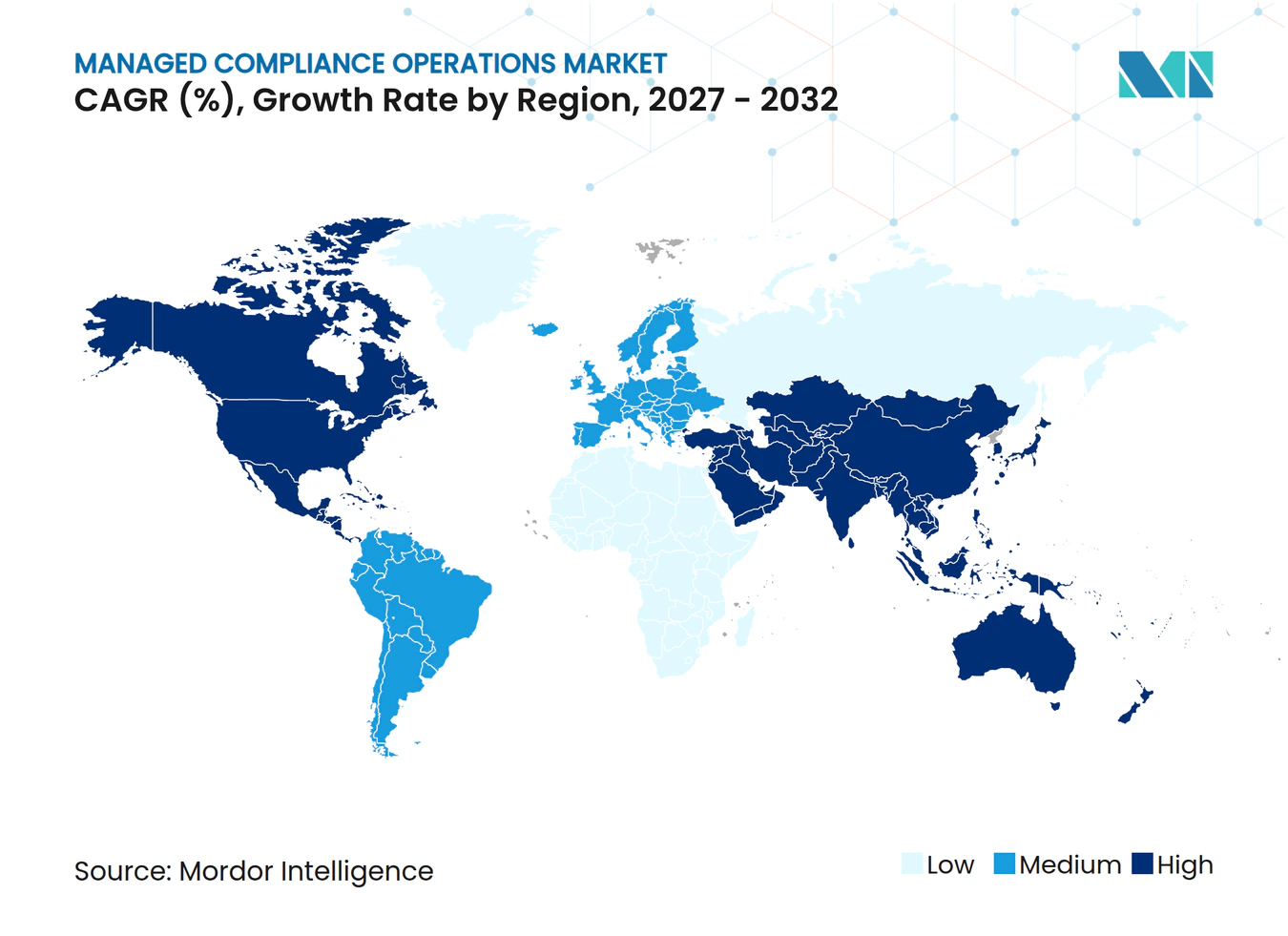
- By geography, North America held 37.92% share in 2026, while Asia-Pacific is projected to expand at a 15.47% CAGR through 2032.
Note: Market numbers in this report are based on Mordor Intelligence's proprietary estimation framework, which combines nine months of actuals with Q4 projections for base year 2026.
Market Trends and Insights
Drivers Impact Analysis of Managed Compliance Operations Market*
| Driver | (~) % Impact on CAGR Forecast | Geographic Relevance | Impact Timeline |
|---|---|---|---|
| Increasing Regulatory Complexity Across Jurisdictions | +3.5% | Global, with EU, North America, and Asia-Pacific as core areas | Long term (≥ 4 years) |
| Escalating Cybersecurity, Data Privacy, and Operational Resilience Obligations | +2.8% | Global, strongest in the EU and North America | Medium term (2-4 years) |
| Demand for Cloud-Based Continuous Monitoring and Audit Readiness | +2.1% | Global, particularly U.S. federal mandates and EU regulated sectors | Medium term (2-4 years) |
| Shortage and Cost of Specialized Compliance Professionals | +1.8% | Global, most acute in North America and the EU | Long term (≥ 4 years) |
| AI Governance and Model-Risk Obligations Creating New Service Demand | +1.5% | Global, including the EU, United States, and China | Short term (≤ 2 years) |
| Control-to-Evidence Automation for Legacy and Multi-Cloud Environments | +1.0% | Global, strongest in U.S. multi-cloud and EU regulated sectors | Medium term (2-4 years) |
| Source: Mordor Intelligence | |||
Increasing Regulatory Complexity Across Jurisdictions
The Managed compliance operations market benefits when organizations face rules with different evidence standards and enforcement schedules. These differences make compliance work difficult to standardize across jurisdictions. The European Banking Authority issued final guidance on third-party risk management for non-ICT services in September 2026. The guidance extends strict vendor oversight beyond technology suppliers for EU financial entities. Organizations therefore need broader monitoring, documentation, and review processes for vendor relationships. The International Association of Privacy Professionals reported that regulators expect organizations to demonstrate accountability through reliable audit trails and documented controls.[1] This expectation turns compliance from periodic legal work into an ongoing operating responsibility.
Escalating Cybersecurity, Data Privacy, and Operational Resilience Obligations
Cybersecurity and compliance requirements increasingly require the same evidence, controls, and operating routines. Financial entities subject to the EU Digital Operational Resilience Act must maintain ICT contract registers, risk assessments, and resilience testing records. These needs favor continuing managed support rather than a one-time advisory engagement. The NIS2 Directive has also widened cybersecurity obligations across critical sectors, including healthcare, energy, and manufacturing. Organizations that use external technology services must show that their own resilience controls remain effective. This creates additional demand for oversight across supplier relationships and internal operations. The resulting work gives the Managed compliance operations market a recurring role in compliance programs.
Demand for Cloud-Based Continuous Monitoring and Audit Readiness
Continuous monitoring is replacing periodic assessment as organizations seek more current audit evidence. Cloud environments can capture control information as activity occurs across applications and infrastructure. An IEEE study found that policy-as-code and AI-supported analytics can improve compliance detection and enable continuous evidence generation in cloud supply chains.[2] This approach can reduce manual collection work for dispersed technology environments. It also allows providers to organize evidence against multiple control frameworks. The Managed compliance operations market gains when clients purchase recurring support for evidence collection and audit preparation. This model can provide a more predictable operating process than a project-based audit cycle.
Shortage and Cost of Specialized Compliance Professionals
The supply of experienced compliance professionals remains inadequate for the volume and range of work required. The U.S. Bureau of Labor Statistics projects more than 33,300 annual openings for compliance officers over the next decade. Organizations also face turnover that can remove experienced staff from already small teams. The shortfall is especially important where staff must understand both regulations and operational systems. Managed service providers can provide continuity when employers cannot recruit or retain specialized personnel. This supports demand for external monitoring, policy coordination, and audit readiness work. It also makes the Managed compliance operations market relevant to organizations that need expertise without building large internal teams.
Restraints Impact Analysis of Managed Compliance Operations Market*
| Restraint | (~) % Impact on CAGR Forecast | Geographic Relevance | Impact Timeline |
|---|---|---|---|
| Non-Transferability of Regulatory Accountability | -1.8% | Global, under GDPR, DORA, and the EU AI Act | Long term (≥ 4 years) |
| Jurisdictional Fragmentation and Limited Global Standardization | -1.4% | Global, with high complexity across the EU, United States, and Asia-Pacific | Long term (≥ 4 years) |
| Data Residency, Outsourcing, and Cross-Border Processing Restrictions | -1.1% | Global, most acute in the EU, China, and India | Medium term (2-4 years) |
| Integration Complexity Across Legacy Systems and Unstructured Evidence | -0.8% | Global, particularly among large enterprises and BFSI | Medium term (2-4 years) |
| Source: Mordor Intelligence | |||
Non-Transferability of Regulatory Accountability
The Managed compliance operations market cannot replace the governance duties of the client organization. Under GDPR, a data controller remains accountable for processing activities even when it uses a provider. Financial entities also remain responsible for operational resilience under DORA. The EU AI Act similarly leaves transparency and incident-reporting responsibilities with the responsible organization. Providers can collect evidence, monitor controls, coordinate policies, and prepare for audits. However, management must still approve decisions and remain answerable to regulators. This boundary raises the level of client involvement required in every managed engagement.
Jurisdictional Fragmentation and Limited Global Standardization
Different compliance rules across regions increase delivery complexity for multinational clients. China’s Personal Information Cross-Border Certification Measures took effect on January 1, 2026. The measures created a certification route with documentation processes distinct from those used under GDPR.[3] Providers must therefore maintain different workflows for Chinese and European data transfers. Japan also introduced its own framework for outsourced compliance operations in investment management. These variations limit the ability to deliver a single standardized global service. They also require regional regulatory knowledge and local evidence practices.
*Our forecasts treat driver/restraint impacts as directional, not additive. The impact forecasts reflect baseline growth, mix effects, and variable interactions.
Managed Compliance Operations Market Segment Analysis
By Offering:
Services Lead While Software Closes the GapServices held 64.37% of the Managed compliance operations market share in 2026. The lead reflects the need for people who can interpret rules, coordinate controls, and prepare organizations for audits. BFSI and healthcare buyers need dependable coverage because gaps in audit readiness can create operational and regulatory pressure. Professional services firms and specialist providers deliver much of this work through recurring engagements. The talent shortage also makes external delivery a practical continuity option for organizations with small internal teams. Human support remains necessary when decisions need interpretation, escalation, or formal management approval. Services also help clients coordinate compliance work across policies, evidence sources, and business units. The Managed compliance operations industry therefore continues to rely on expertise alongside automation. Buyers still need services when a control exception needs interpretation, when evidence is incomplete, or when leaders need an accountable recommendation before approving a response. This preserves a role for experienced teams even as routine collection tasks move into software.
Software is projected to grow at a 15.87% CAGR through 2032. Vanta stated that its AI-generated responses address more than 80% of security questionnaire queries at a 95% acceptance rate. The company also stated that customers complete security reviews 81% faster than through manual processes. These tools can reduce repetitive evidence requests and make questionnaires easier to manage. Workiva said its platform is used by more than 85% of Fortune 1,000 companies. Its platform connects audit, risk, controls, and reporting in one data environment. Evidence automation is gaining importance because organizations need current proof across a growing list of frameworks. Software does not remove the need for human review, but it can reduce the volume of manual work. Its value is strongest where questionnaires, policy checks, and evidence requests repeat across customers, suppliers, or frameworks. Providers can then focus specialist time on exceptions and decisions that require context rather than routine administration.



By Service Model:
Fully Managed Delivery Anchors Revenue While Self-Service AcceleratesThe fully managed model held 29.43% of the Managed compliance operations market share in 2026. It suits organizations that face frequent audits and cannot maintain all needed expertise internally. BFSI, healthcare, and government buyers often require continuous support because their obligations span many policies and systems. Providers can manage day-to-day monitoring while client leaders retain responsibility for key decisions. This arrangement gives organizations access to defined workflows and specialized staff. It also helps them maintain coverage during internal hiring gaps or regulatory change. The embedded compliance team model supports clients that want external staff to work like an internal function. Project-based consulting and partial outsourcing serve clients that want narrower support for selected requirements. These options allow a buyer to keep strategic control internally while obtaining help for a new rule, a remediation program, or a demanding audit cycle. The model choice often reflects internal capacity, the maturity of controls, and the level of regulatory exposure.
The technology-led self-service model is projected to grow at a 15.43% CAGR through 2032. This model combines software-led tasks with access to expert guidance when a decision requires judgment. It can be more accessible for SMEs that cannot sustain a fully managed team. Technology organizations can also connect these tools with existing development and security processes. The approach suits buyers that want more direct control over daily workflows. Providers still have a role in advising on controls, interpreting requirements, and reviewing evidence. The Managed compliance operations market benefits when these buyers move from informal spreadsheets to structured platforms. This model also supports a gradual shift from manual routines to automated evidence collection. Clients can begin with a limited framework and retain direct ownership of day-to-day tasks before extending automation to other requirements. Expert access remains important when a new rule changes the meaning of a control or evidence record.
By Deployment Model:
Cloud-Based Systems Lead While Hybrid Use ExpandsCloud-based deployment held 57.82% of the Managed compliance operations market share in 2026. Cloud systems support continuous monitoring, current control assessments, and automated evidence capture. These capabilities are difficult to reproduce consistently in separate on-premises systems. The IEEE research on cloud supply chains supports the role of policy-as-code and AI-enabled analytics in continuous compliance monitoring. Centralized cloud delivery can also make it easier to coordinate reporting across distributed teams. Organizations use these environments to collect evidence from multiple applications and services. The Managed compliance operations industry can use these capabilities to support recurring assurance work. Cloud deployment is particularly suited to clients with digital operations and frequent external reviews. It can give control owners a current view of evidence while allowing compliance teams to identify missing records earlier. This reduces dependence on last-minute collection work when an audit or customer assessment begins.
Hybrid deployment is projected to grow at a 15.68% CAGR through 2032. Regulated buyers cannot always move all evidence and data into a cloud environment. Some classified records, sensitive repositories, and jurisdiction-specific materials must remain on premises. Cloud components can still support monitoring, workflow management, and evidence coordination. This creates a combined architecture that needs knowledge of both environments. Providers must connect legacy systems with newer cloud tools without breaking evidence chains. The need is especially important in BFSI and government settings. The Managed compliance operations market rewards providers that can operate across these mixed systems. Pure-cloud providers and legacy-only providers may be less well placed for these requirements. Clients need a consistent evidence trail even when the underlying records remain in different environments. Providers that can map controls across cloud tools and retained on-premises systems can reduce gaps created by separate operating models.

By Organization Size:
Large Enterprises Lead While SMEs Create New DemandLarge enterprises held 69.17% of the Managed compliance operations market share in 2026. These organizations typically manage more regulations, entities, systems, and supplier relationships than smaller buyers. They used an average of 8 GRC technology solutions in 2025, and Gartner forecast that the average will reach 10 by 2028. Multiple tools can create disconnected evidence workflows and duplicate manual steps. Managed providers help clients connect source records to board-level reporting and external disclosures. Large enterprises also have greater exposure when audits uncover gaps in controls or documentation. Many are moving from separate point tools toward integrated platforms that can support several frameworks. The Managed compliance operations market size for large enterprises remains substantial because their programs require broad coordination across business functions. Procurement, technology, legal, risk, finance, and operational teams can each own part of the evidence needed for a single obligation. Managed support helps coordinate these contributors and makes responsibilities clearer across a complex control environment.
SMEs are projected to grow at a 15.93% CAGR through 2032. The European Commission proposed GDPR simplification measures in May 2025 for organizations with fewer than 750 employees. The proposal retained full compliance obligations for high-risk data processing. Smaller organizations therefore still need organized controls when they handle sensitive information. SaaS delivery reduces the cost of adopting basic compliance tooling. Managed support remains useful when SMEs operate across jurisdictions or need help interpreting evidence requirements. These buyers may not need a full in-house team, but they still need repeatable processes. The segment gives providers an opportunity to combine automation with selective expert assistance. This can help smaller buyers create an organized compliance program without matching the cost of a large internal department. The practical value lies in giving an SME repeatable tasks, clearer ownership, and access to help when requirements become more complex.
By End-User Industry:
BFSI Leads While Healthcare Expands FasterBFSI held 27.38% of the Managed compliance operations market share in 2026. Financial institutions must coordinate anti-money laundering, know-your-customer, capital reporting, conduct monitoring, and resilience activities. The wide range of work makes it difficult for many institutions to staff every task internally. DORA also requires EU financial entities to maintain formal registers for ICT contracts with critical and important service providers. These rules make documented third-party oversight part of normal operations. BFSI buyers need both technology platforms and managed delivery to maintain evidence across their control environment. The sector’s high audit frequency reinforces demand for continuous support. This position gives BFSI a leading role in the Managed compliance operations market. Financial institutions also need to manage obligations across subsidiaries, partners, and technology suppliers, which increases the importance of consistent documentation. External support can help teams keep evidence current when rules, systems, and provider relationships change at the same time.
Healthcare is projected to grow at a 15.28% CAGR through 2032. The U.S. Department of Health and Human Services identifies safeguards under the HIPAA Security Rule that protect electronic protected health information. Healthcare organizations need documented controls for access, security, and patient-data protection. The proposed update discussed in the draft would make several safeguards more prescriptive. These include multifactor authentication, encryption, annual penetration testing, and 72-hour data restoration. Providers can help healthcare organizations collect and organize the evidence needed to show that controls operate as intended. The work is ongoing because cybersecurity risks and patient-data obligations require continuing review. Healthcare therefore offers a faster-growing use case for the Managed compliance operations industry. Providers can support healthcare teams by linking technical safeguards with the policies, testing records, and recovery documentation needed for a defensible compliance program. The need for continuous review is important where care delivery depends on connected systems and sensitive patient information.
Geography Analysis
North America held 37.92% of the Managed compliance operations market share in 2026. The region has a high concentration of financial services, healthcare, and technology organizations with overlapping federal, state, and sector-specific obligations. U.S. buyers must manage cybersecurity disclosure requirements, the FTC Safeguards Rule, and different state privacy rules. These rules vary in scope, consent requirements, and enforcement practices. Organizations therefore need recurring support to track evidence and maintain controls. Canada’s Consumer Privacy Protection Act discussions and Mexico’s federal privacy enforcement add further complexity for companies operating across the region. The regional environment supports sustained demand for managed delivery in BFSI and technology.
Europe is the second-largest regional area in the Managed compliance operations market. The region’s data protection and operational resilience rules require detailed records and regular third-party oversight. DORA has created demand for ICT risk registers, resilience test documentation, and supplier monitoring records since January 2025. Germany’s Supply Chain Due Diligence Act extends monitoring expectations into international supplier relationships. This broadens the need for documentation beyond internal systems. The European Banking Authority’s September 2026 guidelines on non-ICT third-party risk management indicate that financial compliance duties will continue to widen. Providers serving the region need strong knowledge of regional rules and evidence expectations.
Asia-Pacific is projected to grow at a 15.47% CAGR through 2032. China’s cross-border certification measures created a separate compliance route for personal information transfers beginning in January 2026. China’s AI Safety Governance Framework 2.0 added risk-based lifecycle controls for AI model operators in September 2025. The Ministry of Commerce also issued an action plan in December 2025 that supports data security compliance certification and cross-border data services. Japan’s revised Financial Instruments and Exchange Act allows investment managers to outsource compliance operations within its own regulatory framework. Saudi Arabia and the United Arab Emirates are developing compliance infrastructure alongside digitization plans. South Africa and Nigeria are also developing data protection frameworks that can create future demand in financial services and telecommunications.
Competitive Landscape
Market Concentration
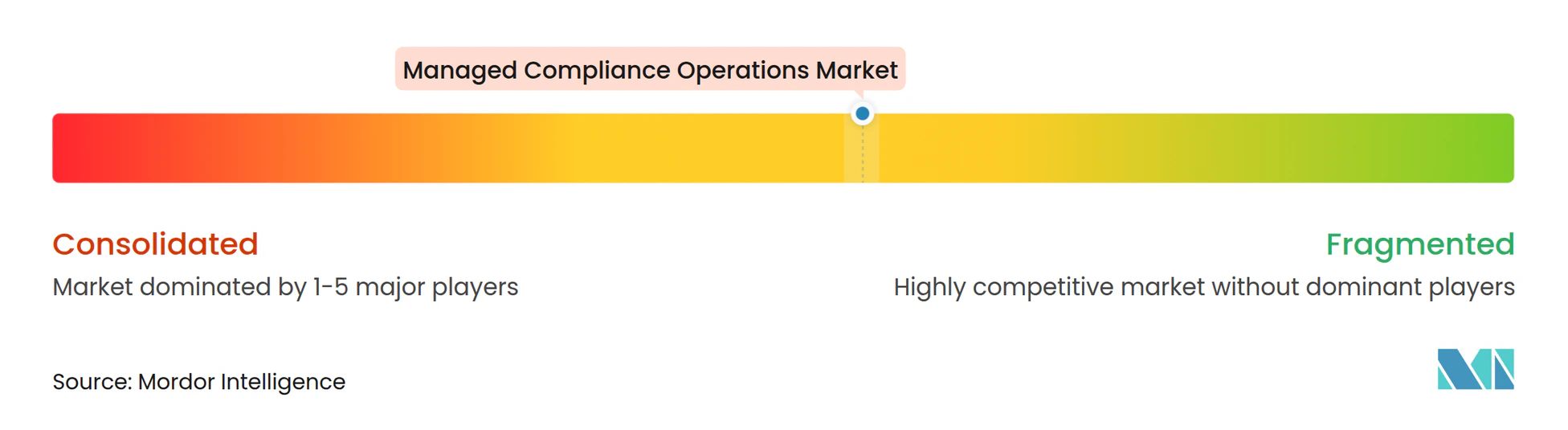
The Managed compliance operations market is moderately fragmented because providers cover different parts of the value chain. Vanta, Drata, ControlCase, and DataGuard GmbH focus on automation for technology-oriented organizations. OneTrust, MetricStream, Workiva, Diligent, Wolters Kluwer, ServiceNow, IBM, SAP SE, and Oracle compete for larger multi-framework programs. Deloitte, EY, KPMG, PwC, Accenture, and Capgemini SE support fully managed delivery for BFSI and government clients. Thomson Reuters and NAVEX Global combine regulatory content libraries with workflow software. No single provider covers every client need across content, software, and managed operations. Buyers often use a platform from one provider and services from another. This structure gives system integrators an important role in multi-vendor environments.
Competition increasingly centers on AI-supported evidence generation, workflow execution, and regulatory change management. Diligent introduced agentic GRC capabilities in September 2026, including an orchestration agent, enterprise risk management agent, audit agent, AI reporting, and a GRC knowledge base. The company said the knowledge base connects regulations, controls, risks, and evidence drawn from more than 200,000 SEC 10-K filings. Workiva introduced an AI-powered GRC platform in March 2026 with audit, risk, and controls capabilities. These actions show that vendors are moving beyond dashboards toward workflow support and more connected evidence. Human oversight remains relevant because regulated decisions still require accountable management involvement.
Vanta closed a USD 150 million Series D round in July 2025 at a USD 4.15 billion valuation, according to the company. The funding was intended to support AI-driven trust automation, wider framework coverage, and U.S. government expansion. Wolters Kluwer launched Compliance Intelligence in October 2025 to combine regulatory data, domain expertise, and AI workflows for applicability assessment and obligation tracking. These moves reflect the value of combining regulatory content with software and workflow support. Providers that can work across existing client systems may have an advantage in hybrid environments. The Managed compliance operations market remains open to specialized software firms, content providers, and services-led organizations. Competitive positions depend on each provider’s ability to connect automation with practical compliance operations.
Managed Compliance Operations Industry Leaders
-
OneTrust, LLC
-
International Business Machines Corporation
-
SAP SE
-
NAVEX Global, Inc.
-
MetricStream, Inc.
- *Disclaimer: Major Players sorted in no particular order
Managed Compliance Operations Market Companies Covered in this Report
- OneTrust, LLC
- International Business Machines Corporation
- SAP SE
- NAVEX Global, Inc.
- MetricStream, Inc.
- Workiva Inc.
- Wolters Kluwer N.V.
- Diligent Corporation
- ServiceNow, Inc.
- Microsoft Corporation
- Oracle Corporation
- Thomson Reuters Corporation
- Fenergo Limited
- ComplyAdvantage Ltd.
- Vanta Inc.
- Drata Inc.
- Accenture plc
- Deloitte Touche Tohmatsu Limited
- Ernst & Young Global Limited
- KPMG International Limited
- PricewaterhouseCoopers International Limited
- Capgemini SE
- ControlCase LLC
- DataGuard GmbH
Recent Industry Developments in Managed Compliance Operations Market
- September 2026: Wolters Kluwer launched Expert AI additions to CT hCue, enhancing AI-powered documentation capabilities across entity management compliance workflows.
- September 2026: Diligent unveiled agentic GRC capabilities within the Diligent One platform at the Gartner Enterprise Risk, Audit and Compliance Conference, including an orchestration agent, enterprise risk management agent, audit agent, AI reporting, and a GRC brain, extending GRC from periodic reporting toward autonomous, continuous compliance execution with human oversight maintained throughout.
- July 2026: Workiva announced 3 purpose-built AI agents and Workiva Knowledge, enabling GRC, finance, and sustainability teams to automate complex compliance workflows grounded in live organizational data, extending the platform's coverage from financial and ESG reporting into continuous audit and controls automation.
- March 2026: Forescout Technologies launched Automated Security Controls Assessment within its Vistaro platform, enabling continuous evidence-based compliance monitoring across managed and unmanaged assets and replacing manual, spreadsheet-driven audit processes with real-time automated evidence collection.
Global Managed Compliance Operations Market Report Scope
The Managed Compliance Operations Market encompasses software and outsourced services for regulatory compliance monitoring, risk assessment, reporting, audit management, and governance across diverse industries, service models, and deployment environments globally.
The Managed Compliance Operations Market Report is Segmented by Offering (Software, and Services), Service Model (Fully Managed Model, Partial Outsourcing Model, Project-Based Consulting Model, Embedded Compliance Team Model, and Technology-Led Self-Service Model), Deployment Model (On-Premises, Cloud-Based, and Hybrid), Organization Size (Small and Medium Enterprises, and Large Enterprises), End-User Industry (Information Technology and Telecommunications, BFSI, Healthcare, Retail and E-Commerce, Manufacturing, Government and Defense, and Other End-User Industries), and Geography (North America, South America, Europe, Asia-Pacific, Middle East, and Africa). The Market Forecasts are Provided in Terms of Value (USD).
Segmentation Overview
| Software |
| Services |
| Fully Managed Model |
| Partial Outsourcing Model |
| Project-Based Consulting Model |
| Embedded Compliance Team Model |
| Technology-Led Self-Service Model |
| On-Premises |
| Cloud-Based |
| Hybrid |
| Small and Medium Enterprises |
| Large Enterprises |
| Information Technology and Telecommunications |
| BFSI |
| Healthcare |
| Retail and E-Commerce |
| Manufacturing |
| Government and Defense |
| Other End-User Industries |
| North America | United States |
| Canada | |
| Mexico | |
| South America | Brazil |
| Argentina | |
| Rest of South America | |
| Europe | Germany |
| United Kingdom | |
| France | |
| Italy | |
| Spain | |
| Russia | |
| Rest of Europe | |
| Asia-Pacific | China |
| India | |
| Japan | |
| South Korea | |
| Australia | |
| Rest of Asia-Pacific | |
| Middle East | Saudi Arabia |
| United Arab Emirates | |
| Turkey | |
| Rest of Middle East | |
| Africa | South Africa |
| Egypt | |
| Nigeria | |
| Rest of Africa |
| By Offering | Software | |
| Services | ||
| By Service Model | Fully Managed Model | |
| Partial Outsourcing Model | ||
| Project-Based Consulting Model | ||
| Embedded Compliance Team Model | ||
| Technology-Led Self-Service Model | ||
| By Deployment Model | On-Premises | |
| Cloud-Based | ||
| Hybrid | ||
| By Organization Size | Small and Medium Enterprises | |
| Large Enterprises | ||
| By End-User Industry | Information Technology and Telecommunications | |
| BFSI | ||
| Healthcare | ||
| Retail and E-Commerce | ||
| Manufacturing | ||
| Government and Defense | ||
| Other End-User Industries | ||
| By Geography | North America | United States |
| Canada | ||
| Mexico | ||
| South America | Brazil | |
| Argentina | ||
| Rest of South America | ||
| Europe | Germany | |
| United Kingdom | ||
| France | ||
| Italy | ||
| Spain | ||
| Russia | ||
| Rest of Europe | ||
| Asia-Pacific | China | |
| India | ||
| Japan | ||
| South Korea | ||
| Australia | ||
| Rest of Asia-Pacific | ||
| Middle East | Saudi Arabia | |
| United Arab Emirates | ||
| Turkey | ||
| Rest of Middle East | ||
| Africa | South Africa | |
| Egypt | ||
| Nigeria | ||
| Rest of Africa | ||
Key Questions Answered in the Report
What is the size of the managed compliance operations market?
The managed compliance operations market is projected to increase from USD 9.84 billion in 2026 and USD 11.24 billion in 2027 to USD 21.93 billion by 2032, at a 14.24% CAGR. The forecast reflects demand for continuous monitoring, evidence collection, audit preparation, policy management, and risk assessment delivered through managed services and software. It also reflects the pressure on organizations to maintain reliable documentation across rules that differ by jurisdiction, sector, data type, technology environment, and supplier relationship.
What is driving demand for managed compliance operations?
Regulatory complexity, cybersecurity obligations, continuous audit evidence requirements, and shortages of experienced compliance professionals support demand. AI governance obligations also add new work for organizations that need to monitor automated decision systems and keep documented records of how those systems operate. The effect is especially clear where cybersecurity controls, privacy requirements, supplier oversight, and operational resilience records must be maintained through one coordinated compliance program.
Which offering leads managed compliance operations?
Services lead with 64.37% share in 2026, while software is projected to be the faster-growing offering at a 15.87% CAGR through 2032. Services remain important because compliance teams need human interpretation, clear escalation, and management sign-off at key points in the compliance process. They are particularly relevant in BFSI and healthcare, where high audit frequency and complex control requirements can make a gap in documentation or oversight difficult to manage internally.
Which deployment approach is growing fastest?
Hybrid deployment is projected to grow at a 15.68% CAGR through 2032 because regulated organizations often need both cloud and on-premises systems. This approach allows them to retain sensitive or jurisdiction-specific materials on premises while using cloud tools for monitoring, workflow management, and evidence coordination. Providers must connect these environments without weakening the evidence trail between the source record, the control being tested, the responsible owner, and the resulting audit documentation.
Which end-user sector has the largest demand?
BFSI leads with 27.38% share in 2026 because financial institutions manage broad requirements across financial crime, reporting, conduct, and operational resilience. Formal ICT contract registers, third-party oversight, and resilience documentation make continuous support useful for institutions managing multiple control frameworks. These buyers often need software for recurring evidence capture and managed services for tasks that need interpretation, coordination across teams, or formal review by accountable management.
Which region is expanding fastest?
Asia-Pacific is projected to grow at a 15.47% CAGR through 2032, supported by new cross-border data and AI governance requirements. Chinas certification measures and AI governance controls, together with outsourcing changes in Japan, create more structured needs for documentation, review, and compliance support. Regional growth also reflects the need for providers to adapt workflows to local rules rather than relying on a single global process for data transfers, model governance, and financial services obligations.