
Managed GRC Operations Services Market Size and Share
Market Overview
| Study Period | 2021 - 2032 |
|---|---|
| Market Size (2027) | USD 25.46 Billion |
| Market Size (2032) | USD 43.47 Billion |
| Growth Rate (2027 - 2032) | 11.29 % |
| Fastest Growing Market | Middle East |
| Largest Market | North America |
| Market Concentration | Medium |
Major Players *Disclaimer: Major Players sorted in no particular order Image © Mordor Intelligence. Reuse requires attribution under CC BY 4.0. | |
Managed GRC Operations Services Market Analysis by Mordor Intelligence
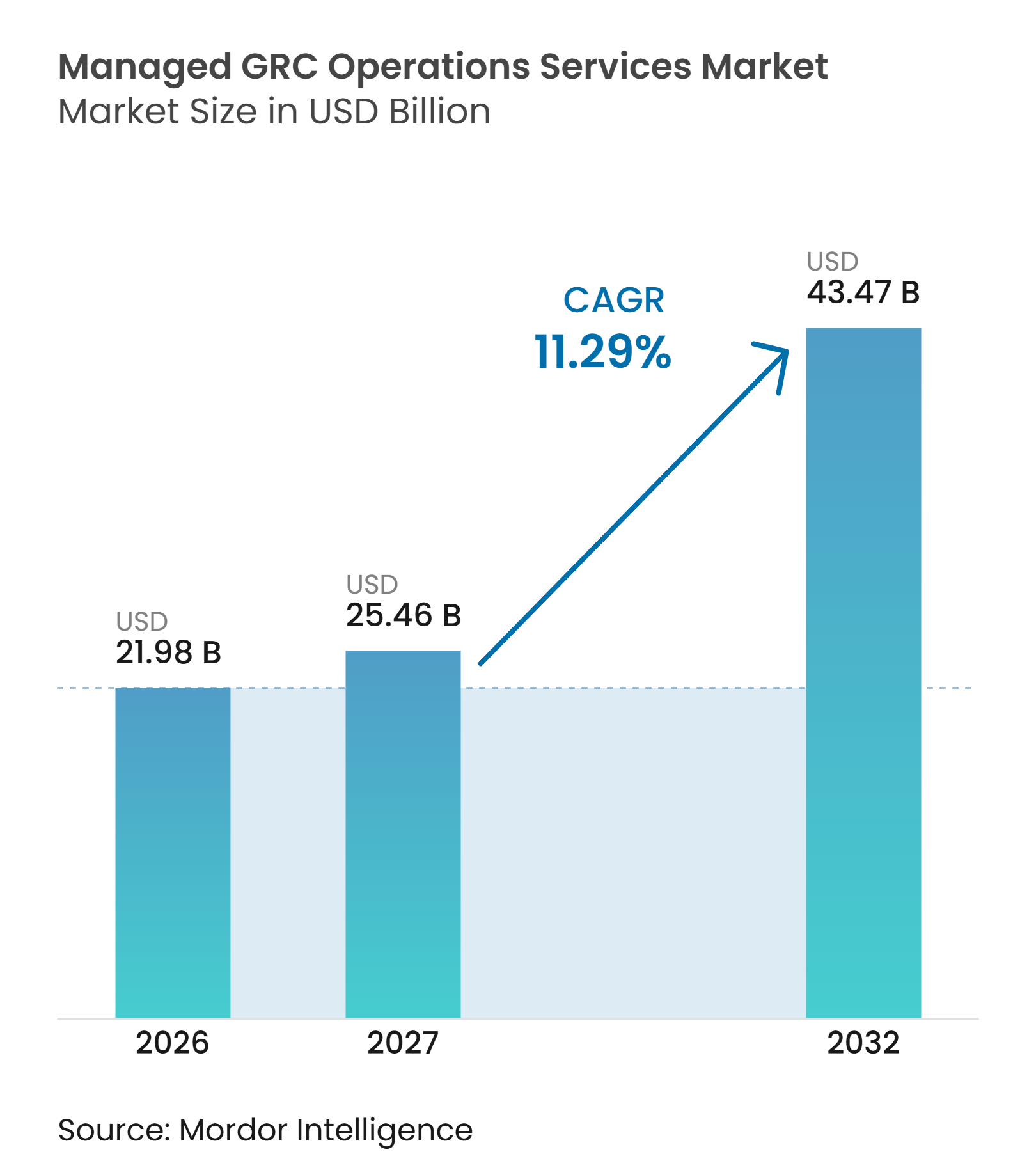
The Managed GRC Operations Services Market size was valued at USD 21.98 billion in 2026 and is estimated to grow from USD 25.46 billion in 2027 to reach USD 43.47 billion by 2032, at a CAGR of 11.29% during the forecast period (2027-2032).
Regulated organizations face overlapping requirements that need continuing evidence rather than periodic assessments. DORA, the EU AI Act, and NIS2 have increased the number of compliance activities that must run at the same time. Outsourcing gives organizations access to specialized operating capacity when internal teams cannot add people or skills quickly enough. Providers are responding by combining audit, risk, compliance, third-party oversight, and AI governance services on common platforms. Automation can reduce work per compliance cycle, although fragmented systems can delay the benefits during the first year of an engagement.
Key Report Takeaways
- By service type, managed compliance operations held a 23.56% share in 2026, while managed AI governance operations are projected to expand at a 12.11% CAGR through 2032.
- By organization size, large enterprises held an 82.34% share in 2026, while small and medium-sized enterprises are projected to expand at a 12.73% CAGR through 2032.
- By industry vertical, banking, financial services, and insurance held a 32.56% share in 2026, while healthcare and life sciences is projected to expand at a 12.67% CAGR through 2032.
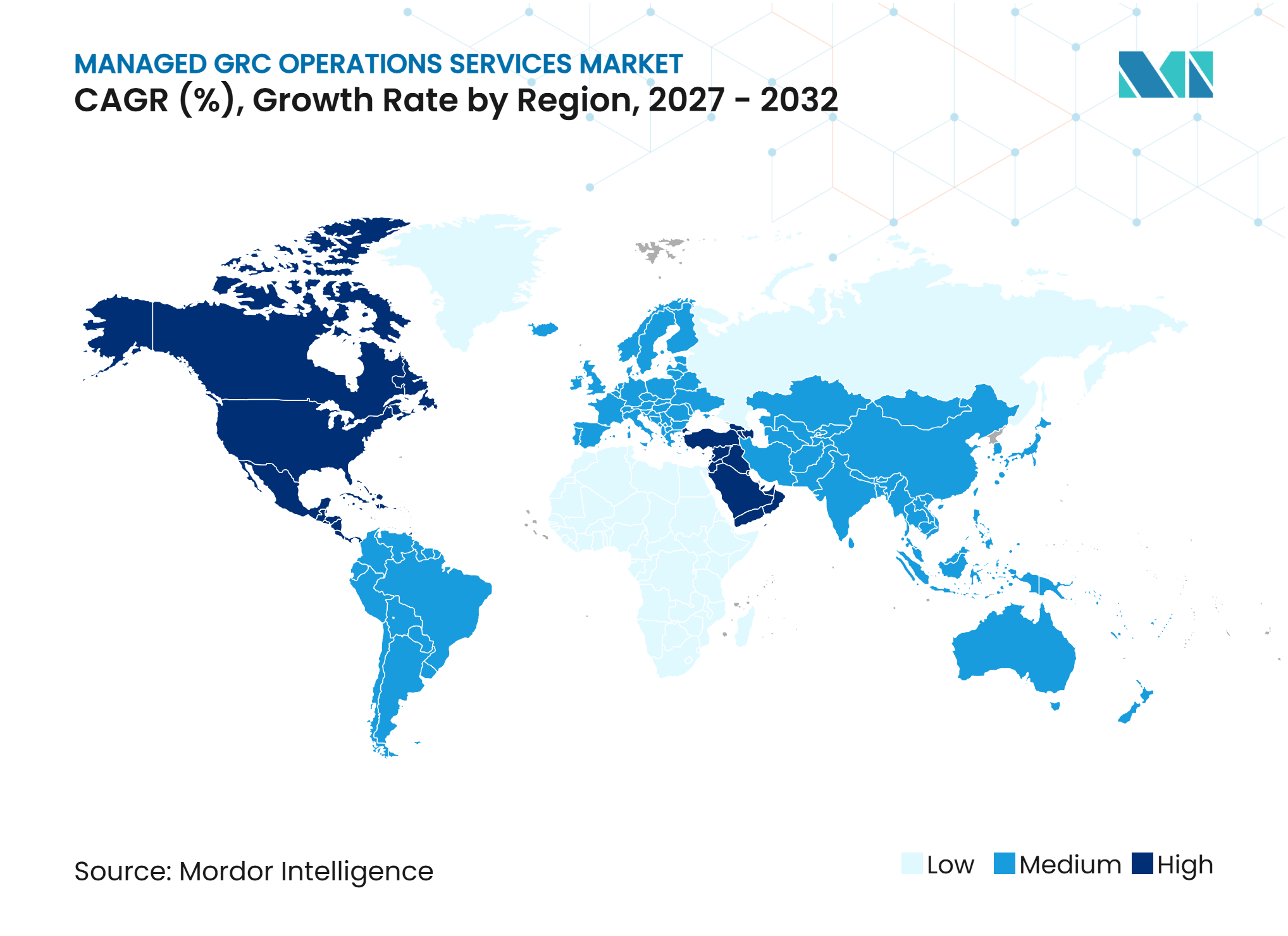
- By geography, North America held a 43.23% share in 2026, while the Middle East is projected to expand at a 12.58% CAGR through 2032.
Note: Market numbers in this report are based on Mordor Intelligence's proprietary estimation framework, which combines nine months of actuals with Q4 projections for base year 2026.
Market Trends and Insights
Drivers Impact Analysis of Managed GRC Operations Services Market*
| Driver | (~) % Impact on CAGR Forecast | Geographic Relevance | Impact Timeline |
|---|---|---|---|
| Escalating Cross-Border Regulatory Complexity | +2.5% | Global, with peak intensity in Europe and North America | Medium term (2-4 years) |
| Cybersecurity and Third-Party Risk Accountability | +2.1% | Global, concentrated in BFSI and healthcare | Short term (≤ 2 years) |
| Persistent Shortage of GRC and Cybersecurity Specialists | +1.6% | Global, most acute in North America, United Kingdom, and Asia-Pacific | Long term (≥ 4 years) |
| AI Governance Creating Recurring Control Operations | +1.5% | Global, with the earliest obligations in Europe | Short term (≤ 2 years) |
| Board Demand for Continuous Risk Intelligence | +1.3% | North America and Europe, with spillover to Asia-Pacific | Medium term (2-4 years) |
| Regulatory Evidence Automation for Distributed Workforces | +0.9% | North America, United Kingdom, and Asia-Pacific | Long term (≥ 4 years) |
| Source: Mordor Intelligence | |||
Escalating Cross-Border Regulatory Complexity
The managed GRC operations services market is supported by compliance programs that now run in parallel across many jurisdictions. DORA became enforceable for European Union financial entities in January 2025 and introduced detailed requirements for ICT risk management, incident reporting, and third-party oversight.[1] The EU AI Act began applying rules for general-purpose AI models in August 2025, while its wider framework has continued to introduce obligations on a phased schedule. France had not completed NIS2 transposition as of October 2026, but its pre-registration process has already encouraged affected entities to prepare for compliance. Organizations operating across European Union member states therefore need several control programs to operate together instead of completing one project before starting another. Saudi Arabia has created a similar trigger because the Saudi Central Bank asked supervised finance companies to develop governance roadmaps within 12 months of its December 2025 circular.
Cybersecurity and Third-Party Risk Accountability
The managed GRC operations services market also benefits from rules that place accountability for supplier risk with the regulated organization. DORA requires financial entities to manage ICT third-party risk and retain responsibility for the operational resilience of services they use. This obligation extends attention beyond direct technology providers to the wider vendor chain and its subcontractors. The 2025 ISC2 workforce study found that 27% of cybersecurity teams identified GRC as a critical skills gap. The same study reported that 19% of organizations were using third-party service providers to address internal gaps.[2] A managed provider can apply common monitoring tools across many vendor relationships, which can reduce the cost of continuous checks for each client. This model is especially relevant in BFSI, healthcare, and critical infrastructure, where supplier outages can create material regulatory and operational consequences.
Persistent Shortage of GRC and Cybersecurity Specialists
The managed GRC operations services market has a continuing need for people who understand both security operations and regulatory requirements. ISC2 found that 59% of security professionals reported critical or significant skills needs in 2025, compared with 44% in 2024. GRC and compliance were among the skill areas organizations identified as deficient in the study. The United Kingdom government reported that 57% of businesses had a basic technical cyber skills gap in 2026, up from 49% in the preceding year.[3] GRC work requires knowledge of frameworks such as NIST, ISO/IEC 27001, HIPAA, and DORA, as well as audit methods and legal interpretation. These capabilities take time to build within a team and are difficult to obtain through broad cybersecurity training alone. Providers can therefore offer ongoing support for privacy, AI governance assessment, and multi-framework mapping where internal hiring remains difficult.
AI Governance Creating Recurring Control Operations
The managed GRC operations services market is gaining a new service category as AI governance moves from policy work into recurring control operations. The EU AI Act became fully applicable on August 2, 2026, subject to the regulation's staged exceptions, and it requires documentation, human oversight, incident reporting, and post-market monitoring for applicable high-risk systems. The European Commission published EN 18286:2026 in the Official Journal on October 19, 2026 as the first harmonized quality management standard supporting AI Act compliance. ISO/IEC 42001 provides a further AI management system framework that organizations can use alongside legal requirements. New models, changed vendors, and altered use cases can each require controls to be reviewed again. This makes AI governance a continuing operational task rather than a one-time certification project. Human oversight remains necessary when automated tools gather evidence or produce audit material, creating a recurring role for managed teams.
Restraints Impact Analysis of Managed GRC Operations Services Market*
| Restraint | (~) % Impact on CAGR Forecast | Geographic Relevance | Impact Timeline |
|---|---|---|---|
| Legacy-System Integration and Data Normalization Costs | -1.2% | Global, most acute in large enterprises and government | Long term (≥ 4 years) |
| Fragmented Ownership Across the Three Lines of Defense | -0.8% | Global, most pronounced in BFSI and manufacturing | Medium term (2-4 years) |
| Data Residency and Cross-Border Processing Constraints | -0.7% | Europe and Asia-Pacific, with spillover to the Middle East and Africa | Medium term (2-4 years) |
| Trust Deficit Around AI-Assisted Control Decisions | -0.5% | Global, most visible in healthcare and financial services | Short term (≤ 2 years) |
| Source: Mordor Intelligence | |||
Legacy-System Integration and Data Normalization Costs
The managed GRC operations services market can face slower adoption when client evidence remains spread across GRC platforms, ticketing systems, HR tools, and cloud security products. In the managed GRC operations services market, these systems were often not designed to exchange information with each other. Providers must normalize the data before they can automate evidence collection or reporting. This work can delay the value delivered to the client and reduce provider margins during the first year. The task returns when a client adds regulations, suppliers, or jurisdictions because the evidence model must change with the operating environment. Large enterprises and government organizations often have the most complex legacy estates, making integration a continuing limit on delivery speed.
Fragmented Ownership Across the Three Lines of Defense
The managed GRC operations services market can also be constrained when accountability remains unclear between internal functions and external providers. Across the managed GRC operations services market, the three-lines model separates business operations, risk and compliance oversight, and internal audit. A provider may aggregate evidence for the second line while business units retain responsibility for control execution. This can lead to disagreement about control design, evidence quality, and responsibility for remediation. Organizations that do not settle these responsibilities before implementation can face delayed sign-offs and duplicate risk assessments. The issue is particularly important in BFSI because internal audit must preserve independence, while manufacturing organizations often have risk ownership spread across many sites.
*Our forecasts treat driver/restraint impacts as directional, not additive. The impact forecasts reflect baseline growth, mix effects, and variable interactions.
Managed GRC Operations Services Market Segment Analysis
By Service Type, Compliance Mandates Support the Largest Category
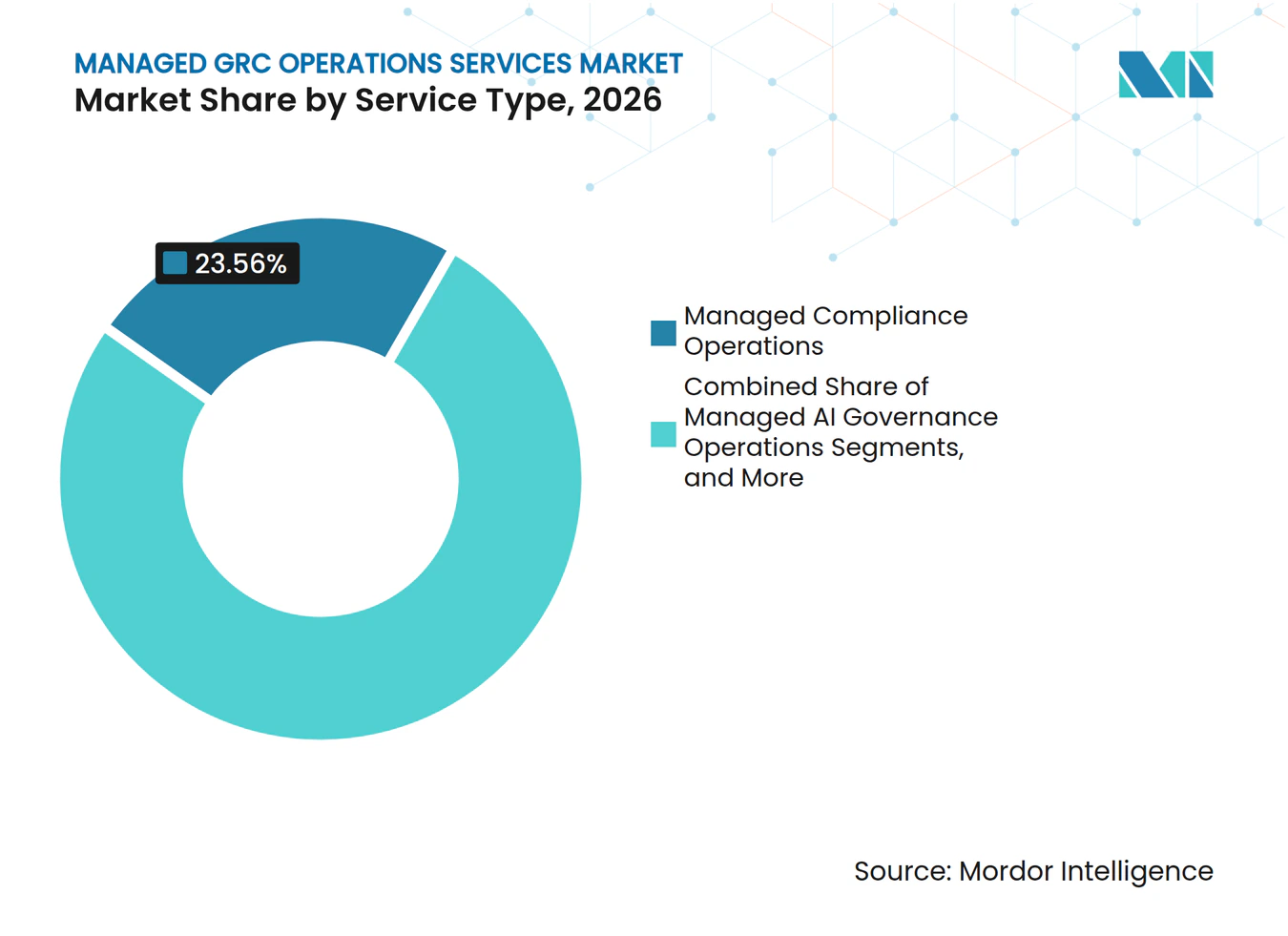
Managed Compliance Operations held 23.56% share in 2026. In the managed GRC operations services market, compliance status is the common outcome of work across internal audit testing, risk monitoring, third-party onboarding, and AI governance documentation. Regulators and boards increasingly expect evidence to be current rather than refreshed only before a review. Managed Risk Operations and Managed Internal Audit and Controls Testing are also important because DORA, ISO 31000, and audit standards require more frequent, evidence-based testing cycles. Managed Third-Party Risk Operations is gaining demand as DORA expands the set of vendor relationships that financial entities must monitor. Managed Regulatory Change and Obligation Management addresses the need to interpret overlapping mandates, especially in financial services. Managed Privacy and Data Governance Operations supports organizations managing GDPR, Brazil's LGPD, and data localization requirements across Asia-Pacific.
Managed AI Governance Operations is projected to expand at a 12.11% CAGR through 2032. Its demand is linked to the EU AI Act and EN 18286:2026, which establish a more structured pathway for ongoing AI quality and governance controls. Organizations are moving from informal oversight toward documented model monitoring, lifecycle records, and human review protocols. Managed Business Continuity and Operational Resilience completes the service portfolio and gains relevance from DORA resilience testing requirements. Annual tabletop exercises alone do not provide the continuous validation that many organizations now need. The managed GRC operations services industry is consequently shifting from recording compliance activities toward operating controls on a continuing basis.



By Organization Size, Enterprise Demand Coexists With a Small and Medium-Sized Enterprise Opportunity
Large Enterprises held 82.34% share in 2026. In the managed GRC operations services market, global companies, financial institutions, healthcare systems, and multinational industrial firms have large compliance estates across several jurisdictions. These organizations often use a provider to supplement internal teams rather than replace them. Providers take on high-effort tasks such as evidence collection, third-party onboarding, and regulatory change tracking. Multi-year engagements are common because the provider must be integrated into the client’s audit and compliance processes. The scale and complexity of these environments support continued demand for broad, integrated service scopes.
Small and Medium-Sized Enterprises are projected to expand at a 12.73% CAGR through 2032. DORA captures ICT third-party service providers regardless of size, which can bring smaller suppliers within the scope of client due diligence. NIS2 Implementing Regulation 2024/2690 also applies security requirements to managed service providers. These requirements do not reduce simply because an organization has a small governance team. Small firms may therefore look for pre-scoped, framework-ready services that cost less than a customized enterprise engagement. Providers that adapt service packages and delivery models for these buyers can reach a client group that has historically received less attention.
By Industry Vertical, BFSI Leads Demand While Healthcare and Life Sciences Sets the Pace
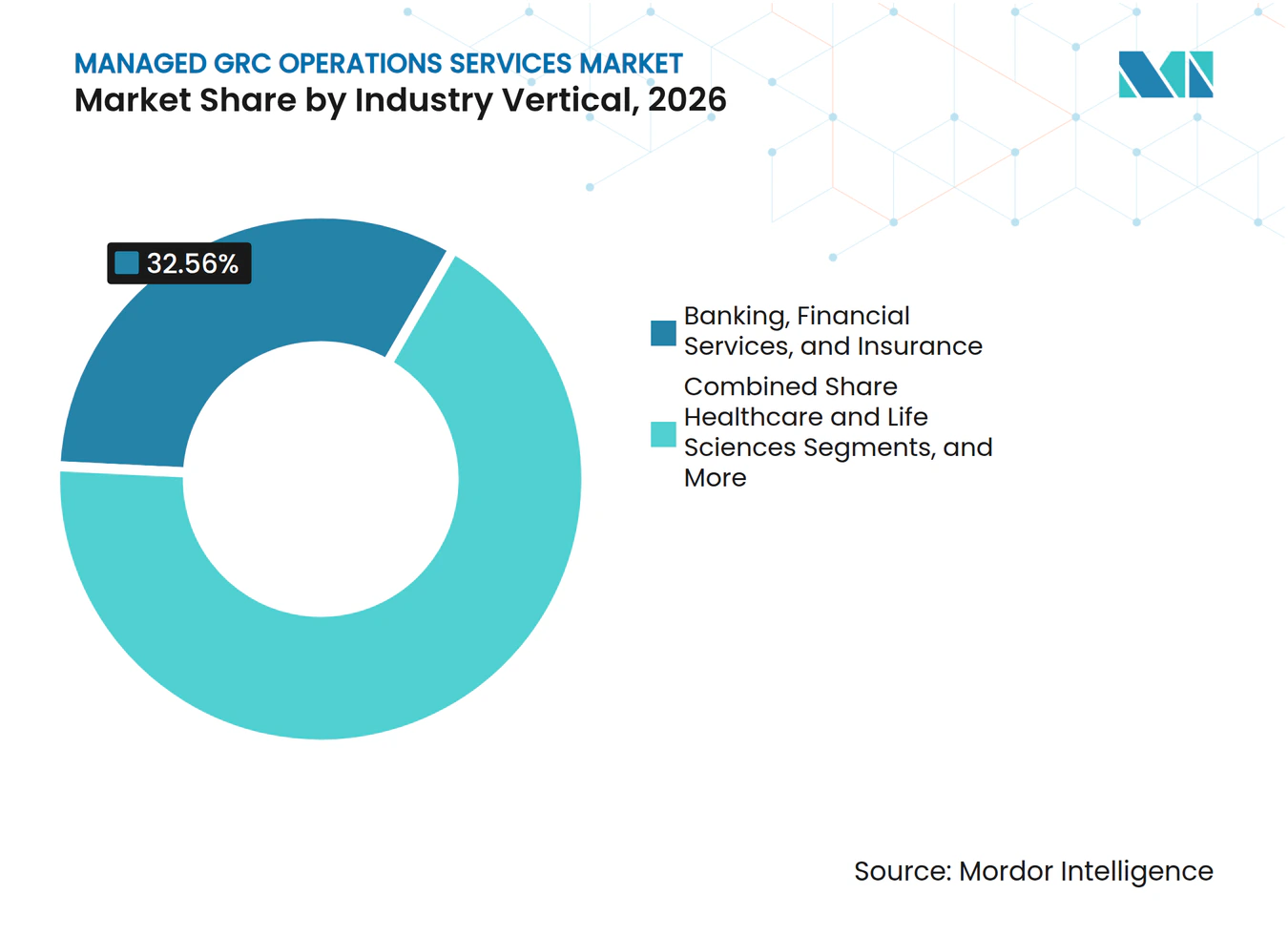
Banking, Financial Services, and Insurance accounted for 32.56% share in 2026. In the managed GRC operations services market, the sector manages overlapping requirements for AML-CFT, PCI DSS v4, DORA ICT risk, Basel IV reporting, and SEC cybersecurity disclosures. These requirements generate extensive evidence work and make continuous monitoring more important than periodic assessment. Managed Third-Party Risk Operations has strong relevance because banks depend on fintech, cloud, and data analytics providers. Information technology and telecom companies are also important because NIS2 identifies many of these providers as important entities. Government organizations use managed support for cybersecurity frameworks and data governance, although procurement timing and sovereignty requirements can slow private-sector provider engagement.
Healthcare and Life Sciences is projected to expand at a 12.67% CAGR through 2032. HIPAA security rule modernization proposals, FDA cybersecurity guidance for software-enabled medical devices, and AI diagnostic oversight are adding work for providers, payers, and health technology vendors. These requirements create both pre-market and post-market responsibilities for connected medical technology. HITRUST has also extended attention to AI risk domains, which adds another governance consideration for health technology companies operating across regions. Energy and utilities, manufacturing, and retail have meaningful demand, but their adoption is more often tied to a regulatory action, supply chain event, or sector mandate. The wider vertical base gives providers opportunities beyond hospitals and insurance carriers.

Geography Analysis
North America Managed GRC Operations Services Market
North America held 43.23% of the managed GRC operations services market share in 2026. The United States drives much of this demand through SEC cybersecurity disclosure rules, HIPAA enforcement, CMMC 2.0 requirements, and state privacy laws. SEC registrants must disclose material cybersecurity incidents and provide annual information on cybersecurity risk management and governance. CMMC 2.0 also shapes compliance planning across the defense industrial base. Canada and Mexico add regional demand through privacy obligations that multinational groups can manage through shared delivery models.
Europe and APAC Managed GRC Operations Services Market
Europe’s position is based on regulatory density across DORA, NIS2, GDPR, and the EU AI Act. Providers with control libraries that cover these frameworks can reduce setup work for clients. Germany, the United Kingdom, and France are the principal national markets. Germany’s BSI has issued NIS2 guidance for affected organizations, while France’s pre-registration process has prompted planning before national transposition is completed. Asia-Pacific demand is concentrated in banking, IT, and healthcare, supported by Singapore’s technology risk requirements, Australia’s resilience reforms, and Indonesia’s data protection framework.
MEA Managed GRC Operations Services Market
The Middle East is projected to expand at a 12.58% CAGR through 2032. For the managed GRC operations services market, Saudi Arabia’s SAMA circular requires finance companies to conduct governance assessments and submit board-approved compliance roadmaps. The Saudi National Cybersecurity Authority’s 2025 risk management framework adds structured compliance work for regulated organizations. Africa remains an emerging opportunity, with South Africa and Nigeria supported by data protection obligations but limited by infrastructure and lower managed services penetration.
Competitive Landscape
Market Concentration
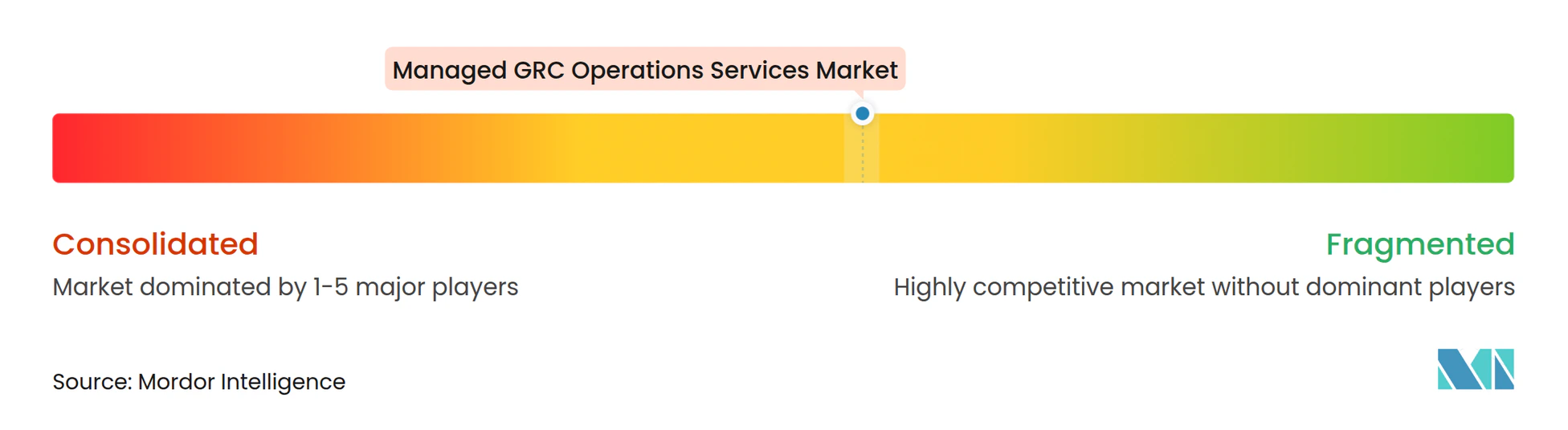
The managed GRC operations services market is moderately concentrated around established GRC platform companies, consulting-led providers, and specialized firms. MetricStream, OneTrust, Diligent, and NAVEX are among the established platform companies identified in the available material. Their strategies increasingly combine audit, risk, compliance, and AI governance within a single operating layer. A unified platform can reduce friction when evidence moves between functions that were previously separated. Enterprise customers also use ISO/IEC 27001 and SOC 2 Type II attestations as baseline procurement requirements.
Diligent acquired 3rdRisk in January 2026, adding an AI-native third-party risk management capability to its platform. NAVEX was recapitalized in October 2025 through a majority investment led by Goldman Sachs Alternatives with Blackstone as a significant minority co-investor. These moves support investment in integrated ethics, risk, and compliance platforms. MetricStream’s 2026 Chartis recognition points to continued visibility for enterprise GRC and audit technology. Consolidation can give buyers fewer vendors to manage, while raising pressure on specialist firms with a narrower scope.
Managed AI Governance Operations remains a relatively open area because it emerged recently and has no dominant provider. Small and Medium-Sized Enterprise compliance packages are another opportunity because many services remain designed for large, customized engagements. LogicGate introduced Config Newton in May 2026 to support workflow configuration, evidence collection, and audit narrative preparation. Optro acquired Midship in May 2026 and expanded its AI-focused GRC capabilities. These moves show how providers are shifting from compliance recording toward operational delivery features.
Managed GRC Operations Services Industry Leaders
-
MetricStream, Inc.
-
Riskonnect, Inc.
-
NAVEX Global, Inc.
-
OneTrust, LLC
-
Diligent Corporation
- *Disclaimer: Major Players sorted in no particular order
Managed GRC Operations Services Market Companies Covered in this Report
- MetricStream, Inc.
- Riskonnect, Inc.
- LogicGate, Inc.
- OneTrust, LLC
- NAVEX Global, Inc.
- SAI360
- Diligent Corporation
- Mitratech Holdings, Inc.
- Ideagen plc
- Origami Risk, LLC
- Archer Software, LLC
- AuditBoard, Inc. (Optro)
- Onspring Technologies, LLC
- Resolver, Inc. (a Kroll Business)
- Corporater AS
- Protecht Group Holdings Pty Ltd
- LogicManager, Inc.
- SureCloud Limited
- CyberSaint, Inc.
- 360factors, Inc.
- ZenGRC, Inc.
- ProcessUnity Corporation
Recent Industry Developments in Managed GRC Operations Services Market
- June 2026: Optro, formerly AuditBoard, opened its Singapore regional hub for the managed GRC operations services market on June 22, 2026. The center provides localized support for audit, risk, compliance, and information security practitioners across Asia-Pacific.
- May 2026: Optro completed the acquisition of Midship, an AI-SOX automation solution. The acquisition expanded its ability to automate repetitive audit evidence tasks for teams facing budget constraints.
- May 2026: LogicGate introduced Config Newton, described as an agentic GRC engineer, to assist with workflow configuration, evidence collection, and audit narrative generation.
- March 2026: Optro launched an expanded suite of AI-powered GRC capabilities covering AI governance, cyber risk, and continuous control monitoring.
Global Managed GRC Operations Services Market Report Scope
The Managed GRC Operations Services Market comprises outsourced and managed service offerings that help organizations design, implement, monitor, and continuously operate Governance, Risk, and Compliance (GRC) programs across regulatory, cybersecurity, operational, financial, and third-party risk domains.
The Managed GRC Operations Services Market Report is Segmented by Service Type (Managed Compliance Operations, Managed Risk Operations, Managed Internal Audit and Controls Testing, Managed Third-Party Risk Operations, Managed Regulatory Change and Obligation Management, Managed Privacy and Data Governance Operations, Managed AI Governance Operations, and Managed Business Continuity and Operational Resilience), by Organization Size (Large Enterprises and Small and Medium-Sized Enterprises), by Industry Vertical (Banking, Financial Services, and Insurance; Healthcare and Life Sciences; Information Technology and Telecom; Government and Public Sector; Energy and Utilities; Manufacturing and Industrial; Retail and Consumer Goods; and Other Industry Verticals), and by Geography (North America [United States, Canada, and Mexico], South America [Brazil, Argentina, and Rest of South America], Europe [United Kingdom, Germany, France, Italy, Spain, Russia, and Rest of Europe], Asia-Pacific [China, Japan, India, South Korea, Southeast Asia, Australia, and Rest of Asia-Pacific], Middle East [Saudi Arabia, United Arab Emirates, Turkey, Israel, and Rest of Middle East], and Africa [South Africa, Nigeria, and Rest of Africa]). The Market Forecasts Are Provided in Terms of Value (USD).
Segmentation Overview
| Managed Compliance Operations |
| Managed Risk Operations |
| Managed Internal Audit and Controls Testing |
| Managed Third-Party Risk Operations |
| Managed Regulatory Change and Obligation Management |
| Managed Privacy and Data Governance Operations |
| Managed AI Governance Operations |
| Managed Business Continuity and Operational Resilience |
| Large Enterprises |
| Small and Medium-Sized Enterprises |
| Banking, Financial Services, and Insurance |
| Healthcare and Life Sciences |
| Information Technology and Telecom |
| Government and Public Sector |
| Energy and Utilities |
| Manufacturing and Industrial |
| Retail and Consumer Goods |
| Other Industry Verticals |
| North America | United States |
| Canada | |
| Mexico | |
| South America | Brazil |
| Argentina | |
| Rest of South America | |
| Europe | United Kingdom |
| Germany | |
| France | |
| Italy | |
| Spain | |
| Russia | |
| Rest of Europe | |
| Asia-Pacific | China |
| Japan | |
| India | |
| South Korea | |
| Southeast Asia | |
| Australia | |
| Rest of Asia-Pacific | |
| Middle East | Saudi Arabia |
| United Arab Emirates | |
| Turkey | |
| Israel | |
| Rest of Middle East | |
| Africa | South Africa |
| Nigeria | |
| Rest of Africa |
| By Service Type | Managed Compliance Operations | |
| Managed Risk Operations | ||
| Managed Internal Audit and Controls Testing | ||
| Managed Third-Party Risk Operations | ||
| Managed Regulatory Change and Obligation Management | ||
| Managed Privacy and Data Governance Operations | ||
| Managed AI Governance Operations | ||
| Managed Business Continuity and Operational Resilience | ||
| By Organization Size | Large Enterprises | |
| Small and Medium-Sized Enterprises | ||
| By Industry Vertical | Banking, Financial Services, and Insurance | |
| Healthcare and Life Sciences | ||
| Information Technology and Telecom | ||
| Government and Public Sector | ||
| Energy and Utilities | ||
| Manufacturing and Industrial | ||
| Retail and Consumer Goods | ||
| Other Industry Verticals | ||
| By Geography | North America | United States |
| Canada | ||
| Mexico | ||
| South America | Brazil | |
| Argentina | ||
| Rest of South America | ||
| Europe | United Kingdom | |
| Germany | ||
| France | ||
| Italy | ||
| Spain | ||
| Russia | ||
| Rest of Europe | ||
| Asia-Pacific | China | |
| Japan | ||
| India | ||
| South Korea | ||
| Southeast Asia | ||
| Australia | ||
| Rest of Asia-Pacific | ||
| Middle East | Saudi Arabia | |
| United Arab Emirates | ||
| Turkey | ||
| Israel | ||
| Rest of Middle East | ||
| Africa | South Africa | |
| Nigeria | ||
| Rest of Africa | ||
Key Questions Answered in the Report
What is the size of the managed GRC operations services market?
The managed GRC operations services market is projected to reach USD 43.47 billion by 2032, from USD 25.46 billion in 2027, at a CAGR of 11.29%.
What services are included in managed GRC operations?
The service scope includes managed compliance, risk, internal audit and controls testing, third-party risk, regulatory change, privacy and data governance, AI governance, and operational resilience.
Which service type has the largest share?
Managed Compliance Operations held the largest service type share at 23.56% in 2026.
Why is AI governance becoming important for buyers?
EU AI Act requirements and EN 18286:2026 have increased the need for documented controls, human oversight, monitoring, and evidence management.
Which customer group is expected to expand fastest?
Small and Medium-Sized Enterprises (SMEs) are projected to expand at a 12.73% CAGR through 2032 as regulatory obligations reach more suppliers and service providers.
Which region offers the fastest projected expansion?
The Middle East is projected to expand at a 12.58% CAGR through 2032, supported by governance and cybersecurity requirements in Saudi Arabia and the UAE.