
Managed Cloud Threat Hunting Services Market Size and Share
Market Overview
| Study Period | 2021 - 2032 |
|---|---|
| Market Size (2027) | USD 1.72 Billion |
| Market Size (2032) | USD 4.39 Billion |
| Growth Rate (2027 - 2032) | 20.61 % |
| Fastest Growing Market | Asia-Pacific |
| Largest Market | North America |
| Market Concentration | Medium |
Major Players *Disclaimer: Major Players sorted in no particular order Image © Mordor Intelligence. Reuse requires attribution under CC BY 4.0. | |
Managed Cloud Threat Hunting Services Market Analysis by Mordor Intelligence
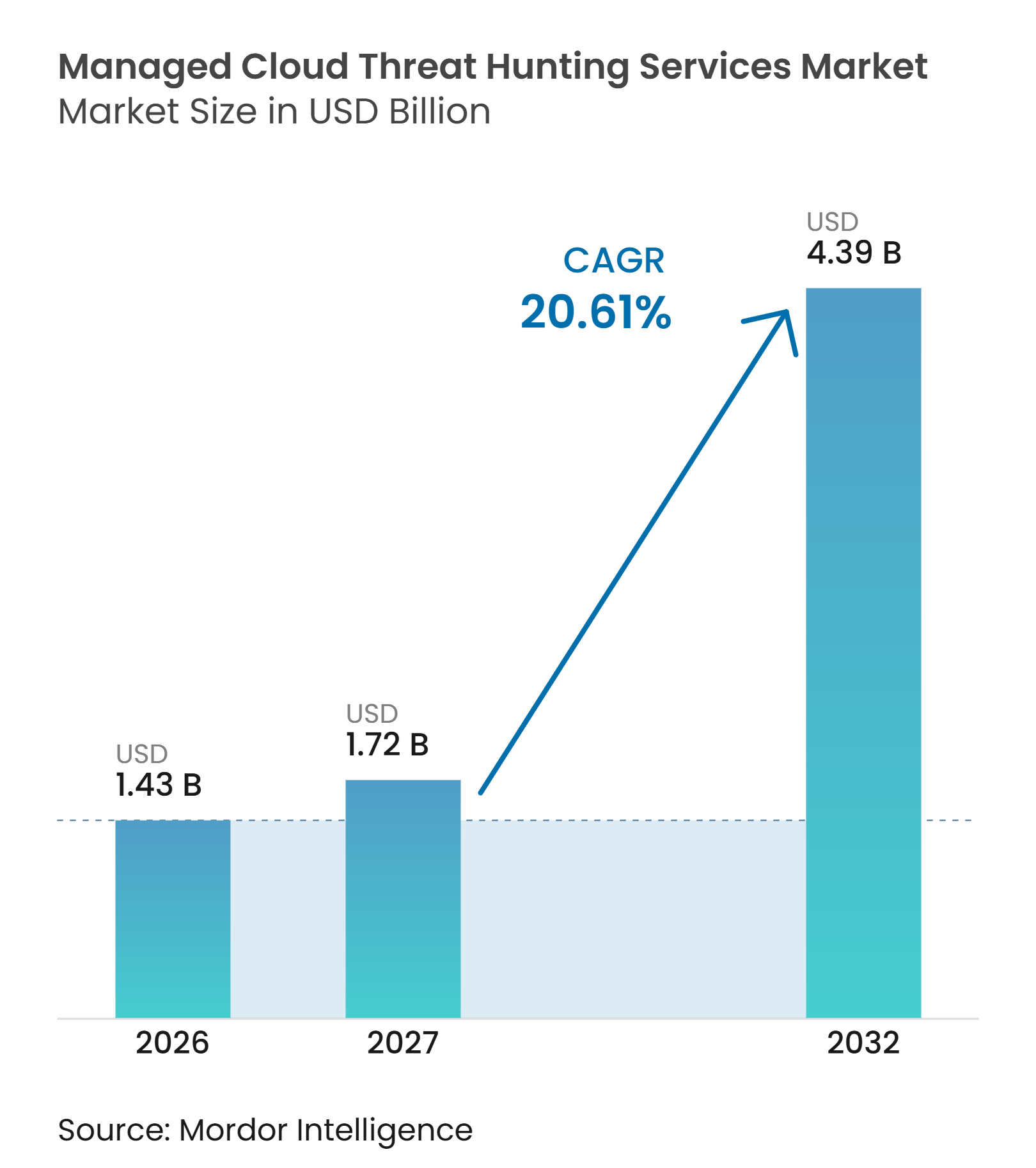
The managed cloud threat hunting services market size is projected to expand from USD 1.43 billion in 2026 and USD 1.72 billion in 2027 to USD 4.39 billion by 2032, registering a CAGR of 20.61% between 2027 and 2032. Growth follows the widening security exposure created by multi-cloud workloads, service accounts, and third-party application programming interfaces. Identity compromise has become a major route into cloud environments, which raises demand for monitoring that can connect activity across identities, workloads, and cloud platforms. Many organizations also lack the specialist staff needed to run continuous hunt programs internally. Providers are responding by combining managed services with automated investigation tools and broader telemetry coverage. Data residency rules, integration work, and the shortage of experienced cloud hunters remain material limits on service delivery.
Key Report Takeaways
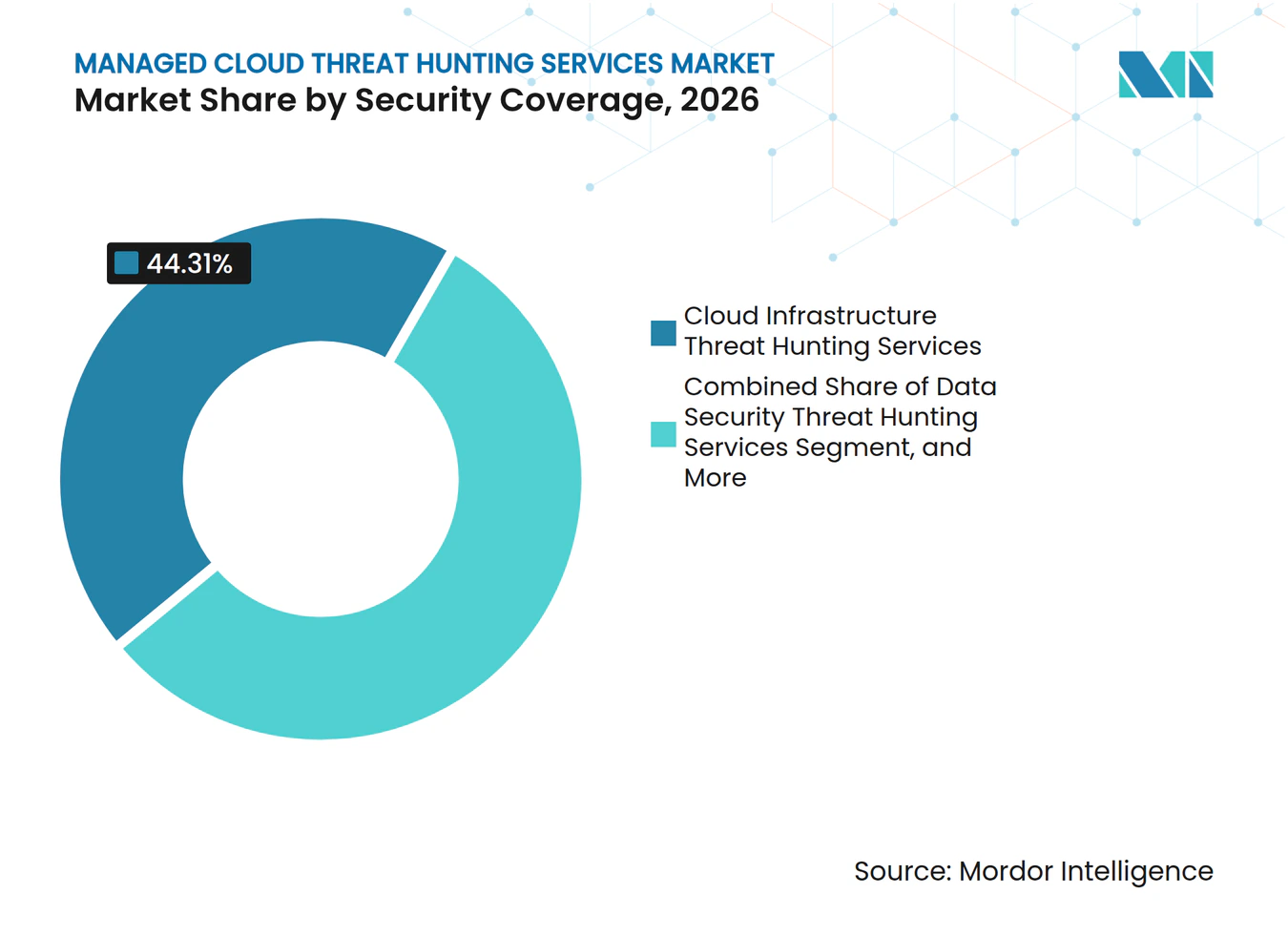
- By security coverage, cloud infrastructure threat hunting services held 44.31% of the managed cloud threat hunting services market in 2026, while identity and access threat hunting services are projected to expand at a 21.68% CAGR through 2032.
- By deployment mode, public cloud held 65.12% of the managed cloud threat hunting services market in 2026, while hybrid cloud is projected to expand at a 22.04% CAGR through 2032.
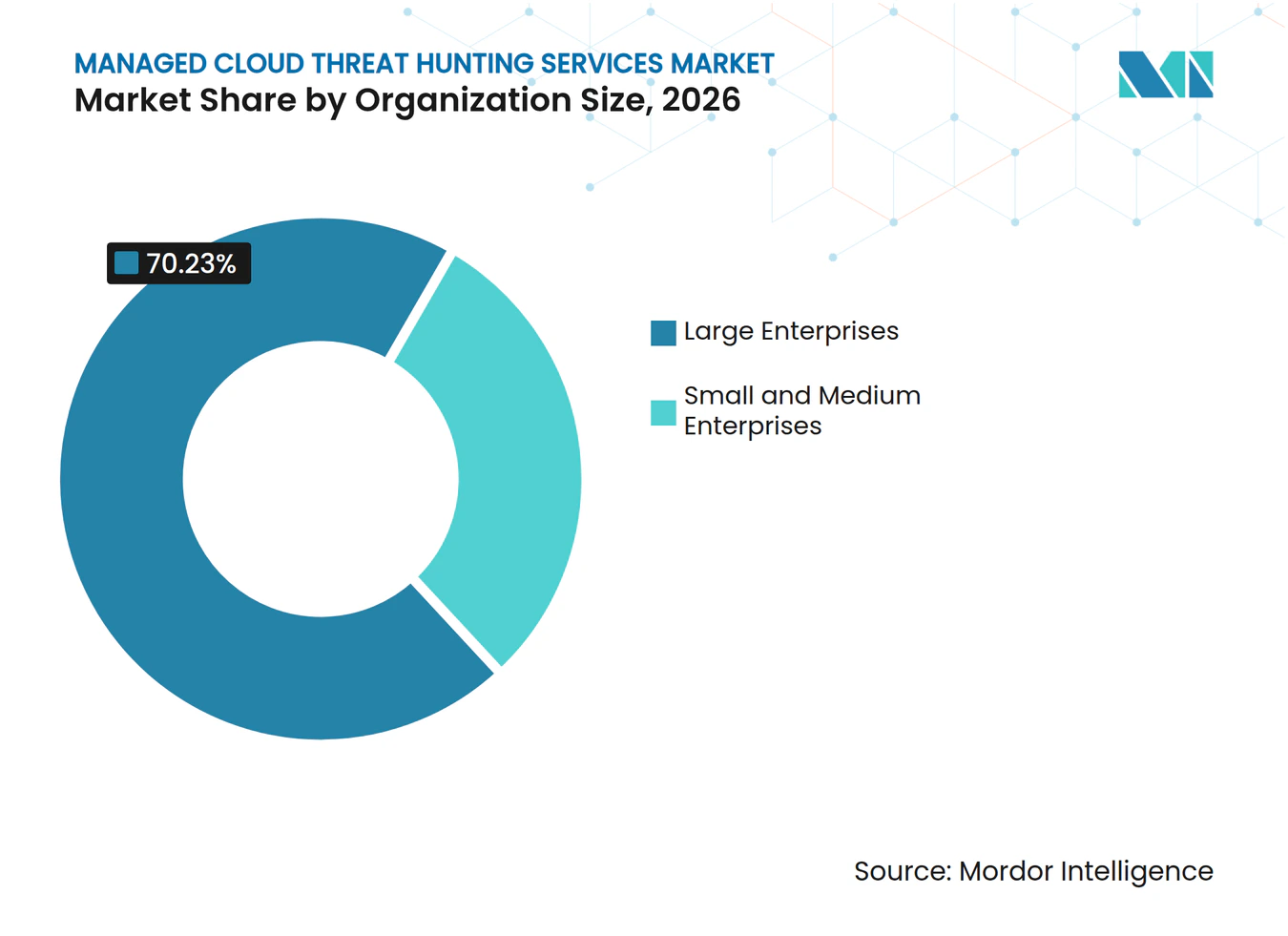
- By organization size, large enterprises held 70.23% of the managed cloud threat hunting services market in 2026, while small and medium enterprises are projected to expand at a 22.37% CAGR through 2032.
- By end-user industry, BFSI accounted for 28.17% of the managed cloud threat hunting services market in 2026, while government and public administration are projected to expand at a 21.08% CAGR through 2032.
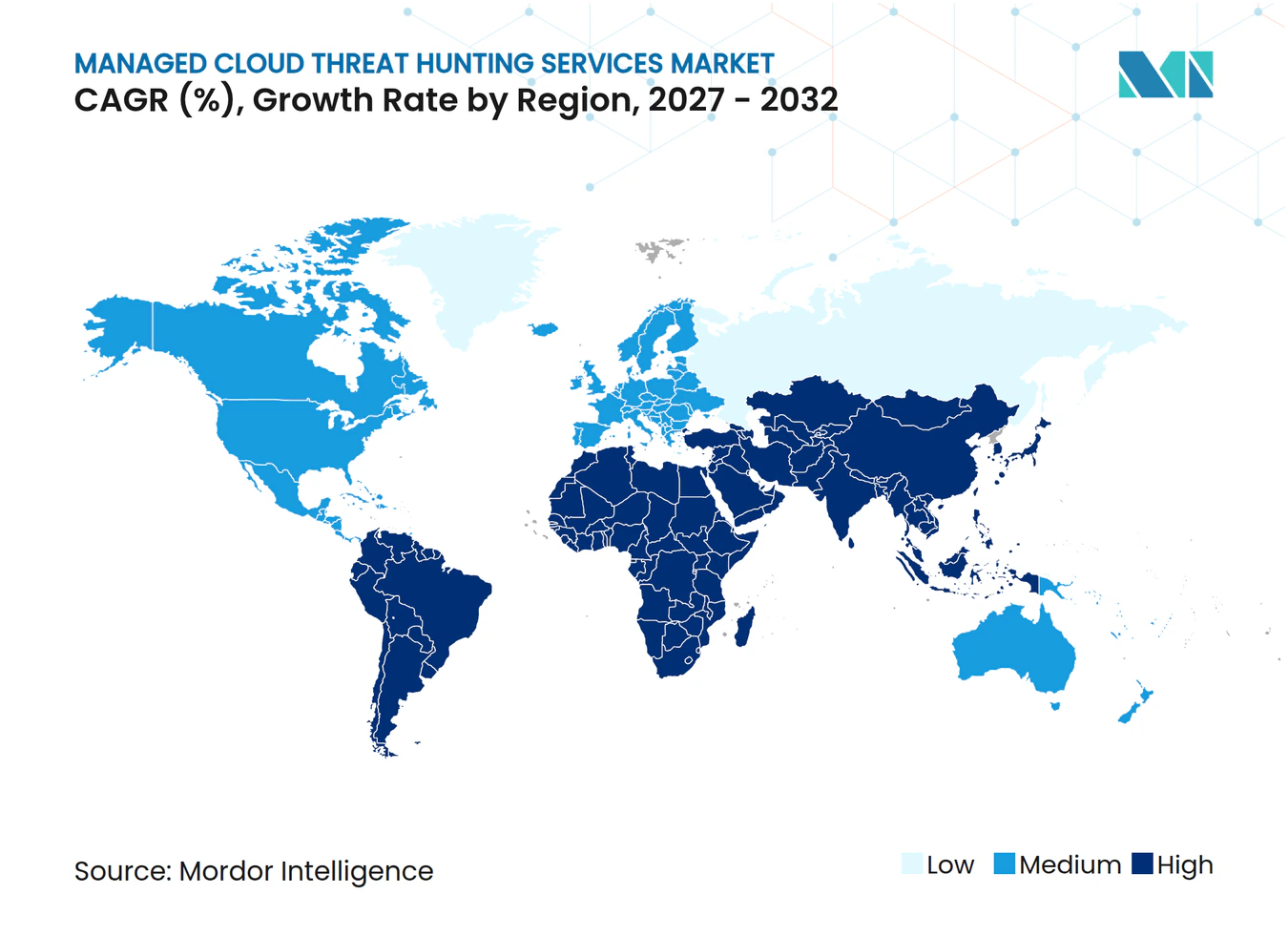
- By geography, North America held 35.88% of the managed cloud threat hunting services market revenue in 2026, while Asia-Pacific is projected to expand at a 21.35% CAGR through 2032.
Note: Market numbers in this report are based on Mordor Intelligence's proprietary estimation framework, which combines nine months of actuals with Q4 projections for base year 2026.
Market Trends and Insights
Drivers Impact Analysis of Managed Cloud Threat Hunting Services Market*
| Driver | (~) % Impact on CAGR Forecast | Geographic Relevance | Impact Timeline |
|---|---|---|---|
| Increasing Cloud Attack-Surface Complexity | +4.2% | Global, most acute in North America and Asia-Pacific cloud-dense corridors | Medium term (2-4 years) |
| Escalating Adversary Use of Living-off-the-Land Techniques | +3.8% | Global, with elevated severity in North America, Europe, and East Asia | Short term (≤ 2 years) |
| AI-Assisted Detection and Investigation Automation | +3.5% | Global, early adoption in North America and Europe, extending to Asia-Pacific | Long term (≥ 4 years) |
| Specialist Talent Shortages Driving Managed-Service Adoption | +3.2% | Global, most acute in Asia-Pacific and sub-Saharan Africa | Medium term (2-4 years) |
| Cloud-Native Workload and Identity Telemetry Expansion | +2.8% | North America and Europe, extending to Asia-Pacific and Middle East and Africa | Medium term (2-4 years) |
| Cyber-Resilience and Disclosure Mandates | +2.4% | North America, Europe, and Asia-Pacific national equivalents | Short term (≤ 2 years) |
| Source: Mordor Intelligence | |||
Expanding Cloud Attack Surfaces Multiply Entry Points Faster Than Defenses Scale
Cloud infrastructure now changes continually as organizations add workloads, service accounts, and third-party application programming interfaces. Microsoft reported an 87% rise in campaigns targeting Azure customer environments through destructive actions in 2025, while more than 40% of ransomware incidents involved hybrid cloud elements. Multi-cloud environments make the issue harder because security teams must interpret different logs, permissions, and configurations across environments. The 2025 SANS survey found that 63% of respondents identified environmental complexity as their main cloud security management challenge. The same survey found that 77% rated cloud-native tools as only somewhat effective or less in complex multi-cloud settings. These conditions make cross-cloud correlation a basic requirement in the managed cloud threat hunting services market.
Living-Off-The-Land Techniques Exploit Native Cloud Tools To Avoid Signature Detection
Living-off-the-land activity uses legitimate services and administrative tools in ways that resemble normal operations. Bitdefender found such techniques in 84% of high-severity incidents and 85% of managed detection and response incidents in its analysis of 700,000 security incidents. CISA identified cloud-specific examples in 2025, including credential extraction through instance metadata services, misuse of cloud command-line tools, scheduled automation, and identity token manipulation.[1] These actions are difficult to identify through fixed signatures because the underlying tools are trusted. The 2025 SANS threat hunting survey found that 76% of nation-state attacks used living-off-the-land methods. This pattern supports behavioral analysis by the managed cloud threat hunting services market.
AI-Assisted Detection and Investigation Automation
Artificial intelligence is changing how providers triage alerts and build detection logic. A 2026 IEEE study reported that an artificial intelligence-supported security operations framework classified threats with 94.2% accuracy while supporting autonomous investigation and triage. Research published in Electronics found that large language model-supported detection pipelines reduced the time from threat intelligence to detection logic from 45 minutes to less than 5 minutes. The 2025 SANS Detection and Response Survey found that 76% of organizations planned to increase the use of artificial intelligence and machine learning for detection and response, up from 67% in 2024, while 73% planned to adopt automated threat hunting. In the managed cloud threat-hunting services market, these tools can reduce routine investigative work and allow analysts to focus on complex cloud behavior. Providers must demonstrate that automation produces faster detection and containment.
Specialist Talent Shortages Push Organizations Toward Outsourced Hunting Models
The shortage of cloud security specialists is prompting organizations to adopt managed services. CDW reported 457,000 unfilled cybersecurity positions in the United States in 2025, and 46% of leaders identified cloud security as a highly needed skill. ISC2 reported in 2026 that cloud security was the leading technical skill sought by hiring managers, cited by 29% of respondents. Continuous hunting also requires round-the-clock coverage, which is difficult for smaller internal teams to provide. Subscription services reduce the need to build a full security operations center before deploying proactive monitoring. Together, these needs expand the addressable customer base for the managed cloud threat hunting services market.
Restraints Impact Analysis of Managed Cloud Threat Hunting Services Market*
| Restraint | (~) % Impact on CAGR Forecast | Geographic Relevance | Impact Timeline |
|---|---|---|---|
| Shortage of Cloud Threat-Hunting Specialists | -2.8% | Global, most acute in Asia-Pacific and sub-Saharan Africa | Medium term (2-4 years) |
| Data-Sovereignty Restrictions on Cross-Border Telemetry | -2.4% | Europe, India, China, and broader emerging-market scope | Short term (≤ 2 years) |
| Integration Friction Across Legacy and Multi-Cloud Stacks | -2.1% | Global, most pronounced in industrial and public-sector environments | Medium term (2-4 years) |
| Alert Fatigue and Difficulty Demonstrating Return on Investment | -1.8% | Global | Long term (≥ 4 years) |
| Source: Mordor Intelligence | |||
Specialist Scarcity Limits Managed-Service Providers' Capacity To Scale Delivery
The shortage that drives outsourcing also limits service providers' capacity. The 2025 SANS threat hunting survey found that 61% of respondents viewed skilled staffing shortages as their main barrier to successful threat hunting, ahead of tooling and budget constraints. Providers must recruit from the same limited pool of experienced cloud analysts as their clients. Platforms are using automation for Tier 1 and Tier 2 investigation tasks so experienced staff can concentrate on deeper investigation. Smaller specialists may struggle to fund those platform investments. The restraint may favor scaled platforms in the managed cloud threat hunting services market.
Cross-Border Data-Sovereignty Mandates Restrict Telemetry Centralization and Hunting Scope
Managed hunting works best when telemetry from cloud regions, endpoints, and identity systems can be analyzed together. The European Union General Data Protection Regulation places conditions on the transfer of personal data that may be embedded in telemetry. NIST stated in its 2026 initial public draft on multi-cloud security that telemetry and logging were among the areas needing stronger cross-provider alignment. These requirements can lengthen implementation and procurement because providers may need regional operations or localized processing. Fragmented data reduces the completeness of cross-cloud behavioral analysis. Regional delivery models may become increasingly important in the managed cloud threat-hunting services market.
*Our forecasts treat driver/restraint impacts as directional, not additive. The impact forecasts reflect baseline growth, mix effects, and variable interactions.
Managed Cloud Threat Hunting Services Market Segment Analysis
By Security Coverage:
Cloud Infrastructure Leads While Identity Threats Gain PriorityCloud infrastructure threat-hunting services held 44.31% of the managed cloud threat-hunting services market share in 2026. The segment supports visibility across compute instances, container clusters, serverless functions, and cloud storage. Large cloud estates generate extensive application programming interface activity that cannot be reviewed effectively through native logging alone. Managed teams correlate asset, configuration, and runtime information to identify privilege escalation, lateral movement, and data exfiltration. These capabilities make infrastructure monitoring the foundation of most managed engagements.
Identity and access threat hunting services are projected to grow at a 21.68% CAGR through 2032. CrowdStrike recorded a 136% year-over-year rise in cloud intrusions in 2025, while Red Canary reported a near 500% increase in cloud account detections in the first half of 2025.[2] Microsoft expanded Defender for Identity coverage to Okta identities in June 2025, establishing cross-platform identity monitoring across Active Directory, Entra ID, and Okta. Application and application programming interface threat hunting is gaining ground as firms deploy microservices and third-party integrations. Data security hunting remains smaller in scope, but data access and exfiltration monitoring gain importance when regulated information is held in cloud environments.



By Deployment Mode:
Public Cloud Provides Scale While Hybrid Cloud Grows FastestPublic cloud accounted for 65.12% of the managed cloud threat-hunting services market in 2026. This position reflects the widespread use of Amazon Web Services, Microsoft Azure, and Google Cloud for enterprise workloads. Managed providers have developed mature integrations for these environments. Prebuilt telemetry connections and familiar cloud services make it easier to introduce managed hunting. Public cloud, therefore, remains the primary volume source for the managed cloud threat-hunting services market.
Hybrid cloud is projected to grow at a 22.04% CAGR through 2032. Presidio found that 54% of organizations used hybrid cloud as their main deployment strategy in 2025, up from 43% in the prior year. Hybrid estates require teams to join telemetry from on-premises systems with cloud-native activity, and 67% of SANS respondents struggled to integrate cloud security tools into the wider security stack. Private cloud use continues in banking, defense, and utilities, where shared public infrastructure may not meet residency or control requirements. Providers that cover private and hybrid environments can address customers with complex architectures, even when delivery is less economical than a hyperscaler-native model.
By Organization Size:
Large Enterprises Lead Spending While SMEs Expand AccessLarge enterprises accounted for 70.23% of the managed cloud threat-hunting services market in 2026. Their multi-cloud estates generate high volumes of telemetry data and require continuous coverage in line with internal governance and regulatory obligations. These clients often use custom playbooks, dedicated hunt capacity, and threat intelligence feeds shaped for their cloud configurations. Such engagements lead to higher contract values and can support stronger retention among providers. They also push providers to improve identity correlation, telemetry normalization, and automated investigation.
Small and medium enterprises are projected to grow at a 22.37% CAGR through 2032. Subscription-based managed hunting provides specialized monitoring without the upfront cost of building an internal security operations center. Services delivered through managed service provider partners can be sold on a per-user or per-endpoint basis. This approach broadens the managed cloud threat hunting services market beyond organizations that already operate a dedicated hunt program. It also requires providers to offer clear service levels and useful reporting for customers with limited internal security resources.

By End-User Industry:
BFSI Leads Current Demand While Public Agencies AccelerateBFSI accounted for 28.17% of the managed cloud threat-hunting services market in 2026. Cloud migration, open banking application programming interfaces, and stringent accountability requirements create a need for continuous detection. Brazilian banks are projected to invest BRL 3.9 billion (USD 667 million) in cloud migration during 2026. Italy’s banking sector spent EUR 500 million (USD 541 million) on cybersecurity from 2021 through 2025. These investments show why financial institutions remain a central customer group for cloud-focused monitoring and response.
Government and public administration are projected to grow at a 21.08% CAGR through 2032. A 2025 ICIT study found that 84% of federal and state agency professionals had started cloud migration, and 49% identified data security as their largest cloud challenge. Public agencies need to protect critical infrastructure and sensitive information as they move workloads to cloud services, while healthcare, IT and telecommunications, industrial manufacturing, energy and utilities, and retail and e-commerce need broader monitoring as cloud use grows. Proofpoint reported that 97% of healthcare organizations experienced at least 1 cyberattack in 2026. In energy and utilities, the convergence of operational technology and information technology introduces new telemetry sources that providers need to include in their hunting workflows.
Geography Analysis
North America Managed Cloud Threat Hunting Services Market
North America accounted for 35.88% of the managed cloud threat-hunting services market share in 2026. The region has a large population of cloud-native enterprises and a mature ecosystem of managed security providers. United States public companies must disclose material cybersecurity incidents within 4 business days after determining materiality under the Securities and Exchange Commission’s rule. The United States talent gap further supports the use of managed services.
Europe and South America Managed Cloud Threat Hunting Services Market
Europe is the second-largest regional grouping, led by Germany, the United Kingdom, and France. The NIS2 Directive, which took effect in October 2024, extended cybersecurity risk management and reporting requirements to more essential entities.[3] This wider scope increases the number of organizations that need formal security capabilities. The European Union Data Act also seeks to reduce barriers to cloud switching and promote data portability. South America remains an emerging area of demand, supported by cloud modernization among financial institutions.
APAC and MEA Managed Cloud Threat Hunting Services Market
Asia-Pacific is projected to grow at a 21.35% CAGR through 2032. Demand comes from cloud adoption by financial institutions and public agencies, as well as shortages of experienced security staff. Japan is moving from managed endpoint detection and response toward services that offer contextual hunting rather than alert monitoring alone. In China, critical infrastructure rules under the Cybersecurity Law and Network Security Grading Protection 2.0 support demand for continuous detection and response. Sovereign cloud programs in Gulf Cooperation Council states and financial technology growth in South Africa support demand for services suited to less mature security environments.
Competitive Landscape
Market Concentration
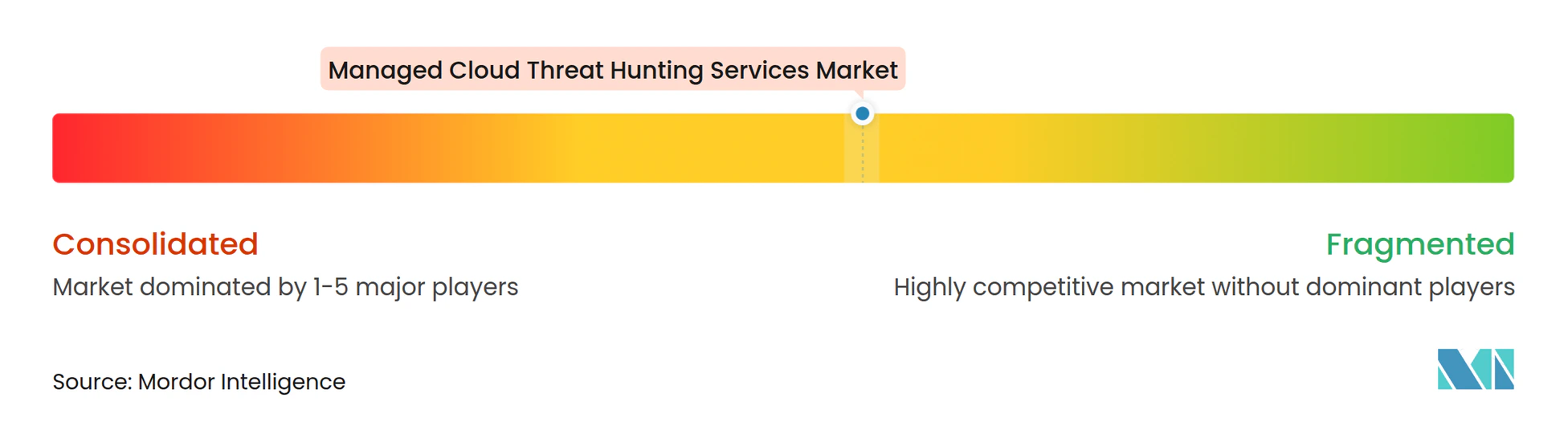
The managed cloud threat hunting services market has moderate-to-high concentration, with global cybersecurity platforms serving large enterprise customers alongside specialist and regional managed security providers. Sophos completed its acquisition of Secureworks in February 2025, combining Secureworks’ Taegis XDR and managed detection and response platform with Sophos MDR and Counter Threat Unit capabilities. Zscaler completed its USD 675 million acquisition of Red Canary in August 2025. These transactions demonstrate the competitive value of larger telemetry pools, integrated security data, and broader delivery capacity in the managed cloud threat-hunting services market.
Arctic Wolf signed a strategic collaboration agreement with Amazon Web Services in October 2025 to advance its Aurora Platform and artificial intelligence-powered security operations capabilities. The company stated that the platform processed more than 9 trillion security observations each week at the time of the agreement. TCS Japan launched a managed endpoint detection and response service powered by CrowdStrike in May 2025. The service combines licensing, deployment, monitoring, threat analysis, and containment for enterprise customers in Japan. Regional providers can compete by pairing local compliance knowledge with global technology platforms.
Technology competition is moving toward automated investigation, cross-cloud normalization, and identity-centered monitoring. Microsoft research described an agentic detection authoring framework with 99.4% matching accuracy against established MITRE ATT&CK patterns.[4] Hybrid environments remain an open area because providers must normalize on-premises and cloud telemetry without losing context. Identity hunting beyond a single identity provider is also important, as customers use multiple directories and software-as-a-service platforms. Mid-market customers need enterprise-grade behavioral analysis at prices compatible with smaller security budgets.
Managed Cloud Threat Hunting Services Industry Leaders
-
Arctic Wolf Networks, Inc.
-
Binary Defense Systems, Inc.
-
Expel, Inc.
-
Deepwatch, Inc.
-
Proficio, Inc.
- *Disclaimer: Major Players sorted in no particular order
Managed Cloud Threat Hunting Services Market Companies Covered in this Report
- Arctic Wolf Networks, Inc.
- Binary Defense Systems, Inc.
- BlueVoyant LLC
- CrowdStrike Holdings, Inc.
- Deepwatch, Inc.
- eSentire, Inc.
- Expel, Inc.
- Huntress Labs Incorporated
- LevelBlue Holdings, Inc.
- Mitiga Security, Inc.
- Pondurance, LLC
- Proficio, Inc.
- Rapid7, Inc.
- Red Canary, Inc.
- ReliaQuest Holdings, LLC
- Secureworks Corp.
- SentinelOne, Inc.
- Sophos Limited
- UnderDefense, Inc.
- Zscaler, Inc.
Recent Industry Developments in Managed Cloud Threat Hunting Services Market
- October 2026: Sophos received a USD 200 million investment co-led by GTCR and Thoma Bravo, reinforcing its capital position for platform integration and product development following the 2025 Secureworks acquisition. The investment signals continued private-equity conviction in the pure-play managed detection and response segment amid accelerating enterprise demand.
- May 2026: Arctic Wolf launched the Aurora Agentic SOC and the Aurora Superintelligence Platform at RSAC 2026, positioning agentic AI as the operational backbone of a security operations center processing over 10 trillion cybersecurity events weekly. The system combines a proprietary knowledge graph with a swarm of AI agents to handle core SOC workflows autonomously, while retaining human analysts for oversight and advanced decision-making.
- May 2026: SentinelOne unveiled Prompt Security On-Premise for self-hosted AI security and general availability of Purple AI Auto Investigation at RSAC 2026, and announced a go-to-market partnership with LevelBlue for co-delivered MDR and SIEM. The announcements extended SentinelOne's managed detection capability into on-premises and sovereign data center environments.
- March 2026: Rapid7 advanced its 2026 PACT Partner Program by introducing a Platinum Partner tier, streamlining deal motions, and improving program economics to accelerate partner-led managed detection and response growth. The program also debuted a Tech Champion Program providing partner sales engineers with early roadmap visibility and structured enablement for complex MDR engagements.
Global Managed Cloud Threat Hunting Services Market Report Scope
The Managed Cloud Threat Hunting Services Market comprises outsourced cybersecurity services that proactively search for, investigate, analyze, and mitigate advanced threats, malicious activities, indicators of compromise, and attack paths within cloud environments. These services leverage cloud telemetry, threat intelligence, behavioral analytics, identity monitoring, application security monitoring, and threat-hunting methodologies to identify threats that evade traditional detection controls across hybrid and multi-cloud infrastructures.
The Managed Cloud Threat Hunting Services Market Report is Segmented by Security Coverage (Cloud Infrastructure Threat Hunting Services, Identity and Access Threat Hunting Services, Application and API Threat Hunting Services, and Data Security Threat Hunting Services), Deployment Model (Public Cloud, Private Cloud, and Hybrid Cloud), Organization Size (Large Enterprises, and Small and Medium Enterprises), End-User Industry (Banking, Financial Services, and Insurance [BFSI], Government and Public Administration, Healthcare and Life Sciences, IT and Telecommunication, Industrial Manufacturing, Retail and E-commerce, Energy and Utilities, and Other End-User Industries), and Geography (North America, South America, Europe, Asia-Pacific, Middle East, and Africa). The Market Forecasts are Provided in Terms of Value (USD).
Segmentation Overview
| Cloud Infrastructure Threat Hunting Services |
| Identity and Access Threat Hunting Services |
| Application and API Threat Hunting Services |
| Data Security Threat Hunting Services |
| Public Cloud |
| Private Cloud |
| Hybrid Cloud |
| Large Enterprises |
| Small and Medium Enterprises |
| Banking, Financial Services, and Insurance (BFSI) |
| Government and Public Administration |
| Healthcare and Life Sciences |
| IT and Telecommunication |
| Industrial Manufacturing |
| Retail and E-commerce |
| Energy and Utilities |
| Other End-User Industries |
| North America | United States |
| Canada | |
| Mexico | |
| South America | Brazil |
| Argentina | |
| Rest of South America | |
| Europe | Germany |
| United Kingdom | |
| France | |
| Italy | |
| Russia | |
| Rest of Europe | |
| Asia-Pacific | China |
| Japan | |
| India | |
| South Korea | |
| Rest of Asia-Pacific | |
| Middle East | Saudi Arabia |
| United Arab Emirates | |
| Rest of Middle East | |
| Africa | South Africa |
| Nigeria | |
| Rest of Africa |
| By Security Coverage | Cloud Infrastructure Threat Hunting Services | |
| Identity and Access Threat Hunting Services | ||
| Application and API Threat Hunting Services | ||
| Data Security Threat Hunting Services | ||
| By Deployment Mode | Public Cloud | |
| Private Cloud | ||
| Hybrid Cloud | ||
| By Organization Size | Large Enterprises | |
| Small and Medium Enterprises | ||
| By End-User Industry | Banking, Financial Services, and Insurance (BFSI) | |
| Government and Public Administration | ||
| Healthcare and Life Sciences | ||
| IT and Telecommunication | ||
| Industrial Manufacturing | ||
| Retail and E-commerce | ||
| Energy and Utilities | ||
| Other End-User Industries | ||
| By Geography | North America | United States |
| Canada | ||
| Mexico | ||
| South America | Brazil | |
| Argentina | ||
| Rest of South America | ||
| Europe | Germany | |
| United Kingdom | ||
| France | ||
| Italy | ||
| Russia | ||
| Rest of Europe | ||
| Asia-Pacific | China | |
| Japan | ||
| India | ||
| South Korea | ||
| Rest of Asia-Pacific | ||
| Middle East | Saudi Arabia | |
| United Arab Emirates | ||
| Rest of Middle East | ||
| Africa | South Africa | |
| Nigeria | ||
| Rest of Africa | ||
Key Questions Answered in the Report
What is the managed cloud threat hunting services market size?
The managed cloud threat hunting services market is projected to grow from USD 1.43 billion in 2026 and USD 1.72 billion in 2027 to USD 4.39 billion by 2032, at a 20.61% CAGR.
What is driving demand for managed cloud threat hunting services?
Growing multi-cloud complexity, identity-based attacks, and shortages of cloud security specialists are expanding demand for external hunting support.
Which security coverage segment is largest?
Cloud infrastructure threat hunting services led with 44.31% of revenue in 2026, supported by the need to monitor workloads and cloud activity.
Which deployment approach is growing fastest?
Hybrid cloud is projected to expand at a 22.04% CAGR through 2032 because organizations need unified monitoring across on-premises and cloud environments.
Which organizations are adopting these services most quickly?
Small and medium enterprises are projected to grow at a 22.37% CAGR through 2032 as subscription services lower the cost of continuous proactive monitoring.
Which end-user sector is projected to grow fastest?
Government and public administration is projected to expand at a 21.08% CAGR through 2032 as public agencies move workloads to cloud environments.