
Managed Proactive Threat Hunting Services Market Size and Share
Market Overview
| Study Period | 2021 - 2032 |
|---|---|
| Market Size (2027) | USD 6.07 Billion |
| Market Size (2032) | USD 11.83 Billion |
| Growth Rate (2027 - 2032) | 14.28 % |
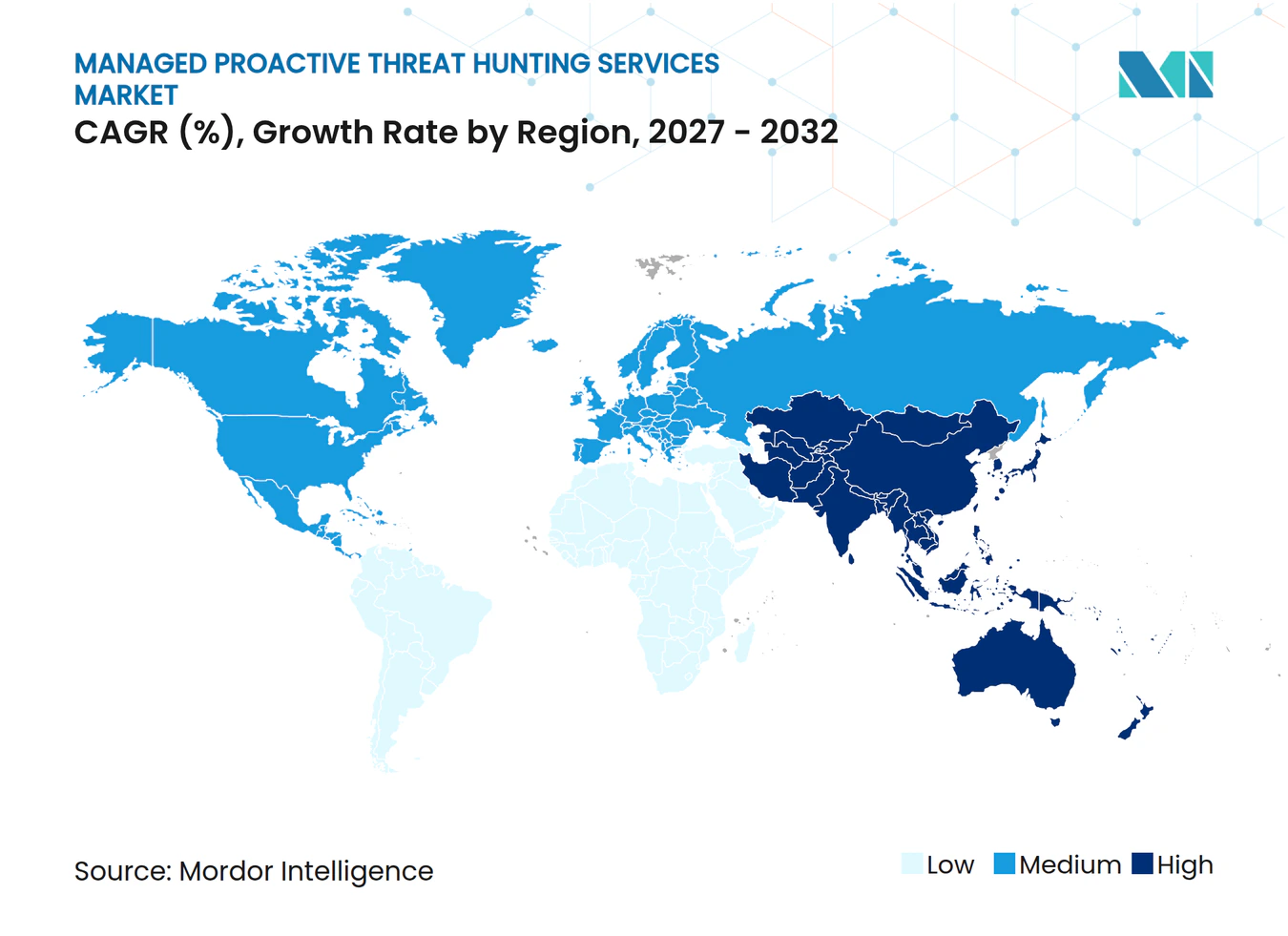
| Fastest Growing Market | Asia-Pacific |
| Largest Market | North America |
| Market Concentration | Medium |
Major Players *Disclaimer: Major Players sorted in no particular order Image © Mordor Intelligence. Reuse requires attribution under CC BY 4.0. | |
Managed Proactive Threat Hunting Services Market Analysis by Mordor Intelligence
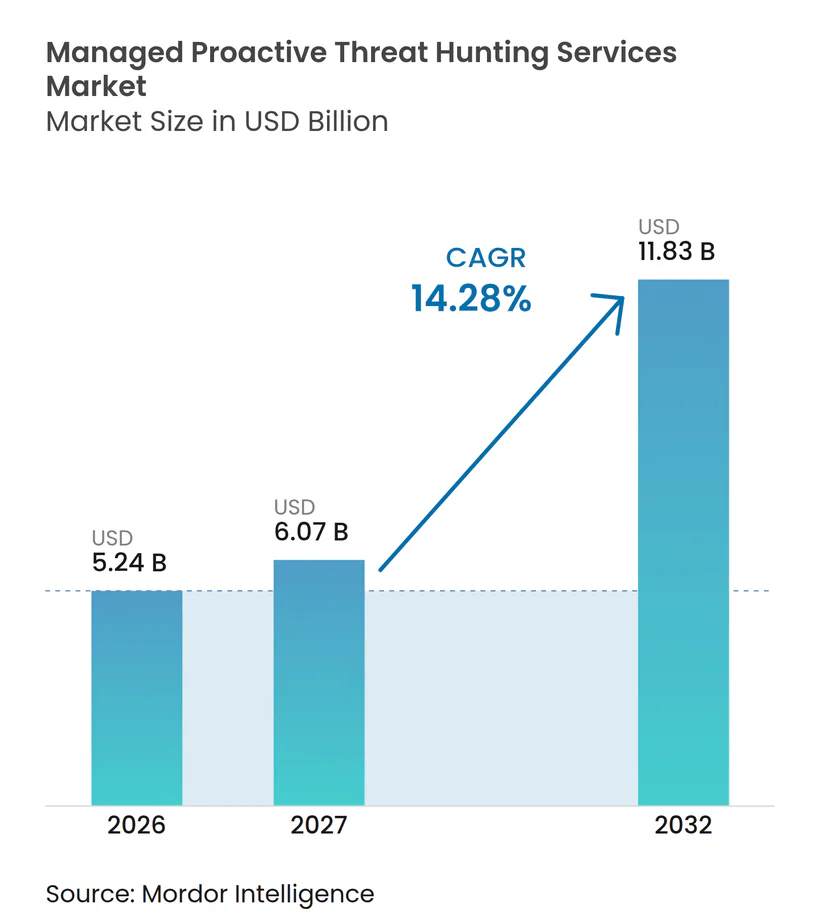
The Managed Proactive Threat Hunting Services Market size is projected to expand from USD 5.24 billion in 2026 and USD 6.07 billion in 2027 to USD 11.83 billion by 2032, registering a CAGR of 14.28% between 2027 and 2032. The managed proactive threat hunting services market is shaped by a shift from reactive alert handling toward ongoing investigations that test for threats missed by automated controls. Ransomware operators, supply-chain compromise, and identity misuse are raising the value of continuous investigation across complex enterprise environments. Buyers are also looking for support that can use security data already collected across endpoints, cloud systems, and identity tools. Providers are responding through AI-supported workflows, broader telemetry pipelines, and co-managed delivery models that retain customer involvement. Cost, evidence of financial value, fragmented data, and rules governing cross-border data movement continue to slow some buying decisions.
Key Report Takeaways
- By service type, Fully Managed Threat Hunting Services held 41.70% of the Managed Proactive Threat Hunting Services Market share in 2026, while Co-Managed Threat Hunting Services are projected to expand at a 16.49% CAGR through 2032.
- By deployment mode, Hybrid Cloud accounted for 49.37% in 2026 and is projected to advance at a 16.69% CAGR through 2032.
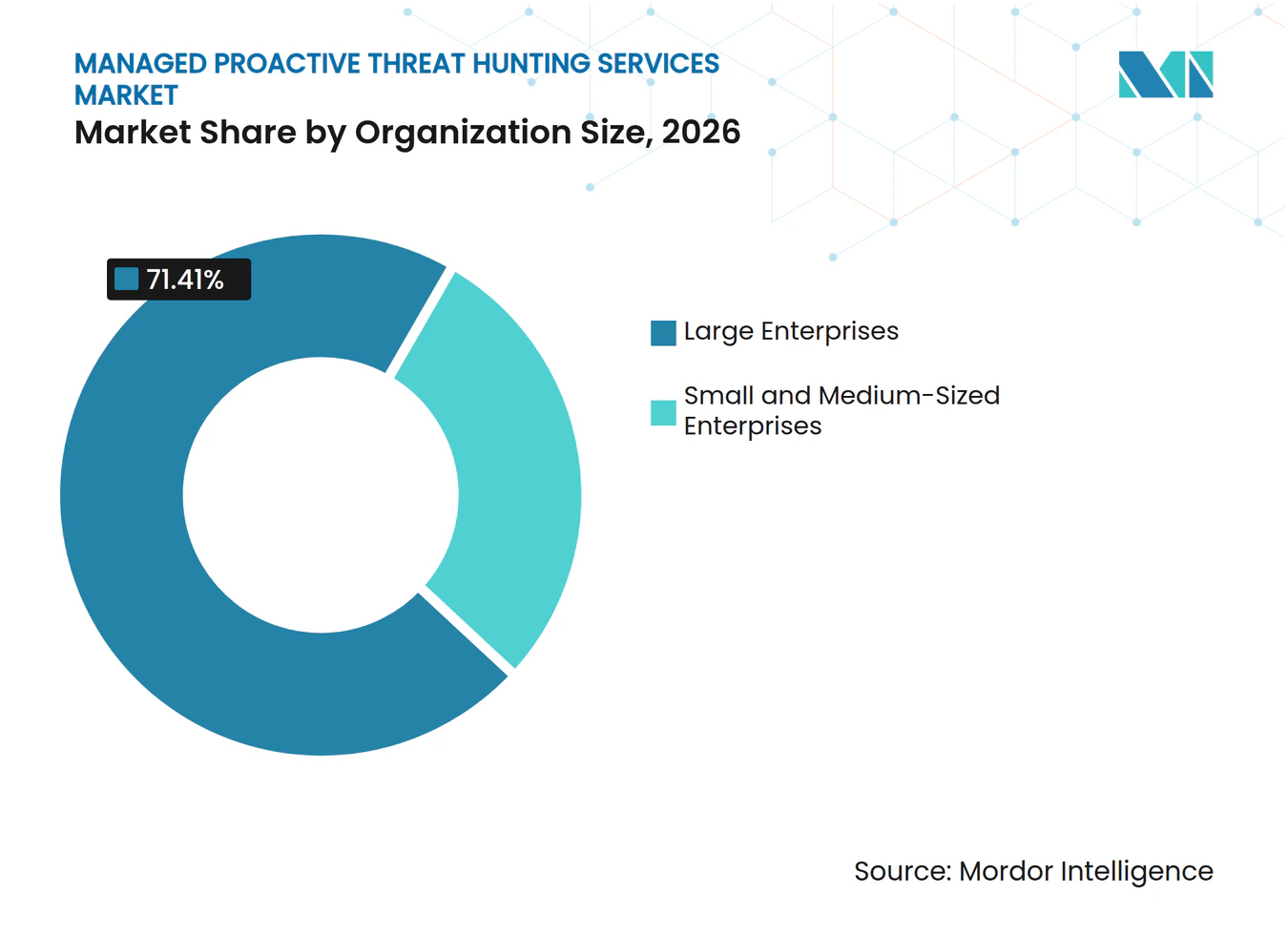
- By organization size, Large Enterprises accounted for 71.41% of the Managed Proactive Threat Hunting Services Market revenue in 2026, while SMEs are projected to expand at a 17.32% CAGR through 2032.
- By end-user industry, BFSI held 26.33% of the market in 2026, while Healthcare and Life Sciences are projected to expand at an 18.12% CAGR through 2032.
- By geography, North America held 40.19% of the market in 2026, while Asia-Pacific is projected to expand at a 17.89% CAGR through 2032.
Note: Market numbers in this report are based on Mordor Intelligence's proprietary estimation framework, which combines nine months of actuals with Q4 projections for base year 2026.
Market Trends and Insights
Drivers Impact Analysis of Managed Proactive Threat Hunting Services Market*
| Driver | (~) % Impact on CAGR Forecast | Geographic Relevance | Impact Timeline |
|---|---|---|---|
| Escalating Ransomware, Supply-Chain, and Identity-Based Attacks | +3.2% | Global, concentrated in North America and Europe | Short term (≤ 2 years) |
| Expansion of Hybrid Cloud and Connected Workloads | +2.6% | Global, strongest in North America and Asia-Pacific | Medium term (2-4 years) |
| Cybersecurity Skills Shortages and Demand for Outsourced Expertise | +2.4% | Global, acute in EU and Asia-Pacific | Long term (≥ 4 years) |
| Regulatory Pressure for Continuous Detection and Response | +2.0% | North America and EU, NIS2, DORA, SEC | Medium term (2-4 years) |
| Autonomous Threat Operations and AI-Assisted Investigation | +1.6% | Global, technology-forward markets lead | Medium term (2-4 years) |
| Reuse of Existing Security Telemetry Through Platform-Agnostic Hunting | +1.1% | Global, particularly mid-market enterprises | Long term (≥ 4 years) |
| Source: Mordor Intelligence | |||
Escalating Ransomware, Supply-Chain, and Identity-Based Attacks
Ransomware-as-a-service has made complex attacks available to a wider group of affiliates and placed pressure on security teams that depend on alert volumes alone. Healthcare and public health recorded the highest ransomware incident count among the 16 critical-infrastructure sectors in the FBI data summarized by the American Hospital Association for 2025. This exposure is increasing demand for the managed proactive threat hunting services market among hospital networks and clinical systems that need to identify intrusions before care delivery is disrupted. CISA, FBI, and HHS documented more than 500 Medusa ransomware victims in critical infrastructure as of April 2026 and described a double-extortion model that increases the importance of early discovery.[1] Supply-chain compromise and ransomware delivery increasingly overlap because trusted supplier access can be used to reach a target environment. Identity telemetry, therefore, needs to sit alongside endpoint signals in a credible hunt program.
Expansion of Hybrid Cloud and Connected Workloads
Hybrid environments produce security information across on-premises infrastructure, private cloud environments, and public cloud services at the same time. That operating model creates data volumes and architectural differences that a single security stack can struggle to cover consistently. The managed proactive threat hunting services market benefits when providers can normalize information from several environments and apply the same hunt hypotheses across them. Arctic Wolf stated that its Aurora Platform processed more than 9 trillion security observations each week across on-premises and cloud environments through Open Cybersecurity Schema Framework normalization in October 2025. Internal security tools can leave coverage gaps when they do not ingest cloud-native logs at a production scale. Continued use of connected applications and mixed infrastructure should keep telemetry coverage a central purchasing issue.
Cybersecurity Skills Shortages and Demand for Outsourced Expertise
Cybersecurity workforce shortages continue to limit an organization’s ability to staff specialized investigation roles. ISACA reported in 2025 that 55% of cybersecurity teams were understaffed, 65% had unfilled positions, and 66% of practitioners experienced greater job stress than 5 years earlier. These conditions make it difficult to sustain round-the-clock coverage and maintain current hunt playbooks internally. The managed proactive threat hunting services market offers a way to access investigators, threat intelligence, and established operating routines without building a complete internal team. The issue is especially relevant where smaller organizations cannot compete for security talent against larger employers. Long-term demand is supported because outsourcing addresses both open positions and the pressure placed on existing analysts.
Regulatory Pressure for Continuous Detection and Response
Regulatory requirements are becoming more specific about logging, monitoring, and evidence that detection capabilities are in place. The EU NIS2 technical implementation guidance identifies managed security service providers within the scope of relevant obligations and supports more structured monitoring expectations.[2] DORA also requires continuous monitoring of ICT anomalies with layered controls and automatic alerting. These conditions support the Managed Proactive Threat Hunting Services Market because buyers need both security coverage and evidence that controls operate as intended. Continuous detection is particularly important for organizations that face short incident reporting windows. Managed providers can help buyers demonstrate monitoring capability, retain investigation records, and add expertise where internal teams are limited.
Restraints Impact Analysis of Managed Proactive Threat Hunting Services Market*
| Restraint | (~) % Impact on CAGR Forecast | Geographic Relevance | Impact Timeline |
|---|---|---|---|
| High Cost of 24/7 Human-Led Threat Hunting | -2.9% | Global, disproportionately affects SMEs and emerging markets | Short term (≤ 2 years) |
| Difficulties Demonstrating Avoided-Loss ROI | -2.1% | Global, most pronounced in budget-constrained organizations | Medium term (2-4 years) |
| Fragmented Telemetry and Integration Complexity | -1.5% | Global, concentrated in heterogeneous IT environments | Medium term (2-4 years) |
| Data Sovereignty and Cross-Border Telemetry Restrictions | -0.8% | EU and Asia-Pacific, Germany, Japan, India | Long term (≥ 4 years) |
| Source: Mordor Intelligence | |||
High Cost of 24/7 Human-Led Threat Hunting
Continuous human-led hunting requires specialized analysts, shift coverage, current intelligence, and regularly refreshed playbooks. Those requirements can make a full internal capability expensive, particularly when it is layered on top of endpoint detection and response tools. The Managed Proactive Threat Hunting Services Market faces an affordability barrier among SMEs and organizations operating with limited security budgets. AI-supported investigation can reduce the manual effort required in each hunt cycle, but customers may not receive those efficiency gains immediately through lower prices. Providers must still staff experienced teams to investigate high-priority findings and support customer decisions. Cost sensitivity is therefore likely to remain strongest where buyers cannot justify an always-on service.
Difficulties Demonstrating Avoided-Loss ROI
Threat hunting creates much of its value when an intrusion does not become a material incident. This avoided-loss outcome is difficult for security leaders to translate into a direct financial case for budget committees. Providers often report dwell-time reduction, completed hunts, and MITRE ATT&CK coverage, but these measures do not always show a financial result. The Managed Proactive Threat Hunting Services Market can face longer purchasing cycles when buyers need a measurable link between service activity and loss prevention. Consistent outcome measures would help customers compare providers and explain the value of proactive security work. Until those measures are used more widely, ROI uncertainty will remain a restraint for budget-constrained organizations.
*Our forecasts treat driver/restraint impacts as directional, not additive. The impact forecasts reflect baseline growth, mix effects, and variable interactions.
Managed Proactive Threat Hunting Services Market Segment Analysis
By Service Type:
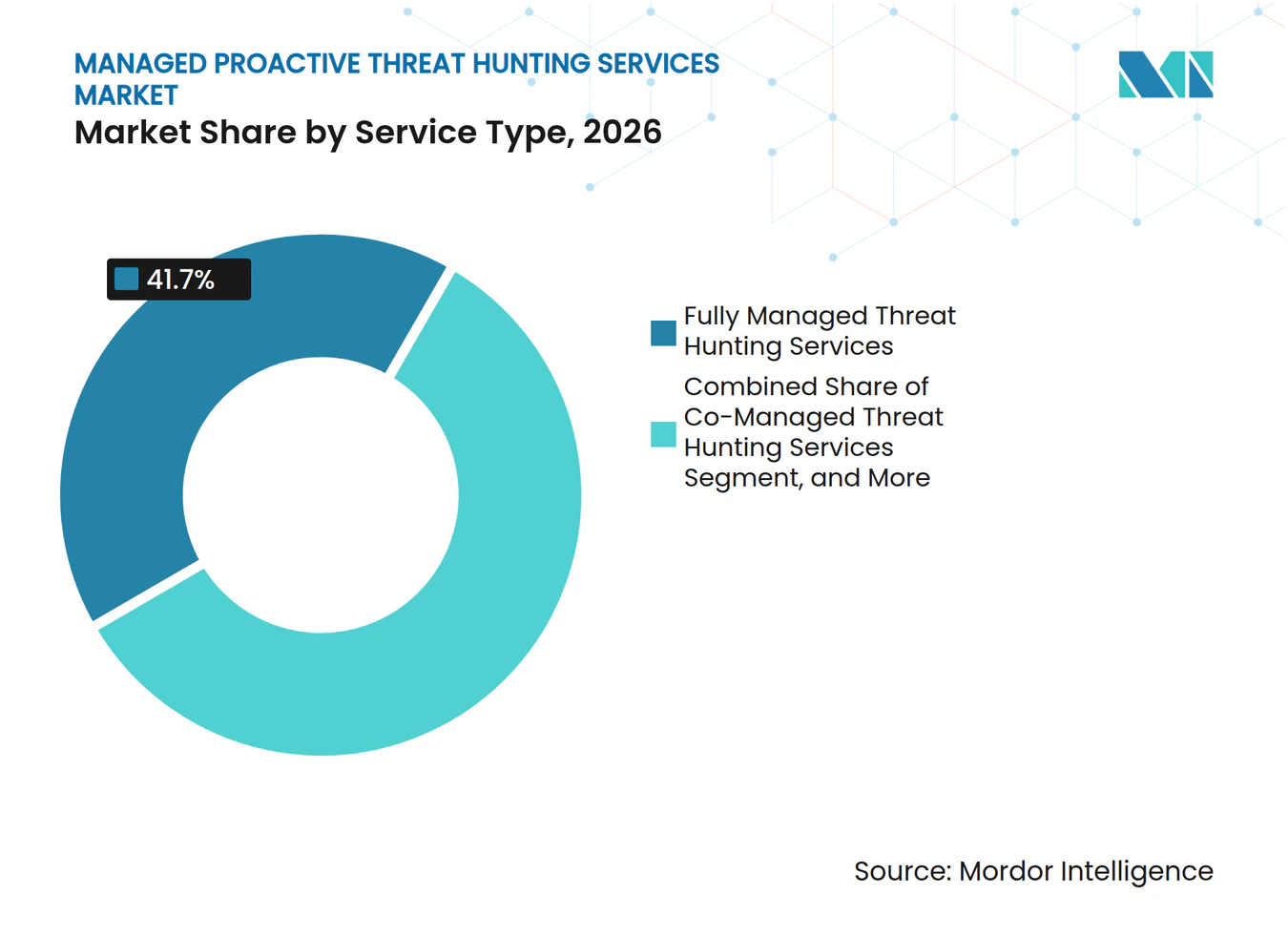
Co-Managed Models Are Changing the Fully Managed PremiumFully Managed Threat Hunting Services held 41.70% of the Managed Proactive Threat Hunting Services Market in 2026. The position reflects the preference of organizations that want to outsource hunting labor, tools, and continuous coverage. This model is suited to buyers without a mature security operations center because it provides access to specialized resources without internal analyst headcount. It also gives organizations a single provider relationship for regular investigation, operational escalation, and the operational routines needed when a finding requires immediate attention. Fully managed delivery remains important where an internal security team has limited capacity to interpret complex findings and coordinate a response across business systems.
Co-Managed Threat Hunting Services are projected to record a 16.49% CAGR through 2032. The Managed Proactive Threat Hunting Services Market is therefore shifting toward models that add provider telemetry, intelligence, and playbooks to internal teams rather than replace them. This approach can appeal to regulated organizations that want accountability to stay with internal staff while gaining outside capacity for deeper investigation. Campaign-based services serve mid-market buyers who run defined, hypothesis-led investigations around specific threat actors or vulnerability disclosures. Incident-response and retainer-based hunting are relevant where cyber insurance arrangements encourage a provider relationship before an event occurs, although scalable platforms are needed to avoid pressure on provider margins.



By Deployment Mode:
Hybrid Cloud Reflects How Enterprise Systems OperateHybrid Cloud held 49.37% of the Managed Proactive Threat Hunting Services Market in 2026. It is also projected to advance at a 16.69% CAGR through 2032. This position reflects the fact that many large organizations operate legacy systems on premises while using cloud-native workloads for newer applications and customer-facing services. Providers must bring together information from these distinct environments without creating new blind spots or requiring the customer to maintain separate investigative processes. Hybrid delivery is therefore closely connected to the ability to normalize data and run a consistent investigation process across the environment.
Fully cloud-based deployment is relevant to cloud-native organizations and SMEs that do not have major legacy infrastructure commitments. On-premises delivery remains necessary in air-gapped environments, defense installations, and critical infrastructure settings where data residency limits telemetry movement. Germany’s critical infrastructure environment supports deployment choices that can meet local monitoring and data-control requirements. Elastic introduced AlertZero in October 2026 as a multi-agent AI system intended for cloud, self-managed, and air-gapped settings. The offering illustrates why providers need flexibility across deployment architectures, rather than assuming that every buyer can centralize security information in a public cloud.
By Organization Size:
SME Adoption Is Rising as Access Barriers DeclineLarge Enterprises accounted for 71.41% of the Managed Proactive Threat Hunting Services Market in 2026. Large organizations have higher security budgets, broader attack surfaces, and established procurement channels for managed security services. They also operate complex technology estates that make continuous investigation more valuable, including several business units and a mix of legacy and modern applications. Their scale helps support dedicated vendor contracts and advanced service configurations that smaller buyers may not be able to fund. This buyer group remains central to revenue because it has the resources to deploy broad coverage across its operating environment.
SMEs are projected to record a 17.32% CAGR through 2032. Their adoption is supported by specialist offerings, lower per-endpoint economics from AI-supported automation, and insurance requirements that can favor continuous monitoring. ISACA’s finding that 65% of organizations had unfilled cybersecurity roles highlights the staffing challenge facing smaller buyers. TD SYNNEX Germany and digit solutions introduced a German-language managed SOC service in November 2025 to help MSPs serve SME and public-sector clients without their own SOC.[3] Co-managed and campaign-based formats can provide access to specialist skills without the price and commitment of a full-time managed engagement, allowing providers to reach organizations with narrower budgets.

By End-User Industry:
Healthcare and Life Sciences Are Outpacing BFSIBFSI held 26.33% of the Managed Proactive Threat Hunting Services Market in 2026. The sector has a long history of investment in threat detection because it manages high-value financial and personal data. Its compliance requirements and the need to protect real-time services also support continuous monitoring across applications that customers and employees use each day. Security teams in this sector commonly need to investigate activity across customer channels, internal systems, and cloud services. These conditions make proactive investigation an established part of its security spending and provider selection process.
Healthcare and Life Sciences are projected to expand at an 18.12% CAGR through 2032. The American Hospital Association reported that healthcare and public health had the highest ransomware incident count among the 16 critical-infrastructure sectors in 2025. This risk is prompting hospital systems to focus more on continuous detection and managed investigation because disruption can affect clinical systems and care operations. Government and defense demand reflects exposure to nation-state activity and the need to protect sensitive systems. Energy and utilities are increasing adoption as operational technology and information technology become more connected, while IT and telecommunications, retail and e-commerce, and other end-user groups add a wider base of demand.
Geography Analysis
North America Managed Proactive Threat Hunting Services Market
North America held 40.19% of the Managed Proactive Threat Hunting Services Market share in 2026. The region has a large concentration of enterprise security buyers and a mature ecosystem of managed security providers. Organizations also face a regulatory environment that places more emphasis on timely detection and incident handling, which can make continuous monitoring a practical operational requirement. Healthcare and manufacturing remain important buyer groups because ransomware has created operational and financial risk. The United States leads regional revenue, while Canada and Mexico support further demand as providers extend their coverage and service availability.
Europe and South America Managed Proactive Threat Hunting Services Market
Europe is the second-largest geography for the Managed Proactive Threat Hunting Services Market. Germany, the United Kingdom, and France lead adoption, while NIS2 and DORA support investment in monitoring, logging, and detection processes.[4] Germany adds critical-infrastructure requirements that can favor data-controlled deployment models. Providers with platform-agnostic services can address buyers who need to keep telemetry within defined locations. South America remains at an earlier stage, with Brazil and Argentina representing the main areas of enterprise demand.
APAC and MEA Managed Proactive Threat Hunting Services Market
Asia-Pacific is projected to expand at a 17.89% CAGR through 2032. Japan is a meaningful market because local providers are introducing services that place proactive hunting within the Managed Proactive Threat Hunting Services Market security operations cycle. MBSD launched MBSD-SOC Proactive Hunt in October 2026 and stated that hunt-derived detection rules are fed back into its ongoing SIEM monitoring. China, India, and South Korea are also increasing investment in security capability, while the Middle East, led by Saudi Arabia and the UAE, and Africa, led by South Africa and Nigeria, are emerging areas where providers must adapt delivery to local operating conditions and data rules.
Competitive Landscape
Market Concentration
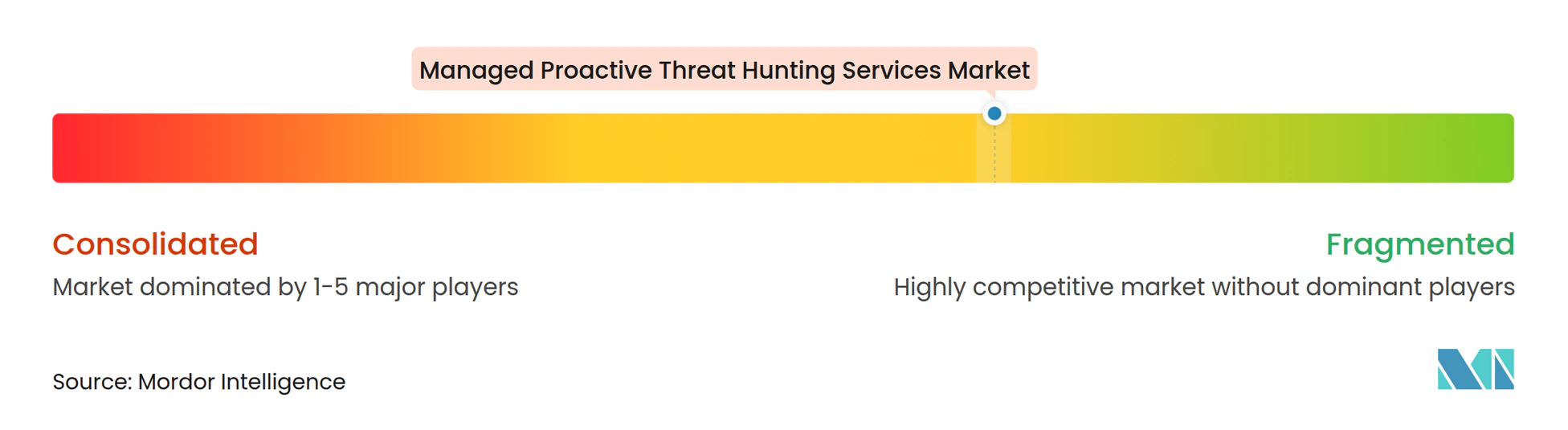
The Managed Proactive Threat Hunting Services Market is moderately fragmented among large platforms and more fragmented among specialist providers. AI capability and intelligence depth are becoming more important competitive factors than a simple increase in analyst headcount. Large vendors are placing autonomous hunt functions within managed service layers to increase investigation throughput and address the volume of security data across customer environments. CrowdStrike launched Threat AI in September 2025 with a Hunt Agent for continuous queries and a Malware Analysis Agent for automated YARA-rule generation. This move shows how leading providers are seeking to separate hunting capacity from a linear expansion of analyst teams.
Elastic introduced AlertZero in October 2026 as an agent-based layer for security operations that includes Triage Watch, Hunt Watch, Detection Watch, and Forensics Watch. The product is intended to support continuous hunting, detection tuning, and forensic work across cloud, self-managed, and air-gapped deployments. Arctic Wolf formalized a strategic collaboration with AWS in October 2025 to scale the Aurora Platform and its AI-powered SOC, while stating that the platform processes more than 9 trillion security observations each week. These actions show a competition centered on data scale, automation, and broader environment support. The Managed ProactiveThreat Hunting Services Market is also seeing vendors use cloud relationships and product architecture to improve the reach of managed delivery.
Specialists such as Red Canary, Expel, and Huntress Labs compete through vertical expertise and co-managed delivery that leaves customers more involved in decisions. White space remains in operational technology-aware hunting, where specialized detection skills are limited, and in locations where compliance requirements make cloud-hosted service delivery difficult. Consolidation is likely to favor firms that combine broad telemetry coverage, proprietary threat intelligence, and automated investigation capability. No combined market share for leading companies was provided, so a concentration score cannot be calculated under the stated criteria.
Managed Proactive Threat Hunting Services Industry Leaders
-
CrowdStrike Holdings, Inc.
-
Arctic Wolf Networks, Inc.
-
Sophos Limited
-
Palo Alto Networks, Inc.
-
SentinelOne, Inc.
- *Disclaimer: Major Players sorted in no particular order
Managed Proactive Threat Hunting Services Market Companies Covered in this Report
- CrowdStrike Holdings, Inc.
- Arctic Wolf Networks, Inc.
- Sophos Limited
- Microsoft Corporation
- Palo Alto Networks, Inc.
- SentinelOne, Inc.
- Rapid7, Inc.
- eSentire, Inc.
- Red Canary
- Expel, Inc.
- Huntress Labs Incorporated
- LevelBlue
- Bitdefender SRL
- Critical Start, Inc.
- Binary Defense Systems, Inc.
- Kroll, LLC
- WithSecure Corporation
- Darktrace Limited
- IBM Corporation
- Cisco Systems, Inc.
- Fortinet, Inc.
- Trend Micro Incorporated
- Orange S.A.
Recent Industry Developments in Managed Proactive Threat Hunting Services Market
- October 2026: Elastic launched AlertZero on October 8, 2026, an agentic layer in Elastic Security deploying 4 specialized AI agents, Triage Watch, Hunt Watch, Detection Watch, and Forensics Watch, to continuously hunt threats, tune detections, and perform forensics across cloud, self-managed, and air-gapped deployments.
- October 2026: Mitsui Bussan Secure Directions launched "MBSD-SOC Proactive Hunt" in Japan, embedding proactive threat hunting into its SOC cycle and feeding hunt-derived detection rules back into continuous SIEM monitoring.
- February 2026: Arctic Wolf was selected by Chubb as a preferred managed detection and response provider, marking a convergence of cyber insurance underwriting criteria and managed threat hunting service selection.
- November 2025: NEC launched "CyIOC", an intelligence-driven next-generation managed security service brand integrating NEC’s proprietary threat intelligence with AI analysis across a global 4-site Cyber Intelligence and Operation Center network in Japan, Asia-Pacific, Europe, and the United States.
Global Managed Proactive Threat Hunting Services Market Report Scope
Managed proactive threat hunting services are outsourced, cybersecurity operations where specialized, human-led security analysts systematically search through an organization’s digital footprint to uncover hidden, sophisticated cyber threats that have successfully bypassed automated security controls.
The Managed Proactive Threat Hunting Services Market Report is Segmented by Service Model (Fully Managed Threat Hunting Services, Co-Managed Threat Hunting Services, Campaign-Based Threat Hunting Services, and Incident-Response and Retainer-Based Hunting), Deployment Mode (Cloud-Based, Hybrid Cloud, and On-Premises), Organization Size (Large Enterprises and Small and Medium-Sized Enterprises), End-User Industry (BFSI, Incident-Response and Retainer-Based Hunting, Healthcare and Life Sciences, IT and Telecommunications, Energy and Utilities, Retail and E-Commerce, and Other End-User Industries), and Geography (North America, South America, Europe, Asia-Pacific, Middle East, and Africa). The Market Forecasts are Provided in Terms of Value (USD).
Segmentation Overview
| Fully Managed Threat Hunting Services |
| Co-Managed Threat Hunting Services |
| Campaign-Based Threat Hunting Services |
| Incident-Response and Retainer-Based Hunting |
| Cloud-Based |
| Hybrid Cloud |
| On-Premises |
| Large Enterprises |
| Small and Medium-Sized Enterprises |
| BFSI |
| Government and Defense |
| Healthcare and Life Sciences |
| IT and Telecommunications |
| Energy and Utilities |
| Retail and E-Commerce |
| Other End-User Industries |
| North America | United States |
| Canada | |
| Mexico | |
| South America | Brazil |
| Argentina | |
| Rest of South America | |
| Europe | Germany |
| United Kingdom | |
| France | |
| Italy | |
| Rest of Europe | |
| Asia-Pacific | China |
| Japan | |
| India | |
| South Korea | |
| Rest of Asia-Pacific | |
| Middle East | Saudi Arabia |
| United Arab Emirates | |
| Rest of Middle East | |
| Africa | South Africa |
| Nigeria | |
| Rest of Africa |
| By Service Type | Fully Managed Threat Hunting Services | |
| Co-Managed Threat Hunting Services | ||
| Campaign-Based Threat Hunting Services | ||
| Incident-Response and Retainer-Based Hunting | ||
| By Deployment Mode | Cloud-Based | |
| Hybrid Cloud | ||
| On-Premises | ||
| By Organization Size | Large Enterprises | |
| Small and Medium-Sized Enterprises | ||
| By End-User Industry | BFSI | |
| Government and Defense | ||
| Healthcare and Life Sciences | ||
| IT and Telecommunications | ||
| Energy and Utilities | ||
| Retail and E-Commerce | ||
| Other End-User Industries | ||
| By Geography | North America | United States |
| Canada | ||
| Mexico | ||
| South America | Brazil | |
| Argentina | ||
| Rest of South America | ||
| Europe | Germany | |
| United Kingdom | ||
| France | ||
| Italy | ||
| Rest of Europe | ||
| Asia-Pacific | China | |
| Japan | ||
| India | ||
| South Korea | ||
| Rest of Asia-Pacific | ||
| Middle East | Saudi Arabia | |
| United Arab Emirates | ||
| Rest of Middle East | ||
| Africa | South Africa | |
| Nigeria | ||
| Rest of Africa | ||
Key Questions Answered in the Report
What is the size of the Managed Proactive Threat Hunting Services Market?
The Managed Proactive Threat Hunting Services Market is projected to be USD 5.24 billion in 2026 and USD 6.07 billion in 2027, reaching USD 11.83 billion by 2032 at a 14.28% CAGR. The forecast reflects demand for continuous investigation across complex enterprise environments and connected infrastructure.
Which service type leads the Managed Proactive Threat Hunting Services Market?
Fully Managed Threat Hunting Services lead with a 41.70% share in 2026, while Co-Managed Threat Hunting Services have the highest projected CAGR at 16.49% through 2032.
Why are organizations using the Managed Proactive Threat Hunting Services Market?
Organizations use these services to investigate ransomware, supply-chain, identity, and cloud-related threats that may bypass automated controls and affect business operations.
Which deployment model is most widely used for managed threat hunting?
Hybrid Cloud leads with a 49.37% share in 2026 and has the highest projected CAGR at 16.69% through 2032.
Which end-user sector is expanding fastest for threat hunting services?
Healthcare and Life Sciences are projected to expand at an 18.12% CAGR through 2032, supported by heightened ransomware exposure.
Which region has the strongest projected expansion?
Asia-Pacific is projected to expand at a 17.89% CAGR through 2032, while North America leads with a 40.19% share in 2026.