
Managed Incident Response and Threat Hunting Services Market Size and Share
Market Overview
| Study Period | 2021 - 2032 |
|---|---|
| Market Size (2027) | USD 5.73 Billion |
| Market Size (2032) | USD 11.34 Billion |
| Growth Rate (2027 - 2032) | 14.63 % |
| Fastest Growing Market | Asia-Pacific |
| Largest Market | North America |
| Market Concentration | Medium |
Major Players *Disclaimer: Major Players sorted in no particular order Image © Mordor Intelligence. Reuse requires attribution under CC BY 4.0. | |
Managed Incident Response and Threat Hunting Services Market Analysis by Mordor Intelligence
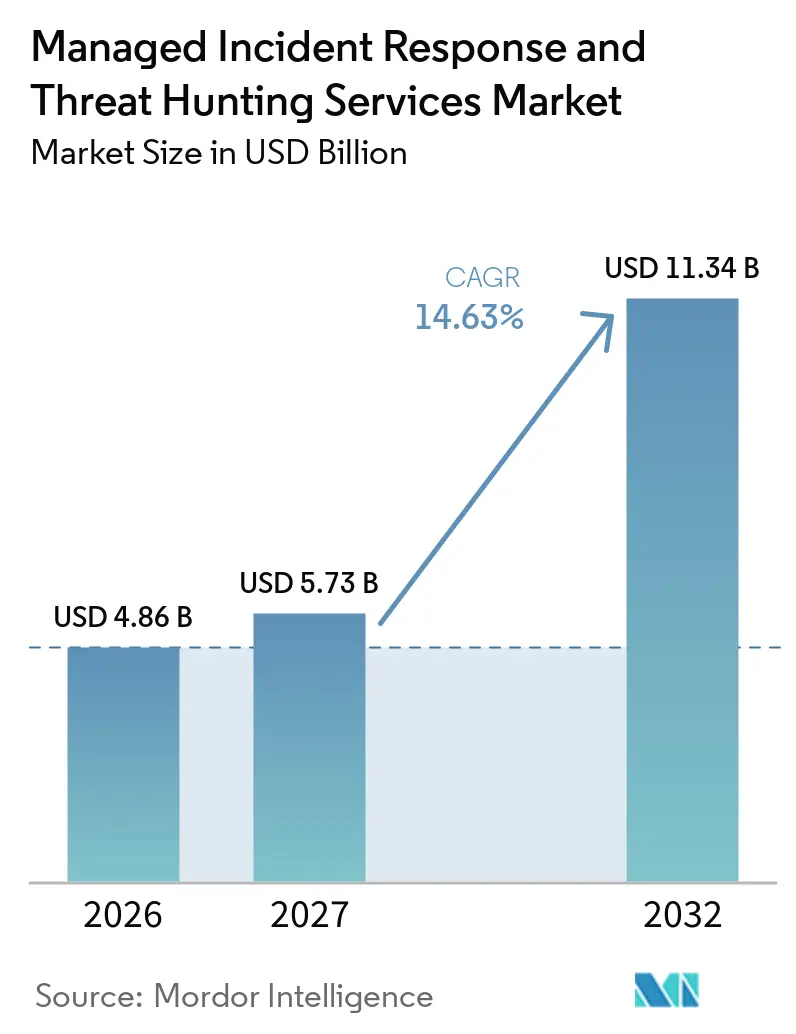
The managed incident response and threat hunting services market size is expected to grow from USD 4.86 billion in 2026 to USD 5.73 billion in 2027 and is forecast to reach USD 11.34 billion by 2032 at 14.63% CAGR over 2027-2032. The Managed incident response and threat hunting services market is moving from standalone security tools toward ongoing services that combine monitoring, threat hunting, forensics, containment, and remediation. Rising attack activity, shortages of experienced analysts, and stricter reporting rules make it harder for organizations to maintain equivalent in-house coverage. These pressures make continuous detection a core security requirement for many organizations, rather than a discretionary purchase. Providers that combine broad telemetry, responsive investigation, and clear response responsibilities are positioned to win larger engagements. The Managed incident response and threat hunting services market also has opportunities in cyber insurance, operational technology, connected devices, and healthcare environments where monitoring requirements are expanding.
Key Report Takeaways
- By service type, Managed Detection and Response held 29.71% of the managed incident response and threat hunting services market share in 2026, while Proactive Threat Hunting is projected to expand at a 19.73% CAGR through 2032.
- By delivery model, Fully Managed services held 39.42% of the managed incident response and threat hunting services market share in 2026, while Co-Managed deployments are projected to expand at a 17.61% CAGR through 2032.
- By organization size, Large Enterprises held 71.54% revenue share in 2026, while Small and Medium-Sized Enterprises are projected to expand at a 16.82% CAGR through 2032.
- By security coverage domain, Endpoint and Server Security held 27.38% revenue share in 2026, while OT, IoT, and medical-device security are projected to expand at a 17.82% CAGR through 2032.
- By end-user industry, BFSI held 26.69% revenue share in 2026, while Healthcare and Life Sciences are projected to expand at an 18.54% CAGR through 2032.
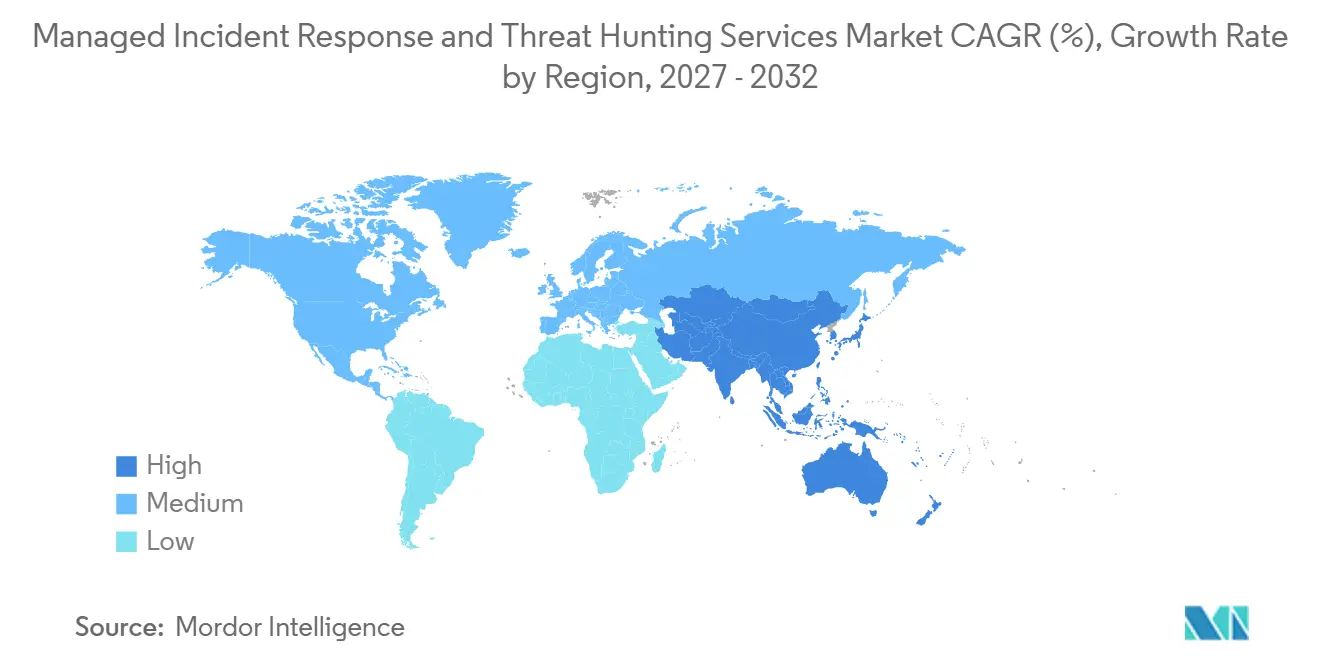
- By geography, North America held 41.64% revenue share in the managed incident response and threat hunting services market in 2026, while Asia-Pacific is projected to expand at a 19.86% CAGR through 2032.
Note: Market numbers in this report are based on Mordor Intelligence's proprietary estimation framework, which combines nine months of actuals with Q4 projections for base year 2026.
Market Trends and Insights
Drivers Impact Analysis of Managed Incident Response and Threat Hunting Services Market*
| Driver | (~) % Impact on CAGR Forecast | Geographic Relevance | IMPACT TIMELINE |
|---|---|---|---|
| Escalating Multi-Vector Cyberattacks and Ransomware Extortion | +3.5% | Global, concentrated in North America and Western Europe | Short term (≤ 2 years) |
| Cybersecurity Talent Shortages and Analyst Burnout | +2.8% | Global, most acute in North America, Western Europe, and Southeast Asia | Medium term (2-4 years) |
| Expanding Cloud, Hybrid IT, and Identity Attack Surfaces | +2.2% | Global, with Asia-Pacific and North America leading multi-cloud adoption | Medium term (2-4 years) |
| Expanding Regulatory and Incident-Disclosure Mandates | +1.8% | North America and Europe, with spillover to Asia-Pacific core markets and the GCC | Short term (≤ 2 years) |
| Cyber-Insurance Controls and Premium Incentives | +1.5% | North America and Western Europe, with early gains in Australia | Short term (≤ 2 years) |
| OT, IoT, and Medical-Device Convergence | +1.4% | Global, concentrated in healthcare, manufacturing, and energy | Long term (≥ 4 years) |
| Source: Mordor Intelligence | |||
Escalating Multi-Vector Cyberattacks and Ransomware Extortion
The FBI’s Internet Crime Complaint Center recorded USD 20.9 billion in cybercrime losses during 2025, 26% higher than in 2024. The report also recorded more than 2,100 ransomware incidents affecting critical infrastructure. Verizon found ransomware in 44% of investigated breaches in 2025, after a 37% annual increase in ransomware involvement.[1] It also reported a 34% increase in the exploitation of vulnerabilities as an initial access route. The managed incident response and threat hunting services market benefits from continuous monitoring and human-led response, which address the period between initial access and material damage.
Cybersecurity Talent Shortages and Analyst Burnout
ISC2 found that 59% of cybersecurity professionals reported critical or significant skills needs in 2025, compared with 44% in 2024. The same study found that 48% of respondents felt exhausted by the effort required to keep up with emerging threats.[2] ISACA reported that 58% of organizations considered their security teams understaffed and 61% had unfilled cybersecurity roles. ISACA also found that 68% of respondents considered cybersecurity jobs more stressful than 5 years earlier. The managed incident response and threat hunting services market, therefore, serves as a practical way to add coverage without requiring organizations to hire and retain a full 24/7 analyst team.
Expanding Cloud, Hybrid IT, and Identity Attack Surfaces
Fortinet found that 88% of enterprises operated hybrid or multi-cloud environments in 2026, up from 82% in 2025. It also reported that 81% used 2 or more cloud providers for critical workloads. IBM reported that attackers increasingly target identities, APIs, SaaS integrations, and administrative workflows at the edge of cloud ecosystems. The ITU recommendation X.1607 calls for continuous discovery, behavioral baselines, and anomaly detection across cloud and hybrid environments. The Managed incident response and threat hunting services market is supported by buyer demand for unified visibility across cloud, endpoint, endpoint entity environments.
Expanding Regulatory and Incident-Disclosure Mandates
DORA has applied to European Union financial entities since January 17, 2025. The regulation requires an initial notification of a major ICT incident within 24 hours and an intermediate report within 72 hours. The U.S. SEC rule requires reporting of material cyber incidents within 4 business days. The European Union Cyber Resilience Act extends cybersecurity obligations to connected-product manufacturers from September 11, 2026. These timelines favor service providers that can document detection, triage, investigation, and reporting processes for the Managed incident response and threat hunting services market.
Restraints Impact Analysis of Managed Incident Response and Threat Hunting Services Market*
| RESTRAINT | (~) % IMPACT ON CAGR FORECAST | GEOGRAPHIC RELEVANCE | IMPACT TIMELINE |
|---|---|---|---|
| High Premium Retainer Costs for Small and Medium Enterprises | -1.2% | Global, most restrictive in South and Southeast Asia, South America, and Africa | Short term (≤ 2 years) |
| Cross-Border Data Sovereignty and Log Residency Requirements | -0.8% | Europe, China, India, Middle East, and Southeast Asia | Medium term (2-4 years) |
| Multi-Vendor Integration Complexity and Alert Normalization | -0.7% | Global, most acute in large enterprises with legacy tool estates | Medium term (2-4 years) |
| Limited Organization-Specific Context in Outsourced SOC Operations | -0.6% | Global | Long term (≥ 4 years) |
| Source: Mordor Intelligence | |||
High Premium Retainer Costs for Small and Medium Enterprises
Enterprise-oriented service models create an affordability barrier for smaller organizations. Small and medium-sized businesses account for more than 90% of enterprises globally, yet budget and resource constraints can limit their cybersecurity coverage. The same research identified automation of 60-80% of low-level incident handling as a potential route to more economical 24/7 coverage. Smaller firms may also struggle to justify recurring monitoring costs when their security programs remain limited. This restraint concentrates current demand in large and upper-mid-market organizations while encouraging providers to introduce modular entry tiers.
Cross-Border Data Sovereignty and Log Residency Requirements
Data residency rules complicate the centralized operating models used by global service providers. Microsoft completed its European Union Data Boundary in 2026, illustrating the investment needed to process service data within the region. Organizations in regulated jurisdictions may be required to retain logs and telemetry within national or regional boundaries. This requirement may require providers to duplicate data-processing capacity and analyst operations across markets. The resulting cost can slow the expansion of the managed incident response and threat-hunting services market in jurisdictions where local capabilities are still developing. It also gives an advantage to providers with in-region operations and clear data-handling controls.
*Our forecasts treat driver/restraint impacts as directional, not additive. The impact forecasts reflect baseline growth, mix effects, and variable interactions.
Managed Incident Response and Threat Hunting Services Market Segment Analysis
By Service Type:
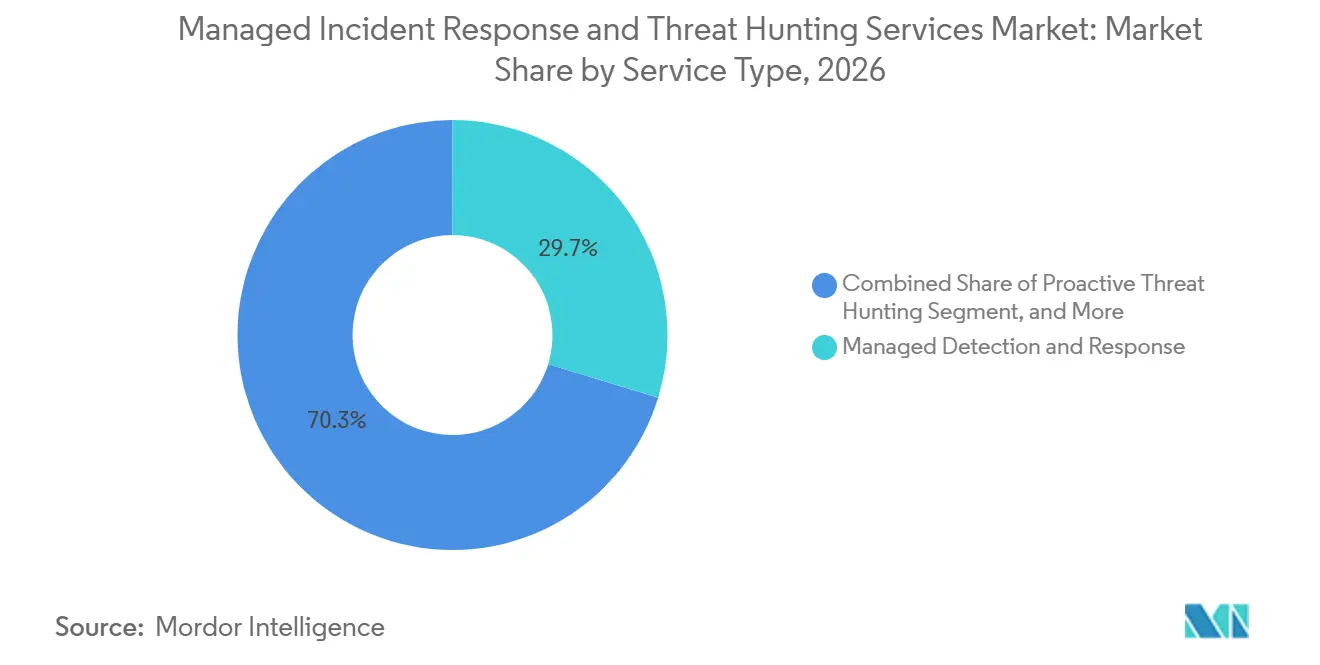
Ransomware Pressure Keeps Managed Detection and Response CentralManaged Detection and Response held 29.71% of service-type revenue in 2026. This share reflects demand for continuous detection and human-led response when periodic assessments cannot address active ransomware campaigns. Proactive Threat Hunting is projected to expand at a 19.73% CAGR from 2027 to 2032, the fastest rate among service types. IBM reported that attackers are shifting toward cloud and identity pathways, increasing the value of teams that search for suspicious behavior before an incident escalates.
The managed incident response and threat hunting services market size for this service mix is also supported by Managed Incident Response Retainers, which provide reserved specialist capacity for organizations without internal response teams. Digital Forensics and Incident Analytics supports the need for documented incident timelines and evidence. Containment, Remediation, and Recovery help organizations return systems to operation after an event. Readiness, Planning, and Tabletop Exercises are relevant in regulated sectors that need evidence of preparedness. These related services complement core MDR rather than replacing it.

By Delivery Model:
Co-Managed Adoption Extends Internal Security TeamsFully managed services held 39.42% of revenue in 2026, making them the largest delivery model. The position reflects the challenge of maintaining 24/7 coverage where organizations lack deep internal resources. Co-Managed deployments are projected to expand at a 17.61% CAGR from 2027 to 2032, the fastest delivery-model rate. This model allows clients to retain their internal security operations center investments while adding outside analysts and specialized investigation support.
On-Demand and retainer-based arrangements serve organizations that prefer spending tied to defined incidents or outcomes. Hybrid Managed configurations are gaining relevance for regulated organizations that need local data controls alongside specialist skills. Arctic Wolf introduced the Aurora Agentic SOC at RSAC 2026, combining automation with analyst work on more complex investigations. Interoperability with SIEM, SOAR, and ticketing systems is becoming an important procurement factor. The Managed incident response and threat hunting services market is, therefore, rewarding providers that can support both client-owned tools and provider-operated platforms.
By Organization Size:
Large Enterprises Lead Revenue While Smaller Firms Gain AccessLarge enterprises held 71.54% of revenue in 2026. Their spending reflects broader attack surfaces, greater regulatory exposure, and the ability to fund multi-year retainers with defined response authority. Small and Medium-Sized Enterprises are projected to expand at a 16.82% CAGR from 2027 to 2032, the fastest organization-size rate. Cyber-insurance requirements and expanding regulatory obligations make continuous monitoring more relevant for smaller organizations.
CBIZ reported that insurers increasingly require documented 24/7 monitoring and MDR deployment as minimum cyber-insurance controls.[3] Providers can reach this group through modular plans, transparent service outcomes, and a clear route from basic monitoring to full retainers. Research on service design also indicates that automation can lower delivery costs for routine activities. Those changes can widen access without removing the need for human investigation. The Managed incident response and threat hunting services market is consequently more likely to expand among smaller firms when providers align pricing and service scope with limited internal resources.
By Security Coverage Domain:
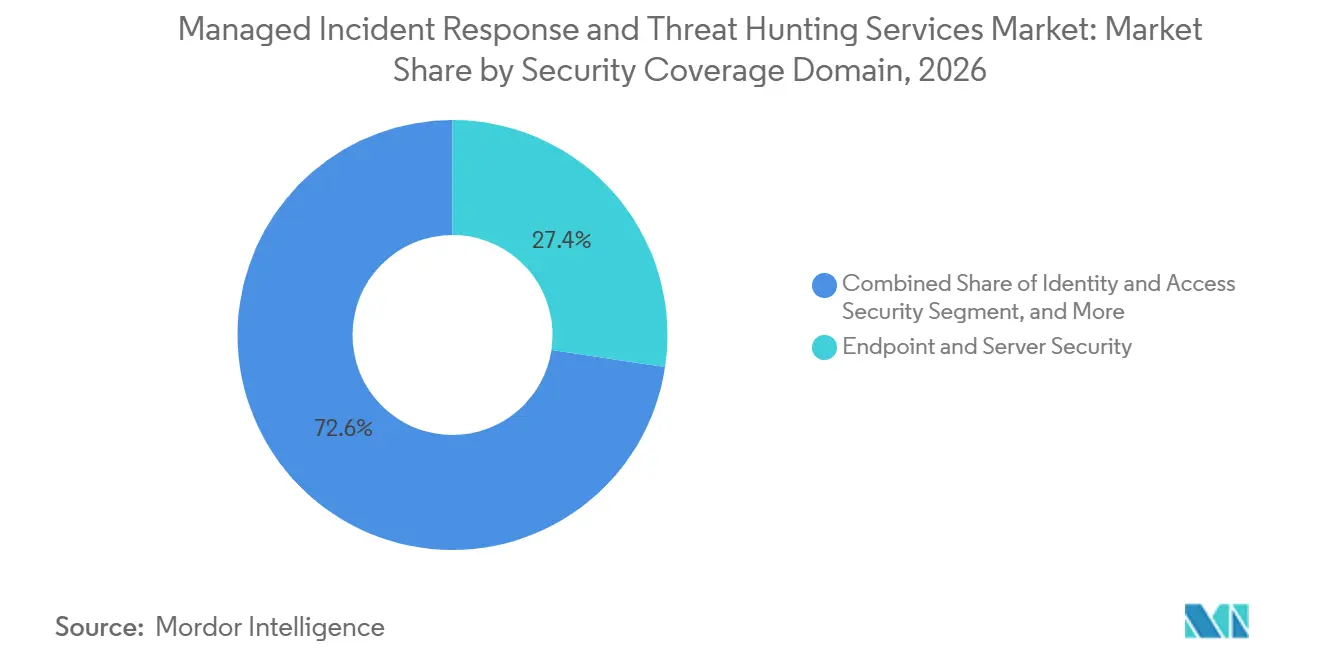
OT, IoT, and Medical Devices Create a New Monitoring NeedEndpoint and Server Security held 27.38% of revenue in 2026, supported by the established availability of endpoint telemetry. OT, IoT, and medical-device security are projected to expand at a 17.82% CAGR from 2027 to 2032. Claroty found known exploitable vulnerabilities on devices at 99% of the healthcare organizations it analyzed.[4] It also found internet-connected, ransomware-linked vulnerabilities at 89% of those organizations.
Network and Perimeter Security, Cloud Workload and SaaS Security, Identity and Access Security, and Application and API Security represent distinct monitoring requirements. IEEE research found that converged IT and OT threats pose infrastructure risks that conventional IT methods alone cannot address. The FDA issued a January 2025 safety communication on vulnerabilities affecting certain Contec and Epsimed patient monitors. The Managed incident response and threat hunting services market is gaining an additional coverage domain as clinical and industrial assets are brought into continuous security monitoring. Providers with OT-specific telemetry and response playbooks can address requirements that endpoint-only approaches do not cover.
By End-User Industry:
BFSI Leads Spending While Healthcare Increases DemandBFSI held 26.69% of revenue in 2026, the largest end-user share. Financial institutions face concentrated exposure to DORA, MiFID II, and incident-disclosure requirements, while holding data that is valuable to attackers. Healthcare and Life Sciences are projected to expand at an 18.54% CAGR from 2027 to 2032. Proofpoint reported that 97% of surveyed U.S. healthcare organizations experienced at least 1 cyberattack in the previous 12 months.
The same study recorded average attack costs of USD 4.2 million and patient-care disruption at 74% of surveyed organizations. IT and Telecommunications, Government and Public Sector, Industrial Manufacturing, and Retail and E-Commerce each have different procurement needs. Government organizations may favor domestic or cleared providers because of classification requirements. Manufacturers are adding OT monitoring in response to greater exposure across operational environments. The Managed incident response and threat hunting services market can address these different needs when providers adapt coverage, data controls, and response procedures to the sector.
Geography Analysis
North America Managed Incident Response and Threat Hunting Services Market
North America held 41.64% of revenue in 2026, the largest regional share. The region has a high concentration of SEC-regulated public companies, persistent cybersecurity staffing pressure, and mature procurement of managed security services. The FBI attributed 58% of globally disclosed ransomware attacks in 2025 to U.S.-based targets. Canada’s financial and energy sectors are extending adoption as cybersecurity requirements change, while Mexico is emerging as a demand center alongside nearshoring activity.
EMEA and South America Managed Incident Response and Threat Hunting Services Market
Europe is shaped by DORA, NIS2, and GDPR-related obligations that require formal detection and reporting programs. The European Union Cyber Resilience Act broadens the compliance-driven buyer base to industrial and consumer-product manufacturers. South America is gaining momentum in Brazil as LGPD enforcement supports cybersecurity investment by financial institutions and e-commerce operators. The Middle East is supported by cybersecurity frameworks in Saudi Arabia and the United Arab Emirates, while Africa is at an earlier stage of adoption, with South Africa serving as its most developed market.
APAC Managed Incident Response and Threat Hunting Services Market
Asia-Pacific is projected to expand at a 19.86% CAGR from 2027 to 2032, the fastest regional rate. The Asia-Pacific Managed incident response and threat hunting services market size is supported by digital transformation, sovereign data requirements, and limited in-country cybersecurity talent. India, Singapore, and South Korea each have jurisdiction-specific rules that create compliance triggers for managed detection procurement. Japan’s managed security services activity is also supported by demand for endpoint monitoring and cloud security operations. Providers that offer regional data processing and local delivery capabilities can better serve the varied requirements across the Asia-Pacific.
Competitive Landscape
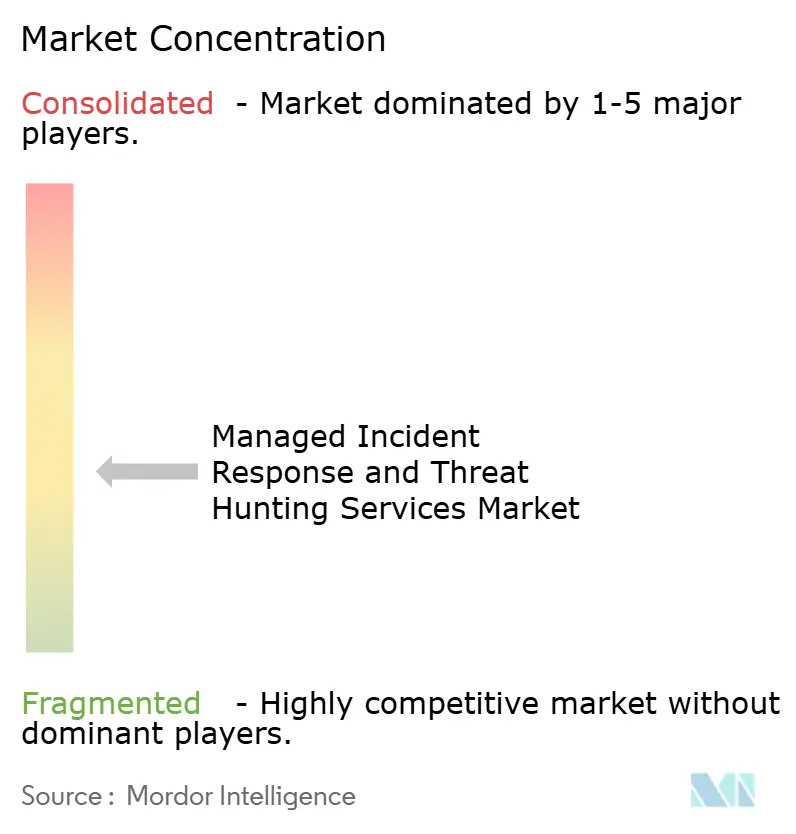
The managed incident response and threat hunting services market remains moderately fragmented, although acquisitions and platform expansion are consolidating competition at the enterprise tier. Gartner counted more than 600 vendors claiming MDR positioning in October 2025. CrowdStrike, SentinelOne, Arctic Wolf, Palo Alto Networks Unit 42, ReliaQuest, eSentire, and Expel compete through automation, telemetry coverage, investigation quality, and response depth. Some providers build broader security platforms, while specialists focus on experienced analysts, threat hunting, and forensics.
CrowdStrike acquired Pangea in September 2026 for USD 260 million to add AI Detection and Response capability to the Falcon platform. SentinelOne announced the acquisition of Observo AI for USD 225 million in September 2026 to add AI-native telemetry pipeline management to its AI SIEM. Arctic Wolf acquired Sevco Security in February 2026 to add agentless cyber asset attack surface management to the Aurora Platform. These moves show that providers are extending beyond endpoint monitoring to gain more context across enterprise environments.
Opportunities remain in OT and IoT monitoring, affordable services for smaller organizations, and co-managed models that preserve customer technology investments. Cyber-insurance providers are also entering the competitive field with bundled risk-financing and detection offerings. Providers that can demonstrate SOC 2 Type II controls and local log-residency capabilities can gain an advantage in Europe and Asia-Pacific. The managed incident response and threat hunting services market will continue to favor providers that combine responsive operations, broad visibility, and governance support. The Managed incident response and threat-hunting services market also creates room for providers that can connect insurance requirements to operational security services. Within the managed incident response and threat hunting services market, specialist providers can differentiate themselves by translating complex investigations into clear client decisions. The managed incident response and threat hunting services market has an additional opening for co-managed providers that enable clients to preserve existing technology investments.
Managed Incident Response and Threat Hunting Services Industry Leaders
-
CrowdStrike Holdings, Inc.
-
Arctic Wolf Networks, Inc.
-
Rapid7, Inc.
-
eSentire Inc.
-
SentinelOne, Inc.
- *Disclaimer: Major Players sorted in no particular order
Managed Incident Response and Threat Hunting Services Market Companies Covered in this Report
- CrowdStrike Holdings, Inc.
- Arctic Wolf Networks, Inc.
- Rapid7, Inc.
- eSentire Inc.
- SentinelOne, Inc.
- Secureworks, Inc.
- Red Canary, Inc.
- Expel, Inc.
- ReliaQuest, LLC
- Kroll, LLC
- Proficio, Inc.
- Trustwave Holdings, Inc.
- Binary Defense Systems, Inc.
- NTT Security Holdings Corporation
- NCC Group plc
- Sophos Group plc
- Palo Alto Networks, Inc. (Unit 42)
- Mandiant (Google LLC)
- IBM Corporation (IBM X-Force)
- Accenture plc
- Deloitte Touche Tohmatsu Ltd.
- Ernst and Young Global Ltd.
- PricewaterhouseCoopers LLP
- Booz Allen Hamilton Inc.
- BAE Systems plc
Recent Industry Developments in Managed Incident Response and Threat Hunting Services Market
- September 2026: CrowdStrike acquired AI-security specialist Pangea for approximately USD 260 million, extending the Falcon platform with AI Detection and Response (AIDR) capability that applies endpoint-style detection discipline to AI model interactions, a strategic move addressing the generative AI attack surface at enterprise scale.
- September 2026: SentinelOne announced the acquisition of Observo AI for USD 225 million in cash and stock, integrating AI-native telemetry pipeline management with its AI SIEM to enable real-time data enrichment, filtering, and routing before logs reach analytics layers.
- August 2026: SentinelOne reached a definitive agreement to acquire Prompt Security for approximately USD 250 million, extending the Singularity Platform to govern and monitor organizational use of GenAI and agentic AI tools, adding a new detection surface as enterprise AI deployments accelerate.
- May 2026: Arctic Wolf unveiled the Aurora Agentic SOC at RSAC 2026, combining a proprietary knowledge graph with AI agents to autonomously handle detection, investigation, and triage, substantially reducing operational complexity and cost for client organizations.
Global Managed Incident Response and Threat Hunting Services Market Report Scope
Managed incident response and threat hunting services provide organizations with expert-led, often 24/7 support to proactively search for hidden threats, investigate suspicious activity, contain incidents, and support recovery after a cyberattack. These services combine security analytics, threat intelligence, and human expertise to shorten detection and response times.
The Managed Incident Response and Threat Hunting Services Market Report is Segmented by Service Type (Managed Detection and Response, Managed Incident Response Retainers, Proactive Threat Hunting, Digital Forensics and Incident Analytics, Containment, Remediation, and Recovery, and Readiness, Planning, and Tabletop Exercises), Delivery Model (Fully Managed, Co-Managed, On-Demand and Retainer-Based, and Hybrid Managed), Organization Size (Large Enterprises, and Small and Medium Enterprises), Security Coverage Domain (Endpoint and Server Security, Network and Perimeter Security, Cloud Workload and SaaS Security, Identity and Access Security, Application and API Security, and OT, IoT, and Medical-Device Security), End-User Industry (Banking, Financial Services and Insurance (BFSI), IT and Telecommunications, Healthcare and Life Sciences, Government and Public Sector, Industrial Manufacturing, Retail and E-Commerce, and Other End-User Industries), and Geography (North America, South America, Europe, Asia-Pacific, Middle East, and Africa). The Market Forecasts are Provided in Terms of Value (USD).
Segmentation Overview
| Managed Detection and Response |
| Managed Incident Response Retainers |
| Proactive Threat Hunting |
| Digital Forensics and Incident Analytics |
| Containment, Remediation, and Recovery |
| Readiness, Planning, and Tabletop Exercises |
| Fully Managed |
| Co-Managed |
| On-Demand and Retainer-Based |
| Hybrid Managed |
| Large Enterprises |
| Small and Medium Enterprises |
| Endpoint and Server Security |
| Network and Perimeter Security |
| Cloud Workload and SaaS Security |
| Identity and Access Security |
| Application and API Security |
| OT, IoT, and Medical-Device Security |
| Banking, Financial Services and Insurance (BFSI) |
| IT and Telecommunications |
| Healthcare and Life Sciences |
| Government and Public Sector |
| Industrial Manufacturing |
| Retail and E-Commerce |
| Other End-User Industries |
| North America | United States |
| Canada | |
| Mexico | |
| South America | Brazil |
| Argentina | |
| Rest of South America | |
| Europe | Germany |
| United Kingdom | |
| France | |
| Italy | |
| Spain | |
| Rest of Europe | |
| Asia-Pacific | China |
| Japan | |
| India | |
| South Korea | |
| Rest of Asia-Pacific | |
| Middle East | Saudi Arabia |
| United Arab Emirates | |
| Turkey | |
| Rest of Middle East | |
| Africa | South Africa |
| Nigeria | |
| Egypt | |
| Rest of Africa |
| By Service Type | Managed Detection and Response | |
| Managed Incident Response Retainers | ||
| Proactive Threat Hunting | ||
| Digital Forensics and Incident Analytics | ||
| Containment, Remediation, and Recovery | ||
| Readiness, Planning, and Tabletop Exercises | ||
| By Delivery Model | Fully Managed | |
| Co-Managed | ||
| On-Demand and Retainer-Based | ||
| Hybrid Managed | ||
| By Organization Size | Large Enterprises | |
| Small and Medium Enterprises | ||
| By Security Coverage Domain | Endpoint and Server Security | |
| Network and Perimeter Security | ||
| Cloud Workload and SaaS Security | ||
| Identity and Access Security | ||
| Application and API Security | ||
| OT, IoT, and Medical-Device Security | ||
| By End-User Industry | Banking, Financial Services and Insurance (BFSI) | |
| IT and Telecommunications | ||
| Healthcare and Life Sciences | ||
| Government and Public Sector | ||
| Industrial Manufacturing | ||
| Retail and E-Commerce | ||
| Other End-User Industries | ||
| By Geography | North America | United States |
| Canada | ||
| Mexico | ||
| South America | Brazil | |
| Argentina | ||
| Rest of South America | ||
| Europe | Germany | |
| United Kingdom | ||
| France | ||
| Italy | ||
| Spain | ||
| Rest of Europe | ||
| Asia-Pacific | China | |
| Japan | ||
| India | ||
| South Korea | ||
| Rest of Asia-Pacific | ||
| Middle East | Saudi Arabia | |
| United Arab Emirates | ||
| Turkey | ||
| Rest of Middle East | ||
| Africa | South Africa | |
| Nigeria | ||
| Egypt | ||
| Rest of Africa | ||
Key Questions Answered in the Report
What is the size of the managed detection and response services market?
The managed incident response and threat hunting services market size is expected to grow from USD 4.86 billion in 2026 to USD 5.73 billion in 2027 and is forecast to reach USD 11.34 billion by 2032 at 14.63% CAGR over 2027-2032.
What is driving demand for managed detection and response services?
Rising ransomware activity, persistent analyst shortages, cloud complexity, and faster incident-reporting requirements are increasing demand for continuous monitoring and response.
Which service type is expanding fastest?
Proactive Threat Hunting is projected to expand at a 19.73% CAGR through 2032 as organizations seek to identify attacker activity before encryption or disruption occurs.
Which deployment model leads managed detection and response adoption?
Fully Managed services held 39.42% revenue share in 2026, while Co-Managed deployments are projected to expand at a 17.61% CAGR through 2032.
Which end-user sector has the fastest projected expansion?
Healthcare and Life Sciences is projected to expand at an 18.54% CAGR through 2032, supported by high cyberattack exposure and patient-care disruption risks.
Which region has the strongest projected expansion?
Asia-Pacific is projected to expand at a 19.86% CAGR through 2032 as data requirements, digitalization, and cybersecurity talent constraints increase demand.