
Managed Document Workflow Optimization Services Market Size and Share
Market Overview
| Study Period | 2021 - 2032 |
|---|---|
| Market Size (2027) | USD 13.91 Billion |
| Market Size (2032) | USD 22.10 Billion |
| Growth Rate (2027 - 2032) | 11.44 % |
| Fastest Growing Market | Asia-Pacific |
| Largest Market | North America |
| Market Concentration | Medium |
Major Players *Disclaimer: Major Players sorted in no particular order Image © Mordor Intelligence. Reuse requires attribution under CC BY 4.0. | |
Managed Document Workflow Optimization Services Market Analysis by Mordor Intelligence
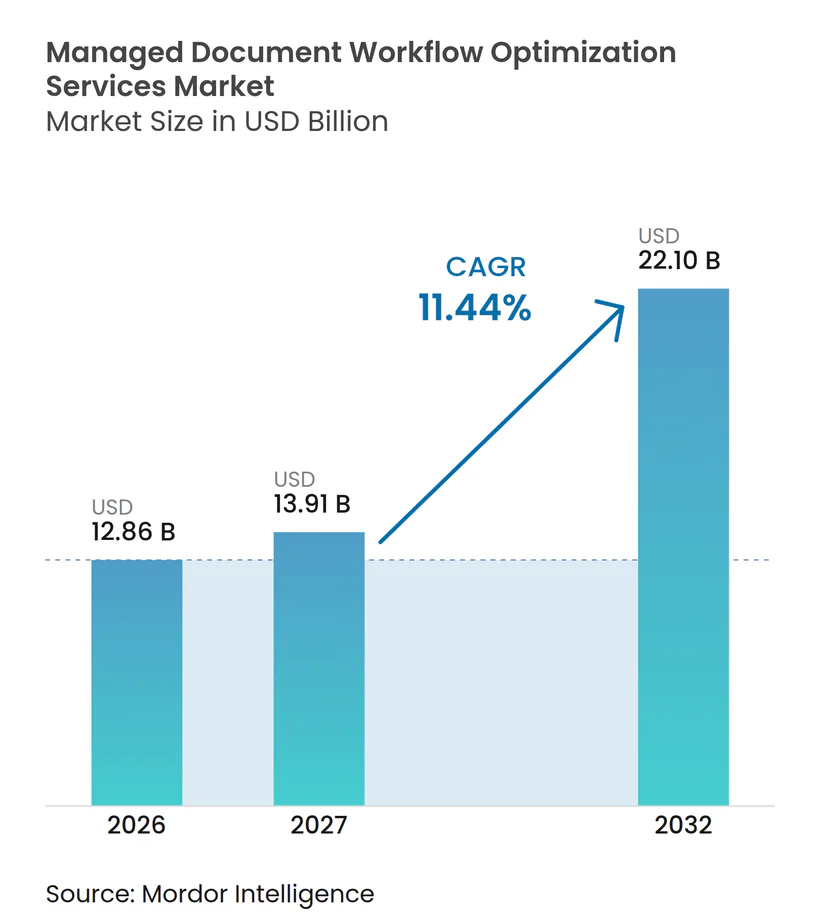
The managed document workflow optimization services market size is projected to expand from USD 12.86 billion in 2026 and USD 14.33 billion in 2027 to USD 22.10 billion by 2032, registering a CAGR of 11.44% between 2027 to 2032. Demand reflects the need to manage physical and digital documents within the same operating environment. Buyers are moving beyond storage and retrieval toward document routing, approvals, exception handling, and traceable decisions. This shift makes managed services more relevant to daily business operations, especially in regulated organizations. Providers are responding by combining capture, content management, automation, security controls, and process analytics. The managed document workflow optimization services market is also shaped by closer competition between print-led service providers and software-led content platforms.
Key Report Takeaways
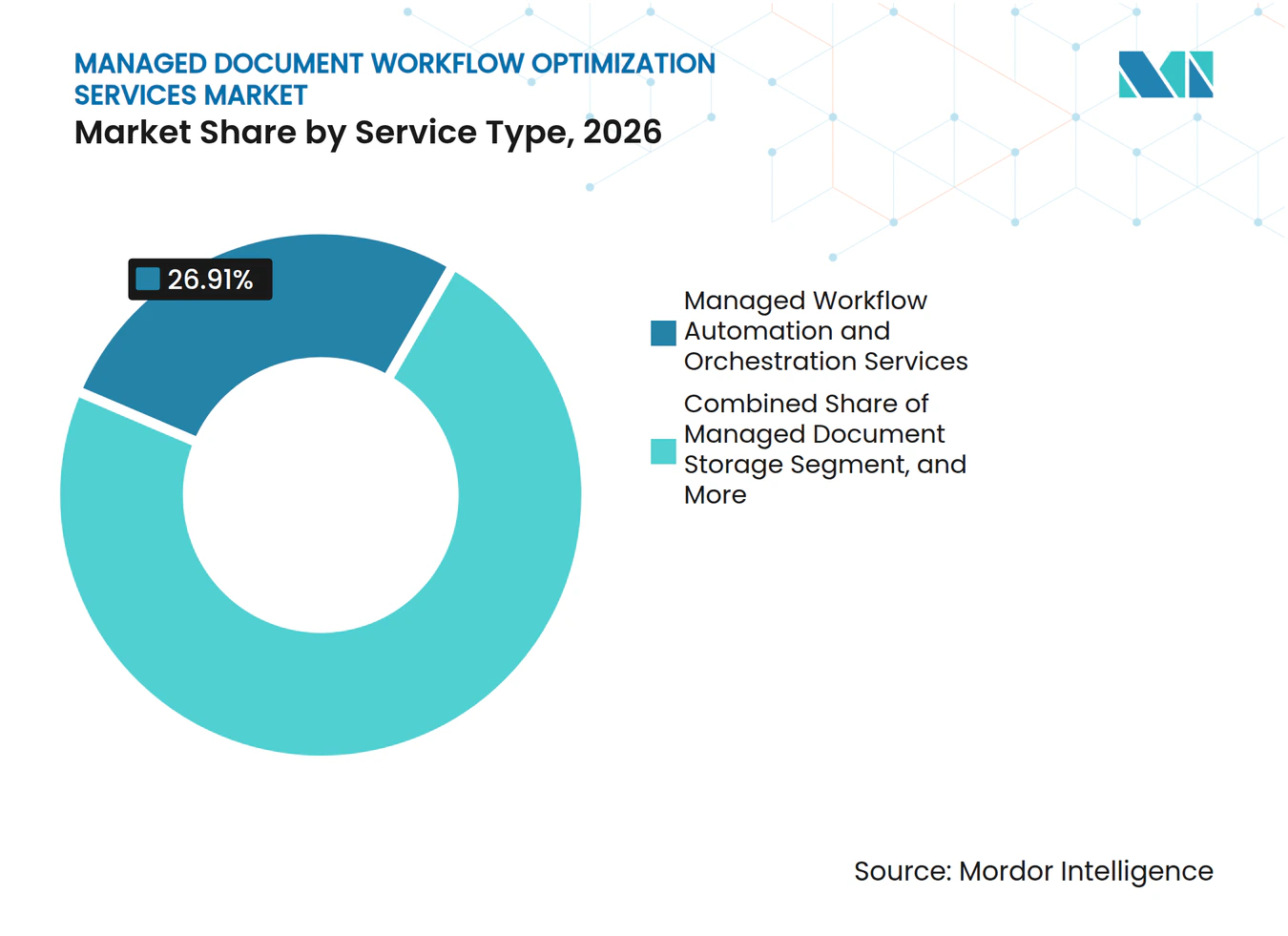
- By service type, Managed Workflow Automation and Orchestration Services held 26.91% of the market in 2026 and is projected to expand at a 12.67% CAGR through 2032.
- By technology, OCR and Intelligent Capture accounted for 24.49% of the market in 2026, while NLP and Large Language Models are projected to expand at a 12.82% CAGR through 2032.
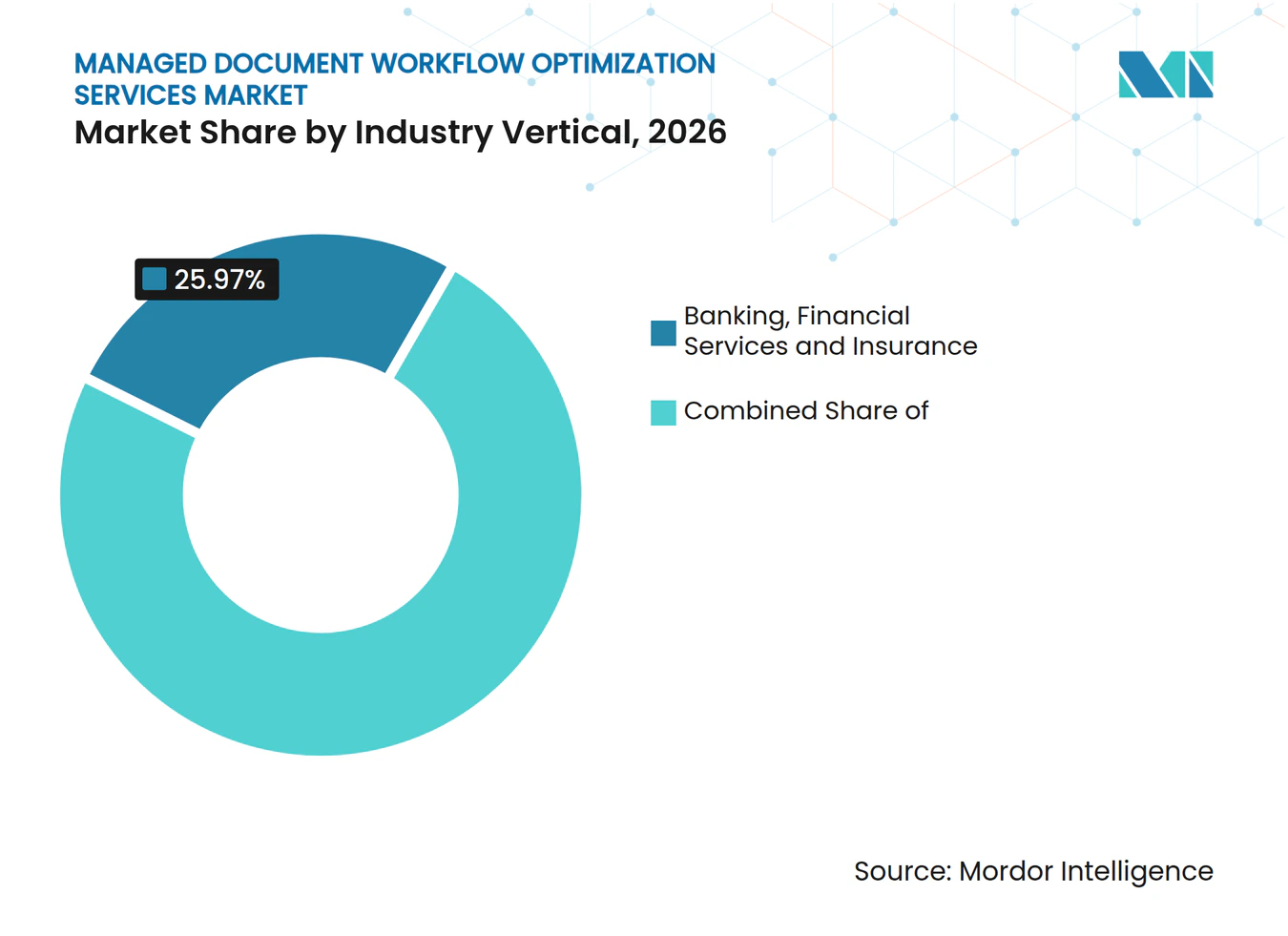
- By end user, BFSI held 25.97% of the market in 2026, while Healthcare and Life Sciences is projected to expand at a 12.38% CAGR through 2032.
- By geography, North America held 41.99% of the market in 2026, while Asia-Pacific is projected to expand at a 12.79% CAGR through 2032.
Note: Market numbers in this report are based on Mordor Intelligence's proprietary estimation framework, which combines nine months of actuals with Q4 projections for base year 2026.
Market Trends and Insights
Drivers Impact Analysis of Managed Document Workflow Optimization Services Market*
| Driver | (~) % Impact on CAGR Forecast | Geographic Relevance | Impact Timeline |
|---|---|---|---|
| Enterprise Demand for Digital Workflow Automation | +2.3% | Global | Short term (≤ 2 years) |
| AI-Enabled Intelligent Document Processing | +2.1% | Global | Medium term (2-4 years) |
| Cloud Migration and Hybrid Workplace Enablement | +1.7% | North America and Europe | Medium term (2-4 years) |
| Regulatory Compliance and Auditability Requirements | +1.2% | Europe and Asia-Pacific, with spillover to the Middle East | Medium term (2-4 years) |
| Verticalization of Document-Centric Business Processes | +0.9% | Global, with early gains in BFSI and healthcare | Long term (≥ 4 years) |
| Workflow Telemetry as a Continuous Optimization Asset | +0.6% | North America and Europe | Long term (≥ 4 years) |
| Source: Mordor Intelligence | |||
Enterprise Demand for Digital Workflow Automation
Organizations are seeking to reduce delays in document-intensive work, which supports adoption across the managed document workflow optimization services market. The need extends beyond invoice handling to onboarding, human resources files, contract review, licenses, permits, and compliance documentation. These uses place document workflows closer to customer-facing and operational processes. Managed providers can therefore compete on shorter approval cycles and clearer service outcomes rather than on digitization alone. This approach is particularly relevant for financial institutions and public agencies that must process large volumes while maintaining documented control. It also creates demand for contracts that cover ongoing operation, performance review, and workflow improvement.
AI-Enabled Intelligent Document Processing
AI-enabled document processing is changing how providers extract information and manage exceptions in the managed document workflow optimization services market. ABBYY introduced Vantage 3.0 in January 2026 with direct large language model integration, real-time processing insights, and compliance and redaction capabilities.[1] In October 2026, ABBYY introduced PHOENIX Plus, a generative AI layer for Vantage that supports zero-shot extraction across variable document types. These releases show that providers are reducing their reliance on predefined templates and labeled training data. The commercial value increasingly rests on integration, quality controls, governance, and the ability to support complex document sets. This gives managed providers an opportunity to operate and refine the technology after deployment.
Cloud Migration and Hybrid Workplace Enablement
The managed document workflow optimization services market benefits from hybrid work arrangements that require secure document access across distributed teams. Regulated organizations often need to retain selected content within controlled environments while allowing other workflows to use cloud services. This arrangement creates recurring work around access rules, routing, retention, and oversight. Hyland expanded its cloud-native and agentic capabilities in European markets during its October 2025 CommunityLIVE World Tour.[2] The move illustrates how established content platforms are adapting their offerings for organizations that need both cloud flexibility and managed controls. Providers with clear migration plans and data-location controls can address requirements that a cloud-only offer may not meet.
Regulatory Compliance and Auditability Requirements
Compliance requirements are making managed document services more important for organizations that handle sensitive records. The European Union’s Digital Operational Resilience Act applied from January 17, 2025 and sets requirements for digital operational resilience in the financial sector. These obligations raise the value of audit trails, documented access controls, incident handling, and resilient workflows. The UAE Department of Health published its Document and Content Management Standard in December 2025, with effect from April 2026, covering lifecycle management, version control, and retention expectations for health entities.[3] Such requirements encourage buyers to seek operating models that bring compliance controls into daily document work. In the managed document workflow optimization services market, providers can differentiate through repeatable configurations for regulated use cases.
Restraints Impact Analysis of Managed Document Workflow Optimization Services Market*
| Restraint | (~) % Impact on CAGR Forecast | Geographic Relevance | Impact Timeline |
|---|---|---|---|
| Legacy-System Integration Complexity | -1.9% | Global | Medium term (2-4 years) |
| Data Privacy, Security and Sovereignty Concerns | -1.5% | Global, with emphasis on the European Union | Medium term (2-4 years) |
| Implementation, Change Management and Recurring Service Costs | -1.0% | Global | Medium term (2-4 years) |
| Confidence Loss from Low-Quality AI Extraction on Exceptional Documents | -0.6% | Global | Long term (≥ 4 years) |
| Source: Mordor Intelligence | |||
Legacy-System Integration Complexity
Legacy enterprise resource planning, customer relationship management, and content systems can delay a managed document workflow optimization services market deployment. A provider may need to connect old data models, custom workflows, security controls, and informal business practices before the new service can operate fully. This work can extend implementation timelines and postpone the benefits expected from automation. It can also create internal resistance when business units have developed familiar workarounds. Modular connectors and staged migration plans can reduce disruption, but they require careful governance. Providers that support integration without forcing immediate replacement of core systems can make this constraint more manageable.
Data Privacy, Security and Sovereignty Concerns
Data privacy and security remain material barriers when documents include financial, health, legal, or personal information. Data residency expectations can limit where processing occurs and which cloud services can be used. OpenText released Documentum Content Management CE 25.4 in November 2025 with options for full on-premises AI processing, responding to organizations with strict sovereignty requirements. Private cloud, on-premises, and single-tenant configurations can address buyer concerns but may increase service costs. Concerns are particularly strong where organizations must prove who accessed information and how AI-assisted decisions were handled. The managed document workflow optimization services market must therefore balance automation benefits with clear control over data, models, and processing locations.
*Our forecasts treat driver/restraint impacts as directional, not additive. The impact forecasts reflect baseline growth, mix effects, and variable interactions.
Managed Document Workflow Optimization Services Market Segment Analysis
By Service Type:
Workflow Automation and Orchestration Leads DemandManaged Workflow Automation and Orchestration Services held 26.91% of the managed document workflow optimization services market share in 2026 and is projected to expand at a 12.67% CAGR through 2032. Its position shows that buyers are placing greater value on routing, approvals, exceptions, and decisions than on document storage alone. These services are integrated with operational systems, which makes them harder to replace once embedded. They are also relevant when organizations need consistent handling across multiple document types and business units. Tungsten Automation announced its Tungsten Automation Platform in September 2025, combining document automation, workflow orchestration, and knowledge discovery. The platform illustrates how providers are combining tools that were previously offered separately.
Managed Document Capture and Digitization Services and Managed Document Storage and Archiving Services remain important where paper records and retention obligations are still significant. Managed Document Security and Compliance Services serves organizations that need documented controls and audit-ready records. Managed Document Analytics and Process Optimization Services uses performance information from workflows to identify delays and recurring exceptions. Managed Document Integration and Migration Services is needed when organizations move content and workflow processes between platforms. Together, these categories show that the managed document workflow optimization services market includes both established records services and higher-value operating services. Providers that connect these activities can reduce handoffs between capture, storage, automation, and governance.



By Technology:
NLP and LLMs Change Document ExtractionOCR and Intelligent Capture accounted for 24.49% of the managed document workflow optimization services market size in 2026. OCR remains the intake layer for converting paper, images, and semi-structured files into usable information. Its established role makes it central to document workflows in sectors that still receive diverse formats. However, baseline extraction capabilities are becoming less distinctive when incorporated into broader cloud platforms. NLP and Large Language Models are projected to expand at a 12.82% CAGR through 2032 because they can support more contextual review of unstructured content. This technology can assist with documents that do not follow fixed formats.
Machine Learning and Deep Learning support classification and anomaly detection, particularly for invoices, purchase orders, and insurance claims. RPA Integration can connect extraction results to business processes that remain partly rules-based. Process Mining and Workflow Analytics helps service teams see where documents are delayed, misrouted, or repeatedly rejected. Identity, Security, and Zero-Trust Technologies address the need to control document access and preserve logs in regulated settings. ABBYY’s 2026 releases demonstrate the movement toward combining traditional extraction with large language model features. In the managed document workflow optimization services market, technology selection increasingly depends on the level of control, integration, and human review that each use case requires.
By End User:
BFSI Holds the Largest Position and Healthcare AdvancesBFSI held 25.97% of the managed document workflow optimization services market in 2026. Financial institutions manage documents across onboarding, lending, claims, compliance, and audit processes. The sector also faces strict requirements for operational resilience, traceability, third-party oversight, record retention, and controlled review of exceptions. Fiserv launched Content Next with OpenText in September 2025 as a cloud-based content management and workflow offering for financial institutions. The offering included tools for natural-language search, classification, and automated processing. This specialization reflects the need for document workflows that align with financial services operations and can be administered within defined governance arrangements.
Healthcare and Life Sciences is projected to expand at a 12.38% CAGR through 2032. Electronic health records, clinical documentation, and interoperable patient information are increasing the need for dependable document controls. Government and public-sector users also require services that improve accessibility of citizen records and processing speed. Manufacturing and Industrial users need controlled records for quality systems, maintenance, and process documentation. Telecommunications and IT organizations use document workflows for software contracts and AI governance records. Legal and Professional Services remains a smaller end-user area, but the sensitivity of discovery and contract work can support higher-value engagements in the managed document workflow optimization services market.

Geography Analysis
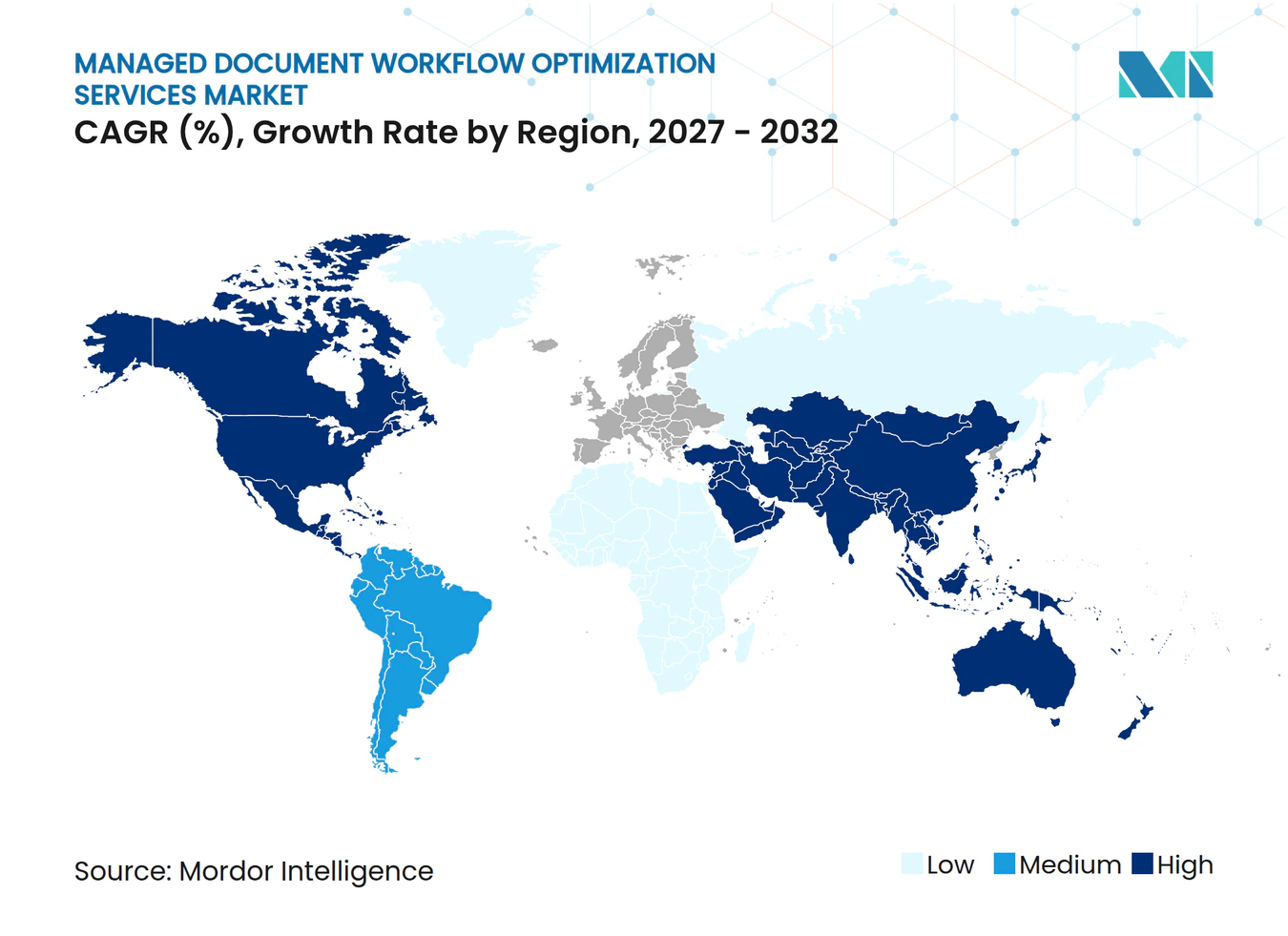
North America held 41.99% of the managed document workflow optimization services market in 2026. The region has a large base of financial services and healthcare organizations, along with established managed-services buying practices and extensive document-processing requirements. Providers are converting hardware-oriented managed print arrangements into broader workflow contracts that include capture, compliance reporting, process analysis, and continuous service management. Xerox reported cumulative run-rate gross cost savings exceeding USD 500 million through the end of 2025 and completed the Lexmark acquisition for USD 768 million. The transaction expanded Xerox’s portfolio and manufacturing footprint, supporting its move toward services-led offerings.
Europe is a major center for compliant document operations because organizations must respond to GDPR, DORA, the EU AI Act, and national rules. These frameworks increase the need for traceable workflows and controlled data handling. Hyland’s 2025 European cloud and AI initiative shows that platform suppliers are addressing this demand through cloud-native content capabilities. Asia-Pacific is projected to expand at a 12.79% CAGR through 2032. Demand is supported by public-sector digitization, expanding enterprise adoption, and document needs in health, manufacturing, and financial services, which broadens the managed document workflow optimization services market.
South America is led by Brazil, where data protection requirements support demand for auditable document services. Argentina and other regional markets are earlier in cloud-based document workflow adoption, with financial services and retail among the active user groups. The Middle East is seeing government-led demand, including the UAE health-sector document standard. Africa represents a longer-term opportunity centered on financial inclusion, insurance expansion, telecommunications, and government digital identity programs. South Africa and Nigeria are likely focal points as public-sector requirements become more formal. These regional conditions give the managed document workflow optimization services market different entry points, ranging from enterprise modernization to government compliance programs.
Competitive Landscape
Market Concentration
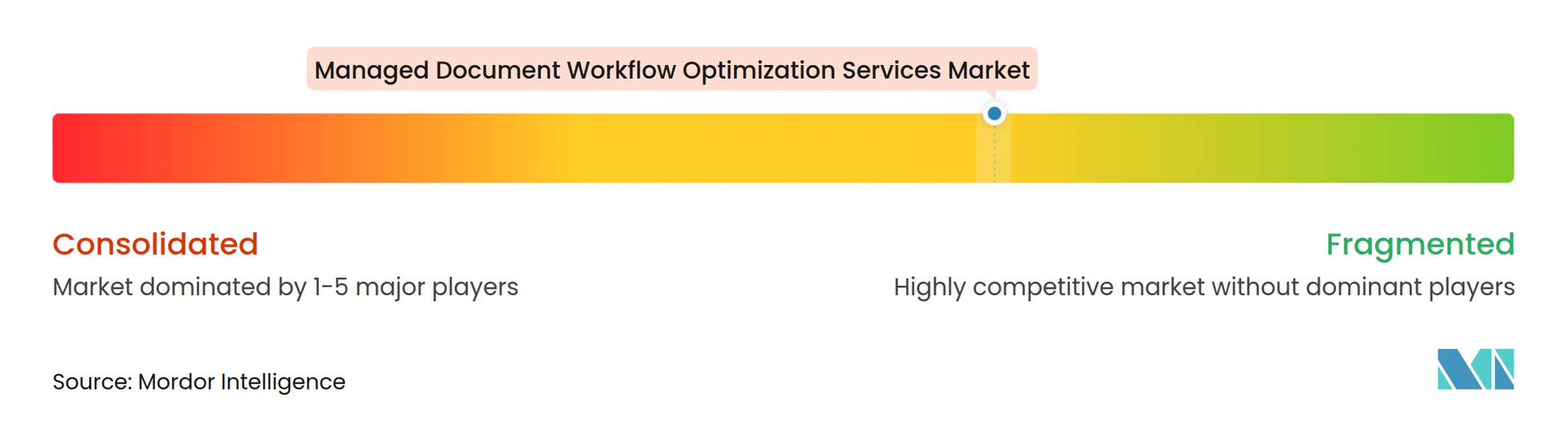
The managed document workflow optimization services market is moderately fragmented, with no single vendor holding a dominant position across all service categories and geographies. Print-rooted providers such as Xerox, Ricoh, Canon, and Konica Minolta are extending their offers beyond devices and print management. Software-led platforms including OpenText, Hyland, Tungsten Automation, and ABBYY compete on content controls, automation, AI features, and integration. The main competitive issue is the ability to connect into enterprise resource planning, customer relationship management, and cloud productivity environments. Providers with repeatable connectors can reduce the number of separate point solutions required by a customer.
Xerox completed its Lexmark acquisition in July 2025 for USD 768 million, which expanded its A4 color print position, Asia-Pacific presence, manufacturing footprint, and managed services capability. OpenText announced an agreement in October 2025 to divest its on-premises eDOCS solution to NetDocuments for USD 163 million in cash. The divestiture focused resources on cloud-native and AI-oriented information management. Ricoh completed the sale of Avanti Computer Systems to eProductivity Software in June 2025, reflecting its emphasis on document workflow, software, and business process services. These moves show how leading companies are narrowing their portfolios around higher-priority workflow capabilities in the managed document workflow optimization services market.
Smaller software providers can compete by offering cloud-native automation with lighter implementation requirements. This positioning can be useful for mid-sized customers that do not need a large enterprise platform. Industry-specific configurations for healthcare records, legal discovery, and financial compliance are another route to differentiation. Such configurations can include document types, retention rules, audit paths, and approval controls suited to specific operations. The managed document workflow optimization services industry therefore rewards providers that combine practical implementation support with specialized process knowledge. Competition in the managed document workflow optimization services market is likely to remain active as large platforms expand native features and specialized firms focus on integration and managed operation.
Managed Document Workflow Optimization Services Industry Leaders
-
Xerox Holdings Corporation
-
Ricoh Company, Ltd.
-
Konica Minolta, Inc.
-
Canon Inc.
-
Kyocera Document Solutions Inc.
- *Disclaimer: Major Players sorted in no particular order
Managed Document Workflow Optimization Services Market Companies Covered in this Report
- Xerox Holdings Corporation
- Ricoh Company, Ltd.
- Konica Minolta, Inc.
- Canon Inc.
- Kyocera Document Solutions Inc.
- Lexmark International, Inc.
- SHARP CORPORATION
- Toshiba Tec Corporation
- Seiko Epson Corporation
- FUJIFILM Business Innovation Corp.
- Pitney Bowes Inc.
- Open Text Corporation
- Hyland Software, Inc.
- Newgen Software Technologies Limited
- Laserfiche
- DocuWare GmbH
- ABBYY USA Software House Inc.
- Tungsten Automation Corporation
- PaperCut Software Pty Ltd
- Pharos Systems International, Inc.
- Vasion, Inc.
- Process Fusion, Inc.
Recent Industry Developments in Managed Document Workflow Optimization Services Market
- October 2026: ABBYY introduced PHOENIX Plus, a native GenAI layer built directly into the ABBYY Vantage platform, enabling zero-shot extraction across any document type including long-tail and highly variable documents, and providing AI-driven decision recommendations that support downstream automation workflows. The development signals a structural shift away from template-based extraction models toward generative AI-first document processing at enterprise scale.
- October 2026: OpenText unveiled Content Cloud solutions for Guidewire PolicyCenter, ClaimCenter, and BillingCenter, embedding AI-powered content assistance directly into core insurance workflow applications. The solutions are designed to accelerate cloud migration for insurers while enabling faster claims decision timelines through AI-driven content activation.
- February 2026: Xerox entered a joint venture with funds managed by Angelo, Gordon and Co. (TPG), contributing certain intellectual property and trademarks in exchange for USD 405 million in senior secured term loans and USD 45 million in Class A Units from IPCo Holdings. The transaction strengthens Xerox's balance sheet to support long-term investment in managed workflow and IT solutions.
- January 2026: ABBYY launched Vantage 3.0 with direct LLM integration, a redesigned technology stack, an analytics dashboard with real-time processing insights, and built-in compliance and redaction capabilities. The release positions ABBYY as a platform capable of bridging traditional AI extraction reliability with generative AI flexibility for enterprise document workflows.
Global Managed Document Workflow Optimization Services Market Report Scope
The Managed Document Workflow Optimization Services Market refers to the industry focused on outsourced and managed services that design, automate, monitor, and continuously improve document-centric business processes across physical and digital environments. These services help organizations streamline the creation, capture, classification, routing, approval, storage, retrieval, and disposal of documents while enhancing operational efficiency, regulatory compliance, data security, and employee productivity. Service providers leverage technologies such as intelligent document processing (IDP), optical character recognition (OCR), robotic process automation (RPA), workflow orchestration platforms, cloud-based document management systems, artificial intelligence, and analytics to optimize end-to-end document workflows. The market serves enterprises across sectors including banking, financial services, healthcare, government, manufacturing, retail, legal, and telecommunications, enabling faster decision-making, reduced processing costs, improved document visibility, and support for digital transformation initiatives.
The Managed Document Workflow Optimization Services Report is Segmented by Service Type (Managed Document Capture and Digitization Services, Managed Document Storage and Archiving Services, Managed Workflow Automation and Orchestration Services, Managed Document Security and Compliance Services, Managed Document Analytics and Process Optimization Services, and Managed Document Integration and Migration Services), Technology (Optical Character Recognition and Intelligent Capture, Natural Language Processing and Large Language Models, Machine Learning and Deep Learning, Robotic Process Automation Integration, Process Mining and Workflow Analytics, and Identity, Security and Zero-Trust Technologies), End User (Banking, Financial Services and Insurance, Government and Public Sector, Healthcare and Life Sciences, Manufacturing and Industrial, Retail and Consumer Goods, Telecommunications and Information Technology, Legal and Professional Services, and Other End Users), and Geography (North America [United States, Canada, and Mexico], South America [Brazil, Argentina, and Rest of South America], Europe [United Kingdom, Germany, France, Italy, Spain, and Rest of Europe], Asia-Pacific [China, Japan, India, South Korea, and Rest of Asia-Pacific], Middle East [United Arab Emirates, Saudi Arabia, Turkey, and Rest of Middle East], and Africa [South Africa, Nigeria, and Rest of Africa]). The Market Forecasts are Provided in Terms of Value (USD).
Segmentation Overview
| Managed Document Capture and Digitization Services |
| Managed Document Storage and Archiving Services |
| Managed Workflow Automation and Orchestration Services |
| Managed Document Security and Compliance Services |
| Managed Document Analytics and Process Optimization Services |
| Managed Document Integration and Migration Services |
| Optical Character Recognition and Intelligent Capture |
| Natural Language Processing and Large Language Models |
| Machine Learning and Deep Learning |
| Robotic Process Automation Integration |
| Process Mining and Workflow Analytics |
| Identity, Security and Zero-Trust Technologies |
| Banking, Financial Services and Insurance |
| Government and Public Sector |
| Healthcare and Life Sciences |
| Manufacturing and Industrial |
| Retail and Consumer Goods |
| Telecommunications and Information Technology |
| Legal and Professional Services |
| Other End Users |
| North America | United States |
| Canada | |
| Mexico | |
| South America | Brazil |
| Argentina | |
| Rest of South America | |
| Europe | United Kingdom |
| Germany | |
| France | |
| Italy | |
| Spain | |
| Rest of Europe | |
| Asia-Pacific | China |
| Japan | |
| India | |
| South Korea | |
| Rest of Asia-Pacific | |
| Middle East | United Arab Emirates |
| Saudi Arabia | |
| Turkey | |
| Rest of Middle East | |
| Africa | South Africa |
| Nigeria | |
| Rest of Africa |
| By Service Type | Managed Document Capture and Digitization Services | |
| Managed Document Storage and Archiving Services | ||
| Managed Workflow Automation and Orchestration Services | ||
| Managed Document Security and Compliance Services | ||
| Managed Document Analytics and Process Optimization Services | ||
| Managed Document Integration and Migration Services | ||
| By Technology | Optical Character Recognition and Intelligent Capture | |
| Natural Language Processing and Large Language Models | ||
| Machine Learning and Deep Learning | ||
| Robotic Process Automation Integration | ||
| Process Mining and Workflow Analytics | ||
| Identity, Security and Zero-Trust Technologies | ||
| By End User | Banking, Financial Services and Insurance | |
| Government and Public Sector | ||
| Healthcare and Life Sciences | ||
| Manufacturing and Industrial | ||
| Retail and Consumer Goods | ||
| Telecommunications and Information Technology | ||
| Legal and Professional Services | ||
| Other End Users | ||
| By Geography | North America | United States |
| Canada | ||
| Mexico | ||
| South America | Brazil | |
| Argentina | ||
| Rest of South America | ||
| Europe | United Kingdom | |
| Germany | ||
| France | ||
| Italy | ||
| Spain | ||
| Rest of Europe | ||
| Asia-Pacific | China | |
| Japan | ||
| India | ||
| South Korea | ||
| Rest of Asia-Pacific | ||
| Middle East | United Arab Emirates | |
| Saudi Arabia | ||
| Turkey | ||
| Rest of Middle East | ||
| Africa | South Africa | |
| Nigeria | ||
| Rest of Africa | ||
Key Questions Answered in the Report
What is the managed document workflow optimization services market size?
The managed document workflow optimization services market size is projected to expand from USD 12.86 billion in 2026 and USD 14.33 billion in 2027 to USD 22.10 billion by 2032, at an 11.44% CAGR.
Which service type leads managed document workflow optimization services?
Managed Workflow Automation and Orchestration Services held 26.91% in 2026 and is projected to expand at a 12.67% CAGR through 2032.
Which technology is expanding fastest in document workflow optimization?
NLP and Large Language Models is projected to expand at a 12.82% CAGR through 2032, supported by its use in unstructured document processing.
Why do financial institutions use managed document workflow services?
BFSI held 25.97% in 2026 because lending, onboarding, compliance, and audit work require secure and traceable document handling.
Which region is expanding fastest for document workflow optimization services?
Asia-Pacific is projected to expand at a 12.79% CAGR through 2032, supported by public-sector digitization and broader enterprise adoption.
What limits adoption of managed document workflow services?
Legacy-system integration, privacy requirements, data sovereignty concerns, and the cost of secure deployment can delay adoption.