
Managed Cloud Firewall Services Market Size and Share
Market Overview
| Study Period | 2021 - 2032 |
|---|---|
| Market Size (2027) | USD 5.74 Billion |
| Market Size (2032) | USD 11.43 Billion |
| Growth Rate (2027 - 2032) | 14.75 % |
| Fastest Growing Market | Asia-Pacific |
| Largest Market | North America |
| Market Concentration | Medium |
Major Players *Disclaimer: Major Players sorted in no particular order Image © Mordor Intelligence. Reuse requires attribution under CC BY 4.0. | |
Managed Cloud Firewall Services Market Analysis by Mordor Intelligence
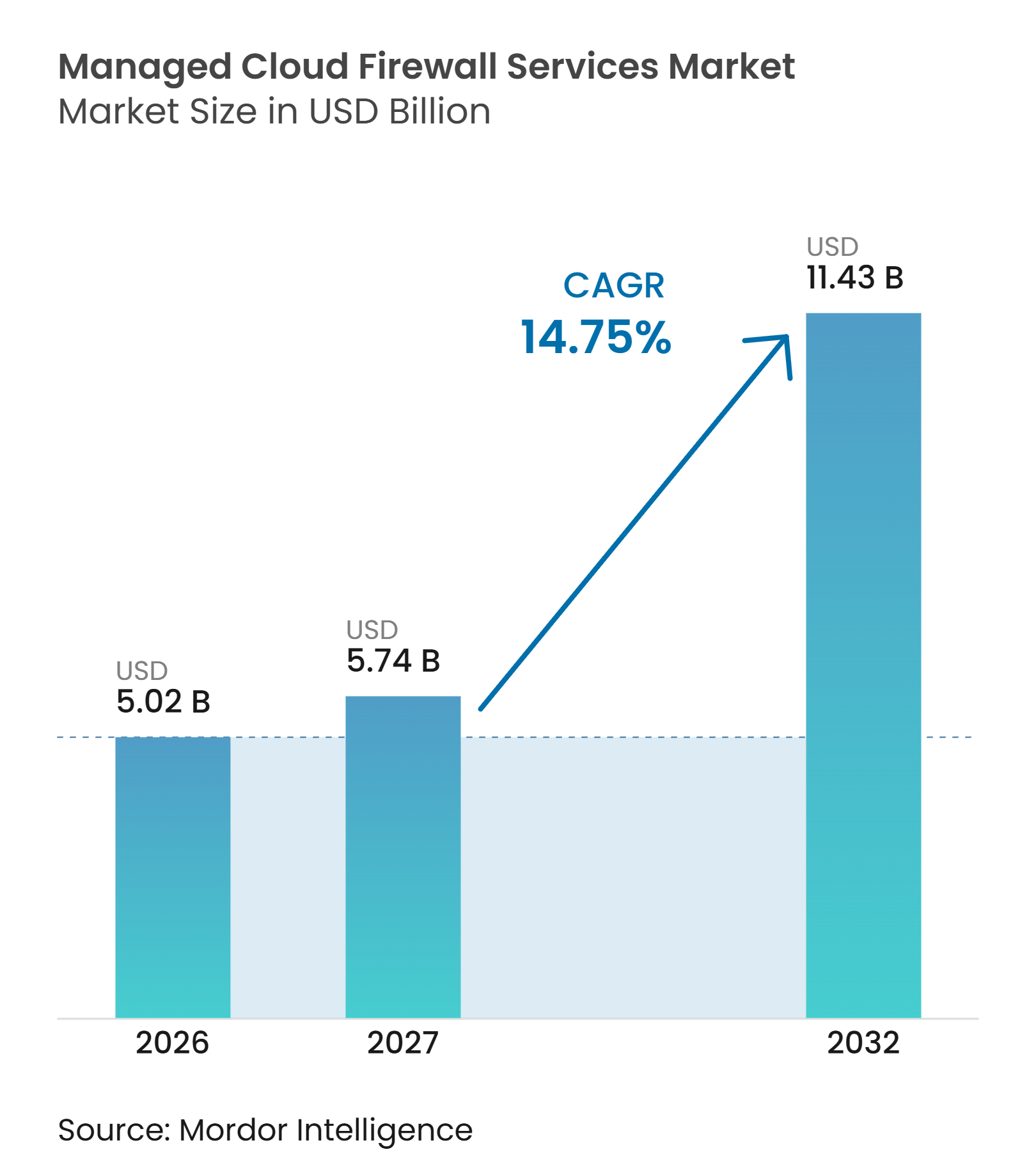
The managed cloud firewall services market size is USD 5.02 billion in 2026 and is forecast to reach USD 11.43 billion by 2032, growing at a CAGR of 14.75% from 2027 to 2032. The managed cloud firewall services market is moving away from appliance-centered perimeter security toward cloud-delivered controls that follow users, workloads, and data across distributed environments, including public cloud, private cloud, hybrid infrastructure, and software-as-a-service traffic. Enterprises are assigning more security operations, threat response, policy administration, and compliance reporting to specialist providers as multi-cloud infrastructure and distributed work increase the management burden, while internal teams must also support existing applications and legacy policies. AI-enabled threats are increasing the value of services that combine policy enforcement with continuous monitoring and response, as organizations need to identify activity across workloads, users, applications, third-party connections, and cloud network paths without relying solely on a fixed perimeter. SASE bundles are lowering the standalone price of firewall services, but they also give providers a broader subscription opportunity by combining networking and security under a single contract and supporting customers seeking fewer disconnected tools, clearer operational accountability, and a more consistent policy model.
Key Report Takeaways
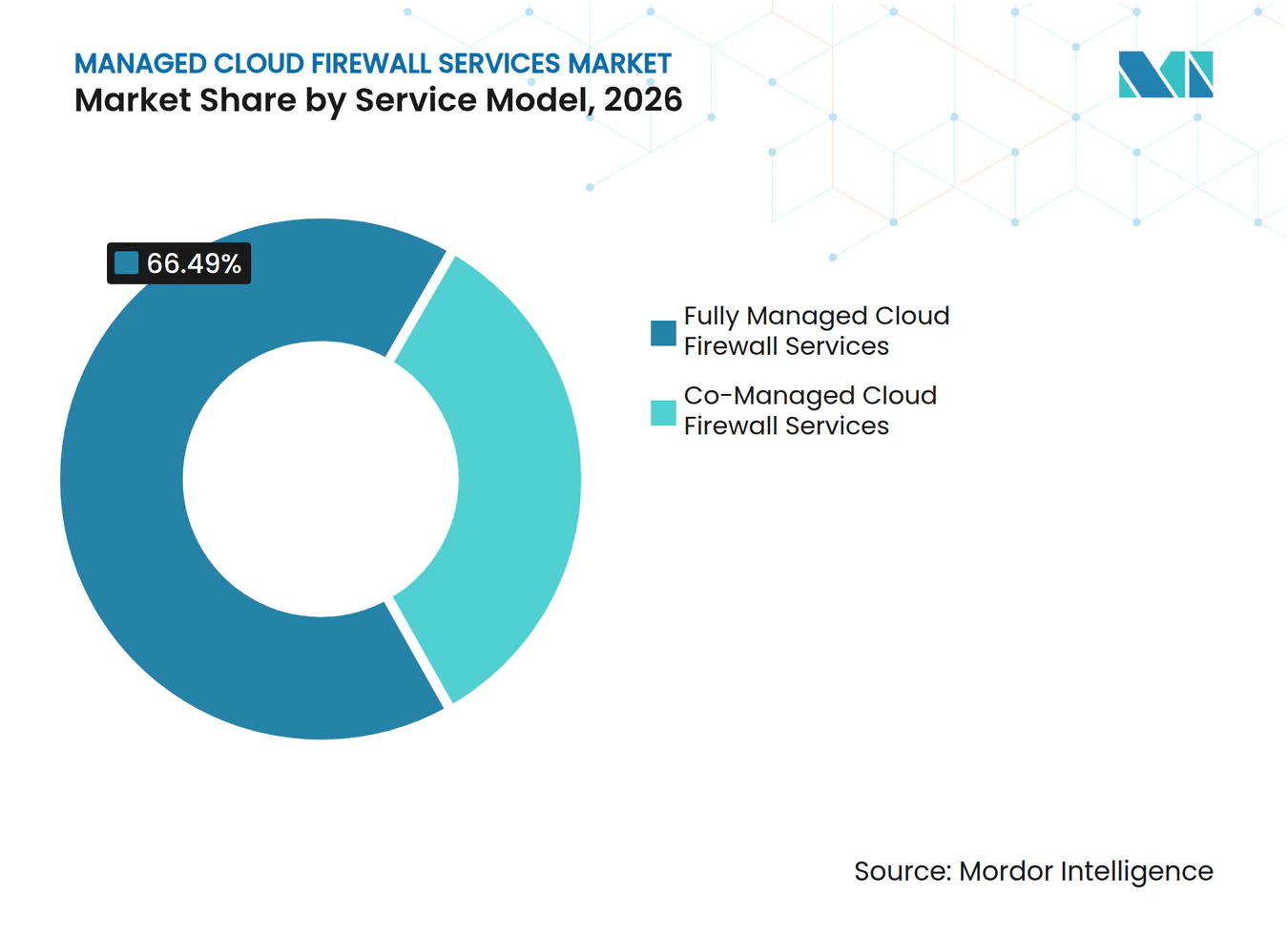
- By service model, fully managed cloud firewall services held 66.49% of the managed cloud firewall services market share in 2026, while co-managed cloud firewall services are projected to expand at a 16.70% CAGR through 2032.
- By function, monitoring and alerting accounted for 46.12% of the managed cloud firewall services market share in 2026, while incident response and threat investigation are projected to grow at a 15.75% CAGR through 2032.
- By deployment mode, public cloud held 65.18% of the managed cloud firewall services market share in 2026, while hybrid cloud is projected to expand at a 16.02% CAGR through 2032.
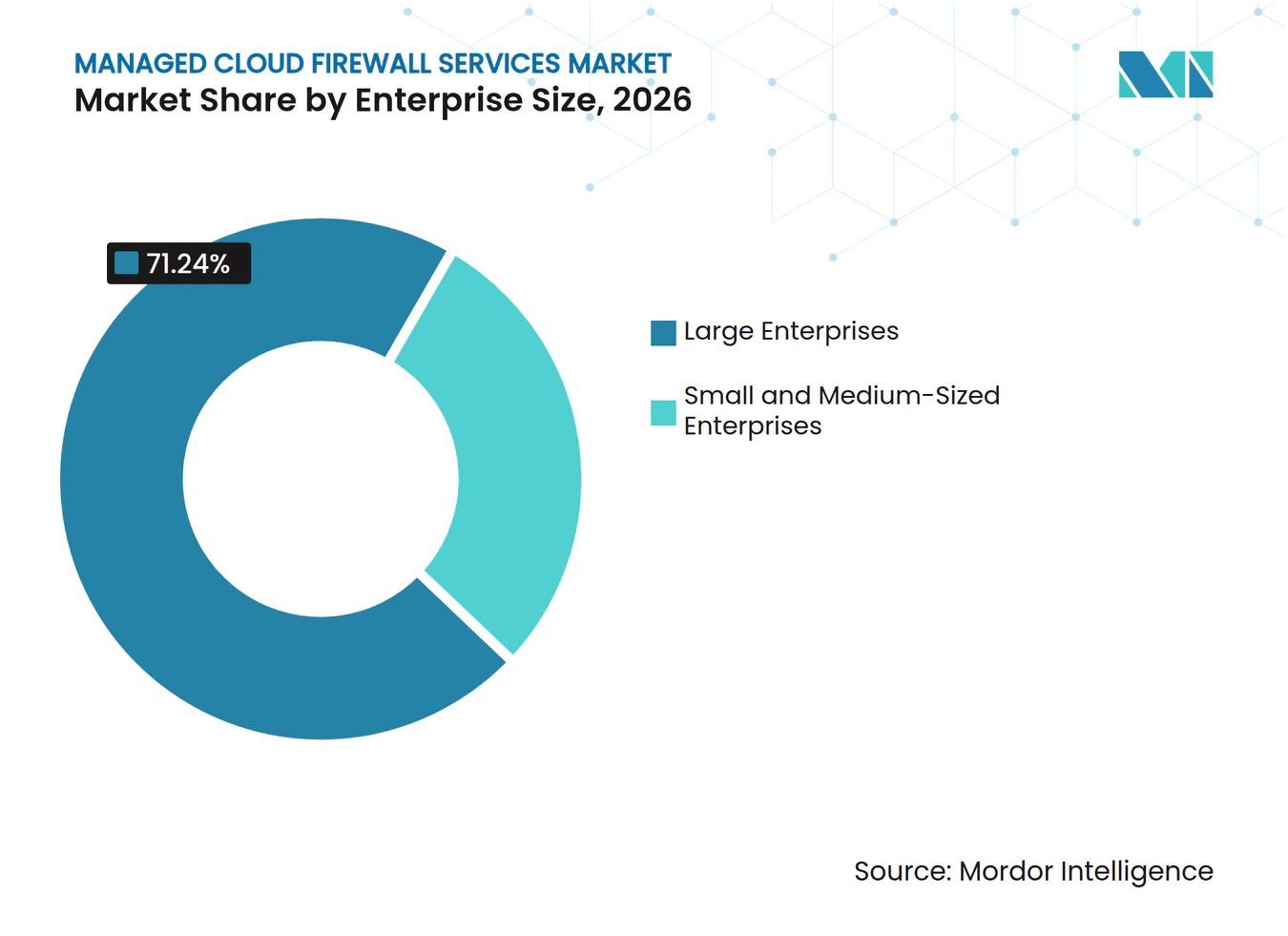
- By enterprise size, large enterprises accounted for 71.24% of the managed cloud firewall services market share in 2026, while small and medium-sized enterprises are projected to grow at a 16.36% CAGR through 2032.
- By end-user industry, banking, financial services, and insurance held 28.76% of the managed cloud firewall services market share in 2026, while government and public administration are projected to expand at a 15.06% CAGR through 2032.
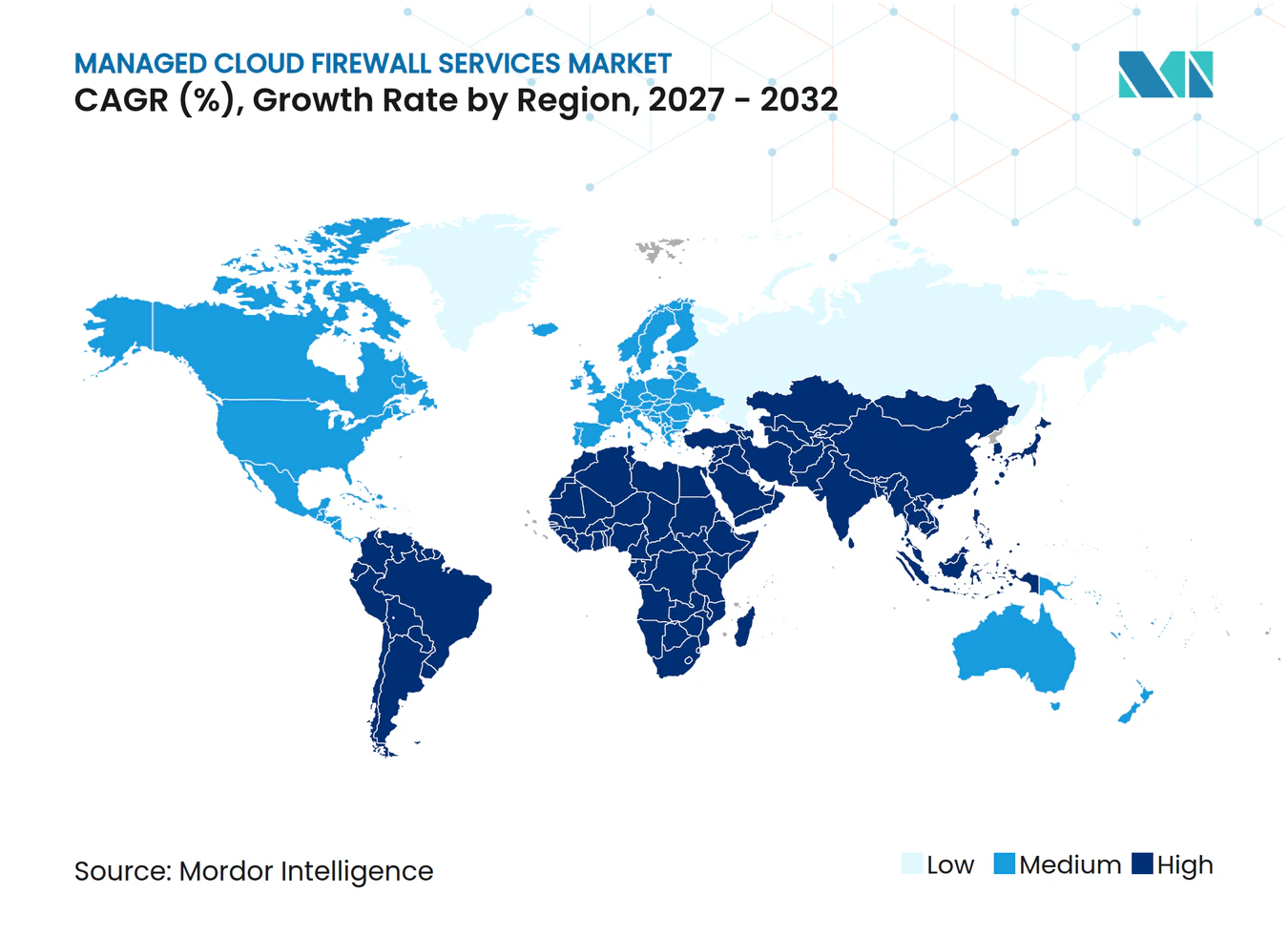
- By geography, North America accounted for 35.23% of the managed cloud firewall services market share in 2026, while Asia-Pacific is projected to grow at a 15.33% CAGR through 2032.
Note: Market numbers in this report are based on Mordor Intelligence's proprietary estimation framework, which combines nine months of actuals with Q4 projections for base year 2026.
Market Trends and Insights
Drivers Impact Analysis of Managed Cloud Firewall Services Market*
| Driver | (~) % Impact on CAGR Forecast | Geographic Relevance | Impact Timeline |
|---|---|---|---|
| Rising Cloud-Borne Breach and Ransomware Exposure | +3.2% | Global | Short term (≤ 2 years) |
| Zero-Trust and SASE Architecture Adoption | +2.8% | North America and Europe, spillover to Asia-Pacific | Medium term (2-4 years) |
| Multi-Cloud and SaaS Expansion | +2.5% | Global | Medium term (2-4 years) |
| Distributed Workforce and Identity-Centric Access | +2.0% | Global, with early gains in North America, Western Europe, and Southeast Asia | Short term (≤ 2 years) |
| Security Skills Shortages and Managed Operations Demand | +1.6% | Global | Long term (≥ 4 years) |
| Sovereign Cloud and Data Residency Requirements | +1.2% | Europe, Middle East, and Asia-Pacific core | Medium term (2-4 years) |
| Source: Mordor Intelligence | |||
Rising Cloud-Borne Breach and Ransomware Exposure
Cloud-targeted attacks are changing how organizations buy managed cloud firewall services, as security leaders must protect workloads, users, data, suppliers, and applications that no longer sit behind a single perimeter. The global average data breach cost reached USD 4.99 million in 2026, up 12% from the prior year, as AI-enabled malware and deepfake impersonation increased the challenge of monitoring cloud workloads and validating security events. Ransomware appeared in 48% of confirmed breaches, while third-party involvement increased 60% and accounted for nearly half of incidents, increasing the need to apply controls across supplier and cloud-service connections. These conditions make unmanaged traffic between virtual workloads a material exposure because conventional perimeter tools do not consistently inspect activity that moves within virtual networks or between cloud services. Organizations with extensive AI-supported security operations spent USD 1.83 million less on breach remediation on average, which supports the case for managed services that pair policy enforcement, continuous monitoring, and automated response.[1] Providers that can detect and contain threats across cloud estates can make their service relevant to security teams as well as business leaders responsible for incident costs, operational continuity, and regulatory reporting.
Zero-Trust and SASE Architecture Adoption
Zero-trust architecture is shifting firewall policy from a network-location decision to one based on identity, device posture, application context, and the risk associated with a particular connection. The managed cloud firewall services market benefits when enterprises place firewall capabilities within a SASE stack rather than buy isolated appliances that are managed through separate consoles. A SASE design can join firewall controls with secure web gateways, zero-trust network access, and cloud access security functions under one management model that can serve branches, remote users, and cloud applications. This approach reduces the number of disconnected control points that a security team must operate while making it easier to apply common policy across different types of access. It also gives managed providers a way to deliver policy management, monitoring, and threat response as ongoing services instead of a one-time deployment project. The result is stronger competition for platform consolidation budgets, particularly where buyers want a single provider to oversee network and security operations and support a consistent user experience.
Multi-Cloud and SaaS Expansion
Multi-cloud environments widen the number of places where firewall policy must be defined, reviewed, and enforced, often across separate teams with different operational responsibilities. The managed cloud firewall services market addresses this issue by applying specialized expertise across Amazon Web Services, Microsoft Azure, Google Cloud, and software-as-a-service traffic flows from a managed service operating model. Most internal teams cannot easily maintain consistent rules across these environments because each platform uses different management tools, traffic paths, deployment methods, and native security controls. Cloud-bound software traffic also needs inspection close to the application rather than being routed back through a central data center, which can add delays and create unnecessary network complexity. A provider with a single cloud control plane can provide customers with more consistent identity-based controls across workload and user traffic while maintaining clearer operational ownership. This need becomes more important as cloud architecture choices influence security operations, networking design, compliance responsibilities, application performance, and the speed at which new services can be deployed.
Distributed Workforce and Identity-Centric Access
Hybrid work has weakened the fixed network boundary that traditional firewall designs were built to protect, especially when employees, contractors, and operational teams use cloud applications from different locations. Security teams must now oversee employee-owned devices, contractor endpoints, and connected operational devices across different geographies, connection types, and levels of device management. Netskope expanded its Universal ZTNA offering in October 2025 to apply per-session access control to Internet of Things and operational technology devices through a 5G Netskope One Gateway. The change shows that managed access controls must cover more than standard enterprise laptops and mobile devices, including equipment that may have very different connectivity and security requirements. The 2025 ISC2 study found that 95% of cybersecurity professionals reported at least 1 skills gap, with 59% identifying critical or significant gaps. The shortage supports demand for providers capable of operating identity-aware security controls continuously for organizations that cannot build every specialist capability internally or sustain 24-hour coverage across their own teams.
Restraints Impact Analysis of Managed Cloud Firewall Services Market*
| Restraint | (~) % Impact on CAGR Forecast | Geographic Relevance | Impact Timeline |
|---|---|---|---|
| Legacy Appliance and Policy Integration Complexity | -2.5% | Global, most acute in North America and Western Europe | Short term (≤ 2 years) |
| Public Cloud Egress and Inspection Cost Escalation | -2.0% | Global, highest in Asia-Pacific and South America | Medium term (2-4 years) |
| Latency and Data Sovereignty Constraints | -1.5% | Europe, Middle East, and Asia-Pacific core | Long term (≥ 4 years) |
| Vendor Platform Consolidation and Switching Fatigue | -1.1% | Global | Medium term (2-4 years) |
| Source: Mordor Intelligence | |||
Legacy Appliance and Policy Integration Complexity
Legacy policy migration remains a practical barrier for buyers entering the managed cloud firewall services market, as many organizations must modernize their existing controls while keeping critical applications and customer services available. Large organizations often have firewall rule bases built over many years, and these can contain tens of thousands of entries shaped by past application needs, temporary exceptions, and changes in network design. Converting those rules into cloud-native policies without disrupting applications requires specialized tools, parallel testing, sustained engineering effort, and close coordination among security, infrastructure, and application teams. The task becomes harder where several vendors are already in use because their policy languages, administration workflows, and logging practices do not align. The European Commission's NIS2 Implementing Regulation requires certain organizations to meet cybersecurity risk-management requirements, which can increase the documentation burden during a migration. This complexity can extend sales cycles even when a managed model offers a favorable long-term cost position and a more practical way to maintain policy hygiene after migration.
Public Cloud Egress and Inspection Cost Escalation
Cloud inspection costs can constrain adoption when customer traffic must pass through hosted enforcement points, particularly when traffic volumes rise across applications, users, and virtual workloads. Mirroring or tunneling virtual private cloud traffic for inspection can lead to rising data transfer charges for a service provider and its customer, affecting both delivery costs and the value proposition presented to buyers. Providers may respond by fully inspecting only higher-risk traffic, but that approach can leave gaps in visibility, reduce the consistency of policy coverage, and complicate security reporting. The issue is particularly relevant to small and medium-sized buyers because their security budgets limit how much traffic can be inspected without affecting other technology priorities. Regions with less mature cloud infrastructure can face higher effective inspection costs, including parts of South America, Africa, and Southeast Asia, where local cloud capacity may be less extensive. Providers that reduce egress exposure through their architecture or commercial arrangements can protect service margins and offer a more competitive operating model as customers expect broader and deeper inspection.
*Our forecasts treat driver/restraint impacts as directional, not additive. The impact forecasts reflect baseline growth, mix effects, and variable interactions.
Managed Cloud Firewall Services Market Segment Analysis
By Service Model:
Co-Managed Delivery Broadens Provider RelationshipsFully managed cloud firewall services held 66.49% of the managed cloud firewall services market share in 2026, establishing the model as the preferred arrangement for enterprises without an in-house network security operations capability. The leading position reflects the operational choice made by organizations that need continuous protection but do not maintain a 24-hour cloud firewall team. For many mid-sized buyers, recruiting, training, and retaining that internal team can cost more than using a managed contract. Fully managed delivery combines monitoring, policy administration, threat response, and compliance reporting under one service relationship. This gives customers a single provider responsible for routine execution, while internal technology teams focus on applications, cloud migration, and broader business priorities.
Co-managed cloud firewall services are projected to grow at a 16.70% CAGR from 2027 to 2032, making this the fastest-growing service model within the managed cloud firewall services market. The model allows customers to retain ownership of core policies while the provider handles monitoring, response, and reporting. This structure meets the needs of regulated buyers that must retain a documented role in policy decisions and audit trails. Cisco introduced multi-customer management capabilities for Security Cloud Control in November 2025, enabling managed service providers to centrally oversee Hybrid Mesh Firewall deployments across customer organizations from a single AI-powered control plane.[2] The capability supports providers serving many organizations while giving each customer a clearer role in controls that affect its own network and cloud operations.


By Function:
Monitoring Creates Entry Points While Response Drives GrowthMonitoring and alerting accounted for 46.12% of the managed cloud firewall services market share in 2026, reflecting its role as a practical starting point for organizations moving into managed operations. It serves customers who need continuous visibility but are not yet ready to transfer all operational tasks to an outside provider. Monitoring gives providers an initial relationship and a detailed view of traffic patterns, policies, incidents, and operational workflows. It also lets buyers assess the provider's service quality and reporting before adding more sensitive functions. Policy management, administration, compliance, and reporting remain necessary as workloads move across cloud environments and firewall rules require regular review.
Incident response and threat investigation are projected to advance at a 15.75% CAGR from 2027 to 2032, driven by pressure to identify, investigate, and contain security events more quickly. Providers can build on a monitoring engagement by adding higher-value response, investigation, and compliance services as customer requirements mature. WatchGuard Technologies launched FireCloud Total Access in September 2025, combining monitoring, policy management, incident response, and reporting capabilities into a single cloud-managed platform. Bundled delivery can simplify purchasing for mid-sized organizations by reducing the need for separate evaluations of multiple security tools and service providers. It can also support longer customer relationships when functions are added over time rather than bought separately from disconnected suppliers.
By Deployment Mode:
Hybrid Architectures Remain ImportantPublic cloud accounted for 65.18% of the managed cloud firewall services market share in 2026, driven by the close fit between cloud-native firewall services and hyperscaler environments. Managed providers can use native cloud integrations to apply policy consistently across newly deployed workloads, user connections, and application traffic. Public cloud delivery also places inspection close to applications and users, reducing the need to route traffic through a central data center before action can be taken. This model suits organizations building new workloads directly in public cloud environments and seeking faster provisioning. It gives providers a clear basis for managing policies at scale through cloud control planes while supporting a more flexible operating model.
Hybrid cloud is projected to grow at a 16.02% CAGR from 2027 to 2032, as many large enterprises will retain on-premises systems alongside public cloud workloads for years. The managed cloud firewall services market, therefore, needs providers that can apply common rules across both environments without requiring customers to fully replace their existing infrastructure. The availability of Sovereign SASE from Versa Networks in February 2025 demonstrated that full SASE stacks, including managed firewall capabilities, can be deployed on customer-controlled on-premises or private cloud infrastructure. This approach supports regulated organizations that must keep selected workloads under tighter infrastructure control while still seeking cloud-delivered security functions. Private cloud remains relevant for government and financial services buyers, where data residency requirements limit public cloud-hosted inspection.
By Enterprise Size:
Small and Medium-Sized Enterprises Gain AccessLarge enterprises accounted for 71.24% of the managed cloud firewall services market share in 2026. Their larger cloud budgets, longer histories of firewall migrations, and multi-jurisdiction compliance requirements support this position. These organizations commonly operate across many applications, cloud accounts, and geographic locations, which increases the value of a managed policy framework. They also manage complex legacy estates that need specialist migration, monitoring, and response support during a move to cloud-native enforcement. Large enterprises can buy broad service bundles that include firewall enforcement, threat operations, compliance reporting, and support under established service-level agreements.
Small and medium-sized enterprises are projected to expand at a 16.36% CAGR from 2027 to 2032. Managed service provider-led co-managed models bring specialist security skills within reach of organizations that cannot support a large internal security team. Verizon reported that ransomware was involved in 88% of breach incidents affecting small businesses in its 2025 report, compared with 39% for larger organizations. This exposure increases the urgency of managed protection for smaller buyers who rely on cloud applications, online transactions, and distributed work. WatchGuard designed FireCloud Total Access for managed service providers, offering per-user, recurring licensing and deployment without hardware installation.

By End-User Industry:
BFSI Holds the Largest PositionBanking, financial services, and insurance held 28.76% of the managed cloud firewall services market share in 2026. The sector holds high-value financial and personal data and operates under demanding security and compliance obligations across multiple jurisdictions. Its cloud environments can span many applications, business units, and regions, making consistent policy management particularly difficult. Managed firewall services can provide continuous enforcement, response support, and an operating record for audit and reporting needs. The sector's exposure to financially motivated attackers also supports continuing investment in monitoring and incident response functions.
Government and public administration are projected to grow at a 15.06% CAGR from 2027 to 2032 as modernization programs and sovereign cloud requirements increase demand for managed protection around cloud-hosted critical systems. Healthcare and life sciences are gaining relevance as clinical and research environments shift toward cloud-based applications that require stronger security coverage. Energy and utilities need more controls as operational technology connects with cloud-managed information technology systems. Industrial manufacturers face related requirements as production networks and connected assets demand closer security oversight. Retail and e-commerce organizations use services to support cloud payment infrastructure and compliance duties, while IT and telecommunications companies act as both buyers and delivery channels through white-label programs.
Geography Analysis
North America Managed Cloud Firewall Services Market
North America held 35.23% of the managed cloud firewall services market share in 2026. The United States benefits from a high concentration of hyperscaler infrastructure, cloud-native enterprises, federally mandated zero-trust architecture requirements, and federal compliance reporting that has sustained public-sector demand now moving into commercial managed cloud security architectures. Canada adds demand through financial institutions and federal organizations that are managing technology and cyber risk requirements in environments where cloud adoption must remain aligned with governance and operating expectations. A mature managed security provider channel, established service-level agreements, broad cloud availability, and lower data-sovereignty complexity than in many European markets also support the region's position and provider delivery economics.
APAC Managed Cloud Firewall Services Market
Asia-Pacific is projected to grow at a 15.33% CAGR from 2027 to 2032, the highest regional rate in the managed cloud firewall services market. China, India, Japan, South Korea, and Southeast Asian economies are expanding digital infrastructure while strengthening cybersecurity requirements for enterprises, government entities, critical systems, and connected cloud services. Internet Initiative Japan launched IFMS Cloud in June 2026 for Japanese companies' overseas sites across 6 Asian countries, providing managed firewall operations and incident response from its Global Support Center in Malaysia. The service illustrates demand for managed offerings that connect existing on-premises policy estates with cloud-based security infrastructure, allowing companies to extend controls as they operate across more countries. Cloud application growth, financial-services digitization, regional cloud investment, and regulatory attention widen the provider opportunity across the region.
EMEA and South America Managed Cloud Firewall Services Market
Europe represents a material portion of the managed cloud firewall services market, with Germany and the United Kingdom among the major demand centers. Check Point Software Technologies announced in July 2026 that its Cloud Firewall was available on AWS European Sovereign Cloud, addressing European needs for operational autonomy and data residency.[3] The European Union's NIS2 rules strengthen the importance of documented cybersecurity risk-management measures for covered entities. Middle East and Africa demand is growing from government cloud programs and private-sector procurement, including activity linked to Saudi Arabia's Vision 2030 and the United Arab Emirates' cloud strategy, while South America remains earlier in adoption with Brazil and Argentina supported by financial-sector digitization and data protection compliance needs.
Competitive Landscape
Market Concentration
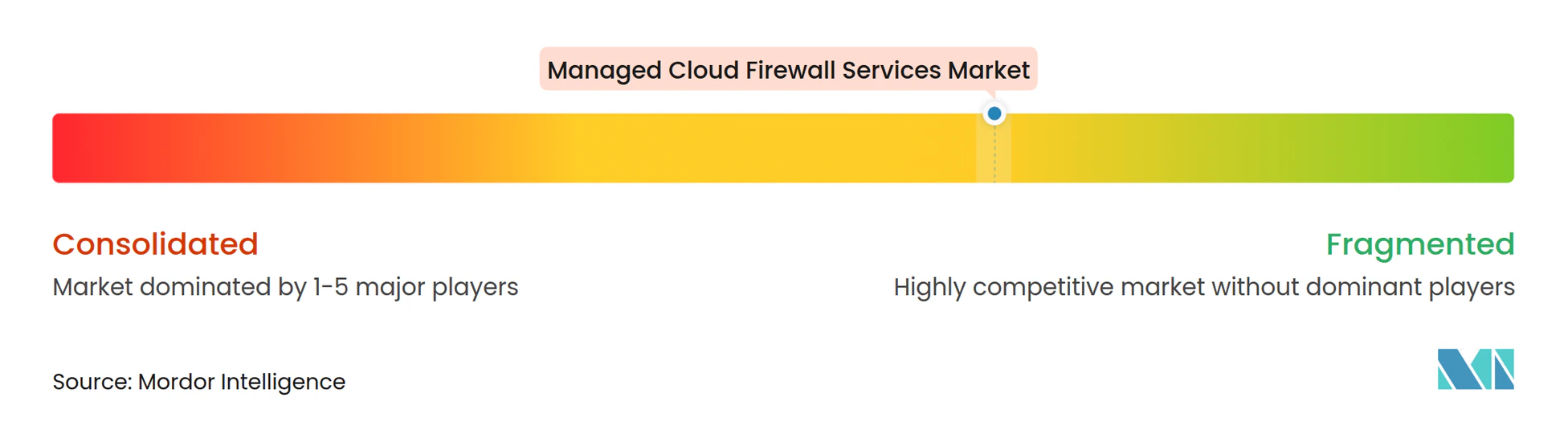
The managed cloud firewall services market is moderately concentrated among large cloud security vendors, SASE platform providers, and established network equipment manufacturers. A broad tier of regional managed security providers and telecommunications-linked firms competes through local delivery, price, existing customer relationships, and the ability to meet country-level operating and compliance needs. Leading suppliers increasingly combine firewall services with secure access, network controls, and security operations rather than sell a standalone firewall offer. This approach broadens the scope of each customer relationship, supports multiyear subscriptions, and encourages vendors to position firewall management as part of an integrated security service. Providers use artificial intelligence-supported threat detection, automated policy orchestration, and managed service provider licensing to differentiate delivery, help partners resell services at a margin, and reduce the operational effort required to support distributed customer environments.
Atos and Fortinet expanded their partnership in October 2026, moving from country-led work to a globally coordinated arrangement that covers resale and managed cybersecurity services. The partnership combines Fortinet's secure networking, unified SASE, and AI-driven security operations with Atos' 17 security operations centers, which process more than 31 billion security events each day. The arrangement shows how vendors are seeking delivery scale through strategic partnerships rather than separate country-level structures, particularly where customers expect a consistent service model across several regions. Palo Alto Networks announced partnerships with Nokia, U Mobile, Aeris, and Celerway in March 2026 to place Security-as-a-Service in carrier-grade 5G environments.[4] These relationships create a route to market via telecommunications infrastructure and extend managed cloud security to edge and mobile network deployments, where traditional enterprise boundaries are less relevant.
Sovereign cloud environments for regulated sectors outside Western markets present an opportunity for providers capable of meeting local data-residency requirements without forcing customers to forgo the broader benefits of cloud-delivered operations. The sub-1,000-employee segment remains open to providers with simpler pricing, managed service provider-led delivery, and offerings that do not require a major hardware investment or a large internal security team. Automated translation of legacy firewall rules into cloud-native policies is a key differentiator because implementation speed can determine whether a customer completes a migration without avoidable operational disruption. Versa Networks reported a 99.91% security effectiveness in a 2026 cloud firewall evaluation, along with the highest tested throughput. Performance evidence helps specialized providers challenge larger incumbents for quality-sensitive deployments, while regional providers retain an advantage in local compliance, language, and operating needs.
Managed Cloud Firewall Services Industry Leaders
-
Palo Alto Networks, Inc.
-
Fortinet, Inc.
-
Trend Micro Incorporated
-
Sophos Limited
-
Check Point Software Technologies Ltd.
- *Disclaimer: Major Players sorted in no particular order
Managed Cloud Firewall Services Market Companies Covered in this Report
- Palo Alto Networks, Inc.
- Zscaler, Inc.
- Fortinet, Inc.
- Cloudflare, Inc.
- Check Point Software Technologies Ltd.
- Cisco Systems, Inc.
- Barracuda Networks, Inc.
- Cato Networks Ltd.
- Netskope, Inc.
- Versa Networks, Inc.
- Sophos Limited
- WatchGuard Technologies, Inc.
- SonicWall, Inc.
- Forcepoint LLC
- Juniper Networks, Inc.
- Hillstone Networks Co., Ltd.
- Trend Micro Incorporated
- Akamai Technologies, Inc.
- Radware Ltd.
- Imperva, Inc.
Recent Industry Developments in Managed Cloud Firewall Services Market
- October 2026: Atos and Fortinet expanded their partnership from a country-led to a globally coordinated engagement, covering worldwide reselling and managed cybersecurity services, and aligning joint business development, service delivery, and commercial terms across SASE architecture, Zero Trust, cloud security, and SOC services. Atos processes more than 31 billion security events per day across 17 SOCs, adding substantial managed delivery scale to Fortinet's security fabric.
- October 2026: Versa Networks announced Versa Inbound SSE, a cloud-delivered security capability protecting internet-facing applications and APIs by inspecting inbound traffic within the Versa SSE platform before it reaches the application environment, extending managed coverage from outbound to inbound application security.
- September 2026: Versa Networks earned a Recommended rating with 99.91% security effectiveness and the highest throughput in the NSS Labs Q3 2026 Cloud Network Firewall evaluation, achieving the second-lowest price per Mbps among all evaluated products.
- July 2026: Check Point Software Technologies announced the availability of its Cloud Firewall on the AWS European Sovereign Cloud, enabling European organizations to meet EU operational autonomy and data-residency requirements while maintaining AI-powered prevention-first security across network, workload, and application layers.
Global Managed Cloud Firewall Services Market Report Scope
The Managed Cloud Firewall Services Market comprises outsourced services that monitor, administer, optimize, govern, and secure cloud-based firewall environments deployed across public, private, and hybrid cloud infrastructures. These services include firewall monitoring and alerting, policy management and administration, incident response and threat investigation, compliance reporting, firewall lifecycle management, and continuous operational support. The market includes managed service contracts, consulting, implementation, integration, maintenance, support, and operational services associated with cloud firewall management.
The Managed Cloud Firewall Services Market Report is Segmented by Service Model (Fully Managed Cloud Firewall Services, and Co-Managed Cloud Firewall Services), Function (Monitoring and Alerting Services, Policy Management and Administration Services, Incident Response and Threat Investigation Services, and Compliance and Reporting Services), Deployment Mode (Public Cloud, Private Cloud, and Hybrid Cloud), Enterprise Size (Large Enterprises, and Small and Medium-Sized Enterprises), End-User Industry (Banking, Financial Services, and Insurance [BFSI], Government and Public Administration, Healthcare and Life Sciences, IT and Telecommunication, Industrial Manufacturing, Retail and E-commerce, Energy and Utilities, and Other End-User Industries), and Geography (North America, South America, Europe, Asia-Pacific, Middle East, and Africa). The Market Forecasts are Provided in Terms of Value (USD).
Segmentation Overview
| Fully Managed Cloud Firewall Services |
| Co-Managed Cloud Firewall Services |
| Monitoring and Alerting |
| Policy Management and Administration |
| Incident Response and Threat Investigation |
| Compliance and Reporting |
| Public Cloud |
| Private Cloud |
| Hybrid Cloud |
| Large Enterprises |
| Small and Medium-Sized Enterprises |
| Banking, Financial Services, and Insurance (BFSI) |
| Government and Public Administration |
| Healthcare and Life Sciences |
| IT and Telecommunication |
| Industrial Manufacturing |
| Retail and E-commerce |
| Energy and Utilities |
| Other End-User Industries |
| North America | United States |
| Canada | |
| Mexico | |
| South America | Brazil |
| Argentina | |
| Rest of South America | |
| Europe | Germany |
| United Kingdom | |
| France | |
| Italy | |
| Russia | |
| Rest of Europe | |
| Asia-Pacific | China |
| Japan | |
| India | |
| South Korea | |
| Rest of Asia-Pacific | |
| Middle East | Saudi Arabia |
| United Arab Emirates | |
| Rest of Middle East | |
| Africa | South Africa |
| Nigeria | |
| Rest of Africa |
| By Service Model | Fully Managed Cloud Firewall Services | |
| Co-Managed Cloud Firewall Services | ||
| By Function | Monitoring and Alerting | |
| Policy Management and Administration | ||
| Incident Response and Threat Investigation | ||
| Compliance and Reporting | ||
| By Deployment Mode | Public Cloud | |
| Private Cloud | ||
| Hybrid Cloud | ||
| By Enterprise Size | Large Enterprises | |
| Small and Medium-Sized Enterprises | ||
| By End-User Industry | Banking, Financial Services, and Insurance (BFSI) | |
| Government and Public Administration | ||
| Healthcare and Life Sciences | ||
| IT and Telecommunication | ||
| Industrial Manufacturing | ||
| Retail and E-commerce | ||
| Energy and Utilities | ||
| Other End-User Industries | ||
| By Geography | North America | United States |
| Canada | ||
| Mexico | ||
| South America | Brazil | |
| Argentina | ||
| Rest of South America | ||
| Europe | Germany | |
| United Kingdom | ||
| France | ||
| Italy | ||
| Russia | ||
| Rest of Europe | ||
| Asia-Pacific | China | |
| Japan | ||
| India | ||
| South Korea | ||
| Rest of Asia-Pacific | ||
| Middle East | Saudi Arabia | |
| United Arab Emirates | ||
| Rest of Middle East | ||
| Africa | South Africa | |
| Nigeria | ||
| Rest of Africa | ||
Key Questions Answered in the Report
What is the managed cloud firewall services market size?
The managed cloud firewall services market size is USD 5.02 billion in 2026 and is forecast to reach USD 11.43 billion by 2032, at a 14.75% CAGR from 2027 to 2032.
What is driving demand for managed cloud firewall services?
Demand is supported by cloud-borne breach exposure, multi-cloud policy complexity, distributed work, and shortages in cybersecurity skills.
Which service model has the largest share?
Fully managed cloud firewall services lead with a 66.49% share in 2026, while co-managed services are projected to grow faster at a 16.70% CAGR through 2032.
Which deployment approach is expanding fastest?
Hybrid cloud is projected to expand at a 16.02% CAGR through 2032 as enterprises retain on-premises systems alongside public-cloud workloads.
Which customer group is growing fastest?
Small and medium-sized enterprises are projected to grow at a 16.36% CAGR through 2032, supported by managed service provider-led delivery models.
Which region has the fastest projected growth?
Asia-Pacific is projected to grow at a 15.33% CAGR through 2032, supported by cloud adoption and cybersecurity requirements across major regional economies.