
Managed Firewall and UTM Services Market Size and Share
Market Overview
| Study Period | 2021 - 2032 |
|---|---|
| Market Size (2027) | USD 10.16 Billion |
| Market Size (2032) | USD 17.21 Billion |
| Growth Rate (2027 - 2032) | 11.12 % |
| Fastest Growing Market | Asia-Pacific |
| Largest Market | North America |
| Market Concentration | Medium |
Major Players *Disclaimer: Major Players sorted in no particular order Image © Mordor Intelligence. Reuse requires attribution under CC BY 4.0. | |
Managed Firewall and UTM Services Market Analysis by Mordor Intelligence
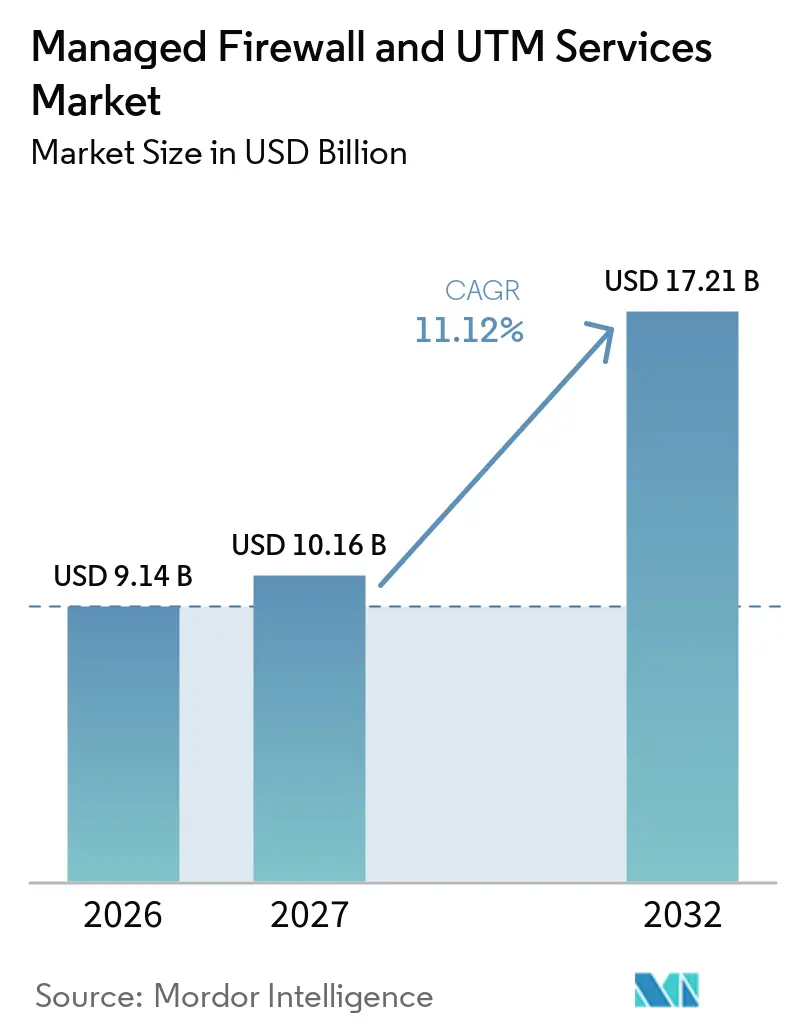
The managed firewall and UTM services market size is USD 9.14 billion in 2026 and is projected to reach USD 17.21 billion by 2032, expanding at a CAGR of 11.12% during 2027-2032. The managed firewall and UTM services market is benefiting from a move away from internally operated firewalls toward contracted services that provide continuous policy management, threat response, and compliance reporting. Enterprises operating hybrid environments need consistent controls across data centers, cloud workloads, remote users, and branch locations. Regulatory obligations in financial services, healthcare, and critical infrastructure are also making documented monitoring and review processes more important in purchasing decisions. Providers that combine network security expertise with clear service-level commitments are better placed to secure long-term contracts. Competition is pushing vendors to widen their service portfolios through platform integration, partnerships, and acquisitions.
Key Report Takeaways
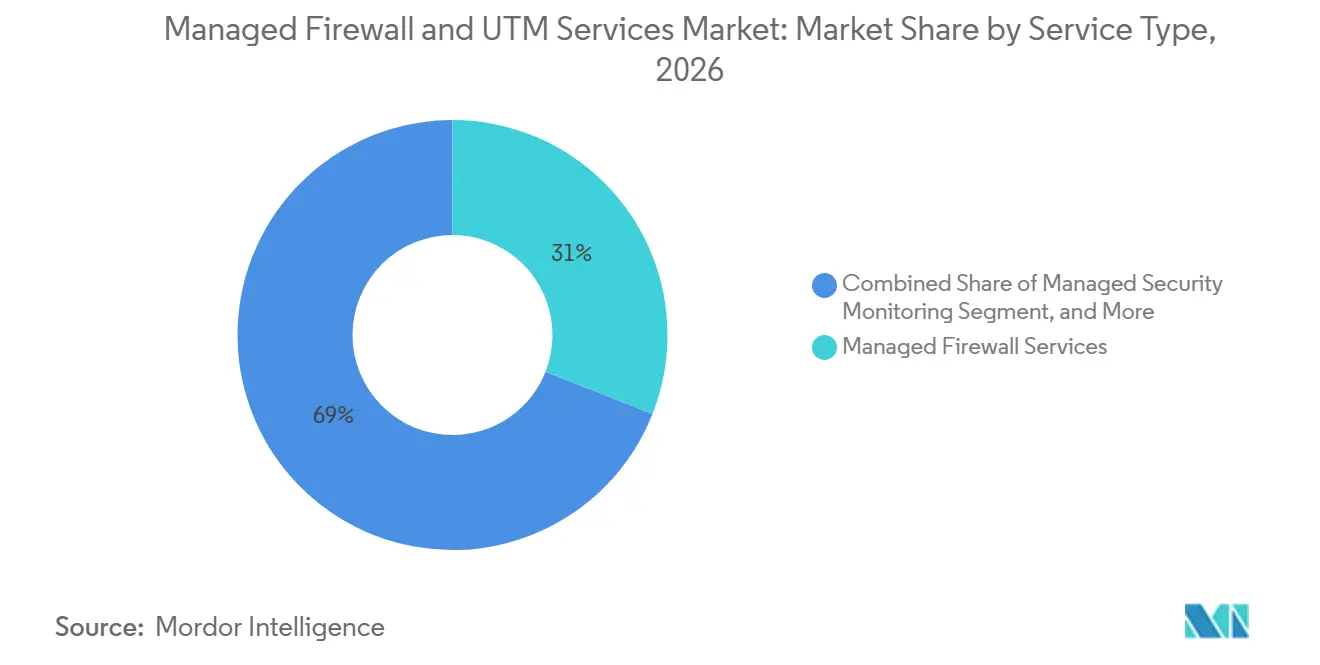
- By service type, Managed Firewall Services held 30.98% of the managed firewall and UTM services market share in 2026, while Managed SASE and Security Service Edge are projected to expand at an 11.46% CAGR through 2032.
- By delivery model, Fully Managed Services held 57.66% share in 2026, while Self-Managed and Partner-Assisted Services are projected to expand at an 11.63% CAGR through 2032.
- By deployment, On-Premises held 40.27% share in 2026, while Cloud-Based deployment is projected to expand at an 11.38% CAGR through 2032.
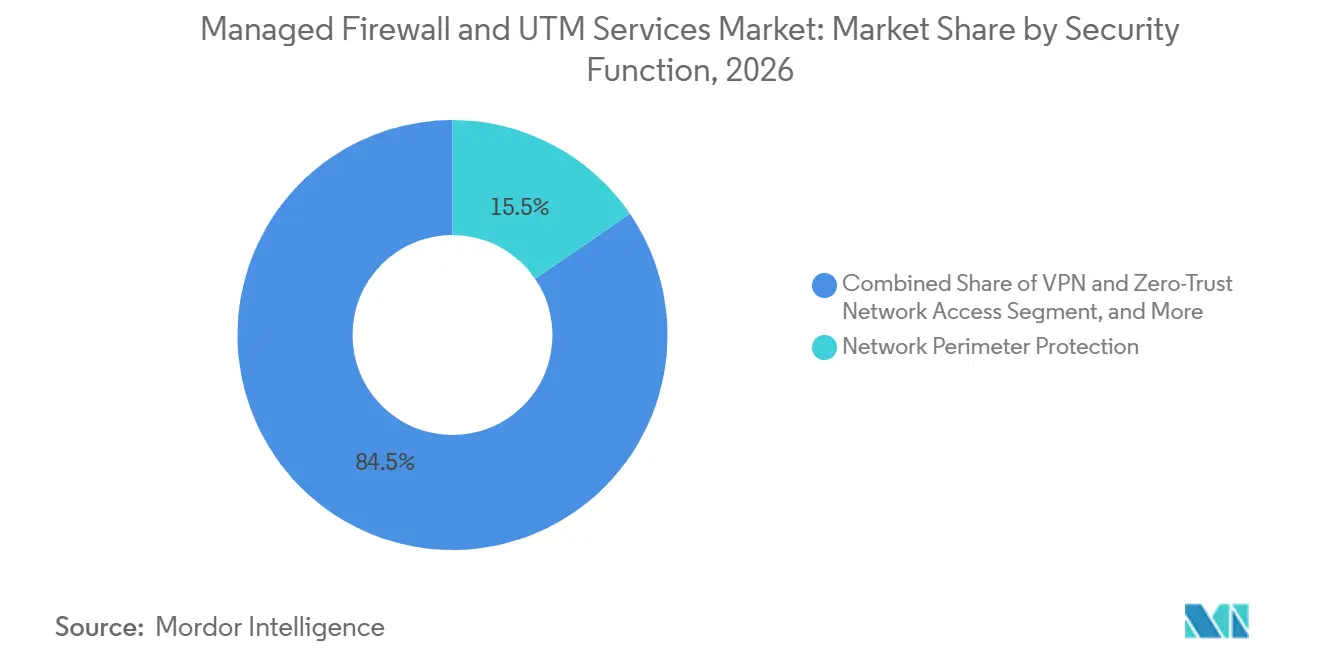
- By security function, Network Perimeter Protection held 15.47% share in 2026, while VPN and Zero-Trust Network Access are projected to expand at an 11.42% CAGR through 2032.
- By end user, BFSI held 23.42% share in 2026, while Healthcare and Life Sciences are projected to expand at an 11.58% CAGR through 2032.
- By geography, North America held 48.73% share in 2026, while Asia-Pacific is projected to expand at an 11.87% CAGR through 2032.
Note: Market numbers in this report are based on Mordor Intelligence's proprietary estimation framework, which combines nine months of actuals with Q4 projections for base year 2026.
Global Managed Firewall and UTM Services Market Trends and Insights
Drivers Impact Analysis*
| Driver | (~) % Impact on CAGR Forecast | Geographic Relevance | Impact Timeline |
|---|---|---|---|
| Escalating Ransomware, DDoS, and Supply-Chain Attacks | +2.80% | Global | Short term (≤ 2 years) |
| Regulatory and Cyber-Insurance Compliance Requirements | +2.30% | North America and EU | Medium term (2-4 years) |
| Cybersecurity Talent and 24/7 Operations Shortages | +2.00% | Global | Medium term (2-4 years) |
| Hybrid and Multi-Cloud Firewall Complexity | +1.80% | North America, Asia-Pacific, and EU | Medium term (2-4 years) |
| Security-Function Consolidation Through UTM and SASE | +1.30% | Global, with Asia-Pacific acceleration | Long term (≥ 4 years) |
| Multi-Tenant Cloud Management for Distributed SMEs | +1.00% | Asia-Pacific, Europe, and North America | Long term (≥ 4 years) |
| Source: Mordor Intelligence | |||
Escalating Ransomware, DDoS, and Supply-Chain Attacks Drive Outsourcing Demand
The threat environment requires organizations to handle multiple attack methods at the same time. Cloudflare mitigated 20.5 million DDoS attacks in the first quarter of 2025, up 358% from the prior-year quarter.[1] Radware reported that terabit-scale volumetric attacks regularly targeted major cloud and telecommunications providers in 2026. Cyble recorded 297 supply-chain attacks in 2025, a 93% year-on-year increase, as attackers targeted cloud integrations and trusted SaaS relationships. These attacks require continuous analysis of network, identity, and application signals. The managed firewall and UTM services market therefore benefits when organizations seek 24/7 operational coverage that internal teams cannot consistently provide.
Regulatory and Cyber-Insurance Compliance Requirements Sustain Structural Demand
Compliance requirements are becoming a lasting part of managed security procurement. The NIS2 framework has expanded network security obligations to essential and important entities across 18 sectors.[2] This broader scope increases the number of organizations that need documented security processes and repeatable control reviews. Managed providers can supply policy records, monitoring evidence, and incident-response support that simplify audit preparation. Cyber-insurance underwriting also makes demonstrable security coverage more important when organizations renew or seek new policies. The managed firewall and UTM services market gains from this shift because a contracted service can turn recurring technical tasks into a documented operating process.
Cybersecurity Talent and 24/7 Operations Shortages Redirect Security Budgets Toward MSSPs
A shortage of qualified security staff continues to redirect budgets toward external providers. ISC2 found that 59% of respondents reported critical or significant skills needs in 2025, compared with 44% in 2024. ISACA reported that 55% of security teams were understaffed and 65% had unfilled positions in 2025. Fortinet estimated a global cybersecurity workforce gap of 4.7 million professionals in 2025.[3] The staffing challenge is especially difficult for organizations that need round-the-clock monitoring rather than occasional support. The managed firewall and UTM services market benefits when organizations decide that retaining a specialist provider is more dependable than competing for a limited pool of personnel.
Hybrid and Multi-Cloud Firewall Complexity Creates Sustained Services Engagement
Multi-cloud use has made firewall policy management an ongoing service requirement rather than a single infrastructure decision. AlgoSec found that 67% of respondents struggled to integrate cloud-native security tools with their wider security stack in 2025. The same research found that 55% experienced performance overhead from multi-vendor firewall deployments. Cisco introduced intent-based policy management for Hybrid Mesh Firewall in January 2026 to support consistent enforcement across Cisco, Palo Alto Networks, Fortinet, and Juniper firewalls. This product direction reflects the operational difficulty of maintaining consistent policies across several control points. The managed firewall and UTM services market is supported by longer engagements when providers can establish policy governance across hybrid and multi-vendor environments.
Restraints Impact Analysis*
| Restraint | (~) % Impact on CAGR Forecast | Geographic Relevance | Impact Timeline |
|---|---|---|---|
| Outsourcing Control, Visibility, and Data-Residency Concerns | -1.90% | Global, acute in EU and Asia-Pacific | Medium term (2-4 years) |
| Migration Friction Across Legacy Firewalls and Multi-Vendor Estates | -1.50% | North America and EU | Short term (≤ 2 years) |
| Managed-Service Alert Noise and Accountability Gaps | -1.00% | Global | Medium term (2-4 years) |
| Budget Pressure and Preference for In-House Control | -0.80% | Asia-Pacific, South America, and Middle East and Africa | Long term (≥ 4 years) |
| Source: Mordor Intelligence | |||
Outsourcing Control, Visibility, and Data-Residency Concerns Constrain Full-Stack Handoff
Handing responsibility for perimeter controls to an external provider can create concerns about oversight, data location, and operational control. Firewall logs may contain IP addresses, which increases the importance of regional processing and data protection practices. ENISA found that 38% of demand-side organizations cited integration with existing environments as a major challenge in 2025. This was more than double the rate reported by suppliers. Buyers may therefore favor co-managed arrangements that retain approval rights for policy changes while outsourcing monitoring and response. This restraint limits immediate outsourcing decisions, but it also creates room for providers that offer transparent governance, regional delivery, and clear accountability.
Migration Friction Across Legacy Firewalls and Multi-Vendor Estates Delays Consolidation
Large organizations often operate firewall estates that span multiple vendors, generations, and policy formats. Replacing or outsourcing these environments can risk service disruption if policies are not carefully translated and tested. Cisco updated its Secure Firewall Migration Tool in June 2026 to support legacy ASA and FTD configurations alongside third-party firewalls from Check Point, Palo Alto Networks, and Fortinet. The update shows that migration remains a practical barrier even where consolidation has strategic support. Providers that can perform discovery, testing, and staged transitions can convert this obstacle into professional services revenue. The managed firewall and UTM services market may see slower initial deal cycles, while successful migrations can lead to deeper, longer-term customer relationships.
*Our forecasts treat driver/restraint impacts as directional, not additive. The impact forecasts reflect baseline growth, mix effects, and variable interactions.
Segment Analysis
By Service Type: Traditional Managed Firewall Anchors Revenue as SASE Redefines Growth
Managed Firewall Services held 30.98% market share in the managed firewall and UTM services market in 2026. Its leading position reflects long-standing hardware deployments and renewal cycles that continue to support contracted firewall management. Many enterprises that installed next-generation firewalls between 2019 and 2022 are entering refresh periods. These buyers can extend existing controls through managed upgrades instead of rebuilding internal teams. Managed UTM services appeal to mid-sized organizations that want consolidated policy administration within a single service. Managed IDS and IPS services remain important for critical infrastructure operators that require dedicated anomaly detection. Managed DDoS protection is also becoming more relevant as volumetric attacks affect telecommunications-dependent organizations. Together, these offerings allow providers to meet varying levels of operational maturity without forcing customers into a single delivery model.
Managed SASE and Security Service Edge are projected to expand at an 11.46% CAGR through 2032. The service combines network access and security controls in a cloud-delivered model, which is useful for organizations with remote users and distributed applications. Adoption requires detailed planning because legacy services, user access rules, and network policies must work together. This requirement creates consulting and implementation work before recurring managed revenue begins. Managed security operations and monitoring is also gaining importance within firewall agreements. Buyers increasingly prefer one provider that can observe alerts, investigate incidents, and report on policy compliance. The managed firewall and UTM services market is moving toward broader service packages because buyers want fewer operational handoffs. Providers that can link firewall administration with security operations can create stronger retention than firms offering a single technical function.

By Delivery Model: Full Outsourcing Dominates While Self-Managed Models Gain Momentum
Fully Managed Services commanded 57.66% share in 2026. Within the managed firewall and UTM services market, this delivery model places monitoring, policy updates, threat response, and compliance documentation with the service provider. It is particularly relevant for large BFSI organizations and public-sector institutions that must show consistent service-level performance. These buyers often have internal teams, but those teams may not have enough staff to run every control continuously. A fully managed contract gives the buyer a defined service boundary and a single provider accountable for operational work. Co-Managed Services serve organizations that retain a small security team but outsource selected technical activities. This model gives internal teams visibility while reducing the burden of daily rule management and alert handling. Standardized co-management portals may increase price competition where providers offer similar interfaces and operating procedures.
Self-Managed and Partner-Assisted Services are projected to expand at an 11.63% CAGR through 2032. In the managed firewall and UTM services market, the model suits mid-sized organizations that want to retain policy ownership while using external infrastructure, threat intelligence, and specialist support. Cisco added multi-customer management features to Security Cloud Control in November 2025, including role-based access controls, license allocation, and application programming interface support for automated provisioning. Such tools allow partners to manage several customer environments with clearer access boundaries. The approach can reduce the labor component of a managed engagement. It may also put pressure on providers that rely primarily on labor-intensive, fully managed contracts. The managed firewall and UTM services industry is therefore likely to contain both full outsourcing and shared-control models rather than one replacing the other.
By Deployment: On-Premises Holds Share as Cloud Migration Accelerates
On-Premises deployment held 40.27% share in 2026. Within the managed firewall and UTM services market, regulated industries and critical infrastructure operators often require local enforcement because of data residency, latency, operational technology, or security-clearance constraints. Government, defense, manufacturing, and energy environments can also have longer approval cycles for infrastructure changes. These conditions preserve the need for provider-managed hardware even as cloud deployments expand. On-premises customers need support for appliance refreshes, rule reviews, incident response, and configuration changes. Hybrid deployment provides a bridge by combining local enforcement with cloud-based policy management and threat intelligence. That model offers a gradual path for organizations that cannot migrate every workload at once. It also requires providers to maintain policy consistency across physical and cloud controls.
Cloud-Based deployment is projected to expand at an 11.38% CAGR through 2032. AlgoSec found that 56% of enterprise applications operated across multi-cloud environments in 2025. Cloud-based controls can follow workloads across regions and support faster updates than static perimeter appliances. However, cloud migration does not remove the need for governance, testing, and logging. Providers must manage policy differences across cloud platforms and existing data-center infrastructure. The managed firewall and UTM services market size for cloud-based delivery is supported by workload migration, but service quality depends on maintaining consistent visibility across the full environment. Buyers also need a practical approach for integrating cloud policy with remaining on-premises controls.
By Security Function: Perimeter Defense Leads as Zero-Trust Adoption Reshapes Priorities
Network Perimeter Protection held 15.47% share in 2026. Across the managed firewall and UTM services market, stateful packet inspection, access-control enforcement, and traffic filtering remain the base controls for managed security engagements. Intrusion prevention and threat prevention extend this foundation by identifying suspicious activity before it affects applications or users. Web, email, and content security are also relevant because employees and external users reach business systems through several channels. Application control and secure remote access become more important when organizations must distinguish approved tools from unmanaged services. Fortinet introduced AI-aware application control and Model Context Protocol visibility in FortiOS 8.0 in March 2026. This reflects a need to manage emerging application use without reducing core perimeter protection. Providers that combine these functions can give customers more consistent security policies across network traffic and applications.
VPN and Zero-Trust Network Access are projected to expand at an 11.42% CAGR through 2032. Netskope reported that 56% of organizations experienced a VPN-related security incident in the prior year, while 26% had deployed ZTNA and 37% planned implementation within 12 months in 2025. The data indicates a move from broad network access toward more controlled access based on users, devices, and applications. This is a substitution of older remote-access practices, not simply another layer added to existing tools. Security monitoring, reporting, and compliance functions continue to support this transition by recording access decisions and responding to alerts. The managed firewall and UTM services market is being shaped by providers that can support both established VPN environments and staged zero-trust deployments. Clear migration plans are important because organizations cannot interrupt employee or partner access during a change. This segment also requires strong identity integration, since access policy is increasingly linked to verified users and devices.
By End User: BFSI Commands the Largest Spend While Healthcare Leads Growth
BFSI held 23.42% share in 2026. In the managed firewall and UTM services market, financial institutions face a dense set of security obligations, including requirements tied to payment data, customer information, internal controls, and operational resilience. These requirements make continuous monitoring and reliable records important parts of a managed contract. Thomas Murray recorded 65 ransomware incidents involving the finance sector in the first quarter of 2026, up 76% from the first quarter of 2025. The sector needs services that can respond quickly without weakening change controls. Government and defense also remain important customers because national frameworks and procurement practices favor long-term service arrangements. Manufacturing organizations are adding demand as information technology and operational technology networks become more connected. A provider's ability to work with strict audit, access, and escalation requirements matters as much as firewall technology in these accounts.
Healthcare and Life Sciences are projected to expand at an 11.58% CAGR through 2032. Providers in this vertical must protect patient information, clinical systems, connected devices, and third-party applications. The operational environment leaves little room for extended service outages or poorly tested security changes. Managed firewall providers can support segmentation, encrypted connections, vulnerability review, and incident response within a defined service model. The need is not limited to large hospital systems because smaller practices and specialized research organizations also operate sensitive digital records. Retail and e-commerce organizations add demand as online transactions, payment systems, and customer-facing applications increase their exposure to cyber threats. IT and telecommunications buyers need protections that can scale with high traffic volumes and distributed infrastructure. The managed firewall and UTM services market has a wider buyer base when providers package controls for the operating conditions of each vertical instead of applying the same service design to every customer.
Geography Analysis
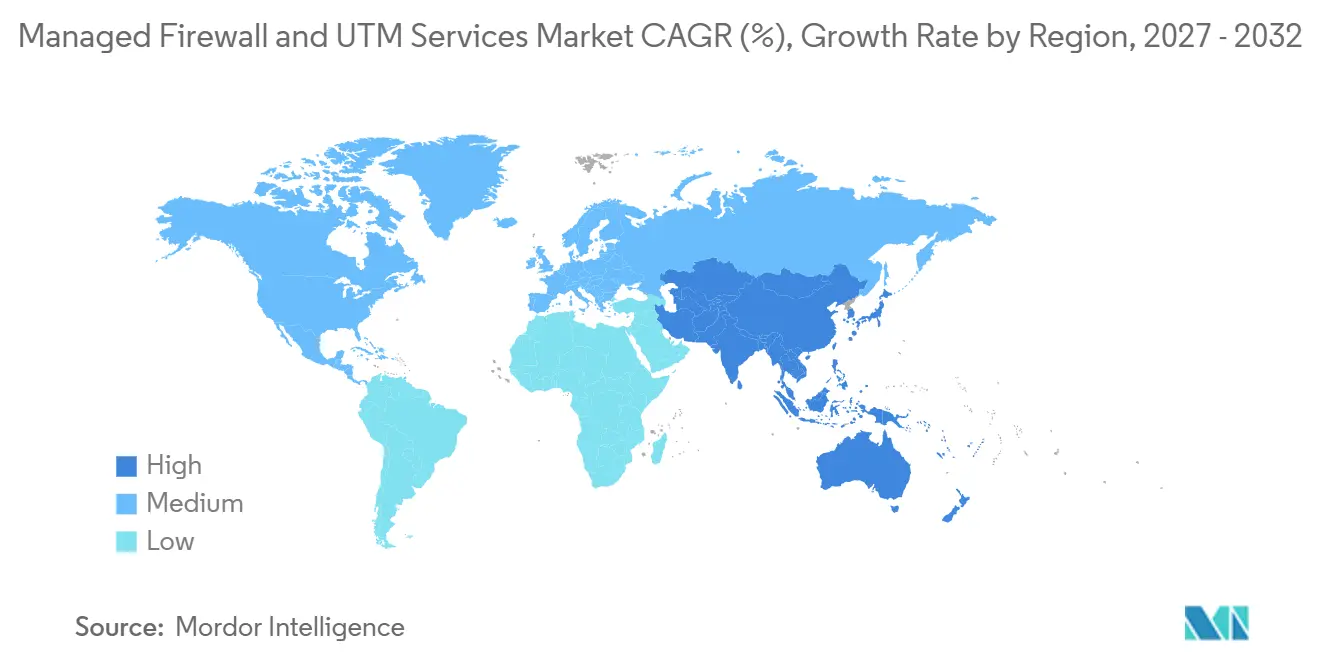
North America held 48.73% of the managed firewall and UTM services market share in 2026. The region combines mature cloud adoption with a concentrated base of large enterprises, federal buyers, and managed security providers. The United States supports demand through security obligations in financial services, healthcare, payment processing, and government operations. Thomas Murray recorded a 76% increase in ransomware incidents in the finance sector in the first quarter of 2026 compared with the first quarter of 2025. This environment makes continuous monitoring and response a practical requirement for regulated organizations. Canada adds demand through privacy obligations and enterprise modernization, while Mexico benefits from near-shoring investment that expands the security buyer base.
Europe holds a strategically important position because network security obligations now cover more organizations across essential sectors. NIS2 applies to 18 sectors, increasing demand for documented processes and reliable provider support. Regional data-processing expectations make local delivery capacity and transparent governance important selection factors. Germany is an important demand center because enterprises are adopting software-defined networking and SASE capabilities alongside established perimeter controls. France, the United Kingdom, and Italy provide further demand from large organizations and regulated service sectors. South America is led by Brazil and Argentina, where financial services digitalization and privacy obligations are increasing interest in managed security services.
Asia-Pacific is projected to expand at an 11.87% CAGR through 2032. Japan's Ministry of Internal Affairs and Communications reported that the country's information security market reached JPY 743.4 billion (USD 5 billion) in FY2025, an increase of 13.8%. Regional demand reflects digital transformation, persistent talent gaps, and increasing attention to state-sponsored threats. India and China are major volume markets, while Australia, Malaysia, Singapore, and Japan are important locations for regional provider expansion. The Middle East and Africa demand is supported by government and energy-sector investment, particularly in the Gulf Cooperation Council. The managed firewall and UTM services market benefits where providers can combine regional operations, local data handling, and support for complex hybrid environments.
Competitive Landscape
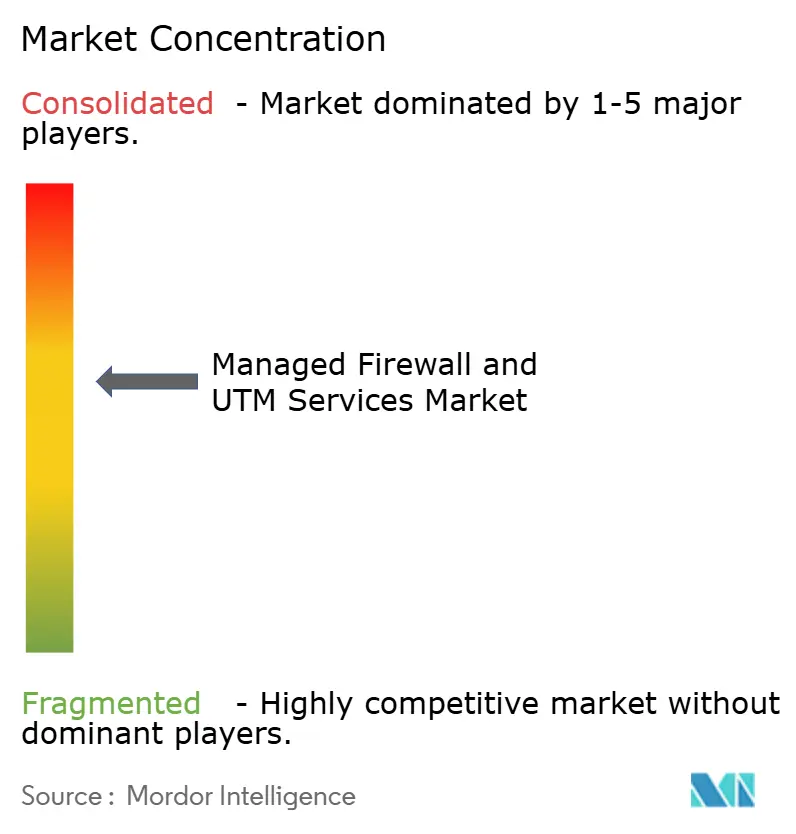
The managed firewall and UTM services market is moderately concentrated across global cybersecurity platform vendors, telecommunications-led managed security service providers, and cloud-native specialists. Fortinet, Palo Alto Networks, Cisco, and Check Point compete with AT&T, Verizon, NTT DATA, Orange, Zscaler, and Cloudflare across different customer groups. Platform vendors use bundled hardware, threat intelligence, cloud management, and support contracts to broaden and make service relationships more durable. Telecommunications providers compete through geographic coverage, network assets, and established enterprise relationships. Cloud-native specialists focus on delivering security controls through distributed platforms that suit remote access and application traffic. This mix means that customer choice depends on existing infrastructure, delivery geography, regulatory needs, and the desired level of operational handoff. The market does not favor a single delivery approach because organizations have different risk, staffing, and control requirements.
Portfolio expansion is a central competitive strategy. Fortinet reported that its SASE annual recurring revenue reached USD 1.15 billion in 2025, an increase of 25.7%. Fortinet introduced FortiOS 8.0 in March 2026 with AI-aware application control, regional log retention through Sovereign SASE, and fabric-based AI agents for firewall and SD-WAN workflows. Cisco introduced intent-based policy management for Hybrid Mesh Firewall in January 2026, addressing policy consistency across multi-vendor environments. These moves show how leading vendors are trying to reduce the operational complexity that customers face across several technologies. Smaller vendors such as WatchGuard, SonicWall, and Barracuda retain positions in price-sensitive mid-sized accounts and co-managed deployments. They can compete where straightforward administration and local partner support are more important than the breadth of a large platform.
Hardware performance also remains relevant in large enterprise and distributed environments. Fortinet stated that FortiGate 700G delivers up to 7x higher throughput, 4x better threat protection, and 7x lower power consumption than competitor offerings. Vendors are pairing such performance claims with automation, post-quantum cryptography readiness, and broader cloud management capabilities. Mergers and acquisitions are also changing the range of functions offered through managed security contracts, particularly in detection, identity, and AI security. This can make it harder for single-function providers to compete for enterprise-wide programs. At the same time, customer reluctance to replace established controls can preserve opportunities for specialists with strong migration and integration skills. The managed firewall and UTM services market remains competitive because buyers can choose from platform vendors, network operators, regional providers, and focused specialists.
Managed Firewall and UTM Services Industry Leaders
-
IBM Corporation
-
AT&T Inc.
-
Fortinet, Inc.
-
Palo Alto Networks, Inc.
-
Verizon Communications Inc.
- *Disclaimer: Major Players sorted in no particular order
Recent Industry Developments
- July 2026: Check Point introduced its AI Network Firewall, adding visibility, governance and threat protection for AI applications, AI agents and enterprise AI traffic directly within the firewall. The development expands the role of the firewall from conventional network protection toward AI-aware security enforcement.
- July 2026: Fortinet and Intel announced a collaboration to co-develop and manufacture the Fortinet Security Processor 6 (SP6), the next-generation custom ASIC supporting Fortinet's FortiGate firewall portfolio. Intel contributes chip design, advanced packaging and manufacturing using its Intel 4 process.
- May 2026: Fortinet expanded its FortiGate G-Series with the FortiGate 3500G and 400G, designed for AI-driven workloads, increasing encrypted traffic and distributed hybrid environments. The new platforms combine hardware-accelerated security with FortiOS and FortiGuard threat intelligence.
- April 2026: NTT DOCOMO BUSINESS and Transatel launched a secure connectivity solution embedding Zscaler Zero Trust Exchange into the mobile network. The service incorporates firewall protection, URL filtering and IPS, extending managed network security to IoT and mobile-connected environments.
Global Managed Firewall and UTM Services Market Report Scope
The Managed Firewall and UTM Services Market comprises outsourced security services in which a provider deploys, configures, monitors, and manages firewalls and unified threat management (UTM) platforms on behalf of enterprises, covering 24/7 monitoring, policy management, threat intelligence updates, patching, and incident response.
The Managed Firewall and UTM Services Market Report is Segmented by Service Type (Managed Firewall Services, Managed Unified Threat Management Services, Managed Intrusion Detection and Prevention Services, Managed Distributed Denial-of-Service Protection, Managed Secure Access Service Edge and Security Service Edge, and Managed Security Monitoring), Delivery Model (Fully Managed Services, Co-Managed Services, and Self-Managed and Partner-Assisted Services), Deployment (Cloud-Based, On-Premises, and Hybrid), Security Function (Network Perimeter Protection, Intrusion Prevention and Threat Prevention, Web, Email, and Content Security, Application Control and Secure Remote Access, VPN and Zero-Trust Network Access, and Security Monitoring, Reporting, and Compliance), End User (BFSI, Government and Defense, Healthcare and Life Sciences, IT and Telecom, Manufacturing and Operational Technology, Retail and E-Commerce, and Other End User), and Geography (North America, South America, Europe, Asia-Pacific, and Middle East and Africa). The Market Forecasts Are Provided in Terms of Value (USD).
| Managed Firewall Services |
| Managed Unified Threat Management Services |
| Managed Intrusion Detection and Prevention Services |
| Managed Distributed Denial-of-Service Protection |
| Managed Secure Access Service Edge and Security Service Edge |
| Managed Security Monitoring |
| Fully Managed Services |
| Co-Managed Services |
| Self-Managed and Partner-Assisted Services |
| Cloud-Based |
| On-Premises |
| Hybrid |
| Network Perimeter Protection |
| Intrusion Prevention and Threat Prevention |
| Web, Email, and Content Security |
| Application Control and Secure Remote Access |
| VPN and Zero-Trust Network Access |
| Security Monitoring, Reporting, and Compliance |
| BFSI |
| Government and Defense |
| Healthcare and Life Sciences |
| IT and Telecom |
| Manufacturing and Operational Technology |
| Retail and E-Commerce |
| Other End User |
| North America | United States |
| Canada | |
| Mexico | |
| South America | Brazil |
| Argentina | |
| Rest of South America | |
| Europe | Germany |
| United Kingdom | |
| France | |
| Italy | |
| Rest of Europe | |
| Asia-Pacific | China |
| Japan | |
| India | |
| South Korea | |
| Rest of Asia-Pacific | |
| Middle East and Africa | Saudi Arabia |
| United Arab Emirates | |
| South Africa | |
| Egypt | |
| Rest of Middle East and Africa |
| By Service Type | Managed Firewall Services | |
| Managed Unified Threat Management Services | ||
| Managed Intrusion Detection and Prevention Services | ||
| Managed Distributed Denial-of-Service Protection | ||
| Managed Secure Access Service Edge and Security Service Edge | ||
| Managed Security Monitoring | ||
| By Delivery Model | Fully Managed Services | |
| Co-Managed Services | ||
| Self-Managed and Partner-Assisted Services | ||
| By Deployment | Cloud-Based | |
| On-Premises | ||
| Hybrid | ||
| By Security Function | Network Perimeter Protection | |
| Intrusion Prevention and Threat Prevention | ||
| Web, Email, and Content Security | ||
| Application Control and Secure Remote Access | ||
| VPN and Zero-Trust Network Access | ||
| Security Monitoring, Reporting, and Compliance | ||
| By End User | BFSI | |
| Government and Defense | ||
| Healthcare and Life Sciences | ||
| IT and Telecom | ||
| Manufacturing and Operational Technology | ||
| Retail and E-Commerce | ||
| Other End User | ||
| By Geography | North America | United States |
| Canada | ||
| Mexico | ||
| South America | Brazil | |
| Argentina | ||
| Rest of South America | ||
| Europe | Germany | |
| United Kingdom | ||
| France | ||
| Italy | ||
| Rest of Europe | ||
| Asia-Pacific | China | |
| Japan | ||
| India | ||
| South Korea | ||
| Rest of Asia-Pacific | ||
| Middle East and Africa | Saudi Arabia | |
| United Arab Emirates | ||
| South Africa | ||
| Egypt | ||
| Rest of Middle East and Africa | ||
Key Questions Answered in the Report
What is the managed firewall and UTM services market size?
The managed firewall and UTM services market size is USD 9.14 billion in 2026 and is projected to reach USD 17.21 billion by 2032 at an 11.12% CAGR.
Which service type leads managed firewall and UTM services?
Managed Firewall Services leads with 30.98% share in 2026, supported by installed firewall bases and contract renewal cycles.
Which delivery model is expanding fastest?
Self-Managed and Partner-Assisted Services is projected to expand at an 11.63% CAGR through 2032 as customers retain policy ownership while using partner support.
Why are enterprises adopting managed firewall services?
Organizations need continuous monitoring, policy management, threat response, and support for hybrid environments while security staffing remains limited.
Which end-user vertical is projected to expand fastest?
Healthcare and Life Sciences is projected to expand at an 11.58% CAGR through 2032 because sensitive systems need stronger network protection and operational support.
Which region is projected to expand fastest?
Asia-Pacific is projected to expand at an 11.87% CAGR through 2032, supported by digital transformation, security talent gaps, and regional provider expansion.