
Managed CIEM Services Market Size and Share
Market Overview
| Study Period | 2021 - 2032 |
|---|---|
| Market Size (2027) | USD 1.63 Billion |
| Market Size (2032) | USD 3.47 Billion |
| Growth Rate (2027 - 2032) | 16.31 % |
| Fastest Growing Market | Asia-Pacific |
| Largest Market | North America |
| Market Concentration | Medium |
Major Players *Disclaimer: Major Players sorted in no particular order Image © Mordor Intelligence. Reuse requires attribution under CC BY 4.0. | |
Managed CIEM Services Market Analysis by Mordor Intelligence
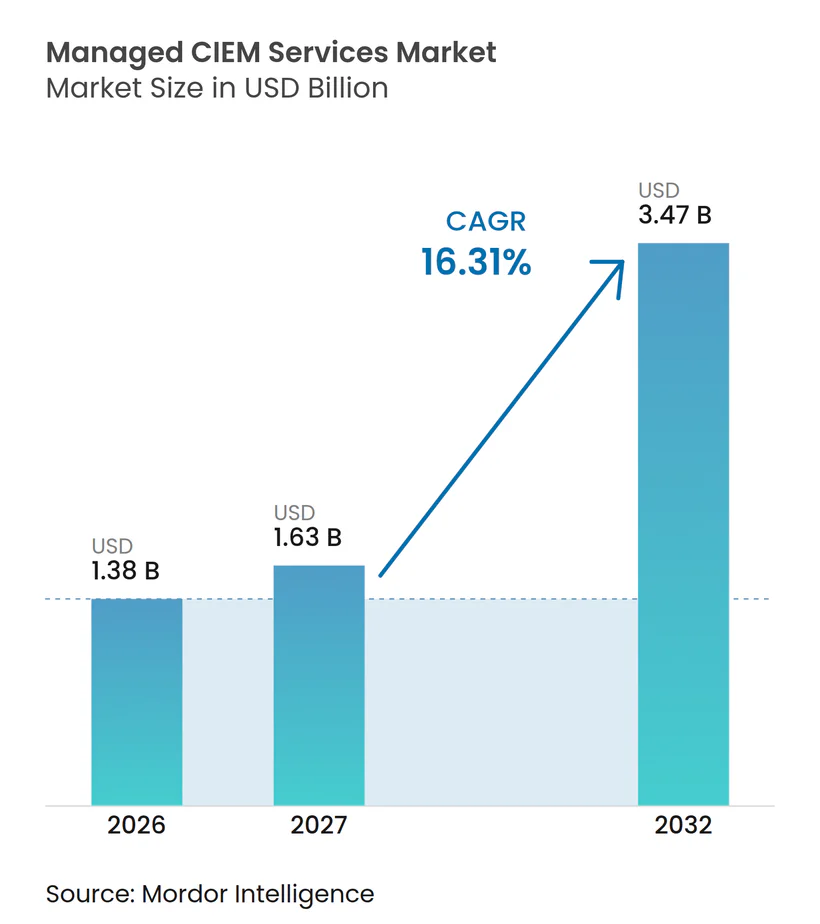
The Managed CIEM Services Market size is projected to expand from USD 1.38 billion in 2026 and USD 1.63 billion in 2027 to USD 3.47 billion by 2032, registering a CAGR of 16.31% from 2027 to 2032. The Managed CIEM Services Market is gaining a larger place in enterprise security budgets as cloud entitlement management becomes an operational requirement. Excess permissions are now treated as a material risk, particularly where audit, regulatory, and insurance obligations expose the financial consequences of poor access controls. Multicloud environments and non-human identities are widening the governance gap that many internal teams cannot manage on their own. Service providers can address this gap by monitoring changes in access, documenting controls, and supporting remediation efforts. Platform consolidation may change how buyers procure these capabilities, but it also increases the need for providers that can combine entitlement management with automation and AI identity governance.
Key Report Takeaways
- By service type, Managed Monitoring and Remediation Services held 34.87% of the Managed CIEM Services Market share in 2026 and is projected to expand at a 17.43% CAGR through 2032.
- By deployment model, Public Cloud accounted for 48.63% of revenue in 2026, while Hybrid Cloud is expected to expand at a 16.78% CAGR through 2032.
- By organization size, Large Enterprises held 74.28% of revenue in 2026, while SMEs are projected to grow at a 17.34% CAGR through 2032.
- By end-user industry, BFSI accounted for 24.37% of revenue in 2026, while Healthcare is projected to expand at a 17.62% CAGR through 2032.
- By geography, North America held 42.13% of revenue in 2026, while Asia-Pacific is projected to grow at a 17.09% CAGR through 2032.
Note: Market numbers in this report are based on Mordor Intelligence's proprietary estimation framework, which combines nine months of actuals with Q4 projections for base year 2026.
Global Managed CIEM Services Market Trends and Insights
Drivers Impact Analysis*
| Driver | (~) % Impact on CAGR Forecast | Geographic Relevance | Impact Timeline |
|---|---|---|---|
| Enterprise Multicloud Adoption and Cloud Control-Plane Expansion | +3.8% | Global, with concentration in North America, Europe, and Asia-Pacific | Medium term (2-4 years) |
| Zero-Trust and Least-Privilege Mandates | +3.2% | North America and EU, with spillover to Asia-Pacific and the Middle East | Short term (≤ 2 years) |
| AI-Agent and Non-Human Identity Proliferation | +2.8% | Global, concentrated in technology-intensive markets | Medium term (2-4 years) |
| Microsoft Entra Permissions Management Retirement and Migration Demand | +2.1% | North America and Europe, with impact in Australia and Japan | Short term (≤ 2 years) |
| Continuous Compliance and Audit-Evidence Requirements | +1.7% | North America, EU, and Asia-Pacific national regulators | Long term (≥ 4 years) |
| Skills Shortages Driving 24/7 Identity-Security Outsourcing | +1.5% | Global, most acute in North America, Western Europe, and Australia | Long term (≥ 4 years) |
| Source: Mordor Intelligence | |||
Enterprise Multicloud Adoption and Cloud Control-Plane Expansion
Each cloud account and workload identity expands the access environment that an organization must govern. A 2025 SANS survey found that more than 78% of organizations use 2 or more cloud providers.[1] AWS, Azure, and Google Cloud apply different permission structures, which makes access analysis harder as an organization adds providers. AWS notes that multicloud security requires centralized operations and integration with native security tools. The Managed CIEM Services Market benefits when internal security teams are unable to maintain consistent identity controls across these environments. Providers with unified entitlement graphs can help customers connect permissions, accounts, and workload identities across cloud platforms.
Zero-Trust and Least-Privilege Mandates
Zero-trust adoption is moving from a policy principle to a requirement in government and regulated-sector procurement. Federal guidance has increased the focus on least privilege at the cloud identity layer. This creates a need for evidence that access rights are limited, reviewed, and removed when no longer needed. The Managed CIEM Services Market can gain from demand for continuous least-privilege monitoring rather than periodic access reviews. Zero-trust programs also expose older, overprivileged accounts created during cloud migrations, expanding the remediation work available to specialist service providers.
AI-Agent and Non-Human Identity Proliferation
AI agents and non-human identities are expanding the set of accounts that require governance. A 2026 Cloud Security Alliance study found that non-human identities outnumbered human users by an average of 82-to-1 in enterprise environments. Accountability often spans IT, security, and AI teams, delaying decisions about access ownership. Managed services can provide a single operating process for discovery, monitoring, and response. The Managed CIEM Services Market is positioned to serve enterprises that need identity controls to keep pace with automated systems and machine access.
Microsoft Entra Permissions Management Retirement and Migration Demand
Microsoft retired Entra Permissions Management on November 1, 2025, following the end of new purchases on April 1, 2025. The company directed customers toward migration options and maintained a voucher program through June 2026 for partner-delivered services. Organizations using Azure, AWS, and Google Cloud needed replacement support for entitlement discovery, permission scoring, and continuous monitoring. Microsoft retained certain CIEM functions in Defender for Cloud, but described the scope as focused on critical cloud security posture use cases. The transition created a concentrated onboarding opportunity for managed providers that could move customers to alternative platforms quickly. The Managed CIEM Services Market also faces permanent changes in supplier choices among former Entra Permissions Management customers.
Restraints Impact Analysis*
| Restraint | (~) % Impact on CAGR Forecast | Geographic Relevance | Impact Timeline |
|---|---|---|---|
| Multicloud Entitlement Model Fragmentation | -2.1% | Global, most acute in multicloud-heavy North America and Asia-Pacific | Long term (≥ 4 years) |
| Integration and Remediation Change-Risk | -1.5% | North America and Europe core, with spillover to Asia-Pacific | Medium term (2-4 years) |
| Customer Reluctance to Delegate Privileged-Access Decisions | -0.9% | Global, most acute in Government, Defense, and BFSI | Long term (≥ 4 years) |
| CIEM Capability Bundling within CNAPP and IAM Platforms | -0.7% | Global | Medium term (2-4 years) |
| Source: Mordor Intelligence | |||
Multicloud Entitlement Model Fragmentation
Cloud providers use different policy syntax, trust boundaries, and permission models. This prevents managed providers from applying a uniform entitlement model across AWS, Azure, and Google Cloud. The 2025 SANS survey reported that many organizations run overlapping security tools because no single tool offers full coverage. The resulting tool overlap adds integration work, API limits, and data normalization requirements to service delivery. Google Cloud is also extending workload identity capabilities, which requires providers to update policy engines and data pipelines as cloud controls change. For the Managed CIEM Services Market, these demands increase delivery costs and can limit aggressive pricing for smaller customers.
Integration and Remediation Change-Risk
Removing excess access can interrupt workloads, block automation pipelines, or revoke permissions that application teams consider necessary. This risk leads some customers to use CIEM only for visibility, rather than allowing a provider to enforce policy changes. The risk is higher where cloud migrations created access arrangements without documented business intent. Managed providers use just-in-time access and simulation-based rightsizing to reduce disruption. Approval steps and formal change management still make remediation slower in controlled sectors. The Managed CIEM Services Market can face longer delivery cycles in financial services, utilities, and healthcare because these customers must validate each production change.
*Our forecasts treat driver/restraint impacts as directional, not additive. The impact forecasts reflect baseline growth, mix effects, and variable interactions.
Segment Analysis
By Service Type: Continuous Monitoring and Remediation Lead Service Demand
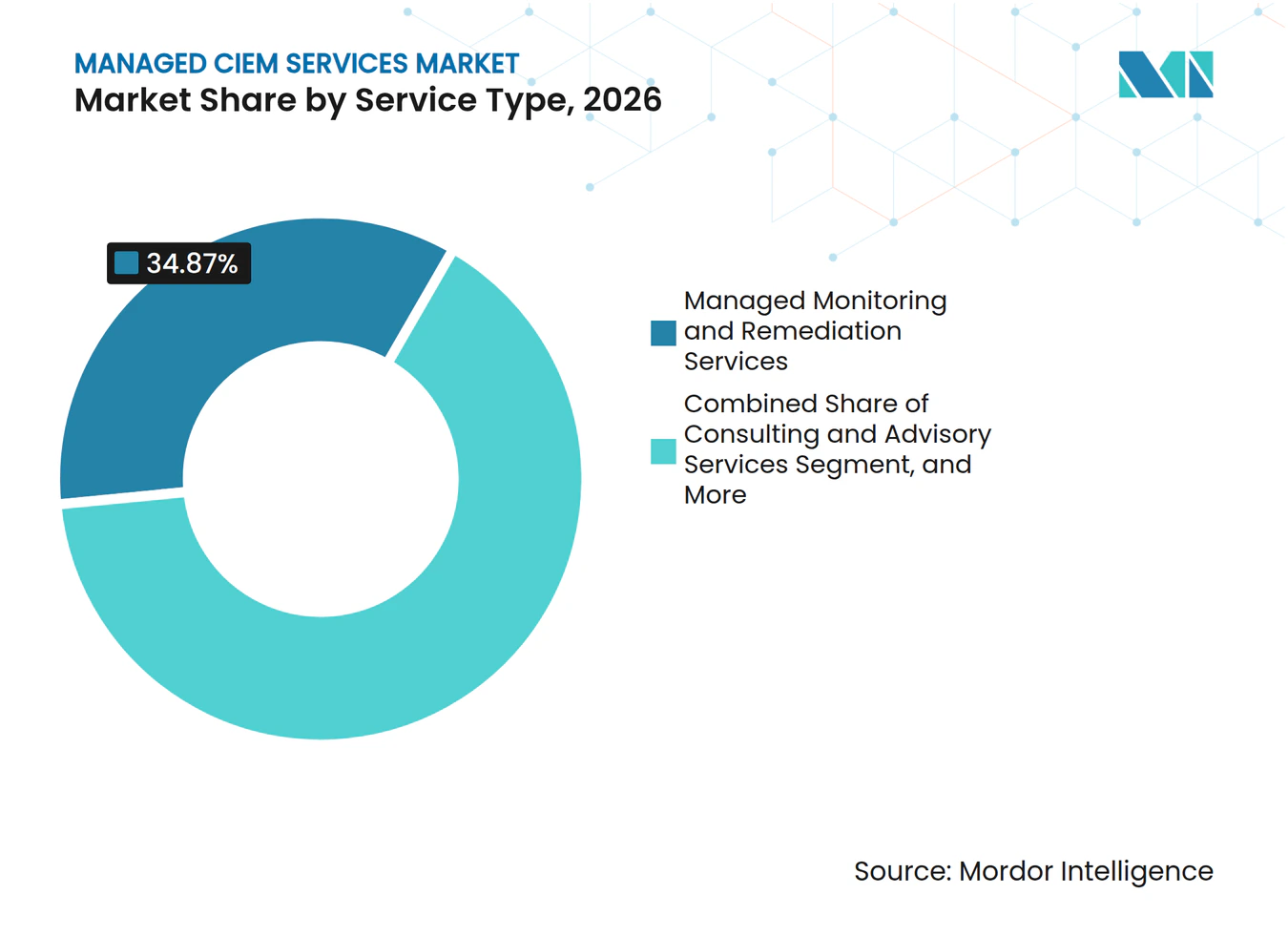
Managed Monitoring and Remediation Services accounted for 34.87% of Managed CIEM Services Market revenue in 2026. The service is also projected to register the fastest CAGR of 17.43% from 2027 to 2032. This combination shows that buyers favor continuous, outcome-based support over one-time assessments. A single entitlement cleanup can quickly lose value when DevOps automation and infrastructure-as-code processes create or modify permissions. The service helps customers identify excessive access before it becomes a persistent control issue. It also lets providers link discovery work with documented remediation activity. Providers are therefore being asked to identify risky rights, prioritize them, and support remediation on an ongoing basis. The Managed CIEM Services Market is strengthened by the need to maintain that operational discipline across changing cloud environments.
Consulting and Advisory Services remain important at the beginning of a program. They help organizations define governance objectives and plan the connection of CIEM with existing identity processes. Implementation and Integration Services support links to SIEM tools, ticketing platforms, and cloud-native security products. These links determine whether identified risks can move into the customer’s normal workflow. Support and Maintenance Services help keep policies current as cloud architectures develop. Training and Education Services remain smaller, but organizations are using them to build internal understanding alongside managed contracts. Training also gives internal teams a clearer basis to review provider recommendations. In the Managed CIEM Services Market, this combination can reduce dependency concerns and improve the value customers receive from longer-term engagements.



By Deployment Model: Hybrid Cloud Creates the Highest Governance Complexity
Public Cloud accounted for 48.63% of Managed CIEM Services Market revenue in 2026. Production workloads in AWS, Azure, and Google Cloud create a substantial pool of cloud permissions to monitor. Native security tools have improved basic entitlement visibility in these environments. Managed providers can build on that visibility by offering remediation, policy administration, and continuous control monitoring. This work is especially relevant when responsibility is divided between the platform, application, and security teams. Public cloud leadership also reflects the availability of mature tools, not only the level of entitlement risk. Organizations still need support when permissions change across multiple accounts and teams.
Hybrid Cloud is projected to grow at a 16.78% CAGR through 2032. These organizations must govern identities that span on-premises directories, federated cloud accounts, and cloud-native service accounts. No single control plane consistently provides visibility across that combination. This makes it harder to determine a user’s effective access across connected systems. Private Cloud remains relevant in sectors with data residency limits. Providers are developing air-gapped and sovereign cloud delivery approaches to meet these requirements.
By Organization Size: Large Enterprises Hold the Revenue Base While SMEs Expand
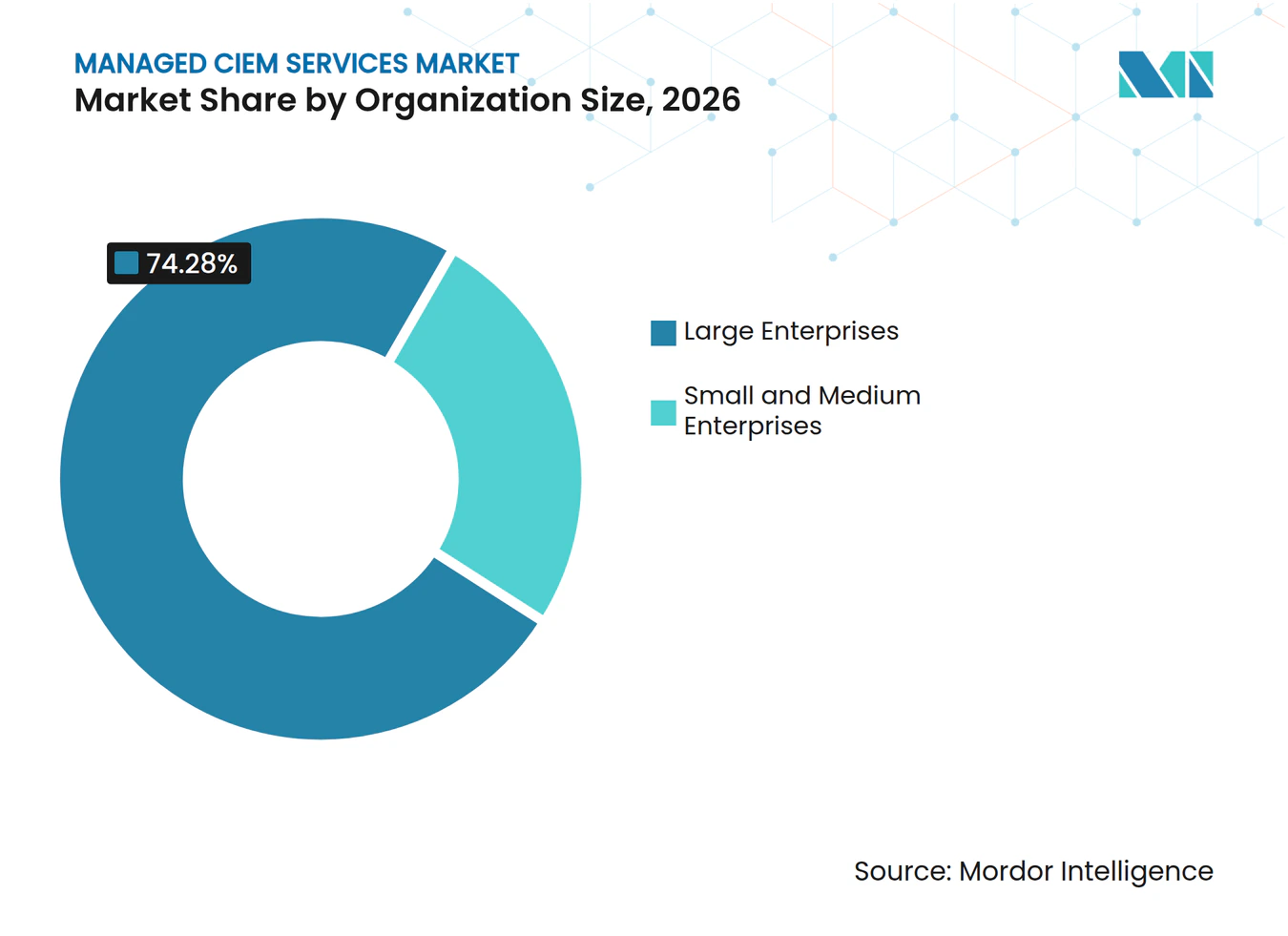
Large Enterprises held 74.28% of revenue in 2026. Their cloud footprints are larger, and their regulatory responsibilities are more demanding. These buyers often seek services that cover identity governance, privileged access, cloud identity, and workflow automation. They also require integration with existing security and service-management processes. Procurement often favors providers that can support several identity functions through a coordinated program. Their exposure to audit findings and regulatory penalties supports spending on sustained access-control operations. This keeps large organizations at the center of demand in the Managed CIEM Services Market.
SMEs are projected to grow at a 17.34% CAGR from 2027 to 2032. Subscription-based service packages are reducing the upfront cost of entitlement governance. Supply-chain audit requirements also encourage smaller vendors to improve access controls to retain larger enterprise customers. This changes CIEM from a specialist project into a more accessible operational service. An ISC2 study of 16,029 cybersecurity practitioners found that cloud security was a top skills need for 36% of respondents.[2] The study also found that 20% of organizations outsourced cybersecurity work and 19% used third-party service providers. AI-assisted policy recommendations can further lower the specialist skills needed to operate entitlement governance.

By End-User Industry: BFSI Sets Current Demand While Healthcare Accelerates
BFSI accounted for 24.37% of revenue in 2026. Financial institutions require documented controls for frameworks such as SOX, PCI DSS, and DORA. These obligations make audit-ready evidence of identity lifecycle management a regular operating need. Access reviews are particularly important for accounts tied to critical systems and sensitive data. Institutions also need to show that access is removed when employment or business responsibilities change. The sector operates complex cloud and application environments, which increases the number of permissions that must be reviewed. BFSI therefore provides the largest current customer base for managed entitlement support.
Healthcare is projected to grow at a 17.62% CAGR through 2032. The US Department of Health and Human Services proposed HIPAA Security Rule updates in January 2025 that would strengthen the protection of electronic protected health information. The proposal addresses access controls in cloud environments and treats multifactor authentication as a baseline expectation. Cloud migrations completed between 2020 and 2025 can leave unmanaged identities and shadow IT that later appear in risk assessments. Health systems must address these gaps without disrupting access that supports clinical and administrative activity. This creates remediation work that the Managed CIEM Services Market can support. Information Technology and Telecommunications, Government and Defense, Manufacturing, Retail and E-Commerce, Energy and Utilities, Transportation and Logistics, Education, Hospitality and Travel, and other sectors also contribute demand as identity controls become part of sector-specific compliance obligations.
Geography Analysis
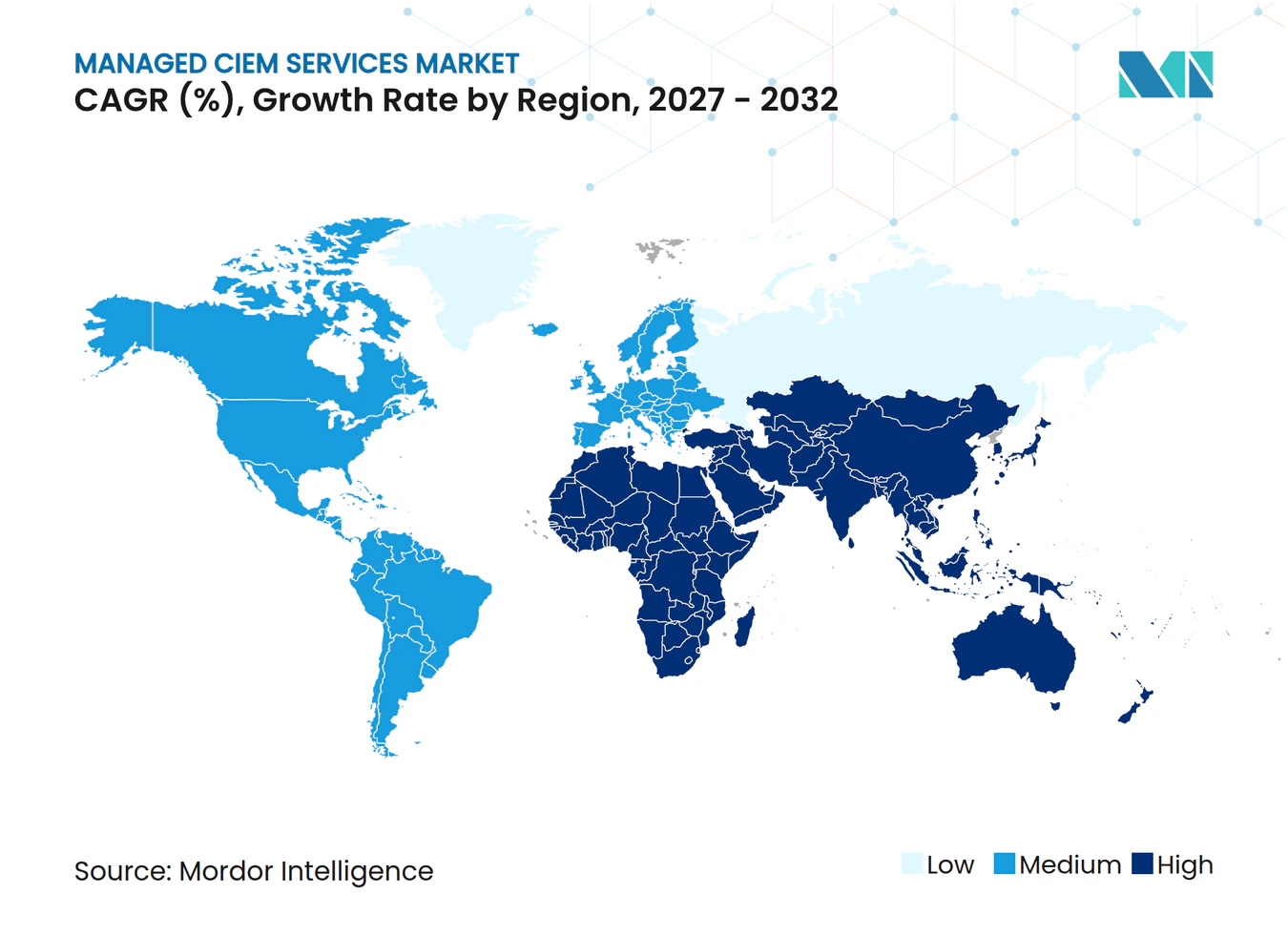
North America held 42.13% of the Managed CIEM Services Market revenue in 2026. The region has a dense concentration of regulated financial services, healthcare organizations, and federal contractors. These customers face parallel requirements from compliance rules, cyber insurance reviews, and supply chain audits. The retirement of Microsoft Entra Permissions Management created demand for migration across the region during the first half of 2026. This demand gave managed providers an opportunity to move customers to alternative entitlement platforms. Government buyers also continue to procure large managed identity programs.
Asia-Pacific is projected to grow at a 17.09% CAGR from 2027 to 2032. India’s enterprise technology sector, Australia’s cloud security environment, South Korea’s digital transformation programs, and China’s hyperscaler ecosystems support demand. Organizations in the region are increasing investment in CIEM and identity threat detection and response as machine identities become more common. NTT DATA Japan received Okta’s Workforce Identity Cloud Service Delivery Specialization in January 2025.[3] This recognition indicates deeper specialist identity service capabilities in the region. The Managed CIEM Services Market share held by North America leaves Asia-Pacific with substantial room to add new cloud identity programs.
Europe, the Middle East, and Africa offer distinct but growing opportunities. Europe is supported by NIS2 and DORA requirements affecting financial entities, essential service operators, and ICT providers. Germany’s federal IT authority issued an EU-wide tender for identity management services in early 2026, indicating expanding public-sector procurement. The Middle East is gaining demand from Saudi Arabia’s Vision 2030 initiatives and the UAE’s cloud infrastructure and sovereign-cloud buildouts. South America is emerging as Brazil’s LGPD requires access-control documentation and Argentina adopts cloud-native architectures. Africa remains smaller in revenue, but financial institutions in South Africa and telecom and banking operators in Nigeria are adopting managed cloud security services in the Managed CIEM Services Market.
Competitive Landscape
Market Concentration
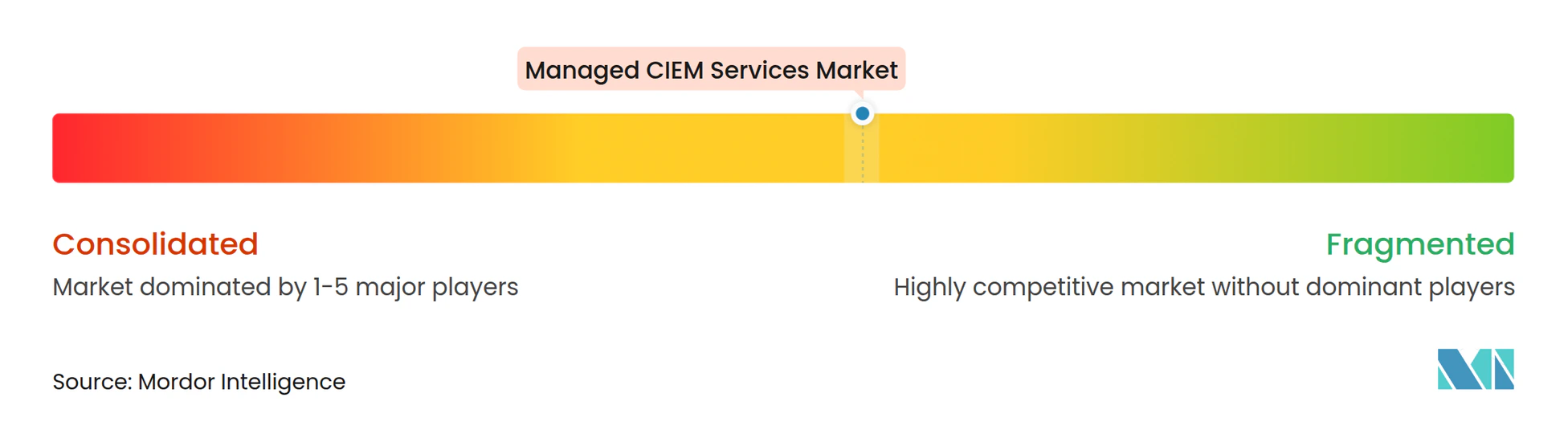
The Managed CIEM Services Market has a bifurcated competitive structure. Large IT services integrators compete through broad delivery capabilities, international coverage, and experience with regulated customers. Specialist identity providers compete through platform depth, faster implementation, and focused automation. Accenture, Deloitte, Capgemini, HCL Technologies, IBM, TCS, and Wipro operate across a wide range of identity and security service portfolios. Saviynt, Simeio Solutions, and LTIMindtree seek to differentiate themselves through identity-specific platforms and managed delivery. Customers choose among these models based on their cloud estate, compliance needs, and preference for a broad or specialized provider.
Palo Alto Networks completed its acquisition of CyberArk in February 2026 for USD 25 billion. The acquisition places identity security alongside Palo Alto Networks’ network, cloud, and secure access offerings. It may reshape partnerships for managed providers that rely on CyberArk capabilities. SailPoint completed its acquisition of Entro Security in June 2026 for USD 200 million.[4] The move adds non-human identity discovery and AI-agent behavioral monitoring to its identity platform. These transactions show that platform vendors are seeking to cover human, machine, and AI identities within a connected offering.
The strongest opportunity for service providers is in SME delivery and sector-specific compliance automation. Many existing offerings are designed for large enterprises and carry corresponding implementation requirements. Providers that package controls for HIPAA, DORA, and PCI DSS can make entitlement governance more accessible to smaller customers. Saviynt launched Zuma in July 2026, combining runtime authorization for AI agents with governance across human, machine, and AI identities. ISO 27001, SOC 2 Type II, and NIS2 compliance are increasingly baseline requirements in enterprise bids. The Managed CIEM Services Market remains competitive because providers must combine technical integration, credible operations, and compliance evidence.
Managed CIEM Services Industry Leaders
-
Accenture plc
-
Atos SE
-
Capgemini SE
-
CGI Inc.
-
CyberArk Software Ltd.
- *Disclaimer: Major Players sorted in no particular order
Recent Industry Developments
- July 2026: Saviynt surpassed USD 300 million in annual recurring revenue and launched Zuma, a purpose-built AI identity security platform providing intent-aware runtime authorization, NHI discovery across the full enterprise, and AI-agent governance capabilities. The milestone follows a USD 700 million Series B financing round in December 2025 that valued the company at USD 3 billion.
- June 2026: SailPoint completed its acquisition of Tel Aviv-based Entro Security for USD 200 million, adding deep non-human identity discovery covering over 1,200 credential types and AI-agent behavioral monitoring to its Agentic Fabric platform. The acquisition positions SailPoint as the first provider with end-to-end governance covering human, machine, and AI identities.
- February 2026: Palo Alto Networks completed its USD 25 billion acquisition of CyberArk, establishing identity security as a new core platform pillar alongside network security, CNAPP, and SASE. The combined entity brings the CyberArk Identity Security Platform, covering PAM, IGA, and CIEM, under the Palo Alto Networks ecosystem available to MSP and managed service delivery partners.
- October 2026: Google Cloud announced that its CIEM capability, the key tool for permissions management within Google Cloud Security Command Center, reached general availability for Google Cloud and AWS environments in 2025 and entered preview for Azure, expanding multicloud entitlement visibility for enterprises relying on Google Cloud as their governance control plane.
Global Managed CIEM Services Market Report Scope
The Managed CIEM Services Market covers services that help organizations manage, monitor, and secure cloud infrastructure entitlements across multi-cloud and hybrid cloud environments. Cloud Infrastructure Entitlement Management (CIEM) enables organizations to identify, analyze, and enforce least-privilege access policies for cloud identities, permissions, and access rights. Managed CIEM service providers deliver ongoing entitlement visibility, access risk assessment, policy enforcement, compliance monitoring, and remediation support to reduce identity-related security risks and improve cloud security posture.
The Managed CIEM Services Market Report is Segmented by Service Type (Consulting and Advisory Services, Implementation and Integration Services, Managed Monitoring and Remediation Services, Support and Maintenance Services, and Training and Education Services), Deployment Model (Public Cloud, Hybrid Cloud, and Private Cloud), Organization Size (Small and Medium Enterprises and Large Enterprises), End-User Industry (Information Technology and Telecommunications, BFSI, Healthcare, Retail and E-Commerce, Manufacturing, Government and Defense, and Other End-User Industries), and Geography (North America, South America, Europe, Asia-Pacific, Middle East, and Africa). The Market Forecasts are Provided in Terms of Value (USD).
| Consulting and Advisory Services |
| Implementation and Integration Services |
| Managed Monitoring and Remediation Services |
| Support and Maintenance Services |
| Training and Education Services |
| Public Cloud |
| Hybrid Cloud |
| Private Cloud |
| Small and Medium Enterprises |
| Large Enterprises |
| Information Technology and Telecommunications |
| BFSI |
| Healthcare |
| Retail and E-Commerce |
| Manufacturing |
| Government and Defense |
| Other End-User Industries |
| North America | United States |
| Canada | |
| Mexico | |
| South America | Brazil |
| Argentina | |
| Rest of South America | |
| Europe | Germany |
| United Kingdom | |
| France | |
| Italy | |
| Spain | |
| Russia | |
| Rest of Europe | |
| Asia-Pacific | China |
| India | |
| Japan | |
| South Korea | |
| Australia | |
| Rest of Asia-Pacific | |
| Middle East | Saudi Arabia |
| United Arab Emirates | |
| Turkey | |
| Rest of Middle East | |
| Africa | South Africa |
| Egypt | |
| Nigeria | |
| Rest of Africa |
| By Service Type | Consulting and Advisory Services | |
| Implementation and Integration Services | ||
| Managed Monitoring and Remediation Services | ||
| Support and Maintenance Services | ||
| Training and Education Services | ||
| By Deployment Model | Public Cloud | |
| Hybrid Cloud | ||
| Private Cloud | ||
| By Organization Size | Small and Medium Enterprises | |
| Large Enterprises | ||
| By End-User Industry | Information Technology and Telecommunications | |
| BFSI | ||
| Healthcare | ||
| Retail and E-Commerce | ||
| Manufacturing | ||
| Government and Defense | ||
| Other End-User Industries | ||
| By Geography | North America | United States |
| Canada | ||
| Mexico | ||
| South America | Brazil | |
| Argentina | ||
| Rest of South America | ||
| Europe | Germany | |
| United Kingdom | ||
| France | ||
| Italy | ||
| Spain | ||
| Russia | ||
| Rest of Europe | ||
| Asia-Pacific | China | |
| India | ||
| Japan | ||
| South Korea | ||
| Australia | ||
| Rest of Asia-Pacific | ||
| Middle East | Saudi Arabia | |
| United Arab Emirates | ||
| Turkey | ||
| Rest of Middle East | ||
| Africa | South Africa | |
| Egypt | ||
| Nigeria | ||
| Rest of Africa | ||
Key Questions Answered in the Report
What is the Managed CIEM Services Market size?
The Managed CIEM Services Market is projected to expand from USD 1.38 billion in 2026 and USD 1.63 billion in 2027 to USD 3.47 billion by 2032, at a 16.31% CAGR. The forecast reflects the growing need to govern entitlements across complex cloud environments.
What is driving demand for managed CIEM services?
Multicloud complexity, least-privilege requirements, AI-agent growth, and demand for audit evidence are supporting adoption. The Managed CIEM Services Market supports organizations when internal teams cannot continuously identify, review, and remediate changing cloud permissions.
Which service type leads managed CIEM demand?
Managed Monitoring and Remediation Services held 34.87% of revenue in 2026 and is projected to grow at a 17.43% CAGR through 2032. The service combines ongoing visibility with action on excessive permissions, rather than limiting providers to one-time assessments.
Which deployment model is growing fastest?
Hybrid Cloud is projected to grow at a 16.78% CAGR through 2032 because identities often span on-premises and cloud environments. The model creates a difficult access-control challenge because directories, federated identities, and cloud-native service accounts can sit in separate systems.
Which end-user sector is expanding fastest?
Healthcare is projected to grow at a 17.62% CAGR through 2032, supported by stronger controls for electronic protected health information. Cloud migrations can leave unmanaged accounts or shadow IT that providers must identify without interrupting clinical and administrative access.