
Cloud Infrastructure Entitlement Management (CIEM) Market Size and Share
Market Overview
| Study Period | 2021 - 2032 |
|---|---|
| Market Size (2027) | USD 3.99 Billion |
| Market Size (2032) | USD 13.04 Billion |
| Fastest Growing Market | Asia-Pacific |
| Largest Market | North America |
| Market Concentration | Medium |
Major Players *Disclaimer: Major Players sorted in no particular order Image © Mordor Intelligence. Reuse requires attribution under CC BY 4.0. | |
Cloud Infrastructure Entitlement Management (CIEM) Market Analysis by Mordor Intelligence
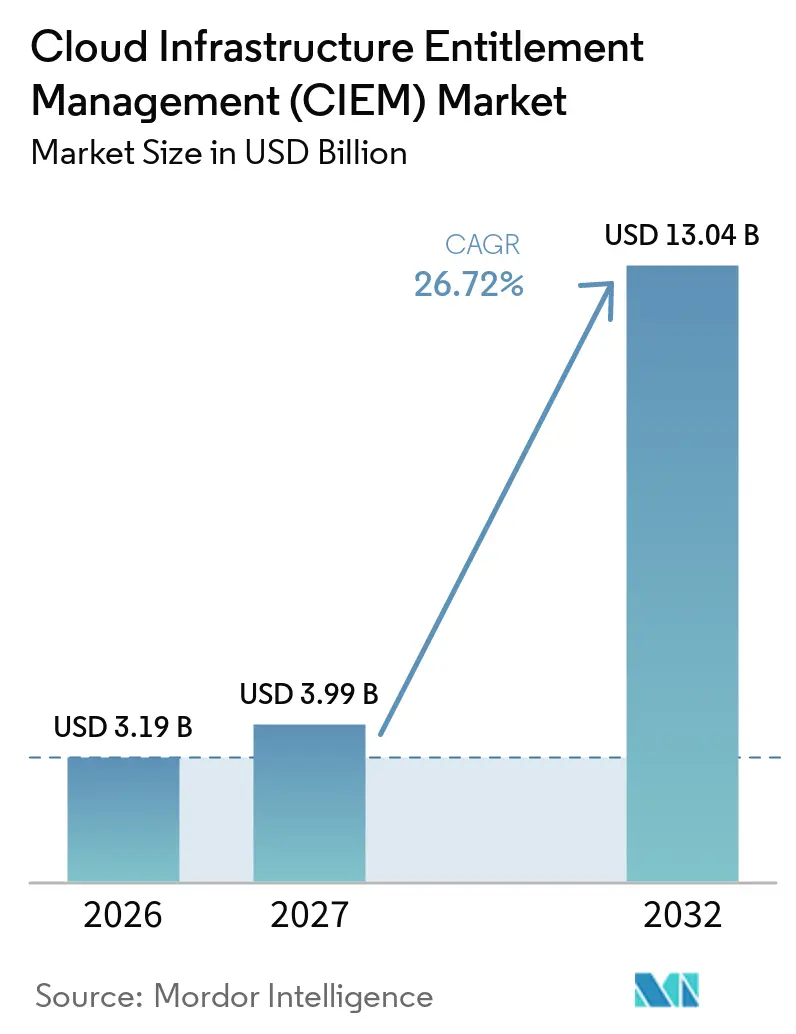
The Cloud infrastructure entitlement management market size is projected to be USD 3.19 billion in 2026, USD 3.99 billion in 2027, and reach USD 13.04 billion by 2032, growing at a CAGR of 26.72% from 2027 to 2032. The Cloud infrastructure entitlement management market is expanding as enterprises operate workloads across public clouds, private environments, software platforms, and legacy systems that use different permission models, making a complete view of effective access harder to maintain. In the Cloud infrastructure entitlement management market, permissions are frequently issued for development work, automation, third-party integration, or temporary operational needs, then remain active after their original purpose has ended because teams lack a continuous review process. Demand is also shaped by stricter access-control obligations in financial services, healthcare, government, and other sectors that handle sensitive information, since those organizations must connect access governance with reliable records for control testing and audit activity. Providers are responding by combining entitlement discovery, least-privilege recommendations, machine identity controls, and automated remediation within broader cloud security platforms, allowing security teams to assess permissions across accounts, resources, human users, and automated workloads. The Cloud infrastructure entitlement management market is also affected by platform acquisitions and product integration, because buyers increasingly assess entitlement capabilities alongside cloud protection, identity governance, threat detection, privileged access management, and machine identity security.
Key Report Takeaways
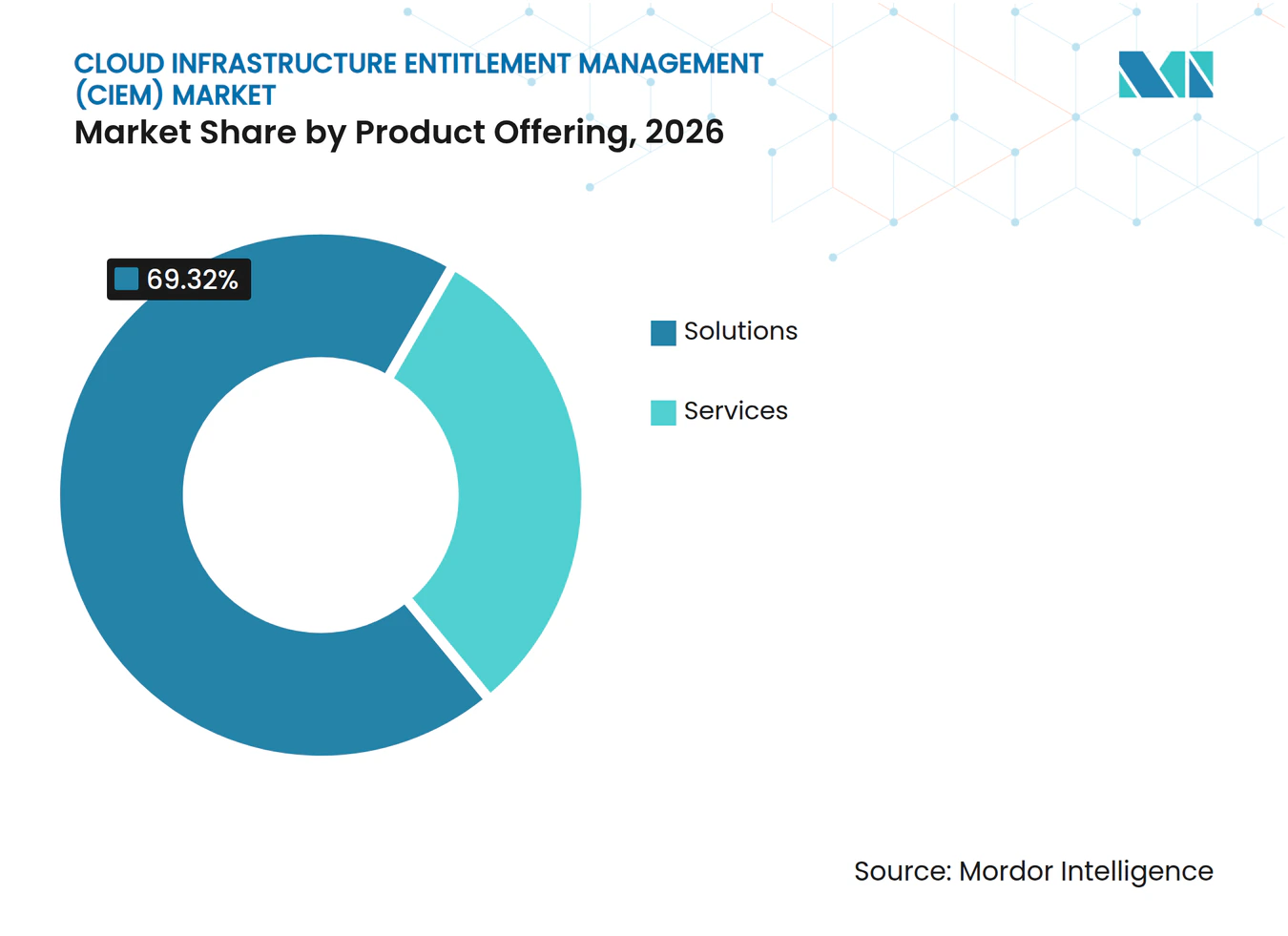
- By product offering, solutions held 69.32% of the Cloud infrastructure entitlement management market share in 2026, while services are projected to expand at a 28.43% CAGR through 2032.
- By deployment model, cloud accounted for 79.34% of the Cloud infrastructure entitlement management market share in 2026, while hybrid cloud is projected to advance at a 28.21% CAGR through 2032.
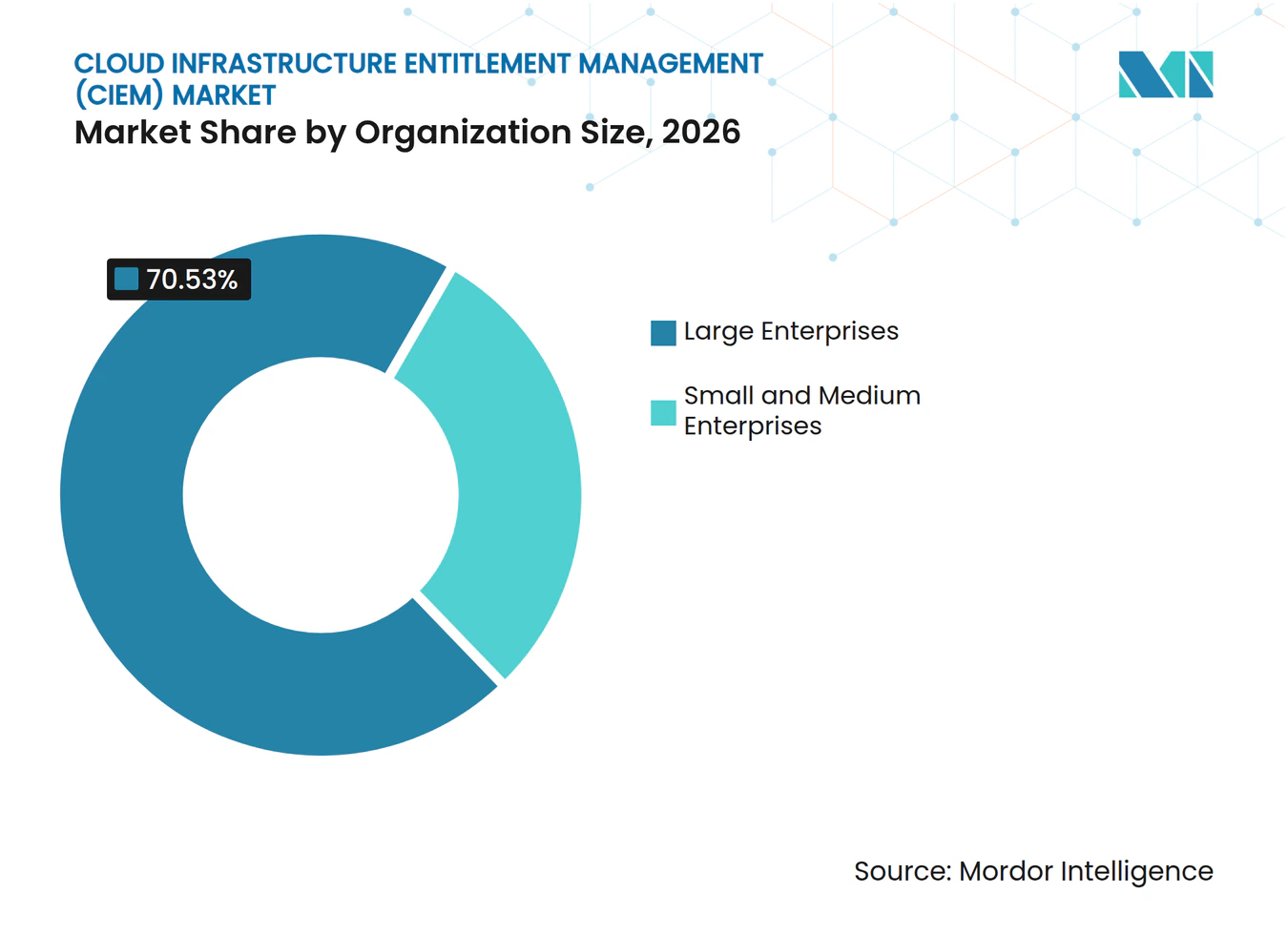
- By organization size, large enterprises held 70.53% share in 2026, while small and medium enterprises are projected to expand at a 29.17% CAGR through 2032.
- By application, BFSI held 26.94% share in 2026, while healthcare and life sciences are projected to expand at a 30.12% CAGR through 2032.
- By geography, North America held 42.31% share in 2026, while Asia-Pacific is projected to expand at a 29.84% CAGR through 2032.
Note: Market numbers in this report are based on Mordor Intelligence's proprietary estimation framework, which combines nine months of actuals with Q4 projections for base year 2026.
Market Trends and Insights
Drivers Impact Analysis of Cloud Infrastructure Entitlement Management (CIEM) Market*
| Driver | (~) % Impact on CAGR Forecast | Geographic Relevance | Impact Timeline |
|---|---|---|---|
| Expansion of Multi-Cloud and Hybrid-Cloud Estates | +6.5% | Global, particularly North America and Asia-Pacific | Medium term (2-4 years) |
| Escalation of Human and Non-Human Identity Risk | +5.8% | Global, highest concentration in North America and Europe | Short term (≤ 2 years) |
| Zero Trust and Least-Privilege Adoption | +5.2% | North America and EU, early gains in Asia-Pacific | Medium term (2-4 years) |
| Regulatory Pressure for Continuous Access Governance | +4.8% | EU, North America, expanding to Asia-Pacific and Middle East | Medium term (2-4 years) |
| AI-Driven Entitlement Analytics and Remediation | +2.9% | North America, Asia-Pacific core, spill-over to Middle East and Africa | Long term (≥ 4 years) |
| Machine Identity and AI Agent Proliferation | +2.5% | Global | Short term (≤ 2 years) |
| Source: Mordor Intelligence | |||
Expansion of Multi-Cloud and Hybrid-Cloud Estates
The Cloud infrastructure entitlement management market is supported by enterprises that use multiple hyperscalers and retain selected workloads in private environments. Each added cloud platform brings a distinct set of users, roles, policies, service accounts, and inherited permissions that security teams must understand together. The 2025 SANS multicloud survey found that 95% of respondents regarded identity and entitlement management across cloud providers as at least a minor challenge, while cross-platform role coordination was among the difficult cloud security tasks. Permissions issued for temporary automation can persist after the task ends, creating access paths that have no current business purpose. Microsoft states that its native CIEM capabilities provide a unified view of permissions across Azure, AWS, and Google Cloud, which reflects the operational value of a consolidated permission view. Hybrid environments make the issue more difficult because on-premises directories and cloud identity systems were not designed as a single permission framework.
Escalation of Human and Non-Human Identity Risk
The Cloud infrastructure entitlement management market is also being shaped by the growing number of service accounts, API keys, workload identities, and credentials used by automated systems. CyberArk reported in 2025 that machine identities outnumber human identities by more than 80 to 1, and 79% of organizations expected further growth in non-human identities.[1] The same research reported that 68% of organizations lacked identity security controls for AI systems, leaving a significant governance gap as organizations introduce AI agents. OWASP identified unnecessary long-term credentials and overprivileged service accounts as major non-human identity risks in its 2025 guidance. These identities often receive broad access when they are created, because automation processes require reliable operation across connected systems. CIEM tools can identify unused access, map effective permissions, and support least-privilege controls for both people and automated workloads.
Zero Trust and Least-Privilege Adoption
The Cloud infrastructure entitlement management market benefits when organizations turn Zero Trust programs into operational access policies rather than strategic statements. Least privilege requires organizations to limit access to the systems and actions required for a defined task, then review that access as infrastructure and roles change. This work is difficult in large cloud environments because a single identity policy can be assigned across many roles and resources. A 2025 StrongDM survey found that 67% of cybersecurity professionals ranked identity and access management and data encryption among their leading Zero Trust priorities. NIST SP 800-53 includes controls for separation of duties and least privilege, and these requirements are relevant to federal environments using FedRAMP-based security programs. Automated entitlement analysis gives organizations a practical way to identify permissions that do not match an approved access model.
Regulatory Pressure for Continuous Access Governance
The Cloud infrastructure entitlement management market gains support from regulations that require organizations to demonstrate controlled access to systems and sensitive data. The European Commission states that NIS2 is intended to strengthen cybersecurity across critical sectors and covers risk-management measures for relevant entities. Germany completed its national NIS2 implementation in December 2025, adding relevance for organizations that need documented access governance. GDPR, HIPAA, PCI DSS, and SOX create overlapping audit expectations for organizations that hold personal, payment, health, or financial information. Continuous monitoring and audit trails can reduce the burden of gathering evidence from disconnected cloud accounts and security tools. The resulting need is not limited to compliance teams, because technology, risk, and security groups all depend on access records that can be reviewed and explained.
Restraints Impact Analysis of Cloud Infrastructure Entitlement Management (CIEM) Market*
| Restraint | (~) % Impact on CAGR Forecast | Geographic Relevance | Impact Timeline |
|---|---|---|---|
| Integration Complexity Across Cloud Permission Models | -3.8% | Global, particularly multi-cloud-heavy markets in North America and Asia-Pacific | Medium term (2-4 years) |
| Limited CIEM Skills and Low Buyer Awareness | -2.9% | Emerging markets in South America, Middle East and Africa, Tier-2 Asia-Pacific | Long term (≥ 4 years) |
| Operational Risk From Incorrect Permission Right-Sizing | -1.8% | Global | Medium term (2-4 years) |
| Feature Convergence Within CNAPP and IAM Platforms | -1.5% | North America and EU | Long term (≥ 4 years) |
| Source: Mordor Intelligence | |||
Integration Complexity Across Cloud Permission Models
The Cloud infrastructure entitlement management market faces a practical adoption barrier because AWS, Azure, and Google Cloud use different permission structures. Security teams must connect these structures to existing directories, application controls, security monitoring tools, and internal approval processes before a platform produces dependable recommendations. Aviatrix reported in 2025 that 67% of surveyed U.S. enterprise IT leaders struggled to integrate cloud security tools with their broader security stack.[2] Organizations can require extended implementation programs before they trust access-right-sizing recommendations for important production workloads. The SANS survey also identified multi-cloud identity and entitlement management as a common challenge, even among organizations that recognize its importance. Complex integrations can delay value realization and make projects vulnerable to changes in budget, leadership attention, or platform priorities.
Limited CIEM Skills and Low Buyer Awareness
The Cloud infrastructure entitlement management market is constrained, where organizations do not have teams that understand cloud architecture, identity engineering, and security operations together. Aviatrix found that 69% of surveyed organizations reported a shortage of skilled security personnel able to manage complex cloud environments. Effective configuration requires practitioners to distinguish excess permissions from access that is legitimately broad for an automation pipeline or critical service. In many mid-market organizations, buyers still group CIEM with privileged access management or identity governance, even though cloud entitlement visibility serves a different operational purpose. The constraint is more pronounced in South America, the Middle East, and Africa, and Tier-2 Asia-Pacific markets where specialist implementation support is less established. Vendor-led services, simpler interfaces, and clearer implementation guidance can reduce this barrier, but they do not eliminate the need for local security skills.
*Our forecasts treat driver/restraint impacts as directional, not additive. The impact forecasts reflect baseline growth, mix effects, and variable interactions.
Cloud Infrastructure Entitlement Management (CIEM) Market Segment Analysis
By Product Offering:
Services Growth Reflects Demand for Specialized SupportSolutions held 69.32% of the Cloud infrastructure entitlement management market in 2026, reflecting the need for software that continuously discovers and assesses permissions across complex cloud estates as teams deploy infrastructure, add applications, create service accounts, and update cloud policies. Persistent monitoring helps security teams find excessive access without relying on intermittent reviews or consulting projects, while a consolidated view shows effective permissions rather than only the permissions initially assigned to an identity. Large enterprises with established cloud security teams commonly prioritize licenses that provide automated visibility across many accounts, subscriptions, environments, and business units, since access relationships can change whenever an application architecture or development workload is altered. The Cloud infrastructure entitlement management industry benefits from products that identify access patterns at the pace of cloud operations and allow buyers to retain control over policies, approval workflows, and remediation choices. This software focus reflects the practical need to assess permissions continuously as responsibilities, infrastructure, automation processes, and service relationships change.
Services are projected to expand at a 28.43% CAGR from 2027 to 2032 because organizations often need help with configuration, operational use, credential rotation, just-in-time access, non-human identity lifecycle management, and AI agent governance. SailPoint introduced its Agentic Fabric platform in 2026, illustrating the direction of vendor investment in AI-supported identity governance capabilities that can be embedded within broader solution stacks.[3] The boundary between software and professional services is becoming less distinct when a platform includes guidance, managed operations, and remediation workflows, but organizations still need to define the access policies that govern their own critical systems. Services also assist buyers that need to connect entitlement governance with audit evidence, internal controls, security operations, and implementation requirements that their internal teams cannot manage alone. The Cloud infrastructure entitlement management market size for services is projected to expand at a 28.43% CAGR between 2027 and 2032, reflecting a need for specialized support alongside software-led entitlement analysis.


By Deployment Model:
Hybrid Cloud Responds to Regulated Workload NeedsCloud deployment held 79.34% share in 2026, reflecting the use of SaaS-delivered tools that can scan permissions across large cloud accounts without local infrastructure, while giving distributed organizations consistent visibility across subscriptions, accounts, and projects. Cloud delivery can simplify updates to entitlement analytics and remediation workflows as vendors add coverage for new services, which matters where infrastructure is changed frequently through automated development processes. The Cloud infrastructure entitlement management market relies on these platforms because public cloud environments create many identity relationships among people, workloads, applications, external partners, and machine credentials that central security teams must review. A cloud-delivered model supports continuous assessment without requiring separate software installations in each business unit, which can help a central function apply common governance practices across a large operating environment. The leading position of cloud deployment reflects mature cloud-native security operations, although it does not remove the need to integrate entitlement tools with existing directories, policy systems, and governance processes.
Hybrid cloud is projected to expand at a 28.21% CAGR from 2027 to 2032 as regulated organizations retain selected workloads on premises for data sovereignty, security, or operational reasons while expanding public cloud use. This arrangement requires organizations to govern Active Directory, cloud identity systems, and software access controls that were developed separately, creating potential gaps when policies, identity records, and audit data are stored in different systems. Orca Security announced runtime protection for hybrid and private cloud environments in July 2025, indicating continued product attention to deployments that extend beyond public cloud infrastructure. Germany’s NIS2 requirements and South Korea’s revised personal information protection framework have supported interest in architectures that keep selected identity and audit data within national boundaries, even when organizations use public cloud services for other workloads. The Cloud infrastructure entitlement management market size for hybrid cloud is projected to expand at a 28.21% CAGR between 2027 and 2032 because governance must cover local workload retention and public cloud adoption at the same time.
By Organization Size:
Smaller Buyers Gain Access Through Cloud-Native DeliveryLarge enterprises held 70.53% share in 2026 because they manage many cloud accounts, subscriptions, business units, applications, external access relationships, and automated workloads that can create substantial permission sprawl across several hyperscalers. These organizations also have formal audit obligations and larger security teams that can evaluate specialized identity security tools, integrate platforms with directories and policy systems, and use the results for remediation and formal access reviews. In financial services and healthcare, leaders need evidence that privileged and sensitive access is controlled under relevant compliance requirements, which raises the importance of clear reporting and reliable audit records. The Cloud infrastructure entitlement management market has found an early base among enterprises that require consistent entitlement reporting across extensive infrastructure, since the business impact of a cloud misconfiguration can be material across a broad customer base or regulated operation. Their leadership reflects both the scale of their cloud environments and their capacity to integrate specialized tools into established security operations.
Small and medium enterprises are projected to expand at a 29.17% CAGR from 2027 to 2032 as cloud-native providers offer consumption-based pricing, simpler service models, and interfaces that present prioritized least-privilege recommendations. These organizations face much of the same permission complexity as larger enterprises after adopting public cloud services, software platforms, and automation tools, but they often do not have dedicated identity and access management teams. Microsoft retired Entra Permissions Management in October 2025 and identified Delinea as a transition option for cloud entitlement visibility, creating a replacement decision for customers that relied on the discontinued service. Managed services can reduce the burden of operating specialized identity security tooling, although buyers still need to verify that a remediation action will not disrupt an application or automation workflow. The Cloud infrastructure entitlement management industry is becoming more accessible to smaller buyers when pricing, configuration, and ongoing operations fit limited budgets and staffing, showing that entitlement governance is moving beyond the largest cloud estates.

By Application:
BFSI Leads While Healthcare and Life Sciences AccelerateBFSI held 26.94% share in 2026, reflecting its reliance on tightly controlled access across customer platforms, payment processes, investment operations, connected partners, and automated systems that have distinct purposes and risk profiles. Financial institutions operate under compliance expectations that require evidence of controlled privileged access and separation of responsibilities, so access governance cannot rely on one policy or an occasional manual review. The Cloud infrastructure entitlement management market supports these organizations by connecting entitlement visibility with ongoing access analysis and audit records that can be assessed as systems, users, and technology relationships change. BFSI’s leading position reflects its extensive technology base and the economic impact of access failures when cloud services are added to established systems holding sensitive financial information. The segment also needs to manage an expanding range of machine identities used in automated financial processes, which increases the number of access relationships that require governance.
Healthcare and life sciences are projected to expand at a 30.12% CAGR from 2027 to 2032 as electronic health records and clinical workloads move to cloud platforms, requiring organizations to control access to protected health information while enabling necessary clinical and administrative activity. Netwrix reported that healthcare organizations reporting losses above USD 200,000 nearly quadrupled year over year, while compromised user and administrator accounts were a leading breach vector in its 2025 findings. Fortified Health Security reported that healthcare breach incidents more than doubled year over year in its 2026 Horizon Report, with credential theft and identity compromise contributing to the threat environment. Government and public sector organizations similarly use CIEM in response to FedRAMP and NIST access-control obligations, while IT and telecommunications organizations apply entitlement management to machine-to-machine access in cloud-native DevOps pipelines. Retail and e-commerce, manufacturing and industrial organizations, and other applications add to the demand base as cloud services become more embedded in operational activity.
Geography Analysis
North America Cloud Infrastructure Entitlement Management (CIEM) Market
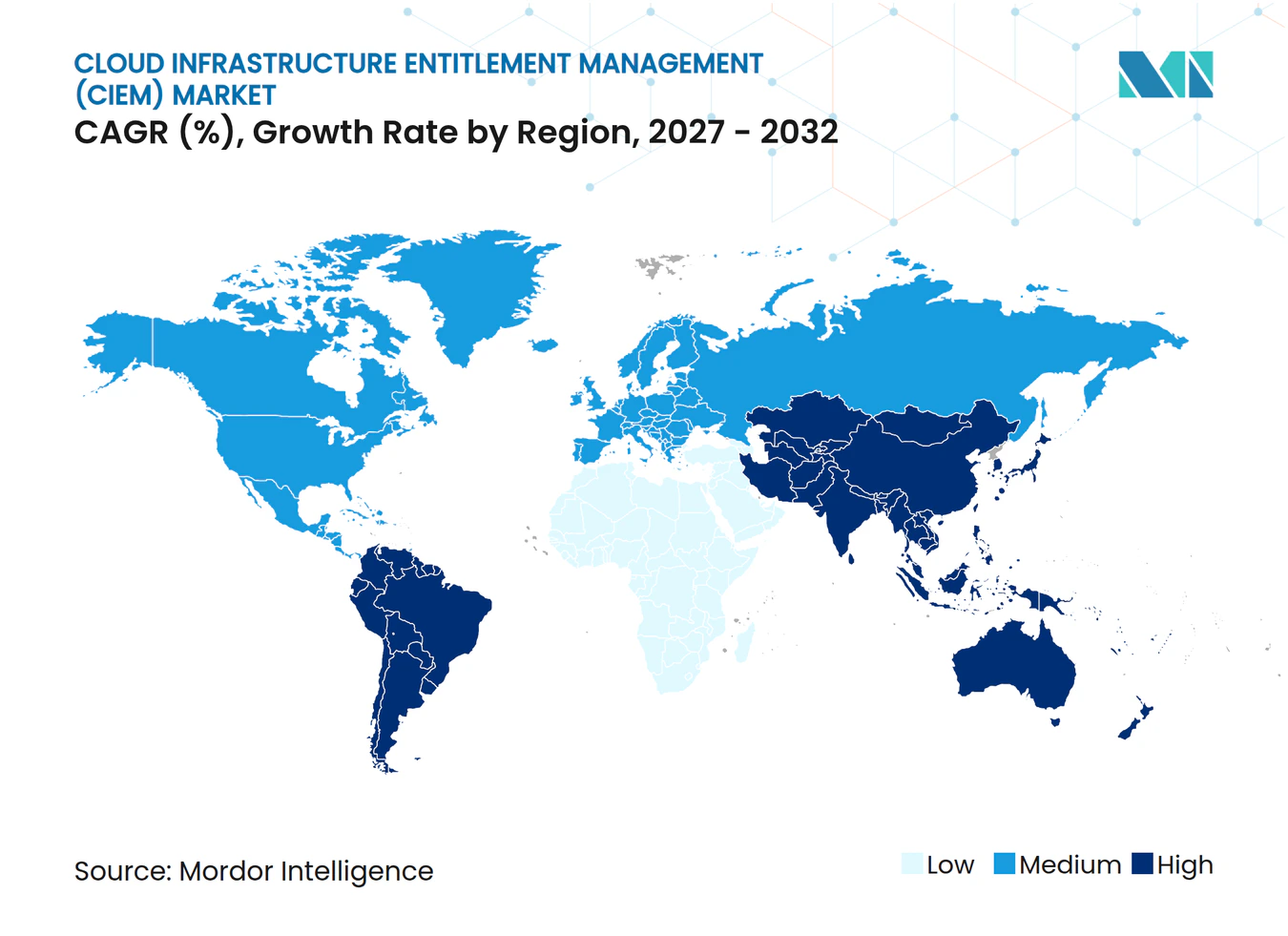
North America held 42.31% of the Cloud infrastructure entitlement management market in 2026, supported by dense enterprise cloud adoption and broad compliance obligations across high-value sectors. Federal contractors must address NIST SP 800-53 access-control requirements in FedRAMP-related environments, while financial institutions and healthcare organizations face their own access governance expectations. The region contains established providers including Palo Alto Networks, CyberArk, SailPoint, CrowdStrike, BeyondTrust, and Saviynt. This supplier base gives enterprise and mid-market buyers access to mature technology platforms and established implementation support. Microsoft’s October 2025 retirement of Entra Permissions Management also created a transition requirement for customers seeking cross-cloud entitlement visibility.
APAC Cloud Infrastructure Entitlement Management (CIEM) Market
Asia-Pacific is projected to expand at a 29.84% CAGR from 2027 to 2032 as cloud migration advances alongside national cybersecurity and privacy frameworks. India’s financial sector has requirements for cloud-hosted systems that increase the focus on controlled access, while healthcare providers moving to cloud-native platforms must govern permissions across clinical workloads. Japan and South Korea represent mature enterprise demand bases where data-protection rules support investment in continuous access monitoring. China’s cloud environment, led by domestic providers such as Alibaba Cloud, Tencent Cloud, and Huawei Cloud, operates under the Cybersecurity Law, Data Security Law, and Personal Information Protection Law. The Cloud infrastructure entitlement management market size for Asia-Pacific is projected to expand at a 29.84% CAGR between 2027 and 2032, creating demand for regional deployment and compliance capabilities.
EMEA and South America Cloud Infrastructure Entitlement Management (CIEM) Market
Europe remains important because NIS2, GDPR, and country-level requirements raise the need for demonstrable access governance. The European Commission has stated that a January 2026 proposal to amend NIS2 would simplify compliance for 28,700 in-scope companies, including 6,200 micro and small enterprises.[4] South America is an emerging demand area, led by Brazil’s data-protection framework and adoption in BFSI, although limited specialist talent restricts uptake beyond large multinationals. The Middle East is supported by Saudi Arabia and the United Arab Emirates through cloud programs linked to Vision 2030, while Africa is led by South Africa and Nigeria as cloud security maturity develops.
Competitive Landscape
Market Concentration
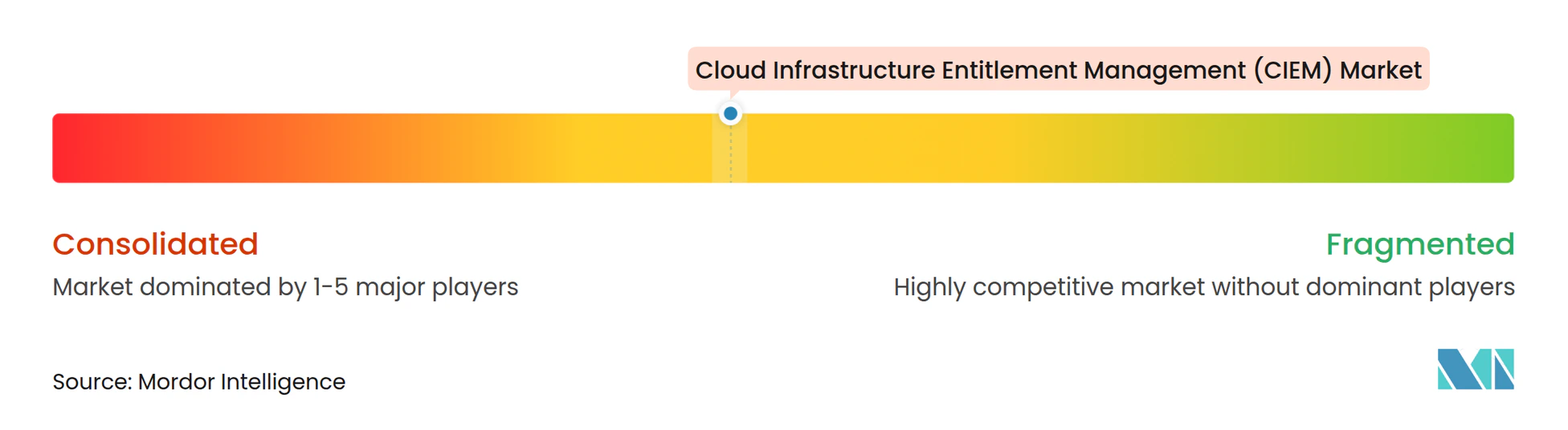
The Cloud infrastructure entitlement management market is moving from a moderately fragmented group of specialist offerings toward broader security and identity platforms. Palo Alto Networks completed its acquisition of CyberArk in February 2026, combining Prisma Cloud capabilities with CyberArk’s privileged access management and machine identity portfolio. The transaction shows that identity security and cloud protection are being evaluated together rather than as unrelated technology decisions. Independent providers, including CrowdStrike, SailPoint, Saviynt, BeyondTrust, and Orca Security, continue to expand coverage across human, non-human, and AI agent identities. Within the Cloud infrastructure entitlement management market, competitive differentiation depends on analyzing permissions across cloud platforms and converting findings into action without interrupting critical workloads.
SailPoint’s 2026 Agentic Fabric initiative reflects vendor efforts to place AI-supported governance within broader identity platforms. Saviynt launched an AI-powered Identity Security Posture Management solution in April 2025 to provide risk insights and prioritization across cloud and software environments. BeyondTrust released AI security controls in September 2025 for the discovery, classification, and risk scoring of AI agents across cloud and software-as-a-service platforms. Orca Security expanded runtime protection to hybrid and private cloud environments in July 2025, extending its coverage beyond public cloud deployments. These actions show that the Cloud infrastructure entitlement management market is connecting entitlement risk, machine identity, cloud posture, and runtime activity within more integrated offerings.
Specialists such as Britive, Sonrai Security, and Sysdig remain relevant where buyers require focused capabilities in just-in-time access, identity risk graphs, or container security with identity context. Their opportunity is strongest where a broad cloud security platform does not provide sufficient depth in permission analysis or non-human identity coverage. Hyperscaler-native services can offer basic entitlement analytics, which increases the expectation that independent vendors must demonstrate advanced cross-cloud analysis and remediation. In the Cloud infrastructure entitlement management market, mid-market buyers and emerging markets in South America, the Middle East, and Africa provide further room for CIEM-as-a-service offerings that combine technology with expert operational support.
Cloud Infrastructure Entitlement Management (CIEM) Industry Leaders
-
Microsoft Corporation
-
Palo Alto Networks, Inc.
-
CrowdStrike Holdings, Inc.
-
SailPoint Technologies, Inc.
-
Zscaler, Inc.
- *Disclaimer: Major Players sorted in no particular order
Cloud Infrastructure Entitlement Management (CIEM) Market Companies Covered in this Report
- Microsoft Corporation
- CyberArk Software Ltd.
- Palo Alto Networks, Inc.
- Zscaler, Inc.
- Check Point Software Technologies Ltd.
- SailPoint Technologies, Inc.
- CrowdStrike Holdings, Inc.
- BeyondTrust Corporation
- Rapid7, Inc.
- Saviynt, Inc.
- Orca Security Ltd.
- Tenable Holdings, Inc.
- One Identity LLC
- Delinea Inc.
- Sysdig, Inc.
- NextLabs, Inc.
- Britive, Inc.
- Sonrai Security, Inc.
- StrongDM, Inc.
- Wiz, Inc.
Recent Industry Developments in Cloud Infrastructure Entitlement Management (CIEM) Market
- March 2026: Orca Security unveiled its agentic cloud security platform at RSAC 2026, introducing AI-powered security agents, real-time detection of AI usage across cloud environments, and code reachability analysis connecting development-time risks to production runtime.
- February 2026: Palo Alto Networks completed its USD 25 billion acquisition of CyberArk, combining Prisma Cloud’s CIEM capabilities with CyberArk’s privileged access management and machine identity portfolio into a unified identity security platform.
- September 2025: BeyondTrust released AI security controls within Identity Security Insights, enabling discovery, classification, and risk-scoring of AI agents across cloud and software-as-a-service platforms, with Zero Standing Privilege and Just-In-Time access policies applied to agentic AI systems.
- July 2025: Orca Security announced a runtime protection solution for hybrid and private cloud environments, extending its agentless-first CNAPP beyond public cloud to private cloud and on-premises infrastructure for regulated industries.
Global Cloud Infrastructure Entitlement Management (CIEM) Market Report Scope
The cloud infrastructure entitlement management (CIEM) refers to an automated security solution designed to manage and control identity access, rights, and permissions across public cloud environments. Continuous monitoring of the activity of users and applications prevents excessive entitlements and enforces appropriate access controls to significantly reduce the risk of unauthorized activity and data breaches.
The Cloud Infrastructure Entitlement Management (CIEM) Market Report is Segmented by Product Offering (Software and Services), Deployment Model (Cloud and Hybrid Cloud), Organization Size (Large Enterprises and Small and Medium Enterprises), Application (Banking, Financial Services and Insurance [BFSI)], Healthcare and Life Sciences, Retail and E-Commerce, Manufacturing and Industrial, Government and Public Sector, Information Technology and Telecommunications, and Other Applications), and Geography (North America, South America, Europe, Asia-Pacific, Middle East, and Africa). The Market Forecasts are Provided in Terms of Value (USD).
Segmentation Overview
| Solutions |
| Services |
| Cloud |
| Hybrid Cloud |
| Large Enterprises |
| Small and Medium Enterprises |
| Banking, Financial Services and Insurance (BFSI) |
| Healthcare and Life Sciences |
| Retail and E-Commerce |
| Manufacturing and Industrial |
| Government and Public Sector |
| Information Technology and Telecommunications |
| Other Applications |
| North America | United States |
| Canada | |
| Mexico | |
| South America | Brazil |
| Argentina | |
| Rest of South America | |
| Europe | Germany |
| United Kingdom | |
| France | |
| Italy | |
| Spain | |
| Rest of Europe | |
| Asia-Pacific | China |
| India | |
| Japan | |
| South Korea | |
| Australia | |
| Rest of Asia-Pacific | |
| Middle East | Saudi Arabia |
| United Arab Emirates | |
| Turkey | |
| Rest of Middle East | |
| Africa | South Africa |
| Nigeria | |
| Egypt | |
| Rest of Africa |
| By Product Offering | Solutions | |
| Services | ||
| By Deployment Model | Cloud | |
| Hybrid Cloud | ||
| By Organization Size | Large Enterprises | |
| Small and Medium Enterprises | ||
| By Application | Banking, Financial Services and Insurance (BFSI) | |
| Healthcare and Life Sciences | ||
| Retail and E-Commerce | ||
| Manufacturing and Industrial | ||
| Government and Public Sector | ||
| Information Technology and Telecommunications | ||
| Other Applications | ||
| By Geography | North America | United States |
| Canada | ||
| Mexico | ||
| South America | Brazil | |
| Argentina | ||
| Rest of South America | ||
| Europe | Germany | |
| United Kingdom | ||
| France | ||
| Italy | ||
| Spain | ||
| Rest of Europe | ||
| Asia-Pacific | China | |
| India | ||
| Japan | ||
| South Korea | ||
| Australia | ||
| Rest of Asia-Pacific | ||
| Middle East | Saudi Arabia | |
| United Arab Emirates | ||
| Turkey | ||
| Rest of Middle East | ||
| Africa | South Africa | |
| Nigeria | ||
| Egypt | ||
| Rest of Africa | ||
Key Questions Answered in the Report
What is the 2026 valuation of cloud infrastructure entitlement management?
It is projected to be USD 3.19 billion in 2026, then reach USD 3.99 billion in 2027 and USD 13.04 billion by 2032, at a 26.72% CAGR from 2027 to 2032.
Which product offering leads cloud entitlement management adoption?
Solutions lead with 69.32% share in 2026 because enterprises require continuous discovery and analysis of permissions across cloud environments.
Why is hybrid cloud important for entitlement governance?
Hybrid cloud is projected to expand at a 28.21% CAGR through 2032 because regulated organizations need to govern both on-premises and public cloud identity systems.
Which application is projected to expand fastest through 2032?
Healthcare and life sciences is projected to expand at a 30.12% CAGR as cloud migration of clinical and health-record workloads increases identity governance needs.
Which region is projected to expand fastest?
Asia-Pacific is projected to expand at a 29.84% CAGR through 2032, supported by cloud migration and developing cybersecurity frameworks.
How do machine identities affect cloud entitlement management?
Service accounts, API keys, workload identities, and AI agent credentials need continuous review because they can hold extensive permissions across cloud systems.