
Managed CSPM Services Market Size and Share
Market Overview
| Study Period | 2027 - 2032 |
|---|---|
| Market Size (2027) | USD 3.47 Billion |
| Market Size (2032) | USD 7.71 Billion |
| Growth Rate (2027 - 2032) | 17.31 % |
| Fastest Growing Market | Asia-Pacific |
| Largest Market | North America |
| Market Concentration | Medium |
Major Players *Disclaimer: Major Players sorted in no particular order Image © Mordor Intelligence. Reuse requires attribution under CC BY 4.0. | |
Managed CSPM Services Market Analysis by Mordor Intelligence
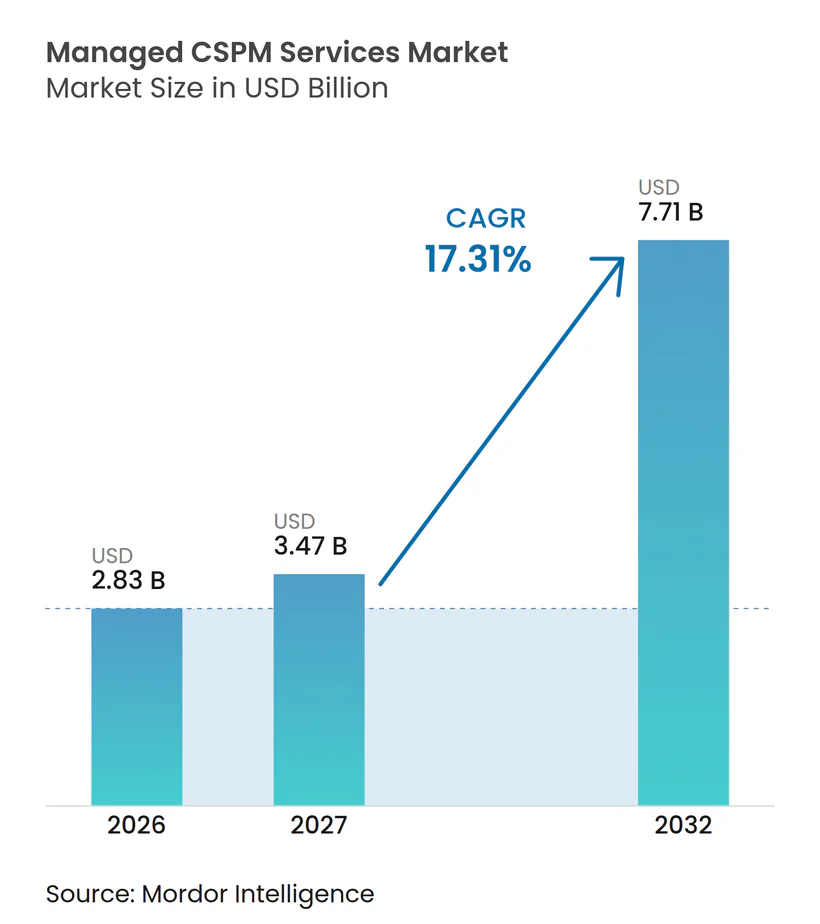
The Managed CSPM Services Market size is projected to expand from USD 2.83 billion in 2026 and USD 3.32 billion in 2027 to USD 7.71 billion by 2032, registering a CAGR of 17.31% between 2027 to 2032. The managed CSPM services market is expanding as organizations use more cloud environments, cloud accounts, cloud-based applications, and shared services than their internal security teams can consistently monitor across development and production settings. Managed providers address configuration drift, compliance evidence, remediation queues, policy exceptions, ownership gaps, and the follow-up work that can remain open for long periods when internal teams have competing responsibilities. Regulatory obligations in financial services and critical sectors are also making continuous cloud controls more important in procurement decisions, because buyers need a regular record of control activity, documented actions, and a clear means of demonstrating accountability rather than a limited point-in-time review. Platform consolidation is changing what buyers expect, with managed providers needing to combine posture management with runtime context, risk prioritization, practical remediation support, client-specific policy settings, and clear accountability for the outcome of a finding. AI workloads add resource types such as GPU clusters, model endpoints, and vector databases, which can create gaps in existing policy libraries and open opportunities for providers with current controls, AI-specific policies, targeted architecture reviews, and an operating process that can adapt as environments change.
Key Report Takeaways
- By offering, Managed CSPM Services held 74.88% of the Managed CSPM Services Market share in 2026, while Professional CSPM Services is projected to expand at a 19.81% CAGR through 2032.
- By service type, Managed Operations accounted for 49.71% of revenue in 2026, while Implementation and Integration Services is projected to expand at a 19.66% CAGR through 2032.
- By delivery model, Agentless Subscription held 34.53% of revenue in 2026 and is projected to expand at a 19.79% CAGR through 2032.
- By deployment mode, Public Cloud held 43.96% of revenue in 2026 and is projected to expand at a 19.31% CAGR through 2032.
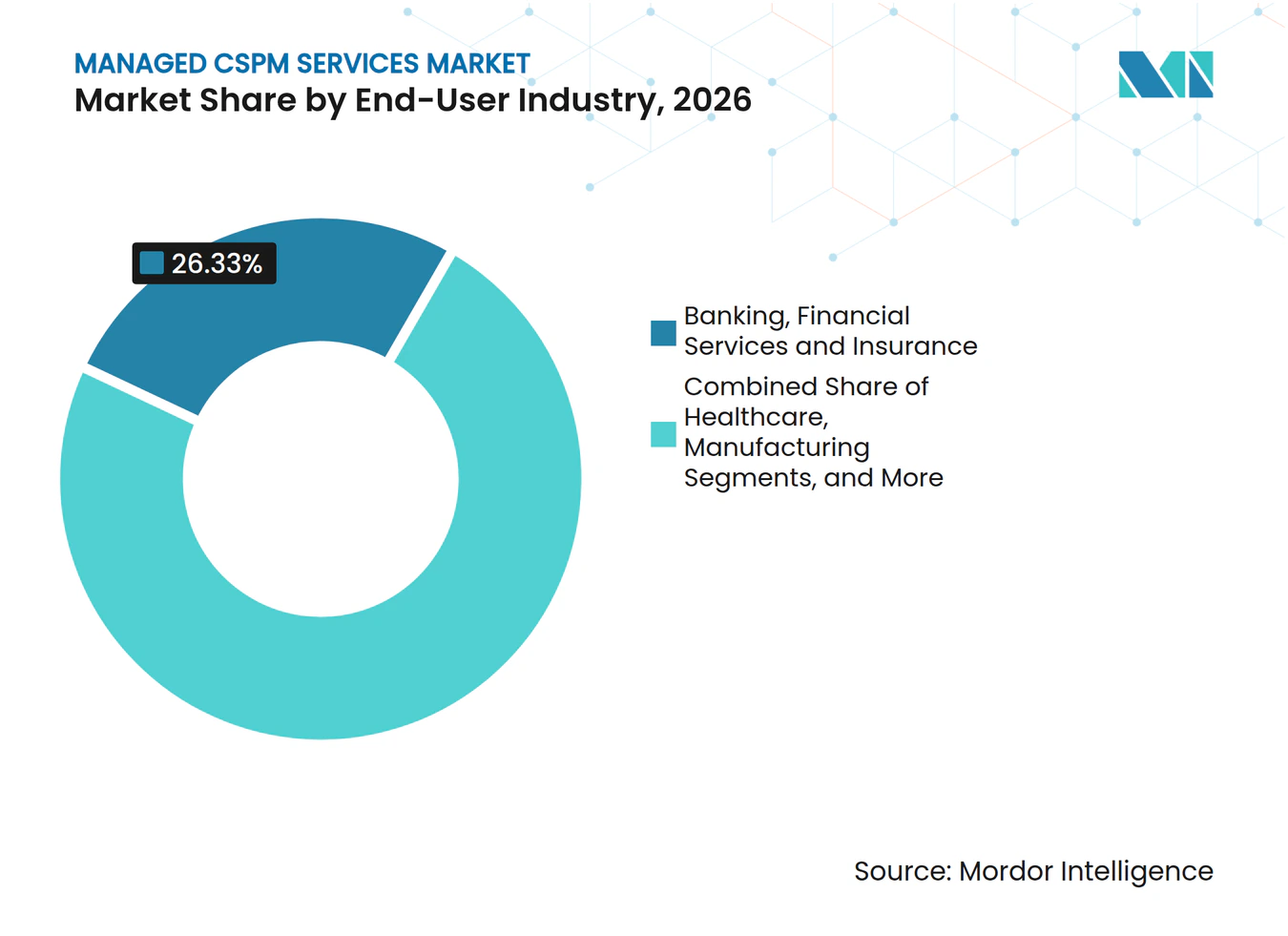
- By end-user industry, BFSI accounted for 26.33% of revenue in 2026, while Information Technology and Telecommunications is projected to expand at a 19.68% CAGR through 2032.
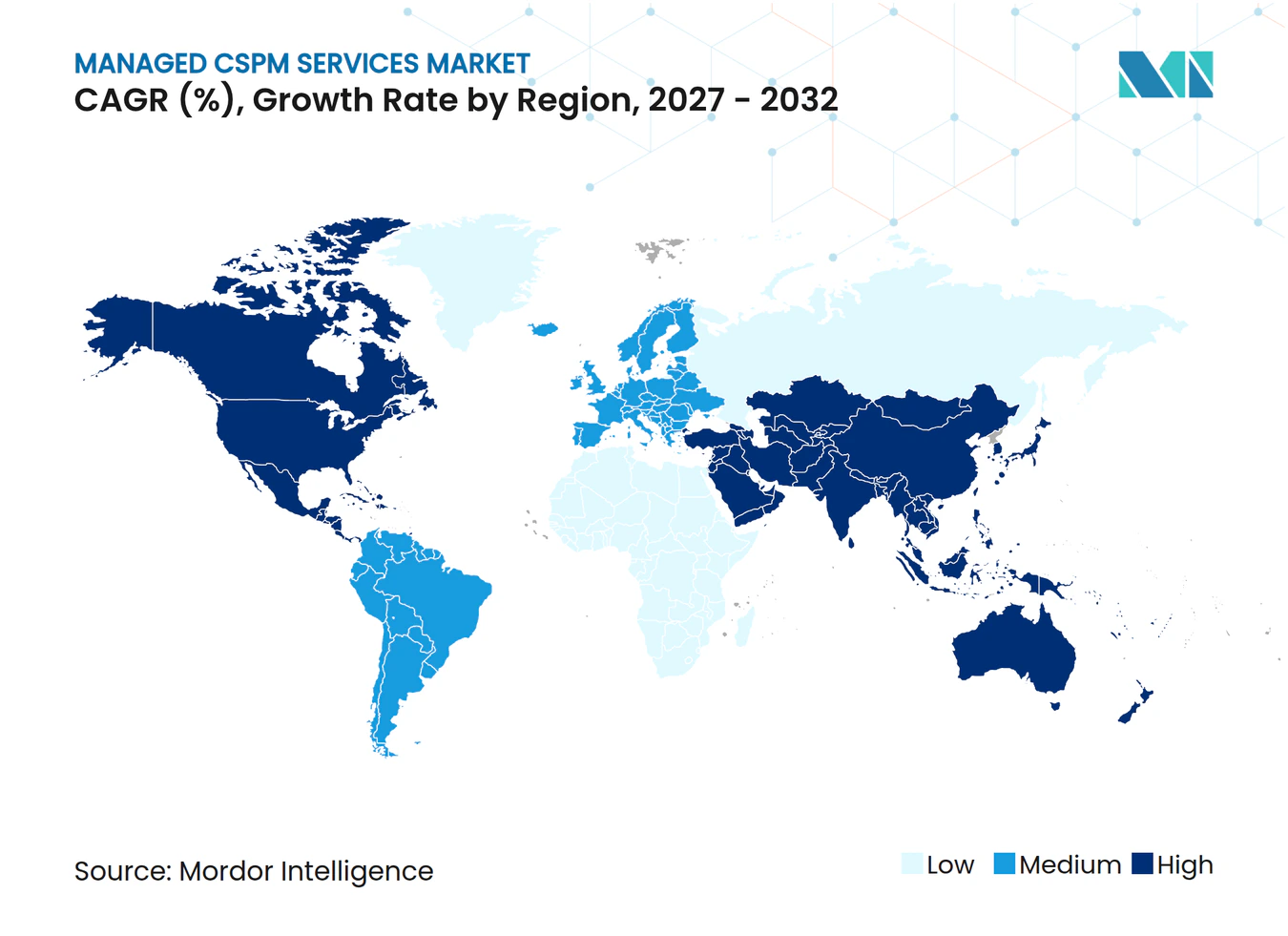
- By geography, North America held 33.08% of revenue in 2026, while Asia-Pacific is projected to expand at a 19.23% CAGR through 2032.
Note: Market numbers in this report are based on Mordor Intelligence's proprietary estimation framework, which combines nine months of actuals with Q4 projections for base year 2026.
Market Trends and Insights
Drivers Impact Analysis of Managed CSPM Services Market*
| Driver | (~) % Impact on CAGR Forecast | Geographic Relevance | Impact Timeline |
|---|---|---|---|
| CNAPP Platform Integration | +3.8% | Global | Medium term (2-4 years) |
| AI-Assisted Auto-Remediation Engines | +3.4% | Global, with North America and Asia-Pacific leading adoption | Medium term (2-4 years) |
| Zero-Trust and Shared-Responsibility Audits | +2.7% | North America and EU core, spillover to Asia-Pacific | Long term (≥ 4 years) |
| Real-Time Cloud-Configuration Reporting | +2.5% | EU, Asia-Pacific, North America | Short term (≤ 2 years) |
| Multi-Cloud Sprawl in Mid-Market Enterprises | +1.9% | Global | Medium term (2-4 years) |
| Cyber-Insurance Security Scorecard Requirements | +1.3% | North America and EU | Short term (≤ 2 years) |
| Source: Mordor Intelligence | |||
Integration of CSPM Into CNAPP Platforms
The managed CSPM services market is being reshaped by the inclusion of cloud security posture management within cloud-native application protection platforms, which bring related controls into a common operating environment. Buyers are consolidating CSPM, workload protection, cloud infrastructure entitlement management, and cloud detection functions to reduce fragmented tooling, repeated alerts, separate dashboards, and unclear accountability for a finding. Palo Alto Networks introduced Cortex Cloud 2.0 in October 2025, combining CNAPP capabilities, cloud detection, and autonomous AI agents trained on 1.2 billion security responses.[1] This wider platform scope raises buyer expectations beyond static configuration checks to include attack-path analysis, runtime context, risk ranking, and a clear route from detection to remediation. Providers that only offer basic posture checks can face pricing pressure when hyperscaler tools cover some scanning needs without an added license, even though those tools may not manage the end-to-end process. The opportunity lies with services that turn platform findings into tailored controls, accountable owners, reliable evidence, and closed remediation actions.
AI-Assisted Auto-Remediation Engines
AI-assisted remediation is changing the delivery model for the managed cloud security posture management services market because it can prioritize, test, and prepare fixes before an analyst takes action. Palo Alto Networks reported that critical cloud risks remained unresolved for an average of 120 days under conventional triage approaches in 2025. Current systems can assess remediation paths, simulate potential effects, generate infrastructure-as-code patches, and operate within client-approved controls, rather than simply reporting the same issue again. ZEST Security introduced a multi-agent system in April 2025 that allocated risk prioritization, impact simulation, code generation, and resolution building to specialized agents, with early deployments reporting a more than 50% reduction in security operations and incident-response workload.[2] This model can increase the number of findings closed per analyst and give clients quicker feedback on whether a risk has been addressed, but poor guardrails can introduce further configuration drift. Managed oversight remains necessary to validate proposed changes, protect production workloads, preserve an approval record, and maintain accountability when automation handles a material action.
Expansion of Zero-Trust and Shared-Responsibility Audits
Zero-trust programs support demand for managed monitoring because they require ongoing proof that cloud controls operate as intended across users, workloads, identities, and resources. NIST Special Publication 1800-35, published in 2025, links cloud security posture management with the continuous-monitoring element of zero-trust architecture and provides multi-cloud integration guidance. Cloud providers can supply configuration information, while customers remain responsible for testing that information against their own risk standards and for documenting the resulting decisions. This distinction creates a verification task that many internal teams cannot perform continuously across different cloud platforms, especially when responsibility is split among application, infrastructure, and security teams. Prowler reported in 2025 that 64% of organizations operated hybrid environments and 55% used multi-cloud configurations. Separate policy baselines, approval processes, and control mappings across these environments increase the value of a managed verification service that can apply a consistent review method.
Regulatory Push for Real-Time Cloud-Configuration Reporting
The managed CSPM services market benefits as compliance obligations move from periodic assessment to continuous, exportable evidence that can show what was in place at a specific time. ENISA issued NIS2 technical implementation guidance in June 2025 that calls for machine-generated evidence of technical controls for essential and important entities. This requirement is difficult to meet through manual reviews or static policy documents because cloud settings can change after a report is prepared. Financial-sector rules in India also require closer cloud control monitoring across banking, securities, and insurance activities, raising the importance of regularly recorded technical evidence. Japan's data protection requirements are encouraging vendors to expand compliance libraries for local data-handling obligations and help clients assess cloud settings against those obligations. The cost and operational consequences of a compliance failure can make a recurring managed service easier to justify, particularly for mid-sized organizations that have limited security operations capacity.
Restraints Impact Analysis of Managed CSPM Services Market*
| Restraint | (~) % Impact on CAGR Forecast | Geographic Relevance | Impact Timeline |
|---|---|---|---|
| Alert Fatigue and Cloud-Security Skills Shortage | -1.2% | Global | Medium term (2-4 years) |
| CWPP and CIEM Tool Overlap | -0.9% | North America and EU | Short term (≤ 2 years) |
| Limited SaaS and PaaS API Depth | -0.7% | Global | Long term (≥ 4 years) |
| Data-Residency Barriers in Sovereign-Cloud Projects | -0.6% | EU and Asia-Pacific | Medium term (2-4 years) |
| Source: Mordor Intelligence | |||
Alert Fatigue and Shortage of Cloud-Security Skills
Alert fatigue and limited specialist capacity can restrict how rapidly managed providers scale without affecting service quality, response time, or the consistency of customer reporting. A 2025 study in ACM Computing Surveys found that 54% of security operations center teams felt overwhelmed by alert volumes and that analysts spent more than 25% of their time on false positives.[3] Cloud environments can intensify this problem because configuration alerts are numerous, vary widely in severity, and can be assigned to different teams depending on the resource involved. Red Canary reported that 75% of organizations faced skills shortages in intrusion detection and 72% faced shortages in incident response during 2025. Providers must compete for analysts who understand cloud architecture, compliance, automation controls, and the operational effect of changing a configuration in a live environment. At the same time, an organization that cannot recruit these skills internally may choose to outsource, which sustains demand while placing pressure on provider capacity.
Tool Overlap With CWPP and CIEM Creating Budget Friction
Overlap among CSPM, cloud workload protection platforms, and cloud infrastructure entitlement management tools can delay purchasing decisions and make a separate managed service harder to position. Organizations often question whether a posture service duplicates features within an existing CNAPP or extended detection and response contract, particularly when budgets are being reviewed. This issue is most relevant where buyers are reducing the number of security tools and seeking a single operating model with fewer vendors and clearer cost control. It favors service providers that can show policy customization, operational depth, workflow ownership, and audit-ready evidence rather than only tool administration. NIS2 and DORA-related control evidence can provide a practical point of distinction where native platform functions do not produce the needed records by default. The managed CSPM services market therefore depends on providers explaining how their work complements, rather than replicates, client technology investments and existing licenses.
*Our forecasts treat driver/restraint impacts as directional, not additive. The impact forecasts reflect baseline growth, mix effects, and variable interactions.
Managed CSPM Services Market Segment Analysis
By Offering:
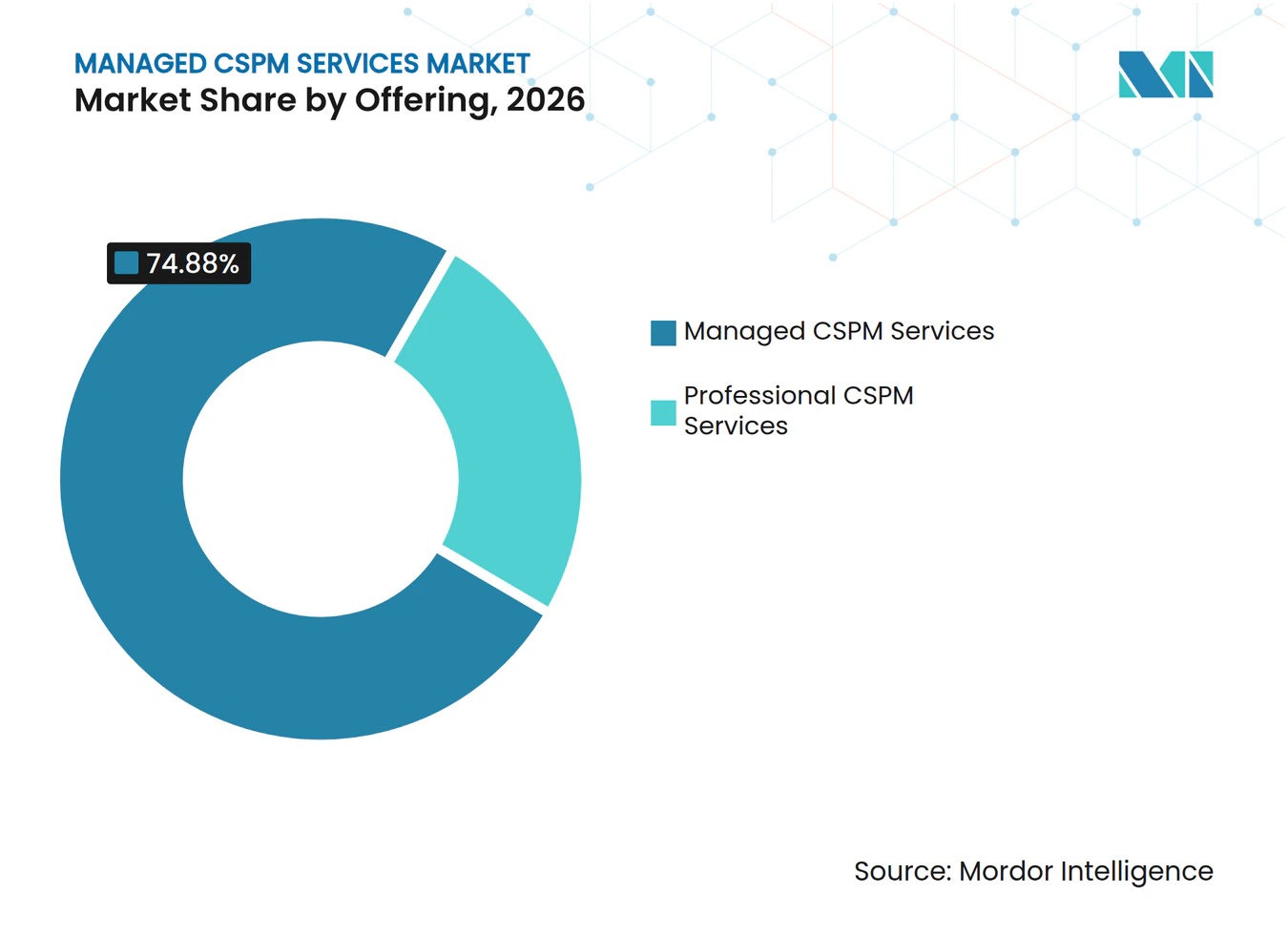
Managed and Professional Services Support Different Stages of AdoptionManaged CSPM Services held 74.88% of offering revenue in 2026, making it the largest offering within the managed CSPM services market. The service gives customers continuous visibility into cloud resources, policy status, configuration changes, compliance obligations, and the ownership of each open issue. Providers review findings on an ongoing basis, help set priorities according to business impact, and record the action taken on material issues for operational and audit purposes. This recurring delivery suits clients that cannot keep skilled staff assigned to monitoring, validation, reporting, and follow-up across several cloud accounts every day. It also lets a provider learn the client's control requirements, ownership structure, risk tolerance, reporting cadence, and escalation path over a longer relationship.
Professional CSPM Services is projected to expand at a 19.81% CAGR through 2032. These engagements cover architecture reviews, zero-trust alignment, implementation planning, migration-security audits, policy design, and assessment of the processes that will support steady-state operations. Tenable reported in 2025 that 63% of organizations used more than 1 cloud provider, while only 57% had adopted CSPM tools. The difference points to work that identifies missing controls, clarifies responsibilities, evaluates existing policies, and connects tool outputs with a practical operating process. A professional engagement can also document baseline configurations, confirm stakeholders, prepare remediation workflows, and define service expectations before a customer hands ongoing monitoring to a provider.



By Service Type:
Managed Operations Leads Revenue While Implementation Expands QuicklyManaged Operations accounted for 49.71% of service-type revenue in 2026, the highest share in the managed cloud security posture management services market. Configuration drift can occur whenever teams create resources, change permissions, modify network rules, update applications, create new identities, or change cloud account settings. Organizations, therefore, need regular monitoring rather than a one-time assessment that quickly becomes outdated as environments and development activity change. Managed operations maintains the evidence trail expected under modern cloud-control requirements and gives customers a clear record of active issues, previous findings, assigned owners, and remediation status. Analysts can investigate findings, coordinate with workload owners, check remediation progress, validate completed changes, and escalate risks that need management attention.
Implementation and Integration Services is projected to expand at a 19.66% CAGR through 2032. This work connects posture tools with security information and event management platforms, ticketing systems, identity tools, DevSecOps pipelines, and the reporting processes that make findings useful to each client team. Tenable found that organizations managed an average of 2.7 cloud environments in 2025. Each environment can require separate connectors, application programming interfaces, ownership models, alert-routing rules, compliance mappings, and review procedures for sensitive changes. Consulting and advisory, training and support, and implementation work may generate less recurring revenue, but they can help clients use the managed service correctly, understand the process, and remain with the provider.
By Delivery Model:
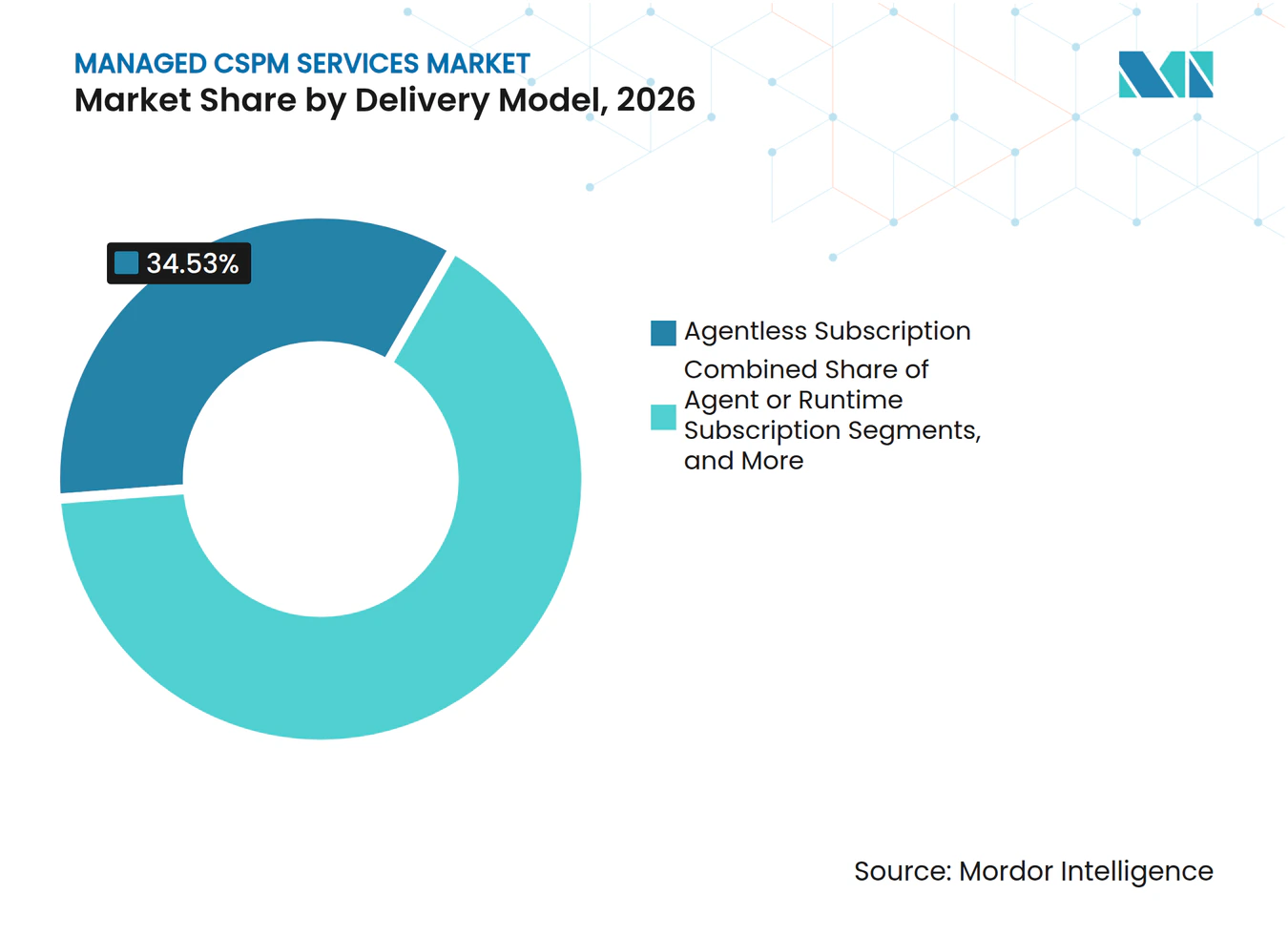
Agentless Subscription Combines Scale and Ease of AdoptionAgentless Subscription held 34.53% of delivery-model revenue in 2026 and represented the largest delivery model in the managed cloud security posture management services market. It is projected to expand at a 19.79% CAGR through 2032. Agentless scanning avoids the need to deploy, patch, maintain, and coordinate security agents across a client's cloud accounts, workload groups, and changing resource inventories. This reduces deployment friction and can speed onboarding for regulated organizations that limit changes to production workloads and need an approved connection method. Providers can review cloud resources through supported interfaces without installing software on each workload, which helps them cover a broad client estate while reducing maintenance work for both parties.
Agent or Runtime Subscription models remain important for use cases that require behavioral detection at the process level, particularly where a client needs signals from activity inside a workload. They can complement agentless posture coverage where organizations need runtime signals, workload-specific protection, or closer visibility into active processes and unusual behavior. Data-Volume Subscription models can serve clients with large and variable telemetry volumes that need pricing linked to use and a clearer method for managing increasing data flows. Feature-Tiered Subscription models can support smaller customers that need a limited control set and large enterprises that require more workflows, integrations, and reporting options. The managed CSPM services market can use these alternatives to match delivery depth with risk exposure, technology maturity, and procurement constraints.

By Deployment Mode:
Public Cloud Leads as Environment Complexity IncreasesPublic Cloud held 43.96% of deployment-mode revenue in 2026 and led the managed CSPM services market by deployment mode. It is projected to expand at a 19.31% CAGR through 2032 as organizations continue to place new workloads, data services, and development activity on major cloud platforms. Native tools from AWS, Microsoft Azure, and Google Cloud can provide useful signals, but each has a limited view outside its own environment and cannot by itself create a complete multi-cloud operating process. Managed providers can assemble findings, policies, ownership details, and evidence across multiple cloud services in one operating process that is adapted to the customer's risk model. This role becomes more valuable as client estates include more accounts, regions, applications, identity permissions, development teams, and third-party services.
Prowler reported that 55% of organizations operated multi-cloud environments in 2025, while only 17% remained on a single cloud. Private cloud and hybrid cloud deployments are smaller in share but remain important for organizations with data-sovereignty obligations, legacy systems, or workloads that cannot move easily. These clients need common policies across on-premises systems and public cloud resources, even where different teams manage each environment and use different technology stacks. Hybrid estates can also blur responsibility boundaries among infrastructure, application, compliance, security teams, and outsourced service providers. The managed CSPM services market can address this complexity by applying common controls, assigning ownership clearly, and producing a unified audit record that follows the resource across environments.
By End-User Industry:
BFSI Retains Leadership as Technology and Telecommunications AcceleratesBFSI accounted for 26.33% of end-user revenue in 2026, the largest end-user share within the managed CSPM services market. Banking, securities, and insurance organizations face strict expectations around cloud outsourcing, incident management, data protection, and the ability to show that controls work after operational changes. Continuous posture assurance helps them demonstrate that controls remain effective between formal audits and after teams add new accounts, workloads, permissions, or applications. It also supports teams that must coordinate security requirements across business units, external service providers, multiple cloud accounts, and internal risk or compliance functions. The sector's demand is reinforced by rules that require reliable documentation as well as timely action on material control gaps.
Information Technology and Telecommunications is projected to expand at a 19.68% CAGR through 2032. These organizations have high cloud infrastructure use and frequently deliver technology services to regulated customers, which increases the importance of their control evidence and remediation processes. ISACA noted in 2025 that DORA applies obligations to third-party ICT providers serving EU financial entities. Healthcare can become a further contributor as clinical systems move to cloud environments and require careful access, configuration, and data management. Government and public-sector demand can be limited by sovereign-cloud requirements, while retail, e-commerce, and manufacturing use cases are shaped by payment-security obligations and operational technology integration risks.
Geography Analysis
North America Managed CSPM Services Market
North America held 33.08% of the Managed CSPM Services Market share in 2026, supported by mature cloud-security purchasing in the United States. Public-company disclosure requirements have increased senior-management attention to material cyber risks and accelerated review of cloud configuration controls, incident readiness, and reporting processes. Canada's cloud guidance for federally regulated financial institutions and expanding banking cloud use in Mexico provide additional demand conditions. The region has a large base of multi-cloud users across BFSI and technology sectors, which gives providers a broad set of environments to support. These buyers often have established tools but need assistance converting technical findings into prioritized, documented remediation work that business and risk leaders can understand.
Europe Managed CSPM Services Market
Europe represented the second-largest regional position in 2026, supported by NIS2 implementation and DORA becoming operational in January 2025. ENISA confirmed in June 2025 that NIS2 evidence needs to be machine generated and exportable. This expectation supports managed services that retain control records as configurations change, rather than relying on documents prepared only for an audit or a periodic assessment. Germany, France, and the United Kingdom have active demand conditions because organizations must show stronger operational resilience, clear responsibility for digital controls, and the capacity to respond to a material issue.
APAC and MEA Managed CSPM Services Market
Asia-Pacific is projected to expand at a 19.23% CAGR through 2032 and is the fastest-growing regional component of the managed cloud security posture management services market. Cloud adoption, AI-related exposure, and government requirements are increasing the need for continuous security operations across the region, including services that can adapt to local compliance expectations. India is particularly relevant because financial regulators require closer monitoring across banking, securities, and insurance cloud environments. Japan's data-protection rules are shaping compliance-check libraries and local product adaptations, while clients also need policies that fit domestic operational requirements. The Middle East and Africa remains the smallest regional share, but the United Arab Emirates and Saudi Arabia are building demand through digital infrastructure programs and cloud controls for critical sectors, while budget availability and talent shortages can limit adoption in Egypt and South Africa and sovereign-cloud requirements can constrain providers that cannot host telemetry locally.
Competitive Landscape
Market Concentration
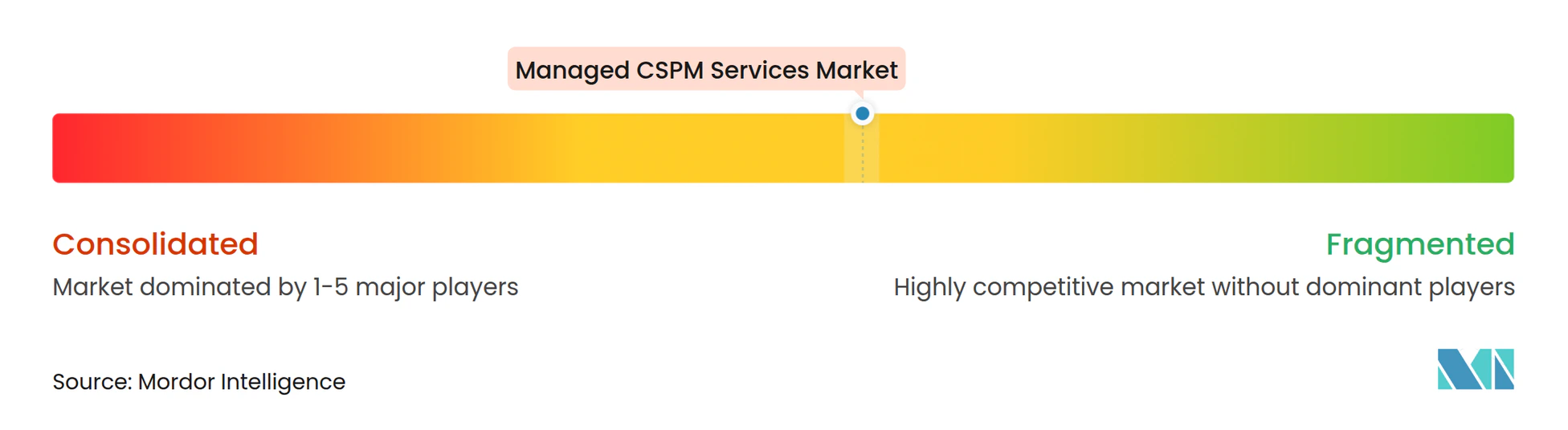
The managed CSPM services market is moderately concentrated and includes CNAPP platform vendors, global system integrators, and managed security service providers that approach customers with different combinations of technology, advisory support, integration, and ongoing operations. Platform vendors combine posture functions with related cloud-security capabilities and often bundle them within broader subscriptions, which can simplify procurement for customers already using their platforms while also increasing the need to show service value beyond the license. Global system integrators such as Accenture, Deloitte Touche Tohmatsu Limited, and Tata Consultancy Services are most active with enterprise and government buyers that require advisory work, implementation support, operations, and coordination across several internal teams. Managed security service providers, including Arctic Wolf, Secureworks under Sophos, and Rapid7, address clients that value continuous coverage, practical response support, lower operating complexity, and a more predictable service model. This mix gives buyers a choice between a broad technology platform, a transformation partner, and a provider focused on daily security operations.
Palo Alto Networks launched Cortex Cloud 2.0 in October 2025, adding autonomous AI agents, CNAPP functions, and cloud detection capabilities. The move shows how large platform vendors are making remediation speed, risk context, integrated operations, easier workflows, and automated support for security teams central to their cloud-security propositions. Check Point Software Technologies and Wiz made their integrated CNAPP and cloud network security solution generally available in September 2025. The partnership combines CNAPP visibility with gateway-level prevention and automated remediation flows, raising the value of prevention capabilities, cross-platform integration, and shorter response paths during provider selection.
Arctic Wolf expanded its Aurora Platform in August 2025 with integrations for Microsoft Defender XDR, Oracle Cloud Guard, OneLogin, and CyberArk Privileged Access Manager. Its approach gives customers wider security operations coverage without requiring them to replace existing technology, which can reduce disruption during service adoption and help preserve previous technology investments. Optiv Security and NTT DATA Corporation are targeting a potential gap between technical CNAPP depth and mid-market pricing through combined advisory and operations delivery. Smaller cloud-native providers are using agentic AI to compete on remediation speed, automation, and the ability to handle a high volume of cloud findings with limited analyst effort. Providers that translate platform findings into client-specific remediation, clear ownership, reliable reporting, and audit evidence may be better placed to retain accounts and demonstrate value after implementation.
Managed CSPM Services Industry Leaders
-
Palo Alto Networks, Inc.
-
Microsoft Corporation
-
IBM Corporation
-
Check Point Software Technologies Ltd.
-
Cisco Systems, Inc.
- *Disclaimer: Major Players sorted in no particular order
Managed CSPM Services Market Companies Covered in this Report
- Palo Alto Networks, Inc.
- Microsoft Corporation
- IBM Corporation
- Check Point Software Technologies Ltd.
- Cisco Systems, Inc.
- Accenture plc
- Deloitte Touche Tohmatsu Limited
- Tata Consultancy Services Limited
- Wipro Limited
- Cognizant Technology Solutions Corporation
- Atos SE
- Verizon Communications Inc.
- AT&T Inc.
- Orange SA
- Secureworks Corp.
- Arctic Wolf Networks, Inc.
- eSentire, Inc.
- Rapid7, Inc.
- Optiv Security, Inc.
- NTT DATA Corporation
Recent Industry Developments in Managed CSPM Services Market
- October 2026: Palo Alto Networks and IBM announced a strategic joint partnership with NHS England to deliver cloud-based security across the NHS Secure Boundary program, spanning more than 1.5 million NHS staff, over 200 NHS trusts, and approximately 2 million devices. The AI-enabled capability consolidates security tools across health and social care organizations, strengthening both companies' managed cloud security credentials in the public-sector vertical.
- February 2026: Arctic Wolf was selected as a preferred managed detection and response provider by Chubb, a major global insurer, signaling growing alignment between insurer-endorsed security stacks and enterprise procurement of cloud security operations.
- February 2026: Arctic Wolf launched Aurora Managed Endpoint Defense for managed service providers, extending cloud and security operations capabilities into the managed service provider channel to broaden reach to mid-market clients.
- October 2025: Palo Alto Networks launched Cortex Cloud 2.0, introducing Cortex AgentiX autonomous AI agents, trained on 1.2 billion real-world security responses, alongside an Application Security Posture Management module and a performance-optimized cloud detection and response agent delivering real-time protection with up to 50% lower resource consumption.
Global Managed CSPM Services Market Report Scope
The Managed CSPM Services Market comprises outsourced, 24/7 security services in which a third-party provider operates and manages Cloud Security Posture Management (CSPM) platforms on behalf of an organization, covering continuous monitoring of cloud infrastructure configurations, misconfiguration detection and remediation, compliance enforcement, identity and access risk management, and policy violation alerting across multi-cloud (AWS, Azure, GCP) and hybrid environments.
The Managed CSPM Services Market is Segmented by Offering (Managed CSPM Services, Professional CSPM Services), Service Type (Consulting and Advisory, Implementation and Integration, Training and Support, Managed Operations), Delivery Model (Agentless Subscription, Agent or Runtime Subscription, Data-Volume Subscription, Feature-Tiered Subscription), Deployment Mode (Public Cloud, Private Cloud, Hybrid Cloud), End-User Industry (Banking, Financial Services and Insurance, Healthcare, Retail and E-Commerce, Information Technology and Telecommunications, Government and Public Sector, Manufacturing, Other End-User Industries), and Geography (North America, Europe, Asia-Pacific, Middle East and Africa). The Market Forecasts are Provided in Terms of Value (USD).
Segmentation Overview
| Managed CSPM Services |
| Professional CSPM Services |
| Consulting and Advisory |
| Implementation and Integration |
| Training and Support |
| Managed Operations |
| Agentless Subscription |
| Agent or Runtime Subscription |
| Data-Volume Subscription |
| Feature-Tiered Subscription |
| Public Cloud |
| Private Cloud |
| Hybrid Cloud |
| Banking, Financial Services and Insurance |
| Healthcare |
| Retail and E-Commerce |
| Information Technology and Telecommunications |
| Government and Public Sector |
| Manufacturing |
| Other End-User Industries |
| North America | United States |
| Canada | |
| Mexico | |
| Europe | Germany |
| United Kingdom | |
| France | |
| Italy | |
| Spain | |
| Rest of Europe | |
| Asia-Pacific | China |
| Japan | |
| India | |
| South Korea | |
| Australia and New Zealand | |
| Rest of Asia-Pacific | |
| Middle East and Africa | Saudi Arabia |
| United Arab Emirates | |
| South Africa | |
| Egypt | |
| Rest of Middle East and Africa |
| By Offering | Managed CSPM Services | |
| Professional CSPM Services | ||
| Service Type | Consulting and Advisory | |
| Implementation and Integration | ||
| Training and Support | ||
| Managed Operations | ||
| Delivery Model | Agentless Subscription | |
| Agent or Runtime Subscription | ||
| Data-Volume Subscription | ||
| Feature-Tiered Subscription | ||
| Deployment Mode | Public Cloud | |
| Private Cloud | ||
| Hybrid Cloud | ||
| End-User Industry | Banking, Financial Services and Insurance | |
| Healthcare | ||
| Retail and E-Commerce | ||
| Information Technology and Telecommunications | ||
| Government and Public Sector | ||
| Manufacturing | ||
| Other End-User Industries | ||
| Geography | North America | United States |
| Canada | ||
| Mexico | ||
| Europe | Germany | |
| United Kingdom | ||
| France | ||
| Italy | ||
| Spain | ||
| Rest of Europe | ||
| Asia-Pacific | China | |
| Japan | ||
| India | ||
| South Korea | ||
| Australia and New Zealand | ||
| Rest of Asia-Pacific | ||
| Middle East and Africa | Saudi Arabia | |
| United Arab Emirates | ||
| South Africa | ||
| Egypt | ||
| Rest of Middle East and Africa | ||
Key Questions Answered in the Report
What is the size of the Managed CSPM Services Market?
The Managed CSPM Services Market is valued at USD 2.83 billion in 2026 and is projected to reach USD 7.71 billion by 2032 at a 17.31% CAGR. This outlook reflects the need for continuous cloud-control operations, recurring evidence collection, and more timely remediation support.
What is driving demand for managed cloud posture services?
Multi-cloud use, continuous compliance evidence requirements, configuration drift, and limited internal security capacity are key demand factors. Together, these conditions support demand across the managed CSPM services market by increasing daily monitoring and follow-up needs.
Which service type leads managed CSPM spending?
Managed Operations leads with a 49.71% share in 2026, reflecting demand for ongoing monitoring, remediation support, clear ownership, and a lasting record of security actions. This recurring need remains important to the managed CSPM services market when clients require regular operational support.
Why is agentless CSPM gaining adoption?
Agentless Subscription held 34.53% of revenue in 2026 because it reduces deployment and maintenance work across cloud accounts. It can give the managed CSPM services market a simpler way to begin coverage without changing every workload or interrupting production operations.
Which end-user sector has the largest demand for managed CSPM services?
BFSI held 26.33% of end-user revenue in 2026 because financial institutions need continuous cloud controls, reliable audit evidence, and timely remediation of material configuration issues. These needs underpin a large part of the managed CSPM services market and favor persistent monitoring services.
Which region is expanding the fastest for managed CSPM services?
Asia-Pacific is projected to expand at a 19.23% CAGR through 2032, supported by cloud adoption and stronger cyber and data requirements. The region is therefore a major source of future demand for the managed CSPM services market, particularly as regulated cloud use expands.