
Managed IAM and Zero-Trust Services Market Size and Share
Market Overview
| Study Period | 2021 - 2032 |
|---|---|
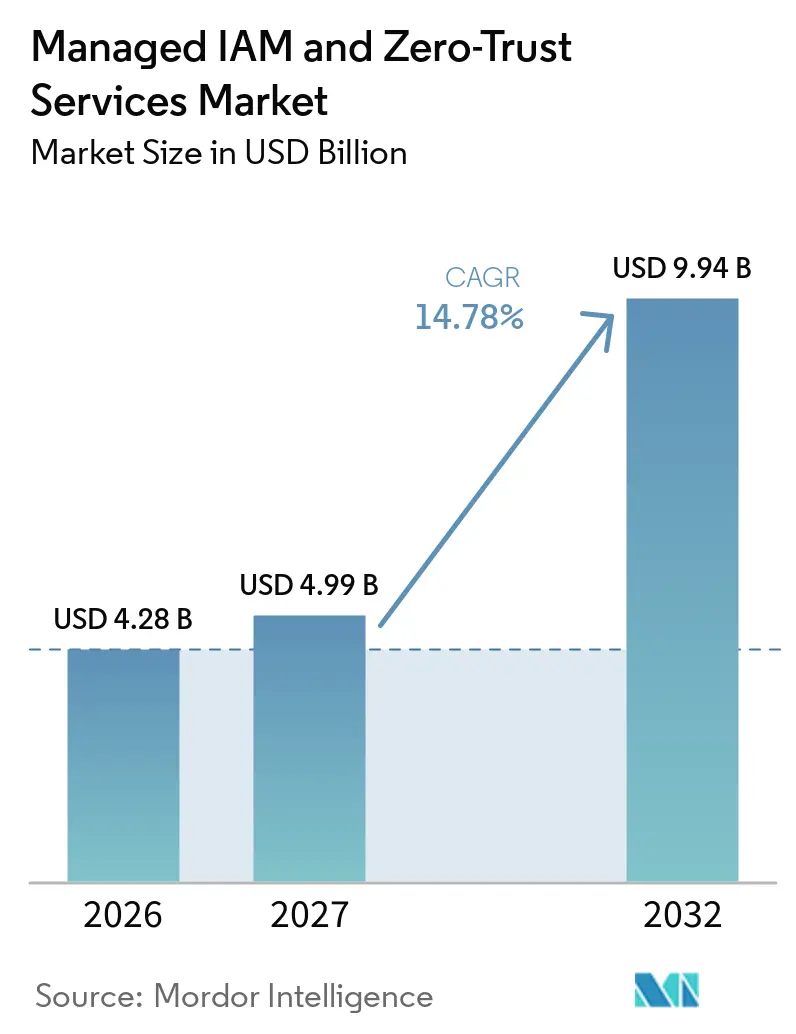
| Market Size (2027) | USD 4.99 Billion |
| Market Size (2032) | USD 9.94 Billion |
| Growth Rate (2027 - 2032) | 14.78 % |
| Fastest Growing Market | Asia-Pacific |
| Largest Market | North America |
| Market Concentration | Medium |
Major Players *Disclaimer: Major Players sorted in no particular order Image © Mordor Intelligence. Reuse requires attribution under CC BY 4.0. | |
Managed IAM and Zero-Trust Services Market Analysis by Mordor Intelligence
The managed IAM and zero-trust services market size is expected to increase from USD 4.28 billion in 2026 to USD 4.99 billion in 2027 and reach USD 9.94 billion by 2032, growing at a CAGR of 14.78% over 2027-2032. The managed IAM and zero-trust services market is being shaped by enterprise security teams moving from self-operated identity systems to specialist providers that monitor access, apply policies, and maintain governance continuously. Cloud migration and hybrid work have widened the number of users, applications, and environments that require verification. Non-human identities, including service accounts, API tokens, and AI agents, have added a separate set of credentials that enterprises must secure. Buyers are also treating managed identity operations as an operational control that can reduce exposure to identity-based attacks and support compliance needs. High implementation costs, complex legacy integrations, and data-residency requirements will continue to influence provider selection and deployment design.
Key Report Takeaways
- By offering managed IAM services, the market accounted for 64.32% of the managed IAM and zero-trust services market share in 2026, and it is projected to expand at a 19.73% CAGR through 2032.
- By service type, Managed Services accounted for 68.32% of revenue in 2026 and are projected to expand at a 17.73% CAGR through 2032.
- By technology capability, Access Management held 24.47% of revenue in 2026, while Machine Identity and Secrets Management are projected to expand at an 18.61% CAGR through 2032.
- By deployment mode, cloud-based services held 69.78% of revenue in the managed IAM and zero-trust services market in 2026 and are projected to expand at a 17.82% CAGR through 2032.
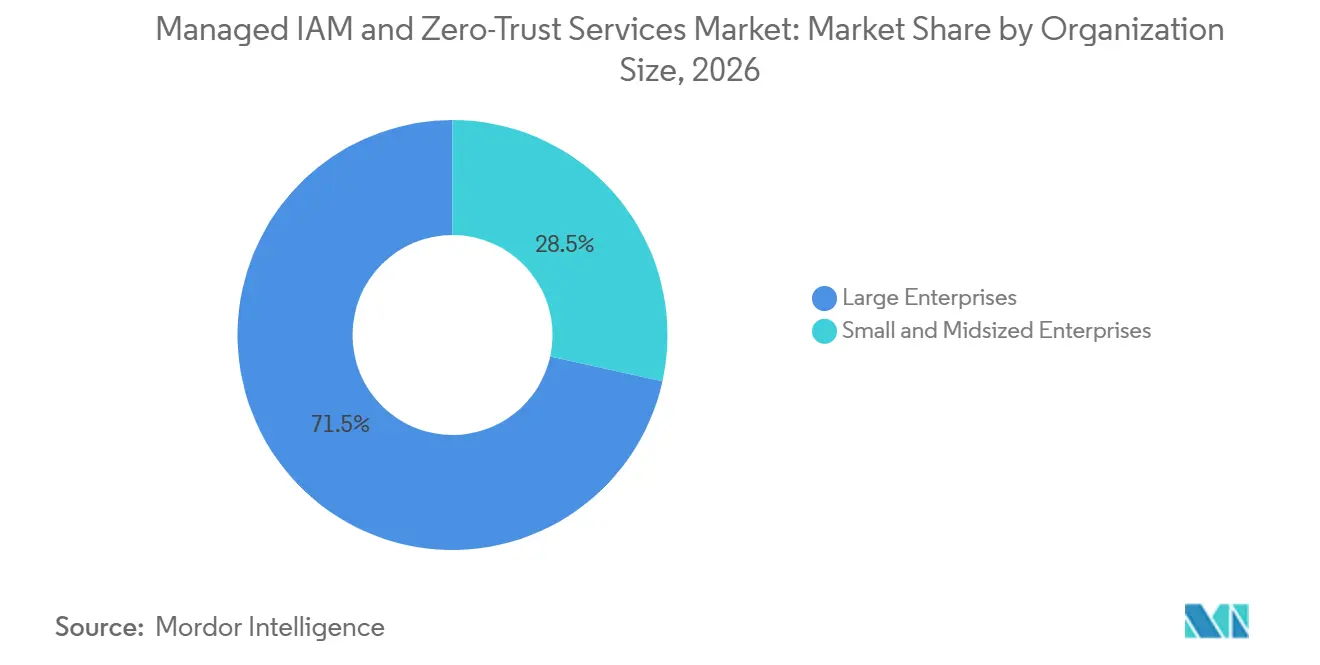
- By organization size, large enterprises accounted for 71.54% of revenue in 2026, while SMEs are projected to expand at a 17.82% CAGR through 2032.
- By end-user industry, BFSI accounted for 26.69% of revenue in 2026, while IT and telecommunications is projected to expand at an 18.54% CAGR through 2032.
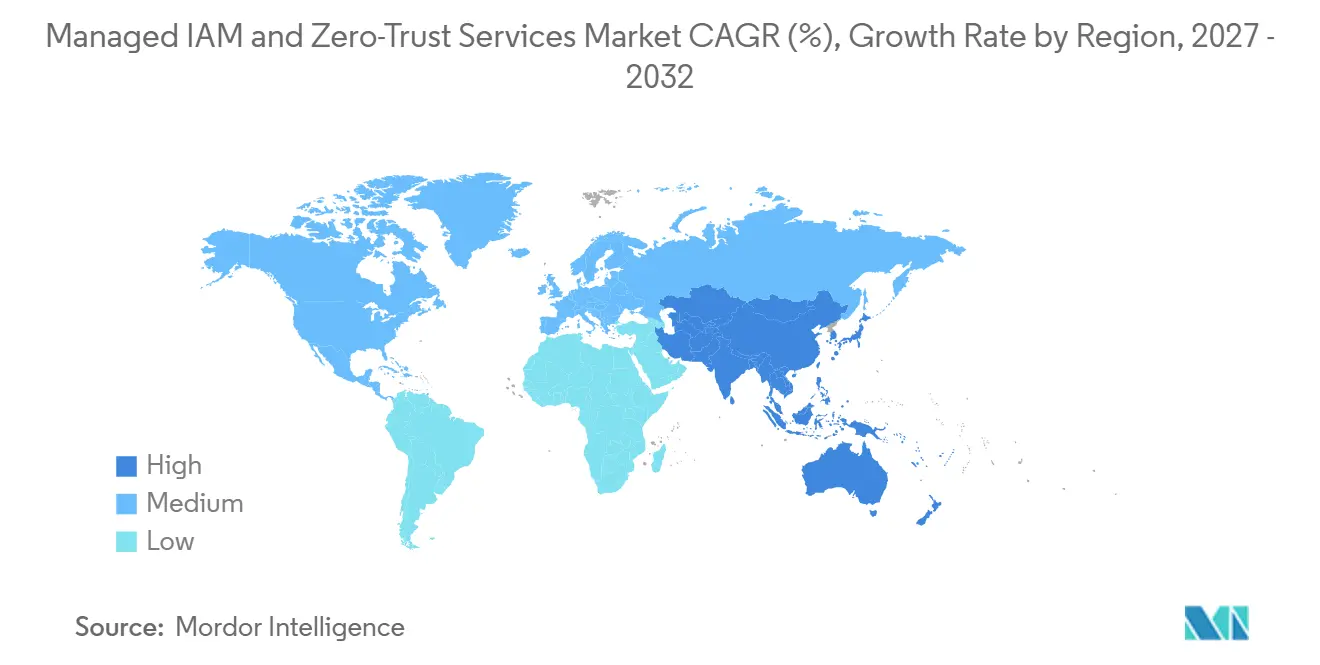
- By geography, North America held 41.64% of revenue in the managed IAM and zero-trust services market in 2026, while Asia-Pacific is projected to expand at a 19.23% CAGR through 2032.
Note: Market numbers in this report are based on Mordor Intelligence's proprietary estimation framework, which combines nine months of actuals with Q4 projections for base year 2026.
Market Trends and Insights
Drivers Impact Analysis of Managed IAM and Zero-Trust Services Market*
| DRIVER | (~) % IMPACT ON CAGR FORECAST | GEOGRAPHIC RELEVANCE | IMPACT TIMELINE |
|---|---|---|---|
| Escalating Identity-Based Cyberattacks and Data Breaches | +3.2% | Global | Short term (≤ 2 years) |
| Transition to Zero-Trust Operating Models | +2.9% | North America and Europe, spill-over to Asia-Pacific | Medium term (2-4 years) |
| Proliferation of Machine Identities and AI Agents | +2.5% | Global, with intensity in North America and Asia-Pacific | Medium term (2-4 years) |
| Regulatory Mandates for Continuous Verification and Access Governance | +2.3% | Europe and North America, spill-over to Asia-Pacific and Middle East | Short term (≤ 2 years) |
| Cloud Migration and Hybrid Workforce Expansion | +2.0% | Global | Medium term (2-4 years) |
| Phishing-Resistant Passkeys and Adaptive Authentication | +1.5% | North America and Europe, gaining in Asia-Pacific | Long term (≥ 4 years) |
| Source: Mordor Intelligence | |||
Escalating Identity-Based Cyberattacks and Data Breaches
Identity abuse has become a major initial-access route in enterprise breaches, increasing the need for continuous identity monitoring. The Identity Theft Resource Center recorded 3,322 data compromise events in the United States during 2025, a 5% increase from the prior year.[1] Sophos found that 71% of organizations experienced at least 1 identity-related breach in the preceding 12 months, with an average remediation cost of USD 1.64 million per incident. Red Canary reported that identity threats rose 850% in 2024 and accounted for 53% of confirmed threat volume in 2025. The managed IAM and zero-trust services market therefore benefits when internal teams need always-on detection and response capabilities they cannot operate on their own. Providers can convert this operational gap into longer managed contracts centered on identity threat detection and response.
Transition to Zero-Trust Operating Models
Zero-trust programs have shifted from policy intent to a direct driver of technology and service procurement. Open Systems found that only 8%-9% of surveyed organizations had fully integrated zero-trust architectures, while many were operating with incomplete deployment and inconsistent policy enforcement. DXC Technology and Microsoft found that 66% of organizations identified legacy systems as the largest barrier to advancing their zero-trust posture.[2] The managed IAM and zero-trust services market gains support from this implementation gap because many buyers require external help with architecture, policy enforcement, and integration. Managed and co-managed delivery can provide a practical route for companies without specialized staff. Providers with integrated access-enforcement platforms are better placed to support these multistage programs.
Proliferation of Machine Identities and AI Agents
Service accounts, API keys, certificates, secrets, and AI agent credentials have broadened the identity estate beyond human users. Segura Security reported that machine identities can outnumber human identities by more than 80 to 1 in large organizations, with cloud-native settings reaching 40,000 machine identities for each human user. The SANS Institute found that 73% of respondents use agentic AI or automation requiring credentials, but no individual governance control was used by more than 40% of respondents. Only 8% of respondents rotated non-human credentials on the recommended 90-day cycle. The managed IAM and zero-trust services market is responding as secrets management and machine identity governance become standard requirements in managed agreements. Providers need to manage credential lifecycles at volumes that cannot be handled by 80-to-1 in large organizations, with cloud-native settings reaching 40,000 machine identities per manual governance processes.
Regulatory Mandates for Continuous Verification and Access Governance
The European Union Digital Operational Resilience Act has been applied since January 17, 2025, and sets requirements around user and system identification, authentication, least-privilege access, access reviews, and prompt removal of access rights. These obligations align closely with the operating scope of managed identity providers, especially in financial services. The NIS2 Directive has extended mandatory cybersecurity controls, including multi-factor authentication, across essential and important entities. The EU AI Act also establishes requirements for traceability, access attribution, and human oversight for high-risk AI systems. The managed IAM and zero-trust services market can benefit as legal and compliance teams seek service models that combine auditable access governance with ongoing operations. Compliance needs are especially material in Europe and North America, while related frameworks are widening the buyer base in Asia-Pacific and the Middle East.
Restraints Impact Analysis of Managed IAM and Zero-Trust Services Market*
| RESTRAINT | (~) % IMPACT ON CAGR FORECAST | GEOGRAPHIC RELEVANCE | IMPACT TIMELINE |
|---|---|---|---|
| High Implementation and Ongoing Operating Costs | -1.8% | Global, with intensity in the SME segment | Short term (≤ 2 years) |
| Legacy-System Integration Complexity | -1.5% | Global, concentration in industrial and government sectors | Medium term (2-4 years) |
| Fragmented Ownership of Machine and Nonhuman Identity Data | -1.0% | Global | Medium term (2-4 years) |
| Data-Residency, Third-Party Processing, and Outsourcing-Control Concerns | -0.8% | Europe, Middle East, and Asia-Pacific | Long term (≥ 4 years) |
| Source: Mordor Intelligence | |||
High Implementation and Ongoing Operating Costs
High deployment and operating costs remain a meaningful barrier, especially for organizations with fewer than 5,000 employees. Complex enterprise engagements can combine identity governance, privileged access management, and machine identity tools with recurring service fees, application onboarding, and custom integration work. RSA found that 90% of organizations reported active challenges in adopting passwordless and adaptive authentication, while 24% said a single identity breach cost more than USD 10 million. These costs create pressure from both investment requirements and incident-response exposure. The managed IAM and zero-trust services market must therefore support service models that make comprehensive identity controls more accessible to smaller security teams. Usage-based pricing and consolidated platforms can reduce the effect of per-seat pricing on SME budgets.
Legacy-System Integration Complexity
Legacy integration is a persistent delivery challenge because many enterprise applications lack modern APIs, federation support, or standardized access interfaces. Zilla Security found that 82% of identity and security leaders identified integration difficulty as the main reason identity governance processes were not automated. Its research also showed that 64% cited difficulty connecting IGA platforms to SaaS and cloud applications, while 18% cited the effort required to adapt tools for non-standard application portfolios. The managed IAM and zero-trust services market depends on providers' ability to connect identity governance to legacy application estates without compromising policy consistency. Pre-built connectors for enterprise resource planning systems and mainframes can shorten implementation timelines. This capability can also support renewal by reducing blind spots that lead to security and audit issues.
*Our forecasts treat driver/restraint impacts as directional, not additive. The impact forecasts reflect baseline growth, mix effects, and variable interactions.
Managed IAM and Zero-Trust Services Market Segment Analysis
By Offering:
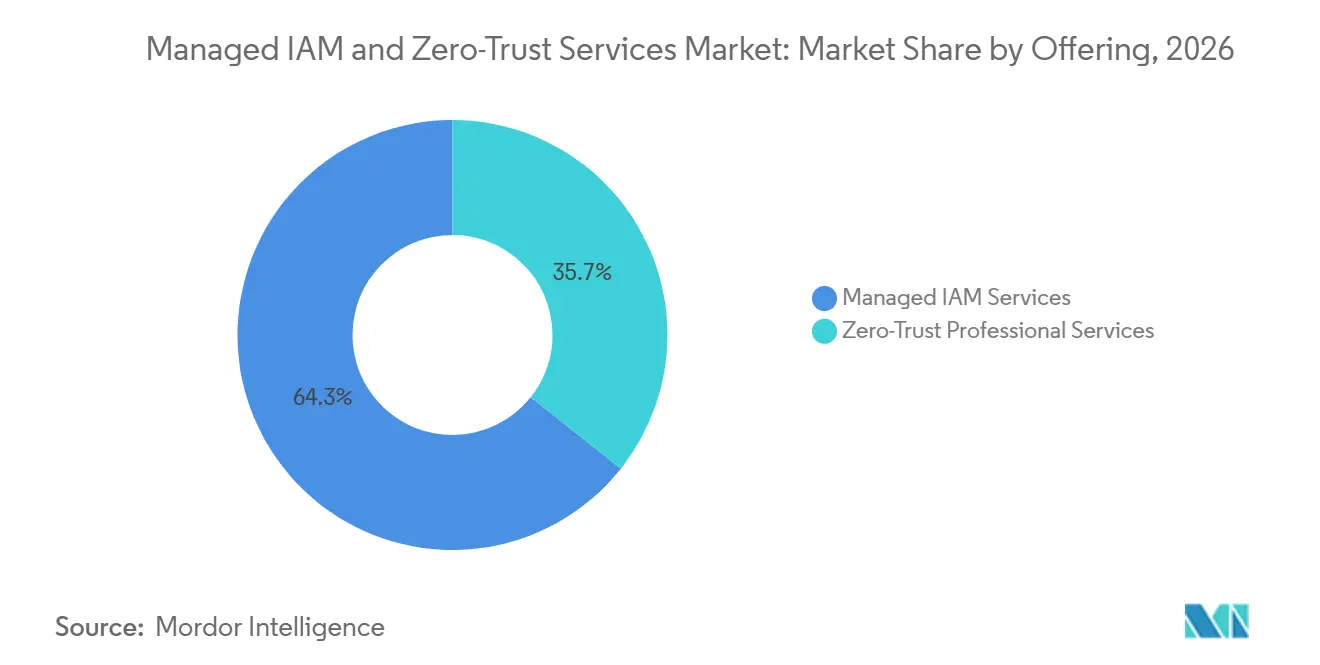
Managed Operations Lead Enterprise Identity DeliveryManaged IAM Services accounted for 64.32% of the managed IAM and zero-trust services market size in 2026. The share reflects a clear buyer preference for ongoing operational support instead of limited advisory work. Identity environments require continuing monitoring, access review, policy updates, and response to new risks. These recurring needs favor providers that can exert control over extended periods. The managed IAM and zero-trust services market is also supported by the accumulated knowledge a provider develops across a client’s applications, users, and access policies.
High switching costs can reinforce this position once a provider is embedded across several systems. Zero-Trust Professional Services remain relevant for companies that have committed to zero-trust programs but need specialized architecture and consulting skills. Machine identity governance and secrets management are increasingly included within standard service-level agreements. IBM’s February 2025 acquisition of HashiCorp brought the Vault secrets management platform and Boundary privileged-access tool into IBM’s services infrastructure. This move illustrates the value placed on the non-human identity layer.
By Service Type:
Managed Services Strengthen Recurring RevenueManaged Services held 68.32% of revenue in 2026 and are projected to expand at a 17.73% CAGR through 2032. Enterprises use these arrangements to maintain predictable identity operations without having to recruit and retain every specialized IAM skill internally. The model is suited to access provisioning, monitoring, lifecycle management, and policy administration that require consistent execution. It also shifts spending away from isolated project completion toward recurring annual contract value. The managed IAM and zero-trust services market benefits when buyers want a clearer operating model for these ongoing security tasks.
Professional Services retain an important role in early-stage implementation, complex migrations, and audit-preparedness work. These engagements offer specialist expertise when a company is changing identity platforms or addressing a control gap. Support and Maintenance Services represent the smallest revenue category, but they can keep clients tied to a provider through platform updates and break-fix support. That relationship can create a practical path from basic support to broader managed operations. Across service types, buyers are moving toward longer contracts linked to defined operating outcomes.
By Technology Capability:
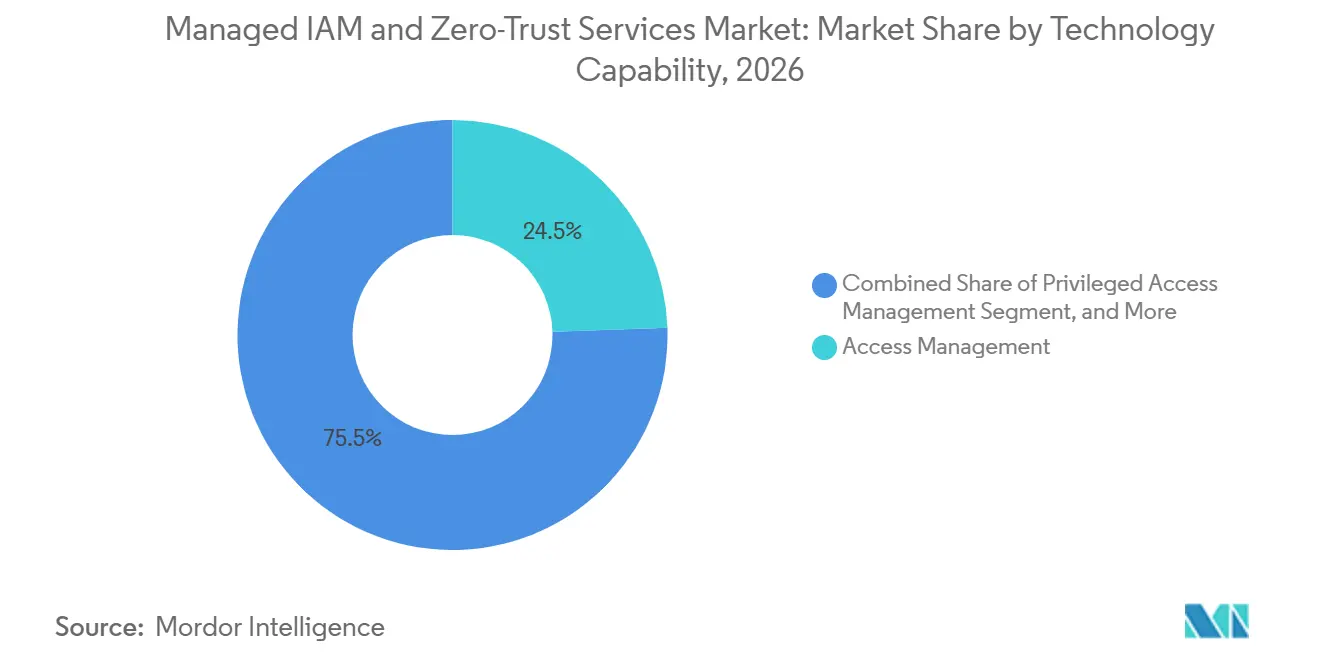
Machine Identity Governance AcceleratesAccess Management led technology capability with 24.47% of revenue in 2026. Single sign-on, adaptive multi-factor authentication, and risk-based access controls have become baseline measures across many enterprise settings. Identity Governance and Administration follows because regulated organizations need auditable access lifecycle processes for their human users. Privileged Access Management is gaining importance where critical systems require just-in-time elevation and session recording. Directory, federation, and single sign-on services remain foundational for connecting access across hybrid and multi-cloud environments.
Identity Threat Detection and Response is becoming more important as buyers connect static access governance to real-time behavioral monitoring. The FIDO Alliance found that 93% of user accounts are technically eligible for passkey authentication, shifting the main barrier from platform availability to deployment complexity.[3] Machine Identity and Secrets Management is projected to expand at an 18.61% CAGR through 2032. AI agents and containerized workloads create large numbers of credentials that manual controls cannot manage at scale. The managed IAM and zero-trust services market, therefore, has room for providers that make non-human identity governance part of core delivery.

By Deployment Mode:
Cloud Delivery Sets the Architecture BaselineCloud-based services accounted for 69.78% of the managed IAM and zero-trust services market size in 2026 and are projected to expand at a 17.82% CAGR through 2032. Cloud-native identity platforms can use API-first architectures and integrations with major cloud environments. These capabilities can shorten deployment time and provide flexibility as users, applications, and workloads change. They also help buyers apply identity policy across more than 1 cloud environment. The managed IAM and zero-trust services market is consequently moving toward cloud delivery as the core architecture for new identity programs.
Hybrid deployment remains important for regulated buyers and organizations with operational technology or data-sovereignty requirements. These companies may keep sensitive governance functions on-premises while using cloud-based services for standard authentication. On-premises deployments are declining as a share of revenue, but their absolute base remains relevant in industrial manufacturing and government. Legacy operational technology and classified infrastructure can make a full migration impractical. ISO/IEC 27001:2022 access-control requirements can be mapped to cloud-compatible controls, reducing a historical compliance concern.
By Organization Size:
SMEs Address Identity Maturity GapsLarge enterprises accounted for 71.54% of revenue in 2026. Earlier adoption of formal identity programs, greater regulatory exposure, and more complex identity estates explain their leading position. These organizations often need professional support across many applications, business units, and access models. Their requirements can include governance, privileged access, machine identity, and threat detection in the same operating model. The managed IAM and zero-trust services market continues to depend on this large-enterprise base for substantial contract values.
SMEs are projected to expand at a 17.82% CAGR through 2032 as platform pricing and bundled delivery make stronger controls more attainable. Sophos found that organizations with 100-250 employees were 72% less likely to detect an identity attack than organizations with 1,001-3,000 employees.[4] A single agreement covering access management, governance, privileged access, and threat detection can reduce the cost and management burden for smaller teams. Adoption is particularly relevant in Asia-Pacific and South America, where many mid-market firms are increasing investment in identity controls. Regulatory pressure and board scrutiny can make identity maturity a near-term operating priority.
By End-User Industry:
BFSI Leads While IT and Telecommunications AccelerateBFSI held 26.69% of revenue in 2026. The sector has high volumes of identity transactions and is subject to multiple layers of access and audit requirements. Managed privileged access management and identity governance are important spending areas because financial institutions must review access and preserve audit trails. Identity security is therefore treated alongside broader operational and systemic risk. The managed IAM and zero-trust services market has a strong foundation in financial services because the sector requires continuous verification rather than periodic control checks.
The IT and telecommunications industry is projected to expand at an 18.54% CAGR through 2032. Hyperscalers, telecom operators, and managed service providers supporting AI infrastructure face a rising number of machine identities, API credentials, and third-party access relationships. The demand for healthcare and life sciences is linked to patient data protection and electronic health record access. Government demand is connected to zero-trust mandates, while industrial manufacturers need identity federation across operational technology and IT environments. Retail and e-commerce buyers use customer identity controls and adaptive authentication to strengthen fraud prevention.
Geography Analysis
North America Managed IAM and Zero-Trust Services Market
North America accounted for 41.64% of revenue in 2026. The region combines mature enterprise identity programs, broad regulatory requirements, and early adoption of zero-trust approaches. The United States contributes the largest revenue base, while mid-sized enterprises are increasing outsourcing to address gaps in specialized identity security roles. Securities and Exchange Commission disclosure requirements, state data-protection laws, and the federal zero-trust mandate support continued attention to identity controls. Canada provides another compliance-driven demand pool as financial institutions adopt identity frameworks, and Mexico is gaining from cross-border digital transformation programs.
APAC Managed IAM and Zero-Trust Services Market
Asia-Pacific is projected to expand at a 19.23% CAGR through 2032, the fastest rate among the geographic groups. National digital identity initiatives, cybersecurity mandates, and expanding cloud investment underpin demand across the region. China is supported by industrial digitization, while India benefits from its digital identity infrastructure and growing IT services capacity. South Korea’s cybersecurity certification requirements and Australia’s government-led zero-trust strategies add further demand. Differing national requirements mean that organizations operating across several countries need consistent access governance despite different compliance expectations.
Europe, South America and Middle East Managed IAM and Zero-Trust Services Market
DORA, NIS2, and the EU AI Act create a compliance floor for access governance, authentication, and traceability. Germany, the United Kingdom, and France each support demand through security, financial-services, and digital-sovereignty requirements. South America is an emerging area led by Brazil’s data-protection rules, followed by Chile and Argentina as digital transformation programs raise managed security spending. The Middle East is gaining momentum through Saudi Arabia’s digital transformation agenda, UAE zero-trust guidance, and regional service-provider investment.
Competitive Landscape
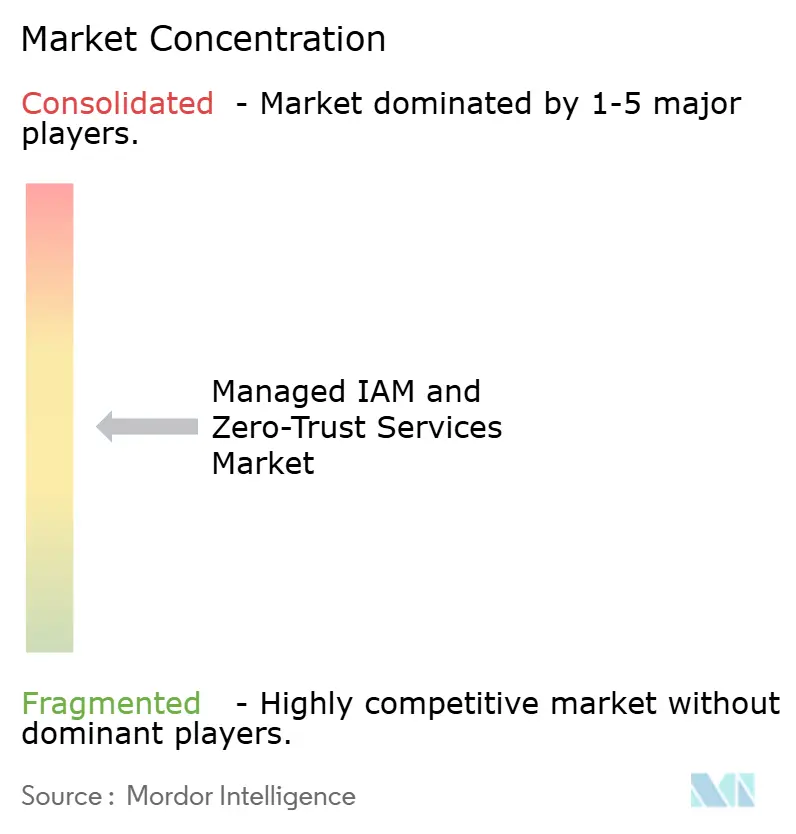
The managed IAM and zero-trust services market is moderately concentrated among leading providers but fragmented across the mid-tier. Global IT services companies, including IBM, Accenture, Deloitte, TCS, and Cognizant, compete on broad delivery capabilities, multi-region infrastructure, and the ability to include identity operations in broader outsourcing contracts. Identity-security specialists compete on technical depth, faster deployment for new environments, and outcome-based service agreements. The category is increasingly defined by platform convergence, in which access, privileged access, threat detection, machine identity, and network security are combined.
Palo Alto Networks completed the acquisition of CyberArk in February 2026, combining privileged access management, machine identity, SASE, and threat intelligence capabilities within a wider security architecture. ServiceNow acquired Veza in March 2026 to add effective-permissions graph capabilities to AI Control Tower. SailPoint acquired Entro Security in June 2026 to add non-human identity discovery and secrets management to its Agentic Fabric platform. These transactions show that governance of AI agents and non-human identities has become a central competitive requirement. The managed IAM and zero-trust services market also offers opportunities in SME machine identity governance, sovereign hybrid delivery, and AI-agent identity programs.
Technology differentiation is shaping win rates across the field. Providers with behavioral analytics, continuous access evaluation, and automated session revocation can offer stronger real-time identity protection than those using only rules-based controls. Okta acquired Permiso Security in July 2026 and later announced expanded Okta Identity Governance and Okta Privileged Access capabilities in September 2026. DXC Technology partnered with Primary in August 2026 to offer a managed AI-native Zero Trust Unified Control Plane. These actions show how providers are combining managed delivery with AI access governance and compliance support.
Managed IAM and Zero-Trust Services Industry Leaders
-
IBM Corporation
-
Accenture plc
-
Capgemini SE
-
Tata Consultancy Services Limited
-
Wipro Limited
- *Disclaimer: Major Players sorted in no particular order
Managed IAM and Zero-Trust Services Market Companies Covered in this Report
- IBM Corporation
- Accenture plc
- Capgemini SE
- Tata Consultancy Services Limited
- Wipro Limited
- HCL Technologies Limited
- Cognizant Technology Solutions Corporation
- Deloitte Touche Tohmatsu Limited
- Ernst & Young Global Limited
- Kyndryl Holdings, Inc.
- NTT DATA Corporation
- DXC Technology Company
- Atos SE
- Fujitsu Limited
- Okta, Inc.
- Microsoft Corporation
- CyberArk Software Ltd.
- SailPoint Technologies, Inc.
- Ping Identity Holding Corp.
- Palo Alto Networks, Inc.
- Zscaler, Inc.
- Broadcom Inc.
- Oracle Corporation
- Amazon Web Services, Inc.
- Cisco Systems, Inc.
Recent Industry Developments in Managed IAM and Zero-Trust Services Market
- October 2026: IonQ agreed to acquire Elisity, an identity-based microsegmentation vendor, for up to USD 1.3 billion. The transaction adds network-layer zero-trust enforcement to IonQ’s portfolio and reflects the accelerating convergence of identity and network security architectures in enterprise zero-trust programs.
- September 2026: Okta announced expanded product innovations across Okta Identity Governance and Okta Privileged Access, incorporating identity threat detection and response capabilities from the Permiso Security acquisition, with new tools to close governance blind spots and extend zero standing privilege controls to AI-driven enterprise environments.
- August 2026: DXC Technology partnered with Primary as its exclusive managed services provider for Primary’s AI-native Zero Trust Unified Control Plane, offering enterprises a co-managed service that governs AI agent access to enterprise data, enforces identity policy, and supports regulatory compliance, targeting organizations scaling AI deployments that require managed governance.
- July 2026: Okta completed its acquisition of Permiso Security for USD 200 million, adding cloud identity threat detection and response capabilities to Okta’s managed identity governance portfolio and strengthening real-time anomalous access detection for cloud-native environments.
Global Managed IAM and Zero-Trust Services Market Report Scope
Managed IAM and zero-trust services are externally delivered capabilities for managing digital identities, access rights, authentication, privileged access, and identity governance under a zero-trust security model. Providers help organizations enforce least-privilege access, continuously verify users and devices, and reduce identity-related security risks across on-premises, cloud, and hybrid environments.
The managed IAM and zero-trust services market Report is Segmented by Offering (Managed IAM Services, and Zero-Trust Professional Services), Service Type (Professional Services, Managed Services, and Support and Maintenance Services), Technology Capability (Identity Governance and Administration, Access Management, Privileged Access Management, Identity Threat Detection and Response, Directory, Federation, and Single Sign-On, Authentication and Passwordless Access, and Machine Identity and Secrets Management), Deployment Model (Cloud-Based, Hybrid, and On-Premises), Organization Size (Large Enterprises, and Small and Medium Enterprises), End-User Industry (Banking, Financial Services and Insurance (BFSI), IT and Telecommunications, Healthcare and Life Sciences, Government and Public Sector, Industrial Manufacturing, Retail and E-Commerce, and Other End-User Industries), and Geography (North America, South America, Europe, Asia-Pacific, Middle East, and Africa). The Market Forecasts are Provided in Terms of Value (USD).
Segmentation Overview
| Managed IAM Services |
| Zero-Trust Professional Services |
| Professional Services |
| Managed Services |
| Support and Maintenance Services |
| Identity Governance and Administration |
| Access Management |
| Privileged Access Management |
| Identity Threat Detection and Response |
| Directory, Federation, and Single Sign-On |
| Authentication and Passwordless Access |
| Machine Identity and Secrets Management |
| Cloud-Based |
| Hybrid |
| On-Premises |
| Large Enterprises |
| Small and Midsized Enterprises |
| Banking, Financial Services and Insurance (BFSI) |
| IT and Telecommunications |
| Healthcare and Life Sciences |
| Government and Public Sector |
| Industrial Manufacturing |
| Retail and E-Commerce |
| Other End-User Industries |
| North America | United States |
| Canada | |
| Mexico | |
| South America | Brazil |
| Argentina | |
| Chile | |
| Rest of South America | |
| Europe | United Kingdom |
| Germany | |
| France | |
| Italy | |
| Rest of Europe | |
| Asia-Pacific | China |
| India | |
| Japan | |
| South Korea | |
| Australia | |
| Rest of Asia-Pacific | |
| Middle East | Saudi Arabia |
| United Arab Emirates | |
| Israel | |
| Rest of Middle East | |
| Africa | South Africa |
| Egypt | |
| Rest of Africa |
| By Offering | Managed IAM Services | |
| Zero-Trust Professional Services | ||
| By Service Type | Professional Services | |
| Managed Services | ||
| Support and Maintenance Services | ||
| By Technology Capability | Identity Governance and Administration | |
| Access Management | ||
| Privileged Access Management | ||
| Identity Threat Detection and Response | ||
| Directory, Federation, and Single Sign-On | ||
| Authentication and Passwordless Access | ||
| Machine Identity and Secrets Management | ||
| By Deployment Mode | Cloud-Based | |
| Hybrid | ||
| On-Premises | ||
| By Organization Size | Large Enterprises | |
| Small and Midsized Enterprises | ||
| By End-User Industry | Banking, Financial Services and Insurance (BFSI) | |
| IT and Telecommunications | ||
| Healthcare and Life Sciences | ||
| Government and Public Sector | ||
| Industrial Manufacturing | ||
| Retail and E-Commerce | ||
| Other End-User Industries | ||
| By Geography | North America | United States |
| Canada | ||
| Mexico | ||
| South America | Brazil | |
| Argentina | ||
| Chile | ||
| Rest of South America | ||
| Europe | United Kingdom | |
| Germany | ||
| France | ||
| Italy | ||
| Rest of Europe | ||
| Asia-Pacific | China | |
| India | ||
| Japan | ||
| South Korea | ||
| Australia | ||
| Rest of Asia-Pacific | ||
| Middle East | Saudi Arabia | |
| United Arab Emirates | ||
| Israel | ||
| Rest of Middle East | ||
| Africa | South Africa | |
| Egypt | ||
| Rest of Africa | ||
Key Questions Answered in the Report
What is the 2026 size of the managed IAM and zero-trust services market?
The managed IAM and zero-trust services market size is expected to increase from USD 4.28 billion in 2026 to USD 4.99 billion in 2027 and reach USD 9.94 billion by 2032, growing at a CAGR of 14.78% over 2027-2032.
What is driving demand for managed IAM and zero-trust services?
Identity-related attacks, cloud adoption, hybrid work, non-human identities, and regulatory requirements are increasing the need for continuous access governance. These factors also increase demand for managed monitoring and policy enforcement.
Which managed IAM offering has the largest share?
Managed IAM Services hold 64.32% of revenue in 2026. The share reflects enterprise demand for continuous identity operations instead of isolated advisory engagements.
Which deployment model leads managed IAM and zero-trust services?
Cloud-based services hold 69.78% of revenue in 2026. They are projected to expand at a 17.82% CAGR through 2032 as buyers seek adaptable identity delivery.
Which end-user sector leads spending on managed IAM services?
BFSI leads with a 26.69% revenue share in 2026. The sector has high identity transaction volumes and extensive regulatory obligations.
Which region is expanding fastest for managed IAM and zero-trust services?
Asia-Pacific is projected to expand at a 19.23% CAGR through 2032. Cloud investment, digital identity programs, and cybersecurity requirements support this expansion.