
Managed CDN Security Services Market Size and Share
Market Overview
| Study Period | 2021 - 2032 |
|---|---|
| Market Size (2027) | USD 5.61 Billion |
| Market Size (2032) | USD 8.88 Billion |
| Growth Rate (2027 - 2032) | 9.62 % |
| Fastest Growing Market | Asia-Pacific |
| Largest Market | North America |
| Market Concentration | Medium |
Major Players *Disclaimer: Major Players sorted in no particular order Image © Mordor Intelligence. Reuse requires attribution under CC BY 4.0. | |
Managed CDN Security Services Market Analysis by Mordor Intelligence
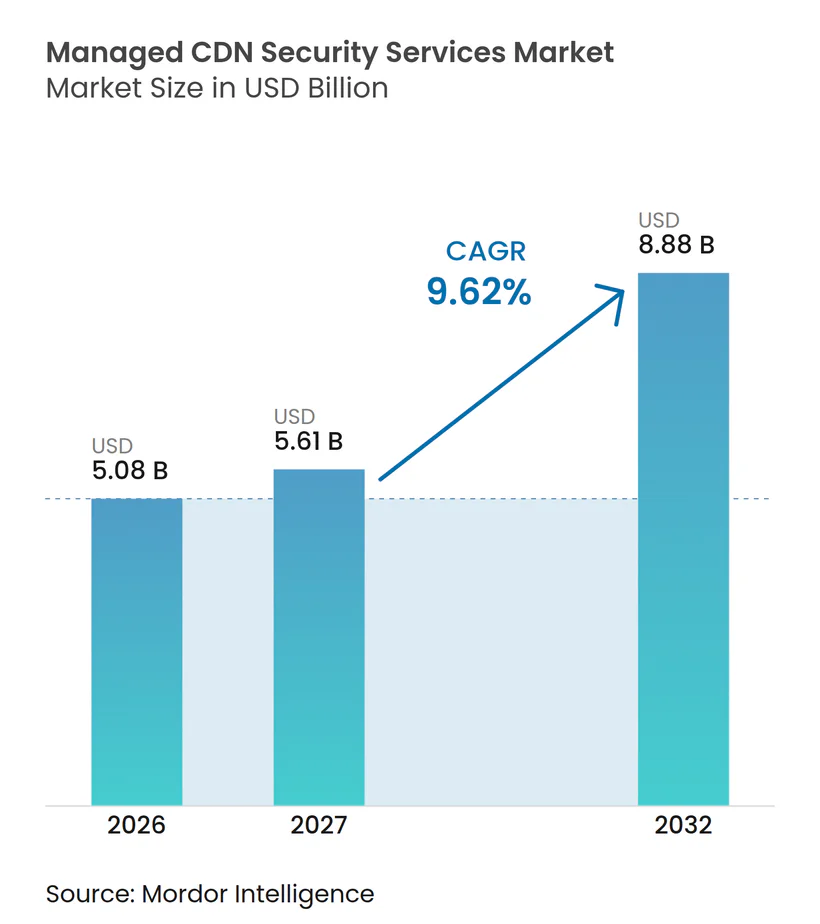
The managed CDN security services market size is projected to expand from USD 5.08 billion in 2026 and USD 5.61 billion in 2027 to USD 8.88 billion by 2032, registering a CAGR of 9.62% between 2027 to 2032. Demand reflects a shift in enterprise security buying toward managed platforms that combine content delivery with protection at the network edge. Organizations are consolidating DDoS mitigation, web application firewalls, bot controls, and API protection rather than managing separate products. Providers that add API security, bot management, and security operations coverage can secure higher contract values than providers with a single protection capability. The managed CDN security services market also benefits when customers need consistent controls across cloud, hybrid, and distributed application environments. Competition increasingly centers on the breadth of the platform, policy management, and the ability to support regulated workloads.
Key Report Takeaways
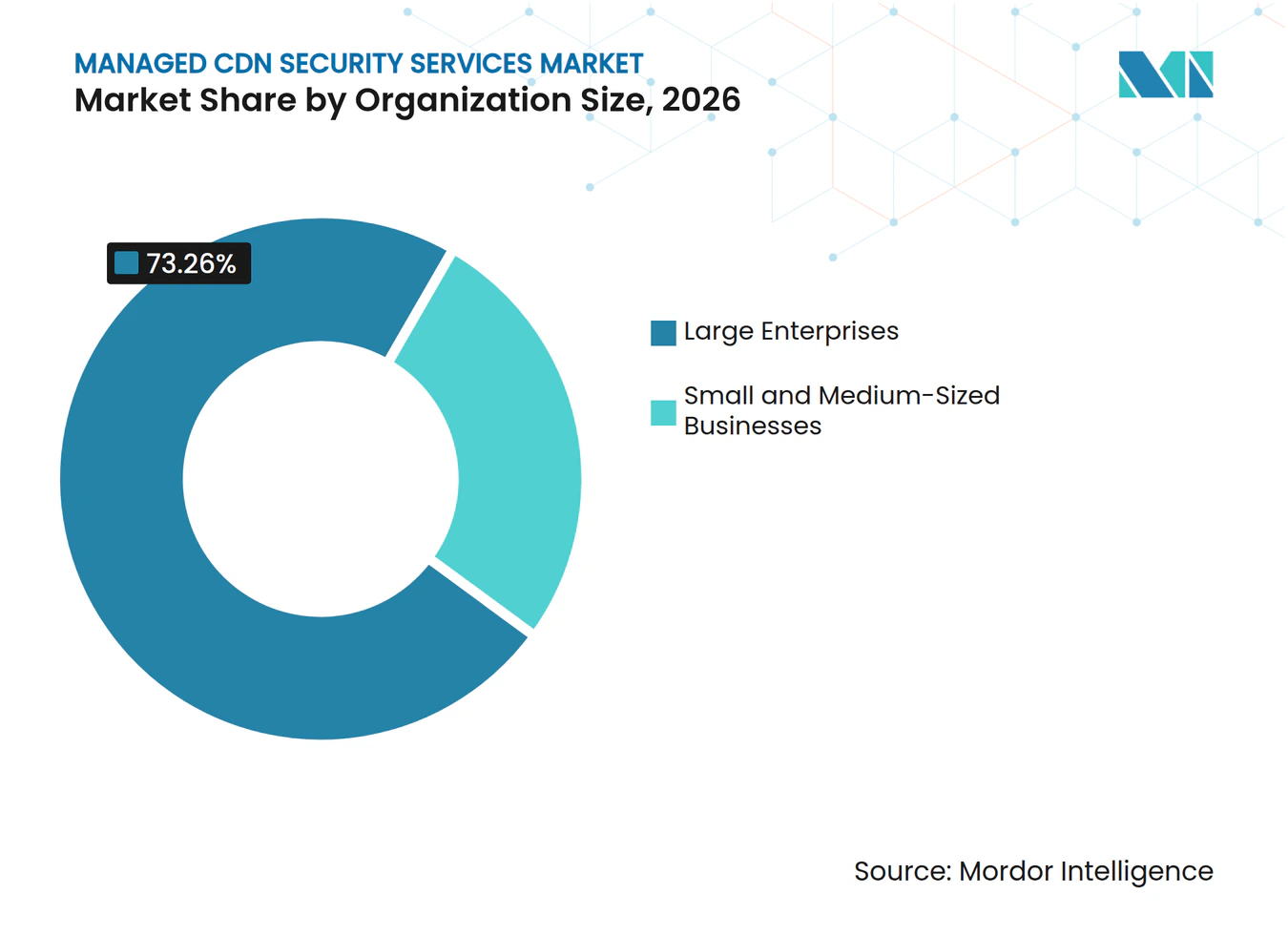
- By organization size, large enterprises held 73.26% of the managed CDN security services market share in 2026, while SMBs are projected to expand at a 10.02% CAGR through 2032.
- By security type, DDoS protection accounted for 87.43% of the managed CDN security services market size in 2026, while API security and runtime protection is projected to expand at a 10.81% CAGR through 2032.
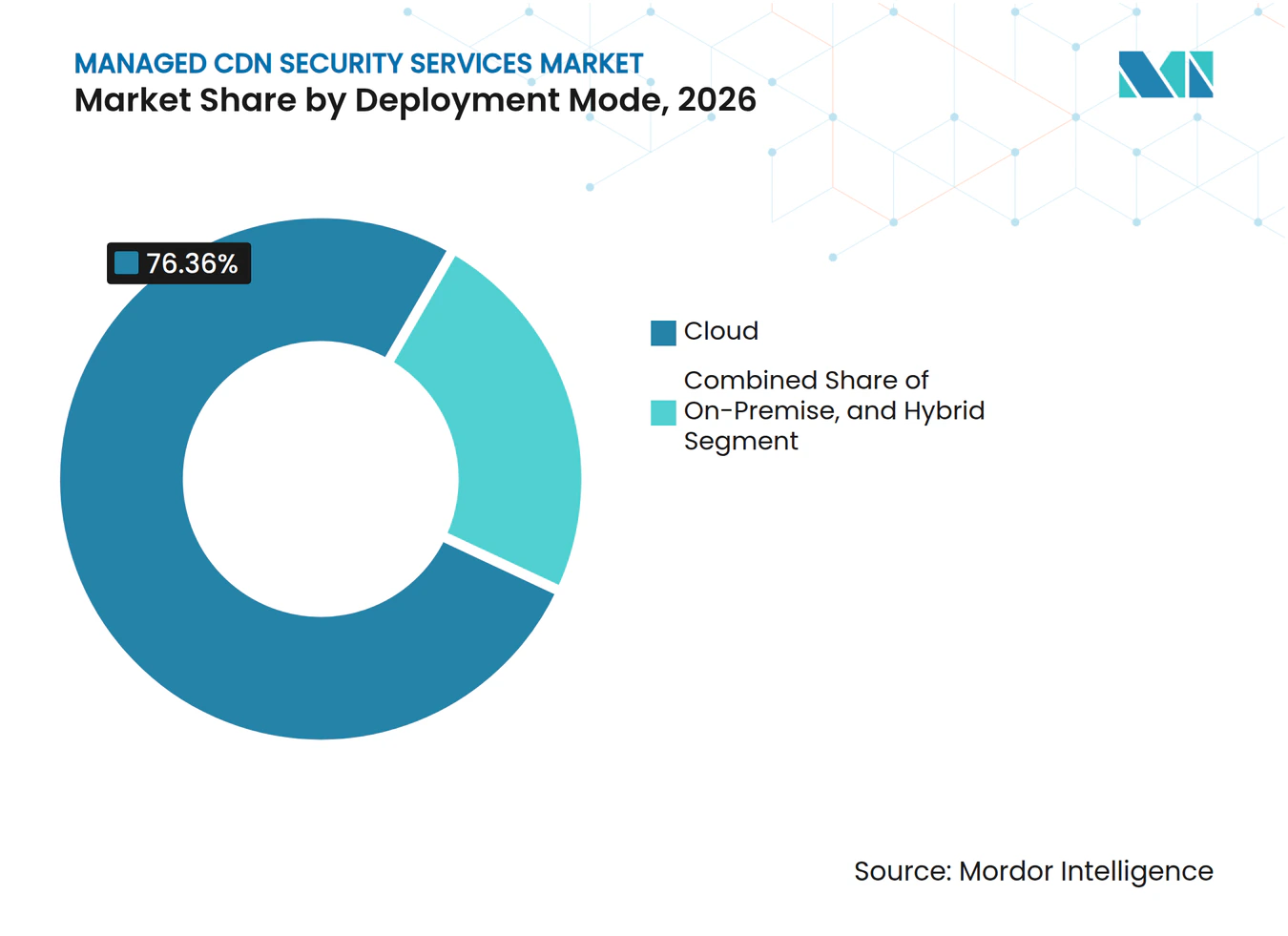
- By deployment mode, cloud held 76.36% share in 2026 and is projected to expand at a 10.19% CAGR through 2032.
- By end-user industry, media and entertainment accounted for 22.56% share in 2026, while retail and e-commerce is projected to expand at a 10.98% CAGR through 2032.
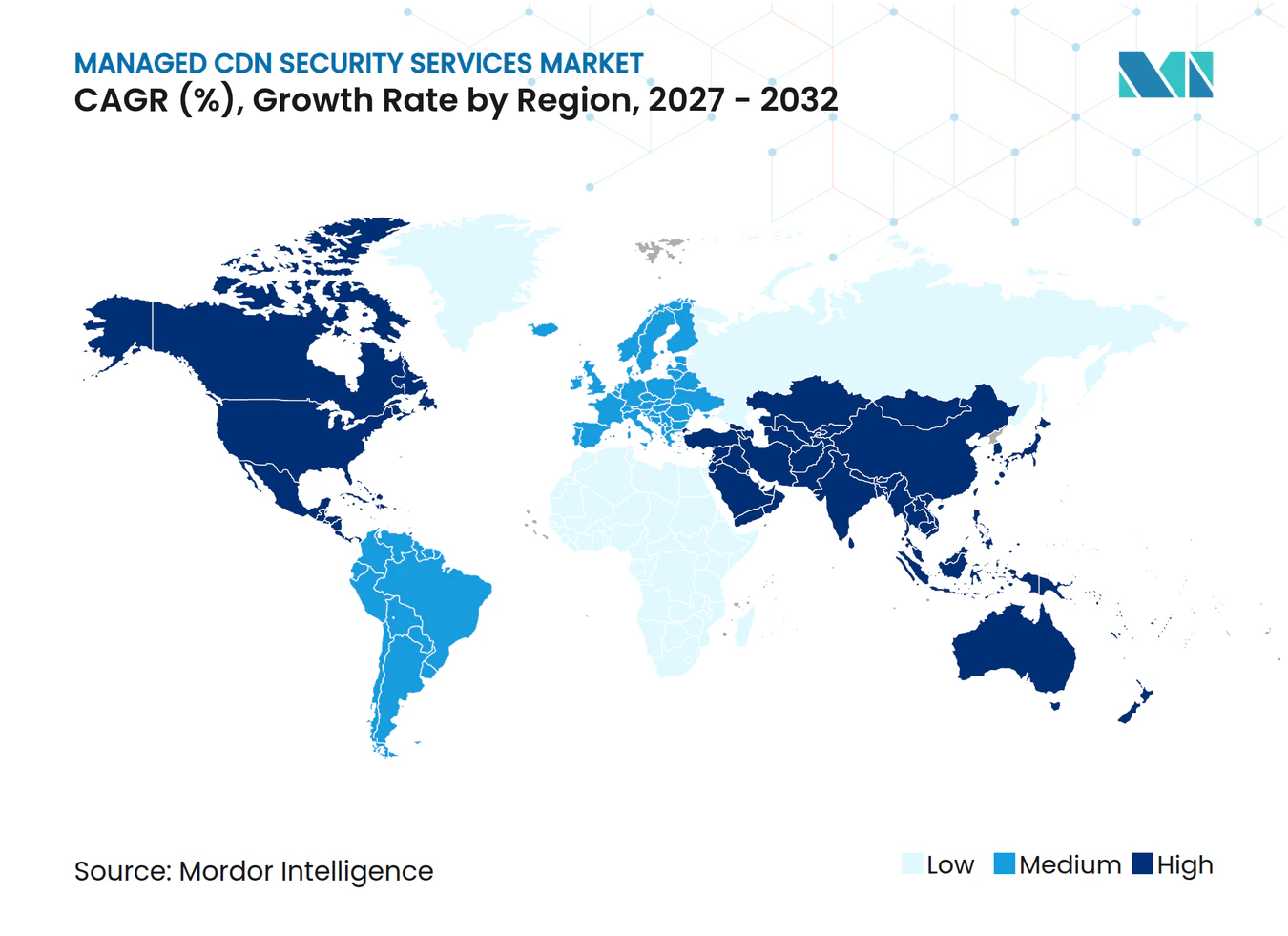
- By geography, North America held 42.29% share in 2026, while Asia-Pacific is projected to expand at a 10.57% CAGR through 2032.
Note: Market numbers in this report are based on Mordor Intelligence's proprietary estimation framework, which combines nine months of actuals with Q4 projections for base year 2026.
Market Trends and Insights
Drivers Impact Analysis of Managed CDN Security Services Market*
| Driver | (~) % Impact on CAGR Forecast | Geographic Relevance | Impact Timeline |
|---|---|---|---|
| Rising Frequency and Sophistication of DDoS and Layer 7 Attacks | +2.8% | Global, concentrated in Asia-Pacific and North America | Short term (≤ 2 years) |
| Enterprise Shift to Multi-Cloud and Edge Architectures | +2.0% | North America and Europe, with spillover to Asia-Pacific | Medium term (2-4 years) |
| Rapid Growth in OTT Video and Real-Time Streaming Traffic | +1.8% | Global, particularly Asia-Pacific and North America | Medium term (2-4 years) |
| Regulatory Uptime and Data-Protection Mandates | +1.2% | Europe and North America | Short term (≤ 2 years) and Medium term (2-4 years) |
| Edge-Native Security Convergence for AI Workloads | +0.9% | North America and Asia-Pacific, with early adoption in Singapore and the UAE | Medium term (2-4 years) and Long term (≥ 4 years) |
| Managed Security Policy Automation Reducing SecOps Scarcity | +0.8% | Global | Medium term (2-4 years) |
| Source: Mordor Intelligence | |||
Rising Frequency and Sophistication of DDoS and Layer 7 Attacks
The managed CDN security services market is responding to attacks that use several vectors and often end before traditional escalation procedures can begin. Cloudflare reported that 96.62% of network-layer attacks in the first half of 2026 stayed below 500 Mbps, yet these events could still overload DNS resolvers and connection tables.[1] DNS flood attacks rose from 25.7% to 40.0% of network-layer activity quarter over quarter, while CLDAP amplification increased 580% during the same period. NETSCOUT found that direct-path attacks made up 64% of attacks in the first half of 2026 and had increased for a third consecutive half-year.[2] These patterns favor managed services that apply mitigation at the edge before attack traffic reaches application infrastructure. The need for rapid and continuously managed protection supports spending across the managed CDN security services market.
Enterprise Shift to Multi-Cloud and Edge Architectures
Enterprises using several cloud providers face security gaps when each environment has separate policies and tools. The managed CDN security services market gains from customers seeking a shared control plane for web, API, and DDoS protection across public cloud, private data centers, and hybrid environments. Akamai launched App and API Protector Hybrid in April 2025 to extend its Adaptive Security Engine rulesets across these environments through Kubernetes-native autoscaling. Cloudflare identified its ability to deliver security, performance, and reliability through one vendor as a differentiator in its 2025 annual filing. Consistent access controls and encryption policies are important for organizations subject to ISO 27001 and PCI DSS requirements. This procurement pattern favors providers that can replace separate point products with managed security services across the full application estate.
Rapid Growth in OTT Video and Real-Time Streaming Traffic
Live streaming creates immediate financial and operational consequences when a DDoS attack, CDN abuse event, or content piracy incident interrupts delivery. The managed CDN security services market is therefore relevant to broadcasters, gaming platforms, and streaming operators that need both traffic protection and content-integrity controls. CDNetworks reported that Asia-Pacific accounted for 67.45% of Layer 7 DDoS activity in 2025, with SaaS, fintech, and gaming platforms under concentrated pressure. Nagravision and Broadpeak introduced a 2025 solution that uses AI analytics to monitor CDN traffic and DRM license requests for pirate-stream detection without disrupting legitimate viewers. Fastly said its edge platform processes 1.8 trillion HTTP requests daily and later partnered with Comcast and NBCUniversal for Peacock live-sports delivery. Providers that combine volumetric protection and content-integrity services can compete for high-value live-event contracts.
Regulatory Uptime and Data-Protection Mandates
The managed CDN security services market is supported by regulations that require documented risk management, incident reporting, and resilient digital operations. ENISA stated that the NIS2 framework places important requirements on entities that fall within its scope, including risk-management measures and supply-chain security controls. These requirements create formal procurement reviews of provider controls, audit trails, and incident-response capabilities. Financial services customers also need operational resilience planning that connects API availability to tested continuity procedures. Providers with established certifications, documented controls, and managed incident processes are better positioned than lower-cost providers that lack this evidence. The resulting procurement discipline supports longer vendor evaluations but can improve the value of managed contracts.
Restraints Impact Analysis of Managed CDN Security Services Market*
| Restraint | (~) % Impact on CAGR Forecast | Geographic Relevance | Impact Timeline |
|---|---|---|---|
| Global Shortage of Skilled Cybersecurity Practitioners | -1.5% | Global | Medium term (2-4 years) |
| High Total Cost of Always-On Mitigation for Small and Medium-Sized Businesses | -1.0% | Global, with greater intensity in emerging markets and Tier-2 cities | Short term (≤ 2 years) and Medium term (2-4 years) |
| Multi-CDN Policy Fragmentation and Hidden Egress Costs | -0.7% | North America and Europe | Medium term (2-4 years) |
| Encrypted Traffic Inspection and Privacy Trade-Offs | -0.6% | Europe and North America | Long term (≥ 4 years) |
| Source: Mordor Intelligence | |||
Global Shortage of Skilled Cybersecurity Practitioners
The managed CDN security services market benefits from customers that lack in-house security capacity, but providers also need qualified staff to operate and support their offerings. ISC2 estimated a global cybersecurity workforce gap of 4.8 million positions in 2025, up 19% from the prior year. The organization also reported that the workforce would need to expand 87% to meet demand, while actual workforce expansion was 0.1%. ISACA found that 55% of security teams were understaffed and 65% had open positions in 2025.[3] Staffing shortages can delay policy tuning and incident response, which affects the quality of premium managed services. Automation of routine analyst work can limit this constraint and raise the delivery barrier for smaller providers.
High Total Cost of Always-On Mitigation for Small and Medium-Sized Businesses
Always-on DDoS mitigation and managed WAF services include infrastructure costs that are easier for large enterprises to absorb than for SMBs. Variable egress fees from multi-CDN routing can make total ownership costs hard to predict even when the service price appears manageable. Yottaa introduced managed web-performance services for retailers in February 2025 and said unconsolidated CDN and security stacks could cost 40% more than a managed alternative. ISC2 identified budget reductions as the leading contributor to cybersecurity staffing shortages for 33% of organizations in its 2025 study. Usage-based pricing and managed security service provider channels can reduce entry barriers for smaller customers. However, pricing pressure remains a limit on adoption where digital budgets are volatile.
*Our forecasts treat driver/restraint impacts as directional, not additive. The impact forecasts reflect baseline growth, mix effects, and variable interactions.
Managed CDN Security Services Market Segment Analysis
By Organization Size:
Large Enterprises Anchor Revenue While SMBs AccelerateLarge enterprises held 73.26% share in 2026, reflecting their need for multi-CDN routing, full-stack web application and API protection, and always-on controls across many workloads. These buyers often have complex compliance obligations and high costs from application disruption. Cloudflare stated that enterprise customers increasingly seek a single integrated platform for security, performance, and reliability. This preference moves procurement away from separate DDoS, WAF, and delivery vendors. Akamai recorded 150 billion API-targeted attacks within 311 billion total web application attacks, showing the security scope that enterprise contracts may need to cover. Security operations coverage layered over automated edge controls is a key differentiator for these customers. Such coverage can raise contract values where internal teams need specialist support. The managed CDN security services market remains closely linked to these larger, compliance-sensitive deployments.
SMBs are projected to expand at a 10.02% CAGR through 2032 as usage-based pricing and managed security service provider channels improve access to advanced controls. Rakuten Mobile and Cloudflare launched a managed zero-trust and CDN security service in Japan in April 2025 for corporate customers with fewer than 1,000 employees. The partnership demonstrates how channel providers can package platform capabilities for smaller customers. OpenText found that 92% of managed service providers expected AI-driven growth, while readiness gaps remained. Simplified dashboards and automated service delivery are more practical for this group than staff-intensive security operations models. These approaches can preserve provider margins despite lower average contract values. SMB adoption also gives regional service partners a route into the managed CDN security services market. The segment depends on transparent pricing and reliable support rather than the largest raw scrubbing capacity.



By Security Type:
DDoS Protection Dominates While API Security Outpaces the FieldDDoS protection held 87.43% share in 2026 because it is the baseline protection layer in most managed CDN security contracts. Attack methods are changing beyond the volumetric scrubbing approaches associated with older service designs. Cloudflare reported that DNS floods represented 40% of network-layer activity and that CLDAP amplification rose 580% in the first half of 2026. This environment requires adaptive filtering closer to the edge. Web application firewalls, bot mitigation, screen-scraping controls, data security, and content-integrity features are often bundled with DDoS services. These adjacent capabilities help providers create broader web application and API protection agreements. The managed CDN security services industry therefore competes on the quality of integrated controls, not only on mitigation capacity. Payment-processing requirements also support WAF adoption where application-layer controls are necessary.
API security and runtime protection is projected to expand at a 10.81% CAGR through 2032, making it the fastest-growing security type. Indusface reported a 104% increase in e-commerce API attacks, a 127% rise in vulnerability exploits, and a 420% increase in DDoS attempts targeting API endpoints in the first half of 2025. APIs now connect checkout, payment, inventory, customer-service, and application functions that were once handled through traditional web endpoints. Akamai introduced App and API Protector Hybrid in April 2025 to extend consistent web and API protection across multicloud and on-premises environments. Its Kubernetes-native model addresses the challenge of discovering and managing API calls across distributed applications. Healthcare also faces expanding API-protection needs through technical safeguard requirements. The managed CDN security services market is expected to gain where buyers treat API discovery, validation, and runtime protection as core controls. Behavioral detection accuracy will be particularly important in competitive enterprise selections.
By Deployment Mode:
Cloud Consolidates Dual Leadership Across the Forecast PeriodCloud deployment held 76.36% share in 2026 and is projected to expand at a 10.19% CAGR through 2032. Cloud-based services avoid appliance provisioning delays and can add capacity quickly during a large attack. They also support centralized policy management for application portfolios spread across different environments. An IEEE conference paper found that edge-focused AI can improve detection and mitigation time while reducing data movement compared with centralized models. Tencent Cloud describes EdgeOne as combining DDoS protection, WAF, bot management, and adaptive CC detection with 25 Tbps of protection capacity. These scale and management benefits explain why cloud deployment leads the managed CDN security services market. Providers can also update protection policies centrally as threat patterns change.
On-premises deployment remains relevant for classified government and defense environments that cannot route certain traffic through third-party infrastructure. Hybrid deployment is an important alternative for organizations that must keep sensitive east-west traffic on-site while protecting public-facing workloads through managed edge services. NIS2 supply-chain requirements can add review obligations for third-party delivery infrastructure. This can lead buyers to use hybrid designs rather than move every workload to a public edge platform. Akamai positioned App and API Protector Hybrid around consistent policy enforcement across cloud and on-premises environments. Hybrid services must show that controls remain consistent even when traffic paths and infrastructure ownership differ. The managed CDN security services industry can serve this need when it offers a common policy model across deployment options. Data sovereignty and system integration will remain important selection criteria.

By End-User Industry:
Media and Entertainment Leads While Retail and E-Commerce AcceleratesMedia and entertainment held 22.56% share in 2026 because broadcasters and publishers manage high-value content, large live-event traffic spikes, and material exposure to outages and piracy. Cloudflare reported that media, production, and publishing represented 14.2% of mitigated HTTP DDoS requests in the first half of 2026. This made it the most-attacked HTTP-layer vertical in the report. DRM-integrated delivery, concurrency management, and rapid mitigation are critical to this group. Fastly's 2026 work with Comcast and NBCUniversal for Peacock live-sports delivery shows how major broadcasters are embedding edge delivery and security into their operating architecture. BFSI, information technology and telecommunications, healthcare and life sciences, and government customers have different regulatory requirements. Those requirements can raise contract scope beyond basic DDoS protection. The managed CDN security services market supports these verticals through services that link content delivery, resilience, and security management.
Retail and e-commerce is projected to expand at a 10.98% CAGR through 2032, driven by API-intensive checkout, payment, inventory, and promotional systems. Digital retail also faces traffic surges during flash sales and targeted attacks on customer-facing APIs. Indusface reported a 420% increase in DDoS attempts against e-commerce API endpoints in the first half of 2025. Yottaa said that it onboarded more than 40 retailers to its managed platform during 2025. Retailers need bot governance at checkout, concurrency anomaly detection, and real-time API validation to protect revenue events. These functions are becoming standard contract requirements rather than optional additions. The managed CDN security services market benefits when retail buyers combine performance and security purchasing decisions. Service providers that reduce operational complexity can be attractive to brands with limited internal security resources.
Geography Analysis
North America Managed CDN Security Services Market
North America held 42.29% share in 2026, supported by a large base of regulated enterprises and a developed managed security service provider ecosystem. The region has overlapping security expectations for financial services, healthcare, and payment environments. Cloudflare provided fiscal 2026 revenue guidance of USD 2,785-2,795 million, illustrating the commercial scale of integrated edge-platform services. Cloudflare also described a global network with more than 800 subscriber organizations contributing threat telemetry. This threat-sharing capability can strengthen detection and response for providers with substantial regional operations. Canada and Mexico offer developing demand as public-sector and financial-services buyers seek audit-ready documentation. The managed CDN security services market in the region benefits from mature enterprise buying practices and a broad channel network.
APAC and South America Managed CDN Security Services Market
Asia-Pacific is projected to expand at a 10.57% CAGR through 2032, supported by OTT expansion and high application-layer attack activity. Cloudflare stated that it blocked 385 million cyberattacks per day in Japan during the first quarter of 2025, a factor linked to its managed-service partnership with Rakuten Mobile. The partnership targeted Japanese corporate customers that need managed security and CDN capabilities. In China, Akamai planned to exit mainland China CDN services by June 30, 2026, which may create capacity for local providers. Tencent Cloud's EdgeOne offering shows the regional importance of integrated protection for cross-border e-commerce and gaming workloads. South America, led by Brazil, is developing from a smaller base as digital banking and e-commerce activity increase. Demand is likely to be strongest where providers can combine local delivery capacity with security operations support. The managed CDN security services market in Asia-Pacific will remain shaped by local data requirements and strong streaming demand.
EMEA Managed CDN Security Services Market
Europe is the second-largest geography, with NIS2 requirements shaping security reviews across Germany, the United Kingdom, France, Italy, and Spain. ENISA's technical guidance supports structured implementation of the directive's risk-management expectations. This increases the importance of audit trails, incident procedures, and supply-chain documentation in vendor selection. The Middle East is developing as a high-opportunity subregion as data-residency policies increase demand for in-country routing and managed security. ZainTECH launched AI-powered managed security operations across the Middle East and North Africa in August 2025, supported by security operations centers in the UAE, Saudi Arabia, and Jordan. Africa remains at an earlier stage, with Nigeria, South Africa, and Egypt as potential areas of demand as digital infrastructure develops. The managed CDN security services market across Europe, the Middle East, and Africa depends on a provider's ability to document controls and serve regional traffic requirements.
Competitive Landscape
Market Concentration
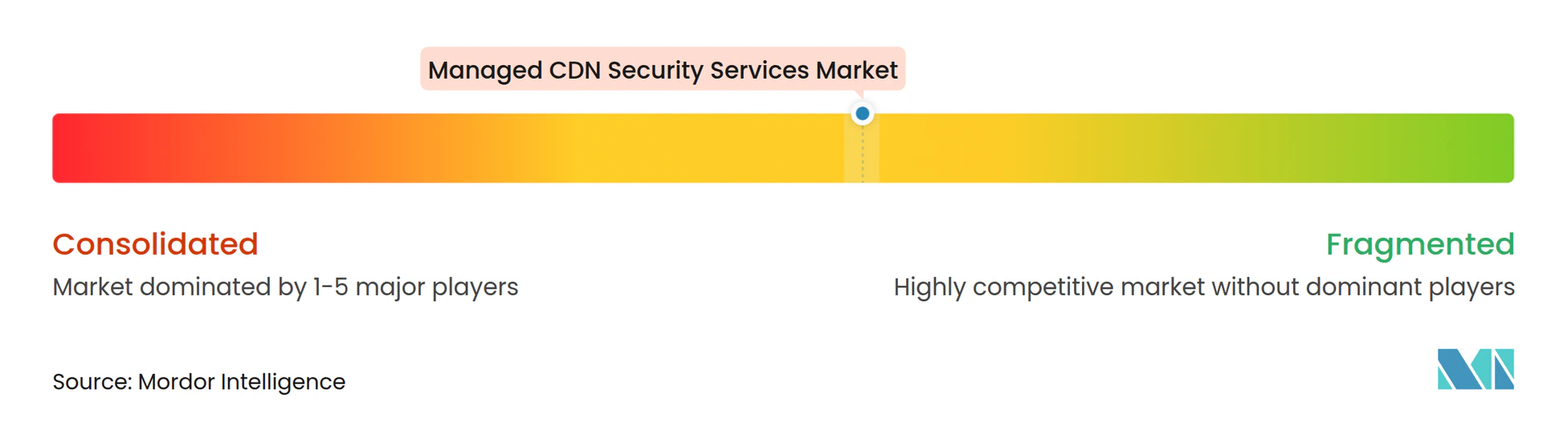
The managed CDN security services market has moderate concentration among global platform providers and fragmentation among regional providers and specialists. Akamai, Cloudflare, and Fastly operate global anycast networks with integrated web application and API protection capabilities. Cloudflare stated that customers are moving toward integrated infrastructure platforms, putting pressure on standalone DDoS vendors and appliance-focused WAF suppliers. Buyers increasingly evaluate delivery performance, security breadth, policy management, and support as a single package. Akamai introduced Firewall for AI and API LLM Discovery during RSA Conference 2025, extending protection toward AI inference traffic and language-model interactions. Fastly launched AI Runtime Control and AI Firewall in September 2026, signaling that AI application protection is becoming a more common platform capability. Participation in AI-security frameworks and related product development may influence future enterprise contract requirements.
Security-policy automation is an important competitive opening because it can reduce security operations effort and support lower-cost service models for SMBs. Cloudflare's channel program added solution bundles during 2025 that packaged CDN, security, and performance for managed security service providers and systems integrators. This type of packaging helps providers reach customers that do not purchase directly from large platforms. Regional providers such as G-Core Labs, Medianova, and CDNetworks can compete where global platforms have fewer local points of presence or limited data-sovereignty alignment. CDNetworks' threat research highlights the relevance of Layer 7 protection in Asia-Pacific markets. Certified controls and clear audit evidence are increasingly important where NIS2 and other operational-resilience requirements apply. The managed CDN security services market rewards providers that pair local delivery reach with practical compliance support. Price alone is less persuasive when customers need documented incident and policy-management processes.
F5 is a relevant enterprise competitor through distributed cloud web application and API protection that supports hybrid and multicloud environments. Tencent Cloud EdgeOne is also relevant in Asia-Pacific because it combines DDoS protection, WAF, bot management, and adaptive detection. The competitive field is therefore not limited to traditional CDN providers. It includes security platforms that can protect application traffic across different delivery architectures. Fastly's partnership with Comcast and its work supporting Peacock live sports illustrate the value of deep delivery integration for demanding media workloads. Cyber Security Cloud and Fastly Japan also formed a 2025 partnership combining Fastly's CDN with the Attack Blocker cloud WAF for Japanese e-commerce and video deployments. The managed CDN security services market remains competitive because customers can choose global platforms, regional networks, or hybrid security vendors according to traffic location and control requirements. No combined market-share figure for the leading companies was provided, so a concentration score cannot be derived under the stated scoring framework.
Managed CDN Security Services Industry Leaders
-
Akamai Technologies, Inc.
-
Cloudflare, Inc.
-
Fastly, Inc.
-
Imperva, Inc.
-
Radware Ltd.
- *Disclaimer: Major Players sorted in no particular order
Managed CDN Security Services Market Companies Covered in this Report
- Akamai Technologies, Inc.
- Cloudflare, Inc.
- Fastly, Inc.
- Radware Ltd.
- Imperva, Inc.
- Nexusguard Limited
- Corero Network Security plc
- G-Core Labs S.A.
- CDNetworks Co., Ltd.
- CacheFly, Inc.
- BaishanCloud (Beijing) Technology Co., Ltd.
- ChinaCache International Holdings Ltd.
- Beijing Wangsu Science and Technology Co., Ltd.
- QUANTIL, Inc.
- Medianova Internet Services, Inc.
- BunnyWay d.o.o.
- Leaseweb Global B.V.
- StackPath, LLC
- Edgio, Inc.
- CDN77.com s.r.o.
Recent Industry Developments in Managed CDN Security Services Market
- October 2026: Fastly expanded its partnership with Jio Platforms, with JioCDN Powered by Fastly now delivering secure, high-performance digital experiences for businesses across India.
- September 2026: Fastly launched AI Runtime Control and AI Firewall, extending managed security capabilities to govern AI requests, protect AI applications, and control agent interactions at the network edge.
- September 2026: Comcast and Fastly announced a next-generation content delivery model integrating Fastly software across Comcast's network for streaming, gaming, and edge AI services. NBCUniversal's Peacock live sports delivery was cited as a primary deployment.
- September 2026: Fastly signed its first Singapore distribution agreement with Ingram Micro, accelerating managed CDN security access for enterprises across Southeast Asia.
Global Managed CDN Security Services Market Report Scope
The managed CDN security services market encompasses outsourced security solutions and services designed to protect content delivery networks (CDNs), web applications, APIs, and digital content from cyber threats, while ensuring secure, reliable, and efficient content delivery. These services include distributed denial-of-service (DDoS) protection, web application firewalls, bot mitigation and screen-scraping protection, API security and runtime protection, data security, and content integrity solutions.
The Managed CDN Security Services Report is Segmented by Organization Size (Small and Medium-Sized Businesses, and Large Enterprises), Security Type (DDoS Protection, Web Application Firewall, Bot Mitigation and Screen-Scraping Protection, API Security and Runtime Protection, Data Security and Content Integrity, and Other Security Types), Deployment Mode (Cloud, On-Premise, and Hybrid), End-User Industry (Media and Entertainment, Retail and E-Commerce, BFSI, Information Technology and Telecommunications, Healthcare and Life Sciences, Government and Public Sector, and Other End-User Industries), and Geography (North America, South America, Europe, Asia-Pacific, Middle East, and Africa). The Market Forecasts are Provided in Terms of Value (USD).
Segmentation Overview
| Small and Medium-Sized Businesses |
| Large Enterprises |
| DDoS Protection |
| Web Application Firewall |
| Bot Mitigation and Screen-Scraping Protection |
| API Security and Runtime Protection |
| Data Security and Content Integrity |
| Other Security Types |
| Cloud |
| On-Premise |
| Hybrid |
| Media and Entertainment |
| Retail and E-Commerce |
| BFSI |
| Information Technology and Telecommunications |
| Healthcare and Life Sciences |
| Government and Public Sector |
| Other End-User Industries |
| North America | United States |
| Canada | |
| Mexico | |
| South America | Brazil |
| Argentina | |
| Rest of South America | |
| Europe | Germany |
| United Kingdom | |
| France | |
| Italy | |
| Spain | |
| Russia | |
| Rest of Europe | |
| Asia-Pacific | China |
| Japan | |
| India | |
| South Korea | |
| Southeast Asia | |
| Rest of Asia-Pacific | |
| Middle East | Saudi Arabia |
| United Arab Emirates | |
| Turkey | |
| Rest of Middle East | |
| Africa | South Africa |
| Nigeria | |
| Egypt | |
| Rest of Africa |
| By Organization Size | Small and Medium-Sized Businesses | |
| Large Enterprises | ||
| By Security Type | DDoS Protection | |
| Web Application Firewall | ||
| Bot Mitigation and Screen-Scraping Protection | ||
| API Security and Runtime Protection | ||
| Data Security and Content Integrity | ||
| Other Security Types | ||
| By Deployment Mode | Cloud | |
| On-Premise | ||
| Hybrid | ||
| By End-User Industry | Media and Entertainment | |
| Retail and E-Commerce | ||
| BFSI | ||
| Information Technology and Telecommunications | ||
| Healthcare and Life Sciences | ||
| Government and Public Sector | ||
| Other End-User Industries | ||
| By Geography | North America | United States |
| Canada | ||
| Mexico | ||
| South America | Brazil | |
| Argentina | ||
| Rest of South America | ||
| Europe | Germany | |
| United Kingdom | ||
| France | ||
| Italy | ||
| Spain | ||
| Russia | ||
| Rest of Europe | ||
| Asia-Pacific | China | |
| Japan | ||
| India | ||
| South Korea | ||
| Southeast Asia | ||
| Rest of Asia-Pacific | ||
| Middle East | Saudi Arabia | |
| United Arab Emirates | ||
| Turkey | ||
| Rest of Middle East | ||
| Africa | South Africa | |
| Nigeria | ||
| Egypt | ||
| Rest of Africa | ||
Key Questions Answered in the Report
What is the managed CDN security services market size?
The managed CDN security services market is projected to expand from USD 5.08 billion in 2026 and USD 5.61 billion in 2027 to USD 8.88 billion by 2032, at a 9.62% CAGR.
Which security type leads managed CDN security services?
DDoS protection led with 87.43% share in 2026. API security and runtime protection is projected to expand at the fastest 10.81% CAGR through 2032.
Why are enterprises adopting managed CDN security services?
Enterprises are consolidating DDoS mitigation, web application firewalls, bot controls, API protection, and delivery capabilities onto integrated platforms.
Which deployment mode is most used for managed CDN security?
Cloud deployment held 76.36% share in 2026 and is projected to expand at a 10.19% CAGR through 2032.
Which end-user segment is expanding fastest?
Retail and e-commerce is projected to expand at a 10.98% CAGR through 2032 because checkout, payment, inventory, and promotional systems rely heavily on APIs.
Which region is expanding fastest for managed CDN security services?
Asia-Pacific is projected to expand at a 10.57% CAGR through 2032, supported by streaming demand and elevated application-layer attack activity.