
Managed Fraud Bot Mitigation Services Market Size and Share
Market Overview
| Study Period | 2021 - 2032 |
|---|---|
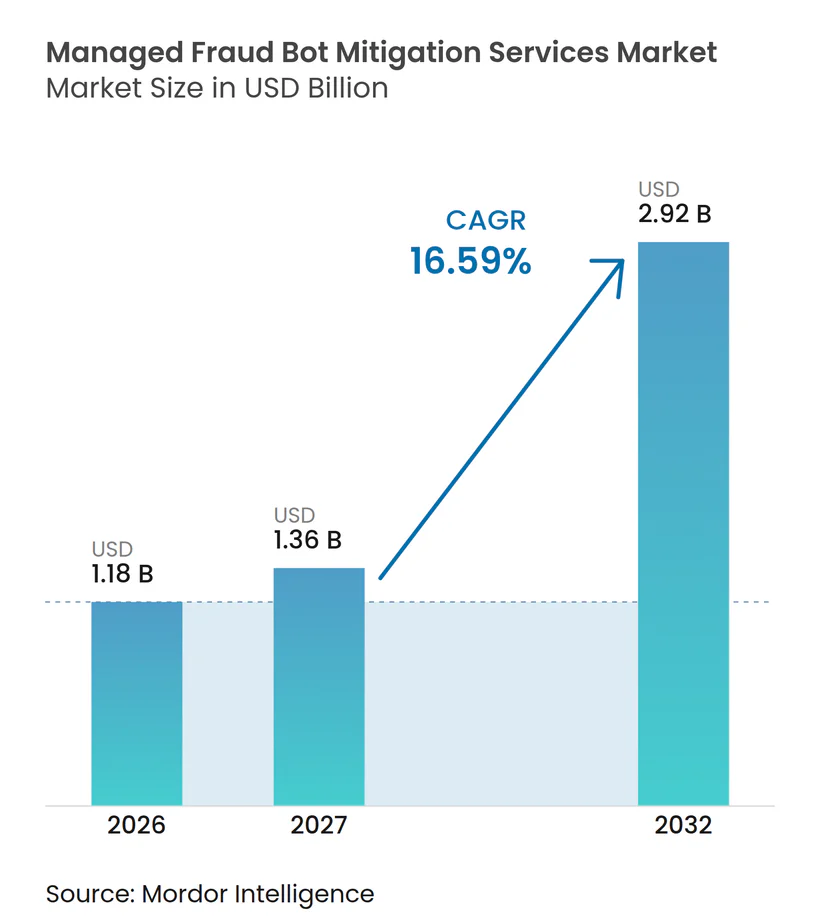
| Market Size (2027) | USD 1.36 Billion |
| Market Size (2032) | USD 2.92 Billion |
| Growth Rate (2027 - 2032) | 16.59 % |
| Fastest Growing Market | Asia-Pacific |
| Largest Market | North America |
| Market Concentration | Medium |
Major Players *Disclaimer: Major Players sorted in no particular order Image © Mordor Intelligence. Reuse requires attribution under CC BY 4.0. | |
Managed Fraud Bot Mitigation Services Market Analysis by Mordor Intelligence
The managed fraud bot mitigation services market size is projected to expand from USD 1.18 billion in 2026 to USD 1.36 billion in 2027, and to USD 2.92 billion by 2032, registering a CAGR of 16.59% between 2027 and 2032. The managed fraud bot mitigation services market is benefiting from rising concern over account takeover, automated abuse, and fraudulent activity across online channels. Enterprises are moving beyond isolated tools because web, API, and mobile traffic require coordinated monitoring and response. Managed delivery can provide continuing model tuning and threat intelligence without requiring every organization to build a specialist team. This creates room for providers that can combine behavioral detection with clear service commitments and low-friction deployment. The managed fraud bot mitigation services market also faces practical limits posed by complex security environments, privacy requirements, and the need to prevent false challenges to legitimate users.
Key Report Takeaways
- By component, Solutions held 62.12% of the market in 2026, while Managed Services is projected to expand at a 17.19% CAGR through 2032.
- By service delivery model, Fully Managed held 47.83% of the market in 2026 and is projected to expand at a 16.99% CAGR through 2032.
- By deployment mode, Cloud-Based accounted for 72.34% of the market in 2026 and is projected to expand at a 17.16% CAGR through 2032.
- By enterprise size, Large Enterprises accounted for 74.92% of the market in 2026, while SMEs are projected to expand at a 16.97% CAGR through 2032.
- By industry vertical, Retail and e-commerce held 28.87% of the market in 2026, while BFSI is projected to expand at a 17.78% CAGR through 2032.
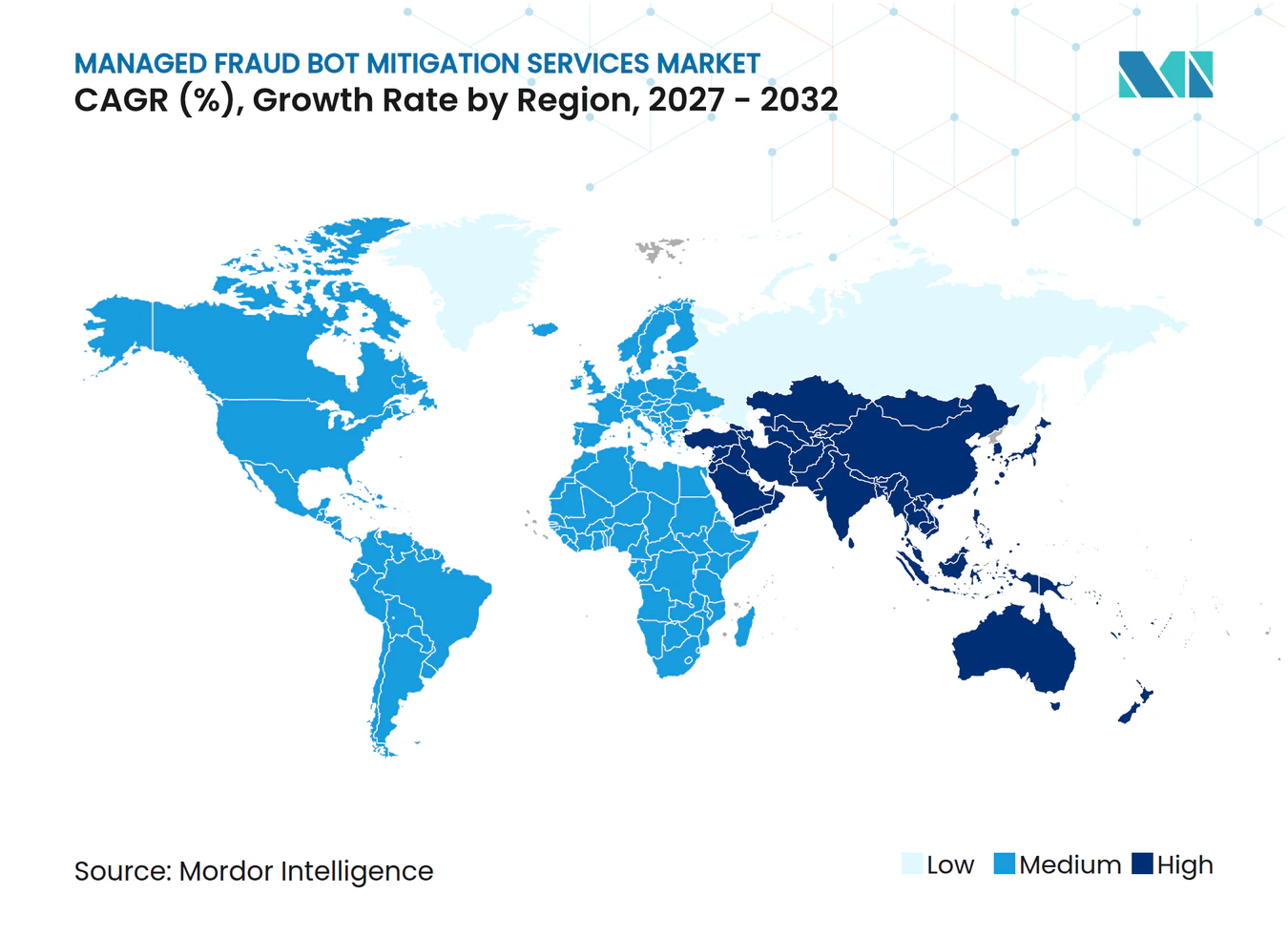
- By geography, North America held 41.18% of the market in 2026, while Asia-Pacific is projected to expand at a 17.58% CAGR through 2032.
Note: Market numbers in this report are based on Mordor Intelligence's proprietary estimation framework, which combines nine months of actuals with Q4 projections for base year 2026.
Market Trends and Insights
Drivers Impact Analysis of Managed Fraud Bot Mitigation Services Market*
| Driver | (~) % Impact on CAGR Forecast | Geographic Relevance | Impact Timeline |
|---|---|---|---|
| Increasing Account Takeover and Credential-Stuffing Attacks | +3.5% | Global, concentrated in North America, Europe, and Asia-Pacific e-commerce hubs | Short term (≤ 2 years) |
| Rising API, Mobile Application, and Digital Commerce Exposure | +3.0% | Global, with North America and Asia-Pacific leading in API-first digital commerce | Medium term (2-4 years) |
| Increasing Use of AI-Powered Behavioral Analytics | +2.5% | North America and Europe, with early enterprise deployment in Asia-Pacific | Medium term (2-4 years) |
| Shortage of Specialized Bot-Security Personnel | +2.0% | Global, most acute in Asia-Pacific and South America | Long term (≥ 4 years) |
| Managed Detection of AI Agents and Automated Fraud Farms | +1.8% | North America and Europe, expanding across Asia-Pacific and the Middle East | Medium term (2-4 years) |
| Economic Value of Preventing False Positives in High-Conversion Journeys | +1.2% | Global, especially retail and e-commerce | Short term (≤ 2 years) |
| Source: Mordor Intelligence | |||
Increasing Frequency of Account Takeover and Credential-Stuffing Attacks
Account takeover has become a pressing security concern for organizations that depend on online accounts and digital transactions. Sift estimated global account takeover fraud losses at USD 17 billion in 2025, highlighting the financial exposure that can elevate bot-defense decisions in security planning. TransUnion reported that account takeover accounted for 3.14% of total digital fraud in 2025, following a 37% year-over-year increase in rate and a 13% rise in volume. Kaspersky reported a 59% increase in infostealer detections on personal computers in 2025.[1] The company also reported that more than 1 million banking accounts at the 100 largest banks were compromised through stolen credentials. The managed fraud bot mitigation services market can address this exposure through session-level analysis, API monitoring, and shared threat intelligence.
Rising API, Mobile Application, and Digital Commerce Exposure
API-first architectures have widened the number of endpoints that automated attackers can target. F5 Labs reported that persistent bots can affect account creation, login, payment, and content workflows across online services. Direct API traffic may not carry the browser signals used by many older web-focused detection methods, which allows attackers to bypass controls built around JavaScript telemetry. Mobile applications create a related challenge because SDK update cycles can leave attackers time to study fingerprinting logic and adapt before a new version reaches users. Automated activity can also exploit business processes by holding inventory, abusing loyalty programs, and overloading checkout flows without creating a conventional security alert. The managed fraud bot mitigation services market favors coverage that connects web, API, and mobile channels.
Increasing Use of AI-Powered Behavioral Analytics
Behavioral analytics is shifting bot detection from static signatures to models that are updated as adversaries evolve their methods. Cloudflare’s per-customer approach uses edge-based models to identify abnormal behavior against a customer-specific baseline. This approach can shift the cost of evasion because attackers must adjust more than a known signature or fixed rule. HUMAN Security introduced its Threat Tracker capability in 2025 to help identify, isolate, and track malicious activity over time. Retraining these models requires data, specialist staff, and sustained operational attention as traffic and attack behavior evolve. The managed fraud bot mitigation services market benefits when providers can build broader intelligence pools and secondary detection models than individual security teams.
Shortage of Specialized Bot-Security Personnel
Cybersecurity staffing constraints make it difficult for many organizations to operate specialist bot-defense programs internally. ISC2 found that 59% of respondents reported critical or significant skills needs in 2025, while 95% identified at least 1 skills gap. Indeed estimated that 4.8 million cybersecurity roles remained unfilled worldwide, while demand in G7 countries rose 9.5% during the 6 months covered by its 2025 research. Bot security requires skills across behavioral analytics, API traffic analysis, detection-model operations, and adversarial testing. ISC2 found that 20% of organizations used outsourcing and 19% used third-party service providers to address workforce needs. The managed fraud bot mitigation services market is supported when providers turn specialist work into defined response processes for smaller internal teams.
Restraints Impact Analysis of Managed Fraud Bot Mitigation Services Market*
| Restraint | (~) % Impact on CAGR Forecast | Geographic Relevance | Impact Timeline |
|---|---|---|---|
| Integration Complexity Across CDNs, WAFs, APIs, and Identity Systems | -2.0% | Global, most acute in large enterprises with multi-vendor architectures | Medium term (2-4 years) |
| Privacy, Consent, and Cross-Border Data-Processing Constraints | -1.5% | Europe, Asia-Pacific, and other markets with emerging privacy frameworks | Long term (≥ 4 years) |
| Adversarial Evasion Against Fingerprinting and Behavioral Models | -1.2% | Global | Medium term (2-4 years) |
| Customer Friction From Incorrect Challenges and Legitimate-Bot Blocking | -0.8% | Global, especially retail, BFSI, and travel | Short term (≤ 2 years) |
| Source: Mordor Intelligence | |||
Integration Complexity Across CDNs, WAFs, APIs, and Identity Systems
Large organizations often run content delivery networks, web application firewalls, identity systems, API gateways, and cloud environments from several vendors. Integrating managed bot controls into those layers requires policy coordination, traffic testing, exception handling, and agreement on which system makes the final blocking decision. OWASP states that bot management involves controls across several layers and requires consideration of legitimate automated traffic, including search crawlers, payment processors, and monitoring agents. Conflicting rules can create duplicate challenges or block valid traffic when security systems interpret the same session differently. ISACA reported that 58% of cybersecurity teams were understaffed in 2026, while 61% had open positions. The managed fraud bot mitigation services market needs providers that offer implementation support and integrated policy management.
Privacy, Consent, and Cross-Border Data-Processing Constraints
Bot controls can process behavioral signals such as device data, browser characteristics, mouse movements, and keystroke patterns. A 2025 peer-reviewed study concluded that web bot detection monitoring can involve personal data under the General Data Protection Regulation. The study emphasized data minimization, retention controls, transparent disclosure of processing practices, and documented grounds for processing. The European Commission states that the EU AI Act became fully applicable on August 2, 2026, including transparency requirements for certain automated interactions.[2] Data residency requirements in markets such as China, India, and Saudi Arabia can also limit how providers pool signals across jurisdictions. The managed fraud bot mitigation services market may need region-specific service designs that preserve detection quality while meeting local requirements.
*Our forecasts treat driver/restraint impacts as directional, not additive. The impact forecasts reflect baseline growth, mix effects, and variable interactions.
Managed Fraud Bot Mitigation Services Market Segment Analysis
By Component:
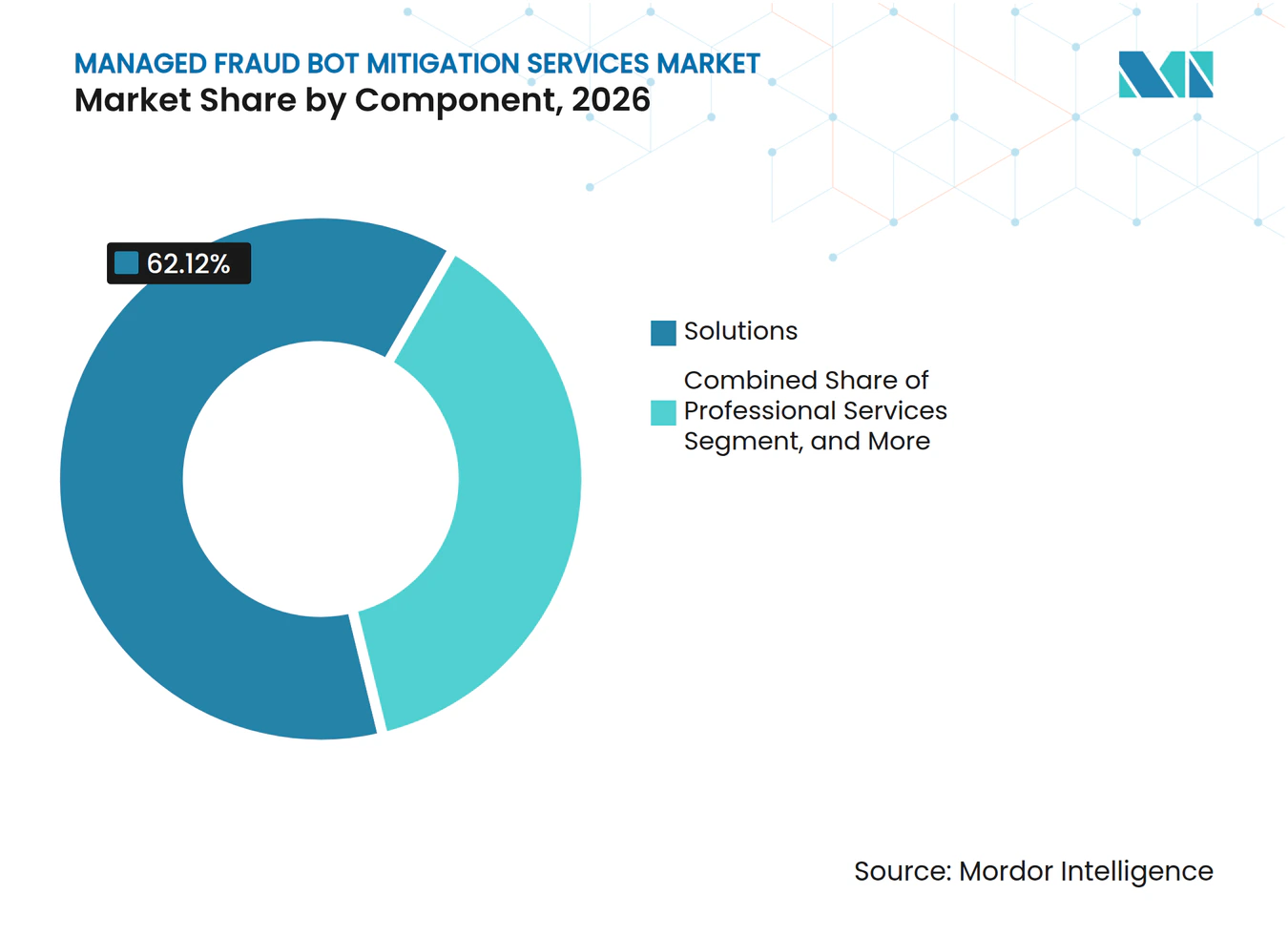
Managed Services Gain From Demand for Ongoing OperationsSolutions commanded 62.12% of the managed fraud bot mitigation services market share in 2026, reflecting the installed base of software platforms at enterprises that already have security engineering capacity and established internal workflows. Managed Services is projected to expand at a 17.19% CAGR through 2032, the highest rate among component types, because customers increasingly seek defined operational accountability. This direction shows that many buyers want accountable outcomes rather than software alone. Detection models need regular tuning as attack techniques and normal traffic patterns change. Workforce constraints make it difficult for internal teams to sustain that work.
Professional Services supports the other components through policy design, API integration, and incident response arrangements. It can help customers prepare custom detection policies and connect controls to new applications. Managed providers can differentiate through clear response commitments, false-positive service levels, and reporting on model performance. Those service features can matter when security teams need evidence that controls are working without adding internal workload. The managed fraud bot mitigation services industry is therefore shifting toward services that absorb continuing detection and governance tasks.



By Service Delivery Model:
Fully Managed Delivery Retains Its LeadFully Managed held 47.83% of the managed fraud bot mitigation services market in 2026 and is projected to expand at a 16.99% CAGR through 2032. The segment’s position shows a preference for a single provider accountable for continuous coverage amid changing traffic patterns. Buyers can use this approach to centralize monitoring, tuning, and escalations. Co-Managed delivery remains relevant for organizations that retain internal security operations but need help with selected tasks. These tasks can include model governance, threat intelligence enrichment, and tuning for new API endpoints.
On-Demand incident response can serve organizations that need specialist assistance during a high-traffic event, a retail sales period, or a payment disruption. Advisory, deployment, and optimization services can help customers standardize protection across several delivery channels. Partial coverage can leave direct API or mobile flows exposed even when web traffic is protected. Unified behavioral coverage enables providers to compare activity across channels and respond with a more complete context. The managed fraud bot mitigation services market continues to reward providers that can make broad coverage easier to operate.
By Deployment Mode:
Cloud-Based Delivery Extends Its AdvantageCloud-Based delivery held 72.34% of the managed fraud bot mitigation services market in 2026 and is projected to expand at a 17.16% CAGR through 2032. Its position reflects the need to inspect requests quickly across distributed online services and protect transactions that occur far from a central data center. Cloud-native architectures can place controls close to web and API traffic. DataDome states that its detection engine processes 5 trillion signals each day. This scale illustrates why cloud infrastructure is central to high-volume behavioral analysis.
On-Premises deployments remain important in government, defense, and financial environments with localized processing requirements. Some customers use hybrid models that combine cloud inspection for external traffic with local enforcement for sensitive internal systems. Payment-card compliance needs in 2025 and 2026 have increased the focus on evidence collection, audit readiness, and control documentation. Managed cloud providers can package operational reporting and compliance materials as part of their services. The managed fraud bot mitigation services industry will retain several deployment models because data residency and latency needs differ by customer.
By Enterprise Size:
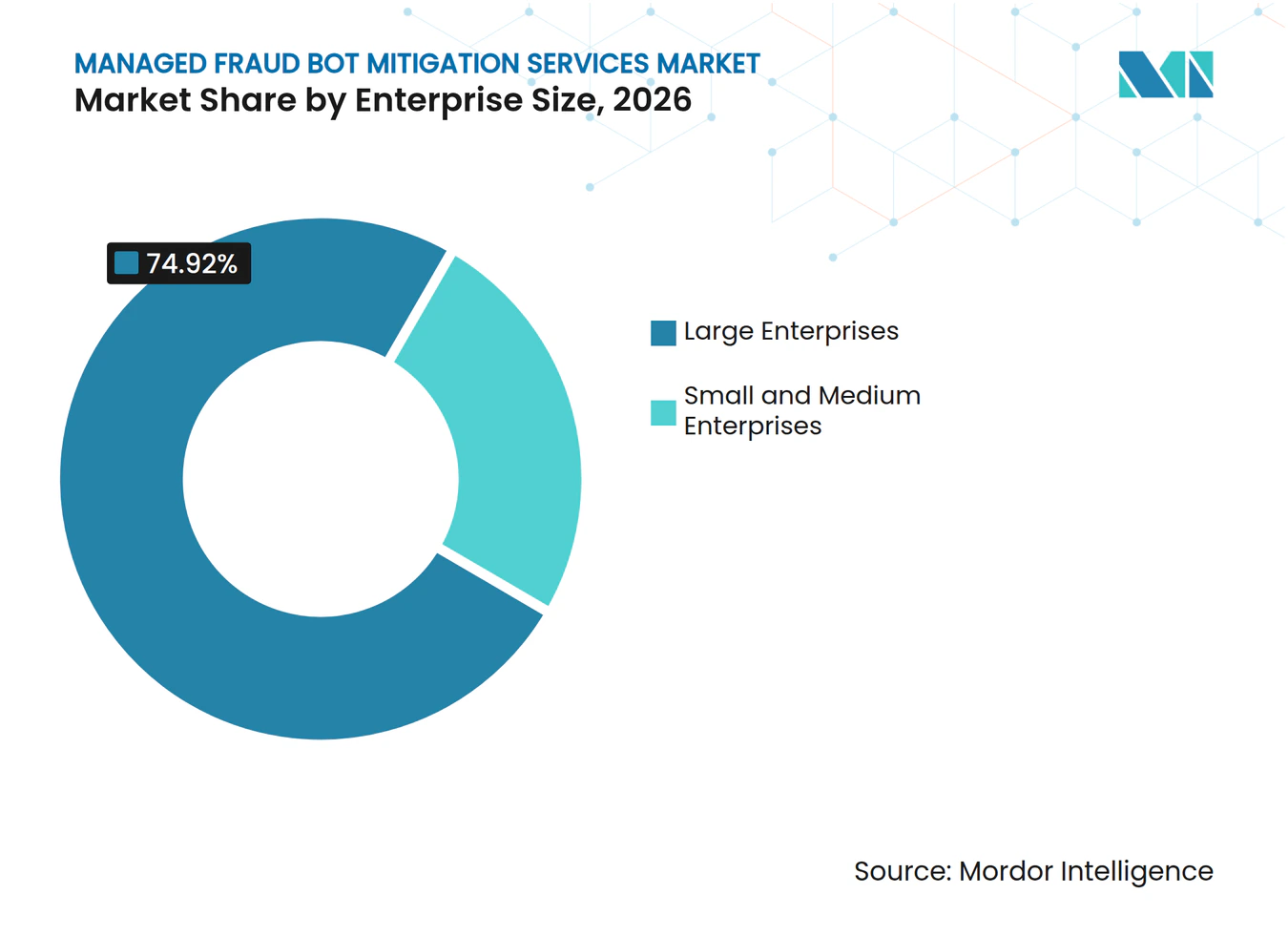
SMEs Expand Their Use of Managed ProtectionLarge Enterprises accounted for 74.92% of the managed fraud bot mitigation services market in 2026 because they have long invested in digital infrastructure, security operations, and platform-grade protection. SMEs are projected to expand at a 16.97% CAGR through 2032 as managed packages reduce operational barriers and limit the need to maintain a specialist team. Barracuda Networks reported that 61% of organizations with 50 to 100 employees used managed service providers for security support. Smaller organizations can face the same account abuse and automated attacks as larger firms. Their challenge is often interpreting signals and responding without dedicated staff.
ConnectWise found that 57% of small and medium-sized businesses identified cybersecurity as their top organizational priority in 2025, compared with 43% in 2024. Fully managed contracts can deliver plain-language reports, policy updates, and incident support without requiring customers to operate complex dashboards. These arrangements do not replace demand from large enterprises, which remain important buyers. Providers may need simpler implementation, flexible prices, and responsive support to serve this group. The managed fraud bot mitigation services market has a wider customer base when protection is delivered as an ongoing service.

By Industry Vertical:
Retail Leads While BFSI AcceleratesRetail and e-commerce held 28.87% of the managed fraud bot mitigation services market in 2026 because their transaction flows are frequent and highly exposed to automation. Bots can take over accounts, reserve inventory, scrape prices, abuse promotional offers, and overload checkout queues. Riskified reported that 85% of surveyed merchants identified reducing friction for legitimate customers as their primary fraud management challenge. This makes false-positive control important for both revenue and customer retention. BFSI is projected to expand at a 17.78% CAGR through 2032 as open banking APIs, real-time payment services, and digital-first banking platforms create more exposure points.
Healthcare and life sciences represent a developing opportunity because patient portals and telehealth applications can be targeted through credential stuffing. Government bodies also need protection for benefit portals and digital identity services. Travel, gaming, and telecommunications drive demand because their accounts and promotional programs are valuable targets. These verticals have different risk patterns, so providers must adjust detection and response policies. The managed fraud bot mitigation services industry must balance security controls with conversion, service availability, and user access.
Geography Analysis
North America Managed Fraud Bot Mitigation Services Market
North America held 41.18% of the managed fraud bot mitigation services market share in 2026, supported by extensive digital commerce activity and a mature managed security supply base. The Federal Reserve reported that account takeover fraud losses in the United States exceeded USD 15.6 billion in 2024. This level of loss supports enterprise attention to stronger fraud and authentication controls. The United States hosts many specialist providers, including HUMAN Security, Kasada, Arkose Labs, and Cequence Security, while Canada’s digital banking activity and Mexico’s e-commerce expansion add regional demand.
APAC Managed Fraud Bot Mitigation Services Market
Asia-Pacific is projected to expand at a 17.58% CAGR through 2032, the highest regional rate in the managed fraud bot mitigation services market. India’s payment infrastructure and financial sector cybersecurity requirements support demand for managed fraud controls. China has a distinct provider environment, as local data and security regulations can limit international vendors' participation. Singapore and South Korea operate as regional hubs where security standards can influence subsidiary operations. Japan and Australia also support outsourcing through formalized expectations for financial-sector information security.
EMEA and South America Managed Fraud Bot Mitigation Services Market
Europe is the second-largest regional presence, with the United Kingdom and Germany anchoring enterprise adoption. The UK government estimated the national cyber workforce at 145,900 in 2026 and identified persistent skills needs. South America is led by Brazil, where instant-payment activity creates additional API exposure. Saudi Arabia and the United Arab Emirates are expanding digital services that require more resilient fraud controls. Africa remains in the early stages, with Nigeria, South Africa, and Egypt serving as key focal points for adoption.
Competitive Landscape
Market Concentration
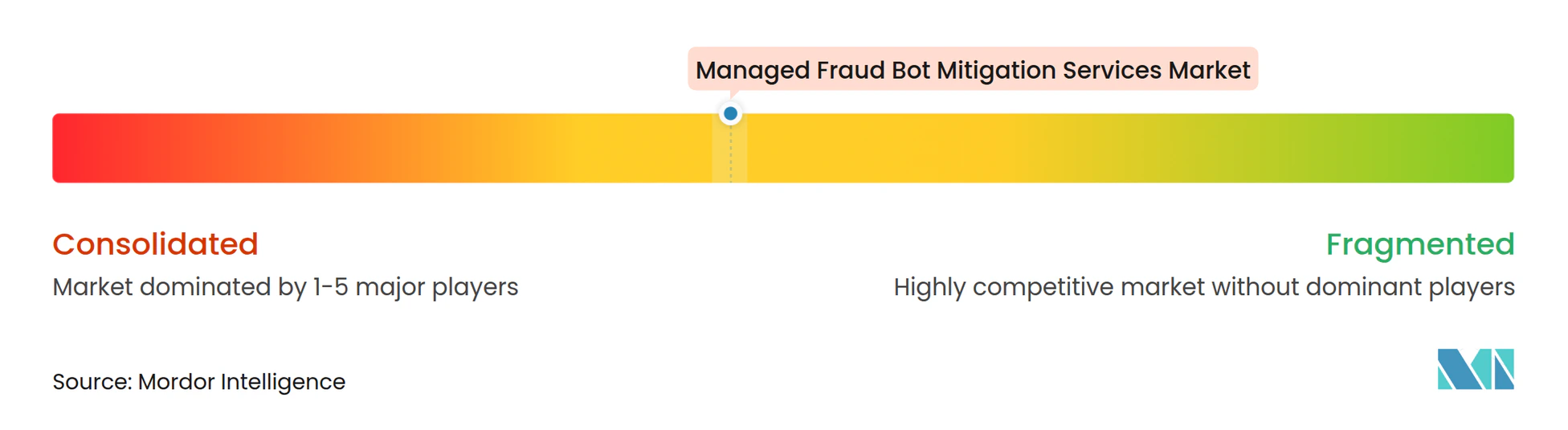
The managed fraud bot mitigation services market is moderately concentrated, with specialist vendors competing against broader application security and content delivery providers. Competition focuses on the depth of behavioral detection, managed operations, and integration across customer environments. DataDome partnered with Arc XP in July 2025 to embed bot protection and AI traffic control in the Arc XP ecosystem. It also partnered with TollBit in July 2025 to help customers distinguish authorized AI agents from harmful automation. These moves reduce the need for customers to build each integration independently.
HUMAN Security has expanded its capabilities to identify and track malicious activity through its Threat Tracker platform. Arkose Labs introduced Arkose Titan in January 2026 as a unified platform for malicious bots, AI agents, and human fraud networks. Kasada secured USD 20 million in February 2026 to support international expansion and platform development.[3] These examples show that providers are extending bot protection toward AI-agent governance and broader fraud controls. The competitive advantage rests on dependable detection, deployment support, and a service model that works across channels.
Mid-market and regional providers can compete by offering deployment flexibility, local-language support, and lower-complexity service packages. Larger providers have an advantage when buyers need documented compliance controls, broad integration coverage, and local traffic processing to meet data residency requirements. The managed fraud bot mitigation services market will remain competitive as both specialist and platform providers expand their managed offerings. The managed fraud bot mitigation services market will also favor vendors that can manage approved AI agents without confusing them with malicious automation.
Managed Fraud Bot Mitigation Services Industry Leaders
-
HUMAN Security, Inc.
-
DataDome SAS
-
Arkose Labs Inc.
-
Kasada Inc.
-
Netacea Limited
- *Disclaimer: Major Players sorted in no particular order
Managed Fraud Bot Mitigation Services Market Companies Covered in this Report
- DataDome SAS
- HUMAN Security, Inc.
- Kasada Inc.
- Arkose Labs Inc.
- Netacea Limited
- Cequence Security, Inc.
- Reblaze Technologies Ltd.
- ThreatX, Inc.
- BotGuard OÜ
- InfiSecure Technologies Pvt. Ltd.
- Variti International GmbH
- hCaptcha, Inc.
- Castle Intelligence, Inc.
- FingerprintJS, Inc.
- SEON Technologies Ltd.
- Forter, Inc.
- Riskified Ltd.
- HUMAN Security, Inc., PerimeterX Business
- DataVisor, Inc.
- ShieldSquare Technologies Private Limited
Recent Industry Developments in Managed Fraud Bot Mitigation Services Market
- October 2026: Cequence Security published research revealing that Meta's Muse AI agent reached more than half of the enterprise customers studied within 2 weeks of deployment without identifying itself as an AI agent, highlighting a critical AI traffic governance gap that managed bot mitigation services are uniquely positioned to address. The finding underscores how agentic AI has moved from a theoretical risk to an active and measurable operational challenge for enterprises.
- October 2026: HUMAN Security's Sightline platform received updates adding AI-agent policy management directly within bot defense workflows, including an Okta integration enabling real-time account-level response actions, including session disconnection and password reset, triggered by bot or agent activity detections.
- August 2026: Cequence Security and Enterprise Management Associates released joint research finding that 94% of enterprises trust their AI agents are not over-provisioned while only 33% actually enforce provisioning controls, a gap that expands the serviceable demand for managed AI-agent and bot governance platforms with automated enforcement capabilities.
- August 2026: Arkose Labs released a new capability addition to Arkose Titan enabling security teams to define how each class of AI agent is trusted, challenged, or stopped while maintaining transaction continuity, directly extending its managed fraud defense to cover autonomous agent traffic without disrupting legitimate automation workflows.
Global Managed Fraud Bot Mitigation Services Market Report Scope
The Managed Fraud Bot Mitigation Services Market refers to the market for specialized solutions and outsourced services designed to detect, analyze, manage, and mitigate malicious automated bot traffic that facilitates online fraud, account takeovers, credential stuffing, payment fraud, fake account creation, web scraping, inventory hoarding, and other automated cyberattacks. The market includes technology solutions, managed security services, and professional services that help organizations identify legitimate and malicious bot activity, protect digital platforms and transactions, minimize financial losses, and maintain service availability and customer trust.
The Managed Fraud Bot Mitigation Services Market Report is Segmented by Component (Solutions, Managed Services, and Professional Services), Service Delivery Model (Fully Managed Bot Mitigation, Co-Managed Bot Mitigation, On-Demand Incident Response, and Advisory, Deployment, and Optimization Services), Deployment Mode (Cloud-Based, On-Premises, and Hybrid), Enterprise Size (Large Enterprises and Small and Medium Enterprises), Industry Vertical (Retail and E-Commerce, BFSI, Healthcare and Life Sciences, Government and Public Sector, and Other Industry Verticals), and Geography (North America, South America, Europe, Asia-Pacific, Middle East, and Africa). The Market Forecasts are Provided in Terms of Value (USD).
Segmentation Overview
| Solutions |
| Managed Services |
| Professional Services |
| Fully Managed Bot Mitigation |
| Co-Managed Bot Mitigation |
| On-Demand Incident Response |
| Advisory, Deployment, and Optimization Services |
| Cloud-Based |
| On-Premises |
| Hybrid |
| Large Enterprises |
| Small and Medium Enterprises |
| Retail and E-Commerce |
| BFSI |
| Healthcare and Life Sciences |
| Government and Public Sector |
| Other Industry Verticals |
| North America | United States |
| Canada | |
| Mexico | |
| South America | Brazil |
| Argentina | |
| Rest of South America | |
| Europe | United Kingdom |
| Germany | |
| France | |
| Italy | |
| Spain | |
| Russia | |
| Rest of Europe | |
| Asia-Pacific | China |
| Japan | |
| India | |
| South Korea | |
| Australia | |
| Singapore | |
| Rest of Asia-Pacific | |
| Middle East | Saudi Arabia |
| United Arab Emirates | |
| Turkey | |
| Rest of Middle East | |
| Africa | South Africa |
| Nigeria | |
| Egypt | |
| Rest of Africa |
| By Component | Solutions | |
| Managed Services | ||
| Professional Services | ||
| By Service Delivery Model | Fully Managed Bot Mitigation | |
| Co-Managed Bot Mitigation | ||
| On-Demand Incident Response | ||
| Advisory, Deployment, and Optimization Services | ||
| By Deployment Mode | Cloud-Based | |
| On-Premises | ||
| Hybrid | ||
| By Enterprise Size | Large Enterprises | |
| Small and Medium Enterprises | ||
| By Industry Vertical | Retail and E-Commerce | |
| BFSI | ||
| Healthcare and Life Sciences | ||
| Government and Public Sector | ||
| Other Industry Verticals | ||
| Geography | North America | United States |
| Canada | ||
| Mexico | ||
| South America | Brazil | |
| Argentina | ||
| Rest of South America | ||
| Europe | United Kingdom | |
| Germany | ||
| France | ||
| Italy | ||
| Spain | ||
| Russia | ||
| Rest of Europe | ||
| Asia-Pacific | China | |
| Japan | ||
| India | ||
| South Korea | ||
| Australia | ||
| Singapore | ||
| Rest of Asia-Pacific | ||
| Middle East | Saudi Arabia | |
| United Arab Emirates | ||
| Turkey | ||
| Rest of Middle East | ||
| Africa | South Africa | |
| Nigeria | ||
| Egypt | ||
| Rest of Africa | ||
Key Questions Answered in the Report
What is the size of the managed fraud bot mitigation services market?
The market is projected to increase from USD 1.18 billion in 2026 to USD 2.92 billion by 2032, at a 16.59% CAGR from 2027 to 2032.
Why is the managed fraud bot mitigation services market gaining adoption?
Account takeover, API abuse, and automated fraud are increasing, while many organizations lack specialist staff to operate detection programs internally.
Which deployment mode leads the managed fraud bot mitigation services market?
Cloud-Based delivery held 72.34% of the market in 2026 and is projected to expand at a 17.16% CAGR through 2032.
Which customer group is expanding fastest for these services?
SMEs are projected to expand at a 16.97% CAGR through 2032 as managed packages reduce the need for in-house bot-security expertise.
Which vertical has the highest projected expansion?
BFSI is projected to expand at a 17.78% CAGR through 2032 as open banking APIs and real-time payment services add exposure points.
Which region has the highest projected CAGR?
Asia-Pacific is projected to expand at a 17.58% CAGR through 2032, supported by payment infrastructure growth and rising managed security adoption.