
IT Hardware Managed Services Market Size and Share
Market Overview
| Study Period | 2020 - 2031 |
|---|---|
| Market Size (2026) | USD 73.85 Billion |
| Market Size (2031) | USD 105.62 Billion |
| Growth Rate (2026 - 2031) | 7.41 % |
| Fastest Growing Market | Asia Pacific |
| Largest Market | North America |
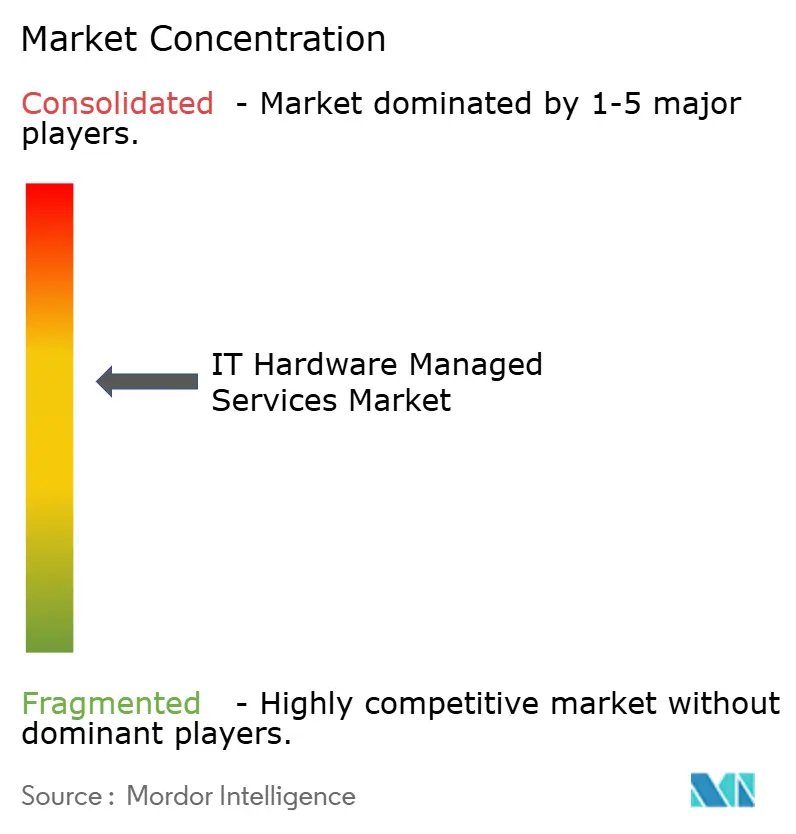
| Market Concentration | Medium |
Major Players *Disclaimer: Major Players sorted in no particular order Image © Mordor Intelligence. Reuse requires attribution under CC BY 4.0. | |
IT Hardware Managed Services Market Analysis by Mordor Intelligence
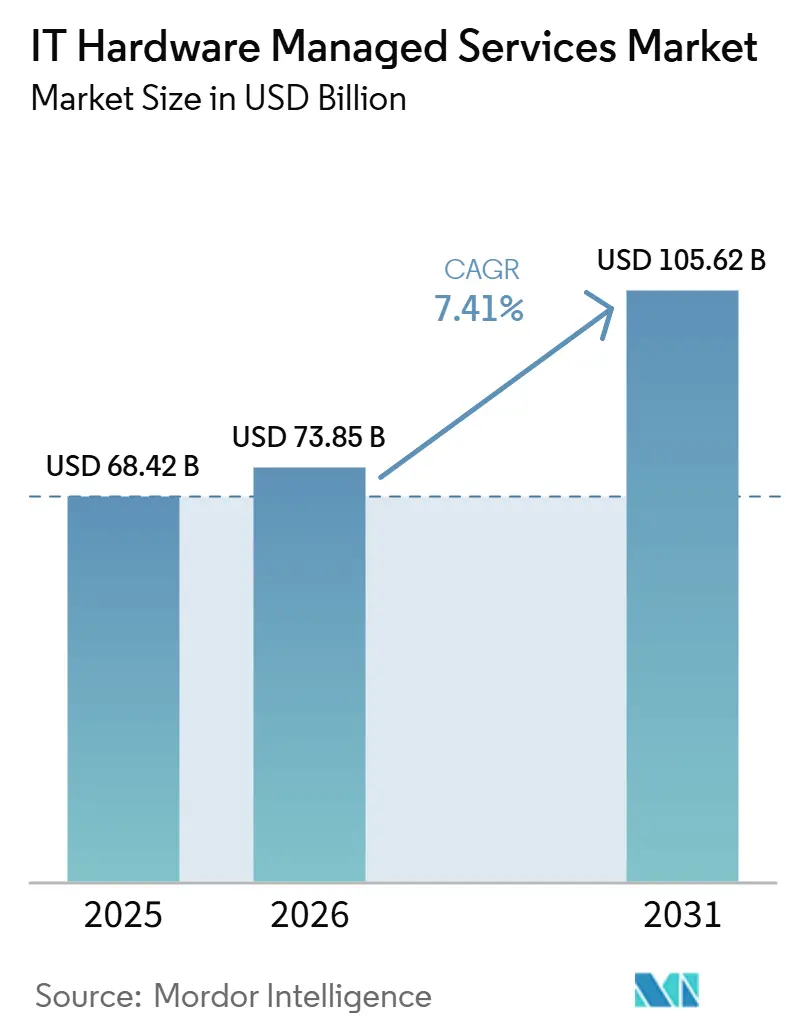
The IT hardware managed services market size is expected to increase from USD 68.42 billion in 2025 to USD 73.85 billion in 2026 and reach USD 105.62 billion by 2031, growing at a CAGR of 7.41% over 2026-2031. The expansion reflects a decisive shift from capital ownership of servers, storage, and end-user devices to pay-as-you-use service models that bundle procurement, deployment, and lifecycle support into predictable operating expenses. Enterprises are compressing refresh cycles to run artificial-intelligence workloads, while Device-as-a-Service agreements proliferate as hybrid work demands secure, continuously patched laptops, desktops, and mobile endpoints. Service providers that guarantee parts allocation during the 2026 server supply crisis gained share, especially in North America, where stringent data-protection laws mandate verifiable audit trails. Europe’s trajectory is shaped by the General Data Protection Regulation and the forthcoming EU Data Act, which favor regional suppliers that can demonstrate in-region data residency.
Key Report Takeaways
- By service type, maintenance and support led with 42.56% of revenue in 2025, whereas asset management is projected to grow at a 9.62% CAGR through 2031.
- By hardware type, servers accounted for 32.40% of the IT hardware management services market revenue in 2025, but end-user devices are forecast to expand at a 9.85% CAGR through 2031.
- By end-user industry, IT and telecommunications accounted for 22.63% of 2025 revenue, while healthcare and life sciences were projected to grow at a 10.62% CAGR to 2031.
- By organization size, large enterprises captured 71.46% of the 2025 spending in the IT hardware managed services market, yet small and medium enterprises are set to grow at a 10.25% CAGR through 2031.
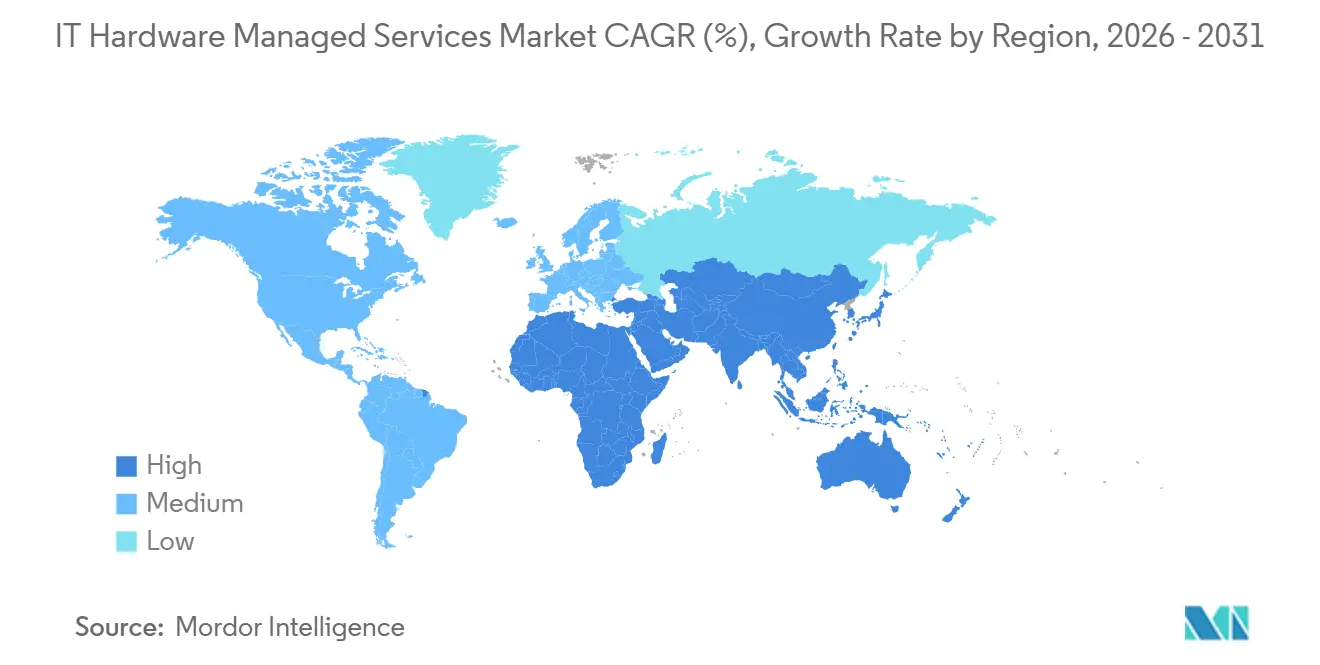
- By geography, North America led with a 37.11% share in 2025, whereas Asia-Pacific is forecast to grow at a 9.42% CAGR over 2026-2031.
Note: Market size and forecast figures in this report are generated using Mordor Intelligence’s proprietary estimation framework, updated with the latest available data and insights as of January 2026.
Global IT Hardware Managed Services Market Trends and Insights
Drivers Impact Analysis*
| Driver | (~) % Impact on CAGR Forecast | Geographic Relevance | Impact Timeline |
|---|---|---|---|
| Accelerated Hardware Refresh Cycles Among Large Enterprises | +1.8% | Global, with concentration in North America and Europe | Short term (≤ 2 years) |
| Growth of Device-as-a-Service Subscription Models | +1.5% | North America and Europe core, expanding to Asia-Pacific | Medium term (2-4 years) |
| Rising Complexity of Hybrid Multi-Cloud Architectures | +1.3% | Global, particularly North America and Asia-Pacific | Medium term (2-4 years) |
| Heightened Cybersecurity Compliance Mandates for On-Premises Assets | +1.2% | Global, with regulatory emphasis in Europe, North America, and select Asia-Pacific markets | Long term (≥ 4 years) |
| Edge Computing Proliferation in Smart Facilities | +1.0% | Global, early adoption in North America and Europe, accelerating in Asia-Pacific | Medium term (2-4 years) |
| Sustainability Targets Driving Circular IT Hardware Programs | +0.9% | Europe and North America lead, emerging in Asia-Pacific | Long term (≥ 4 years) |
| Source: Mordor Intelligence | |||
Accelerated Hardware Refresh Cycles Among Large Enterprises
Enterprises are shortening refresh intervals to run memory-intensive AI models, a trend intensified by the 2026 server-hardware shortage, which pushed DRAM prices up 50-60% and stretched OEM lead times to 8 weeks. Managed service providers (MSPs) responded with pool-based procurement that lowers unit costs 15-25% while guaranteeing staged deliveries. Financial institutions swap legacy x86 boxes for high-density platforms that support real-time fraud detection, thereby locking in multi-year lifecycle contracts that bundle deployment, patching, and firmware updates.
Growth of Device-as-a-Service Subscription Models
DaaS decouples endpoint hardware from capital budgets, letting companies scale fleets with headcount. European buyers, mindful of GDPR fines, demand contracts that include certified destruction and cryptographic erasure at the end of life. Vendors now embed AI telemetry that predicts component failure and reduces unplanned downtime by 30-40%, an advantage valued by resource-constrained small and medium enterprises.
Rising Complexity of Hybrid Multi-Cloud Architectures
Organizations juggle five to seven unique environments spanning on-premises data centers, colocation cages, and public-cloud zones. MSPs deliver unified orchestration platforms that abstract hardware diversity, cutting mean time to resolution by 40-50%. In Asia-Pacific, compliance with China’s Cybersecurity Law and India’s draft Data Protection Bill fuels demand for in-country diagnostic and spare-parts depots.
Heightened Cybersecurity Compliance Mandates for On-Premises Assets
Frameworks such as ISO 27001 and the NIST Cybersecurity Framework require continuous monitoring of server firmware and the secure disposal of devices.[1]International Organization for Standardization, “ISO 27001: Information Security Management,” iso.org MSPs earn a competitive advantage by securing National Association for Information Destruction and Responsible Recycling certifications and by following ITU-L.1081 cryptographic erasure protocols, which regulators increasingly require for audit evidence.
Restraints Impact Analysis*
| Restraint | (~) % Impact on CAGR Forecast | Geographic Relevance | Impact Timeline |
|---|---|---|---|
| Macro-Economic Slowdowns Reducing Capital Expenditure Cycles | -1.1% | Global, pronounced in Europe and emerging markets | Short term (≤ 2 years) |
| OEM Warranty Extensions Limiting Third-Party Service Adoption | -0.8% | North America and Europe | Medium term (2-4 years) |
| Skills Shortage in Advanced Hardware Support Engineering | -0.6% | Global, acute in North America and Europe | Long term (≥ 4 years) |
| Data-Residency Regulations Hindering Remote Management | -0.5% | Europe, Asia-Pacific, select Middle East markets | Medium term (2-4 years) |
| Source: Mordor Intelligence | |||
Macro-Economic Slowdowns Reducing Capital Expenditure Cycles
CFOs defer hardware investment during downturns, extending server lifespans by swapping memory and drives instead of full chassis. The tactic shifts revenue from high-margin procurement services to lower-margin break-fix work, a pattern most visible in Europe’s late-2025 manufacturing contraction. MSPs counter with pay-per-use pricing that aligns fees to actual utilization, easing cash-flow pressure on small businesses.
OEM Warranty Extensions Limiting Third-Party Service Adoption
Dell Technologies and Hewlett Packard Enterprise now offer five-year proactive warranties that dispatch parts before failure, narrowing the historical 30-70% cost gap offered by independent maintainers. Third-party providers still appeal in multi-vendor estates but must invest in reverse-engineering diagnostics to stay relevant. AI-driven health monitoring is fast becoming a baseline requirement rather than a differentiator.
*Our forecasts treat driver/restraint impacts as directional, not additive. The impact forecasts reflect baseline growth, mix effects, and variable interactions.
Segment Analysis
By Service Type: Asset Management Momentum Under Circular-Economy Mandates
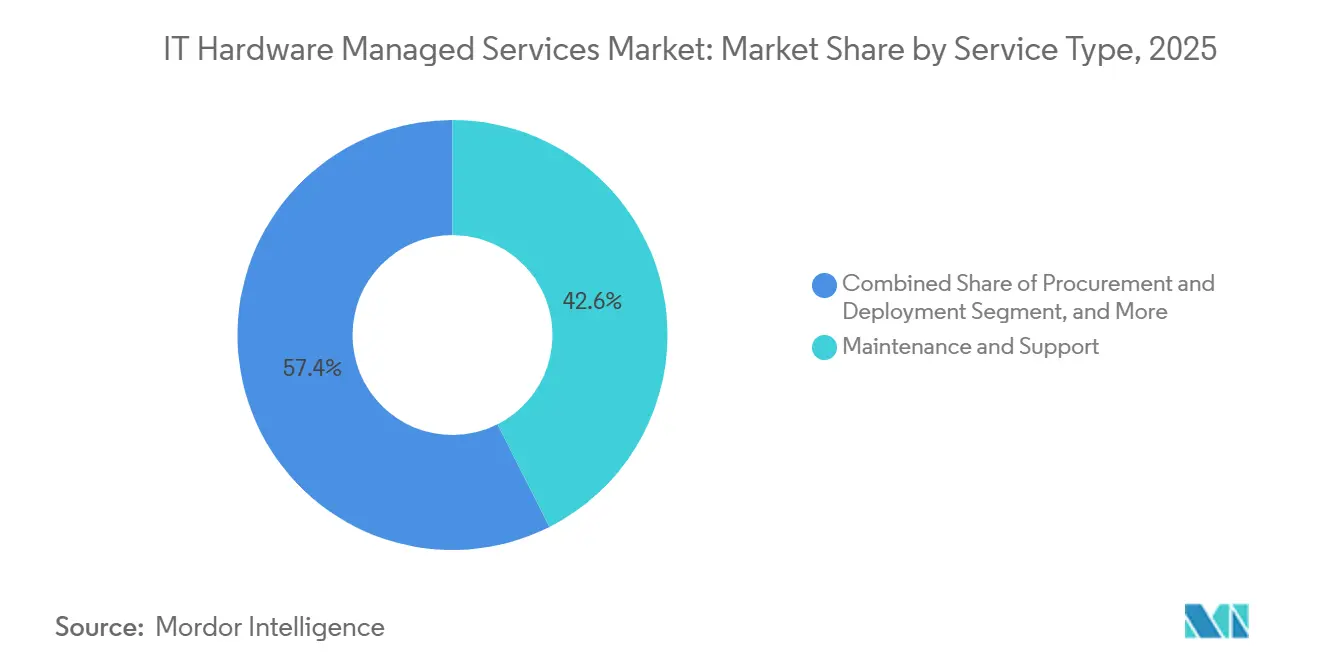
The maintenance and support segment accounted for 42.56% of 2025 revenue and is shifting to AI-driven predictive models exemplified by IBM-Lenovo Technology Lifecycle Services, which achieves 97% first-call resolution. Asset management is projected to grow at a 9.62% CAGR, the fastest among service lines, as extended producer responsibility laws require track-and-trace of equipment via digital product passports. Lenovo’s November 2025 refurbishment program grants trade-in credits and resells sanitized gear, lowering the total cost of ownership 10-15% while diverting e-waste.[2]Lenovo Press Release, “Lenovo Circular IT Refurbishment Program,” lenovo.com
Procurement and deployment services surged during the 2026 supply crunch because MSPs pooled orders to secure allocation. Installation and integration remain vital for edge projects in remote sites with no resident IT staff. The International Telecommunication Union's L.1071 standard for digital product passports, which mandates lifecycle tracking of electronic equipment, is driving enterprises to outsource asset tagging, inventory reconciliation, and disposition planning to specialized providers.[3]International Telecommunication Union, “L.1071 and L.1081 Standards for Digital Product Passports and Data Sanitization,” itu.int



By Hardware Type: End-User Devices Accelerate on Hybrid Work
In 2025, servers accounted for 32.40% of total revenue. However, as hybrid work becomes the norm, laptops, desktops, and mobile devices are projected to grow at an annual rate of 9.85% through 2031. The increasing adoption of hybrid work models has driven organizations to invest in end-user devices that support remote and flexible working environments. This shift is expected to sustain the demand for these devices over the forecast period, as businesses prioritize employee productivity and connectivity.
DaaS (Device as a Service) packages hardware, operating system licensing, and lifecycle management into one consolidated invoice, making it attractive to budget-conscious finance teams. With data growing at an annual rate of 23%, storage systems are evolving, leading to a shift towards NVMe and all-flash arrays that require specialized tuning. Networking equipment is transitioning to 400 Gb and 800 Gb Ethernet to support AI clusters, while peripheral devices, like uninterruptible power supplies, ensure uptime for distributed edge cabinets. These advancements in hardware infrastructure are critical to meeting the demands of modern workloads and ensuring operational efficiency.
By End-User Industry: Healthcare and Life Sciences Lead Growth
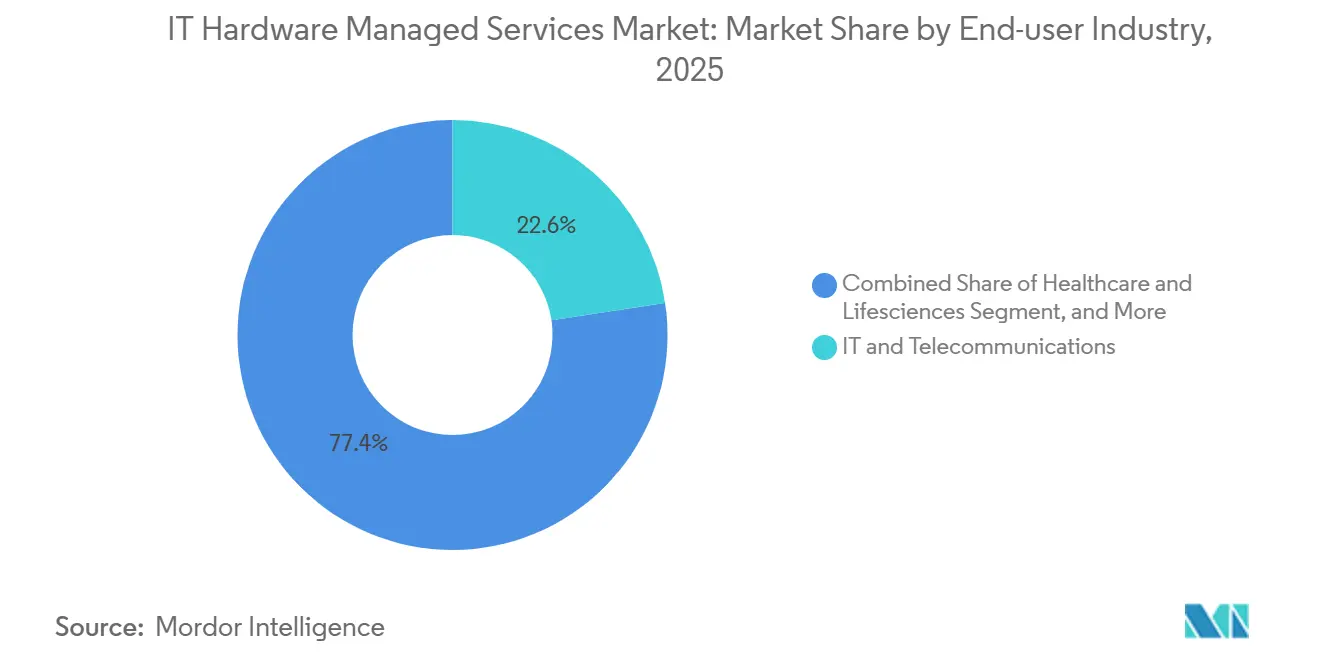
In 2025, IT and telecommunications accounted for 22.63% of total spending. Yet hospitals and research laboratories are set to experience a robust CAGR of 10.62% through 2031 as they modernize their electronic health record platforms in compliance with HIPAA regulations. The healthcare and life sciences industries are increasingly adopting advanced IT solutions to enhance patient care and streamline operations. This trend is further supported by regulatory requirements and the growing need for secure and efficient data management systems. Hyper-converged systems are reducing on-premise footprints, and the demand for high-core-count servers with liquid cooling is surging, driven by genomic analyses.
The banking and financial sector is revamping data centers to enhance real-time fraud analytics. At the same time, retail chains are utilizing in-store edge servers for inventory management and personalized promotions. In manufacturing, predictive maintenance tasks are being integrated into ruggedized hardware on the shop floor. These developments highlight the diverse applications of IT infrastructure across industries, each tailored to address specific operational challenges and opportunities.
By Organization Size: SME Uptake Rises on Modular Offers
In 2025, large enterprises accounted for 71.46% of revenue, managing extensive multi-site estates that require tailored SLAs and 24/7 support. Large organizations continue to dominate the market due to their significant IT budgets and complex infrastructure requirements. Their reliance on bespoke solutions and round-the-clock service agreements underscores the critical role of IT in maintaining business continuity and supporting large-scale operations. Conversely, small and medium enterprises are set to grow at an annual rate of 10.25%.
This growth is facilitated by cloud-brokered MSP portals, which have eliminated traditional minimum-volume constraints. Providers focused on specific sectors are offering compliance-ready solutions, whether legal e-discovery or healthcare imaging, allowing smaller firms to outsource tasks from procurement to secure destruction without the need for additional IT personnel. The increasing availability of modular and scalable IT solutions is enabling SMEs to overcome traditional barriers and compete effectively in the market.
Geography Analysis
North America, at 37.11% of 2025 revenue, remains the largest contributor, driven by stringent HIPAA and PCI-DSS rules and the world’s densest MSP ecosystem. US banks and insurers refresh infrastructure for AI fraud detection, while Canadian buyers favor in-country support to comply with the Personal Information Protection and Electronic Documents Act. Mexico benefits from nearshoring, which spurs factory-edge deployments that require rugged hardware and local spares.
Asia-Pacific is forecast to log the fastest 9.42% CAGR through 2031. India’s data-center boom and government incentives drive bulk server procurements managed under turnkey contracts. China’s sovereign-cloud mandates restrict foreign remote access, so local MSPs embed staff within customer sites. Japan favors long-term vendor relationships that bundle hardware, software, and services, while South Korea invests in 5G-backed smart-factory programs that require edge lifecycle care. Australia and New Zealand combine on-premises gear for regulated workloads with hyperscale cloud resources for overflow capacity, fueling demand for orchestrated hybrid support.
Europe’s outlook hinges on strict data-sovereignty laws. Germany’s automotive and manufacturing sectors deploy sensor-rich digital-twin environments that demand predictive maintenance. The United Kingdom’s healthcare trusts outsource device sanitation and firmware patching to avert GDPR fines. France channels public funding into sovereign cloud stacks administered by domestic MSPs, while Italy and Spain modernize public-sector infrastructure under EU recovery grants. Across the region, cross-border data transfer limits spur growth for providers with certified in-region service hubs.

Competitive Landscape
The IT hardware managed services market exhibits moderate concentration. IBM, Hewlett Packard Enterprise, Dell Technologies, Cisco Systems, and Lenovo combine manufacturing, financing, and lifecycle know-how, enabling end-to-end contracts that simplify accountability. IBM’s March 2026 AI-driven support platform, paired with Lenovo’s logistics network, delivers 97% first-call resolution and shortened parts-delivery windows, winning share among uptime-sensitive banks.[4]IBM Newsroom, “IBM and Lenovo Launch AI-Driven Technology Lifecycle Services,” ibm.com Dell’s new AI Data Platform, co-developed with NVIDIA, wraps servers, storage, networking, and lifecycle services for turnkey AI clusters. Cisco’s rugged edge suite supports industrial deployments where on-site IT is scarce.
Third-party maintainers such as Curvature, Park Place Technologies, and Maintech offer significant cost savings over OEM warranties, appealing to budget-minded buyers, though OEMs blunt this advantage by extending proactive contracts. Cloud-native disruptors such as Rackspace Technology and Softcat attract small and medium enterprises with self-service portals and month-to-month billing. Vertical specialists bundle compliance, integration, and hardware. For instance, healthcare-focused MSPs provide electronic-record hosting plus HIPAA reporting, creating stickiness despite lower scale.
Providers are increasingly distinguishing themselves through innovations like AI analytics, digital product passports, and certified green disposal methods. Those who adopt ITU-L.1071 lifecycle tagging or provide cryptographic erasure in line with L.1081 standards are positioning themselves advantageously. By aligning with tightening sustainability and privacy regulations, these providers are not only improving their win rates in heavily regulated sectors but also enhancing their brand reputation. Additionally, integrating advanced solutions helps providers address growing customer demands for transparency, security, and environmental responsibility. As sustainability and data privacy become critical decision-making factors, early adopters of these practices are likely to secure a competitive edge, driving long-term growth and customer retention.
IT Hardware Managed Services Industry Leaders
Hewlett Packard Enterprise Company
Dell Technologies Inc.
Cisco Systems Inc.
Lenovo Group Limited
International Business Machines Corporation
- *Disclaimer: Major Players sorted in no particular order

Recent Industry Developments
- April 2026: IBM and Lenovo formed Technology Lifecycle Services, integrating AI predictive support with global logistics to cut downtime for banking, healthcare, and manufacturing clients.
- March 2026: Dell Technologies and NVIDIA rolled out the AI Data Platform, a turnkey server, storage, and network stack bundled with lifecycle management for high-performance computing workloads.
- January 2026: Cisco Systems debuted an AI-ready edge platform with rugged servers and remote-management services aimed at industrial IoT customers.
- November 2025: Lenovo expanded its refurbishment scheme, granting trade-in credits, sanitizing equipment under ITU-L.1081, and reselling devices to cut customer ownership costs.


Global IT Hardware Managed Services Market Report Scope
The IT Hardware Managed Services Market comprises revenues generated from services delivered by specialized vendors that take responsibility for the lifecycle management of enterprise IT hardware assets under defined service-level agreements (SLAs). These services encompass end-to-end support, including installation, monitoring, maintenance, upgrades, and decommissioning of hardware such as servers, storage systems, networking equipment, and end-user devices.
The IT Hardware Managed Services Market Report is Segmented by Service Type (Procurement and Deployment, Installation and Integration, Maintenance and Support, Asset Management, and End-of-Life Disposition), Hardware Type (Servers, Storage Systems, End-User Devices, Networking Equipment, and Other Hardware Types), End-User Industry (Banking Financial Services and Insurance, Healthcare and Lifesciences, IT and Telecommunications, Retail and E-commerce, Manufacturing, Government and Public Sector, and Other End-User Industries), Organization Size (Large Enterprises, and Small and Medium Enterprises), and Geography (North America, South America, Europe, Asia-Pacific, Middle East, and Africa). The Market Forecasts are Provided in Terms of Value (USD).
| Procurement and Deployment |
| Installation and Integration |
| Maintenance and Support |
| Asset Management |
| End-of-Life Disposition |
| Servers |
| Storage Systems |
| End-User Devices |
| Networking Equipment |
| Other Hardware Types |
| Banking, Financial Services and Insurance |
| Healthcare and Lifesciences |
| IT and Telecommunications |
| Retail and E-commerce |
| Manufacturing |
| Government and Public Sector |
| Other End-User Industries |
| Large Enterprises |
| Small and Medium Enterprises |
| North America | United States |
| Canada | |
| Mexico | |
| South America | Brazil |
| Argentina | |
| Rest of South America | |
| Europe | Germany |
| United Kingdom | |
| France | |
| Italy | |
| Spain | |
| Russia | |
| Rest of Europe | |
| Asia-Pacific | China |
| India | |
| Japan | |
| South Korea | |
| Australia and New Zealand | |
| Rest of Asia-Pacific | |
| Middle East | Saudi Arabia |
| United Arab Emirates | |
| Turkey | |
| Rest of Middle East | |
| Africa | South Africa |
| Nigeria | |
| Rest of Africa |
| By Service Type | Procurement and Deployment | |
| Installation and Integration | ||
| Maintenance and Support | ||
| Asset Management | ||
| End-of-Life Disposition | ||
| By Hardware Type | Servers | |
| Storage Systems | ||
| End-User Devices | ||
| Networking Equipment | ||
| Other Hardware Types | ||
| By End-User Industry | Banking, Financial Services and Insurance | |
| Healthcare and Lifesciences | ||
| IT and Telecommunications | ||
| Retail and E-commerce | ||
| Manufacturing | ||
| Government and Public Sector | ||
| Other End-User Industries | ||
| By Organization Size | Large Enterprises | |
| Small and Medium Enterprises | ||
| By Geography | North America | United States |
| Canada | ||
| Mexico | ||
| South America | Brazil | |
| Argentina | ||
| Rest of South America | ||
| Europe | Germany | |
| United Kingdom | ||
| France | ||
| Italy | ||
| Spain | ||
| Russia | ||
| Rest of Europe | ||
| Asia-Pacific | China | |
| India | ||
| Japan | ||
| South Korea | ||
| Australia and New Zealand | ||
| Rest of Asia-Pacific | ||
| Middle East | Saudi Arabia | |
| United Arab Emirates | ||
| Turkey | ||
| Rest of Middle East | ||
| Africa | South Africa | |
| Nigeria | ||
| Rest of Africa | ||


Key Questions Answered in the Report
How large is global spending on IT hardware managed services expected to be by 2031?
Outlays are projected to reach USD 105.62 billion by 2031, up from USD 73.85 billion in 2026, reflecting a 7.41% CAGR over 2026-2031.
Which service line is forecast to post the fastest growth through 2031?
Asset management is set to expand at a 9.62% CAGR as extended-producer-responsibility rules push enterprises to outsource lifecycle tracking, resale, and certified disposition.
Which region shows the strongest growth outlook?
Asia-Pacific is forecast to record a 9.42% CAGR through 2031, driven by data-center build-outs in India and China’s sovereign-cloud mandates that require local hardware-management partners.
How do Device-as-a-Service agreements benefit smaller organizations?
DaaS bundles hardware, software licenses, and lifecycle support into a monthly fee, removing large upfront capital outlays and giving small and medium enterprises secure, fully managed endpoints that scale with headcount.
What capabilities set leading providers apart?
Top vendors embed AI-driven predictive analytics, hold certified spare-parts inventories, and comply with standards such as ISO 27001 and ITU-L.1081, enabling 97% first-call resolution and audited data sanitization.
Page last updated on:


 Your data is secure and never sold or shared.


