
Managed Attack Surface Management Services Market Size and Share
Market Overview
| Study Period | 2021 - 2032 |
|---|---|
| Market Size (2027) | USD 1.73 Billion |
| Market Size (2032) | USD 4.44 Billion |
| Growth Rate (2027 - 2032) | 20.74 % |
| Fastest Growing Market | Asia-Pacific |
| Largest Market | North America |
| Market Concentration | Medium |
Major Players *Disclaimer: Major Players sorted in no particular order Image © Mordor Intelligence. Reuse requires attribution under CC BY 4.0. | |
Managed Attack Surface Management Services Market Analysis by Mordor Intelligence
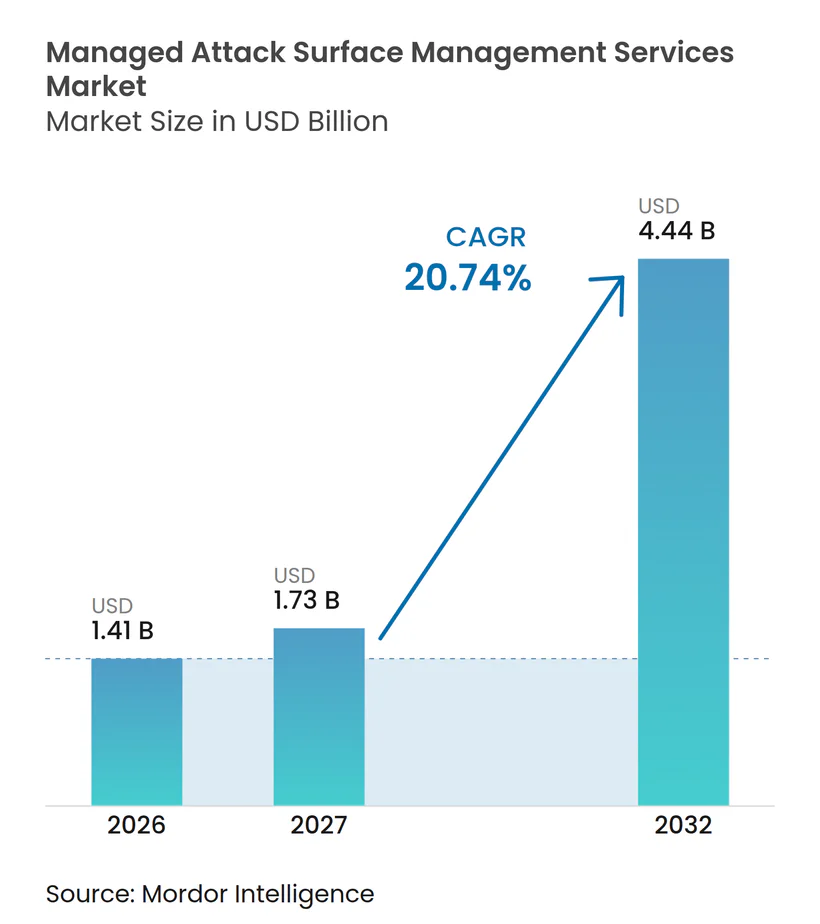
The Managed Attack Surface Management Services Market size is projected to expand from USD 1.41 billion in 2026 and USD 1.73 billion in 2027 to USD 4.44 billion by 2032, registering a CAGR of 20.74% between 2027 to 2032. Demand is moving toward continuous discovery because cloud, software-as-a-service, and hybrid systems are becoming harder for internal teams to inventory and monitor. Organizations are using managed services to add analyst capacity, operational processes, and specialized tools that they cannot establish quickly on their own. Buyers are also favoring providers that connect discovery, prioritization, and verified remediation within a single operating model. The managed attack surface management services market, therefore, benefits from both security needs and the need to document exposure management for business and regulatory stakeholders. Integration complexity, unclear asset ownership, and data-residency requirements can still delay adoption, particularly in larger organizations with fragmented technology environments.
Key Report Takeaways
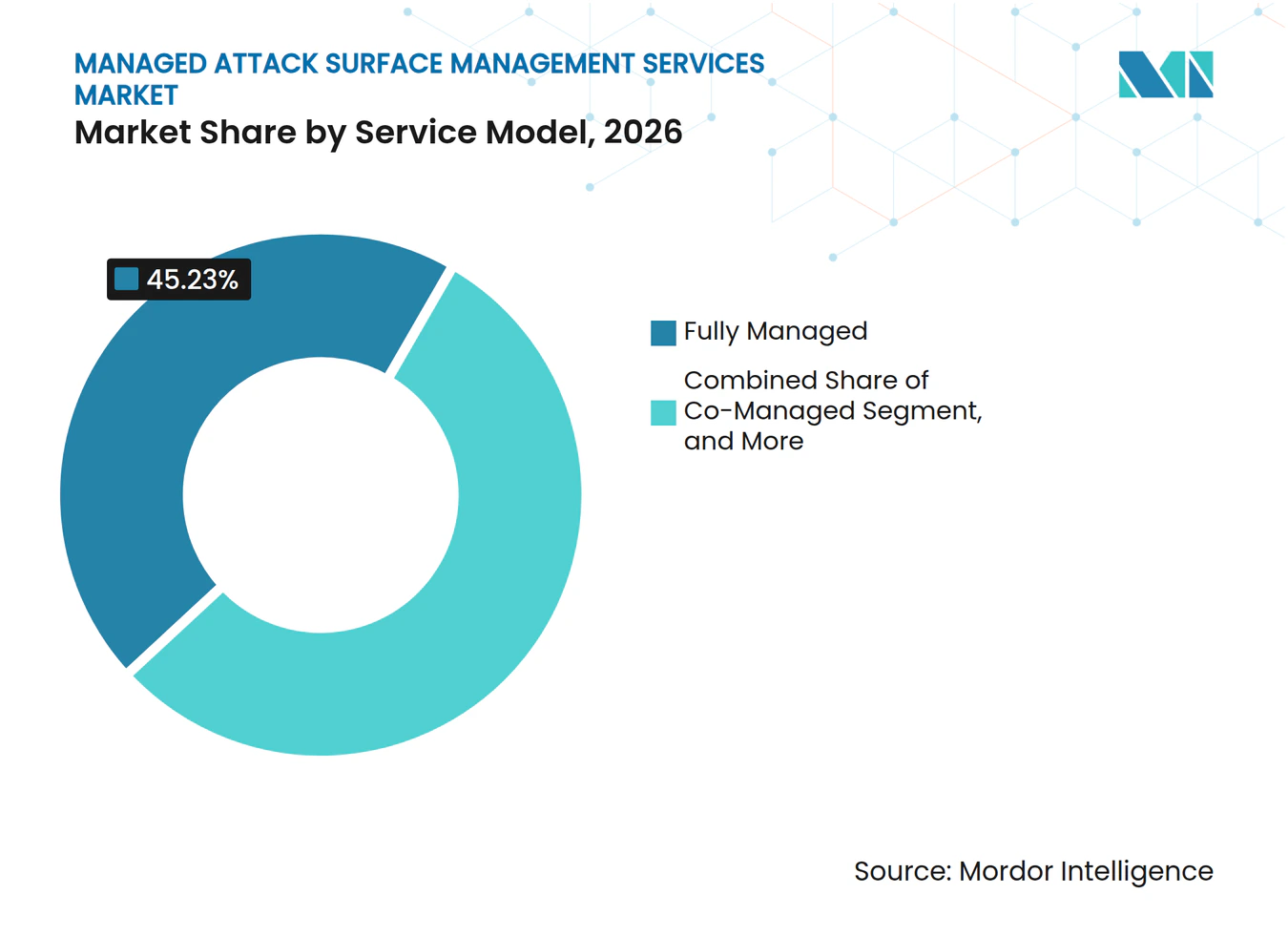
- By service model, Fully Managed held 45.23% of the managed attack surface management services market share in 2026 and is projected to expand at a CAGR of 20.93% through 2032.
- By deployment mode, Cloud-Native accounted for 57.62% of revenue in 2026, demonstrating why the managed attack surface management services market relies on continuous monitoring of rapidly changing infrastructure.
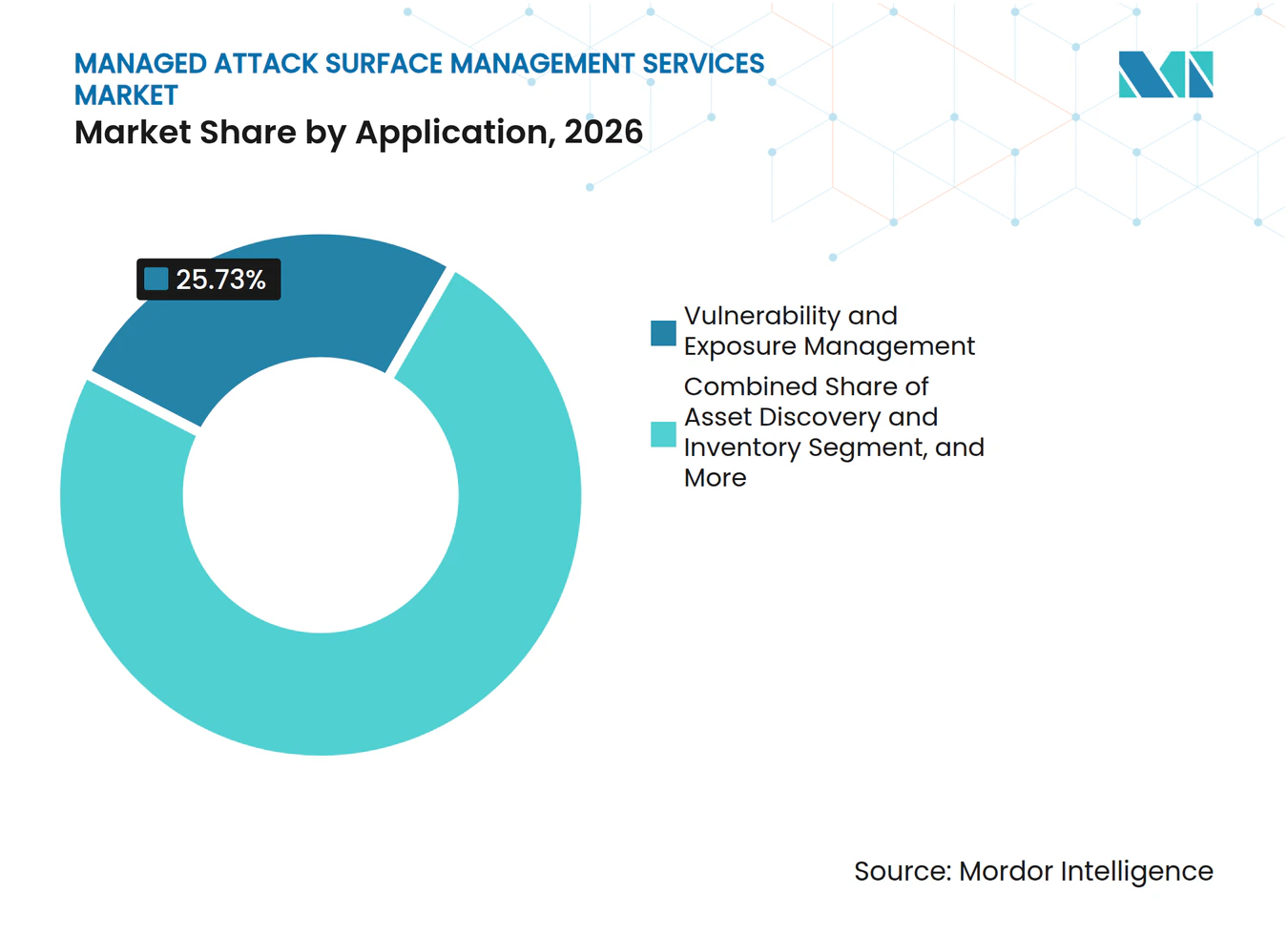
- By application, Vulnerability and Exposure Management held 25.73% of revenue in 2026, while Remediation Orchestration and Verification is projected to expand at a CAGR of 21.16% through 2032.
- By industry vertical, BFSI held 23.38% of revenue in 2026, while IT and Telecommunications are projected to expand at a CAGR of 21.22% through 2032, reinforcing the need for managed attack surface management services market specialist coverage.
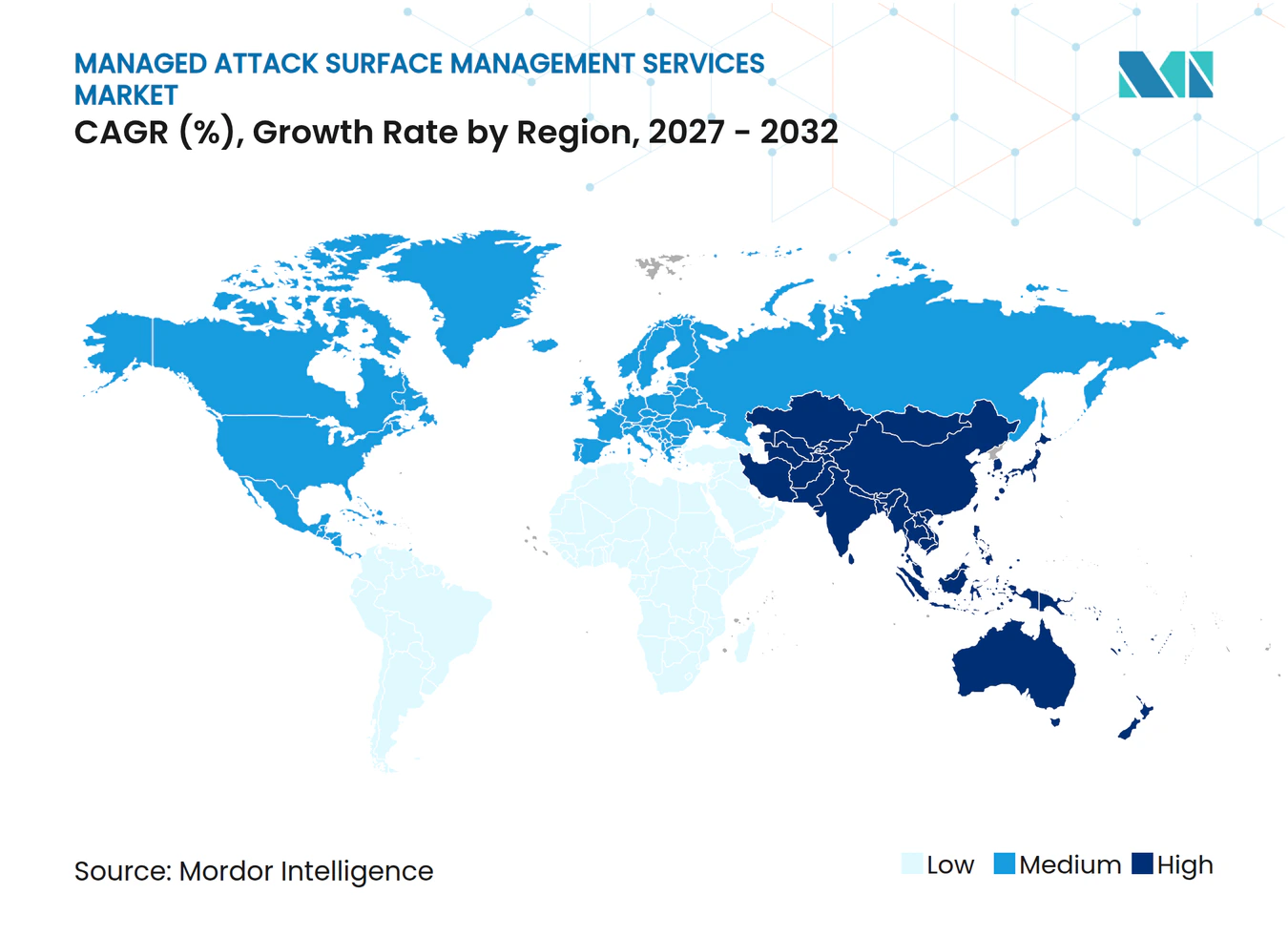
- By geography, North America accounted for 41.89% of revenue in 2026, while Asia-Pacific is projected to expand at a CAGR of 21.36% through 2032.
Note: Market numbers in this report are based on Mordor Intelligence's proprietary estimation framework, which combines nine months of actuals with Q4 projections for base year 2026.
Market Trends and Insights
Drivers Impact Analysis of Managed Attack Surface Management Services Market*
| Driver | (~) % Impact on CAGR Forecast | Geographic Relevance | Impact Timeline |
|---|---|---|---|
| Expansion of Cloud, SaaS and Hybrid Digital Footprints | +4.5% | Global | Short term (≤ 2 years) |
| Escalation of Unknown and Unmanaged Internet-Facing Assets | +3.8% | Global | Medium term (2-4 years) |
| Increasing Regulatory Pressure for Continuous Exposure Evidence | +3.2% | North America and EU, spill-over to Asia-Pacific | Short term (≤ 2 years) |
| Shortage of Specialized Cybersecurity Operations Talent | +2.9% | Global, acute in North America and Asia-Pacific | Medium term (2-4 years) |
| AI-Enabled Discovery and Risk Prioritization | +2.6% | Global | Medium term (2-4 years) |
| Rising Third-Party and Software Supply-Chain Exposure | +2.2% | Global, highest in financial services and manufacturing | Long term (≥ 4 years) |
| Source: Mordor Intelligence | |||
Expansion of Cloud, SaaS, and Hybrid Digital Footprints
Cloud and software-as-a-service adoption have expanded the assets that organizations need to identify and protect. Enterprises use an average of 85 software-as-a-service applications, 82% operate hybrid environments, and 63% use more than 1 cloud provider at the same time.[1] Multiple cloud environments can produce separate inventories, uneven policy enforcement, and gaps in authentication controls. In the past 12 months, 41% of enterprises reported vulnerabilities in software-as-a-service user permissions, and 29% reported incidents linked to application misconfigurations.[2] The managed attack surface management services market is supported when providers can monitor authorization states as well as infrastructure assets. This approach also helps organizations meet internal governance and reporting needs through an ongoing process rather than periodic reviews.
Escalation of Unknown and Unmanaged Internet-Facing Assets
Unknown internet-facing assets can leave organizations exposed even when their established security tools are operating as intended. Organizations with larger technology estates are more likely to face repeated attacks when assets are not identified or retired in a timely manner. The U.S. Cybersecurity and Infrastructure Security Agency directs federal civilian agencies to conduct regular credentialed vulnerability scanning and create formal processes for identifying and prioritizing internet-accessible assets. This operating model is increasingly reflected in enterprise procurement requirements, where documented inventories and remediation records carry more weight. The Managed Attack Surface Management Services Market gains relevance as continuous monitoring provides a clearer record of the asset estate and the actions taken against identified exposures. Organizations that cannot show this discipline may face more difficult procurement reviews and higher insurance costs.
Increasing Regulatory Pressure for Continuous Exposure Evidence
Regulatory requirements are increasing the value of documented exposure management processes. In the United States, public companies must describe cybersecurity risk management and governance practices in their annual disclosures. European rules under the NIS2 Directive broaden security responsibilities across critical infrastructure sectors and can lead to fines of up to EUR 10 million (USD 11.20 million) or 2% of global annual turnover for noncompliance. Organizations must be able to demonstrate continuous monitoring rather than rely only on point-in-time assessments. CISA issued zero-trust microsegmentation guidance in 2025, further reinforcing the need to maintain a current understanding of internal and external assets.[3] The managed attack surface management services market can address this need by combining evidence collection, exposure prioritization, and remediation tracking in recurring service workflows.
Shortage of Specialized Cybersecurity Operations Talent
Security teams face a shortage of specialists who can operate continuous exposure management programs. ISC2 found that a growing share of respondents reported critical or significant skills gaps, while nearly all respondents identified at least one skill need. Artificial intelligence, cloud security, and risk assessment were the most frequently cited skill gaps. ISACA reported that many cybersecurity teams were understaffed and had unfilled roles. The managed attack surface management services market continues to rely on providers that can extend analyst capacity and reduce repetitive triage workloads. Smaller organizations and public-sector bodies can use the service as an alternative to building a security function that they cannot staff internally.
Restraints Impact Analysis of Managed Attack Surface Management Services Market*
| Restraint | (~) % Impact on CAGR Forecast | Geographic Relevance | Impact Timeline |
|---|---|---|---|
| Integration Friction Across Security and IT Toolchains | -2.8% | Global | Medium term (2-4 years) |
| Difficulty Establishing Asset Ownership and Remediation Accountability | -2.3% | Global | Medium term (2-4 years) |
| False Positives and Incomplete Attribution in Dynamic Environments | -1.9% | Global | Short term (≤ 2 years) |
| Data-Residency, Authorization and Safe-Scanning Constraints | -1.4% | EU, Asia-Pacific core, Middle East and Africa | Long term (≥ 4 years) |
| Source: Mordor Intelligence | |||
Integration Friction Across Security and IT Toolchains
Integration across security and IT systems remains a significant barrier to managed service adoption. Organizations manage numerous security solutions from multiple vendors. A managed service must exchange information with security information and event management platforms, endpoint tools, cloud security systems, and IT service management platforms. These systems often use different data structures and application programming interfaces. If integration is incomplete, a provider can identify exposures that customer teams cannot route into an operational workflow. The managed attack surface management services market benefits from pre-built connectors and data normalization, although complex environments can still require long deployment periods.
Difficulty Establishing Asset Ownership and Remediation Accountability
Finding an exposed asset does not by itself ensure that the asset will be remediated. Large organizations often struggle to connect a discovered asset to the responsible application owner, business unit, or cost center. The issue becomes harder when cloud services are purchased independently across departments, and older accounts remain active. The result can be a discovery report without a clear owner who can act on the finding. Buyers may then need to invest in change management and ticketing integration before the service can produce verified remediation outcomes. In the managed attack surface management services market, providers that assign ownership during onboarding and track remediation verification are better placed to address this limitation.
*Our forecasts treat driver/restraint impacts as directional, not additive. The impact forecasts reflect baseline growth, mix effects, and variable interactions.
Managed Attack Surface Management Services Market Segment Analysis
By Service Model:
Fully Managed Contracts Lead Outsourcing DemandFully Managed contracts held 45.23% of the Managed Attack Surface Management Services Market share in 2026 and are projected to expand at a CAGR of 20.93% through 2032. The model shifts responsibility for continuous monitoring, alert triage, and escalation processes to the provider. Buyers are therefore acquiring operating capacity and specialized expertise, not simply access to a software platform. This distinction is important because continuous exposure management requires cloud security, threat interpretation, and remediation coordination skills. The service model can reduce the pressure on security teams that are already constrained by staffing gaps.
Generative artificial intelligence can help providers extend analyst coverage without equivalent increases in headcount. This can lower the unit cost of ongoing monitoring and broaden the appeal of fully managed services among mid-sized buyers. Co-Managed arrangements suit organizations that have a security operations center but want specialist tools and extra analyst capacity. Monitoring-Only contracts can give providers an initial relationship before customers adopt remediation and advisory functions. Within the managed attack surface management services market, Advisory and Incident-Triggered services remain the smallest service model because they are most often used by organizations with early-stage security programs or a specific audit or post-breach need.



By Deployment Mode:
Cloud-Native Delivery Sets the Operating StandardCloud-Native deployment accounted for 57.62% of revenue in 2026. Containers, serverless functions, and auto-scaling workloads can change within seconds. Cloud-native integrations and agents can identify these changes much more quickly than traditional sensors that depend on longer polling intervals. This supports faster identification of newly configured or misconfigured assets. Tenable analyzed nearly 50 million assets and more than 1.7 trillion security findings, illustrating the volume of information that cloud-scale systems must interpret.
Hybrid deployments remain important for regulated sectors that cannot route all asset telemetry through public cloud systems. Financial institutions in Germany, Singapore, and India may require hybrid delivery to address local data-residency conditions. On-Premises and Private Cloud deployments retain a focused role for defense entities and critical infrastructure operators with strict classification or operational security policies. Cloud-native delivery is becoming more common across the vendor landscape as customers seek continuous discovery at the same pace as their cloud infrastructure. The managed attack surface management services market must accommodate security policy, data handling, and the speed at which the underlying environment changes.
By Application:
Remediation Outcomes Move Up the Value ChainRemediation Orchestration and Verification is projected to expand at a CAGR of 21.16% from 2027 to 2032. Customers increasingly assess providers by the time required to move from exposure identification to verified remediation. Findings without a workflow for action can be displaced by services that provide a closed process. Native asset inventory capabilities from large cloud providers are also reducing the standalone value of basic discovery. In the managed attack surface management services market, this raises the importance of remediation coordination and verification, where providers can establish more durable customer relationships.
Vulnerability and Exposure Management held 25.73% of revenue in 2026. Enterprises use this application to prioritize technical findings according to their likely business impact rather than work through undifferentiated vulnerability lists. Asset Discovery and Inventory remains essential to every engagement, although its separate commercial value is falling as discovery is bundled with risk scoring. Risk and Compliance Management is supported by demand for continuous compliance evidence instead of annual audit documents. Threat Intelligence and Digital Risk Protection covers external reconnaissance, including dark web exposure, brand impersonation, and third-party data leakage, and is particularly relevant to financial services and government users.

By Industry Vertical:
IT and Telecommunications Challenge BFSI LeadershipBFSI held 23.38% of revenue in 2026. Its position reflects long-standing investment in security operations and demanding regulatory oversight. Banks allocate 11% of IT budgets to cybersecurity, while banking sector IT spending was forecast at USD 290 billion in 2025. The European Banking Authority found that 82.4% of banks considered cyber risk the main driver of operational risk. Large institutions use managed services to extend mature security programs, while regional institutions can use them as a primary security operations capability.
IT and Telecommunications is projected to expand at a CAGR of 21.22% from 2027 to 2032. Managed security service providers and telecommunications companies are also buyers because their own cloud platforms, software-defined networks, and application programming interface-based service stacks create extensive internet-facing estates. Healthcare and Life Sciences are expanding as patient records are digitized and connected medical devices become more common. In 2025, 67% of healthcare organizations reported great concern about supply-chain cyber risk. The managed attack surface management services market also serves Government and Public Sector users responding to national cybersecurity strategies, while Retail and E-Commerce and Manufacturing face new exposure from digital commerce and operational technology convergence.
Geography Analysis
North America Managed Attack Surface Management Services Market
North America accounted for 41.89% of revenue in 2026. The region has a large base of managed security buyers, mature vendor ecosystems, and requirements that encourage documented exposure management. Public companies must maintain cybersecurity governance disclosures, which raises senior-level attention on asset visibility and risk management. The United States drives regional revenue, while Canada and Mexico create demand for managed coverage across cross-border enterprise operations.
Europe and South America Managed Attack Surface Management Services Market
Europe is adopting managed attack surface management services in response to a regulatory environment that covers more critical infrastructure organizations. NIS2 has expanded risk management and reporting obligations across 18 critical infrastructure sectors. The United Kingdom, Germany, and France represent the largest national revenue pools in the region. Germany’s industrial base supports demand for services that can address operational technology as information technology and operational technology environments become more connected. South America remains smaller, with Brazil leading demand as financial organizations invest in cybersecurity and data protection receive more attention.
APAC and MEA Managed Attack Surface Management Services Market
Asia-Pacific is projected to expand at a CAGR of 21.36% from 2027 to 2032. Rapid digital transformation, cyber threats, and multi-cloud adoption support demand across India, Japan, South Korea, and Southeast Asia. India is a major country-level driver as digital infrastructure expands and local security operations center capacity develops. CrowdStrike expanded its managed security service provider strategy across Japan and Asia-Pacific in April 2026 through partnerships with Dicker Data and Otsuka Corporation. For the managed attack surface management services market, Middle East and Africa demand is supported by digital infrastructure investment in the Gulf Cooperation Council, while South Africa leads enterprise managed security adoption on the continent.
Competitive Landscape
Market Concentration
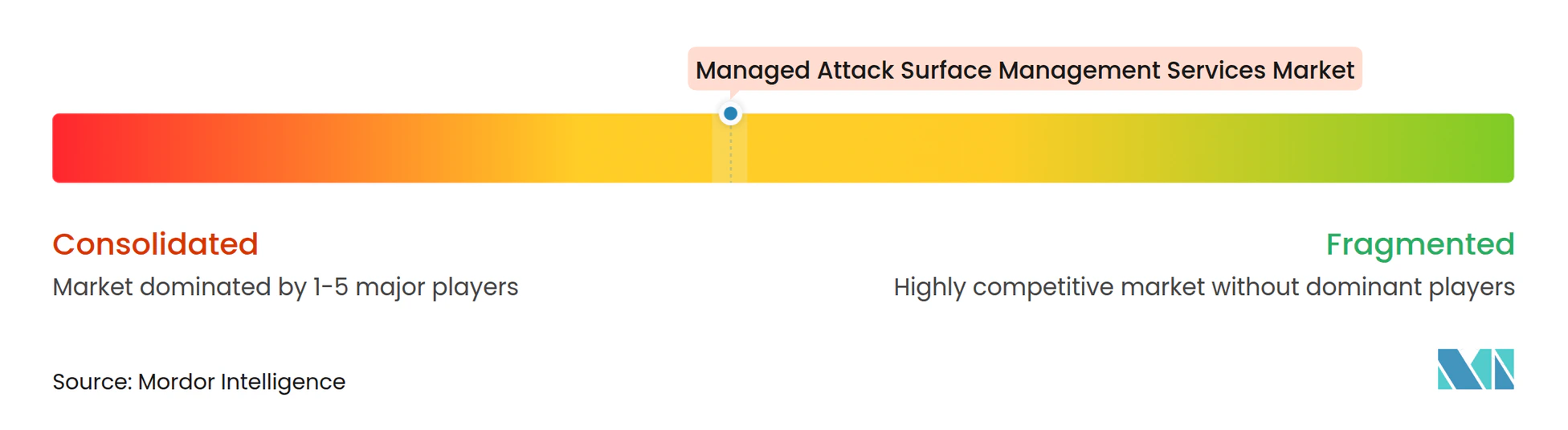
The managed attack surface management services market is moderately concentrated at the platform layer and fragmented at the service delivery layer. IBM, Accenture, Deloitte, Kyndryl, and Microsoft compete for large managed service mandates through broad security operations capabilities, global delivery coverage, and established customer relationships. Their advantage lies in integration and advisory capacity, although platform innovation can move faster than internal development programs. IBM and Palo Alto Networks formalized a partnership in 2025 under which IBM Consulting serves as a preferred managed security services provider across Palo Alto Networks’ platform portfolio. The arrangement combines Cortex XSIAM-based security operations center transformation services with IBM’s managed threat detection and response delivery.
Specialist providers, including Armis, CyCognito, IONIX, Tenable, and Qualys, compete through asset discovery depth, risk prioritization, and remediation orchestration. In the managed attack surface management services market, platform breadth and integration ecosystems are increasingly important alongside native discovery. Tenable added third-party connectors to Tenable One in 2025 so that the platform could ingest telemetry from AWS, CrowdStrike, Microsoft, Rapid7, and other providers alongside native data. Armis launched Centrix for Vulnerability Management Detection and Response in March 2026, with continuous detection across IT, internet of things, cloud, and network devices.
The competitive opportunity in the managed attack surface management services market is strongest among mid-sized organizations with 500-2,500 employees that lack the resources to operate complex multi-vendor platforms. Providers that can address operational technology environments safely also have a differentiated position because many traditional information technology scanning tools are unsuitable for industrial systems. Supply-chain exposure management remains an early area, focused on continuous oversight of third-party vendors in addition to the direct enterprise estate. CyCognito launched Continuous AI Pentesting in June 2026 to combine external exposure discovery with continuous offensive testing. IONIX introduced Live Exposure Defense in May 2026 to match newly published CVEs against customer-facing assets and deliver a prioritized mitigation workflow within 12 hours.
Managed Attack Surface Management Services Industry Leaders
-
Kyndryl Holdings, Inc.
-
IBM Corporation
-
Microsoft Corporation
-
Accenture plc
-
Palo Alto Networks, Inc.
- *Disclaimer: Major Players sorted in no particular order
Managed Attack Surface Management Services Market Companies Covered in this Report
- Accenture plc
- Armis, Inc.
- BitSight Technologies, Inc.
- Cisco Systems, Inc.
- CrowdStrike Holdings, Inc.
- CyCognito, Inc.
- Cyberint Technologies Ltd.
- Deloitte Touche Tohmatsu Limited
- Google LLC
- IBM Corporation
- IONIX Ltd.
- Kyndryl Holdings, Inc.
- Microsoft Corporation
- Palo Alto Networks, Inc.
- Qualys, Inc.
- Rapid7, Inc.
- Recorded Future, Inc.
- SecurityScorecard, Inc.
- Tenable Holdings, Inc.
- UpGuard, Inc.
Recent Industry Developments in Managed Attack Surface Management Services Market
- June 2026: CyCognito launched Continuous AI Pentesting across its Target Graph architecture, enabling AI-driven offensive testing of the external attack surface in a continuous cycle rather than point-in-time assessments. The capability bridges the gap between passive exposure discovery and active exploitability validation, allowing managed ASM programs to confirm which discovered exposures represent real, exploitable risk rather than theoretical vulnerabilities.
- May 2026: IONIX introduced Live Exposure Defense, which correlates newly published CVEs against a customer's internet-facing assets, confirms exploitability through safe active testing, and delivers a prioritized mitigation workflow within 12 hours of CVE publication. The 12-hour delivery window targets the phase after public disclosure but before broad patch adoption, when well-resourced threat actors conduct mass scanning campaigns.
- April 2026: CrowdStrike expanded its MSSP go-to-market strategy across Japan and Asia-Pacific through partnerships with distributors Dicker Data and Otsuka Corporation, enabling a distributor-led aggregation model that allows regional MSSPs to offer Falcon platform-based managed services to small and medium-sized businesses. The program is designed to address Asia-Pacific's fragmented MSSP channel by using distributors as aggregation and billing infrastructure for managed security delivery at scale.
- March 2026: Rapid7 updated Exposure Command with runtime validation and data security posture management capabilities, enabling security teams to confirm which cloud vulnerabilities are actively exploitable and to identify the category and sensitivity of data they expose. The addition of runtime validation moves Rapid7's exposure management offering from a static risk-scoring model to an active, evidence-based exploitability confirmation workflow.
Global Managed Attack Surface Management Services Market Report Scope
The Managed Attack Surface Management Services Market comprises outsourced, continuous security services in which MSSPs or specialized providers discover, monitor, prioritize, and remediate an organization’s external and internal attack surface, including internet-facing assets, cloud services, SaaS applications, third-party integrations, APIs, and connected devices.
The Managed Attack Surface Management Services Market Report is Segmented by Service Model (Fully Managed, Co-Managed, Monitoring-Only, and Advisory and Incident-Triggered), Deployment Mode (Cloud-Native, Hybrid, and On-Premises and Private Cloud), Application (Asset Discovery and Inventory, Risk and Compliance Management, Vulnerability and Exposure Management, Threat Intelligence and Digital Risk Protection, and Remediation Orchestration and Verification), Industry Vertical (Banking, Financial Services and Insurance, Healthcare and Life Sciences, IT and Telecommunications, Government and Public Sector, Retail and E-Commerce, Manufacturing, and Other Industry Verticals), and Geography (North America, South America, Europe, Asia-Pacific, and Middle East and Africa). The Market Forecasts Are Provided in Terms of Value (USD).
Segmentation Overview
| Fully Managed |
| Co-Managed |
| Monitoring-Only |
| Advisory and Incident-Triggered |
| Cloud-Native |
| Hybrid |
| On-Premises and Private Cloud |
| Asset Discovery and Inventory |
| Risk and Compliance Management |
| Vulnerability and Exposure Management |
| Threat Intelligence and Digital Risk Protection |
| Remediation Orchestration and Verification |
| Banking, Financial Services and Insurance |
| Healthcare and Life Sciences |
| IT and Telecommunications |
| Government and Public Sector |
| Retail and E-Commerce |
| Manufacturing |
| Other Industry Verticals |
| North America | United States |
| Canada | |
| Mexico | |
| South America | Brazil |
| Argentina | |
| Rest of South America | |
| Europe | United Kingdom |
| Germany | |
| France | |
| Italy | |
| Spain | |
| Rest of Europe | |
| Asia-Pacific | China |
| Japan | |
| India | |
| South Korea | |
| Rest of Asia-Pacific | |
| Middle East and Africa | Saudi Arabia |
| United Arab Emirates | |
| South Africa | |
| Egypt | |
| Rest of Middle East and Africa |
| By Service Model | Fully Managed | |
| Co-Managed | ||
| Monitoring-Only | ||
| Advisory and Incident-Triggered | ||
| By Deployment Mode | Cloud-Native | |
| Hybrid | ||
| On-Premises and Private Cloud | ||
| By Application | Asset Discovery and Inventory | |
| Risk and Compliance Management | ||
| Vulnerability and Exposure Management | ||
| Threat Intelligence and Digital Risk Protection | ||
| Remediation Orchestration and Verification | ||
| By Industry Vertical | Banking, Financial Services and Insurance | |
| Healthcare and Life Sciences | ||
| IT and Telecommunications | ||
| Government and Public Sector | ||
| Retail and E-Commerce | ||
| Manufacturing | ||
| Other Industry Verticals | ||
| By Geography | North America | United States |
| Canada | ||
| Mexico | ||
| South America | Brazil | |
| Argentina | ||
| Rest of South America | ||
| Europe | United Kingdom | |
| Germany | ||
| France | ||
| Italy | ||
| Spain | ||
| Rest of Europe | ||
| Asia-Pacific | China | |
| Japan | ||
| India | ||
| South Korea | ||
| Rest of Asia-Pacific | ||
| Middle East and Africa | Saudi Arabia | |
| United Arab Emirates | ||
| South Africa | ||
| Egypt | ||
| Rest of Middle East and Africa | ||
Key Questions Answered in the Report
What is the size of the Managed Attack Surface Management Services Market?
The Managed Attack Surface Management Services Market is projected at USD 1.41 billion in 2026 and USD 4.44 billion by 2032, with a CAGR of 20.74% from 2027 to 2032.
What is driving demand for managed attack surface management services?
Cloud, software-as-a-service, and hybrid environments are creating more assets to identify, monitor, and remediate. Regulatory documentation needs and cybersecurity talent shortages also support adoption.
Which service model leads managed attack surface management services?
Fully Managed held 45.23% of revenue in 2026 and is projected to expand at a CAGR of 20.93% through 2032.
Which deployment mode is most used for managed attack surface management services?
Cloud-Native deployment held 57.62% of revenue in 2026 because it can monitor rapidly changing containers, serverless functions, and multi-cloud workloads.
Which region is expanding fastest for managed attack surface management services?
Asia-Pacific is projected to expand at a CAGR of 21.36% from 2027 to 2032, supported by digital infrastructure development and increasing managed security adoption.
Which application is expanding fastest in managed attack surface management services?
Remediation Orchestration and Verification is projected to expand at a CAGR of 21.16% through 2032 as buyers seek verified remediation rather than exposure findings alone.