
Managed External Attack Surface Intelligence Services Market Size and Share
Market Overview
| Study Period | 2021 - 2032 |
|---|---|
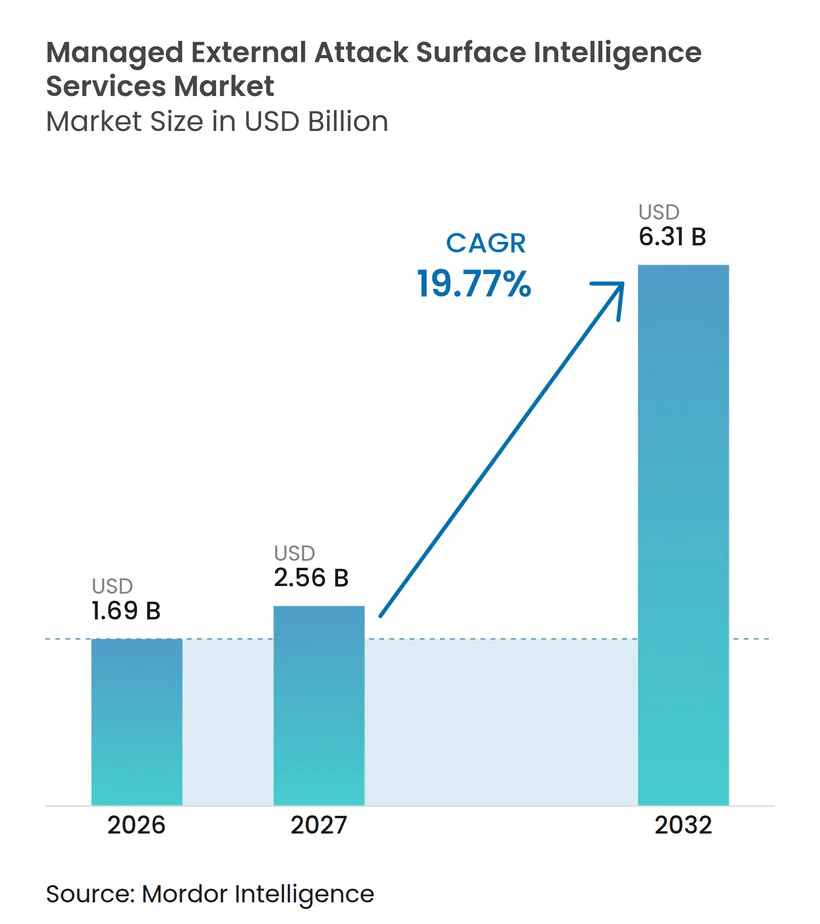
| Market Size (2027) | USD 2.56 Billion |
| Market Size (2032) | USD 6.31 Billion |
| Growth Rate (2027 - 2032) | 19.77 % |
| Fastest Growing Market | Asia-Pacific |
| Largest Market | North America |
| Market Concentration | Low |
Major Players *Disclaimer: Major Players sorted in no particular order Image © Mordor Intelligence. Reuse requires attribution under CC BY 4.0. | |
Managed External Attack Surface Intelligence Services Market Analysis by Mordor Intelligence
The managed external attack surface intelligence services market size is projected to expand from USD 1.69 billion in 2026 and USD 2.56 billion in 2027 to USD 6.31 billion by 2032, registering a CAGR of 19.77% between 2027 and 2032. The managed external attack surface intelligence services market is being shaped by cloud tenants, software-as-a-service applications, IoT endpoints, and AI-connected systems that security teams must identify outside their internal networks. Regulatory requirements are making external visibility a documented control, particularly for financial institutions and critical infrastructure operators. This supports longer managed-service contracts because clients need continuous monitoring rather than periodic scans. Providers are responding by offering broader discovery coverage, threat intelligence, and validation workflows to help customers prioritize remediation. The managed external attack surface intelligence services market also benefits when organizations lack the staff needed to operate these capabilities internally.
Key Report Takeaways
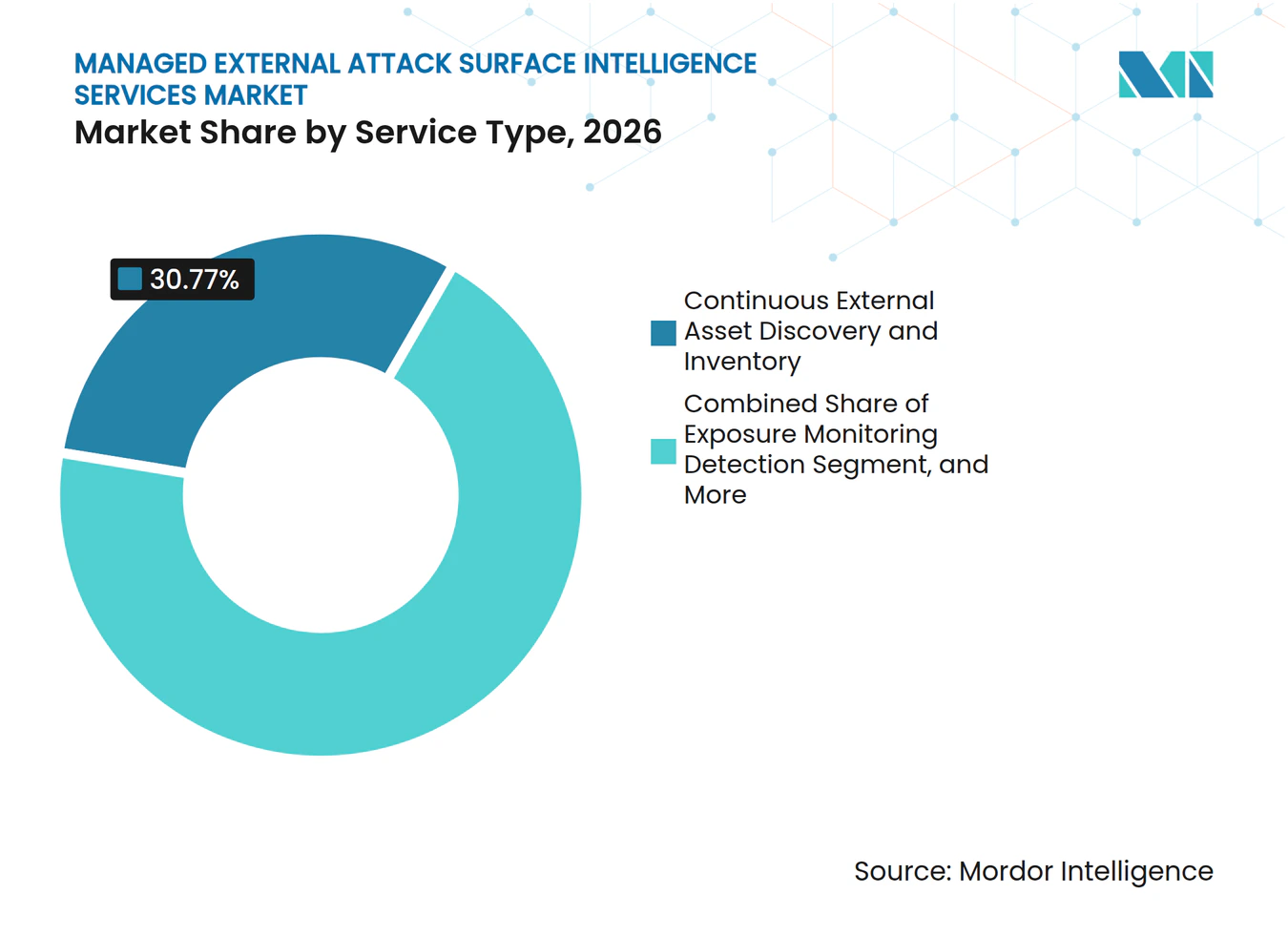
- By service type, continuous external asset discovery and inventory held 30.77% of the managed external attack surface intelligence services market share in 2026, while threat intelligence and dark web monitoring are projected to expand at a 20.76% CAGR through 2032.
- By deployment mode, cloud delivery accounted for 76.84% of revenue in 2026, and the segment is expected to expand at a CAGR of 20.18% through 2032.
- By organization size, large enterprises accounted for 20.19% of revenue in 2026 in the managed external attack intelligence services market, while small and medium-sized enterprises are projected to expand at a 20.23% CAGR through 2032.
- By end-user industry, BFSI accounted for 42.31% of revenue in 2026, while IT and Telecommunications are projected to expand at a 21.19% CAGR through 2032.
- By geography, North America held 81.14% of revenue in 2026, while Asia-Pacific is projected to expand at a 20.74% CAGR through 2032.
Note: Market size and forecast figures in this report are generated using Mordor Intelligence’s proprietary estimation framework, updated with the latest available data and insights as of January 2026.
Market Trends and Insights
Drivers Impact Analysis of Managed External Attack Surface Intelligence Services Market*
| Driver | (~) % Impact on CAGR Forecast | Geographic Relevance | Impact Timeline |
|---|---|---|---|
| Expansion of Cloud, SaaS, IoT, and Internet-Facing Assets | +4.5% | Global | Short term (≤ 2 years) |
| Increasing Unknown and Unmanaged External Assets | +3.8% | Global, most acute in North America and Europe | Medium term (2-4 years) |
| Rising Regulatory and Board-Level Cyber-Risk Accountability | +3.2% | North America, EU, Asia-Pacific | Medium term (2-4 years) |
| Shortage of Specialized Exposure-Management Personnel | +2.6% | Global, most acute in North America and Europe | Long term (≥ 4 years) |
| Growth of Third-Party, Subsidiary, and Digital Supply-Chain Exposure | +2.0% | North America, EU, with growing impact in Asia-Pacific | Medium term (2-4 years) |
| AI-Enabled Reconnaissance and Automated Threat Discovery | +1.5% | Global | Short term (≤ 2 years) |
| Source: Mordor Intelligence | |||
Expansion of Cloud, SaaS, IoT, and Internet-Facing Assets
The managed external attack surface intelligence services market is supported by the expansion of publicly reachable cloud resources, SaaS tenants, IoT devices, and AI systems. Organizations now manage assets outside the traditional network perimeter, and many are created without the security team being notified. Censys reported nearly 268,000 internet-facing AI systems in October 2026, showing how a newer asset class can escape established inventories. Agent-based tools may miss short-lived cloud instances and containers, whereas outside-in discovery observes assets as an attacker would. This makes a continuously updated external register more useful than a periodic inventory for many security programs. The RBI framework also requires commercial banks to assess internet-facing critical systems and maintain current asset inventories, adding urgency to this service need.[1]
Increasing Unknown and Unmanaged External Assets
Unknown assets remain a major reason that buyers adopt managed discovery services. Cloud provisioning, developer self-service, and SaaS integrations can create accessible resources without fitting existing asset-management procedures. Initial external scans can reveal materially more internet-facing assets than an enterprise records internally, especially when legacy applications and forgotten subdomains remain active. KELA reported more than 204 million compromised credentials in the first half of 2025, underscoring the scale of information available to attackers seeking access paths. Forgotten applications and unmanaged domains can turn into access points when credentials or related intelligence become available. The managed external attack surface intelligence services market, therefore, favors discovery approaches that do not rely on an internal seed list or client credentials.
Rising Regulatory and Board-Level Cyber-Risk Accountability
Regulation has made cyber-risk visibility a compliance requirement across financial services and critical infrastructure. The RBI's 2026 framework requires commercial banks to conduct vulnerability assessments on internet-facing critical systems at least every 6 months and report cyber incidents through its DAKSH platform within 6 hours of detection. The framework also expects continuously updated asset inventories that connect directly to continuous external monitoring. A Bank for International Settlements paper noted that supervisors, including APRA, the European Central Bank, the New York Department of Financial Services, and MAS, have called for attack-surface reduction in response to AI-related cyber threats. Regular board reporting increases the need for clear exposure metrics and evidence of remediation progress. Managed providers can support this need by combining monitoring with analyst review and reporting.
Shortage of Specialized Exposure-Management Personnel
Exposure management requires knowledge of offensive security, threat intelligence, and vulnerability triage. The required skills are difficult and costly for individual organizations to maintain, particularly when continuous coverage is expected. This staffing constraint gives managed services a practical role for buyers who cannot build a dedicated internal team. It is especially important for small and medium-sized enterprises, which are projected to expand in the managed external attack surface intelligence services market. Providers can spread analyst costs across their client base while maintaining more consistent coverage than a small internal team. KELA's launch of AI-powered Digital Cyber Analysts in April 2025 shows how suppliers are using automation to increase the capacity of threat-intelligence teams.
Restraints Impact Analysis of Managed External Attack Surface Intelligence Services Market*
| Restraint | (~) % Impact on CAGR Forecast | Geographic Relevance | Impact Timeline |
|---|---|---|---|
| Difficulty Proving Return on Security-Service Investment | -2.8% | Global, most pronounced in cost-sensitive developing markets | Medium term (2-4 years) |
| Integration Complexity Across SIEM, SOAR, ITSM, and Vulnerability Tools | -2.3% | North America and EU, early-stage in Asia-Pacific | Medium term (2-4 years) |
| Alert Fatigue and Inconsistent Finding Validation | -1.9% | Global | Short term (≤ 2 years) |
| Customer Concerns Over Permission, Privacy, and Active Testing | -1.5% | EU, Asia-Pacific | Long term (≥ 4 years) |
| Source: Mordor Intelligence | |||
Difficulty Proving Return on Security-Service Investment
Managed external monitoring produces a continuous stream of findings, but the financial benefit of avoiding an unrealized breach can be difficult to demonstrate to procurement committees. There is no standard return-on-investment metric for exposure management, so customers often compare service fees to lower-cost alternatives. This can make continuous managed coverage harder to defend during periods of budget control. The challenge is stronger when a buyer cannot link the service to a prevented breach or a resolved compliance finding. Outpost24 introduced the next generation of CyberFlex in July 2026 with executive reporting and risk insights, reflecting demand for clearer remediation evidence for executives and auditors.[2] The managed external attack surface intelligence services market depends on providers demonstrating operational progress and identifying exposures.
Integration Complexity Across SIEM, SOAR, ITSM, and Vulnerability Tools
A managed external attack surface service is more valuable when findings enter the client's remediation process without manual rework. SIEM, SOAR, ITSM, and vulnerability tools can use different data structures and ticketing methods, creating integration work for customers with complex security estates. This can delay the operational benefit after an initial deployment, even if asset visibility is available quickly. The gap between rapid discovery and slower remediation can increase churn risk and limit the service's expansion. Providers are responding by linking validation more closely with remediation workflows and reducing the number of manual handoffs. The managed external attack surface intelligence services market will need smoother operational integration to sustain wider adoption.
*Our forecasts treat driver/restraint impacts as directional, not additive. The impact forecasts reflect baseline growth, mix effects, and variable interactions.
Managed External Attack Surface Intelligence Services Market Segment Analysis
By Service Type:
Discovery Anchors Spending While Dark-Web Intelligence AcceleratesContinuous external asset discovery and inventory led with 30.77% of the managed external attack surface intelligence services market share in 2026. Buyers generally need reliable inventory data before they can identify weaknesses or direct remediation work. Cloud provisioning, SaaS adoption, corporate acquisitions, and unmanaged subdomains can continuously add reachable assets outside normal change control. Detectify introduced IP Range Scanning in March 2026 to extend surface monitoring across up to 65,536 IP addresses in a range. That expansion reflects the need to monitor network-layer infrastructure in addition to domains and subdomains. Exposure monitoring, change detection, and vulnerability validation follow discovery as organizations move from intermittent assessment to regular monitoring.
Threat intelligence and dark web monitoring are projected to expand at a 20.76% CAGR from 2027 to 2032. The service is becoming more important as ransomware groups and infostealer operators use reconnaissance before taking action against a target. Searchlight Cyber reported a 30% annual increase in ransomware victims in 2025, underscoring the need to link criminal activity to a client's exposed assets. This makes dark-web intelligence an input to exposure prioritization rather than a separate monitoring exercise. Remediation orchestration and supply-chain exposure management are also emerging service areas, particularly for organizations with complex third-party relationships. The managed external attack surface intelligence services industry is moving toward service combinations that identify, validate, and help close a risk.



By Deployment Mode:
Cloud Delivery Shapes Managed Service EconomicsCloud deployment accounted for 76.84% of the managed external attack surface intelligence services market in 2026. Continuous scanning of external infrastructure needs flexible computing capacity, which cloud delivery can provide without hardware procurement or maintenance cycles. It also allows coverage to adjust when the client's asset footprint changes. Regulatory expectations for continuous monitoring are consistent with cloud-native services designed for availability and geographic reach. Providers can add discovery data sources and update coverage without requiring customer infrastructure changes. This operating model supports the continuous service pattern expected in the managed external attack surface intelligence services market.
On-premises delivery remains in demand among defense organizations, financial institutions with strict data controls, and critical infrastructure operators managing partially isolated environments. These users may use a hybrid model in which external scanning occurs on cloud infrastructure, while the results remain within controlled systems. The model addresses data-sovereignty concerns without removing the operational advantages of continuous external monitoring. CyCognito's Continuous AI Pentesting, released in June 2026, used its cloud-based Target Graph architecture to conduct ongoing external tests. As cloud security posture management and external attack surface management become more connected, purely on-premises options are likely to have a narrower role. Providers will need flexible deployment choices for clients that cannot move all security data outside a controlled environment.
By Organization Size:
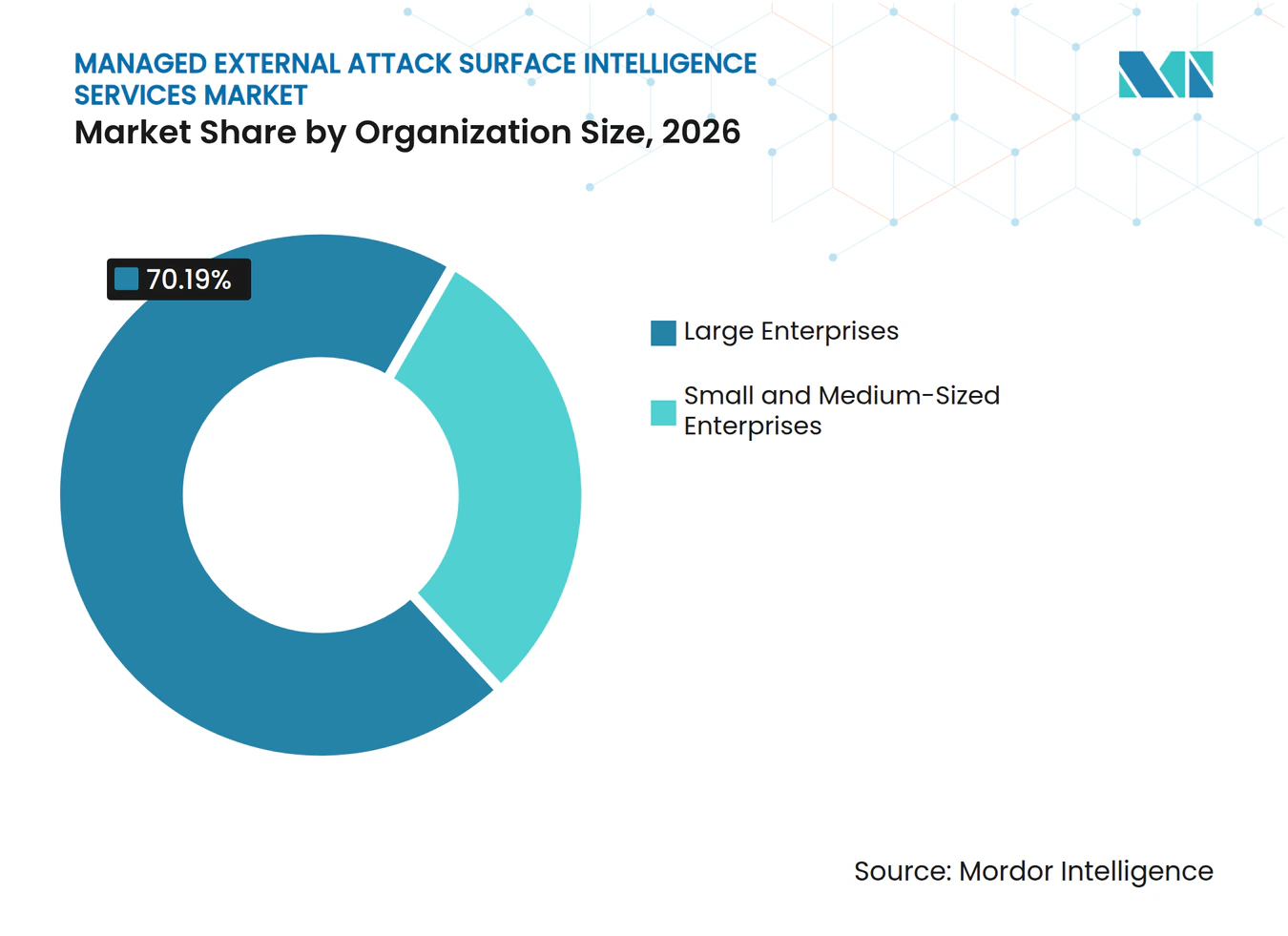
SMEs Are the Fastest-Growing Buyer GroupLarge enterprises accounted for 70.19% of the managed external attack surface intelligence services market size in 2026. Their complex structures can include subsidiaries, acquired entities, and extensive supplier networks, making external discovery useful at scale. They also have established security budgets and more frequent requirements to report exposure data to senior leadership. A 2026 GigaOm assessment evaluated 32 attack surface management vendors and described a shift toward validated risk reduction and prioritized remediation over simple asset counts. This change supports managed providers that can explain which findings require action. Large clients also value continuous reporting because point-in-time reviews cannot capture the effects of frequent technology and organizational changes.
Small and medium-sized enterprises are projected to expand at a 20.23% CAGR from 2027 to 2032. A fully managed service can be more practical than hiring an exposure-management analyst with threat-intelligence expertise. Cybertrust Japan launched an ASM service in October 2025 for internet-accessible IT assets, showing how vendors are packaging services for smaller organizations. PentaTrail's service design also reflects demand for operations that do not require a dedicated security team. Supply-chain cybersecurity requirements can encourage smaller vendors to demonstrate external risk management to retain commercial relationships. The managed external attack surface intelligence services market can therefore extend through tiered pricing and reporting models designed for resource-constrained buyers.

By End-User Industry:
BFSI Sets the Standard While Telecom Advances QuicklyBFSI held 42.31% of revenue in 2026, the largest end-user position in the managed external attack surface intelligence services market. Financial institutions face a combination of high-value assets, strict regulation, and disruption risks, all of which support continuous coverage. The RBI framework, DORA, the New York Department of Financial Services regulation, and APRA guidance all place attention on internet-facing systems and third-party cyber risk. These requirements make managed monitoring easier to justify because it supports both risk management and compliance reporting. Financial organizations also need evidence that exposures are being tracked and addressed between formal assessments. Those needs support longer service relationships than a single technical scan.
IT and Telecommunications is projected to expand at a 21.19% CAGR from 2027 to 2032. Carriers and technology operators maintain large external asset bases that include network management systems, customer portals, API gateways, and interconnect points across multiple jurisdictions. Their service-availability commitments make external visibility a core operating requirement. Healthcare and life sciences are also advancing as medical devices and clinical systems receive greater cybersecurity scrutiny. Government and defense, retail and e-commerce, manufacturing, and energy and utilities continue to contribute demand. Censys identified nearly 134,000 exposed industrial control system hosts in its 2026 Internet Report, with 38% in North America, highlighting the exposure challenge for industrial sectors.
Geography Analysis
North America Managed External Attack Surface Intelligence Services Market
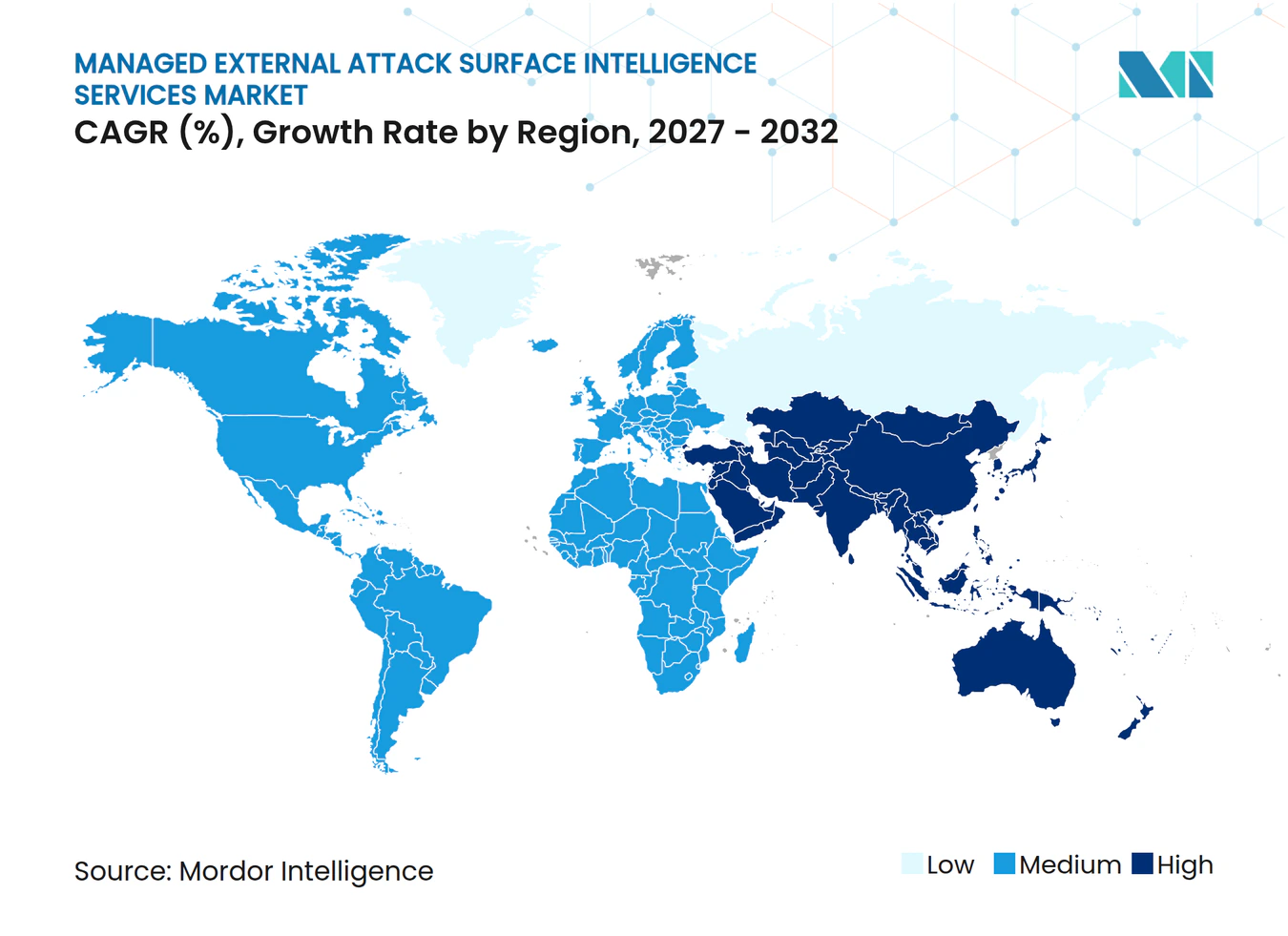
North America held 81.14% of the managed external attack surface intelligence services market share in 2026. The region has a dense base of enterprise technology buyers, mature managed security service providers, and federal and state regulations. The U.S. Treasury's Financial Services Sector-Specific Goals call for reductions in attack surface and improved third-party visibility, reinforcing demand in financial services.[3] Enterprise spending patterns and the large installed base of security providers support demand for managed monitoring. The United States also had 62,687 exposed AI systems in the Censys report, making continuous monitoring of AI-related exposure relevant to regional buyers.
Europe Managed External Attack Surface Intelligence Services Market
Europe remains an established market for managed external attack surface intelligence services because compliance requirements are especially clear. DORA took effect in January 2025 and requires financial entities and critical third-party providers of ICT to manage operational resilience. This creates demand for external exposure monitoring that spans the financial services value chain. The BIS described the European Central Bank's request that banks identify vulnerabilities using AI tools and update their resilience plans. Outpost24 and Detectify show the region's established supplier base in managed external visibility. Positive Technologies acquired a 33% stake in CyberOK in September 2026 to support EASM and penetration operations capabilities.
APAC, MEA and South America Managed External Attack Surface Intelligence Services Market
Asia-Pacific is projected to expand at a 20.74% CAGR from 2027 to 2032. Digital infrastructure expansion, national cybersecurity requirements, and limited internal security capacity support managed delivery in the region. Regulators, including MAS, APRA, Japan's NISC, and the RBI, are linking external asset monitoring with cyber-risk oversight. NTT East Japan launched BizDrive ASM in September 2025 at JPY 116,000 (USD 800) per month, for a minimum of 3 domains, demonstrating a localized managed-service approach for mid-market customers. This localized approach gives the managed external attack surface intelligence services market a practical route to smaller and mid-sized organizations. South America, the Middle East, and Africa are in earlier stages of adoption, with demand concentrated among financial institutions and government entities. Sovereign cybersecurity programs and exposure across industrial systems can support additional demand for managed visibility in Brazil, Saudi Arabia, the UAE, and South Africa.
Competitive Landscape
Market Concentration
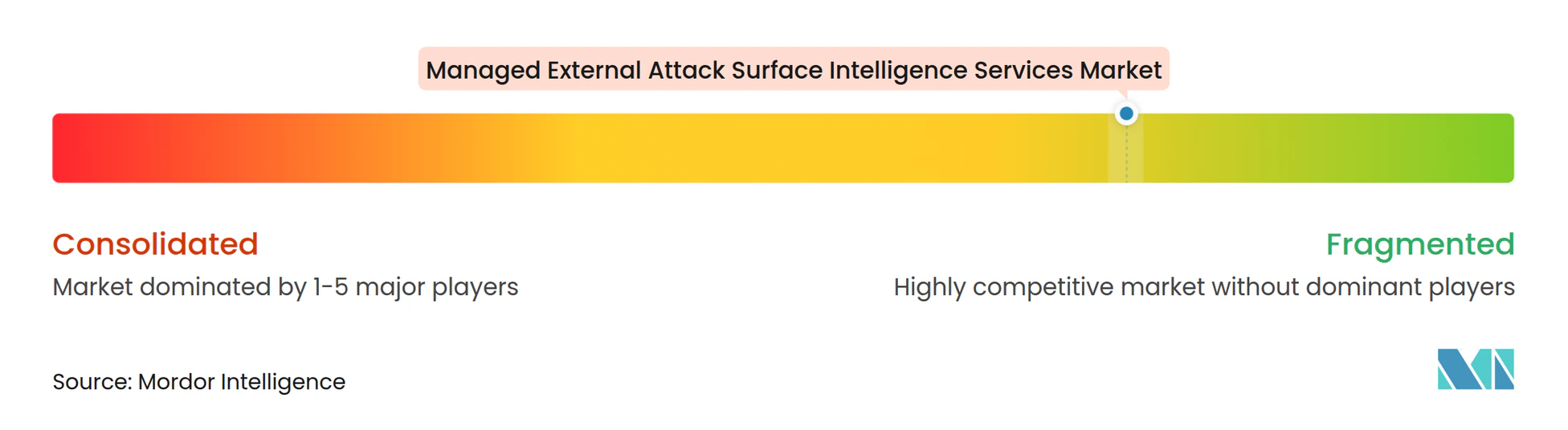
The managed external attack surface intelligence services market is fragmented, with more than 25 active vendors offering overlapping discovery, threat-intelligence, validation, and remediation capabilities. No single company has a dominant revenue position in the available information. Providers differentiate through internet-scale data, validation methods, dark-web intelligence, and integrations with customer remediation processes. Censys uses its Internet Map to support its discovery proposition, while KELA and Searchlight Cyber emphasize threat intelligence. CyCognito's Continuous AI Pentesting, released in June 2026, represented a strategic move toward continuous exploitability testing across the external surface. The managed external attack surface intelligence services market is shifting from discovery volume toward validated exposure and faster mitigation workflows. Vendors in the managed external attack surface intelligence services market also need to show that their findings can support practical remediation decisions.
Strategic consolidation is extending the competitive range of established security platforms. CrowdStrike was the only vendor named a Customer's Choice in the 2025 Gartner Peer Insights Voice of the Customer for external attack surface management in February 2026, showing how broader platforms are gaining visibility in the category.[4] Infoblox entered the field in July 2026 with DNS-native EASM and supply-chain intelligence. It reported that dangling CNAME records were found at 31 of 40 early-access organizations, with nearly 1/3 of those organizations facing easily exploitable subdomain-hijacking exposure. These moves show that data assets and workflow integration are central to competitive positioning. They also increase competitive pressure on specialists who only provide an asset list.
The managed external attack surface intelligence services market retains opportunities in healthcare, energy, and manufacturing, where specialized managed coverage is less established. Buyers in these sectors may need detection content that reflects medical, industrial, or operational technologies rather than general enterprise systems. Providers can also differentiate through remediation workflows that meet SOC 2 Type II requirements. Searchlight Cyber acquired Intangic in October 2025, adding quantitative cyber-risk modeling to its exposure and dark-web intelligence capabilities. FireCompass raised USD 20 million in September 2025 to scale its AI-powered offensive security platform across North America, EMEA, and Asia-Pacific. CloudSEK raised USD 19 million in May 2025 to advance AI model development and international expansion of its predictive cyber threat intelligence platform.
Managed External Attack Surface Intelligence Services Industry Leaders
-
CyCognito, Inc.
-
Censys, Inc.
-
Outpost24 AB
-
Bishop Fox Consulting, LLC
-
IONIX Ltd.
- *Disclaimer: Major Players sorted in no particular order
Managed External Attack Surface Intelligence Services Market Companies Covered in this Report
- CyCognito, Inc.
- Censys, Inc.
- Detectify AB
- Assetnote Pty Ltd
- Halo Security, Inc.
- Hadrian, Inc.
- IONIX Ltd.
- Outpost24 AB
- RiskProfiler, Inc.
- Searchlight Cyber Ltd
- watchTowr Pte. Ltd.
- Cyberint Technologies Ltd.
- Cyble, Inc.
- Group-IB Global Private Limited
- KELA Ltd.
- ImmuniWeb SA
- Hadar Cybersecurity, Inc.
- Intruder Systems Ltd
- Bishop Fox Consulting, LLC
- Foresiet Oy
- ThreatNG Security, Inc.
- Sweepatic NV
- FireCompass Technologies Private Limited
- CloudSEK Information Security Private Limited
- JupiterOne, Inc.
Recent Industry Developments in Managed External Attack Surface Intelligence Services Market
- October 2026: Censys published its fifth annual State of the Internet Report, finding internet-facing AI infrastructure grew 63% in 9 months to nearly 268,000 exposed systems globally, providing authoritative data validating continuous managed external discovery as a market category requirement.
- September 2026: Positive Technologies acquired a 33% equity stake in cybersecurity firm CyberOK to accelerate development of EASM and penetration operations capabilities, signaling continued strategic investment in managed external threat visibility within Eastern European and CIS markets.
- August 2026: Searchlight Cyber launched its Preemptive Threat Exposure Management platform, fusing dark-web intelligence with external attack surface context to deliver adversary-timed exposure alerts ahead of active threat campaigns, a meaningful upgrade from reactive dark-web monitoring toward forward-looking exposure defense.
- July 2026: Infoblox entered the external attack surface management market with a DNS-native EASM capability and Supply Chain Intelligence module, in an early-access program, dangling CNAME records were identified at 31 of approximately 40 participating organizations, nearly 1/3 of which were trivially exploitable for subdomain hijacking.
Global Managed External Attack Surface Intelligence Services Market Report Scope
The Managed External Attack Surface Intelligence Services Market comprises revenue generated by third-party cybersecurity service providers that help organizations continuously identify, inventory, monitor, and assess their internet-facing digital assets and external security exposures. These services combine external asset discovery, exposure monitoring, change detection, vulnerability and misconfiguration validation, threat intelligence, and dark web monitoring to identify potential attack vectors and provide actionable insights to reduce cyber risk.
The Managed External Attack Surface Intelligence Services Market Report is Segmented by Service Type (Continuous External Asset Discovery and Inventory, Exposure Monitoring and Change Detection, Vulnerability and Misconfiguration Validation, Threat-Intelligence and Dark-Web Monitoring, and Other Service Types), Deployment Mode (Cloud and On-Premises), Organization Size (Large Enterprises and Small and Medium-Sized Enterprises), End-User Industry (BFSI, IT and Telecommunications, Healthcare and Life Sciences, Government and Defense, Retail and E-Commerce, Manufacturing, Energy and Utilities, and Other End-User Industries), and Geography (North America, South America, Europe, Asia-Pacific, Middle East, and Africa). The Market Forecasts are Provided in Terms of Value (USD).
Segmentation Overview
| Continuous External Asset Discovery and Inventory |
| Exposure Monitoring Detection |
| Vulnerability and Misconfiguration Validation |
| Threat-Intelligence and Dark-Web Monitoring |
| Other Managed External Attack Surface Intelligence Services |
| Cloud |
| On-Premises |
| Large Enterprises |
| Small and Medium-Sized Enterprises |
| BFSI |
| IT and Telecommunications |
| Healthcare and Life Sciences |
| Government and Defense |
| Retail and E-Commerce |
| Manufacturing |
| Energy and Utilities |
| Other End-User Industries |
| North America | United States |
| Canada | |
| Mexico | |
| South America | Brazil |
| Argentina | |
| Chile | |
| Rest of South America | |
| Europe | United Kingdom |
| Germany | |
| France | |
| Italy | |
| Spain | |
| Russia | |
| Benelux | |
| Nordics | |
| Rest of Europe | |
| Asia-Pacific | China |
| Japan | |
| India | |
| South Korea | |
| Singapore | |
| Australia | |
| Rest of Asia-Pacific | |
| Middle East | Saudi Arabia |
| United Arab Emirates | |
| Turkey | |
| Qatar | |
| Rest of Middle East | |
| Africa | South Africa |
| Nigeria | |
| Egypt | |
| Kenya | |
| Rest of Africa |
| By Service Type | Continuous External Asset Discovery and Inventory | |
| Exposure Monitoring Detection | ||
| Vulnerability and Misconfiguration Validation | ||
| Threat-Intelligence and Dark-Web Monitoring | ||
| Other Managed External Attack Surface Intelligence Services | ||
| By Deployment Mode | Cloud | |
| On-Premises | ||
| By Organization Size | Large Enterprises | |
| Small and Medium-Sized Enterprises | ||
| By End-User Industry | BFSI | |
| IT and Telecommunications | ||
| Healthcare and Life Sciences | ||
| Government and Defense | ||
| Retail and E-Commerce | ||
| Manufacturing | ||
| Energy and Utilities | ||
| Other End-User Industries | ||
| By Geography | North America | United States |
| Canada | ||
| Mexico | ||
| South America | Brazil | |
| Argentina | ||
| Chile | ||
| Rest of South America | ||
| Europe | United Kingdom | |
| Germany | ||
| France | ||
| Italy | ||
| Spain | ||
| Russia | ||
| Benelux | ||
| Nordics | ||
| Rest of Europe | ||
| Asia-Pacific | China | |
| Japan | ||
| India | ||
| South Korea | ||
| Singapore | ||
| Australia | ||
| Rest of Asia-Pacific | ||
| Middle East | Saudi Arabia | |
| United Arab Emirates | ||
| Turkey | ||
| Qatar | ||
| Rest of Middle East | ||
| Africa | South Africa | |
| Nigeria | ||
| Egypt | ||
| Kenya | ||
| Rest of Africa | ||
Key Questions Answered in the Report
What is the size of the managed external attack surface intelligence services market?
The market is projected to expand from USD 1.69 billion in 2026 and USD 2.56 billion in 2027 to USD 6.31 billion by 2032, at a 19.77% CAGR.
What is driving demand for managed external attack surface intelligence services?
Cloud, SaaS, IoT, AI-connected assets, regulatory requirements, and limited specialist staffing are strengthening demand for continuous external monitoring.
Which service type leads managed external attack surface intelligence services?
Continuous external asset discovery and inventory led with 30.77% share in 2026, while threat-intelligence and dark-web monitoring is projected to expand at a 20.76% CAGR through 2032.
Why is cloud the preferred deployment model for these services?
Cloud delivery held 76.84% of revenue in 2026 because it supports elastic, continuous scanning without on-premises hardware requirements.
Which end-user sector has the largest demand?
BFSI accounted for 42.31% of revenue in 2026 because it faces high-value cyber risk and extensive regulatory oversight.
Which region is expanding the fastest?
Asia-Pacific is projected to expand at a 20.74% CAGR through 2032, supported by digital infrastructure