
Managed Application Security Services Market Size and Share
Market Overview
| Study Period | 2021 - 2032 |
|---|---|
| Market Size (2027) | USD 5.15 Billion |
| Market Size (2032) | USD 9.58 Billion |
| Growth Rate (2027 - 2032) | 13.22 % |
| Fastest Growing Market | Asia-Pacific |
| Largest Market | North America |
| Market Concentration | Medium |
Major Players *Disclaimer: Major Players sorted in no particular order Image © Mordor Intelligence. Reuse requires attribution under CC BY 4.0. | |
Managed Application Security Services Market Analysis by Mordor Intelligence
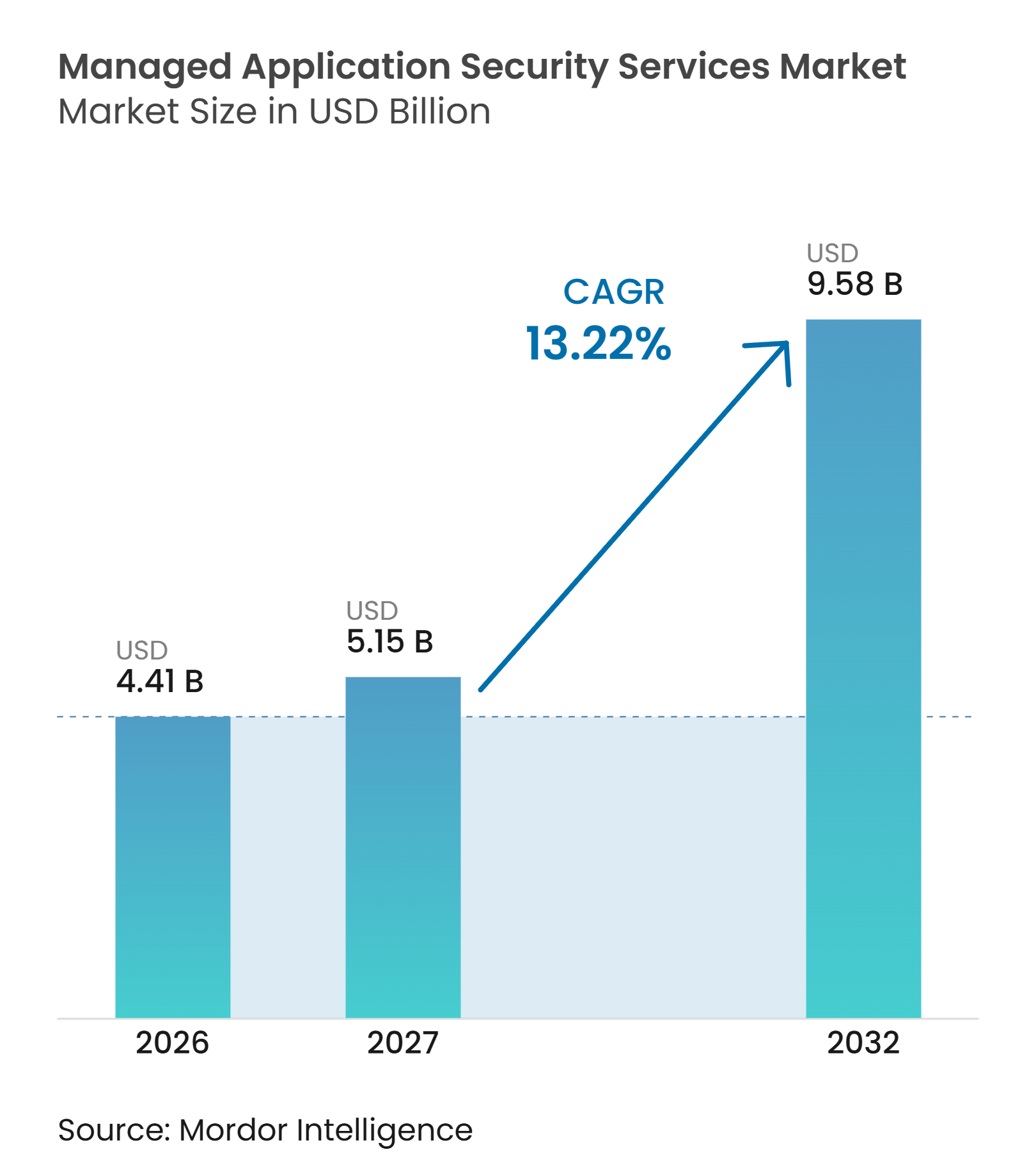
The managed application security services market size is projected to expand from USD 4.41 billion in 2026 to USD 9.58 billion by 2032, registering a CAGR of 13.22% from 2027 to 2032. Application layers have become a central point of exposure as organizations rely on web, mobile, cloud-native, and API-led software. The managed application security services market is benefiting from a move away from isolated testing engagements toward continuous assurance, governance, and remediation tracking. Regulatory requirements, cloud architecture changes, and shortages of experienced security personnel are increasing the need for specialist delivery. Providers are responding with managed services that connect security findings to development workflows, although cross-border data rules and limits on source-code access can restrict unified service delivery.
Key Report Takeaways
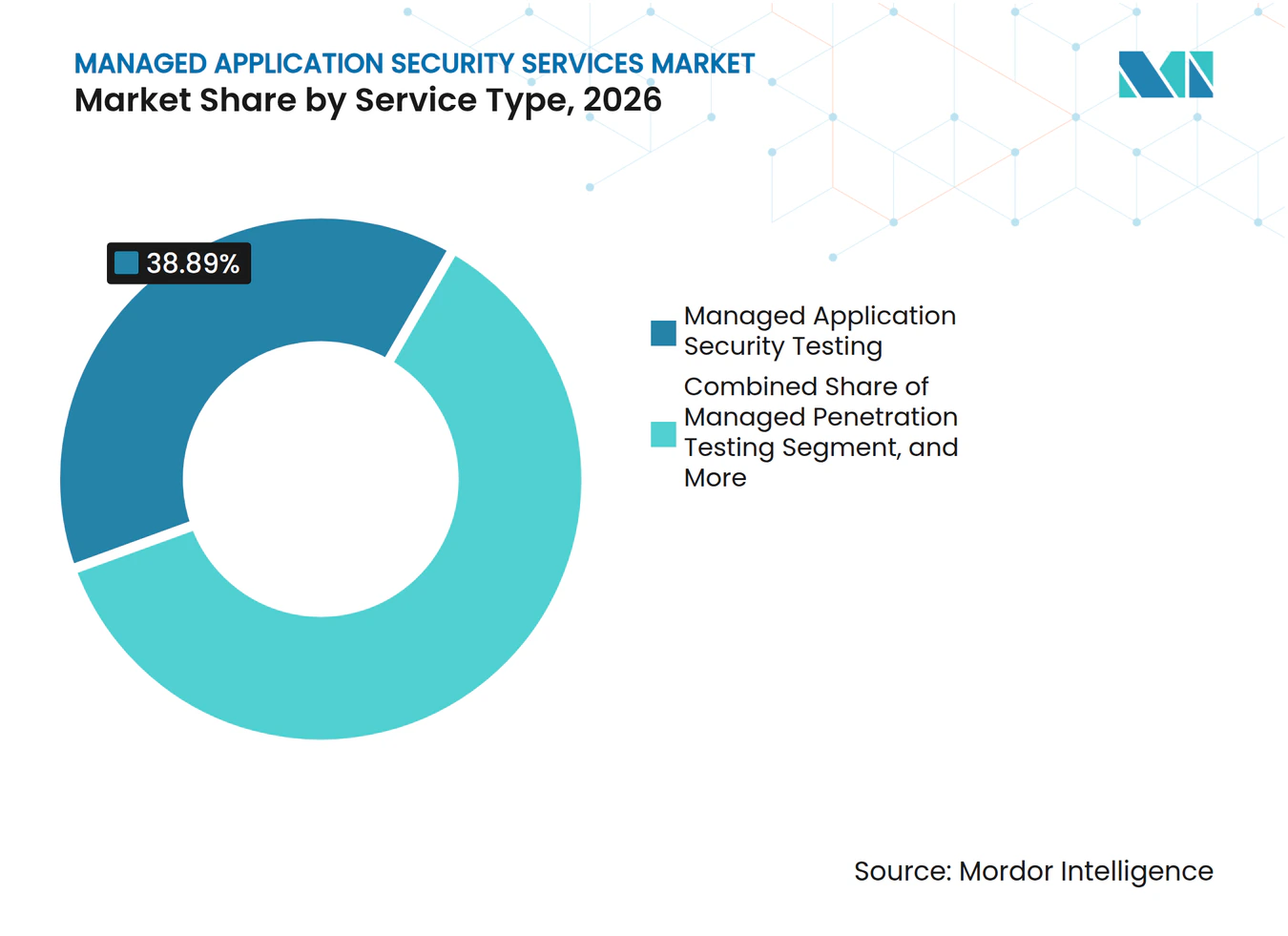
- By service type, Managed Application Security Testing held 38.89% of the managed application security services market share in 2026, while Managed Application Security Program Operations is projected to expand at a 14.37% CAGR through 2032.
- By delivery model, Fully Managed Services held 32.26% revenue share in 2026, while Outcome-Based and Consumption-Based Services are projected to expand at a 14.68% CAGR through 2032.
- By application, Web Applications accounted for 32.92% of revenue in 2026, while AI-Enabled Applications are projected to expand at a 14.22% CAGR through 2032.
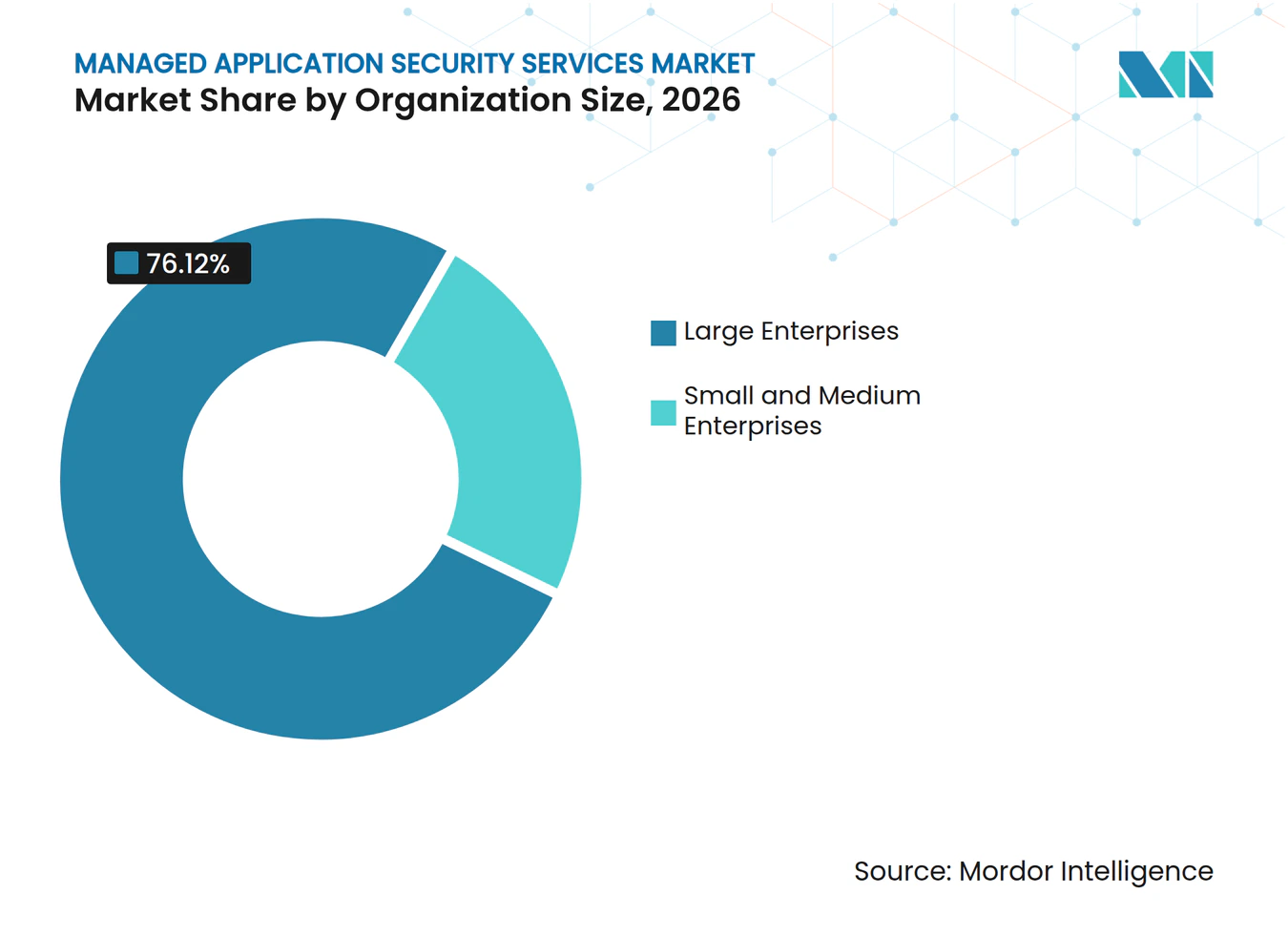
- By organization size, Large Enterprises accounted for 76.12% of revenue in 2026, while Small and Medium Enterprises are projected to expand at a 14.08% CAGR through 2032.
- By end-user industry, BFSI accounted for 24.76% of revenue in 2026, while Energy and Utilities is projected to expand at a 14.16% CAGR through 2032.
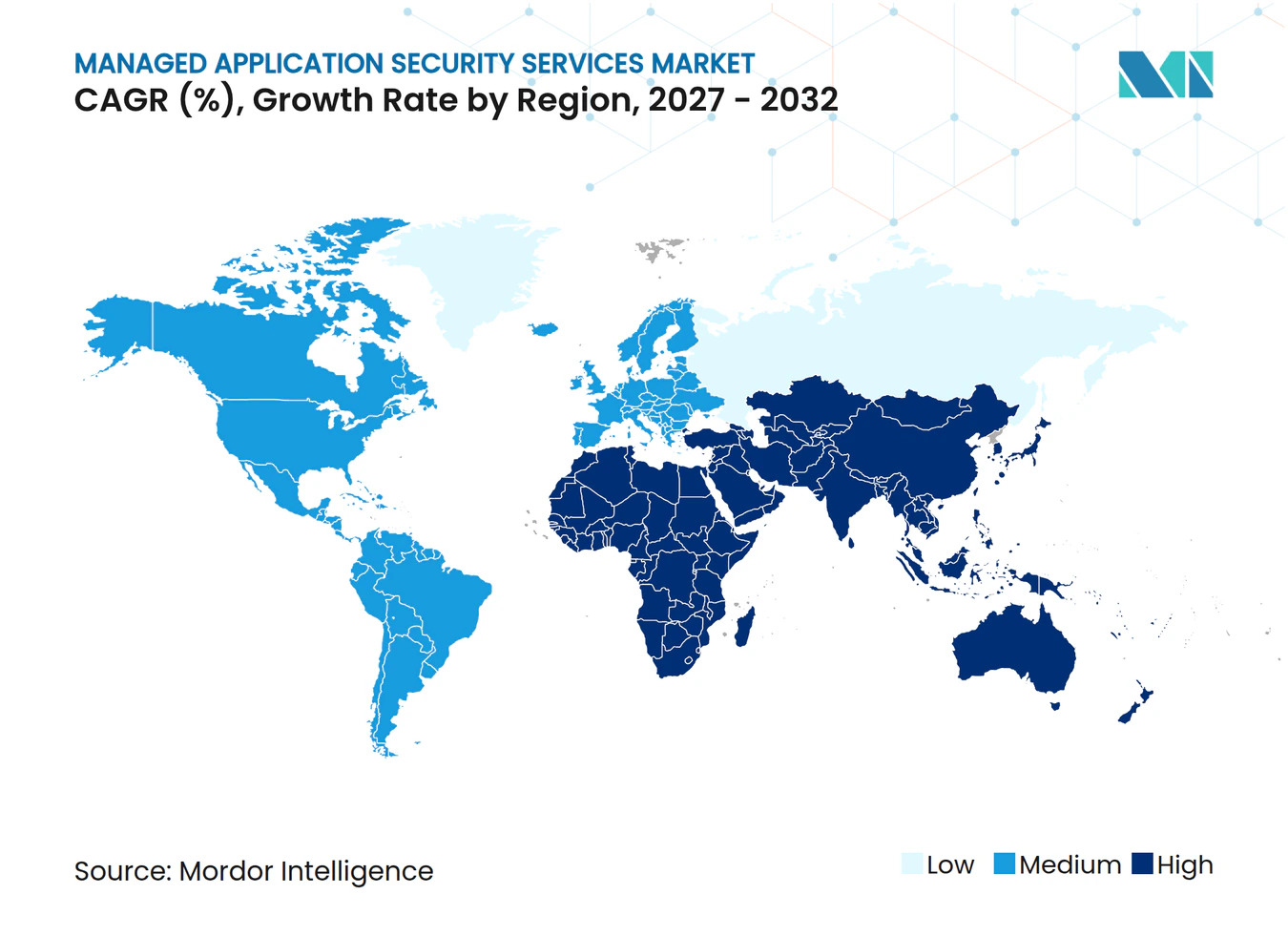
- By geography, North America held 43.28% revenue share in 2026, while Asia-Pacific is projected to expand at a 14.92% CAGR through 2032.
Note: Market numbers in this report are based on Mordor Intelligence's proprietary estimation framework, which combines nine months of actuals with Q4 projections for base year 2026.
Market Trends and Insights
Drivers Impact Analysis of Managed Application Security Services Market*
| Driver | (~) % Impact on CAGR Forecast | Geographic Relevance | Impact Timeline |
|---|---|---|---|
| Rising Regulatory and Audit Demand for Continuous Application Assurance | +2.3% | Global | Short term (≤ 2 years) |
| Accelerating Cloud-Native, API, and Microservices Adoption | +2.1% | Global | Medium term (2-4 years) |
| Persistent Application Security Talent Shortages | +2.0% | Global | Short term (≤ 2 years) |
| Expansion of AI-Assisted Software Development | +1.8% | Global, with concentration in North America and Asia-Pacific | Medium term (2-4 years) |
| Managed Validation of Business-Logic and API Risks | +1.5% | North America and Europe | Medium term (2-4 years) |
| Security Evidence Automation Across Distributed Software Supply Chains | +1.2% | Global, with early gains in North America and Europe | Long term (≥ 4 years) |
| Source: Mordor Intelligence | |||
Rising Regulatory and Audit Demand for Continuous Application Assurance
Regulatory obligations are moving application assurance from a periodic activity to an ongoing operating requirement. The managed application security services market gains support when organizations need evidence that scanning, testing, and issue management occur consistently. The European Union Digital Operational Resilience Act took effect in January 2025 and requires covered financial entities to conduct threat-led penetration testing at least every 3 years. Its technical standards also require weekly vulnerability scanning for ICT assets that support critical or important functions. These requirements make an annual testing cycle insufficient for many covered organizations. Service providers can help clients maintain the testing cadence, documentation, and reporting expected by regulators.
Accelerating Cloud-Native, API, and Microservices Adoption
Cloud-native design increases the number of application components that teams need to secure. Microservices, APIs, containers, and continuous delivery pipelines create more opportunities for authentication, authorization, and input validation to fail. NIST updated SP 800-228 in March 2026 to address API protection across cloud-native systems and recommends risk-based controls during both pre-runtime and runtime stages.[1] The managed application security services market, therefore, benefits from demand for continuous coverage rather than occasional code scans. Runtime application detection and response can add visibility into issues that do not emerge in development or testing. IBM Consulting and Contrast Security expanded their collaboration in October 2025 to integrate application detection and response capabilities into application security services.
Persistent Application Security Talent Shortages
Application security roles require knowledge of both security methods and software development practices. ISC2 reported in April 2026 that 95% of organizations had at least 1 cybersecurity skill need, and 59% described their gaps as critical or significant. AI and cloud security were among the technical areas that hiring managers found difficult to staff. Fortinet reported that 56% of IT leaders linked cybersecurity skills shortages to security breaches, while 60% identified AI-related cybersecurity experience as their leading recruitment challenge. The managed application security services market offers organizations a way to leverage specialist capabilities without building a large internal team. This need is especially strong where development teams own remediation but lack dedicated security engineers.
Expansion of AI-Assisted Software Development
AI-assisted development adds code at a pace that can exceed established review practices. A 2025 empirical study in ACM Transactions on Software Engineering and Methodology found security weaknesses in 29.5% of assessed Python and 24.2% of assessed JavaScript GitHub Copilot code snippets. The weaknesses covered 43 CWE categories and included 8 entries in the 2023 CWE Top 25. Organizations also need controls over model access, prompt injection, and AI supply chain exposure in applications that use AI components. Checkmarx reported in 2026 that over 60% of organizational code is written by AI, while only 18% of organizations have formal governance policies for that shift. The managed application security services market can address this gap through assessment methods that examine generated code, models, agents, and connected software components.
Restraints Impact Analysis of Managed Application Security Services Market*
| Restraint | (~) % Impact on CAGR Forecast | Geographic Relevance | Impact Timeline |
|---|---|---|---|
| Tool Sprawl and Alert-Fatigue Risk | -1.5% | Global | Medium term (2-4 years) |
| Data-Sovereignty and Source-Code Access Constraints | -1.1% | Europe, Asia-Pacific, and Middle East | Medium term (2-4 years) |
| Budget Competition with Broader Cybersecurity Priorities | -0.8% | Global | Short term (≤ 2 years) |
| Client-Side Remediation Ownership Gaps | -0.5% | Global | Medium term (2-4 years) |
| Source: Mordor Intelligence | |||
Tool Sprawl and Alert-Fatigue Risk
Organizations often use several security tools that report similar findings. This adds work for managed providers, who must integrate, compare, and prioritize results before a client can act. Black Duck reported in October 2025 that over 71% of surveyed software and security professionals considered a significant portion of security alerts to be noise. The managed application security services market can be constrained if contracts reward alert volume rather than verified risk reduction. Application security posture management layers can reduce duplication, but integration across diverse client toolsets remains difficult.
Data-Sovereignty and Source-Code Access Constraints
Data localization rules can limit where providers store or process telemetry from client applications. Source-code access can also be restricted in defense, financial services, and healthcare environments. These limits reduce the extent to which a provider can apply static analysis, threat modeling, or centralized case management from another jurisdiction. The managed application security services market needs service models that support local delivery, data-residency-capable tools, and client-approved access controls. The issue is a legal and operating constraint rather than a simple customer awareness problem. Providers that cannot meet local requirements may need to narrow service scope or rely on regional delivery partners.
*Our forecasts treat driver/restraint impacts as directional, not additive. The impact forecasts reflect baseline growth, mix effects, and variable interactions.
Managed Application Security Services Market Segment Analysis
By Service Type:
Program Operations Gains Ground Against Testing-Led ModelsManaged Application Security Testing accounted for 38.89% of revenue in 2026. Its position reflects the long-standing use of vulnerability scanning and penetration testing as core security purchases. Managed Penetration Testing and Managed Vulnerability and Exposure Management also remain important parts of enterprise security programs. These services help organizations locate flaws across applications and supporting environments. Testing-led engagements remain relevant because most organizations need periodic independent validation. They can also provide a practical entry point for clients who are beginning to outsource application security work. The managed application security services market continues to depend on this established demand base.
Managed Application Security Program Operations is projected to expand at a 14.37% CAGR through 2032. This service type goes beyond finding vulnerabilities to include governance, remediation tracking, reporting, and coordination with client teams. The shift reflects a need for continuous oversight as regulatory obligations and software releases become more frequent. Managed Compliance, Reporting, and Remediation Advisory also gains relevance when audit evidence must be current. Checkmarx launched a reimagined Checkmarx One platform in March 2026 with Triage Assist and Remediation Assist agents that support program-level security workflows.



By Delivery Model:
Consumption-Based Pricing Reshapes Buyer-Provider RelationshipsFully Managed Services held 32.26% of revenue in 2026. This model appeals to organizations that want complete outsourced delivery under defined service levels and annual contracts. It is suitable for larger companies with established vendor governance processes and broad application portfolios. Co-Managed Services support clients that retain internal security teams but need help with day-to-day operations. License-Inclusive Services combine software and delivery in a single contract. These options allow the managed application security services market to serve different operating models without requiring each customer to follow the same procurement path.
Outcome-Based and Consumption-Based Services are projected to expand at a 14.68% CAGR through 2032. The model links service fees to work units or verified results rather than to staff hours or a fixed tool bundle. Small and medium enterprises can use per-application, per-scan, or per-remediated-vulnerability pricing to avoid large initial commitments. This approach can lower the barrier to managed security adoption for buyers who previously relied on self-managed tools. It can also shorten sales cycles when a client wants to begin with a limited scope. Providers must automate triage, reporting, and onboarding to protect delivery margins. The managed application security services industry is likely to see pricing and operational design become more closely connected as this model expands.
By Application:
AI-Enabled Applications Define the Next Growth CategoryWeb Applications accounted for 32.92% of revenue in 2026. Public-facing websites and digital services require coverage for recurring testing, API security, and vulnerability management. Mobile Applications and APIs also represent substantial needs as financial services and retail organizations expand digital customer channels. Cloud-Native Applications require checks that work with containers, registries, microservices, and continuous integration pipelines. Legacy and Enterprise Applications require hybrid testing approaches because maintenance windows and access to source code can be limited. These varied technical conditions broaden the scope of services for providers. The managed application security services market, therefore, must support both modern and long-established software estates.
AI-Enabled Applications are projected to expand at a 14.22% CAGR through 2032. The category includes risks such as model poisoning, prompt injection, and dependencies linked to AI models and agents. Conventional static and dynamic testing tools were not designed to address every AI-specific risk. CISA and NSA issued joint guidance on software bills of materials in September 2025 with 19 international cybersecurity organizations.[2] The guidance signals a continued focus on transparency in software components. Providers that assess AI assets and generated code alongside conventional application elements can create a more integrated service. This capability is relevant as enterprises move AI-supported applications into production.
By Organization Size:
SME Momentum Tests Mid-Market Delivery EconomicsLarge Enterprises accounted for 76.12% of revenue in 2026. Their application portfolios, regulatory exposure, and budgets have historically supported larger managed testing and vulnerability management contracts. Many large organizations operate across several clouds and maintain web, API, mobile, and legacy systems. They often require continuous coverage across business units and regions. This creates a substantial revenue base for providers with global delivery and client governance capabilities. Large enterprises also need integration with internal development and incident response processes. The managed application security services market will continue to rely on this customer group for large multi-application programs.
Small and Medium Enterprises are projected to expand at a 14.08% CAGR through 2032. Supply-chain requirements can bring security obligations to smaller contractors, including companies connected to defense work. Consumption pricing and tiered service bundles can make managed coverage easier to acquire. Smaller organizations can face a sharper talent challenge because they cannot always match larger employers for experienced practitioners. Automated onboarding and focused service packages are important for serving this group profitably. Providers that improve these operating models can reach a fragmented group of buyers without relying on enterprise-scale contracts.

By End-User Industry:
Energy and Utilities Advances on IT and OT ConvergenceBFSI accounted for 24.76% of revenue in 2026. Financial institutions face ongoing testing and reporting requirements because application security is closely tied to regulatory oversight and sensitive customer data. PCI DSS testing expectations, DORA requirements for European financial entities, and New York cybersecurity rules reinforce demand for managed services. Information Technology and Telecommunications, Healthcare, Retail and E-Commerce, Manufacturing, and Government and Defense also contribute to demand. Government and Defense organizations are increasing activity as zero-trust programs and CMMC requirements extend through supply chains. The managed application security services market supports these sectors through testing, reporting, and governance services that can align with sector-specific obligations.
Energy and Utilities is projected to expand at a 14.16% CAGR through 2032. Growth is connected to the convergence of information technology and operational technology, which brings legacy SCADA and industrial control system software into security programs. These environments can require careful testing because availability and safety constraints may limit direct assessment methods. Providers need to understand the boundary between business systems and operational systems. NexusTek launched a managed IT and cybersecurity practice for mid-market energy, oil and gas, and utility operators in May 2026. The offering focused on IT and OT security, compliance readiness, hybrid cloud infrastructure, and virtual CIO support. Energy operators may need specialist managed support as connected systems expand and internal teams remain limited.
Geography Analysis
North America Managed Application Security Services Market
North America held 43.28% of the managed application security services market share in 2026. The region combines dense regulation with a mature ecosystem of managed security providers and application security specialists. U.S. requirements involving financial services, federal systems, defense suppliers, privacy, and cross-border data shape demand for continuous assurance. Canada contributes to demand from financial services and critical infrastructure organizations that align with U.S.-oriented practices. Mexico's manufacturing base also creates managed security requirements tied to North American supply-chain obligations. The United States has a deep concentration of providers capable of supporting web, mobile, API, cloud-native, and AI-enabled applications.
Europe Managed Application Security Services Market
Europe is the second-largest regional market. DORA became effective in January 2025 and has increased demand for continuous vulnerability scanning, testing, and audit documentation in financial services.[3] NIS2 and the Cyber Resilience Act also support attention to secure software development and transparency in software components. Germany, the United Kingdom, France, Italy, and Spain are important demand centers due to their financial institutions and critical infrastructure operators. BearingPoint introduced SBOM Management Services in 2026 to align software transparency workflows with Cyber Resilience Act requirements. Russia remains structurally constrained within the regional managed services landscape.
APAC, South America and MEA Managed Application Security Services Market
Asia-Pacific is projected to expand at a 14.92% CAGR through 2032. China, India, South Korea, Australia, and Japan combine cloud adoption, growing regulatory obligations, and shortages of experienced security personnel. India has domestic demand while its IT service companies support managed delivery for clients in other regions. NTT DATA launched FinSOC in Japan in March 2026 to provide 24-hour cybersecurity monitoring and response support for banking and insurance institutions. South America is growing from a smaller base, led by activity in Brazil's financial services sector and Argentina's technology sector. Saudi Arabia and the United Arab Emirates are also building long-term demand as national digitization programs increase cloud adoption, while Africa remains at an earlier stage of managed application security maturity.
Competitive Landscape
Market Concentration
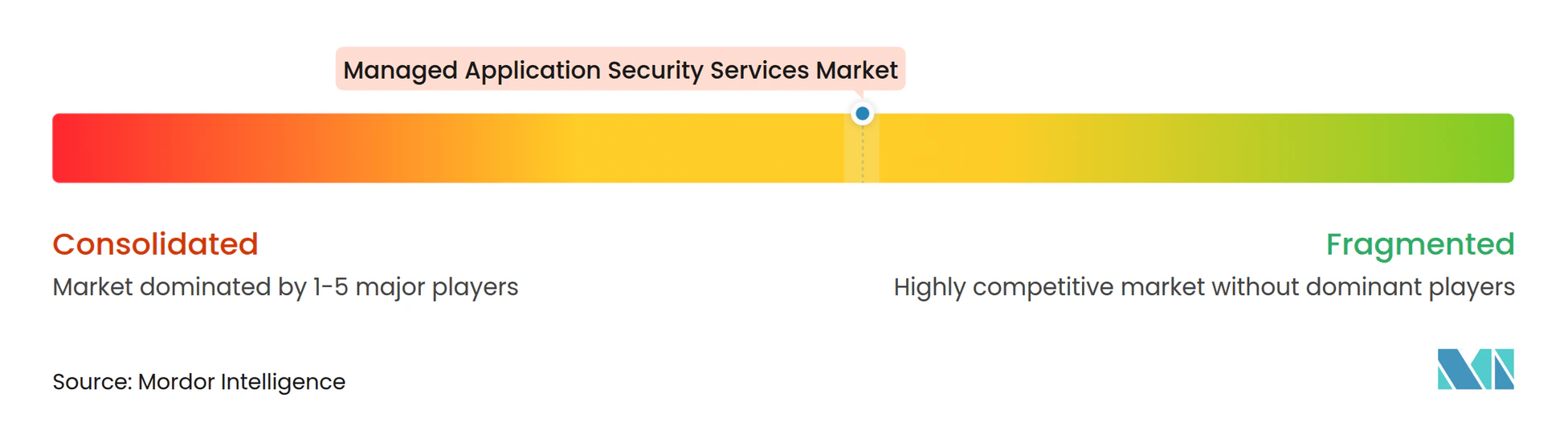
The managed application security services market is moderately concentrated. Accenture, IBM, NTT DATA, Capgemini, TCS, and HCL Technologies compete through global delivery capacity, existing client relationships, and broader digital service portfolios. Veracode, Checkmarx, Rapid7, Trustwave, Kroll, and GuidePoint Security compete through application security specialization and focused technology capabilities. The first group can embed application security services within wider transformation engagements. The specialist group can compete by offering greater product depth and implementing changes to testing and remediation workflows more quickly. The managed application security services market also rewards providers that can coordinate security findings with client development teams. Competition, therefore, involves both scale and technical focus. Buyers may select providers based on delivery reach, sector knowledge, required tools, and the ability to connect security findings with engineering teams.
Partnerships and acquisitions are shaping provider capabilities. CrowdStrike launched Project QuiltWorks in April 2026 with Accenture, EY, IBM Cybersecurity Services, and Kroll to assess, prioritize, and remediate vulnerabilities in production code identified by frontier AI models. UltraViolet Cyber acquired Black Duck's Application Security Testing services business in September 2025, adding penetration testing, red teaming, threat modeling, cloud and container risk assessments, and secure development consulting. Veracode expanded its Package Firewall in January 2026 to block malicious packages as they enter development pipelines.These moves reflect interest in prevention, AI-related assessment, and broader managed delivery scope.
The managed application security services market has opportunity in small and medium enterprise delivery and purpose-built assessment of AI-enabled applications. Smaller buyers require efficient onboarding, clear pricing, and service packages that do not carry large enterprise overhead. AI application assessment remains less mature than conventional code and API testing. IBM introduced X-Force Advanced Proactive Security to apply frontier AI models to enterprise security testing in controlled environments. Checkmarx also introduced AI Supply Chain Security capabilities that identify AI assets, models, agents, and AI-BOM elements in production environments.
Managed Application Security Services Industry Leaders
-
Accenture plc
-
International Business Machines Corporation
-
Cisco Systems, Inc.
-
Verizon Communications Inc.
-
NTT DATA Corporation
- *Disclaimer: Major Players sorted in no particular order
Managed Application Security Services Market Companies Covered in this Report
- Accenture plc
- International Business Machines Corporation
- Cisco Systems, Inc.
- Verizon Communications Inc.
- NTT DATA Corporation
- DXC Technology Company
- Capgemini SE
- Deloitte Touche Tohmatsu Limited
- Fujitsu Limited
- Tata Consultancy Services Limited
- HCL Technologies Limited
- Rapid7, Inc.
- Trustwave Holdings, Inc.
- Secureworks Corp.
- Kroll, LLC
- Trend Micro Incorporated
- Check Point Software Technologies Ltd.
- Fortinet, Inc.
- CrowdStrike Holdings, Inc.
- Veracode, Inc.
- Checkmarx Ltd.
- GuidePoint Security LLC
- KPMG International Cooperative
Recent Industry Developments in Managed Application Security Services Market
- June 2026: Omicron and Controlware announced a partnership delivering integrated OT and IT security for energy facility and grid operators, combining StationGuard attack detection with Controlware's consulting, integration, and 24/7 managed security operations for NIS2 and German Energy Industry Act compliance.
- April 2026: CrowdStrike launched Project QuiltWorks, an industry-wide coalition with Accenture, EY, IBM Cybersecurity Services, and Kroll to continuously assess, prioritize, and remediate production code vulnerabilities discovered by frontier AI models from OpenAI and Anthropic. The coalition simultaneously launched the Frontier AI Readiness and Resilience Service, a 12-month subscription offering, establishing AI-powered vulnerability discovery as a managed engagement model with board-level reporting.
- March 2026: NTT DATA launched FinSOC, a dedicated financial-sector cybersecurity monitoring facility in Japan, providing 24-hour centralized surveillance, cyberattack detection, scope identification, and remediation support shared across banking and insurance clients, representing a shared-infrastructure model that enables smaller financial institutions to access enterprise-grade application security operations.
- March 2026: Checkmarx unveiled the reimagined Checkmarx One platform for agentic application security, embedding autonomous Triage Assist and Remediation Assist agents, AI Supply Chain Security, AI SAST, and DAST for AI capabilities, shifting from reactive scanning to continuous, machine-speed governance across code, open-source dependencies, and AI assets.
Global Managed Application Security Services Market Report Scope
Managed application security services involve the outsourcing of application security activities to specialized third-party providers. These services help organizations identify, prevent, detect, and respond to security vulnerabilities and threats across web, mobile, cloud-based, and enterprise applications throughout the application lifecycle.
The Managed Application Security Services Market Report is Segmented by Service Type (Managed Application Security Testing, Managed Vulnerability and Exposure Management, Managed Penetration Testing, Managed Application Security Program Operations, and Managed Compliance, Reporting, and Remediation Advisory), by Delivery Model (Fully Managed Services, Co-Managed Services, License-Inclusive Services, Bring-Your-Own-License Services, and Outcome-Based and Consumption-Based Services), by Application (Web Applications, Mobile Applications, Application Programming Interfaces, Cloud-Native Applications, Legacy and Enterprise Applications, and AI-Enabled Applications), by Organization Size (Small and Medium Enterprises and Large Enterprises), by End-User Industry (Information Technology and Telecommunications, BFSI, Healthcare, Retail and E-Commerce, Manufacturing, Government and Defense, Education, Professional Services, Energy and Utilities, and Other End-User Industries), and by Geography (North America, South America, Europe, Asia-Pacific, Middle East, and Africa). The Market Forecasts are Provided in Terms of Value (USD).
Segmentation Overview
| Managed Application Security Testing |
| Managed Vulnerability and Exposure Management |
| Managed Penetration Testing |
| Managed Application Security Program Operations |
| Managed Compliance, Reporting, and Remediation Advisory |
| Fully Managed Services |
| Co-Managed Services |
| License-Inclusive Services |
| Bring-Your-Own-License Services |
| Outcome-Based and Consumption-Based Services |
| Web Applications |
| Mobile Applications |
| Application Programming Interfaces |
| Cloud-Native Applications |
| Legacy and Enterprise Applications |
| AI-Enabled Applications |
| Small and Medium Enterprises |
| Large Enterprises |
| Information Technology and Telecommunications |
| BFSI |
| Healthcare |
| Retail and E-Commerce |
| Manufacturing |
| Government and Defense |
| Education |
| Professional Services |
| Energy and Utilities |
| Other End-User Industries |
| North America | United States |
| Canada | |
| Mexico | |
| South America | Brazil |
| Argentina | |
| Rest of South America | |
| Europe | Germany |
| United Kingdom | |
| France | |
| Italy | |
| Spain | |
| Russia | |
| Rest of Europe | |
| Asia-Pacific | China |
| India | |
| Japan | |
| South Korea | |
| Australia | |
| Rest of Asia-Pacific | |
| Middle East | Saudi Arabia |
| United Arab Emirates | |
| Turkey | |
| Rest of Middle East | |
| Africa | South Africa |
| Egypt | |
| Nigeria | |
| Rest of Africa |
| By Service Type | Managed Application Security Testing | |
| Managed Vulnerability and Exposure Management | ||
| Managed Penetration Testing | ||
| Managed Application Security Program Operations | ||
| Managed Compliance, Reporting, and Remediation Advisory | ||
| By Delivery Model | Fully Managed Services | |
| Co-Managed Services | ||
| License-Inclusive Services | ||
| Bring-Your-Own-License Services | ||
| Outcome-Based and Consumption-Based Services | ||
| By Application | Web Applications | |
| Mobile Applications | ||
| Application Programming Interfaces | ||
| Cloud-Native Applications | ||
| Legacy and Enterprise Applications | ||
| AI-Enabled Applications | ||
| By Organization Size | Small and Medium Enterprises | |
| Large Enterprises | ||
| By End-User Industry | Information Technology and Telecommunications | |
| BFSI | ||
| Healthcare | ||
| Retail and E-Commerce | ||
| Manufacturing | ||
| Government and Defense | ||
| Education | ||
| Professional Services | ||
| Energy and Utilities | ||
| Other End-User Industries | ||
| By Geography | North America | United States |
| Canada | ||
| Mexico | ||
| South America | Brazil | |
| Argentina | ||
| Rest of South America | ||
| Europe | Germany | |
| United Kingdom | ||
| France | ||
| Italy | ||
| Spain | ||
| Russia | ||
| Rest of Europe | ||
| Asia-Pacific | China | |
| India | ||
| Japan | ||
| South Korea | ||
| Australia | ||
| Rest of Asia-Pacific | ||
| Middle East | Saudi Arabia | |
| United Arab Emirates | ||
| Turkey | ||
| Rest of Middle East | ||
| Africa | South Africa | |
| Egypt | ||
| Nigeria | ||
| Rest of Africa | ||
Key Questions Answered in the Report
What is the managed application security services market size?
The managed application security services market is projected to increase from USD 4.41 billion in 2026 to USD 9.58 billion by 2032 at a 13.22% CAGR. The forecast reflects demand for continuous testing, governance, and remediation coordination as application exposure expands.
What is driving demand for managed application security services?
Continuous regulatory obligations, cloud-native architectures, API use, and shortages of application security talent are increasing demand for specialist managed delivery. The managed application security services market supports organizations that need regular assurance without building every capability internally.
Which service type leads managed application security services?
Managed Application Security Testing leads with 38.89% revenue share in 2026, while Program Operations is projected to grow fastest at a 14.37% CAGR. Program operations adds governance, reporting, and remediation tracking to traditional testing delivery.
Which region has the largest managed application security services revenue share?
North America leads with 43.28% revenue share in 2026, supported by regulatory density and a mature ecosystem of security providers. The managed application security services market also grows through regulatory and cloud adoption activity in Europe and Asia-Pacific.
Which customer group is growing fastest in managed application security services?
Small and Medium Enterprises are projected to grow at a 14.08% CAGR through 2032 as consumption pricing and automated delivery lower adoption barriers. These buyers may use focused services when they cannot recruit or retain dedicated application security specialists.
Why are AI-enabled applications important for application security providers?
AI-Enabled Applications are projected to grow at a 14.22% CAGR through 2032 and introduce risks involving generated code, prompt injection, models, agents, and software dependencies. The managed application security services market needs specialized assessment methods as these applications enter production environments.