
Managed API Security Services Market Size and Share
Market Overview
| Study Period | 2021 - 2032 |
|---|---|
| Market Size (2027) | USD 2.57 Billion |
| Market Size (2032) | USD 5.43 Billion |
| Growth Rate (2027 - 2032) | 16.14 % |
| Fastest Growing Market | Asia-Pacific |
| Largest Market | North America |
| Market Concentration | Medium |
Major Players *Disclaimer: Major Players sorted in no particular order Image © Mordor Intelligence. Reuse requires attribution under CC BY 4.0. | |
Managed API Security Services Market Analysis by Mordor Intelligence
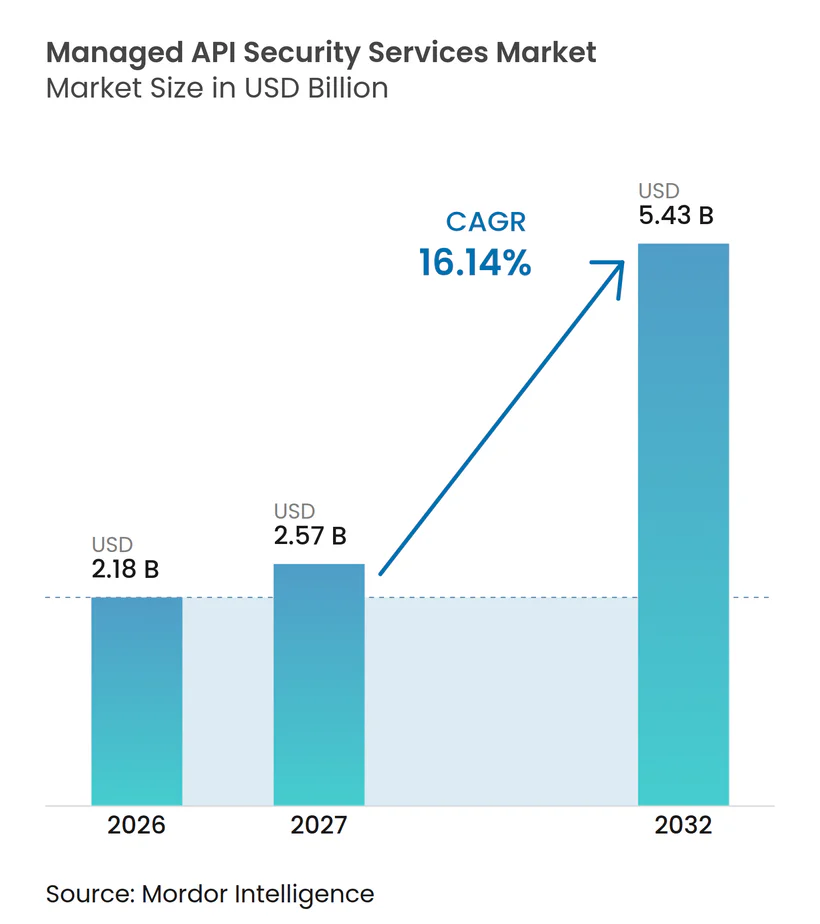
The Managed API Security Services Market size is projected to expand from USD 2.18 billion in 2026 and USD 2.57 billion in 2027 to USD 5.43 billion by 2032, registering a CAGR of 16.14% between 2027 to 2032. The managed API security services market is growing as APIs carry customer interactions, revenue flows, and regulated data exchanges across digital operations. Enterprises are adding cloud-native applications, microservices, and AI-enabled workloads faster than internal security teams can extend continuous coverage. Providers are responding with managed discovery, runtime monitoring, threat detection, and incident response that can operate across complex API estates. Regulatory requirements and fraud exposure are increasing demand for services that combine technical controls with documented operational support.
Key Report Takeaways
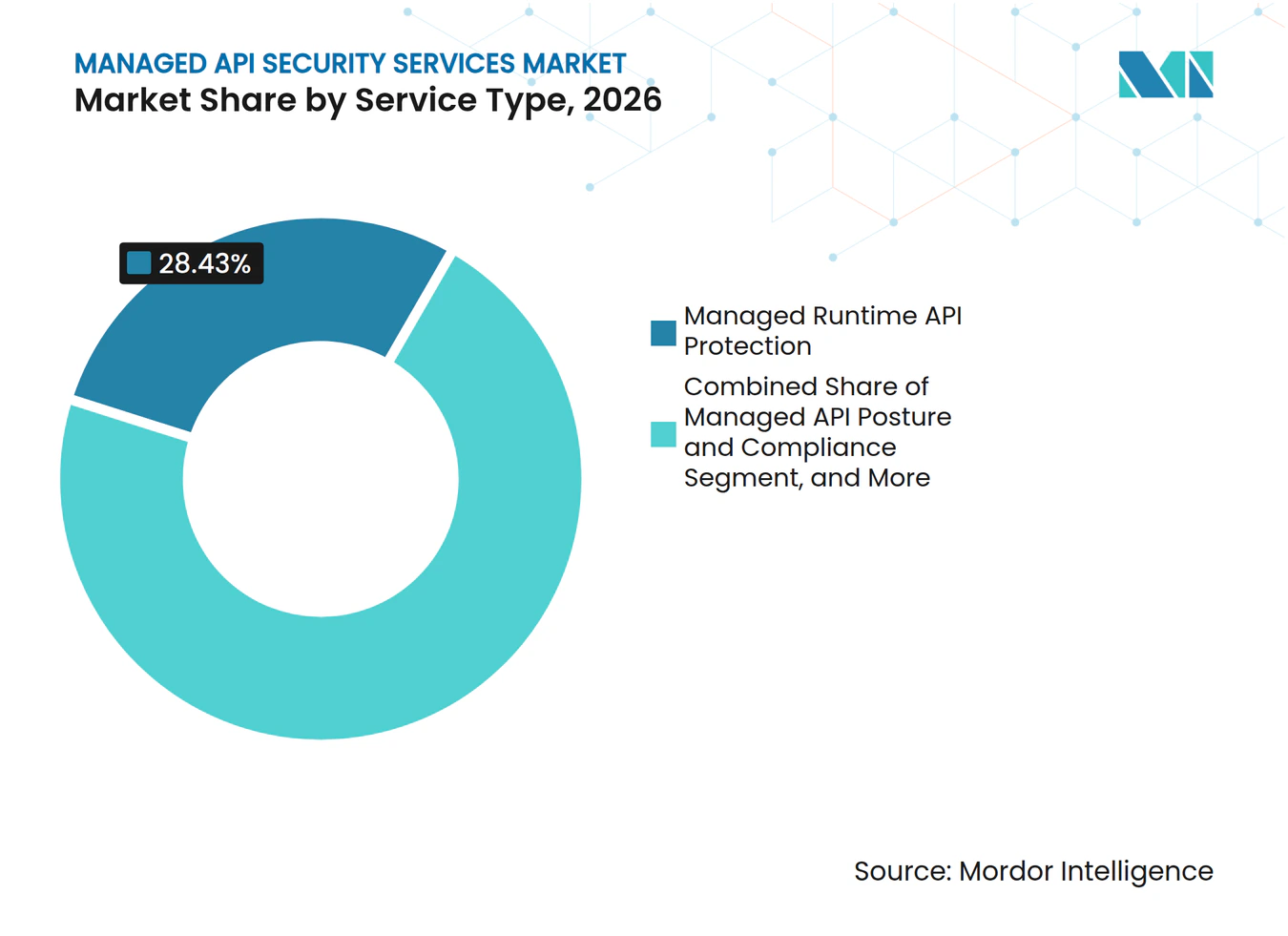
- By service type, Managed Runtime API Protection held 28.43% of the managed API security services market share in 2026, while Managed API Threat Detection and Response is projected to expand at a 17.63% CAGR through 2032.
- By architecture type, REST APIs held 52.67% share in 2026, while GraphQL APIs are projected to expand at a 17.34% CAGR through 2032.
- By deployment model, cloud-based deployment held 61.38% share in 2026, while hybrid deployment is projected to expand at a 17.31% CAGR through 2032.
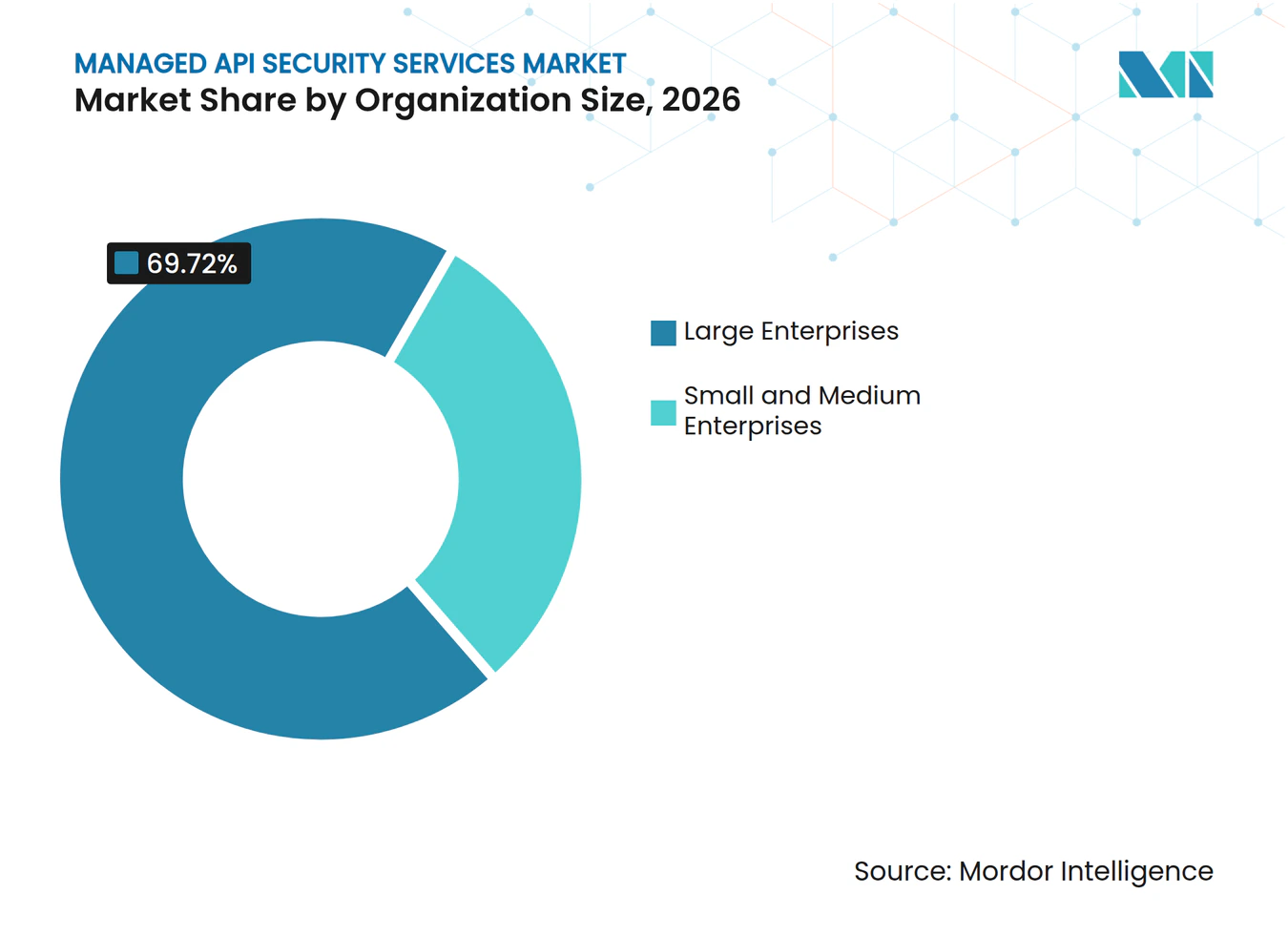
- By organization size, large enterprises held 69.72% share in 2026, while small and medium enterprises are projected to expand at a 17.23% CAGR through 2032.
- By end-user industry, BFSI held 25.83% share in 2026, while healthcare is projected to expand at a 17.42% CAGR through 2032.
- By geography, North America held 41.87% share in 2026, while Asia-Pacific is projected to expand at a 17.19% CAGR through 2032.
Note: Market numbers in this report are based on Mordor Intelligence's proprietary estimation framework, which combines nine months of actuals with Q4 projections for base year 2026.
Global Managed API Security Services Market Trends and Insights
Drivers Impact Analysis*
| Driver | (~) % Impact on CAGR Forecast | Geographic Relevance | Impact Timeline |
|---|---|---|---|
| Rising API Exposure Across Cloud-Native and Microservices Architectures | +4.2% | Global | Short term (≤ 2 years) |
| Expansion of AI Agents and LLM-Based API Workloads | +3.6% | Global, with early concentration in North America and Europe | Medium term (2-4 years) |
| Escalating Business-Logic Abuse and API Fraud | +2.7% | Global, heightened in North America and Asia-Pacific core | Short term (≤ 2 years) |
| Tightening Privacy, Financial-Services, and AI Regulations | +2.0% | North America and EU, spillover to Asia-Pacific | Medium term (2-4 years) |
| Shortage of Specialized API Security Talent | +1.4% | Global, most acute in Asia-Pacific and South America | Long term (≥ 4 years) |
| Demand for Continuous API Discovery and Runtime Monitoring | +1.0% | Global | Short term (≤ 2 years) |
| Source: Mordor Intelligence | |||
Rising API Exposure Across Cloud-Native and Microservices Architectures
Cloud-native adoption has changed how organizations must secure application traffic, because microservices exchange data through many distributed interfaces. Many security tools were designed for monolithic applications and have limited visibility into stateless interactions during runtime. Managed providers can maintain discovery tools, behavioral baselines, and threat intelligence across client environments. NIST's 2025 guidance sets out a risk-based approach for API protection before deployment and during runtime. Unregistered endpoints remain a material weakness, making continuous discovery a practical requirement for the managed API security services market.
Expansion of AI Agents and LLM-Based API Workloads
AI agents make repeated authenticated API calls that many conventional controls do not recognize as a distinct operational pattern. Palo Alto Networks stated that each AI model query or agentic workflow call creates API activity that needs appropriate visibility and governance. Wallarm recorded 439 AI-related CVEs in 2025, with 99% directly linked to APIs through flaws such as injection, misconfiguration, and memory corruption.[1] A compromised agent can move through several services through prompt injection or tool misuse without exceeding volume-based detection thresholds. Salt Security introduced its Agentic Security Platform in March 2026 to provide discovery and governance across LLMs, MCP servers, and APIs. These requirements favor managed teams that can continuously baseline agent behavior and investigate deviations, thereby supporting the managed API security services market.
Escalating Business-Logic Abuse and API Fraud
Business logic abuse involves using legitimate application functions in unintended ways, making it difficult for signature-based defenses to detect. Imperva reported more than 40,000 API incidents across over 4,000 environments during the first half of 2025, including payment fraud, coupon fraud, account takeover, data scraping, and Broken Object Level Authorization. Thales found that bad bots represented 40% of internet traffic in 2025 and reported blocking 17.2 trillion bad bot requests. OWASP's 2025 Business Logic Abuse Top 10 formalized the need to address these risks through stronger design and authorization controls. The managed API security services market benefits when organizations need monitoring that interprets the intent and sequence of API activity rather than only matching known attack signatures.
Tightening Privacy, Financial-Services, and AI Regulations
Regulatory deadlines in 2025 and 2026 increased the need for continuous API risk management in financial services and healthcare. DORA took effect in January 2025 and requires covered financial entities to manage information and communication technology risk, with penalties that can reach 2% of global annual turnover. PCI DSS v4.0.1 has required API security testing in payment card data environments since March 2025 under Requirement 6.2.4. ENISA launched the European Vulnerability Database in May 2025, strengthening vulnerability reporting infrastructure under EU cybersecurity rules. Managed providers that prepare compliance reporting for DORA, PCI DSS, and HIPAA can turn complex controls into ongoing service engagements in the managed API security services market.
Restraints Impact Analysis*
| Restraint | (~) % Impact on CAGR Forecast | Geographic Relevance | Impact Timeline |
|---|---|---|---|
| Data Sovereignty and Cross-Border Monitoring Constraints | -1.2% | EU, Asia-Pacific, including China and India, and Middle East | Long term (≥ 4 years) |
| High Integration Complexity Across Legacy and Multi-Cloud Estates | -0.9% | Global, most acute in North America and Europe | Medium term (2-4 years) |
| False Positives That Can Disrupt Digital Transactions | -0.6% | Global | Short term (≤ 2 years) |
| Unclear Ownership Between Development, Security, and Operations Teams | -0.4% | Global | Medium term (2-4 years) |
| Source: Mordor Intelligence | |||
Data Sovereignty and Cross-Border Monitoring Constraints
Data sovereignty rules can limit centralized monitoring for organizations operating in several jurisdictions. China, India, Russia, and some Gulf states impose data localization requirements that can restrict transfers of API logs, behavioral telemetry, and threat intelligence. The GDPR also limits transfers of personal data to security operations centers in third countries. Managed providers may need local infrastructure or regional operating centers, which can reduce the visibility available to shared threat-correlation systems. Sovereign deployment options can address part of the issue, but they also increase operating costs and can slow expansion. This restraint shapes how the managed API security services market develops in regulated cross-border environments.
High Integration Complexity Across Legacy and Multi-Cloud Estates
Deployment can take longer when organizations run legacy systems and multiple cloud environments with different API designs. The analysis reports that the average enterprise uses 3.8 cloud environments, while older systems may rely on SOAP or proprietary protocols that modern tools do not always inspect effectively. Salt Security found that 54% of organizations rely on developer documentation to identify sensitive-data exposure, leaving discovery work with an incomplete starting point. Connecting services to CI/CD pipelines, gateways, and SIEM platforms adds operational workload for already stretched security teams. Simplified onboarding is therefore important for small and medium enterprises that need external protection but have limited technical capacity in the managed API security services market.
*Our forecasts treat driver/restraint impacts as directional, not additive. The impact forecasts reflect baseline growth, mix effects, and variable interactions.
Segment Analysis
By Service Type: Runtime Protection Leads While Threat Response Expands
Managed Runtime API Protection held 28.43% of revenue in 2026. Enterprises use runtime protection to block anomalous API activity while applications are in production. Payment fraud, account takeover, and data scraping can directly affect revenue and customer trust. That exposure creates demand for operational coverage rather than periodic assessments alone. Akamai launched a managed API security service in June 2025 that combines real-time monitoring with expert response.
Managed API Threat Detection and Response is projected to grow at a 17.63% CAGR from 2027 to 2032. AI agents create authenticated, multistep interactions that often require human interpretation alongside automated detection. Managed discovery and inventory services for organizations that lack a complete view of their endpoints. Managed posture and compliance services support evidence collection and control monitoring. Testing and remediation services also support earlier validation in software development, keeping the managed API security services market aligned with shift-left security practices.



By Architecture Type: REST Retains Scale While GraphQL Requires Specialized Coverage
REST APIs accounted for 52.67% of the managed API security services market in 2026. They remain widely used across web services, mobile backends, and cloud microservices. Managed protection tools have broad operational maturity for these API patterns. Their installed base gives providers a large source of recurring monitoring and protection work. REST environments still require continuous discovery because endpoint inventories can change rapidly.
GraphQL APIs are projected to grow at a 17.34% CAGR from 2027 to 2032. Their flexible query model can create layered authorization issues and query-depth denial-of-service risks. Protection for SOAP and legacy APIs remains relevant for financial institutions with older core systems. gRPC and event-driven API protection also offer scope for the managed API security services market as performance-sensitive microservices programs expand.
By Deployment Model: Cloud-Based Delivery Leads While Hybrid Demand Rises
Cloud-based deployment held 61.38% share in 2026. Its scale enables automatic updates and broad threat intelligence sharing for managed providers. Cloud delivery can also simplify service rollout across distributed operations. Organizations with cloud-native workloads can use it to apply consistent security policies across changing application environments. These operating benefits keep cloud delivery central to the managed API security services market.
Hybrid deployment is projected to grow at a 17.31% CAGR from 2027 to 2032. Financial services and healthcare organizations seek local control for sensitive data while retaining cloud-based intelligence and analytics. On-premises deployment remains relevant for government, defense, and critical infrastructure environments with air-gap or classified-network requirements. Providers that integrate cloud and local controls can address governance needs without forcing a single deployment approach in the managed API security services market.
By Organization Size: Large Enterprises Lead Revenue While SMEs Grow Faster
Large enterprises accounted for 69.72% of revenue in 2026. Their API estates can span hundreds of endpoints across multiple cloud environments. These organizations face large compliance workloads and complex attack surfaces, which support recurring demand for managed services. External providers can extend governance and monitoring across environments that internal teams struggle to cover continuously. This scale keeps large enterprises as important customers in the managed API security services market.
Large enterprises accounted for 69.72% of revenue in 2026. Their API estates can span hundreds of endpoints across multiple cloud environments. These organizations face large compliance workloads and complex attack surfaces, which support recurring demand for managed services. External providers can extend governance and monitoring across environments that internal teams struggle to cover continuously. This scale keeps large enterprises important customers in the managed API security services market.arding effort and clearly explain risks are better positioned to serve this customer group in the managed API security services market.

By End-User Industry: BFSI Leads Spending While Healthcare Accelerates
BFSI held 25.83% share in 2026. Open banking, payment processing, and third-party integrations expose financial APIs to fraud and account compromise. Akamai reported that API security incidents cost financial services organizations USD 620,000 per year on average, while 88.7% of firms reported an API-related incident in the prior year.[2] These conditions make continuous monitoring and response a relevant service requirement. The managed API security services market also serves financial organizations that need audit support alongside technical protection.
Healthcare is projected to grow at a 17.42% CAGR from 2027 to 2032. Electronic health record APIs and connected clinical networks increase the number of systems that need protection. Information technology and telecommunications, retail and e-commerce, government and defense, manufacturing, energy and utilities, and transportation and logistics also continue to add API-dependent services. This diverse demand base broadens the managed API security services market beyond its core financial services customers.
Geography Analysis
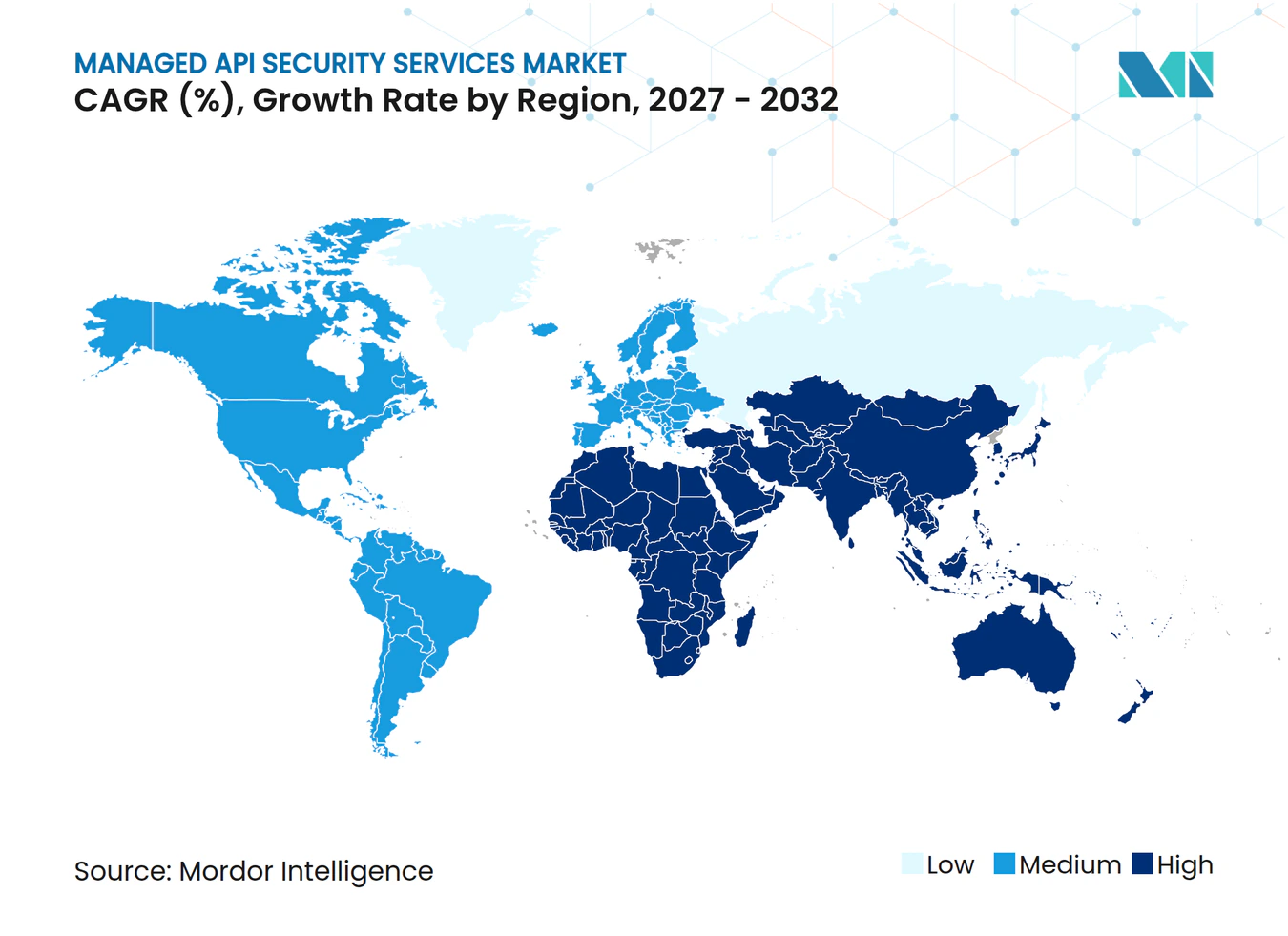
North America held 41.87% of the managed API security services market share in 2026. The region combines regulated financial institutions, technology enterprises, and federal agencies that face overlapping security requirements. The U.S. Securities and Exchange Commission's cybersecurity disclosure rules require registrants to disclose material cybersecurity incidents within 4 business days after determining that an incident is material.[3] This has increased board-level attention to continuous monitoring capabilities. Canada and Mexico add demand shaped by proximity to U.S. compliance standards and shared cloud infrastructure.
Europe is the second-largest region in the managed API security services market. Germany, the United Kingdom, and France lead spending because they have significant financial services activity and digital government programs. Buyers often prioritize auditability and documented operational control alongside detection outcomes. Spain, Italy, and Russia represent secondary growth opportunities in the source material. South America, led by Brazil and Argentina, is adding demand as digital banking and open finance programs increase API exposure.
Asia-Pacific is projected to expand at a 17.19% CAGR from 2027 to 2032. India's Account Aggregator framework, Australia's Consumer Data Right expansion, and the Monetary Authority of Singapore's Technology Risk Management guidelines are driving stronger API security requirements in digital financial systems. Cequence Security announced an NTT DOCOMO deployment in August 2026, showing that managed API security engagements are expanding in Japan. The Middle East and Africa offer longer-term opportunity as government digitization programs expand API use under national cybersecurity frameworks in the managed API security services market.
Competitive Landscape
Market Concentration
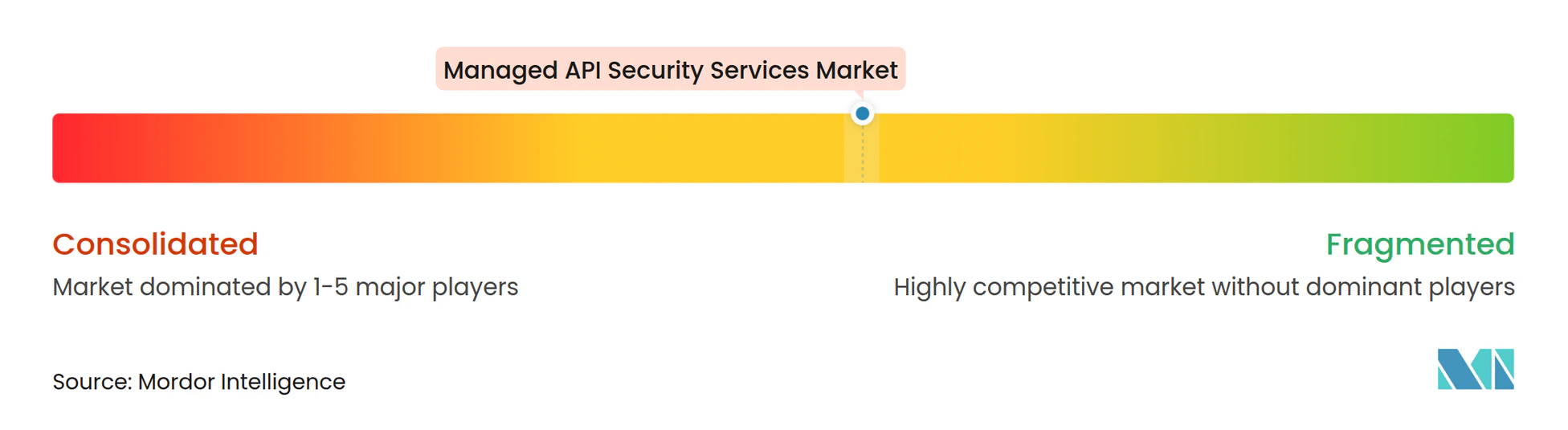
The managed API security services market includes large platform vendors, focused API security providers, and managed security service providers. Akamai Technologies, Cloudflare, Microsoft, and Palo Alto Networks bring broad customer bases, global threat intelligence, and established delivery infrastructure. Salt Security and Cequence Security focus on behavioral API threat detection and agentic AI governance. LevelBlue and IBM add API protection to wider security operations services. This mix creates competition across platform capabilities, specialist analysis, and managed operational support.
The main strategic focus in 2025 and 2026 has been the connection between API security and AI-agent governance. Salt Security launched its Agentic Security Platform in March 2026 for LLMs, MCP servers, and APIs. Cequence launched its AI Gateway in July 2025 to connect AI agents to enterprise applications and APIs via the Model Context Protocol, with real-time policy enforcement. Palo Alto Networks also announced an integration with the Claude Compliance API in May 2026 to support enterprise AI governance. These moves position API controls as an enforcement point for governing what AI agents can access and do in the managed API security services market.
Platform vendors are also extending prevention and scanning capabilities. Cloudflare introduced a Web and API Vulnerability Scanner in March 2026 that performs stateful Broken Object Level Authorization testing within API Shield. Akamai expanded managed API security services in June 2025 with monitoring, expert response, and a compliance dashboard. Opportunities remain in mid-market coverage, sovereign-cloud delivery for the Gulf and South Asia, and specialized services for GraphQL and gRPC environments. The managed API security services industry therefore has room for both broad platforms and specialized providers with differentiated operational capabilities.
Managed API Security Services Industry Leaders
-
Akamai Technologies, Inc.
-
Broadcom Inc.
-
Cequence Security, Inc.
-
Cloudflare, Inc.
-
F5, Inc.
- *Disclaimer: Major Players sorted in no particular order
Recent Industry Developments
- October 2026: Cloudflare launched Application Profiles for its WAF, enabling positive-security enforcement by learning valid request structures across path variables, query parameters, and JSON bodies; Schema Profiles for API Shield customers advance automated runtime API posture management at network edge scale.
- August 2026: Cequence Security announced NTT DOCOMO's deployment of its application and API protection platform, simultaneously launching Cequence AI Gateway in Japan for agentic AI security and deepening its collaboration with ITOCHU Techno-Solutions Corporation for domestic support.
- March 2026: Salt Security launched the Salt Agentic Security Platform, covering LLMs, MCP servers, and APIs through Agentic Security Posture Management and Agentic Detection and Response, with Siemens CISO Shawn Griffin citing improved visibility as Siemens Software scales AI deployment.
- March 2026: Cloudflare launched the open beta of its Web and API Vulnerability Scanner, an active DAST tool integrated within API Shield that performs stateful BOLA scanning by probing endpoints rather than waiting for attack traffic, with plans to expand coverage to the broader OWASP API Top 10.
Global Managed API Security Services Market Report Scope
The managed API security services market encompasses outsourced services that protect application programming interfaces (APIs) against security threats, unauthorized access, data breaches, and other malicious attacks. These services typically include API discovery, authentication and authorization management, threat detection, vulnerability assessment, traffic monitoring, incident response, and compliance support.
The Managed API Security Services Market Report is Segmented by Service Type (Managed API Discovery and Inventory, Managed API Posture and Compliance, Managed Runtime API Protection, Managed API Threat Detection and Response, Managed API Security Testing and Remediation, and Managed API Security Advisory and Implementation), Architecture Type (REST APIs, GraphQL APIs, SOAP and Legacy APIs, gRPC and Event-Driven APIs, and Other Architecture Types), Deployment Model (On-Premises, Cloud-Based, and Hybrid), Organization Size (Small and Medium Enterprises, and Large Enterprises), End-User Industry (Information Technology and Telecommunications, BFSI, Healthcare, Retail and E-Commerce, Manufacturing, Government and Defense, and Other End-User Industries), and Geography (North America, South America, Europe, Asia-Pacific, Middle East, Africa). The Market Forecasts are Provided in Terms of Value (USD).
| Managed API Discovery and Inventory |
| Managed API Posture and Compliance |
| Managed Runtime API Protection |
| Managed API Threat Detection and Response |
| Managed API Security Testing and Remediation |
| Managed API Security Advisory and Implementation |
| REST APIs |
| GraphQL APIs |
| SOAP and Legacy APIs |
| gRPC and Event-Driven APIs |
| Other Architecture Types |
| On-Premises |
| Cloud-Based |
| Hybrid |
| Small and Medium Enterprises |
| Large Enterprises |
| Information Technology and Telecommunications |
| BFSI |
| Healthcare |
| Retail and E-Commerce |
| Manufacturing |
| Government and Defense |
| Other End-User Industries |
| North America | United States |
| Canada | |
| Mexico | |
| South America | Brazil |
| Argentina | |
| Rest of South America | |
| Europe | Germany |
| United Kingdom | |
| France | |
| Italy | |
| Spain | |
| Russia | |
| Rest of Europe | |
| Asia-Pacific | China |
| India | |
| Japan | |
| South Korea | |
| Australia | |
| Rest of Asia-Pacific | |
| Middle East | Saudi Arabia |
| United Arab Emirates | |
| Turkey | |
| Rest of Middle East | |
| Africa | South Africa |
| Egypt | |
| Nigeria | |
| Rest of Africa |
| By Service Type | Managed API Discovery and Inventory | |
| Managed API Posture and Compliance | ||
| Managed Runtime API Protection | ||
| Managed API Threat Detection and Response | ||
| Managed API Security Testing and Remediation | ||
| Managed API Security Advisory and Implementation | ||
| By Architecture Type | REST APIs | |
| GraphQL APIs | ||
| SOAP and Legacy APIs | ||
| gRPC and Event-Driven APIs | ||
| Other Architecture Types | ||
| By Deployment Model | On-Premises | |
| Cloud-Based | ||
| Hybrid | ||
| By Organization Size | Small and Medium Enterprises | |
| Large Enterprises | ||
| By End-User Industry | Information Technology and Telecommunications | |
| BFSI | ||
| Healthcare | ||
| Retail and E-Commerce | ||
| Manufacturing | ||
| Government and Defense | ||
| Other End-User Industries | ||
| By Geography | North America | United States |
| Canada | ||
| Mexico | ||
| South America | Brazil | |
| Argentina | ||
| Rest of South America | ||
| Europe | Germany | |
| United Kingdom | ||
| France | ||
| Italy | ||
| Spain | ||
| Russia | ||
| Rest of Europe | ||
| Asia-Pacific | China | |
| India | ||
| Japan | ||
| South Korea | ||
| Australia | ||
| Rest of Asia-Pacific | ||
| Middle East | Saudi Arabia | |
| United Arab Emirates | ||
| Turkey | ||
| Rest of Middle East | ||
| Africa | South Africa | |
| Egypt | ||
| Nigeria | ||
| Rest of Africa | ||
Key Questions Answered in the Report
What is the managed API security services market size?
The Managed API Security Services Market is projected to expand from USD 2.18 billion in 2026 and USD 2.57 billion in 2027 to USD 5.43 billion by 2032, at a 16.14% CAGR.
What is driving demand for managed API security services?
Growth in cloud-native systems, AI-agent API activity, business-logic abuse, fraud, and compliance requirements is increasing demand for continuous external monitoring and response.
Which service type leads managed API security spending?
Managed Runtime API Protection leads with a 28.43% share in 2026 because enterprises need continuous protection for production API traffic.
Which API architecture is growing fastest?
GraphQL APIs are projected to grow at a 17.34% CAGR through 2032, supported by demand for specialized protection against authorization and query-depth risks.
Which deployment approach is expanding fastest?
Hybrid deployment is projected to grow at a 17.31% CAGR through 2032 as regulated organizations combine local data control with cloud-based threat intelligence.
Which region has the highest growth outlook?
Asia-Pacific is projected to grow at a 17.19% CAGR through 2032, supported by digital financial systems and expanding API security obligations.