
Application Security Posture Management Market Size and Share
Market Overview
| Study Period | 2020 - 2031 |
|---|---|
| Market Size (2026) | USD 2.55 Billion |
| Market Size (2031) | USD 6.5 Billion |
| Growth Rate (2026 - 2031) | 20.55 % |
| Fastest Growing Market | Asia-Pacific |
| Largest Market | North America |
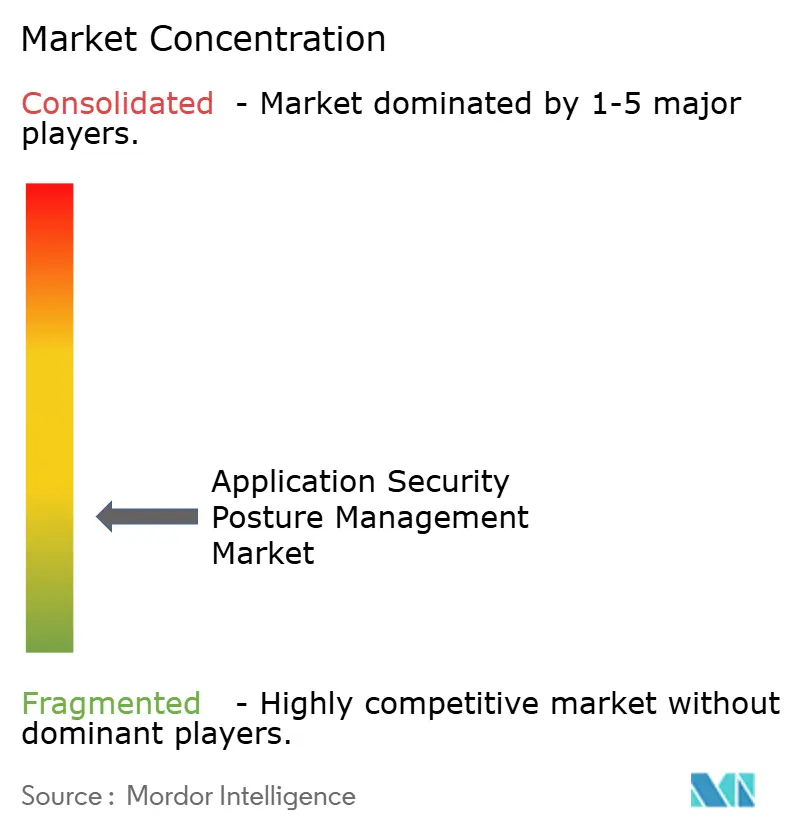
| Market Concentration | Low |
Major Players *Disclaimer: Major Players sorted in no particular order Image © Mordor Intelligence. Reuse requires attribution under CC BY 4.0. | |
Application Security Posture Management Market Analysis by Mordor Intelligence
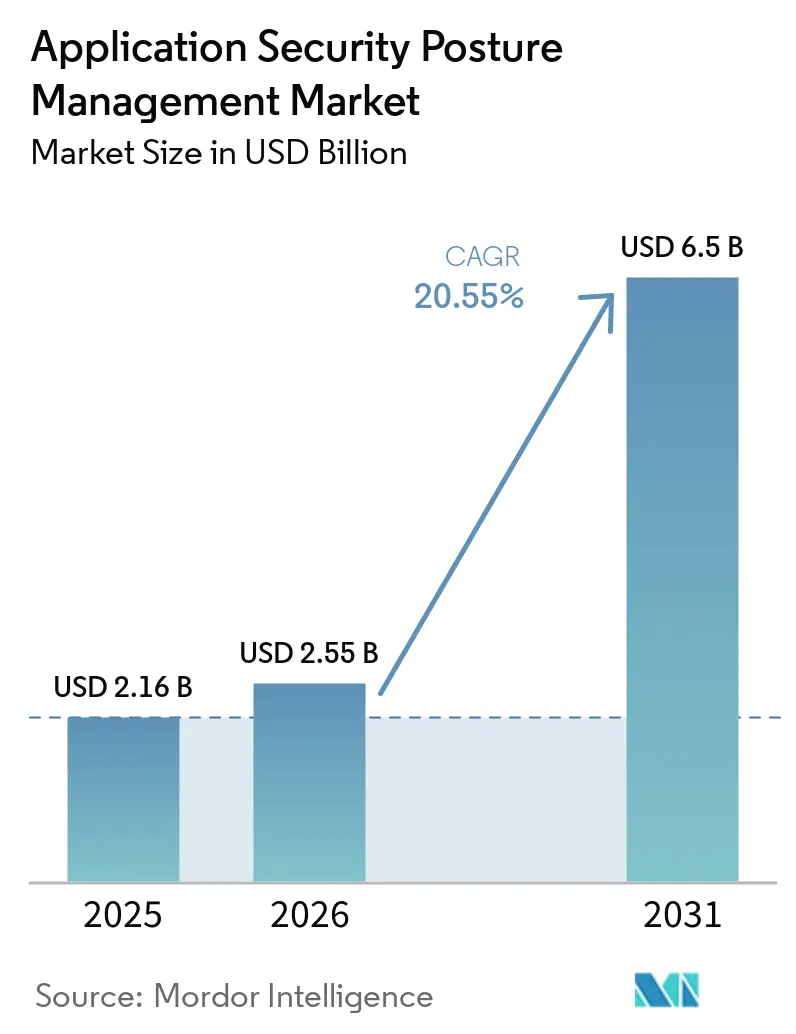
The application security posture management market size was valued at USD 2.16 billion in 2025 and estimated to grow from USD 2.55 billion in 2026 to reach USD 6.50 billion by 2031, at a CAGR of 20.55% during the forecast period (2026-2031). Growth is tied to the need for a continuous view of application risks across development, deployment, and runtime environments. Organizations are moving away from isolated testing tools when security teams must reconcile duplicate findings and prove that material risks are being addressed. Regulatory reporting and software security obligations are also making manual evidence collection harder to sustain. Cloud-native applications, AI-assisted coding, and software supply chains add dependencies that security teams need to monitor together. These conditions favor platforms that connect developer workflows, security controls, and remediation decisions.
Key Report Takeaways
- By component, software and platforms held 70.16% of the application security posture management market share in 2025, while services are projected to expand at a 22.72% CAGR through 2031.
- By deployment model, cloud held 65.11% of the application security posture management market share in 2025, while hybrid is projected to expand at a 22.04% CAGR through 2031.
- By organization size, large enterprises held 72.41% of the application security posture management market share in 2025, while SMEs are projected to expand at a 23.02% CAGR through 2031.
- By application environment, web applications held 61.12% of the application security posture management market share in 2025, while mobile applications are projected to expand at a 22.31% CAGR through 2031.
- By industry vertical, BFSI accounted for 24.13% of the application security posture management market share in 2025 and is projected to grow at a 21.45% CAGR through 2031.
- By geography, North America held 35.66% of the application security posture management market share in 2025, while Asia-Pacific is projected to expand at a 21.77% CAGR through 2031.
Note: Market size and forecast figures in this report are generated using Mordor Intelligence’s proprietary estimation framework, updated with the latest available data and insights as of January 2026.
Global Application Security Posture Management Market Trends and Insights
Drivers Impact Analysis*
| Driver | (~) % Impact on CAGR Forecast | Geographic Relevance | Impact Timeline |
|---|---|---|---|
| Regulatory and Governance Pressure | +5.2% | Global, with peak intensity in North America and Europe | Short term (≤ 2 years) |
| Cloud-Native and AI-Assisted Development | +4.5% | Global, accelerating in Asia-Pacific | Medium term (2-4 years) |
| Tool-Sprawl Reduction and Risk Consolidation | +3.5% | North America and Europe, with spillover to Asia-Pacific | Medium term (2-4 years) |
| DevSecOps Workflow Integration | +2.8% | Global, led by North America | Medium term (2-4 years) |
| Code-to-Runtime Contextual Prioritization | +2.4% | North America and core Asia-Pacific markets | Long term (≥ 4 years) |
| Software Supply Chain Visibility Requirements | +1.5% | Global, with high urgency in Europe and North America | Short term (≤ 2 years) |
| Source: Mordor Intelligence | |||
Regulatory and Governance Pressure
Several overlapping cybersecurity requirements are shifting application security from a periodic review activity to a continuous operational responsibility. The EU Cyber Resilience Act introduced reporting obligations for actively exploited vulnerabilities and severe incidents in September 2026. DORA, NIS2, PCI DSS 4.0.1, and the NIST Secure Software Development Framework add related demands for documented security practices and incident readiness. The application security posture management market benefits because security teams need current vulnerability inventories and evidence that can be retrieved quickly. Manual processes do not produce this evidence consistently across large software estates. Software bill-of-materials programs also need to be established before product obligations apply, which brings platform evaluations forward in many procurement cycles.
Cloud-Native and AI-Assisted Development
AI-assisted code generation can introduce unfamiliar dependencies, incorrect package references, and security findings that conventional testing rules do not always prioritize well. Microservices, containers, Kubernetes clusters, serverless functions, and third-party packages introduce additional control points within a single application estate. The application security posture management market is therefore supported by demand for a shared view across source code, CI/CD pipelines, registries, and runtime environments. Platforms that connect these sources can distinguish an exploitable path from a theoretical alert. Palo Alto Networks introduced Cortex Cloud ASPM in August 2025 to correlate native and third-party scanner data into a unified risk graph before production.[1]Palo Alto Networks, “Palo Alto Networks Introduces Cortex Cloud Application Security Posture Management,” Palo Alto Networks, paloaltonetworks.com This approach becomes more relevant as software teams release AI-supported code at a higher volume.
Tool-Sprawl Reduction and Risk Consolidation
Many security teams use separate tools for static testing, dynamic testing, software composition analysis, secret detection, and infrastructure-as-code scanning. Those tools can produce repeated alerts, inconsistent severity ratings, and limited context about whether a vulnerability can be exploited. A unified platform can reduce the effort required to compare outputs and assign remediation work to the correct development team. The application security posture management market is gaining from this operational need, rather than from a simple preference for fewer suppliers. Palo Alto Networks positioned its application security capabilities around integrating code, cloud, and runtime context. Consolidation still depends on the quality of the underlying scanners because a platform cannot correct incomplete or inaccurate source data.
DevSecOps Workflow Integration
Security controls are more likely to influence remediation when findings appear in the tools developers already use. Policy-as-code checks, pull-request annotations, and CI/CD gates can prevent new critical issues from reaching production. This approach can also create a clearer audit trail than periodic exports and manual ticket reviews. The application security posture management market is supported when developers, application owners, and security teams can work from the same prioritized queue. HENNGE adopted IssueHunt’s Baseline tool in April 2025 to consolidate vulnerability information across source code, cloud environments, containers, and open-source libraries. The deployment shows that the demand for integrated workflows extends beyond large U.S. security platforms.
Restraints Impact Analysis*
| Restraint | (~) % Impact on CAGR Forecast | Geographic Relevance | Impact Timeline |
|---|---|---|---|
| AppSec Maturity and Change-Management Gaps | -4.2% | Global, most acute in Asia-Pacific and South America | Medium term (2-4 years) |
| Budget and ROI Scrutiny | -3.1% | North America and Europe mid-market, and Asia-Pacific SMEs | Short term (≤ 2 years) |
| Scarcity of AppSec and DevSecOps Talent | -2.4% | Global, particularly Asia-Pacific and South America | Long term (≥ 4 years) |
| Data Residency and Integration Complexity | -1.5% | Europe and national Asia-Pacific markets | Medium term (2-4 years) |
| Source: Mordor Intelligence | |||
AppSec Maturity and Change-Management Gaps
Many organizations are introducing posture management before basic application security practices are consistently in place. Incomplete static testing coverage, undocumented dependencies, and irregular build processes limit the usefulness of a consolidated platform. The application security posture management market can face slower adoption when teams cannot maintain reliable asset and pipeline records. Development groups must also move from post-release security reviews to shared, continuous ownership of findings. That shift can be difficult when engineering teams are measured mainly on release speed. Organizations may purchase a platform but delay full deployment, which weakens realized value and complicates later renewal decisions.
Budget and ROI Scrutiny
Platform-level pricing is often compared with the cost of retaining narrower testing tools. Mid-market buyers must demonstrate value through shorter remediation times, less manual work, and lower audit preparation effort. The application security posture management market faces a constraint when buyers lack baseline data for those comparisons. Continuous validation requirements can make the business case more tangible by enabling teams to compare manual assessment processes with automated evidence collection. However, early-stage programs may not have dependable records of developer time or remediation costs. This is particularly relevant for organizations with meaningful cybersecurity budgets but limited capacity for a large consolidation project.
*Our forecasts treat driver/restraint impacts as directional, not additive. The impact forecasts reflect baseline growth, mix effects, and variable interactions.
Segment Analysis
By Component: Platforms Lead While Services Expand Delivery Capacity
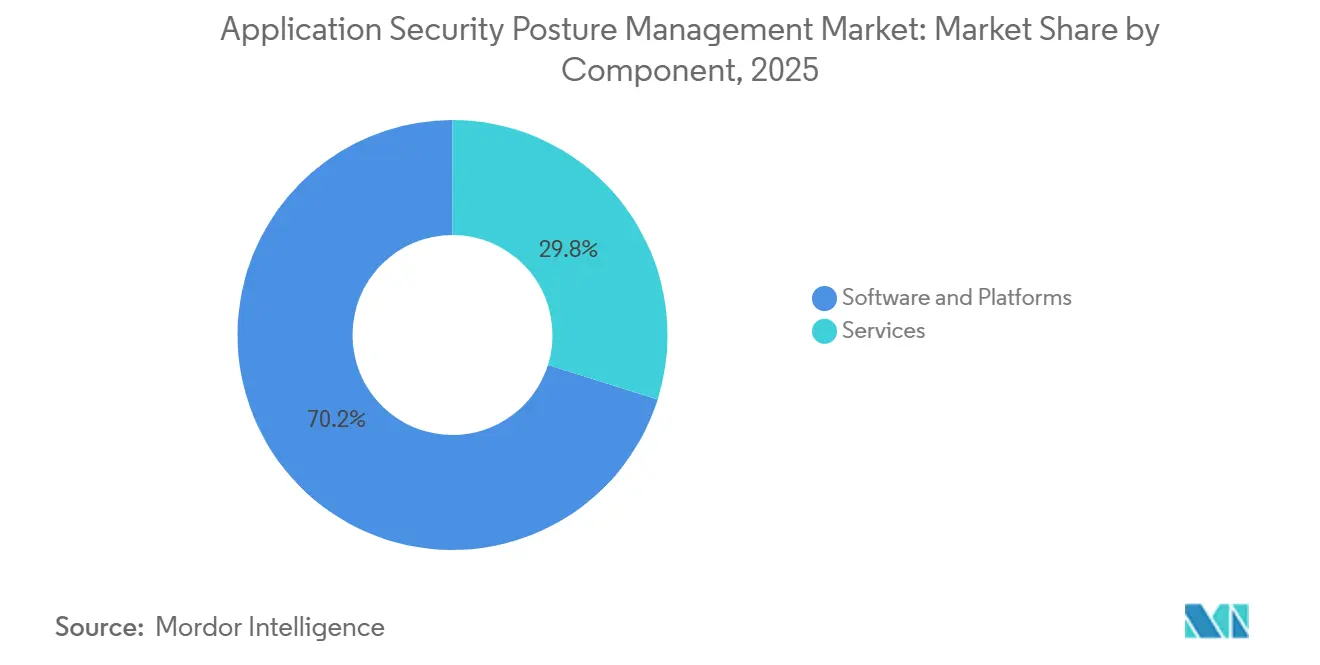
Software and platforms accounted for 70.16% of the application security posture management market size in the component segment in 2025. Enterprises favor platform coverage when they need one environment for risk prioritization, policy enforcement, and compliance evidence. A common platform can connect findings that would otherwise remain separated across testing tools. It also gives security teams a clearer way to assign ownership across repositories and development groups. These benefits explain why software licenses remain the main commercial foundation of the application security posture management industry.
Services are projected to grow at a 22.72% CAGR through 2031, the fastest rate among components. Organizations use managed support when internal teams lack the time or expertise to tune tools, investigate alerts, and redesign workflows. Managed delivery can combine a platform license with ongoing triage and implementation support. This model expands access for regulated organizations that need continuous evidence across many pipelines. It can also help teams translate security findings into work that developers can complete. Services growth, therefore, complements platform adoption rather than replacing it.


By Deployment Model: Cloud Leads While Hybrid Supports Data Control
Cloud held 65.11% of the application security posture management market share in the deployment segment in 2025. Cloud delivery is well-suited to applications that already use hosted CI/CD platforms, container registries, and multi-cloud runtime environments. It can reduce the effort required to maintain local infrastructure and keep integrations up to date. Security teams can add new repositories and environments without waiting for an on-premises deployment cycle. This model is especially relevant for organizations that release software frequently.
Hybrid deployment is projected to grow at a 22.04% CAGR through 2031. It addresses organizations that want cloud-based coordination while keeping sensitive vulnerability telemetry in a specified location. Financial institutions, public-sector agencies, defense contractors, and critical infrastructure operators may impose stricter rules on connectivity and data residency. Hybrid architectures allow these organizations to preserve local control over selected information. They also retain access to centrally managed orchestration and reporting capabilities. The application security posture management market can benefit from this design, as it broadens adoption beyond fully cloud-based environments.
By Organization Size: Large Enterprises Anchor Demand While SMEs Gain Access
Large enterprises held 72.41% of the application security posture management market share in the organization-size segment in 2025. Large development organizations can operate multiple product teams, repositories, cloud accounts, and CI/CD pipelines simultaneously. Their scale creates a large number of alerts that cannot be assessed through a manually coordinated security program. A shared risk model helps teams identify issues that need immediate remediation. Centralized governance also supports communication between security leaders and individual product teams.
SMEs are projected to grow at a 23.02% CAGR through 2031. Smaller suppliers increasingly face security expectations from enterprise customers and public procurement bodies. Certification programs that include cloud and AI security can introduce more formal application security requirements. SaaS delivery and usage-based pricing can lower the barrier to entry for smaller security teams. Managed services can further reduce the need to hire specialized staff before deployment. These factors make SMEs an important avenue for expansion in the application security posture management market.
By Application Environment: Web Applications Lead While Mobile Adoption Rises
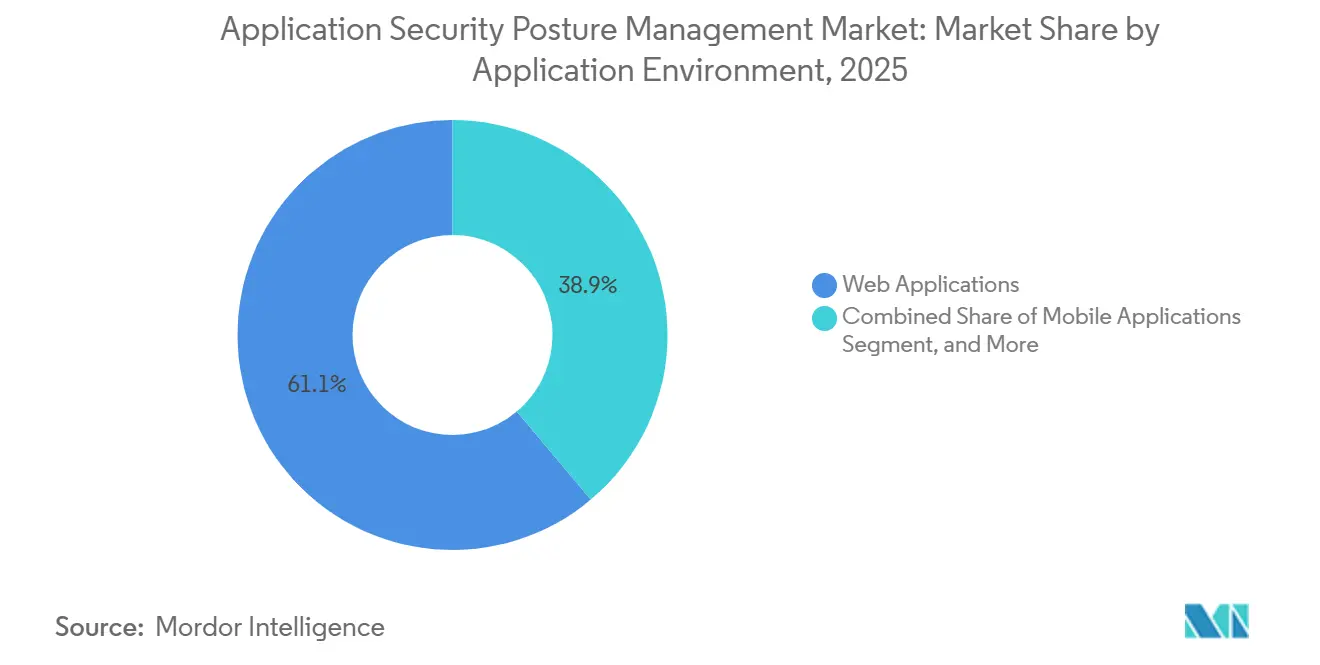
Web applications accounted for 61.12% of the application security posture management market size within the application environment segment in 2025. Web estates include APIs, authentication layers, server-side components, scripts, and external dependencies. This breadth creates a large attack surface and makes ownership difficult to track across development and operations teams. Continuous monitoring of dependencies is important because risks can emerge after a site has been deployed. Web application coverage remains the starting point for many posture management implementations.
Mobile applications are projected to grow at a 22.31% CAGR through 2031. Organizations are extending security controls as mobile-first services become more central to customer and employee activity. Updated mobile verification practices give teams clearer control over families and testing guidance for mobile development. Integration remains less mature than in web and backend environments because mobile testing can require device, operating system, and release channel context. Vendors that connect dynamic analysis with developer workflows can address this gap. The application security posture management market has room to develop stronger mobile capabilities while retaining its broader code-to-runtime scope.

By Industry Vertical: BFSI Holds a Leading Position in Size and Growth
BFSI held 24.13% market share in the application security posture management market in 2025, the highest among industry verticals. Financial institutions manage extensive customer data, payment processes, mobile services, and digital partner connections. They also operate under multiple reporting, resilience, and security obligations. A unified application risk record can reduce the burden of collecting evidence from separate systems. The application security posture management industry is, therefore, closely aligned with the sector’s need for continuous oversight.
BFSI is projected to grow at a 21.45% CAGR through 2031. Requirements related to operational resilience, payment security, and cybersecurity disclosure create distinct evidence needs that can be addressed through a common application security process. The Cyber Risk Institute Profile provides a shared framework that maps financial-sector controls to several relevant standards.[2]MITRE Center for Threat-Informed Defense, “Threat-Informed Defense for the Financial Sector,” MITRE, ctid.mitre.org This alignment can help institutions reduce duplication across governance processes. Healthcare and life sciences, government and public administration, and IT and telecommunication remain important secondary users because they also manage regulated data and essential digital services. Energy, utilities, oil and gas, and other critical infrastructure operators add future demand as operational technology and IT systems become more connected.
Geography Analysis
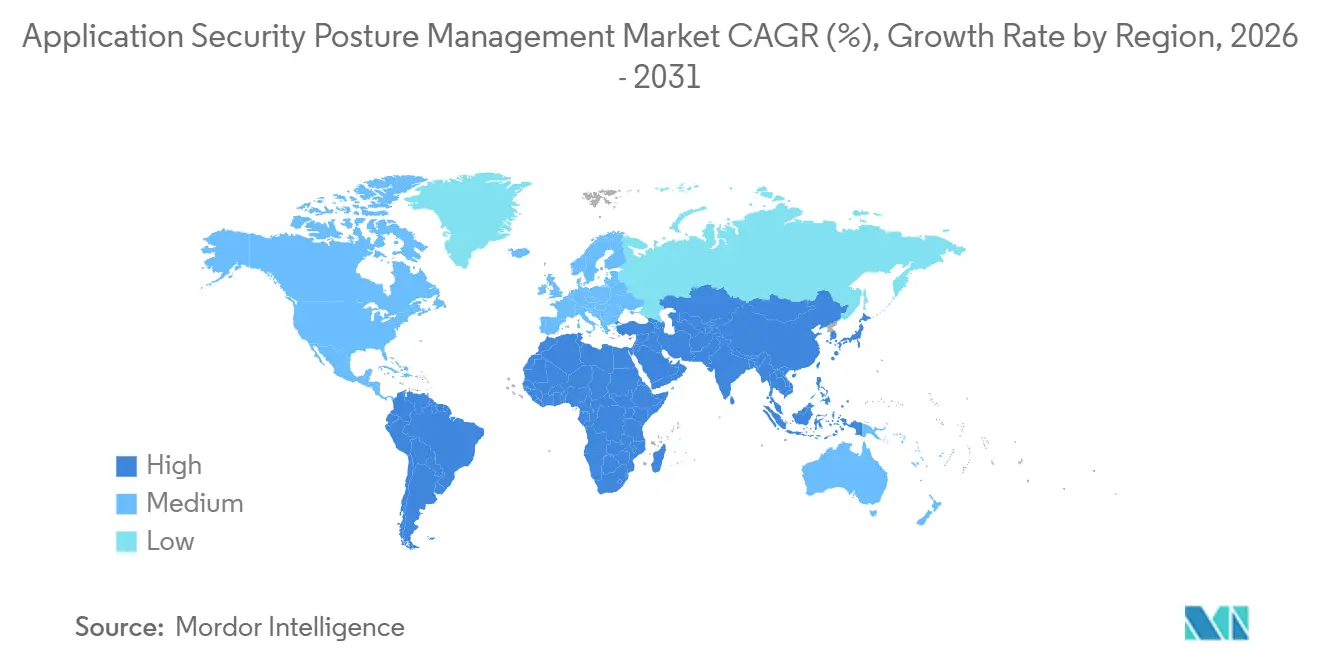
North America held 35.66% of the application security posture management market share in 2025. The region has a high concentration of enterprise cybersecurity budgets and a mature cloud and DevSecOps ecosystem. Public companies and financial organizations need reliable records for cybersecurity governance and material incident disclosure. Canada’s public-sector cloud adoption and provincial privacy requirements add demand in regulated applications. Mexico’s digital economy and software services activity support demand among firms that serve cross-border customers. These factors give the region a durable advantage in vendor presence, developer security talent, and funding for platform-level security programs.
Europe was the second-largest regional contributor to the application security posture management market. DORA, NIS2, and Cyber Resilience Act obligations create a demanding environment for software producers and operators. Germany’s implementation of NIS2 created an early national wave of compliance planning, while Italy’s timetable added another demand cycle. Financial services and insurance organizations have a particular need to document resilient application processes. Data residency also supports interest in hybrid delivery designs. The region’s service demand can be stronger than in North America when organizations need help adapting global platforms to national obligations.
Asia-Pacific is projected to expand at a 21.77% CAGR through 2031, the fastest regional rate in the application security posture management market. Cloud-first transformation across China, India, Japan, South Korea, and Southeast Asia is increasing the number of modern software environments that require coordinated security controls. Japan’s Active Cyber Defense Act and Singapore’s updated Cyber Essentials Mark framework support more formal security activity among enterprises and suppliers. HENNGE’s 2025 adoption of an ASPM tool illustrates local demand for consolidated visibility across cloud and software assets.[3]HENNGE K.K., “HENNGE Introduces Application Security Posture Management Baseline,” HENNGE, hennge.com The Middle East and Africa remain smaller contributors, but digital government programs in the UAE and Saudi Arabia are raising expectations for public-sector software suppliers.

Competitive Landscape
The application security posture management market is fragmented, with pure-play specialists, broader cloud security providers, and established testing vendors serving different buyer needs. Apiiro, ArmorCode, Cycode, Legit Security, Nucleus Security, and OX Security focus on code-to-cloud risk graphs and prioritization. Palo Alto Networks and CrowdStrike can package related capabilities within larger security operations portfolios. Checkmarx, Snyk, Black Duck, Veracode, and Invicti Security bring established testing relationships and scanner data into posture management offerings. Competition centers on integration quality, runtime context, developer workflow fit, and the ability to prioritize risks that have a credible path to exploitation.
Platform vendors can benefit when enterprises prefer to simplify procurement and connect application security with cloud and exposure management. Google completed its USD 32 billion acquisition of Wiz in March 2026, adding a multi-cloud security platform to Google Cloud while retaining support across major cloud environments.[4]Google LLC, “Google Completes Acquisition of Wiz,” Google, blog.google CrowdStrike agreed in July 2026 to acquire XM Cyber technology, source code, and a portfolio of more than 45 patents for attack-path simulation and exploitability modeling. Palo Alto Networks acquired Console in September 2026 to add AI-native capabilities for alert investigation, work prioritization, and remediation. These moves increase the pressure on specialists to demonstrate deeper integration or specific value in compliance.
A persistent opportunity remains in linking API behavior to code ownership and exploitability. Many products bring together static testing, dynamic testing, and software composition analysis, but continuous runtime API monitoring is less consistently integrated. This matters in open banking, embedded finance, and microservices environments where APIs expand quickly. Specialist vendors can differentiate through stronger API context, validated runtime signals, and vertical-specific evidence workflows. Larger vendors may have a distribution advantage, while smaller providers can move faster in narrower technical areas. The application security posture management market, therefore, remains competitive without being dominated by a small group of suppliers.
Application Security Posture Management Industry Leaders
Palo Alto Networks, Inc.
IBM Corporation
Oracle Corporation
Fortinet, Inc.
Trend Micro Incorporated
- *Disclaimer: Major Players sorted in no particular order

Recent Industry Developments
- September 2026: Palo Alto Networks acquired Console, an AI-native agentic security platform, to deepen its Cortex platform with autonomous alert investigation, work prioritization, and cross-environment remediation capabilities. The acquisition extends the ASPM vision from posture visibility to machine-speed response, positioning Cortex Cloud as a self-directing security operations layer.
- July 2026: CrowdStrike signed an agreement to acquire XM Cyber’s technology, source code, and portfolio of more than 45 patents to strengthen its Falcon Exposure Management business with attack-path simulation and risk-prioritization capabilities. CrowdStrike concurrently announced plans to deploy Falcon on STACKIT, Schwarz Digits’ sovereign cloud platform, responding to NIS2 and CRA compliance requirements for European enterprises that require EU-hosted security services.
- March 2026: Google completed its USD 32 billion acquisition of Wiz, integrating the cloud and AI security platform into Google Cloud while maintaining multi-cloud availability across AWS, Azure, and Oracle Cloud. Wiz had surpassed USD 1 billion in annual recurring revenue in 2025, before the deal closed.
- August 2025: Palo Alto Networks launched Cortex Cloud Application Security Posture Management at Black Hat USA, offering early access with an open partner ecosystem that included Black Duck, Checkmarx, GitLab, HashiCorp, Semgrep, Snyk, and Veracode. The module enabled security teams to consolidate scanner data without requiring developer tool migration.


Global Application Security Posture Management Market Report Scope
The Application Security Posture Management (ASPM) Market comprises software platforms, solutions, and associated services that provide centralized visibility, assessment, prioritization, monitoring, and management of application security risks across the software development lifecycle and production environments. ASPM solutions aggregate security findings from application security testing tools, code repositories, cloud environments, runtime environments, and vulnerability management systems to establish a unified application security posture. The market includes platforms that continuously identify, correlate, contextualize, prioritize, and remediate security exposures affecting web applications, mobile applications, APIs, cloud-native applications, and software services. ASPM solutions enable organizations to improve application risk visibility, streamline developer remediation workflows, reduce vulnerability backlogs, strengthen compliance, and enhance application security governance through centralized security posture management.
The Application Security Posture Management Market Report is Segmented by Component (Software and Platforms, and Services), Deployment Model (Cloud, On-Premises, and Hybrid), Organization Size (Large Enterprises, and Small and Medium-Sized Enterprises), Application Environment (Web Applications, Mobile Applications, and Other Application Environments), Industry Vertical (Government and Public Administration, Industrial Manufacturing, Retail and E-Commerce, Transportation and Logistics, Energy and Utilities, Oil and Gas, IT and Telecommunication, Media and Entertainment, Education and Research Institutions, Healthcare and Life Sciences, Banking, Financial Services, and Insurance [BFSI], and Other Industry Verticals), and Geography (North America, South America, Europe, Asia-Pacific, and Middle East and Africa). The Market Forecasts are Provided in Terms of Value (USD).
| Software and Platforms |
| Services |
| Cloud |
| On-Premises |
| Hybrid |
| Large Enterprises |
| Small and Medium-Sized Enterprises |
| Web Applications |
| Mobile Applications |
| Other Application Environments |
| Government and Public Administration |
| Industrial Manufacturing |
| Retail and E-Commerce |
| Transportation and Logistics |
| Energy and Utilities |
| Oil and Gas |
| IT and Telecommunication |
| Media and Entertainment |
| Education and Research Institutions |
| Healthcare and Life Sciences |
| Banking, Financial Services, and Insurance (BFSI) |
| Other Industry Verticals |
| North America | United States | |
| Canada | ||
| Mexico | ||
| South America | Brazil | |
| Argentina | ||
| Rest of South America | ||
| Europe | Germany | |
| United Kingdom | ||
| France | ||
| Italy | ||
| BENELUX | ||
| Rest of Europe | ||
| Asia-Pacific | China | |
| Japan | ||
| India | ||
| South Korea | ||
| Australia | ||
| Rest of Asia-Pacific | ||
| Middle East and Africa | Middle East | United Arab Emirates |
| Saudi Arabia | ||
| Rest of Middle East | ||
| Africa | South Africa | |
| Nigeria | ||
| Egypt | ||
| Rest of Africa | ||
| By Component | Software and Platforms | ||
| Services | |||
| By Deployment Model | Cloud | ||
| On-Premises | |||
| Hybrid | |||
| By Organization Size | Large Enterprises | ||
| Small and Medium-Sized Enterprises | |||
| By Application Environment | Web Applications | ||
| Mobile Applications | |||
| Other Application Environments | |||
| By Industry Vertical | Government and Public Administration | ||
| Industrial Manufacturing | |||
| Retail and E-Commerce | |||
| Transportation and Logistics | |||
| Energy and Utilities | |||
| Oil and Gas | |||
| IT and Telecommunication | |||
| Media and Entertainment | |||
| Education and Research Institutions | |||
| Healthcare and Life Sciences | |||
| Banking, Financial Services, and Insurance (BFSI) | |||
| Other Industry Verticals | |||
| By Geography | North America | United States | |
| Canada | |||
| Mexico | |||
| South America | Brazil | ||
| Argentina | |||
| Rest of South America | |||
| Europe | Germany | ||
| United Kingdom | |||
| France | |||
| Italy | |||
| BENELUX | |||
| Rest of Europe | |||
| Asia-Pacific | China | ||
| Japan | |||
| India | |||
| South Korea | |||
| Australia | |||
| Rest of Asia-Pacific | |||
| Middle East and Africa | Middle East | United Arab Emirates | |
| Saudi Arabia | |||
| Rest of Middle East | |||
| Africa | South Africa | ||
| Nigeria | |||
| Egypt | |||
| Rest of Africa | |||


Key Questions Answered in the Report
What is the application security posture management market size?
The application security posture management market size is estimated at USD 2.55 billion in 2026 and is forecast to reach USD 6.50 billion by 2031, at a 20.55% CAGR.
What is driving adoption of application security posture management platforms?
Organizations need continuous visibility across code, CI/CD pipelines, cloud environments, dependencies, and runtime systems. Regulatory reporting and software security obligations also increase demand.
Which component leads application security posture management adoption?
Software and platforms led the component segment with a 70.16% share in 2025. Services is the fastest-growing component, with a projected 22.72% CAGR through 2031.
Why are large enterprises major users of ASPM solutions?
Large enterprises held 72.41% of the organization-size segment in 2025 because they manage many teams, repositories, applications, and security findings.
Which region is growing fastest for application security posture management?
Asia-Pacific is projected to expand at a 21.77% CAGR through 2031, supported by cloud transformation and evolving cybersecurity requirements.
How do ASPM platforms support DevSecOps teams?
They connect security findings to developer workflows, enable policy checks in CI/CD processes, and help teams prioritize vulnerabilities with stronger code-to-runtime context.
Page last updated on:





