
Application Security Testing Orchestration Market Size and Share
Market Overview
| Study Period | 2020 - 2031 |
|---|---|
| Market Size (2026) | USD 1.05 Billion |
| Market Size (2031) | USD 2.97 Billion |
| Growth Rate (2026 - 2031) | 23.12 % |
| Fastest Growing Market | Asia-Pacific |
| Largest Market | North America |
| Market Concentration | Medium |
Major Players *Disclaimer: Major Players sorted in no particular order Image © Mordor Intelligence. Reuse requires attribution under CC BY 4.0. | |
Application Security Testing Orchestration Market Analysis by Mordor Intelligence
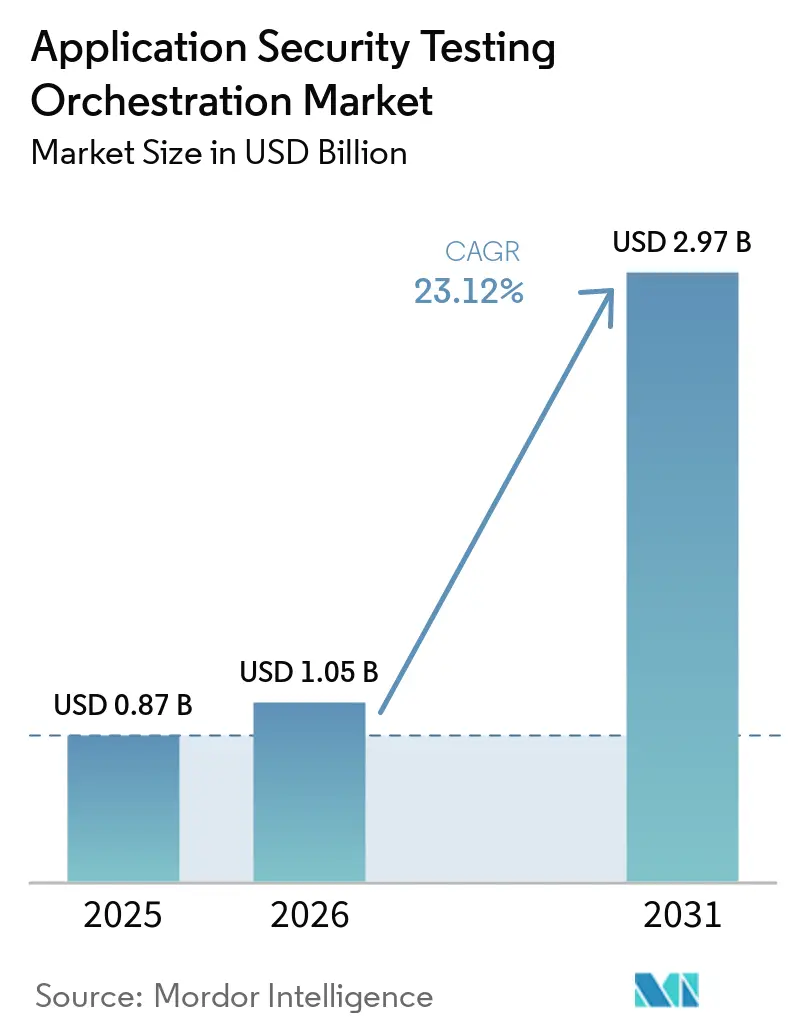
The application security testing orchestration market size was valued at USD 0.87 billion in 2025 and estimated to grow from USD 1.05 billion in 2026 to reach USD 2.97 billion by 2031, at a CAGR of 23.12% during the forecast period (2026-2031). Growth reflects higher attack activity against web applications and APIs, wider use of DevSecOps, and faster software releases supported by generative AI tools. Organizations increasingly need one workflow to coordinate testing results, remove duplicates, and direct urgent issues to the right teams. This need is changing vendor competition, because integration quality and remediation support now matter alongside the breadth of testing engines. The application security testing orchestration market also has scope to expand where buyers need managed deployment and compliance reporting rather than another standalone scanner. Demand will depend on whether vendors can reduce alert noise and make security checks workable inside ordinary development practices.
Key Report Takeaways
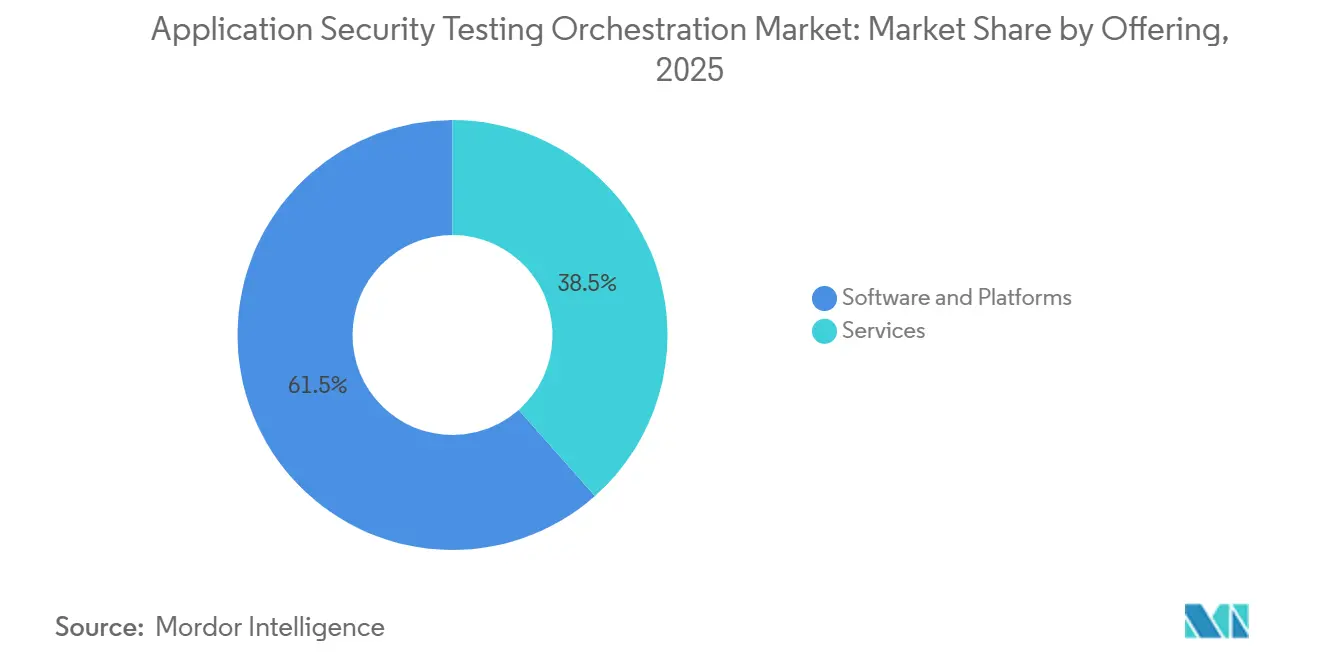
- By offering, software and platforms held 61.53% of revenue in the application security testing orchestration market in 2025, while services are projected to expand at a 26.43% CAGR through 2031.
- By orchestration capability, tool integration and test pipeline management was the largest revenue sub-segment in 2025, while risk-based test prioritization is projected to expand at a 27.21% CAGR through 2031.
- By deployment mode, cloud held 64.78% of revenue in the application security testing orchestration market in 2025 and is projected to expand at a 26.29% CAGR through 2031.
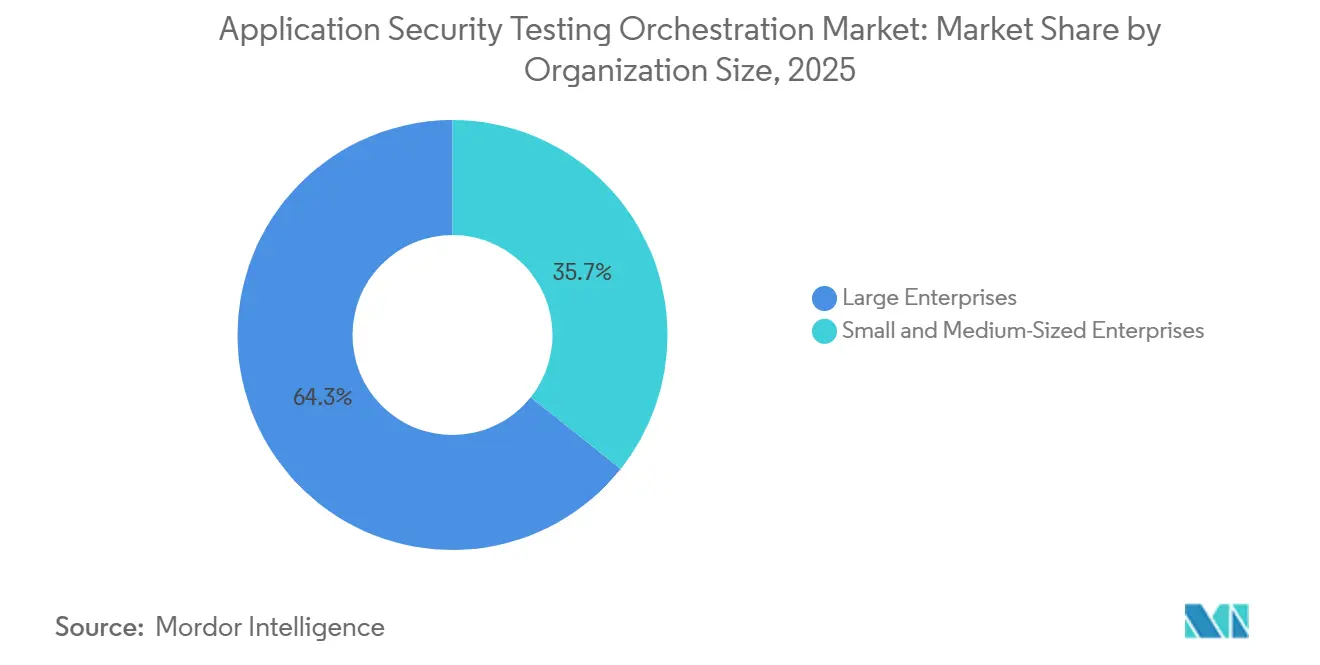
- By organization size, large enterprises held 64.29% of revenue in 2025, while SMEs are projected to expand at a 27.11% CAGR through 2031.
- By industry vertical, BFSI held 26.41% of revenue in the application security testing orchestration market in 2025, while healthcare and life sciences are projected to expand at a 26.23% CAGR through 2031.
- By geography, North America held 41.29% of global revenue in 2025, while Asia-Pacific is projected to expand at a 24.79% CAGR through 2031 in the application security testing orchestration market.
Note: Market size and forecast figures in this report are generated using Mordor Intelligence’s proprietary estimation framework, updated with the latest available data and insights as of January 2026.
Global Application Security Testing Orchestration Market Trends and Insights
Drivers Impact Analysis*
| DRIVER | (~) % IMPACT ON CAGR FORECAST | GEOGRAPHIC RELEVANCE | IMPACT TIMELINE |
|---|---|---|---|
| Rising Application-Layer Attack Volume | +5.5% | Global, North America accounted for 80% of blocked web and API transactions in Q1 2026 | Short term (≤ 2 years) |
| DevSecOps and Shift-Left Adoption | +4.8% | Global, with North America and Europe leading maturity | Medium term (2-4 years) |
| API-First and Cloud-Native Application Growth | +4.2% | Global, with Asia-Pacific central and spillover to the Middle East and Africa | Medium term (2-4 years) |
| Regulatory and Secure-by-Design Requirements | +3.5% | North America and Europe, with compliance effects extending to Asia-Pacific and the Middle East and Africa | Long term (≥ 4 years) |
| AI-Generated Code Security Requirements | +3.0% | Global, with early adoption in North America and Europe | Short term (≤ 2 years) |
| Software Supply-Chain and SBOM Governance | +2.5% | North America and Europe, with effects in regulated Asia-Pacific sectors | Medium term (2-4 years) |
| Source: Mordor Intelligence | |||
Rising Application-Layer Attack Volume
Application-layer attacks are creating a continuing need for security orchestration. Radware reported that exploitation of vulnerabilities accounted for nearly 62% of blocked web application and API attempts in Q1 2026. SQL injection attempts remained at 50-60 million per month, while cloud services blocked more than 6 billion exploitation attempts in March 2026.[1]Radware, “2026 Q1 Network and Application Attack Trends,” Radware, radware.com Verizon reported that software vulnerabilities became the leading entry point for breaches at 31% in 2026, ahead of stolen credentials. Automated attack tools can scale campaigns more quickly than teams can manually review findings. The application security testing orchestration market benefits when SAST, DAST, IAST, and SCA results are consolidated into a single prioritized remediation queue. Continuous testing can shorten the time between a vulnerability entering code and a team responding to it.
DevSecOps and Shift-Left Adoption
DevSecOps adoption is increasing demand for tools that connect source control, build systems, and developer environments. Black Duck expanded Polaris integrations across GitHub, GitLab, Azure DevOps, and Bitbucket in February 2026, providing unified SAST, SCA, and DAST coverage.[2]Black Duck, “Black Duck Expands Polaris Integrations to Deliver Frictionless DevSecOps at Enterprise Scale,” Black Duck News, blackduck.com This shows why vendors increasingly compete on integration breadth as well as test-engine functionality. GitLab found that DevSecOps professionals lost 7 hours each week to fragmented tools in 2025. The same survey found that the average enterprise managed close to 50 security tools. Unfiltered scanner output can create shift-left fatigue when developers learn to work around blocking quality checks. The application security testing orchestration market favors platforms that validate exploitability before findings enter sprint queues.
API-First and Cloud-Native Application Growth
Microservices, containers, and event-driven APIs are extending the testing scope beyond monolithic release processes. APIs can introduce stateful interactions, authentication flows, and business-logic weaknesses that SAST does not consistently identify. This requires DAST and API-focused tools to work with common policies, finding deduplication, and remediation routing. Singapore's Synapxe operates a Healthcare Integrated Pipeline that handles more than 16,000 software updates each year through a unified DevSecOps workflow with embedded security scanning. The Reserve Bank of India requires vulnerability assessments every 6 months for critical banking systems and VAPT before new services are deployed. These requirements make automated and auditable testing relevant throughout the application delivery lifecycle. Infrastructure-as-code scanning can also identify API topology and configuration risks before deployment, which extends the value of application security testing orchestration market platforms.
AI-Generated Code Security Requirements
Generative AI coding tools are accelerating development while introducing security risks that reviewers may not detect quickly. Veracode found that 44% of AI code-generation tasks introduced a risky vulnerability in 2026. The tested models had an average security pass rate of 56%, including 15% for cross-site scripting and 12% for log injection. In organizations using these tools, AI wrote close to half of the committed code. Testing programs that focus only on human-authored code, therefore, cover only part of the active risk surface. The application security testing orchestration market is supported by policies that require SAST for AI-assisted commits and SCA for AI-recommended dependencies. These policies can make AI-aware controls a normal part of enterprise governance instead of an optional setting.
Restraints Impact Analysis*
| RESTRAINT | (~) % IMPACT ON CAGR FORECAST | GEOGRAPHIC RELEVANCE | IMPACT TIMELINE |
|---|---|---|---|
| High Total Cost of Ownership and Integration Complexity | -3.5% | Global, most acute in SME-intensive Asia-Pacific and South American markets | Medium term (2-4 years) |
| Application-Security Talent Shortage | -2.5% | Global, most severe in Asia-Pacific and the Middle East and Africa | Long term (≥ 4 years) |
| False-Positive Fatigue and Developer Friction | -1.8% | Global | Short term (≤ 2 years) |
| Legacy Monolith and Data-Residency Constraints | -1.2% | Europe and Asia-Pacific, especially government and financial services | Long term (≥ 4 years) |
| Source: Mordor Intelligence | |||
High Total Cost of Ownership and Integration Complexity
Integrating an orchestration layer can require more investment than the platform license itself. Enterprises often need to connect legacy SAST engines, several DAST scanners, SCA tools, container registries, and issue-tracking systems. Connector development, API version alignment, and policy translation can add unplanned AppSec engineering work during deployment. GitLab's 2025 survey reported 7 hours of weekly productivity loss from fragmented security tools. PCI DSS 4.0 also requires a software component inventory, which adds documentation work to implementation programs.[3]PCI Security Standards Council, “PCI DSS v4.0: Requirements and Testing Procedures,” PCI SSC, pcisecuritystandards.org ISO/IEC 27034 can provide an integration reference, but connectors still need local tuning. These demands can slow adoption in lower-maturity organizations, particularly in Asia-Pacific and South America.
Application-Security Talent Shortage
Application-security orchestration requires people who understand both software security and platform operations. Fortinet reported that AI-specific cybersecurity experience was the leading hiring challenge for 60% of hiring managers in 2026. SANS found that 60% of security teams identified skills gaps as their main challenge in 2026, ahead of headcount shortages. The constraint concerns specialization depth, not only the number of available employees. Guided workflows, AI-supported quality-gate configuration, and managed services can reduce some of the implementation burden. They cannot fully replace the practical judgment needed to tune policies across development environments. This limitation is likely to remain more pronounced in parts of Asia-Pacific, the Middle East, and Africa, where security engineering labor markets are less developed.
*Our forecasts treat driver/restraint impacts as directional, not additive. The impact forecasts reflect baseline growth, mix effects, and variable interactions.
Segment Analysis
By Offering: Software Platforms Anchor Revenue While Services Expand
Software and platforms held 61.53% of application security testing orchestration market revenue in 2025. Enterprises favored purpose-built orchestration engines that provided a shared policy layer and a unified view of findings across different tools. These investments dominated early adoption because buyers first needed control over testing pipelines. A common interface reduced the need to manage each point product as a separate workflow. Platform deployments also gave security teams a base for adding adjacent risk-management processes. The application security testing industry is moving toward platforms that help teams set testing rules once and apply them across repositories. This approach can make outcomes more consistent across business units. It can also make the underlying testing stack easier for developers to use.
Services are projected to record a 26.43% CAGR from 2026 to 2031, the highest growth rate within the offering segment. This segment includes implementation, advisory, managed testing, and integration work. Buyers need this support as orchestration reaches more deeply into engineering processes. Policy tuning and operating-model design often exceed what a self-service deployment can provide. Services growth also reflects the shortage of in-house specialists who can configure and operate complex programs. It is therefore more than a standard upsell opportunity for vendors. Managed delivery can help smaller security teams gain access to enterprise practices. The application security testing orchestration market can gain from this model where customers want measurable deployment support. Implementation work often starts with defining which repositories, tests, and issue-management systems should be connected. Advisory support can then help teams translate internal risk policies into usable gates for daily development work. Managed testing gives buyers a way to maintain those controls when internal staffing does not keep pace with software releases. These needs explain why services can rise alongside platform adoption instead of declining as the software category matures. They also show that a successful deployment depends on process design, not only on connecting technical interfaces. Teams need clear ownership for findings, workable escalation routes, and policies that match how developers release software. Where these elements are missing, a new platform can simply transfer existing alert noise into a different interface. Service providers can help customers address these practical issues while security teams build their own internal capabilities.


By Orchestration Capability: Risk-Based Prioritization Has the Highest Growth
Risk-based test prioritization is projected to grow at a 27.21% CAGR from 2026 to 2031. It addresses the need to identify the findings that demand action when multi-tool environments generate thousands of alerts during a sprint. A prioritization process can combine exploitability, reachability, and business effect before assigning work. That process helps developers focus on a shorter, more relevant list. The application security testing orchestration market size for this capability is expanding as remediation capacity becomes more limited than detection capacity. Security teams are placing greater value on contextual evidence than on raw scan volume. This change supports tools that can identify the issues most likely to cause harm. It also increases the importance of good data quality across the connected tools.
Tool integration and test pipeline management was the largest capability sub-segment by revenue in 2025. It forms the connectivity layer that most organizations establish before applying advanced risk models. Organizations generally connect tools first, then add risk scoring and automated policy enforcement as programs mature. CISA's 2026 SBOM guidance added machine-processable component identifiers and hash requirements that prioritization engines can use with dependency evidence.[4]Cybersecurity and Infrastructure Security Agency, “Minimum Elements for a Software Bill of Materials (SBOM), 2026 Revision,” Cybersecurity and Infrastructure Security Agency, cisa.gov Security policy and quality-gate enforcement then turns the resulting evidence into repeatable development controls. Test scheduling and execution orchestration develops alongside that progression. The application security testing orchestration market therefore follows a practical sequence from connectivity to prioritization and then to policy automation. This sequence allows buyers to improve maturity without replacing every existing testing engine at once. It also explains why integration work remains central even as risk-based prioritization grows faster. A connected program needs consistent inputs before it can produce credible risk scores or enforce common quality gates. Buyers can phase changes across their existing tools, repositories, and teams rather than undertake a complete replacement program. That gradual approach can make orchestration more practical in enterprises with established security investments. It recognizes that mature organizations rarely use one testing engine, one development environment, or one set of release practices. The task is to coordinate varied sources of evidence without losing the context that makes a finding useful. This is also why risk-based prioritization depends on the quality of the integration layer beneath it. A platform that connects tools poorly can leave teams with more records, but not with clearer remediation decisions.
By Deployment Mode: Cloud Leads as Hybrid Use Cases Grow
Cloud deployment held 64.78% of the application security testing orchestration market share in 2025. It is also projected to grow at a 26.29% CAGR from 2026 to 2031. Hosted source control and build services create a natural environment for cloud-based engines that can respond to pipeline events. These offerings avoid some firewall exceptions and on-premises agent management work. Cloud delivery can also provide new capabilities without lengthy local upgrades. This alignment makes the cloud an important route to faster testing coverage. It supports teams that release software frequently across distributed environments. The application security testing orchestration market benefits when security can follow the same delivery model as the applications it protects.
On-premises deployment retains a meaningful role among financial institutions and government agencies with source-code and data-residency restrictions. Black Duck added secure tunnel connectivity in August 2026 for self-hosted GitHub Enterprise Server, Azure DevOps Server, GitLab Self-Managed, and Bitbucket Server. That move addressed organizations that cannot route code through external SaaS tenants. Hybrid deployment is gaining interest where buyers need data control but still want SaaS feature updates. European organizations working under GDPR and Asia-Pacific organizations facing data-localization rules are important users of these options. This need is also related to legacy monoliths that cannot be moved quickly to public-cloud processes. Vendors must therefore support several deployment patterns rather than treat cloud adoption as a complete replacement cycle. The application security testing industry will continue to need practical paths for regulated and self-hosted environments. Data control is not the only reason for these choices, because some customers also operate development systems that are not easily connected to external tenants. Secure connectivity can reduce that obstacle without changing the customer's source-code location. Hybrid use cases therefore sit between full cloud adoption and fully local testing processes. Providers that address these operational details can serve a wider range of regulated development organizations.
By Organization Size: SMEs Increase Coverage Faster
Large enterprises held 64.29% of application security testing orchestration market revenue in 2025. They have the resources to integrate multiple tools, employ dedicated AppSec teams, and conduct long vendor evaluations. Their programs often cover hundreds of repositories, several geographies, and varied technology stacks. These conditions make orchestration an operational requirement rather than an optional tool. Large deployments can also justify dedicated policy governance and service support. Their scale gives leading vendors an established base for broad platform sales. It also creates complex implementation requirements that favor proven integration capabilities. The application security testing orchestration market remains closely tied to these enterprise-level deployment needs.
SMEs are projected to grow at a 27.11% CAGR from 2026 to 2031. SaaS delivery can reduce the minimum deployment time from quarters to weeks without requiring on-premises infrastructure. This makes more structured security testing attainable for organizations with smaller technical teams. Regulated SMEs in BFSI and healthcare face PCI DSS 4.0 and HIPAA obligations without the same resources as large institutions. Base subscriptions that include compliance templates and preconfigured risk policies can be especially relevant to this group. Managed services can also fill gaps in policy configuration and daily operation. The application security testing orchestration market can broaden as providers simplify these deployment choices. The opportunity depends on pricing, integration effort, and the ability to limit developer friction. Smaller buyers need the same evidence of control as larger institutions, but they cannot devote the same level of staff time to implementation. Preconfigured policies and reporting templates reduce some initial work, while managed support can help with more specialized tasks. The value proposition is strongest when a platform simplifies security testing without adding another disconnected workflow. This is why accessible delivery models matter as much as the underlying testing capabilities for SME adoption.
By Industry Vertical: BFSI Holds Demand While Healthcare and Life Sciences Grow Fastest
BFSI held 26.41% of the application security testing orchestration market revenue in 2025. The sector needs ongoing software security validation across payment systems, core banking platforms, and customer-facing applications. PCI DSS 4.0 requirements became effective on March 31, 2025, covering software component inventories, risk-based vulnerability management, and payment-page script tamper controls. These requirements increased the need to coordinate testing and maintain usable records. The Digital Operational Resilience Act became effective on January 17, 2025, requiring ICT resilience testing and third-party software governance across European financial entities.[5]European Union, “Regulation (EU) 2022/2554 on Digital Operational Resilience for the Financial Sector (DORA),” Official Journal of the European Union, eur-lex.europa.eu Together, these obligations reinforce demand for workflows that link evidence to controls. The application security testing orchestration market is relevant to institutions that need repeatable validation, rather than periodic reviews alone. Financial entities also need deployment models that meet their security and data-location requirements.
Healthcare and life sciences are projected to grow at a 26.23% CAGR from 2026 to 2031. Digitized patient records and connected medical-device software are increasing the number of systems that need security validation. HIPAA-related pre-deployment requirements add pressure to show that controls have been applied. Synapxe's Healthcare Integrated Pipeline in Singapore embeds security scanning in continuous delivery for more than 16,000 annual software updates. This model shows how continuous testing can operate in a large public healthcare setting. IT and telecommunications, government and public administration, retail and e-commerce, and energy and utilities also contribute meaningful demand. Their requirements arise from expanding digital infrastructure, rising exposure to attacks, and tighter governance expectations. The application security testing orchestration market serves these groups when it can combine testing evidence with delivery speed. Each of these sectors operates applications that are important to customers, public services, or essential operations. They need a way to apply security checks consistently as development teams release updates more frequently. Coordinated testing can help link technical findings with the records required for governance and audit reviews. This makes the platform relevant beyond a single vertical, even though BFSI and healthcare have the clearest regulatory needs.
Geography Analysis
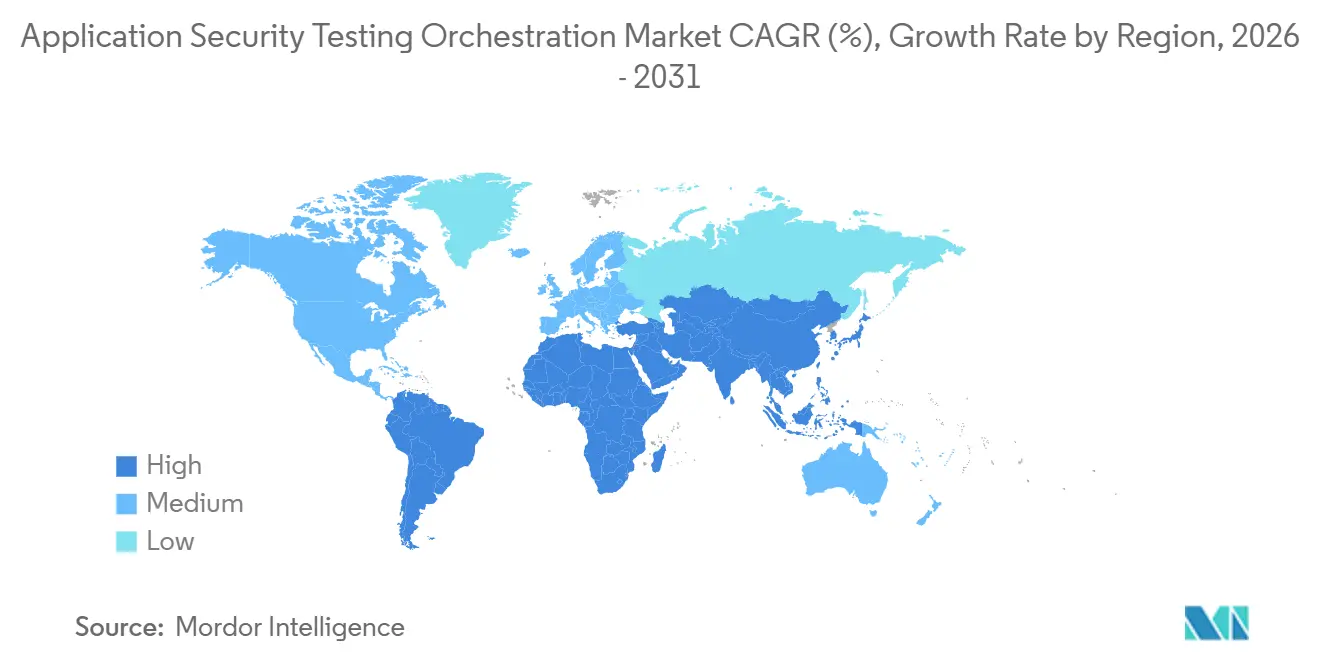
North America held 41.29% of the application security testing orchestration market revenue in 2025. The region has a high concentration of enterprise technology buyers and a well-developed DevSecOps talent base. The Federal secure-by-design procurement direction also extends software security expectations to commercial supply chains. Radware found that North America accounted for 80% of blocked malicious web application and API transactions globally in Q1 2026. The United States remained the main regional market because federal guidance encouraged SBOM generation and software security attestations for government procurement. These practices influence commercial vendors that sell to public agencies. Canada and Mexico also benefit from cross-border alignment with U.S. regulations and quality-gate expectations. The application security testing orchestration market share in the region reflects both high threat exposure and sustained software security spending.
Europe held the second-largest regional share in 2025, led by Germany, the United Kingdom, and France. High enterprise technology spending and dense regulation support regional adoption. DORA prompted platform evaluations across EU financial institutions after it became effective in January 2025. GDPR accountability requirements also increase attention to software-level data protection controls. European buyers frequently seek on-premises and hybrid options because of data residency and technology sovereignty concerns. SaaS suppliers must therefore offer regional cloud instances or self-hosted alternatives. South America is an emerging area led by Brazil, where LGPD requirements support security validation and financial inclusion expands digital portfolios for payment providers. These payment providers also face PCI DSS obligations, which increases the value of auditable testing workflows.
Asia-Pacific is projected to grow at a 24.79% CAGR from 2026 to 2031. China, India, Japan, South Korea, and Australia are expanding digital services while regulatory requirements become more specific. India's payment-system direction requires vulnerability assessments every 6 months, VAPT before new services, and CVSS-scored reports from CERT-In empaneled vendors. Singapore's Monetary Authority of Singapore Technology Risk Management guidelines and Japan's FSA FISC standards increasingly reference NIST and CIS benchmarks. These requirements create a need for security-posture evidence and automated compliance reporting. The Middle East and Africa remains smaller in absolute revenue, but the UAE and Saudi Arabia are increasing demand through Vision 2030 digitization programs and financial cybersecurity rules. South Africa, Nigeria, and Egypt add demand as digital banking infrastructure expands. The application security testing orchestration market has room to grow where cloud adoption advances faster than older on-premises testing approaches.

Competitive Landscape
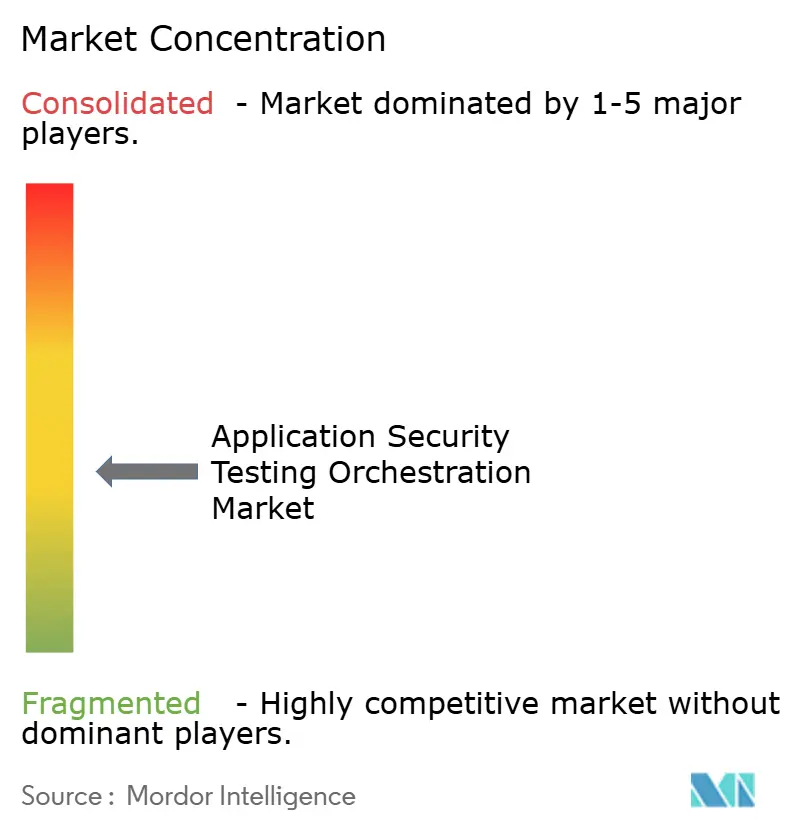
The application security testing orchestration market is moderately fragmented. Established full-stack vendors such as Black Duck, Checkmarx, and Veracode compete through integration depth, broad testing capabilities, and support for enterprise pipelines. Their portfolios can include SAST, DAST, IAST, SCA, and software supply-chain security. ASPM-focused companies, including ArmorCode, Apiiro, OX Security, Legit Security, and Endor Labs, compete through risk-graph analysis, developer experience, and aggregation of third-party scanner findings. These companies do not always need to replace existing tools to provide value. The category included 18 active ASPM vendors in an independent 2025 evaluation, which indicated a crowded but consolidating field. The application security testing orchestration market, therefore, has several credible suppliers, but buyers increasingly prefer broad lifecycle coverage. NIST's Secure Software Development Framework is an evaluation reference in regulated-sector purchases, where clear SSDF mapping can strengthen vendor positioning.[6]National Institute of Standards and Technology, “Secure Software Development Framework (SSDF), Special Publication 800-218,” National Institute of Standards and Technology, csrc.nist.gov
Vendor activity in 2025 and 2026 showed a move toward broader orchestration offerings. Invicti Security acquired Kondukto in 2025, combining DAST and runtime validation with ASPM capabilities. The deal brought DAST, API security, SAST, SCA, and ASPM into a single workflow. Veracode acquired Phylum in January 2025, adding machine-learning analysis of malicious packages, including typosquatting and backdoor injections. Black Duck expanded Polaris integrations in February 2026 across major source code management platforms. These actions reflect buyer demand for connected testing and remediation rather than isolated products. Smaller ASPM specialists may face pressure to add capabilities or form partnerships as sales costs favor larger platforms. The application security testing orchestration market is likely to reward vendors that combine breadth with practical developer workflows.
The strongest open areas include mid-market programs that need managed deployment, controls for AI-assisted code, and cross-framework compliance reporting. SMEs can need service-led support instead of self-service configuration. AI-heavy repositories need testing policies that recognize the source and context of code changes. Reporting that supports PCI DSS 4.0, DORA, GDPR, and HIPAA within one policy structure can reduce repeated configuration work. Black Duck made Signal available as an MCP server in the Claude Directory in September 2026, placing real-time vulnerability detection in Claude Desktop. This move placed security information closer to AI-assisted coding workflows. Vendors can differentiate by treating coding assistants as inputs to security orchestration, not only as sources of new risk. The application security testing orchestration market will remain competitive because integration, remediation, compliance, and AI support are developing at the same time.
Application Security Testing Orchestration Industry Leaders
Black Duck
Checkmarx Ltd.
GitHub, Inc.
Palo Alto Networks, Inc.
CrowdStrike Holdings, Inc.
- *Disclaimer: Major Players sorted in no particular order

Recent Industry Developments
- August 2026: Black Duck released the Polaris Platform August 2026 update, introducing bidirectional synchronization with GitLab Issues, GitHub Issues, Jira, ServiceNow, and Azure Boards, and secure tunnel connectivity to self-hosted Azure DevOps Server, GitLab Self-Managed, Bitbucket Server, and on-premises Jira, extending enterprise-grade orchestration to regulated on-premises SCM environments.
- June 2026: Black Duck released Polaris Platform enhancements including a Polaris issue-management MCP server enabling agentic AI tools such as Claude Code and GitHub Copilot to access scan results and remediation guidance, AI-assisted fix generation across GitHub, GitLab, Bitbucket, and Azure DevOps, and self-hosted SCM support for GitHub Enterprise Server versions 3.16, 3.17, and 3.18.
- February 2026: Black Duck announced immediate availability of expanded Polaris Platform integrations across GitHub, GitLab, Azure DevOps, and Bitbucket, providing native unified SAST, SCA, and DAST coverage across all major SCM platforms as a consistent SaaS experience.
- September 2025: UltraViolet Cyber completed the acquisition of Black Duck's Application Security Testing services business, integrating red teaming, threat modeling, cloud and container risk assessments, and secure SDLC consulting into UltraViolet's unified offensive-defensive cybersecurity portfolio, expanding its reach to commercial enterprises and federal agencies.


Global Application Security Testing Orchestration Market Report Scope
The application security testing orchestration market comprises platforms that unify, automate, and coordinate multiple application security testing tools, including static analysis (SAST), dynamic analysis (DAST), interactive analysis (IAST), software composition analysis (SCA), and API security testing across the software development lifecycle. These solutions aggregate and correlate findings from disparate security scanners, eliminate duplicate vulnerabilities through intelligent deduplication, prioritize risks based on exploitability and business context, and integrate with CI/CD pipelines and development workflows to enable security teams to manage testing campaigns at scale, reduce alert fatigue, accelerate remediation through automated ticket creation and developer guidance, and maintain consistent security governance across distributed development teams and technology stacks.
The Application Security Testing Orchestration Market Report is Segmented by Offering (Software and Platforms, and Services), Orchestration Capability (Test Scheduling and Execution Orchestration, Tool Integration and Test Pipeline Management, Finding Aggregation and Correlation, Risk-Based Test Prioritization, Security Policy and Quality-Gate Enforcement, and Other Orchestration Capabilities), Deployment Mode (Cloud, On-Premises, and Hybrid), Organization Size (Large Enterprises, and Small and Medium-Sized Enterprises), Industry Vertical (Government and Public Administration, Industrial Manufacturing, Retail and E-Commerce, Transportation and Logistics, Energy and Utilities, Oil and Gas, IT and Telecommunication, Media and Entertainment, Education and Research Institutions, Healthcare and Life Sciences, Banking, Financial Services, and Insurance (BFSI), and Other Industry Verticals), and Geography (North America, South America, Europe, Asia-Pacific, and Middle East and Africa). The Market Forecasts are Provided in Terms of Value (USD).
| Software and Platforms |
| Services |
| Test Scheduling and Execution Orchestration |
| Tool Integration and Test Pipeline Management |
| Finding Aggregation and Correlation |
| Risk-Based Test Prioritization |
| Security Policy and Quality-Gate Enforcement |
| Other Orchestration Capabilities |
| Cloud |
| On-Premises |
| Hybrid |
| Large Enterprises |
| Small and Medium-Sized Enterprises |
| Government and Public Administration |
| Industrial Manufacturing |
| Retail and E-Commerce |
| Transportation and Logistics |
| Energy and Utilities |
| Oil and Gas |
| IT and Telecommunication |
| Media and Entertainment |
| Education and Research Institutions |
| Healthcare and Life Sciences |
| Banking, Financial Services, and Insurance (BFSI) |
| Other Industry Verticals |
| North America | United States | |
| Canada | ||
| Mexico | ||
| South America | Brazil | |
| Argentina | ||
| Rest of South America | ||
| Europe | Germany | |
| United Kingdom | ||
| France | ||
| Italy | ||
| BENELUX | ||
| Rest of Europe | ||
| Asia-Pacific | China | |
| Japan | ||
| India | ||
| South Korea | ||
| Australia | ||
| Rest of Asia-Pacific | ||
| Middle East and Africa | Middle East | United Arab Emirates |
| Saudi Arabia | ||
| Rest of Middle East | ||
| Africa | South Africa | |
| Nigeria | ||
| Egypt | ||
| Rest of Africa | ||
| By Offering | Software and Platforms | ||
| Services | |||
| By Orchestration Capability | Test Scheduling and Execution Orchestration | ||
| Tool Integration and Test Pipeline Management | |||
| Finding Aggregation and Correlation | |||
| Risk-Based Test Prioritization | |||
| Security Policy and Quality-Gate Enforcement | |||
| Other Orchestration Capabilities | |||
| By Deployment Mode | Cloud | ||
| On-Premises | |||
| Hybrid | |||
| By Organization Size | Large Enterprises | ||
| Small and Medium-Sized Enterprises | |||
| By Industry Vertical | Government and Public Administration | ||
| Industrial Manufacturing | |||
| Retail and E-Commerce | |||
| Transportation and Logistics | |||
| Energy and Utilities | |||
| Oil and Gas | |||
| IT and Telecommunication | |||
| Media and Entertainment | |||
| Education and Research Institutions | |||
| Healthcare and Life Sciences | |||
| Banking, Financial Services, and Insurance (BFSI) | |||
| Other Industry Verticals | |||
| By Geography | North America | United States | |
| Canada | |||
| Mexico | |||
| South America | Brazil | ||
| Argentina | |||
| Rest of South America | |||
| Europe | Germany | ||
| United Kingdom | |||
| France | |||
| Italy | |||
| BENELUX | |||
| Rest of Europe | |||
| Asia-Pacific | China | ||
| Japan | |||
| India | |||
| South Korea | |||
| Australia | |||
| Rest of Asia-Pacific | |||
| Middle East and Africa | Middle East | United Arab Emirates | |
| Saudi Arabia | |||
| Rest of Middle East | |||
| Africa | South Africa | ||
| Nigeria | |||
| Egypt | |||
| Rest of Africa | |||


Key Questions Answered in the Report
What is the application security testing orchestration market size?
The application security testing orchestration market size was valued at USD 0.87 billion in 2025 and estimated to grow from USD 1.05 billion in 2026 to reach USD 2.97 billion by 2031, at a CAGR of 23.12% during the forecast period (2026-2031).
What is driving demand for application security testing orchestration?
Rising web and API attack activity, DevSecOps adoption, cloud-native delivery, and security needs associated with AI-generated code are supporting demand. Buyers also seek better prioritization and remediation of findings generated by several security tools.
Which deployment model leads this field?
Cloud deployment held 64.78% of revenue in 2025 and is projected to grow at a 26.29% CAGR through 2031. It connects naturally with hosted source control and build services that support frequent application releases.
Which organizations are adopting these platforms fastest?
SMEs are projected to grow at a 27.11% CAGR through 2031 as SaaS models reduce deployment barriers and expand access to managed support. Compliance templates and preconfigured policies can further reduce the burden on smaller teams.
Which end-use sector has the largest revenue share?
BFSI held 26.41% of revenue in 2025 because payment, banking, and insurance applications require continuous security validation. PCI DSS 4.0 and DORA reinforce the need for coordinated testing evidence and governance records.
Which region is expanding fastest?
Asia-Pacific is projected to grow at a 24.79% CAGR through 2031 as digital services, cloud adoption, and regulatory requirements increase. India, Singapore, Japan, and other regional markets are strengthening their application-security governance requirements. These rules support demand for controls that can document testing activity, organize remediation, and generate compliance evidence across varied software delivery environments. Cloud adoption also creates opportunities to introduce pipeline-integrated security checks before applications reach production, while retaining clear records for security teams, developers, governance functions, audit reviews, and compliance reporting requirements across regional operating environments and evolving regulatory obligations.
Page last updated on:





