
API Posture Management Market Size and Share
Market Overview
| Study Period | 2020 - 2031 |
|---|---|
| Market Size (2026) | USD 1.23 Billion |
| Market Size (2031) | USD 3.24 Billion |
| Growth Rate (2026 - 2031) | 21.38 % |
| Fastest Growing Market | Asia-Pacific |
| Largest Market | North America |
| Market Concentration | Medium |
Major Players *Disclaimer: Major Players sorted in no particular order Image © Mordor Intelligence. Reuse requires attribution under CC BY 4.0. | |
API Posture Management Market Analysis by Mordor Intelligence
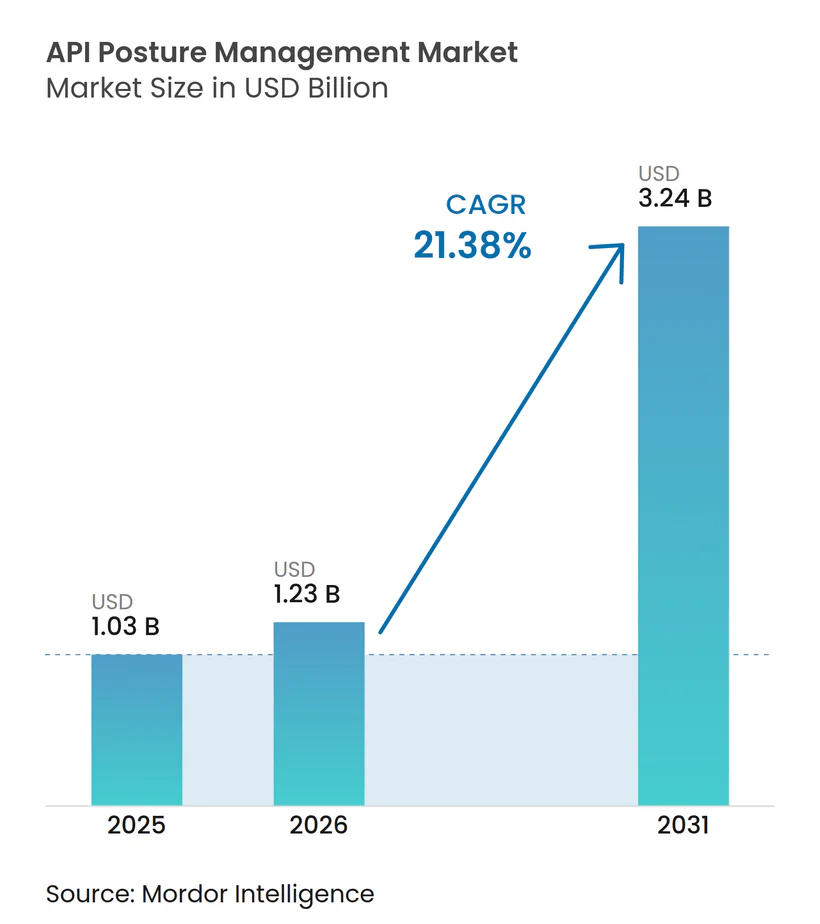
The API posture management market size is projected to expand from USD 1.03 billion in 2025 to USD 1.23 billion in 2026, and to USD 3.24 billion by 2031, registering a CAGR of 21.38% between 2026 and 2031. Enterprise API estates are becoming harder to govern as cloud-hosted services and short-lived endpoints replace more stable application environments. Security teams are responding to a widening gap between the APIs they know about and those that remain active in production. Demand is also shaped by the need to assess AI-related interfaces, including MCP servers and LLM tool-call APIs, alongside conventional APIs. Providers are responding through acquisitions, platform integration, and services that help customers operate controls continuously. The API posture management market, therefore, favors suppliers that can combine discovery, risk prioritization, and practical remediation across mixed environments.
Key Report Takeaways
- By offering software and platforms, it held 71.19% of the API posture management market revenue in 2025, while services are projected to expand at a 23.05% CAGR through 2031.
- By deployment mode, cloud held 68.15% of the API posture management market revenue in 2025, while hybrid deployment is expected to expand at a 22.77% CAGR through 2031.
- By organization size, large enterprises held 70.44% of the API posture management market revenue in 2025, while SMEs are projected to grow at a 23.45% CAGR through 2031.
- By API type, REST APIs accounted for 56.10% of API posture management market revenue in 2025, while GraphQL APIs are expected to expand at a 22.49% CAGR through 2031.
- By capability, API discovery and inventory held 24.15% of the API posture management market revenue in 2025, while risk scoring and prioritization are projected to expand at a 21.82% CAGR through 2031.
- By industry vertical, BFSI held 21.49% of revenue in 2025, while government and public administration is expected to expand at a 21.56% CAGR through 2031.
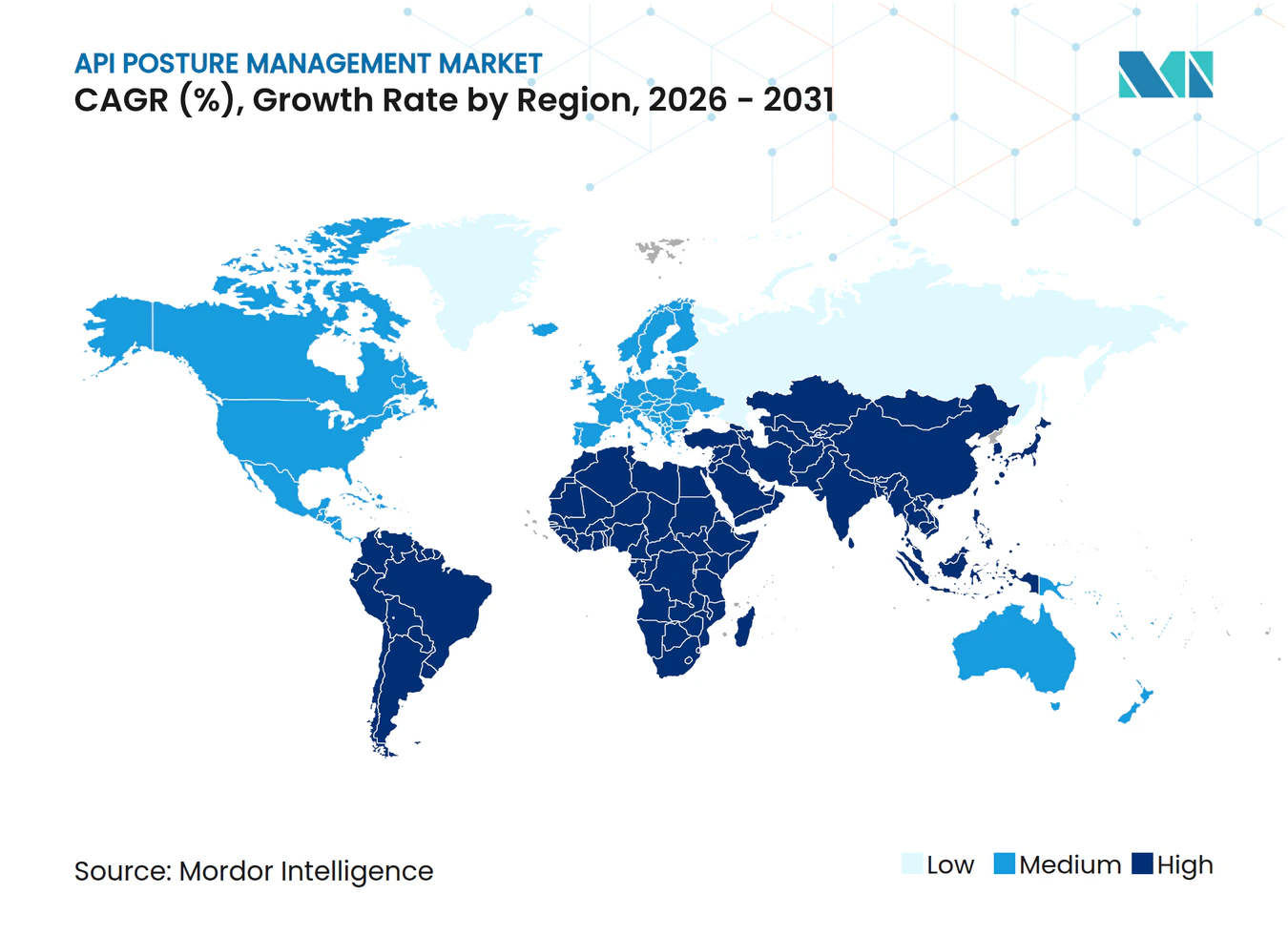
- By geography, North America held 35.66% of revenue in 2025, while Asia-Pacific is expected to expand at a 22.14% CAGR through 2031.
Note: Market size and forecast figures in this report are generated using Mordor Intelligence’s proprietary estimation framework, updated with the latest available data and insights as of January 2026.
Market Trends and Insights
Drivers Impact Analysis of API Posture Management Market*
| Driver | (~) % Impact on CAGR Forecast | Geographic Relevance | Impact Timeline |
|---|---|---|---|
| Expansion of Cloud-Native and Microservices Architectures | +4.2% | Global, concentrated in North America and Asia-Pacific | Short term (≤ 2 years) |
| Growth in API Exposure Across Digital Ecosystems | +3.8% | Global, strong in North America, Europe, and Asia-Pacific | Medium term (2-4 years) |
| Increasing API-Related Data Breaches and Business Abuse | +3.5% | Global | Short term (≤ 2 years) |
| Rising Regulatory and Secure-by-Design Requirements | +2.6% | Global, concentrated in North America | Short term (≤ 2 years) |
| AI Agent and Model Context Protocol API Expansion | +2.0% | Global, strongest in large enterprises in North America and Europe | Medium term (2-4 years) |
| API Inventory Drift Across Ephemeral Infrastructure | +1.8% | Global, strongest in North America and Europe | Medium term to Long term (2-5 years) |
| Source: Mordor Intelligence | |||
Expansion of Cloud-Native and Microservices Architectures
Cloud-native migration is changing API estates faster than many governance programs can keep pace with. Each microservice can expose an interface, while service meshes can create endpoints within minutes. This operating model supports demand in the API posture management market because registered gateway traffic is not a complete inventory. Akamai reported a median of 5,900 APIs per enterprise in 2026, while the top quartile exceeded 29,400 APIs. These inventory levels make manual governance difficult and support demand for automated discovery platforms.
Growth in API Exposure Across Digital Ecosystems
APIs are increasingly used to support revenue-generating services, partner connections, and internal digital operations. Traceable AI and Ponemon Institute found that a typical organization had 131 third-party connections integrated into its API layer.[1] These connections can make it harder to observe partner and aggregator behavior at the interface level. Behavioral monitoring can identify business logic abuse, enumeration activity, and data extraction that schema checks may not identify. This need is broadening the use of the API posture management market beyond early BFSI and technology to detect business logic abuse, enumeration activity, and data extraction that schema checks may missy adopters. Open-banking frameworks and fintech integration requirements also increase the value of a current inventory and continuous monitoring.
Increasing API-Related Data Breaches and Business Abuse
API incidents gained greater executive attention during 2024 and 2025 because their frequency and remediation costs became more visible. Akamai reported in 2024 that 84% of surveyed security professionals had experienced an API security incident in the prior 12 months. The study cited an average U.S. remediation cost of USD 591,404 and a financial-services cost of USD 832,801. Akamai’s 2026 study reported an average organizational financial impact of USD 700,000, and attributed 42% of incidents to AI-linked APIs. Wallarm’s analysis of 60 disclosed incidents from 2025 found that broken authentication accounted for 52% of the categorized incidents. Undiscovered APIs can be particularly difficult to protect because they may fall outside standard authentication and monitoring processes.
Rising Regulatory and Secure-by-Design Requirements
Regulatory requirements are becoming a more direct factor in procurement for API protection. NIST published SP 800-228 in June 2025 and updated it in March 2026 with API risk categories and lifecycle security controls. PCI DSS v4.0.1 requirements, which became mandatory in March 2025, include maintaining an API inventory under Requirement 6.3.2. The standard also requires continuous automated detection and prevention of API-layer attacks under Requirement 6.4.2. Akamai documented a 32% increase in OWASP API Security Top 10-related incidents, while NIS2 is extending oversight across European critical infrastructure. For the API posture management market, compliance deployments can also provide continuous discovery and risk-scoring capabilities that remain useful after an audit.
Restraints Impact Analysis of API Posture Management Market*
| Restraint | (~) % Impact on CAGR Forecast | Geographic Relevance | Impact Timeline |
|---|---|---|---|
| Integration With Existing API Gateways and Security Tools | -1.8% | Global, most acute in North America and Europe where legacy stacks are dense | Medium term (2-4 years) |
| Shortage of API and Cloud Security Specialists | -1.5% | Global, most severe in Asia-Pacific and South America | Long term (≥ 4 years) |
| False Positives in Behavioral API Monitoring | -1.0% | Global | Medium term (2-4 years) |
| Unclear Ownership of Internal, Partner, and Shadow APIs | -0.8% | Global, strongest friction in large enterprise deployments | Long term (≥ 4 years) |
| Source: Mordor Intelligence | |||
Complex Integration With Existing API Gateways and Security Tools
Integration with API gateways, web application firewalls, and security information and event management systems remains a recurring deployment issue. Akamai found that 80% of enterprises had deployed web application firewalls, but only 35% used dedicated API security tools. This difference reflects the additional work required to add dedicated discovery and risk-scoring capabilities to existing controls. Organizations with more than 1 gateway must normalize telemetry before they can apply risk scores consistently. Large enterprise deployments can take 6 to 12 months, reducing the time available to demonstrate value within an annual security budget. The API posture management market rewards vendors with connectors that reduce integration effort and consolidate data from different gateways into 1 operating view.
Shortage of API Security and Cloud Security Specialists
The shortage of API and cloud security specialists restricts adoption beyond the challenge of recruiting staff. Traceable AI and Ponemon Institute found that only 19% of respondents rated their API security solutions as highly effective. Effective use requires analysts who can tune discovery policies, understand behavioral patterns, and manage remediation work at scale. Business logic abuse also requires security expertise and knowledge of how an application functions. These needs support managed detection and remediation services for buyers unable to operate the technology independently. They also help explain why services are growing faster within the API posture management market as customers seek support that reduces the operating burden.
*Our forecasts treat driver/restraint impacts as directional, not additive. The impact forecasts reflect baseline growth, mix effects, and variable interactions.
API Posture Management Market Segment Analysis
By Offering:
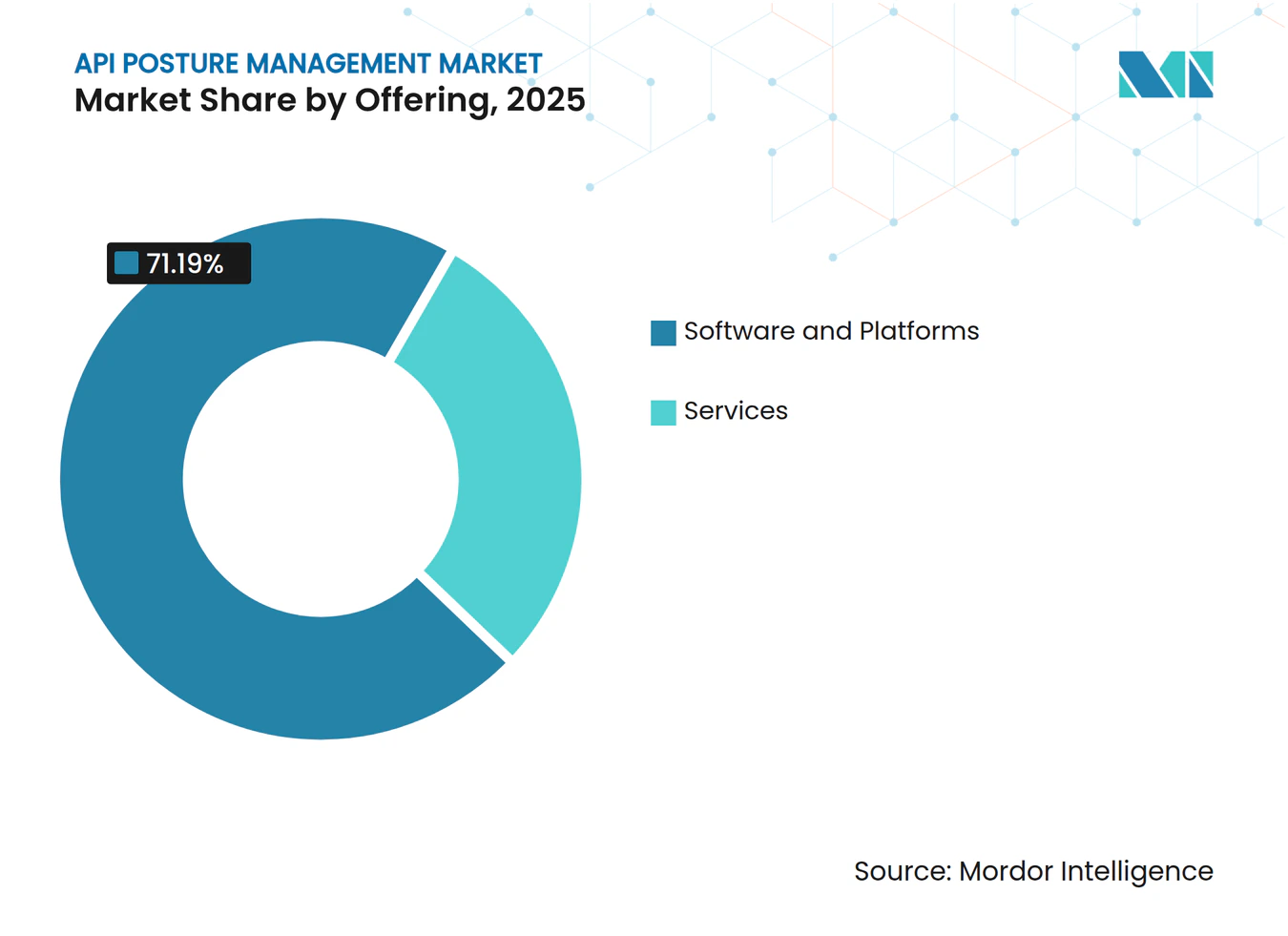
Services Growth Reflects Operational NeedsSoftware and platforms accounted for 71.19% of 2025 revenue in the API posture management market, reflecting demand for packaged tools to assess a defined API estate. Services are projected to expand at a 23.05% CAGR through 2031. The growth rate reflects multi-cloud configuration requirements that often exceed internal security capacity. Platform buyers need discovery, monitoring, and remediation processes to work together in production. Large organizations also need support when they extend controls across distributed cloud environments. The API posture management industry, therefore, gives software providers an incentive to add implementation and managed operating support.
Professional services include implementation, managed detection, and continuous monitoring. These offerings serve mid-market customers adopting posture management for the first time. They also support large enterprises that need to coordinate controls across multiple cloud environments. Services for GraphQL, gRPC, and WebSockets can address gaps left by older REST-focused configurations. Apollo GraphQL reported that organizations using GraphQL-based orchestration achieved deployment cycles 2 to 3 times faster than their REST-only peers. This shift can increase demand for practitioners who can apply security policies across multiple protocol types. Hybrid environments can create inventory drift between cloud services and local systems. Cloud-only tools may miss unregistered on-premises APIs, while local tools may lack access to cloud-based ephemeral endpoints. A unified control plane can provide a single view of discovery and risk information. Vendors that cover both environments without separate tier-based licensing may be better placed to serve these customers.


By Deployment Mode:
Cloud Leads While Hybrid Addresses Mixed EstatesCloud deployment held 68.15% of 2025 revenue, as most new API estates are built in cloud-native environments. SaaS-delivered tools can support continuous discovery across changing endpoints. On-premises deployment remains relevant in defense, regulated financial services, and critical infrastructure settings that require data sovereignty. However, on-premises operations can require more local infrastructure and administrative work. Hybrid deployment is projected to expand at a 22.77% CAGR through 2031. The API posture management market size for hybrid deployments is supported by organizations that retain older systems while building new API-first workloads in the cloud.
Hybrid environments can create inventory drift between cloud services and local systems. Cloud-only tools may miss unregistered on-premises APIs, while local tools may lack access to cloud-based ephemeral endpoints. A unified control plane can provide a single view of discovery and risk information. Vendors that cover both environments without separate tier-based licensing may be better placed to serve these customers.
By Organization Size:
Large Enterprises Lead Spending While SMEs Gain MomentumLarge enterprises held 70.44% of 2025 revenue because their API estates, regulatory exposure, and security budgets are larger. SMEs are projected to expand at a 23.45% CAGR through 2031. Cloud-native firms in fintech, e-commerce, and digital health are now operating API estates once associated with larger companies. Large customers increasingly place API posture management alongside cloud and application security posture management. This can reduce overlap between tools and support more consistent policy use. The API posture management market remains anchored in large organizations, but smaller buyers are adding demand through managed and platform-based delivery.
SMEs often rely on managed services because they do not operate dedicated API security teams. Usage-based pricing, lightweight onboarding, and prebuilt compliance templates can lower adoption barriers. Cequence released Platform 9.0 in June 2026 with risk rules mapped to 25 global regulatory frameworks and an AI-assisted interface. These capabilities can reduce the time needed to configure controls for customers with limited specialist resources. Large enterprises can also encourage supplier adoption when API security controls are part of supply chain requirements. This creates an entry path for SMEs that need simpler deployment and ongoing support.
By API Type:
REST Remains the Largest Base While GraphQL Adds ComplexityREST APIs held 56.10% of 2025 revenue, reflecting their large installed base in enterprise API infrastructure. SOAP APIs remain in legacy financial services and enterprise resource planning environments where replacement costs are high. gRPC, WebSockets, and other APIs are used for communication between internal microservices, where performance and binary encoding are important. GraphQL APIs are projected to expand at a 22.49% CAGR through 2031. The API posture management market must therefore address mixed-protocol environments rather than relying on 1 inspection method.
Enterprise use of GraphQL exceeded 50% in production by 2025, according to the research provided. Its single endpoint and client-defined queries can limit the effectiveness of REST-oriented path rules and rate controls. Security teams need to assess introspection abuse, query-depth attacks, and mass assignment through mutation inputs. 42Crunch expanded schema-aware GraphQL federation coverage in June 2026. This move shows the growing need for multi-protocol coverage in the API posture management industry.
By API Posture Management Capability:
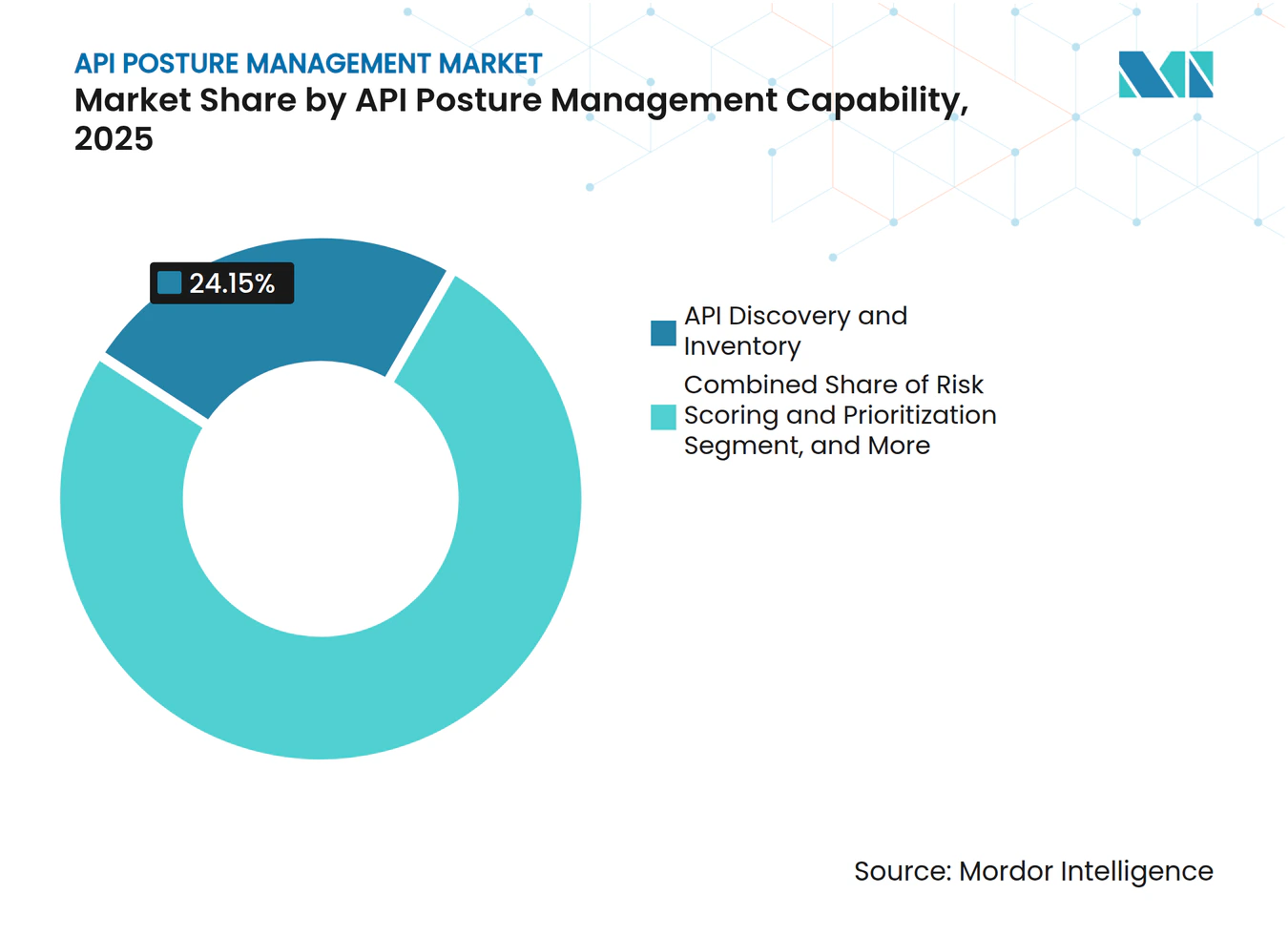
Discovery Is Foundational While Risk Scoring GrowsAPI discovery and inventory held 24.15% of 2025 revenue, the largest capability share in the API posture management market. It is the starting point for identifying assets that require assessment and remediation. Risk scoring and prioritization are projected to expand at a 21.82% CAGR through 2031. Buyers are moving from basic asset lists toward methods that help security teams decide what to fix first. Configuration and security policy assessment, together with vulnerability and exposure management, constitute the other main foundational controls. Discovery's API posture management market share reflects the practical need to know which APIs are active before applying controls.
Risk scores can consider data sensitivity, authentication state, public exposure, and active threat signals. This approach can help security teams direct limited resources toward higher-risk interfaces. Imperva reported that advanced machine learning identified an average of 613 APIs per organization in 2024. Lifecycle and version governance are also gaining importance because deprecated APIs may remain active without current authentication or monitoring. Salt Security found that 30% to 40% of enterprise APIs were undocumented or orphaned. These conditions make risk prioritization more useful when discovery reveals a large and unevenly governed estate.


By Industry Vertical:
BFSI Leads While Government Adoption IncreasesBFSI held 21.49% of 2025 revenue, the largest vertical share in the API posture management market. Payment APIs, open banking connections, and financial penalties provide strong reasons to maintain visibility. Akamai reported that banking absorbed 83% of all API attacks in 2025.[2] Healthcare and life sciences, IT and telecommunication, and retail and e-commerce also have substantial API exposure. Transportation and logistics, manufacturing, energy, and utilities are adding API connections as operational and information technology systems converge. The API posture management market size is supported by the need to govern these expanding service connections.
Government and public administration are projected to expand at a 21.56% CAGR through 2031. Digital citizen services are increasing API use across North America, Europe, and the Asia-Pacific. Akamai found in 2024 that energy and utilities reported a 91% API incident rate. The sector also ranked API security lowest among its 13 security priorities. Media and entertainment, education and research institutions, and other verticals are also adopting tools as cloud workloads and SaaS integrations expand. Their adoption is more commonly linked to service modernization than to direct regulatory pressure.
Geography Analysis
North America API Posture Management Market
North America accounted for 35.66% of global revenue in 2025, driven by cloud-native enterprise adoption and established security procurement channels. The United States was the largest national market because BFSI, technology, and healthcare organizations have substantial API security spending. NIST SP 800-228-upd1, CISA Secure by Design guidance, and PCI DSS 4.0.1 are shaping regional requirements.[3] The NSA issued guidance in May 2026 describing systemic MCP design risks, including CVE-2025-49596, which has a CVSS score of 9.4. Canada and Mexico are secondary growth markets, and Canadian financial institutions are aligning with U.S.-equivalent posture standards.
Europe API Posture Management Market
Europe was the second-largest regional market in the API posture management market, with adoption shaped by NIS2, GDPR implications, and DORA mapping requirements for third-party API connections. Germany, the United Kingdom, and France led adoption in the region. Akamai found that 83% of German enterprises experienced API security incidents in 2025. The study reported an average per-incident financial damage of USD 540,041, based on the supplied 2025 conversion rate. It also found that 37% of EMEA respondents used dedicated API security tools, compared with 78% using web application firewalls.
APAC, MEA and South America API Posture Management Market
Asia-Pacific is projected to expand at a 22.14% CAGR through 2031, making it the fastest-growing region. The API posture management market share in the region is supported by fintech expansion, e-commerce activity, and public digitalization programs. Akamai surveyed 640 cybersecurity leaders across China, India, Japan, and Singapore and found that 81% had experienced an API security incident in 2025. Only 22% reported having a complete API inventory. Japan reported an average incident loss of JPY 246 million (USD 1.71 million). India and Southeast Asia are developing opportunities, while South America, the Middle East, and Africa are seeing initial demand led by multinational BFSI programs and digital government activity in the UAE and Saudi Arabia.
Competitive Landscape
Market Concentration
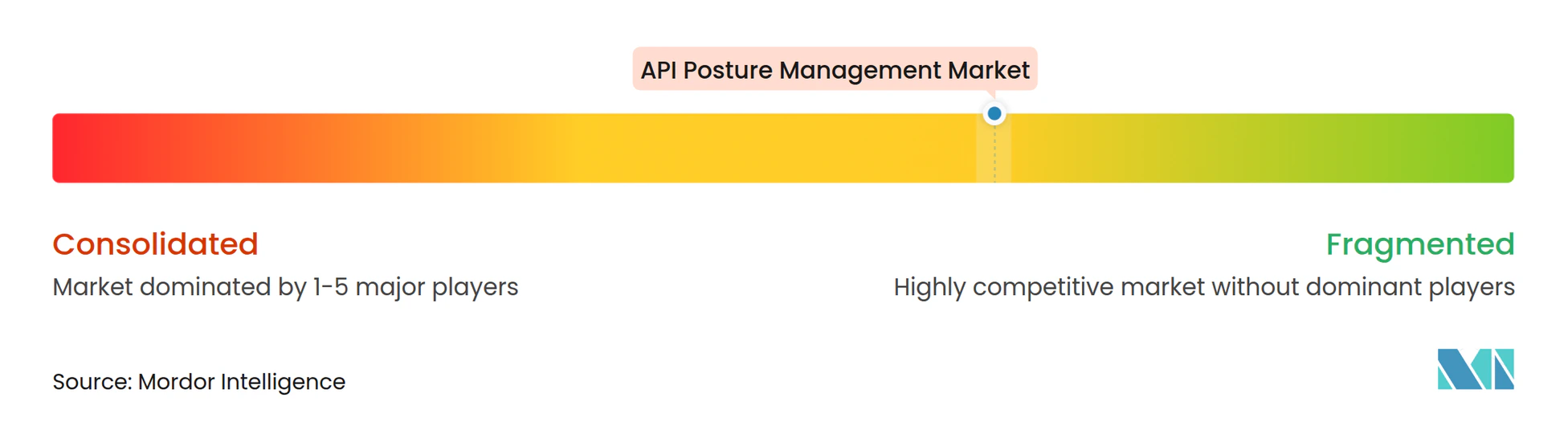
The API posture management market is consolidating as platform vendors acquire specialist capabilities and smaller vendors compete through specialized product development. Platform providers are combining discovery, inventory, risk scoring, behavioral monitoring, and AI-related coverage within fewer products. Palo Alto Networks completed its acquisition of CyberArk in February 2026 for USD 25 billion.[4] The acquisition added identity capabilities for human, machine, and agentic identities, with API connectivity. Palo Alto Networks then acquired Portkey in May 2026 to extend its AI gateway coverage.
NIST guidance is becoming a useful technical reference for enterprise evaluations because it addresses controls across the API lifecycle. Within the API posture management market, specialist vendors are differentiating through agentic AI coverage and faster release cycles. Salt Security launched its Agentic Security Platform in March 2026 for continuous discovery and governance of LLM connections, MCP servers, and API interactions.
Coverage for gRPC and WebSocket protocols remains an area where vendors are developing products. Automated remediation can also help link discovery and risk scores with developer actions in delivery pipelines. Cequence reported a record quarter in June 2026, including its largest deal across the telecommunications, financial services, and energy sectors. This performance suggests that specialized vendors can still compete for large enterprise deployments. The API posture management market remains competitive because breadth across platforms and depth across protocols are both important. Available information did not provide a combined market share for the leading vendors, so it does not establish a concentration score under the stated methodology.
API Posture Management Industry Leaders
-
IBM Corporation
-
Oracle Corporation
-
Microsoft Corporation
-
Google LLC
-
Amazon Web Services, Inc.
- *Disclaimer: Major Players sorted in no particular order
API Posture Management Market Companies Covered in this Report
- Salt Security Ltd.
- Traceable, Inc.
- Cequence Security, Inc.
- Wallarm Inc.
- Akto Technologies, Inc.
- 42Crunch Limited
- APIsec, Inc.
- FireTail, Inc.
- Data Theorem, Inc.
- Escape Technologies, Inc.
- Noname Gate, Inc.
- Neosec, Inc.
- Imperva, Inc.
- Akamai Technologies, Inc.
- Palo Alto Networks, Inc.
- Checkmarx Ltd.
- Broadcom Inc.
- F5, Inc.
- Kong Inc.
- IBM Corporation
- Cisco Systems, Inc.
- Microsoft Corporation
- Google LLC
- Amazon Web Services, Inc.
- Oracle Corporation
Recent Industry Developments in API Posture Management Market
- September 2026: Palo Alto Networks completes the acquisition of Console, an AI-native platform enabling agentic security operations. Console advances Cortex's autonomous alert investigation and action capabilities, deepening coverage of API and agentic AI security orchestration across enterprise environments.
- August 2026: Salt Security launches Salt Managed Rules for AWS WAF in AWS Marketplace, announced at Black Hat USA 2026. The ruleset extends AWS WAF with purpose-built protection against API abuse and AI agent-driven threats, including the industry's first MCP-aware detection rules for enterprise edge deployments.
- July 2026: Cequence Security releases five new AI Gateway capabilities, AI Discovery, API Registry, LLM Registry, Skill Registry, and upgraded Agent Personas, enabling business users to govern AI agents with least-privilege access bound to specific tools, data, and automated policy enforcement without requiring technical expertise.
- June 2026: Cequence Security releases Platform 9.0 with a built-in AI Assistant, open MCP server, compliance-ready risk rules mapped to 25 global regulatory frameworks, and a redesigned API security engine supporting up to 50 times more endpoints while maintaining sub-5-second page load times.
Global API Posture Management Market Report Scope
The API Posture Management Market comprises software platforms, solutions, and associated services designed to continuously discover, inventory, assess, monitor, govern, and improve the security posture of application programming interfaces (APIs) across enterprise environments. API posture management solutions provide organizations with comprehensive visibility into API assets, configurations, security controls, vulnerabilities, exposures, lifecycle status, and risk levels across cloud, on-premises, and hybrid infrastructures. The market includes technologies that identify known and unknown APIs, evaluate API configurations against security policies, detect vulnerabilities and exposures, prioritize risks based on business and technical context, govern API lifecycle activities, and support ongoing API security management. These solutions help organizations reduce API-related attack surfaces, improve compliance, enforce security standards, strengthen governance, and maintain operational visibility across increasingly complex API ecosystems.
The API Posture Management Market Report is Segmented by Offering (Software and Platforms, and Services), Deployment Mode (Cloud, On-Premises, and Hybrid), Organization Size (Large Enterprises, and Small and Medium-Sized Enterprises), API Type (REST APIs, GraphQL APIs, SOAP APIs, and gRPC and Other APIs), API Posture Management Capability (API Discovery and Inventory, Configuration and Security-Policy Assessment, Vulnerability and Exposure Management, Risk Scoring and Prioritization, API Lifecycle and Version Governance, and Others), Industry Vertical (Government and Public Administration, Industrial Manufacturing, Retail and E-Commerce, Transportation and Logistics, Energy and Utilities, Oil and Gas, IT and Telecommunication, Media and Entertainment, Education and Research Institutions, Healthcare and Life Sciences, Banking, Financial Services, and Insurance [BFSI], and Other Industry Verticals), and Geography (North America, South America, Europe, Asia-Pacific, and Middle East and Africa). The Market Forecasts are Provided in Terms of Value (USD).
Segmentation Overview
| Software and Platforms |
| Services |
| Cloud |
| On-Premises |
| Hybrid |
| Large Enterprises |
| Small and Medium-Sized Enterprises |
| REST APIs |
| GraphQL APIs |
| SOAP APIs |
| gRPC and Other APIs |
| API Discovery and Inventory |
| Configuration and Security-Policy Assessment |
| Vulnerability and Exposure Management |
| Risk Scoring and Prioritization |
| API Lifecycle and Version Governance |
| Other API Posture Management Capabilities |
| Government and Public Administration |
| Industrial Manufacturing |
| Retail and E-Commerce |
| Transportation and Logistics |
| Energy and Utilities |
| Oil and Gas |
| IT and Telecommunication |
| Media and Entertainment |
| Education and Research Institutions |
| Healthcare and Life Sciences |
| Banking, Financial Services, and Insurance (BFSI) |
| Other Industry Verticals |
| North America | United States | |
| Canada | ||
| Mexico | ||
| South America | Brazil | |
| Argentina | ||
| Rest of South America | ||
| Europe | Germany | |
| United Kingdom | ||
| France | ||
| Italy | ||
| BENELUX | ||
| Rest of Europe | ||
| Asia-Pacific | China | |
| Japan | ||
| India | ||
| South Korea | ||
| Australia | ||
| Rest of Asia-Pacific | ||
| Middle East and Africa | Middle East | United Arab Emirates |
| Saudi Arabia | ||
| Rest of Middle East | ||
| Africa | South Africa | |
| Nigeria | ||
| Egypt | ||
| Rest of Africa | ||
| By Offering | Software and Platforms | ||
| Services | |||
| By Deployment Mode | Cloud | ||
| On-Premises | |||
| Hybrid | |||
| By Organization Size | Large Enterprises | ||
| Small and Medium-Sized Enterprises | |||
| By API Type | REST APIs | ||
| GraphQL APIs | |||
| SOAP APIs | |||
| gRPC and Other APIs | |||
| By API Posture Management Capability | API Discovery and Inventory | ||
| Configuration and Security-Policy Assessment | |||
| Vulnerability and Exposure Management | |||
| Risk Scoring and Prioritization | |||
| API Lifecycle and Version Governance | |||
| Other API Posture Management Capabilities | |||
| By Industry Vertical | Government and Public Administration | ||
| Industrial Manufacturing | |||
| Retail and E-Commerce | |||
| Transportation and Logistics | |||
| Energy and Utilities | |||
| Oil and Gas | |||
| IT and Telecommunication | |||
| Media and Entertainment | |||
| Education and Research Institutions | |||
| Healthcare and Life Sciences | |||
| Banking, Financial Services, and Insurance (BFSI) | |||
| Other Industry Verticals | |||
| By Geography | North America | United States | |
| Canada | |||
| Mexico | |||
| South America | Brazil | ||
| Argentina | |||
| Rest of South America | |||
| Europe | Germany | ||
| United Kingdom | |||
| France | |||
| Italy | |||
| BENELUX | |||
| Rest of Europe | |||
| Asia-Pacific | China | ||
| Japan | |||
| India | |||
| South Korea | |||
| Australia | |||
| Rest of Asia-Pacific | |||
| Middle East and Africa | Middle East | United Arab Emirates | |
| Saudi Arabia | |||
| Rest of Middle East | |||
| Africa | South Africa | ||
| Nigeria | |||
| Egypt | |||
| Rest of Africa | |||
Key Questions Answered in the Report
What is the API posture management market size?
The API posture management market is valued at USD 1.23 billion in 2026 and is projected to reach USD 3.24 billion by 2031 at a 21.38% CAGR.
What is driving adoption of API posture management tools?
Cloud-native architectures, expanding partner connections, API incidents, and compliance requirements are increasing the need for continuous API visibility.
Which deployment mode leads adoption?
Cloud deployment held 68.15% of revenue in 2025, while hybrid deployment is projected to grow fastest at a 22.77% CAGR through 2031.
Which API type is growing fastest?
GraphQL APIs are projected to grow at a 22.49% CAGR through 2031 because their query model needs controls beyond REST-oriented inspection rules.
Which end-user vertical has the largest demand?
BFSI held 21.49% of 2025 revenue, supported by payment API density, open-banking activity, and regulatory requirements.
Which region is projected to grow fastest?
Asia-Pacific is projected to grow at a 22.14% CAGR through 2031, driven by fintech, e-commerce, and government digitalization programs.