
Machine Vision Active Optical Cable Market Size and Share
Market Overview
| Study Period | 2020 - 2031 |
|---|---|
| Market Size (2026) | USD 161.71 Million |
| Market Size (2031) | USD 261.63 Million |
| Growth Rate (2026 - 2031) | 10.10 % |
| Fastest Growing Market | Middle East and Africa |
| Largest Market | Asia-Pacific |
| Market Concentration | Low |
Major Players *Disclaimer: Major Players sorted in no particular order Image © Mordor Intelligence. Reuse requires attribution under CC BY 4.0. | |
Machine Vision Active Optical Cable Market Analysis by Mordor Intelligence
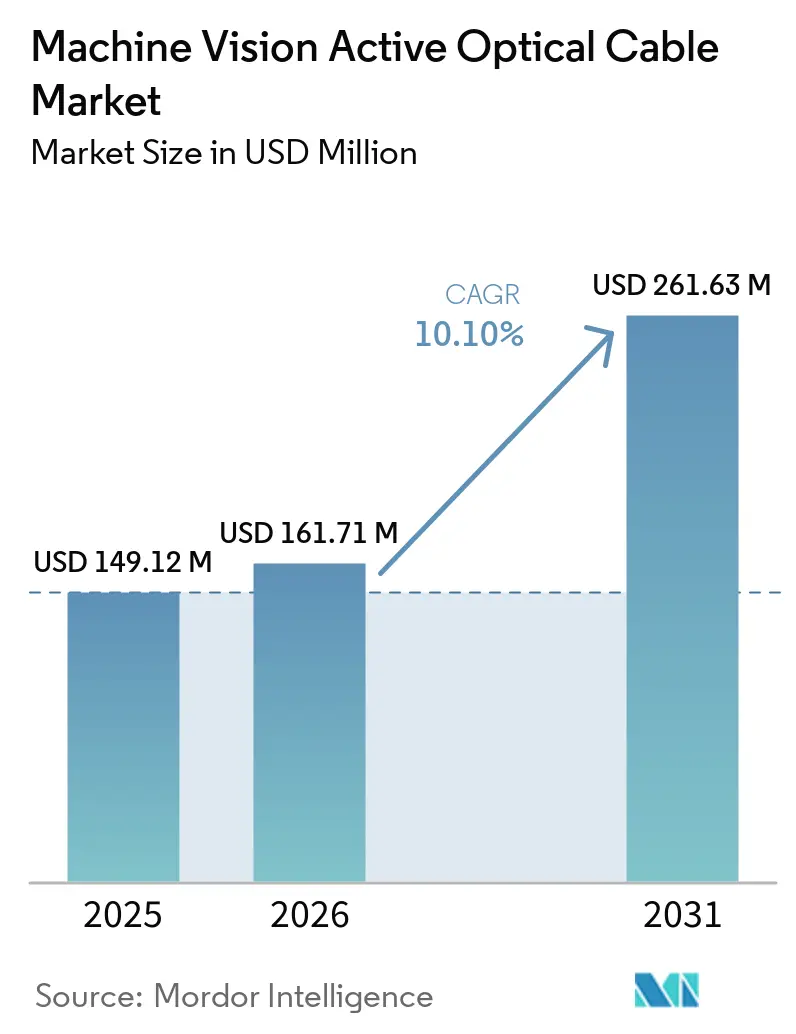
The Machine Vision Active Optical Cable Market size was valued at USD 149.12 million in 2025 and estimated to expand from USD 161.71 million in 2026 to reach USD 261.63 million by 2031, at a CAGR of 10.10% during the forecast period 2026-2031. The Machine Vision Active Optical Cable Market is driven by inspection systems that require higher bandwidth and longer camera runs than passive copper cables can provide. Fiber links also avoid electromagnetic interference on factory floors where servo drives, welders, and high-voltage switching equipment are used. GigE Vision 3.0 widened the case for fiber-based systems by enabling RoCEv2 streaming at up to 400 Gbps and beyond. Suppliers are responding with protocol-specific cable designs and AOC-ready camera connectors, while system builders increasingly favor designs that can support distributed cameras and centralized computing. The Machine Vision Active Optical Cable Market, therefore, has opportunities in semiconductor inspection, automotive production, robotics, and emerging automated factories.
Key Report Takeaways
- By interface protocol, GigE Vision held 26.47% of the Machine Vision Active Optical Cable Market share in 2025, while Camera Link HS is projected to expand at a 13.67% CAGR through 2031.
- By cable architecture, pure-fiber AOC accounted for 61.73% of revenue in 2025, while fiber-and-copper hybrid AOC is expected to advance at a 12.87% CAGR through 2031.
- By transmission length, the up-to-10-meters category captured 42.83% of revenue in 2025, while the above-30-meters-to-100-meters category is projected to register a 13.47% CAGR through 2031.
- By end-user industry, semiconductor and electronics held 28.67% of revenue in 2025, while automotive is expected to expand at a 12.76% CAGR through 2031.
- By geography, Asia-Pacific accounted for 37.94% of revenue in 2025, while the Middle East and Africa are projected to advance at a 13.34% CAGR through 2031.
Note: Market size and forecast figures in this report are generated using Mordor Intelligence’s proprietary estimation framework, updated with the latest available data and insights as of January 2026.
Global Machine Vision Active Optical Cable Market Trends and Insights
Drivers Impact Analysis*
| Driver | (~) % Impact on CAGR Forecast | Geographic Relevance | Impact Timeline |
|---|---|---|---|
| High-Resolution and High-Frame-Rate Inspection Expansion | +3.2% | Asia-Pacific core, with strong demand in North America and Europe | Short term (≤ 2 years) |
| Robotic and Continuous-Motion Vision System Adoption | +2.8% | Global | Short term (≤ 2 years) |
| EMI-Immune Camera Link Adoption | +2.1% | Global, especially heavy-industry facilities in Europe and North America | Medium term (2-4 years) |
| Edge AI and Distributed Vision Processing Deployment | +1.5% | North America and Asia-Pacific | Medium term (2-4 years) |
| MIPI-Based Long-Reach Embedded Vision Connectivity | +0.9% | Asia-Pacific and North America | Medium term (2-4 years) |
| Integrated Power and Data for Space-Constrained Vision Systems | +0.6% | Global | Long term (≥ 4 years) |
| Source: Mordor Intelligence | |||
Expansion of High-Resolution, High-Frame-Rate Inspection
Higher pixel counts and faster frame rates are increasing the data load carried by industrial camera links. Semiconductor inspection systems are moving from legacy 24.5 MP cameras to equipment capable of exceeding 400 frames per second. Allied Vision launched its FXO 100GigE series in 2026 with QSFP28 fiber interfaces that support up to 10 kilometers of reach, demonstrating the bandwidth available over fiber connections.[1]Allied Vision, “Allied Vision Among First to Launch 100GigE Machine Vision Cameras,” Allied Vision, alliedvision.com A four-link CXP-12 copper system aggregates to 50 Gbps, while a 100GigE QSFP28 AOC can provide similar capacity over a single connection. This makes cable selection more closely tied to camera upgrade cycles, especially in the Machine Vision Active Optical Cable Market. The Camera Link HS standard also defines CX4 and AOC fiber interfaces, which give buyers a common technical basis for procurement.
Growth of Robotic and Continuous-Motion Vision Systems
Robotic arms and gantries require cables that can withstand repeated movement without interrupting image transmission. Standard copper cables rated for 100,000 to 1,000,000 flex cycles do not meet the 10 million to 50 million cycles used for demanding robotic vision links. EverPro reported that its BendRobust-fiber hybrid AOC passed drag-chain testing above 100 million cycles.[2]EverPro Technologies, “Long Reach Camera Link and MIPI AOC Products,” EverPro Technologies, everprotech.com More axes and sensor channels also raise the cable requirement per collaborative robot. USB3 Vision and MIPI hybrid AOC designs can carry power and data to cameras at robot wrists and tool-center points, where lighter cable profiles simplify routing. This makes robotic movement a direct driver of demand for the Machine Vision Active Optical Cable Market.[3]Nortech Systems Incorporated, “USB-C Active Optical for Machine Vision Cables,” Nortech Systems Incorporated, nortechsys.com
Increasing Adoption of EMI-Immune Camera Links
Servo drives, induction welding, and high-current electronics can introduce noise into copper camera connections. Optical data transmission provides galvanic isolation and resistance to electromagnetic interference, which is valuable in semiconductor, automotive, and battery production environments. The CoaXPress-over-Fiber extension allows plants that use CoaXPress infrastructure to migrate to fiber without changing the software layer.[4]Euresys, “What Is CoaXPress-over-Fiber?,” Euresys, euresys.com Active Silicon introduced its FireBird CoaXPress-over-Fiber 4xCOF-12 frame grabber in June 2025, with image acquisition up to 40 Gbps over fiber. The use of 40 Gigabit Ethernet physical-layer components can also broaden access to available transceiver technology. These factors enhance the value proposition of the Machine Vision Active Optical Cable Market, where interference and long cable runs pose production risks.
Rising Deployment of Edge AI and Distributed Vision Processing
Edge AI systems need stable, high-bandwidth image feeds from cameras placed around an inspection cell. MIPI CSI-2 is a native interface for many such systems, but its standard board-level reach is limited without serialization. The MIPI Alliance adopted CSI-2 v4.2 in December 2025 and added support for event-based vision sensors and low-power sleep-mode streaming. Silicon Line launched the MSDL 20G chipset in September 2026 under the EverProX brand, extending 20 Gbps MIPI D-PHY links over tens of meters through an active optical connection. This supports designs in which 4 to 8 cameras send data to a single GPU host. The Machine Vision Active Optical Cable Market benefits as factories separate camera placement from computing hardware.
Restraints Impact Analysis*
| Restraint | (~) % Impact on CAGR Forecast | Geographic Relevance | Impact Timeline |
|---|---|---|---|
| Higher Initial Cost Than Passive Copper Cables | -0.8% | Global, most pronounced in Middle East and Africa and South America | Short term (≤ 2 years) |
| Power Budget and Thermal Limits at Active Terminations | -0.5% | Global | Medium term (2-4 years) |
| Interface Fragmentation and Interoperability Requirements | -0.4% | Global | Medium term (2-4 years) |
| Fiber Termination, Repair, and Qualification Complexity in Robotic Environments | -0.3% | Global | Long term (≥ 4 years) |
| Source: Mordor Intelligence | |||
Higher Initial Cost Than Passive Copper Cables
Those components make them more costly than passive copper assemblies. For runs of 3 to 5 meters, machine builders may not see enough performance benefit to justify the additional cost. Chinese VCSEL capacity expansion reduced the price of a 10-meter 10 GigE AOC from CNY 600 (USD 89.58) to CNY 120-150 (USD 17.92-22.40) across recent product cycles. The input does not provide an exchange-rate source for these amounts, so no USD conversion is stated. This cost issue limits the adoption of the Machine Vision Active Optical Cable Market among smaller builders in South America, the Middle East, and Africa.
Power Budget and Thermal Constraints at Active Terminations
Active components typically consume 0.5-1.0 W at each cable end. A system with 4 to 8 AOC links can therefore place a meaningful heat load inside a camera housing or junction box. Smaller camera enclosures leave less space for airflow and heat sinking. Hybrid fiber-and-copper designs can deliver power through copper conductors, but they shift rather than eliminate the system's thermal requirement. Power-over-CXP and power-over-Camera-Link applications also need careful voltage planning at longer distances. These integration demands can lengthen qualification timelines in the Machine Vision Active Optical Cable Market, especially in harsh industrial environments.
*Our forecasts treat driver/restraint impacts as directional, not additive. The impact forecasts reflect baseline growth, mix effects, and variable interactions.
Segment Analysis
By Interface Protocol: GigE Vision Leads, Camera Link HS Supports High-Speed Inspection
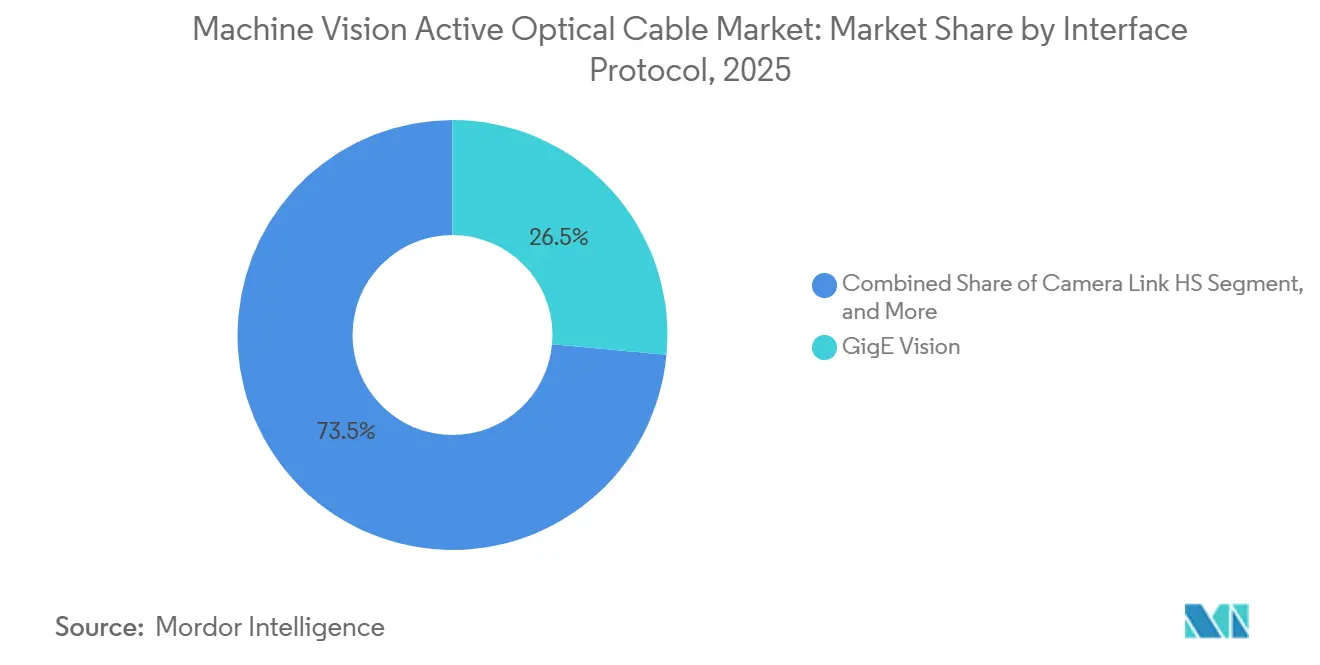
GigE Vision held 26.47% of the Machine Vision Active Optical Cable Market share in 2025. Its installed base reflects compatibility with Ethernet networks, standard switching infrastructure, Power over Ethernet, and established factory automation systems. The A3 GigE Vision Technical Committee ratified GigE Vision 3.0 in April 2026, introducing RoCEv2-based streaming and supporting data rates up to 400 Gbps and beyond. Allied Vision released a GigE Vision 3.0 FPGA IP core in the same month that supports 10 Gbps and 25 Gbps operation with a route to 100 Gbps. At higher data rates, fiber becomes the practical physical layer for many installations.
Camera Link HS is projected to expand at a 13.67% CAGR through 2031. It is suited to line-scan TDI cameras used in wafer inspection, genomics flow cells, and web inspection. Teledyne DALSA Xtium2-CLHS frame grabbers support single-cable runs up to 8.4 GByte/s for demanding image streams. USB3 Vision serves a broad mid-range electronics and printed circuit board installed base, while CoaXPress supports high-bandwidth area-scan systems. MIPI D-PHY, CSI-2, GMSL2, and FPD-Link III are gaining relevance in embedded vision, ADAS module testing, and autonomous mobile robots.



By Cable Architecture: Pure-Fiber Leads, Hybrid Addresses Robotic Requirements
Pure-fiber AOC accounted for 61.73% of revenue in 2025. It is used in CoaXPress-over-Fiber, Camera Link HS, and 10 GigE Vision applications where device-side power is not needed through the cable. The architecture provides an optical signal path and aligns with QSFP28 and SFP+ transceiver ecosystems used in high-speed data connectivity. CoaXPress-over-Fiber uses 40 Gigabit Ethernet physical-layer components, providing a standard pathway for high-bandwidth fiber implementations. The Machine Vision Active Optical Cable Market size for this architecture is supported by systems that prioritize interference resistance and clean high-speed transmission.
Fiber-and-copper hybrid AOC is expected to expand at a 12.87% CAGR through 2031. It combines optical fibers for data with copper conductors for device power and suits USB3 Vision, MIPI D-PHY, and USB3.2 Gen2 camera systems on robotic equipment. EverPro reported 10 GigE hybrid assemblies with outer diameters as small as 4.5 mm for constrained drag-chain routing. Its PHOTONFLEX product, introduced in 2026, used a sub-1.5 mm construction for USB3.2 Gen1 data and flexible printed-circuit power delivery. The Machine Vision Active Optical Cable Market benefits from this single-cable arrangement for thin robotic arms and future humanoid-arm vision systems, despite a higher assembly cost.
By Transmission Length: Short Runs Anchor Revenue, Longer Runs Change System Design
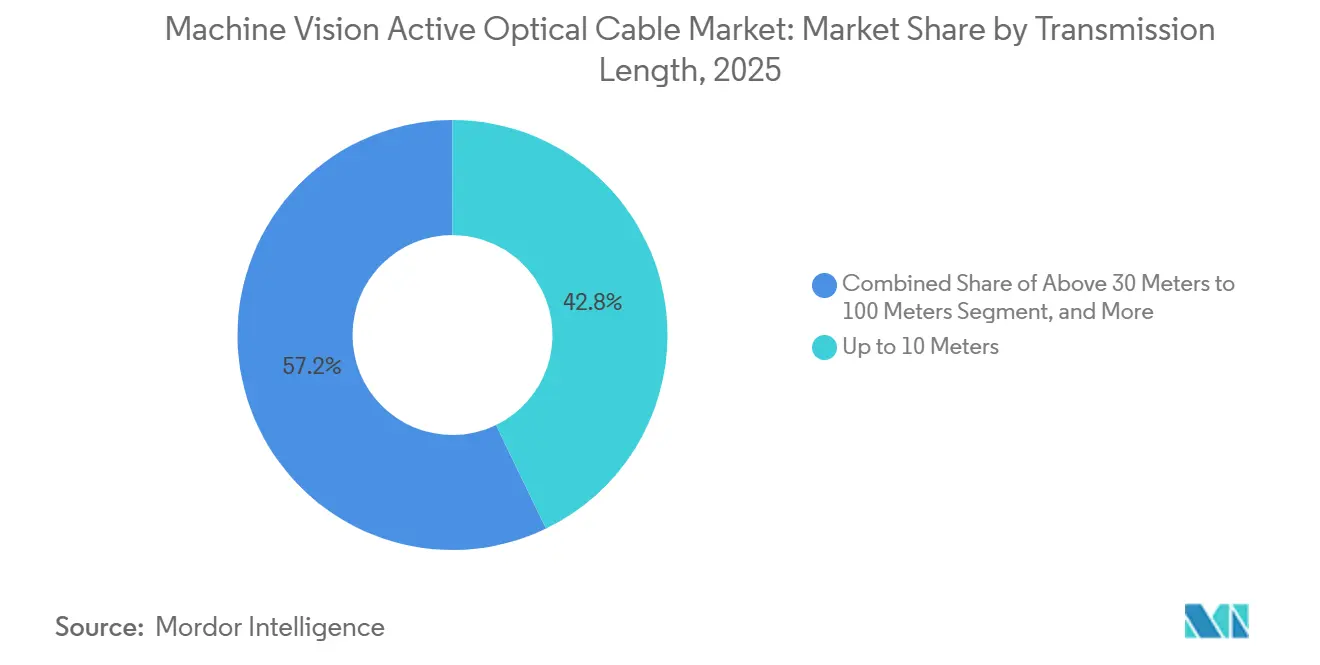
The up-to-10-meter category accounted for 42.83% of revenue in 2025. Compact inspection cells, printed-circuit-board AOI stations, and semiconductor packaging equipment commonly place cameras close to the processing unit. In these settings, buyers use AOCs for interference protection, lighter cable construction, or tighter routing. The 10-to-30-meters category serves conveyor lines and gantries, with electronics manufacturing and food and beverage inspection supporting replacement demand. Short runs remain important in the current Machine Vision Active Optical Cable Market because they represent a large installed base of equipment.
The above-30-meters-to-100-meters category is projected to register a 13.47% CAGR through 2031. The segment supports distributed layouts with cameras on automotive body lines, solar panel inspection tables, presses, and cold storage conveyors. CoaXPress-over-Fiber can support camera-to-host distances beyond 100 meters over multimode fiber and beyond 100 kilometers over single-mode fiber. Above-100-meters systems serve narrower applications, including glass production, film inspection, and telescope arrays. This design change strengthens the Machine Vision Active Optical Cable Market by enabling distances and data rates that copper links cannot meet.
By End-User Industry: Semiconductor and Electronics Lead, Automotive Expands Fastest
Semiconductor and electronics accounted for 28.67% of revenue in 2025. The segment requires sub-10-micrometer defect detection, chiplet-package metrology, and fast 2D inspection of printed circuit boards and display panels. China’s semiconductor equipment outlays reached USD 49 billion in 2025, supporting demand for high-bandwidth camera systems. Japan also continued investment in 3D metrology for SiC inverter-board heat-sink coplanarity. Allied Vision positioned its FXO 100GigE platform for semiconductor and electronics AOI, with 24.5 MP imaging at 442 frames per second. This demand base gives the Machine Vision Active Optical Cable Market a high-value inspection application.
Automotive is expected to expand at a 12.76% CAGR through 2031. Vehicle and supplier facilities are adding visual inspection for EV battery cells, SiC power modules, and body-in-white production, often at distances where copper connections are susceptible to interference. Valens Semiconductor and Imavix Engineering announced a production-ready MIPI A-PHY machine vision platform in December 2025, featuring the automotive-grade VA7000 chipset and connectivity to 10 Gbps GigE Vision hosts. Industrial automation, medical and life sciences, aerospace and defense, research institutes, and system integrators also create varied requirements for AOC protocols and ruggedization.
Geography Analysis
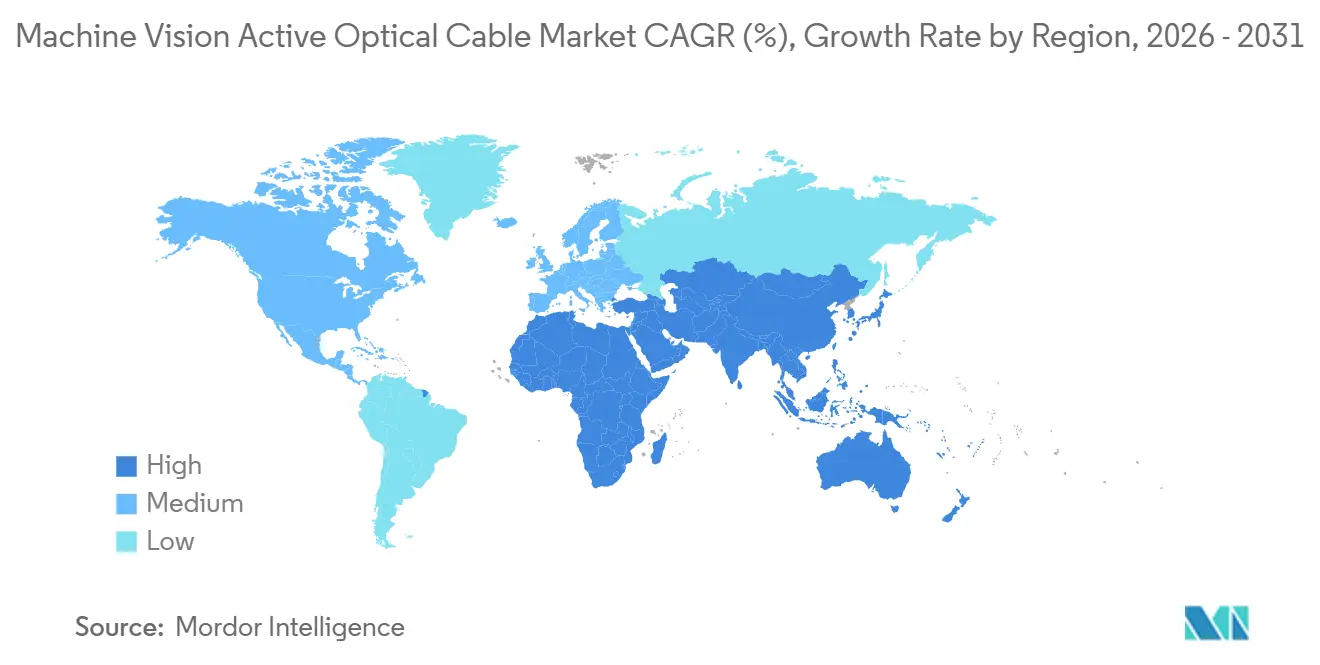
Asia-Pacific held 37.94% of regional revenue in 2025. China, Japan, South Korea, and Taiwan are home to concentrated production of electronics, semiconductors, and automated optical inspection. China invested USD 49 billion in semiconductor equipment in 2025, while Taiwan’s panel-level packaging projects and Japan’s SiC power-device metrology upgrades also support demand for camera-link equipment. South Korea contributes display and memory-chip inspection infrastructure. India, Vietnam, and Malaysia are expanding electronics manufacturing capacity, thereby widening the regional demand base for the Machine Vision Active Optical Cable Market.
North America and Europe form the second-largest regional bloc. North America has demand from aerospace and defense, semiconductor capital equipment, and embedded edge AI vision, including Mobix Labs’ True Xero AOC line for high-reliability applications. Europe’s activity centers on Germany’s automotive suppliers, machine builders, and system integrators, while South America’s smaller base is led by automotive manufacturing and agri-food inspection.
The Middle East and Africa are projected to advance at a 13.34% CAGR through 2031. Saudi Vision 2030 and the UAE’s Industry 4.0 programs are adding industrial automation systems that can specify modern interconnects at the initial design stage. Regional industrial automation spending reached USD 5.28 billion in 2025 and is forecast to reach USD 7.44 billion by 2030 at a 7.10% CAGR. Turkey and Israel add demand for electronics manufacturing and defense systems integration. South Africa and Nigeria are early users in food and beverage inspection and mining automation, creating a new regional path for the Machine Vision Active Optical Cable Market.

Competitive Landscape
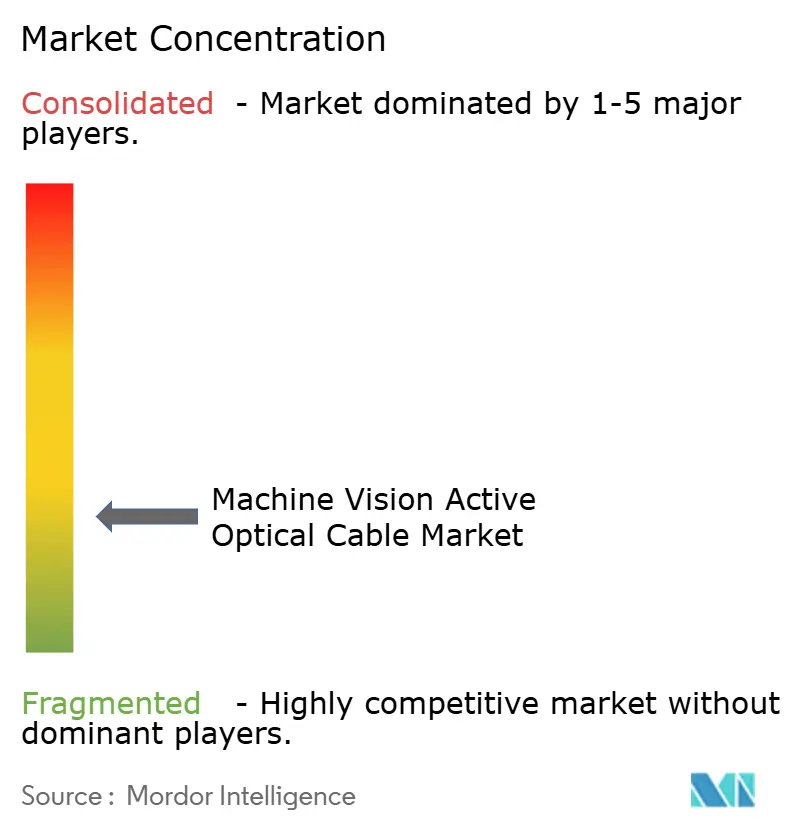
The Machine Vision Active Optical Cable Market is fragmented, with no supplier holding a decisive position across all interface protocols and cable architectures. Chinese manufacturers account for a large share of assembly volume. EverPro described itself as the world’s largest AOC shipper by volume, with more than 340 patents, more than 200 RandD personnel, and RandD centers in Germany and China. Specialized SerDes IC design and optoelectronic integration are concentrated among fewer participants in Europe and North America. The competitive structure, therefore, combines high-volume assembly with more specialized component innovation.
Silicon Line launched its MSDL 20G chipset in September 2026 to extend 20 Gbps MIPI D-PHY connectivity over active optical links across tens of meters. Teledyne DALSA released the Linea HS2 8k camera in June 2026 with Camera Link HS CX4 connectors for AOC connectivity. Allied Vision also launched a 100GigE camera series with QSFP28 fiber interfaces in 2026. These moves show how chipset suppliers, cable assemblers, and camera makers support one another’s product road maps.
MIPI A-PHY AOC for automotive inline inspection remains an emerging area. Circuit Assembly Corporation states that it holds AS9100D and ISO 9001:2015 certifications and is ITAR- and DDTC-registered. These requirements can limit direct competition from high-volume cable assemblers in specialized aerospace and defense applications. The Machine Vision Active Optical Cable Market also has opportunities in lower-power protocol extensions, ruggedized cable configurations, 100 GigE inspection systems, and AI data collection.
Machine Vision Active Optical Cable Industry Leaders
EverPro Technologies Co., Ltd.
Nortech Systems Incorporated
Circuit Assembly Corporation
Shenzhen Fiberlink Tech Co., Ltd
Donghoo Technologies Co., Limited
- *Disclaimer: Major Players sorted in no particular order

Recent Industry Developments
- September 2026: EverProX Technologies Munich GmbH launched the MSDL 20G chipset under its Silicon Line brand, the first end-to-end SerDes chipset extending 20 Gbps MIPI D-PHY connectivity over active optical cables to tens of meters, targeting machine vision, robotics, medical, and defense applications. The launch represented the highest-bandwidth MIPI D-PHY AOC chipset available commercially and enabled 4K and 8K uncompressed video transport at scale.
- June 2026: Teledyne DALSA released the Linea HS2 8k backside-illuminated 1 MHz TDI camera equipped with Camera Link HS CX4 connectors for active optical cable connectivity, providing complete EMI immunity for high-speed semiconductor wafer, genomics flow cell, and precision web inspection. The camera’s BSI sensor design enabled high-speed operation in low-light conditions, expanding AOC use in inspection applications where illumination constraints previously required longer integration times.
- April 2026: The A3 GigE Vision Technical Committee ratified GigE Vision 3.0, formally introducing RoCEv2-based streaming that scales GigE Vision to 400 Gbps and beyond. Allied Vision launched the first fully compliant GigE Vision 3.0 FPGA IP core simultaneously, enabling 10 Gbps and 25 Gbps data rates with a scalable path to 100 Gbps and expanding fiber AOC relevance across the GigE Vision installed base.
- June 2025: Active Silicon introduced the FireBird CoaXPress-over-Fiber 4xCOF-12 frame grabber, acquiring image data at up to 40 Gbps using 40 Gigabit Ethernet physical-layer fiber components. The product placed cameras kilometers from the host PC using standard multimode or single-mode fiber, extending the reach of the CoaXPress-over-Fiber standard to large-format factory deployments and harsh-EMI environments.


Global Machine Vision Active Optical Cable Market Report Scope
Machine Vision Active Optical Cables are high-performance connectivity solutions that integrate optical transceivers directly into the cable assembly, converting electrical signals into light and enabling high-bandwidth, low-latency, electrically isolated data transmission for industrial cameras over distances far exceeding those of traditional copper cables.
The Machine Vision Active Optical Cable Market Report is Segmented by Interface Protocol (USB3 Vision, Camera Link HS, CoaXPress, MIPI D-PHY and CSI-2, GigE Vision, 10 GigE Vision, and Automotive Serialized Camera Links), Cable Architecture (Pure-Fiber Active Optical Cables and Fiber-and-Copper Hybrid Active Optical Cables), Transmission Length (Up to 10 Meters, Above 10 Meters to 30 Meters, Above 30 Meters to 100 Meters, and Above 100 Meters), End-User Industry (Industrial Automation and Machine Builders, Electronics and Semiconductor Manufacturers, Automotive Manufacturers and Tier Suppliers, Medical Device and Life Sciences Organizations, Aerospace and Defense Organizations, Research Institutes and Universities, System Integrators and Contract Inspection Providers, and Other End-User Industries), and Geography (North America, South America, Europe, Asia-Pacific, Middle East and Africa). The Market Forecasts are Provided in Terms of Value (USD).
| USB3 Vision |
| Camera Link HS |
| CoaXPress |
| MIPI D-PHY and CSI-2 |
| GigE Vision |
| 10 GigE Vision |
| Automotive Serialized Camera Links |
| Pure-Fiber Active Optical Cables |
| Fiber-and-Copper Hybrid Active Optical Cables |
| Up to 10 Meters |
| Above 10 Meters to 30 Meters |
| Above 30 Meters to 100 Meters |
| Above 100 Meters |
| Industrial Automation and Machine Builders |
| Electronics and Semiconductor Manufacturers |
| Automotive Manufacturers and Tier Suppliers |
| Medical Device and Life Sciences Organizations |
| Aerospace and Defense Organizations |
| Research Institutes and Universities |
| System Integrators and Contract Inspection Providers |
| Other End-User Industries |
| North America | United States | |
| Canada | ||
| Mexico | ||
| South America | Brazil | |
| Argentina | ||
| Rest of South America | ||
| Europe | Germany | |
| United Kingdom | ||
| France | ||
| Italy | ||
| Spain | ||
| Rest of Europe | ||
| Asia-Pacific | China | |
| Japan | ||
| India | ||
| South Korea | ||
| Rest of Asia-Pacific | ||
| Middle East and Africa | Middle East | Saudi Arabia |
| United Arab Emirates | ||
| Turkey | ||
| Rest of the Middle East | ||
| Africa | South Africa | |
| Nigeria | ||
| Rest of Africa | ||
| By Interface Protocol | USB3 Vision | ||
| Camera Link HS | |||
| CoaXPress | |||
| MIPI D-PHY and CSI-2 | |||
| GigE Vision | |||
| 10 GigE Vision | |||
| Automotive Serialized Camera Links | |||
| By Cable Architecture | Pure-Fiber Active Optical Cables | ||
| Fiber-and-Copper Hybrid Active Optical Cables | |||
| By Transmission Length | Up to 10 Meters | ||
| Above 10 Meters to 30 Meters | |||
| Above 30 Meters to 100 Meters | |||
| Above 100 Meters | |||
| By End-User Industry | Industrial Automation and Machine Builders | ||
| Electronics and Semiconductor Manufacturers | |||
| Automotive Manufacturers and Tier Suppliers | |||
| Medical Device and Life Sciences Organizations | |||
| Aerospace and Defense Organizations | |||
| Research Institutes and Universities | |||
| System Integrators and Contract Inspection Providers | |||
| Other End-User Industries | |||
| By Geography | North America | United States | |
| Canada | |||
| Mexico | |||
| South America | Brazil | ||
| Argentina | |||
| Rest of South America | |||
| Europe | Germany | ||
| United Kingdom | |||
| France | |||
| Italy | |||
| Spain | |||
| Rest of Europe | |||
| Asia-Pacific | China | ||
| Japan | |||
| India | |||
| South Korea | |||
| Rest of Asia-Pacific | |||
| Middle East and Africa | Middle East | Saudi Arabia | |
| United Arab Emirates | |||
| Turkey | |||
| Rest of the Middle East | |||
| Africa | South Africa | ||
| Nigeria | |||
| Rest of Africa | |||


Key Questions Answered in the Report
What is the Machine Vision Active Optical Cable Market size?
The Machine Vision Active Optical Cable Market was valued at USD 149.12 million in 2025 and is estimated at USD 161.71 million in 2026. It is forecast to reach USD 261.63 million by 2031 at a 10.10% CAGR.
Which interface protocol leads the Machine Vision Active Optical Cable Market?
GigE Vision led with a 26.47% revenue share in 2025. Its installed Ethernet base and the GigE Vision 3.0 upgrade support continuing fiber adoption.
Which cable architecture is expanding fastest?
Fiber-and-copper hybrid AOC is expected to advance at a 12.87% CAGR through 2031. It supports single-cable data and power delivery for robotic vision systems.
Why are AOCs used instead of copper camera cables?
AOCs support longer high-bandwidth runs and avoid electromagnetic interference. These benefits matter in automated inspection, welding, battery production, and large factory layouts.
Which end-user application is expected to expand fastest?
Automotive is expected to expand at a 12.76% CAGR through 2031. Demand is linked to EV battery inspection, SiC power-module assembly, and body-in-white verification.
Which region is forecast to expand fastest?
Middle East and Africa is projected to advance at a 13.34% CAGR through 2031. Industrial automation investment and greenfield manufacturing programs support this outlook.
Page last updated on:


 Your data is secure and never sold or shared.


