
USB3 Vision Connectivity Components Market Size and Share
Market Overview
| Study Period | 2020 - 2031 |
|---|---|
| Market Size (2026) | USD 648.74 Million |
| Market Size (2031) | USD 937.05 Million |
| Growth Rate (2026 - 2031) | 7.63 % |
| Fastest Growing Market | Asia-Pacific |
| Largest Market | Asia-Pacific |
| Market Concentration | Low |
Major Players *Disclaimer: Major Players sorted in no particular order Image © Mordor Intelligence. Reuse requires attribution under CC BY 4.0. | |
USB3 Vision Connectivity Components Market Analysis by Mordor Intelligence
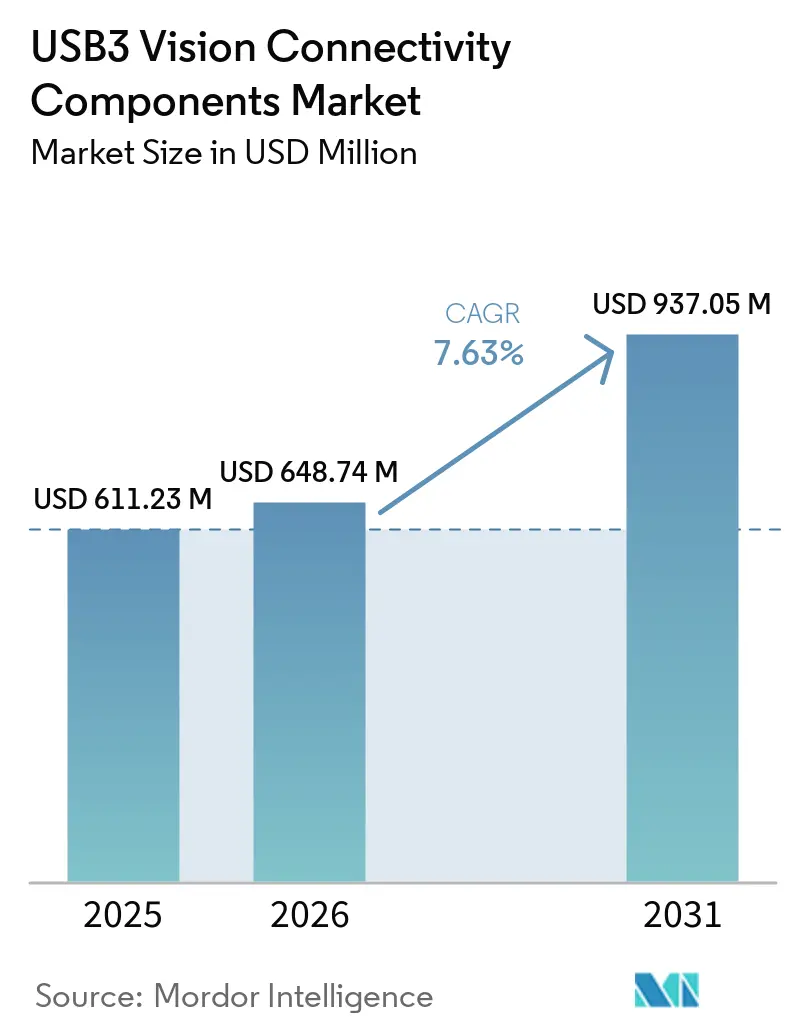
The USB3 Vision Connectivity Components Market size is projected to expand from USD 611.23 million in 2025 to USD 648.74 million in 2026, and to USD 937.05 million by 2031, registering a CAGR of 7.63% between 2026 and 2031. The USB3 Vision Connectivity Components Market benefits from the USB3 Vision 1.2 standard and GenICam compliance, which allows many mid-speed inspection cells to operate without frame grabbers. A single cable can carry power and data over runs of up to 5 meters, lowering installation work in SMT, semiconductor packaging, and optical inspection lines. The 2025.10 GenICam release and its cable extender test plan strengthen interoperability for active cable and hybrid-fiber deployments. Demand is moving toward active, programmable, and embedded products as edge processing becomes more common on production lines. Distance, bandwidth, power limits, and host qualification needs still leave room for GigE Vision, CoaXPress, and Camera Link HS in larger or higher-bandwidth installations.
Key Report Takeaways
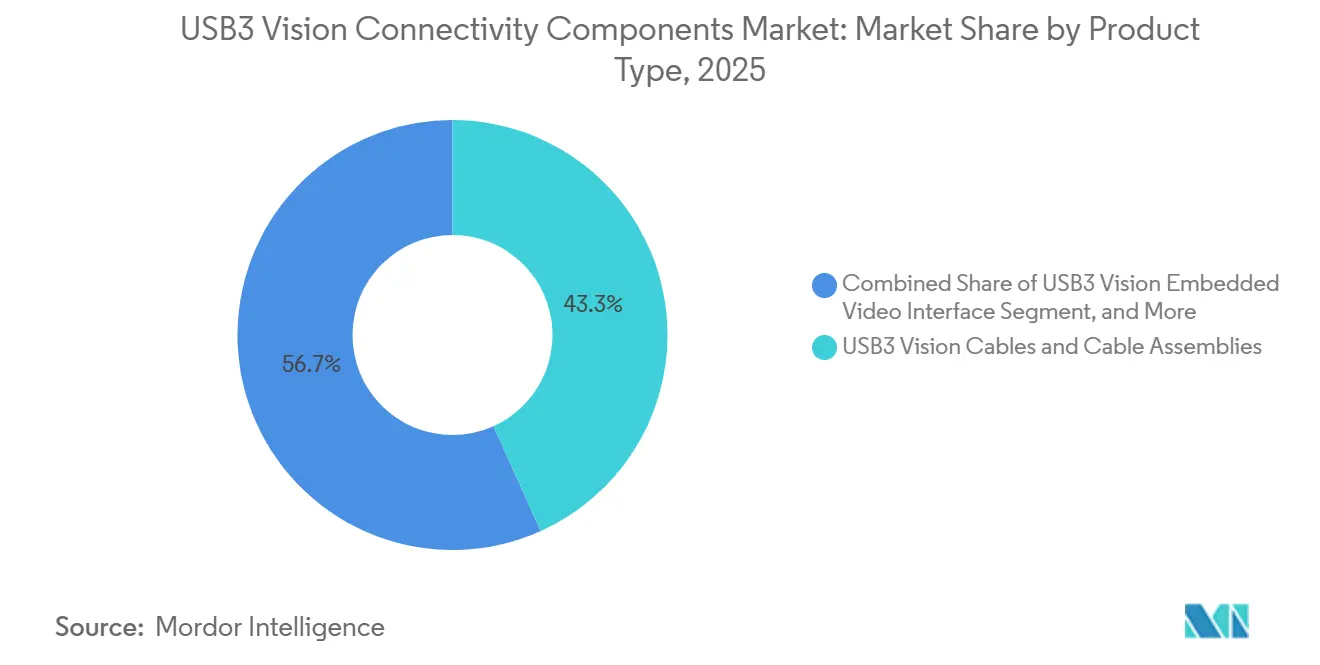
- By product type, USB3 Vision Cables and Cable Assemblies accounted for 43.27% of the USB3 Vision Connectivity Components Market size in 2025, while Embedded Video Interfaces and IP Cores are projected to expand at a 10.42% CAGR through 2031.
- By cable technology, Twisted-Pair Copper Cables held 51.36% of revenue in 2025, while Active Optical Cables are projected to expand at a 10.27% CAGR through 2031.
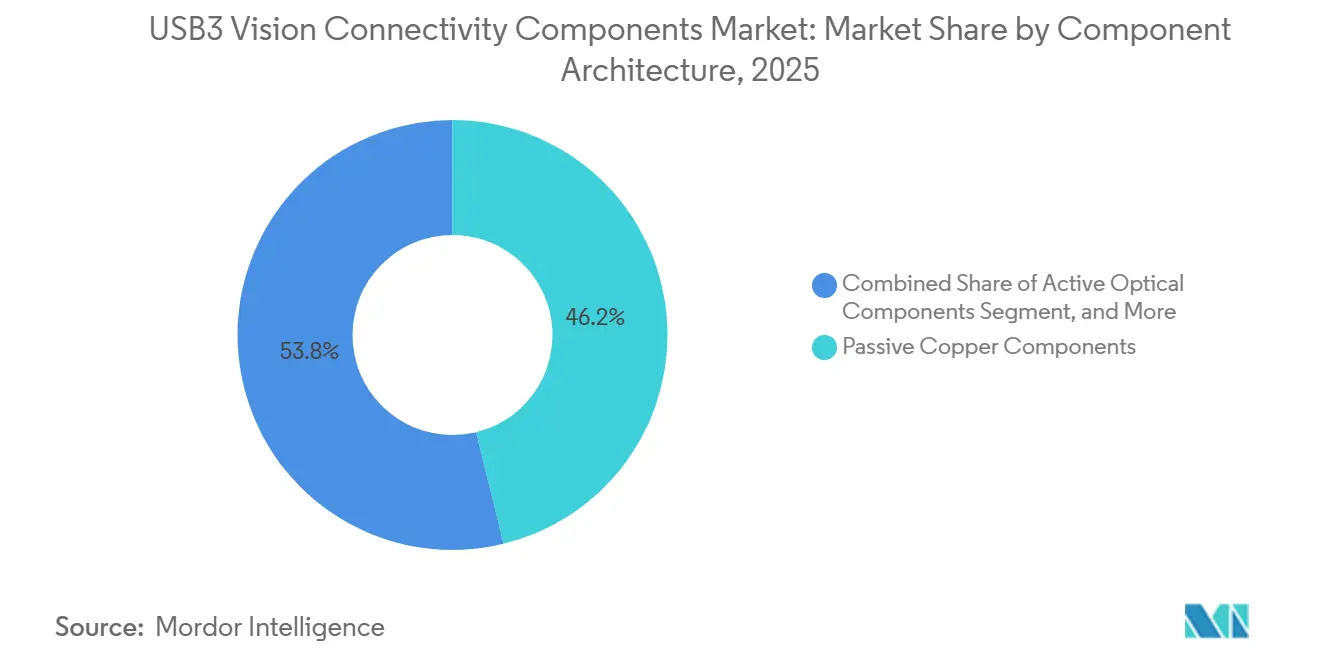
- By component architecture, Passive Copper Components accounted for 46.18% of revenue in 2025, while Active Optical Components are projected to expand at a 10.86% CAGR through 2031.
- By end-user industry, Electronics and Semiconductor Manufacturers held 27.84% of the USB3 Vision Connectivity Components Market share in 2025 and are projected to expand at a 9.38% CAGR through 2031.
- By geography, Asia-Pacific accounted for 40.63% of global revenue in 2025 and is projected to expand at a 9.61% CAGR through 2031.
Note: Market size and forecast figures in this report are generated using Mordor Intelligence’s proprietary estimation framework, updated with the latest available data and insights as of January 2026.
Global USB3 Vision Connectivity Components Market Trends and Insights
Drivers Impact Analysis*
| Driver | (~) % Impact on CAGR Forecast | Geographic Relevance | Impact Timeline |
|---|---|---|---|
| Standardized GenICam-Based Interoperability | +2.1% | Global | Long term (≥ 4 years) |
| Plug-and-Play Adoption on Standard PC Architectures | +1.7% | Global, strongest in North America and Europe | Medium term (2-4 years) |
| Embedded Vision and Edge-AI Deployment | +1.4% | Asia-Pacific core, extending to North America | Medium term (2-4 years) |
| Rising High-Resolution Inspection Throughput Requirements | +1.1% | Asia-Pacific core, secondary in Europe | Long term (≥ 4 years) |
| Longer-Reach Active and Optical USB3 Vision Connectivity | +0.9% | Global | Short term (≤ 2 years) |
| Multi-Camera Synchronization in Compact Inspection Cells | +0.6% | Europe and North America | Short term (≤ 2 years) |
| Source: Mordor Intelligence | |||
Standardized GenICam-Based Interoperability Unlocks Multi-Vendor Cell Design
EMVA released the GenICam Package 2025.10 in late 2025, including GenApi 3.5 and GenTL 1.6. The release extended software support for GenDC container transfer mode and more device-description options. One runtime can therefore manage compliant cameras using GigE Vision, USB3 Vision, CoaXPress, and Camera Link HS. This reduces the need for separate configuration files in mixed-vendor inspection cells. For the USB3 Vision Connectivity Components Market, certified cables, hubs, and IP cores can access a broader software ecosystem once they pass the applicable compliance tests. The certification process also favors suppliers that invest in qualification and can reduce validation work at factory sites.[1]
Plug-and-Play Adoption on Standard PC Architectures Drives Volume Deployments
USB3 Vision uses standard PC host controllers and does not require proprietary frame-grabber cards in many installations. This lowers equipment and maintenance requirements for smaller camera cells. The Basler pylon and IDS peak use the GenICam transport layer in user space, which simplifies cable replacement and firmware updates. The USB3 Vision Connectivity Components Market, therefore, has a durable base in applications that prioritize serviceability over maximum bandwidth. This applies to first-time buyers of lower-priced cameras in expanding SMT lines across Southeast Asia and India. The EU Cyber Resilience Act, which becomes applicable from December 2027, also supports interest in SDK stacks with auditable firmware-signing chains.[2]
Embedded Vision and Edge-AI Deployment Elevates IP Core Demand
Moving AI processing to the inspection line reduces the need to send each image to a remote system. This supports demand for embedded USB3 Vision transport in FPGA and system-on-chip designs. Lattice updated its CrossLinkU-NX USB3 Vision reference design in February 2026 and released a new bitstream in June 2026. The design connects an MIPI CSI-2 sensor to a USB3 SuperSpeed host while using an integrated processor and software environment. Cognex also expanded its cloud-to-edge model by placing trained inspection models on local vision controllers. The USB3 Vision Connectivity Components Market can benefit as each new edge platform creates design-in opportunities for transport IP and embedded interface modules.[3]
Rising High-Resolution Inspection Throughput Requirements Deepen Cable Qualification Cycles
Semiconductor inspection systems increasingly require high image resolution with short cycle times. IDS used its USB3 Vision uEye CP camera with a Sony IMX183 20.44 MP sensor in Micro-LED transfer and HBM die-bonding systems during 2025. Allied Vision also introduced the allPIXA evo 32k line-scan camera in October 2025, with 73 kHz line rates at 32,768 pixels. These applications place sustained demands on cable assemblies and host interface cards. The USB3 Vision Connectivity Components Market gains replacement demand when a resolution increase requires renewed link qualification. This replacement cycle can occur independently of the camera refresh cycle.[4]
Restraints Impact Analysis*
| Restraint | (~) % Impact on CAGR Forecast | Geographic Relevance | Impact Timeline |
|---|---|---|---|
| Passive-Cable Distance and Bandwidth Limits | -1.0% | Global | Short term (≤ 2 years) |
| Power Constraints for High-Performance Cameras | -0.6% | Global, pronounced in Asia-Pacific | Medium term (2-4 years) |
| Host-Chipset, Driver, and Signal-Integrity Qualification Risk | -0.4% | North America and Europe | Short term (≤ 2 years) |
| Substitution by GigE Vision, CoaXPress, and Camera Link HS | -0.5% | Europe and North America | Long term (≥ 4 years) |
| Source: Mordor Intelligence | |||
Passive-Cable Distance and Bandwidth Limits Constrain Large-Cell Deployments
Passive copper links are generally limited to 5 meters and can require shorter runs in demanding configurations. Performance at longer distances depends on the host controller, cable shielding, and camera power demand. This constrains the USB3 Vision Connectivity Components Market because it adds qualification work that GigE Vision can avoid with much longer cable runs. Infineon’s EZ-USB FX10 in a 3M passive 5-meter cable supports 10 Gbps operation and improves signal tolerance. However, additional controller content narrows the cost advantage of USB3 Vision over competing interfaces for 5-15-meter links. Active repeater and optical solutions address the problem but add power management and qualification requirements.
Power Constraints for High-Performance Cameras Limit Multi-Camera Bus Configurations
USB bus power is limited to 4.5 W per port under the stated USB3 power delivery configuration. High-resolution area-scan cameras with cooling or onboard processing can approach or exceed this limit. A shared hub distributes available bus current across connected cameras and can create voltage-drop risks during burst inspection. IDS Imaging and Basler use power-management features and low-power camera designs, but these measures do not change the underlying power limit. In Asia-Pacific semiconductor fabs, stations with 8 or more cameras may require externally powered hubs or an alternative interface. This increases the bill of materials and limits the use of USB3 Vision in dense camera cells.
*Our forecasts treat driver/restraint impacts as directional, not additive. The impact forecasts reflect baseline growth, mix effects, and variable interactions.
Segment Analysis
By Product Type: Cables Lead Revenue While Embedded Interfaces Lead Future Demand
USB3 Vision Cables and Cable Assemblies accounted for 43.27% of product-type revenue in 2025, reflecting demand for cables for each camera installed in electronics assembly, automotive inspection, and life science imaging cells. 3M’s 1U30G Series supports runs of up to 7 meters. Its 1U30P-TC Series, introduced in July 2026, supports 10 Gbps transmission over Standard-A-to-Type-C connections up to 5 meters. Within the USB3 Vision Connectivity Components Market, these products show how cable suppliers are extending performance in fixed industrial installations, while Connectors and Receptacles remain the second-largest product subcategory. Camera designs use different mechanical formats.
USB3 Vision Embedded Video Interfaces and IP Cores are projected to expand at a 10.42% CAGR through 2031. FPGA vendors are placing USB3 Vision transport directly in edge system-on-chip and FPGA designs, including Lattice’s CrossLinkU-NX with its hardened USB 3.2 Gen 1 interface. This can remove the need for a separate bridge chip in some camera modules. Hubs, host interface cards, external frame grabbers, software, SDKs, and drivers address the integration layer around the camera. MVTec HALCON and Pleora eBUS provide libraries that separate transport handling from the application layer, while the USB3 Vision Connectivity Components industry relies on A3 compliance for several automotive and semiconductor OEM programs.

By Cable Technology: Active Optical Cables Address Longer-Distance Requirements
Twisted-Pair Copper Cables held 51.36% of cable technology revenue in 2025. Their position stems from short-run installations in which 3-5-meter passive cables meet data-transfer needs at a lower cost. These products do not require external power or active electronic components and work with USB3 Vision host controllers without driver modifications. Twinax Copper Cables provide 5-8-meter extensions in medium-density cells. Active Copper Cables are used in robotics and drag-chain settings where repeated bending is required.
Active Optical Cables are projected to expand at a 10.27% CAGR through 2031. They provide 10 Gbps transmission over distances that passive copper cannot serve in electromagnetically demanding environments. Alysium-Tech USB 3.2 Gen2 cables support lengths up to 100 meters and use USB VBus for power, eliminating the need for an external power source. The products can supply 800 mA at 5 V to a camera over distances up to 15 meters. The USB3 Vision Connectivity Components Market includes these products in Chinese semiconductor and flat-panel manufacturing sites with long equipment spacing, while Hybrid Optical-Power Cables serve cameras above the 4.5 W USB bus limit.
By Component Architecture: Passive Copper Holds Volume While Active Optical Gains Use Cases
Passive Copper Components held 46.18% of component architecture revenue in 2025. The position is linked to lower unit cost, no need for thermal management, and limited exposure to active failure in continuous production. This makes passive products suitable across the USB3 Vision Connectivity Components Market for first-time machine vision installations. Active Copper Components use signal conditioning and retiming circuitry to support 5-15 meter USB3.2 Gen2 links. Infineon’s EZ-USB FX10 provides 28 dB insertion-loss tolerance and an integrated eye monitor for link-quality feedback.
Active Optical Components are projected to expand at a 10.86% CAGR through 2031. Optical transceiver miniaturization and lower fiber assembly costs are narrowing the gap with active copper options. At Vision China 2026, suppliers showed USB3.0 6 MP cameras in 29 × 29 × 29 mm formats and dual-optical-port 25 MP inspection cameras. For the USB3 Vision Connectivity Components Market, the displays indicated broader use of optical topologies beyond high-end semiconductor inspection. Hybrid Copper-Fiber Components combine copper power delivery with fiber data transmission for robot-arm imaging heads.
By End-User Industry: Semiconductor Applications Support Leading Demand and Growth
Electronics and Semiconductor Manufacturers accounted for 27.84% of end-user revenue in 2025 and are projected to expand at a 9.38% CAGR through 2031. In the USB3 Vision Connectivity Components Market, rising wafer and die inspection requirements require regular upgrades to cables, interfaces, and SDKs within existing production lines. IDS deployed USB3 Vision uEye CP cameras in Micro-LED chip transfer and HBM die-bonding systems in 2025. These applications require image quality and latency control for sub-micron alignment. Automotive and Mobility Manufacturers formed the second-largest end-user group for PCB, battery-cell, and body-panel inspection.
General Manufacturing and Machinery OEMs, Healthcare and Life Sciences Institutions, and Research Institutions and Universities form the next demand group. Fluorescence microscopy and pathology imaging use USB3 Vision when sample-rate throughput is more important than the highest bandwidth. GenICam SFNC helps laboratories integrate cameras from multiple suppliers. System Integrators and Machine Vision OEMs influence specifications across many downstream installations, and their requests for quotation can favor standardized and A3-certified components. The USB3 Vision Connectivity Components industry depends on suppliers serving both OEM designs and integrator-led deployments.
Geography Analysis
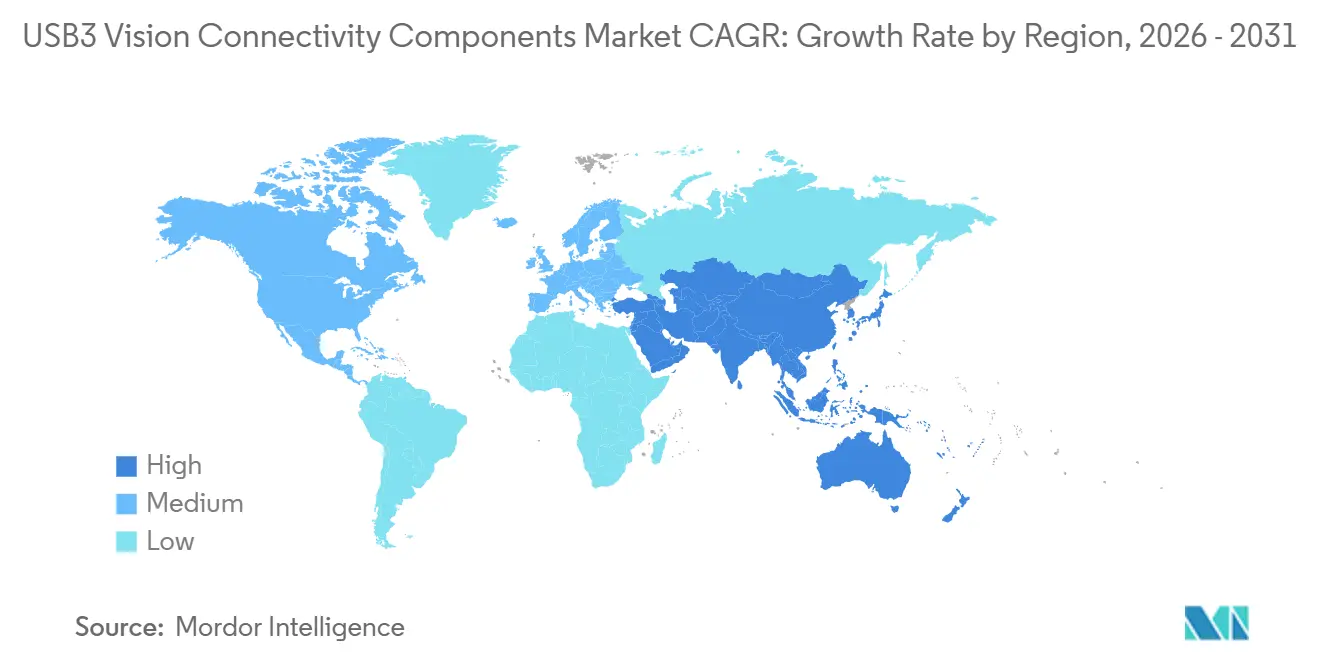
Asia-Pacific held 40.63% of the USB3 Vision Connectivity Components Market share in 2025 and is projected to expand at a 9.61% CAGR through 2031. China is the largest national market in the region, with PCB and semiconductor inspection lines in Guangdong, Jiangsu, and Zhejiang forming a substantial installed base. Industrial automation programs and advanced packaging fabs support replacement demand for cables, connectors, and host interface cards. Japan and South Korea remain technology centers for precision semiconductor inspection, where Omron Sentech, Toshiba Teli, and Vieworks supply precision cameras. Local system integrators increasingly require A3-certified connectivity products.
India and Southeast Asia, including Thailand, Vietnam, and Malaysia, are important areas for expansion in the Asia-Pacific. Greenfield SMT line installations are increasing demand for USB3 Vision Connectivity Components Market, driving demand for USB3 Vision cables and hubs as production diversifies from coastal China. North America and Europe comprise the next demand cluster and use a higher proportion of active optical and hybrid cable designs than the Asia-Pacific. Semiconductor capital equipment OEMs, life sciences users, and research institutions support North American demand. Teledyne Spinnaker and IDS peak SDKs reduce software integration work in these applications.
Europe’s machine vision base is concentrated in Germany and favors compact embedded inspection cells, where Basler pylon is used in OEM designs, and suppliers distribute 3M 10 Gbps cable assemblies. The USB3 Vision Connectivity Components Market will also be affected as the EU Cyber Resilience Act becomes applicable from December 2027, which will support demand for software-signed SDKs. South America, the Middle East, and Africa remain early-stage markets that primarily absorb passive copper cables through system integrator channels. Brazil is the primary South American demand center, while the UAE and Saudi Arabia are developing smart-factory infrastructure, and South Africa is an entry point for camera systems in Africa.
Competitive Landscape
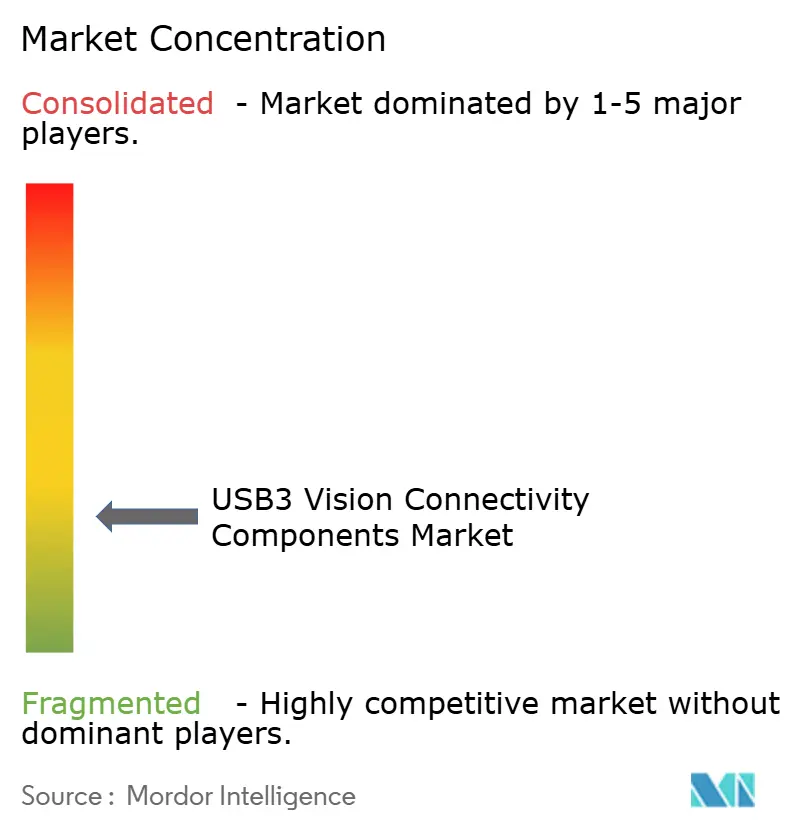
The USB3 Vision Connectivity Components Market is fragmented across its product groups. Cable and connector suppliers compete on certification, industrial durability, and supported cable length. IP core and SDK suppliers compete on software maturity and ecosystem support. 3M and Alysium-Tech supply industrial cable families validated for USB3.2 Gen1 and Gen2 speeds, while Zhaolong Interconnect Technology and COMOSS Electronic participate in high-volume cable assembly supply in the Asia-Pacific. No supplier controls hardware and software across all product categories.
Lattice Semiconductor updated the CrossLinkU-NX USB3 Vision reference design in February and June 2026. Its hardened USB 3.2 PHY and RISC-V integration provide a differentiated option for embedded camera modules. Sensor to Image GmbH and MACNICA pursue customer-specific U3V IP licensing for camera module applications. Hybrid copper-fiber products for robot-arm cameras and trigger hubs for camera synchronization present opportunities. In the USB3 Vision Connectivity Components Market, SDK suppliers can gain an advantage by supporting the GenDC pipeline early in the product cycle.
Teledyne Technologies announced an agreement in August 2026 to acquire Varex Imaging Corporation for USD 1.1 billion, broadening its imaging component range and potentially supporting future integration with USB3 Vision-compatible frame grabbers. Allied Vision consolidated 5 machine vision brands under its name in January 2026, creating a single offering that covers cameras, frame grabbers, IP cores, and software under 1 SDK. 3M introduced the 1U30P-TC Series in July 2026 for fixed-installation inspection systems that need 10 Gbps transmission. These actions show that competition in the USB3 Vision Connectivity Components Market centers on broader product coverage, embedded designs, and higher-performance cable assemblies.
USB3 Vision Connectivity Components Industry Leaders
-
Basler AG
-
Teledyne Technologies Incorporated
-
3M Company
-
Pleora Technologies Inc.
-
Euresys S.A.
- *Disclaimer: Major Players sorted in no particular order
Recent Industry Developments
- September 2026: Allied Vision launched the Alecs VSWIR Smart Camera, integrating edge-AI capability directly into an infrared inspection platform. The launch was the first application of the newly consolidated Allied Vision brand's unified hardware-software architecture for smart camera deployments.
- August 2026: Teledyne Technologies Incorporated announced a definitive agreement to acquire Varex Imaging Corporation for USD 1.1 billion, expanding Teledyne's imaging component portfolio and strengthening its position in high-energy and advanced industrial inspection markets.
- June 2026: Lattice Semiconductor released an updated CrossLinkU-NX USB3 Vision Reference Design Bitstream, providing FPGA-based USB3 Vision transport at 3.4 Gbps with GenICam-compliant XML, multi-format video support, and hardware trigger capabilities for embedded inspection applications.
- June 2026: 3M Company launched the USB3 Vision Industrial Camera Cable Assembly 1U30P-TC Series, delivering reliable 10 Gbps USB3.2 Gen2 data transmission over Standard-A to Type-C connections at distances up to 5 meters, specifically engineered for fixed-installation, high-throughput industrial inspection environments.
Global USB3 Vision Connectivity Components Market Report Scope
USB3 Vision Connectivity Components refer to the specialized hardware and software infrastructure required to implement the USB3 Vision standard, enabling high-speed, plug-and-play data transmission between industrial cameras and host systems while ensuring robust signal integrity, power delivery, and interoperability in machine vision applications.
The USB3 Vision Connectivity Components Market Report is Segmented by Product Type (USB3 Vision Cables and Cable Assemblies, USB3 Vision Connectors and Receptacles, USB3 Vision Hubs and Host Interface Cards, USB3 Vision External Frame Grabbers, USB3 Vision Embedded Video Interfaces and IP Cores, and USB3 Vision Software, SDKs, and Drivers), Cable Technology (Twisted-Pair Copper Cables, Twinax Copper Cables, Active Copper Cables, Active Optical Cables, and Hybrid Optical-Power Cables), Component Architecture (Passive Copper Components, Active Copper Components, Active Optical Components, and Hybrid Copper-Fiber Components), End-User Industry (Automotive and Mobility Manufacturers, Electronics and Semiconductor Manufacturers, General Manufacturing and Machinery OEMs, Healthcare and Life Sciences Institutions, Research Institutions and Universities, System Integrators and Machine Vision OEMs, and Other End-User Industries), and Geography (North America, South America, Europe, Asia-Pacific, Middle East and Africa). The Market Forecasts are Provided in Terms of Value (USD).
| USB3 Vision Cables and Cable Assemblies |
| USB3 Vision Connectors and Receptacles |
| USB3 Vision Hubs and Host Interface Cards |
| USB3 Vision External Frame Grabbers |
| USB3 Vision Embedded Video Interfaces and IP Cores |
| USB3 Vision Software, SDKs, and Drivers |
| Twisted-Pair Copper Cables |
| Twinax Copper Cables |
| Active Copper Cables |
| Active Optical Cables |
| Hybrid Optical-Power Cables |
| Passive Copper Components |
| Active Copper Components |
| Active Optical Components |
| Hybrid Copper-Fiber Components |
| Automotive and Mobility Manufacturers |
| Electronics and Semiconductor Manufacturers |
| General Manufacturing and Machinery OEMs |
| Healthcare and Life Sciences Institutions |
| Research Institutions and Universities |
| System Integrators and Machine Vision OEMs |
| Other End-User Industries |
| North America | United States | |
| Canada | ||
| Mexico | ||
| South America | Brazil | |
| Argentina | ||
| Rest of South America | ||
| Europe | Germany | |
| United Kingdom | ||
| France | ||
| Italy | ||
| Spain | ||
| Rest of Europe | ||
| Asia-Pacific | China | |
| Japan | ||
| India | ||
| South Korea | ||
| Rest of Asia-Pacific | ||
| Middle East and Africa | Middle East | Saudi Arabia |
| United Arab Emirates | ||
| Turkey | ||
| Rest of the Middle East | ||
| Africa | South Africa | |
| Nigeria | ||
| Rest of Africa | ||
| By Product Type | USB3 Vision Cables and Cable Assemblies | ||
| USB3 Vision Connectors and Receptacles | |||
| USB3 Vision Hubs and Host Interface Cards | |||
| USB3 Vision External Frame Grabbers | |||
| USB3 Vision Embedded Video Interfaces and IP Cores | |||
| USB3 Vision Software, SDKs, and Drivers | |||
| By Cable Technology | Twisted-Pair Copper Cables | ||
| Twinax Copper Cables | |||
| Active Copper Cables | |||
| Active Optical Cables | |||
| Hybrid Optical-Power Cables | |||
| By Component Architecture | Passive Copper Components | ||
| Active Copper Components | |||
| Active Optical Components | |||
| Hybrid Copper-Fiber Components | |||
| By End-User Industry | Automotive and Mobility Manufacturers | ||
| Electronics and Semiconductor Manufacturers | |||
| General Manufacturing and Machinery OEMs | |||
| Healthcare and Life Sciences Institutions | |||
| Research Institutions and Universities | |||
| System Integrators and Machine Vision OEMs | |||
| Other End-User Industries | |||
| By Geography | North America | United States | |
| Canada | |||
| Mexico | |||
| South America | Brazil | ||
| Argentina | |||
| Rest of South America | |||
| Europe | Germany | ||
| United Kingdom | |||
| France | |||
| Italy | |||
| Spain | |||
| Rest of Europe | |||
| Asia-Pacific | China | ||
| Japan | |||
| India | |||
| South Korea | |||
| Rest of Asia-Pacific | |||
| Middle East and Africa | Middle East | Saudi Arabia | |
| United Arab Emirates | |||
| Turkey | |||
| Rest of the Middle East | |||
| Africa | South Africa | ||
| Nigeria | |||
| Rest of Africa | |||
Key Questions Answered in the Report
What is the size of the USB3 Vision Connectivity Components Market?
The USB3 Vision Connectivity Components Market was USD 648.74 million in 2026 and is forecast to reach USD 937.05 million by 2031 at a 7.63% CAGR.
What products lead demand in USB3 Vision connectivity components?
USB3 Vision Cables and Cable Assemblies led product-type revenue with a 43.27% share in 2025.
Which cable technology is expected to expand fastest?
Active Optical Cables are projected to expand at a 10.27% CAGR through 2031 because they support longer 10 Gbps links in high-interference environments.
Which end users create the largest demand for these components?
Electronics and Semiconductor Manufacturers held 27.84% of 2025 end-user revenue and are projected to expand at a 9.38% CAGR through 2031.
Which region is expected to expand fastest through 2031?
Asia-Pacific held 40.63% of revenue in 2025 and is projected to expand at a 9.61% CAGR through 2031.
What limits USB3 Vision adoption in larger inspection cells?
Passive-cable distance limits, bus-power constraints, and host qualification needs can favor GigE Vision, CoaXPress, or Camera Link HS in larger installations.