
CoaXPress-over-Fiber Components Market Size and Share
Market Overview
| Study Period | 2020 - 2031 |
|---|---|
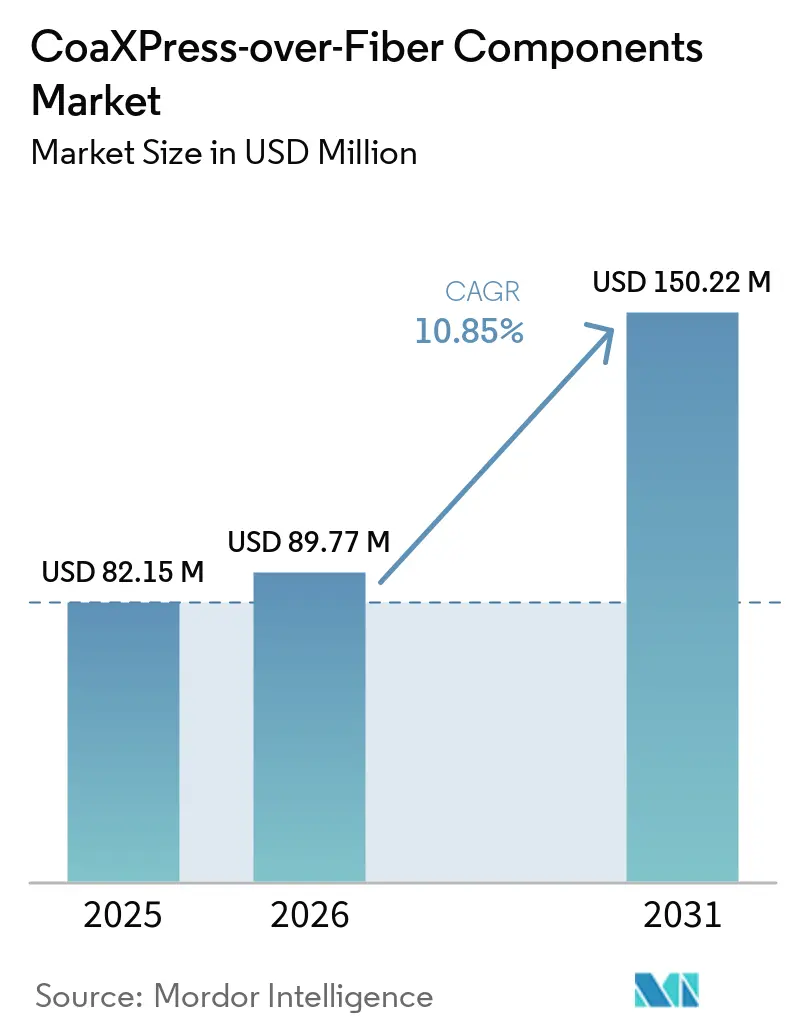
| Market Size (2026) | USD 89.77 Million |
| Market Size (2031) | USD 150.22 Million |
| Growth Rate (2026 - 2031) | 10.85 % |
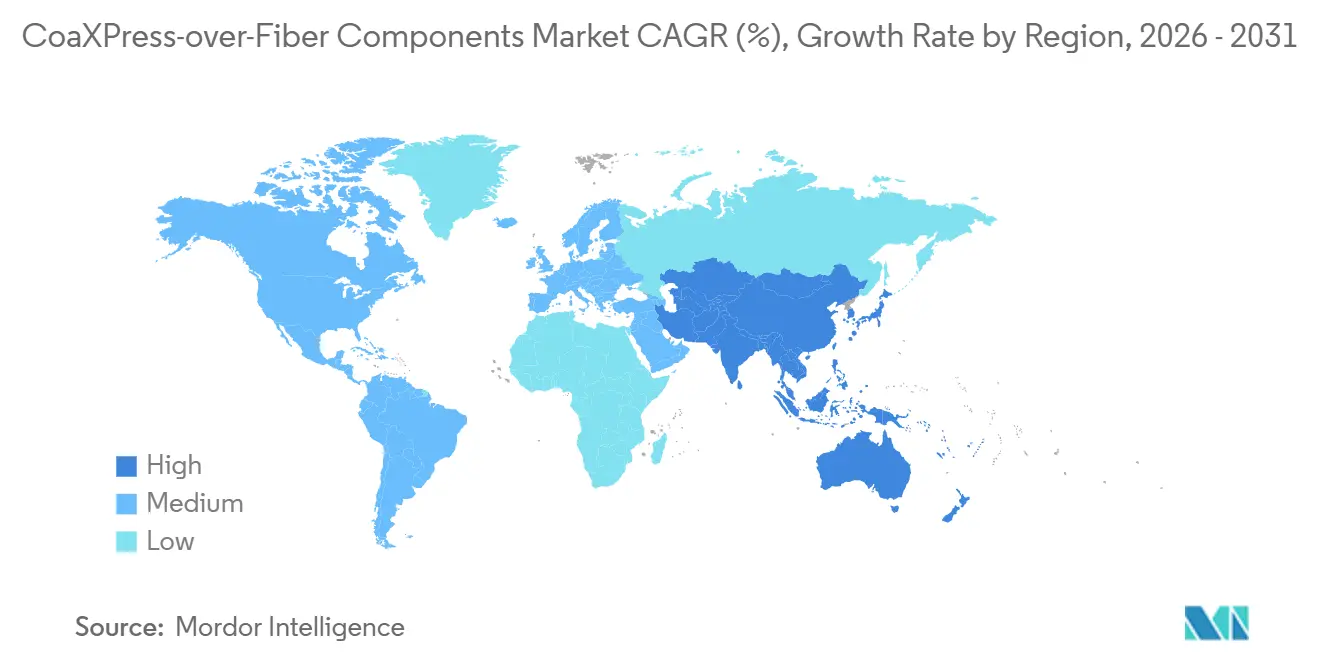
| Fastest Growing Market | Asia-Pacific |
| Largest Market | Asia-Pacific |
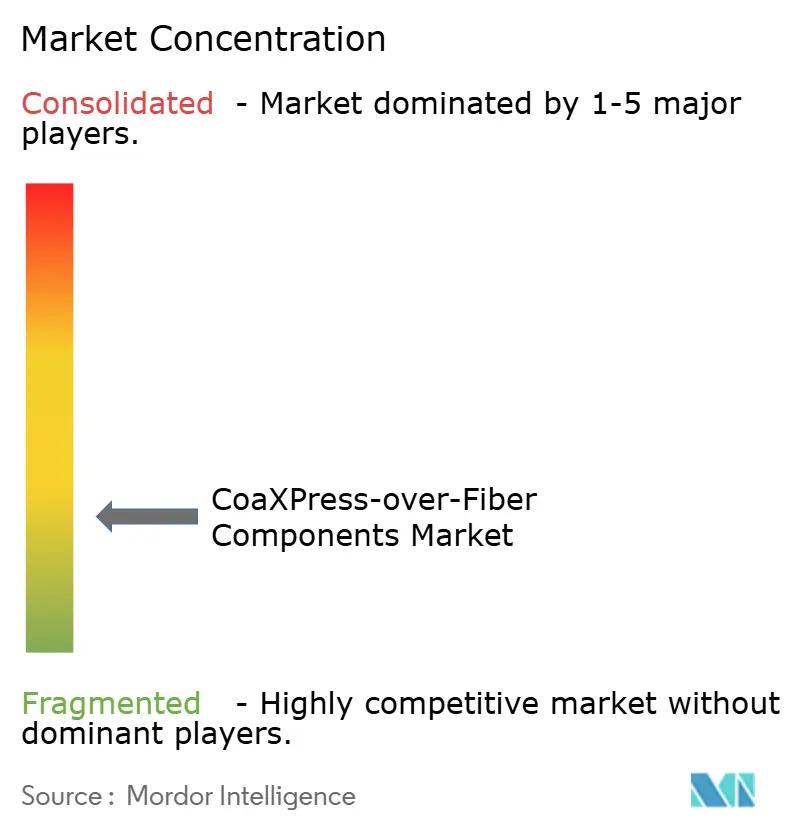
| Market Concentration | Low |
Major Players *Disclaimer: Major Players sorted in no particular order Image © Mordor Intelligence. Reuse requires attribution under CC BY 4.0. | |
CoaXPress-over-Fiber Components Market Analysis by Mordor Intelligence
The CoaXPress-over-Fiber Components Market size was valued at USD 82.15 million in 2025 and estimated to expand from USD 89.77 million in 2026 to reach USD 150.22 million by 2031, at a CAGR of 10.85% during the forecast period, 2026-2031. The CoaXPress-over-Fiber Components Market is moving toward distributed imaging systems that require high bandwidth, reliable transmission, and longer cable runs. Fiber extends deployment options beyond the practical 40-meter limit associated with copper CoaXPress systems. The expected CoaXPress v3.0 specification may bring fiber support into the core standard at nominal 25 Gbps per lane. Suppliers are responding by combining cameras, frame grabbers, transceivers, cables, and software in validated systems. This approach can reduce integration work for machine builders while shifting competition toward reliability and total system cost.
Key Report Takeaways
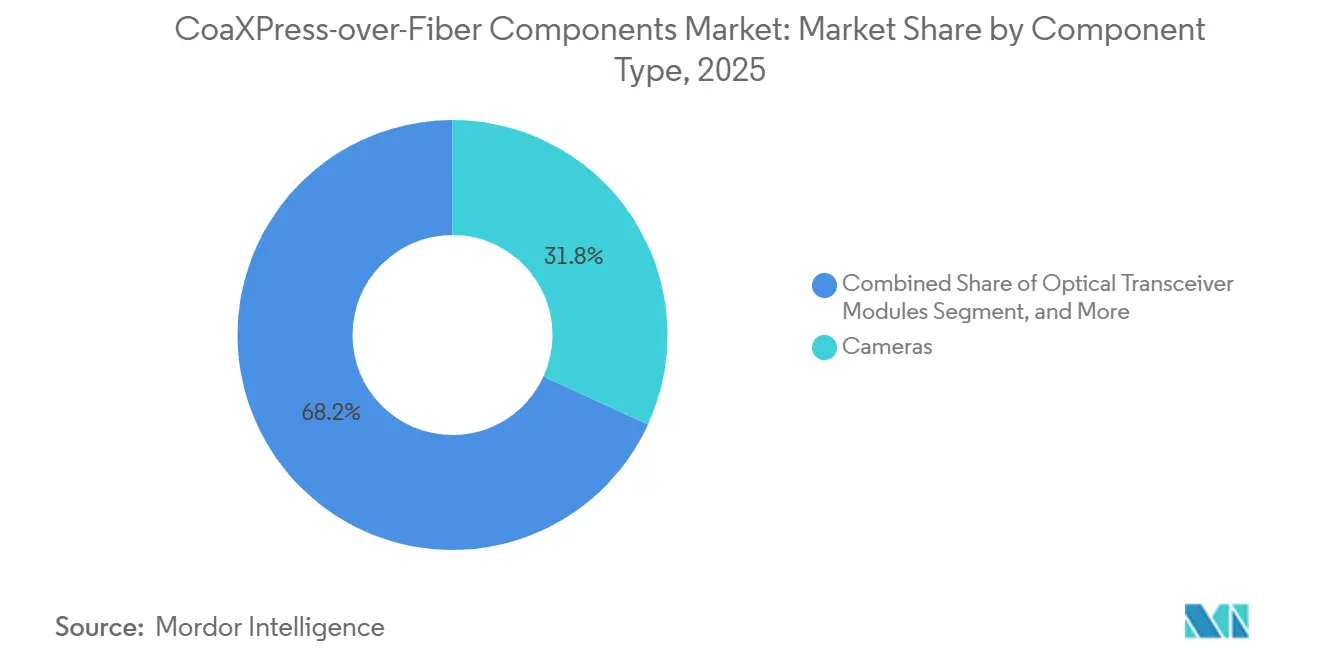
- By component type, cameras held 31.83% of the CoaXPress-over-Fiber Components Market share in 2025, while optical transceiver modules are projected to expand at a 13.63% CAGR through 2031.
- By fiber type, active optical cables accounted for 38.67% of revenue in 2025, while single-mode fiber is expected to grow at a 13.27% CAGR through 2031.
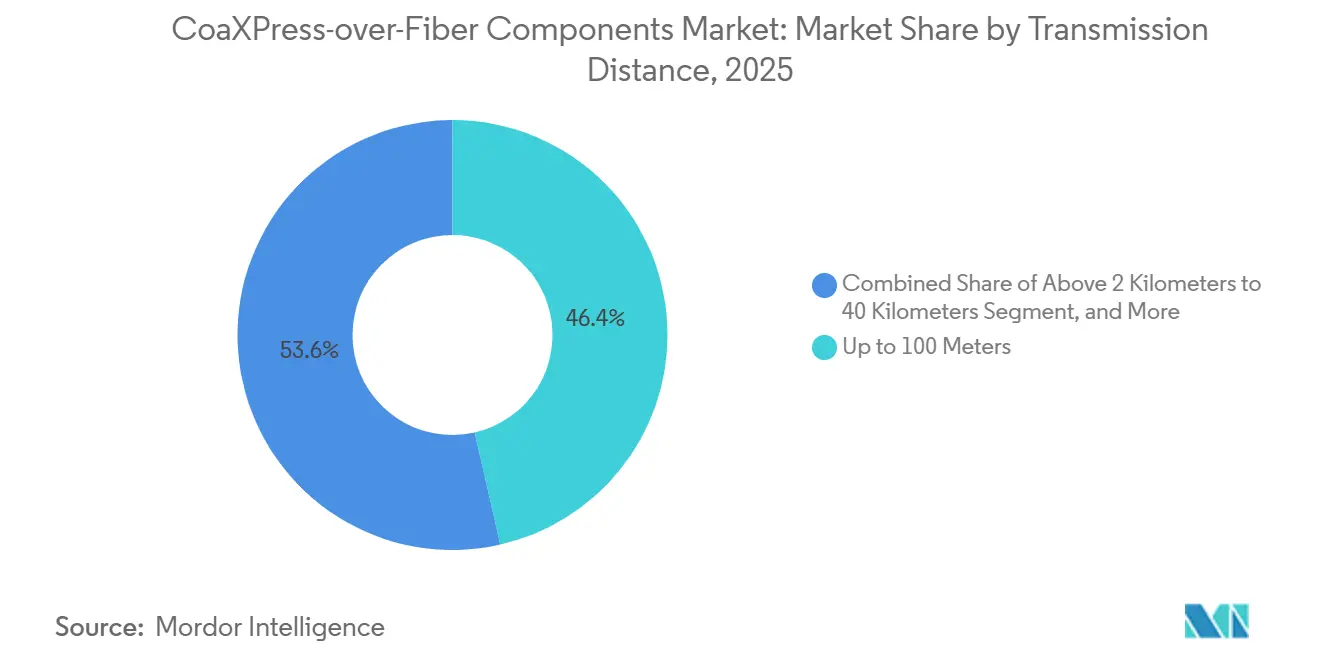
- By transmission distance, links up to 100 meters accounted for 46.43% of revenue in 2025, while the 2-40 kilometers range is projected to grow at a 13.83% CAGR through 2031.
- By end-user industry, semiconductor and integrated circuit manufacturing held 24.73% of revenue in 2025, while automotive and battery manufacturers are projected to expand at a 13.97% CAGR through 2031.
- By geography, North America held 39.57% of global revenue in 2025, while Asia-Pacific is projected to expand at a 12.87% CAGR through 2031.
Note: Market size and forecast figures in this report are generated using Mordor Intelligence’s proprietary estimation framework, updated with the latest available data and insights as of January 2026.
Global CoaXPress-over-Fiber Components Market Trends and Insights
Drivers Impact Analysis*
| Driver | (~) % Impact on CAGR Forecast | Geographic Relevance | Impact Timeline |
|---|---|---|---|
| High-Resolution, Low-Latency Machine Vision Demand | +2.5% | Global | Short term (≤ 2 years) |
| Longer Camera-to-Host Distances in Distributed Inspection | +2.0% | Asia-Pacific and North America | Medium term (2-4 years) |
| Electromagnetic Interference Immunity in Harsh Environments | +1.6% | Europe and North America | Short term (≤ 2 years) |
| Ethernet Component Availability and Bandwidth Scaling | +1.3% | Global, with early gains in North America and Asia-Pacific | Medium term (2-4 years) |
| Fiber Retrofit of Installed CoaXPress Camera Bases | +0.9% | North America and Europe | Short term (≤ 2 years) |
| Optical Data Forwarding for Multi-Stage TDI Inspection | +0.7% | Asia-Pacific semiconductor fabs and European printing and packaging | Long term (≥ 4 years) |
| Source: Mordor Intelligence | |||
Rising Demand for High-Resolution, Low-Latency Machine Vision
Machine vision sensors now support tens of megapixels and hundreds of frames per second, which increases the pressure on camera interfaces. CXP-12 over copper has a practical cable limit of 40 meters, while a 50 Gbps connection can require 4 separate coaxial links. The CoaXPress-over-Fiber Components Market supports equivalent bandwidth through a QSFP+ module and a single fiber cable. This arrangement reduces the number of cables, connectors, and potential failure points in complex inspection cells. Centralized edge computing also needs consistent data delivery from multi-camera arrays. Manufacturers of flat-panel displays and advanced packaging are increasingly considering fiber connections during system design rather than after installation.
Longer Camera-to-Host Distances in Distributed Inspection
CoaXPress-over-Fiber supports runs of up to 120 kilometers over single-mode fiber and 550 meters over multimode fiber. These distances exceed the practical 40-meter limit of copper coaxial CoaXPress.[1] The longer reach strengthens the CoaXPress-over-Fiber Components Market by enabling camera arrays in large production halls, on moving gantries, and in protected control rooms. Semiconductor fabs are a relevant use case because cleanroom partitions can separate inspection tools from computing infrastructure. A direct fiber run also removes repeater power supplies, firmware versions, and maintenance needs. These operational benefits can lower lifecycle complexity for distributed inspection systems.
Electromagnetic Interference Immunity in Harsh Environments
Fiber carries light through a non-conductive glass core and neither radiates nor receives electromagnetic signals. This property helps prevent noise artifacts and packet errors near high-voltage equipment, plasma etch tools, induction heaters, and variable-frequency drives. The CoaXPress-over-Fiber Components Market benefits from this protection in automotive welding and battery production lines that operate under demanding conditions. KAYA Instruments positions its Komodo III Quad frame grabber for aerospace and high-EMI factory deployments that require galvanic isolation.[2] Fiber can also simplify cable management in medical device and pharmaceutical facilities. Its immunity remains relevant as interface bandwidth increases.
Standard Ethernet Component Availability and Bandwidth Scaling
The CoaXPress-over-Fiber Components Market uses standard Ethernet physical-layer components, including SFP+ modules for 10 Gbps and QSFP+ modules for 40 Gbps. Access to these supply chains can improve availability compared with specialized copper assemblies. The planned CoaXPress v3.0 specification is expected later in 2026 and is intended to natively support fiber at a nominal 25 Gbps per lane. Existing fiber infrastructure could therefore support future camera bandwidths without a full cable replacement. Euresys already offers a QSFP28 frame grabber with 4 lanes at 25 Gbps and PCIe Gen 4 x8 host bandwidth of 12,500 MB/s. The product direction indicates that the technology is progressing from a specification roadmap to deployable hardware.
Restraints Impact Analysis*
| Restraint | (~) % Impact on CAGR Forecast | Geographic Relevance | Impact Timeline |
|---|---|---|---|
| System Integration Complexity and Separate Camera Power | -2.1% | Global | Medium term (2-4 years) |
| Limited Native CoaXPress-over-Fiber Camera Availability | -1.7% | Global, acute in Asia-Pacific and Europe | Medium term (2-4 years) |
| Fragmented Interoperability and Validation Requirements | -1.2% | Global, concentrated in Europe and North America | Long term (≥ 4 years) |
| Specialist Design-In and Service Capability Requirements | -0.8% | Global, acute in emerging markets | Long term (≥ 4 years) |
| Source: Mordor Intelligence | |||
Higher System Integration Complexity and Separate Camera Power
Copper CoaXPress can use Power over CoaXPress to deliver power through the same cable. Fiber cannot carry electrical current, so each CoaXPress-over-Fiber camera needs a separate power path. This requirement imposes an adoption constraint on the CoaXPress-over-Fiber Components Market when large arrays require individual power management. BitFlow introduced the QFi module in March 2025 to connect a standard CXP camera to fiber while providing 13 W of PoCXP power at up to 10 Gbps. The module can reduce retrofit barriers, but it adds hardware, a calibration point, and a possible failure mode. This remains important for cost-sensitive automation projects with many cameras.[3]
Limited Native CoaXPress-over-Fiber Camera Availability
The installed base includes many CoaXPress cameras designed before the CoF extension was standardized in 2021. Native models with optics built into the camera remain less common than copper camera models. Vieworks demonstrated the VC-21 MHF at Automatica 2025, featuring 21 MP resolution and 575 fps via CoaXPress-over-Fiber. This limited choice constrains the CoaXPress-over-Fiber Components Market because system builders may need external bridge modules. Those configurations increase integration cost and reduce the simple installation experience associated with traditional CoaXPress systems. Camera suppliers must balance premium fiber products against the greater existing demand for copper-based models.[4]
*Our forecasts treat driver/restraint impacts as directional, not additive. The impact forecasts reflect baseline growth, mix effects, and variable interactions.
Segment Analysis
By Component Type: Cameras Lead Revenue While Transceiver Modules Expand Fastest
Cameras held 31.83% of revenue in 2025, making them the largest component category. Their role reflects the continued replacement of Camera Link and copper CoaXPress systems with higher-throughput imaging platforms. Frame grabbers and interface cards remain essential because each camera installation needs a compatible host-side QSFP+ or QSFP28 connection. The CoaXPress-over-Fiber Components industry, therefore, links camera demand directly to frame grabber demand. OKI Electric Wire introduced a 3.7 mm K-type CoaXPress 2.0 cable in November 2025 with 50 million flex-cycle durability for robotic-arm semiconductor inspection equipment. This product shows that cables and accessories can be differentiated by mechanical performance rather than treated as basic add-ons.
Optical transceiver modules are projected to expand at a 13.63% CAGR through 2031, the highest rate among component types. The CoaXPress-over-Fiber Components Market size for optical transceiver modules is supported by the adoption of QSFP+ and QSFP28 form factors from established Ethernet supply chains. Basler introduced the imaFlex 2 Dual 100 frame grabber in April 2026, featuring dual QSFP28 ports delivering 100 Gbps per connector. Signal converters, bridge IP cores, drivers, SDKs, connectors, and accessories complete the category set. Allied Vision offers a licensable bridge host IP core for camera OEMs that want native CoF capability without developing the protocol bridge internally. These options give OEMs several ways to add fiber support at different stages of product design.

By Fiber Type: Active Optical Cables Retain the Installed Base While Single-Mode Fiber Expands
Active optical cables held 38.67% of fiber-type revenue in 2025. Their integrated optics and pre-terminated design simplify installations, as customers do not need separate transceivers and patch cables. Their cost position is strongest at distances of 100 meters or below. The CoaXPress-over-Fiber Components Market size associated with active optical cables benefits from data-center production volumes that have reduced unit costs. These cables are practical for factory cells that require higher bandwidth and electromagnetic immunity over relatively short transmission distances. They also provide a clear transition path for installations moving away from high-grade copper assemblies.
Single-mode fiber is projected to expand at a 13.27% CAGR through 2031, the fastest rate in this segmentation. Semiconductor fab projects and aerospace applications need camera-to-host distances that can exceed the 550-meter capability of multimode fiber. KAYA Instruments states that its CoaXPress-to-CoaXPress-over-Fiber converter supports up to 80 kilometers over single-mode fiber and 300 meters over multimode fiber. Multimode fiber is used for mid-range applications, including large automated optical inspection lines and automotive vision stations. Direct attach copper and hybrid links remain relevant in short-reach and cost-sensitive deployments. The CoaXPress-over-Fiber Components industry is also benefiting from supply-chain overlap between industrial imaging and data-center optical products.
By Transmission Distance: Short Links Lead Revenue While 2 to 40 Kilometer Deployments Accelerate
Links up to 100 meters held 46.43% of revenue in 2025. This segment covers factory-floor systems where bandwidth consolidation and electromagnetic interference protection matter more than extended reach. This distance range reflects the broad installed base of industrial cameras and host computers located within the same production area. The 101 meters to 2 kilometers range serves inspection systems that span automotive body shops, printed circuit board facilities, and packaging lines. Fiber avoids the multiple repeaters that long copper routes would otherwise require. The segment remains a practical entry point for manufacturers that need performance gains without campus-scale cabling.
The 2-40 kilometers range is projected to expand at a 13.83% CAGR through 2031. The CoaXPress-over-Fiber Components Market size for the range is linked to semiconductor campuses, aerospace hangars, and remote industrial monitoring sites. BitFlow states that its Claxon frame grabber and QFi module support single-mode fiber runs of up to 120 kilometers. Available hardware, therefore, supports longer runs than many current installations require. Above 40 kilometers remains a smaller category relevant to defense, remote surveillance, and scientific instrumentation. These applications value deterministic transmission over distances that other machine-vision interfaces may not support as effectively.
By End-User Industry: Semiconductor Manufacturing Leads While Battery Inspection Expands Fastest
Semiconductor and integrated circuit manufacturing held 24.73% of revenue in 2025. Advanced packaging and wafer inspection need high-throughput data handling, especially when line-scan systems operate at high resolution. Basler's Racer 2 XL TDI camera operates at up to 500 kHz line rate and 16K resolution, with 256 TDI stages, in its April 2026 CoF system. This vertical is a core part of the CoaXPress-over-Fiber Components Market because it needs validated interfaces in precision inspection. ISO 9001 and SEMI-related equipment requirements also support standardized imaging architectures. Electronics and PCB production, aerospace and defense, medical imaging, pharmaceutical and life sciences manufacturing, industrial production, and printing, packaging, and web inspection drive demand across the remaining end-user base.
Automotive and battery manufacturers are projected to expand at a 13.97% CAGR through 2031. Battery cell inspection requires full optical coverage of electrode foils and requires camera placement that can exceed copper cable limits. GM used AI-based gas-imaging cameras and edge computing in its BVSeal automated battery-tray inspection system in 2025. Atlas Copco's VisionTools AI platform was deployed for EV battery assembly inspection in 2025. These deployments show that vision systems are being used across more assembly stages rather than only at the end of the line. This broader placement increases the need for reliable imaging links in large production facilities.
Geography Analysis
North America held 39.57% of global revenue in 2025. The region benefits from semiconductor foundries, aerospace integrators, and machine vision OEMs that can specify fiber systems during the design stage. The United States leads the regional base, while Canada and Mexico add demand through automotive supply-chain inspection and EV battery assembly. North American leadership in the CoaXPress-over-Fiber Components Market is also supported by copper CoaXPress installations that can be retrofitted with fiber. BitFlow's QFi module can help existing camera users make this transition with lower initial equipment changes.
Europe is the second-largest regional market. Germany's machine vision clusters around Munich and Stuttgart support demand from camera suppliers and system integrators. Basler introduced its complete CoaXPress-over-Fiber TDI vision system in April 2026, while Chromasens introduced the allPIXA evo 16k in January 2025 and the allPIXA evo 32k in September 2025. Printing, packaging, and flat-panel display inspection support medium-distance demand in Germany, Italy, and France. The United Kingdom, France, Italy, and Spain add demand through automotive suppliers that deploy in-line battery and body-panel inspection.
Asia-Pacific is projected to expand at a 12.87% CAGR through 2031, making it the fastest-growing region. Japan is strategically important because the Japan Industrial Imaging Association hosts the CoaXPress specification, and domestic suppliers develop compatible products. OKI Electric Wire introduced its slim, high-flex cable for semiconductor inspection in November 2025 and set a fiscal year 2026 sales target of JPY 100 million (USD 700,000). South Korea and Japan host OLED panel and NAND flash facilities that require high-throughput TDI inspection. China is expanding adoption of CXP-12 across its domestic machine-vision base, while India’s electronics manufacturing expansion is creating early demand for inspection systems. South America remains smaller, with Brazil's automotive sector providing the primary contribution, while the Middle East and Africa have isolated demand from defense and infrastructure monitoring.
Competitive Landscape
The CoaXPress-over-Fiber Components Market has fragmentation among frame grabber and signal converter suppliers. Basler AG, Euresys, KAYA Instruments, BitFlow, and Advantech have a meaningful presence in these categories. Cameras, transceivers, and accessories remain more fragmented because suppliers compete through specialized performance or regional pricing. The CoaXPress-over-Fiber Components Market is increasingly defined by validated system integration rather than a single component specification. This shift makes compatibility among cameras, frame grabbers, fiber modules, cables, and software an important selection factor.
Basler introduced a complete TDI vision system in April 2026 that combined its Racer 2 XL TDI camera, imaFlex 2 Dual 100 frame grabber, QSFP28 modules, cables, and Pylon software. The package targets wafer, battery cell, flat-panel display, and PCB inspection. Active Silicon introduced the 40 Gbps FireBird CoaXPress over Fiber 4xCOF-12 frame grabber in June 2025 using QSFP+-compatible connectors. Allied Vision offers a licensable bridge IP core for OEMs that want to integrate the protocol into custom FPGA designs. These strategies reduce the need for buyers to assemble and validate every part of the link independently.
Euresys offers a Coaxlink QSFP28 product with a 100 Gbps acquisition rate and 8 GB of on-board memory for burst handling. This approach focuses on semiconductor inspection projects where throughput and reliability can outweigh cost per gigabit. Suppliers are also adding image preprocessing functions that can reduce storage and compute requirements in high-volume inspection. In parallel, 25GigE and 100GigE Vision remain alternatives for applications that value network flexibility over deterministic latency. Commodity Ethernet transceiver production can pressure optical module margins, but it can also improve availability and supply security. The CoaXPress-over-Fiber Components Market is therefore likely to reward suppliers that combine bandwidth, interoperability, and validated deployment support.
CoaXPress-over-Fiber Components Industry Leaders
-
Euresys S.A.
-
Basler AG
-
KAYA Instruments Ltd.
-
Active Silicon Limited
-
BitFlow, Inc.
- *Disclaimer: Major Players sorted in no particular order
Recent Industry Developments
- April 2026: Basler AG introduced a complete CoaXPress-over-Fiber TDI vision system featuring the racer 2 XL TDI line-scan camera (16K resolution, up to 500 kHz line rate, 256 TDI stages, GPixel GLT5016BSI CMOS sensor) paired with the imaFlex 2 Dual 100 frame grabber (dual QSFP28 ports, 100 Gbps per port, PCIe interface). Integrated image preprocessing delivers 20-50% bandwidth reduction, lowering downstream storage and compute requirements. The system targets wafer and semiconductor inspection, battery cell inspection, flat panel display, and PCB inspection applications.
- March 2026: Onto Innovation launched the Dragonfly G5 inspection and metrology platform for sub-micron 2D/3D macro defect detection, capable of identifying defects as small as 150 nm across front-end and advanced packaging process nodes. The system integrates AI-powered vision and multi-mode illumination, driving demand for the ultra-high-throughput CoF imaging links required by next-generation semiconductor inspection tools.
- March 2025: OKI Electric Wire (Japan) launched the slim K-type CoaXPress 2.0 cable, with a 3.7 mm outer diameter and 50 million flex-cycle durability for movable and robotic-arm sections in semiconductor manufacturing inspection equipment. Mass production at OKI's Gunma factory began November 2025, with a fiscal year 2026 sales target of JPY 100 million (USD 700,000).
- September 2025: Chromasens GmbH launched the allPIXA evo 32k line-scan camera, combining a 32,768-pixel monochrome CMOS sensor with a CXP-12 four-lane interface (50 Gbps total) and a maximum line rate of 73 kHz at full resolution. Target applications include high-speed automated inspection and quality control in web, print, and semiconductor substrate inspection.
Global CoaXPress-over-Fiber Components Market Report Scope
CoaXPress-over-Fiber Components refer to the specialized hardware and software infrastructure that extends the CoaXPress interface standard over fiber-optic networks, enabling high-bandwidth, low-latency, and electrically isolated data transmission for industrial machine vision systems across long distances in demanding manufacturing environments.
The CoaXPress-over-Fiber Components Market Report is Segmented by Component Type (Cameras including Area-Scan, Line-Scan, High-Speed, and TDI Cameras; Frame Grabbers and Interface Cards; CoaXPress-to-Fiber Signal Converters; Optical Transceiver Modules; Fiber-Optic Cables and Active Optical Cables; Connectors, Adapters, and Accessories; CoaXPress-over-Fiber Bridge IP Cores; and Drivers, SDKs, and Vision Software), Fiber Type (Single-Mode Fiber, Multi-Mode Fiber, Active Optical Cable, and Direct Attach Copper and Hybrid Links), Transmission Distance (Up to 100 Meters, 101 Meters to 2 Kilometers, Above 2 Kilometers to 40 Kilometers, and Above 40 Kilometers), End-User Industry (Semiconductor and Integrated Circuit Manufacturing, Electronics and PCB Manufacturing, Automotive and Battery Manufacturers, Aerospace and Defense, Medical Imaging and Medical Device Manufacturing, Pharmaceutical and Life-Sciences Manufacturing, Industrial Manufacturing and Machinery, Printing, Packaging, and Web Inspection, and Other End-User Industries), and Geography (North America, South America, Europe, Asia-Pacific, Middle East and Africa). The Market Forecasts are Provided in Terms of Value (USD).
| Cameras | Area-Scan Cameras |
| Line-Scan Cameras | |
| High-Speed Cameras | |
| TDI Cameras | |
| Frame Grabbers and Interface Cards | |
| CoaXPress-to-Fiber Signal Converters | |
| Optical Transceiver Modules | |
| Fiber-Optic Cables and Active Optical Cables | |
| Connectors, Adapters, and Accessories | |
| CoaXPress-over-Fiber Bridge IP Cores | |
| Drivers, SDKs, and Vision Software |
| Single-Mode Fiber |
| Multi-Mode Fiber |
| Active Optical Cable |
| Direct Attach Copper and Hybrid Links |
| Up to 100 Meters |
| 101 Meters to 2 Kilometers |
| Above 2 Kilometers to 40 Kilometers |
| Above 40 Kilometers |
| Semiconductor and Integrated Circuit Manufacturing |
| Electronics and PCB Manufacturing |
| Automotive and Battery Manufacturers |
| Aerospace and Defense |
| Medical Imaging and Medical Device Manufacturing |
| Pharmaceutical and Life-Sciences Manufacturing |
| Industrial Manufacturing and Machinery |
| Printing, Packaging, and Web Inspection |
| Other End-User Industries |
| North America | United States | |
| Canada | ||
| Mexico | ||
| South America | Brazil | |
| Argentina | ||
| Rest of South America | ||
| Europe | Germany | |
| United Kingdom | ||
| France | ||
| Italy | ||
| Spain | ||
| Rest of Europe | ||
| Asia-Pacific | China | |
| Japan | ||
| India | ||
| South Korea | ||
| Rest of Asia-Pacific | ||
| Middle East and Africa | Middle East | Saudi Arabia |
| United Arab Emirates | ||
| Turkey | ||
| Rest of the Middle East | ||
| Africa | South Africa | |
| Nigeria | ||
| Rest of Africa | ||
| By Component Type | Cameras | Area-Scan Cameras | |
| Line-Scan Cameras | |||
| High-Speed Cameras | |||
| TDI Cameras | |||
| Frame Grabbers and Interface Cards | |||
| CoaXPress-to-Fiber Signal Converters | |||
| Optical Transceiver Modules | |||
| Fiber-Optic Cables and Active Optical Cables | |||
| Connectors, Adapters, and Accessories | |||
| CoaXPress-over-Fiber Bridge IP Cores | |||
| Drivers, SDKs, and Vision Software | |||
| By Fiber Type | Single-Mode Fiber | ||
| Multi-Mode Fiber | |||
| Active Optical Cable | |||
| Direct Attach Copper and Hybrid Links | |||
| By Transmission Distance | Up to 100 Meters | ||
| 101 Meters to 2 Kilometers | |||
| Above 2 Kilometers to 40 Kilometers | |||
| Above 40 Kilometers | |||
| By End-User Industry | Semiconductor and Integrated Circuit Manufacturing | ||
| Electronics and PCB Manufacturing | |||
| Automotive and Battery Manufacturers | |||
| Aerospace and Defense | |||
| Medical Imaging and Medical Device Manufacturing | |||
| Pharmaceutical and Life-Sciences Manufacturing | |||
| Industrial Manufacturing and Machinery | |||
| Printing, Packaging, and Web Inspection | |||
| Other End-User Industries | |||
| By Geography | North America | United States | |
| Canada | |||
| Mexico | |||
| South America | Brazil | ||
| Argentina | |||
| Rest of South America | |||
| Europe | Germany | ||
| United Kingdom | |||
| France | |||
| Italy | |||
| Spain | |||
| Rest of Europe | |||
| Asia-Pacific | China | ||
| Japan | |||
| India | |||
| South Korea | |||
| Rest of Asia-Pacific | |||
| Middle East and Africa | Middle East | Saudi Arabia | |
| United Arab Emirates | |||
| Turkey | |||
| Rest of the Middle East | |||
| Africa | South Africa | ||
| Nigeria | |||
| Rest of Africa | |||
Key Questions Answered in the Report
What is the size of the CoaXPress-over-Fiber Components Market?
The CoaXPress-over-Fiber Components Market was valued at USD 82.15 million in 2025 and is estimated at USD 89.77 million in 2026. It is forecast to reach USD 150.22 million by 2031 at a 10.85% CAGR.
What component leads revenue in CoaXPress-over-Fiber systems?
Within the CoaXPress-over-Fiber Components Market, cameras led component revenue with a 31.83% share in 2025. Optical transceiver modules are projected to record the fastest component CAGR at 13.63% through 2031.
Why is single-mode fiber gaining adoption in machine vision?
In the CoaXPress-over-Fiber Components Market, single-mode fiber supports long camera-to-host runs in semiconductor fabs, aerospace facilities, and other distributed sites. It is projected to expand at a 13.27% CAGR through 2031.
Which end users are driving demand for CoF equipment?
In the CoaXPress-over-Fiber Components Market, semiconductor and integrated circuit manufacturing led with a 24.73% share in 2025. Automotive and battery manufacturers are projected to expand at a 13.97% CAGR through 2031.
Which region is expanding fastest for CoF components?
Asia-Pacific is projected to expand at a 12.87% CAGR through 2031. Japan, South Korea, China, and India support demand through semiconductor, display, and electronics manufacturing.
What restricts adoption of fiber-based CoaXPress systems?
Fiber systems need separate camera power, and native CoF camera availability remains limited. Interoperability validation and specialist service needs can also slow adoption.