
Local Telecom System Integrator Ecosystem Market Size and Share
Market Overview
| Study Period | 2020 - 2031 |
|---|---|
| Market Size (2026) | USD 34.07 Billion |
| Market Size (2031) | USD 52.98 Billion |
| Growth Rate (2026 - 2031) | 9.23 % |
| Fastest Growing Market | Asia-Pacific |
| Largest Market | North America |
| Market Concentration | Low |
Major Players *Disclaimer: Major Players sorted in no particular order Image © Mordor Intelligence. Reuse requires attribution under CC BY 4.0. | |
Local Telecom System Integrator Ecosystem Market Analysis by Mordor Intelligence
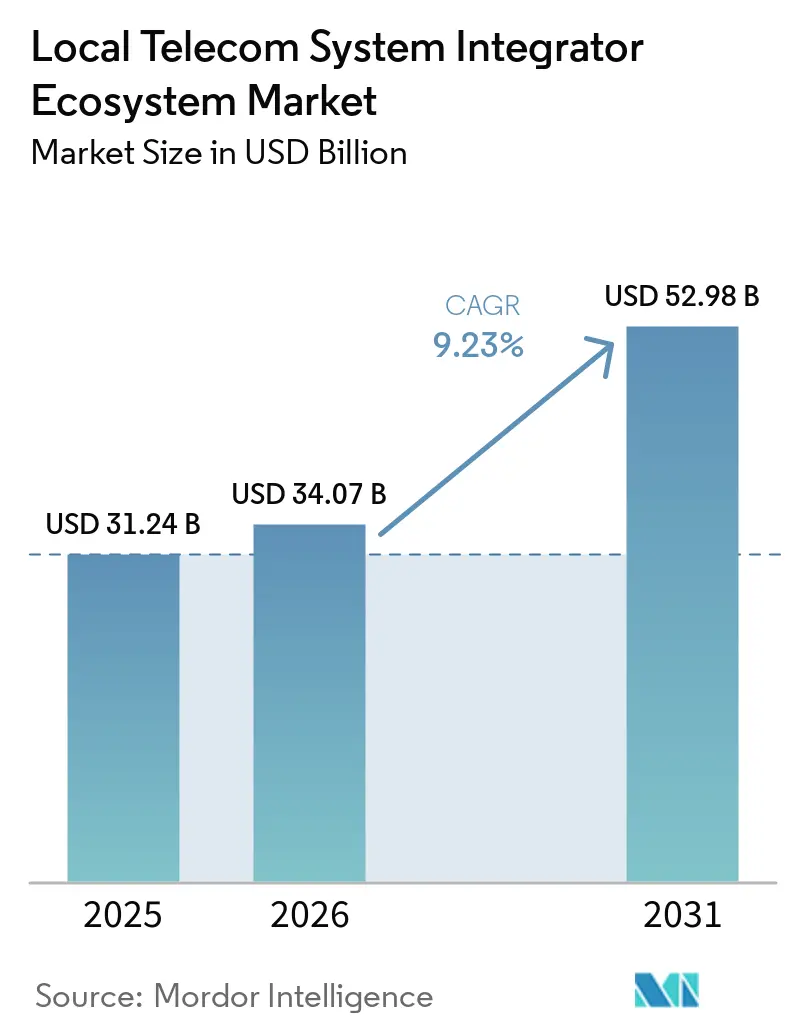
The local telecom system integrator ecosystem market size is expected to increase from USD 31.24 billion in 2025 to USD 34.07 billion in 2026 and reach USD 52.98 billion by 2031, growing at a CAGR of 9.23% over 2026-2031. Carrier deployment of 5G Standalone cores, private network projects, and modernization of legacy operations support systems and business support systems are supporting demand for integration work. The local telecom system integrator ecosystem market is also shaped by regulated operators that need hybrid or private cloud designs rather than standard managed-service packages. This creates work across network functions, data platforms, security controls, and enterprise applications. Established providers are responding with broader transformation programs, cloud alliances, and pre-integrated offerings. Smaller regional integrators face pressure as global providers and equipment vendors add managed services to project-based integration work.
Key Report Takeaways
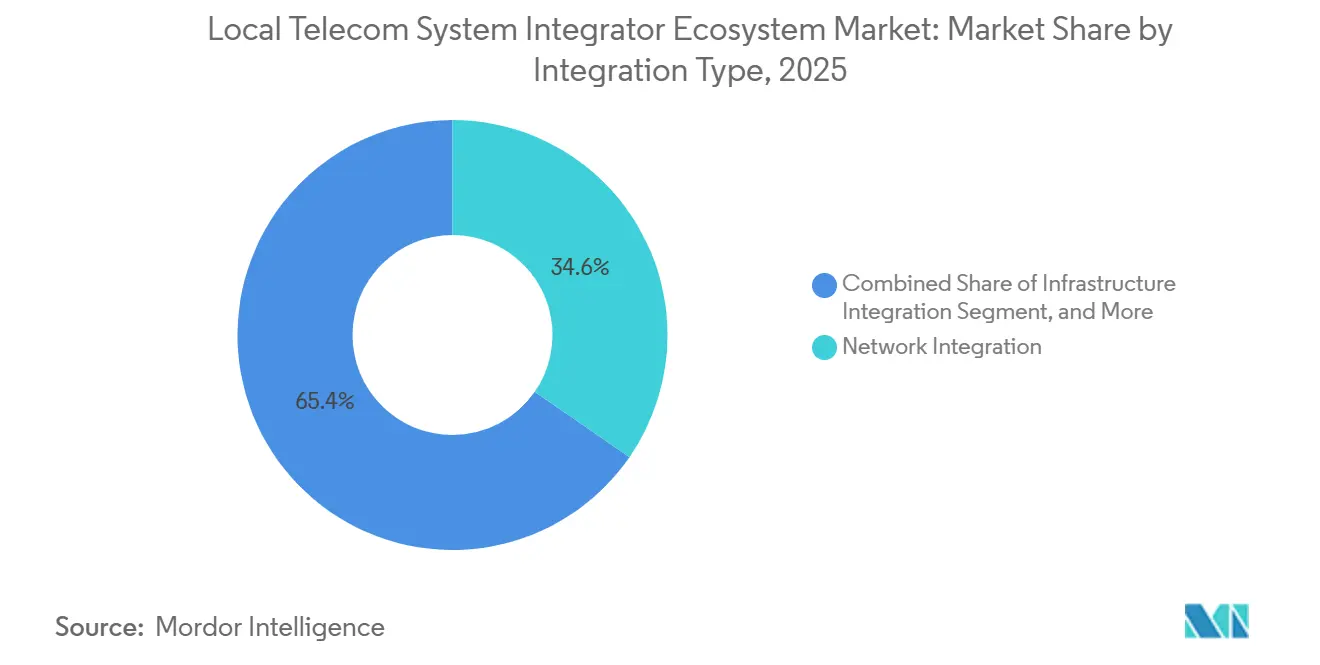
- By integration type, network integration held 34.62% of the local telecom system integrator ecosystem market share in 2025, while data and API integration is projected to expand at a 10.53% CAGR through 2031.
- By deployment mode, cloud accounted for 46.71% of revenue in 2025, while hybrid is projected to grow at a 10.72% CAGR through 2031.
- By organization size, large enterprises accounted for 71.28% of 2025 spending, while small and medium-sized enterprises are projected to grow at a 10.16% CAGR through 2031.
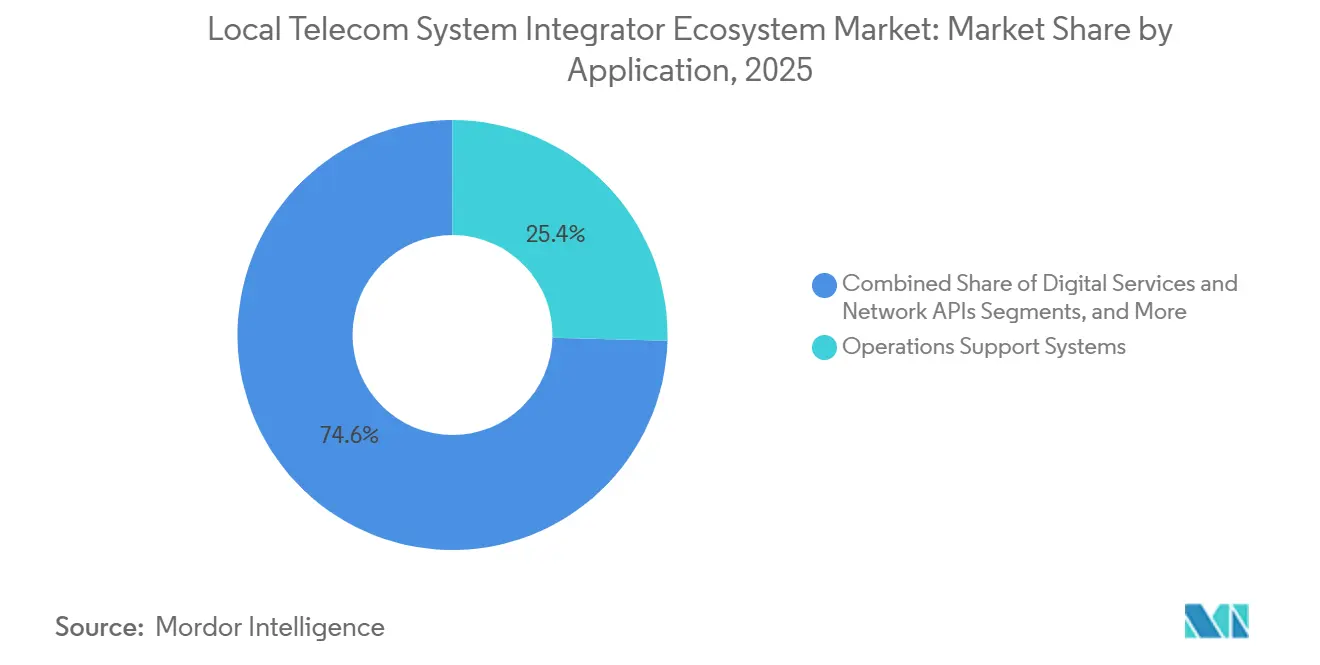
- By application, operations support systems accounted for 25.43% of revenue in 2025, while private 5G and edge services are projected to advance at a 11.07% CAGR through 2031.
- By end user, mobile network operators held 50.87% of revenue in 2025, while enterprises and industrial campuses are projected to grow at a 10.61% CAGR through 2031.
- By geography, North America held 35.19% of revenue in 2025, while Asia-Pacific is projected to grow at a 11.23% CAGR through 2031.
Key Report Takeaways
| Segmentation | Segment | Metric | Year | Value |
|---|---|---|---|---|
| By Integration Type | Network Integration | Market Share | 2025 | 34.62% |
| By Integration Type | Data and API Integration | CAGR | 2031 | 10.53% |
| By Deployment Mode | Cloud | Market Share | 2025 | 46.71% |
| By Deployment Mode | Hybrid | CAGR | 2031 | 10.72% |
| By Organization Size | Large Enterprises | Market Share | 2025 | 71.28% |
| By Organization Size | Small and Medium-Sized Enterprises | CAGR | 2031 | 10.16% |
| By Application | Operations Support Systems | Market Share | 2025 | 25.43% |
| By Application | Private 5G and Edge Services | CAGR | 2031 | 11.07% |
| By End User | Mobile Network Operators | Market Share | 2025 | 50.87% |
| By End User | Enterprises and Industrial Campuses | CAGR | 2031 | 10.61% |
| By Geography | North America | Market Share | 2025 | 35.19% |
| By Geography | Asia-Pacific | CAGR | 2031 | 11.23% |
| Source: Mordor Intelligence | ||||
Note: Market size and forecast figures in this report are generated using Mordor Intelligence’s proprietary estimation framework, updated with the latest available data and insights as of January 2026.
Global Local Telecom System Integrator Ecosystem Market Trends and Insights
Drivers Impact Analysis*
| Driver | (~) % Impact on CAGR Forecast | Geographic Relevance | Impact Timeline |
|---|---|---|---|
| 5G Standalone and Cloud-Native Network Rollouts | +2.5% | Global, led by North America, Asia-Pacific, and Europe | Short term (≤ 2 years) |
| OSS/BSS and Customer Experience Transformation | +1.8% | Global, with North America and Europe as core demand centers | Medium term (2-4 years) |
| Multi-Vendor Network Modernization and Interoperability Demand | +1.2% | Global, with Open RAN momentum concentrated in Europe, North America, and Asia-Pacific | Medium term (2-4 years) |
| Growth of Enterprise Private Networks, Edge, and Industrial IoT | +1.0% | North America, Asia-Pacific, and industrial European corridors | Medium term (2-4 years) |
| Open API and Network Exposure Monetization | +0.8% | Europe and Asia-Pacific, with spillover to the Middle East | Long term (≥ 4 years) |
| Shortage of Telecom Integration Talent at Tier-2 and Tier-3 Operators | +0.5% | Africa, Middle East, South America, and Tier-2 and Tier-3 markets globally | Short term (≤ 2 years) |
| Source: Mordor Intelligence | |||
5G Standalone and Cloud-Native Network Rollouts
5G Standalone core deployments have created continuing work for the local telecom system integrator ecosystem market, rather than a single network-build cycle. Ericsson signed a multiyear agreement with SoftBank in March 2026 to deploy a dual-mode 5G Standalone core, cloud IMS, and subscriber data management on cloud-native infrastructure. The program requires migrating active 4G and 5G subscriber functions while maintaining service continuity. NTT DOCOMO launched commercial 5G Core services on AWS in March 2026, with NEC serving as the system integration partner.[1] The deployment used automation, reducing core deployment time by 80% and raising expectations for shorter implementation cycles. Cloud-native cores also make software upgrades recurring integration events because APIs, orchestration layers, and multi-vendor compatibility must be maintained over time.
OSS/BSS and Customer Experience Transformation
Modernization of OSS and BSS platforms remains a major source of work for the local telecom system integrator ecosystem market. Amdocs launched aOS in February 2026 and announced a multiyear collaboration with AWS that combines a telecommunications digital twin with cloud and AI services. The companies stated that structured modernization patterns can reduce some migration timelines from months to weeks. Operators increasingly require API readiness when procuring BSS platforms, thereby extending the scope of integration contracts. Amdocs reported USD 4.53 billion in revenue in fiscal 2025, underscoring the scale of demand for multiyear telecommunications modernization programs. Programs can still be delayed by executive changes, revised strategies, or organizational resistance, so providers with change-management capabilities retain an important role.
Multi-Vendor Network Modernization and Interoperability Demand
Open RAN programs have increased the need for interoperability work within the local telecom system integrator ecosystem. Digital Catapult reported that 70-80% of the effort at its O-RAN Spring 2026 Plugfest was devoted to preparing and validating multi-vendor interoperability before formal testing began. Nokia and Ericsson announced in March 2026 that Ericsson joined Nokia’s SMO Marketplace and Nokia joined Ericsson’s rApp Ecosystem. The arrangement supports the deployment of multi-vendor rApps across the company’s network management platforms. The National Telecommunications and Information Administration found that multi-vendor Open RAN integration required work on interface compatibility, timing synchronization, and hardware dependencies. These requirements make validation a continuing part of disaggregated network programs rather than a temporary technical issue.
Growth of Enterprise Private Networks, Edge, and Industrial IoT
Enterprise private networks are expanding the addressable market for the local telecom system integrator ecosystem. NTT DATA and Ericsson announced a multiyear partnership in February 2026 to integrate private 5G and provide managed services across manufacturing, transportation, energy, and smart-city applications. Cargill had deployed NTT DATA-led private 5G across 50 facilities by February 2026 and planned to expand to more than 100 sites per year. The company reported a 70% reduction in cabling and setup costs from the deployment. Private 5G projects require coordination across network infrastructure, operational technology, industrial applications, and security. This favors providers that can combine carrier systems with enterprise technology requirements.
Restraints Impact Analysis*
| Restraint | (~) % Impact on CAGR Forecast | Geographic Relevance | Impact Timeline |
|---|---|---|---|
| High Integration Cost and Long Migration Timelines | -2.0% | Global, most severe in South America, Africa, and Tier-2 operator markets | Short term (≤ 2 years) |
| Cybersecurity, Data Sovereignty, and Compliance Exposure | -1.2% | Europe, North America, Southeast Asia, and Middle East | Medium term (2-4 years) |
| Proprietary Interfaces and Legacy Technical Debt | -0.8% | Global, with Europe and North America carrying the deepest legacy estate | Long term (≥ 4 years) |
| Scarcity of Reusable Local Integration Blueprints Across Smaller Markets | -0.4% | Africa, Middle East, South America, and smaller Asia-Pacific markets | Long term (≥ 4 years) |
| Source: Mordor Intelligence | |||
High Integration Cost and Long Migration Timelines
High costs and long migration periods can limit project activity in the local telecom system integrator ecosystem. Amdocs stated that automation can shorten certain structured migration tasks from months to weeks. This does not remove the work associated with organizational change, data validation, and sequenced cutovers across several systems. Large carrier programs can face multiyear overruns, pauses, or reduced scope when technology plans outpace internal decision-making processes. Tier-2 operators often have less financial capacity and less mature governance for these programs. Deferred modernization can add technical debt and make later integration work more costly, favoring larger providers that can manage milestone-risk contracts.
Cybersecurity, Data Sovereignty, and Compliance Exposure
Data sovereignty and security requirements add cost and design complexity to the local telecom system integrator ecosystem market. Deutsche Telekom built a sovereign data platform on Google Cloud using external key management to retain cryptographic control outside the cloud provider’s infrastructure. The design was intended to meet GDPR and Germany’s telecommunications and telemedia data-protection requirements. These requirements create additional integration layers across network operations, security operations, and compliance controls. European security obligations also add incident reporting, supply-chain assurance, audit, and certification requirements to carrier contracts. New 5G-Advanced security requirements may necessitate reviews of existing contracts as standards evolve.
*Our forecasts treat driver/restraint impacts as directional, not additive. The impact forecasts reflect baseline growth, mix effects, and variable interactions.
Segment Analysis
By Integration Type: Network Integration Retains Scale While Data and API Work Grows
Network integration held 34.62% of 2025 revenue and remained the largest component of the local telecom system integrator ecosystem market. Carrier RAN and core modernization programs produce long-duration contracts because they require work across radio access, packet core, subscriber management, security, testing, and operational handover. Ericsson’s March 2026 SoftBank agreement covered a dual-mode 5G Standalone core, cloud IMS, and subscriber data management on cloud-native infrastructure. Migrating live subscriber functions requires sequencing, compatibility checks, and service-continuity controls across several releases. Infrastructure and application integration remain important because legacy OSS and BSS platforms must operate alongside cloud-native network functions.
Data and API integration is projected to grow at a 10.53% CAGR through 2031, the highest rate among integration types. Operators are exposing network capabilities through the GSMA Open Gateway and CAMARA APIs to enterprise developers and cloud platforms, adding integration work for access, identity, events, billing, and service assurance. GSMA and TM Forum introduced a joint conformance program during 2025-2026 for TM Forum Operate APIs and CAMARA Service APIs that meet Open Gateway requirements. Standardized verification is becoming relevant to procurement because operators need a way to assess whether network interfaces can support external applications. The local telecom system integrator ecosystem market therefore requires network engineering teams and separate specialists who can build API gateways, data pipelines, and event-streaming systems.

By Deployment Mode: Cloud Leads While Hybrid Meets Operating Requirements
Cloud deployments accounted for 46.71% of revenue in the local telecom system integrator ecosystem market in 2025. Operators are moving from proprietary hardware toward software-defined network functions that can run on public or private cloud infrastructure. Nokia and AWS announced a live 5G Core Software-as-a-Service deployment for Belgium’s Citymesh in February 2026.[2] The service provided a commercial mobile offering based on 5G Core SaaS, showing how core functions can be separated from underlying infrastructure. On-premises deployment remains relevant where data residency, operational control, or low-latency requirements prevent cloud offload.
Hybrid deployment is projected to grow at a 10.72% CAGR through 2031. Many operators cannot complete a wholesale cloud migration within a single program cycle because current services, older applications, and existing operating processes remain in place. Hybrid environments require identity, security, observability, and data controls to work consistently across different infrastructure domains. This creates more complex integration work than a purely cloud-based or on-premises configuration. Ericsson launched Ericsson On-Demand with Google Cloud in June 2025, offering communications service providers a carrier-grade 5G Core as a service.
By Organization Size: Large Enterprises Lead While SMEs Gain Access
Large enterprises accounted for 71.28% of 2025 revenue by organization size. Their investment capacity, multiple locations, and complex network estates support sustained demand in the local telecom system integrator ecosystem market. Cargill’s private 5G program combined network infrastructure, operational technology, and industrial AI workloads in a single delivery scope. The program covered 50 facilities by February 2026 and planned deployment at more than 100 sites each year. Large enterprises can also support repeated integration activity as they add equipment, applications, security controls, and sites to their operating environments.
Small and medium-sized enterprises are projected to grow at a 10.16% CAGR through 2031. Turnkey private 5G and cloud-native connectivity offerings are lowering the barrier to entry for buyers who do not have dedicated telecommunications teams or large internal integration budgets. Eurofiber and Nokia introduced 5G RedCap in Eurofiber’s private 5G ecosystem at MWC 2026. The offering supports smaller IoT deployments without major upfront infrastructure investment, allowing buyers to add operational technology equipment and IT network connections in stages. Providers serving this group need reusable blueprints, managed-service packages, and partner-led delivery, as bespoke project teams are ill-suited to lower-margin engagements.
By Application: OSS Anchors Spending While Private 5G and Edge Services Advance
Operations support systems accounted for 25.43% of 2025 revenue and had the largest application share. Network monitoring, fault management, service assurance, and operations workflows have supported recurring work in the local telecom system integrator ecosystem market over many contract cycles. SK Telecom outlined a 2026 plan to rebuild its OSS architecture toward TM Forum Autonomous Network Level 4 in collaboration with AWS. The work includes changes to data ontology, system architecture, and AI agent standardization, which create new dependencies across network and data systems. BSS modernization and network management remain substantial secondary application areas because operators need to integrate customer, product, billing, and network information.
Private 5G and edge services are projected to grow at an 11.07% CAGR through 2031. Manufacturing, logistics, and campus connectivity support this application area, as they require dependable local connectivity for operational systems and connected equipment. AT&T and Cisco launched a 5G Standalone-native IoT platform in February 2026 that combined AT&T’s nationwide core with Cisco’s Mobility Services Platform. The platform supports network slicing, connected vehicles, and smart-city applications, illustrating the need to coordinate carrier systems with enterprise applications. This keeps application, data, security, and operational technology integration central to private 5G and edge projects.
By End User: Mobile Operators Lead While Industrial Campuses Grow Fastest
Mobile network operators accounted for 50.87% of 2025 revenue and remained the leading end-user group. Their 5G Standalone rollouts, OSS and BSS modernization, and API monetization programs support a large share of the local telecom system integrator ecosystem market. Fixed and converged operators are also investing in software-defined networking and network virtualization as they compete for enterprise connectivity and converged services. Cable and broadband providers face related modernization needs as fiber and wireless services must be managed through connected service platforms. Government agencies and public-safety networks increase demand through sovereign connectivity programs, which entail additional security, compliance, and data-control requirements.
Enterprises and industrial campuses are projected to grow at a 10.61% CAGR through 2031. Industrial automation, edge AI, and private 5G connectivity are driving increased requirements for integration between enterprise information technology and operational technology. NTT DATA and Ericsson positioned their February 2026 partnership around network integration, IT and OT security, managed operations, and edge AI. Providers working with these customers need knowledge of industrial protocols and operational technology security capabilities, in addition to conventional network expertise. The local telecom system integrator ecosystem market is consequently extending into work that spans the operator back office and enterprise operating environments.
Geography Analysis
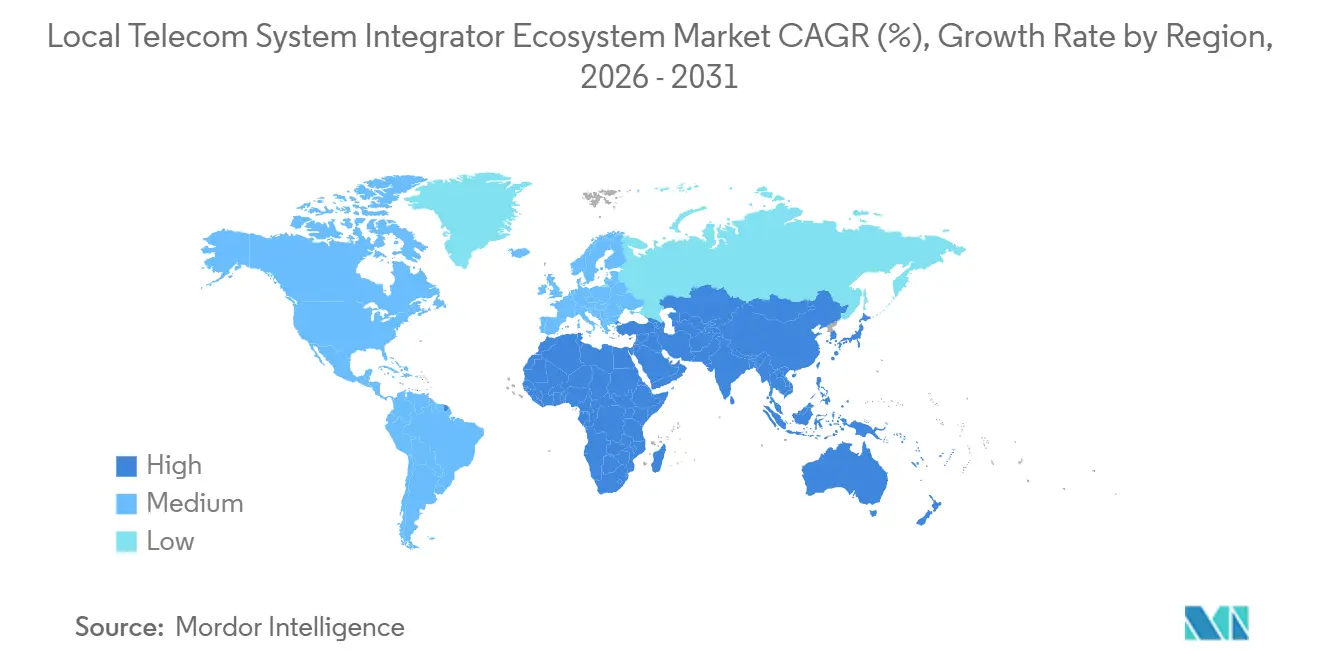
North America accounted for 35.19% of 2025 revenue, giving it the largest regional share in the local telecom system integrator ecosystem market. Tier-1 carrier budgets, 5G Standalone migration, enterprise private 5G, and OSS and BSS modernization sustain this position. AT&T and Cisco commercially launched a 5G Standalone-native IoT platform in February 2026 for network slicing and enterprise IoT applications. The platform supports connected vehicles, smart cities, and digital healthcare, requiring coordination between carrier-grade core functions and enterprise application layers. North American operators are also moving toward autonomous network platforms that require ongoing integration, testing, and validation, while FCC-related obligations add a regulatory element to contracts.
Asia-Pacific is projected to grow at an 11.23% CAGR through 2031, the fastest regional rate. Japan, South Korea, China, and India are undergoing overlapping 5G Standalone upgrade cycles, which are driving demand across core networks, cloud platforms, OSS, applications, and private networks. NTT DOCOMO launched commercial 5G Core services on AWS in March 2026, with NEC as its system integration partner. China had 4.838 million 5G base stations nationwide by the end of 2025, while 5G-Advanced deployment expanded for low-altitude economy and industrial internet applications.[3] Korea’s National Information Society Agency (NIA) announced a KRW 17.2 billion (USD 12.3 million) program for 2026 to deploy 5G Standalone-based AI networks across industrial sites, including KRW 8 billion (USD 5.7 million) in government funding.
The Middle East and Africa are emerging areas for the local telecom system integrator ecosystem market, supported by smart-city and industrial connectivity programs. Saudi Arabia and the United Arab Emirates are advancing 5G buildouts linked to Vision 2030 targets, which require network and enterprise-IT integration capability. Europe provides technically demanding engagements through open RAN, autonomous network, and network API programs, while GDPR adds data architecture and compliance requirements. South America, particularly Brazil, has network modernization and private 5G opportunities, although investment cycles and the limited availability of local blueprints can slow wider service deployment.
Competitive Landscape
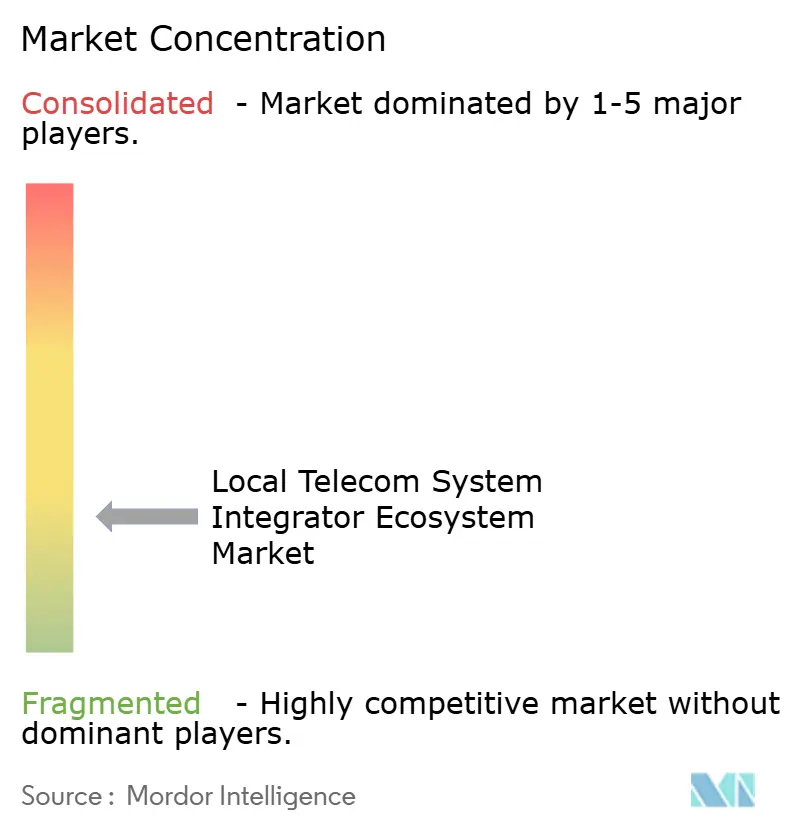
The local telecom system integrator ecosystem market is moderately fragmented. Accenture, Capgemini, TCS, and IBM compete on the scope of transformation, cloud alliances, and their capacity to manage multiyear program risk. Amdocs, Ericsson, and Nokia compete through telecommunications expertise and pre-integrated technology stacks that can reduce architecture and delivery time for operators. Amdocs and AWS expanded their collaboration in February 2026 to support AI-driven telecommunications modernization and cloud migration. The arrangement shows that software providers are competing on delivery speed, migration economics, and product capabilities.
Capgemini signed an agreement with Deutsche Telekom in February 2026 to engineer a unified open RAN automation platform. The platform is intended to operate across Open RAN and legacy environments and to be commercialized as SaaS. The local telecom system integrator ecosystem market is moving toward reusable platforms that can convert project work into recurring software revenue. This raises the barrier to entry for providers that cannot invest in productized automation assets and long-term participation in standards. Patent activity in automated OSS and BSS migration tools is concentrated among the top 5 providers, which can affect bid evaluation during the forecast period.
Nokia and Ericsson strengthened cooperation in March 2026 by joining each other’s automation ecosystems.[4] Their arrangement creates opportunities for providers that can deploy rApps across both platforms and support multi-vendor operational environments. Mid-tier firms with manufacturing or logistics expertise can compete for industrial private 5G projects through outcome-based delivery models. TM Forum Open Digital Architecture requirements are also relevant in operator procurement, favoring providers with certified architects and validated components.
Local Telecom System Integrator Ecosystem Industry Leaders
-
Accenture plc
-
Amdocs Limited
-
Atos SE
-
Capgemini SE
-
Cisco Systems, Inc.
- *Disclaimer: Major Players sorted in no particular order
Recent Industry Developments
- July 2026: Ceragon secured an additional 5-year, USD 70 million agreement with a Tier-1 Asia-Pacific mobile operator to supply transport solutions, including IP-50CX, IP-50GP, and E-band technologies, for the operator’s 4G and 5G transport network expansion, with scope to extend into managed services and network monitoring via Ceragon Insight software, directly supporting 5G integration programs across the region.
- March 2026: NTT DOCOMO launched the first commercial 5G Core services on AWS in Asia-Pacific, in a hybrid environment combining AWS cloud infrastructure with on-premises NFV. NEC Corporation served as the system integration partner, and agentic AI automation reduced core deployment time by 80%, establishing a regional reference model for cloud-native carrier integration.
- March 2026: Ericsson signed a multiyear framework agreement with SoftBank to modernize SoftBank’s core network with dual-mode 5G Standalone core, cloud-native IMS, and subscriber data management on cloud-native infrastructure, accelerating SoftBank’s transition to AI-driven network operations across Japan.
- March 2026: Nokia and Ericsson announced a cross-company collaboration in which Ericsson joined Nokia’s SMO Marketplace and Nokia joined Ericsson’s rApp Ecosystem, advancing multi-vendor rApp interoperability and accelerating industry-wide progress toward autonomous networks.
Global Local Telecom System Integrator Ecosystem Market Report Scope
The local telecom system integrator ecosystem market comprises companies that design, deploy, integrate, and maintain telecommunications infrastructure and solutions within specific regional or national markets. The report covers system integrators that deliver network infrastructure, wireless and wireline solutions, cloud and data center integration, cybersecurity, managed services, and operational support for telecom operators, enterprises, and public-sector organizations.
The Local Telecom System Integrator Ecosystem Market Report is Segmented by Integration Type (Network Integration, Infrastructure Integration, Application Integration, Data and API Integration, and Other Integration Types), Deployment Mode (Cloud, On-Premises, and Hybrid), Organization Size (Large Enterprises, and Small and Medium-Sized Enterprises), Application (Operations Support Systems, Business Support Systems, Network Management, Digital Services and Network APIs, Private 5G and Edge Services, and Other Applications), End User (Mobile Network Operators, Fixed and Converged Operators, Cable and Broadband Providers, Enterprises and Industrial Campuses, and Other End Users), and Geography (North America, South America, Europe, Asia-Pacific, Middle East, and Africa). The Market Forecasts are Provided in Terms of Value (USD).
| Network Integration |
| Infrastructure Integration |
| Application Integration |
| Data and API Integration |
| Other Integration Types |
| Cloud |
| On-Premises |
| Hybrid |
| Large Enterprises |
| Small and Medium-Sized Enterprises |
| Operations Support Systems |
| Business Support Systems |
| Network Management |
| Digital Services and Network APIs |
| Private 5G and Edge Services |
| Other Applications |
| Mobile Network Operators |
| Fixed and Converged Operators |
| Cable and Broadband Providers |
| Enterprises and Industrial Campuses |
| Other End Users |
| North America | United States |
| Canada | |
| Mexico | |
| South America | Brazil |
| Argentina | |
| Rest of South America | |
| Europe | Germany |
| United Kingdom | |
| France | |
| Italy | |
| Russia | |
| Spain | |
| Rest of Europe | |
| Asia-Pacific | China |
| India | |
| Japan | |
| South Korea | |
| Australia | |
| Rest of Asia-Pacific | |
| Middle East | Saudi Arabia |
| United Arab Emirates | |
| Turkey | |
| Rest of Middle East | |
| Africa | South Africa |
| Nigeria | |
| Egypt | |
| Rest of Africa |
| By Integration Type | Network Integration | |
| Infrastructure Integration | ||
| Application Integration | ||
| Data and API Integration | ||
| Other Integration Types | ||
| By Deployment Mode | Cloud | |
| On-Premises | ||
| Hybrid | ||
| By Organization Size | Large Enterprises | |
| Small and Medium-Sized Enterprises | ||
| By Application | Operations Support Systems | |
| Business Support Systems | ||
| Network Management | ||
| Digital Services and Network APIs | ||
| Private 5G and Edge Services | ||
| Other Applications | ||
| By End User | Mobile Network Operators | |
| Fixed and Converged Operators | ||
| Cable and Broadband Providers | ||
| Enterprises and Industrial Campuses | ||
| Other End Users | ||
| By Geography | North America | United States |
| Canada | ||
| Mexico | ||
| South America | Brazil | |
| Argentina | ||
| Rest of South America | ||
| Europe | Germany | |
| United Kingdom | ||
| France | ||
| Italy | ||
| Russia | ||
| Spain | ||
| Rest of Europe | ||
| Asia-Pacific | China | |
| India | ||
| Japan | ||
| South Korea | ||
| Australia | ||
| Rest of Asia-Pacific | ||
| Middle East | Saudi Arabia | |
| United Arab Emirates | ||
| Turkey | ||
| Rest of Middle East | ||
| Africa | South Africa | |
| Nigeria | ||
| Egypt | ||
| Rest of Africa | ||
Key Questions Answered in the Report
What is the size of the local telecom system integrator ecosystem market?
The local telecom system integrator ecosystem market is expected to increase from USD 31.24 billion in 2025 to USD 34.07 billion in 2026 and USD 52.98 billion by 2031, at a 9.23% CAGR.
What is driving demand for telecom system integration services?
5G Standalone core deployment, OSS and BSS modernization, private 5G, edge services, and multi-vendor network coordination are the main demand factors.
Which integration type is growing fastest?
Data and API integration is projected to grow at a 10.53% CAGR through 2031 as operators expose network capabilities through standardized APIs.
Which deployment model is expanding fastest?
Hybrid deployment is projected to grow at a 10.72% CAGR through 2031 because operators need to connect cloud and on-premises environments.
Which end users are increasing spending most quickly?
Enterprises and industrial campuses are projected to grow at a 10.61% CAGR through 2031, supported by industrial automation, edge AI, and private 5G adoption.