
Private 5G System Integrator Market Size and Share
Market Overview
| Study Period | 2020 - 2031 |
|---|---|
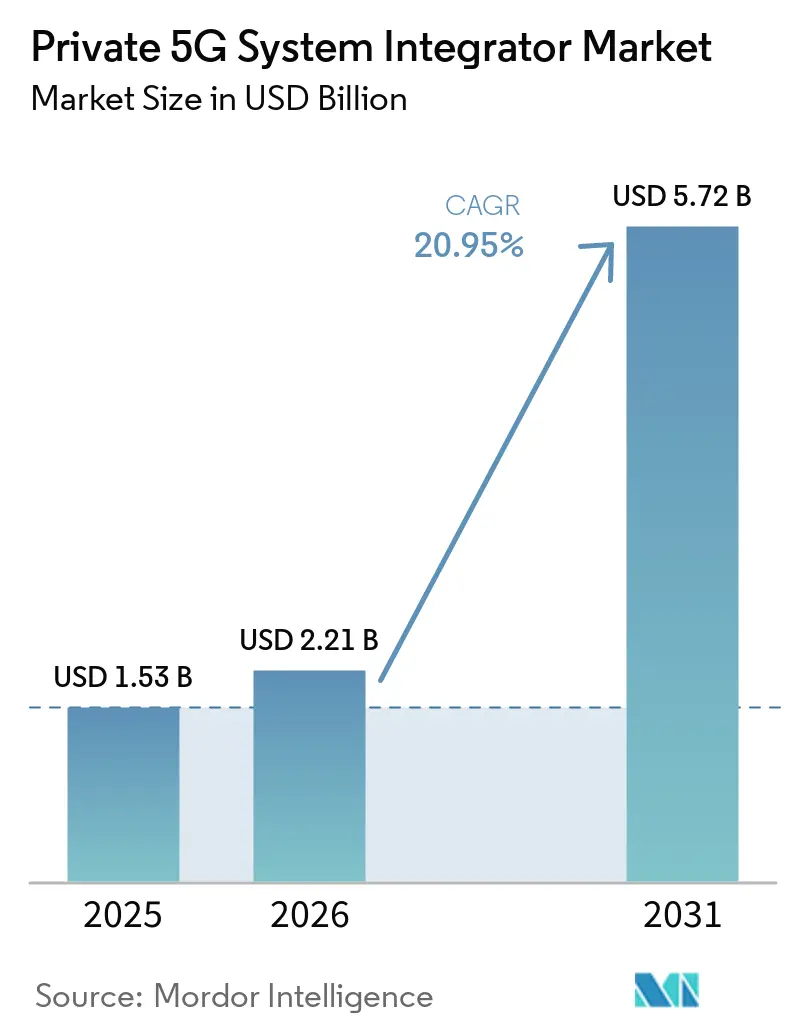
| Market Size (2026) | USD 2.21 Billion |
| Market Size (2031) | USD 5.72 Billion |
| Growth Rate (2026 - 2031) | 20.95 % |
| Fastest Growing Market | Asia-Pacific |
| Largest Market | North America |
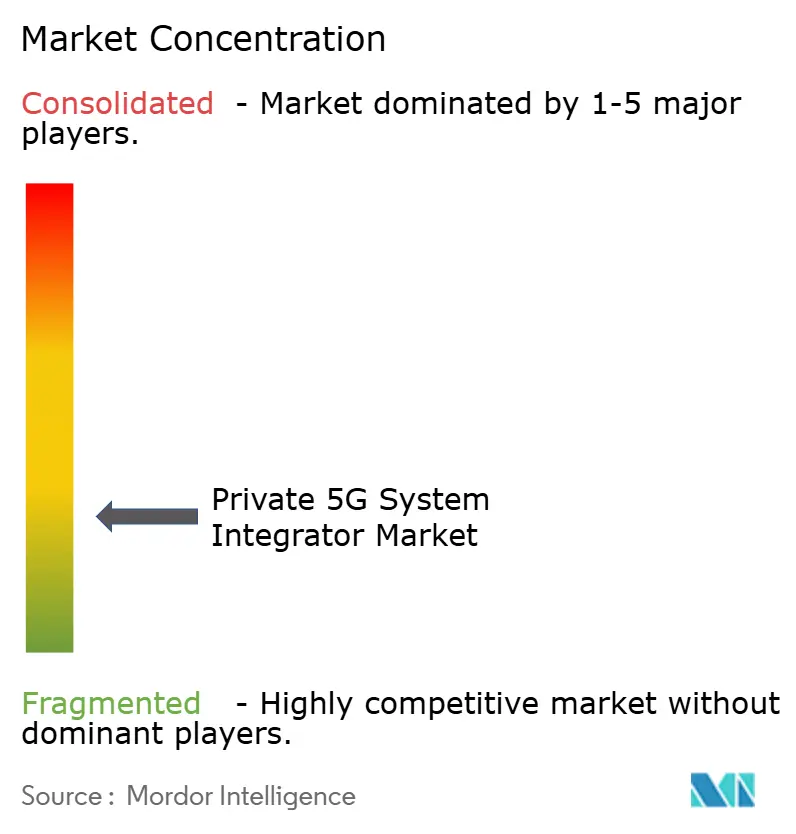
| Market Concentration | Low |
Major Players *Disclaimer: Major Players sorted in no particular order Image © Mordor Intelligence. Reuse requires attribution under CC BY 4.0. | |
Private 5G System Integrator Market Analysis by Mordor Intelligence
The private 5G system integrator market size was valued at USD 1.53 billion in 2025 and is estimated to grow from USD 2.21 billion in 2026 to reach USD 5.72 billion by 2031, at a CAGR of 20.95% during the forecast period 2026-2031. Production deployments are replacing earlier pilot programs as industrial users apply private networks across more facilities. Integrators are positioned between operational technology and enterprise IT teams, which makes design, deployment, and lifecycle support central to contract delivery. Industrial automation, secure connectivity requirements, cloud-based core networks, and local spectrum access are supporting demand across the private 5G system integrator market. The strongest opportunities center on deployments that combine radio networks, edge applications, security controls, and managed operations. Multi-site programs also favor providers that can use a repeatable design while adapting to local spectrum and compliance requirements.
Key Report Takeaways
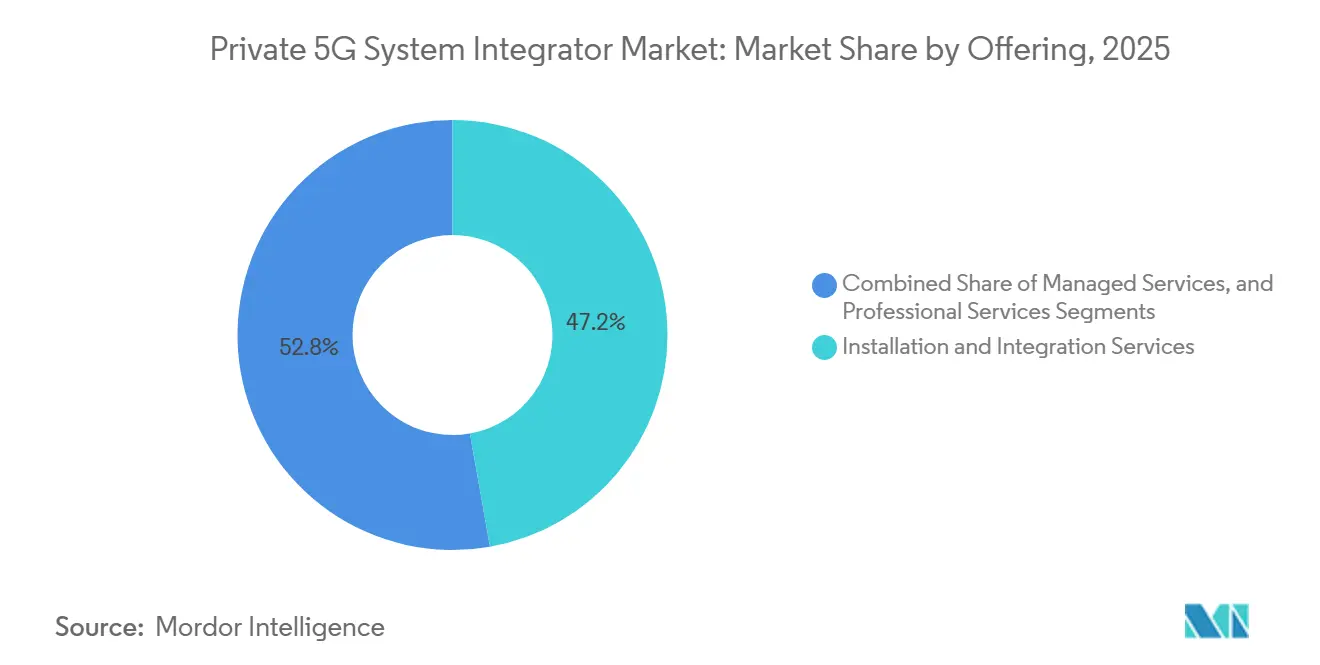
- By offering installation and integration services, the company held 47.21% of the Private 5G System Integrator Market share in 2025, while managed services are projected to grow at a 21.87% CAGR through 2031.
- By deployment model, on-premise deployment held 45.04% of the Private 5G System Integrator Market share in 2025, while hybrid deployment is projected to grow at a 22.76% CAGR through 2031.
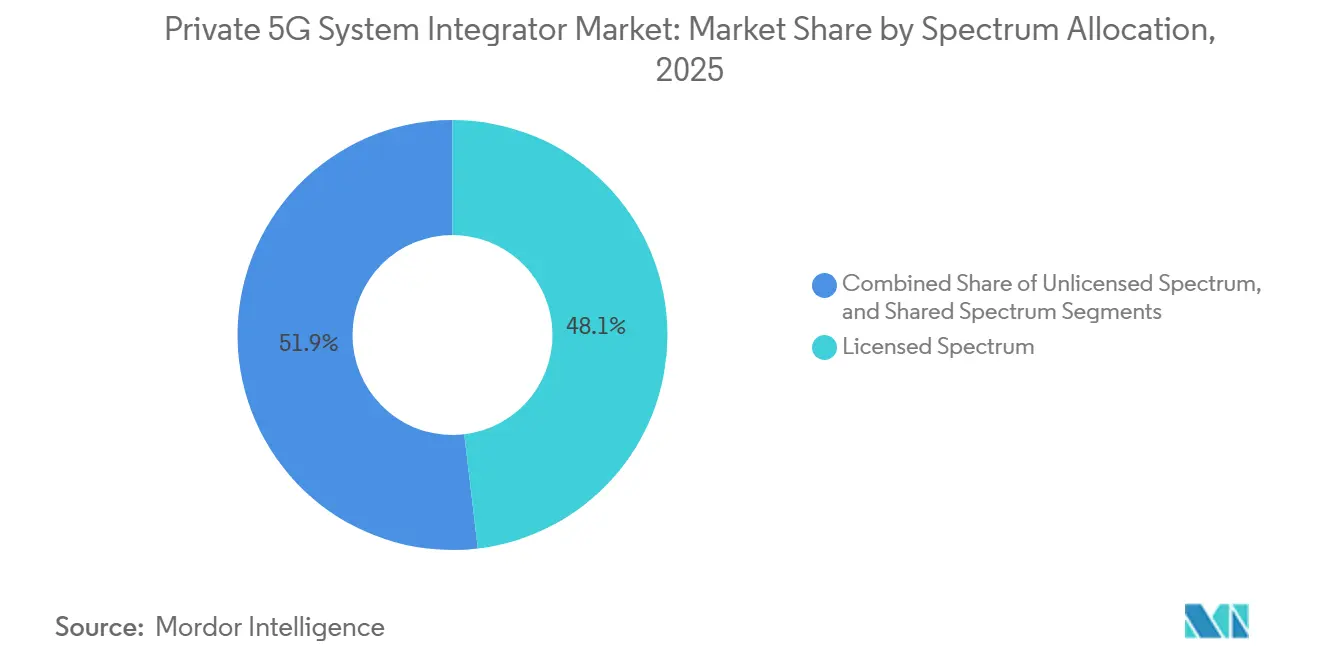
- By spectrum allocation, licensed spectrum held 48.12% of the Private 5G System Integrator Market share in 2025, and it is expected to grow at 21.87% CAGR through 2031.
- By frequency band, the low band held 61.28% of the Private 5G System Integrator Market share in 2025, while mmWave is projected to grow at a 22.68% CAGR through 2031.
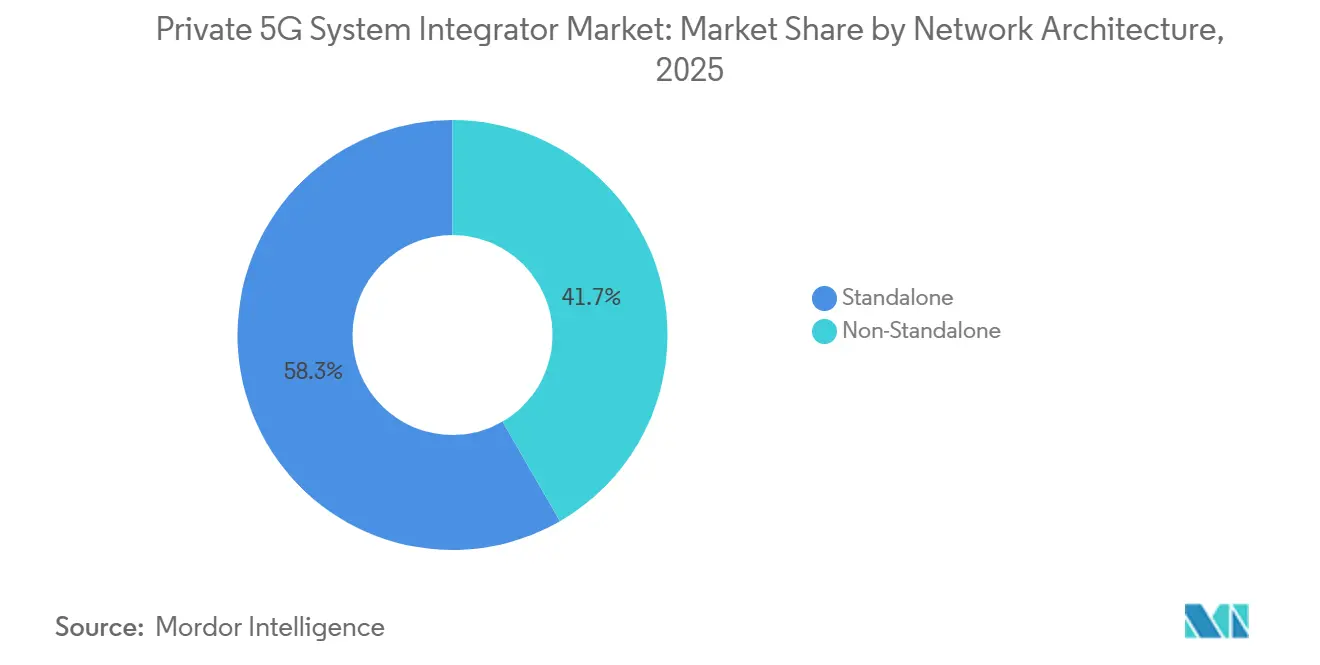
- By network architecture, standalone architecture held 58.33% of the Private 5G System Integrator Market share in 2025 and is projected to grow at a 22.94% CAGR through 2031.
- By cloud model, private or dedicated cloud held 46.04% of the Private 5G System Integrator Market share in 2025, while public cloud is projected to grow at a 21.62% CAGR through 2031.
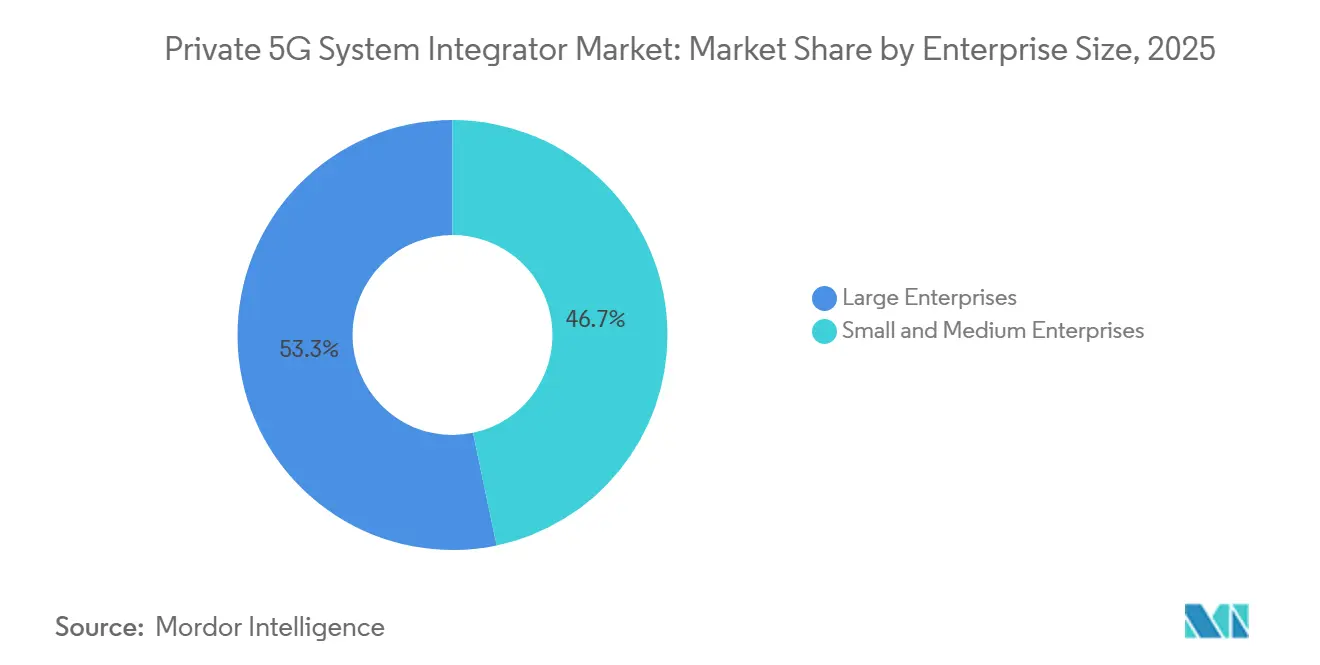
- By enterprise size, large enterprises held 53.29% of the Private 5G System Integrator Market share in 2025, while SMEs are projected to grow at a 22.14% CAGR through 2031.
- By industry vertical, manufacturing and factories held 28.98% of the Private 5G System Integrator Market share in 2025, while mining and oil and gas are projected to grow at a 22.17% CAGR through 2031.
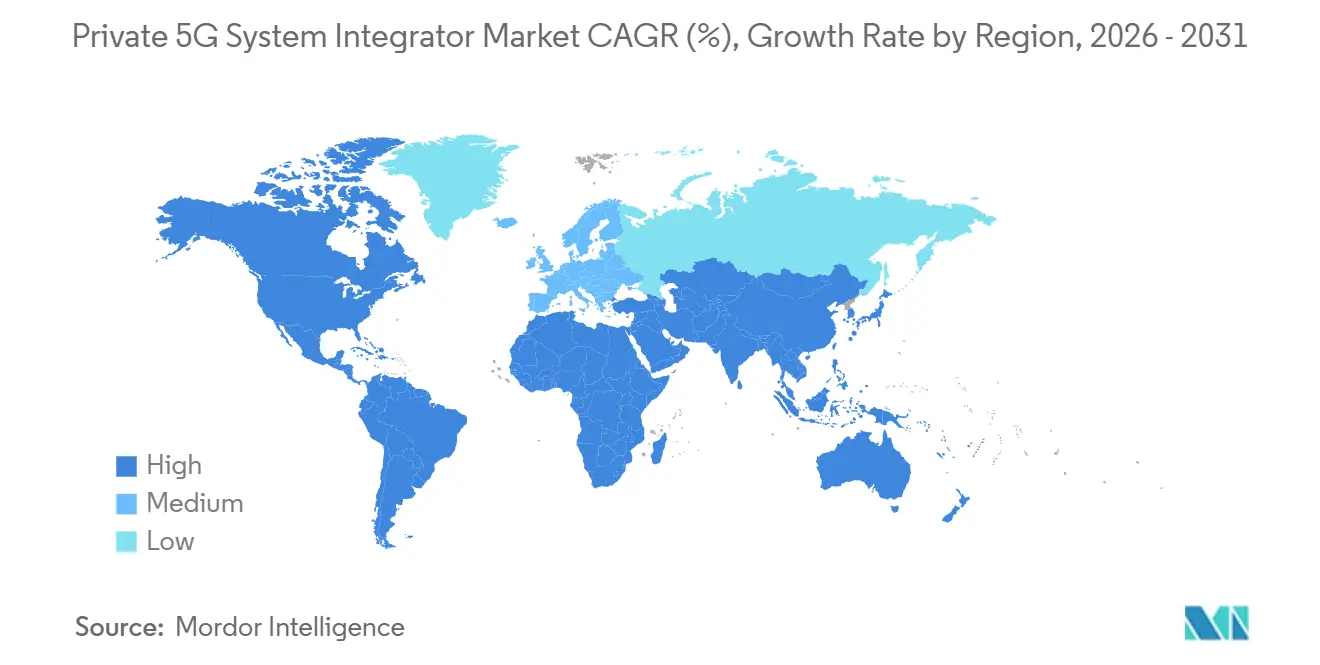
- By geography, North America held 74.23% of the Private 5G System Integrator Market share in 2025, while Asia-Pacific is projected to grow at a 22.67% CAGR through 2031.
Note: Market size and forecast figures in this report are generated using Mordor Intelligence’s proprietary estimation framework, updated with the latest available data and insights as of January 2026.
Market Trends and Insights
Drivers Impact Analysis of Private 5G System Integrator Market*
| Driver | (~) % Impact on CAGR Forecast | Geographic Relevance | Impact Timeline |
|---|---|---|---|
| Industrial Automation and Smart Factory Rollouts | +4.8% | Global, concentrated in North America, Germany, Japan, South Korea, and China | Medium term (2-4 years) |
| Secure, Low-Latency Mission-Critical Connectivity Demand | +4.2% | Global, with early gains in North America and Europe and expansion to Asia-Pacific and the Middle East and Africa | Medium term (2-4 years) |
| Cloud-Native 5G Standalone Cores and Edge Platforms | +3.5% | Global, led by North America and Japan and expanding across Europe and Asia-Pacific | Short term (≤ 2 years) |
| Local and Shared Spectrum Liberalization | +2.8% | North America, Europe, and Asia-Pacific | Medium term (2-4 years) |
| Lower Industrial 5G Module and Small Cell Prices | +2.2% | Global, with greater relevance in price-sensitive Asia-Pacific and Middle East and Africa markets | Short term (≤ 2 years) |
| Multi-Site Brownfield Integration Requirements | +1.7% | Global, especially among multinationals with distributed manufacturing and logistics operations | Medium term (2-4 years) |
| Source: Mordor Intelligence | |||
Industrial Automation and Smart Factory Rollouts
Industrial automation is a major driver of demand because manufacturers need reliable wireless connectivity for mobile equipment, sensors, and production systems. The Private 5G System Integrator Market benefits when enterprises expand a site pilot into a multi-location program. NTT DATA announced in February 2026 that its private 5G service covered 50 Cargill manufacturing and processing sites in the United States and Europe.[1] Such programs require site design, device connection, application integration, and operational support at every location. They also require careful work with older factory equipment and industrial protocols such as Modbus, OPC UA, and Profinet. This gives integrators with industrial and network expertise a role throughout the deployment lifecycle.
Enterprise Demand for Secure, Low-Latency Mission-Critical Connectivity
Enterprises operating rail facilities, mines, utilities, and production plants need dependable local connectivity for time-sensitive activities. The Private 5G System Integrator Market addresses this need by connecting radio systems with security, device management, and local computing. GlobalLogic and Ericsson deployed a private 5G network at Hitachi Rail's 307,000-square-foot digital factory in Maryland in September 2025.[2] The work included technical consulting, deployment, OT and IT integration, and lifecycle management. Verizon reported that private wireless can support operational efficiency when network services are connected with business operations. Full-scope integrators can maintain the network and adapt it as operational needs change.
Cloud-Native 5G Standalone Cores and Edge Platforms
Cloud-native cores are changing how private network projects are delivered and maintained. They allow core functions to be updated and managed via software rather than relying solely on dedicated hardware. A survey published by Mavenir in 2025 found that 33% of operators ran most 5G core functions on cloud-native infrastructure and 48% identified private 5G as the leading network edge cloud workload. NEC and DOCOMO launched Japan’s first commercial 5G core on AWS in March 2026.[3] NEC stated that the deployment used a hybrid cloud environment, infrastructure-as-code, and CI/CD tools. This model makes software maintenance and cloud coordination ongoing opportunities for integrators.
Local and Shared Spectrum Liberalization
Private 5G deployment depends on access to spectrum that enterprises can use legally and predictably. Local and shared spectrum policies have therefore shaped where projects can move from planning into operation. Germany had issued 484 local network allocations in the 3.7-3.8 GHz and 26 GHz bands by November 2025.[4] These allocations support direct enterprise participation and create demand for engineering teams capable of operating within the national framework. South Korea opened private 5G frequencies at 4.7 GHz and 28 GHz to non-operator enterprises in 2021. Integrators that manage spectrum, devices, and national requirements have an advantage in multi-site work.
Restraints Impact Analysis of Private 5G System Integrator Market*
| Restraint | (~) % Impact on CAGR Forecast | Geographic Relevance | Impact Timeline |
|---|---|---|---|
| High Upfront Deployment and Integration Costs | -2.4% | Global, most acute in SME-heavy markets across South America, Africa, and Southeast Asia | Short term (≤ 2 years) |
| Fragmented Spectrum Rules and Cross-Border Interoperability | -2.1% | Cross-border EU and UK, Middle East, South Asia, and Asia-Pacific | Long term (≥ 4 years) |
| Shortage of Spectrum Engineering and Core Orchestration Skills | -1.3% | Global, most acute in emerging Asia-Pacific markets and Africa | Medium term (2-4 years) |
| Unclear Return on Investment for Brownfield Retrofits | -0.9% | Global, most visible in traditional heavy industry in Europe and North America | Medium term (2-4 years) |
| Source: Mordor Intelligence | |||
High Upfront Deployment and Integration Costs
Upfront costs can delay private 5G decisions, especially when a customer already has a working Wi-Fi system. The challenge is greater at older industrial sites, where legacy controls can require custom integration and extended testing. Enterprises must assess the costs of spectrum, equipment, devices, security, support, and integration before approving a program. Smaller businesses can find the initial commitment particularly difficult. Managed service and as-a-service contracts can reduce the initial payment burden by aligning spending with operating needs. Providers must still avoid designs that become expensive to support after deployment.
Fragmented Spectrum Rules and Cross-Border Interoperability
Different spectrum rules pose challenges for enterprises with facilities in multiple countries. A company operating in the United States, Germany, India, and South Korea may face different licensing requirements, bands, and compliance obligations. This may require several local designs rather than a single uniform network. Germany’s local licensing approach provides a direct route for enterprises. Integrators must understand these differences before promising a common deployment model. Standardization can help over time, but national policy differences will remain relevant for cross-border programs.
*Our forecasts treat driver/restraint impacts as directional, not additive. The impact forecasts reflect baseline growth, mix effects, and variable interactions.
Private 5G System Integrator Market Segment Analysis
By Offering:
Integration Services Lead Revenue While Managed Services Support GrowthInstallation and integration services accounted for 47.21% of the Private 5G System Integrator Market size in 2025. This position reflects the substantial design and deployment work required as enterprises build private networks. The service typically includes site assessment, radio design, core setup, device connection, testing, and acceptance. Professional services also remain important because customers need planning and architecture support before deployment begins. These services are particularly relevant where an enterprise must connect legacy production equipment. They also help customers define the responsibilities of the operator, equipment supplier, and systems integrator.
Managed services are projected to grow at a 21.87% CAGR through 2031. The shift reflects customer interest in continuous performance management rather than a one-time delivery model. NTT DATA’s private 5G deployment for Cargill covered 50 manufacturing and processing sites by February 2026. The company described the program as a fully managed service supporting several business and operational systems. For providers, repeatable service methods can improve consistency across locations. For customers, managed delivery can provide a single point of contact responsible for network availability and ongoing changes.

By Deployment Model:
Hybrid Architectures Unlock Multi-Site FlexibilityOn-premises deployment accounted for 45.04% of the Private 5G System Integrator Market share in 2025, and it is favored by users who need close control over operational data and network performance. Defense, utilities, and petrochemical facilities often have requirements that favor local systems. Local deployment can also support applications that cannot accept delays from distant computing resources. These installations require the customer or integrator to manage a larger portion of the stack on-site. That requirement can increase the need for experienced engineering and operations teams.
Hybrid deployment is projected to grow at a 22.76% CAGR through 2031. It can keep sensitive and time-critical functions on-site while using cloud resources for analytics and broader coordination. In 2025, Mavenir reported that 48% of respondents identified private 5G as the most popular network edge cloud workload. This approach can help enterprises manage multiple sites without deploying every application to a remote cloud. Hosted services remain relevant for customers who prefer lower levels of internal infrastructure ownership. Each model requires careful definition of data paths, security responsibilities, and service levels.
By Spectrum Allocation:
Licensed Frequencies Support Enterprise PerformanceLicensed spectrum accounted for 48.12% of the Private 5G System Integrator Market share in 2025, and it is expected to grow at a CAGR of 21.87% by 2031. Enterprises use licensed frequencies when they need predictable performance and stronger control over interference, which is important for applications with safety, production, and real-time communication requirements. Licensed deployments usually involve formal planning and coordination before the system becomes operational. That work can increase project complexity for the integrator. It can also support longer customer engagements because compliance and network operations must be maintained.
Shared spectrum provides an alternative for customers who cannot obtain dedicated frequencies or do not need them. It can be useful in industrial and healthcare settings that need private coverage without the cost of licensed access. Unlicensed 5G remains more limited and is best suited to controlled indoor environments. Germany’s local spectrum program had issued 484 allocations by November 2025. This type of framework provides enterprises with a clearer path to dedicated spectrum. It also makes local regulatory expertise an important part of integration and delivery.
By Frequency Band:
mmWave Supports Industrial PrecisionLow band held 61.28% of the Private 5G System Integrator Market share in 2025, and its coverage and ability to penetrate industrial structures can reduce the number of radio units needed at a site, which is useful in large facilities, outdoor yards, and underground work areas. The mid band remains important because it offers a practical balance between coverage and capacity. It is widely relevant to campus networks that need reliable service across mixed indoor and outdoor areas. Integrators need to match the band plan with physical site conditions and the applications being supported.
mmWave is projected to grow at a 22.68% CAGR through 2031. It is relevant where sites need high capacity for video inspection, robotics, or dense groups of connected devices. Druid Software and Microamp validated 5G LAN functionality over mmWave radios for an industrial private 5G network in February 2026.[5] Samsung and Hyundai Motor completed a private 5G RedCap trial at the Ulsan plant in 2025. These examples show how the band choice must align with device type, coverage needs, and industrial system design. mmWave deployments will continue to need careful radio engineering and site-specific testing.[6]
By Network Architecture:
Standalone Cores Drive Full 5G AutonomyStandalone architecture held 58.33% of the Private 5G System Integrator Market share in 2025 and is projected to grow at a 22.94% CAGR through 2031. This model gives enterprises access to 5G functions that depend on a standalone core. Those functions can include network slicing, low-latency service support, and independent session management. The design requires deeper knowledge of core functions than a non-standalone overlay. This increases the importance of integrators with proven 5G core delivery skills.
Non-standalone systems can offer a lower entry path because they retain a link to 4G infrastructure. They may be suitable for customers who want to gain experience before moving to a full 5G core. However, their capabilities are more limited for applications that need the full 5G feature set. NEC and DOCOMO launched Japan’s first commercial 5G core on AWS in March 2026. The project demonstrated a standalone architecture in a hybrid cloud environment. This gives integrators another reference point for combining cloud operations with core network delivery.
By Cloud Model:
Public Cloud Integrations Expand OptionsPrivate or dedicated cloud accounted for 46.04% of the Private 5G System Integrator Market share in 2025. Large enterprises and defense-related users often select this model to keep operational data within a controlled infrastructure, and it can also simplify compliance with internal rules for sensitive workloads. The model requires dedicated resources for software updates, capacity planning, and security monitoring. This work can create a continuing role for the systems integrator. It also makes the implementation approach closely linked to the customer’s broader IT standards.
Public cloud is projected to grow at a 21.62% CAGR through 2031. Customers can use it for flexible computing, managed updates, and cross-location coordination. NEC stated that its 2026 DOCOMO core deployment achieved a 70% reduction in power consumption using AWS Graviton processors. Nokia offers a multi-cloud 5G core across Red Hat, VMware, AWS, and Google Cloud environments. Hybrid cloud remains a practical option when both local processing and cloud management are required. Integrators must ensure that cloud choices do not compromise application response times or data controls.[7]
By Enterprise Size:
Large Enterprises Anchor Revenue, SMEs Expand AdoptionLarge enterprises held 53.29% of the Private 5G System Integrator Market share in 2025. These buyers can support multi-site programs and assign internal teams to complex transformation efforts, and manufacturing groups, mining companies, and logistics operators have used private 5G for mobile equipment and distributed sensor systems. Their larger budgets also allow longer planning cycles and broader testing. This makes them important early customers for system integrators. Their deployments can establish delivery methods that are later adapted for smaller sites.
SMEs are projected to grow at a 22.14% CAGR through 2031. More compact equipment and managed services can make private 5G more accessible for smaller facilities. The commercial model must be simpler than the model used for a major industrial campus. Providers need repeatable designs that avoid costly customization for every site. This can shift competition toward delivery speed, standard service tiers, and remote support. The Private 5G System Integrator Market will rely on these methods to profitably serve smaller buyers. SMEs may prefer an operating expense model when the value of ownership is unclear at the outset.
By Industry Vertical:
Manufacturing Leads While Mining and Oil and Gas AccelerateManufacturing and factories held 28.98% of the Private 5G System Integrator Market share in 2025. The sector needs reliable coverage for automation, quality checks, materials movement, and worker communications. GSA identified 374 private network deployments in manufacturing worldwide in April 2026. Industrial environments can be challenging for wireless systems due to oil, metal structures, moving equipment, and electromagnetic interference. These conditions make network design and integration particularly important. Manufacturing users also often need a phased approach that does not interrupt production.
Mining and oil and gas are projected to grow at a 22.17% CAGR through 2031. Remote sites and autonomous equipment require dependable coverage and data transfer. The network must work with vehicle systems, safety applications, and operational control platforms. NTT DATA’s Cargill program shows how a managed private network can support connected workers, automation, and edge applications across operational sites. Similar requirements apply when resource operators connect mobile machinery and field equipment. The systems integrator must account for terrain, coverage, equipment durability, and site safety rules.
Geography Analysis
North America Private 5G System Integrator Market
North America held 74.23% of the Private 5G System Integrator Market share in 2025. The region benefits from a developed CBRS ecosystem, industrial investment, and demand from public-sector users. The United States has a broad base of manufacturing, transport, defense, and utility sites that can use private wireless systems. Canada is also developing industrial private 5G references. TERAGO and Ericsson launched a managed private 5G network at McMaster Manufacturing Research Institute in Canada in May 2026. The deployment supports AI-driven automation, robotics, real-time processing, and smart manufacturing applications.[8]
APAC Private 5G System Integrator Market
Asia-Pacific is projected to expand at a 22.67% CAGR through 2031. Japan, South Korea, China, India, and Australia each provide demand through different industrial and policy conditions. South Korea has opened the 4.7 GHz and 28 GHz private 5G frequency bands to non-operator enterprises. Japan is building greater interoperability through its local 5G ecosystem. NTT EAST published results from 265 cross-vendor interconnection tests involving 26 participating companies in March 2026. This work can reduce integration difficulty for enterprises that need to connect equipment from different suppliers. The region’s diversity means integrators must adjust their delivery model to each country.
EMEA and South America Private 5G System Integrator Market
Europe holds a significant position due to Germany’s local spectrum framework and its industrial customer base. Germany’s 484 local 5G spectrum allocations by November 2025 provide a clear foundation for campus deployments. The United Kingdom, France, Italy, and Spain also offer multi-country opportunities, but their national rules require local planning. South America, the Middle East, and Africa remain earlier-stage opportunities. Their demand is tied to mining, utilities, oil and gas, ports, and smart city programs. The Private 5G System Integrator Market has room to develop in these regions as spectrum access, skills, and enterprise use cases become more established.
Competitive Landscape
The Private 5G System Integrator Market is fragmented across IT service firms, equipment vendors, telecom operators, cloud providers, and specialist integrators. Accenture, IBM, Kyndryl, Capgemini, Tech Mahindra, and NTT DATA compete on program delivery and on the integration of operational technology and IT. Nokia, Ericsson, Samsung, Huawei, ZTE, NEC, and Fujitsu provide equipment and integration capabilities across radio, core, and management layers. Operators such as Deutsche Telekom, Orange, Vodafone, AT&T, and Verizon can combine managed services with licensed spectrum resources. Cloud providers participate through private network management and edge computing services. Specialists such as JMA Wireless, Mavenir, Celona, Federated Wireless, and Rakuten Symphony compete through focused deployment and spectrum expertise.
Companies are seeking to reduce the cost and time required to deliver a private network. NTT DATA expanded its managed private 5G service for Cargill across 50 sites in February 2026. NEC and DOCOMO launched a commercial cloud-based 5G core in Japan in March 2026. Nokia’s multi-cloud core offering supports deployment across several cloud environments. These moves show that providers are extending their role beyond radio delivery into lifecycle operations and cloud coordination. They also increase the value of teams that can work across equipment, cloud software, and site operations.
The competitive focus is moving toward reusable designs for specific industrial settings. A provider that can deliver a validated template for manufacturing, mining, or logistics can reduce deployment effort for later customers. Ongoing work in robotics, computer vision, analytics, and maintenance platforms can also create recurring service revenue. Druid Software acquired Node-H’s team and intellectual property in July 2026 to strengthen its radio access network software capabilities. TERAGO and Ericsson’s Canadian deployment demonstrates a managed model that connects dedicated private 5G with manufacturing use cases.
Private 5G System Integrator Industry Leaders
-
Nokia Corporation
-
Telefonaktiebolaget LM Ericsson
-
NTT DATA Corporation
-
Kyndryl Holdings, Inc.
-
Accenture plc
- *Disclaimer: Major Players sorted in no particular order
Private 5G System Integrator Market Companies Covered in this Report
- Accenture plc
- Cisco Systems, Inc.
- Hewlett Packard Enterprise Company
- International Business Machines Corporation
- Kyndryl Holdings, Inc.
- Nokia Corporation
- Telefonaktiebolaget LM Ericsson
- Huawei Technologies Co., Ltd.
- Samsung Electronics Co., Ltd.
- ZTE Corporation
- NEC Corporation
- Fujitsu Limited
- Siemens AG
- Deutsche Telekom AG
- Orange S.A.
- Vodafone Group Plc
- AT&T Inc.
- Verizon Communications Inc.
- NTT DATA Corporation
- Amazon Web Services, Inc.
- Microsoft Corporation
- Mavenir Systems, Inc.
- Rakuten Symphony Singapore Pte. Ltd.
- Celona, Inc.
- Federated Wireless, Inc.
- Betacom Incorporated
- Boingo Wireless, Inc.
- JMA Wireless, Inc.
- Tech Mahindra Limited
- Capgemini SE
Recent Industry Developments in Private 5G System Integrator Market
- July 2026: Druid Software acquired the team and intellectual property assets of Munich-based Node-H, adding radio access network software expertise to Druid's existing 5G core portfolio.
- May 2026: TERAGO and Ericsson launched a private 5G network at the McMaster Manufacturing Research Institute in Canada, using Canadian mmWave spectrum.
- March 2026: NEC Corporation and DOCOMO launched Japan's first commercial 5G core on AWS, using a hybrid cloud environment with infrastructure-as-code and CI/CD tools.
- February 2026: NTT DATA announced the deployment of its private 5G network across 50 of Cargill's manufacturing and processing sites in the United States and Europe.
Global Private 5G System Integrator Market Report Scope
The private 5G system integrator market refers to the ecosystem of specialized service providers that design, deploy, integrate, and manage dedicated, non-public 5G networks for enterprises. These integrators bridge the gap between complex telecom infrastructure components, such as radio access networks (RANs), 5G core systems, and edge computing platforms, and the specific operational technology (OT) requirements of end users. By offering professional, installation, and managed services across on-premise, hybrid, or hosted deployment models, these providers enable organizations to leverage various spectrum allocations (licensed, shared, or unlicensed) and cloud architectures to build highly secure, ultra-reliable, and low-latency communication networks. Catering to large enterprises and SMEs across industries such as manufacturing, automotive, energy, mining, and logistics, private 5G system integrators empower businesses to successfully implement Industry 4.0 initiatives, industrial IoT, and advanced automation by delivering tailored, high-performance wireless infrastructure that operates independently of public mobile networks.
The Private 5G System Integrator Market Report is Segmented by Offering (Professional Services, Installation and Integration Services, and Managed Services), Deployment Model (On-Premise, Hybrid, and Hosted), Spectrum Allocation (Licensed Spectrum, Shared Spectrum, and Unlicensed Spectrum), Frequency Band (Low Band, Mid Band, and mmWave), Network Architecture (Standalone, and Non-Standalone), Cloud Model (Private or Dedicated Cloud, Public Cloud, and Hybrid Cloud), Enterprise Size (Large Enterprises, and Small and Medium Enterprises), Industry Vertical (Manufacturing and Factories, Automotive, Energy and Utilities, Transportation and Logistics, Mining and Oil and Gas, Agriculture, Media and Entertainment, IT and Telecommunications, and Other Industry Verticals), and Geography (North America, South America, Europe, Asia-Pacific, Middle East, and Africa). The Market Forecasts are Provided in Terms of Value (USD).
Segmentation Overview
| Professional Services |
| Installation and Integration Services |
| Managed Services |
| On-Premise |
| Hybrid |
| Hosted |
| Licensed Spectrum |
| Shared Spectrum |
| Unlicensed Spectrum |
| Low Band |
| Mid Band |
| mmWave |
| Standalone |
| Non-Standalone |
| Private or Dedicated Cloud |
| Public Cloud |
| Hybrid Cloud |
| Large Enterprises |
| Small and Medium Enterprises |
| Manufacturing and Factories |
| Automotive |
| Energy and Utilities |
| Transportation and Logistics |
| Mining and Oil and Gas |
| Agriculture |
| Media and Entertainment |
| IT and Telecommunications |
| Other Industry Verticals |
| North America | United States |
| Canada | |
| Mexico | |
| South America | Brazil |
| Argentina | |
| Chile | |
| Rest of South America | |
| Europe | Germany |
| United Kingdom | |
| France | |
| Italy | |
| Spain | |
| Rest of Europe | |
| Asia-Pacific | China |
| Japan | |
| India | |
| South Korea | |
| Australia | |
| Rest of Asia-Pacific | |
| Middle East | United Arab Emirates |
| Saudi Arabia | |
| Qatar | |
| Rest of Middle East | |
| Africa | South Africa |
| Egypt | |
| Nigeria | |
| Rest of Africa |
| By Offering | Professional Services | |
| Installation and Integration Services | ||
| Managed Services | ||
| By Deployment Model | On-Premise | |
| Hybrid | ||
| Hosted | ||
| By Spectrum Allocation | Licensed Spectrum | |
| Shared Spectrum | ||
| Unlicensed Spectrum | ||
| By Frequency Band | Low Band | |
| Mid Band | ||
| mmWave | ||
| By Network Architecture | Standalone | |
| Non-Standalone | ||
| By Cloud Model | Private or Dedicated Cloud | |
| Public Cloud | ||
| Hybrid Cloud | ||
| By Enterprise Size | Large Enterprises | |
| Small and Medium Enterprises | ||
| By Industry Vertical | Manufacturing and Factories | |
| Automotive | ||
| Energy and Utilities | ||
| Transportation and Logistics | ||
| Mining and Oil and Gas | ||
| Agriculture | ||
| Media and Entertainment | ||
| IT and Telecommunications | ||
| Other Industry Verticals | ||
| By Geography | North America | United States |
| Canada | ||
| Mexico | ||
| South America | Brazil | |
| Argentina | ||
| Chile | ||
| Rest of South America | ||
| Europe | Germany | |
| United Kingdom | ||
| France | ||
| Italy | ||
| Spain | ||
| Rest of Europe | ||
| Asia-Pacific | China | |
| Japan | ||
| India | ||
| South Korea | ||
| Australia | ||
| Rest of Asia-Pacific | ||
| Middle East | United Arab Emirates | |
| Saudi Arabia | ||
| Qatar | ||
| Rest of Middle East | ||
| Africa | South Africa | |
| Egypt | ||
| Nigeria | ||
| Rest of Africa | ||
Key Questions Answered in the Report
What is the projected value of the Private 5G System Integrator Market by 2031?
The Private 5G System Integrator Market is projected to reach USD 5.72 billion by 2031, growing at a 20.95% CAGR from 2026. Growth reflects greater need for end-to-end deployment, lifecycle support, and links between enterprise IT and operational systems. The outlook also depends on enterprise willingness to replace isolated pilots with broader operating programs.
Which offering is expanding most quickly?
Managed services are projected to grow at a 21.87% CAGR through 2031 as enterprises seek ongoing network performance support. This model can give customers a single provider for service levels, software changes, monitoring, and support across multiple sites. It can reduce the customer’s need to build a large internal network operations team.
Why do manufacturers use private 5G systems?
Manufacturers use private 5G for connected workers, robotics, edge applications, safety monitoring, and production systems. The network needs to operate with industrial devices and factory processes, which creates a substantial role for systems integration specialists. Site surveys, testing, and device onboarding remain important before critical workloads are moved to the network.
Which network architecture has the strongest growth outlook?
Standalone architecture held 58.33% share in 2025 and is projected to grow at a 22.94% CAGR through 2031. It supports capabilities such as independent session management, network slicing, and low-latency performance for demanding industrial uses. These capabilities require deeper core-network configuration and operational knowledge than basic connectivity overlays.
Which region will grow the fastest through 2031?
Asia-Pacific is projected to grow at a 22.67% CAGR through 2031, supported by industrial programs and national private spectrum policies. Delivery approaches vary by country because spectrum access, enterprise demand, and equipment ecosystems differ across the region. Local knowledge of spectrum conditions and supplier interoperability will remain important for programs operating across borders.
What limits adoption among smaller enterprises?
Upfront deployment costs, integration work, and limited technical skills can delay adoption, although managed service models can reduce the initial burden. Standardized packages and remote support can also help providers make private 5G more practical for smaller facilities. Customers will still need to assess long-term support costs, site conditions, and the business value of specific applications. Clear implementation planning, vendor coordination, and measurable service commitments can improve confidence before a deployment decision for each site.