
Local Telecom Partner and System Integrator Mapping Market Size and Share
Market Overview
| Study Period | 2020 - 2031 |
|---|---|
| Market Size (2026) | USD 26.75 Billion |
| Market Size (2031) | USD 41.37 Billion |
| Growth Rate (2026 - 2031) | 9.11 % |
| Fastest Growing Market | Asia-Pacific |
| Largest Market | North America |
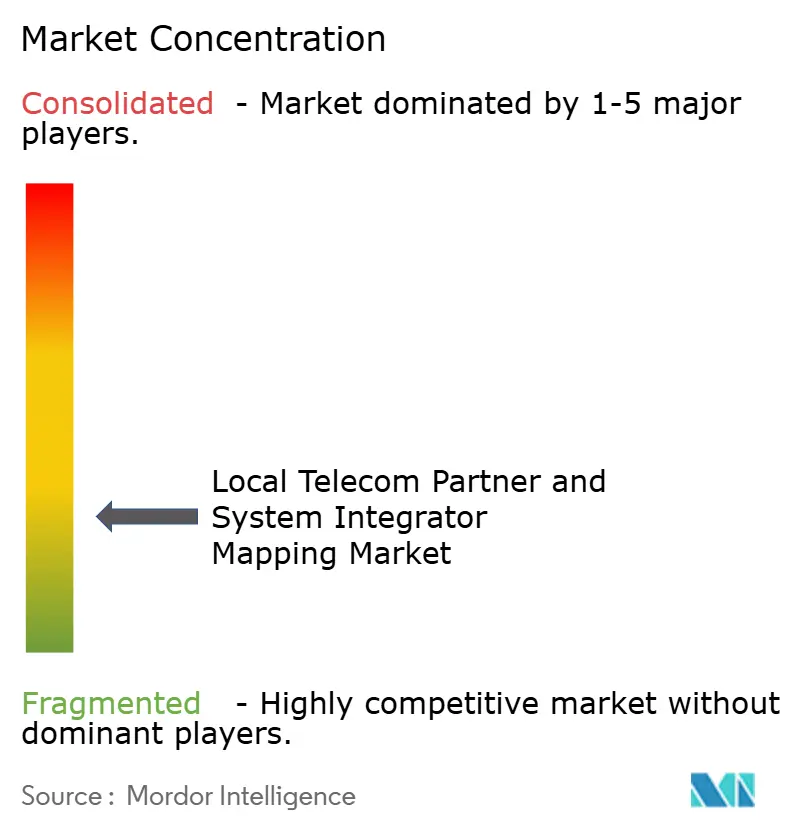
| Market Concentration | Low |
Major Players *Disclaimer: Major Players sorted in no particular order Image © Mordor Intelligence. Reuse requires attribution under CC BY 4.0. | |
Local Telecom Partner and System Integrator Mapping Market Analysis by Mordor Intelligence
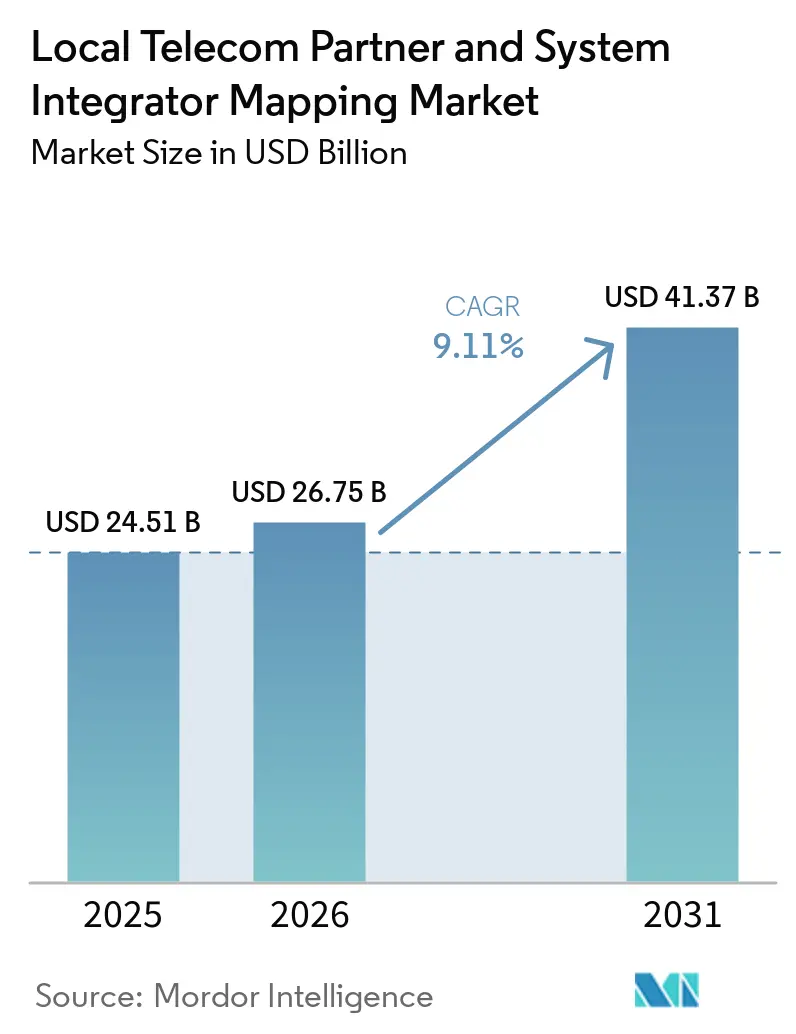
The Local telecom partner and system integrator mapping market size is expected to increase from USD 24.51 billion in 2025 to USD 26.75 billion in 2026 and reach USD 41.37 billion by 2031, growing at a CAGR of 9.11% over 2026-2031. Growth reflects the need for communications service providers to manage technology programs that span radio networks, cloud platforms, operations systems, billing systems, and local delivery teams. The move away from closed, single-vendor architectures makes partner selection and coordination a more material part of network transformation. Operators are also looking for firms that can work across legacy systems and newer cloud-native platforms without interrupting essential network services. Local knowledge, compliance capability, and standards certification have become more important in procurement decisions, especially in regulated network environments. The Local telecom partner and system integrator mapping market, therefore, favors providers that combine technical delivery with an understanding of country-specific operating conditions.
Key Report Takeaways
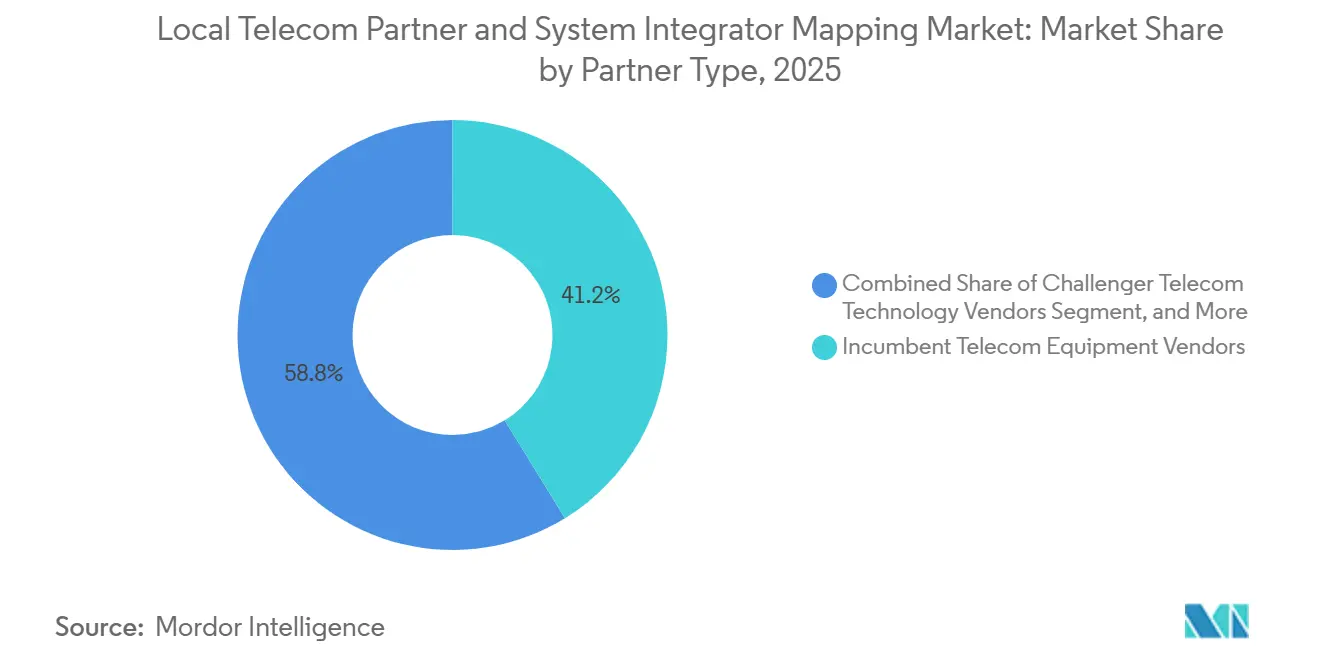
- By partner type, incumbent telecom equipment vendors held 41.23% of the Local telecom partner and system integrator mapping market share in 2025, while challenger telecom technology vendors recorded the highest projected CAGR at 10.34% through 2031.
- By service type, systems integration and implementation accounted for 36.14% of the Local telecom partner and system integrator mapping market size in 2025, while migration and modernization services are forecast to grow at a 10.46% CAGR through 2031.
- By integration domain, network integration held a 31.26% revenue share in 2025, while cloud and data center integration is projected to expand at a 10.67% CAGR through 2031.
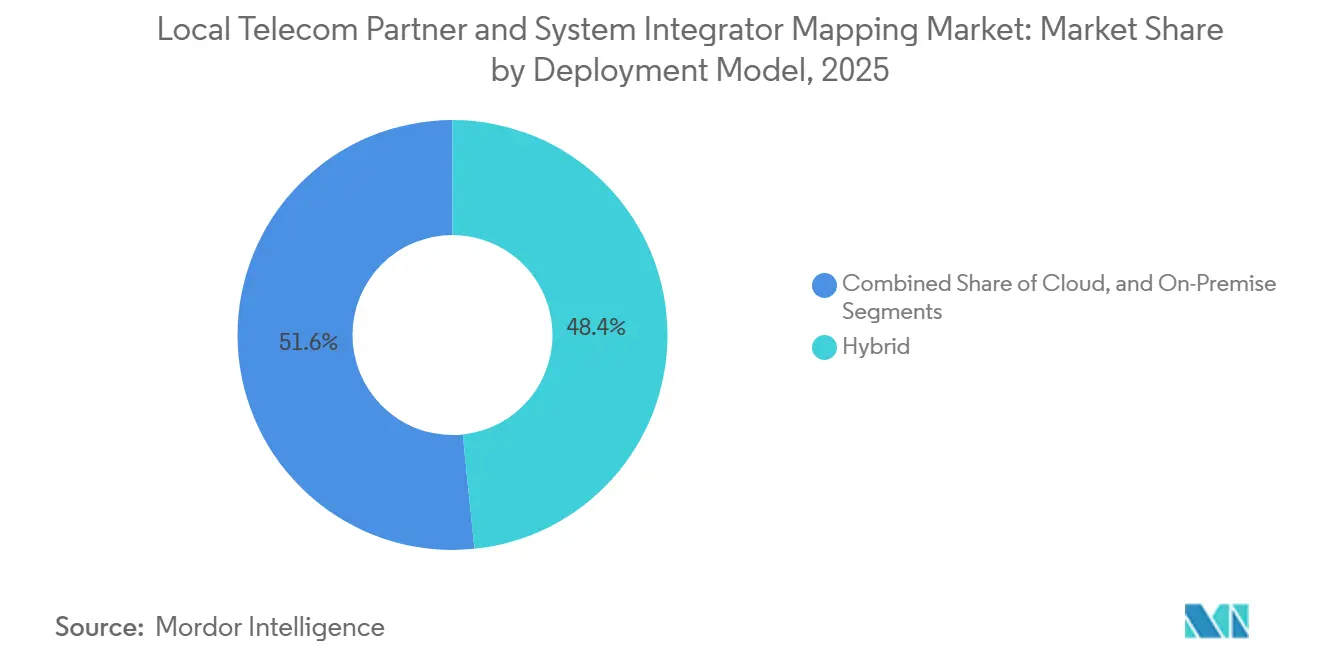
- By deployment model, hybrid deployment captured 48.37% Local telecom partner and system integrator mapping market share in 2025, while cloud deployment is projected to grow at a CAGR of 10.78% through 2031.
- By customer type, Tier-1 mobile network operators held 47.18% share in 2025, while enterprises and government agencies are forecast to advance at a CAGR of 10.81% through 2031.
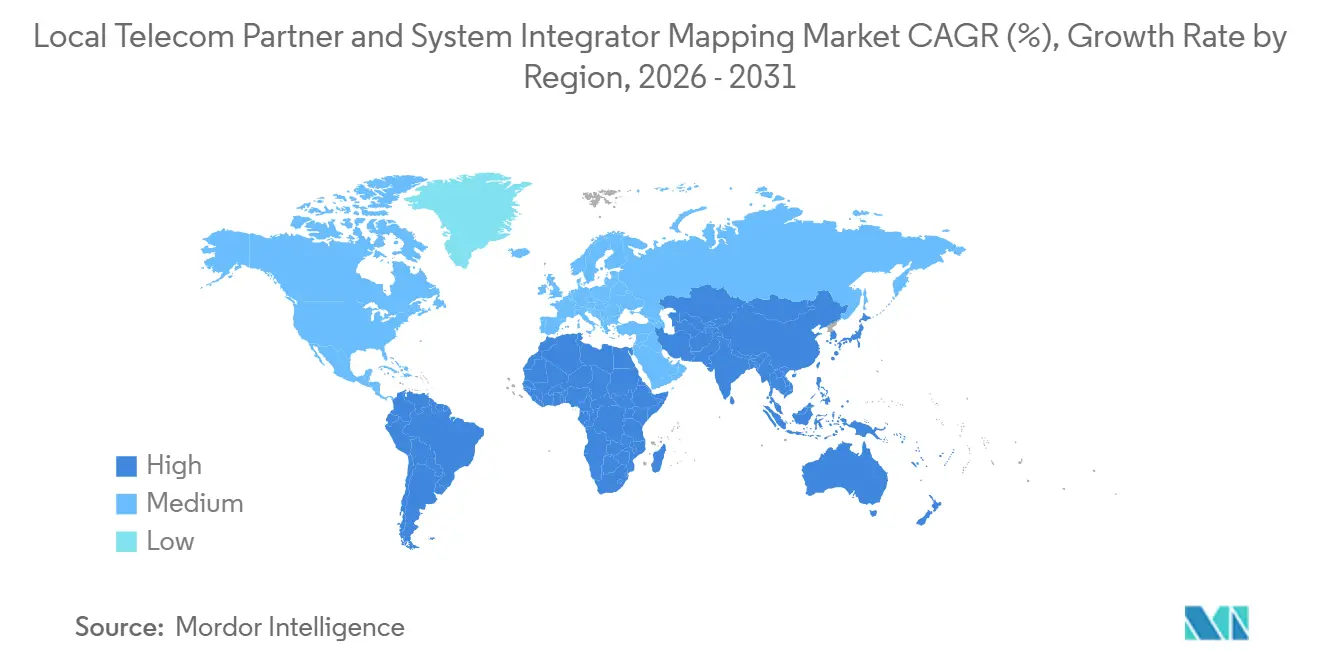
- By geography, North America held 36.49% market share in the local telecom partner and system integrator mapping market in 2025, while Asia-Pacific recorded the highest projected CAGR at 10.92% through 2031.
Note: Market size and forecast figures in this report are generated using Mordor Intelligence’s proprietary estimation framework, updated with the latest available data and insights as of January 2026.
Market Trends and Insights
Drivers Impact Analysis of Local Telecom Partner and System Integrator Mapping Market*
| Driver | (~) % Impact on CAGR Forecast | Geographic Relevance | Impact Timeline |
|---|---|---|---|
| 5G, Open RAN, and Network Modernization Programs | +2.5% | Global, with concentration in North America, Europe, and Asia-Pacific | Short term (≤ 2 years) |
| Cloud-Native OSS and BSS Transformation | +2.0% | Global, strongest in North America and Western Europe | Medium term (2-4 years) |
| Expansion of B2B2X and Partner Monetization Models | +1.4% | Global, with early gains in North America and Asia-Pacific | Medium term (2-4 years) |
| Rising Demand for Local Delivery and Regulatory Expertise | +1.1% | Global, most acute in Middle East and Africa and Asia-Pacific | Short term (≤ 2 years) |
| AI-Based Network Automation and Assurance | +0.9% | Global, Asia-Pacific leading in deployment maturity | Medium term (2-4 years) |
| Fragmentation of Telecom Technology Vendor Ecosystems | +0.7% | Global | Long term (≥ 4 years) |
| Source: Mordor Intelligence | |||
5G, Open RAN, and Network Modernization Programs
Open RAN requires operators to connect radio units, distributed units, centralized units, and service management layers from different suppliers. This structure increases the need for local system integrators who understand interfaces, testing procedures, and field deployment requirements. In February 2026, Capgemini and Deutsche Telekom developed an intelligent RAN automation platform that operates across O-RAN and legacy RAN environments. Deutsche Telekom said it was preparing the platform for use across its European footprint and as a software service for operators worldwide.[1] The Local telecom partner and system integrator mapping market benefits because these platforms still require deployment, validation, and lifecycle support in individual operator environments. Samsung’s selection by Vodafone in October 2025 to provide virtualized RAN and Open RAN solutions in Germany and other European countries also included system integration services, showing that equipment suppliers are pursuing a larger role in delivery programs.
Cloud-Native OSS and BSS Transformation
Cloud-native OSS and BSS programs change integration work from a one-time implementation into an ongoing activity. Operators must keep legacy interfaces running while introducing modular applications and cloud-based services. This creates a continuing need for specialists who can connect operational, billing, inventory, and orchestration systems without disrupting service delivery. The Local telecom partner and system integrator mapping market gains from this requirement because many operators cannot use a single migration path across all systems. TM Forum’s Open Digital Architecture work includes a 2025 to 2026 catalyst project that applies artificial intelligence to extract logic from legacy code and redesign applications into ODA-compliant components.[2] This work indicates that legacy modernization remains a practical delivery issue, even where open interfaces provide a common target architecture.
Expansion of B2B2X and Partner Monetization Models
B2B2X models expand the number of commercial relationships that operators must support across partners, enterprises, and application providers. Network API programs add settlement, reconciliation, billing, and revenue-sharing tasks to the integration workload. GSMA Open Gateway identified monetization as a critical challenge for network APIs in 2026, including APIs based on CAMARA standards.[3] Existing charging systems were generally built for bilateral carrier relationships rather than multi-party service chains with changing pricing terms. The Local telecom partner and system integrator mapping market has room for providers capable of integrating partner management, charging, and settlement systems. This work also requires delivery teams that can apply commercial rules consistently across multiple platforms and local operating entities.
Rising Demand for Local Delivery and Regulatory Expertise
Local delivery capability is becoming a central requirement where network programs involve sensitive data, critical infrastructure, or public-sector customers. The U.S. Federal Communications Commission adopted foreign-adverse-control rules in April 2026 that require telecom license holders to attest to and disclose relevant control relationships. Canada’s Bill C-8 received royal assent in June 2026 and established cybersecurity obligations for federally regulated telecommunications sectors.[4] China’s data security requirements and telecom data classification standards also increase the value of partners capable of applying domestic compliance processes. The United Kingdom’s revised Telecommunications Security Code of Practice 2026 reinforces a risk-based approach that extends to integration partners and subcontractors. These rules support demand in the Local telecom partner and system integrator mapping market for organizations with local regulatory knowledge and verifiable security controls.
Restraints Impact Analysis of Local Telecom Partner and System Integrator Mapping Market*
| Restraint | (~) % Impact on CAGR Forecast | Geographic Relevance | Impact Timeline |
|---|---|---|---|
| Legacy-System Interoperability Constraints | -2.0% | Global, most acute in North America and Europe | Short term (≤ 2 years) |
| Prolonged Integration Timelines and Budget Overruns | -1.5% | Global | Medium term (2-4 years) |
| Telecom Data-Security and Sovereignty Requirements | -0.9% | Global, most acute in Asia-Pacific and Europe | Long term (≥ 4 years) |
| Shortage of Certified Telecom Integration Specialists | -0.7% | Global, most acute in Europe and Southeast Asia | Medium term (2-4 years) |
| Source: Mordor Intelligence | |||
Legacy-System Interoperability Constraints
Legacy OSS and BSS systems remain a major constraint because their processes and data structures were not built for modular, API-based architectures. Each connection may require a separate abstraction layer to align old inventory, billing, and orchestration logic with newer applications. Open standards can reduce variation, but they do not remove differences in data formats, access controls, or historic customizations. TM Forum’s legacy modernization catalyst shows that the sector is actively seeking ways to extract and restructure legacy business logic for ODA-compliant environments. The Local telecom partner and system integrator mapping market faces longer delivery cycles when teams must resolve these constraints before new capabilities can be introduced. Capacity used for bridging old systems may also delay work on cloud-native functions and automation programs.
Prolonged Integration Timelines and Budget Overruns
Integration timelines can extend when a program contains tightly linked systems, fragmented interfaces, and years of accumulated technical debt. Microsoft stated in June 2026 that these conditions make it more difficult for operators to introduce services, respond quickly, and deliver consistent experiences. Data migration, hidden dependencies, and application programming interface version changes can require extra testing and contract changes during a project. Telecom infrastructure programs also compete for technicians and integration specialists with skills that take time to develop. The Local telecom partner and system integrator mapping market may consequently favor larger providers that can manage delivery risk within broader contracts. This can make it harder for smaller specialist firms to secure lead roles, even when they hold strong expertise in a particular technology.
*Our forecasts treat driver/restraint impacts as directional, not additive. The impact forecasts reflect baseline growth, mix effects, and variable interactions.
Local Telecom Partner and System Integrator Mapping Market Segment Analysis
By Partner Type:
Challengers Build Positions in Cloud-Native ProgramsIncumbent telecom equipment vendors held 41.23% of the Local telecom partner and system integrator mapping market share in 2025. Their position reflects long procurement relationships and their ability to package integration work with equipment and software deliveries. Incumbents retain an advantage where operators require established network support and proven delivery resources. Challenger telecom technology vendors are projected to grow at a 10.34% CAGR through 2031. Their cloud-native and artificial intelligence-focused offerings suit new Open RAN and private network programs where buyers do not want to rely on a proprietary stack.
Operators are increasingly separating tenders for equipment supply from tenders for software and integration delivery, creating a clearer opening for challengers with flexible tools and faster implementation methods. Independent system integrators benefit when operators want to limit dependence on a single supplier across multi-vendor programs, while cloud service providers enter the same space as cloud infrastructure becomes more closely integrated with network, OSS, and BSS workloads. Amdocs reported fiscal 2025 revenue of USD 4.53 billion, reflecting the resource depth typically required in large OSS and BSS contracts. The Local telecom partner and system integrator mapping market is shaped by established vendors, independent integrators, and cloud-focused providers that address different parts of the same transformation program. The balance between these groups depends on whether

By Service Type:
Migration Work Gains Importance During ModernizationSystems integration and implementation accounted for 36.14% of the Local telecom partner and system integrator mapping market size in 2025. Connecting systems remains necessary across network upgrades, cloud adoption, and new service launches. The multi-vendor structure of many Open RAN programs increases the coordination required for each project. Migration and modernization services are forecast to grow at a CAGR of 10.46% through 2031. This reflects the number of operators moving OSS and BSS programs from planning to execution.
Managed network and IT services become more relevant after major transformation projects reach production, as operators still need help managing ongoing operational complexity and system maintenance. Testing, assurance, and certification receive greater attention because multi-vendor Open RAN environments must meet evolving conformance requirements, while technical support and lifecycle services remain necessary despite the wider adoption of automated fault resolution. The Local telecom partner and system integrator mapping market continues to rely on a broad range of service types because no single activity can cover the full transformation process. Providers that combine migration, testing, and managed delivery can stay involved after the initial implementation is complete. This continuity gives customers a way to retain delivery knowledge as network and business systems continue to change.
By Integration Domain:
Cloud Work Expands Alongside Network IntegrationNetwork integration held 31.26% of the Local telecom partner and system integrator mapping revenue share in 2025. This domain remains important because 5G standalone deployment and multi-vendor radio modernization require extensive work across radio and core network layers. Cloud and data center integration is projected to grow at a CAGR of 10.67% through 2031. The rate reflects OSS and BSS migration programs, as well as cloud-native 5G core deployments. NTT Docomo and NEC, working with AWS, launched Japan’s first commercial 5G core on a hybrid cloud environment in March 2026.
The deployment used artificial intelligence-based construction methods and reported an 80% reduction in deployment time. This example shows why cloud-native core programs require close coordination between telecom and cloud environments, even where the target architecture is designed to be more modular. OSS integration and BSS integration remain costly because each operator has a distinct legacy configuration and operating model. The partner ecosystem and settlement integration are smaller but are gaining importance as B2B2X models add multi-party commercial processes. The Local telecom partner and system integrator mapping market needs specialists who can work across infrastructure, operations, commercial, and partner systems.
By Deployment Model:
Hybrid Environments Retain the Largest PositionHybrid deployment captured 48.37% of the Local telecom partner and system integrator mapping revenue share in 2025. Many Tier-1 operators cannot migrate every critical function to public cloud infrastructure simultaneously. They must operate on-premises systems alongside newer cloud-native layers during a prolonged transition. Cloud deployment is forecast to grow at a CAGR of 10.78% through 2031. Growth is linked to OSS and BSS software-as-a-service adoption and cloud-native 5G core programs.
Hybrid environments often create more integration work than either fully on-premises or fully cloud environments because teams must align orchestration, data flows, security controls, and service management across both settings. On-premises deployment remains relevant in government-linked networks, private 5G projects, and markets with strict data localization requirements. The Local telecom partner and system integrator mapping market, therefore, continues to require middleware and managed services while operators make gradual platform choices. The broad use of hybrid configurations gives delivery partners a continuing role in maintaining both old and new operating layers. Progress toward cloud-only models will depend on better integration tools and clearer regulatory conditions.
By Customer Type:
Enterprise and Government Demand Broadens the Buyer BaseTier-1 mobile network operators accounted for 47.18% of the Local telecom partner and system integrator mapping market size in 2025. Their spending reflects the scale of 5G standalone, cloud-native, and OSS and BSS transformation programs at major operators. Enterprises and government agencies are forecast to grow at a CAGR of 10.81% through 2031. Private network requirements, sovereign network programs, and B2B2X integration needs are expanding demand beyond traditional communications service provider buyers. These customers often require detailed security documentation and local delivery teams with sector-specific experience.
Enterprise and government clients often require direct integration between connectivity, operational systems, and internal applications, which can increase the value of sector-specific delivery expertise. Tier-2 and Tier-3 mobile network operators are becoming more accessible to customers as cloud-native services lower the entry cost for some integration programs. Fixed broadband operators are updating fiber networks and cloud-based OSS platforms, while MVNOs and MVNEs need BSS and settlement integration as they extend into Internet of Things and enterprise connectivity services. The Local telecom partner and system integrator mapping market gains from this broader customer base because delivery requirements are no longer limited to the largest mobile operators. Local specialists can play a stronger role when security, regulation, and vertical operating needs differ from those of traditional carrier programs.
Geography Analysis
North America and Europe Local Telecom Partner and System Integrator Mapping Market
North America held 36.49% of the Local telecom partner and system integrator mapping revenue share in 2025. The region benefits from Tier-1 transformation programs and policy measures that increase the importance of domestic partner engagement. Amdocs and AWS announced a multi-year collaboration in February 2026 to support artificial intelligence-driven telecom modernization, with a large-scale program underway at a North American Tier-1 communications service provider. The FCC rules adopted in April 2026 also change qualification processes for government and critical infrastructure contracts. Europe holds the second-largest regional position and is shifting toward multi-vendor programs linked to Open RAN, including Nokia and Ericsson marketplace cooperation and the European Edge Continuum demonstration by 5 operators.
APAC Local Telecom Partner and System Integrator Mapping Market
Asia-Pacific is projected to record the fastest CAGR of 10.92% through 2031. Greenfield 5G investment, public digital infrastructure programs, and cloud-native network architecture support demand across Japan, South Korea, India, and Southeast Asia. Rakuten Mobile and Rakuten Symphony completed a national commercial rollout of O-RAN-compliant RAN Intelligent Controllers in Japan in February 2026, demonstrating that Open RAN integration has entered commercial production at a national scale. India’s Telecom Cyber Security Rules, 2024, require network protection measures and incident reporting, increasing the need for partners with certified security capabilities. The Local telecom partner and system integrator mapping market in the region is supported by the need to integrate new networks while meeting domestic security and operating requirements.
MEA and South America Local Telecom Partner and System Integrator Mapping Market
South America, the Middle East, and Africa form an emerging growth tier centered on first-generation 5G deployment, fiber expansion, and sovereign network investment. Brazil leads South American integration efforts as operators advance 5G standalone deployments and modernize OSS and BSS. The United Arab Emirates and Saudi Arabia are working with global system integrators for 5G core, OSS transformation, and partner ecosystem programs, while South Africa, Nigeria, and Egypt are supporting African demand through 4G-to-5G migration and fiber expansion. The Local telecom partner and system integrator mapping market can benefit as projects move from network construction into recurring operation, assurance, and modernization work.
Competitive Landscape
The Local telecom partner and system integrator mapping market has a fragmented group of large providers at the top and a fragmented base of regional and specialist firms. Leading providers compete across OSS and BSS, network integration, cloud platforms, and managed services, while smaller firms commonly compete for local implementation work and specialized subcontracting assignments. Competitive selection increasingly depends on automation capabilities, open-standards certification, and country-specific regulatory knowledge. Amdocs introduced its aOS agentic operating system in February 2026 alongside a multi-year collaboration with AWS. The move places artificial intelligence agents within migration, fault management, and customer-care workflows, strengthening the company’s role in larger transformation programs.
Nokia and Ericsson expanded their cross-ecosystem cooperation in March 2026 by joining each other’s automation marketplaces. Their move makes multivendor interoperability a basic requirement for automation suppliers and integrators, shifting competition toward the quality, certification speed, and range of rApps that partners can deploy. Mavenir launched an Agentic Service Assurance Framework in June 2026 that aligns with TM Forum IG1251 and IG1453 specifications. The framework supports cross-domain monitoring, root-cause analysis, and closed-loop remediation without replacing existing OSS stacks. This type of offering raises the standard for providers competing in network operations and assurance contracts.
Nokia and Google Cloud announced a partnership in June 2026 to embed Gemini artificial intelligence agents in Nokia’s Assurance Center, with a Google Cloud Marketplace release planned for September 2026. AI-native assurance, B2B2X settlement implementation for mid-tier MVNOs, and sovereign-cloud-compatible OSS programs remain areas where providers can differentiate. The Local telecom partner and system integrator mapping market rewards firms that combine standards-based solutions with accountable local delivery.
Local Telecom Partner and System Integrator Mapping Industry Leaders
-
Amdocs Limited
-
Netcracker Technology Corporation
-
Telefonaktiebolaget LM Ericsson
-
Nokia Corporation
-
Huawei Technologies Co., Ltd.
- *Disclaimer: Major Players sorted in no particular order
Local Telecom Partner and System Integrator Mapping Market Companies Covered in this Report
- Amdocs Limited
- Netcracker Technology Corporation
- Telefonaktiebolaget LM Ericsson
- Nokia Corporation
- Huawei Technologies Co., Ltd.
- ZTE Corporation
- Ciena Corporation
- Mavenir Systems, Inc.
- Cerillion plc
- Tecnotree Oyj
- Subex Limited
- Optiva Inc.
- Ribbon Communications Inc.
- Aviat Networks, Inc.
- Comtech Telecommunications Corp.
- Radisys Corporation
- Harmonic Inc.
- Parallel Wireless, Inc.
- JSC Ingenium
- Hansen Technologies Limited
- MATRIXX Software, Inc.
- Qvantel Oy
Recent Industry Developments in Local Telecom Partner and System Integrator Mapping Market
- June 2026: Nokia and Google Cloud expanded their partnership to embed Gemini AI models into Nokia's Assurance Center, developing 6 specialized AI agents for router triage, event correlation, and automated fault resolution. The solution is scheduled for the Google Cloud Marketplace in September 2026, with agent-based automation extending across Nokia's Unified Inventory and Data Suite through late 2026 and into 2027, marking the arrival of AI-native network assurance as a cloud-marketplaced service.
- June 2026: Mavenir launched its Agentic Service Assurance Framework, a TM Forum IG1251/IG1453-aligned multi-agent system automating cross-domain network operations without replacing existing OSS stacks, covering intent-driven fault detection, root-cause analysis, and closed-loop remediation across 5G and cloud-native networks for over 300 operators in more than 120 countries.
- May 2026: BCM One and TD SYNNEX announced a strategic partnership enabling TD SYNNEX's IT channel partners to deliver end-to-end telecom communications stacks, with BCM One managing regulatory and tax requirements across multiple go-to-market models, removing historical barriers that prevented IT partners from delivering integrated telecom solutions.
- March 2026: Nokia and Ericsson announced cross-platform cooperation for autonomous networks, with Ericsson joining Nokia's SMO Marketplace and Nokia joining Ericsson's rApp Ecosystem, promoting open standards and multivendor rApp compatibility that materially expands the integration surface area for network automation partners.
Global Local Telecom Partner and System Integrator Mapping Market Report Scope
The local telecom partner and system integrator mapping market refers to the ecosystem of data platforms, intelligence services, and strategic profiling tools designed to identify, evaluate, and benchmark regional system integrators and technology partners for telecommunications projects. This market provides granular visibility into the technical capabilities, service portfolios, certification statuses, and geographic footprints of various partner types, ranging from independent SIs and incumbent vendors to cloud service providers. By analyzing critical integration domains such as network infrastructure, OSS/BSS, cloud and data center, and security, these mapping solutions enable global telecom equipment vendors to build and optimize their channel partner ecosystems. Additionally, they empower communication service providers (CSPs) to identify and select the most qualified local partners to execute complex network modernization, migration, and digital transformation initiatives with reduced risk and improved operational alignment.
The Local Telecom Partner and System Integrator Mapping Market Report is Segmented by Partner Type (Independent System Integrators, Incumbent Telecom Equipment Vendors, Challenger Telecom Technology Vendors, Cloud Service Providers, and Other Partners), Service Type (Consulting and Advisory Services, Network Design and Planning, Systems Integration and Implementation, Migration and Modernization Services, Testing, Assurance, and Certification, Managed Network and IT Services, and Technical Support and Lifecycle Services), Integration Domain (Network Integration, Operations Support Systems Integration, Business Support Systems Integration, Cloud and Data Center Integration, Application and API Integration, Security and Identity Integration, and Partner Ecosystem and Settlement Integration), Deployment Model (Cloud, Hybrid, and On-Premises), Customer Type (Tier-1 Mobile Network Operators, Tier-2 and Tier-3 Mobile Network Operators, Fixed Broadband Operators, Cable and Converged Operators, MVNOs and MVNEs, Internet Service Providers, and Enterprises and Government Agencies), and Geography (North America, South America, Europe, Asia-Pacific, Middle East, and Africa). The Market Forecasts are Provided in Terms of Value (USD).
Segmentation Overview
| Independent System Integrators |
| Incumbent Telecom Equipment Vendors |
| Challenger Telecom Technology Vendors |
| Cloud Service Providers |
| Other Partner Types |
| Consulting and Advisory Services |
| Network Design and Planning |
| Systems Integration and Implementation |
| Migration and Modernization Services |
| Testing, Assurance, and Certification |
| Managed Network and IT Services |
| Technical Support and Lifecycle Services |
| Network Integration |
| Operations Support Systems Integration |
| Business Support Systems Integration |
| Cloud and Data Center Integration |
| Application and API Integration |
| Security and Identity Integration |
| Partner Ecosystem and Settlement Integration |
| Cloud |
| Hybrid |
| On-Premises |
| Tier-1 Mobile Network Operators |
| Tier-2 and Tier-3 Mobile Network Operators |
| Fixed Broadband Operators |
| Cable and Converged Operators |
| MVNOs and MVNEs |
| Internet Service Providers |
| Enterprises and Government Agencies |
| North America | United States |
| Canada | |
| Mexico | |
| South America | Brazil |
| Argentina | |
| Chile | |
| Rest of South America | |
| Europe | Germany |
| United Kingdom | |
| France | |
| Italy | |
| Spain | |
| Rest of Europe | |
| Asia-Pacific | China |
| Japan | |
| India | |
| South Korea | |
| Australia | |
| Rest of Asia-Pacific | |
| Middle East | United Arab Emirates |
| Saudi Arabia | |
| Qatar | |
| Rest of Middle East | |
| Africa | South Africa |
| Egypt | |
| Nigeria | |
| Rest of Africa |
| By Partner Type | Independent System Integrators | |
| Incumbent Telecom Equipment Vendors | ||
| Challenger Telecom Technology Vendors | ||
| Cloud Service Providers | ||
| Other Partner Types | ||
| By Service Type | Consulting and Advisory Services | |
| Network Design and Planning | ||
| Systems Integration and Implementation | ||
| Migration and Modernization Services | ||
| Testing, Assurance, and Certification | ||
| Managed Network and IT Services | ||
| Technical Support and Lifecycle Services | ||
| By Integration Domain | Network Integration | |
| Operations Support Systems Integration | ||
| Business Support Systems Integration | ||
| Cloud and Data Center Integration | ||
| Application and API Integration | ||
| Security and Identity Integration | ||
| Partner Ecosystem and Settlement Integration | ||
| By Deployment Model | Cloud | |
| Hybrid | ||
| On-Premises | ||
| By Customer Type | Tier-1 Mobile Network Operators | |
| Tier-2 and Tier-3 Mobile Network Operators | ||
| Fixed Broadband Operators | ||
| Cable and Converged Operators | ||
| MVNOs and MVNEs | ||
| Internet Service Providers | ||
| Enterprises and Government Agencies | ||
| By Geography | North America | United States |
| Canada | ||
| Mexico | ||
| South America | Brazil | |
| Argentina | ||
| Chile | ||
| Rest of South America | ||
| Europe | Germany | |
| United Kingdom | ||
| France | ||
| Italy | ||
| Spain | ||
| Rest of Europe | ||
| Asia-Pacific | China | |
| Japan | ||
| India | ||
| South Korea | ||
| Australia | ||
| Rest of Asia-Pacific | ||
| Middle East | United Arab Emirates | |
| Saudi Arabia | ||
| Qatar | ||
| Rest of Middle East | ||
| Africa | South Africa | |
| Egypt | ||
| Nigeria | ||
| Rest of Africa | ||
Key Questions Answered in the Report
How large is the Local telecom partner and system integrator mapping market?
The Local telecom partner and system integrator mapping market was valued at USD 26.75 billion in 2026 and is forecast to reach USD 41.37 billion by 2031 at a CAGR of 9.11%. The projection reflects the growing volume of modernization work across established and newer network platforms.
Which partner type held the largest position in 2025?
Incumbent telecom equipment vendors held 41.23% share in 2025, supported by established procurement relationships and bundled delivery capabilities. Challengers are growing more quickly where operators select cloud-native tools and vendor-neutral integration models.
Which service type is growing fastest through 2031?
Migration and modernization services are forecast to grow at a CAGR of 10.46% as operators move OSS and BSS programs into implementation. The work includes connecting older applications with newer operating, billing, and orchestration platforms.
Which region is growing fastest through 2031?
Asia-Pacific is forecast to grow at a CAGR of 10.92%, supported by 5G investment, digital infrastructure programs, and cloud-native network activity. Japan, South Korea, India, and Southeast Asia all contribute to the need for local delivery capability.
Why are hybrid environments important to system integrators?
Hybrid deployment held 48.37% share in 2025 and requires teams to connect on-premises and cloud-native systems during an extended transition. Integrators must maintain security, data flows, orchestration, and service management across both operating environments.