
Liraglutide Market Size and Share
Market Overview
| Study Period | 2021 - 2032 |
|---|---|
| Market Size (2027) | USD 3.74 Billion |
| Market Size (2032) | USD 4.36 Billion |
| Growth Rate (2027 - 2032) | 3.16 % |
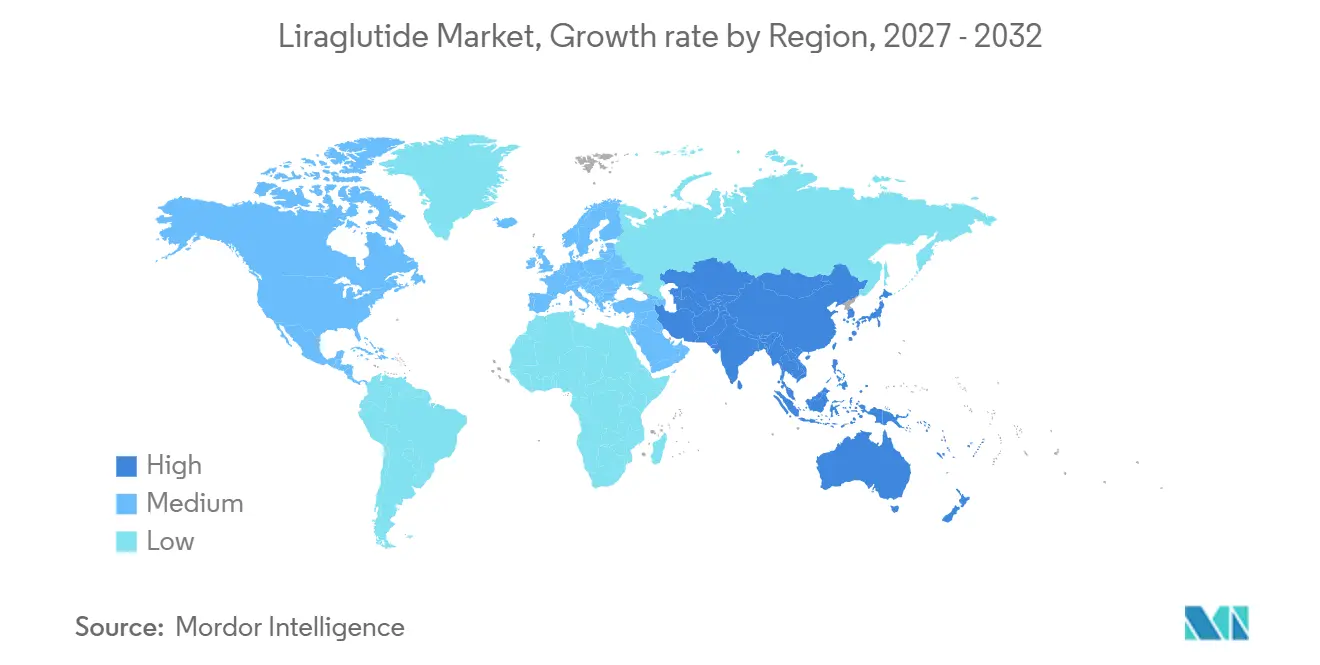
| Fastest Growing Market | Asia-Pacific |
| Largest Market | North America |
| Market Concentration | Medium |
Major Players *Disclaimer: Major Players sorted in no particular order Image © Mordor Intelligence. Reuse requires attribution under CC BY 4.0. | |
Liraglutide Market Analysis by Mordor Intelligence
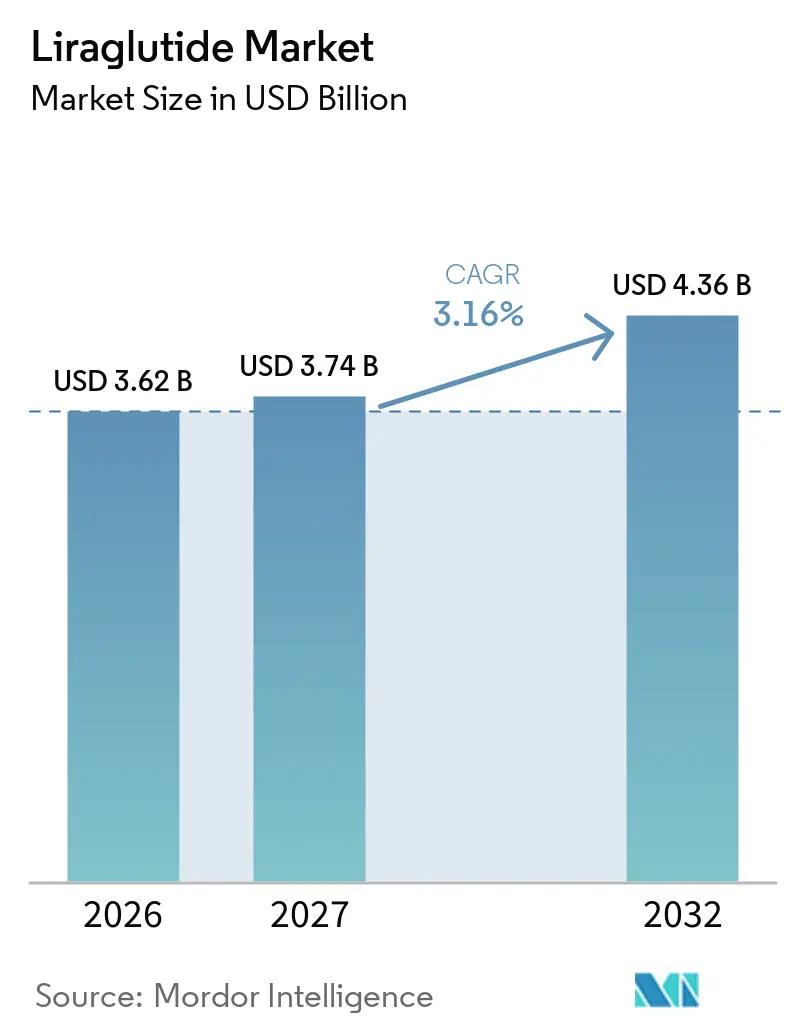
The Liraglutide Market size is projected to expand from USD 3.62 billion in 2026 and USD 3.74 billion in 2027 to USD 4.36 billion by 2032, registering a CAGR of 3.16% between 2027 and 2032.
The COVID-19 pandemic co-morbidities included hypertension, diabetes, cardiovascular disease, and cancer. According to an article,” 89-LB: COVID-19 Outcomes in Patients Who Started GLP1-RAs during Hospitalization,” published by the American Diabetes Association in June 2022, glucagon-like peptide-1 receptor agonists (GLP-1 RAs) were considered beneficial in improving COVID-19 outcomes due to their anti-inflammatory properties. Patients admitted for severe interstitial bilateral pneumonia in the COVID-19 ward due to SARS-COV2 infection and having type-2 diabetes or in-hospital hyperglycemia were treated with GLP-1 RAs in addition to standard therapy.
Furthermore, health authorities and diabetes organizations emphasized that individuals with diabetes faced a higher risk of severe illness and complications during the COVID-19 pandemic, highlighting the importance of maintaining adequate glycemic control. Patients with poorly managed diabetes were more likely to experience adverse clinical outcomes following COVID-19 infection, leading to increased attention on effective diabetes management and treatment adherence. Consequently, the pandemic reinforced the need for antidiabetic therapies and regular disease monitoring, supporting demand for diabetes treatments during the period. The International Diabetes Federation explained that when people with diabetes develop a viral infection, it can be harder to treat due to fluctuations in blood glucose levels and diabetes complications as the immune system is compromised, making it harder to fight the virus and likely leading to a longer recovery period.
Liraglutide is a glucagon-like peptide-1 (GLP-1) receptor agonist used to treat type-2 diabetes and chronic obesity. It is used when diet and exercise alone do not result in good blood sugar control. It is a second-line therapy for diabetes, following first-line therapy with metformin. It is also used to help reduce the risk of heart and blood vessel problems, including heart attacks and strokes in patients with type-2 diabetes and established heart or blood vessel disease. Liraglutide is sold under the brand names Victoza and Saxenda.
Regulatory agencies and healthcare authorities across major markets have increasingly emphasized improving access to GLP-1 receptor agonist therapies for diabetes and obesity management. The expanding clinical acceptance of liraglutide, supported by treatment guideline updates, reimbursement expansions, and regulatory approvals for multiple indications, has strengthened its adoption within routine care pathways. In addition, ongoing efforts to enhance chronic disease management, promote early intervention for metabolic disorders, and improve patient access to innovative injectable therapies continue to support market growth. These developments are expected to reinforce the role of liraglutide in diabetes and weight management strategies over the coming years.
Major factors expected to drive the growth of the glucagon-like peptide-1 (GLP-1) agonists market include the increasing prevalence of obesity and diabetes, changing lifestyle patterns characterized by reduced physical activity, and unhealthy dietary habits. The growing burden of metabolic disorders, coupled with rising awareness regarding effective diabetes and weight management therapies, is contributing to market expansion. Furthermore, continuous investment in research and development, advancements in drug formulation technologies, and the introduction of innovative GLP-1 therapies are expected to create significant growth opportunities for the market during the forecast period.
Note: Market numbers in this report are based on Mordor Intelligence's proprietary estimation framework, which combines nine months of actuals with Q4 projections for base year 2026.
Market Trends and Insights
Victoza is expected to register the highest growth rate over the forecast period.
Victoza is used with a diet and exercise program to control blood sugar levels in adults and children 10 years of age and older with type-2 diabetes when other medications did not control levels well. Victoza is also used to reduce the risk of a heart attack, stroke, or mortality in adults with type-2 diabetes mellitus and heart and blood vessel disease. Victoza is not used to treat type 1 diabetes or diabetic ketoacidosis in adults.
Teva Pharmaceuticals agreed to a patent litigation settlement with Novo Nordisk that would see the generic drugmaker wait until December 2023 to begin marketing its generic version of the type-2 diabetes drug Victoza. Novo Nordisk filed a lawsuit in March 2017 after Teva submitted an ANDA application to the FDA seeking approval for a generic version of the drug. Novo Nordisk alleged that Teva was engaging in patent infringement. The Federal Trade Commission and the Department of Justice awarded Teva a license to launch a generic version of Victoza starting December 22, 2023.
The growth of the studied market is being supported by the increasing prevalence of obesity, type 2 diabetes, and cardiovascular disorders worldwide. Rising consumption of calorie-dense foods, declining physical activity levels, and other lifestyle-related risk factors have contributed to a growing population requiring long-term metabolic disease management. For instance, according to the World Obesity Atlas 2024, the global number of individuals living with overweight and obesity is projected to continue increasing over the coming years, highlighting the expanding burden of weight-related health conditions. As obesity is a major risk factor for type 2 diabetes and cardiovascular diseases, the rising patient population is expected to drive demand for GLP-1 agonists during the forecast period. The World Health Organization predicted that by 2025, roughly 167 million people are likely to become overweight or obese. Furthermore, as per World Obesity Atlas 2023, the estimates for global levels of overweight and obesity (BMI ≥25kg/m²) suggest that over 4 billion people may be affected by 2035. The prevalence of obesity (BMI ≥30kg/m²) alone is anticipated to rise to 24% of the population over the same period, affecting nearly 2 billion adults, children, and adolescents by 2035.
Hence, owing to the high burden of obesity, the increasing prevalence of diabetes and expected new product launches are expected to fuel market growth over the forecast period.
North America held the highest market share in the current year
The North American region held the highest market share in the current year.
In the North American region, the prevalence of diabetes has increased dramatically during the last two decades, a fact driven by the increased prevalence of obesity and lifestyle changes owing to less physical activity, unhealthy food habits, and other lifestyle factors. According to the Centers for Disease Control and Prevention (CDC) press release in November 2023, more than one in three Americans are at increased risk for type 2 diabetes. Furthermore, more than 1 in 3 adults, i.e., about 98 million Americans, have prediabetes, and 81% of them are unaware of the condition. Similarly, the Government of Canada in October 2022 estimated that over 3 million Canadians, or 8.9% of the population, have been diagnosed with diabetes. After adjusting for the aging population over time, the prevalence has been increasing at an average rate of 3.3% per year. In addition, 6.1% of Canadian adults have prediabetes, putting them at high risk of developing type-2 diabetes.
Leading diabetes and endocrinology organizations, including the American Diabetes Association (ADA), the European Association for the Study of Diabetes (EASD), and other clinical bodies, have increasingly emphasized the use of GLP-1 receptor agonists for improving glycemic control and reducing cardiometabolic risk in appropriate patient populations. Updated treatment guidelines have expanded the role of liraglutide as an effective option for patients requiring better blood glucose management, weight reduction, and cardiovascular risk mitigation.
The Centers for Disease Control and Prevention (CDC) National Diabetes Statistics Report 2022 estimated that more than 130 million adults are living with diabetes or prediabetes in the United States. Type-2 diabetes is more common, and diabetes is more consequential among communities of color, those who live in rural areas, and those with less education, lower incomes, and lower health literacy.
Therefore, the studied market is anticipated to grow over the analysis period due to rising prevalence and the factors above.

Competitive Landscape
Market Concentration
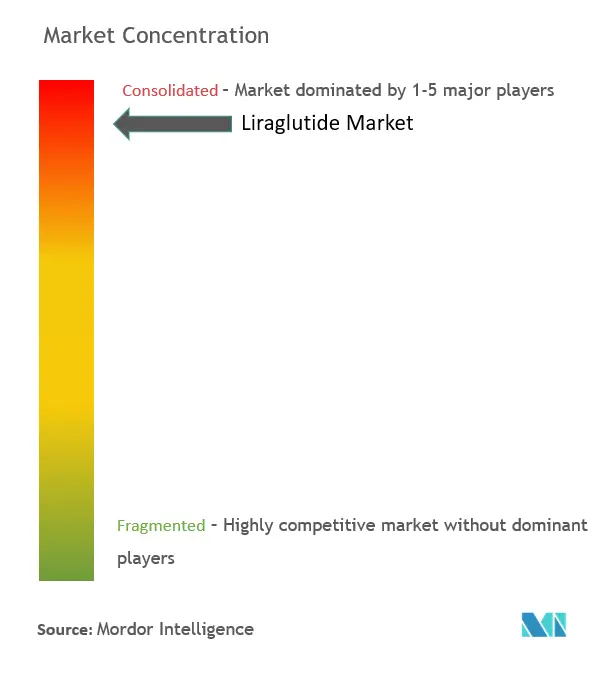
The liraglutide market is moderately consolidated, with a limited number of pharmaceutical companies participating due to product patent protection, regulatory requirements, and the complexity associated with the development and commercialization of GLP-1 receptor agonists. Competition is primarily driven by innovation, lifecycle management strategies, geographic expansion, and the introduction of advanced formulations. Market participants are also focusing on clinical research, label expansions, and strategic collaborations to strengthen their positions. However, as patents expire in certain markets and interest in GLP-1 therapies continues to grow, the competitive landscape is expected to gradually evolve with the potential entry of additional manufacturers over the forecast period.
Liraglutide Industry Leaders
-
Novo Nordisk A/S
- *Disclaimer: Major Players sorted in no particular order
Liraglutide Market Companies Covered in this Report
- AstraZeneca
- Biocon Biologics
- Boehringer Ingelheim
- Dr. Reddy’s Laboratories
- Eli Lilly and Company
- GlaxoSmithKline
- Merck
- Novo Nordisk
- Pfizer
- Samsung Bioepis
- Sanofi
- Sun Pharmaceuticals Industries
- Teva Pharmaceutical Industries
Recent Industry Developments in Liraglutide Market
- January 2024: Novo Nordisk announced positive progress in expanding access to its GLP-1 receptor agonist portfolio across multiple markets, supported by ongoing investments in manufacturing capacity to address growing demand for diabetes and obesity treatments. The company's continued focus on strengthening supply capabilities and broadening patient access to GLP-1 therapies reflects the increasing adoption of these products in diabetes management.
- October 2023: Global biopharmaceutical company Biocon announced a partnership with Juno Pharmaceuticals, a specialty pharmaceutical firm based in Canada, for the commercialization of Liraglutide, a drug-device combination intended for the treatment and management of type-2 diabetes and obesity in the Canadian market. Under the agreement's terms, Biocon will be responsible for obtaining regulatory approvals for Liraglutide and will subsequently manage the manufacturing and distribution of the product within Canada.
Global Liraglutide Market Report Scope
Liraglutide, sold under the brand names Victoza and Saxenda, is an anti-diabetic medication used to treat type 2 diabetes and chronic obesity. The Liraglutide market is segmented into brands (Victoza, Saxenda) and geography (North America, Europe, Asia-Pacific, Middle East and Africa, and Latin America). The report offers the value (in USD) and volume (in units) for the above segments.
Segmentation Overview
| Victoza |
| Saxenda |
| North America | United States |
| Canada | |
| Rest of North America | |
| Europe | Germany |
| Spain | |
| Italy | |
| France | |
| United Kingdom | |
| Russia | |
| Rest of Europe | |
| Asia-Pacific | Japan |
| China | |
| Australia | |
| India | |
| South Korea | |
| Malaysia | |
| Indonesia | |
| Thailand | |
| Philippines | |
| Vietnam | |
| Rest of Asia-Pacific | |
| Latin America | Brazil |
| Mexico | |
| Rest of Latin America | |
| Middle East and Africa | South Africa |
| Saudi Arabia | |
| Oman | |
| Egypt | |
| Iran | |
| Rest of Middle East and Africa |
| Brand | Victoza | |
| Saxenda | ||
| By Geography | North America | United States |
| Canada | ||
| Rest of North America | ||
| Europe | Germany | |
| Spain | ||
| Italy | ||
| France | ||
| United Kingdom | ||
| Russia | ||
| Rest of Europe | ||
| Asia-Pacific | Japan | |
| China | ||
| Australia | ||
| India | ||
| South Korea | ||
| Malaysia | ||
| Indonesia | ||
| Thailand | ||
| Philippines | ||
| Vietnam | ||
| Rest of Asia-Pacific | ||
| Latin America | Brazil | |
| Mexico | ||
| Rest of Latin America | ||
| Middle East and Africa | South Africa | |
| Saudi Arabia | ||
| Oman | ||
| Egypt | ||
| Iran | ||
| Rest of Middle East and Africa | ||
Key Questions Answered in the Report
How big is the Liraglutide Market?
The Liraglutide Market size is expected to reach USD 3.74 billion in 2027 and grow at a CAGR of 3.16% to reach USD 4.36 billion by 2032.
What is the current Liraglutide Market size?
In 2026, the Liraglutide Market size is expected to reach USD 3.62 billion.
Who are the key players in Liraglutide Market?
Novo Nordisk A/S are the major companies operating in the Liraglutide Market.
Which is the fastest growing region in Liraglutide Market?
North America is estimated to grow at the highest CAGR over the forecast period (2027-2032).
Which region has the biggest share in Liraglutide Market?
In 2026, the North America accounts for the largest market share in Liraglutide Market.