
Lecture Capture Systems Market Size and Share
Market Overview
| Study Period | 2020 - 2031 |
|---|---|
| Market Size (2026) | USD 17.44 Billion |
| Market Size (2031) | USD 59.39 Billion |
| Growth Rate (2026 - 2031) | 27.77 % |
| Fastest Growing Market | Asia Pacific |
| Largest Market | North America |
| Market Concentration | Medium |
Major Players *Disclaimer: Major Players sorted in no particular order Image © Mordor Intelligence. Reuse requires attribution under CC BY 4.0. | |
Lecture Capture Systems Market Analysis by Mordor Intelligence
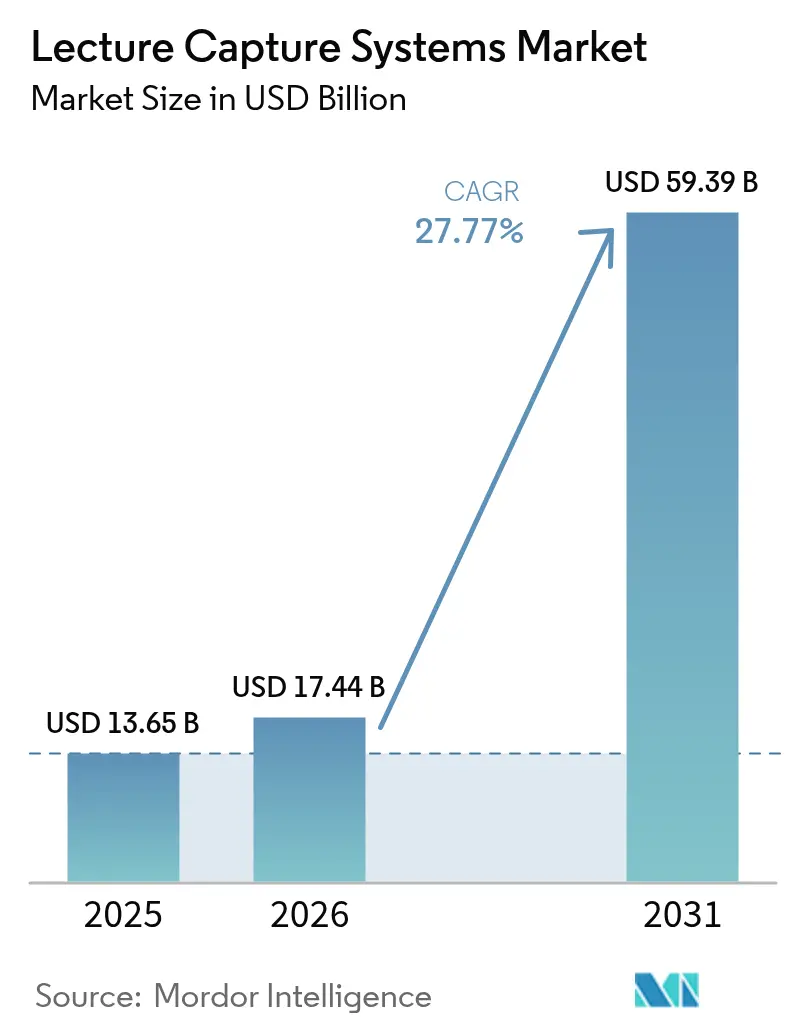
The lecture capture systems market size was valued at USD 13.65 billion in 2025 and estimated to grow from USD 17.44 billion in 2026 to reach USD 59.39 billion by 2031, at a CAGR of 27.77% during the forecast period (2026-2031). Rapid shifts toward hybrid pedagogy, government-funded classroom digitization, and the rise of AI-driven analytics are supporting double-digit expansion. Software-centric deployments are increasingly displacing proprietary hardware as institutions demand cloud-native platforms that incorporate auto-captioning, sentiment analysis, and micro-credential tracking. Compliance mandates under FERPA, GDPR, and similar regulations elevate data-security features from optional extras to purchase prerequisites. Meanwhile, large enterprises intensify spending on asynchronous compliance training, deepening the buyer base beyond traditional higher-education customers.
Key Report Takeaways
- By component, software captured 65.12% of the lecture capture systems market share in 2025. Cloud delivery is forecast to expand at a 28.67% CAGR through 2031.
- By deployment model, on-premise installations held 53.85% of the lecture capture systems market size in 2025, while cloud-based solutions are projected to advance at 28.95% CAGR to 2031.
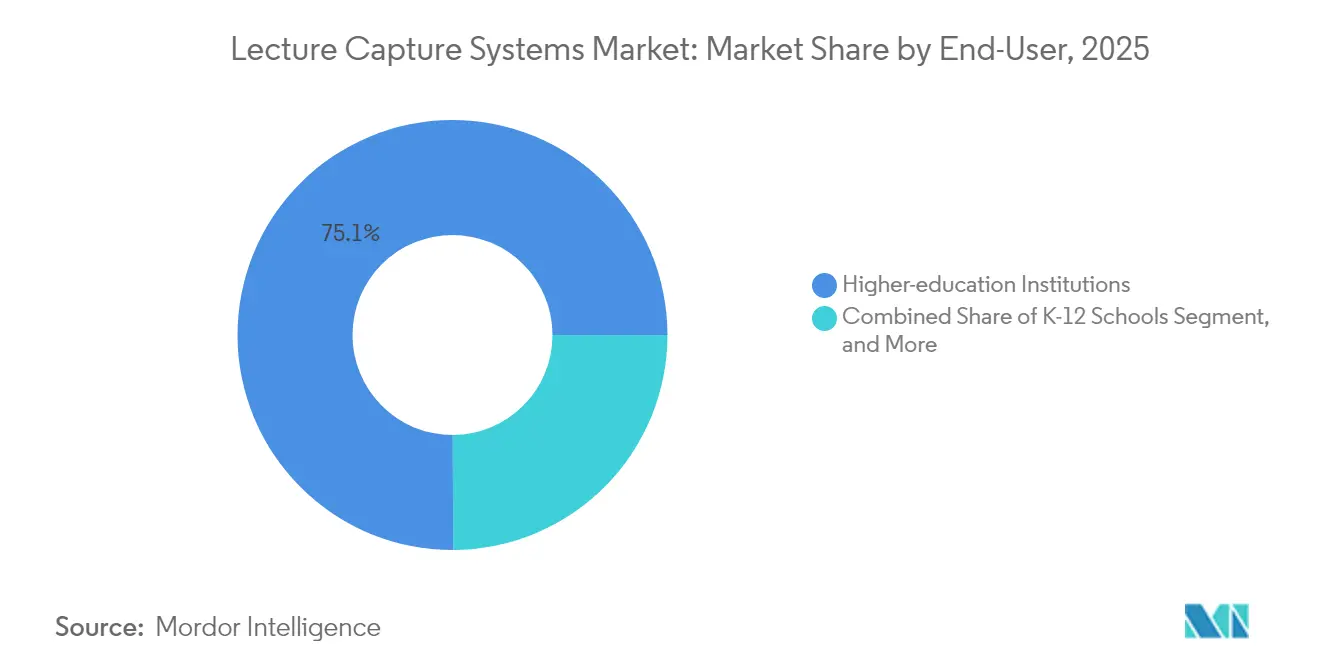
- By end-user, higher-education institutions commanded 75.05% revenue in 2025, and corporate buyers are set to grow at 29.10% CAGR between 2026 and 2031.
- By service type, professional services accounted for 46.20% revenue in 2025, whereas training services will grow fastest at 28.40% CAGR to 2031.
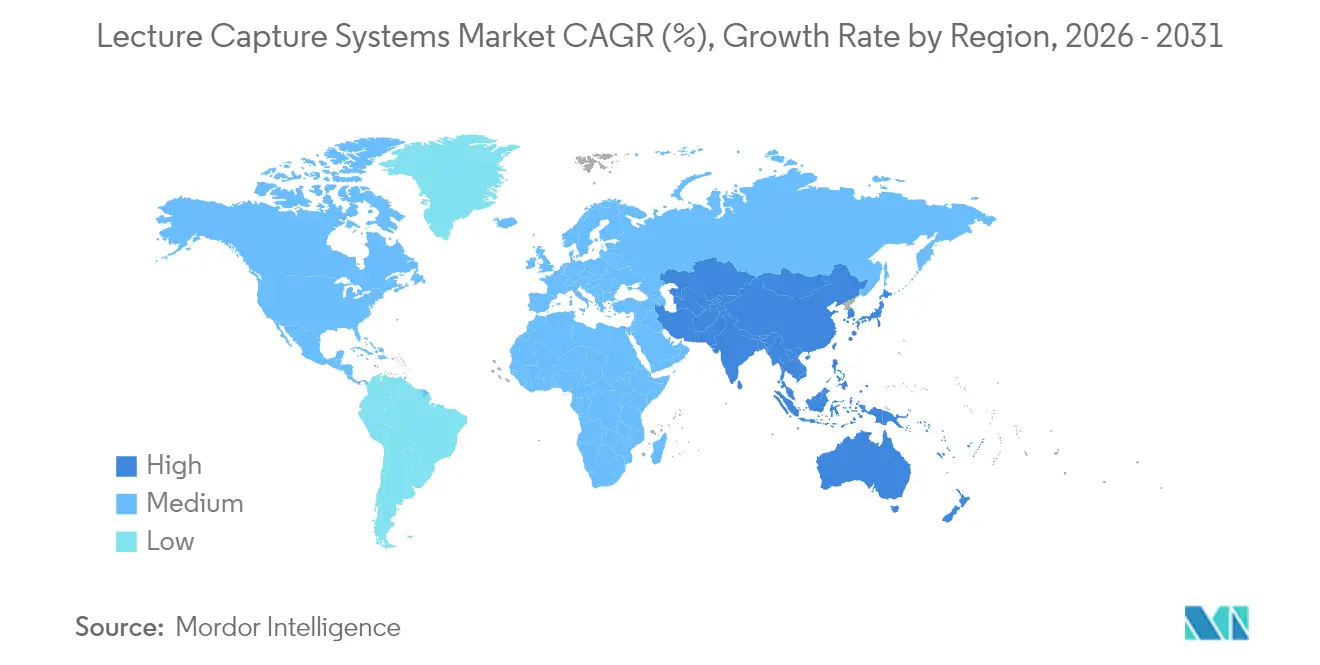
- By geography, North America accounted for 38.10% revenue in 2025, whereas Asia-Pacific will grow fastest at 28.60% CAGR to 2031.
Note: Market size and forecast figures in this report are generated using Mordor Intelligence’s proprietary estimation framework, updated with the latest available data and insights as of 2026.
Global Lecture Capture Systems Market Trends and Insights
Drivers Impact Analysis*
| Driver | (~) % Impact on CAGR Forecast | Geographic Relevance | Impact Timeline |
|---|---|---|---|
| Rising demand for distance and hybrid education | +6.2% | Global, with concentration in North America and Europe | Medium term (2-4 years) |
| Government-led digital-learning initiatives | +5.8% | Global, with early gains in South Korea, Germany, Japan, U.S. | Short term (≤ 2 years) |
| Corporate upskilling and compliance training spend | +7.1% | Global, with Asia-pacific core and spill-over to MEA | Medium term (2-4 years) |
| AI-driven micro-credential analytics adoption | +4.3% | North America and EU, expanding to Asia-pacific | Long term (≥ 4 years) |
| Growth of micro-learning and short-form video | +3.9% | Global, mobile-first markets in Asia-pacific and South America | Medium term (2-4 years) |
| LMS–talent-platform integration unlocking ROI | +4.6% | Global, with enterprise concentration in North America | Short term (≤ 2 |
| Source: Mordor Intelligence | |||
Rising Demand for Distance and Hybrid Education
Most of chief online-learning officers report continued student preference for flexible learning pathways, and 52% of online programs generate net revenue, up from 47% in 2020. Learners now expect studio-quality video, interactive transcripts, and mobile-optimized playback as table stakes. Vendors respond by integrating multilingual auto-captioning based on OpenAI Whisper and sentiment-analysis APIs that flag disengagement.[1]Panopto Inc., “Panopto Acquires Elai to Expand AI-Powered Video Creation Capabilities,” panopto.com Hybrid models therefore drive a distinct revenue stream that demands specialized content-production workflows. Institutions that ignore quality thresholds risk erosion of enrollment to competitors that package instruction asynchronously.
Government-Led Digital-Learning Initiatives
The U.S. Digital Equity Act directs USD 811 million toward connectivity, Germany’s Digital Pact 2.0 allocates EUR 2.5 billion, and South Korea designates USD 276 million for classroom digitization.[2]U.S. Department of Commerce, “Digital Equity Act Funding Allocation,” commerce.gov Japan pilots generative-AI content across 52 schools, indicating a shift from device provisioning to algorithm-based instruction.[3]Ministry of Education, Culture, Sports, Science and Technology, Japan, “Generative AI Pilot Program,” mext.go.jp Subsidies lower adoption risk but introduce region-specific compliance mandates such as FERPA or GDPR, forcing vendors to maintain localized SKUs. Such fragmentation increases development costs but expands the addressable demand.
Corporate Upskilling and Compliance Training Spend
Large enterprises intensify their digital learning investments to mitigate regulatory exposure. Accenture logged 13 million training hours in Q3 FY24 as part of its USD 1 billion workforce-development initiative. Organizations that fail to document certifications risk multi-million-dollar penalties, a reality underscored by recent FTC enforcement actions. Compliance needs, therefore, anchor recurring subscriptions even during budget freezes. Platforms that integrate with Workday or SAP SuccessFactors gain preference because they automate re-certification triggers when recorded modules lapse.
AI-Driven Micro-Credential Analytics Adoption
Most academic and corporate learning teams now deploy or pilot AI tools that transform video transcripts into competency maps. Panopto’s October 2024 acquisition of Elai embeds text-to-video generation, letting instructors refresh content without reshooting footage. Micro-credentials demand verifiable engagement metrics, yet opaque algorithms risk over-valuing screen time. Institutions, therefore, scrutinize vendor transparency around model accuracy and bias mitigation.
Restraints Impact Analysis*
| Restraint | (~) % Impact on CAGR Forecast | Geographic Relevance | Impact Timeline |
|---|---|---|---|
| Data-privacy and compliance hurdles | -3.8% | Global, with acute pressure in EU and California | Short term (≤ 2 years) |
| High up-front hardware and integration costs | -4.2% | Global, with concentration in budget-constrained K-12 and emerging markets | Medium term (2-4 years) |
| Faculty push-back over performance scrutiny | -2.7% | North America and Europe, union-dense institutions | Medium term (2-4 years) |
| Fragmented AV standards and interoperability gaps | -3.1% | Global, with legacy infrastructure in North America | Long term (≥ 4 years) |
| Source: Mordor Intelligence | |||
Data-Privacy and Compliance Hurdles
The FTC levied USD 91.5 million against University of Phoenix in 2024 and USD 5.8 million against Chegg in 2022, demonstrating an appetite for strict enforcement. Most of higher-education institutions suffered breaches in 2024, incurring average costs of USD 3.86 million. The EU AI Act restricts biometric surveillance, compelling vendors to disable facial recognition. These pressures prolong procurement cycles and tilt preference toward suppliers offering indemnification clauses.
High Up-Front Hardware and Integration Costs
Dedicated lecture-capture appliances range from USD 5,000 to USD 50,000 per room, while integration often consumes up to 30% of deployment budgets. Subscription fatigue also looms as institutions allocate a growing share of learning budgets to software, prompting consolidation toward multi-function vendors. Although cloud delivery reduces capex, data-residency requirements force some campuses to retain costly on-premise infrastructure.
*Our forecasts treat driver/restraint impacts as directional, not additive. The impact forecasts reflect baseline growth, mix effects, and variable interactions.
Segment Analysis
By Component: Software Centric Growth Outpaces Hardware
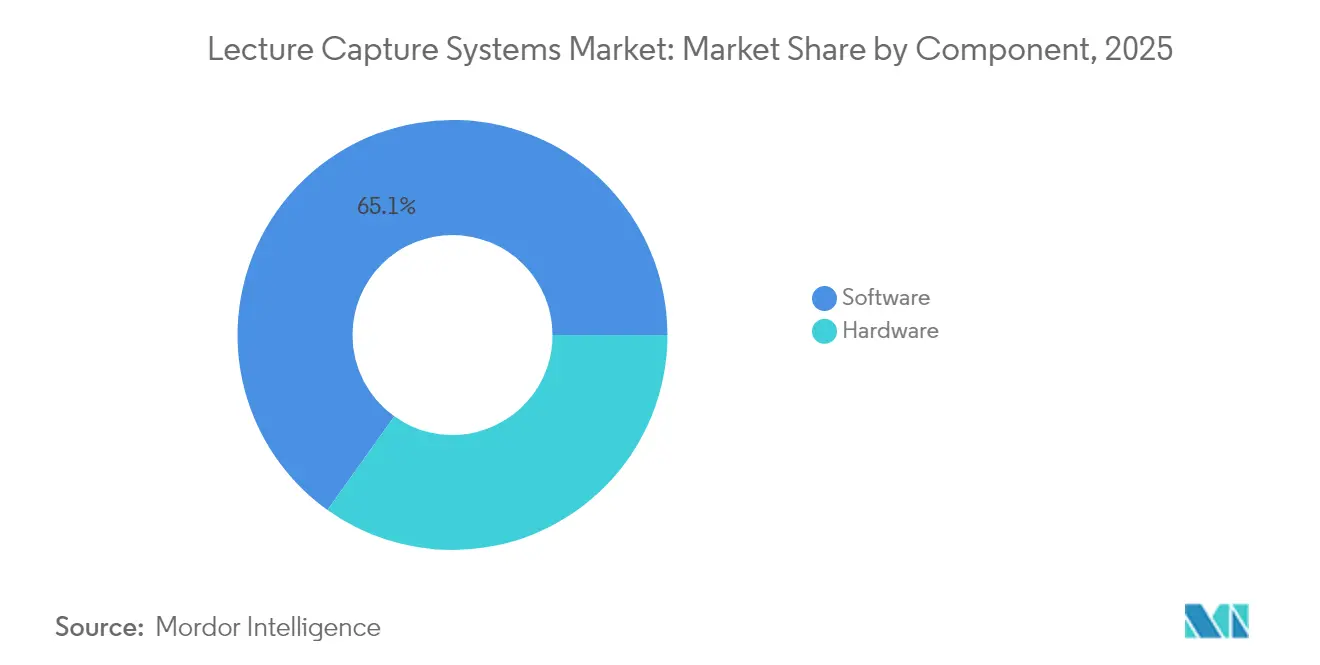
In 2025, software dominated the lecture capture systems market, holding a 65.12% share. Meanwhile, cloud delivery is projected to grow at a robust 28.67% CAGR, continuing through 2031. This trajectory reflects institutions prioritizing cloud-native video management suites that include AI captioning and engagement analytics. Hardware contributed the remaining USD 4.76 billion and faces pressure from commoditization as inexpensive webcams and mobile devices satisfy entry-level capture needs. Software-driven offerings deliver gross margins of 70% to 80%, supporting aggressive reinvestment in R&D, whereas hardware carries thinner margins, constrained by supply-chain volatility. Vendors therefore champion “software-first” roadmaps that offload encoding and storage to the cloud, anchoring recurring revenue streams that underpin higher valuations.
Moderate hardware demand endures in flagship lecture theaters where multi-camera switching, balanced audio, and redundant recording remain essential. Epiphan’s Pearl Nexus rack-mount encoder, certified with Panopto in January 2024, illustrates hardware’s pivot toward high-density enterprise installations. Yet software’s rapid gains confirm that institutions value agility over appliance ownership, reinforcing the software premium within the lecture capture systems market.



By Deployment Model: Cloud Expansion Amid Residency Constraints
On-premise deployments represented 53.85% of 2025 revenue but now grow in single digits. Cloud-hosted platforms are projected to grow at a 28.95% CAGR to 2031, driven by elastic scaling, lower maintenance costs, and tight LMS integrations that reduce IT workload. Institutions with unpredictable enrollment, especially during periods of MOOC or executive education peaks, leverage usage-based pricing to avoid capital overspending. However, the GDPR and China’s Personal Information Protection Law necessitate localized data centers, which delays wholesale migration. Hybrid models that combine on-premise capture with cloud archiving have therefore gained favor, helping campuses comply with residency mandates while leveraging cloud-based AI services for transcription and analytics.
As vendors bolster zero-trust architectures and secure SOC 2 Type II certifications, cloud apprehension gradually eases. Still, latency-sensitive engagements such as live polling preserve an on-premise niche. The balance of cost, compliance, and user experience will dictate deployment choices as the lecture capture systems market matures.
By End-User: Corporate Segment Accelerates
Higher-education institutions retained a commanding share in 2025, however, enterprise adoption is the fastest-growing segment, with a forecast 29.10% CAGR. Corporations replace fragmented webinar archives with centralized video hubs that integrate with human capital suites, thereby automating compliance renewals.
Accenture’s scale, 13 million training hours logged in one quarter, signals the magnitude of enterprise demand. K-12 districts tapped USD 811 million in Digital Equity Act funds to outfit classrooms with entry-level solutions, but constrained operating budgets temper growth. Government agencies remain cautious, insisting on FedRAMP or equivalent security certifications before migrating sensitive content to cloud-hosted repositories.
By Service Type: Training Services Gain Momentum
Professional services led service revenue in 2025 as institutions contracted consultancies for workflow mapping and API integration. Yet training services will register the highest CAGR at 28.40% through 2031 because faculty acceptance is pivotal.
Platforms now bundle instructor workshops and micro-credential badges that encourage pedagogical adoption. YuJa’s multi-semester onboarding for the Montana University System improved utilization in less than six months. Such programs convert hesitant professors into advocates, ensuring that lecture capture investments yield measurable student engagement outcomes.
Geography Analysis
North America accounted for 38.10% revenue in 2025, supported by USD 811 million from the U.S. Digital Equity Act and Canada’s CAD 39.2 million CanCode investment. Continued hybrid learning demand underpins license renewals; however, many institutions now enter refresh rather than expansion cycles. Budget restrictions, 61% of organizations reported flat or declining L&D allocations, curb upsell opportunities. Meanwhile, heightened data-privacy enforcement following the University of Phoenix settlement compels vendors to embed FERPA-aligned controls at the core of product architectures.
The Asia-Pacific region is projected to grow at a 28.60% CAGR, the fastest worldwide. South Korea’s USD 276 million classroom initiative, Japan’s generative-AI pilots, and India’s National Education Policy 2020 collectively drive volume. Localization challenges abound: China demands onshore data hosting under its personal-information statute, while Japan favors licensed domestic cloud zones. Vendors must therefore field region-specific instances and language packs to capture share, increasing operational complexity across the lecture capture systems market.
Europe shows steady momentum on the back of Germany’s EUR 2.5 billion Digital Pact 2.0 and EU Digital Europe funding. Yet stringent GDPR requirements suppress rapid cloud migration. The EU AI Act bans certain biometric functions in classrooms, forcing feature roll-backs that slow deployment. Emerging regions, including South America and the Middle East, gain traction through World Bank–backed digital-education grants, though inconsistent broadband and power reliability sustain preference for download-first workflow.

Regulatory Landscape
Lecture capture procurement and product design are shaped by accessibility, privacy, and copyright rules across major regions. In the United States, the Department of Justice issued a final rule in March 2024 under ADA Title II requiring state and local government entities, including public educational institutions, to make web content and mobile apps accessible to WCAG 2.1 Level AA, raising the bar for captioning, transcripts, and audio-description readiness from a feature choice to a compliance requirement. Alongside this, student-data protections such as FERPA, the EU GDPR, and China’s Personal Information Protection Law affect hosting models, retention controls, and incident-response obligations, which reinforces demand for auditable access controls, encryption, and data-residency options.
Europe adds content-use and AI constraints that influence how recorded materials are created, stored, and reused in teaching. The EU’s Copyright in the Digital Single Market Directive (Directive (EU) 2019/790) includes a mandatory digital teaching exception conditioned on use within a secure digital environment, which pushes platforms to strengthen authentication, rights management, and controlled sharing workflows for lecture recordings. Standards are also tightening around inclusive media delivery: ISO/IEC 20071-20:2025 sets requirements for accessible audiovisual content development (including timing, localization, and accessibility components), giving global institutions and vendors a common reference when aligning lecture capture workflows to accessibility-focused policies.
Value Chain Analysis
The lecture capture systems value chain spans capture hardware, software platforms, cloud infrastructure, and campus and enterprise integration services. Upstream inputs include cameras, microphones, capture appliances, and codec and sensor components, with specialized encoder and optical parts commonly sourced through East Asian semiconductor and imaging supply chains. Midstream players combine on-room capture (encoders, PTZ cameras, DSP and control systems) with video management software that handles scheduling, ingestion, indexing, storage, search, and accessibility tooling. These capabilities are increasingly delivered as cloud services, but deployments still skew toward hybrid architectures to meet residency and security requirements.
Downstream value creation centers on interoperability and deployment execution. Large higher-education systems and enterprises are typically served through direct sales and solution engineering, while mid-tier institutions rely on AV integrators and value-added resellers for room builds, control-system programming, and LMS/SIS connectivity. Platform vendors increasingly partner with hardware suppliers to de-risk deployments and extend the installed base, as reflected in Echo360’s partnership with Epiphan Video to integrate EchoVideo with Pearl capture appliances, and in Panopto and Epiphan’s co-development of the Panopto-certified EC20 PTZ camera. Professional and training services also stay important for adoption, since lecture capture deployments often require workflow mapping, identity and LMS integration, and faculty enablement to turn room-level installations into repeatable content operations.
Competitive Landscape
The lecture capture systems market remains moderately fragmented, with the top five vendors collectively holding most of share. Panopto, YuJa, Echo360, and Enghouse’s Mediasite assets lead among software specialists, while Zoom, Microsoft Teams, and Cisco Webex offer embedded recording features that undercut standalone pricing. Panopto enhanced its AI capabilities through the October 2024 acquisition of Elai and secured certifications for NewTek CaptureCast and Q-SYS hardware to facilitate seamless multi-camera deployments. Enghouse’s February 2024 purchase of Mediasite removed a distressed rival, but integration delays postponed feature roadmap updates. Kaltura’s valuation slide from USD 10 to USD 1.78, illustrating revenue growth challenges when content storage costs rise faster than subscription expansion.
LMS interoperability and data-governance assurances now trump video fidelity as differentiators. Vendors rush to deliver plug-and-play connectors for Canvas, Google Classroom, and Schoology, while publishing API libraries for Workday and Oracle. YuJa’s AccessNotes.AI auto-generated study guides, boosting time-on-task metrics, and Epiphan’s AV1 codec support for bandwidth-constrained deployments address niche pain points. Unmet opportunities persist in micro-learning personalization and offline mobile synchronization, especially in emerging markets.
Lecture Capture Systems Industry Leaders
Panopto Inc.
YuJa Corporation
TechSmith Corporation
Echo360 Inc.
Cisco Systems Inc.
- *Disclaimer: Major Players sorted in no particular order


Market Opportunities and Future Outlook
Accessibility governance is a key whitespace area, moving beyond basic captioning toward institution-wide monitoring and remediation workflows. The U.S. DOJ ADA Title II web and mobile accessibility rule (March 2024) and ISO/IEC 20071-20:2025 on accessible audiovisual content raise demand for platforms that surface compliance gaps at scale and streamline fixes across large video libraries. Product updates in 2026 indicate vendors are building this oversight into their offerings, including Enghouse Videos’ April 2026 Mediasite 8.51 release with an Accessibility Dashboard to identify content gaps that affect WCAG-aligned policies, and Echo360’s April 2026 deployment updates that include integrations supporting audio description services.
Standardized, certified room hardware tied closely to software ecosystems is another opportunity area, particularly where institutions enforce AV design standards and seek plug-and-play interoperability across lecture halls, active-learning rooms, and corporate training spaces. University AV standards commonly call out control and content-protection requirements (such as VISCA control and HDCP compliance) alongside reliable 1080p or higher capture, which pushes vendors toward certified device catalogs and predictable commissioning. The May 2026 launch of Panopto and Epiphan Video’s EC20, positioned as a Panopto remote recorder with AI auto-tracking and 4K capture, shows how the market is packaging hardware plus platform integration to reduce installation friction and lift utilization. As corporate compliance training and public-sector procurement expand buyer segments, distribution partnerships that simplify contracting also create room for lecture capture vendors to bundle secure video management, accessibility tooling, and room capture into a single supportable architecture.
Recent Industry Developments
- May 2026: Panopto and Epiphan Video launched the EC20, a Panopto-certified 4K PTZ camera positioned as a remote recorder with AI-powered auto-tracking modes for automated lecture capture. The release tightens the hardware-software coupling needed for standardized room builds and reduces integration risk for institutions migrating from bespoke AV stacks to certified device ecosystems.
- March 2026: Echo360 partnered with Epiphan Video to integrate the EchoVideo platform with Epiphan Pearl capture appliances. The move expands interoperability options for campuses and enterprises that want to preserve existing room hardware while consolidating recordings into a single video learning platform.
- October 2024: Panopto acquired Elai to expand AI-powered video creation capabilities within its video platform. The acquisition broadened Panoptos roadmap beyond capture and management into faster content refresh workflows, supporting micro-learning and analytics-driven training use cases without requiring full reshoots.


Research Methodology Framework and Report Scope
Market Definition and Coverage
For this study, the lecture capture systems market covers solutions used to record live instruction or training sessions, and then store, manage, and deliver the content for later viewing, including the related platforms and services sold for these workflows.
Scope exclusions: We exclude general video conferencing tools and generic video hosting when they are not purchased or configured for lecture capture use cases.
Segmentation Overview
- By Component
- Hardware
- Software
- By Deployment Model
- On-premise
- Cloud
- By End-User
- Higher-education Institutions
- K-12 Schools
- Corporates and Enterprises
- Government and Public Agencies
- By Service Type
- Professional Services
- Integration and Maintenance
- Training Services
- By Geography
- North America
- United States
- Canada
- South America
- Brazil
- Mexico
- Argentina
- Rest of South America
- Europe
- Germany
- United Kingdom
- France
- Italy
- Rest of Europe
- Asia-Pacific
- China
- Japan
- India
- South Korea
- Rest of Asia-Pacific
- Middle East and Africa
- Middle East
- United Arab Emirates
- Saudi Arabia
- Rest of Middle East
- Africa
- South Africa
- Nigeria
- Rest of Africa
- Middle East
- North America
Data Sources, Market Sizing, and Validation
Desk Research
Desk work starts with building a basic fact base on education and training digitization, device penetration, and campus IT spending. We mainly used public sources such as the US Department of Education, the National Center for Education Statistics, UNESCO, OECD education indicators, and standards and guidance published by bodies such as NIST for security baselines that often shape procurement.
To translate those signals into market inputs, we also reviewed company filings, investor presentations, product documentation, press coverage from reputed outlets, and public procurement portals where available. In some cases, we referenced paid subscriptions for company financials and intelligence, patent lookups, and global tenders to understand buying cycles and feature direction. The desk sources listed here are illustrative only, and many other sources were checked for data collection, cross-checking, and clarification.
Primary Interviews and Surveys
Primary work was used to pressure-test pricing ranges, deployment mix, and what is actually included in a typical lecture capture deal (hardware kits, software licenses, and support). We spoke with stakeholders across higher education, K-12, and enterprise training, and we also included system integrators and channel partners to validate regional adoption patterns across APAC, EMEA, and the Americas.
Distribution of primary research fieldwork respondents
| Company type | Respondent position | Region |
|---|---|---|
| Top tier: 26% | CXOs: 12% | APAC: 46% |
| Mid tier: 56% | Functional/Unit leaders: 34% | EMEA: 36% |
| Smaller Players: 18% | Managers: 54% | Americas: 18% |
Market-Sizing & Forecasting
Sizing was built using a mix of top-down and bottom-up checks so the final total stays realistic. From the top-down side, education and training digitization signals were converted into an addressable install and upgrade pool by tracking how many rooms and programs are likely to adopt recording, and then applying adoption and replacement cycles by institution type. The totals were then corroborated with selective bottom-up approximations, using sampled average selling price ranges by deployment, typical bundle contents, and channel feedback on annual volumes to adjust any over or under sizing.
A few inputs that mattered in this market include the mix of on-premise versus cloud deployments, average number of capture-enabled rooms per campus or site, subscription versus perpetual license patterns, refresh cycles for capture hardware, service attach rates for integration and maintenance, and the share of usage that shifts toward automated captioning and analytics. For forecasting, we used scenario analysis supported by expert views because adoption can move quickly based on hybrid learning policies, security requirements, and budget timing. Where bottom-up checks had gaps, we filled them using conservative ranges and then rechecked the output against procurement signals and the observed deployment mix shared by interviewees.
Data Validation & Update Cycle
Validation is done through multiple passes of checks so outliers do not quietly drive the result. We compare the model output with independent signals such as education IT spending direction, cloud adoption benchmarks, and the pace of classroom technology upgrades, and then we review any large variances by region and end user before sign-off.
Reports are refreshed annually, and interim updates are made when material events change demand or pricing expectations. Before delivery, a final analyst review is completed so the market numbers and assumptions reflect the latest available information.
Mordor Intelligence's Lecture Capture Systems Market Size Versus Other Published Estimates
Published market sizes for lecture capture systems can vary a lot, even when the same label is used. The differences usually come from what is counted as a lecture capture system versus a broader video or learning tool stack, and from how pricing and multi-year contracts are treated.
The table shows a higher 2026 value than some 2024 to 2025 figures, and in Mordor Intelligence's model the total includes software, hardware, and related services across higher education, K-12, corporate, and public agencies, while excluding generic video platforms that are not bought for lecture capture workflows.
Benchmark comparison
| Source | Market Size | Gaps in Research Methodology |
|---|---|---|
| Mordor Intelligence | USD 17.44 B (2026) | |
| Global Advisory A | USD 11.30 B (2024) | Uses an earlier base year and a narrower end-user lens that groups demand mainly under education and corporate buyers, which can undercount public agency adoption and later contract expansions. |
| Industry Publisher B | USD 11.16 B (2025) | Leans more on capture-device and core software coverage, with less explicit treatment of service revenue and longer-term cloud subscription ramp, which can shift totals downward in the near term. |
Taken together, the spread mainly reflects timing and what revenue streams are included in the counted deal value. By keeping the scope tied to lecture capture specific workflows and then checking the totals against deployment mix, price ranges, and service attach patterns, we can present a market view that is easy to trace and repeat when assumptions change.


Key Questions Answered in the Report
How fast is the lecture capture systems market expected to grow through 2031?
The market is projected to expand at a 27.77% CAGR, rising from USD 13.65 billion in 2025 to USD 59.39 billion by 2031.
Which component represents the largest revenue share today?
Software platforms account for 65.12% of 2025 revenue, confirming the shift from hardware to cloud-native solutions.
Why are enterprises adopting lecture-capture platforms?
Corporations need verifiable records of compliance training and favor systems that integrate with HR suites to automate re-certification schedules.
What is the biggest geographic growth opportunity?
Asia-Pacific is forecast to post a 28.60% CAGR through 2031, driven by government digitization programs in South Korea, Japan, and India.
Which regulatory frameworks most affect product design?
FERPA in the U.S., GDPR in Europe, and China’s Personal Information Protection Law shape data-hosting, privacy, and AI-feature roadmaps.
Page last updated on:





