
South America Electric Utility Protective Relay Market Size and Share
Market Overview
| Study Period | 2020 - 2031 |
|---|---|
| Forecast Data Period | 2026 - 2031 |
| Historical Data Period | 2020 - 2024 |
| Market Size (2026) | USD 117.89 Million |
| Market Size (2031) | USD 146.63 Million |
| Growth Rate (2026 - 2031) | 4.46 % |
| Market Concentration | Medium |
Major Players *Disclaimer: Major Players sorted in no particular order Image © Mordor Intelligence. Reuse requires attribution under CC BY 4.0. | |
South America Electric Utility Protective Relay Market Analysis by Mordor Intelligence
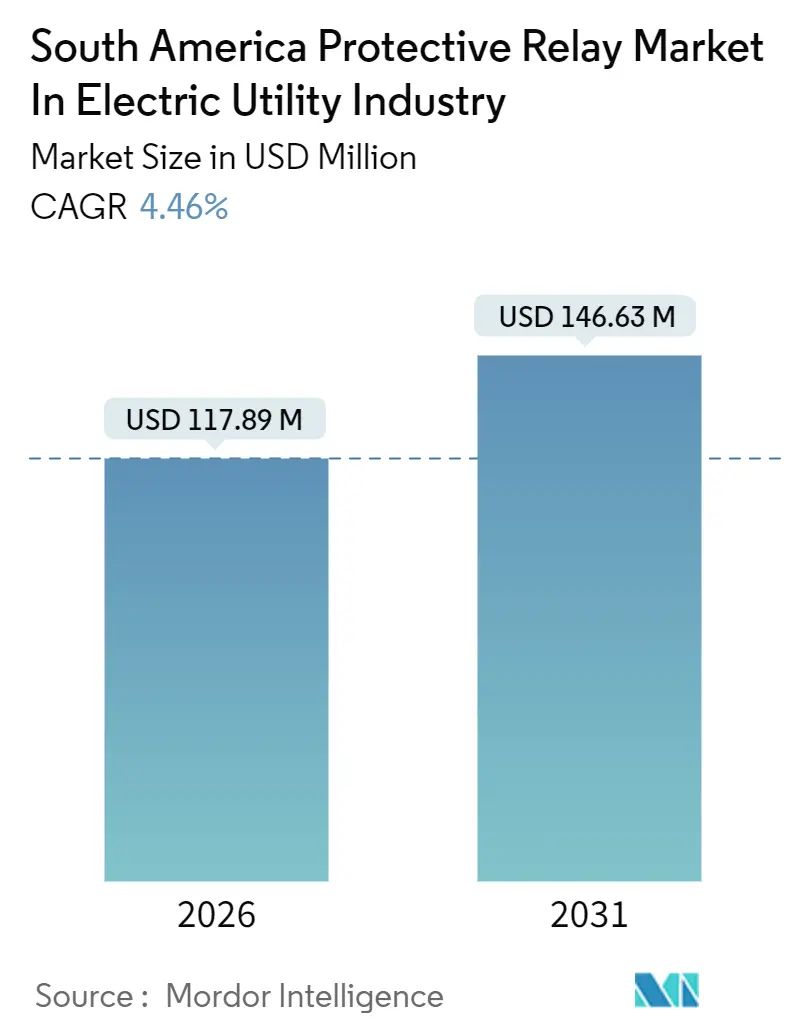
The South America Electric Utility Protective Relay Market is valued at USD 117.89 million in 2026 and is projected to reach USD 146.63 million by 2031, reflecting a 4.46% CAGR. Investment momentum is shaped by the push for digital substations, the roll-out of IEC 61850 process-bus architectures, and the need to integrate more than 190 GW of new renewable capacity across Latin America by 2030.[1] Transmission auctions worth USD 3.65 billion in Brazil during 2024 mandated IEC 61850 compliance, accelerating the phase-out of electromechanical devices. Cross-border HVDC links such as the 2,200 MW Garabi project require sub-cycle fault detection across asynchronous grids, lifting demand for high-speed numerical relays. Regional utilities also face pressure to cut technical losses, which averaged 14.3% in 2024, prompting upgrades at the distribution level.
Key Report Takeaways
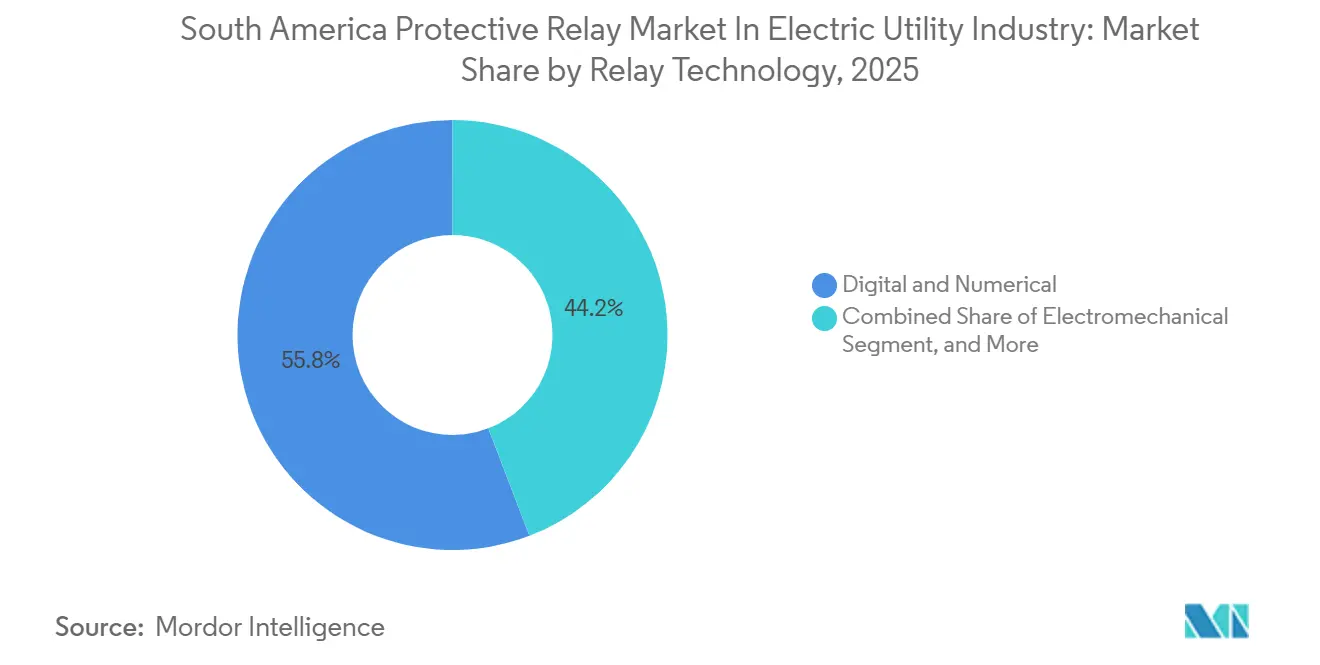
- By relay technology, digital and numerical platforms held 55.83% spending of the South America Electric Utility Protective Relay Market in 2025, static and electromechanical devices will lag behind as the digital segment expands at a 5.67% CAGR through 2031.
- By voltage range, high-voltage applications captured 45.83% of the market size in 2025, while medium-voltage feeders are forecast to grow at a 5.34% CAGR to 2031.
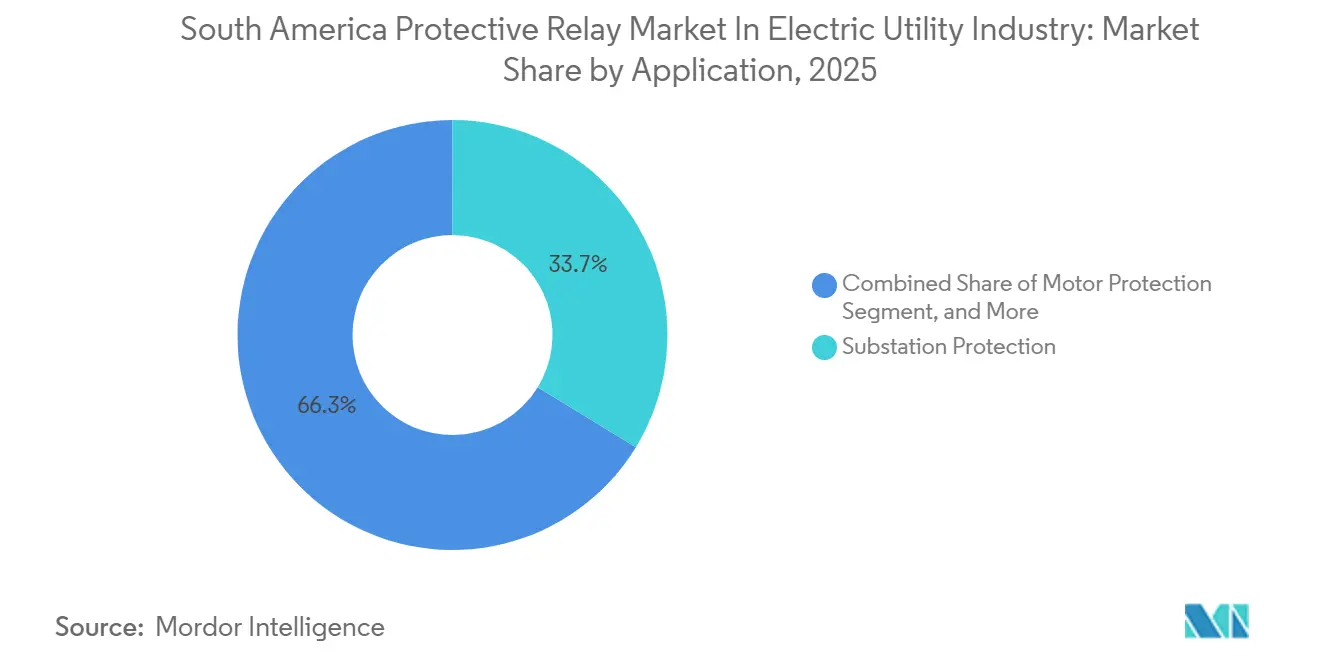
- By application, substation protection led with a 33.74% spending of the South America Electric Utility Protective Relay Market; distribution feeder protection is projected to climb at a 5.22% CAGR through 2031.
- By end user, transmission utilities commanded 42.95% of the 2025 spending of the South America Electric Utility Protective Relay Market, whereas distribution utilities are expected to post the fastest 5.32% CAGR to 2031.
- By country, Brazil dominated with 58.73% share of the market in 2025; Colombia is set to grow at a leading 5.77% CAGR through 2031.
Note: Market size and forecast figures in this report are generated using Mordor Intelligence’s proprietary estimation framework, updated with the latest available data and insights as of January 2026.
South America Electric Utility Protective Relay Market Trends and Insights
Drivers Impact Analysis*
| Driver | (~) % Impact on CAGR Forecast | Geographic Relevance | Impact Timeline |
|---|---|---|---|
| Surge in grid-connected renewable capacity additions | +1.2% | Brazil, Chile, Colombia, with spillover to Argentina | Medium term (2-4 years) |
| Accelerating adoption of IEC-61850 and digital substations | +0.9% | Brazil (São Paulo, Rio de Janeiro), Colombia (Bogotá, Medellín), Chile (Santiago) | Short term (≤ 2 years) |
| Government-funded T&D reliability programmes (e.g., Brazil's Procel) | +0.7% | Brazil nationwide, with pilot extensions to Paraguay, Uruguay | Long term (≥ 4 years) |
| Large-scale HVDC interconnection projects across Mercosur | +0.6% | Argentina-Brazil border, Chile-Argentina Andes corridor | Medium term (2-4 years) |
| AI-enabled predictive-maintenance relays lowering OPEX | +0.4% | Brazil (major utilities), Colombia (ISA), Chile (Transelec) | Long term (≥ 4 years) |
| Growing demand for cyber-secure relay retrofits after 2026 attacks | +0.2% | Regional, with priority in Brazil, Chile, Colombia | Short term (≤ 2 years) |
| Source: Mordor Intelligence | |||
Surge in Grid-Connected Renewable Capacity Additions
Utilities added 12.4 GW of wind and solar in 2024, and cumulative installations are expected to reach 95 GW by 2030.[2] Variable generation causes more frequent voltage excursions, forcing operators to adopt adaptive protection schemes that static relays cannot perform. Brazil logged 1,847 renewable curtailments in 2024 due to insufficient dynamic support, highlighting the need for relays with embedded voltage-regulation logic. Chile now requires synthetic inertia for solar farms above 20 MW, driving demand for fast-frequency response algorithms in new relay procurements. Modular intelligent electronic devices allow utilities to reconfigure firmware as the resource mix evolves, cutting future hardware swaps. Vendors able to support rapid firmware upgrades are therefore favored in upcoming tenders in the South America Electric Utility Protective Relay Market.
Accelerating Adoption of IEC 61850 and Digital Substations
Brazil’s ISA CTEEP retrofitted 14 substations with IEC 61850 in 2024 and reported a 38% reduction in fault-clearance times after migrating to process-bus architectures. Colombia has mandated compliance for all 220 kV substations by December 2026, prompting an estimated 1,200 relay panel replacements. Removal of copper wiring can lower construction cost by up to 20% but poses new cybersecurity challenges that must be addressed through IEC 62351 encryption.[3] Digital substations also enable traveling-wave fault locators, which cut outage duration and improve the reliability metrics regulators use for tariff incentives. Utilities now rank digital-substation capability as a top technical specification in tender documents.
Government-Funded T&D Reliability Programs
The Procel Reluz program allocated BRL 420 million (USD 84 million) for distribution feeder upgrades in 2024, with 30% of funds earmarked for numerical relays. Colombia adopted a performance-based regulation that fines distributors if the annual interruption index exceeds 18 hours, pushing recloser-controller installations. Argentina is using a USD 150 million World Bank loan to modernize 87 rural substations with IEC 61850 devices. These public-sector initiatives guarantee revenue visibility for relay suppliers while shortening payback periods for utilities by linking reliability to tariff recovery in the South America Electric Utility Protective Relay Market.
Large-Scale HVDC Interconnection Projects Across Mercosur
The 2,200 MW Garabi line, scheduled for completion in 2029, requires relays that can detect DC faults within 3 ms to prevent system collapse. A 5 GW HVDC link connecting Brazil’s northeast wind corridor to its southeast load centers broke ground in 2024 and specifies converter-station relays with advanced valve-fault discrimination. ABB, Siemens Energy, and NR Electric dominate HVDC protection due to established references in China’s ultra-high-voltage projects. As Mercosur seeks a unified electricity market by 2030, synchronized protection across asynchronous grids is becoming non-negotiable for concession awards.
Restraints Impact Analysis*
| Restraint | (~) % Impact on CAGR Forecast | Geographic Relevance | Impact Timeline |
|---|---|---|---|
| High upfront cost of microprocessor relays vs. electromechanical | -0.6% | Regional, with acute impact in Argentina, smaller Central American markets (Costa Rica, Panama, Dominican Republic) | Short term (≤ 2 years) |
| Shortage of skilled relay-testing technicians | -0.4% | Brazil (interior states), Colombia (rural zones), Argentina, Central America | Medium term (2-4 years) |
| Single-source dependence on European ASIC fabs for IEDs | -0.3% | Regional, affecting all markets dependent on imported intelligent electronic devices | Medium term (2-4 years) |
| Fragmented utility procurement delaying IEC-61850 roll-outs | -0.3% | Regional, with concentration in Brazil (47 transmission concessionaires), Argentina (provincial utilities), Colombia | Long term (≥ 4 years) |
| Source: Mordor Intelligence | |||
High Upfront Cost of Microprocessor Relays Versus Electromechanical
Digital relays cost USD 2,500 to USD 8,000 each, while electromechanical units range from USD 600 to USD 1,200, challenging utilities that operate under rate-of-return caps. Inflation above 200% in Argentina during 2024 forced several provincial distributors to postpone upgrades, choosing to refurbish legacy panels. Smaller Central American utilities saw landed costs rise 15% to 25% after currency depreciation. Although total ownership favors digital relays over 15 years, short planning cycles and uncertain tariff recovery hinder procurement.
Shortage of Skilled Relay-Testing Technicians
Brazil’s industrial training agency reported a 34% vacancy rate for IEC 61850 specialists in 2024. Colombia has only three institutes offering certification, which can slow down substation commissioning by up to eight months in rural zones. Utilities often pay for vendor fly-in crews, which raises project costs and delays energization. Vendors are piloting self-commissioning relays; however, these remain in an early-stage and unproven state at scale in the South America Electric Utility Protective Relay Market.
*Our forecasts treat driver/restraint impacts as directional, not additive. The impact forecasts reflect baseline growth, mix effects, and variable interactions.
Segment Analysis
By Relay Technology: Digital Platforms Dominate Amid Legacy Transitions
In 2025, digital and numerical platforms commanded a dominant 55.83% share of South America Electric Utility Protective Relay Market. As the digital segment is projected to grow at a 5.67% CAGR through 2031, static and electromechanical devices are set to trail behind. Static and electromechanical devices persist in rural networks, where capital budgets remain tight, as production lines close. ABB has confirmed its exit from static relay manufacturing by 2027.
The adoption curve favors digital relays that integrate synchrophasor units and cybersecurity modules. Products like the SEL-400 provide fault stamps within sub-millisecond windows, aiding post-event analysis. Their modular architecture supports 20-year life cycles, twice the span of many static units. Training complexity and vendor dependence remain pain points, yet the clear operational gains keep utilities on the migration path.

By Voltage Range: Medium-Voltage Feeders Accelerate Amid Distributed Generation
High-voltage applications above 35 kV captured 45.83% of 2025 revenue as transmission expansions intensified. Medium-voltage feeders, however, are expected to record the fastest 5.34% CAGR due to the integration pressures of rooftop solar and community wind. Brazil’s ANEEL now requires adaptive protection on new medium-voltage circuits, a specification that only microprocessor relays can meet.
ISA in Colombia added 1,200 km of 34.5 kV lines in 2024 and installed automated relays to cut truck rolls. Chile’s utilities have identified 68% of customer outages as being caused by medium-voltage faults, prompting retrofits with sectionalizing capabilities. Declining microcontroller costs allowed Eaton to trim relay prices by 9% in 2024, improving ROI for distributors.
By Application: Distribution Feeders Gain as Grid Edge Demands Intelligence
Substation protection held a 33.74% share of the South America Electric Utility Protective Relay Market in 2025, thanks to transformer differential upgrades. Distribution feeder protection is expected to grow at a 5.22% CAGR as regulators tighten interruption indices. Transmission-line and generator protection segments remain stable, tied respectively to backbone upgrades and renewable build-outs.
Energisa installed 4,200 intelligent reclosers in Minas Gerais in 2024, cutting outage duration by 31%. Buenos Aires distributor Edenor piloted self-healing schemes that reroute power within two seconds. Colombia now mandates ground-fault relays at public fast-charging stations, opening new non-utility demand pockets.
By End-User: Distribution Utilities Invest to Meet Regulatory Mandates
Transmission operators spent 42.95% of total 2025 outlays, driven by Brazil’s USD 3.65 billion auction and Chile’s USD 1.2 billion grid plan. Distribution utilities will, however, register the top 5.32% CAGR as performance-based regulation rewards reliability investments. Generation companies, particularly independent producers, standardize on single vendor platforms to simplify maintenance.
Casa dos Ventos negotiated a 12% discount on bulk Relion purchases across 47 wind farms. Celsia reported 19% fewer relay-related outages after adopting a single vendor strategy. Municipal water boards, which run 8,200 MW of pumping load, remain an untapped niche for motor protection solutions.
Geography Analysis
Brazil held 58.73% of 2025 revenue thanks to its 180 GW generation base and 165,000 km of transmission lines that demand ongoing modernization in the South America Electric Utility Protective Relay Market. Privatization of Eletrobras unleashed large automation budgets, and Procel earmarked BRL 420 million for loss reduction. São Paulo and Rio de Janeiro are frontrunners, yet interior states lack qualified staff, extending commissioning schedules.
Colombia grows at a 5.77% CAGR to 2031 as it expands renewable capacity and enforces performance-based tariffs. ISA is installing 34.5 kV lines equipped with numerical relays, while the Bogotá and Medellín hubs are leading training initiatives despite rural labor shortages. Utilities rely on vendor crews for field tests, raising expenses.
Chile battles renewable curtailment, driving adoption of synchrophasor-based relays for better visibility. Argentina’s relay market is subdued by macroeconomic instability, but critical projects continue with the support of the World Bank. Costa Rica completed nine substation retrofits, Panama floated USD 85 million in relay tenders, and the Dominican Republic targets feeder automation to curb 30% commercial losses.
Competitive Landscape
The South America Electric Utility Protective Relay Market shows moderate consolidation; five European and North American OEMs control about 65% of revenue through turnkey packages that combine relays, SCADA, and switchgear. Fragmented regulation across nine countries and 47 transmission owners still lets niche vendors sell retrofit kits that fit mixed-vintage panels.
Chinese firms led by NR Electric gained share in 2024 by pricing 25% below Western bids while meeting IEC 61850 specs. High-end users choose Schweitzer and Basler for extended temperature ratings and cybersecurity features. Hitachi Energy’s IEC 62443-certified Relion line won contracts with Brazil’s grid operator under tougher cyber guidelines.
Competitive differentiation is shifting toward software platforms that aggregate fault data across fleets. Incumbents leverage installed IT ecosystems, whereas startups partner with relay makers to embed analytics inside firmware. Local after-sales service in Spanish and Portuguese remains a decisive factor for winning bids.
South America Electric Utility Protective Relay Industry Leaders
-
Schweitzer Engineering Laboratories, Inc.
-
General Electric Company
-
Eaton Corporation PLC
-
Schneider Electric SE
-
ABB Ltd.
- *Disclaimer: Major Players sorted in no particular order

Recent Industry Developments
- November 2025: Schneider Electric inaugurated a digital-relay R&D and training campus in São Paulo, investing USD 18 million to localize EcoStruxure firmware and certify 200 technicians per year in IEC 61850 commissioning.
- September 2025: NR Electric won a USD 55 million tender from Colombia’s ISA to provide converter-station protection relays for the 2 GW Colectora HVDC project linking Caribbean renewables to the national grid.
- June 2025: Hitachi Energy signed a five-year framework agreement with Brazil’s Eletrobras to deploy AI-enabled predictive-maintenance relays across 25 newly privatized substations, targeting a 15% reduction in unplanned outages.
- April 2025: Siemens Energy received a USD 120 million order from Chile’s Transelec to supply IEC 61850-compliant numerical relays and process-bus automation systems for the 500 kV Atacama transmission expansion, with commissioning slated for 2028.
South America Electric Utility Protective Relay Market Report Scope
The South America Electric Utility Protective Relay Market report is segmented by Relay Technology (Electromechanical, Static/Solid-State, Digital and Numerical), Voltage Range (Low-Voltage, Medium-Voltage, High-Voltage), Application (Generator Utilities, Substation Utilities, Transmission Line Utilities, Distribution Feeder Utilities, Motor Protection), End-User (Generation Utilities, Transmission Utilities, Distribution Utilities, Independent Power Producers), and Country (Brazil, Argentina, Chile, Colombia, Costa Rica, Mexico, Panama, Rest of South America). The Market Forecasts are Provided in Terms of Value (USD).
| Electromechanical |
| Static / Solid-State |
| Digital and Numerical |
| Low-Voltage (Below 1 kV) |
| Medium-Voltage (1-35 kV) |
| High-Voltage (Above 35 kV) |
| Generator Protection |
| Substation Protection |
| Transmission Line Protection |
| Distribution Feeder Protection |
| Motor Protection |
| Generation Utilities |
| Transmission Utilities |
| Distribution Utilities |
| Independent Power Producers |
| Brazil |
| Argentina |
| Chile |
| Colombia |
| Peru |
| Rest of South America |
| By Relay Technology | Electromechanical |
| Static / Solid-State | |
| Digital and Numerical | |
| By Voltage Range | Low-Voltage (Below 1 kV) |
| Medium-Voltage (1-35 kV) | |
| High-Voltage (Above 35 kV) | |
| By Application | Generator Protection |
| Substation Protection | |
| Transmission Line Protection | |
| Distribution Feeder Protection | |
| Motor Protection | |
| By End-User | Generation Utilities |
| Transmission Utilities | |
| Distribution Utilities | |
| Independent Power Producers | |
| By Country | Brazil |
| Argentina | |
| Chile | |
| Colombia | |
| Peru | |
| Rest of South America |
Key Questions Answered in the Report
How large is the South America Electric Utility Protective Relay Market in 2026?
The market is valued at USD 117.89 million in 2026 and is forecast to reach USD 146.63 million by 2031.
Which country now leads spending on protection relays?
Brazil leads with 58.73% share of 2025 revenue, driven by large-scale transmission investments and reliability programs.
What segment is growing fastest within protection relays?
Distribution feeder protection is set to grow at a 5.22% CAGR thanks to performance-based regulation and grid-edge modernization.
Why are utilities shifting to digital and numerical relays?
Digital devices support IEC 61850 communication, faster fault clearing, built-in cybersecurity, and predictive maintenance that lowers lifetime costs.
How does renewable expansion affect relay demand?
More variable generation stresses grid stability, prompting operators to deploy adaptive relays with voltage- and frequency-regulation algorithms.
What is the main restraint on relay adoption?
High upfront costs of microprocessor relays versus electromechanical units remain a hurdle for cash-constrained utilities, especially in Argentina and smaller Central American markets.